Very Large Angle Pendulum (Short answer)
A simple pendulum of length in a uniform gravitational field is initially in stable equilibrium. It is given an impulse suddenly so that it has an angular velocity , where . We find that the pendulum makes full turns with angular frequency , where is slightly less than . Find to accuracy. Note that a simple pendulum is essentially just a point mass on a string of length .
Risposta:
Soluzione:
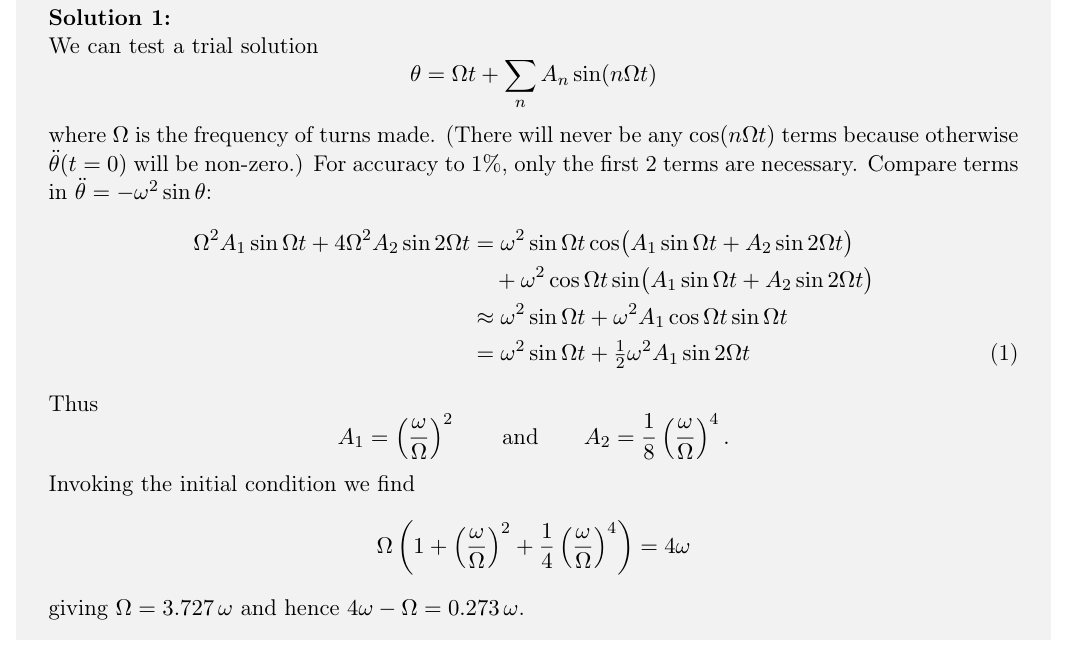
Official solution (OPhO 2026, Physoly), reproduced from the official PDF — p. 5.
Topic: Oscillations & Waves Metodi: Approximation & Series Expansion, Energy Conservation Method Competenze: Mathematical Modeling Objects: Pendulum Fonte: Testo (PDF) — p.5 · Soluzione ufficiale (PDF) — p.5
Pendolo ad angoli molto grandi (Risposta breve)
Un pendolo semplice di lunghezza in un campo gravitazionale uniforme si trova inizialmente in equilibrio stabile. Gli viene impresso un impulso improvviso, così che acquista una velocità angolare , dove . Si osserva che il pendolo compie giri completi con frequenza angolare , con di poco inferiore a . Trova con l’accuratezza dell’. Un pendolo semplice è sostanzialmente una massa puntiforme appesa a un filo di lunghezza .
Risposta:
Soluzione: La soluzione ufficiale completa (in inglese) è nella versione originale di questo quesito e nel PDF ufficiale.
Topic: Oscillations & Waves Metodi: Approximation & Series Expansion, Energy Conservation Method Competenze: Mathematical Modeling Objects: Pendulum Fonte: Testo (PDF) — p.5 · Soluzione ufficiale (PDF) — p.5
Teo I (Short answer)
Upon the discovery of the exoplanet Teo I by the esteemed astronomer and astrophysicist Kai Wen, news sources around the world (that is to say, Earth) began buzzing with excitement due to the remarkable similarities Teo I shared with planet Earth: identical surface gravity, atmospheric composition, average temperature and size, but also cultural similarities — chess, boxing, chessboxing, large amounts of gambling and, of course, physics olympiads. Kai Wen decided to immediately challenge the inhabitants of Teo I to a high-stakes no-limit Hold’em (poker) match, wagering his entire life savings (approximately five Singaporean dollars). Unfortunately, soon after the events of this problem, the astronomers of Earth reclassified Teo I as uninhabited following numerous mysterious explosions detected in the planet’s atmosphere.
In order to reach Teo I, Kai Wen designs a photon rocket, which has a total mass and a payload with mass . The rocket has been calibrated to run out of fuel upon reaching Teo I, after decelerating to rest. (Due to a slight miscalculation, Kai Wen forgot to reserve any fuel to return to Earth.) Naturally, in order to ensure the terms of the match are fair, Kai Wen sends out a radio message detailing his challenge and urging the inhabitants of Teo I to begin training their best poker team. To place both teams on an even playing field, both teams must engage in the same amount of training. From prior research, it is known that the rate of increase in one’s poker ability is directly proportional to the magnitude of the local gravitational acceleration. The radio message and the photon rocket are launched simultaneously as measured by an observer at infinity.
What is the maximum possible distance, in light years, between Teo I and Earth?
Risposta: light years
Soluzione:
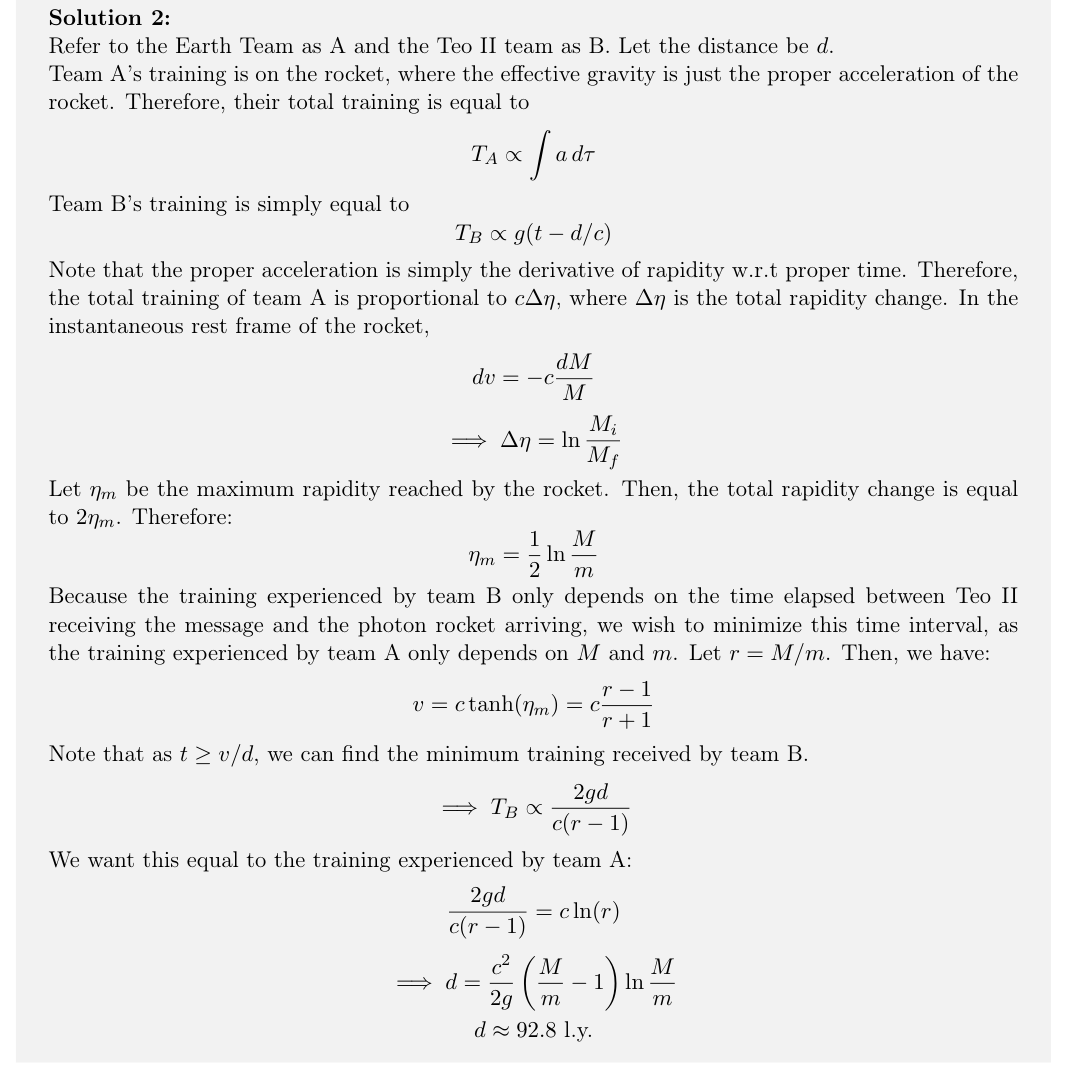
Official solution (OPhO 2026, Physoly), reproduced from the official PDF — p. 6.
Topic: Special Relativity, Gravitation Metodi: Relativistic Energy-Momentum, Conservation of Momentum, Calculus-Integration Competenze: Mathematical Modeling, Physical Reasoning Objects: Photon Fonte: Testo (PDF) — p.5 · Soluzione ufficiale (PDF) — p.6
Teo I (Risposta breve)
Dopo la scoperta dell’esopianeta Teo I da parte dello stimato astronomo e astrofisico Kai Wen, i notiziari di tutto il mondo (cioè della Terra) si entusiasmarono per le notevoli somiglianze tra Teo I e la Terra: stessa gravità superficiale, stessa composizione atmosferica, stessa temperatura media e stesse dimensioni, ma anche somiglianze culturali — scacchi, pugilato, scacchi-pugilato, molto gioco d’azzardo e, naturalmente, olimpiadi di fisica. Kai Wen decise di sfidare subito gli abitanti di Teo I a una partita di Texas Hold’em no-limit (poker) ad alta posta, scommettendo tutti i suoi risparmi (circa cinque dollari di Singapore). Purtroppo, poco dopo i fatti di questo problema, gli astronomi terrestri riclassificarono Teo I come disabitato, in seguito a numerose misteriose esplosioni rilevate nella sua atmosfera.
Per raggiungere Teo I, Kai Wen progetta un razzo a fotoni di massa totale con un carico utile di massa . Il razzo è calibrato per esaurire il combustibile all’arrivo su Teo I, dopo aver decelerato fino a fermarsi. (Per un piccolo errore di calcolo, Kai Wen non ha tenuto da parte combustibile per il ritorno.) Per garantire una sfida equa, Kai Wen invia un messaggio radio che descrive la sfida e invita gli abitanti di Teo I ad allenare la loro migliore squadra di poker. Per mettere le due squadre alla pari, entrambe devono allenarsi per la stessa quantità. Da ricerche precedenti è noto che il ritmo con cui cresce l’abilità a poker è direttamente proporzionale al modulo dell’accelerazione di gravità locale. Il messaggio radio e il razzo a fotoni partono simultaneamente secondo un osservatore all’infinito.
Qual è la massima distanza possibile, in anni luce, tra Teo I e la Terra?
Risposta: anni luce
Soluzione: La soluzione ufficiale completa (in inglese) è nella versione originale di questo quesito e nel PDF ufficiale.
Topic: Special Relativity, Gravitation Metodi: Relativistic Energy-Momentum, Conservation of Momentum, Calculus-Integration Competenze: Mathematical Modeling, Physical Reasoning Objects: Photon Fonte: Testo (PDF) — p.5 · Soluzione ufficiale (PDF) — p.6
Kugel Fountain (Short answer)
A Kugel fountain is a water feature that uses the phenomenon of hydroplaning to suspend large rocks above a thin film of water.
One such fountain has a flat base. A circular hole is drilled through the center of the fountain and fitted with a vertical pipe of radius . The opening of the pipe is flush with the base. Water flows out of the pipe at a volume flow rate . A puck-shaped rock with radius is placed on the fountain, with its flat side resting on the base and its center right above the pipe’s center. The water film suspends it, and the thickness of the water film between the rock and the base is . Find the weight of the rock in newtons to accuracy.
Assume that the water beneath the rock is in steady-state laminar flow (although this is not very realistic due to the high Reynolds number of the flow). The viscosity of water at room temperature is .
Risposta:
Soluzione:
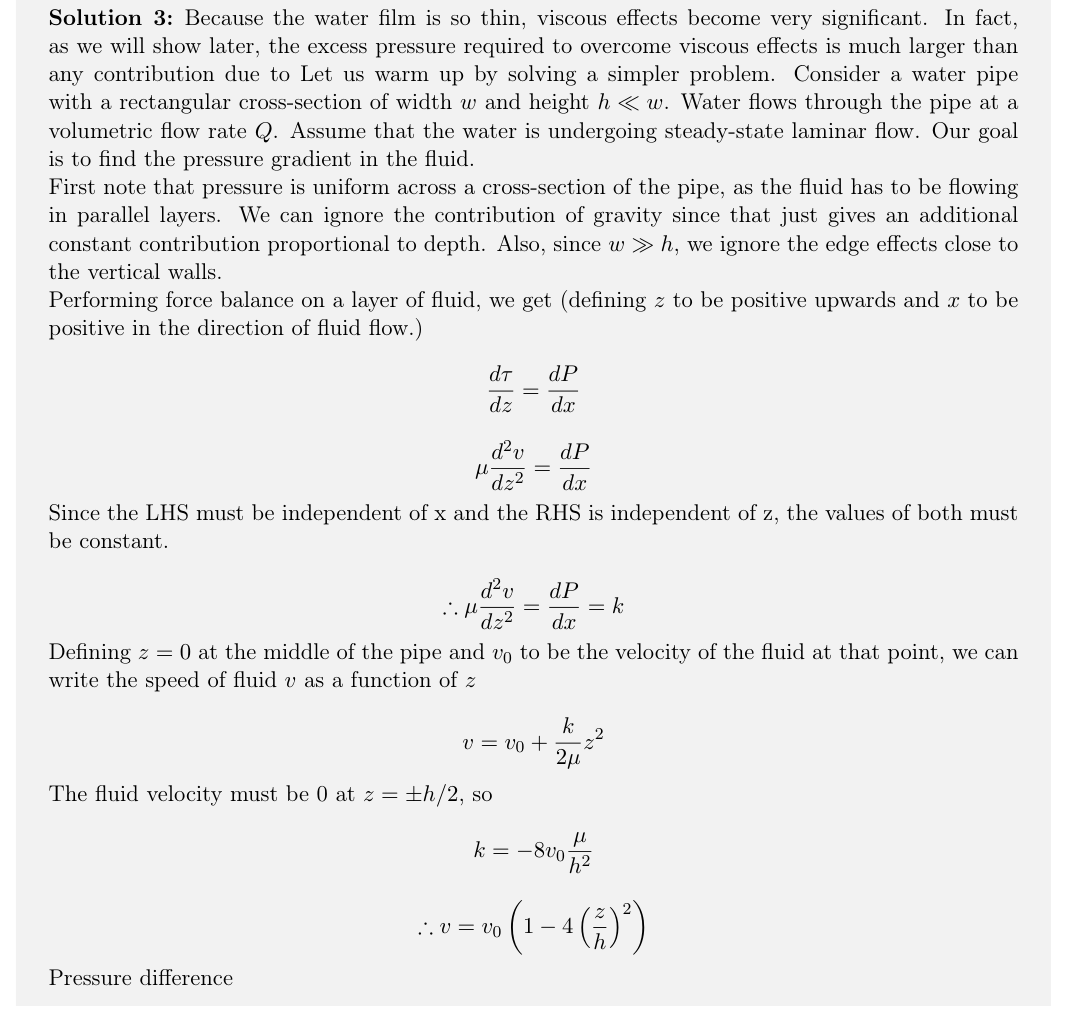
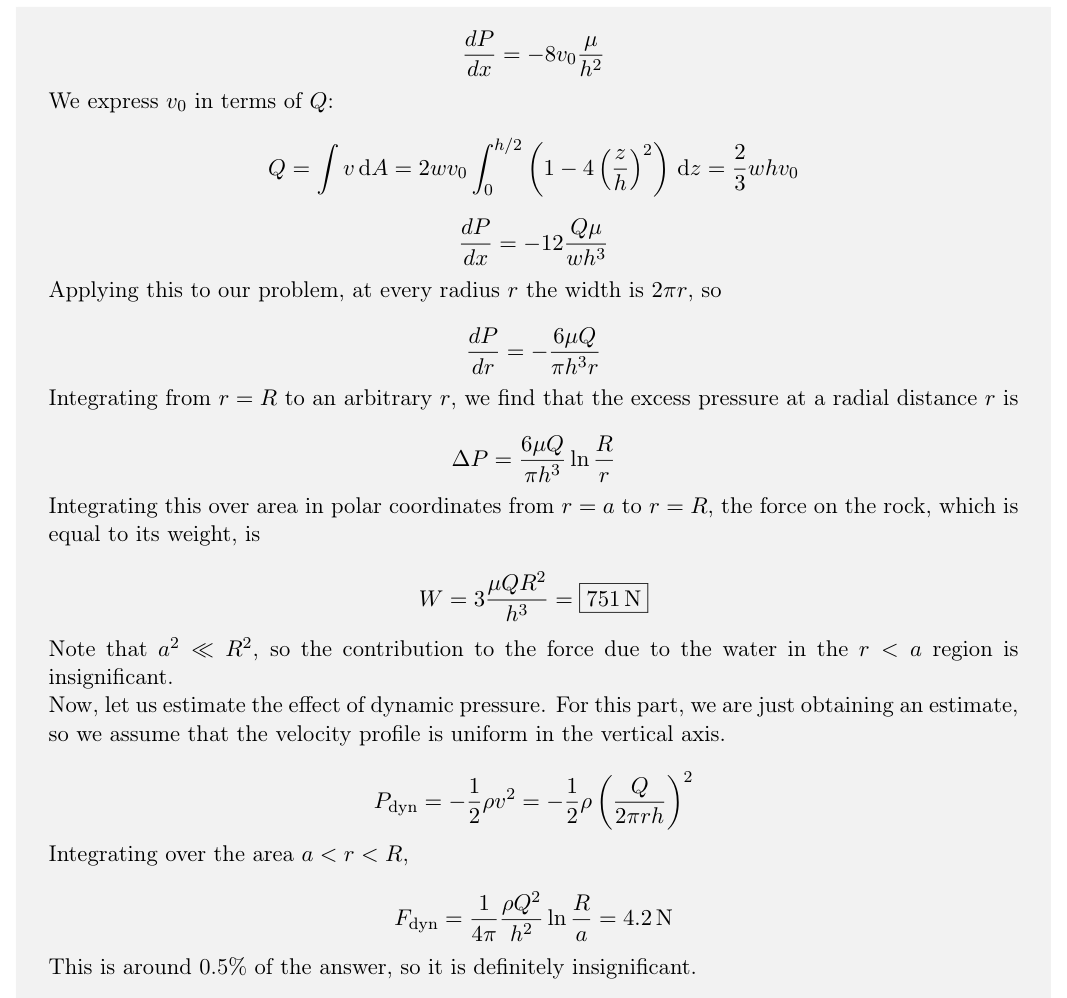
Official solution (OPhO 2026, Physoly), reproduced from the official PDF — p. 7, 8.
Topic: Fluid Mechanics Metodi: Physical Modeling, Calculus-Integration, Continuity Equation Competenze: Mathematical Modeling Objects: Disk, Tube Fonte: Testo (PDF) — p.5 · Soluzione ufficiale (PDF) — p.7
Fontana a sfera (Risposta breve)
Una fontana a sfera (Kugel fountain) è un elemento d’acqua che sfrutta il fenomeno dell’aquaplaning per tenere sospese grosse pietre sopra un sottile velo d’acqua.
Una di queste fontane ha la base piana. Al centro è praticato un foro circolare in cui è inserito un tubo verticale di raggio , con l’apertura a filo della base. L’acqua esce dal tubo con portata volumetrica . Una pietra a forma di disco di raggio è appoggiata sulla fontana con la faccia piana sulla base e il centro esattamente sopra il centro del tubo. Il velo d’acqua la tiene sospesa, e lo spessore del velo tra pietra e base è . Trova il peso della pietra in newton, con un’accuratezza del .
Supponi che l’acqua sotto la pietra sia in flusso laminare stazionario (anche se ciò non è molto realistico, dato l’alto numero di Reynolds). La viscosità dell’acqua a temperatura ambiente è .
Risposta:
Soluzione: La soluzione ufficiale completa (in inglese) è nella versione originale di questo quesito e nel PDF ufficiale.
Topic: Fluid Mechanics Metodi: Physical Modeling, Calculus-Integration, Continuity Equation Competenze: Mathematical Modeling Objects: Disk, Tube Fonte: Testo (PDF) — p.5 · Soluzione ufficiale (PDF) — p.7
A Different Kind of Superfluid (Short answer)
Consider a very large tub of a superconducting fluid with negligible surface tension. The fluid has density . A small magnet is slowly lowered to a height above the fluid surface. The magnet has net dipole moment of magnitude , oriented vertically. Find the magnitude of the maximum vertical deflection of the fluid surface (as compared to the height of the fluid surface very far from the magnet). Input your answer in micrometers.
Risposta:
Soluzione:

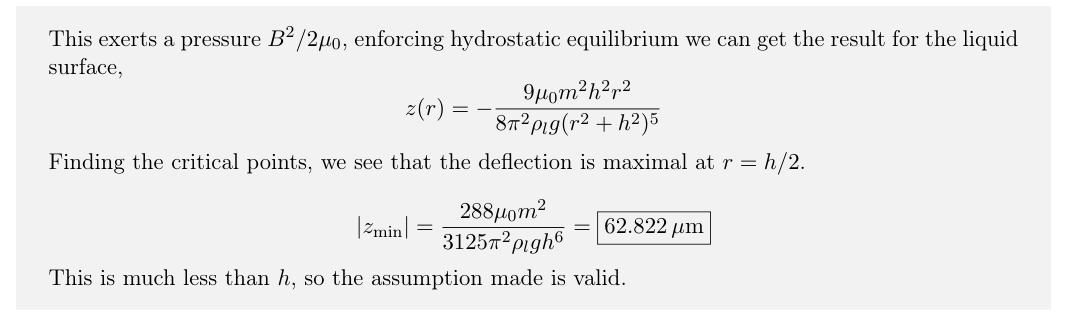
Official solution (OPhO 2026, Physoly), reproduced from the official PDF — p. 8, 9.
Topic: Magnetism, Fluid Mechanics Metodi: Superposition Principle, Hydrostatic Equilibrium, Symmetry Argument Competenze: Mathematical Modeling, Physical Reasoning Objects: Magnet, Magnetic Dipole Fonte: Testo (PDF) — p.6 · Soluzione ufficiale (PDF) — p.8
Un superfluido di tipo diverso (Risposta breve)
Considera una vasca molto grande piena di un fluido superconduttore con tensione superficiale trascurabile. Il fluido ha densità . Un piccolo magnete viene abbassato lentamente fino a un’altezza sopra la superficie del fluido. Il magnete ha momento di dipolo di modulo , orientato verticalmente. Trova il modulo della massima deformazione verticale della superficie del fluido (rispetto al livello della superficie molto lontano dal magnete). Esprimi la risposta in micrometri.
Risposta:
Soluzione: La soluzione ufficiale completa (in inglese) è nella versione originale di questo quesito e nel PDF ufficiale.
Topic: Magnetism, Fluid Mechanics Metodi: Superposition Principle, Hydrostatic Equilibrium, Symmetry Argument Competenze: Mathematical Modeling, Physical Reasoning Objects: Magnet, Magnetic Dipole Fonte: Testo (PDF) — p.6 · Soluzione ufficiale (PDF) — p.8
Belt friction (Short answer)
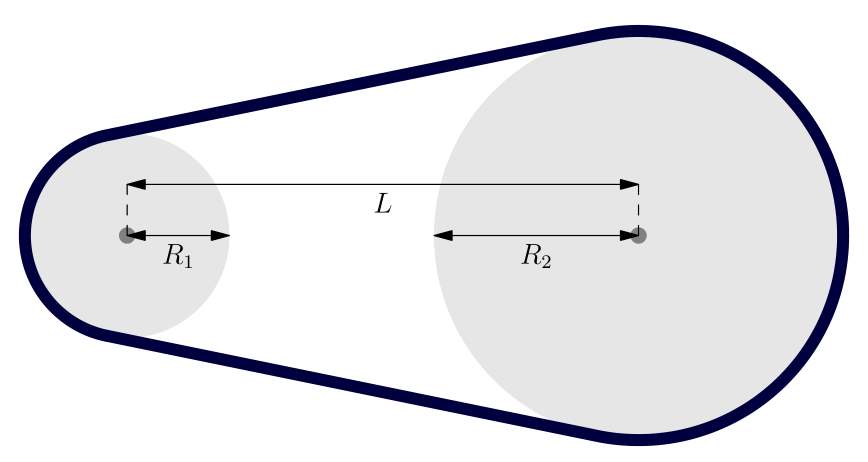
Belts are sometimes used to “connect” the rotation of two wheels. This problem will explore the mechanics of such systems. There are two uniform cylinders, Cylinders 1 and 2. Cylinders 1 and 2 have masses and , radii and respectively. The central axes of the cylinders are attached to separate horizontal frictionless axles a distance apart such that the cylinders can freely rotate. A taut inelastic belt with a mass much less than the mass of the cylinders is wrapped around both cylinders. There is significant friction between the belt and the surface of the cylinders.
Cylinder 1 is quickly spun up to an angular speed of (clockwise), fast enough that Cylinder 2 does not rotate while Cylinder 1 is being spun up. Then, the cylinders are left to rotate freely. After a time , both cylinders reach a constant angular velocity. Find the magnitude of the average vertical force exerted by the axle of Cylinder 1 on the cylinder (in newtons), across the seconds. Gravity is pointing downwards in the diagram provided.
Risposta: (official: )
Soluzione:
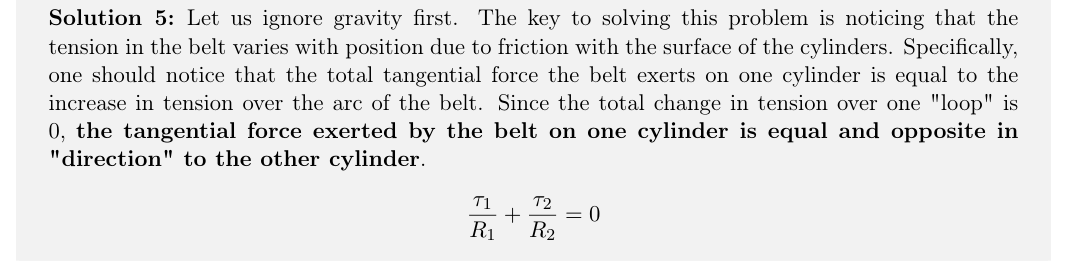
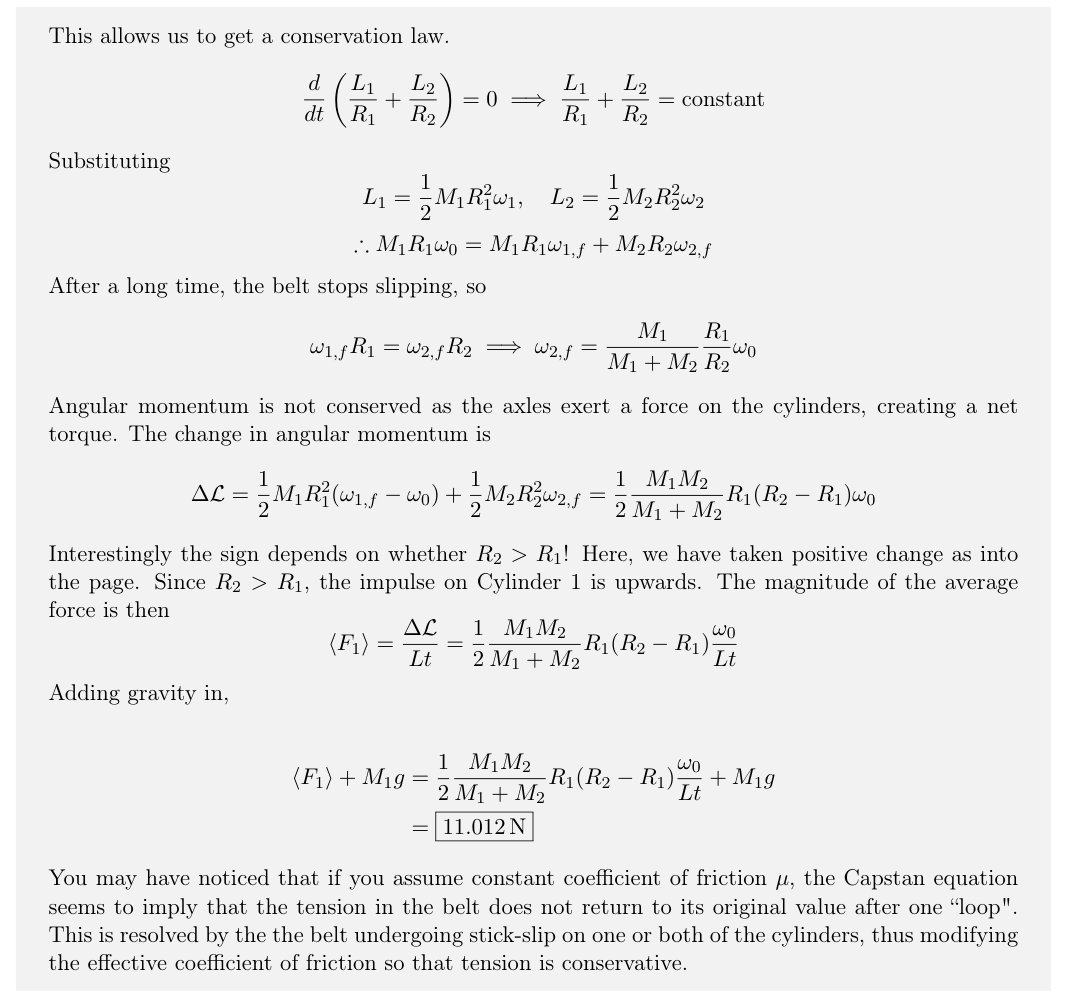
Official solution (OPhO 2026, Physoly), reproduced from the official PDF — p. 9, 10.
Topic: Rotational Dynamics Metodi: Torque & Angular Momentum Analysis, Impulse-Momentum Theorem, Free-Body Diagram Competenze: Physical Reasoning Objects: Cylinder, Wheel, String Fonte: Testo (PDF) — p.6 · Soluzione ufficiale (PDF) — p.9
Attrito della cinghia (Risposta breve)
A volte si usano cinghie per “collegare” la rotazione di due ruote. Questo problema esplora la meccanica di tali sistemi. Ci sono due cilindri omogenei, il Cilindro 1 e il Cilindro 2, di masse e e raggi e . Gli assi centrali dei cilindri sono fissati a due assi orizzontali distinti, privi di attrito, a distanza , così che i cilindri possano ruotare liberamente. Una cinghia tesa e inestensibile, di massa molto minore di quella dei cilindri, è avvolta attorno a entrambi. Tra cinghia e superficie dei cilindri c’è un attrito significativo.
Il Cilindro 1 viene portato rapidamente alla velocità angolare (in senso orario), abbastanza in fretta che il Cilindro 2 non ruoti durante questa fase. Poi i cilindri vengono lasciati ruotare liberamente. Dopo un tempo entrambi raggiungono una velocità angolare costante. Trova il modulo della forza verticale media esercitata dall’asse del Cilindro 1 sul cilindro (in newton) durante questi secondi. Nel disegno la gravità è diretta verso il basso.
Risposta: (ufficiale: )
Soluzione: La soluzione ufficiale completa (in inglese) è nella versione originale di questo quesito e nel PDF ufficiale.
Topic: Rotational Dynamics Metodi: Torque & Angular Momentum Analysis, Impulse-Momentum Theorem, Free-Body Diagram Competenze: Physical Reasoning Objects: Cylinder, Wheel, String Fonte: Testo (PDF) — p.6 · Soluzione ufficiale (PDF) — p.9
Stars and Deltas (Short answer)
Consider two infinite planar resistive networks.
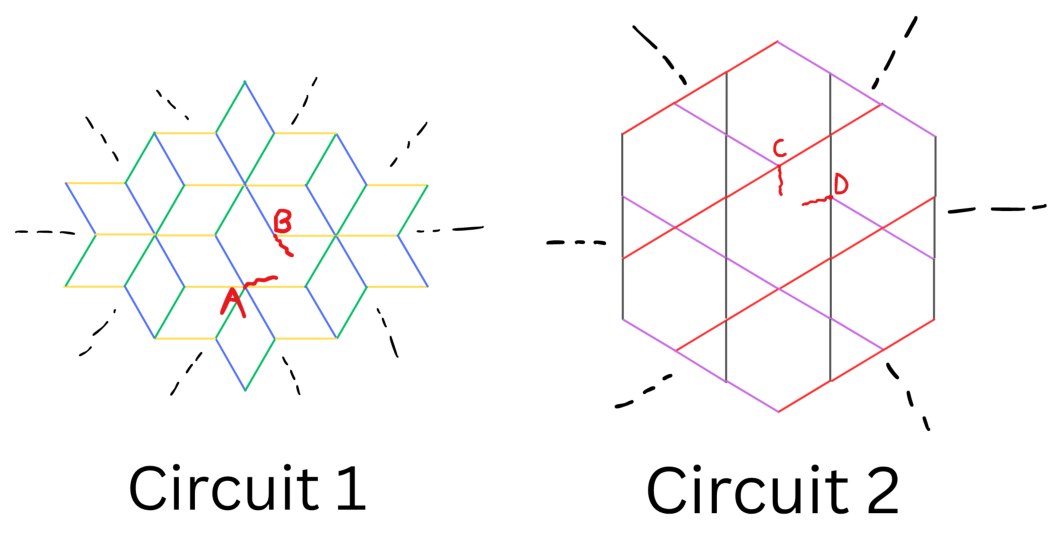
Circuit 1. The network is obtained by tiling the plane with rhombi having interior angles and , as depicted. Each edge of the tiling is occupied by a resistor. Edges are partitioned into three classes by orientation, indicated by colour: yellow edges each carry resistance , blue edges each carry resistance , and green edges each carry resistance . Let denote the equivalent resistance measured between the terminals and marked in the figure.
Circuit 2. The network is obtained by tiling the plane with regular hexagons and equilateral triangles (the tri-hexagonal tiling), as depicted, with a resistor on every edge. Grey edges each carry resistance , red edges each carry resistance , and magenta edges each carry resistance . Let denote the equivalent resistance between the terminals and marked in the figure.
In both networks, all mutually parallel edges (i.e. all edges of the same orientation) belong to the same colour class and hence carry equal resistance.
Given: , , , , , .
Determine the product , expressed in .
Risposta:
Soluzione:

Official solution (OPhO 2026, Physoly), reproduced from the official PDF — p. 11.
Topic: Circuits Metodi: Equivalent Circuit Reduction, Symmetry Argument Competenze: Diagrammatic Reasoning, Physical Reasoning Objects: Resistor Fonte: Testo (PDF) — p.6 · Soluzione ufficiale (PDF) — p.11
Stelle e triangoli (Risposta breve)
Considera due reti resistive piane infinite.
Circuito 1. La rete si ottiene tassellando il piano con rombi di angoli interni e , come in figura. Su ogni lato della tassellatura c’è un resistore. I lati sono divisi in tre classi secondo l’orientazione, indicate dal colore: i lati gialli hanno resistenza , quelli blu e quelli verdi . Sia la resistenza equivalente misurata tra i terminali e indicati in figura.
Circuito 2. La rete si ottiene tassellando il piano con esagoni regolari e triangoli equilateri (tassellatura triesagonale), come in figura, con un resistore su ogni lato. I lati grigi hanno resistenza , quelli rossi e quelli magenta . Sia la resistenza equivalente tra i terminali e indicati in figura.
In entrambe le reti, tutti i lati paralleli tra loro (cioè con la stessa orientazione) appartengono alla stessa classe di colore e hanno quindi la stessa resistenza.
Dati: , , , , , .
Determina il prodotto , in .
Risposta:
Soluzione: La soluzione ufficiale completa (in inglese) è nella versione originale di questo quesito e nel PDF ufficiale.
Topic: Circuits Metodi: Equivalent Circuit Reduction, Symmetry Argument Competenze: Diagrammatic Reasoning, Physical Reasoning Objects: Resistor Fonte: Testo (PDF) — p.6 · Soluzione ufficiale (PDF) — p.11
Fridge Magnet (Short answer)
Note: this problem consists of two parts, but there is only one input. Hence, submit the product of both answers. For example, if your answer to part 1 is and your answer to part 2 is , you should submit as your final answer.
Iron is a ferromagnetic material which we assume to have a relative permeability and negligible hysteresis. Suppose we have a cylindrical neodymium magnet with mass density , radius and length . The neodymium magnet has a uniform magnetisation density directed along its axis of rotational symmetry. We place the flat side of the magnet on the vertical wall of a fridge, which can be treated as a large cube of iron. The coefficient of static friction between the magnet and the fridge surface is (not to be confused with the relative permeability defined earlier!). Assume that the magnetisation density of the neodymium magnet is independent of the magnetic field.
- If and , find the minimum value of (in units of kA/m) such that the magnet remains stuck on the fridge in its original orientation.
- If and , find the minimum value of (in units of kA/m) such that the magnet remains stuck on the fridge in its original orientation.
Risposta: product (official approximate solution: ; exact: )
Soluzione:
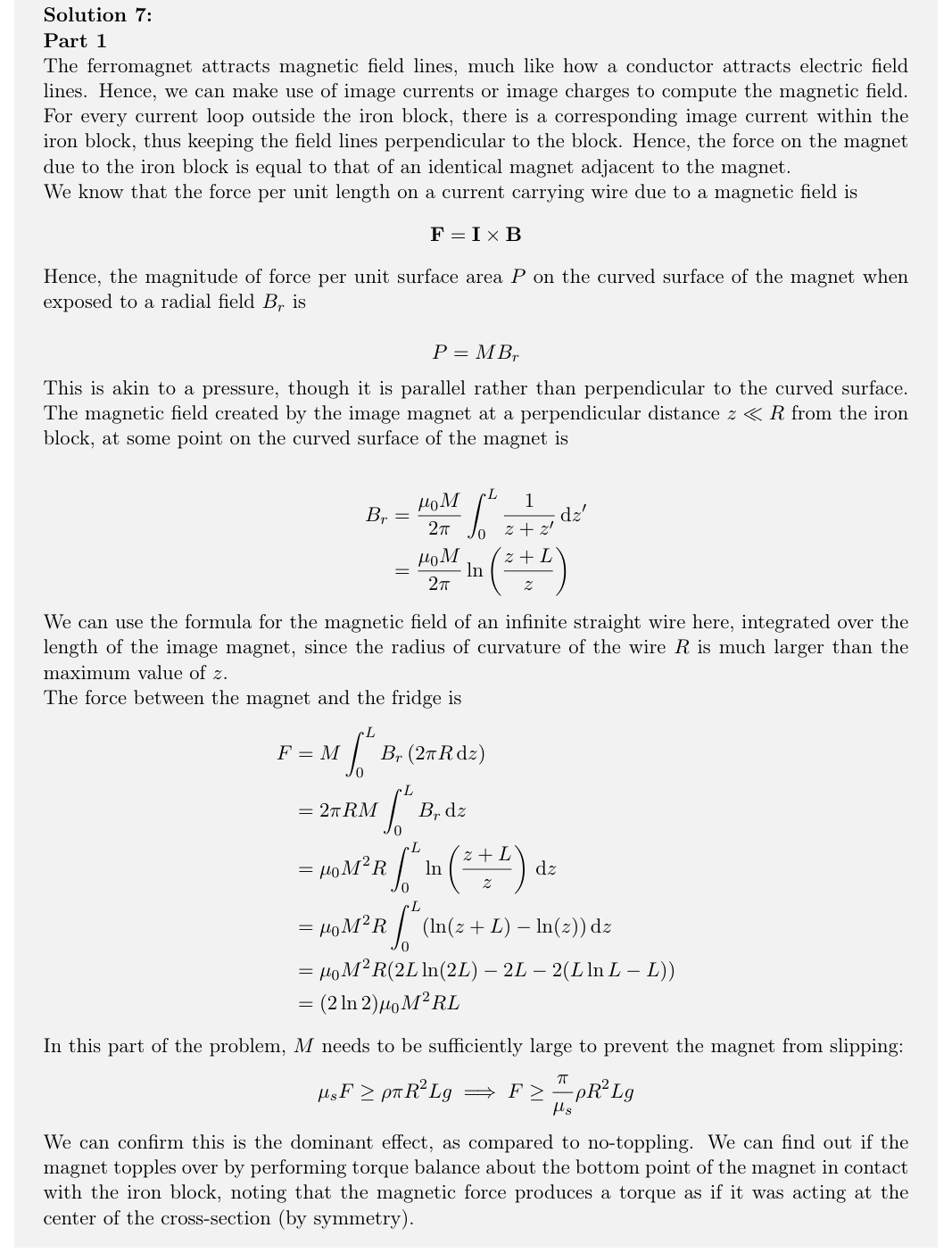
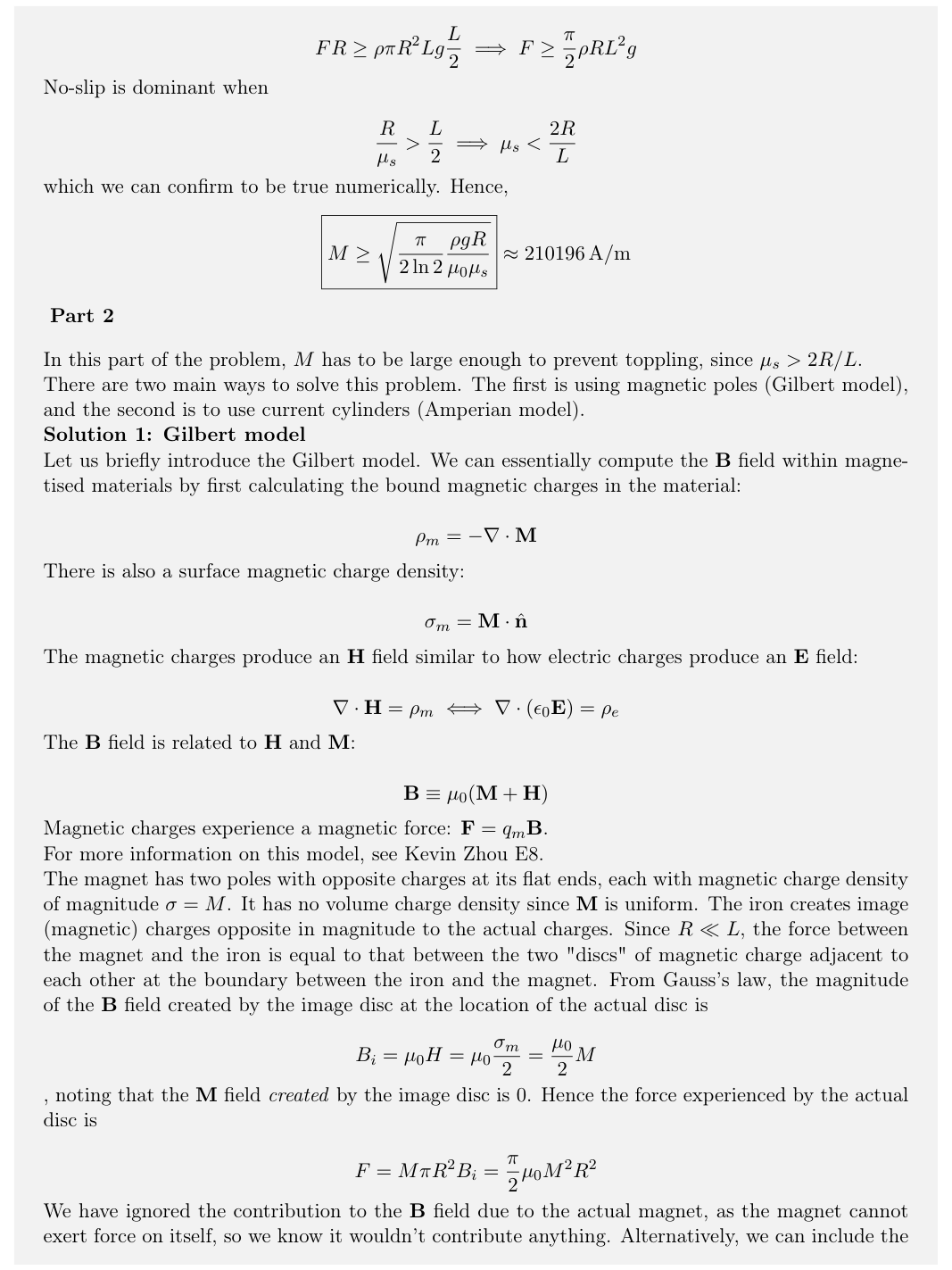
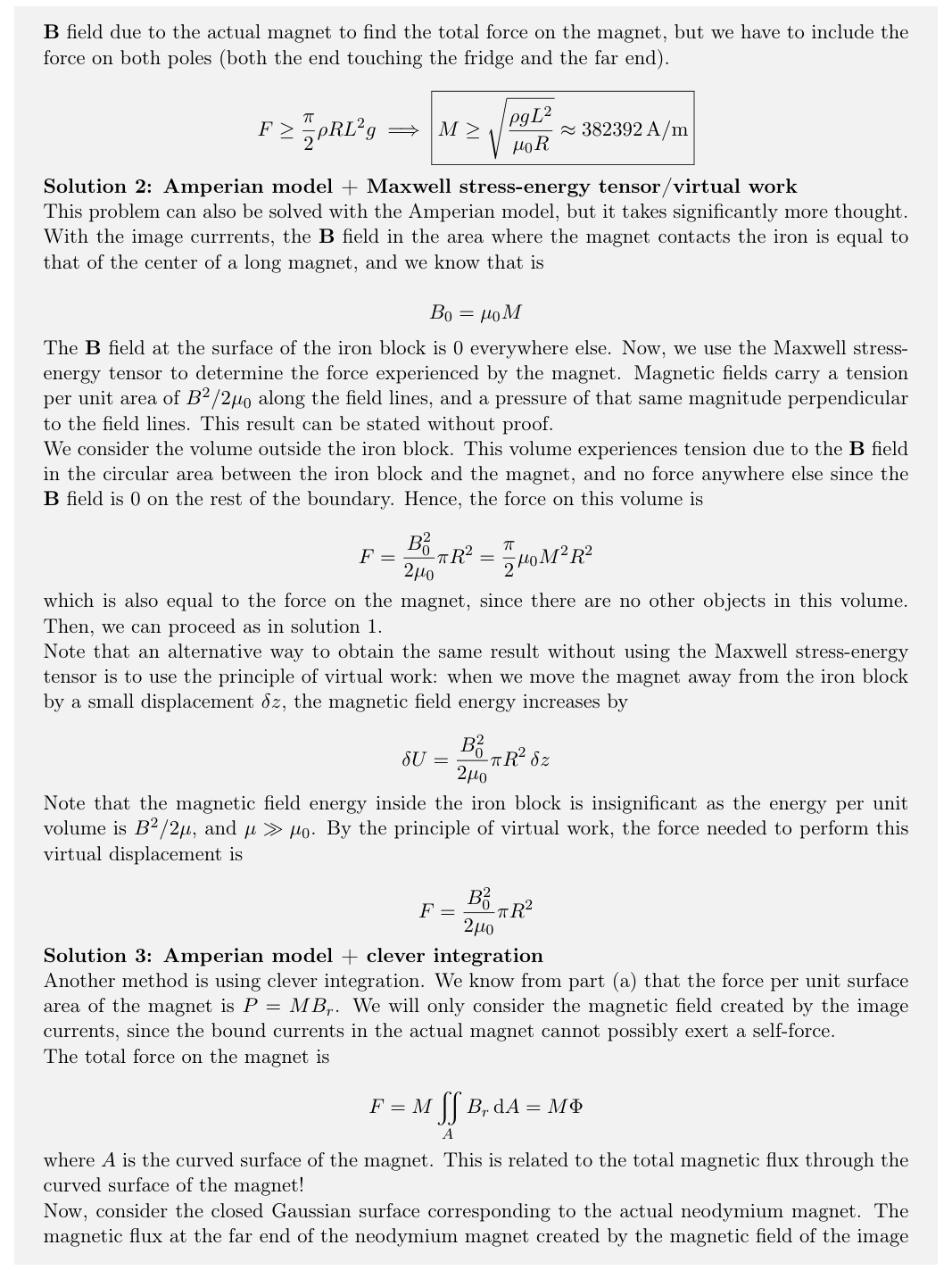
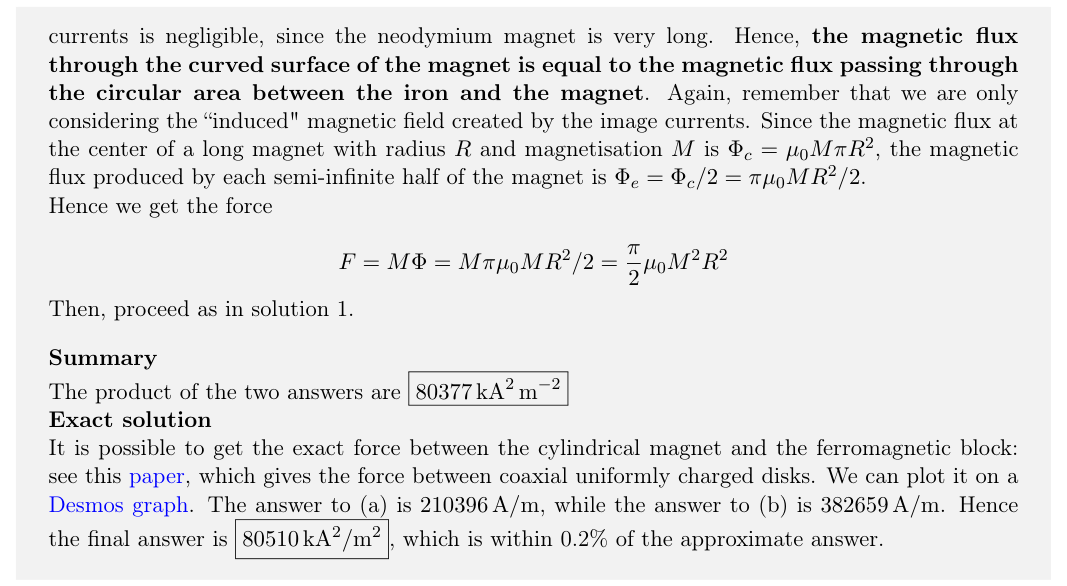
Official solution (OPhO 2026, Physoly), reproduced from the official PDF — p. 12, 13, 14, 15.
Topic: Magnetism, Newtonian Mechanics Metodi: Free-Body Diagram, Physical Modeling, Superposition Principle Competenze: Mathematical Modeling, Physical Reasoning Objects: Magnet Fonte: Testo (PDF) — p.7 · Soluzione ufficiale (PDF) — p.12
Calamita da frigorifero (Risposta breve)
Nota: il problema ha due parti ma un solo campo di risposta. Inserisci quindi il prodotto delle due risposte. Ad esempio, se la risposta alla parte 1 è e quella alla parte 2 è , devi inserire .
Il ferro è un materiale ferromagnetico che supponiamo abbia permeabilità relativa e isteresi trascurabile. Abbiamo un magnete cilindrico al neodimio di densità , raggio e lunghezza , con magnetizzazione uniforme diretta lungo l’asse di simmetria. Appoggiamo la faccia piana del magnete sulla parete verticale di un frigorifero, che si può trattare come un grande cubo di ferro. Il coefficiente di attrito statico tra magnete e frigorifero è (da non confondere con la permeabilità relativa!). Supponi che la magnetizzazione del magnete al neodimio non dipenda dal campo magnetico.
- Se e , trova il valore minimo di (in kA/m) perché il magnete resti attaccato al frigorifero nell’orientazione iniziale.
- Se e , trova il valore minimo di (in kA/m) perché il magnete resti attaccato al frigorifero nell’orientazione iniziale.
Risposta: prodotto (soluzione ufficiale approssimata: ; esatta: )
Soluzione: La soluzione ufficiale completa (in inglese) è nella versione originale di questo quesito e nel PDF ufficiale.
Topic: Magnetism, Newtonian Mechanics Metodi: Free-Body Diagram, Physical Modeling, Superposition Principle Competenze: Mathematical Modeling, Physical Reasoning Objects: Magnet Fonte: Testo (PDF) — p.7 · Soluzione ufficiale (PDF) — p.12
Fabric of Reality (Short answer)
Consider a weightless fabric with constant surface tension , initially stretched taut in the horizontal plane. The outer boundary of the fabric is a circle of radius . A circular region of radius is carved out from the fabric, concentric with the outer boundary. A ring with weight , uniformly distributed along its length, is then attached along the inner circular boundary. This causes the fabric to sag under the action of the mass.
Particles with negligible mass can perform circular orbits around the center of the fabric. When holds, all such circular orbits are stable. Determine the numerical value of .
Risposta:
Soluzione:
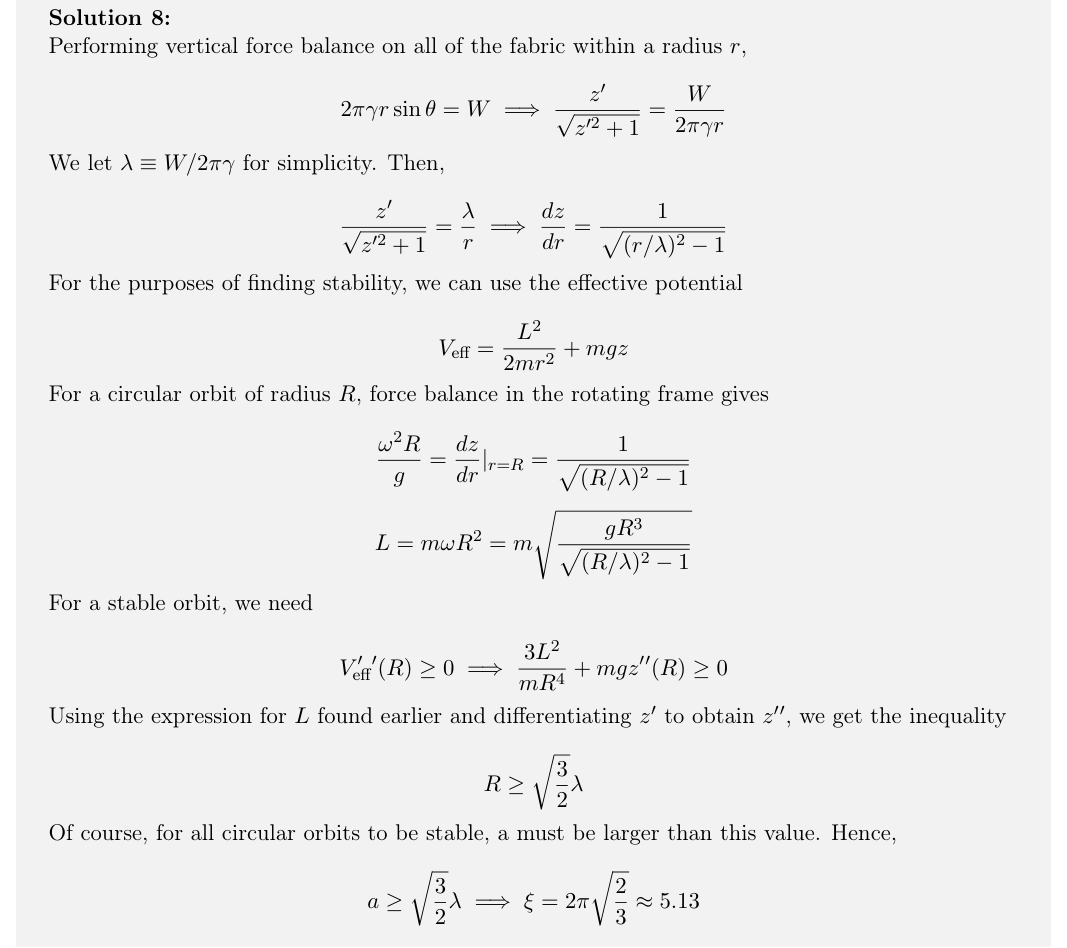
Official solution (OPhO 2026, Physoly), reproduced from the official PDF — p. 16.
Topic: Newtonian Mechanics, Gravitation Metodi: Physical Modeling, Differential Equations, Kepler’s Laws Competenze: Mathematical Modeling, Physical Reasoning Objects: Membrane Fonte: Testo (PDF) — p.8 · Soluzione ufficiale (PDF) — p.16
Il tessuto della realtà (Risposta breve)
Considera un telo privo di peso con tensione superficiale costante , inizialmente teso in un piano orizzontale. Il bordo esterno del telo è una circonferenza di raggio . Dal telo si ritaglia una regione circolare di raggio , concentrica con il bordo esterno. Lungo il bordo interno si fissa poi un anello di peso , distribuito uniformemente lungo la sua lunghezza. Per effetto della massa il telo si incurva verso il basso.
Particelle di massa trascurabile possono percorrere orbite circolari attorno al centro del telo. Quando vale tutte queste orbite circolari sono stabili. Determina il valore numerico di .
Risposta:
Soluzione: La soluzione ufficiale completa (in inglese) è nella versione originale di questo quesito e nel PDF ufficiale.
Topic: Newtonian Mechanics, Gravitation Metodi: Physical Modeling, Differential Equations, Kepler’s Laws Competenze: Mathematical Modeling, Physical Reasoning Objects: Membrane Fonte: Testo (PDF) — p.8 · Soluzione ufficiale (PDF) — p.16
Beam Splitter (Short answer)
Zeus, an aspiring optics enthusiast, fires a laser producing a beam of unpolarized light. Being somewhat careless with expensive equipment, he manages to trap this beam inside a glass slab of refractive index , length , and breadth , with the beam propagating at an angle to the normal. Zeus positions a camera at the far end inside the slab.
The camera can distinguish between the two linearly polarized components if the separation between the centers of the two beams is . In order for the two components to be distinguishable, what is the minimum length (in meters) of the glass slab? The light has a vacuum wavelength , and the slab is surrounded by air.
Neglect the diffraction effects of the laser.
Risposta: (official: )
Soluzione:
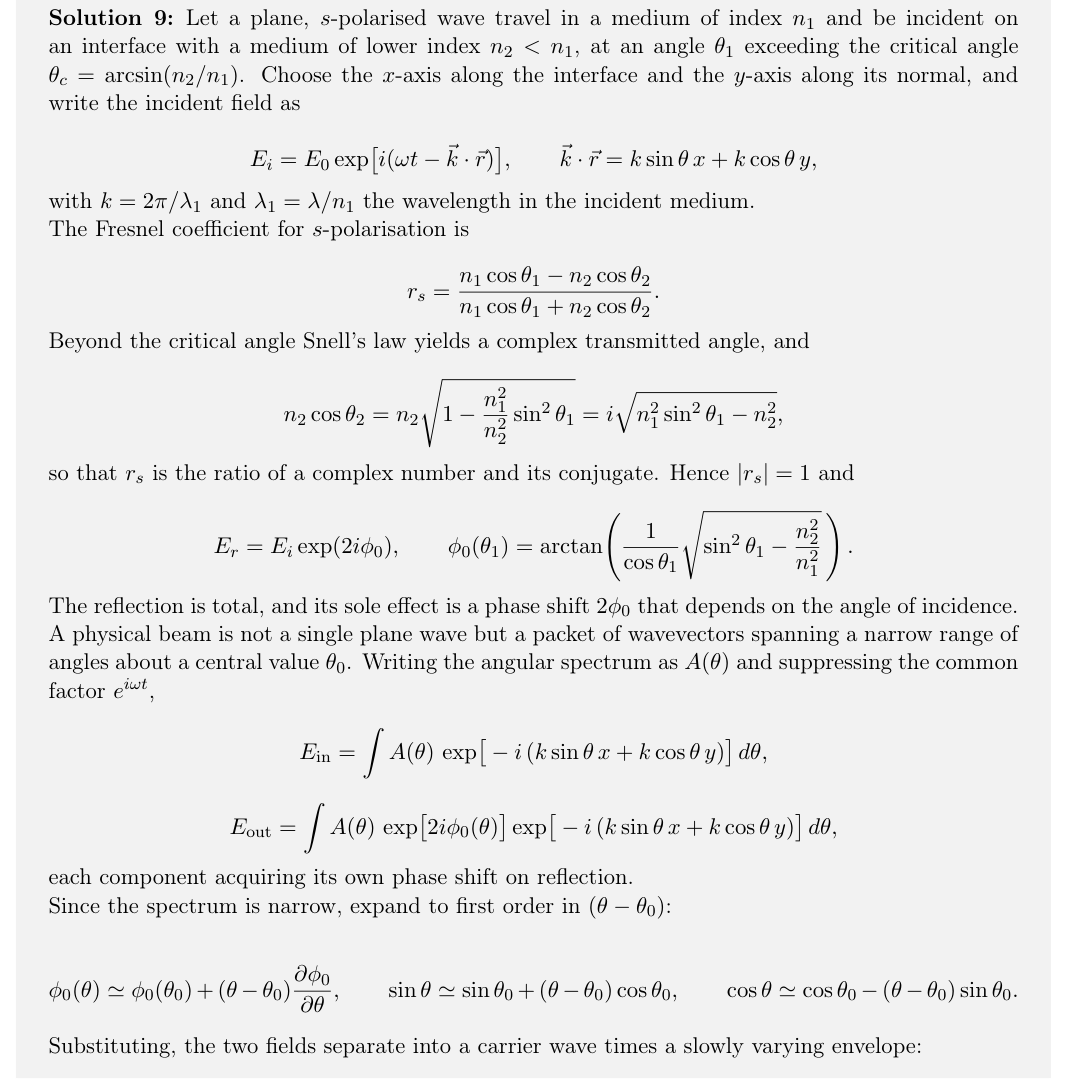
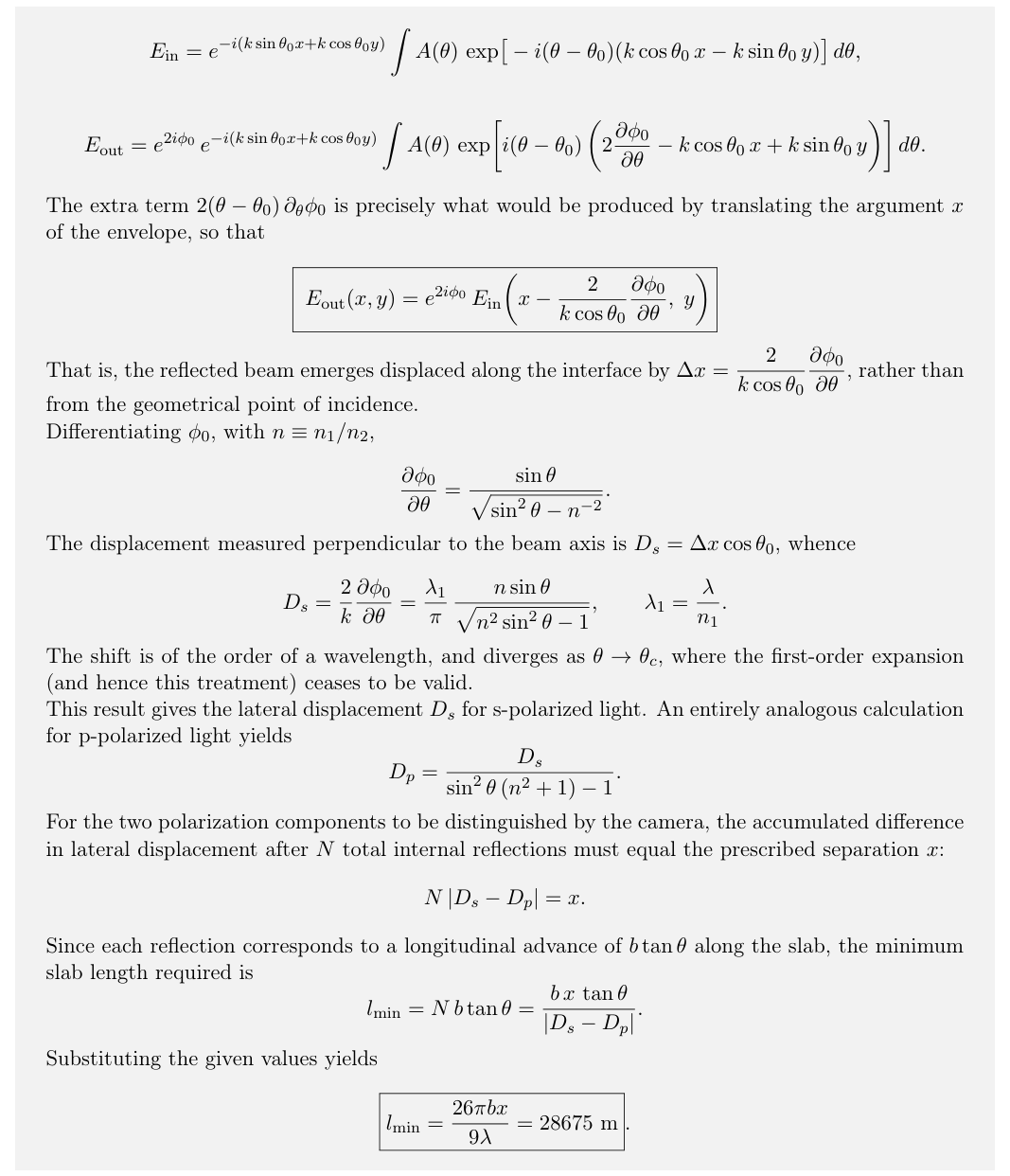
Official solution (OPhO 2026, Physoly), reproduced from the official PDF — p. 17, 18.
Topic: Wave Optics, Geometric Optics Metodi: Snell’s Law, Physical Modeling Competenze: Mathematical Modeling Objects: Photon Fonte: Testo (PDF) — p.8 · Soluzione ufficiale (PDF) — p.17
Divisore di fascio (Risposta breve)
Zeus, aspirante appassionato di ottica, accende un laser che produce un fascio di luce non polarizzata. Un po’ sbadato con le attrezzature costose, riesce a intrappolare il fascio dentro una lastra di vetro di indice di rifrazione , lunghezza e larghezza , con il fascio che si propaga formando un angolo con la normale. Zeus mette una fotocamera all’estremità opposta, dentro la lastra.
La fotocamera distingue le due componenti polarizzate linearmente se la distanza tra i centri dei due fasci è . Qual è la lunghezza minima (in metri) della lastra perché le due componenti siano distinguibili? La luce ha lunghezza d’onda nel vuoto e la lastra è circondata da aria.
Trascura gli effetti di diffrazione del laser.
Risposta: (ufficiale: )
Soluzione: La soluzione ufficiale completa (in inglese) è nella versione originale di questo quesito e nel PDF ufficiale.
Topic: Wave Optics, Geometric Optics Metodi: Snell’s Law, Physical Modeling Competenze: Mathematical Modeling Objects: Photon Fonte: Testo (PDF) — p.8 · Soluzione ufficiale (PDF) — p.17
Countless Collisions (Short answer)
This problem is one-dimensional, with all objects constrained to the -axis. Consider a block of mass with initial velocity and position at . A dispenser is positioned at , given an initial velocity , and uniformly releases small balls of mass and initial velocity relative to the lab frame in time intervals of , starting at . If all collisions are elastic, find the minimum distance between the dispenser and block after a very long time has elapsed. Neglect all collisions with the dispenser and assume that the dispenser always moves at the same velocity. Report the answer in meters.
Use the following parameters: , , , , , , .
Risposta:
Soluzione:
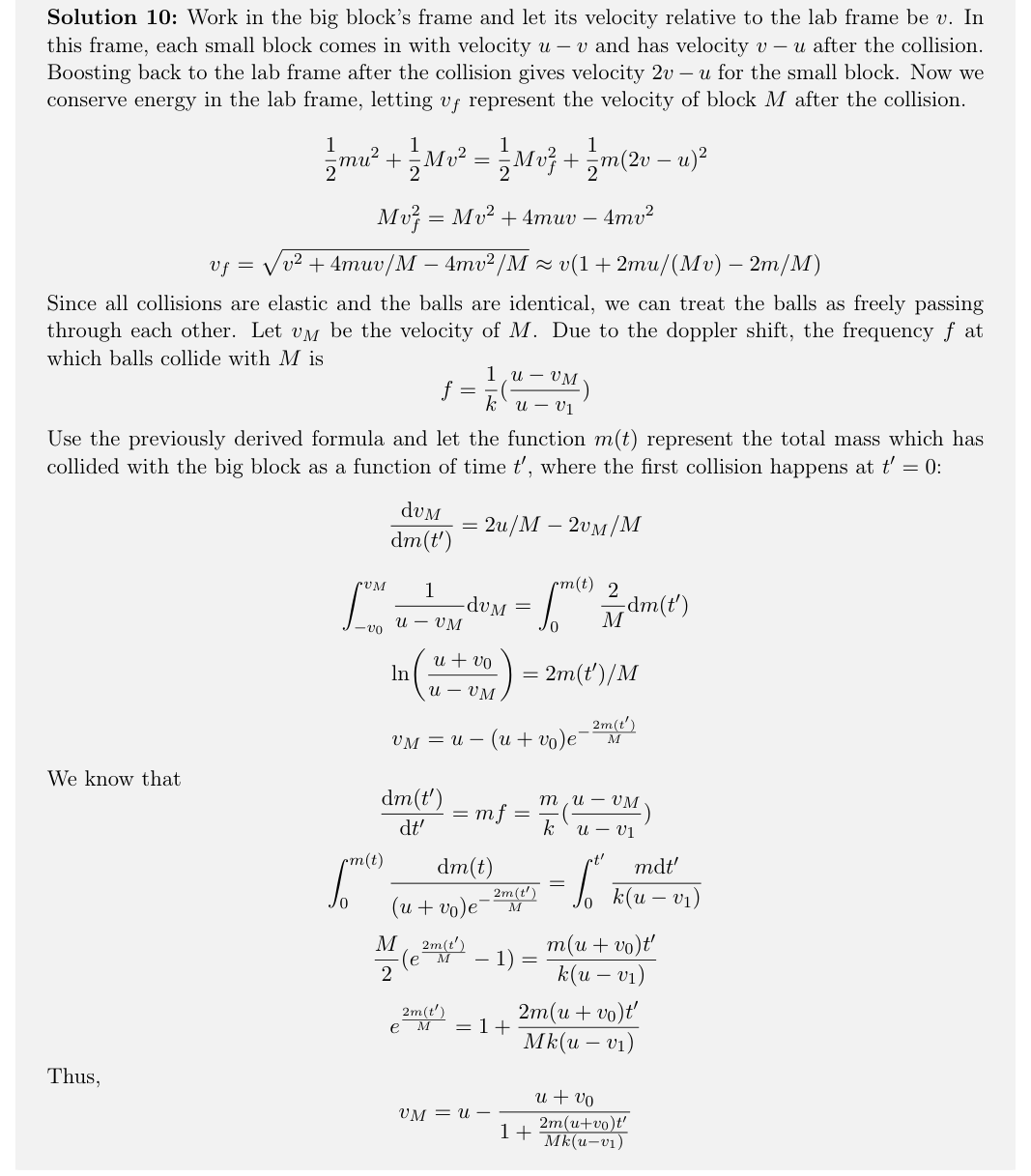
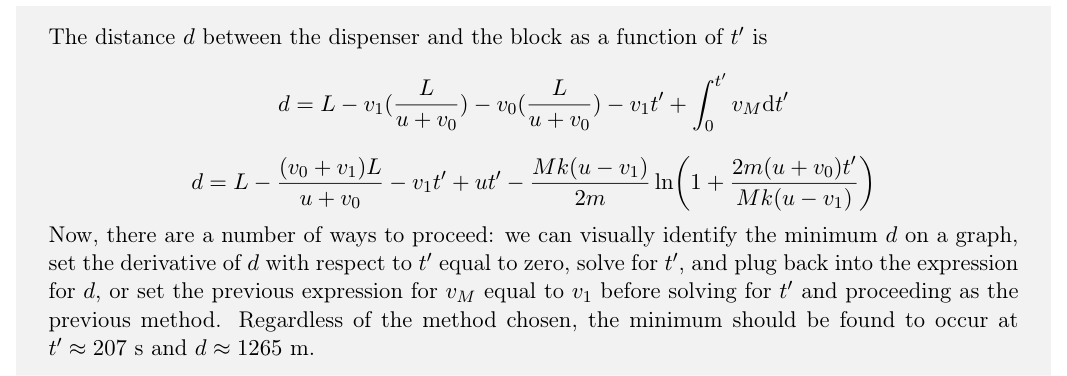
Official solution (OPhO 2026, Physoly), reproduced from the official PDF — p. 19, 20.
Topic: Conservation of Momentum, Newtonian Mechanics Metodi: Conservation Laws, Differential Equations, Impulse-Momentum Theorem Competenze: Mathematical Modeling Objects: Block, Ball Fonte: Testo (PDF) — p.8 · Soluzione ufficiale (PDF) — p.19
Innumerevoli urti (Risposta breve)
Il problema è unidimensionale: tutti gli oggetti si muovono lungo l’asse . Un blocco di massa ha, a , velocità e posizione . Un distributore si trova in , ha velocità iniziale e, a partire da , rilascia a intervalli regolari di durata palline di massa con velocità iniziale nel sistema del laboratorio. Se tutti gli urti sono elastici, trova la distanza minima tra distributore e blocco dopo un tempo molto lungo. Trascura gli urti con il distributore e supponi che il distributore si muova sempre con la stessa velocità. Esprimi la risposta in metri.
Usa i seguenti parametri: , , , , , , .
Risposta:
Soluzione: La soluzione ufficiale completa (in inglese) è nella versione originale di questo quesito e nel PDF ufficiale.
Topic: Conservation of Momentum, Newtonian Mechanics Metodi: Conservation Laws, Differential Equations, Impulse-Momentum Theorem Competenze: Mathematical Modeling Objects: Block, Ball Fonte: Testo (PDF) — p.8 · Soluzione ufficiale (PDF) — p.19
Diffractive Cryptography (Short answer)
The five images below show five diffraction patterns. The central image is a diffraction pattern from an aperture which resembles one mathematical binary operation (, , , ), while the rest represent letters of the English alphabet. The possible alphabetical apertures are the following letters, with the corresponding assigned digits: , , …, . The font of the aperture is sans serif, that is, written such that the edges of the letter are simple straight edges. To encrypt the message, the corresponding digits of each aperture are concatenated, then operated on by the binary operation. Determine the result of the encrypted message up to three significant figures. (E.g. if the apertures are ACKM, it represents .)
Do not solve this by using external tools to apply the Fourier transform.
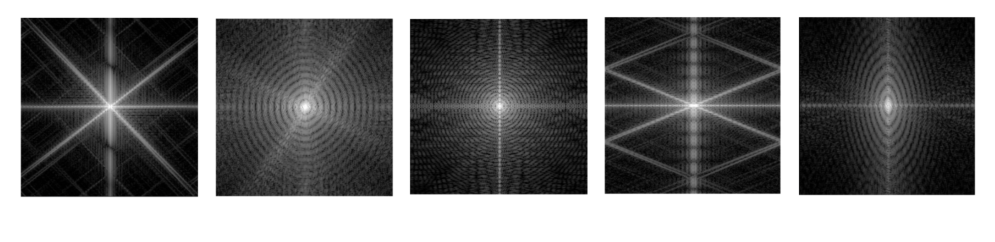
Figure 1: Diffraction patterns.
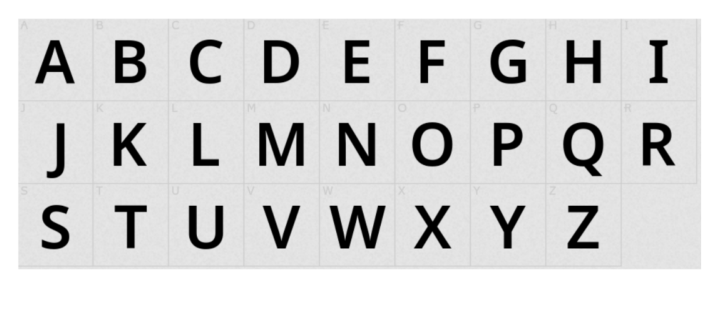
Figure 2: Example font used in the message.
Risposta: KQ/MG
Soluzione:

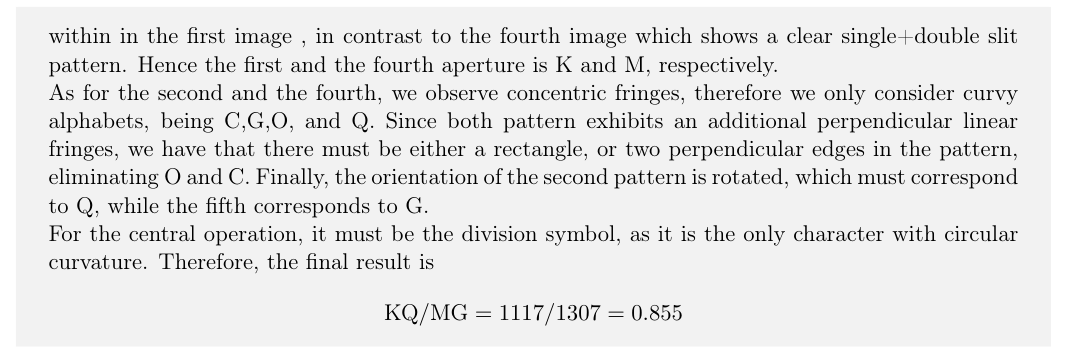
Official solution (OPhO 2026, Physoly), reproduced from the official PDF — p. 20, 21.
Topic: Wave Optics Metodi: Interference & Diffraction Analysis, Symmetry Argument Competenze: Diagrammatic Reasoning, Physical Reasoning Objects: Slit, Screen Fonte: Testo (PDF) — p.8 · Soluzione ufficiale (PDF) — p.20
Crittografia per diffrazione (Risposta breve)
Le cinque immagini qui sotto mostrano cinque figure di diffrazione. L’immagine centrale è la figura di diffrazione di un’apertura che ha la forma di un’operazione matematica binaria (, , , ), mentre le altre rappresentano lettere dell’alfabeto inglese. Le aperture alfabetiche possibili sono le lettere seguenti, con le cifre assegnate: , , …, . Il carattere delle aperture è senza grazie (sans serif), cioè i bordi delle lettere sono semplici segmenti. Per cifrare il messaggio, le cifre delle aperture vengono concatenate e poi combinate con l’operazione binaria. Determina il risultato del messaggio cifrato con tre cifre significative. (Ad esempio, se le aperture sono ACKM, il messaggio rappresenta .)
Non risolvere il problema usando strumenti esterni per calcolare la trasformata di Fourier.
Figura 1: figure di diffrazione.
Figura 2: esempio del carattere usato nel messaggio.
Risposta: KQ/MG
Soluzione: La soluzione ufficiale completa (in inglese) è nella versione originale di questo quesito e nel PDF ufficiale.
Topic: Wave Optics Metodi: Interference & Diffraction Analysis, Symmetry Argument Competenze: Diagrammatic Reasoning, Physical Reasoning Objects: Slit, Screen Fonte: Testo (PDF) — p.8 · Soluzione ufficiale (PDF) — p.20
Compressing Light (Short answer)
A perfectly insulating rigid cylinder is closed at one end and sealed by a movable piston at the other. The cylinder contains a photon gas at initial temperature in a complete vacuum. The walls and piston are purely reflecting. Initially, the cylinder has a length and cross-sectional area . The piston is slowly compressed until the final length of the cylinder is . Find the pressure exerted by the gas on the face of the piston. Give your answer in Pa.
Risposta:
Soluzione:
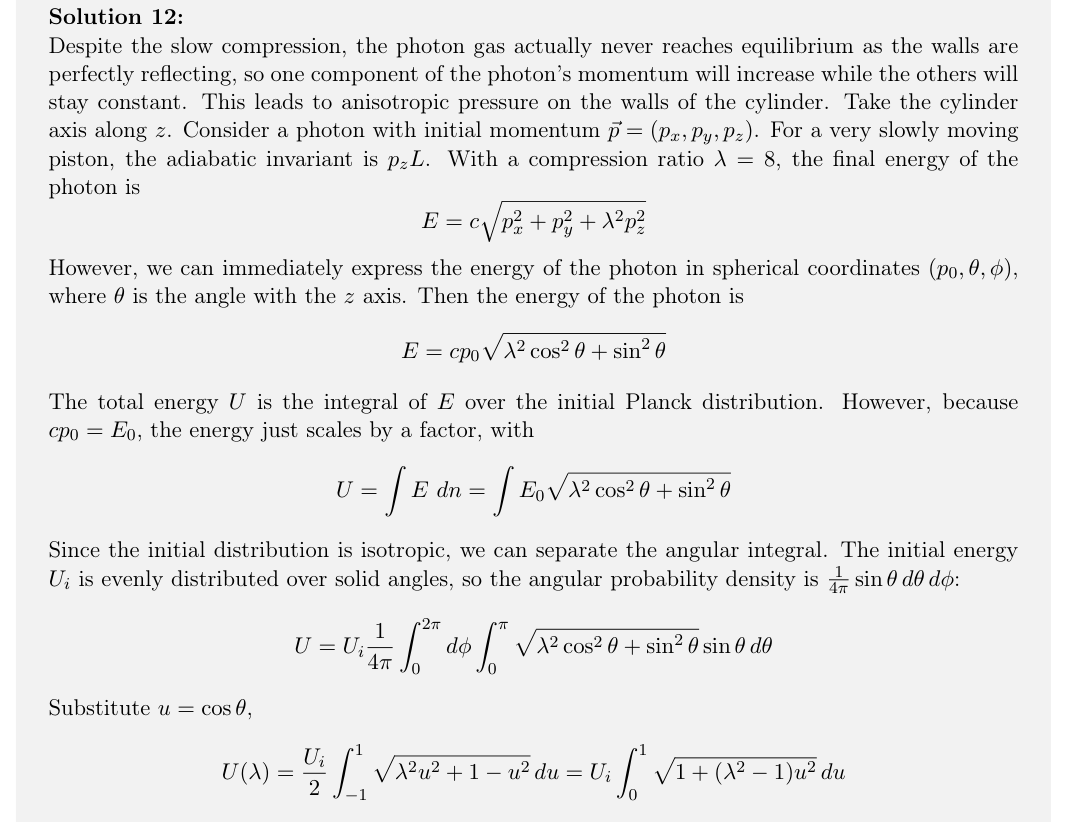
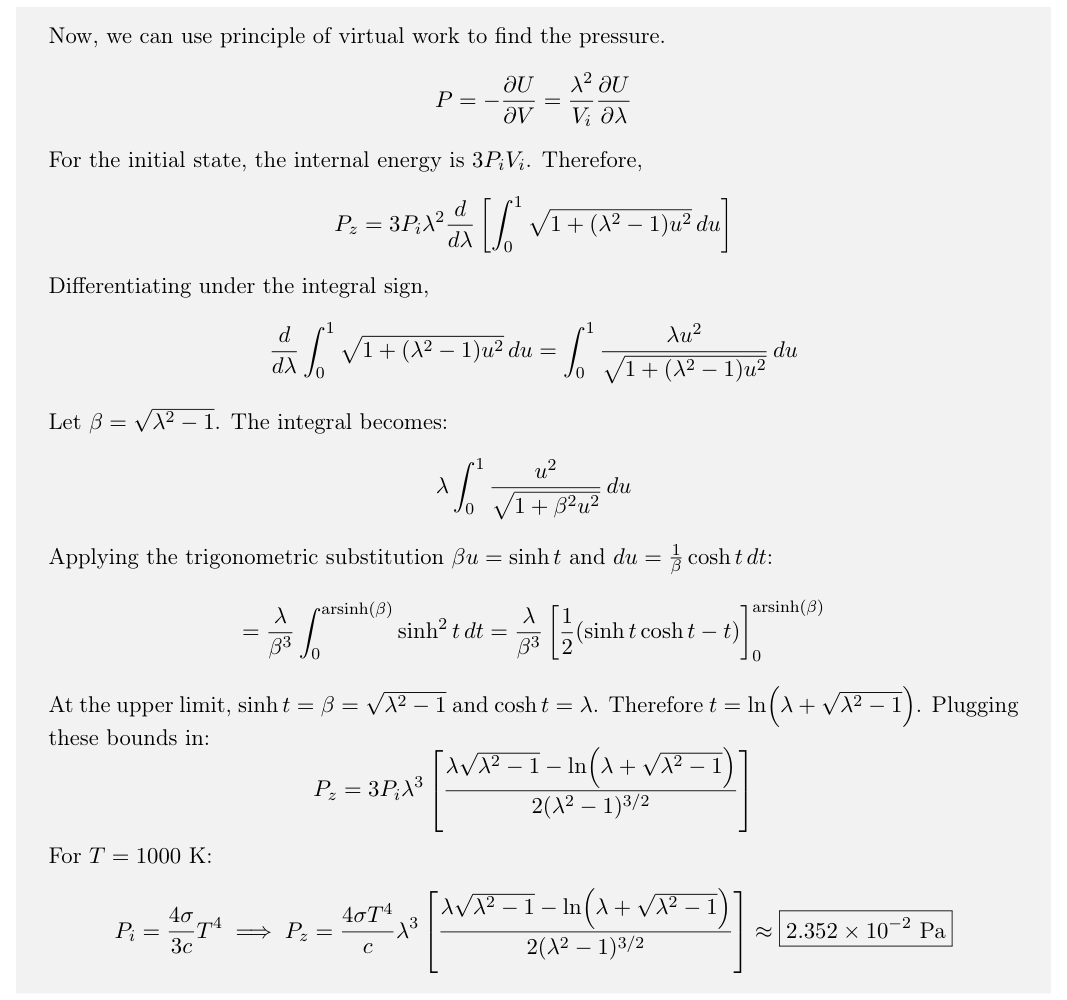
Official solution (OPhO 2026, Physoly), reproduced from the official PDF — p. 21, 22.
Topic: Thermodynamics, Modern-Quantum Physics Metodi: Kinetic Theory of Gases, Calculus-Integration, Physical Modeling Competenze: Mathematical Modeling, Physical Reasoning Objects: Photon, Piston, Gas Fonte: Testo (PDF) — p.9 · Soluzione ufficiale (PDF) — p.21
Comprimere la luce (Risposta breve)
Un cilindro rigido perfettamente isolante è chiuso a un’estremità e sigillato all’altra da un pistone mobile. Il cilindro contiene un gas di fotoni a temperatura iniziale , nel vuoto assoluto. Pareti e pistone sono perfettamente riflettenti. Inizialmente il cilindro ha lunghezza e sezione . Il pistone viene spinto lentamente finché la lunghezza finale del cilindro è . Trova la pressione esercitata dal gas sulla faccia del pistone, in Pa.
Risposta:
Soluzione: La soluzione ufficiale completa (in inglese) è nella versione originale di questo quesito e nel PDF ufficiale.
Topic: Thermodynamics, Modern-Quantum Physics Metodi: Kinetic Theory of Gases, Calculus-Integration, Physical Modeling Competenze: Mathematical Modeling, Physical Reasoning Objects: Photon, Piston, Gas Fonte: Testo (PDF) — p.9 · Soluzione ufficiale (PDF) — p.21
The Odyssey (Short answer)
Achilles has a sealed, opaque container holding one mole of free neutrons together with one mole of a hypothetical particle called the “Odysseon”, whose rest mass is . The two species inside are in mutual thermal equilibrium at a temperature .
He then pokes a tiny hole in the container’s wall, allowing particles of both types to effuse out. As each particle escapes, Achilles records its kinetic energy, and in this way builds up a separate kinetic-energy distribution (spectrum) for each species.
Odysseus, in his wisdom, advises Achilles against analyzing two separate spectra. Achilles, however, trusts his own approach and presses on — computing the root-mean-square (RMS) fluctuation in kinetic energy of the effusing particles, once for the neutrons and once for the Odysseons.
Determine the ratio of these RMS kinetic-energy spreads (standard deviations),
Assumptions: the effusion process is quasi-static, both gases behave ideally, and thermal radiation inside the chamber may be ignored.
Risposta:
Soluzione:
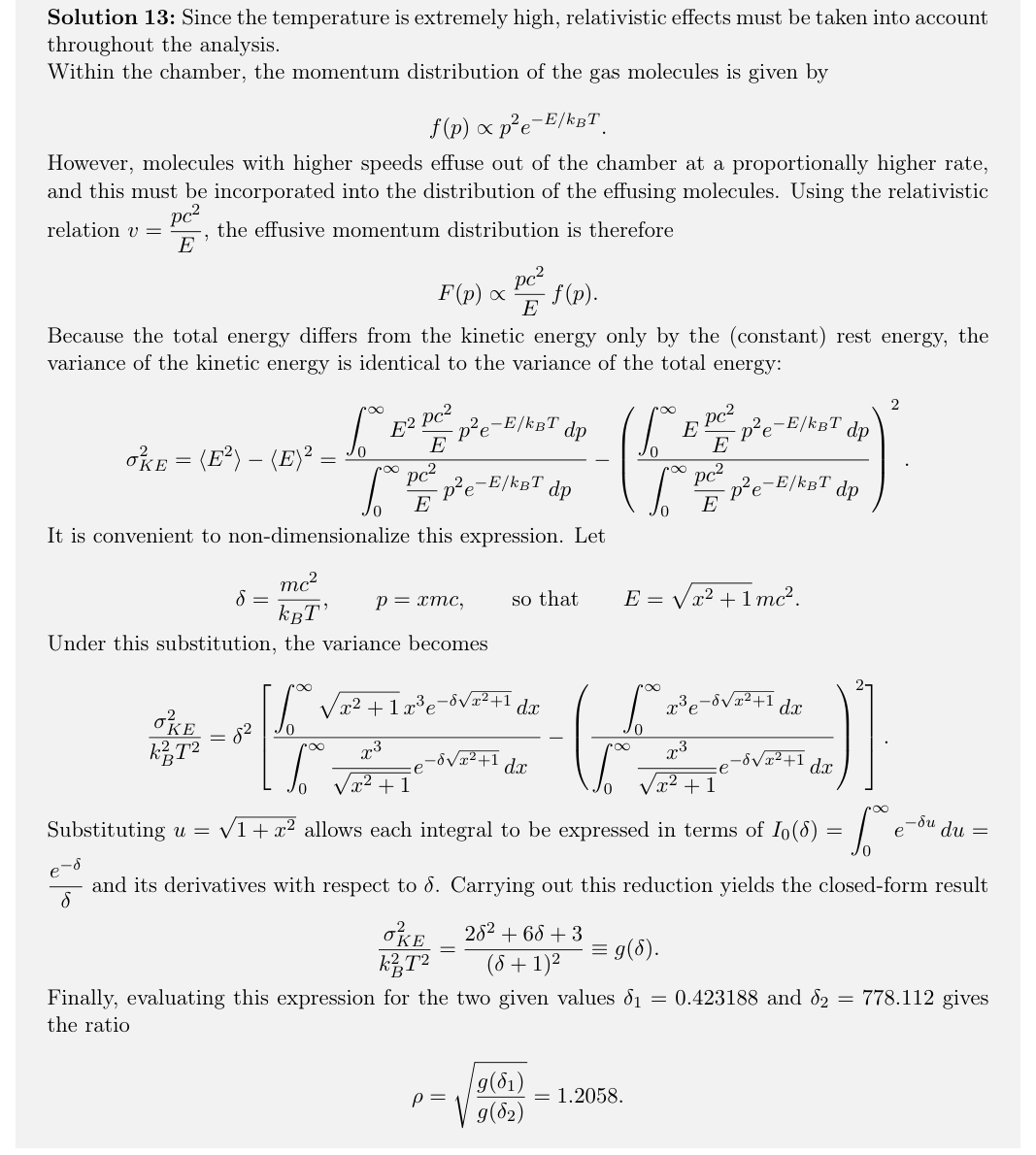
Official solution (OPhO 2026, Physoly), reproduced from the official PDF — p. 23.
Topic: Kinetic Theory, Special Relativity Metodi: Kinetic Theory of Gases, Statistical Averaging, Relativistic Energy-Momentum Competenze: Mathematical Modeling Objects: Gas, Electron Fonte: Testo (PDF) — p.9 · Soluzione ufficiale (PDF) — p.23
L’Odissea (Risposta breve)
Achille ha un contenitore sigillato e opaco che contiene una mole di neutroni liberi insieme a una mole di una particella ipotetica chiamata “Odisseone”, con massa a riposo . Le due specie sono in equilibrio termico reciproco alla temperatura .
Achille pratica poi un minuscolo foro nella parete, lasciando effondere particelle di entrambi i tipi. Per ogni particella che esce registra l’energia cinetica, costruendo così una distribuzione (spettro) di energia cinetica separata per ciascuna specie.
Ulisse, nella sua saggezza, sconsiglia ad Achille di analizzare due spettri separati. Achille però si fida del suo metodo e prosegue, calcolando la fluttuazione quadratica media (RMS) dell’energia cinetica delle particelle effuse, una volta per i neutroni e una volta per gli Odisseoni.
Determina il rapporto tra queste dispersioni RMS dell’energia cinetica (deviazioni standard),
Ipotesi: l’effusione è quasi-statica, entrambi i gas sono ideali e la radiazione termica nella camera si può trascurare.
Risposta:
Soluzione: La soluzione ufficiale completa (in inglese) è nella versione originale di questo quesito e nel PDF ufficiale.
Topic: Kinetic Theory, Special Relativity Metodi: Kinetic Theory of Gases, Statistical Averaging, Relativistic Energy-Momentum Competenze: Mathematical Modeling Objects: Gas, Electron Fonte: Testo (PDF) — p.9 · Soluzione ufficiale (PDF) — p.23
Pursuit of Happiness? (Short answer)
Consider a standard two-dimensional flat Cartesian plane somewhere deep in outer space (called Tristanland). An overworked member of the OPhO committee is standing at rest at the origin. Suddenly, they see an Amazingly Gracious Insect (AGI) at rest at . At , the committee member begins chasing the AGI in their vision; they run at a constant speed of , while the elusive AGI begins running at the same speed in the positive direction as soon as it sees the committee member coming. After a long time, there is a constant distance between the committee member and the AGI; find in meters.
Risposta:
Soluzione:
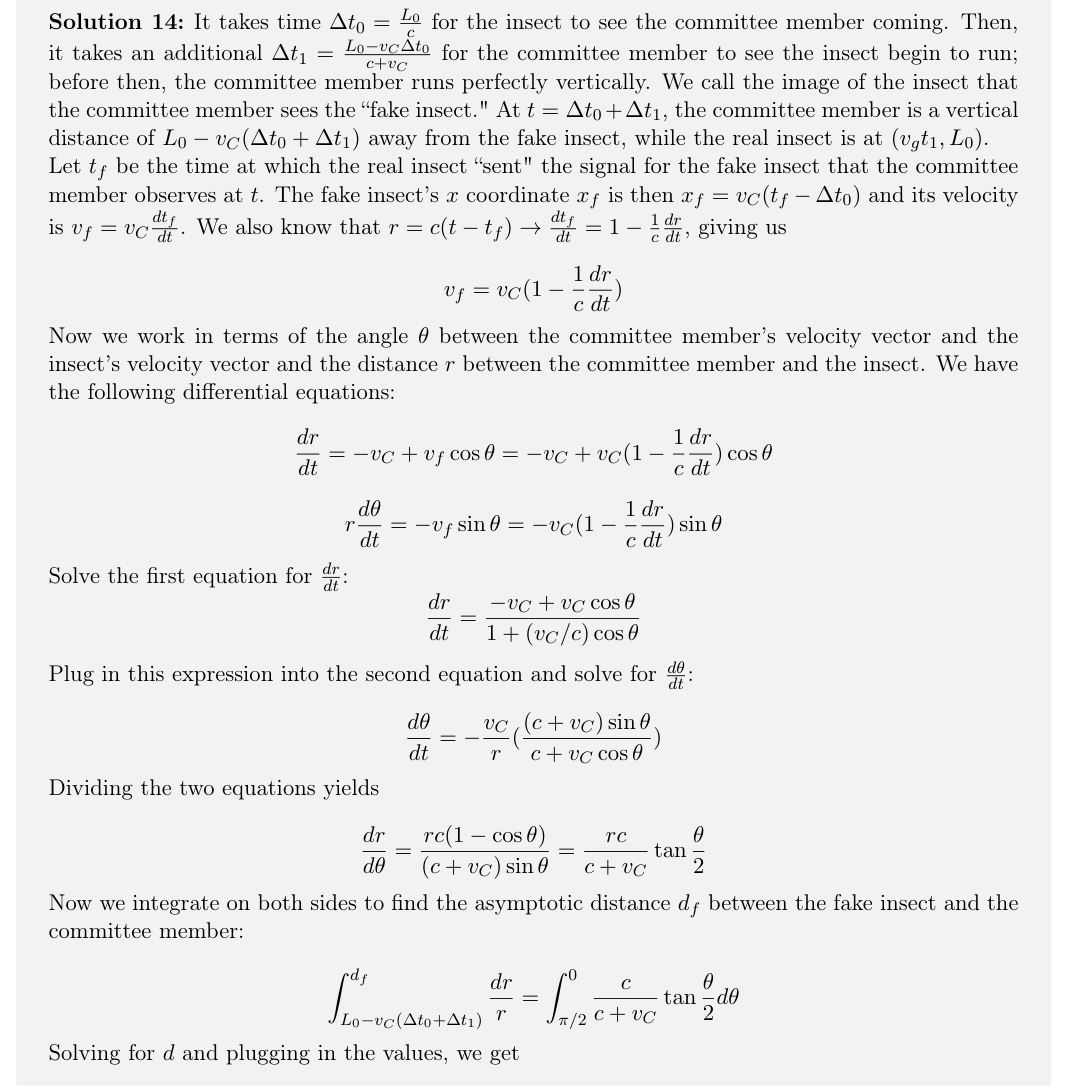
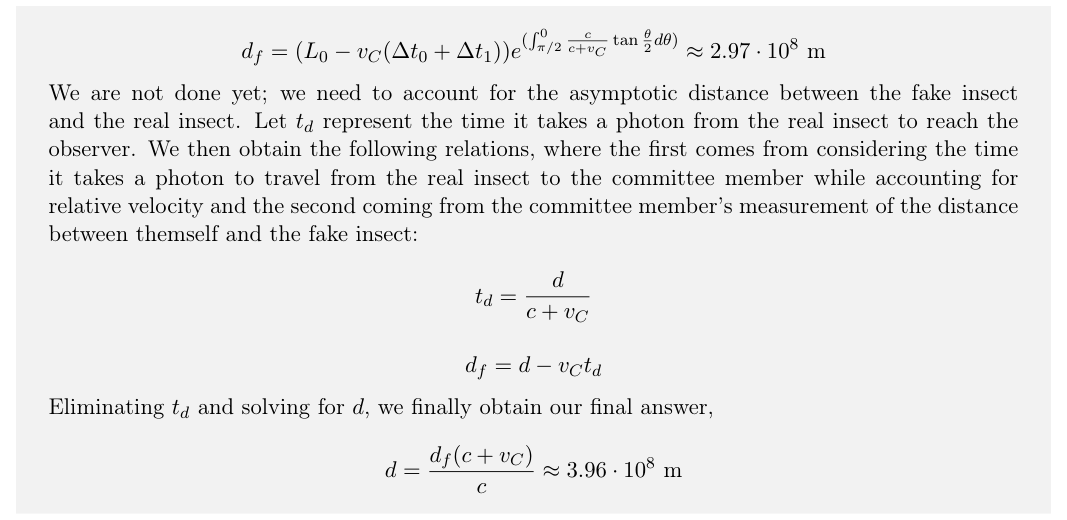
Official solution (OPhO 2026, Physoly), reproduced from the official PDF — p. 24, 25.
Topic: Newtonian Mechanics, Special Relativity Metodi: Kinematic Equations, Differential Equations, Vector Decomposition Competenze: Mathematical Modeling Objects: — Fonte: Testo (PDF) — p.10 · Soluzione ufficiale (PDF) — p.24
Alla ricerca della felicità? (Risposta breve)
Considera un piano cartesiano bidimensionale piatto, da qualche parte nello spazio profondo (detto Tristanland). Un membro sovraccarico di lavoro del comitato OPhO è fermo nell’origine. All’improvviso vede un Insetto Incredibilmente Grazioso (AGI) fermo in . A il membro del comitato inizia a inseguire l’AGI così come lo vede; corre a velocità costante , mentre l’inafferrabile AGI comincia a correre con la stessa velocità nel verso positivo dell’asse non appena vede arrivare l’inseguitore. Dopo molto tempo la distanza tra il membro del comitato e l’AGI diventa costante e pari a ; trova in metri.
Risposta:
Soluzione: La soluzione ufficiale completa (in inglese) è nella versione originale di questo quesito e nel PDF ufficiale.
Topic: Newtonian Mechanics, Special Relativity Metodi: Kinematic Equations, Differential Equations, Vector Decomposition Competenze: Mathematical Modeling Objects: — Fonte: Testo (PDF) — p.10 · Soluzione ufficiale (PDF) — p.24
Aberration (Short answer)
A convex lens is formed by a flat circular surface of diameter and a spherical surface with radius of curvature , as shown in the figure. It has a refractive index .
Light of uniform intensity is incident on the flat surface parallel to the optical axis. The entire lens is illuminated. The intensity pattern produced on the focal plane is shown in the image below. (The -axis is in units of and the -axis is in units of mm.)
You should be able to reverse engineer the radius of curvature and also the diameter of the lens from the plot. Find their product in units of , correct to . Ignore diffraction effects.
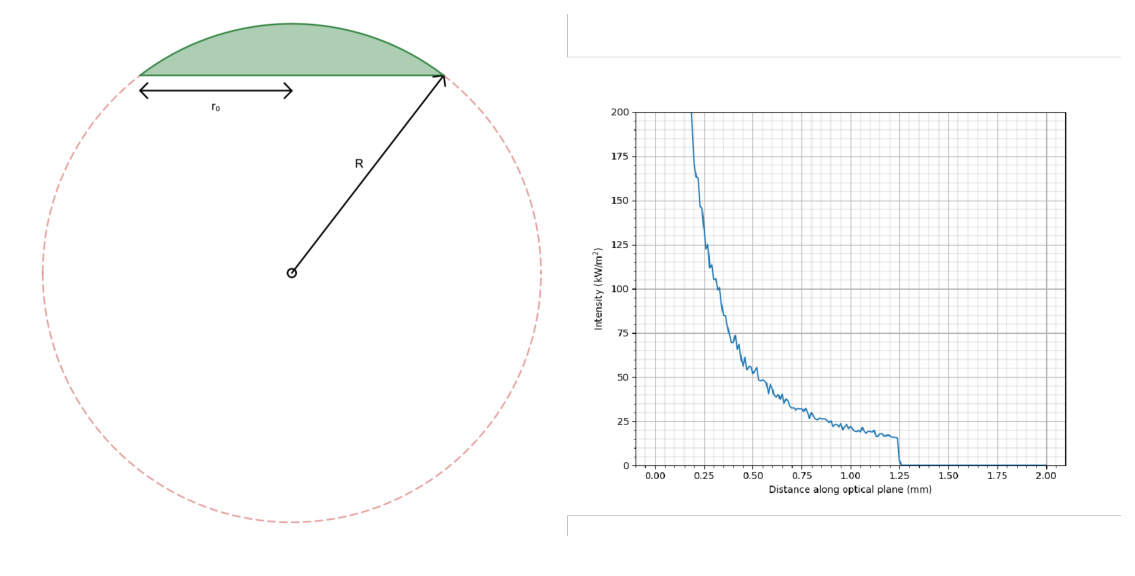
Figure 3: Left: shape of the lens. Right: graph of intensity.
Risposta: (, )
Soluzione:

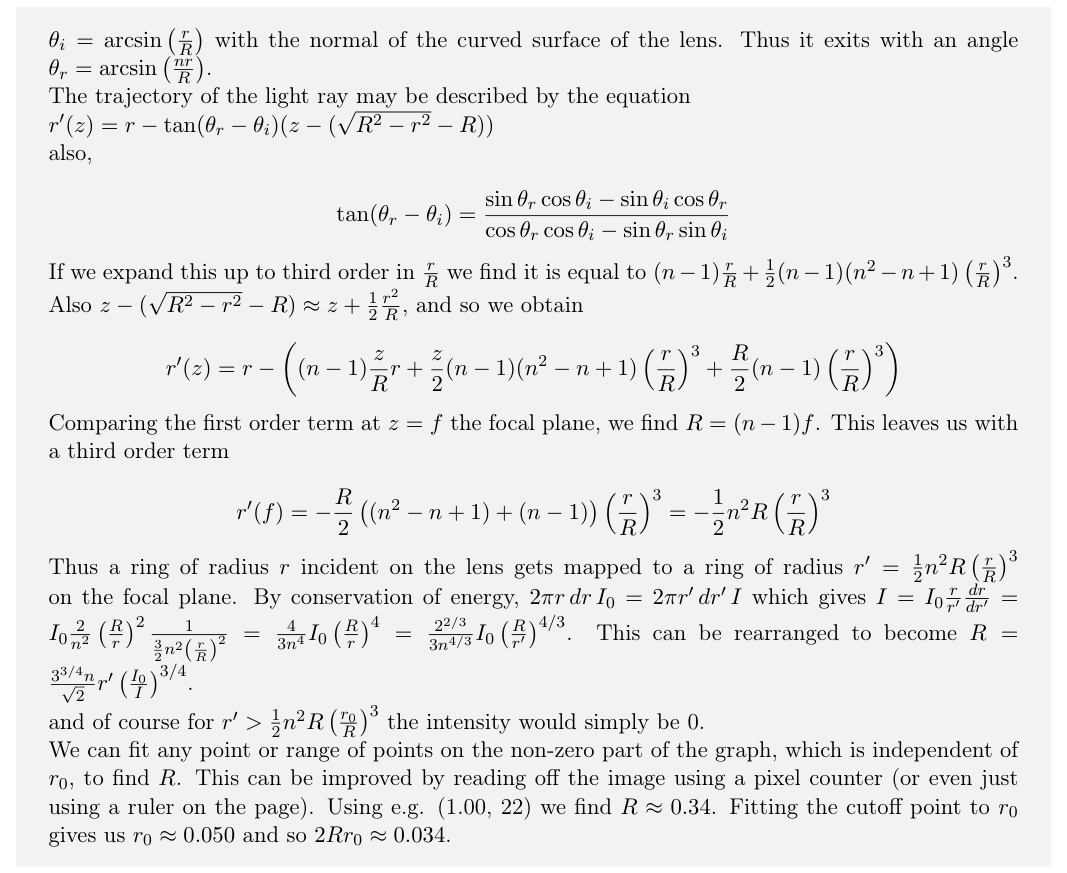
Official solution (OPhO 2026, Physoly), reproduced from the official PDF — p. 25, 26.
Topic: Geometric Optics Metodi: Ray Tracing, Snell’s Law, Experimental Data Analysis Competenze: Experimental Data Analysis, Diagrammatic Reasoning Objects: Lens Fonte: Testo (PDF) — p.10 · Soluzione ufficiale (PDF) — p.25
Aberrazione (Risposta breve)
Una lente convessa è formata da una superficie piana circolare di diametro e da una superficie sferica con raggio di curvatura , come in figura. Il suo indice di rifrazione è .
Luce di intensità uniforme incide sulla faccia piana parallelamente all’asse ottico. Tutta la lente è illuminata. La distribuzione di intensità prodotta sul piano focale è riportata nel grafico qui sotto (asse in , asse in mm).
Dal grafico dovresti riuscire a ricavare sia il raggio di curvatura sia il diametro della lente. Trova il loro prodotto in , con un’accuratezza del . Trascura gli effetti di diffrazione.
Figura 3: a sinistra, forma della lente; a destra, grafico dell’intensità.
Risposta: (, )
Soluzione: La soluzione ufficiale completa (in inglese) è nella versione originale di questo quesito e nel PDF ufficiale.
Topic: Geometric Optics Metodi: Ray Tracing, Snell’s Law, Experimental Data Analysis Competenze: Experimental Data Analysis, Diagrammatic Reasoning Objects: Lens Fonte: Testo (PDF) — p.10 · Soluzione ufficiale (PDF) — p.25
Bee greed (Short answer)
A large number of particles with that do not interact with each other have been launched with a uniform, isotropic angular distribution spanning the plane from the origin with unknown speed . Space around that point is divided along a 2D grid analogous to a chessboard/checkerboard pattern with side length : squares of one “color” (not the one in the image) have a magnetic field of unknown magnitude along the axis, and those of the other have no magnetic field inside them. Find the radius of curvature of the particles’ motion in the field using the following heatmap of squares in which they were detected between 55 and 65 seconds. (The number embedded in each square is the average percentage of particles that ended up there.)
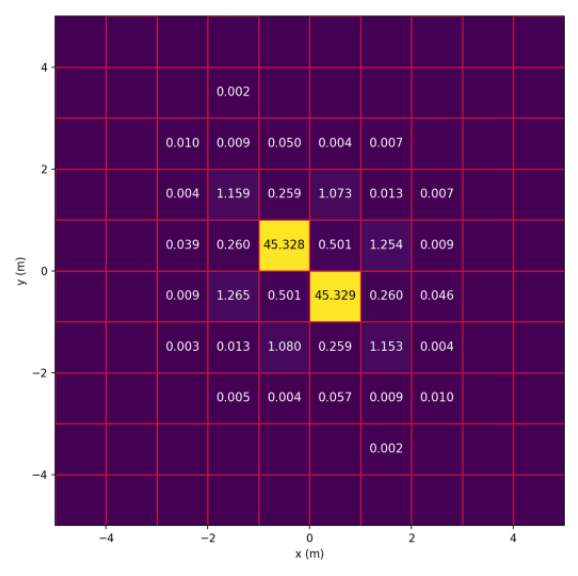
Risposta:
Soluzione:
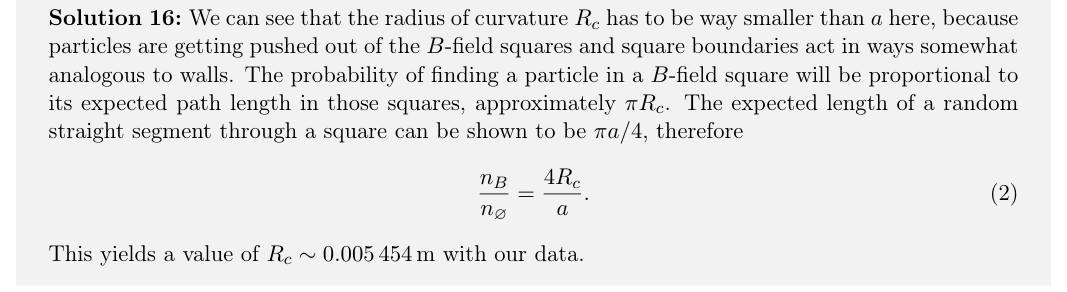
Official solution (OPhO 2026, Physoly), reproduced from the official PDF — p. 27.
Topic: Magnetism Metodi: Lorentz Force Analysis, Statistical Averaging Competenze: Experimental Data Analysis, Estimation & Approximation Objects: Particle Beam Fonte: Testo (PDF) — p.10 · Soluzione ufficiale (PDF) — p.27
Bee greed (scacchiera magnetica) (Risposta breve)
Un gran numero di particelle non interagenti con viene lanciato dall’origine con velocità incognita e distribuzione angolare uniforme e isotropa nel piano . Lo spazio attorno all’origine è diviso da una griglia bidimensionale a scacchiera di lato : nei quadrati di un “colore” (non quello dell’immagine) c’è un campo magnetico di modulo incognito diretto lungo , in quelli dell’altro colore il campo è nullo. Trova il raggio di curvatura del moto delle particelle nel campo usando la mappa di calore seguente, che riporta i quadrati in cui le particelle sono state rilevate tra 55 e 65 secondi. (Il numero in ogni quadrato è la percentuale media di particelle che vi si trovano.)
Risposta:
Soluzione: La soluzione ufficiale completa (in inglese) è nella versione originale di questo quesito e nel PDF ufficiale.
Topic: Magnetism Metodi: Lorentz Force Analysis, Statistical Averaging Competenze: Experimental Data Analysis, Estimation & Approximation Objects: Particle Beam Fonte: Testo (PDF) — p.10 · Soluzione ufficiale (PDF) — p.27
Not Quite Now (Short answer)
A plane electromagnetic wave propagates in vacuum along the direction. In the lab frame, its intensity profile at the initial time can be approximated as for over scales , and the profile thereafter propagates rigidly at speed . An object which is a sphere of radius in its own rest frame is constrained by an external force to move along with constant relativistic speed ; its surface has absorptivity and reflectivity , with reflection taken to be specular. Note that and are constant across the surface, independent of wave polarization or the angle of incidence.
At every instant in the sphere’s rest frame, only a fraction of the absorbed energy is retained by the sphere, the remainder being re-emitted isotropically in that frame.
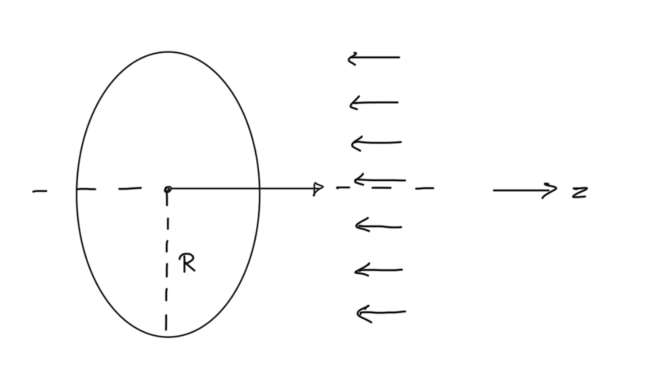
Assuming the sphere’s size is NOT negligible compared to the length scale , find the force applied by the radiation on the sphere as felt in the lab frame, if the sphere’s center starts from the origin at the initial time .
Numerical data: take , , , , , (so ), and evaluate at . Evaluate in newtons, and use a negative sign if the force is along and vice versa.
Risposta:
Soluzione:
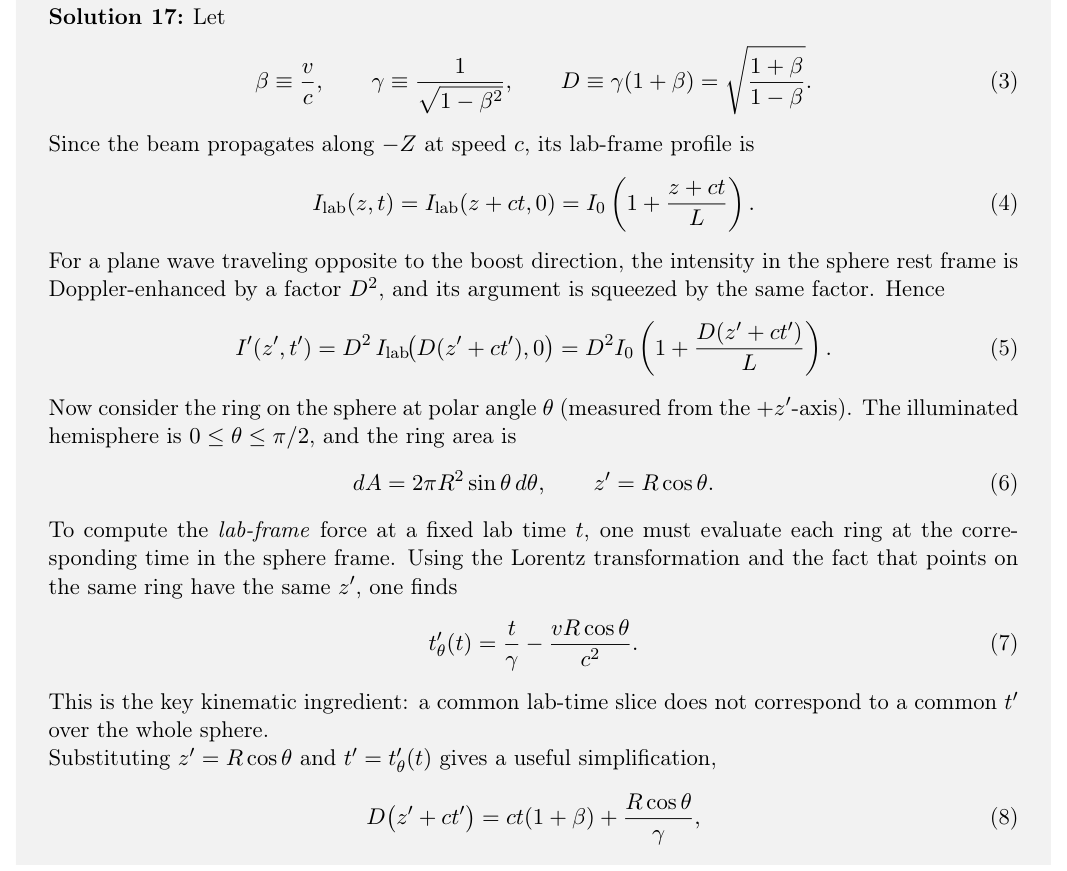
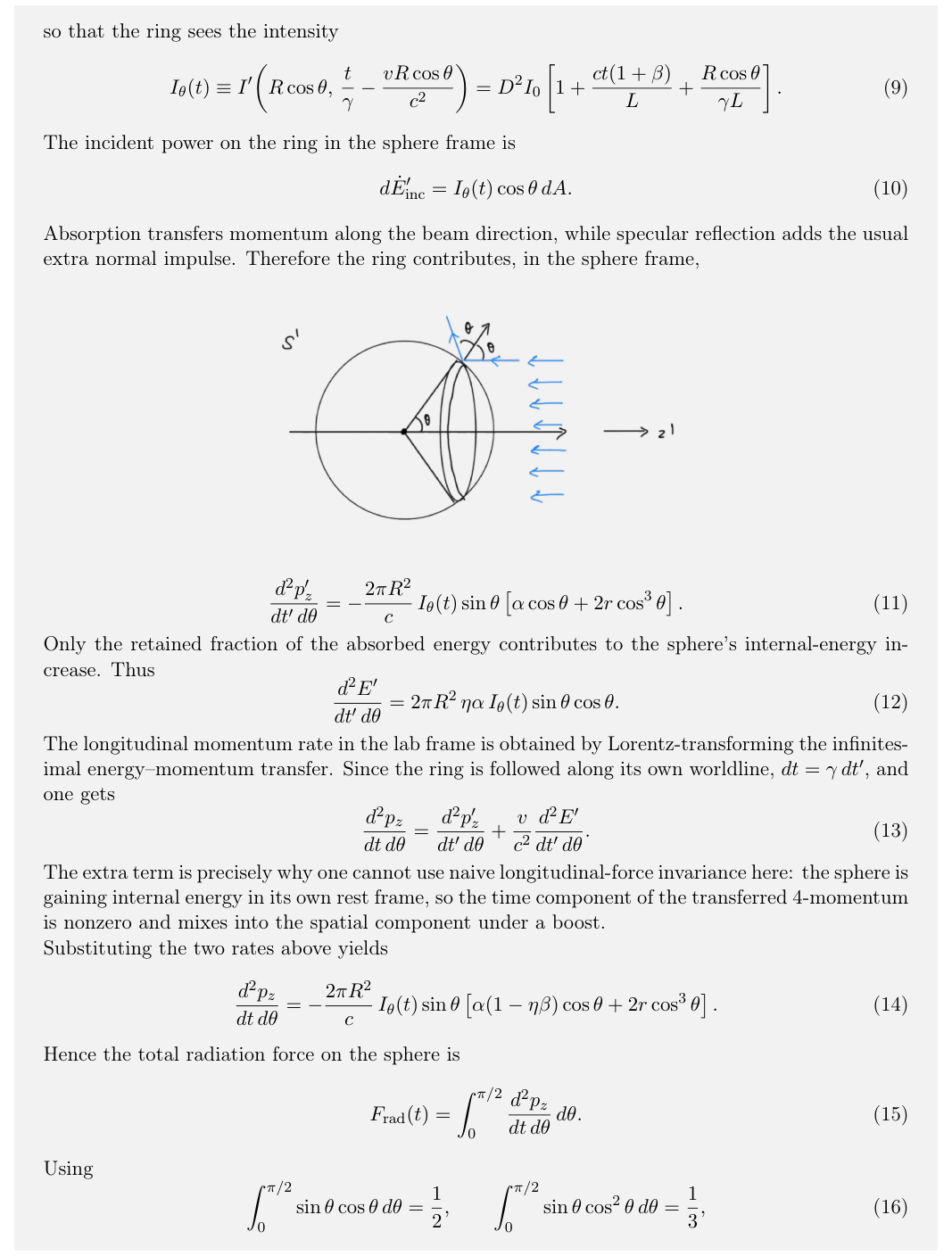
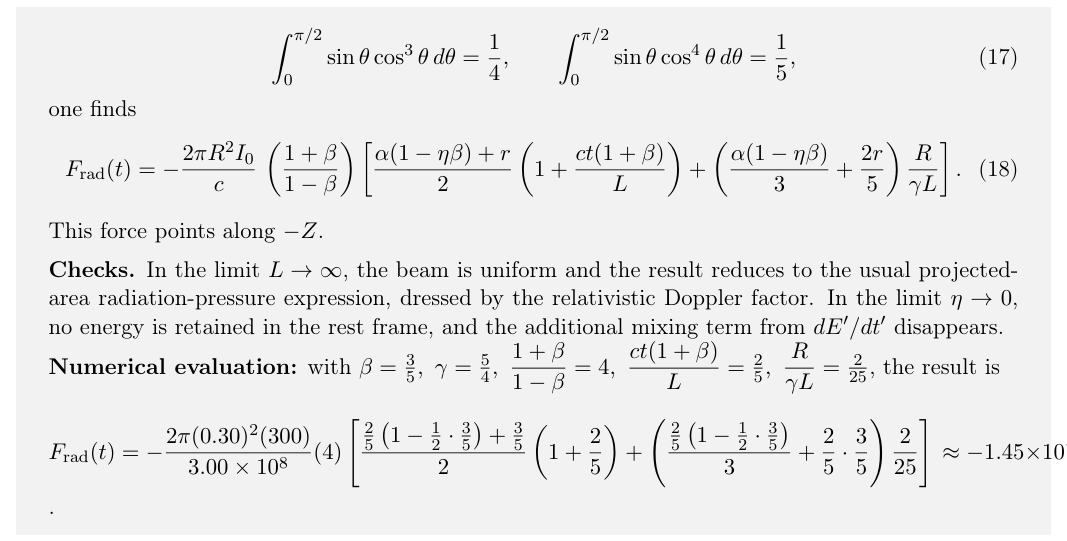
Official solution (OPhO 2026, Physoly), reproduced from the official PDF — p. 28, 29, 30.
Topic: Special Relativity, Electromagnetism Metodi: Lorentz Transformation, Relativistic Energy-Momentum, Calculus-Integration Competenze: Mathematical Modeling Objects: Sphere, Photon Fonte: Testo (PDF) — p.11 · Soluzione ufficiale (PDF) — p.28
Non proprio adesso (Risposta breve)
Un’onda elettromagnetica piana si propaga nel vuoto lungo la direzione . Nel sistema del laboratorio il suo profilo di intensità all’istante iniziale si può approssimare come per su scale ; in seguito il profilo si propaga rigidamente a velocità . Un oggetto che nel proprio sistema di riposo è una sfera di raggio è vincolato da una forza esterna a muoversi lungo con velocità relativistica costante ; la sua superficie ha assorbanza e riflettività , con riflessione speculare. e sono costanti su tutta la superficie e non dipendono dalla polarizzazione dell’onda né dall’angolo di incidenza.
In ogni istante, nel sistema di riposo della sfera, solo una frazione dell’energia assorbita viene trattenuta dalla sfera; il resto viene riemesso isotropicamente in quel sistema.
Supponendo che le dimensioni della sfera NON siano trascurabili rispetto alla scala , trova la forza esercitata dalla radiazione sulla sfera nel sistema del laboratorio, se il centro della sfera parte dall’origine all’istante .
Dati numerici: , , , , , (quindi ); calcola a . Esprimi il risultato in newton, con segno negativo se la forza è diretta lungo e positivo nel caso opposto.
Risposta:
Soluzione: La soluzione ufficiale completa (in inglese) è nella versione originale di questo quesito e nel PDF ufficiale.
Topic: Special Relativity, Electromagnetism Metodi: Lorentz Transformation, Relativistic Energy-Momentum, Calculus-Integration Competenze: Mathematical Modeling Objects: Sphere, Photon Fonte: Testo (PDF) — p.11 · Soluzione ufficiale (PDF) — p.28
Farampere (Short answer)
Consider a hollow metallic ring torus of mean radius and tube thickness , with . A wedge of the torus is cut out and displaced outward, along its own line of symmetry, by a distance (see the figures below). We call the displaced quarter A and the remaining three-quarter arc B.
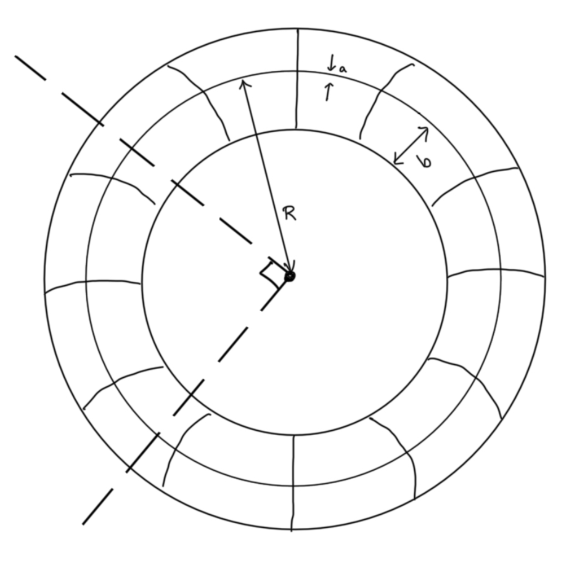
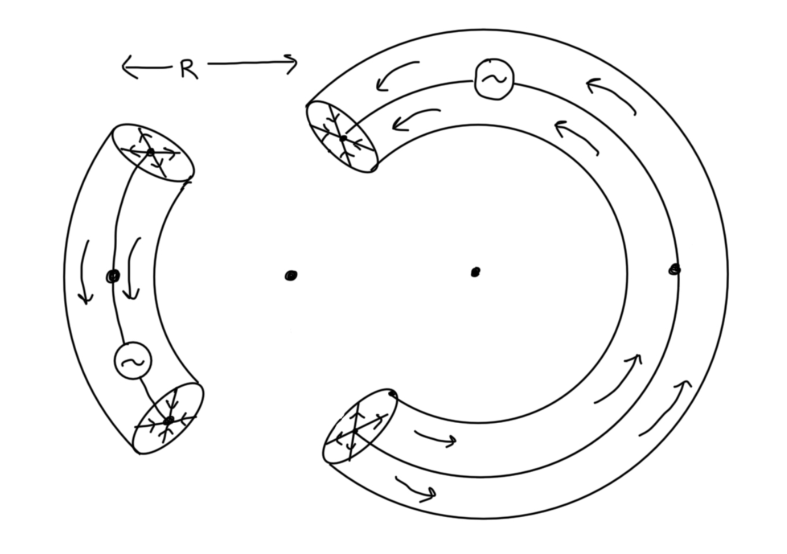
Each piece is wired as a bent coaxial line. A uniform current runs along the toroidal (outer) surface in the directions shown, and at each open end radial spokes hand it off to an inner wire of radius running along the axial circle, so that within both A and B the current closes on itself. An external source drives the current at a common time-rate . Find the interaction force between A and B arising from the changing current.
For a numerical estimate, take , , , , and . Use a negative sign if the force is attractive (the pieces pull together) and a positive sign if it is repulsive.
Risposta: (attractive; numerical value computed from the official formula)
Soluzione:
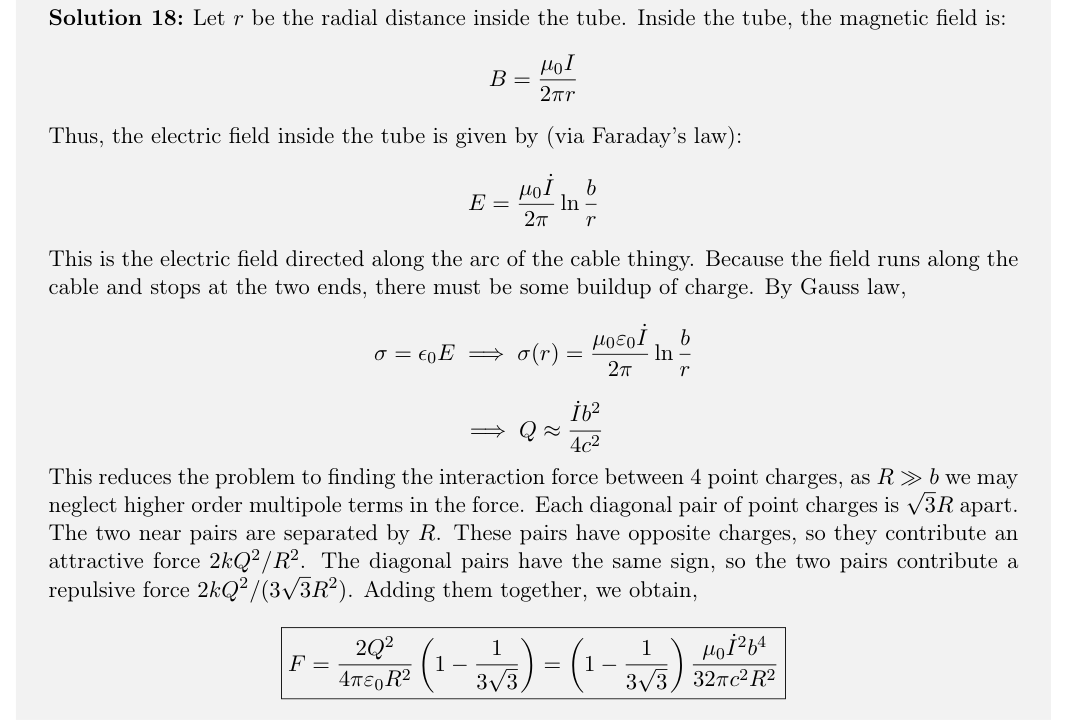
Official solution (OPhO 2026, Physoly), reproduced from the official PDF — p. 31.
Topic: Electromagnetic Induction, Electrostatics Metodi: Faraday’s Law of Induction, Gauss’s Law, Coulomb’s Law Competenze: Mathematical Modeling, Physical Reasoning Objects: Coil, Wire Fonte: Testo (PDF) — p.12 · Soluzione ufficiale (PDF) — p.31
Farampère (Risposta breve)
Considera un toro metallico cavo di raggio medio e spessore del tubo , con . Uno spicchio di del toro viene tagliato e spostato verso l’esterno, lungo il proprio asse di simmetria, di una distanza (vedi le figure). Chiamiamo A il quarto spostato e B l’arco di tre quarti rimanente.
Ciascun pezzo è cablato come una linea coassiale curva. Una corrente uniforme scorre sulla superficie toroidale (esterna) nei versi indicati e, a ogni estremità aperta, raggi radiali la trasferiscono a un filo interno di raggio che corre lungo la circonferenza assiale, così che sia in A sia in B la corrente si richiuda su sé stessa. Una sorgente esterna fa variare la corrente con lo stesso ritmo in entrambi i pezzi. Trova la forza di interazione tra A e B dovuta alla corrente variabile.
Per una stima numerica usa , , , e . Usa il segno negativo se la forza è attrattiva (i pezzi si avvicinano) e positivo se è repulsiva.
Risposta: (attrattiva; valore calcolato dalla formula finale della soluzione ufficiale)
Soluzione: La soluzione ufficiale completa (in inglese) è nella versione originale di questo quesito e nel PDF ufficiale.
Topic: Electromagnetic Induction, Electrostatics Metodi: Faraday’s Law of Induction, Gauss’s Law, Coulomb’s Law Competenze: Mathematical Modeling, Physical Reasoning Objects: Coil, Wire Fonte: Testo (PDF) — p.12 · Soluzione ufficiale (PDF) — p.31
Whiplash (Short answer)
A perfectly flexible, inextensible rope of length and linear mass density is attached to the end of a rigid rod of length . The other end of the rod is kept fixed at the origin. The rod is suddenly rotated by 180 degrees at an angular velocity . The initial shape of the rope is an arc of radius , and the rope makes a right angle with the rod where they are attached. Find the total kinetic energy of the rope, in joules. Ignore air resistance and gravity.
Risposta:
Soluzione:
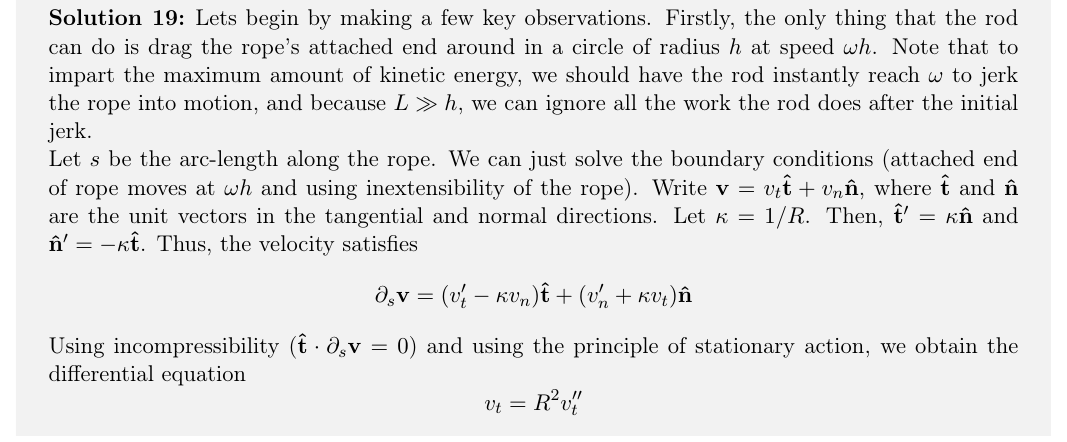
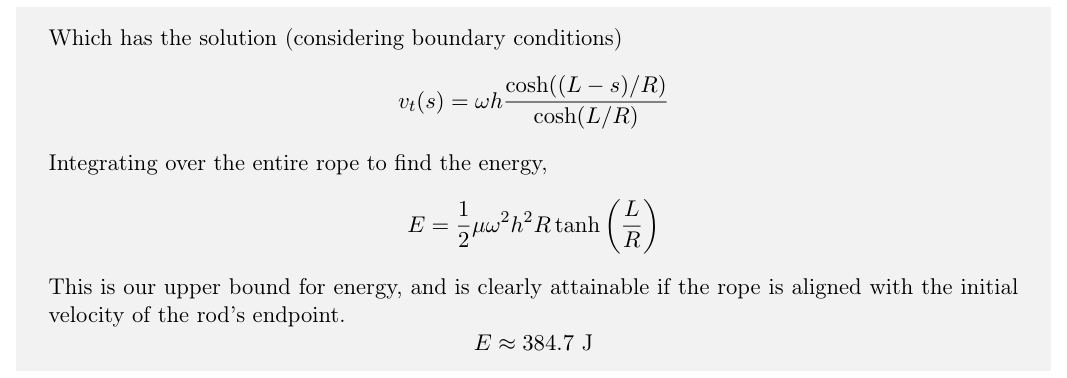
Official solution (OPhO 2026, Physoly), reproduced from the official PDF — p. 31, 32.
Topic: Newtonian Mechanics, Oscillations & Waves Metodi: Impulse-Momentum Theorem, Differential Equations, Wave Equation Competenze: Mathematical Modeling, Physical Reasoning Objects: String, Rod Fonte: Testo (PDF) — p.12 · Soluzione ufficiale (PDF) — p.31
Colpo di frusta (Risposta breve)
Una fune perfettamente flessibile e inestensibile, di lunghezza e densità lineare , è fissata all’estremità di un’asta rigida di lunghezza . L’altra estremità dell’asta è tenuta ferma nell’origine. L’asta viene ruotata improvvisamente di 180 gradi con velocità angolare . Inizialmente la fune ha la forma di un arco di raggio e nel punto di attacco forma un angolo retto con l’asta. Trova l’energia cinetica totale della fune, in joule. Trascura la resistenza dell’aria e la gravità.
Risposta:
Soluzione: La soluzione ufficiale completa (in inglese) è nella versione originale di questo quesito e nel PDF ufficiale.
Topic: Newtonian Mechanics, Oscillations & Waves Metodi: Impulse-Momentum Theorem, Differential Equations, Wave Equation Competenze: Mathematical Modeling, Physical Reasoning Objects: String, Rod Fonte: Testo (PDF) — p.12 · Soluzione ufficiale (PDF) — p.31
Spherical Membrane (Long answer)
Long answer — 10 points.
An ideal gas consisting of classical particles of mass is confined within a harmonic isotropic potential The system is kept at a constant temperature by a thermal bath. A massless, perfectly flexible and perfectly conducting spherical membrane is placed concentrically with the origin. Let the radius of the membrane be . For all parts, assume . When possible, give your answer in terms of .
Initially, the membrane is completely impermeable to the gas particles, and acts as a movable spherical piston. It partitions the gas into two subsystems, an “inner” gas containing particles with and an “outer” gas containing particles in the region . The membrane can freely expand or contract. In the thermodynamic limit (), the membrane settles at an equilibrium radius .
(a) Given , find the value of . [1.5 pts]
As is finite, the membrane radius actually undergoes tiny fluctuations around .
(b) Derive an expression for the mean-square fluctuation in terms of , and . [2.5 pts]
When the fluctuations of the membrane are ignored, the system has a heat capacity . However, when the membrane is free to fluctuate the system has a different heat capacity .
(c) Calculate the difference . [0.5 pts]
Suppose the membrane is now semi-permeable, allowing gas particles to pass through it only if the radial velocity satisfies , where is a fixed energy threshold.
(d) Find all macroscopic equilibrium positions of the membrane. [1.0 pts]
Now, consider fixing the membrane at . Let denote the number of particles with .
(e) Find the mean-square fluctuation . [1.5 pts]
We now once again consider the non-permeable membrane. Suppose the system is initially in thermodynamic and mechanical equilibrium. At time , the stiffness of the harmonic trap is suddenly doubled from .
(f) Find the net force acting on the membrane at . [0.5 pts]
Suppose the membrane now has a constant surface tension , with . The trap stiffness is restored to its original value, and the system is allowed to reach equilibrium.
(g) Estimate the change in the equilibrium radius to first order. [2.5 pts]
Risposta: open answer (7 parts) — see the official solution
Soluzione:
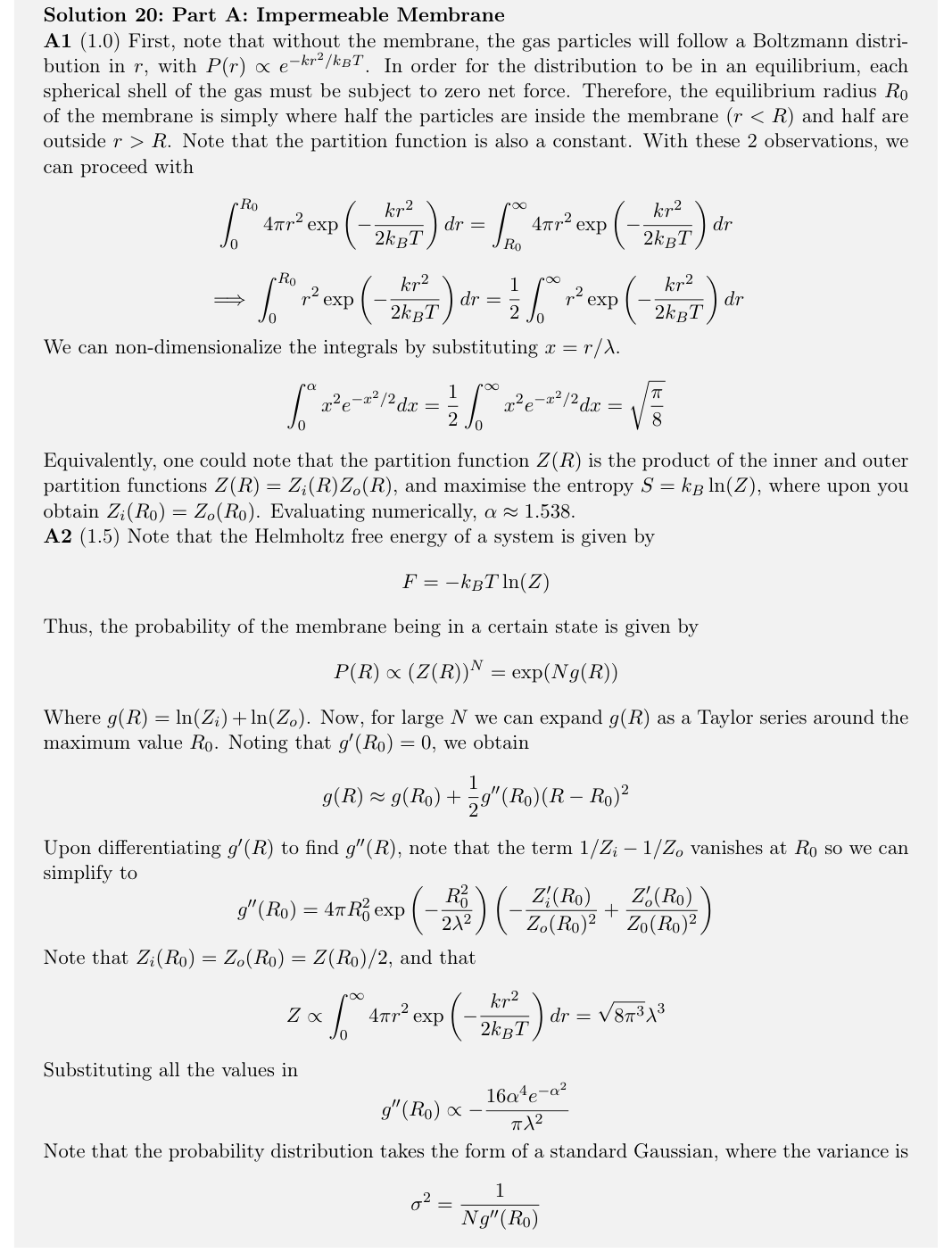
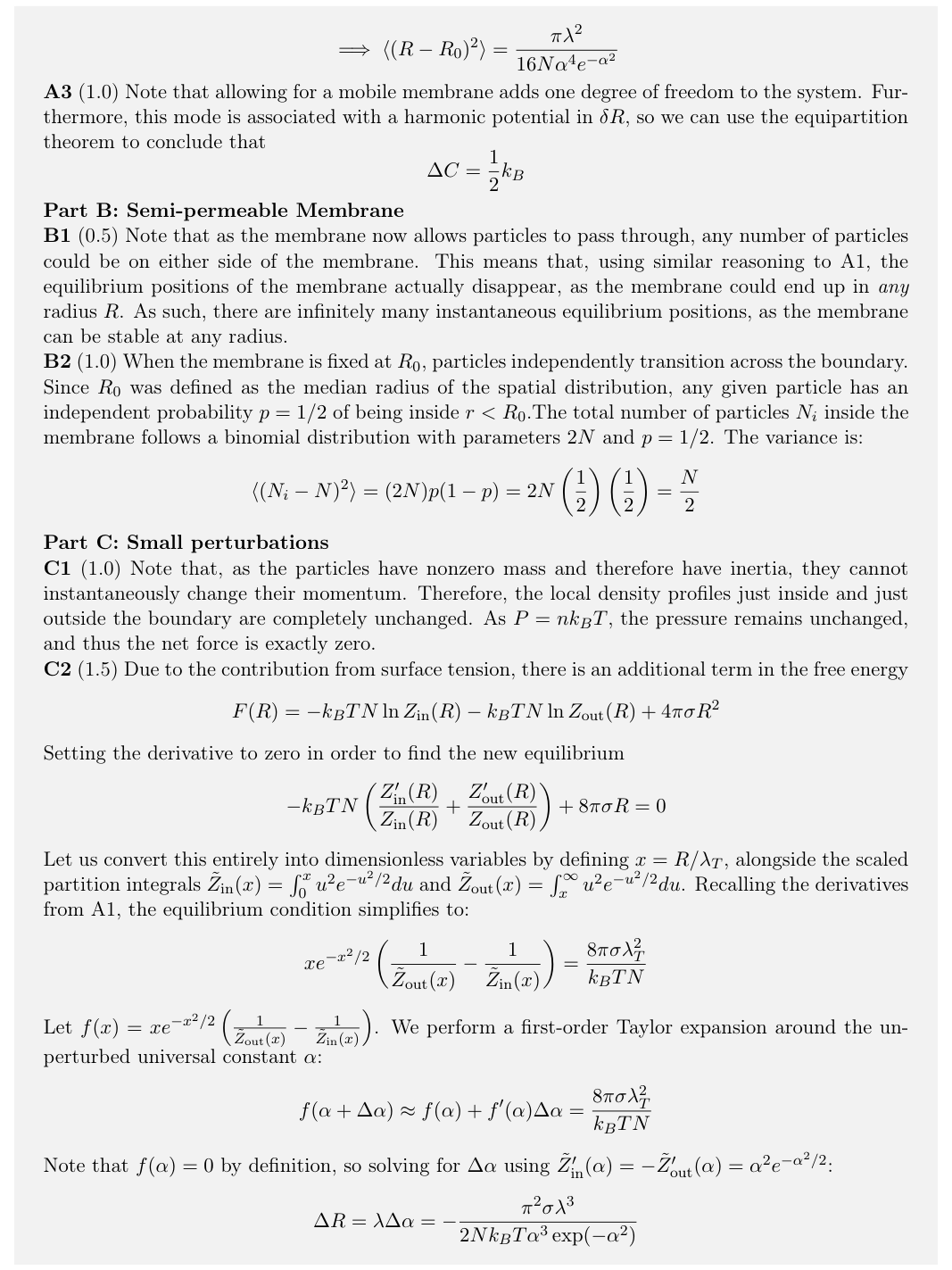
Official solution (OPhO 2026, Physoly), reproduced from the official PDF — p. 34, 35.
Topic: Thermodynamics, Kinetic Theory Metodi: Kinetic Theory of Gases, Statistical Averaging, Approximation & Series Expansion Competenze: Mathematical Modeling, Physical Reasoning Objects: Gas, Membrane Fonte: Testo (PDF) — p.13 · Soluzione ufficiale (PDF) — p.34
Membrana sferica (Risposta lunga)
Problema a risposta lunga — 10 punti.
Un gas ideale formato da particelle classiche di massa è confinato in un potenziale armonico isotropo Il sistema è mantenuto a temperatura costante da un bagno termico. Una membrana sferica priva di massa, perfettamente flessibile e perfettamente conduttrice, è posta in modo concentrico con l’origine; sia il suo raggio. In tutte le parti supponi . Quando possibile, esprimi le risposte in funzione di .
Inizialmente la membrana è del tutto impermeabile alle particelle e funziona da pistone sferico mobile. Divide il gas in due sottosistemi: un gas “interno” di particelle con e un gas “esterno” di particelle nella regione . La membrana può espandersi o contrarsi liberamente. Nel limite termodinamico () la membrana si stabilizza a un raggio di equilibrio .
(a) Posto , trova il valore di . [1,5 punti]
Poiché è finito, il raggio della membrana subisce in realtà piccole fluttuazioni attorno a .
(b) Ricava un’espressione per la fluttuazione quadratica media in funzione di , e . [2,5 punti]
Se si trascurano le fluttuazioni della membrana, il sistema ha capacità termica ; se invece la membrana è libera di fluttuare, la capacità termica è .
(c) Calcola la differenza . [0,5 punti]
Supponi ora che la membrana sia semipermeabile e lasci passare le particelle solo se la velocità radiale soddisfa , con soglia di energia fissata.
(d) Trova tutte le posizioni di equilibrio macroscopico della membrana. [1,0 punti]
Considera ora la membrana fissata in . Sia il numero di particelle con .
(e) Trova la fluttuazione quadratica media . [1,5 punti]
Torniamo alla membrana impermeabile. Il sistema è inizialmente in equilibrio termodinamico e meccanico. All’istante la rigidità della trappola armonica viene raddoppiata improvvisamente, .
(f) Trova la forza netta che agisce sulla membrana a . [0,5 punti]
Supponi ora che la membrana abbia una tensione superficiale costante , con . La rigidità della trappola torna al valore iniziale e il sistema raggiunge l’equilibrio.
(g) Stima al primo ordine la variazione del raggio di equilibrio. [2,5 punti]
Risposta: risposta aperta (7 parti) — vedi la soluzione ufficiale
Soluzione: La soluzione ufficiale completa (in inglese) è nella versione originale di questo quesito e nel PDF ufficiale.
Topic: Thermodynamics, Kinetic Theory Metodi: Kinetic Theory of Gases, Statistical Averaging, Approximation & Series Expansion Competenze: Mathematical Modeling, Physical Reasoning Objects: Gas, Membrane Fonte: Testo (PDF) — p.13 · Soluzione ufficiale (PDF) — p.34
Teo II (Long answer)
Long answer — 10 points.
Kai Wen has discovered another planet: Teo II, a small, dense core with mass surrounded by an atmosphere with negligible mass. The atmosphere is isothermal with temperature , and is composed of two gases with equal adiabatic constants but different molecular masses , , where . Define the dimensionless radial coordinate , and let the mole fraction of the lighter gas be .
Kai Wen is still angry about his decisive poker loss to the inhabitants of Teo I. He detonates a large bomb at radius , sending sound waves through the atmosphere. After a long time, he notices that the sound intensity is large at radius .
(a) Find in terms of . [3.5 pts]
(b) What are the possible values for , if is fixed but the atmospheric composition can vary? [3.5 pts]
(c) Inspecting more closely, he sees that in general, the locations of locally maximum intensity on the sphere of radius form rings. What is the smallest possible such that there are no rings? [3.0 pts]
Risposta: open answer — see the official solution (part c: , )
Soluzione:
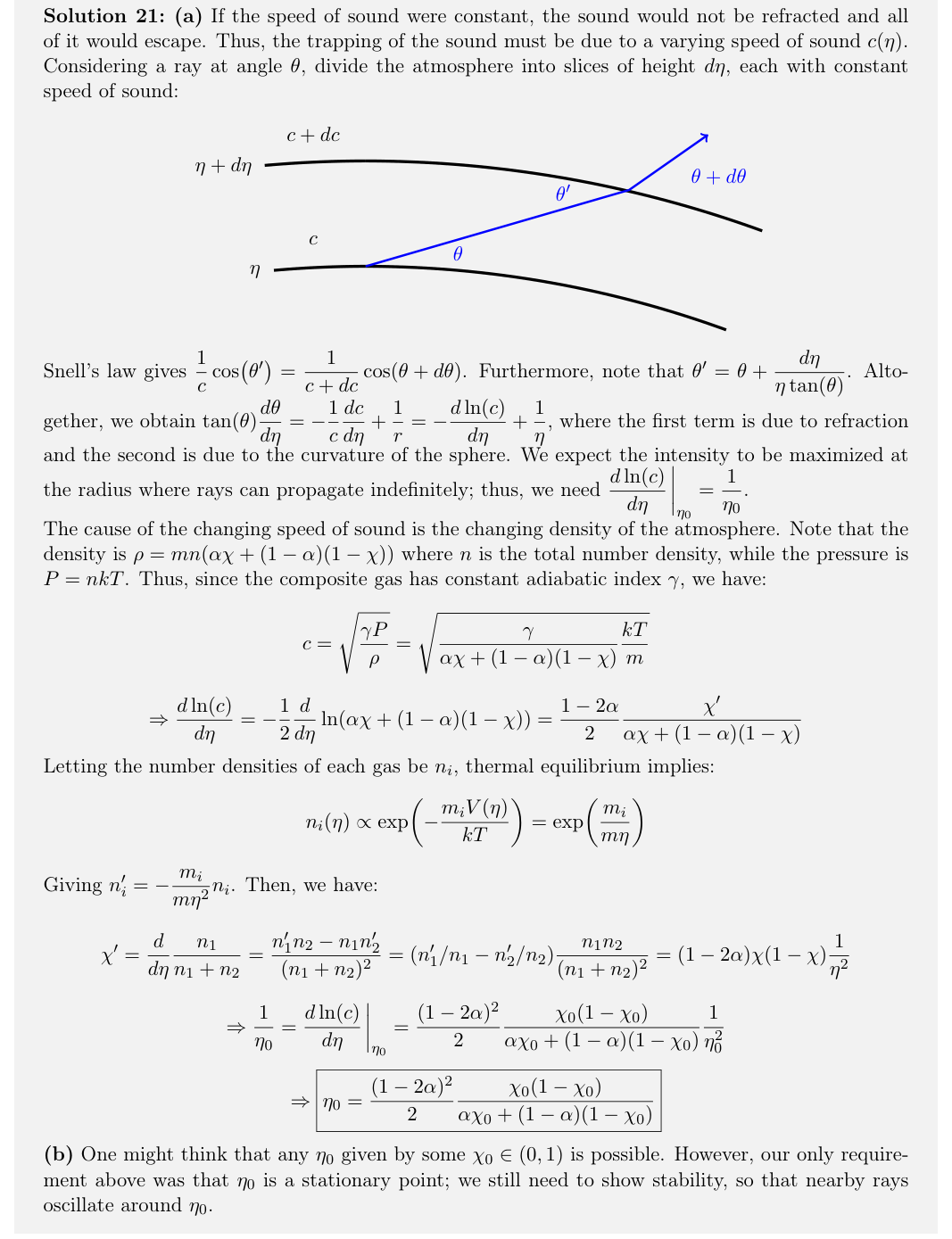
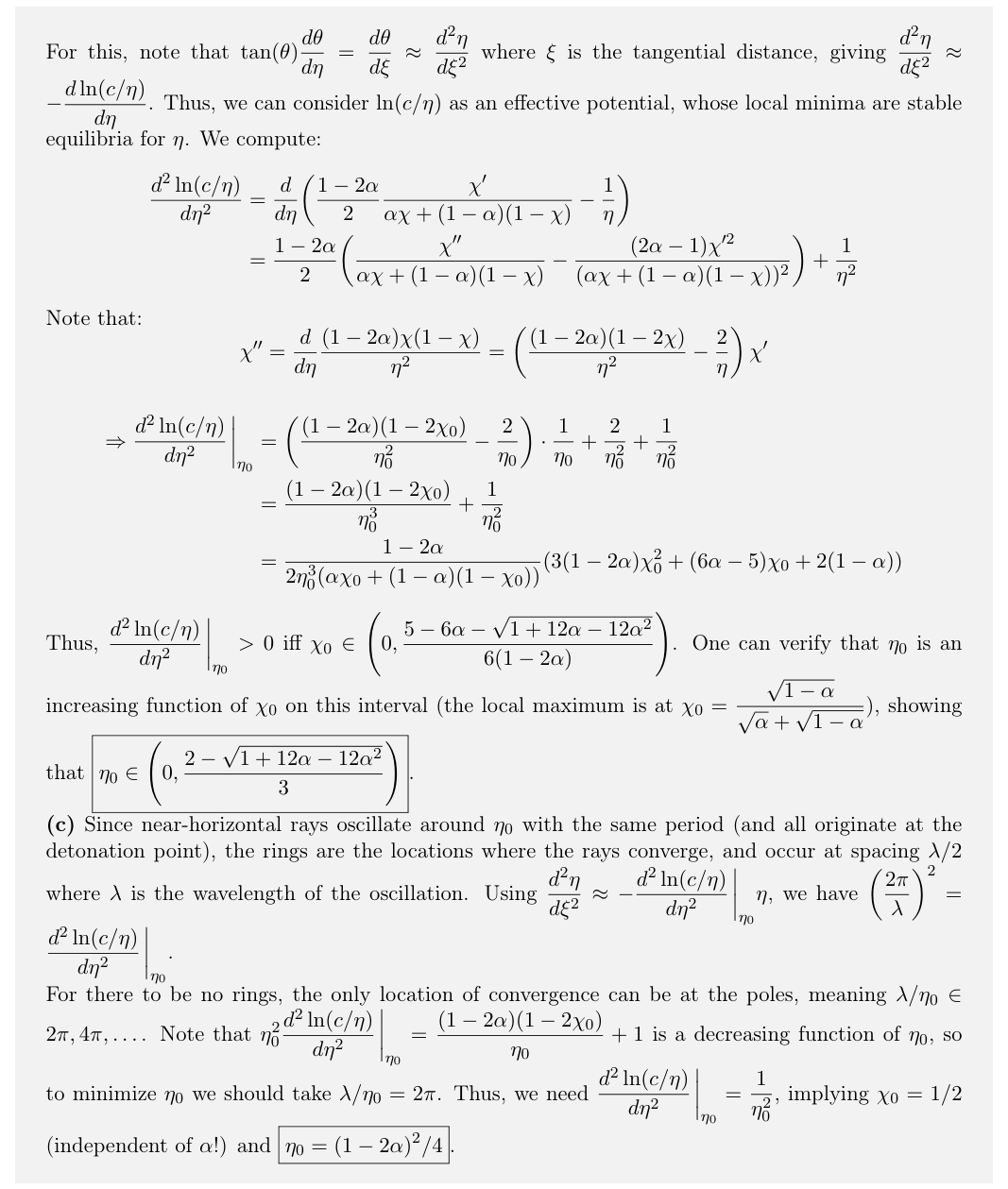
Official solution (OPhO 2026, Physoly), reproduced from the official PDF — p. 37, 38.
Topic: Oscillations & Waves, Gravitation, Thermodynamics Metodi: Wave Equation, Hydrostatic Equilibrium, Differential Equations Competenze: Mathematical Modeling, Physical Reasoning Objects: Planet, Gas Fonte: Testo (PDF) — p.14 · Soluzione ufficiale (PDF) — p.37
Teo II (Risposta lunga)
Problema a risposta lunga — 10 punti.
Kai Wen ha scoperto un altro pianeta: Teo II, un nucleo piccolo e denso di massa circondato da un’atmosfera di massa trascurabile. L’atmosfera è isoterma a temperatura ed è composta da due gas con lo stesso coefficiente adiabatico ma masse molecolari diverse, e , con . Definiamo la coordinata radiale adimensionale e indichiamo con la frazione molare del gas più leggero.
Kai Wen è ancora furioso per la sconfitta decisiva a poker contro gli abitanti di Teo I. Fa esplodere una grande bomba al raggio , generando onde sonore nell’atmosfera. Dopo molto tempo nota che l’intensità sonora è elevata proprio al raggio .
(a) Trova in funzione di . [3,5 punti]
(b) Quali sono i valori possibili di se è fissato ma la composizione dell’atmosfera può variare? [3,5 punti]
(c) Osservando meglio, nota che in generale i punti di massimo locale dell’intensità sulla sfera di raggio formano degli anelli. Qual è il minimo per cui non ci sono anelli? [3,0 punti]
Risposta: risposta aperta — vedi la soluzione ufficiale (parte c: , )
Soluzione: La soluzione ufficiale completa (in inglese) è nella versione originale di questo quesito e nel PDF ufficiale.
Topic: Oscillations & Waves, Gravitation, Thermodynamics Metodi: Wave Equation, Hydrostatic Equilibrium, Differential Equations Competenze: Mathematical Modeling, Physical Reasoning Objects: Planet, Gas Fonte: Testo (PDF) — p.14 · Soluzione ufficiale (PDF) — p.37
Einstein Ring (Long answer)
Long answer — 15 points.
A transparent unit sphere has a small hemispherical indent in its surface, located at . UV light shines on the indent from the direction. The sphere is doped with fluorescent dye that has a chance to absorb UV light and re-emit it as blue light in a random direction. The concentration of dye is small, so a UV photon typically travels a very long distance before being absorbed. Assume that light is either totally reflected or transmitted at interfaces.
A camera far away from the sphere in the direction takes the following image; the center and boundary of the sphere are marked. If the sphere’s indices of refraction for blue and UV light are and respectively:
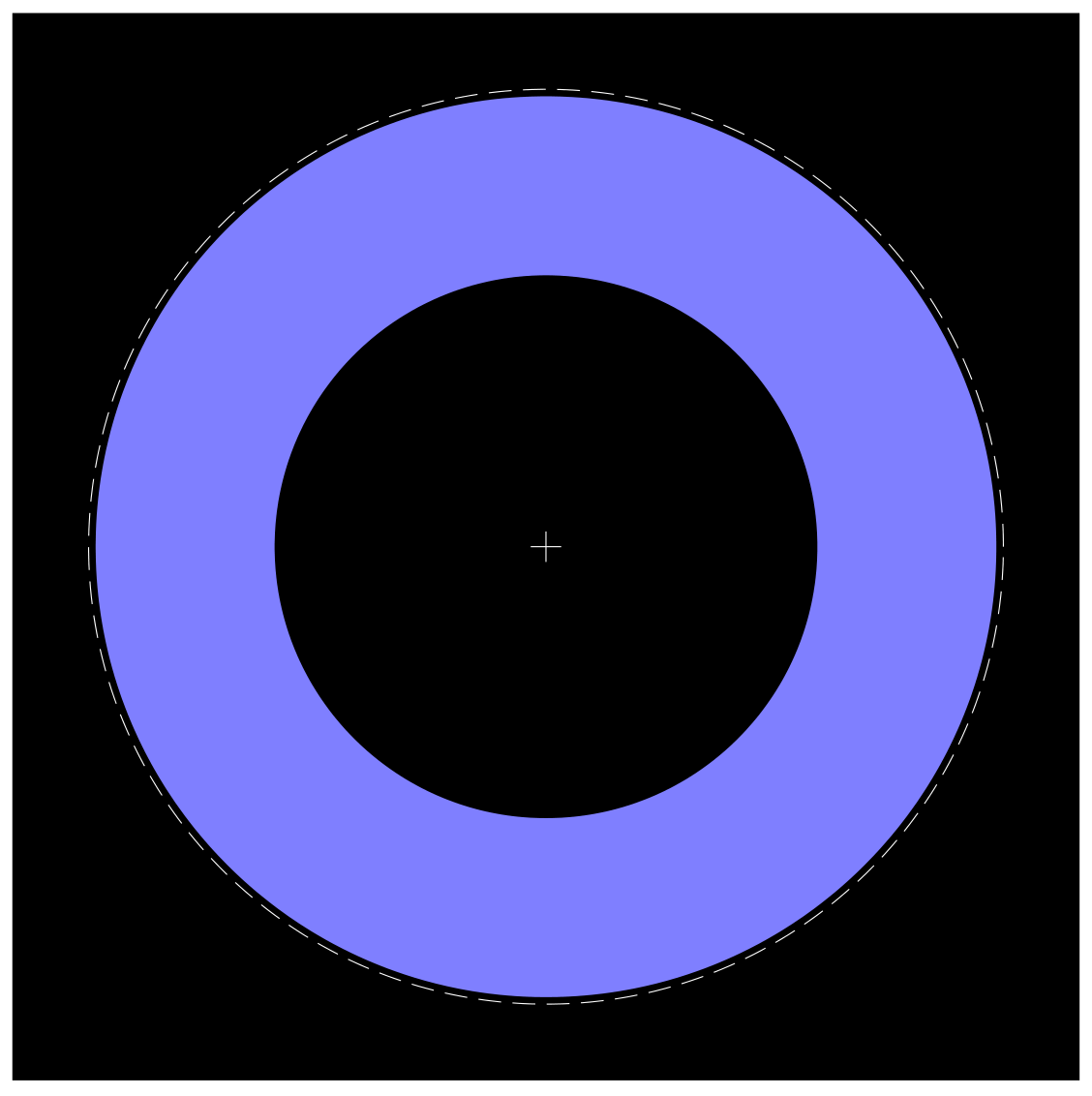
(a) Find . [6.0 pts]
(b) Find . [5.0 pts]
(c) For which values does a similar ring appear? [4.0 pts]
Risposta: open answer — see the official solution
Soluzione:
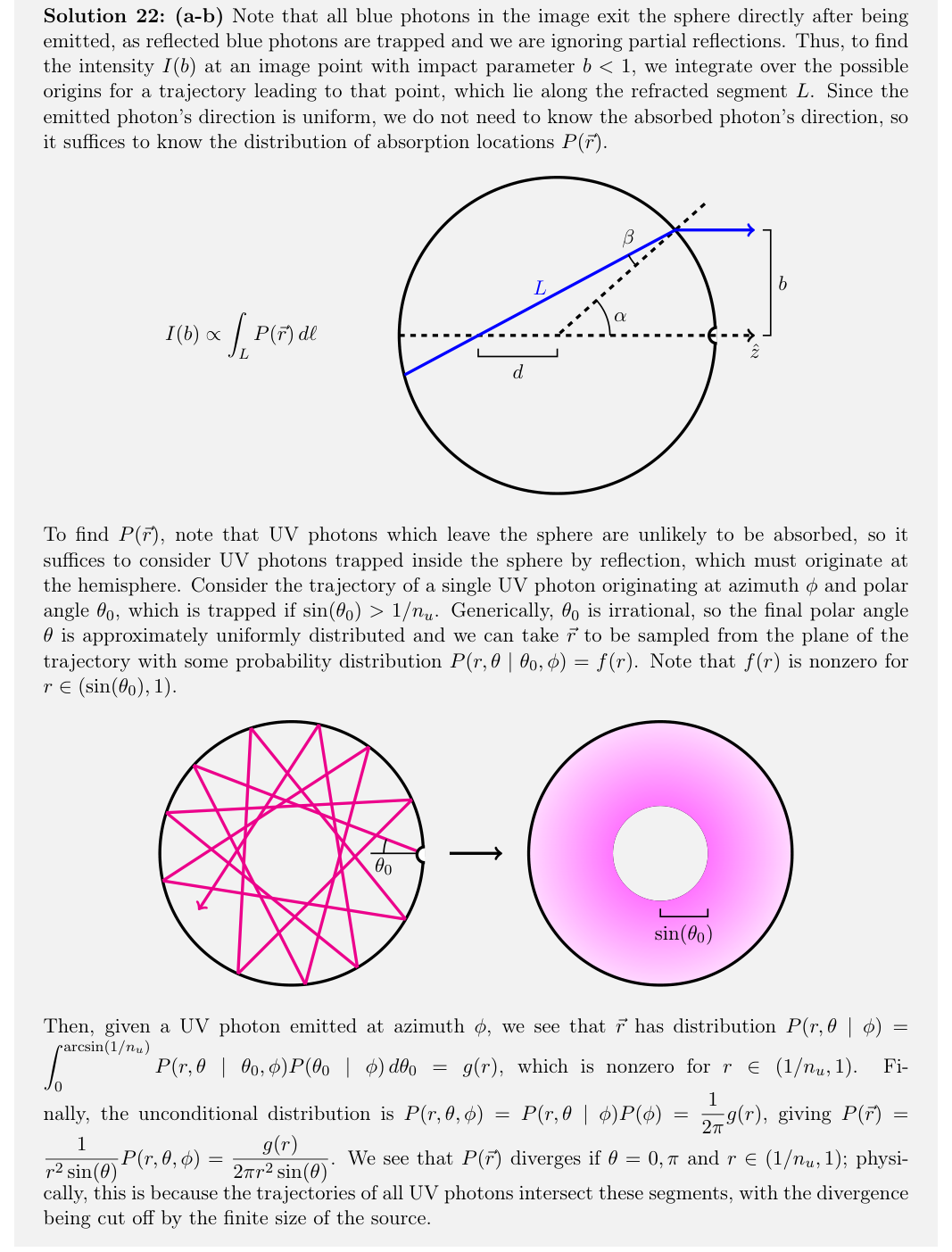
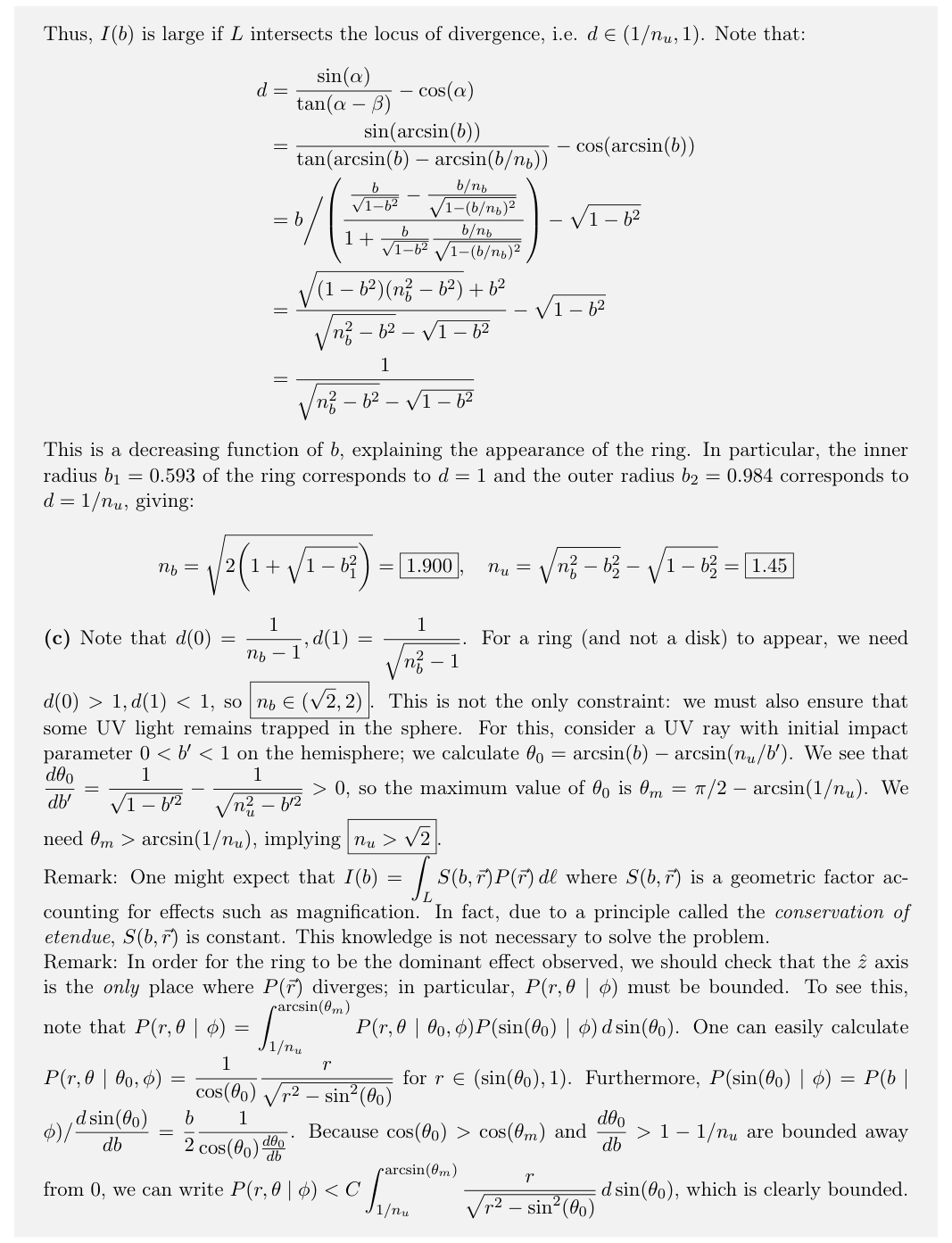
Official solution (OPhO 2026, Physoly), reproduced from the official PDF — p. 40, 41.
Topic: Geometric Optics Metodi: Snell’s Law, Ray Tracing, Symmetry Argument Competenze: Diagrammatic Reasoning, Physical Reasoning Objects: Sphere, Photon Fonte: Testo (PDF) — p.15 · Soluzione ufficiale (PDF) — p.40
Anello di Einstein (Risposta lunga)
Problema a risposta lunga — 15 punti.
Una sfera trasparente di raggio unitario ha sulla superficie una piccola cavità emisferica situata in . Luce UV illumina la cavità provenendo dalla direzione . La sfera è drogata con un colorante fluorescente che può assorbire la luce UV e riemetterla come luce blu in una direzione casuale. La concentrazione di colorante è bassa, quindi un fotone UV percorre in genere una distanza molto lunga prima di essere assorbito. Supponi che alle interfacce la luce sia o totalmente riflessa o totalmente trasmessa.
Una fotocamera molto lontana dalla sfera, nella direzione , scatta l’immagine seguente; sono indicati il centro e il bordo della sfera. Detti e gli indici di rifrazione della sfera per la luce blu e per la luce UV:
(a) Trova . [6,0 punti]
(b) Trova . [5,0 punti]
(c) Per quali valori compare un anello simile? [4,0 punti]
Risposta: risposta aperta — vedi la soluzione ufficiale
Soluzione: La soluzione ufficiale completa (in inglese) è nella versione originale di questo quesito e nel PDF ufficiale.
Topic: Geometric Optics Metodi: Snell’s Law, Ray Tracing, Symmetry Argument Competenze: Diagrammatic Reasoning, Physical Reasoning Objects: Sphere, Photon Fonte: Testo (PDF) — p.15 · Soluzione ufficiale (PDF) — p.40
Spinny Spin Spin (Simulation)
Simulation lab — 10 points. The simulation executable was distributed to teams on the contest portal.
It is well known that the spin of an electron is related to its magnetic moment by , where is the Bohr magneton, is a dimensionless factor that depends on the electron’s environment, and is a vector of magnitude . The angular momentum of the electron is given by .
Now, an ensemble of electron spins are distributed roughly evenly along a rod of length . The rod points in the direction. The left end of the rod is given the coordinate and the right end the coordinate . The magnetic field along the rod points in the direction and is given by . It is known that is on the order of and . You can also add a bias magnetic field which is uniform, but due to budget constraints this magnetic field must be limited to a magnitude of .
The spins are placed in a thermal bath and allowed to thermalise. In this initial stage, each spin will either align with the magnetic field or antiparallel to it according to the Boltzmann distribution. At time , a strong magnetic field pulse is applied to the system to rotate all spins anticlockwise about the axis. You can then set a sensor to detect the total magnetisation along the and axes at certain times (for convenience it will be given in units of ), but remember these measurements are subject to noise! Also, a protection circuit is in place to prevent the initial magnetic field pulse from destroying the measurement circuit, so nothing will be recorded before . After the measurement circuit runs out of memory and nothing will be recorded either.
Your goal is to find and to accuracy, as well as to accuracy. Give the magnetic fields in units of tesla. You may assume the spins do not interact with the environment or with each other after .
Risposta: , ,
Soluzione:
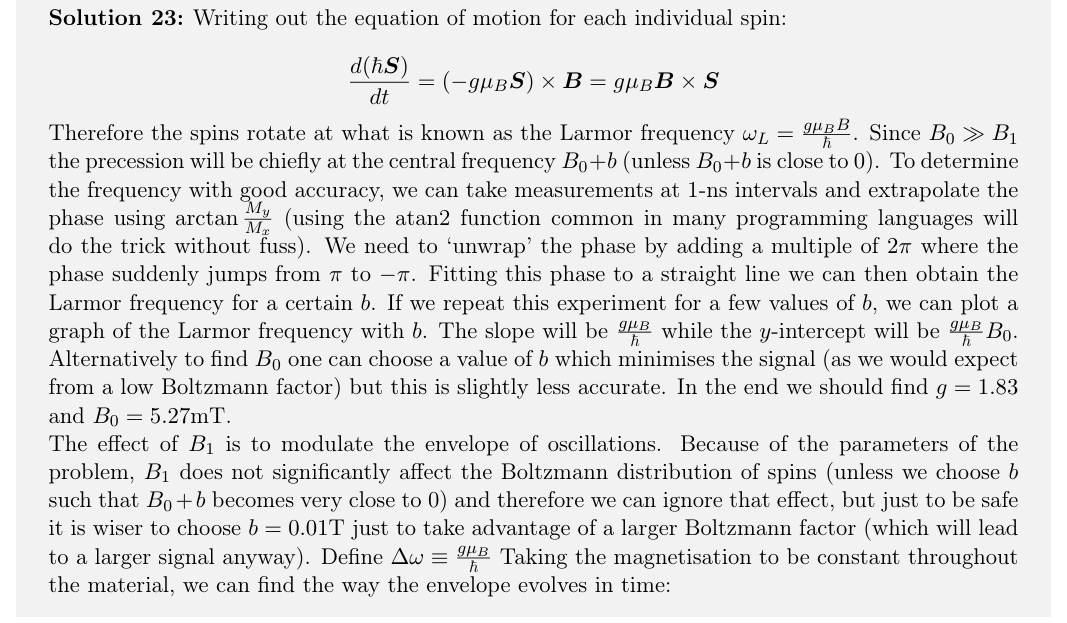
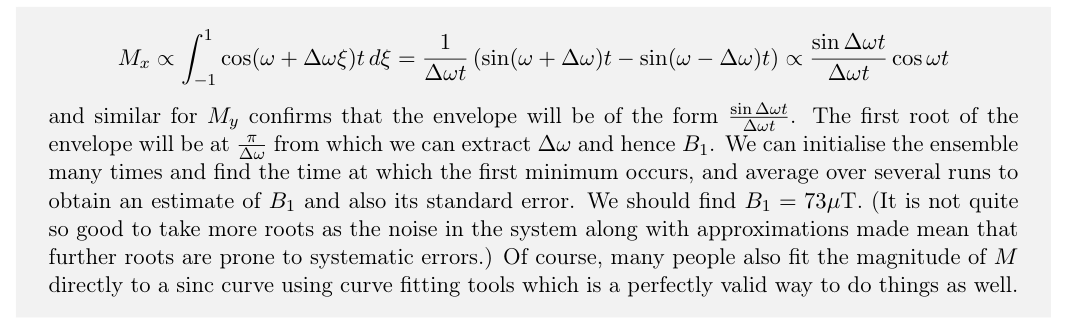
Official solution (OPhO 2026, Physoly), reproduced from the official PDF — p. 42, 43.
Topic: Magnetism, Modern-Quantum Physics Metodi: Experimental Data Analysis, Curve Fitting, Simple Harmonic Motion Analysis Competenze: Experimental Data Analysis, Curve Fitting Objects: Electron, Magnetic Dipole Fonte: Testo (PDF) — p.16 · Soluzione ufficiale (PDF) — p.42
Spin che gira e rigira (Simulazione)
Laboratorio di simulazione — 10 punti. L’eseguibile della simulazione è stato distribuito alle squadre sul portale della gara.
È noto che lo spin di un elettrone è legato al suo momento magnetico da , dove è il magnetone di Bohr, è un fattore adimensionale che dipende dall’ambiente dell’elettrone e è un vettore di modulo . Il momento angolare dell’elettrone è .
Un insieme di spin elettronici è distribuito in modo circa uniforme lungo un’asta di lunghezza , orientata lungo . All’estremità sinistra è assegnata la coordinata e a quella destra . Il campo magnetico lungo l’asta è diretto lungo e vale . È noto che è dell’ordine di e che . Si può anche aggiungere un campo di polarizzazione uniforme , ma per motivi di budget il suo modulo non può superare .
Gli spin vengono messi in un bagno termico e lasciati termalizzare: in questa fase ciascuno si allinea parallelo o antiparallelo al campo secondo la distribuzione di Boltzmann. All’istante un forte impulso di campo magnetico ruota tutti gli spin di in senso antiorario attorno all’asse . Si può poi impostare un sensore che misura la magnetizzazione totale lungo gli assi e in certi istanti (per comodità in unità di ), ricordando che le misure sono affette da rumore! Inoltre un circuito di protezione impedisce che l’impulso iniziale danneggi il circuito di misura, quindi nulla viene registrato prima di ; dopo il circuito esaurisce la memoria e non registra più nulla.
L’obiettivo è trovare e con accuratezza del e con accuratezza del . Esprimi i campi magnetici in tesla. Puoi supporre che dopo gli spin non interagiscano né con l’ambiente né tra loro.
Risposta: , ,
Soluzione: La soluzione ufficiale completa (in inglese) è nella versione originale di questo quesito e nel PDF ufficiale.
Topic: Magnetism, Modern-Quantum Physics Metodi: Experimental Data Analysis, Curve Fitting, Simple Harmonic Motion Analysis Competenze: Experimental Data Analysis, Curve Fitting Objects: Electron, Magnetic Dipole Fonte: Testo (PDF) — p.16 · Soluzione ufficiale (PDF) — p.42
Official answers from the OPhO 2026 solutions (Physoly). Long-answer problems 20–22 are graded on full written solutions.
| Problem | Title | Risposta |
|---|---|---|
| 1 | Very Large Angle Pendulum (Short answer) | |
| 2 | Teo I (Short answer) | light years |
| 3 | Kugel Fountain (Short answer) | |
| 4 | A Different Kind of Superfluid (Short answer) | |
| 5 | Belt friction (Short answer) | (official: ) |
| 6 | Stars and Deltas (Short answer) | |
| 7 | Fridge Magnet (Short answer) | product (official approximate solution: ; exact: ) |
| 8 | Fabric of Reality (Short answer) | |
| 9 | Beam Splitter (Short answer) | (official: ) |
| 10 | Countless Collisions (Short answer) | |
| 11 | Diffractive Cryptography (Short answer) | KQ/MG |
| 12 | Compressing Light (Short answer) | |
| 13 | The Odyssey (Short answer) | |
| 14 | Pursuit of Happiness? (Short answer) | |
| 15 | Aberration (Short answer) | (, ) |
| 16 | Bee greed (Short answer) | |
| 17 | Not Quite Now (Short answer) | |
| 18 | Farampere (Short answer) | (attractive; numerical value computed from the official formula) |
| 19 | Whiplash (Short answer) | |
| 20 | Spherical Membrane (Long answer) | open answer (7 parts) — see the official solution |
| 21 | Teo II (Long answer) | open answer — see the official solution (part c: , ) |
| 22 | Einstein Ring (Long answer) | open answer — see the official solution |
| 23 | Spinny Spin Spin (Simulation) | , , |
Fonte: Testo e soluzioni (PDF)
Risposte ufficiali dalle soluzioni OPhO 2026 (Physoly). I problemi a risposta lunga 20–22 sono valutati sulla soluzione scritta completa.
| Problema | Titolo | Risposta |
|---|---|---|
| 1 | Pendolo ad angoli molto grandi (Risposta breve) | |
| 2 | Teo I (Risposta breve) | anni luce |
| 3 | Fontana a sfera (Risposta breve) | |
| 4 | Un superfluido di tipo diverso (Risposta breve) | |
| 5 | Attrito della cinghia (Risposta breve) | (ufficiale: ) |
| 6 | Stelle e triangoli (Risposta breve) | |
| 7 | Calamita da frigorifero (Risposta breve) | prodotto (soluzione ufficiale approssimata: ; esatta: ) |
| 8 | Il tessuto della realtà (Risposta breve) | |
| 9 | Divisore di fascio (Risposta breve) | (ufficiale: ) |
| 10 | Innumerevoli urti (Risposta breve) | |
| 11 | Crittografia per diffrazione (Risposta breve) | KQ/MG |
| 12 | Comprimere la luce (Risposta breve) | |
| 13 | L’Odissea (Risposta breve) | |
| 14 | Alla ricerca della felicità? (Risposta breve) | |
| 15 | Aberrazione (Risposta breve) | (, ) |
| 16 | Bee greed (scacchiera magnetica) (Risposta breve) | |
| 17 | Non proprio adesso (Risposta breve) | |
| 18 | Farampère (Risposta breve) | (attrattiva; valore calcolato dalla formula finale della soluzione ufficiale) |
| 19 | Colpo di frusta (Risposta breve) | |
| 20 | Membrana sferica (Risposta lunga) | risposta aperta (7 parti) — vedi la soluzione ufficiale |
| 21 | Teo II (Risposta lunga) | risposta aperta — vedi la soluzione ufficiale (parte c: , ) |
| 22 | Anello di Einstein (Risposta lunga) | risposta aperta — vedi la soluzione ufficiale |
| 23 | Spin che gira e rigira (Simulazione) | , , |
Fonte: Testo e soluzioni (PDF)