Prueba experimental — Oscilación de una varilla (XXX Olimpiada Española de Física, Universidad de Salamanca, 25–28 de abril de 2019)
OBJETIVO
Determinar el módulo de Young y la densidad de una varilla de aluminio.
MATERIAL
Metro de papel, sargento, pletina, varilla de aluminio, imanes, cronómetro.
DATOS
- Masa de los dos imanes: g
- Anchura de la varilla: mm
- Grosor de la varilla: mm
FUNDAMENTO TEÓRICO
En esta prueba experimental se va a estudiar la oscilación de una varilla de aluminio de sección rectangular, sujeta por un extremo y libre por el otro (figura 1). Llamaremos y a la masa y la longitud de la porción libre de varilla. Además, sobre la varilla se fija una masa (dos pequeños imanes) a una distancia del extremo fijo. Se demuestra que el periodo de pequeñas oscilaciones de este sistema en un plano vertical viene dado por
donde es el llamado módulo de Young del material, que caracteriza su elasticidad frente a esfuerzos de tracción o compresión, es la anchura de la varilla y su grosor.
Por otra parte, la densidad del aluminio, , está relacionada con la masa y dimensiones de la varilla en la forma
MONTAJE DEL SISTEMA
Trace en la varilla una línea transversal con bolígrafo o lápiz a 80,0 cm del extremo que no tiene etiqueta. Con el sargento, aprisione la varilla entre la pletina y el borde de la mesa, dejando la longitud libre de varilla cm previamente marcada (figura 2). El borde de la pletina, la marca en la varilla y el borde de la mesa deben ser paralelos y quedar en el mismo plano vertical. La varilla debe quedar perpendicular a los bordes de la mesa y de la pletina. Una vez conseguida esta posición, sujete con firmeza el sistema apretando el sargento.
PROCEDIMIENTO EXPERIMENTAL — Apartado 1
Sitúe los dos imanes uno a cada lado del extremo libre de la varilla (figura 3). Mida con el metro la distancia desde el borde de la pletina hasta el centro de los imanes, . Haga oscilar verticalmente el sistema, con pequeña amplitud. Empleando el cronómetro, determine el periodo de oscilación, . Describa detalladamente el procedimiento empleado.
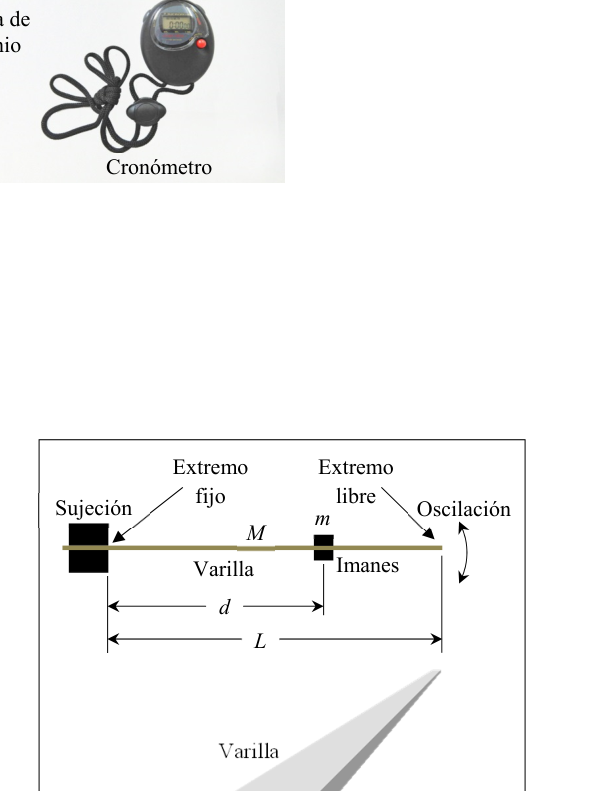 Fig. 1: varilla sujeta con imanes
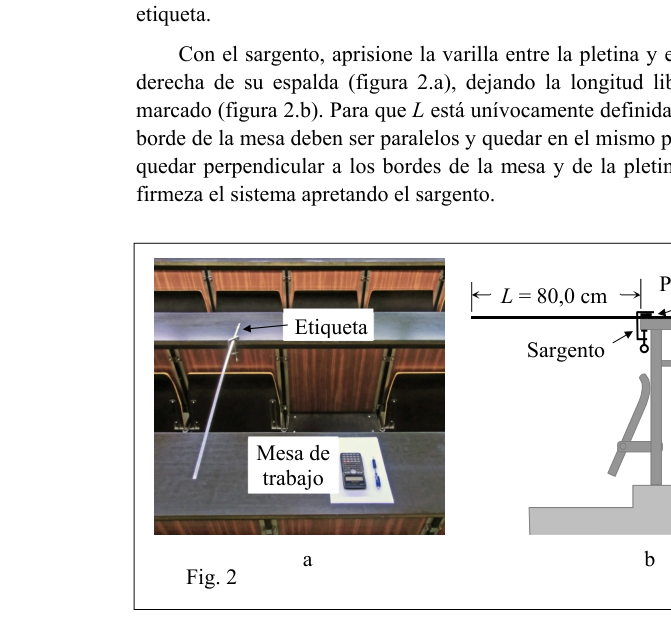 Fig. 2: montaje sargento pletina mesa
Topic: Elasticity & Materials, Oscillations & Waves Metodi: Simple Harmonic Motion Analysis, Experimental Data Analysis Competenze: Measurement & Instrumentation, Physical Reasoning Objects: Rod, Magnet Fonte: Testo (PDF) — p.2
Prova sperimentale Oscillazione di una bacchetta (XXX Olimpiada spagnola di fisica, Università di Salamanca, 2528 aprile 2019)
Il programma di ricerca è stato sviluppato in modo da garantire la sicurezza e la sicurezza dei lavoratori.
Determinare il modulo di Young e la densità di un bastone di alluminio.
MATERIAL
Metro di carta, sergente, pletina, bastone di alluminio, magneti, cronometro.
Dati
- Massa dei due magneti: g
- Larghezza della canna: mm
- Spessore della canna: mm
FUNDAMENTO TEORICO
In questo test sperimentale si studierà l’oscillazione di una bacchetta di alluminio di sezione rettangolare, tenuta da un’estremità e libera dall’altra (figura 1). Chiameremo e la massa e la lunghezza della porzione libera di bastone. Inoltre, sulla canna è fissata una massa (due piccoli magneti) a una distanza dall’estremità fissa. Il periodo di piccole oscillazioni di questo sistema in un piano verticale è dato da
dove è il modulo di Young del materiale, che caratterizza la sua elasticità rispetto agli sforzi di trazione o compressione, è la larghezza del bastone e il suo spessore.
Inoltre, la densità dell’alluminio, , è correlata alla massa e alle dimensioni della canna in forma
Montaggio del sistema
Tracciare sulla canna una linea trasversale con penna o matita a 80,0 cm dall’estremità che non ha etichetta. Con il sergente, stringe la verga tra la pletina e il bordo del tavolo, lasciando la lunghezza libera di verga cm precedentemente segnata (figura 2). Il bordo della tavola, il marchio sul bastone e il bordo del tavolo devono essere paralleli e rimanere nello stesso piano verticale. La verga deve restare perpendicolare ai bordi del tavolo e della piastra. Una volta ottenuto questo posizionamento, stringi il sistema con la forza del sergente.
PROCEDO ESPERIMENTE Paragrafo 1
Metti i due magneti uno su ciascun lato dell’estremità libera del bastone (Figura 3). Misura con il metro la distanza dal bordo della pletina al centro dei magneti, . Fa’ oscillare verticalmente il sistema, con una piccola larghezza. Usando il cronometro, determinare il periodo di oscillazione, . Descriva in dettaglio la procedura utilizzata.
Fig. 1: bastone contigliato con magneti
Fig. 2: montaggio sergente pletina tavola
Topic: Elasticity & Materials, Oscillations & Waves Metodi: Simple Harmonic Motion Analysis, Experimental Data Analysis Competenze: Measurement & Instrumentation, Physical Reasoning Objects: Rod, Magnet Fonte: Testo (PDF) — p.2
Experimental test Oscillation of a rod (XXX Spanish Olympiad of Physics, University of Salamanca, 2528 April 2019)
The Commission shall adopt delegated acts in accordance with Article 21 of this Regulation.
Determine the Young module and the density of an aluminum rod.
The following table shows the methodology used for the calculation of the total cost of the product:
Paper meter, sergeant, plinth, aluminum rod, magnets, timepiece.
The following information is provided by the Commission:
- Mass of the two magnets: g
- Width of rod: mm
- The thickness of the rod: mm
The following is the list of the countries of the European Union:
In this experimental test, the oscillation of a rectangular aluminium rod, held by one end and free by the other, is studied (Figure 1). We’ll call and the mass and length of the free-stick portion. In addition, a mass (two small magnets) is fixed over the rod at a distance from the fixed end. It is shown that the period of small oscillations of this system in a vertical plane is given by
where is the so-called Young module of the material, which characterizes its elasticity against traction or compression stresses, is the width of the rod and its thickness.
Furthermore, the density of aluminium, , is related to the mass and dimensions of the rod in the form of
The following information is provided for in the Annex to this Regulation:
Draw a cross-sectional line with pen or pencil at 80.0 cm from the unlabeled end of the rod. With the sergeant, hold the rod between the plate and the edge of the table, leaving the previously marked length of rod cm free (Figure 2). The edge of the plate, the mark on the rod and the edge of the table shall be parallel and in the same vertical plane. The rod shall be perpendicular to the edges of the table and the tablecloth. Once you’ve reached this position, hold the system tightly by squeezing the sergeant.
The following information is provided by the Commission on the basis of the information provided by the Member States:
Place the two magnets one on each side of the free end of the rod (Figure 3). Measure by the meter the distance from the edge of the plethora to the centre of the magnets, . Make the system swing vertically, with small amplitude. Using the chronometer, determine the oscillation period, . Describe in detail the procedure used.
The Commission shall adopt implementing acts in accordance with Article 21 of Regulation (EC) No 1272/2009. 1: rod held with magnets*
The Commission shall adopt implementing acts in accordance with Article 21 of Regulation (EC) No 1272/2009. 2: assembly sergeant full table*
Topic: Elasticity & Materials, Oscillations & Waves Metodi: Simple Harmonic Motion Analysis, Experimental Data Analysis Competenze: Measurement & Instrumentation, Physical Reasoning Objects: Rod, Magnet Fonte: Testo (PDF) — p.2
Apartado 2
Con el mismo procedimiento, determine para diferentes posiciones de los imanes, hasta cm. Recoja sus resultados en una tabla, dejando espacio para otras columnas, que necesitará más adelante.
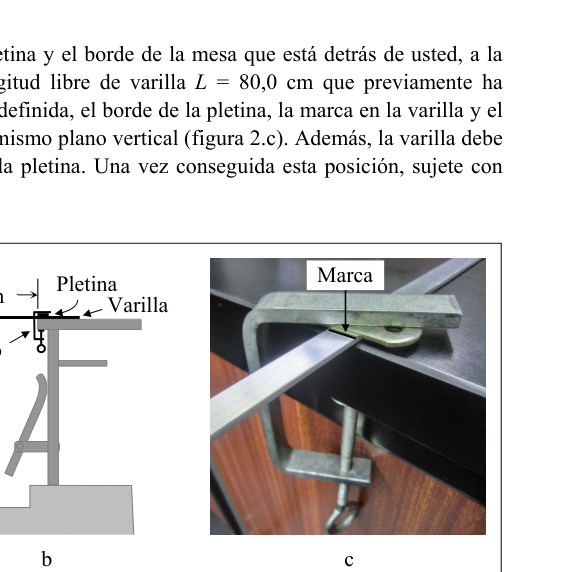 Fig. 3: imanes en extremo libre varilla
Topic: Elasticity & Materials, Oscillations & Waves Metodi: Experimental Data Analysis, Simple Harmonic Motion Analysis Competenze: Measurement & Instrumentation, Experimental Data Analysis Objects: Rod, Magnet Fonte: Testo (PDF) — p.2
Capitolo 2
Con la stessa procedura, determinare per diverse posizioni dei magneti fino a cm. Raccogli i risultati in una tabella, lasciando spazio per altre colonne, che avrete bisogno in seguito.
Fig. 3: magnete a estremità libera di bastone
Topic: Elasticity & Materials, Oscillations & Waves Metodi: Experimental Data Analysis, Simple Harmonic Motion Analysis Competenze: Measurement & Instrumentation, Experimental Data Analysis Objects: Rod, Magnet Fonte: Testo (PDF) — p.2
The following paragraphs shall be added:
Using the same procedure, determine for different positions of magnets, up to cm. Collect your results in a table, leaving room for other columns, which you’ll need later.
The Commission shall adopt implementing acts in accordance with Article 21 of Regulation (EC) No 1272/2009. 3: free end rod magnets*
Topic: Elasticity & Materials, Oscillations & Waves Metodi: Experimental Data Analysis, Simple Harmonic Motion Analysis Competenze: Measurement & Instrumentation, Experimental Data Analysis Objects: Rod, Magnet Fonte: Testo (PDF) — p.2
Apartado 3
Combine las expresiones (1) y (2) y obtenga una dependencia lineal entre y . Indique las expresiones de la pendiente, , y de la ordenada en el origen, , de esta recta. Calcule los valores de y para sus datos experimentales y añádalos a la tabla del apartado anterior.
Referencia: las expresiones (1) y (2) son
Topic: Elasticity & Materials, Oscillations & Waves Metodi: Graph Linearization, Dimensional Analysis Competenze: Mathematical Modeling, Graph Linearization Objects: — Fonte: Testo (PDF) — p.2
Capitolo 3
Combina le espressioni (1) e (2) e ottieni una dipendenza lineare tra e . Indicare le espressioni della pendenza, , e della ordinata di origine, , di questa retta. Calcolare i valori e per i dati sperimentali e aggiungerli alla tabella del precedente paragrafo.
Referenza: le espressioni (1) e (2) sono
Topic: Elasticity & Materials, Oscillations & Waves Metodi: Graph Linearization, Dimensional Analysis Competenze: Mathematical Modeling, Graph Linearization Objects: — Fonte: Testo (PDF) — p.2
The following paragraphs shall be added:
Combine the expressions (1) and (2) and obtain a linear dependence between and . Indicate the slope, , and the originally ordered slope, of this line. Calculate the values of and for your experimental data and add them to the table in the previous section.
Reference: * the expressions (1) and (2) are
Topic: Elasticity & Materials, Oscillations & Waves Metodi: Graph Linearization, Dimensional Analysis Competenze: Mathematical Modeling, Graph Linearization Objects: — Fonte: Testo (PDF) — p.2
Apartado 4
Represente gráficamente en el papel milimetrado los puntos correspondientes a esta dependencia lineal, con en abscisas.
Topic: Elasticity & Materials, Oscillations & Waves Metodi: Graph Linearization, Experimental Data Analysis Competenze: Graph Linearization, Experimental Data Analysis Objects: — Fonte: Testo (PDF) — p.2
Capitolo 4
Rappresenta graficamente sul foglio millimetrico i punti corrispondenti a questa dipendenza lineare, con in abcissi.
Topic: Elasticity & Materials, Oscillations & Waves Metodi: Graph Linearization, Experimental Data Analysis Competenze: Graph Linearization, Experimental Data Analysis Objects: — Fonte: Testo (PDF) — p.2
The following paragraphs shall be added:
Graphically represent on millimeter paper the points corresponding to this linear dependence, with in abscises.
Topic: Elasticity & Materials, Oscillations & Waves Metodi: Graph Linearization, Experimental Data Analysis Competenze: Graph Linearization, Experimental Data Analysis Objects: — Fonte: Testo (PDF) — p.2
Apartado 5
Determine la pendiente, , y la ordenada en el origen, , de la recta que mejor se ajusta a esos puntos.
Topic: Elasticity & Materials, Oscillations & Waves Metodi: Graph Linearization, Curve Fitting Competenze: Graph Linearization, Curve Fitting Objects: — Fonte: Testo (PDF) — p.2
Carto 5
Determina la pendice, , e la pendice ordinata alla origine, , della retta che meglio si adatta a tali punti.
Topic: Elasticity & Materials, Oscillations & Waves Metodi: Graph Linearization, Curve Fitting Competenze: Graph Linearization, Curve Fitting Objects: — Fonte: Testo (PDF) — p.2
The following paragraphs shall be added:
Determine the slope, , and the ordered at the origin, , of the straight line that best fits those points.
Topic: Elasticity & Materials, Oscillations & Waves Metodi: Graph Linearization, Curve Fitting Competenze: Graph Linearization, Curve Fitting Objects: — Fonte: Testo (PDF) — p.2
Apartado 6
A partir del ajuste anterior, deduzca el módulo de Young, , y la densidad, , del aluminio.
Le recordamos que la pendiente y la ordenada en el origen de la recta son
Topic: Elasticity & Materials, Oscillations & Waves Metodi: Experimental Data Analysis, Approximation & Series Expansion Competenze: Mathematical Modeling, Physical Reasoning Objects: — Fonte: Testo (PDF) — p.2
Capitolo 6
Dall’aggiustamento precedente, dedurre il modulo di Young, , e la densità, , dell’alluminio.
Ricordiamo che la pendenza e la curva all’origine della retta sono
Topic: Elasticity & Materials, Oscillations & Waves Metodi: Experimental Data Analysis, Approximation & Series Expansion Competenze: Mathematical Modeling, Physical Reasoning Objects: — Fonte: Testo (PDF) — p.2
The following paragraphs shall be added:
From the previous adjustment, deduce the Young module, , and the density, , of the aluminum.
*We remind you that the slope and the order at the origin of the straight are *
Topic: Elasticity & Materials, Oscillations & Waves Metodi: Experimental Data Analysis, Approximation & Series Expansion Competenze: Mathematical Modeling, Physical Reasoning Objects: — Fonte: Testo (PDF) — p.2
Apartado 7
Haga una estimación de las incertidumbres de la pendiente, , y de la ordenada en el origen, .
Topic: Elasticity & Materials, Oscillations & Waves Metodi: Error Propagation, Graph Linearization Competenze: Error Propagation, Estimation & Approximation Objects: — Fonte: Testo (PDF) — p.2
Capitolo 7
Estima le incertezze della pendenza, , e della pendenza ordinata all’origine, .
Topic: Elasticity & Materials, Oscillations & Waves Metodi: Error Propagation, Graph Linearization Competenze: Error Propagation, Estimation & Approximation Objects: — Fonte: Testo (PDF) — p.2
The following paragraphs shall be added:
Estimate the slope uncertainties, , and the originally ordered uncertainties, .
Topic: Elasticity & Materials, Oscillations & Waves Metodi: Error Propagation, Graph Linearization Competenze: Error Propagation, Estimation & Approximation Objects: — Fonte: Testo (PDF) — p.2
Apartado 8
Teniendo en cuenta únicamente y como fuentes de incertidumbre, haga una estimación de las incertidumbres y .
Topic: Elasticity & Materials, Oscillations & Waves Metodi: Error Propagation, Experimental Data Analysis Competenze: Error Propagation, Mathematical Modeling Objects: — Fonte: Testo (PDF) — p.2
Capitolo 8
Considerando solo e come fonti di incertezza, effettuare un’estimazione delle incertezze e .
Topic: Elasticity & Materials, Oscillations & Waves Metodi: Error Propagation, Experimental Data Analysis Competenze: Error Propagation, Mathematical Modeling Objects: — Fonte: Testo (PDF) — p.2
The following paragraphs shall be added:
Taking into account only and as sources of uncertainty, estimate the uncertainties and .
Topic: Elasticity & Materials, Oscillations & Waves Metodi: Error Propagation, Experimental Data Analysis Competenze: Error Propagation, Mathematical Modeling Objects: — Fonte: Testo (PDF) — p.2
Apartado 9
¿Cuál cree que es la principal fuente de incertidumbre en la obtención de con este procedimiento experimental? Teniendo en cuenta únicamente esta fuente, haga una estimación de .
Topic: Elasticity & Materials, Oscillations & Waves Metodi: Error Propagation, Experimental Data Analysis Competenze: Error Propagation, Physical Reasoning Objects: — Fonte: Testo (PDF) — p.2
Capitolo 9
Qual è la principale fonte di incertezza per ottenere con questa procedura sperimentale? Considerando solo questa fonte, si fa una stima di .
Topic: Elasticity & Materials, Oscillations & Waves Metodi: Error Propagation, Experimental Data Analysis Competenze: Error Propagation, Physical Reasoning Objects: — Fonte: Testo (PDF) — p.2
Apartado 9
¿Cuál cree que es la principal fuente de incertidumbre en la obtención de con este procedimiento experimental? Taking into account this source only, make an estimate of .
Topic: Elasticity & Materials, Oscillations & Waves Metodi: Error Propagation, Experimental Data Analysis Competenze: Error Propagation, Physical Reasoning Objects: — Fonte: Testo (PDF) — p.2