P1. Un calendario fósil.
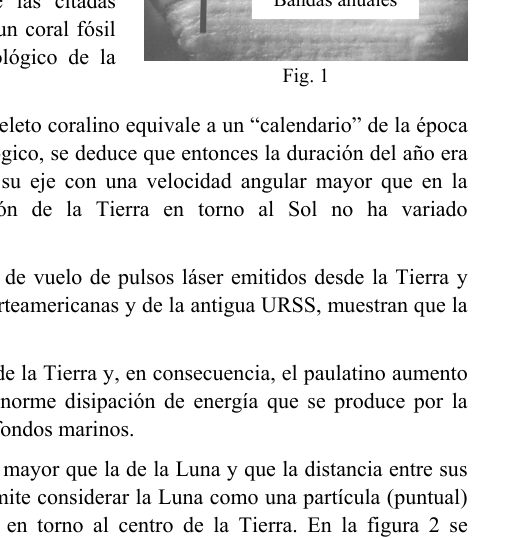
Algunos corales generan en su esqueleto finas estrías a causa de las interrupciones diarias (día-noche) de su crecimiento. Estas estrías, posiblemente debidas a las variaciones de profundidad del mar por efecto de las mareas, se agrupan en estrechas bandas que corresponden a cada mes lunar. A su vez, las bandas mensuales se agrupan en otras, más anchas, con una periodicidad anual. Pueden apreciarse las citadas bandas en la fotografía de la figura 1, que corresponde a un coral fósil de Calceola sandalina, perteneciente al Museo Paleontológico de la Universidad de Zaragoza.
En definitiva, el sistema de estrías y bandas del esqueleto coralino equivale a un “calendario” de la época en la que el coral vivió y, a través de un estudio paleontológico, se deduce que entonces la duración del año era de unos 400 días. Por tanto, la Tierra giraba en torno a su eje con una velocidad angular mayor que en la actualidad. Puede suponerse que el periodo de rotación de la Tierra en torno al Sol no ha variado apreciablemente desde aquella época.
Por otra parte, mediciones muy precisas del tiempo de vuelo de pulsos láser emitidos desde la Tierra y reflejados en espejos colocados en la Luna, en misiones norteamericanas y de la antigua URSS, muestran que la distancia Tierra-Luna aumenta a razón de 3,8 cm/año.
La disminución de la velocidad angular de rotación de la Tierra y, en consecuencia, el paulatino aumento de la distancia entre la Luna y la Tierra, se deben a la enorme disipación de energía que se produce por la fricción del flujo y reflujo de las mareas oceánicas con los fondos marinos.
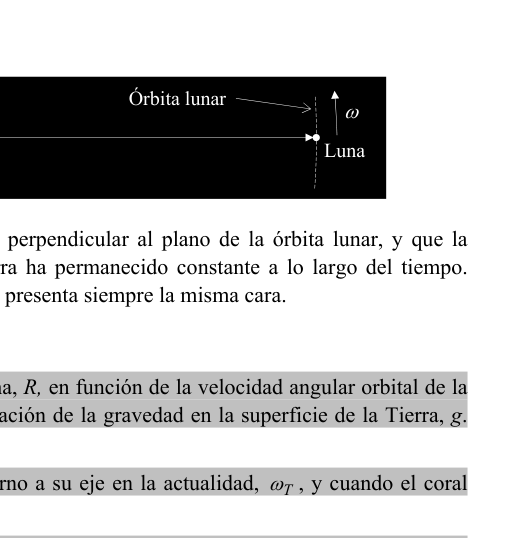
Dado que la masa de la Tierra es considerablemente mayor que la de la Luna y que la distancia entre sus centros es mucho mayor que cualquiera de sus radios, permite considerar la Luna como una partícula (puntual) de masa que describe una órbita circular de radio en torno al centro de la Tierra. En la figura 2 se representa a escala el sistema Tierra-Luna.
Suponga la Tierra esférica, con su eje de rotación perpendicular al plano de la órbita lunar, y que la pequeña velocidad con la que la Luna se aleja de la Tierra ha permanecido constante a lo largo del tiempo. Tenga en cuenta también que la Luna, vista desde la Tierra, presenta siempre la misma cara.
Con los datos que se indican al final del enunciado:
a) Determine la distancia actual entre la Tierra y la Luna, , en función de la velocidad angular orbital de la Luna , del radio de la Tierra , y de la aceleración de la gravedad en la superficie de la Tierra . Calcule y .
b) Calcule las velocidades angulares de la Tierra en torno a su eje en la actualidad, , y cuando el coral vivía, .
c) Determine la distancia entre la Tierra y la Luna, , en la época en la que vivió el coral, en función de las siguientes magnitudes: , , , , , y . Calcule el valor de .
d) Haga una estimación de la “edad” del coral fósil, .
Datos:
- Masas de la Tierra y de la Luna: ;
- Radio de la Tierra:
- Periodo de revolución de la Luna en torno a su eje:
- Periodo de revolución de la Tierra en torno al Sol:
- Día sidéreo:
- Aceleración de la gravedad en la superficie de la Tierra:
Ayudas:
- De acuerdo con el modelo propuesto (Tierra rotatoria con su centro fijo y la Luna como masa puntual) el momento angular total del sistema respecto al centro de la Tierra es igual a la suma de los momentos angulares de los movimientos de la Luna en torno a la Tierra y el de rotación de la Tierra en torno a su eje. Si el sistema está aislado, tal como se considera al sistema Tierra-Luna en este problema, su momento angular total debe conservarse.
- Para una esfera de masa y radio que gira con velocidad angular en torno a un eje que pasa por su centro, el módulo de su momento angular respecto a dicho centro es , donde es el momento de inercia respecto a dicho eje, cuyo valor es .
 Fossil coral Calceola sandalina with growth bands
 Earth-Moon system to scale with angular velocities
 Rotating sphere angular momentum diagram
Topic: Gravitation, Rotational Dynamics, Conservation of Momentum Metodi: Newton’s Law of Gravitation, Torque & Angular Momentum Analysis, Conservation Laws, Kinematic Equations Competenze: Mathematical Modeling, Estimation & Approximation, Physical Reasoning Objects: Planet, Satellite Fonte: Testo (PDF) — p.1
P1. Un calendario fossile.
Alcuni coralli generano strie nei loro scheletri sottili a causa delle interruzioni giornaliere (giorno-notto) della loro crescita. Queste strisce, probabilmente dovute alle variazioni di profondità del mare a causa delle maree, si raggruppano in strette bande che corrispondono a ogni mese lunare. Le bande mensili si raggruppano in altre più ampie, con una periodicità annuale. Si possono vedere le bande citate nella fotografia della figura 1, che corrisponde a un corallo fossile di calceola sandalina, appartenente al Museo Paleontologico dell’Università di Saragozza.
In definitiva, il sistema di stree e bande dello scheletro coralino equivale a un “calendario” dell’epoca in cui il corallo visse e, attraverso uno studio paleontologico, si deduce che allora la durata dell’anno era di circa 400 giorni. Pertanto la Terra ruotava intorno al suo asse con una velocità angolare maggiore di quella attuale. Si può supporre che il periodo di rotazione della Terra intorno al Sole non sia cambiato notevolmente da allora.
Inoltre, misurazioni molto precise del tempo di volo di laser pulsati emessi dalla Terra e riflessi in specchi posti sulla Luna, nelle missioni nordamericane e dell’ex URSS, mostrano che la distanza Terra-Luna aumenta a un tasso di 3,8 cm all’anno.
La diminuzione della velocità angolare di rotazione della Terra e, di conseguenza, il graduale aumento della distanza tra la Luna e la Terra, sono dovuti all’enorme dissipazione di energia che si verifica dalla friczione del flusso e del riflusso delle maree oceaniche con i fondali marini.
Dato che la massa della Terra è notevolmente maggiore di quella della Luna e che la distanza tra i suoi centri è molto maggiore di qualsiasi dei suoi raggi, si può considerare la Luna come una particella (puntuale) di massa che descrive un’orbita circolare di radio attorno al centro della Terra. La figura 2 rappresenta a scala il sistema Terra-Luna.
Supponiamo che la Terra sia sferica, con l’asse di rotazione perpendicolare al piano dell’orbita lunare, e che la piccola velocità con cui la Luna si allontana dalla Terra sia rimasta costante nel tempo. Si noti anche che la Luna, vista dalla Terra, presenta sempre la stessa faccia.
Con le informazioni riportate alla fine della frase:
**a) ** Determina la distanza attuale tra la Terra e la Luna, , in funzione della velocità angolare orbitale della Luna , del raggio terrestre e dell’accelerazione della gravità sulla superficie terrestre . Calcolare e .
**b) ** Calcola le velocità angolari della Terra attorno al suo asse attualmente, , e quando il corallo era vivo, .
**c) ** Determina la distanza tra la Terra e la Luna, , nel periodo in cui il corallo ha vissuto, in base alle seguenti magnitudini: , , , , , e . Calcolare il valore di .
**d) ** Fa’ una stima dell’ “età” del corallo fossile, .
**Dati: **
- Masse della Terra e della Luna: ;
- Radio della Terra:
- Periodo di rivoluzione della Luna attorno al suo asse:
- Periodo di rivoluzione della Terra attorno al Sole:
- Giorno in ferro:
- Accelerazione della gravità sulla superficie terrestre:
**Aiuti: **
- Secondo il modello proposto (Terra rotante con il suo centro fisso e la Luna come massa puntuale) il momento angolare totale del sistema rispetto al centro della Terra è uguale alla somma dei momenti angolari dei movimenti della Luna attorno alla Terra e quello della rotazione della Terra attorno al suo asse. Se il sistema è isolato, come viene considerato il sistema Terra-Luna in questo problema, il suo momento angolare totale deve essere conservato.
- Per una sfera di massa e di radio che ruota a velocità angolare attorno ad un’asse che passa attraverso il suo centro, il modulo del suo momento angolare rispetto a tale centro è , dove è il momento di inerzia rispetto a tale asse, il cui valore è .
Fossil coral Calceola sandalina with growth bands
Earth-Moon system to scale with angular velocities
Rotating sphere angular momentum diagram
Topic: Gravitation, Rotational Dynamics, Conservation of Momentum Metodi: Newton’s Law of Gravitation, Torque & Angular Momentum Analysis, Conservation Laws, Kinematic Equations Competenze: Mathematical Modeling, Estimation & Approximation, Physical Reasoning Objects: Planet, Satellite Fonte: Testo (PDF) — p.1
**P1. A fossil calendar.
Some corals generate stretch marks in their fine skeletons because of the daily (day-night) interruptions in their growth. These streams, possibly due to variations in sea depths due to tidal effects, are grouped into narrow bands corresponding to each lunar month. In turn, the monthly bands are grouped into larger ones with an annual periodicity. The bands can be seen in the photograph in Figure 1, which corresponds to a fossil coral of Sandal calceola, belonging to the Palaeontological Museum of the University of Zaragoza.
In short, the coral skeleton’s striations and bands system is equivalent to a “calendar” of the time when the coral lived and, through a paleontological study, it is inferred that the length of the year was then about 400 days. Thus, the earth was rotating around its axis at a greater angular velocity than it does today. It can be assumed that the period of Earth’s rotation around the Sun has not changed appreciably since that time.
Moreover, very accurate measurements of the flight time of laser pulses emitted from the Earth and reflected in mirrors placed on the Moon, in North American and former USSR missions, show that the Earth-Moon distance increases at a rate of 3.8 cm per year.
The decrease in the angular rotation speed of the Earth and, consequently, the gradual increase in the distance between the Moon and the Earth, are due to the enormous dissipation of energy that is produced by the friction of the ocean tides’ flow and reflux with the seafloor.
Since the Earth’s mass is considerably larger than that of the Moon and the distance between its centers is much greater than any of its radii, it is possible to consider the Moon as a (point) particle of mass that describes a circular radius orbit around the Earth’s center. Figure 2 shows the Earth-Moon system at scale.
Suppose the Earth is spherical, with its axis of rotation perpendicular to the plane of the lunar orbit, and that the small speed at which the Moon moves away from the Earth has remained constant over time. Also note that the moon, seen from the earth, always has the same face.
With the data indicated at the end of the sentence:
**a) ** Determine the current distance between the Earth and the Moon, , based on the Moon’s orbital angular velocity , the Earth’s radius , and the acceleration of gravity on the Earth’s surface . Calculate and .
**b) ** Calculate the angular velocities of the Earth around its axis at present, , and when the coral was alive, .
**c) ** Determine the distance between Earth and the Moon, , in the age of the coral, based on the following magnitudes: , , , , , and . Calculate the value of .
**d) ** Estimate the ‘age’ of the fossil coral, .
The data set shall be reported in the following table:
- Masses of the Earth and the Moon: ;
- Radio of the Earth:
- Period of revolution of the Moon around its axis:
- Period of revolution of the Earth around the Sun:
- Iron day:
- Gravitational acceleration at the surface of the Earth:
The Commission shall adopt delegated acts in accordance with Article 21 of the Financial Regulation.
- According to the proposed model (rotating Earth with its fixed center and the Moon as point mass) the total angular moment of the system with respect to the center of the Earth is equal to the sum of the angular moments of the Moon’s movements around the Earth and that of the Earth’s rotation around its axis. If the system is isolated, as the Earth-Moon system is considered in this problem, its total angular momentum should be preserved.
- For a sphere of mass and radius which rotates at angular velocity around an axis passing through its centre, the modulus of its angular moment with respect to that centre is , where is the moment of inertia with respect to that axis, the value of which is .
Fossil coral Calceola sandalina with growth bands
Earth-Moon system to scale with angular velocities
The following table shows the results of the calculations:
Topic: Gravitation, Rotational Dynamics, Conservation of Momentum Metodi: Newton’s Law of Gravitation, Torque & Angular Momentum Analysis, Conservation Laws, Kinematic Equations Competenze: Mathematical Modeling, Estimation & Approximation, Physical Reasoning Objects: Planet, Satellite Fonte: Testo (PDF) — p.1