P2. Calentamiento de marea de Ío — Barra elástica fija (a)
El calentamiento de marea es un mecanismo complejo en el que las fuerzas de marea provocan el calentamiento de cuerpos que orbitan alrededor de otros. La fuerza de marea es la diferencia entre la fuerza gravitatoria sobre el extremo del cuerpo más cercano y el más alejado. Un cuerpo inicialmente esférico adquiere forma elipsoidal y el estiramiento calienta el cuerpo debido a la fricción interna.
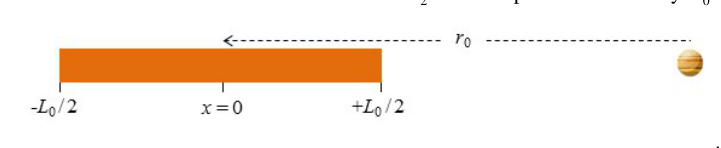
Nuestro primer modelo para Ío consiste en una barra recta de longitud alineada con las líneas del campo gravitatorio de Júpiter, el cual produce una tensión en la barra que la estira hasta una longitud . El extremo izquierdo de la barra, situado en , está fijado a un pivote. Júpiter se encuentra a la derecha con centro en . La barra tiene masa , densidad uniforme , sección constante , capacidad calorífica específica y coeficiente de dilatación lineal . Júpiter tiene masa .
El comportamiento de la barra es totalmente elástico y cumple la ley de Hooke generalizada: donde es la tensión (fuerza por unidad de área), es el alargamiento unitario, e es el módulo de Young.
(a) Calcule el peso de un trozo de barra comprendido entre los puntos y . Calcule después el peso total de la barra. Ayuda: considere la fuerza gravitatoria que ejerce Júpiter sobre un elemento diferencial de masa situado a distancia del origen, e integre.
En el caso de Ío se tiene , por tanto en el resto del problema se supondrá , constante a lo largo de la barra.
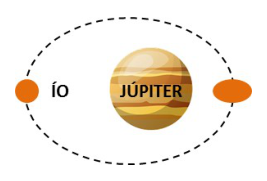 Io ellipsoidal deformation illustration
 Sphere to ellipsoid tidal deformation
Topic: Gravitation, Elasticity & Materials, Newtonian Mechanics Metodi: Newton’s Law of Gravitation, Calculus-Integration, Hooke’s Law Competenze: Mathematical Modeling, Physical Reasoning Objects: Rod, Planet, Satellite Fonte: Testo (PDF) — p.1
P2. Calore di marea di Io Barra di tensione fissa (a)
Il riscaldamento delle maree è un complesso meccanismo in cui le forze delle maree provocano il riscaldamento di corpi che orbitano intorno ad altri. La forza della marea è la differenza tra la forza gravitazionale sull’estremità del corpo più vicino e quella più lontana. Un corpo inizialmente sferico assume forma elipsoidale e lo stretching riscalderà il corpo a causa della friczione interna.
Il nostro primo modello per Io consiste in una barra retta di lunghezza allineata alle linee del campo gravitazionale di Giove, che produce una tensione nella barra che la allunga fino a una lunghezza . L’estremità sinistra della barra, situata a , è fissata a un pivote. Giove è a destra con centro a . La barra ha massa , densità uniforme , sezione costante , capacità calorifica specifica e coefficiente di dilatazione lineare . Giove ha massa .
Il comportamento della barra è totalmente elastico e soddisfa la legge generale di Hooke: dove è la tensione (forza per unità di area), è l’allungamento unitario, e è il modulo di Young.
**(a) ** Calcola il peso di un pezzo di barra compreso tra i punti e . Calcola poi il peso totale della barra. Aiuto: considera la forza gravitazionale esercitata da Giove su un elemento di massa differenziale situato a distanza dalla fonte, e integra.
Nel caso di Io si ha , quindi nel resto del problema si suppone , costante lungo la barra.
Il deformazione ellipsoidale illustration
Sphere to ellipsoid tidal deformation
Topic: Gravitation, Elasticity & Materials, Newtonian Mechanics Metodi: Newton’s Law of Gravitation, Calculus-Integration, Hooke’s Law Competenze: Mathematical Modeling, Physical Reasoning Objects: Rod, Planet, Satellite Fonte: Testo (PDF) — p.1
**P2. The following conditions shall apply:
Tide heating is a complex mechanism in which tidal forces cause bodies to heat up orbiting around others. The tidal force is the difference between the gravitational force on the nearest and farthest end of the body. An initially spherical body takes on an ellipsoidal shape and the stretching warms the body due to internal friction.
Our first model for Io consists of a straight bar of length aligned with Jupiter’s gravitational field lines, which produces a voltage on the bar that stretches it to a length . The left end of the bar, located at , is fixed to a pivot. Jupiter is located to the right with center at . The bar has mass , uniform density , constant section , specific heat capacity and linear dilation coefficient . Jupiter has mass .
The bar’s behavior is fully elastic and complies with the generalized Hooke’s law: where is the voltage (force per unit area), is the unit length, and is the Young module.
**(a) ** Calculate the weight of a bar piece between and . Then calculate the total weight of the bar. Assistance: consider the gravitational force exercised by Jupiter on a mass differential element located at a distance from the source, and integrate.
In the case of Io, is given, so in the rest of the problem, is given, constant along the bar.
The ellipsoidal deformation illustration is *
The following is a list of the types of water-soluble gases used in the production of water:
Topic: Gravitation, Elasticity & Materials, Newtonian Mechanics Metodi: Newton’s Law of Gravitation, Calculus-Integration, Hooke’s Law Competenze: Mathematical Modeling, Physical Reasoning Objects: Rod, Planet, Satellite Fonte: Testo (PDF) — p.1
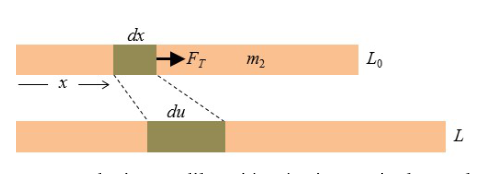
(b) Calcule la deformación de la barra.
Ayuda: obtenga con la ecuación (1) el alargamiento unitario y tenga en cuenta que cada elemento se alarga hasta una longitud .
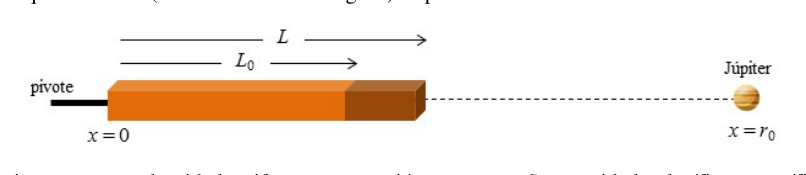 Elastic bar fixed at pivot, Júpiter at right
Topic: Elasticity & Materials, Gravitation Metodi: Hooke’s Law, Calculus-Integration, Free-Body Diagram Competenze: Mathematical Modeling, Physical Reasoning Objects: Rod, Planet Fonte: Testo (PDF) — p.1
**(b) ** Calcola la deformazione della barra.
Aiuto: ottenere con l’equazione (1) l’allungamento unitario e si noti che ogni elemento si allunga fino a una lunghezza .
Elastic bar fixed at pivot, Jupiter at right
Topic: Elasticity & Materials, Gravitation Metodi: Hooke’s Law, Calculus-Integration, Free-Body Diagram Competenze: Mathematical Modeling, Physical Reasoning Objects: Rod, Planet Fonte: Testo (PDF) — p.1
(b) Calcule la deformación de la barra.
Help: obtain the unit length by equation (1) and note that each element is extended to a length .
Elastic bar fixed at pivot, Júpiter at right
Topic: Elasticity & Materials, Gravitation Metodi: Hooke’s Law, Calculus-Integration, Free-Body Diagram Competenze: Mathematical Modeling, Physical Reasoning Objects: Rod, Planet Fonte: Testo (PDF) — p.1
(c) Calcule el calor que habría que comunicar a la barra para producir una dilatación térmica equivalente al alargamiento que crea la fuerza gravitatoria.
Ayuda: la dilatación lineal para un incremento de temperatura viene dada por la expresión .
Topic: Thermodynamics, Elasticity & Materials Metodi: Hooke’s Law, First Law of Thermodynamics Competenze: Mathematical Modeling, Physical Reasoning Objects: Rod Fonte: Testo (PDF) — p.1
**(c) ** Calcola il calore che dovrebbe essere comunicato alla barra per produrre una dilatazione termica equivalente all’allungamento creato dalla forza gravitazionale.
Aiuto: la dilatazione lineare per un aumento di temperatura viene data dall’espressione .
Topic: Thermodynamics, Elasticity & Materials Metodi: Hooke’s Law, First Law of Thermodynamics Competenze: Mathematical Modeling, Physical Reasoning Objects: Rod Fonte: Testo (PDF) — p.1
**(c) ** Calculate the heat that would have to be communicated to the bar to produce a thermal dilation equivalent to the elongation created by the gravitational force.
Help: the linear dilation for a temperature increase is given by the expression .
Topic: Thermodynamics, Elasticity & Materials Metodi: Hooke’s Law, First Law of Thermodynamics Competenze: Mathematical Modeling, Physical Reasoning Objects: Rod Fonte: Testo (PDF) — p.1
Barra elástica en órbita (d)
Ahora se tiene en cuenta el movimiento orbital, sin el pivote. La barra tiene su centro en a distancia de Júpiter. Se supone que toda la barra gira a la misma velocidad angular que su centro de masas. El trozo de masa está comprendido entre y .
(d) Escriba la expresión de la velocidad angular . ¿Cuánto vale el período orbital de Ío? Escriba la expresión de la fuerza centrípeta que actúa sobre el trozo de masa considerando que toda la masa está situada en el centro de masas del trozo.
 Bar in orbital motion around Jupiter
Topic: Gravitation, Newtonian Mechanics, Rotational Dynamics Metodi: Kepler’s Laws, Newton’s Law of Gravitation, Kinematic Equations Competenze: Mathematical Modeling, Physical Reasoning Objects: Rod, Planet, Satellite Fonte: Testo (PDF) — p.2
**L’elastico in orbita (d) **
Ora si tiene conto del movimento orbitale, senza il pivote. La barra ha il suo centro a a distanza da Giove. Si suppone che l’intera barra ruota alla stessa velocità angolare del suo centro di massa. Il pezzo di massa è compreso tra e .
**(d) ** Scrivi l’espressione della velocità angolare . Quanto vale il periodo orbitale di Io? Scrivere l’espressione della forza centripeta che agisce sul pezzo di massa considerando che tutta la massa è situata nel centro di massa del pezzo.
Bar in orbital motion around Jupiter
Topic: Gravitation, Newtonian Mechanics, Rotational Dynamics Metodi: Kepler’s Laws, Newton’s Law of Gravitation, Kinematic Equations Competenze: Mathematical Modeling, Physical Reasoning Objects: Rod, Planet, Satellite Fonte: Testo (PDF) — p.2
The following shall be added to the list of the following:
Now the orbital motion is taken into account, without the pivot. The bar has its center at at a distance from Jupiter. The entire bar is assumed to rotate at the same angular velocity as its center of mass. The mass of is between and .
The mean of the angular velocity is **(d) ** Enter the expression of angular velocity . How much is Io’s orbital period worth? Write the expression of the centrifugal force acting on the mass piece assuming that the entire mass is located in the center of mass of the piece.
The orbit of the planet is not known.
Topic: Gravitation, Newtonian Mechanics, Rotational Dynamics Metodi: Kepler’s Laws, Newton’s Law of Gravitation, Kinematic Equations Competenze: Mathematical Modeling, Physical Reasoning Objects: Rod, Planet, Satellite Fonte: Testo (PDF) — p.2
(e) Calcule de nuevo la deformación cuando la barra orbita, teniendo en cuenta que ahora la fuerza de tracción sobre es .
 Traction force expression orbital bar
Topic: Gravitation, Elasticity & Materials, Newtonian Mechanics Metodi: Calculus-Integration, Hooke’s Law, Free-Body Diagram Competenze: Mathematical Modeling, Physical Reasoning Objects: Rod Fonte: Testo (PDF) — p.2
**(e) ** Calcola di nuovo la deformazione quando la barra orbita, tenendo conto che ora la forza di trazione su è .
Traction force expression orbital bar
Topic: Gravitation, Elasticity & Materials, Newtonian Mechanics Metodi: Calculus-Integration, Hooke’s Law, Free-Body Diagram Competenze: Mathematical Modeling, Physical Reasoning Objects: Rod Fonte: Testo (PDF) — p.2
**(e) ** Calculate the deformation again when the bar is in orbit, taking into account that the current traction force on is .
The following table shows the results of the calculations:
Topic: Gravitation, Elasticity & Materials, Newtonian Mechanics Metodi: Calculus-Integration, Hooke’s Law, Free-Body Diagram Competenze: Mathematical Modeling, Physical Reasoning Objects: Rod Fonte: Testo (PDF) — p.2
(f) Si se supone que Ío es una barra de longitud igual a su diámetro, calcule su variación de longitud del periastro al apoastro. Use los datos numéricos:
- Masa de Júpiter: kg, N·m²/kg²
- Datos de Ío: kg, diámetro km, kg/m³, Pa, Pa·s, radio orbital del periastro y del apoastro: km y km.
Topic: Gravitation, Elasticity & Materials, Astrophysics Metodi: Newton’s Law of Gravitation, Hooke’s Law, Order-of-Magnitude Estimation Competenze: Estimation & Approximation, Mathematical Modeling Objects: Rod, Planet, Satellite Fonte: Testo (PDF) — p.2
Se Io è supposto da una barra di lunghezza pari al suo diametro, calcola la sua variazione di lunghezza da periastro a apoastro. Utilizzare i dati numerici:
- Massa di Giove: kg, N·m2/kg2
- Dati di IO: kg, diametro km, kg/m3, Pa, Pa·s, radius orbitale del periastro e dell’apostrato: km e km.
Topic: Gravitation, Elasticity & Materials, Astrophysics Metodi: Newton’s Law of Gravitation, Hooke’s Law, Order-of-Magnitude Estimation Competenze: Estimation & Approximation, Mathematical Modeling Objects: Rod, Planet, Satellite Fonte: Testo (PDF) — p.2
**(f) ** If Io is assumed to be a length bar equal to its diameter, calculate its variation in length from periastral to apoastral. Use the numerical data:
- Mass of Jupiter: kg, N·m2/kg2
- Iodine data: kg, diameter km, kg/m3, Pa, Pa·s, orbital radius of the periastral and apoastral axes: km and km.
Topic: Gravitation, Elasticity & Materials, Astrophysics Metodi: Newton’s Law of Gravitation, Hooke’s Law, Order-of-Magnitude Estimation Competenze: Estimation & Approximation, Mathematical Modeling Objects: Rod, Planet, Satellite Fonte: Testo (PDF) — p.2
Barra viscoelástica en órbita (g)
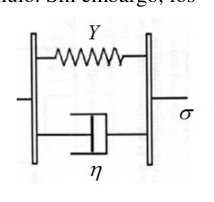
Los cuerpos viscoelásticos presentan un comportamiento mixto parcialmente elástico y viscoso. Se utiliza para Ío el modelo de Kelvin, formado por un resorte elástico actuando en paralelo con un amortiguador. La tensión en el resorte es . La tensión en el amortiguador es .
(g) Demuestre que la tensión en el cuerpo viscoelástico sigue la ecuación constitutiva:
 Kelvin viscoelastic model spring dashpot
Topic: Elasticity & Materials, Thermodynamics Metodi: Hooke’s Law, Differential Equations, Physical Modeling Competenze: Mathematical Modeling, Physical Reasoning Objects: Spring Fonte: Testo (PDF) — p.2
**Barra viscoelastica in orbita (g) **
I corpi viscoelasti presentano un comportamento mix di partialmente elastico e viscoso. Per Io viene utilizzato il modello di Kelvin, formato da una resorte elastica che agisce in parallelo con un ammortizzatore. La tensione di uscita è . La tensione sul cuscinetto è .
**(g) ** Dimostra che la tensione nel corpo viscoelastico segue l’equazione costitutiva:
Kelvin viscoelastic model spring dashpot
Topic: Elasticity & Materials, Thermodynamics Metodi: Hooke’s Law, Differential Equations, Physical Modeling Competenze: Mathematical Modeling, Physical Reasoning Objects: Spring Fonte: Testo (PDF) — p.2
The following is a list of the types of air conditioning systems used:
Viscoelastic bodies exhibit a mixed partially elastic and viscous behaviour. The Kelvin model is used for Io, formed by an elastic spring acting in parallel with a shock absorber. The spring voltage is . The voltage in the damper is .
**(g) ** Demonstrate that the tension in the viscoelastic body follows the constitutive equation:
The following table shows the results of the tests:
Topic: Elasticity & Materials, Thermodynamics Metodi: Hooke’s Law, Differential Equations, Physical Modeling Competenze: Mathematical Modeling, Physical Reasoning Objects: Spring Fonte: Testo (PDF) — p.2
(h) Ío experimenta una variación de la tensión de forma periódica: . En el caso de Ío, para el que se cumple , el término elástico de la ecuación (2) es muy pequeño y puede despreciarse.
Calcule el trabajo a lo largo de una órbita y la potencia disipada.
Topic: Thermodynamics, Elasticity & Materials, Oscillations & Waves Metodi: Differential Equations, Calculus-Integration, Energy Conservation Method Competenze: Mathematical Modeling, Physical Reasoning Objects: Rod, Satellite Fonte: Testo (PDF) — p.2
**(h) ** Io subisce una variazione della tensione periodicamente: . Nel caso di Io, per il quale si soddisfa , il termine elastico dell’equazione (2) è molto piccolo e può essere disprezzato.
Calcola il lavoro lungo un’orbita e la potenza dissipata.
Topic: Thermodynamics, Elasticity & Materials, Oscillations & Waves Metodi: Differential Equations, Calculus-Integration, Energy Conservation Method Competenze: Mathematical Modeling, Physical Reasoning Objects: Rod, Satellite Fonte: Testo (PDF) — p.2
(h) Ío experimenta una variación de la tensión de forma periódica: . In the case of Io, for which is met, the elastic term of equation (2) is very small and can be disregarded.
Calculate the work along an orbit and the power dissipated.
Topic: Thermodynamics, Elasticity & Materials, Oscillations & Waves Metodi: Differential Equations, Calculus-Integration, Energy Conservation Method Competenze: Mathematical Modeling, Physical Reasoning Objects: Rod, Satellite Fonte: Testo (PDF) — p.2
(i) Con los datos numéricos, calcule el valor de la potencia disipada.
Ayuda: calcule la amplitud con la expresión de una fuerza efectiva que produzca la deformación obtenida en el apartado (e), y evalúe dicha fuerza en el periastro y el apoastro. (Tome, de nuevo, igual al diámetro de Ío.)
Datos: Masa de Júpiter: kg, N·m²/kg²; Datos de Ío: kg, diámetro km, kg/m³, Pa, Pa·s, km, km.
Topic: Thermodynamics, Elasticity & Materials, Astrophysics Metodi: Energy Conservation Method, Order-of-Magnitude Estimation, Physical Modeling Competenze: Estimation & Approximation, Mathematical Modeling Objects: Satellite, Planet Fonte: Testo (PDF) — p.2
**(i) ** Con i dati numerici calcoli il valore della potenza dissipata.
Aiuto: calcolare l’ampiezza con l’espressione di una forza effettiva che produce la deformazione ottenuta dal punto (e), e valutare tale forza nel periastro e nell’apostrato. (Togli, ancora una volta, pari al diametro di Io.)
Datos: Masa de Júpiter: kg, N·m²/kg²; Datos de Ío: kg, diámetro km, kg/m³, Pa, Pa·s, km, km.
Topic: Thermodynamics, Elasticity & Materials, Astrophysics Metodi: Energy Conservation Method, Order-of-Magnitude Estimation, Physical Modeling Competenze: Estimation & Approximation, Mathematical Modeling Objects: Satellite, Planet Fonte: Testo (PDF) — p.2
**(i) ** Calculate the value of the dissipated power with the numerical data.
Assistance: calculate the width by the expression of an effective force producing the deformation obtained in paragraph (e) and evaluate this force in the peristalsis and the apostratus. (Take again equal to the diameter of Io.)
Datos: Masa de Júpiter: kg, N·m²/kg²; Datos de Ío: kg, diámetro km, kg/m³, Pa, Pa·s, km, km.
Topic: Thermodynamics, Elasticity & Materials, Astrophysics Metodi: Energy Conservation Method, Order-of-Magnitude Estimation, Physical Modeling Competenze: Estimation & Approximation, Mathematical Modeling Objects: Satellite, Planet Fonte: Testo (PDF) — p.2