Mowing (3 points)
In an attempt to save effort, Verča decided to automate mowing her lawn. She firmly planted a pole in the center of the lawn and attached the lawnmower to it with a rope. The mower can move and cut only forward, but due to the rope winding around the central pole, its path will form a spiral, allowing it to cut an approximately circular area around the pole. What radius must the pole have so that the rope winds in such a way that the cut strips perfectly align with each other? The mower cuts strips of grass wide; neglect the thickness of the rope.
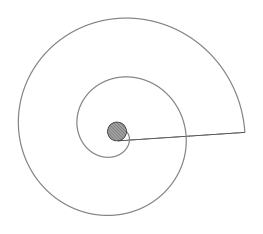
Risposta:
Soluzione:
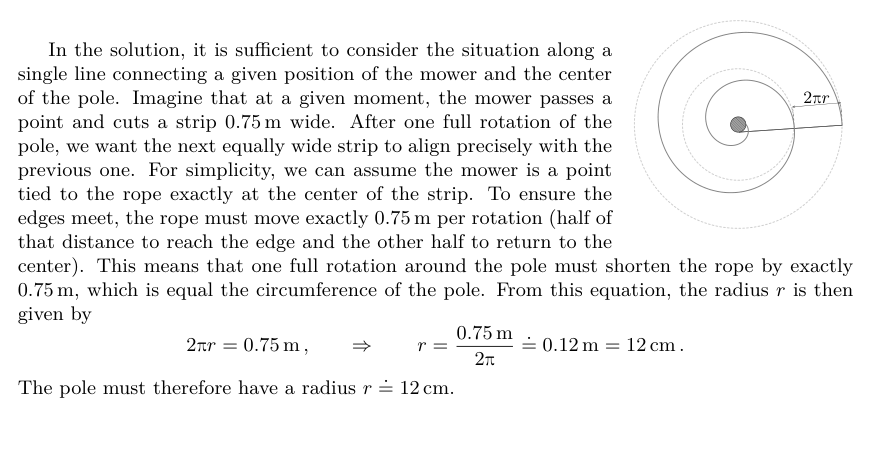
Official solution by FYKOS (Physics Brawl Online 2025), reproduced from the official PDF — p. 2 — under CC BY-SA 3.0.
Topic: Newtonian Mechanics, Mathematics Metodi: Physical Modeling Competenze: Mathematical Modeling Objects: String, Cylinder Fonte: Testo (PDF) — p.2 · Soluzione ufficiale (PDF) — p.2
Falciatura (3 punti)
Per risparmiare fatica, Verča ha deciso di automatizzare il taglio del prato. Ha piantato saldamente un palo al centro del prato e vi ha legato il tosaerba con una corda. Il tosaerba può muoversi e tagliare solo in avanti, ma poiché la corda si avvolge attorno al palo centrale, la sua traiettoria forma una spirale e taglia un’area approssimativamente circolare attorno al palo. Quale raggio deve avere il palo perché la corda si avvolga in modo che le strisce tagliate combacino perfettamente l’una con l’altra? Il tosaerba taglia strisce d’erba larghe ; trascura lo spessore della corda.
Risposta:
Soluzione: La soluzione ufficiale completa (in inglese) è nella versione originale di questo quesito e nel PDF ufficiale.
Topic: Newtonian Mechanics, Mathematics Metodi: Physical Modeling Competenze: Mathematical Modeling Objects: String, Cylinder Fonte: Testo (PDF) — p.2 · Soluzione ufficiale (PDF) — p.2
Different period (3 points)
Two parallel shafts are spaced apart. Each carries one wheel of radius and another of radius . A stretched rubber band is looped around the two small wheels, and another around the two large ones. One shaft rotates at frequency . Find the ratio of the time for the small-wheel band to return to its initial position after one rotation to that for the large-wheel band. The rubber band does not slip on the wheels.
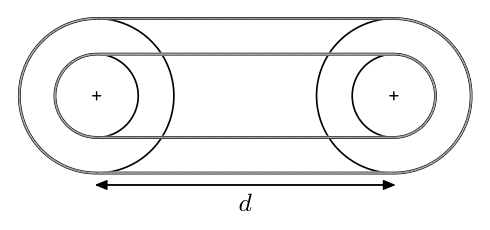
Risposta:
Soluzione:
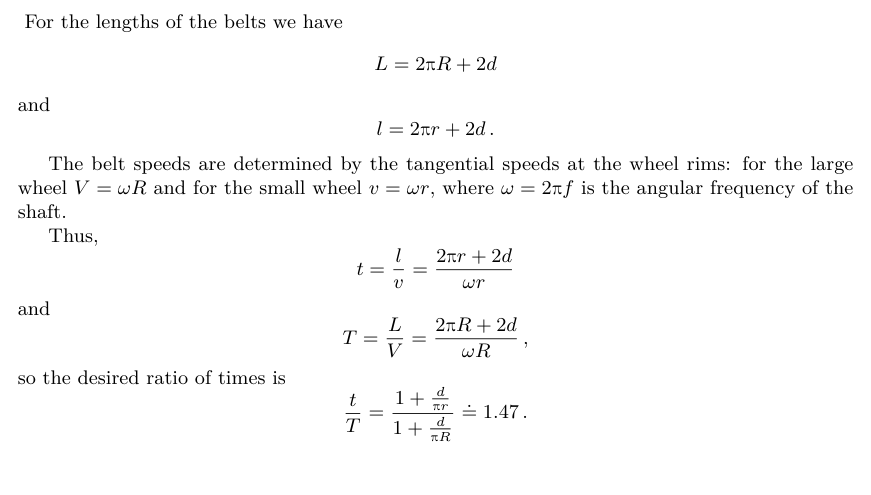
Official solution by FYKOS (Physics Brawl Online 2025), reproduced from the official PDF — p. 3 — under CC BY-SA 3.0.
Topic: Newtonian Mechanics Metodi: Kinematic Equations Competenze: Mathematical Modeling Objects: Wheel, String Fonte: Testo (PDF) — p.2 · Soluzione ufficiale (PDF) — p.3
Periodo diverso (3 punti)
Due alberi paralleli distano . Ciascuno porta una ruota di raggio e un’altra di raggio . Un elastico teso è avvolto attorno alle due ruote piccole e un altro attorno alle due ruote grandi. Uno degli alberi ruota con frequenza . Trova il rapporto tra il tempo impiegato dall’elastico delle ruote piccole per tornare nella posizione iniziale dopo un giro completo e quello impiegato dall’elastico delle ruote grandi. Gli elastici non slittano sulle ruote.
Risposta:
Soluzione: La soluzione ufficiale completa (in inglese) è nella versione originale di questo quesito e nel PDF ufficiale.
Topic: Newtonian Mechanics Metodi: Kinematic Equations Competenze: Mathematical Modeling Objects: Wheel, String Fonte: Testo (PDF) — p.2 · Soluzione ufficiale (PDF) — p.3
Playing with gas (3 points)
By what factor does the volume of an ideal gas change if its thermodynamic temperature increases by and its pressure decreases by ?
Risposta:
Soluzione:
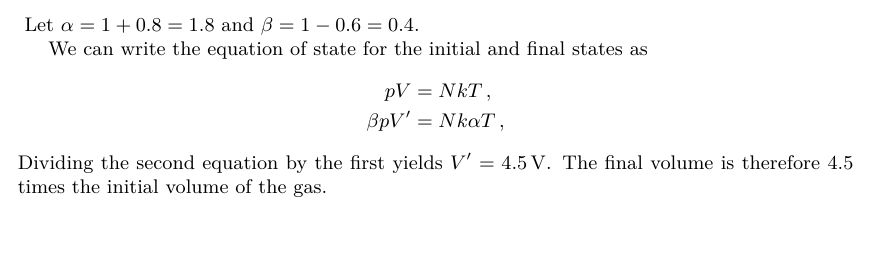
Official solution by FYKOS (Physics Brawl Online 2025), reproduced from the official PDF — p. 3 — under CC BY-SA 3.0.
Topic: Thermodynamics Metodi: Ideal Gas Law Competenze: Physical Reasoning Objects: Gas Fonte: Testo (PDF) — p.3 · Soluzione ufficiale (PDF) — p.3
Giocando con il gas (3 punti)
Di quale fattore cambia il volume di un gas ideale se la sua temperatura assoluta aumenta dell’ e la sua pressione diminuisce del ?
Risposta:
Soluzione: La soluzione ufficiale completa (in inglese) è nella versione originale di questo quesito e nel PDF ufficiale.
Topic: Thermodynamics Metodi: Ideal Gas Law Competenze: Physical Reasoning Objects: Gas Fonte: Testo (PDF) — p.3 · Soluzione ufficiale (PDF) — p.3
Fast serve (4 points)
In table tennis, it is sometimes tactical to surprise your opponent with a long and fast serve. The first impact of the ball is as close as possible to the edge of the serving table, the second impact is as close as possible to the opponent’s edge. What is the shortest possible ball flight time from one side of the table to another? Do not consider air resistance or ball rotation. Look up all the necessary parameters.
Risposta:
Soluzione:

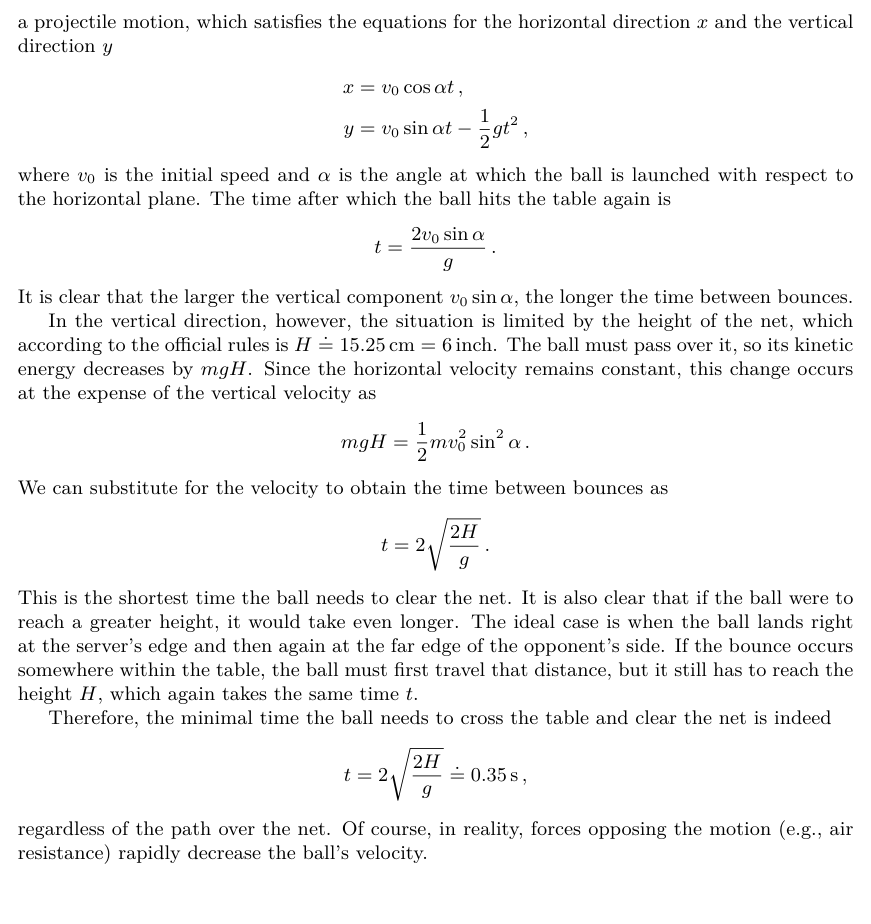
Official solution by FYKOS (Physics Brawl Online 2025), reproduced from the official PDF — p. 3, 4 — under CC BY-SA 3.0.
Topic: Newtonian Mechanics Metodi: Kinematic Equations, Energy Conservation Method Competenze: Mathematical Modeling, Estimation & Approximation Objects: Ball, Projectile Fonte: Testo (PDF) — p.3 · Soluzione ufficiale (PDF) — p.3
Servizio veloce (4 punti)
Nel tennistavolo a volte è tatticamente utile sorprendere l’avversario con un servizio lungo e veloce. Il primo rimbalzo della pallina avviene il più vicino possibile al bordo del lato di chi serve, il secondo il più vicino possibile al bordo opposto, dal lato dell’avversario. Qual è il tempo di volo minimo possibile della pallina da una metà del tavolo all’altra? Trascura la resistenza dell’aria e la rotazione della pallina. Cerca tutti i parametri necessari.
Risposta:
Soluzione: La soluzione ufficiale completa (in inglese) è nella versione originale di questo quesito e nel PDF ufficiale.
Topic: Newtonian Mechanics Metodi: Kinematic Equations, Energy Conservation Method Competenze: Mathematical Modeling, Estimation & Approximation Objects: Ball, Projectile Fonte: Testo (PDF) — p.3 · Soluzione ufficiale (PDF) — p.3
Old power supply (3 points)
David found an old DC power supply. He was wondering about how to use it, so he tried to connect it into a circuit with 2 resistors with the resistance of . In the first case he connected them in series, then in parallel. In both cases he measured the current in the circuit. In the first case he measured the current as and in the second one as . David knew that the power supply is not ideal. Calculate the internal resistance of the power supply.
Risposta:
Soluzione:
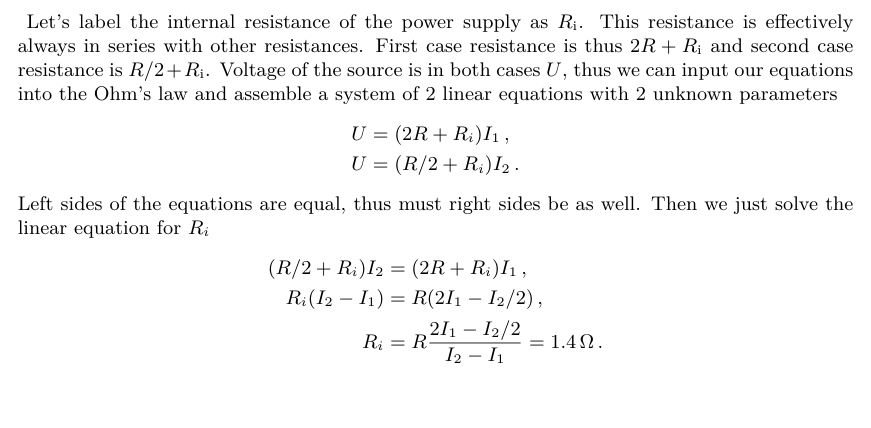
Official solution by FYKOS (Physics Brawl Online 2025), reproduced from the official PDF — p. 5 — under CC BY-SA 3.0.
Topic: Circuits Metodi: Kirchhoff’s Laws, Equivalent Circuit Reduction Competenze: Mathematical Modeling Objects: Battery, Resistor Fonte: Testo (PDF) — p.4 · Soluzione ufficiale (PDF) — p.5
Vecchio alimentatore (3 punti)
David ha trovato un vecchio alimentatore in corrente continua. Per capire come usarlo, lo ha collegato in un circuito con 2 resistori di resistenza : nel primo caso in serie, poi in parallelo. In entrambi i casi ha misurato la corrente nel circuito: nel primo caso , nel secondo . David sapeva che l’alimentatore non è ideale. Calcola la resistenza interna dell’alimentatore.
Risposta:
Soluzione: La soluzione ufficiale completa (in inglese) è nella versione originale di questo quesito e nel PDF ufficiale.
Topic: Circuits Metodi: Kirchhoff’s Laws, Equivalent Circuit Reduction Competenze: Mathematical Modeling Objects: Battery, Resistor Fonte: Testo (PDF) — p.4 · Soluzione ufficiale (PDF) — p.5
Firmly connected mathematical pendulums (3 points)
Consider two massless rods of length , each suspended by one end and able to rotate freely about their suspension points. These suspension points are at the same height, separated by a distance . The free ends of the rods are connected by a rod of mass and length . What is the period of small oscillations if the system is displaced within the plane containing the rods? The system is in a gravitational field with acceleration .
Risposta:
Soluzione:
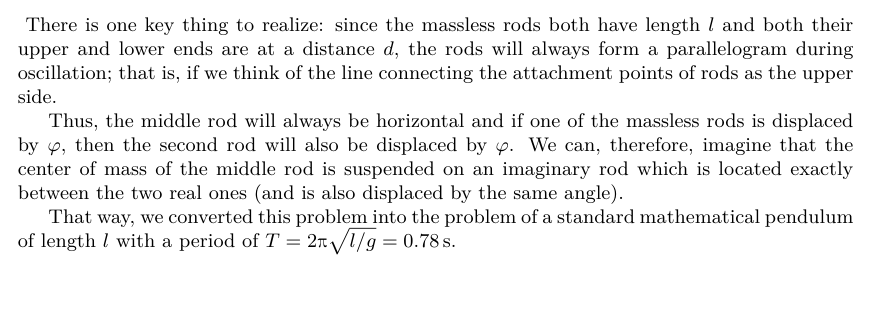
Official solution by FYKOS (Physics Brawl Online 2025), reproduced from the official PDF — p. 5 — under CC BY-SA 3.0.
Topic: Oscillations & Waves Metodi: Simple Harmonic Motion Analysis, Small-Angle Approximation Competenze: Physical Reasoning Objects: Pendulum, Rod Fonte: Testo (PDF) — p.5 · Soluzione ufficiale (PDF) — p.5
Pendoli matematici rigidamente collegati (3 punti)
Considera due aste di massa trascurabile e lunghezza , ciascuna sospesa per un estremo e libera di ruotare attorno al proprio punto di sospensione. I due punti di sospensione sono alla stessa altezza, a distanza . Gli estremi liberi delle aste sono collegati da un’asta di massa e lunghezza . Qual è il periodo delle piccole oscillazioni se il sistema viene spostato nel piano che contiene le aste? Il sistema si trova in un campo gravitazionale di accelerazione .
Risposta:
Soluzione: La soluzione ufficiale completa (in inglese) è nella versione originale di questo quesito e nel PDF ufficiale.
Topic: Oscillations & Waves Metodi: Simple Harmonic Motion Analysis, Small-Angle Approximation Competenze: Physical Reasoning Objects: Pendulum, Rod Fonte: Testo (PDF) — p.5 · Soluzione ufficiale (PDF) — p.5
Icy cold LED lights (3 points)
David read a study stating that LEDs in a laboratory have an electrical input power of , but an optical output power of , which would correspond to an efficiency greater than 100%. At first, he was surprised, but then realized that part of the power comes from thermal energy. How many diodes would be needed to produce an ice cube with a volume of in one hour, assuming we have water at a temperature of ? Assume that all optical power comes from the heat of the water and the electrical source. The optical power is independent of temperature, and heat transfer from the surroundings is negligible.
Risposta:
Soluzione:
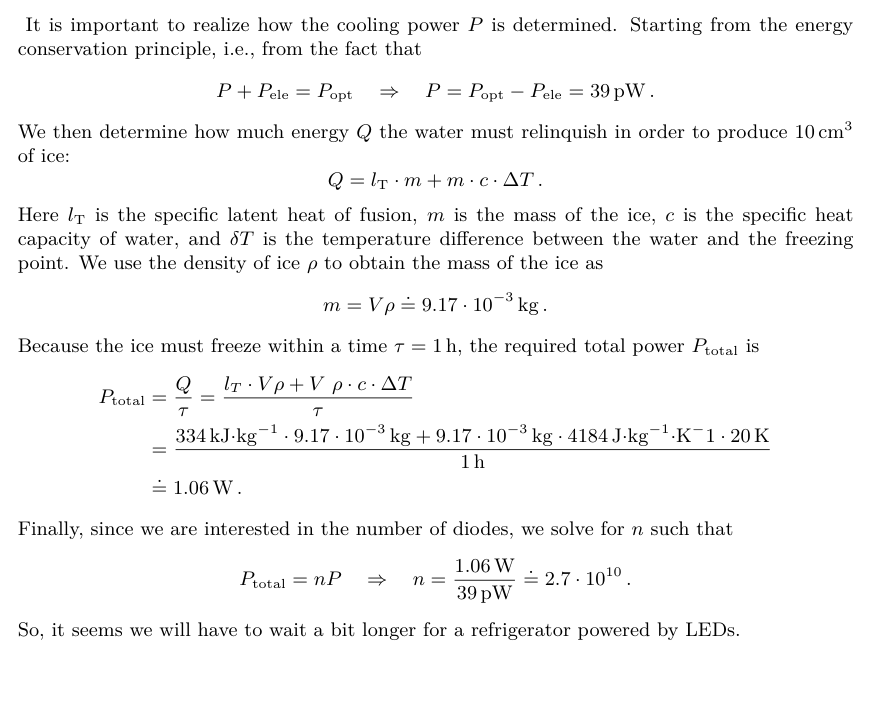
Official solution by FYKOS (Physics Brawl Online 2025), reproduced from the official PDF — p. 6 — under CC BY-SA 3.0.
Topic: Thermodynamics, Modern-Quantum Physics Metodi: Energy Conservation Method, First Law of Thermodynamics Competenze: Mathematical Modeling, Estimation & Approximation Objects: Calorimeter Fonte: Testo (PDF) — p.5 · Soluzione ufficiale (PDF) — p.6
LED gelidi (3 punti)
David ha letto uno studio secondo cui dei LED in laboratorio hanno una potenza elettrica in ingresso ma una potenza ottica in uscita , il che corrisponderebbe a un’efficienza superiore al 100%. All’inizio era sorpreso, poi ha capito che parte della potenza proviene dall’energia termica. Quanti diodi servirebbero per produrre in un’ora un cubetto di ghiaccio di volume , partendo da acqua a ? Supponi che tutta la potenza ottica provenga dal calore dell’acqua e dalla sorgente elettrica. La potenza ottica non dipende dalla temperatura e lo scambio di calore con l’ambiente è trascurabile.
Risposta:
Soluzione: La soluzione ufficiale completa (in inglese) è nella versione originale di questo quesito e nel PDF ufficiale.
Topic: Thermodynamics, Modern-Quantum Physics Metodi: Energy Conservation Method, First Law of Thermodynamics Competenze: Mathematical Modeling, Estimation & Approximation Objects: Calorimeter Fonte: Testo (PDF) — p.5 · Soluzione ufficiale (PDF) — p.6
Lost gas (4 points)
In the examination of the surface area of porous or powdery materials, gas adsorption on the material can be utilized. A sample with a skeletal density of and mass is placed into a pipette, and the air is evacuated to create a very high vacuum. Then, of nitrogen gas is introduced. After reaching equilibrium, the pressure is measured to be . What is the surface area of the sample, assuming that the area of one adsorbed molecule is ? The whole experiment is conducted at the temperature of liquid nitrogen .
Risposta:
Soluzione:
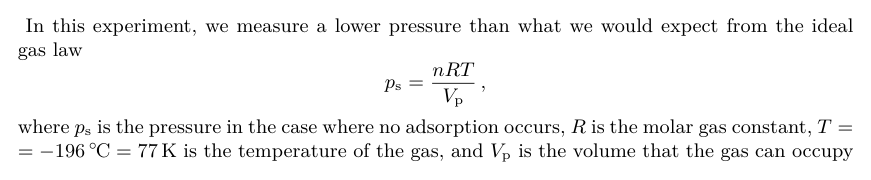
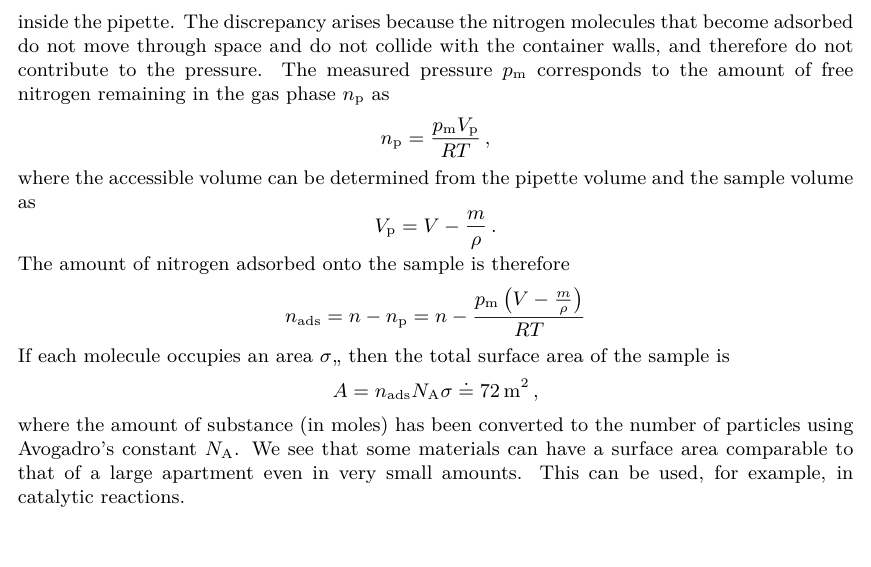
Official solution by FYKOS (Physics Brawl Online 2025), reproduced from the official PDF — p. 6, 7 — under CC BY-SA 3.0.
Topic: Thermodynamics, Chemistry Metodi: Ideal Gas Law Competenze: Mathematical Modeling, Unit Conversion Objects: Gas Fonte: Testo (PDF) — p.6 · Soluzione ufficiale (PDF) — p.6
Gas perduto (4 punti)
Per studiare l’area superficiale di materiali porosi o in polvere si può sfruttare l’adsorbimento di un gas sul materiale. Un campione con densità scheletrica e massa viene posto in una pipetta da e l’aria viene evacuata fino a un vuoto molto spinto. Si introducono poi di azoto. Raggiunto l’equilibrio, la pressione misurata è . Qual è l’area superficiale del campione, supponendo che una molecola adsorbita occupi un’area di ? L’intero esperimento si svolge alla temperatura dell’azoto liquido, .
Risposta:
Soluzione: La soluzione ufficiale completa (in inglese) è nella versione originale di questo quesito e nel PDF ufficiale.
Topic: Thermodynamics, Chemistry Metodi: Ideal Gas Law Competenze: Mathematical Modeling, Unit Conversion Objects: Gas Fonte: Testo (PDF) — p.6 · Soluzione ufficiale (PDF) — p.6
Brokenly charged (4 points)
A particle characterized by a charge and a mass is flying perpendicular to magnetic field lines at a speed of . At one moment, this particle decays into two particles with opposite charges. What is the ratio of the radius of curvature of the positively charged particle’s trajectory to that of the negatively charged particle? The mass of the resulting positively charged particle is , and its charge is . Assume that after the decay, both particles retain the velocity , and they do not interact with each other further.
Risposta:
Soluzione:
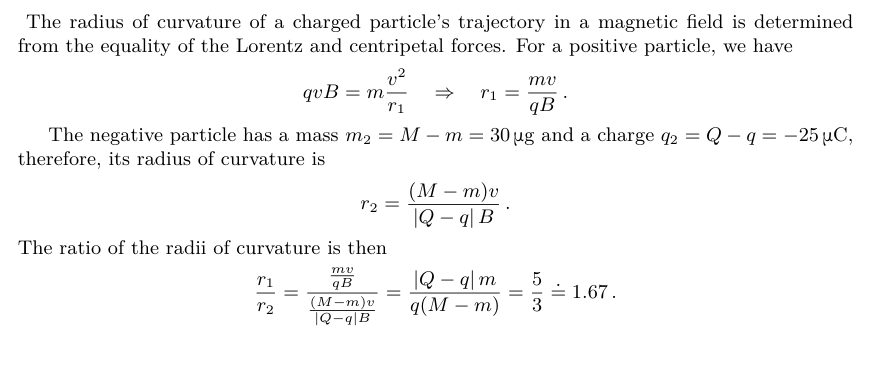
Official solution by FYKOS (Physics Brawl Online 2025), reproduced from the official PDF — p. 7 — under CC BY-SA 3.0.
Topic: Magnetism Metodi: Lorentz Force Analysis Competenze: Physical Reasoning Objects: Point Charge Fonte: Testo (PDF) — p.7 · Soluzione ufficiale (PDF) — p.7
Carica spezzata (4 punti)
Una particella con carica e massa si muove perpendicolarmente alle linee di un campo magnetico con velocità . A un certo istante la particella decade in due particelle di carica opposta. Qual è il rapporto tra il raggio di curvatura della traiettoria della particella positiva e quello della particella negativa? La particella positiva prodotta ha massa e carica . Supponi che dopo il decadimento entrambe le particelle mantengano la velocità e che non interagiscano più tra loro.
Risposta:
Soluzione: La soluzione ufficiale completa (in inglese) è nella versione originale di questo quesito e nel PDF ufficiale.
Topic: Magnetism Metodi: Lorentz Force Analysis Competenze: Physical Reasoning Objects: Point Charge Fonte: Testo (PDF) — p.7 · Soluzione ufficiale (PDF) — p.7
Creative DnD Hero (4 points)
The heroes fight a necromancer in his laboratory. One of the heroes is not exactly strong; however, he is creative and so he gets the idea to knock over a wardrobe so that it would collapse onto a nearby undead. In the brink of a moment, he starts wondering whether him having the strength to knock over the wardrobe implies that the undead would subsequently have enough strength to hold the wardrobe. Suppose the wardrobe is homogeneous and has height , width and depth and the hero can topple it along its width axis. Both the hero and the undead have height (the height at which they will act on the wardrobe). The undead is standing from the wardrobe (measured from the edge of the wardrobe base that remains on the ground). What is the ratio of the force that the undead needs to hold it over its head (provided it keeps standing in the same place) to the force the hero needs to knock it over? Neglect the non-zero speed of a falling wardrobe, i.e., consider this to be a static problem; both the undead and the hero push perpendicularly toward the wardrobe side.
Risposta:
Soluzione:
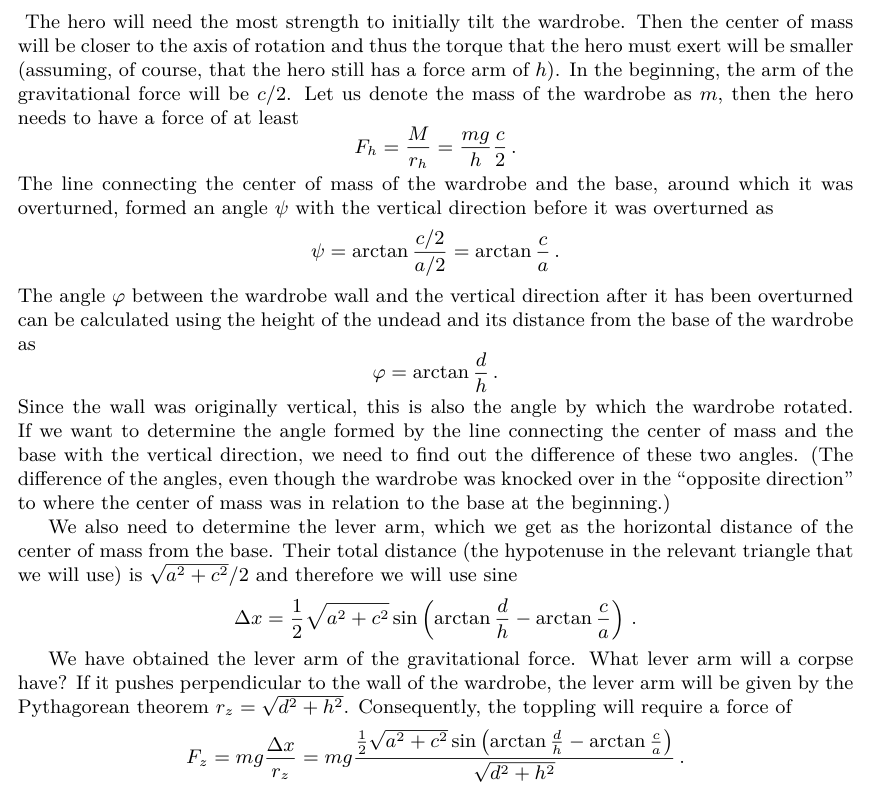
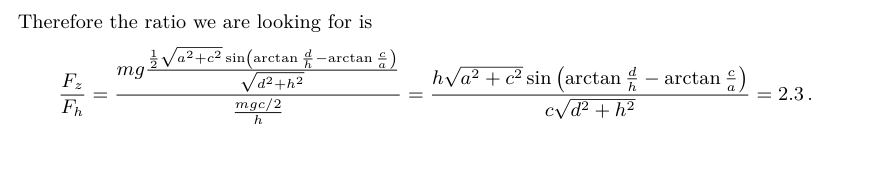
Official solution by FYKOS (Physics Brawl Online 2025), reproduced from the official PDF — p. 8, 9 — under CC BY-SA 3.0.
Topic: Rigid Body Statics Metodi: Torque & Angular Momentum Analysis, Free-Body Diagram Competenze: Mathematical Modeling Objects: Block Fonte: Testo (PDF) — p.8 · Soluzione ufficiale (PDF) — p.8
Eroe creativo di D&D (4 punti)
Gli eroi combattono un negromante nel suo laboratorio. Uno degli eroi non è proprio forzuto, ma è creativo: gli viene l’idea di rovesciare un armadio in modo che crolli su un non-morto lì vicino. In un attimo comincia a chiedersi se il fatto di avere la forza per rovesciare l’armadio implichi che il non-morto avrà poi abbastanza forza per sorreggerlo. Supponi che l’armadio sia omogeneo, con altezza , larghezza e profondità , e che l’eroe possa ribaltarlo attorno a un asse parallelo alla larghezza. Sia l’eroe sia il non-morto sono alti (l’altezza alla quale agiscono sull’armadio). Il non-morto si trova a dall’armadio (misurati dallo spigolo della base che resta a terra). Qual è il rapporto tra la forza necessaria al non-morto per sorreggere l’armadio sopra la testa (restando fermo nello stesso punto) e la forza necessaria all’eroe per rovesciarlo? Trascura la velocità non nulla dell’armadio in caduta, cioè tratta il problema come statico; sia il non-morto sia l’eroe spingono perpendicolarmente alla parete dell’armadio.
Risposta:
Soluzione: La soluzione ufficiale completa (in inglese) è nella versione originale di questo quesito e nel PDF ufficiale.
Topic: Rigid Body Statics Metodi: Torque & Angular Momentum Analysis, Free-Body Diagram Competenze: Mathematical Modeling Objects: Block Fonte: Testo (PDF) — p.8 · Soluzione ufficiale (PDF) — p.8
Staircases in Atomium (3 points)
The Atomium in Brussels is a monumental tourist attraction that resembles an elementary cell of a body-centred lattice of crystalline iron. Instead of atoms, there are large spheres that can be entered. The spheres are connected by passages running along all edges of the cube and also from the corner spheres into the central sphere. The cube is standing on one of its vertices so that its body diagonal points perpendicular to the ground. What is the slope of the staircase leading from the second lowest sphere to the central sphere with respect to the horizontal plane of the ground?
Risposta:
Soluzione:
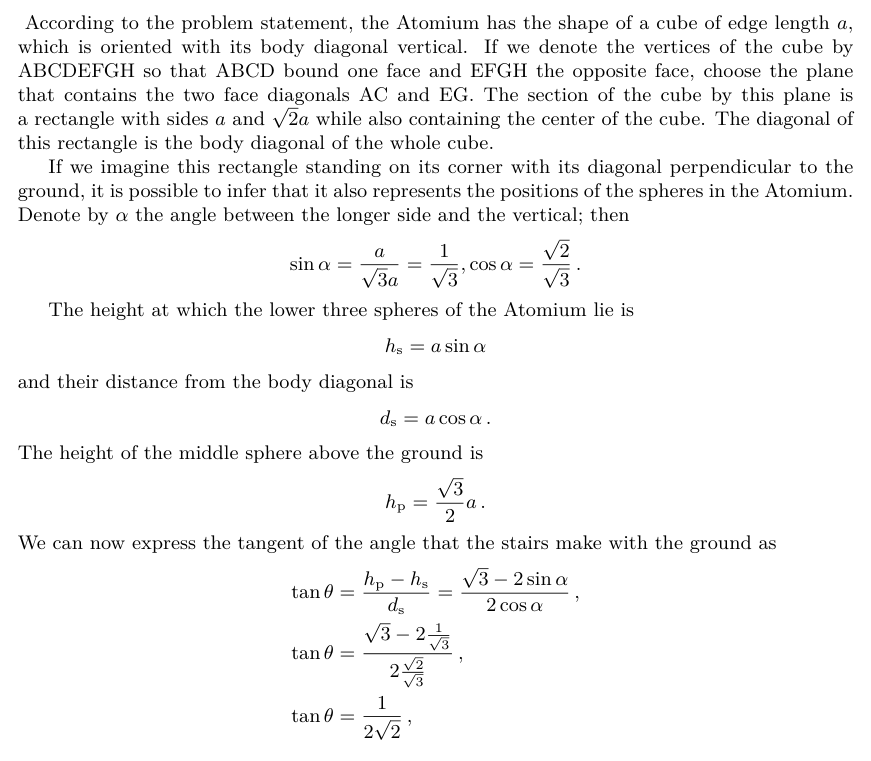

Official solution by FYKOS (Physics Brawl Online 2025), reproduced from the official PDF — p. 9, 10 — under CC BY-SA 3.0.
Topic: Mathematics Metodi: Vector Decomposition, Symmetry Argument Competenze: Diagrammatic Reasoning Objects: Sphere Fonte: Testo (PDF) — p.9 · Soluzione ufficiale (PDF) — p.9
Le scale dell’Atomium (3 punti)
L’Atomium di Bruxelles è un monumento turistico che riproduce la cella elementare di un reticolo cubico a corpo centrato del ferro cristallino. Al posto degli atomi ci sono grandi sfere visitabili, collegate da passaggi lungo tutti gli spigoli del cubo e anche dalle sfere ai vertici alla sfera centrale. Il cubo poggia su uno dei suoi vertici, in modo che la sua diagonale principale sia perpendicolare al suolo. Qual è l’inclinazione, rispetto al piano orizzontale del suolo, della scala che porta dalla seconda sfera più bassa alla sfera centrale?
Risposta:
Soluzione: La soluzione ufficiale completa (in inglese) è nella versione originale di questo quesito e nel PDF ufficiale.
Topic: Mathematics Metodi: Vector Decomposition, Symmetry Argument Competenze: Diagrammatic Reasoning Objects: Sphere Fonte: Testo (PDF) — p.9 · Soluzione ufficiale (PDF) — p.9
The strength of LED strips (4 points)
Jarda installed long LED strips on his kitchen counter, with a power consumption of and a voltage of . The voltage is supplied from a transformer via an long twin-lead cable in which the two wires are spaced apart. What is the magnitude of the force between the pair of wires? If the force is attractive, submit a positive value; if repulsive, submit a negative value. Assume the thickness of the metal wires to be negligible.
Risposta: (repulsive)
Soluzione:
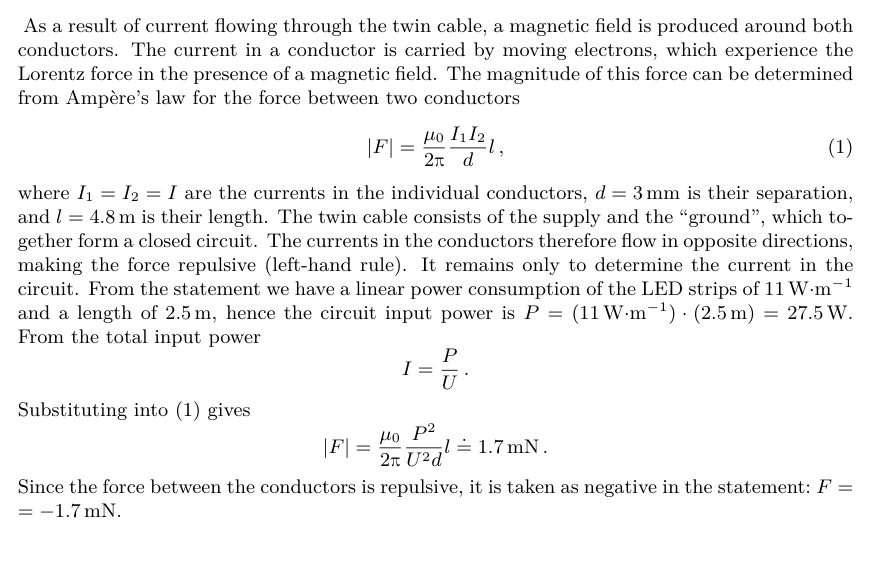
Official solution by FYKOS (Physics Brawl Online 2025), reproduced from the official PDF — p. 10 — under CC BY-SA 3.0.
Topic: Magnetism, Circuits Metodi: Biot-Savart Law, Lorentz Force Analysis Competenze: Mathematical Modeling Objects: Wire Fonte: Testo (PDF) — p.10 · Soluzione ufficiale (PDF) — p.10
La forza delle strisce LED (4 punti)
Jarda ha installato sul piano della cucina strisce LED lunghe , con un consumo di e una tensione . La tensione arriva da un trasformatore attraverso un cavo bipolare lungo i cui due conduttori distano . Quanto vale la forza tra i due conduttori? Se la forza è attrattiva indica un valore positivo, se è repulsiva un valore negativo. Considera trascurabile lo spessore dei fili metallici.
Risposta: (repulsiva)
Soluzione: La soluzione ufficiale completa (in inglese) è nella versione originale di questo quesito e nel PDF ufficiale.
Topic: Magnetism, Circuits Metodi: Biot-Savart Law, Lorentz Force Analysis Competenze: Mathematical Modeling Objects: Wire Fonte: Testo (PDF) — p.10 · Soluzione ufficiale (PDF) — p.10
Skipping pizza (4 points)
On a spring of stiffness with a platform there is a pizza of mass . The spring with the platform is, by a built-in mechanism, compressed to an initial displacement from the equilibrium position. The mechanism then releases the spring, which launches the pizza and immediately after the launch compresses the spring back to the initial displacement . The pizza then lands back on the platform, compresses the spring and is launched again. Immediately after each launch the mechanism pulls the spring to the maximal displacement from the equilibrium position that was reached after the pizza’s impact. This process repeats.
To what displacement will the spring be compressed by the mechanism after the launch at which the pizza first exceeds the height above the equilibrium position? Neglect air resistance. Assume that all kinetic energy of the pizza and the potential energy of the spring are converted into each other ideally (without losses) and that the mass of the platform and the spring is negligible compared to the mass of the pizza.
Risposta:
Soluzione:
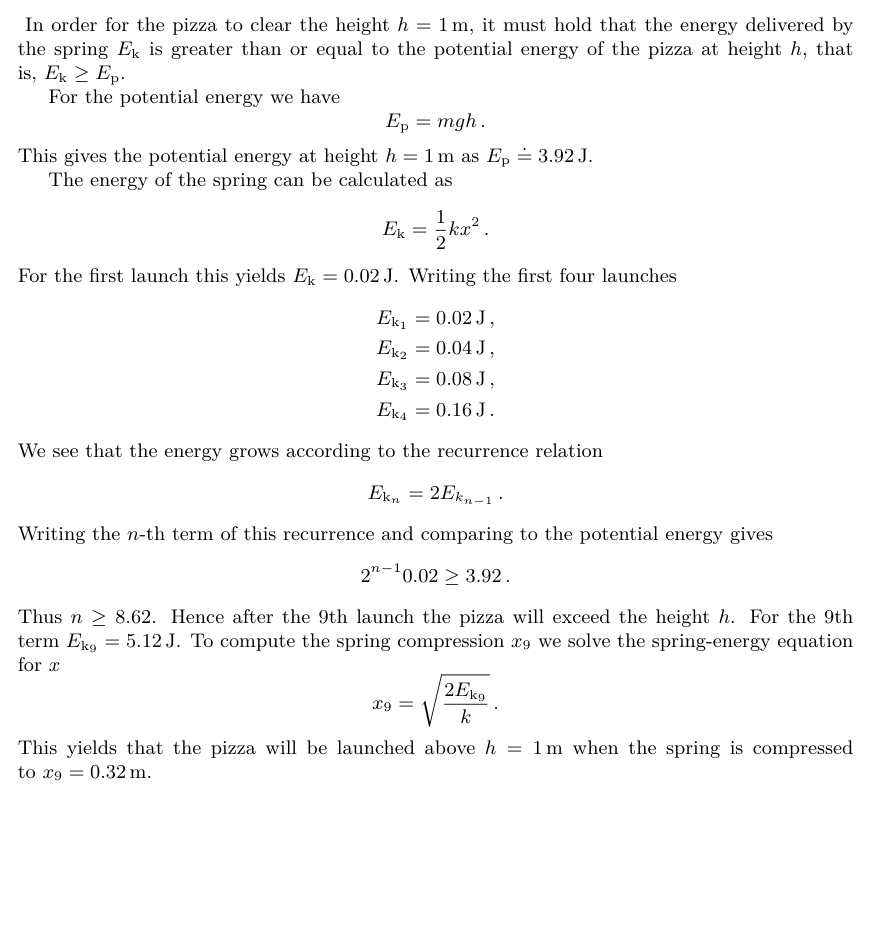
Official solution by FYKOS (Physics Brawl Online 2025), reproduced from the official PDF — p. 11 — under CC BY-SA 3.0.
Topic: Conservation of Energy Metodi: Energy Conservation Method, Hooke’s Law Competenze: Mathematical Modeling Objects: Spring Fonte: Testo (PDF) — p.10 · Soluzione ufficiale (PDF) — p.11
Pizza saltellante (4 punti)
Su una molla di costante elastica munita di piattaforma si trova una pizza di massa . Un meccanismo incorporato comprime la molla con la piattaforma fino a uno spostamento iniziale dalla posizione di equilibrio. Il meccanismo poi rilascia la molla, che lancia la pizza, e subito dopo il lancio ricomprime la molla fino allo spostamento iniziale . La pizza ricade sulla piattaforma, comprime la molla e viene lanciata di nuovo. Subito dopo ogni lancio il meccanismo riporta la molla allo spostamento massimo dalla posizione di equilibrio raggiunto dopo l’impatto della pizza. Il processo si ripete.
A quale spostamento il meccanismo comprimerà la molla dopo il lancio in cui la pizza supera per la prima volta l’altezza sopra la posizione di equilibrio? Trascura la resistenza dell’aria. Supponi che energia cinetica della pizza ed energia potenziale della molla si convertano l’una nell’altra in modo ideale (senza perdite) e che le masse della piattaforma e della molla siano trascurabili rispetto a quella della pizza.
Risposta:
Soluzione: La soluzione ufficiale completa (in inglese) è nella versione originale di questo quesito e nel PDF ufficiale.
Topic: Conservation of Energy Metodi: Energy Conservation Method, Hooke’s Law Competenze: Mathematical Modeling Objects: Spring Fonte: Testo (PDF) — p.10 · Soluzione ufficiale (PDF) — p.11
Voltage on the voltmeter (4 points)
What voltage will the voltmeter show in the circuit shown in the diagram? The source voltage is , the source has negligible internal resistance, the voltmeter is ideal, and the resistors have the following resistance values: , , , and . Provide the result as a positive number.
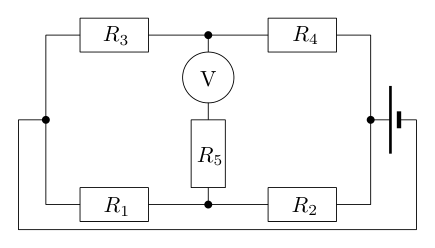
Risposta:
Soluzione:
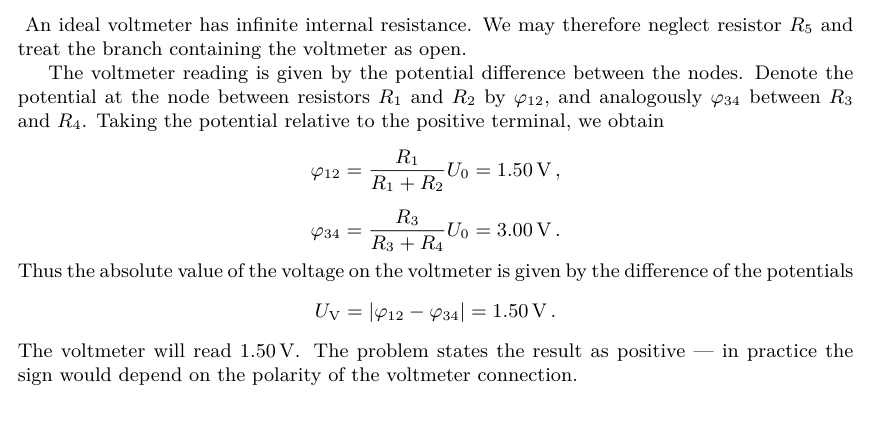
Official solution by FYKOS (Physics Brawl Online 2025), reproduced from the official PDF — p. 12 — under CC BY-SA 3.0.
Topic: Circuits Metodi: Kirchhoff’s Laws, Equivalent Circuit Reduction Competenze: Diagrammatic Reasoning Objects: Resistor, Battery Fonte: Testo (PDF) — p.12 · Soluzione ufficiale (PDF) — p.12
La tensione sul voltmetro (4 punti)
Quale tensione indicherà il voltmetro nel circuito mostrato nello schema? La tensione della sorgente è , la sorgente ha resistenza interna trascurabile, il voltmetro è ideale e i resistori hanno le resistenze , , , e . Esprimi il risultato come numero positivo.
Risposta:
Soluzione: La soluzione ufficiale completa (in inglese) è nella versione originale di questo quesito e nel PDF ufficiale.
Topic: Circuits Metodi: Kirchhoff’s Laws, Equivalent Circuit Reduction Competenze: Diagrammatic Reasoning Objects: Resistor, Battery Fonte: Testo (PDF) — p.12 · Soluzione ufficiale (PDF) — p.12
Radar operator problems (4 points)
A radar operator transmitted a pulse at frequency toward an enemy aircraft flying at an altitude above the ground. After a time the pulse returned with a frequency shifted by relative to the transmitted pulse. Determine how long it will take until the enemy aircraft is directly above the radar operator, assuming the aircraft flies uniformly in a straight line and parallel to the ground toward the point directly above the radar.
Risposta:
Soluzione:

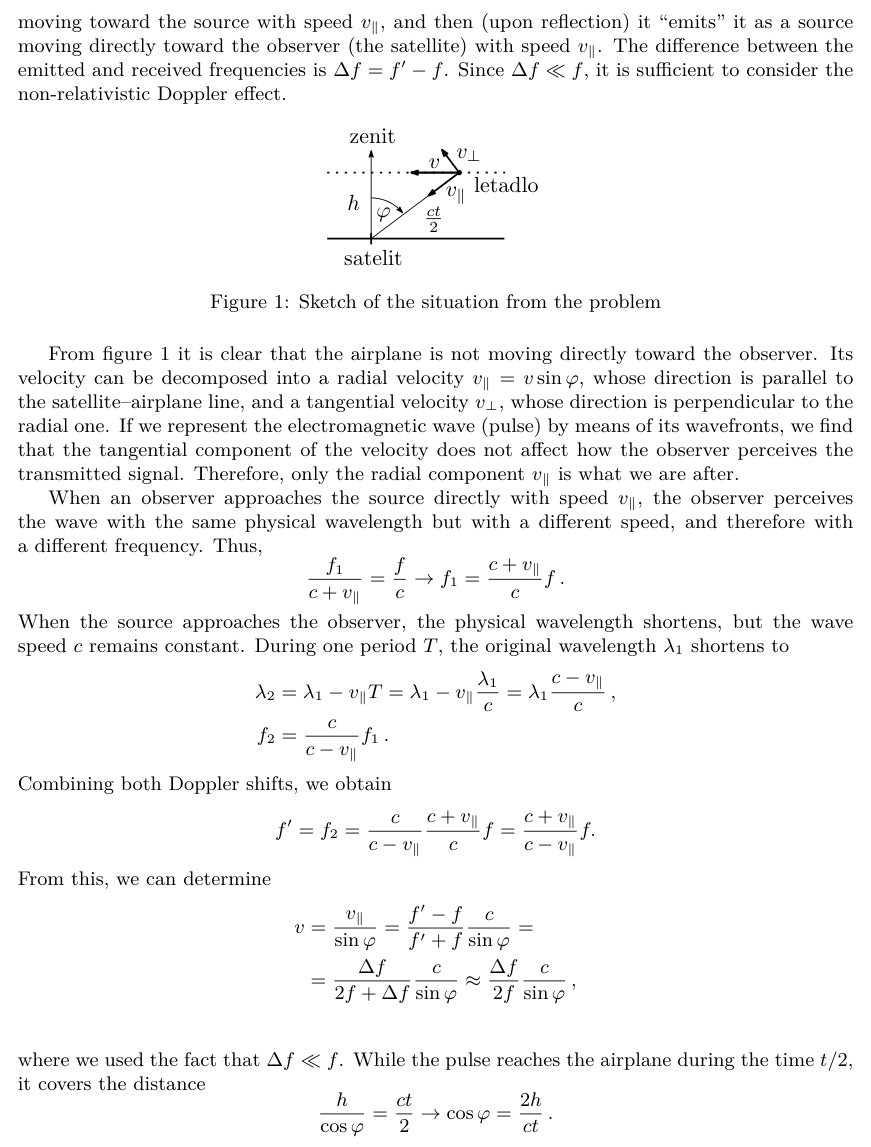
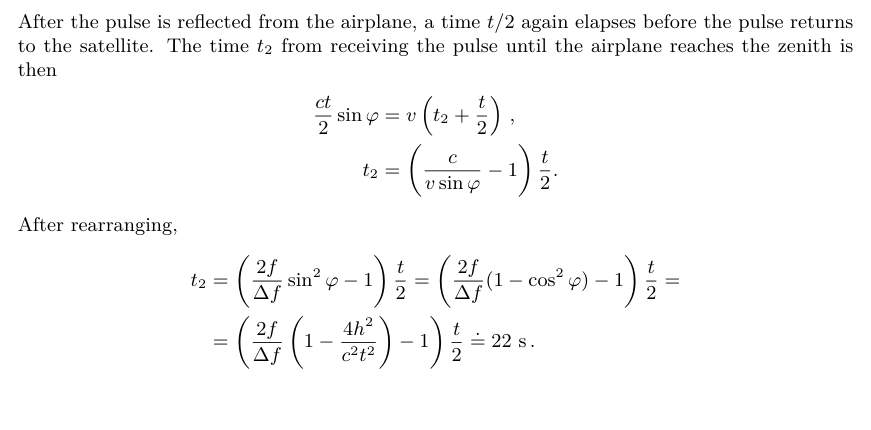
Official solution by FYKOS (Physics Brawl Online 2025), reproduced from the official PDF — p. 12, 13, 14 — under CC BY-SA 3.0.
Topic: Oscillations & Waves Metodi: Vector Decomposition, Physical Modeling Competenze: Mathematical Modeling, Unit Conversion Objects: — Fonte: Testo (PDF) — p.12 · Soluzione ufficiale (PDF) — p.12
I problemi dell’operatore radar (4 punti)
Un operatore radar ha inviato un impulso di frequenza verso un aereo nemico che vola a quota dal suolo. Dopo un tempo l’impulso è tornato con una frequenza spostata di rispetto a quella emessa. Determina quanto tempo passerà prima che l’aereo nemico si trovi esattamente sopra l’operatore radar, supponendo che l’aereo voli di moto rettilineo uniforme, parallelamente al suolo, verso il punto sulla verticale del radar.
Risposta:
Soluzione: La soluzione ufficiale completa (in inglese) è nella versione originale di questo quesito e nel PDF ufficiale.
Topic: Oscillations & Waves Metodi: Vector Decomposition, Physical Modeling Competenze: Mathematical Modeling, Unit Conversion Objects: — Fonte: Testo (PDF) — p.12 · Soluzione ufficiale (PDF) — p.12
Spinning electrons (4 points)
Danka was working in the lab with a flask filled with low-pressure argon, into which a collimated electron beam was introduced. The beam ionized the argon, and during recombination, the path of the electron beam could be observed due to luminescence. Danka adjusted the beam so that its trajectory took the shape of a helix with a radius of and a constant pitch of . The accelerating voltage of the electrons was . What was the magnitude of the magnetic induction (magnetic field) in the flask produced by the external magnets under these conditions? Assume that the magnetic induction is constant throughout the entire volume of the flask and has a uniform direction.
Risposta:
Soluzione:
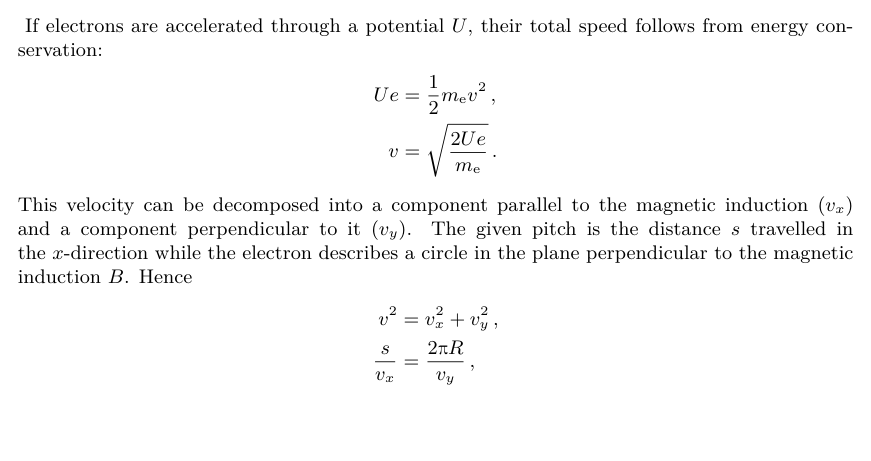
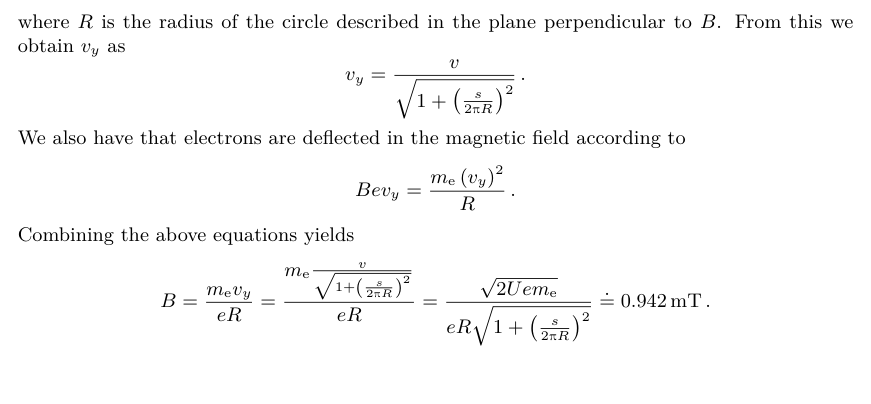
Official solution by FYKOS (Physics Brawl Online 2025), reproduced from the official PDF — p. 14, 15 — under CC BY-SA 3.0.
Topic: Magnetism Metodi: Lorentz Force Analysis, Energy Conservation Method Competenze: Mathematical Modeling Objects: Electron, Particle Beam Fonte: Testo (PDF) — p.14 · Soluzione ufficiale (PDF) — p.14
Elettroni che girano (4 punti)
Danka lavorava in laboratorio con un’ampolla piena di argon a bassa pressione, nella quale veniva introdotto un fascio collimato di elettroni. Il fascio ionizzava l’argon e, durante la ricombinazione, il percorso del fascio diventava visibile per luminescenza. Danka ha regolato il fascio in modo che la traiettoria fosse un’elica di raggio e passo costante . La tensione di accelerazione degli elettroni era . Quanto valeva in queste condizioni l’induzione magnetica (campo magnetico) prodotta nell’ampolla dai magneti esterni? Supponi che l’induzione magnetica sia costante in tutto il volume dell’ampolla e abbia direzione uniforme.
Risposta:
Soluzione: La soluzione ufficiale completa (in inglese) è nella versione originale di questo quesito e nel PDF ufficiale.
Topic: Magnetism Metodi: Lorentz Force Analysis, Energy Conservation Method Competenze: Mathematical Modeling Objects: Electron, Particle Beam Fonte: Testo (PDF) — p.14 · Soluzione ufficiale (PDF) — p.14
Overturned outhouse (4 points)
It was windy and Kuba was walking along a footpath. Suddenly he saw an overturned outhouse, and immediately began to wonder what wind speeds are required to tip it over. Approximate the outhouse as a homogeneous rectangular block of height , with a square base of side length and mass ; the drag coefficient has the value . Assume that the wind blows perpendicularly onto one of the side walls and that the axis of rotation is fixed at the edge of the outhouse touching the ground opposite the side on which the wind is blowing. Take the air density to be . What is the minimum wind speed required for the outhouse to start tipping?
Risposta:
Soluzione:
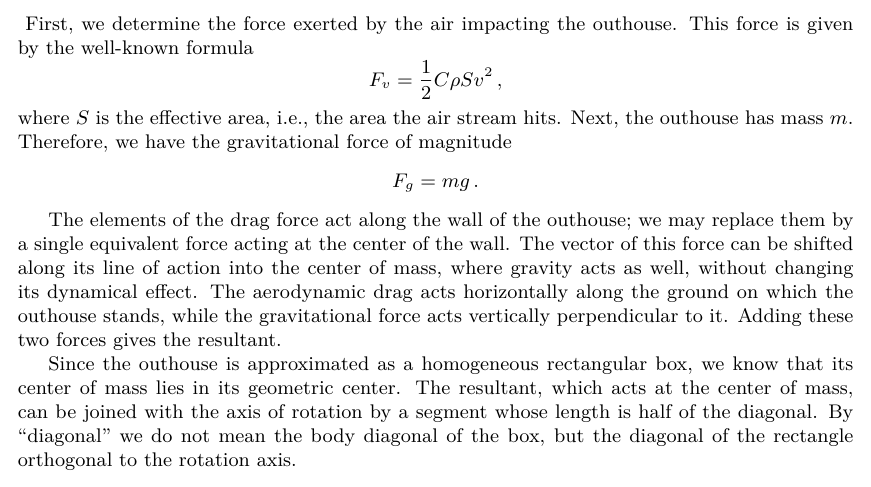
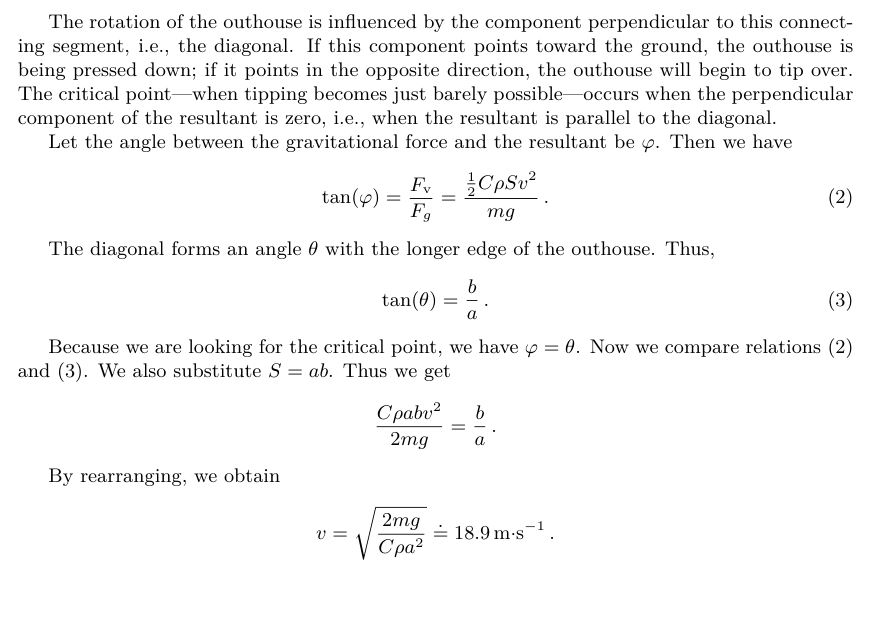
Official solution by FYKOS (Physics Brawl Online 2025), reproduced from the official PDF — p. 15, 16 — under CC BY-SA 3.0.
Topic: Rigid Body Statics, Fluid Mechanics Metodi: Torque & Angular Momentum Analysis, Physical Modeling Competenze: Mathematical Modeling Objects: Block Fonte: Testo (PDF) — p.15 · Soluzione ufficiale (PDF) — p.15
Gabinetto rovesciato (4 punti)
C’era vento e Kuba camminava lungo un sentiero. All’improvviso ha visto un gabinetto da campagna rovesciato e si è subito chiesto quale velocità del vento serva per ribaltarlo. Approssima il gabinetto come un parallelepipedo omogeneo di altezza , base quadrata di lato e massa ; il coefficiente di resistenza aerodinamica vale . Supponi che il vento soffi perpendicolarmente su una delle pareti laterali e che l’asse di rotazione sia lo spigolo a contatto con il suolo dalla parte opposta a quella investita dal vento. Assumi per la densità dell’aria . Qual è la velocità minima del vento perché il gabinetto cominci a ribaltarsi?
Risposta:
Soluzione: La soluzione ufficiale completa (in inglese) è nella versione originale di questo quesito e nel PDF ufficiale.
Topic: Rigid Body Statics, Fluid Mechanics Metodi: Torque & Angular Momentum Analysis, Physical Modeling Competenze: Mathematical Modeling Objects: Block Fonte: Testo (PDF) — p.15 · Soluzione ufficiale (PDF) — p.15
Potassium cube (4 points)
Potassium has a half-life of years. It transforms via decay into the stable calcium isotope with a probability of , and via decay into the stable argon isotope with a probability of . How much would be required in a cube to produce, in one year, enough argon to fill a room of dimensions , and with an argon particle density of ? Assume that argon is released from the entire volume. The molar mass of is .
Risposta:
Soluzione:
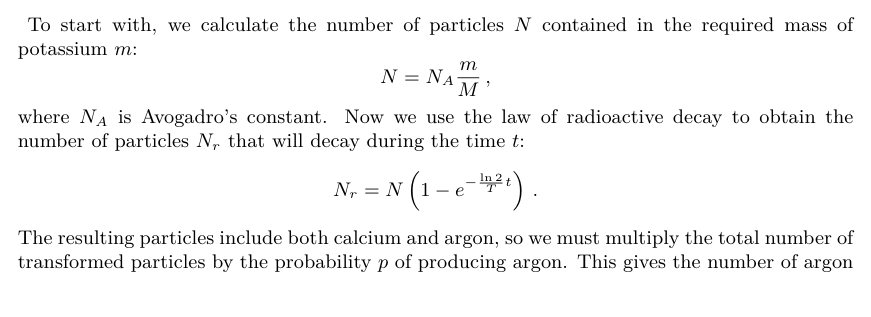
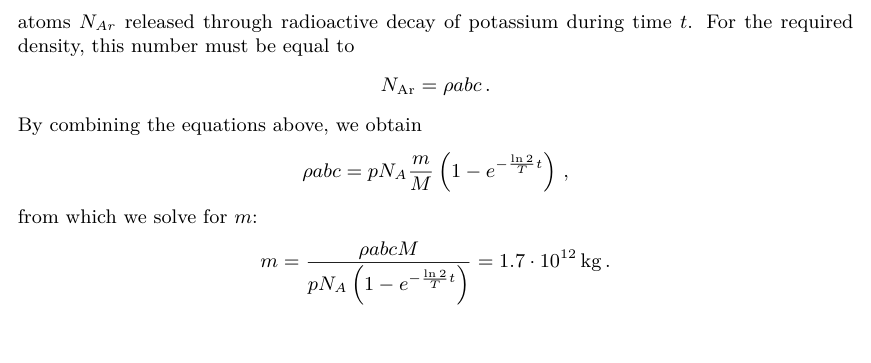
Official solution by FYKOS (Physics Brawl Online 2025), reproduced from the official PDF — p. 16, 17 — under CC BY-SA 3.0.
Topic: Nuclear & Particle Physics Metodi: Radioactive Decay Law Competenze: Mathematical Modeling, Unit Conversion Objects: Nucleus Fonte: Testo (PDF) — p.16 · Soluzione ufficiale (PDF) — p.16
Cubo di potassio (4 punti)
Il potassio ha un tempo di dimezzamento anni. Si trasforma per decadimento nell’isotopo stabile del calcio con probabilità e per decadimento nell’isotopo stabile dell’argon con probabilità . Quanto servirebbe, in un cubo, per produrre in un anno abbastanza argon da riempire una stanza di dimensioni , e con una densità di particelle di argon ? Supponi che l’argon venga rilasciato da tutto il volume. La massa molare del è .
Risposta:
Soluzione: La soluzione ufficiale completa (in inglese) è nella versione originale di questo quesito e nel PDF ufficiale.
Topic: Nuclear & Particle Physics Metodi: Radioactive Decay Law Competenze: Mathematical Modeling, Unit Conversion Objects: Nucleus Fonte: Testo (PDF) — p.16 · Soluzione ufficiale (PDF) — p.16
Thermodynamical pulleys (4 points)
We have a steady configuration as shown in the figure. Both gas vessels are rigidly fixed and each contains of gas at a temperature , which is also the ambient temperature where the atmospheric pressure applies. What is the volume of the gas in the lower piston? Neglect the weight of everything except the weight . The areas in the figure are , , .
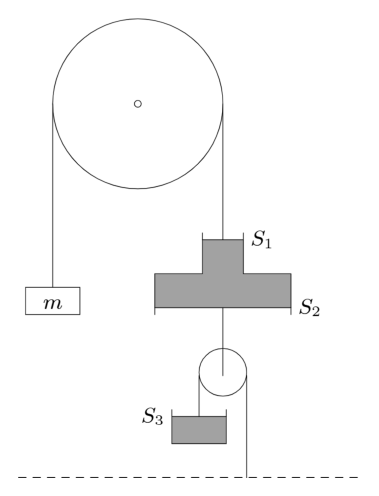
Risposta:
Soluzione:
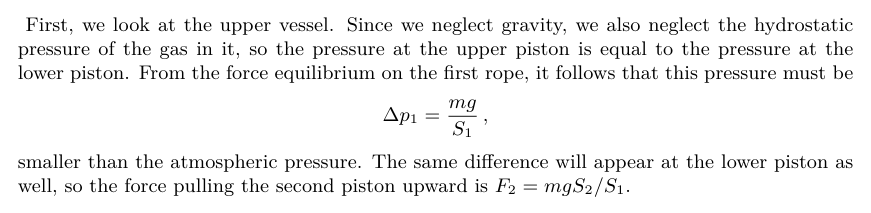
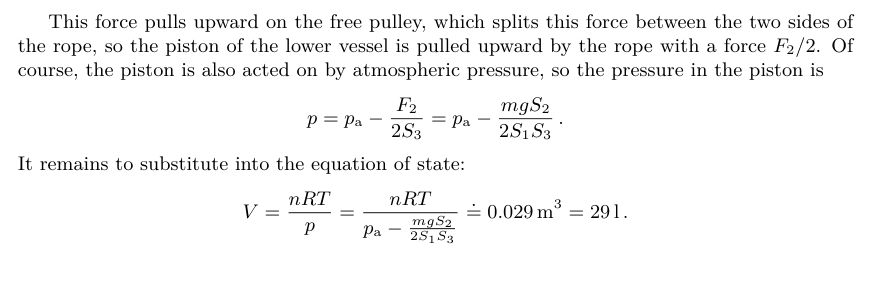
Official solution by FYKOS (Physics Brawl Online 2025), reproduced from the official PDF — p. 17, 18 — under CC BY-SA 3.0.
Topic: Thermodynamics, Rigid Body Statics Metodi: Ideal Gas Law, Free-Body Diagram Competenze: Diagrammatic Reasoning Objects: Piston, Pulley, Gas Fonte: Testo (PDF) — p.17 · Soluzione ufficiale (PDF) — p.17
Carrucole termodinamiche (4 punti)
Abbiamo una configurazione in equilibrio come in figura. Entrambi i recipienti di gas sono fissati rigidamente e ciascuno contiene di gas alla temperatura , che è anche la temperatura dell’ambiente, dove agisce la pressione atmosferica. Qual è il volume del gas nel pistone inferiore? Trascura il peso di tutto tranne quello della massa . Le aree in figura sono , , .
Risposta:
Soluzione: La soluzione ufficiale completa (in inglese) è nella versione originale di questo quesito e nel PDF ufficiale.
Topic: Thermodynamics, Rigid Body Statics Metodi: Ideal Gas Law, Free-Body Diagram Competenze: Diagrammatic Reasoning Objects: Piston, Pulley, Gas Fonte: Testo (PDF) — p.17 · Soluzione ufficiale (PDF) — p.17
Wired wheel (5 points)
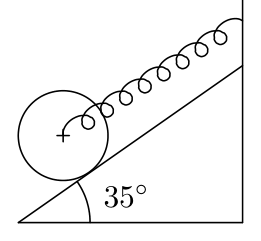
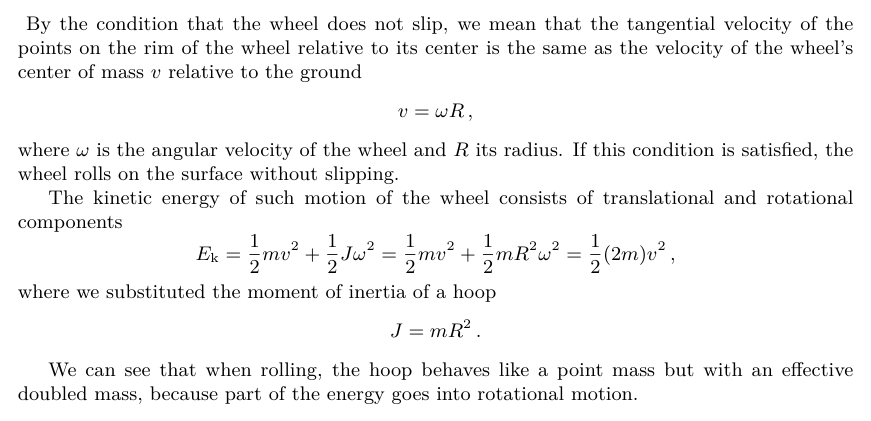
A hoop with a mass of and a diameter of is placed on an inclined plane, tilted at an angle of to the horizontal. The hoop has an axis of symmetry with a shaft that allows it to rotate freely. The shaft is connected to a spring with a spring constant of , which runs parallel to the plane and points upwards. If the hoop is displaced downwards from its equilibrium position, what will be its oscillation period? Assume that there is no slipping between the hoop and the plane.
Risposta:
Soluzione:
Official solution by FYKOS (Physics Brawl Online 2025), reproduced from the official PDF — p. 18, 19 — under CC BY-SA 3.0.
Topic: Oscillations & Waves, Rotational Dynamics Metodi: Simple Harmonic Motion Analysis, Energy Conservation Method Competenze: Mathematical Modeling Objects: Wheel, Spring, Inclined Plane Fonte: Testo (PDF) — p.18 · Soluzione ufficiale (PDF) — p.18
Ruota con la molla (5 punti)
Un anello di massa e diametro è posto su un piano inclinato di rispetto all’orizzontale. L’anello ha lungo l’asse di simmetria un perno che gli permette di ruotare liberamente. Il perno è collegato a una molla di costante elastica , parallela al piano e diretta verso l’alto. Se l’anello viene spostato verso il basso dalla posizione di equilibrio, quale sarà il periodo delle sue oscillazioni? Supponi che l’anello rotoli sul piano senza strisciare.
Risposta:
Soluzione: La soluzione ufficiale completa (in inglese) è nella versione originale di questo quesito e nel PDF ufficiale.
Topic: Oscillations & Waves, Rotational Dynamics Metodi: Simple Harmonic Motion Analysis, Energy Conservation Method Competenze: Mathematical Modeling Objects: Wheel, Spring, Inclined Plane Fonte: Testo (PDF) — p.18 · Soluzione ufficiale (PDF) — p.18
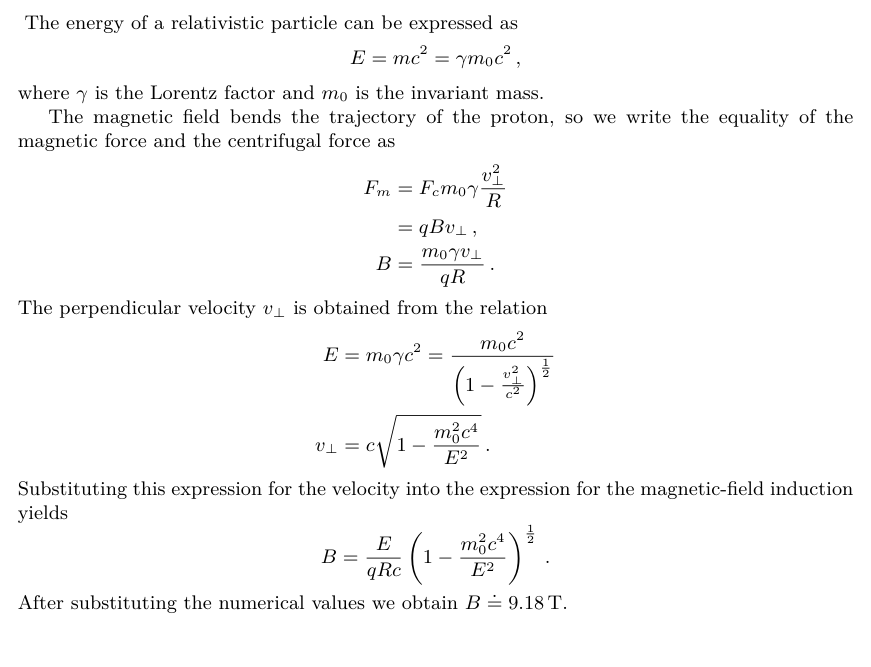
Particles (4 points)
We have a relativistic proton for which the detector measured an energy of . What must be the magnitude of the magnetic flux density so that the particle’s trajectory has a radius of curvature ?
Risposta:
Soluzione:
Official solution by FYKOS (Physics Brawl Online 2025), reproduced from the official PDF — p. 19 — under CC BY-SA 3.0.
Topic: Special Relativity, Magnetism Metodi: Relativistic Energy-Momentum, Lorentz Force Analysis Competenze: Mathematical Modeling Objects: Particle Beam Fonte: Testo (PDF) — p.19 · Soluzione ufficiale (PDF) — p.19
Particelle (4 punti)
Abbiamo un protone relativistico di cui il rivelatore ha misurato l’energia . Quanto deve valere l’induzione magnetica perché la traiettoria della particella abbia raggio di curvatura ?
Risposta:
Soluzione: La soluzione ufficiale completa (in inglese) è nella versione originale di questo quesito e nel PDF ufficiale.
Topic: Special Relativity, Magnetism Metodi: Relativistic Energy-Momentum, Lorentz Force Analysis Competenze: Mathematical Modeling Objects: Particle Beam Fonte: Testo (PDF) — p.19 · Soluzione ufficiale (PDF) — p.19
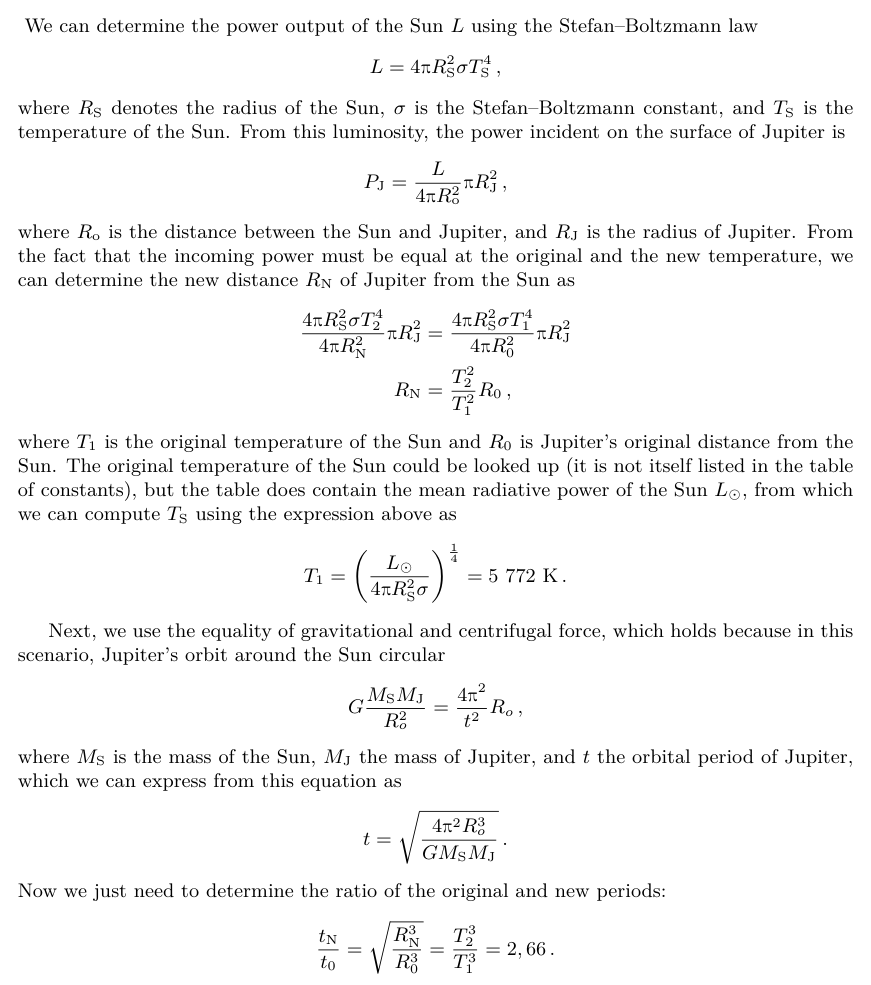
Modified solar system (5 points)
Suppose that the Sun had a temperature of . By what percentage would the orbital period of Jupiter need to increase in order for it to receive the same power as it currently does? Assume that Jupiter’s orbit around the Sun is circular and that all other properties of the Sun remain unchanged.
Risposta:
Soluzione:

Official solution by FYKOS (Physics Brawl Online 2025), reproduced from the official PDF — p. 20, 21 — under CC BY-SA 3.0.
Topic: Astrophysics, Gravitation Metodi: Kepler’s Laws, Physical Modeling Competenze: Mathematical Modeling, Estimation & Approximation Objects: Star, Planet Fonte: Testo (PDF) — p.20 · Soluzione ufficiale (PDF) — p.20
Sistema solare modificato (5 punti)
Supponi che il Sole avesse una temperatura . Di quale percentuale dovrebbe aumentare il periodo orbitale di Giove perché il pianeta riceva la stessa potenza che riceve attualmente? Supponi che l’orbita di Giove attorno al Sole sia circolare e che tutte le altre proprietà del Sole restino invariate.
Risposta:
Soluzione: La soluzione ufficiale completa (in inglese) è nella versione originale di questo quesito e nel PDF ufficiale.
Topic: Astrophysics, Gravitation Metodi: Kepler’s Laws, Physical Modeling Competenze: Mathematical Modeling, Estimation & Approximation Objects: Star, Planet Fonte: Testo (PDF) — p.20 · Soluzione ufficiale (PDF) — p.20
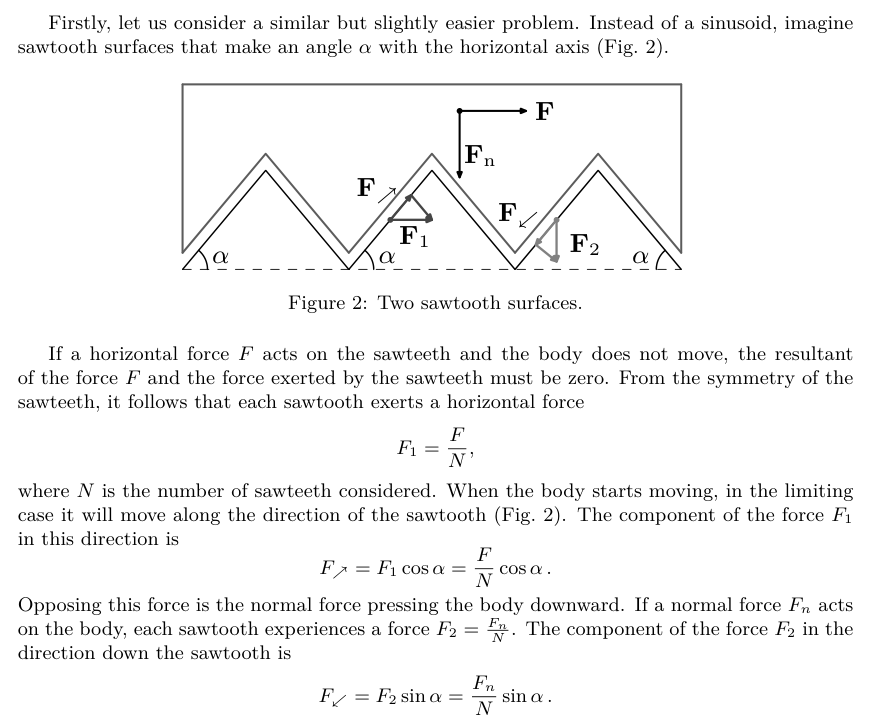
Harmonical friction (5 points)
As is well known, the irregularities of contacting surfaces cause friction. A very simple one-dimensional model of such a surface can be represented by the graph of a harmonic function with a period of and an amplitude of . If we place two identical “surfaces” of this type against each other, they interlock so that they follow the same curve. Determine the coefficient of static friction of such a system — that is, the ratio between the horizontal force acting on the upper body (at which the system begins to move continuously) and the normal force pressing the upper body downward. The lower body is fixed and does not move. The model surfaces are perfectly smooth.
Risposta:
Soluzione:
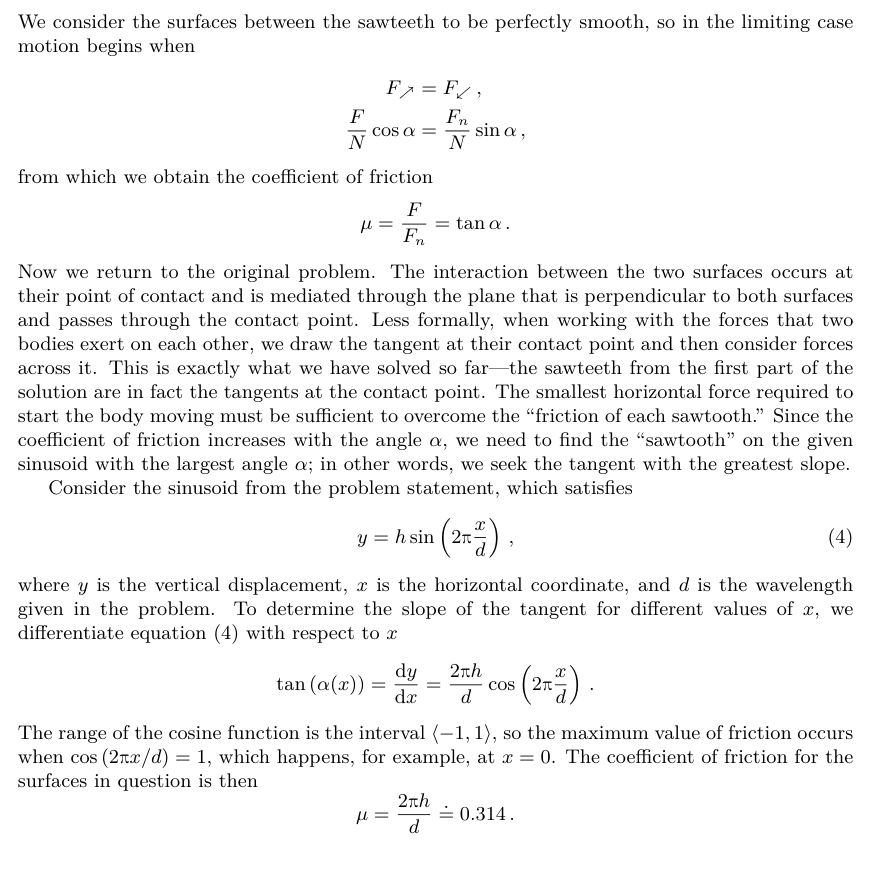
Official solution by FYKOS (Physics Brawl Online 2025), reproduced from the official PDF — p. 21, 22 — under CC BY-SA 3.0.
Topic: Newtonian Mechanics Metodi: Free-Body Diagram, Vector Decomposition Competenze: Mathematical Modeling Objects: Block Fonte: Testo (PDF) — p.21 · Soluzione ufficiale (PDF) — p.21
Attrito armonico (5 punti)
Come è noto, le irregolarità delle superfici a contatto sono la causa dell’attrito. Un modello unidimensionale molto semplice di una tale superficie è il grafico di una funzione armonica di periodo e ampiezza . Se mettiamo a contatto due “superfici” identiche di questo tipo, esse si incastrano seguendo la stessa curva. Determina il coefficiente di attrito statico di un tale sistema, cioè il rapporto tra la forza orizzontale che agisce sul corpo superiore (alla quale il sistema comincia a muoversi con continuità) e la forza normale che preme il corpo superiore verso il basso. Il corpo inferiore è fisso. Le superfici del modello sono perfettamente lisce.
Risposta:
Soluzione: La soluzione ufficiale completa (in inglese) è nella versione originale di questo quesito e nel PDF ufficiale.
Topic: Newtonian Mechanics Metodi: Free-Body Diagram, Vector Decomposition Competenze: Mathematical Modeling Objects: Block Fonte: Testo (PDF) — p.21 · Soluzione ufficiale (PDF) — p.21
Tense oscillations (5 points)
Terka was playing with a plate capacitor consisting of two parallel metallic plates separated by a distance and held at a potential difference , when suddenly her earring fell into the capacitor. She looked in tensely and observed an interesting phenomenon — the earring began to jump back and forth between the plates.
Determine the steady-state frequency of these oscillations. Each plate of the capacitor has an area . Model the earring as a conducting sphere of radius and mass . Collisions of the sphere with the plates are characterized by a coefficient of restitution . Upon contact with a plate, the sphere acquires a charge . Neglect the influence of gravity on the motion.
Risposta:
Soluzione:
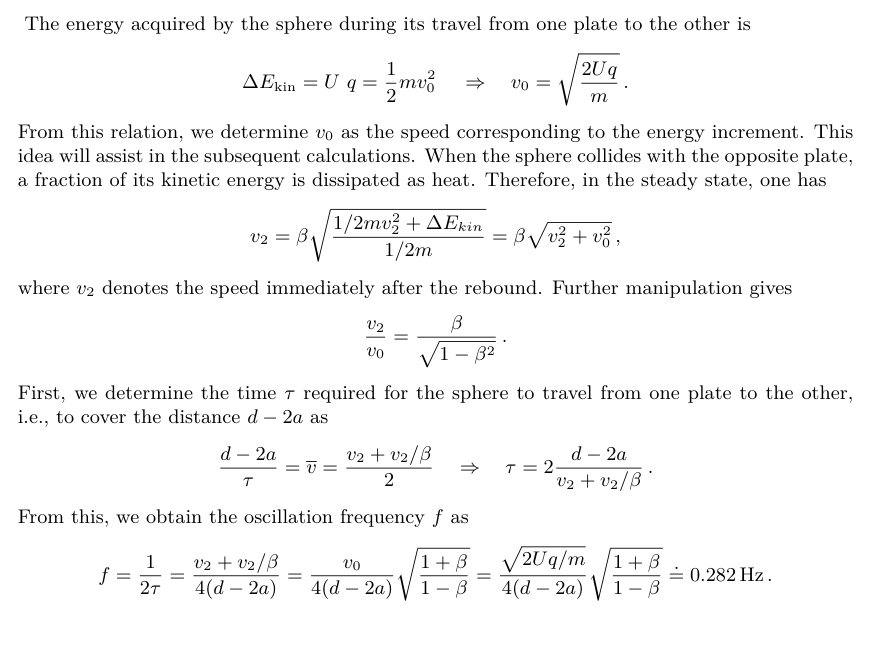
Official solution by FYKOS (Physics Brawl Online 2025), reproduced from the official PDF — p. 23 — under CC BY-SA 3.0.
Topic: Electrostatics Metodi: Energy Conservation Method, Kinematic Equations Competenze: Mathematical Modeling Objects: Capacitor, Conducting Sphere Fonte: Testo (PDF) — p.22 · Soluzione ufficiale (PDF) — p.23
Oscillazioni sotto tensione (5 punti)
Terka stava giocando con un condensatore piano formato da due armature metalliche parallele a distanza , mantenute a una differenza di potenziale , quando all’improvviso il suo orecchino è caduto nel condensatore. Guardando con apprensione ha osservato un fenomeno interessante: l’orecchino ha cominciato a rimbalzare avanti e indietro tra le armature.
Determina la frequenza di regime di queste oscillazioni. Ogni armatura ha area . Modella l’orecchino come una sfera conduttrice di raggio e massa . Gli urti della sfera con le armature hanno coefficiente di restituzione . Al contatto con un’armatura la sfera acquista una carica . Trascura l’effetto della gravità sul moto.
Risposta:
Soluzione: La soluzione ufficiale completa (in inglese) è nella versione originale di questo quesito e nel PDF ufficiale.
Topic: Electrostatics Metodi: Energy Conservation Method, Kinematic Equations Competenze: Mathematical Modeling Objects: Capacitor, Conducting Sphere Fonte: Testo (PDF) — p.22 · Soluzione ufficiale (PDF) — p.23
Bizzare yo-yo adventure (5 points)
A yo-yo is made of two cylinders with radius connected by a small axle with radius . The ratio between and is . All three cylinders have the same width; they are homogeneous, made of the same material. A massless, infinitely thin string of length is wound around the small axle, with one end of the string firmly attached to it. When the yo-yo is released and allowed to unwind freely, after what time will it return to its original position? Assume that at the moment of release, the tangent to the free end of the string is vertical. Also assume that , so that the effects at the turning point of the yo-yo’s motion can be neglected.
Risposta:
Soluzione:

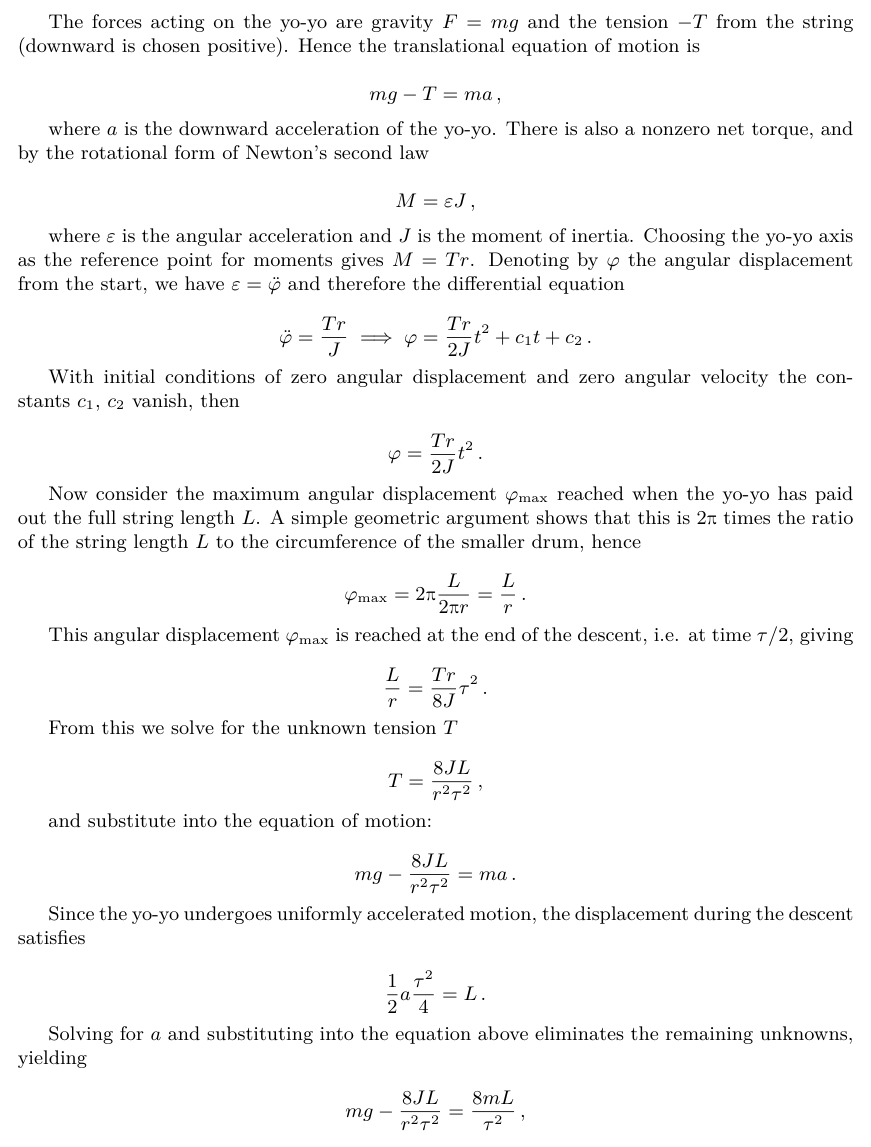
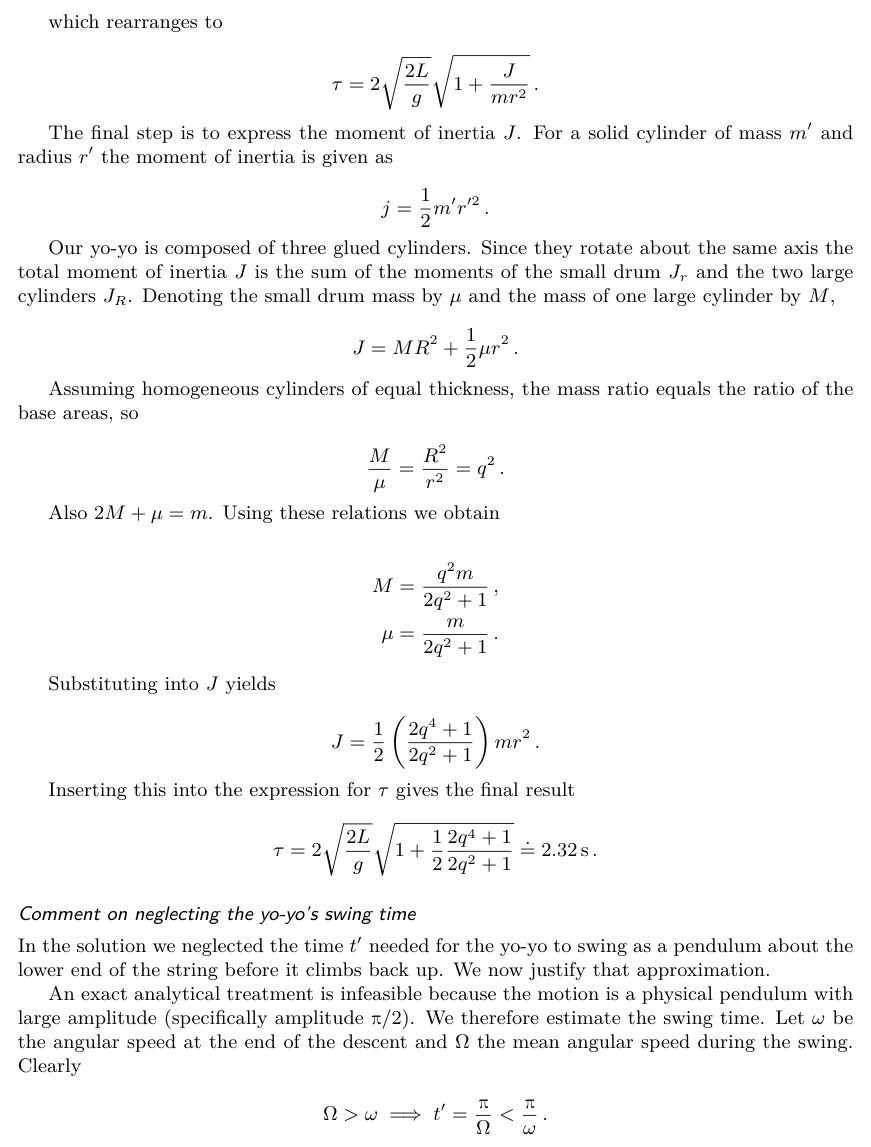
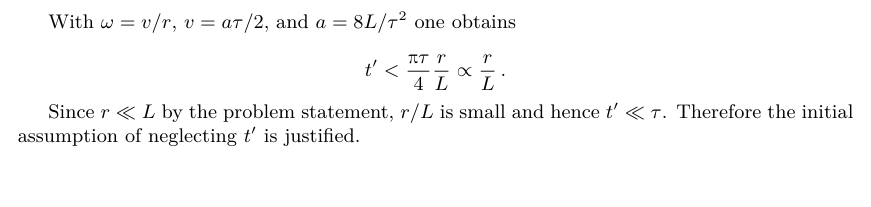
Official solution by FYKOS (Physics Brawl Online 2025), reproduced from the official PDF — p. 23, 24, 25, 26 — under CC BY-SA 3.0.
Topic: Rotational Dynamics Metodi: Torque & Angular Momentum Analysis, Kinematic Equations Competenze: Mathematical Modeling Objects: Cylinder, String Fonte: Testo (PDF) — p.23 · Soluzione ufficiale (PDF) — p.23
Bizzarra avventura dello yo-yo (5 punti)
Uno yo-yo è formato da due cilindri di raggio collegati da un piccolo asse di raggio . Il rapporto tra e è . I tre cilindri hanno la stessa larghezza e sono omogenei, dello stesso materiale. Un filo di massa trascurabile e spessore infinitesimo, lungo , è avvolto attorno all’asse piccolo, al quale è fissato saldamente un suo estremo. Quando lo yo-yo viene lasciato libero di srotolarsi, dopo quanto tempo torna nella posizione iniziale? Supponi che al momento del rilascio la tangente all’estremo libero del filo sia verticale. Supponi inoltre , così che gli effetti nel punto di inversione del moto dello yo-yo siano trascurabili.
Risposta:
Soluzione: La soluzione ufficiale completa (in inglese) è nella versione originale di questo quesito e nel PDF ufficiale.
Topic: Rotational Dynamics Metodi: Torque & Angular Momentum Analysis, Kinematic Equations Competenze: Mathematical Modeling Objects: Cylinder, String Fonte: Testo (PDF) — p.23 · Soluzione ufficiale (PDF) — p.23
Falling square (5 points)
A very long, vertically oriented rod of negligible diameter carries a current upward. A thin conductive square of side , linear resistance , and mass is placed symmetrically around the rod and released. Determine the speed of the square after .
Risposta: (no induced current)
Soluzione:
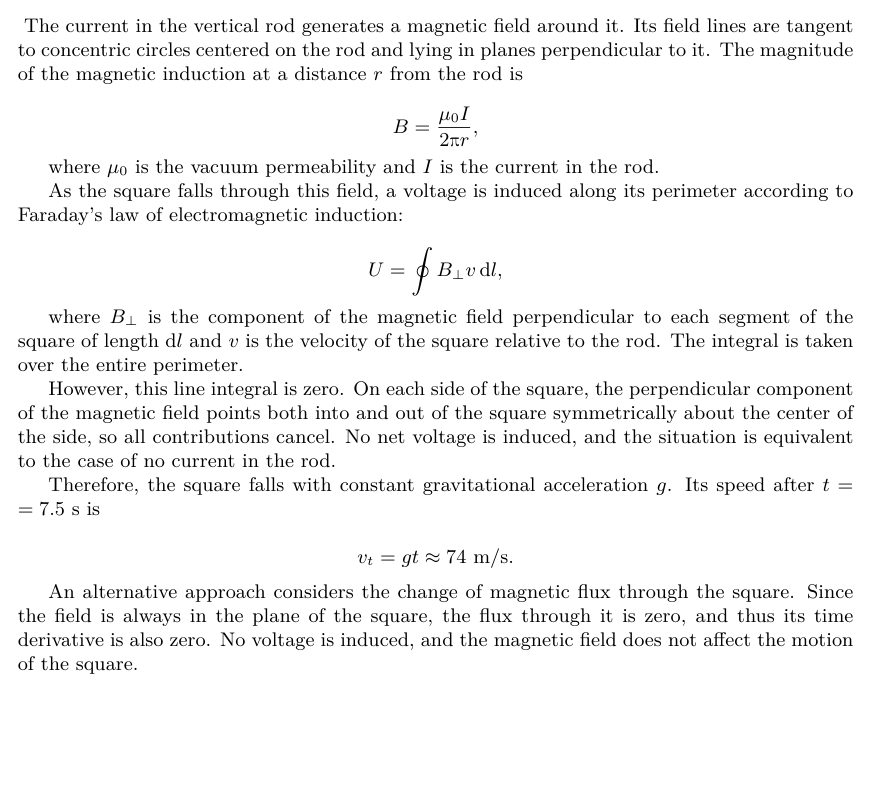
Official solution by FYKOS (Physics Brawl Online 2025), reproduced from the official PDF — p. 26 — under CC BY-SA 3.0.
Topic: Electromagnetic Induction Metodi: Faraday’s Law of Induction, Symmetry Argument Competenze: Physical Reasoning Objects: Coil, Wire Fonte: Testo (PDF) — p.26 · Soluzione ufficiale (PDF) — p.26
Quadrato in caduta (5 punti)
Un’asta verticale molto lunga, di diametro trascurabile, è percorsa verso l’alto da una corrente . Un sottile quadrato conduttore di lato , resistenza per unità di lunghezza e massa viene posto simmetricamente attorno all’asta e lasciato cadere. Determina la velocità del quadrato dopo .
Risposta: (nessuna corrente indotta)
Soluzione: La soluzione ufficiale completa (in inglese) è nella versione originale di questo quesito e nel PDF ufficiale.
Topic: Electromagnetic Induction Metodi: Faraday’s Law of Induction, Symmetry Argument Competenze: Physical Reasoning Objects: Coil, Wire Fonte: Testo (PDF) — p.26 · Soluzione ufficiale (PDF) — p.26
Ion thrust engine (4 points)
There is currently work on the concept of a space drive that accelerates a rocket by ejecting plasma accelerated to relativistic speeds. Consider a rocket with a total mass of that we accelerate by ejecting protons. Each proton has a total energy of and of protons are emitted from the rocket per second. How long will it take to accelerate the rocket to a speed of in this way? Assume the rocket’s mass remains approximately constant during the acceleration.
Risposta:
Soluzione:
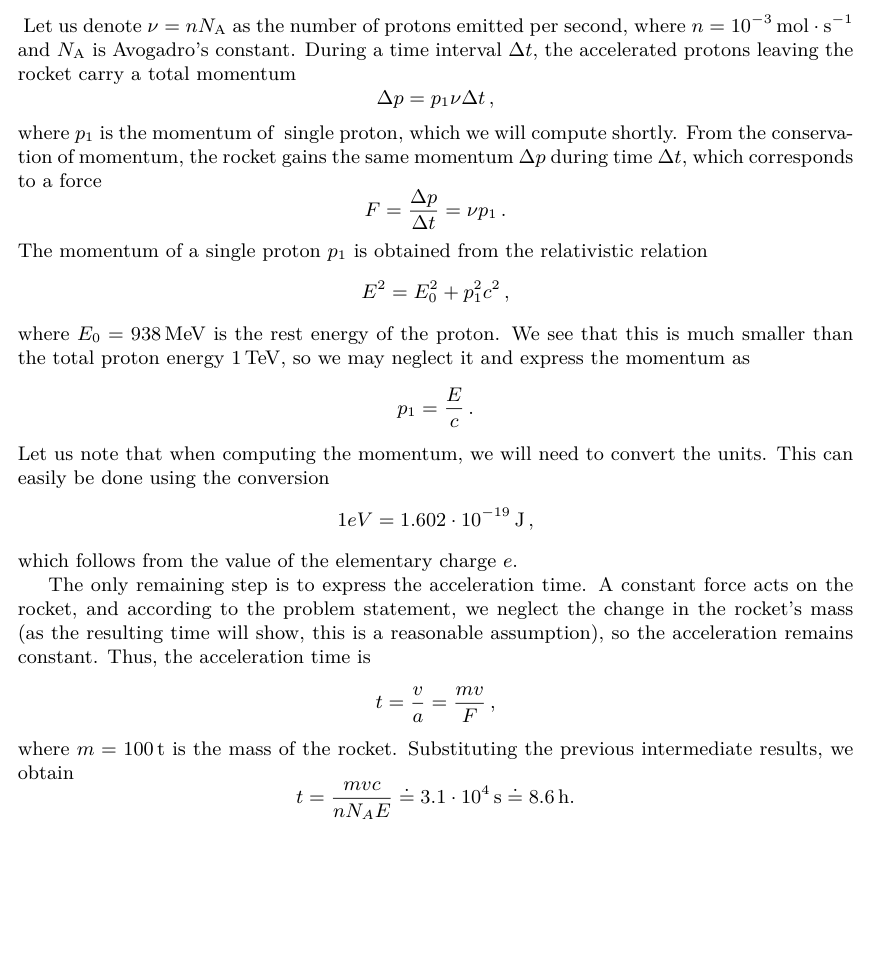
Official solution by FYKOS (Physics Brawl Online 2025), reproduced from the official PDF — p. 27 — under CC BY-SA 3.0.
Topic: Special Relativity, Conservation of Momentum Metodi: Relativistic Energy-Momentum, Impulse-Momentum Theorem Competenze: Mathematical Modeling, Estimation & Approximation Objects: Particle Beam Fonte: Testo (PDF) — p.27 · Soluzione ufficiale (PDF) — p.27
Propulsore a ioni (4 punti)
Attualmente si lavora al concetto di un propulsore spaziale che accelera un razzo espellendo plasma accelerato a velocità relativistiche. Considera un razzo di massa totale che acceleriamo espellendo protoni. Ogni protone ha energia totale e dal razzo vengono emesse di protoni al secondo. Quanto tempo occorre per portare in questo modo il razzo alla velocità di ? Supponi che la massa del razzo resti approssimativamente costante durante l’accelerazione.
Risposta:
Soluzione: La soluzione ufficiale completa (in inglese) è nella versione originale di questo quesito e nel PDF ufficiale.
Topic: Special Relativity, Conservation of Momentum Metodi: Relativistic Energy-Momentum, Impulse-Momentum Theorem Competenze: Mathematical Modeling, Estimation & Approximation Objects: Particle Beam Fonte: Testo (PDF) — p.27 · Soluzione ufficiale (PDF) — p.27
Action scene with motorbike and truck (5 points)
A block with a mass of moves without friction at a constant velocity of along a horizontal surface. On top of the block is a cylinder with a mass of , which rolls with a velocity of relative to the block in the direction of the block’s motion. The cylinder, therefore, eventually rolls off the block and begins to move along the plane as well, assuming that the vertical component of its velocity is absorbed upon impact. How long after hitting the surface will the cylinder collide with the block? Assume that their mutual distance at the moment of impact was negligible. The coefficient of kinetic friction between the cylinder and the plane is .
Risposta:
Soluzione:
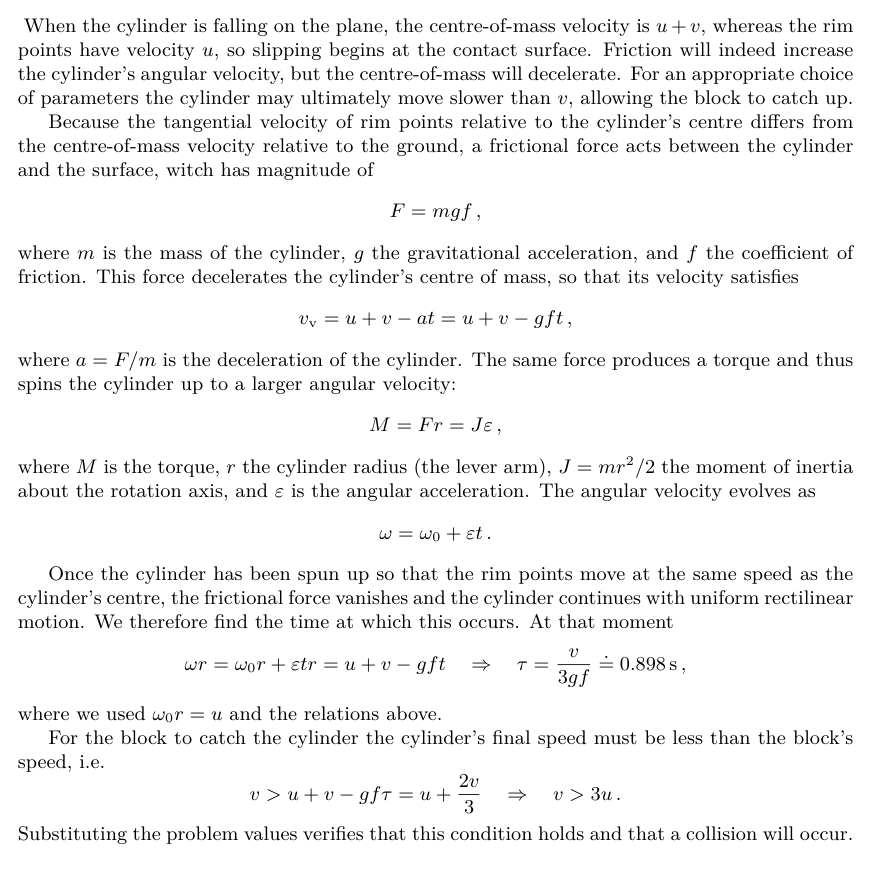
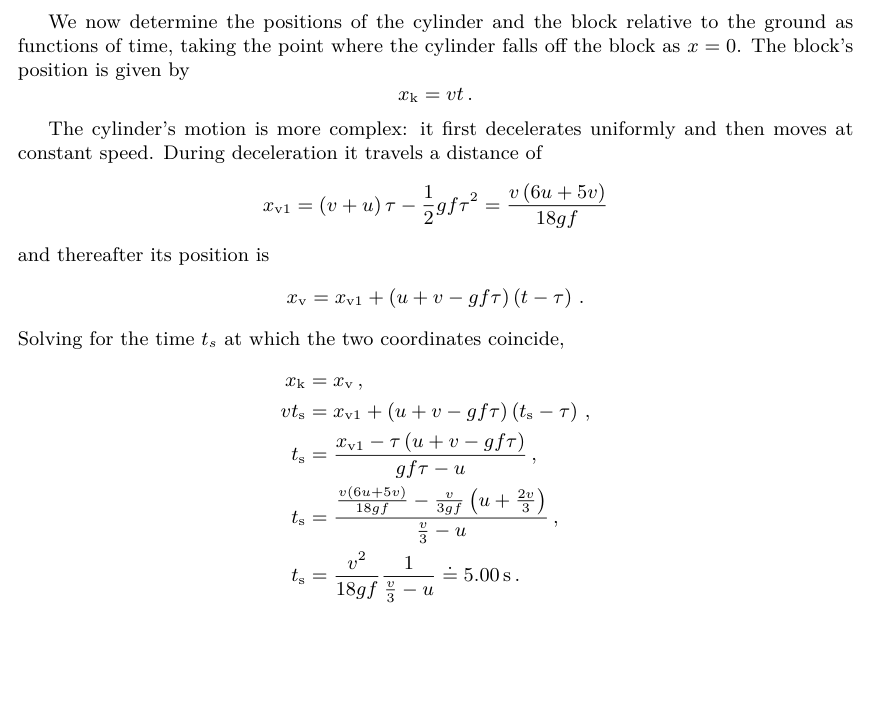
Official solution by FYKOS (Physics Brawl Online 2025), reproduced from the official PDF — p. 28, 29 — under CC BY-SA 3.0.
Topic: Rotational Dynamics, Newtonian Mechanics Metodi: Torque & Angular Momentum Analysis, Kinematic Equations Competenze: Mathematical Modeling Objects: Cylinder, Block Fonte: Testo (PDF) — p.28 · Soluzione ufficiale (PDF) — p.28
Scena d’azione con moto e camion (5 punti)
Un blocco di massa si muove senza attrito con velocità costante su una superficie orizzontale. Sul blocco c’è un cilindro di massa che rotola con velocità rispetto al blocco, nel verso del moto del blocco. Il cilindro quindi a un certo punto cade dal blocco e comincia a muoversi anch’esso sul piano; supponi che la componente verticale della sua velocità venga assorbita nell’impatto. Dopo quanto tempo dall’impatto con il suolo il cilindro urterà il blocco? Supponi che la loro distanza al momento dell’impatto fosse trascurabile. Il coefficiente di attrito dinamico tra cilindro e piano è .
Risposta:
Soluzione: La soluzione ufficiale completa (in inglese) è nella versione originale di questo quesito e nel PDF ufficiale.
Topic: Rotational Dynamics, Newtonian Mechanics Metodi: Torque & Angular Momentum Analysis, Kinematic Equations Competenze: Mathematical Modeling Objects: Cylinder, Block Fonte: Testo (PDF) — p.28 · Soluzione ufficiale (PDF) — p.28
Water turn (6 points)
Consider a boat of mass shaped as a rectangular prism with length , width , and height . The boat is propelled by a propeller that carries an angular momentum of magnitude directed toward the bow. On the water surface, the boat turns with an angular velocity of to the right. What is the angle between the water surface and the deck during this maneuver? If the bow is higher than the stern, give a positive value. Assume the center of mass of the boat is at its geometric center.
Risposta:
Soluzione:
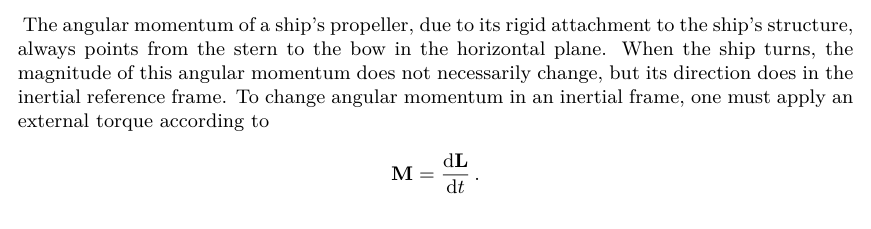
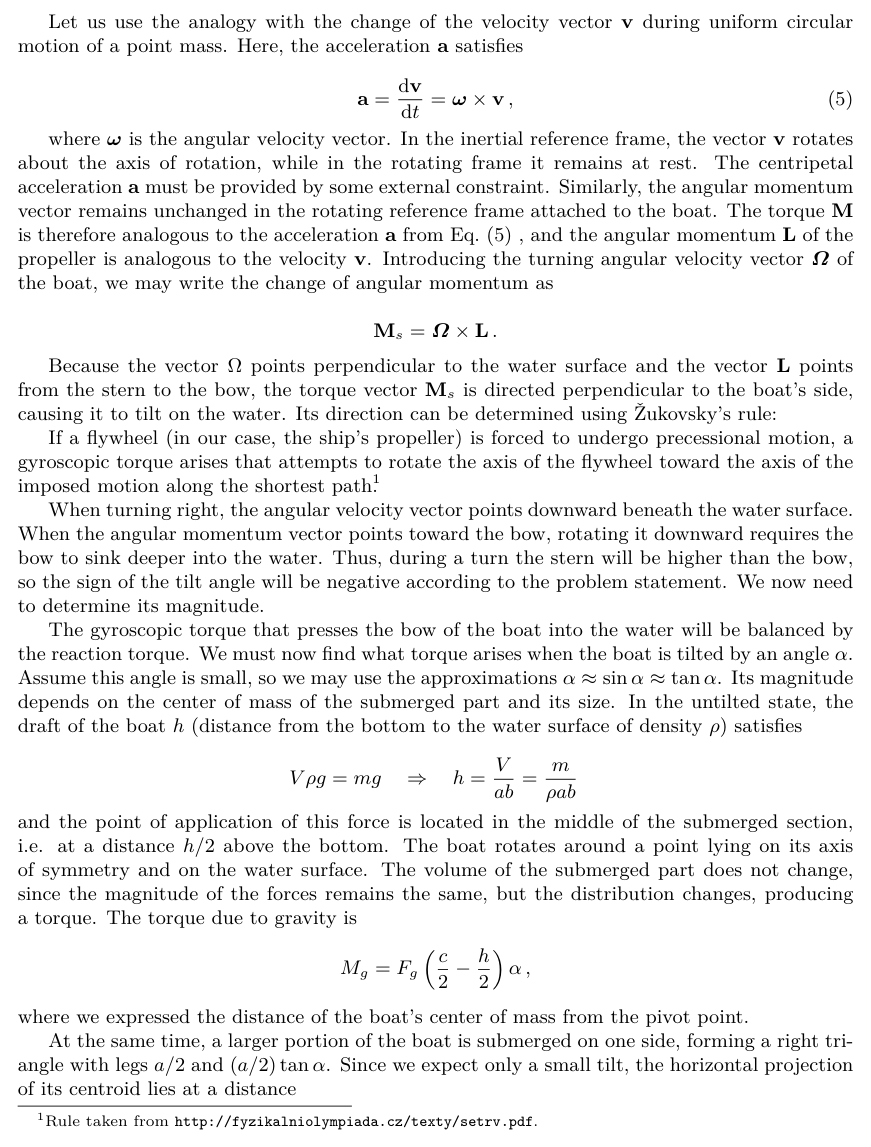
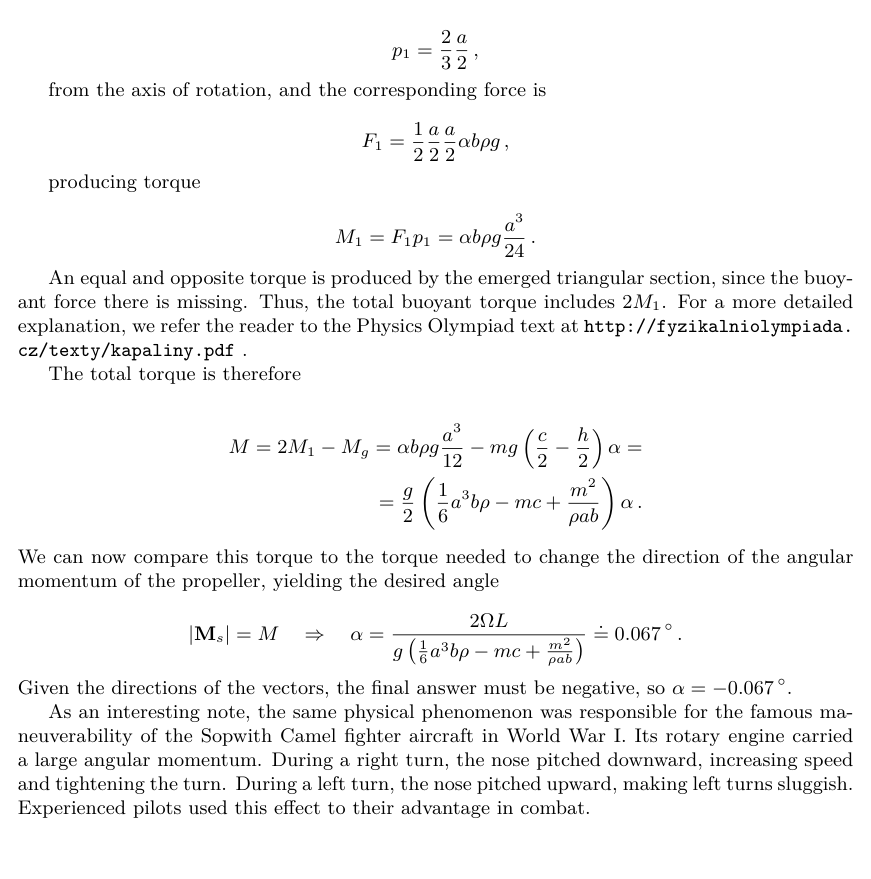
Official solution by FYKOS (Physics Brawl Online 2025), reproduced from the official PDF — p. 29, 30, 31 — under CC BY-SA 3.0.
Topic: Rotational Dynamics, Fluid Mechanics Metodi: Torque & Angular Momentum Analysis, Hydrostatic Equilibrium Competenze: Mathematical Modeling Objects: Block Fonte: Testo (PDF) — p.29 · Soluzione ufficiale (PDF) — p.29
Virata in acqua (6 punti)
Considera una barca di massa a forma di parallelepipedo di lunghezza , larghezza e altezza . La barca è spinta da un’elica con momento angolare di modulo diretto verso la prua. Sulla superficie dell’acqua la barca vira verso destra con velocità angolare . Qual è l’angolo tra la superficie dell’acqua e il ponte durante questa manovra? Se la prua è più alta della poppa, indica un valore positivo. Supponi che il centro di massa della barca sia nel suo centro geometrico.
Risposta:
Soluzione: La soluzione ufficiale completa (in inglese) è nella versione originale di questo quesito e nel PDF ufficiale.
Topic: Rotational Dynamics, Fluid Mechanics Metodi: Torque & Angular Momentum Analysis, Hydrostatic Equilibrium Competenze: Mathematical Modeling Objects: Block Fonte: Testo (PDF) — p.29 · Soluzione ufficiale (PDF) — p.29
Chasing the Sun (5 points)
At 6:10 AM, Danka is sitting in an airplane taking off from Prague Airport, heading directly east. The airplane ascends at an angle of with a speed of . On this day, the sunrise in Prague is expected to occur at 6:38 AM, but Danka will witness it earlier from the plane. How many minutes after takeoff will Danka observe the sunrise? For the purposes of this problem, Prague has been moved to the equator, and Danka is flying on the equinox. Also, consider the Earth to be a perfect sphere, with a 24-hour day, and neglect the Earth’s motion around the Sun.
Risposta: (sunrise at about 6:18)
Soluzione:
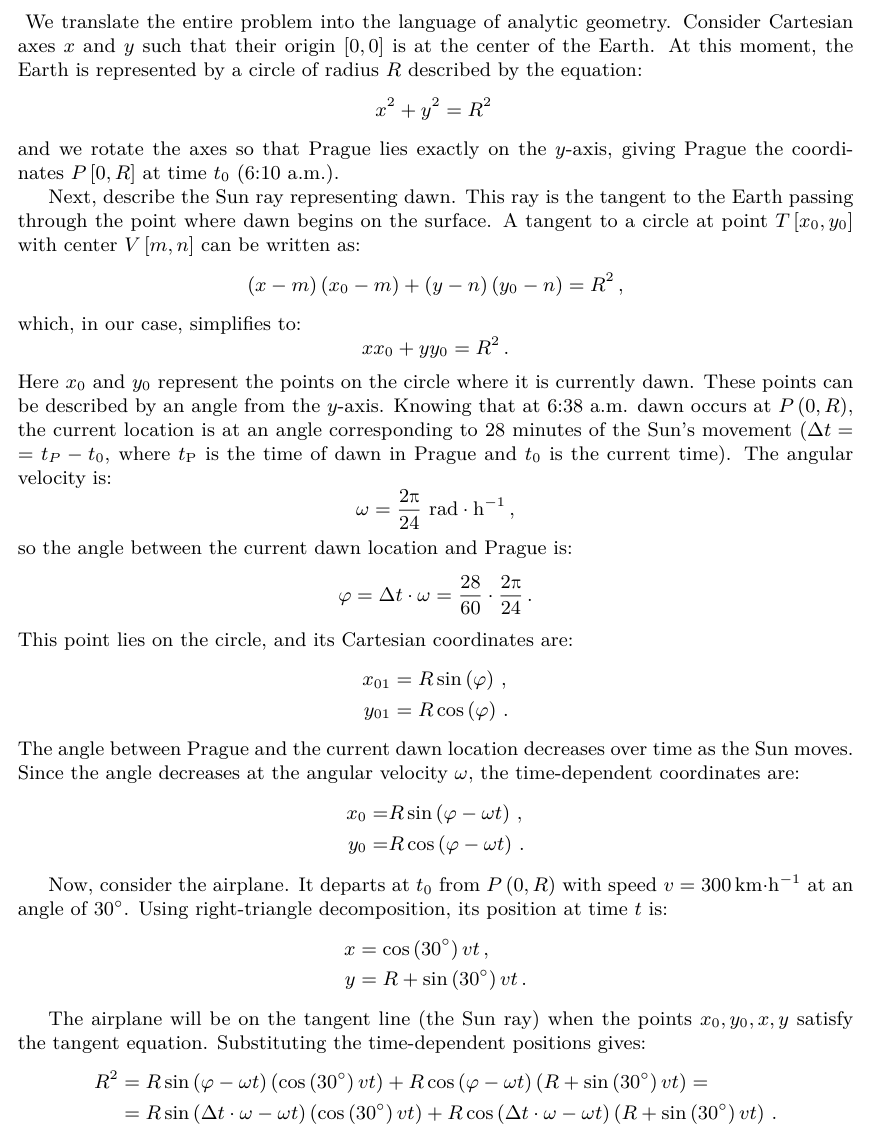
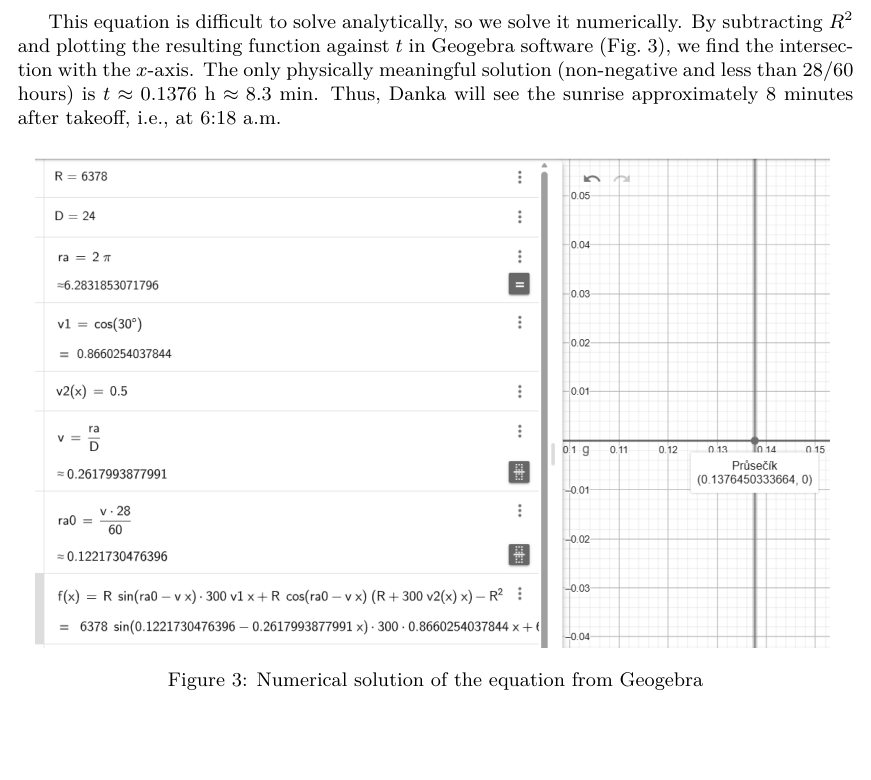
Official solution by FYKOS (Physics Brawl Online 2025), reproduced from the official PDF — p. 32, 33 — under CC BY-SA 3.0.
Topic: Earth & Environmental Science, Mathematics Metodi: Physical Modeling, Kinematic Equations Competenze: Mathematical Modeling Objects: Planet Fonte: Testo (PDF) — p.31 · Soluzione ufficiale (PDF) — p.32
Inseguendo il Sole (5 punti)
Alle 6:10 Danka è seduta su un aereo che decolla dall’aeroporto di Praga diretto esattamente verso est. L’aereo sale con un’inclinazione di alla velocità di . In quel giorno a Praga l’alba è prevista alle 6:38, ma Danka la vedrà prima dall’aereo. Quanti minuti dopo il decollo Danka vedrà sorgere il Sole? Ai fini del problema Praga è stata spostata all’equatore e Danka vola nel giorno dell’equinozio. Considera inoltre la Terra una sfera perfetta, con un giorno di 24 ore, e trascura il moto della Terra attorno al Sole.
Risposta: (alba verso le 6:18)
Soluzione: La soluzione ufficiale completa (in inglese) è nella versione originale di questo quesito e nel PDF ufficiale.
Topic: Earth & Environmental Science, Mathematics Metodi: Physical Modeling, Kinematic Equations Competenze: Mathematical Modeling Objects: Planet Fonte: Testo (PDF) — p.31 · Soluzione ufficiale (PDF) — p.32
Gas flow (5 points)
Consider a cylinder of radius and height , which can rotate about its axis of symmetry. Gas is directed at the cylinder so that particles strike only one half of the cylinder. The other half is covered (the boundary between the halves is the plane that contains the cylinder’s symmetry axis, see the figure). The cylinder spins up to a frequency . Assume that nothing strikes the cylinder from the other side. A resistive torque acts on its rotation such that upon impact, a gas molecule changes its velocity to the velocity of the cylinder surface at that point. The gas flows uniformly across the cross-section that hits the cylinder. What amount of substance of gas (in mol per second) strikes the cylinder? The gas is argon with a volumetric concentration .
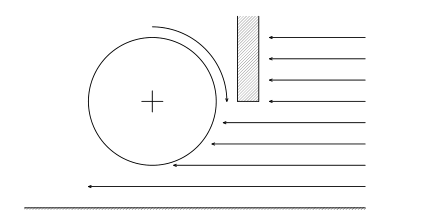
Risposta:
Soluzione:
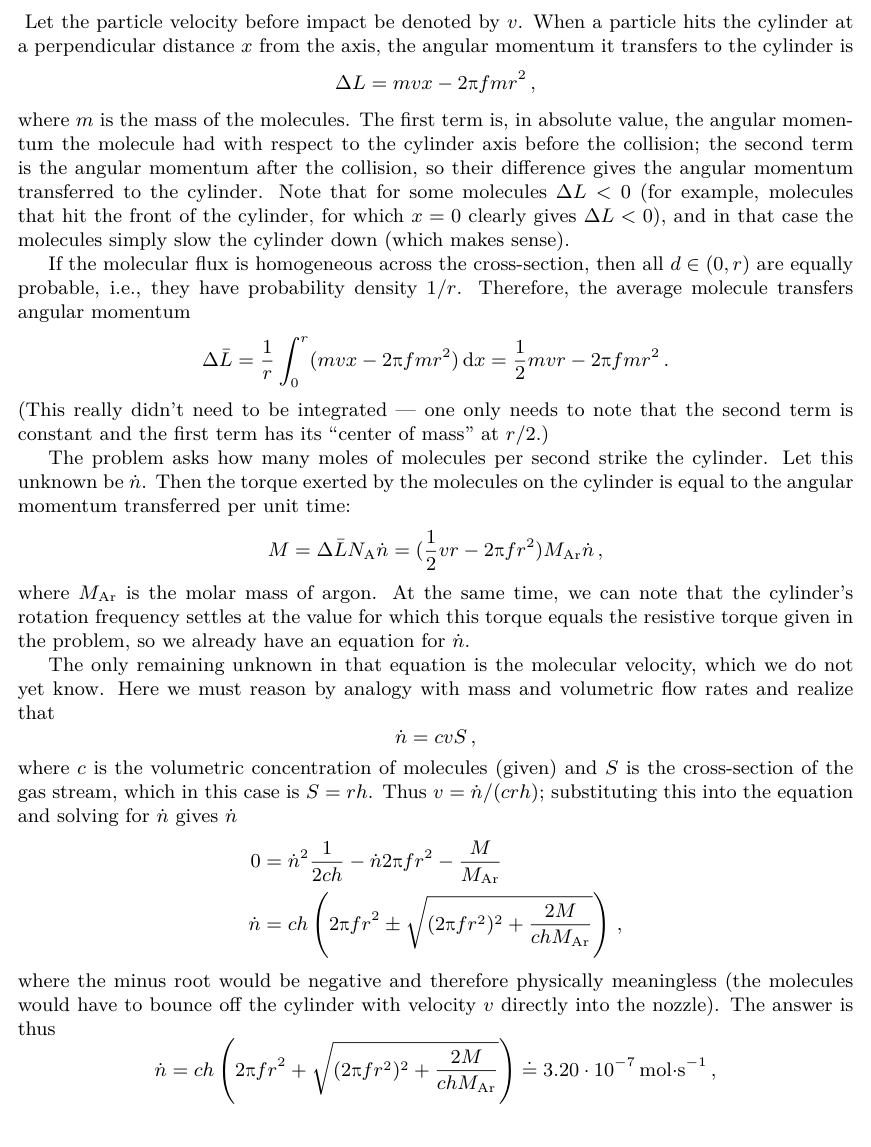
Official solution by FYKOS (Physics Brawl Online 2025), reproduced from the official PDF — p. 34 — under CC BY-SA 3.0.
Topic: Rotational Dynamics, Kinetic Theory Metodi: Torque & Angular Momentum Analysis, Impulse-Momentum Theorem Competenze: Mathematical Modeling Objects: Cylinder, Gas Fonte: Testo (PDF) — p.33 · Soluzione ufficiale (PDF) — p.34
Flusso di gas (5 punti)
Considera un cilindro di raggio e altezza , che può ruotare attorno al proprio asse di simmetria. Un getto di gas è diretto sul cilindro in modo che le particelle colpiscano solo una metà del cilindro; l’altra metà è coperta (il confine tra le due metà è il piano che contiene l’asse di simmetria, vedi figura). Il cilindro si porta a una frequenza di rotazione . Supponi che nulla colpisca il cilindro dall’altro lato. Sulla rotazione agisce un momento resistente ; nell’urto una molecola di gas assume la velocità della superficie del cilindro in quel punto. Il gas fluisce uniformemente attraverso la sezione che investe il cilindro. Quale quantità di gas (in mol al secondo) colpisce il cilindro? Il gas è argon con concentrazione volumica .
Risposta:
Soluzione: La soluzione ufficiale completa (in inglese) è nella versione originale di questo quesito e nel PDF ufficiale.
Topic: Rotational Dynamics, Kinetic Theory Metodi: Torque & Angular Momentum Analysis, Impulse-Momentum Theorem Competenze: Mathematical Modeling Objects: Cylinder, Gas Fonte: Testo (PDF) — p.33 · Soluzione ufficiale (PDF) — p.34
Warming up by work (5 points)
We have a piston filled with air (i.e., the Poisson constant is ) under standard conditions. The surroundings are also at standard conditions, and the piston walls are thermally conductive. We want to bring the air to a state where it has twice the temperature (in the thermodynamic sense) and the same volume as it has now. We have a heater that can supply the necessary heat; however, we want to conserve the heater and its energy for tough times. Therefore, we aim to partially supply the energy to the air through mechanical work. Specifically, we can expand the piston volume to twice its current volume (and then compress it back), and we can use the heater at any point during this process. What is the minimum amount of energy we must supply via the heater? Express your answer as a percentage of the amount we would need to provide if we did not perform any mechanical work and only used a heater.
Risposta:
Soluzione:
Official solution by FYKOS (Physics Brawl Online 2025), reproduced from the official PDF — p. 35, 36 — under CC BY-SA 3.0.
Topic: Thermodynamics Metodi: First Law of Thermodynamics, Thermodynamic Cycle Analysis Competenze: Mathematical Modeling Objects: Piston, Gas Fonte: Testo (PDF) — p.35 · Soluzione ufficiale (PDF) — p.35
Scaldarsi con il lavoro (5 punti)
Abbiamo un cilindro con pistone pieno d’aria (cioè con indice adiabatico (coefficiente di Poisson) ) in condizioni standard. Anche l’ambiente è in condizioni standard e le pareti del cilindro sono conduttrici di calore. Vogliamo portare l’aria in uno stato con temperatura assoluta doppia e lo stesso volume attuale. Abbiamo un riscaldatore in grado di fornire il calore necessario, ma vogliamo risparmiarlo, con la sua energia, per tempi difficili; vogliamo quindi fornire all’aria parte dell’energia sotto forma di lavoro meccanico. In particolare, possiamo espandere il volume fino al doppio di quello attuale (e poi ricomprimerlo) e usare il riscaldatore in qualunque momento del processo. Qual è la minima energia che dobbiamo fornire con il riscaldatore? Esprimi la risposta come percentuale dell’energia necessaria se non compissimo lavoro meccanico e usassimo solo il riscaldatore.
Risposta:
Soluzione: La soluzione ufficiale completa (in inglese) è nella versione originale di questo quesito e nel PDF ufficiale.
Topic: Thermodynamics Metodi: First Law of Thermodynamics, Thermodynamic Cycle Analysis Competenze: Mathematical Modeling Objects: Piston, Gas Fonte: Testo (PDF) — p.35 · Soluzione ufficiale (PDF) — p.35
Lever–pulleys (5 points)
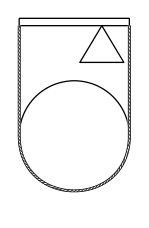
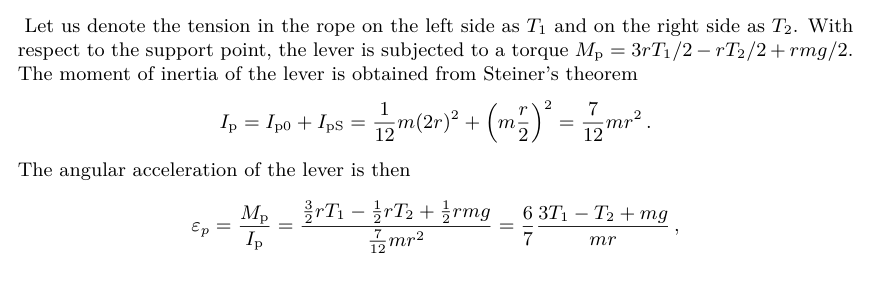
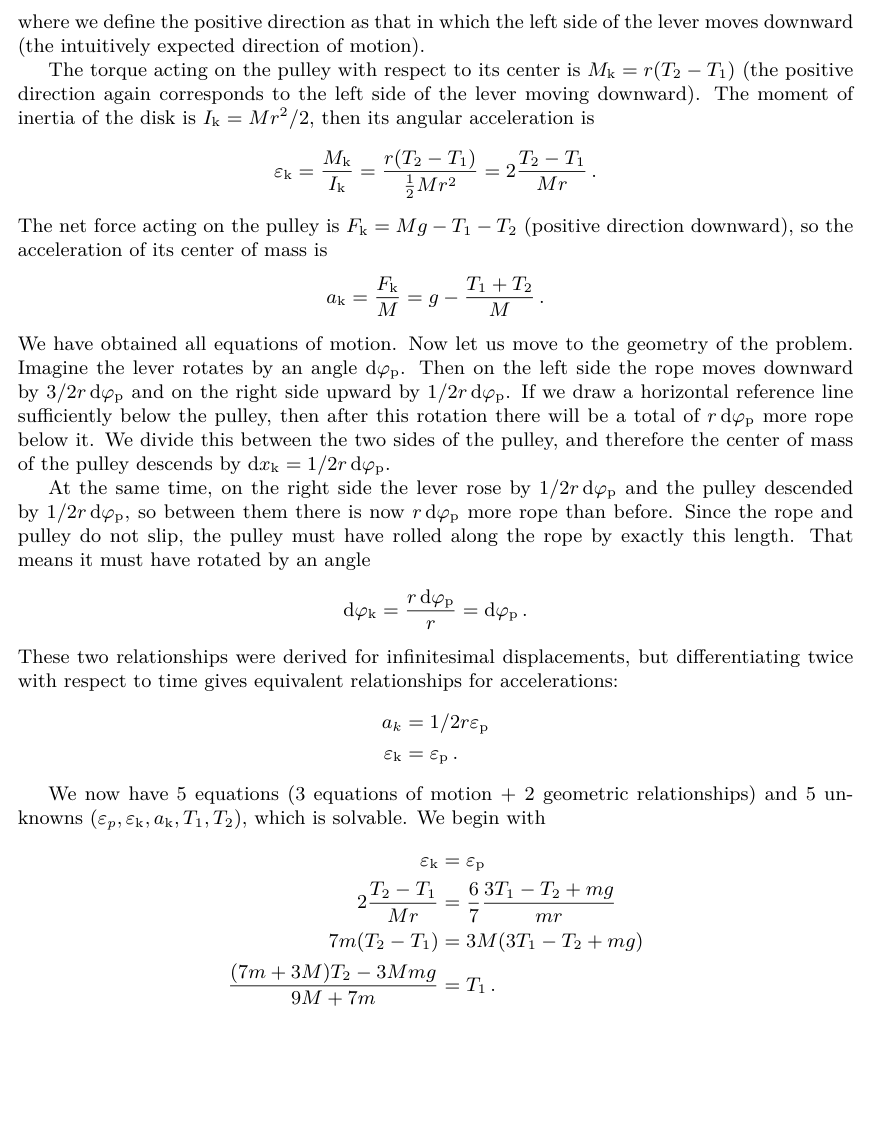
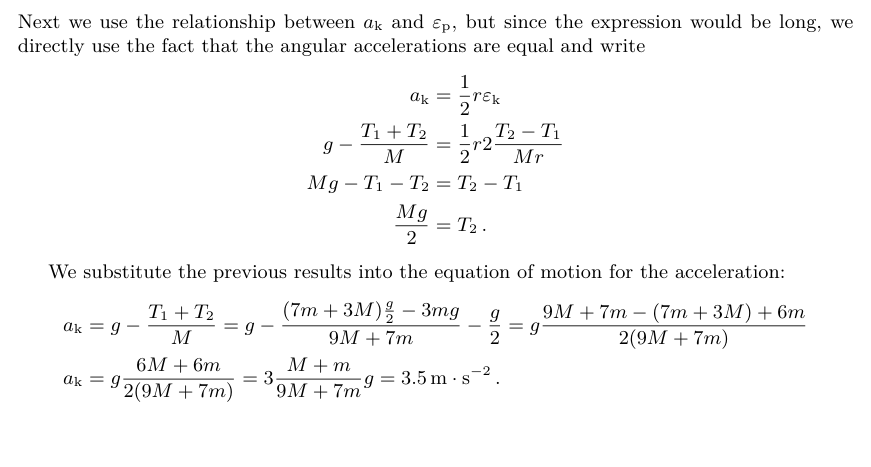
We have a pulley and a lever connected by a massless rope as shown in the figure. Treat the lever as a rod of length with mass . The lever is supported so that the lengths of its arms are in the ratio . The pulley has the shape of a disk of radius and mass . Both the lever and the pulley are homogeneous and the rope does not slip on the pulley. What is the acceleration of the center of mass of the pulley at the moment of release from the state shown in the figure?
Risposta:
Soluzione:
Official solution by FYKOS (Physics Brawl Online 2025), reproduced from the official PDF — p. 36, 37, 38 — under CC BY-SA 3.0.
Topic: Rotational Dynamics Metodi: Torque & Angular Momentum Analysis, Free-Body Diagram Competenze: Diagrammatic Reasoning, Mathematical Modeling Objects: Pulley, Lever, Disk, String Fonte: Testo (PDF) — p.36 · Soluzione ufficiale (PDF) — p.36
Leva e carrucole (5 punti)
Una carrucola e una leva sono collegate da una fune di massa trascurabile come mostrato in figura. Tratta la leva come un’asta di lunghezza e massa . La leva è appoggiata in modo che le lunghezze dei suoi bracci stiano nel rapporto . La carrucola è un disco di raggio e massa . Leva e carrucola sono omogenee e la fune non slitta sulla carrucola. Qual è l’accelerazione del centro di massa della carrucola nell’istante in cui il sistema viene lasciato libero dalla configurazione in figura?
Risposta:
Soluzione: La soluzione ufficiale completa (in inglese) è nella versione originale di questo quesito e nel PDF ufficiale.
Topic: Rotational Dynamics Metodi: Torque & Angular Momentum Analysis, Free-Body Diagram Competenze: Diagrammatic Reasoning, Mathematical Modeling Objects: Pulley, Lever, Disk, String Fonte: Testo (PDF) — p.36 · Soluzione ufficiale (PDF) — p.36
A straw (6 points)
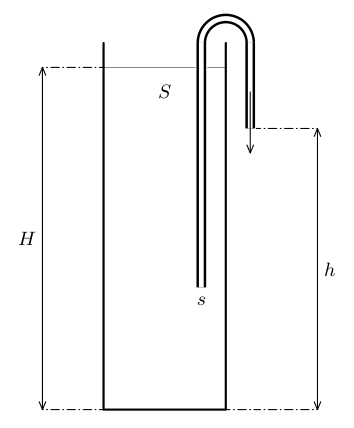
Jarda was playing with his cocktail. He took a straw and fully submerged it in the cocktail. Then he pulled out one end, and to keep the liquid inside, he held the pulled-out end with his finger so that the cocktail would not spill out. Then he released it, and the cocktail began to spill onto the table, much to the displeasure of everyone sitting around.
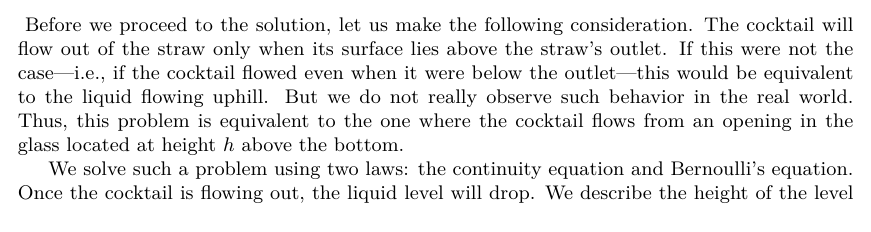
Calculate how long this calamity will last if Jarda does not intervene. We know that the horizontal cross-section of the glass is and the straw has a constant cross-section along its entire length. Initially, the liquid level in the glass is at a height from the bottom, and the straw’s outlet is outside the glass at a height above the bottom of the glass.
Assume that the cocktail is an ideal incompressible fluid. Neglect any undesirable effects, such as bubble intrusion or surface tension. The straw does not move while the liquid flows out.
Risposta:
Soluzione:
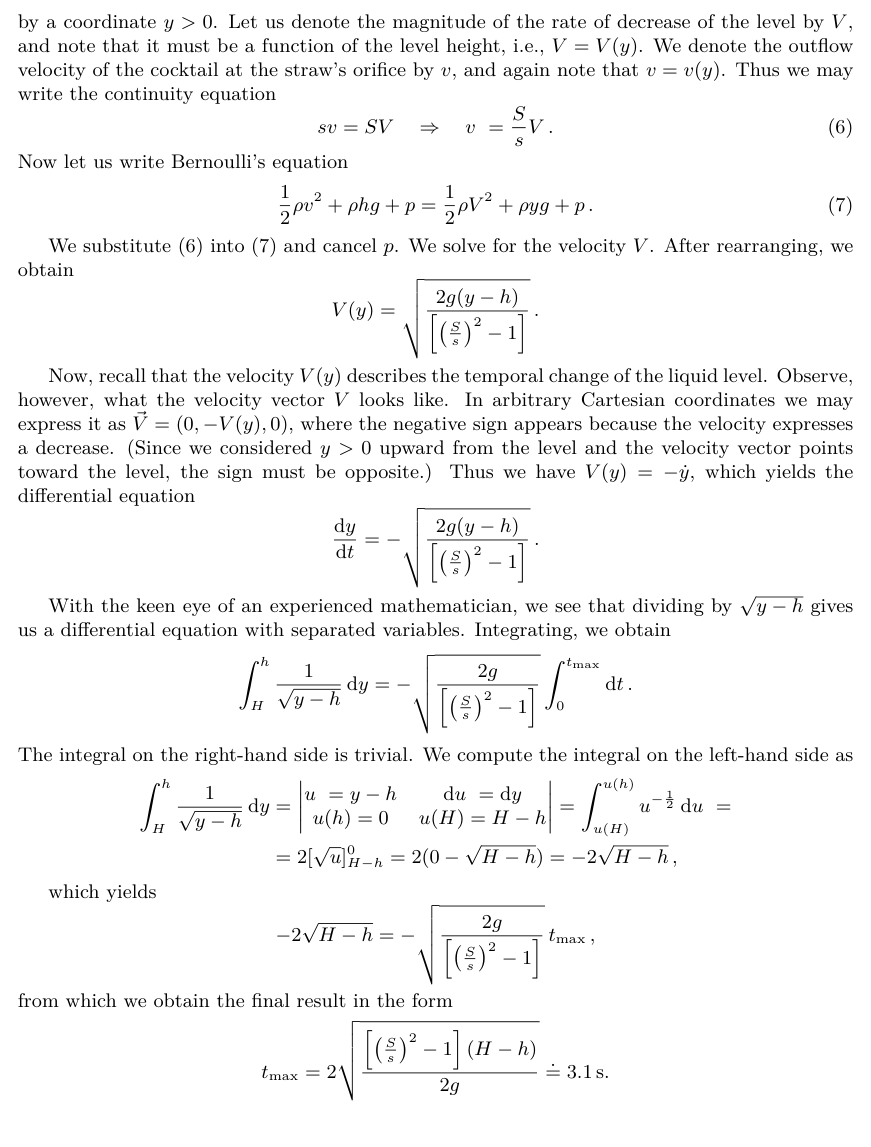
Official solution by FYKOS (Physics Brawl Online 2025), reproduced from the official PDF — p. 38, 39 — under CC BY-SA 3.0.
Topic: Fluid Mechanics Metodi: Bernoulli’s Equation, Continuity Equation, Differential Equations Competenze: Mathematical Modeling Objects: Tube, Container Fonte: Testo (PDF) — p.38 · Soluzione ufficiale (PDF) — p.38
Una cannuccia (6 punti)
Jarda giocava con il suo cocktail. Ha preso una cannuccia e l’ha immersa completamente nel cocktail. Poi ne ha estratto un’estremità e, per trattenere il liquido all’interno, ha chiuso con il dito l’estremità estratta, così che il cocktail non uscisse. Poi l’ha lasciata andare e il cocktail ha cominciato a versarsi sul tavolo, con grande disappunto di tutti i presenti.
Calcola quanto durerà questa calamità se Jarda non interviene. La sezione orizzontale del bicchiere è e la cannuccia ha sezione costante lungo tutta la sua lunghezza. All’inizio il livello del liquido nel bicchiere è all’altezza dal fondo, e lo sbocco della cannuccia si trova fuori dal bicchiere, a un’altezza sopra il fondo del bicchiere.
Supponi che il cocktail sia un fluido ideale incomprimibile. Trascura effetti indesiderati come l’ingresso di bolle o la tensione superficiale. La cannuccia non si muove mentre il liquido esce.
Risposta:
Soluzione: La soluzione ufficiale completa (in inglese) è nella versione originale di questo quesito e nel PDF ufficiale.
Topic: Fluid Mechanics Metodi: Bernoulli’s Equation, Continuity Equation, Differential Equations Competenze: Mathematical Modeling Objects: Tube, Container Fonte: Testo (PDF) — p.38 · Soluzione ufficiale (PDF) — p.38
Waging a war with windmills (6 points)
Don Quixote calmly rides on his faithful Rocinante through La Mancha, when suddenly he spots a four-armed giant on the horizon, waving threateningly at him with all four limbs. However, we, who have our wits about us, clearly see that it is not a giant, but a windmill. It has four blades with a rectangular cross-sectional area and surface area , which are placed on rigid rods at a distance from the axis of rotation of the mill and have length . They are made of homogeneous material with Young’s modulus and each has mass . The giant’s “threatening” waving was caused by a gust of wind, which spun the blades to an angular velocity . To what length do the blades elongate? Assume that these are small deformations and they occur only in the radial direction; also assume that the width and thickness of the blades are small compared to the distance from the axis and thus that the magnitude of the centrifugal force depends only on the perpendicular distance from the end of the blade. Do not consider the influence of gravitational force on the deformation of the blades.
Risposta:
Soluzione:
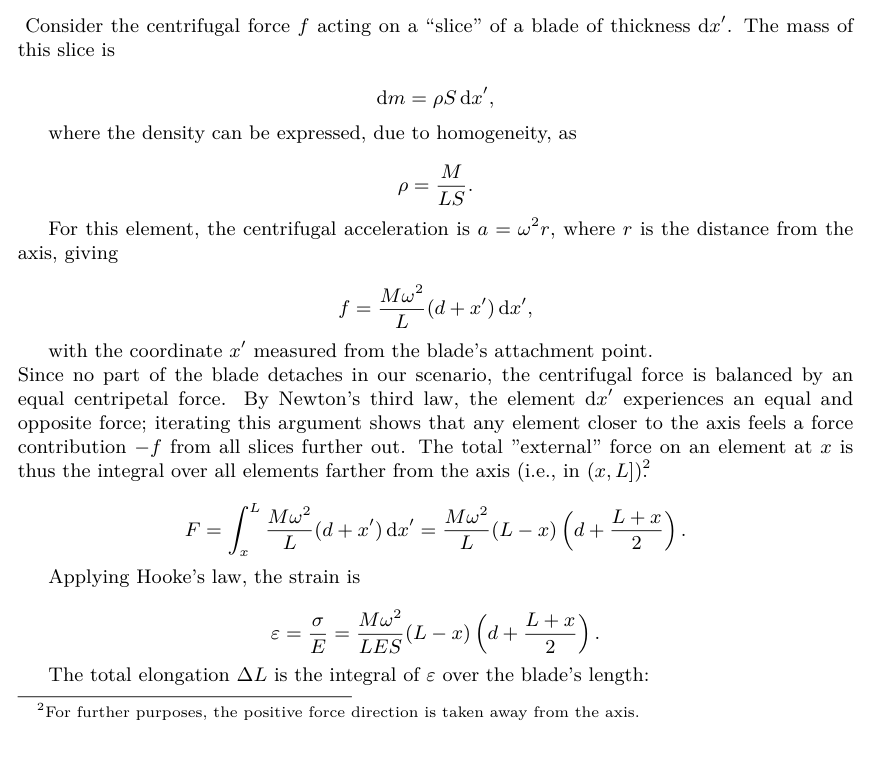
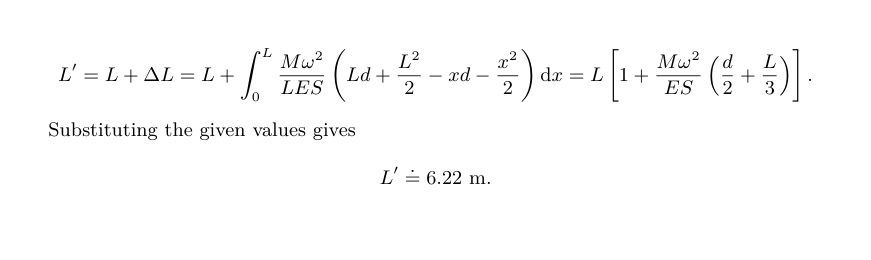
Official solution by FYKOS (Physics Brawl Online 2025), reproduced from the official PDF — p. 40, 41 — under CC BY-SA 3.0.
Topic: Elasticity & Materials, Rotational Dynamics Metodi: Stress-Strain Analysis, Calculus-Integration Competenze: Mathematical Modeling Objects: Beam Fonte: Testo (PDF) — p.40 · Soluzione ufficiale (PDF) — p.40
Combattere contro i mulini a vento (6 punti)
Don Chisciotte cavalca tranquillo sul fedele Ronzinante attraverso la Mancia, quando all’improvviso scorge all’orizzonte un gigante con quattro braccia che si agita minaccioso verso di lui con tutti e quattro gli arti. Noi, che abbiamo la testa sulle spalle, vediamo bene che non è un gigante ma un mulino a vento. Ha quattro pale di sezione rettangolare e superficie , montate su aste rigide a distanza dall’asse di rotazione del mulino e lunghe . Sono fatte di un materiale omogeneo con modulo di Young e ciascuna ha massa . L’agitarsi “minaccioso” del gigante era dovuto a una raffica di vento che aveva portato le pale a una velocità angolare . Fino a quale lunghezza si allungano le pale? Supponi che le deformazioni siano piccole e avvengano solo in direzione radiale; supponi inoltre che larghezza e spessore delle pale siano piccoli rispetto alla distanza dall’asse, così che la forza centrifuga dipenda solo dalla distanza perpendicolare dall’estremo della pala. Non considerare l’effetto della forza di gravità sulla deformazione delle pale.
Risposta:
Soluzione: La soluzione ufficiale completa (in inglese) è nella versione originale di questo quesito e nel PDF ufficiale.
Topic: Elasticity & Materials, Rotational Dynamics Metodi: Stress-Strain Analysis, Calculus-Integration Competenze: Mathematical Modeling Objects: Beam Fonte: Testo (PDF) — p.40 · Soluzione ufficiale (PDF) — p.40
Conducting corner (7 points)
The boundary of the first octant of the Cartesian coordinate system forms a conducting corner (i.e., it consists of three quarter-planes, each oriented along one of the , , and directions). A charge moves along the half-line . Determine the ratio of the charge placed fixed at the origin to the charge such that the conducting corner can be replaced by while the force acting on remains unchanged. You may neglect the induced magnetic field.
Risposta:
Soluzione:
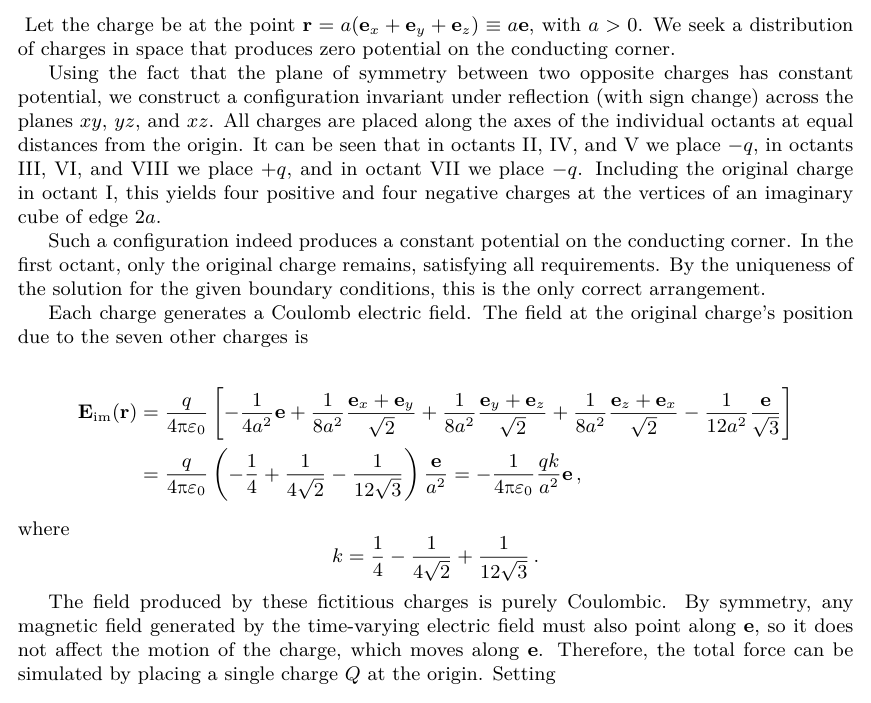

Official solution by FYKOS (Physics Brawl Online 2025), reproduced from the official PDF — p. 41, 42 — under CC BY-SA 3.0.
Topic: Electrostatics Metodi: Superposition Principle, Coulomb’s Law, Symmetry Argument Competenze: Mathematical Modeling Objects: Point Charge Fonte: Testo (PDF) — p.41 · Soluzione ufficiale (PDF) — p.41
Angolo conduttore (7 punti)
Il bordo del primo ottante del sistema di coordinate cartesiane forma un angolo conduttore (è cioè formato da tre quarti di piano, ciascuno orientato lungo una delle direzioni , e ). Una carica si muove lungo la semiretta . Determina il rapporto tra la carica , posta fissa nell’origine, e la carica tale che l’angolo conduttore possa essere sostituito da lasciando invariata la forza che agisce su . Puoi trascurare il campo magnetico indotto.
Risposta:
Soluzione: La soluzione ufficiale completa (in inglese) è nella versione originale di questo quesito e nel PDF ufficiale.
Topic: Electrostatics Metodi: Superposition Principle, Coulomb’s Law, Symmetry Argument Competenze: Mathematical Modeling Objects: Point Charge Fonte: Testo (PDF) — p.41 · Soluzione ufficiale (PDF) — p.41
FTL (6 points)
Consider an empty container formed by rotating the function around the axis for positive values of , with all dimensions in meters. The container is closed at the bottom by the rotated -axis. Water flows into the container at a rate of . Assuming the water instantly forms a flat surface, after how long would the water level begin to rise at a superluminal speed?
Risposta:
Soluzione:
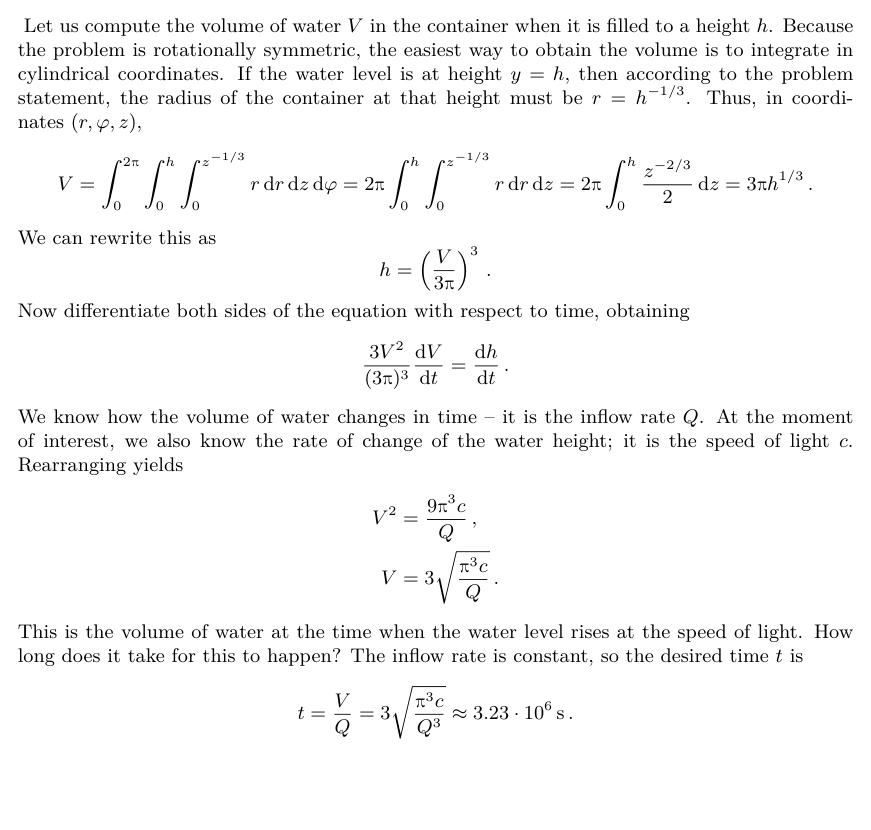
Official solution by FYKOS (Physics Brawl Online 2025), reproduced from the official PDF — p. 42 — under CC BY-SA 3.0.
Topic: Fluid Mechanics, Mathematics Metodi: Continuity Equation, Calculus-Integration Competenze: Mathematical Modeling Objects: Container Fonte: Testo (PDF) — p.42 · Soluzione ufficiale (PDF) — p.42
FTL (6 punti)
Considera un recipiente vuoto ottenuto ruotando la funzione attorno all’asse per valori positivi di , con tutte le dimensioni in metri. Il recipiente è chiuso in basso dall’asse ruotato. Nel recipiente entra acqua con portata . Supponendo che l’acqua formi istantaneamente una superficie piana, dopo quanto tempo il livello dell’acqua comincerebbe a salire a velocità superiore a quella della luce?
Risposta:
Soluzione: La soluzione ufficiale completa (in inglese) è nella versione originale di questo quesito e nel PDF ufficiale.
Topic: Fluid Mechanics, Mathematics Metodi: Continuity Equation, Calculus-Integration Competenze: Mathematical Modeling Objects: Container Fonte: Testo (PDF) — p.42 · Soluzione ufficiale (PDF) — p.42
Speed of a shadow (6 points)
Jarda played tennis in the sun, which was above the horizon. He served the ball to his opponent by hitting it from a height of at an angle of to the ground. The ball landed on the other side of the court at a distance of from Jarda. Determine the maximum speed of the shadow that the ball casts on the ground. The plane of the ball’s trajectory is tilted at an angle of with respect to the vertical plane in which the sun’s rays strike the ball.
Risposta:
Soluzione:
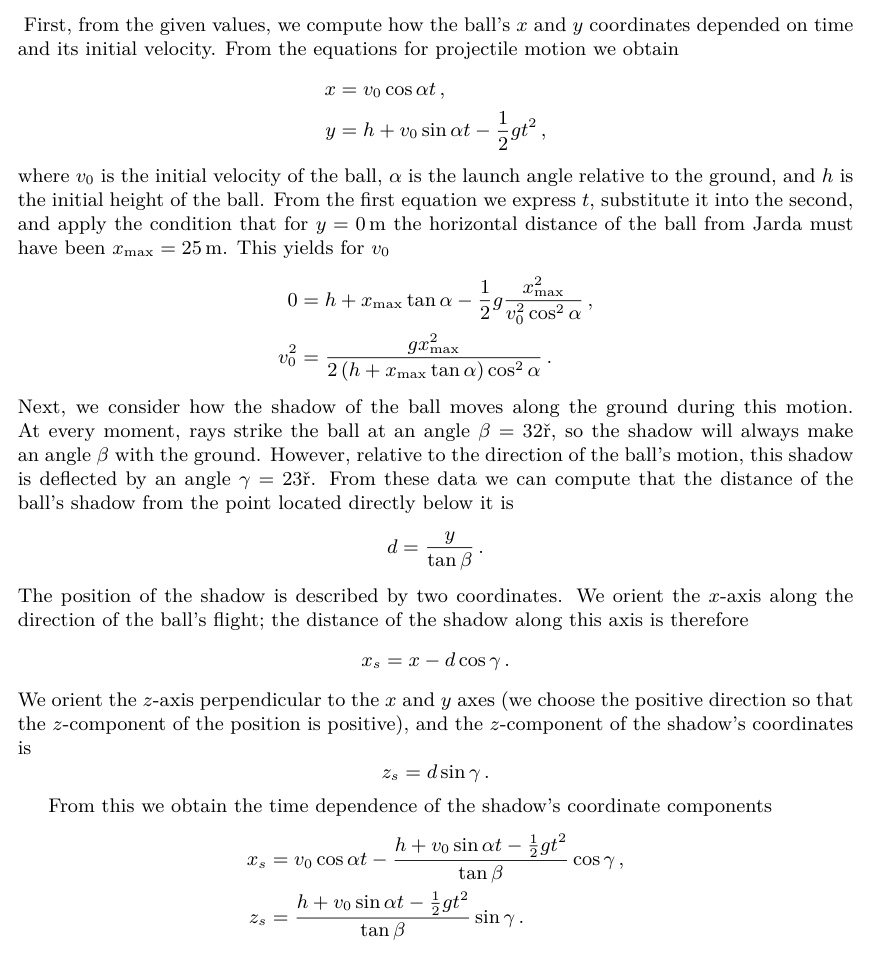
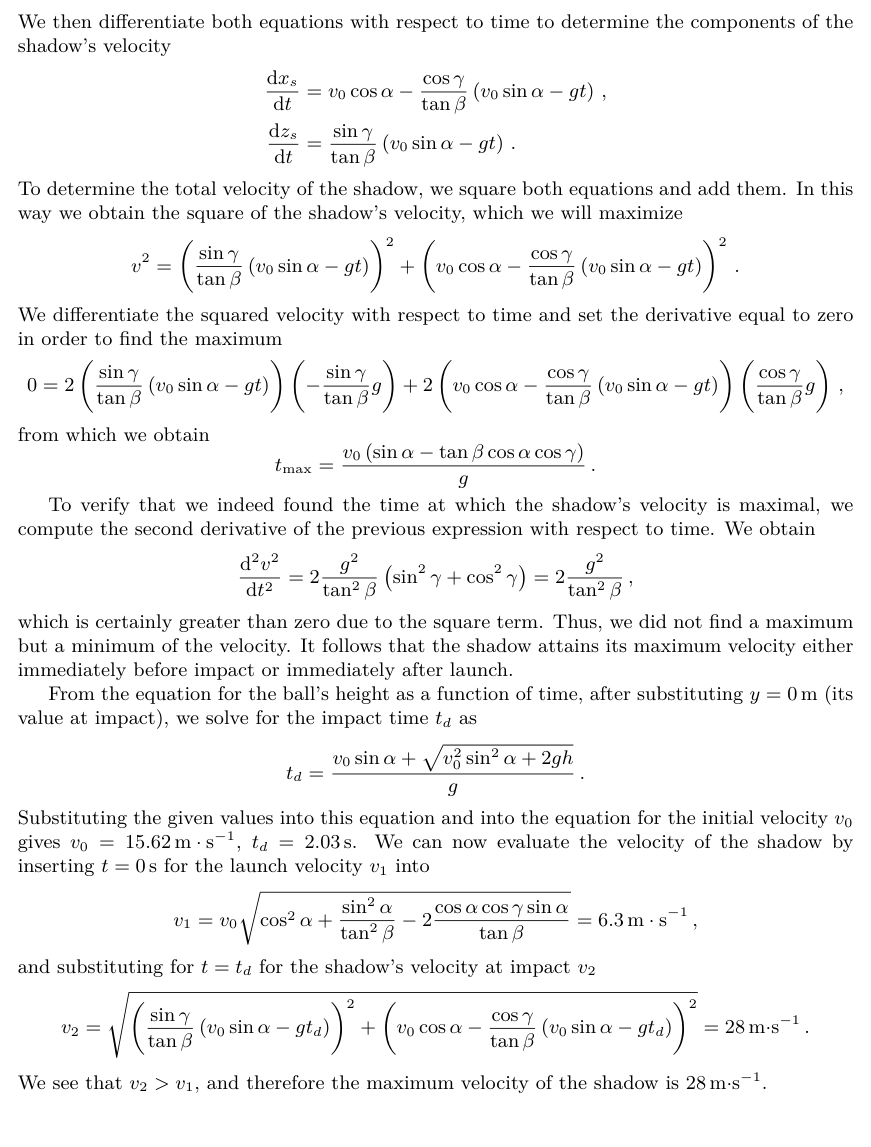
Official solution by FYKOS (Physics Brawl Online 2025), reproduced from the official PDF — p. 43, 44 — under CC BY-SA 3.0.
Topic: Newtonian Mechanics, Geometric Optics Metodi: Kinematic Equations, Vector Decomposition Competenze: Mathematical Modeling Objects: Ball, Projectile Fonte: Testo (PDF) — p.43 · Soluzione ufficiale (PDF) — p.43
Velocità di un’ombra (6 punti)
Jarda giocava a tennis al sole, che era sopra l’orizzonte. Ha servito la palla all’avversario colpendola da un’altezza di con un angolo di rispetto al suolo. La palla è atterrata dall’altra parte del campo a da Jarda. Determina la velocità massima dell’ombra che la palla proietta sul terreno. Il piano della traiettoria della palla forma un angolo di con il piano verticale in cui i raggi del sole colpiscono la palla.
Risposta:
Soluzione: La soluzione ufficiale completa (in inglese) è nella versione originale di questo quesito e nel PDF ufficiale.
Topic: Newtonian Mechanics, Geometric Optics Metodi: Kinematic Equations, Vector Decomposition Competenze: Mathematical Modeling Objects: Ball, Projectile Fonte: Testo (PDF) — p.43 · Soluzione ufficiale (PDF) — p.43
Heavenly bowling (7 points)
It has been a while since God created the world, and because sometimes He has nothing to do, He likes to play bowling with planets. On the Milky Way, He places ten small planets in a classical equilateral triangle, so that the relative distance between two neighbouring planets on the edge is . For the ball, God chooses a star the size of our Sun, which He throws in the plane of the “pins” from a distance of from the back row of planets toward them. Although He gave His sphere the necessary rotation, He forgot that there is no friction in space. The star thus did not turn toward the planets, but instead flew parallel to the axis of the original triangle at a distance of from one of its corners at a speed of . Nevertheless, the star did strike some of the planets. How many planets did God “knock off” in this way? The planets are so small that their gravitational interaction is negligible. Also, do not consider the effect they have on the star’s orbit.
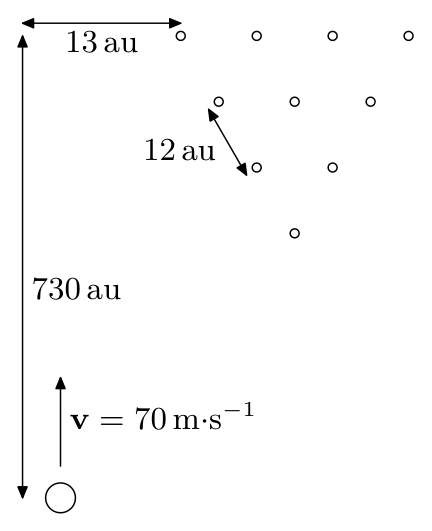
Risposta:
Soluzione:
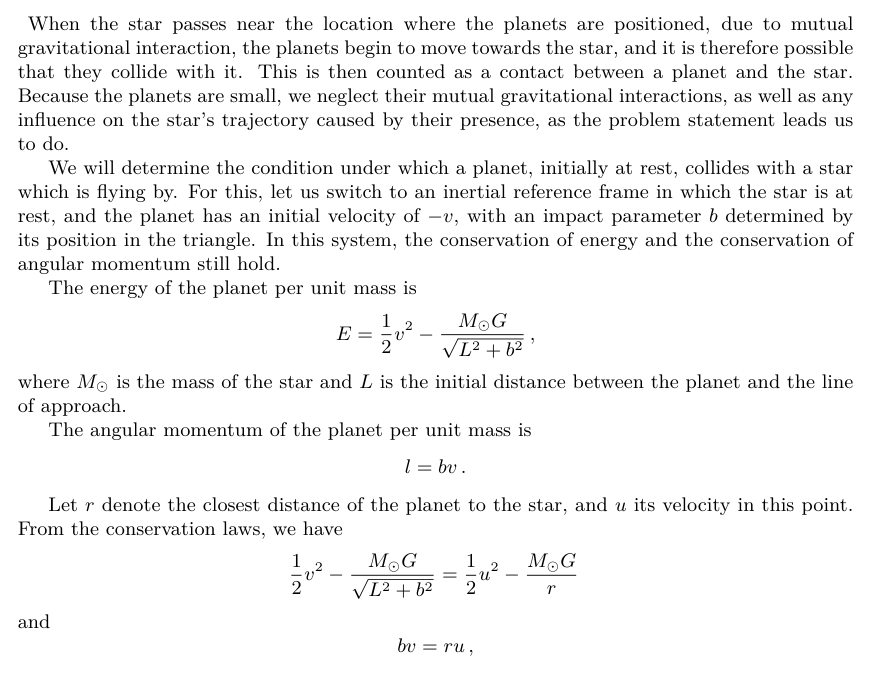
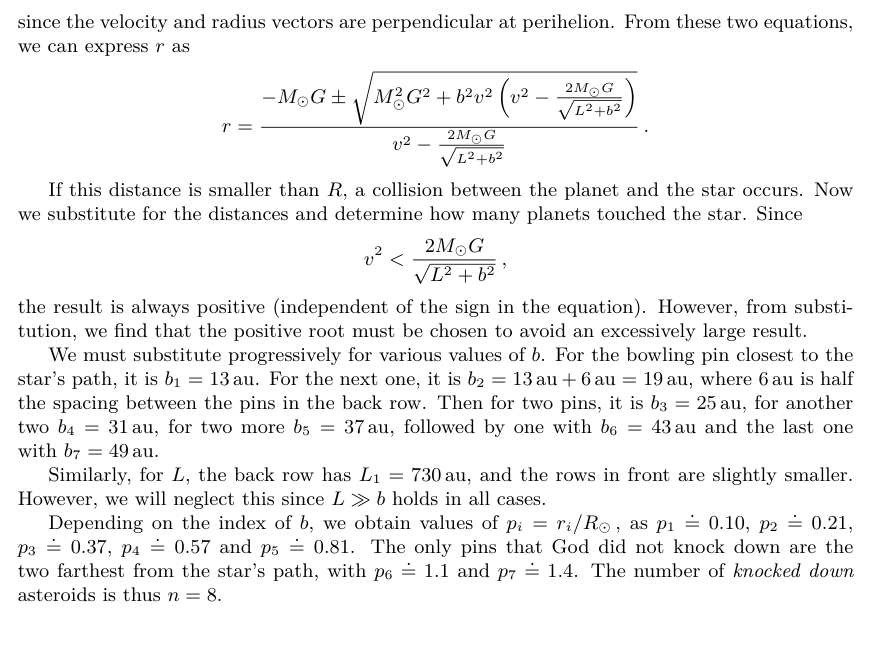
Official solution by FYKOS (Physics Brawl Online 2025), reproduced from the official PDF — p. 45, 46 — under CC BY-SA 3.0.
Topic: Gravitation Metodi: Newton’s Law of Gravitation, Kepler’s Laws, Conservation Laws Competenze: Mathematical Modeling, Diagrammatic Reasoning Objects: Star, Planet Fonte: Testo (PDF) — p.45 · Soluzione ufficiale (PDF) — p.45
Bowling celeste (7 punti)
È passato un po’ di tempo da quando Dio ha creato il mondo e, siccome a volte non ha niente da fare, gli piace giocare a bowling con i pianeti. Nella Via Lattea dispone dieci piccoli pianeti nel classico triangolo equilatero, in modo che due pianeti vicini sul lato distino . Come palla Dio sceglie una stella delle dimensioni del nostro Sole, che lancia nel piano dei “birilli” da una distanza di dall’ultima fila di pianeti, verso di essi. Pur avendo dato alla sfera l’effetto necessario, ha dimenticato che nello spazio non c’è attrito. La stella quindi non ha curvato verso i pianeti, ma ha proseguito parallelamente all’asse del triangolo, a una distanza di da uno dei suoi vertici, con velocità . Ciononostante la stella ha colpito alcuni pianeti. Quanti pianeti ha “abbattuto” Dio in questo modo? I pianeti sono così piccoli che la loro interazione gravitazionale è trascurabile; non considerare neppure il loro effetto sull’orbita della stella.
Risposta:
Soluzione: La soluzione ufficiale completa (in inglese) è nella versione originale di questo quesito e nel PDF ufficiale.
Topic: Gravitation Metodi: Newton’s Law of Gravitation, Kepler’s Laws, Conservation Laws Competenze: Mathematical Modeling, Diagrammatic Reasoning Objects: Star, Planet Fonte: Testo (PDF) — p.45 · Soluzione ufficiale (PDF) — p.45
Leaking liquids (6 points)
Consider a cylindrical container with a cross-section of . Water is poured into the container to a height of ; above it is olive oil with a density of with the same layer thickness , and above the oil ethanol, also with layer thickness and a density of . If a hole with an area of is opened at the bottom of the container, how long will it take for the water and oil to drain, leaving only the ethanol in the container?
Neglect surface tension and cohesion of the liquids. A numerical simulation is recommended.
Risposta:
Soluzione:
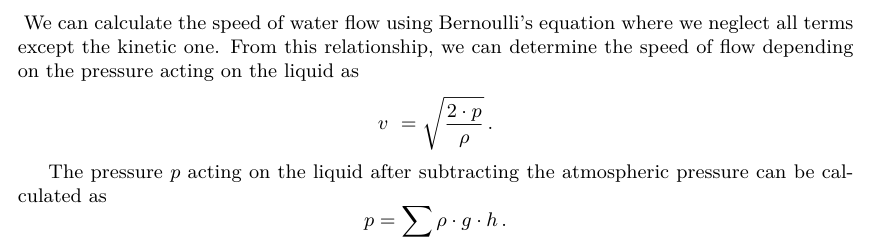
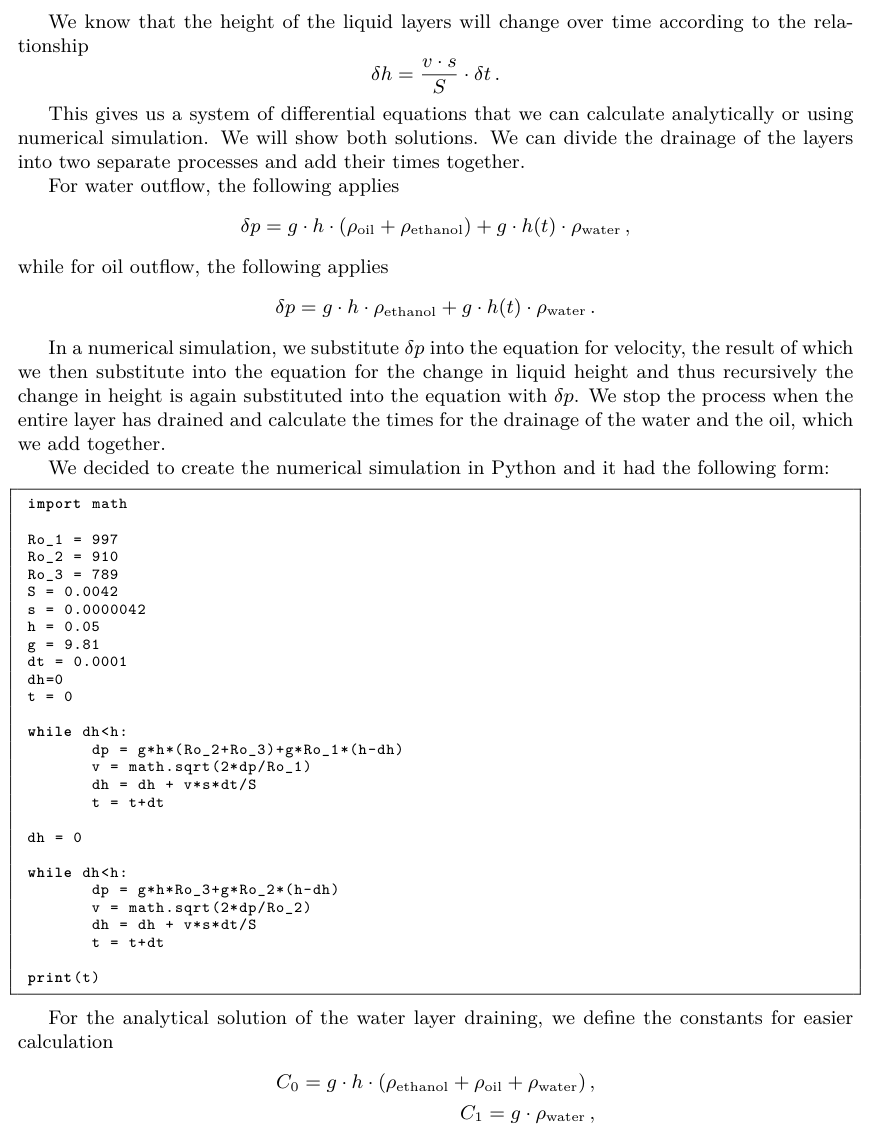
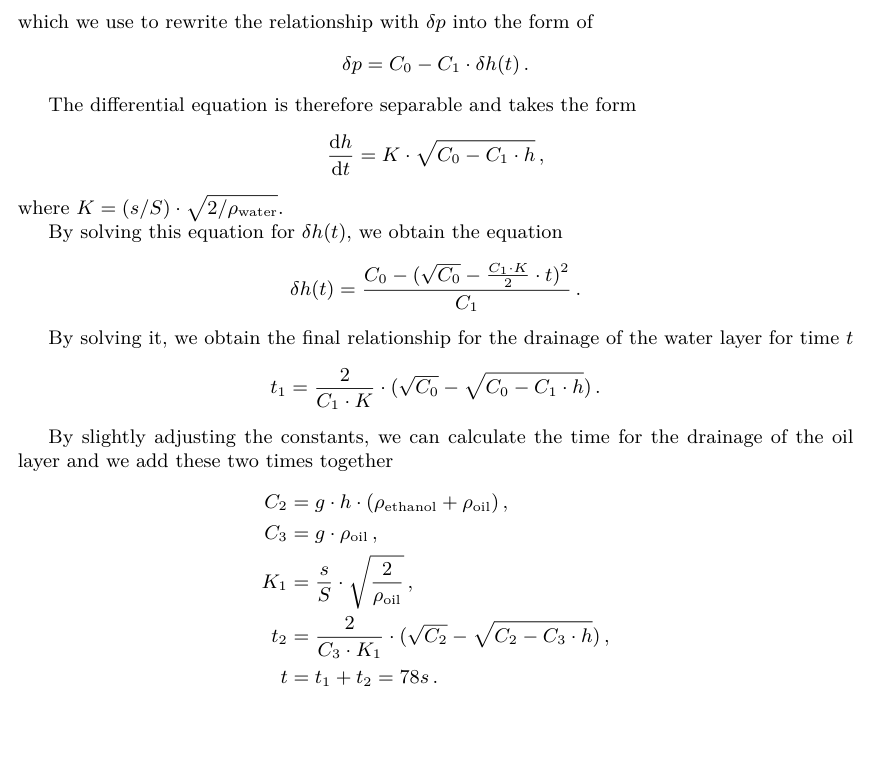
Official solution by FYKOS (Physics Brawl Online 2025), reproduced from the official PDF — p. 46, 47, 48 — under CC BY-SA 3.0.
Topic: Fluid Mechanics Metodi: Bernoulli’s Equation, Continuity Equation, Differential Equations Competenze: Mathematical Modeling Objects: Container Fonte: Testo (PDF) — p.46 · Soluzione ufficiale (PDF) — p.46
Liquidi che colano (6 punti)
Considera un recipiente cilindrico di sezione . Nel recipiente si versa acqua fino a un’altezza ; sopra c’è olio d’oliva di densità , con lo stesso spessore , e sopra l’olio etanolo, anch’esso con spessore e densità . Se si apre sul fondo un foro di area , quanto tempo occorre perché acqua e olio defluiscano, lasciando nel recipiente solo l’etanolo?
Trascura la tensione superficiale e la coesione dei liquidi. Si consiglia una simulazione numerica.
Risposta:
Soluzione: La soluzione ufficiale completa (in inglese) è nella versione originale di questo quesito e nel PDF ufficiale.
Topic: Fluid Mechanics Metodi: Bernoulli’s Equation, Continuity Equation, Differential Equations Competenze: Mathematical Modeling Objects: Container Fonte: Testo (PDF) — p.46 · Soluzione ufficiale (PDF) — p.46
The cosmos getting far, far away (7 points)
How far away would stars and galaxies have to be — objects that would otherwise be relatively at rest with respect to us, but which we observe with such a redshift due to the expansion of the universe that the wavelengths of their radiation are twice as large as at the moment they were emitted? We are asking about the “present-day” distance, not the distance they had at the time the signal was emitted. Assume that the universe is homogeneous and isotropic, that Einstein’s equations and the standard ΛCDM cosmological model hold, and that the universe expands with a Hubble constant that is constant in time, with value .
Risposta:
Soluzione:

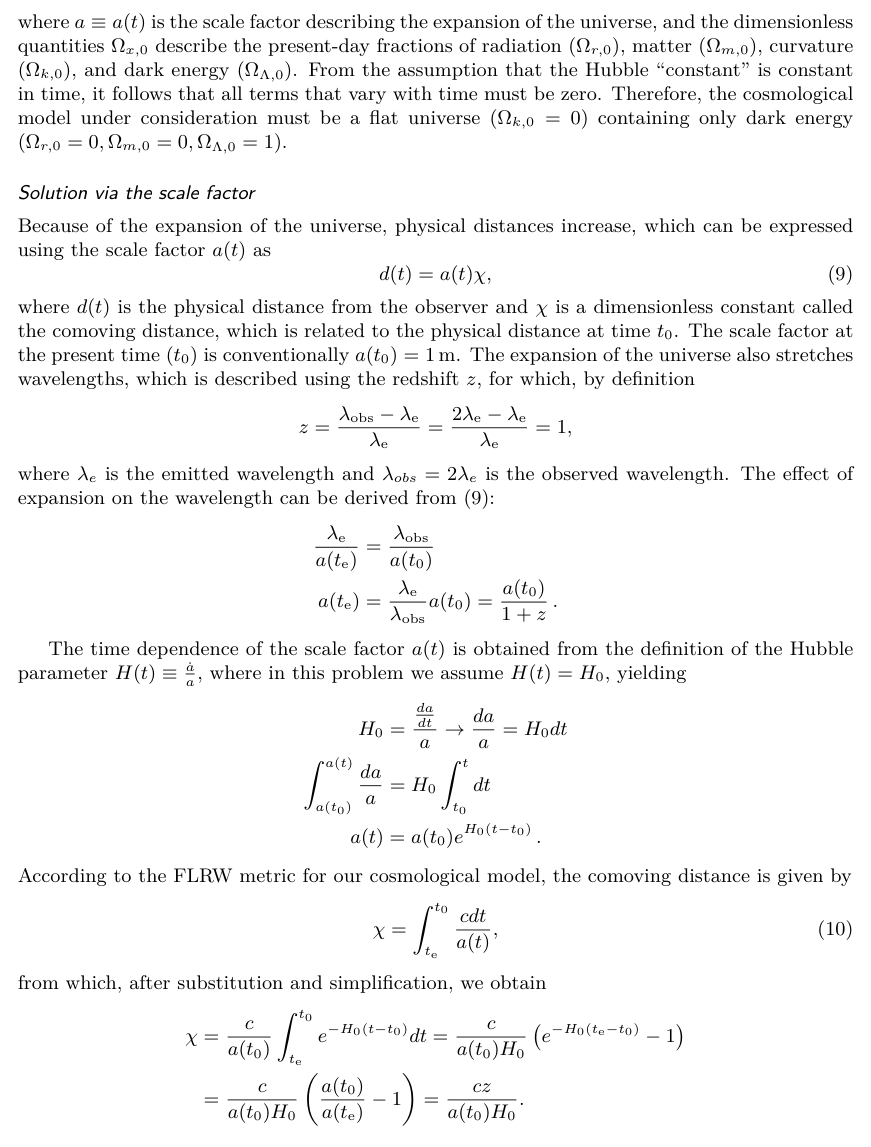
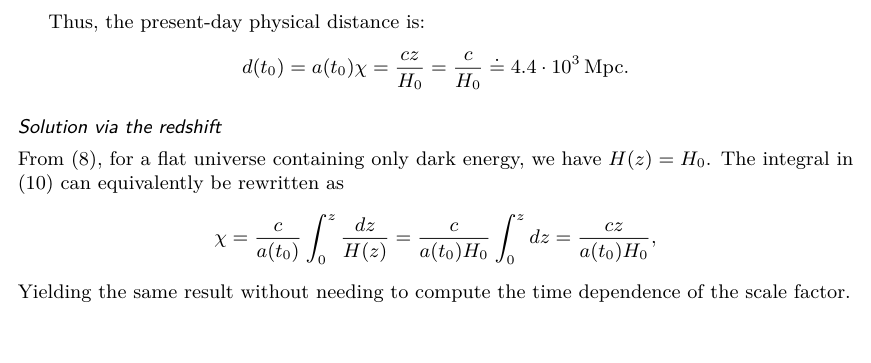
Official solution by FYKOS (Physics Brawl Online 2025), reproduced from the official PDF — p. 48, 49, 50 — under CC BY-SA 3.0.
Topic: Astrophysics Metodi: Calculus-Integration, Physical Modeling Competenze: Mathematical Modeling Objects: Star Fonte: Testo (PDF) — p.48 · Soluzione ufficiale (PDF) — p.48
Il cosmo che si allontana (7 punti)
A quale distanza dovrebbero trovarsi stelle e galassie — oggetti altrimenti in quiete relativa rispetto a noi — che osserviamo, a causa dell’espansione dell’universo, con un redshift tale che le lunghezze d’onda della loro radiazione siano il doppio di quelle al momento dell’emissione? Chiediamo la distanza “attuale”, non quella che avevano quando il segnale è stato emesso. Supponi che l’universo sia omogeneo e isotropo, che valgano le equazioni di Einstein e il modello cosmologico standard ΛCDM, e che l’universo si espanda con una costante di Hubble costante nel tempo, di valore .
Risposta:
Soluzione: La soluzione ufficiale completa (in inglese) è nella versione originale di questo quesito e nel PDF ufficiale.
Topic: Astrophysics Metodi: Calculus-Integration, Physical Modeling Competenze: Mathematical Modeling Objects: Star Fonte: Testo (PDF) — p.48 · Soluzione ufficiale (PDF) — p.48
Underwater light (7 points)
Consider a point source of unpolarized light radiating in all directions. The source is submerged at a depth below a (sufficiently large) calm water surface; the bottom beneath it is perfectly dark. What percentage of the radiant power is transmitted above the surface? The refractive index of water is ; the refractive index of air is . Assume that the water absorbs none of the light. Approximate the intensity transmission coefficient by its value at normal incidence everywhere where light is transmitted.
Risposta:
Soluzione:
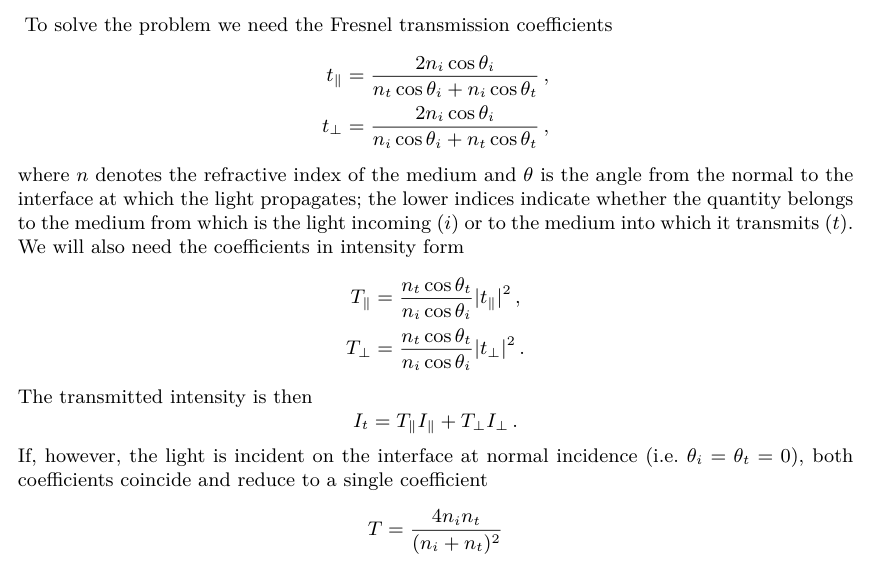
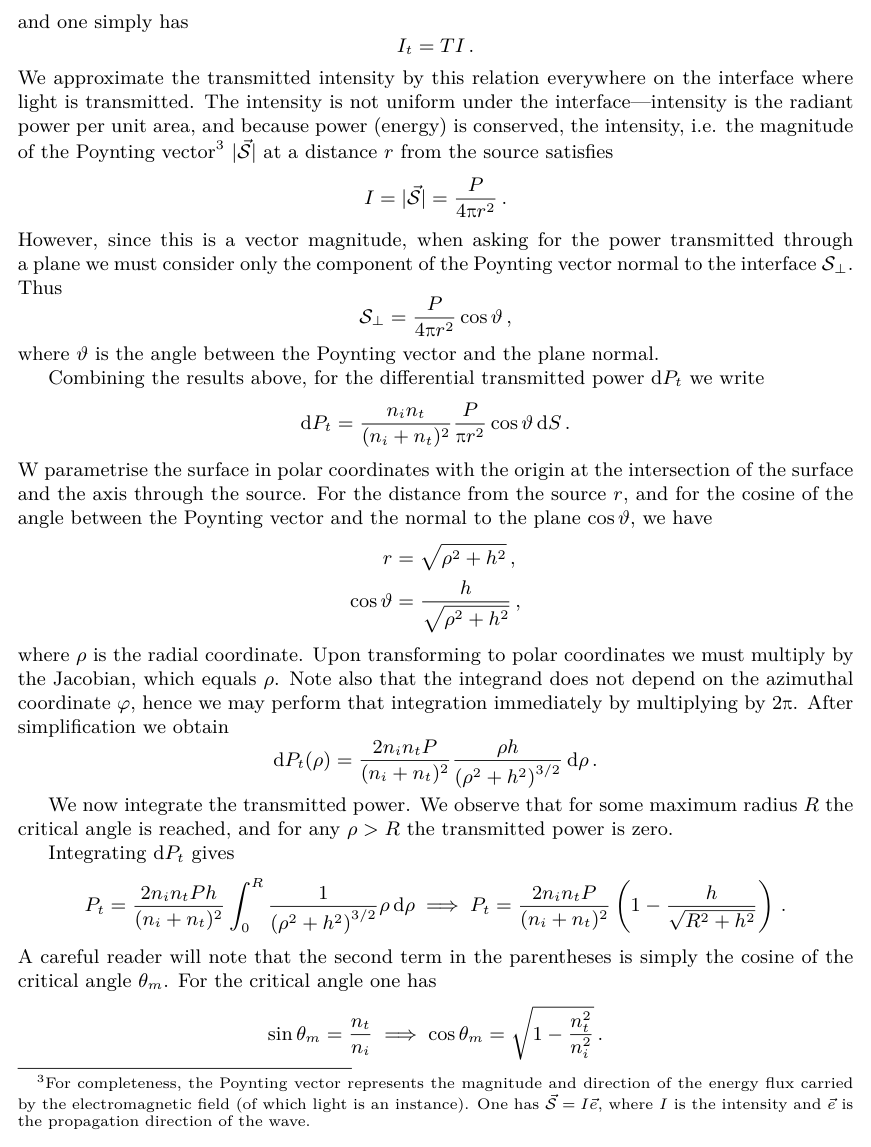
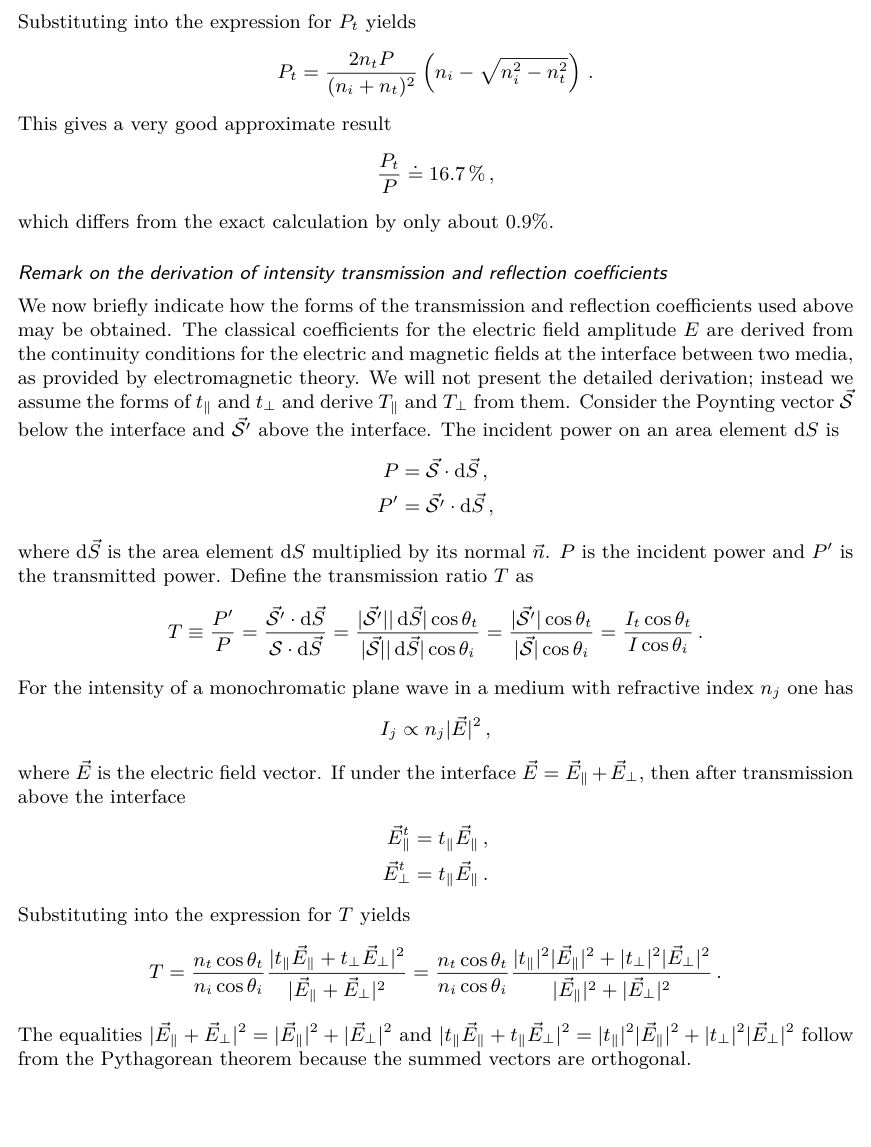
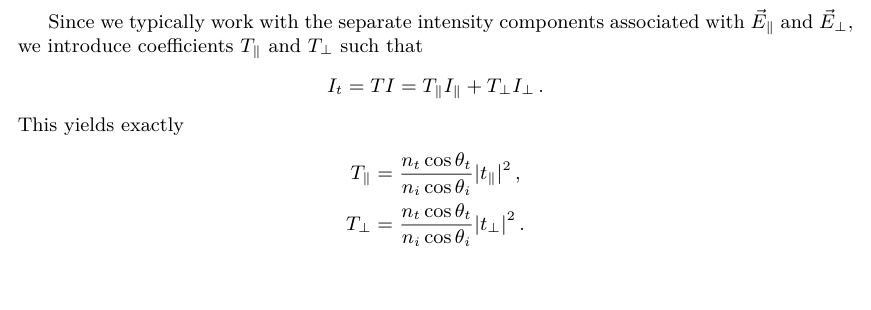
Official solution by FYKOS (Physics Brawl Online 2025), reproduced from the official PDF — p. 50, 51, 52, 53 — under CC BY-SA 3.0.
Topic: Geometric Optics, Wave Optics Metodi: Snell’s Law, Calculus-Integration Competenze: Mathematical Modeling Objects: Photon Fonte: Testo (PDF) — p.50 · Soluzione ufficiale (PDF) — p.50
Luce sott’acqua (7 punti)
Considera una sorgente puntiforme di luce non polarizzata che irradia in tutte le direzioni. La sorgente è immersa a una profondità sotto una superficie d’acqua calma (sufficientemente estesa); il fondo sottostante è perfettamente scuro. Quale percentuale della potenza radiante viene trasmessa sopra la superficie? L’indice di rifrazione dell’acqua è , quello dell’aria . Supponi che l’acqua non assorba luce. Approssima il coefficiente di trasmissione dell’intensità con il suo valore a incidenza normale ovunque la luce venga trasmessa.
Risposta:
Soluzione: La soluzione ufficiale completa (in inglese) è nella versione originale di questo quesito e nel PDF ufficiale.
Topic: Geometric Optics, Wave Optics Metodi: Snell’s Law, Calculus-Integration Competenze: Mathematical Modeling Objects: Photon Fonte: Testo (PDF) — p.50 · Soluzione ufficiale (PDF) — p.50
Hmm, where did i put that? (8 points)
You’ve surely noticed the increase in entropy in your room, or that things tend to diffuse (especially when your roommate is away). Recently, Lego stored his favorite Brownian particle in the minimum of a 2D potential shaped as , where . After a very long time, he went to look for it. What is the probability that he finds it within a distance less than from the spot where he left it? This task was conceived during the summer, so the temperature in the dorm room is .
Risposta:
Soluzione:
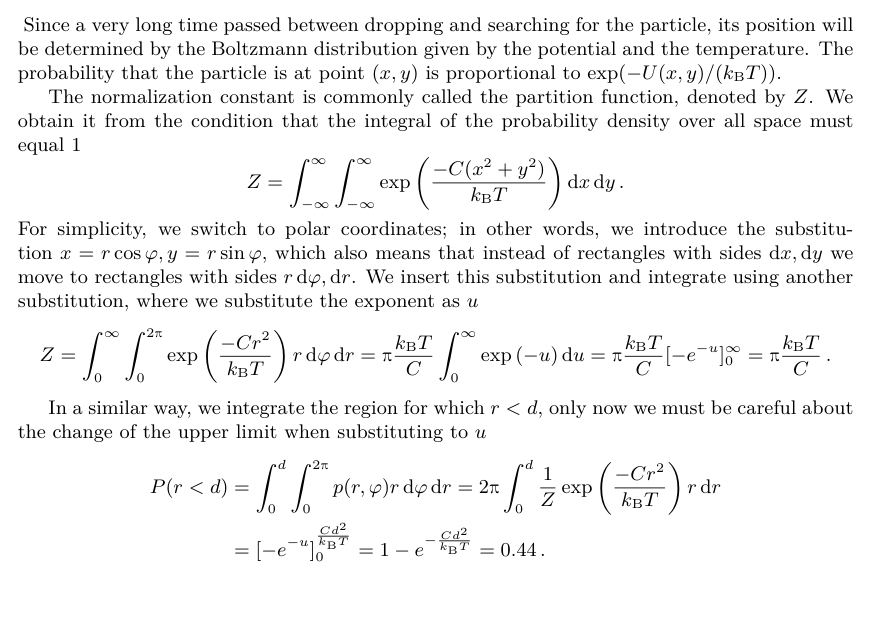
Official solution by FYKOS (Physics Brawl Online 2025), reproduced from the official PDF — p. 53 — under CC BY-SA 3.0.
Topic: Kinetic Theory, Thermodynamics Metodi: Statistical Averaging, Calculus-Integration Competenze: Mathematical Modeling Objects: Particle Beam Fonte: Testo (PDF) — p.53 · Soluzione ufficiale (PDF) — p.53
Hmm, dove l’ho messa? (8 punti)
Avrai sicuramente notato l’aumento di entropia nella tua stanza, o che le cose tendono a diffondere (soprattutto quando il tuo compagno di stanza è via). Di recente Lego ha riposto la sua particella browniana preferita nel minimo di un potenziale bidimensionale , con . Dopo moltissimo tempo è andato a cercarla. Qual è la probabilità di trovarla a meno di dal punto in cui l’aveva lasciata? Il problema è stato ideato d’estate, quindi la temperatura nella stanza dello studentato è .
Risposta:
Soluzione: La soluzione ufficiale completa (in inglese) è nella versione originale di questo quesito e nel PDF ufficiale.
Topic: Kinetic Theory, Thermodynamics Metodi: Statistical Averaging, Calculus-Integration Competenze: Mathematical Modeling Objects: Particle Beam Fonte: Testo (PDF) — p.53 · Soluzione ufficiale (PDF) — p.53
Racing against the rain (6 points)
David and Terka enjoy playing catch with a ball. During the summer, they were able to throw it a maximum distance of . The ball has a radius of and a mass of . By how many centimeters (in absolute value) will the distance they can throw the ball differ in winter? The air density outside the ball is in summer and in winter. The atmosphere does not affect the athletic abilities of David or Terka, nor the physical properties of the ball.
Risposta: (shorter in winter)
Soluzione:
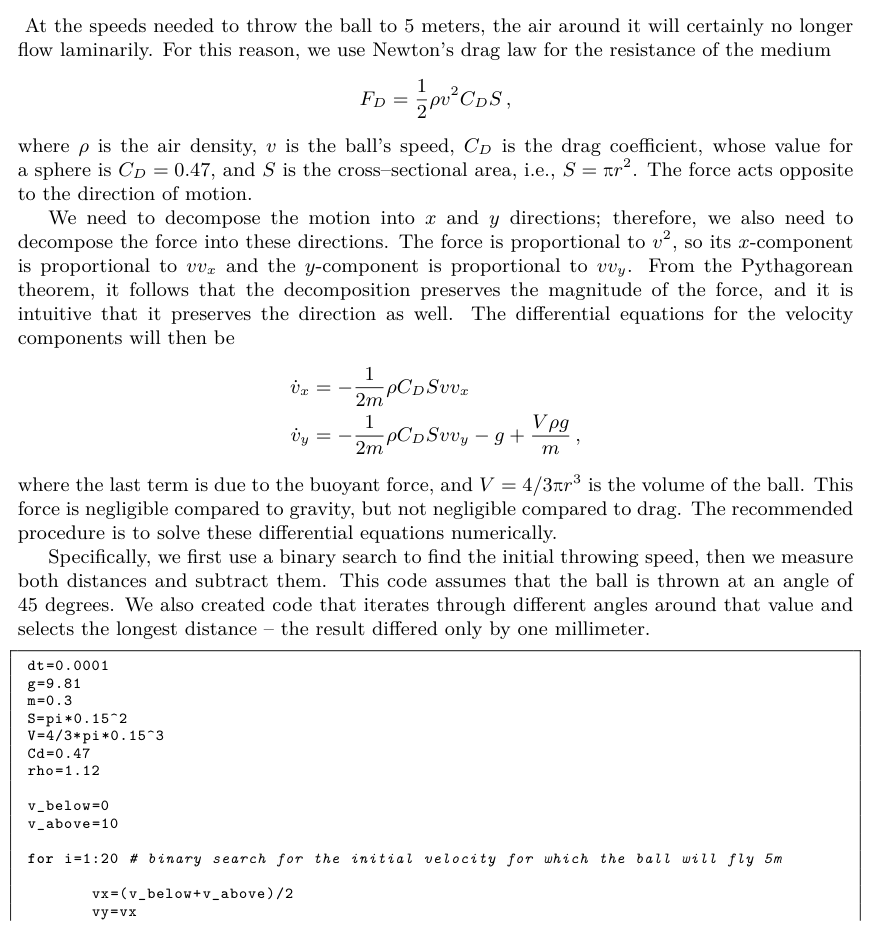
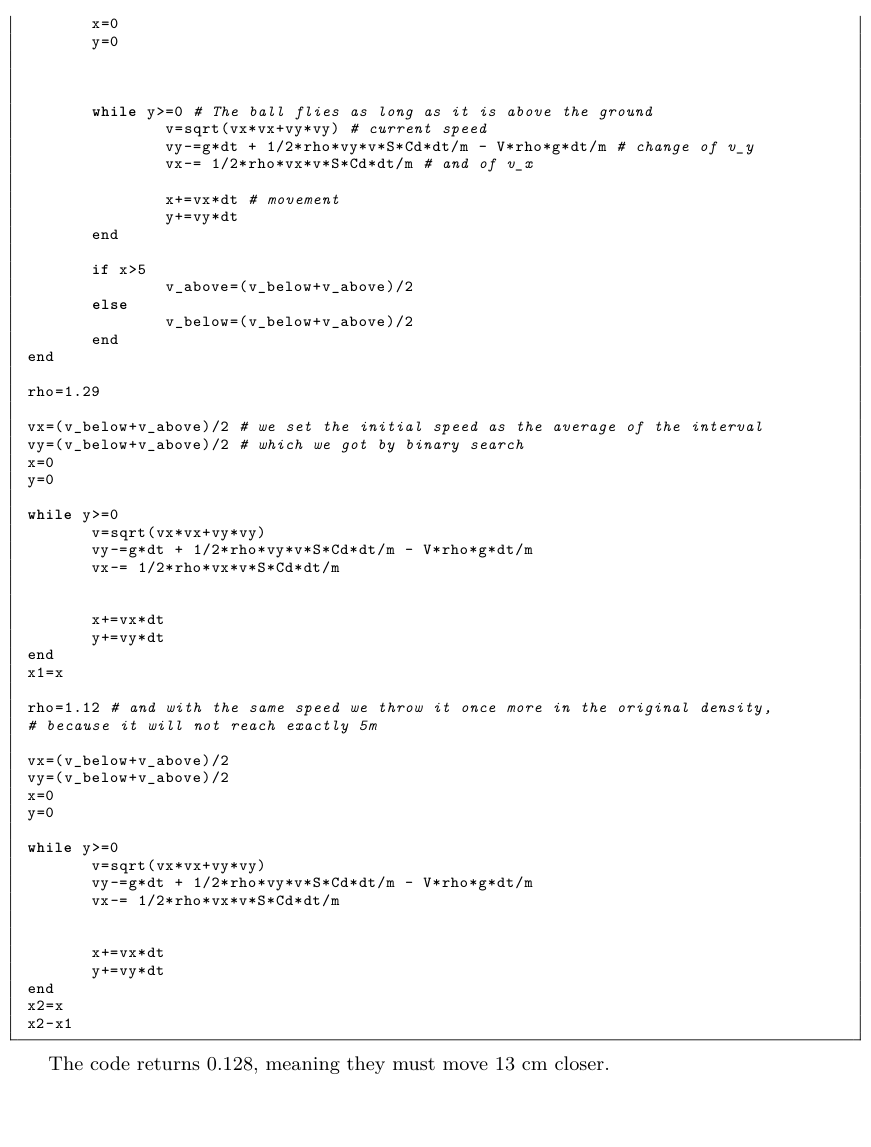
Official solution by FYKOS (Physics Brawl Online 2025), reproduced from the official PDF — p. 54, 55 — under CC BY-SA 3.0.
Topic: Fluid Mechanics, Newtonian Mechanics Metodi: Physical Modeling, Differential Equations Competenze: Mathematical Modeling, Estimation & Approximation Objects: Ball, Projectile Fonte: Testo (PDF) — p.54 · Soluzione ufficiale (PDF) — p.54
Gara contro la pioggia (6 punti)
David e Terka si divertono a lanciarsi una palla. D’estate riuscivano a lanciarla al massimo a . La palla ha raggio e massa . Di quanti centimetri (in valore assoluto) differirà d’inverno la distanza a cui riescono a lanciarla? La densità dell’aria all’esterno della palla è d’estate e d’inverno. L’atmosfera non influisce sulle capacità atletiche di David e Terka né sulle proprietà fisiche della palla.
Risposta: (più corto d’inverno)
Soluzione: La soluzione ufficiale completa (in inglese) è nella versione originale di questo quesito e nel PDF ufficiale.
Topic: Fluid Mechanics, Newtonian Mechanics Metodi: Physical Modeling, Differential Equations Competenze: Mathematical Modeling, Estimation & Approximation Objects: Ball, Projectile Fonte: Testo (PDF) — p.54 · Soluzione ufficiale (PDF) — p.54
Blowing up a balloon reloaded (7 points)
When inflating a balloon, we can, from a certain radius onward, assume with good accuracy that the elastic energy increases directly proportionally to the growing surface area of the balloon. In this size range, Jirka found his previously inflated balloon, which in the meantime had deflated to a radius of (the balloon is approximately spherical). Since the balloon is rather small, he decided to inflate it back to its original size. Balloon inflation is, however, physically demanding. Jirka wants to know how much work his muscles perform when he inflates the balloon using a maximal possible exhalation.
Assume that after inhaling, Jirka has of air in his lungs, and after maximal exhalation, of air remain in his lungs. Further assume that the pressure and temperature of the air in his lungs are at all times equal to those in the balloon, and approximate the inflation as an isothermal process (thus we consider the lungs and the balloon as a single connected vessel undergoing a quasistatic process). The air temperature in the balloon is and the initial pressure . This pressure value corresponds both to the situation before the inflation begins (i.e., for the isolated balloon) and at its start. The pressure in Jirka’s lungs adjusts to match the initial pressure in the balloon. Compute the work of Jirka’s lungs only from the moment the inflation starts. Assume that the work is determined solely by the change in lung volume and the difference between the gas pressure and atmospheric pressure (the surrounding atmospheric pressure assists the lungs during gas compression).
Risposta: (final radius )
Soluzione:
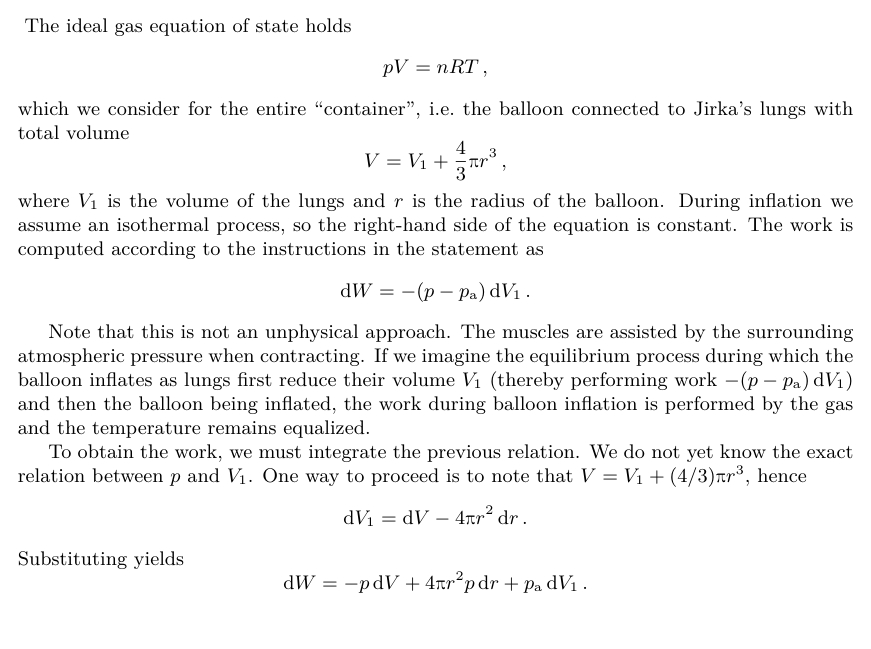
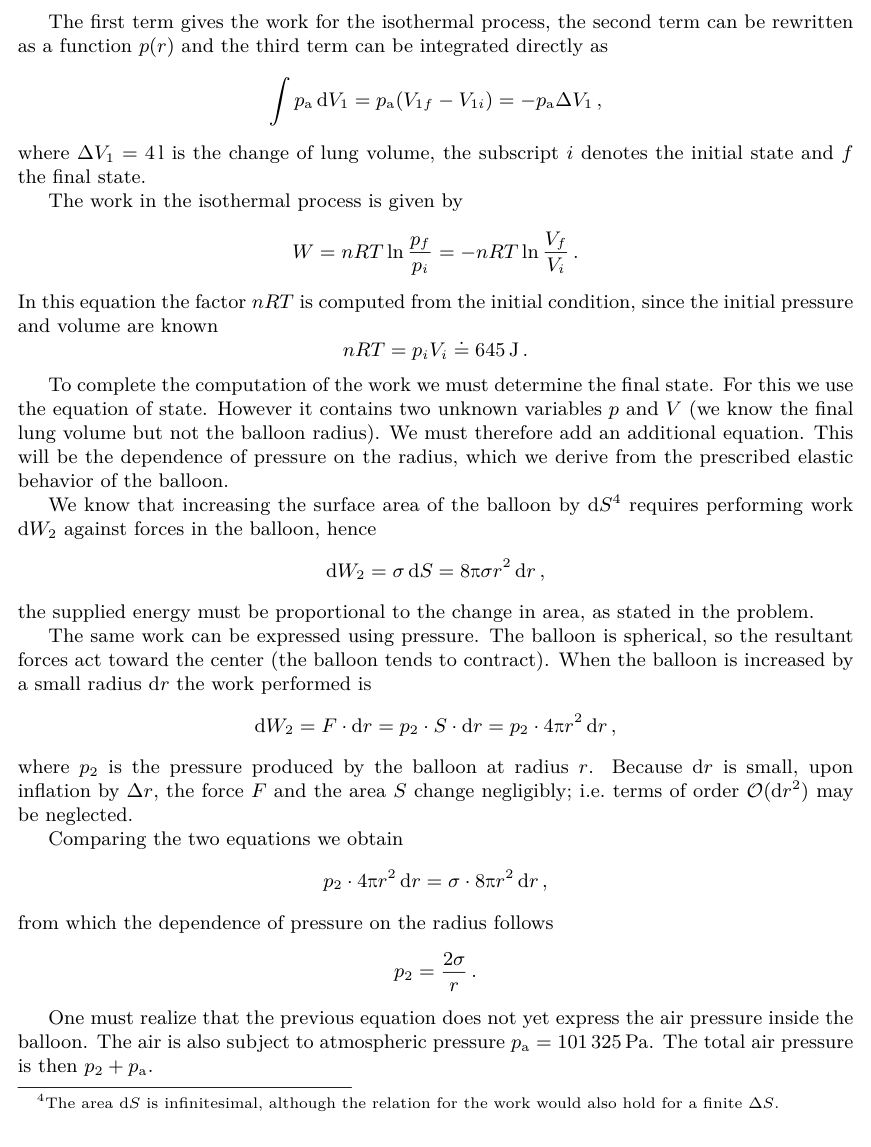
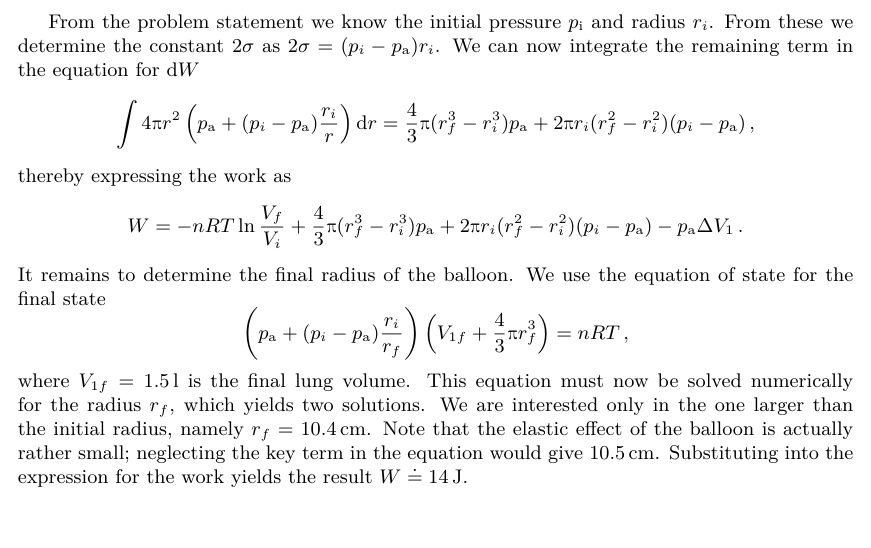
Official solution by FYKOS (Physics Brawl Online 2025), reproduced from the official PDF — p. 56, 57, 58 — under CC BY-SA 3.0.
Topic: Thermodynamics, Elasticity & Materials Metodi: Ideal Gas Law, First Law of Thermodynamics, Calculus-Integration Competenze: Mathematical Modeling Objects: Bubble, Gas Fonte: Testo (PDF) — p.56 · Soluzione ufficiale (PDF) — p.56
Gonfiare un palloncino (reloaded) (7 punti)
Quando si gonfia un palloncino, da un certo raggio in poi si può assumere con buona precisione che l’energia elastica cresca in proporzione diretta all’aumento della superficie del palloncino. In questo intervallo di dimensioni Jirka ha ritrovato un palloncino gonfiato in precedenza, che nel frattempo si era sgonfiato fino a un raggio di (il palloncino è approssimativamente sferico). Poiché il palloncino è piuttosto piccolo, ha deciso di rigonfiarlo fino alla dimensione originale. Gonfiare un palloncino è però faticoso: Jirka vuole sapere quanto lavoro compiono i suoi muscoli quando gonfia il palloncino con un’espirazione massima.
Supponi che dopo l’inspirazione Jirka abbia nei polmoni d’aria e che dopo l’espirazione massima ne restino . Supponi inoltre che pressione e temperatura dell’aria nei polmoni siano in ogni istante uguali a quelle nel palloncino, e approssima il gonfiaggio come un processo isotermo (polmoni e palloncino sono quindi un unico recipiente che subisce una trasformazione quasistatica). La temperatura dell’aria nel palloncino è e la pressione iniziale . Questo valore di pressione vale sia prima che il gonfiaggio cominci (per il palloncino isolato) sia all’inizio del gonfiaggio: la pressione nei polmoni di Jirka si adegua a quella iniziale del palloncino. Calcola il lavoro dei polmoni di Jirka solo a partire dall’inizio del gonfiaggio. Supponi che il lavoro sia determinato solo dalla variazione di volume dei polmoni e dalla differenza tra la pressione del gas e la pressione atmosferica (la pressione atmosferica circostante aiuta i polmoni durante la compressione del gas).
Risposta: (raggio finale )
Soluzione: La soluzione ufficiale completa (in inglese) è nella versione originale di questo quesito e nel PDF ufficiale.
Topic: Thermodynamics, Elasticity & Materials Metodi: Ideal Gas Law, First Law of Thermodynamics, Calculus-Integration Competenze: Mathematical Modeling Objects: Bubble, Gas Fonte: Testo (PDF) — p.56 · Soluzione ufficiale (PDF) — p.56
A spring and a magnet (8 points)
Consider a spring of stiffness , hanging vertically, on which a magnet of mass and magnetic moment is attached. The magnet also acts as a weight. On the floor below the magnetic weight is placed another magnet with the magnetic moment . Calculate the period of the small oscillations, assuming that the magnets are of negligible size, and thus can be considered as magnetic dipoles, and are moving slowly enough that we can neglect any losses. The magnets are oriented in such a direction that they repel each other, and the magnet acting as a weight is exactly such that the deflection of the spring does not change when it is suspended.
Risposta:
Soluzione:
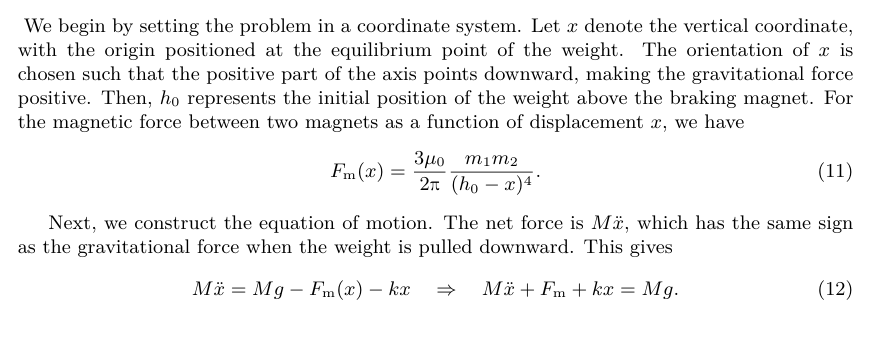
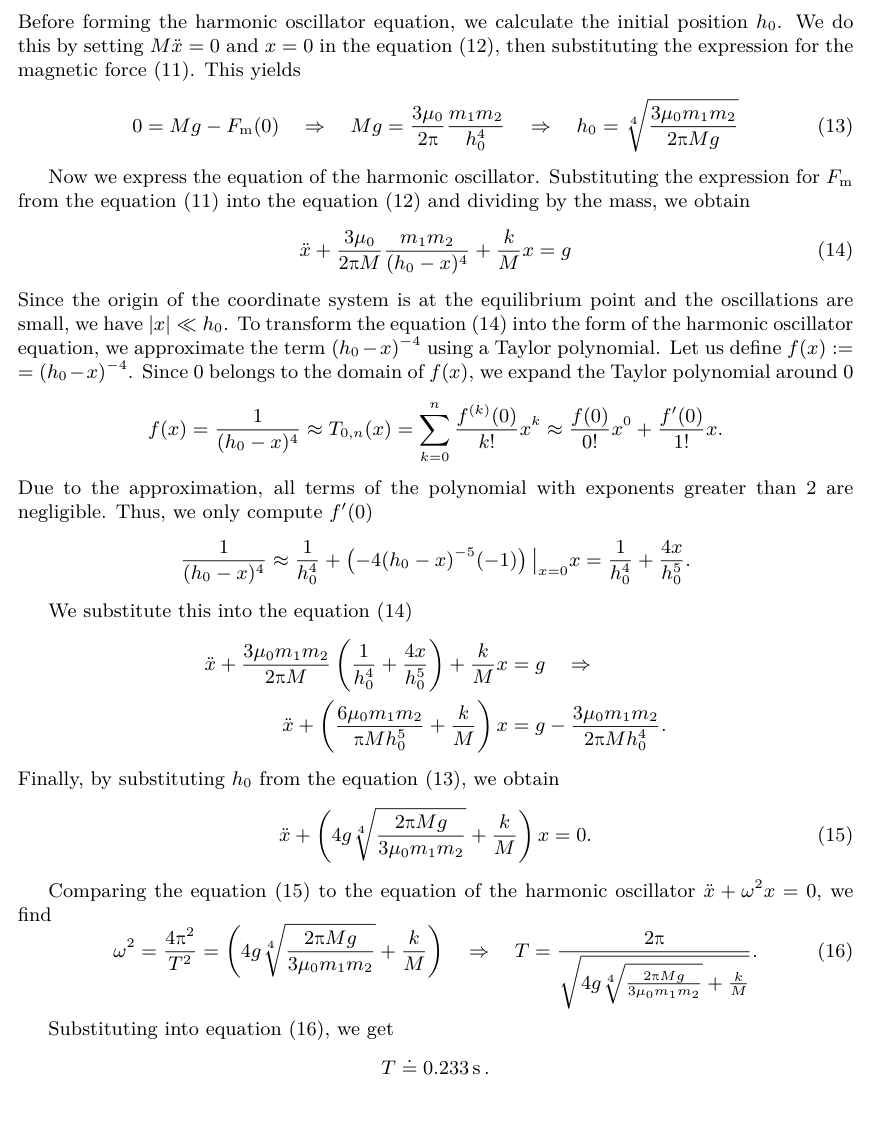
Official solution by FYKOS (Physics Brawl Online 2025), reproduced from the official PDF — p. 58, 59 — under CC BY-SA 3.0.
Topic: Magnetism, Oscillations & Waves Metodi: Simple Harmonic Motion Analysis, Approximation & Series Expansion Competenze: Mathematical Modeling Objects: Spring, Magnetic Dipole, Magnet Fonte: Testo (PDF) — p.58 · Soluzione ufficiale (PDF) — p.58
Una molla e un magnete (8 punti)
Considera una molla di costante elastica , appesa verticalmente, alla quale è attaccato un magnete di massa e momento magnetico ; il magnete funge anche da peso. Sul pavimento, sotto il peso magnetico, è posto un altro magnete di momento magnetico . Calcola il periodo delle piccole oscillazioni, supponendo che i magneti abbiano dimensioni trascurabili, così da poterli considerare dipoli magnetici, e che si muovano abbastanza lentamente da poter trascurare ogni perdita. I magneti sono orientati in modo da respingersi, e il magnete che funge da peso è esattamente tale che, quando viene appeso, l’allungamento della molla non cambia.
Risposta:
Soluzione: La soluzione ufficiale completa (in inglese) è nella versione originale di questo quesito e nel PDF ufficiale.
Topic: Magnetism, Oscillations & Waves Metodi: Simple Harmonic Motion Analysis, Approximation & Series Expansion Competenze: Mathematical Modeling Objects: Spring, Magnetic Dipole, Magnet Fonte: Testo (PDF) — p.58 · Soluzione ufficiale (PDF) — p.58
Underwater light reloaded (9 points)
Consider a point source of unpolarized light radiating in all directions. The source is submerged at a depth of below a (sufficiently large) calm water surface. What percentage of the radiant power is transmitted above the surface? The refractive index of water is ; the refractive index of air is . Assume that water absorbs none of the light and use the exact values of the transmission coefficients.
Risposta:
Soluzione:
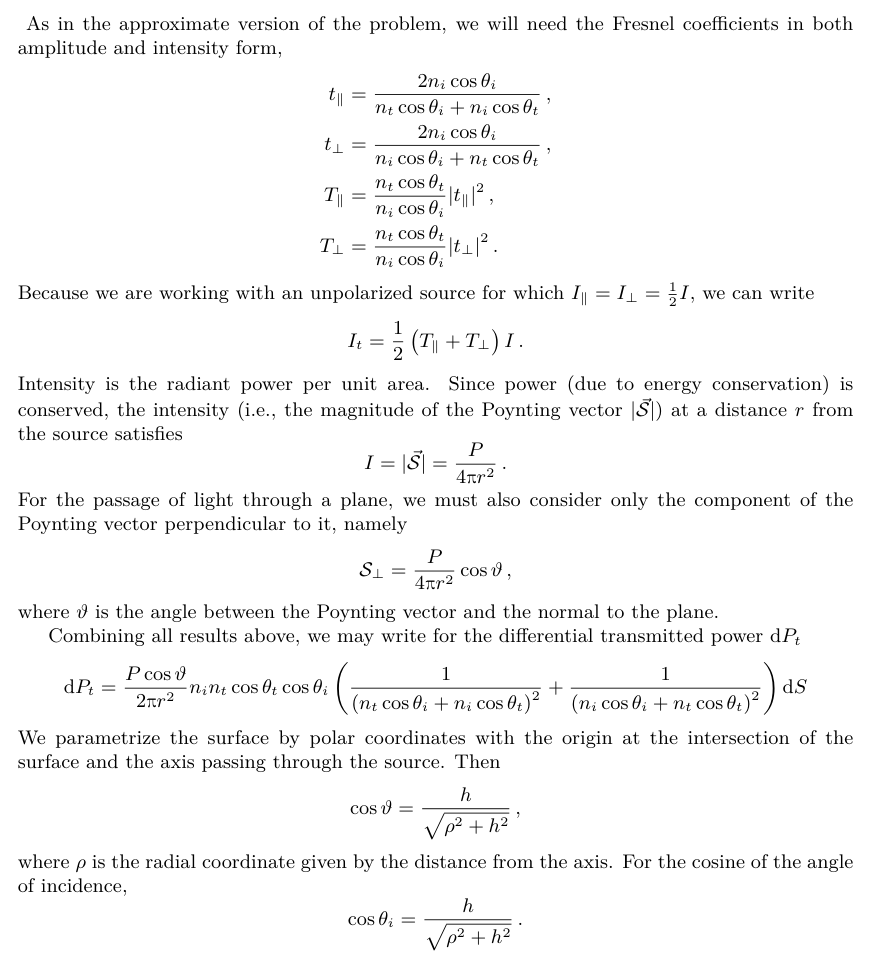
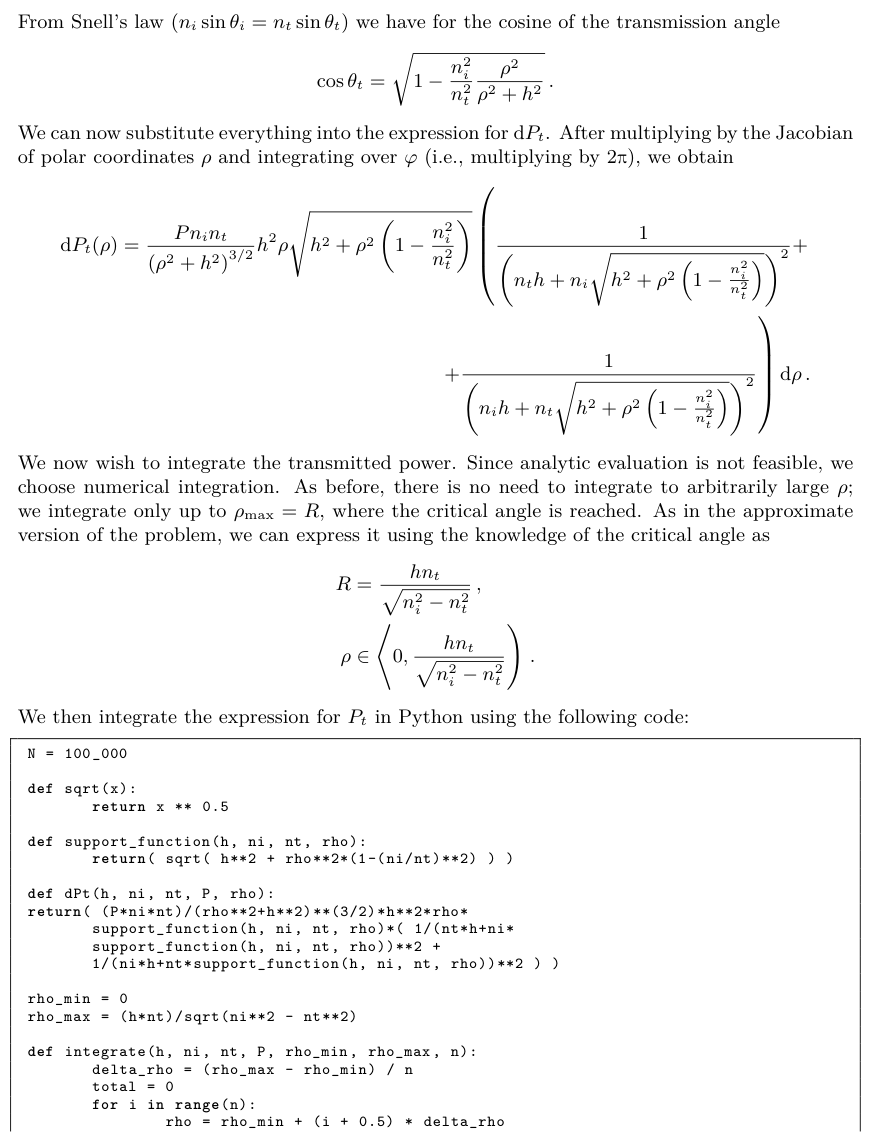
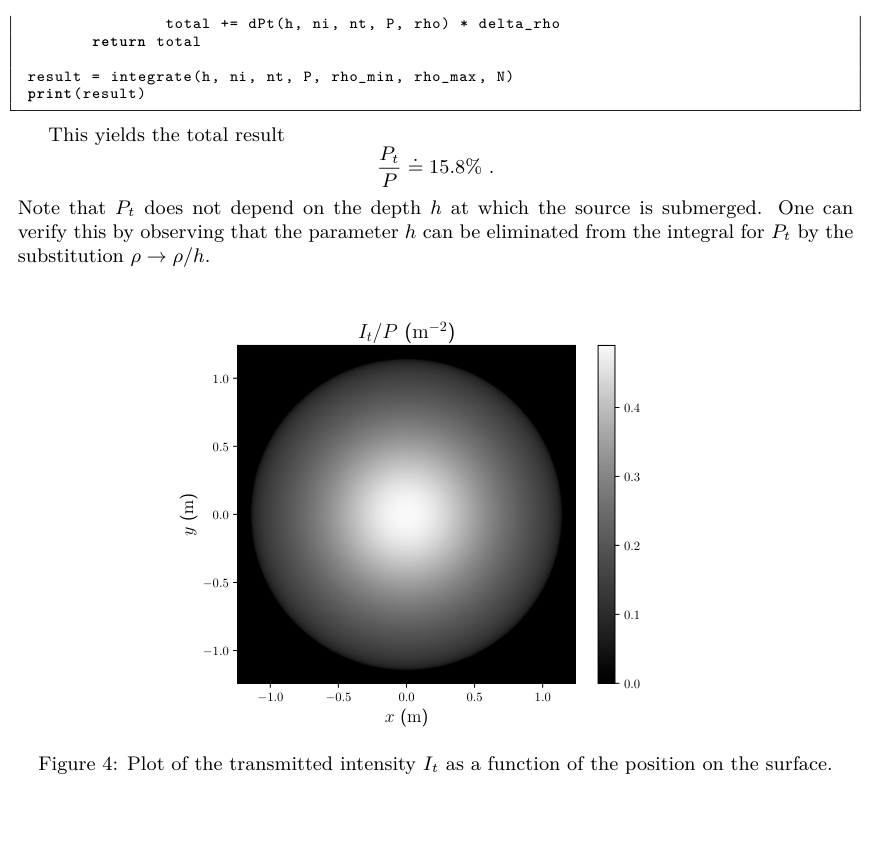
Official solution by FYKOS (Physics Brawl Online 2025), reproduced from the official PDF — p. 60, 61, 62 — under CC BY-SA 3.0.
Topic: Wave Optics, Geometric Optics Metodi: Snell’s Law, Calculus-Integration Competenze: Mathematical Modeling Objects: Photon Fonte: Testo (PDF) — p.60 · Soluzione ufficiale (PDF) — p.60
Luce sott’acqua (reloaded) (9 punti)
Considera una sorgente puntiforme di luce non polarizzata che irradia in tutte le direzioni. La sorgente è immersa a una profondità sotto una superficie d’acqua calma (sufficientemente estesa). Quale percentuale della potenza radiante viene trasmessa sopra la superficie? L’indice di rifrazione dell’acqua è , quello dell’aria . Supponi che l’acqua non assorba luce e usa i valori esatti dei coefficienti di trasmissione.
Risposta:
Soluzione: La soluzione ufficiale completa (in inglese) è nella versione originale di questo quesito e nel PDF ufficiale.
Topic: Wave Optics, Geometric Optics Metodi: Snell’s Law, Calculus-Integration Competenze: Mathematical Modeling Objects: Photon Fonte: Testo (PDF) — p.60 · Soluzione ufficiale (PDF) — p.60
Thermodynamic lottery (8 points)
Two Maxwell demons, Elenka and Tomáš, work in a corporation called “Ensembles Ltd.”. Their task is to find certain microstates. They both have an isolated system in equilibrium composed of a box with monatomic ideal gas particles and volume .
Now, each of them looks into their box and checks if the system is in the desired range of microstates. If yes, these boxes are quickly shipped to the customers. The employee with the higher number of shipped boxes gets a promotion. Elenka really wants to be promoted, so she heated up Tomáš’s box just a little (she is a demon after all).
Consider that the desired range of microstates is the same for both of them and that each microstate compatible with the macroscopic quantities is equally probable. Furthermore, Elenka’s box is at temperature and Tomáš’s is at . What is the ratio between the probability that Elenka looks and finds a desired microstate and the probability that Tomáš does? Consider a classical setting ( and are large enough).
Risposta:
Soluzione:
Official solution by FYKOS (Physics Brawl Online 2025), reproduced from the official PDF — p. 63, 64 — under CC BY-SA 3.0.
Topic: Kinetic Theory, Thermodynamics Metodi: Statistical Averaging, Kinetic Theory of Gases Competenze: Mathematical Modeling Objects: Gas Fonte: Testo (PDF) — p.62 · Soluzione ufficiale (PDF) — p.63
Lotteria termodinamica (8 punti)
Due diavoletti di Maxwell, Elenka e Tomáš, lavorano in un’azienda chiamata “Ensembles Ltd.”. Il loro compito è trovare certi microstati. Entrambi dispongono di un sistema isolato in equilibrio, costituito da una scatola di volume con particelle di gas ideale monoatomico.
Ognuno guarda nella propria scatola e controlla se il sistema si trova nell’intervallo di microstati desiderato. Se sì, le scatole vengono spedite rapidamente ai clienti. Chi spedisce più scatole ottiene una promozione. Elenka vuole davvero la promozione, quindi ha scaldato appena un po’ la scatola di Tomáš (è pur sempre un diavoletto).
Considera che l’intervallo di microstati desiderato sia lo stesso per entrambi e che ogni microstato compatibile con le grandezze macroscopiche sia ugualmente probabile. La scatola di Elenka è alla temperatura e quella di Tomáš a . Qual è il rapporto tra la probabilità che Elenka guardi e trovi un microstato desiderato e la probabilità che lo trovi Tomáš? Considera il caso classico ( e sufficientemente grandi).
Risposta:
Soluzione: La soluzione ufficiale completa (in inglese) è nella versione originale di questo quesito e nel PDF ufficiale.
Topic: Kinetic Theory, Thermodynamics Metodi: Statistical Averaging, Kinetic Theory of Gases Competenze: Mathematical Modeling Objects: Gas Fonte: Testo (PDF) — p.62 · Soluzione ufficiale (PDF) — p.63
Giant metronome (9 points)
Consider a metronome consisting of two rods. The longer rod is homogeneous, with a length of and a linear density of , and is fixed at one end at a point around which it can freely rotate. The shorter rod, with a length of , is massless and its upper end is attached to the midpoint of the longer rod, such that it can freely rotate around the point of connection. Moreover, the shorter rod always passes through a point located at a height of above the point where the lower end of the longer rod is fixed — at this point, it can both rotate and slide. At the other end of the shorter rod, there is a weight with a mass of . What is the period of small oscillations?
Risposta:
Soluzione:

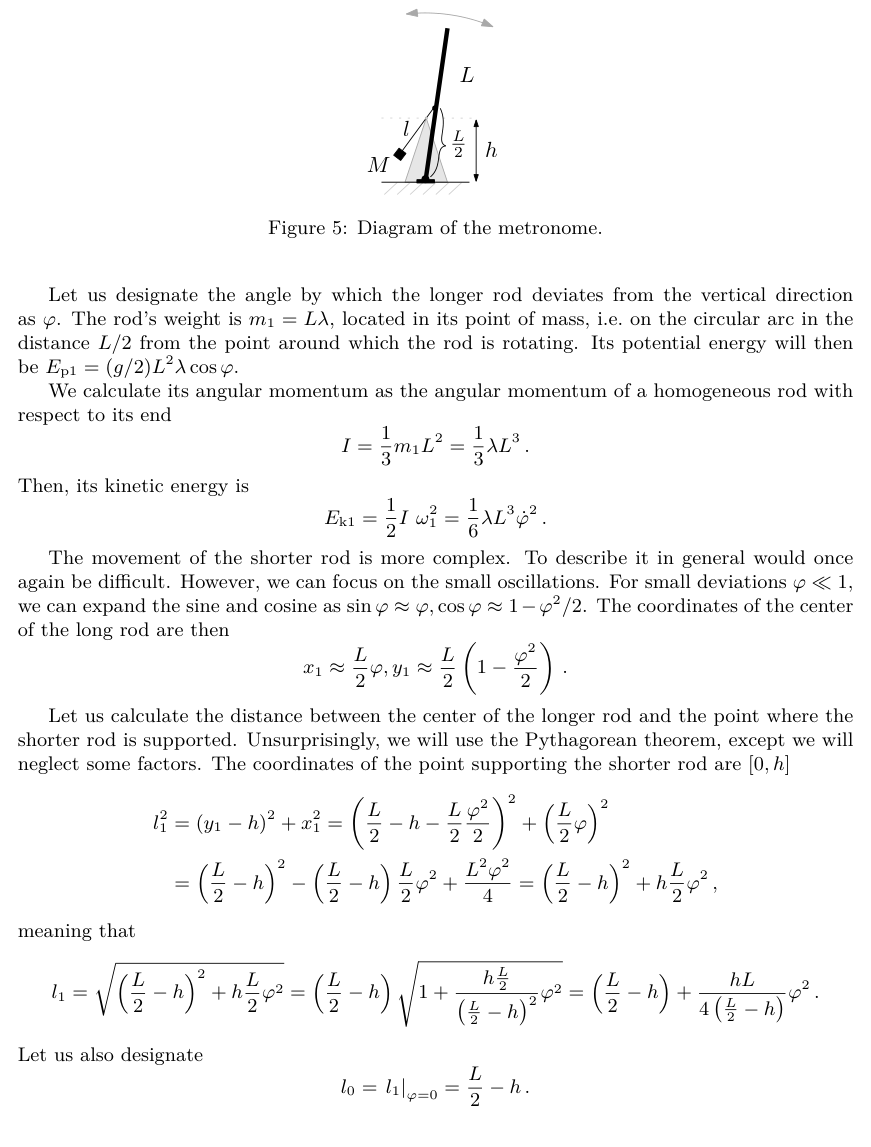
Official solution by FYKOS (Physics Brawl Online 2025), reproduced from the official PDF — p. 64, 65, 66, 67 — under CC BY-SA 3.0.
Topic: Oscillations & Waves, Rotational Dynamics Metodi: Energy Conservation Method, Small-Angle Approximation, Approximation & Series Expansion Competenze: Mathematical Modeling Objects: Rod, Pendulum Fonte: Testo (PDF) — p.64 · Soluzione ufficiale (PDF) — p.64
Metronomo gigante (9 punti)
Considera un metronomo formato da due aste. L’asta più lunga è omogenea, di lunghezza e densità lineare , ed è fissata per un estremo in un punto attorno al quale può ruotare liberamente. L’asta più corta, lunga , ha massa trascurabile e il suo estremo superiore è collegato al punto medio dell’asta lunga, in modo da poter ruotare liberamente attorno al punto di collegamento. Inoltre l’asta corta passa sempre per un punto situato a un’altezza sopra il punto in cui è fissato l’estremo inferiore dell’asta lunga: in quel punto può sia ruotare sia scorrere. All’altro estremo dell’asta corta c’è un peso di massa . Qual è il periodo delle piccole oscillazioni?
Risposta:
Soluzione: La soluzione ufficiale completa (in inglese) è nella versione originale di questo quesito e nel PDF ufficiale.
Topic: Oscillations & Waves, Rotational Dynamics Metodi: Energy Conservation Method, Small-Angle Approximation, Approximation & Series Expansion Competenze: Mathematical Modeling Objects: Rod, Pendulum Fonte: Testo (PDF) — p.64 · Soluzione ufficiale (PDF) — p.64
Charged hoop in a sphere (9 points)
Consider a hollow, ideally conducting sphere of radius . A point charge is placed at its center. Next, a circular ring of radius is placed inside the sphere so that its axis passes through the center of the sphere and the distance between the center of the sphere and the center of the ring is . The ring is uniformly charged with linear charge density . A test charge with charge-to-mass ratio (assumed not to affect the charge distribution on the sphere) is placed on the line segment connecting the centers of the sphere and the ring. The test charge is allowed to stabilize at its equilibrium position inside the sphere. If the test charge is then slightly displaced, what will be the period of its small oscillations?
Risposta:
Soluzione:
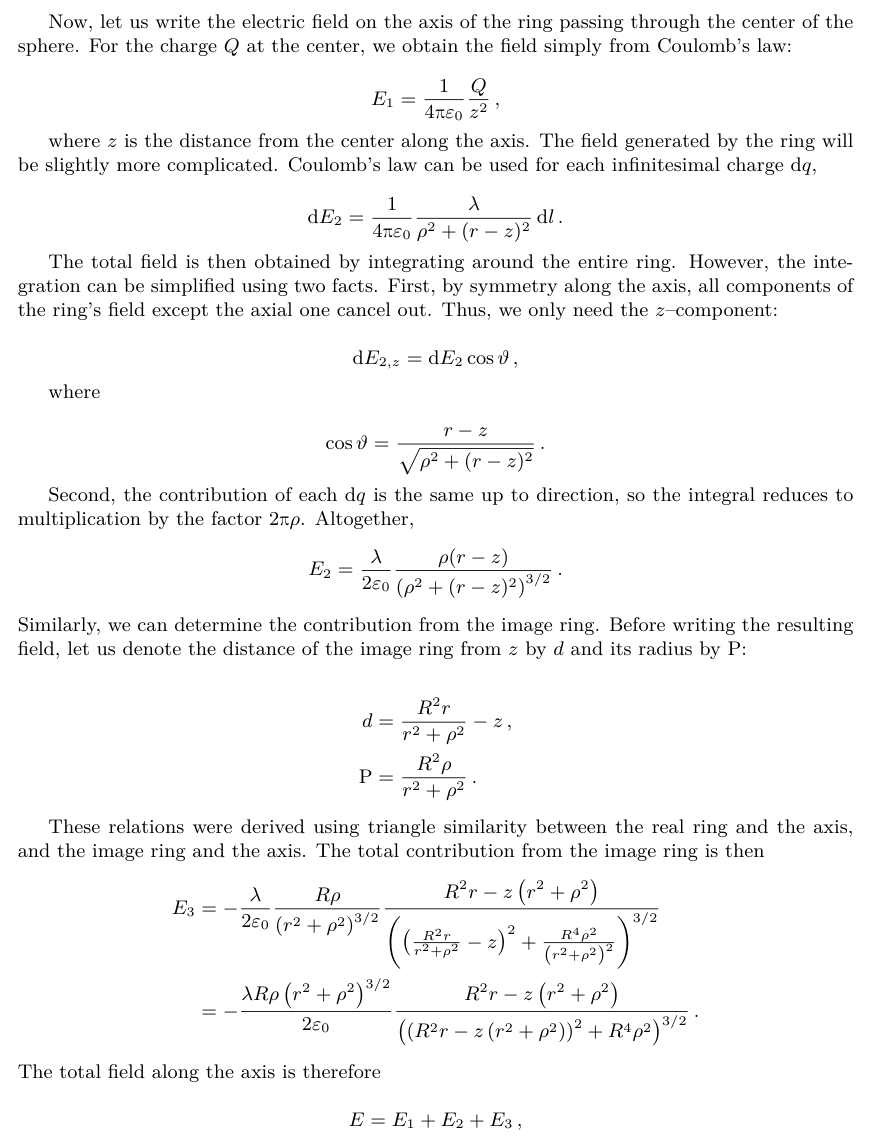
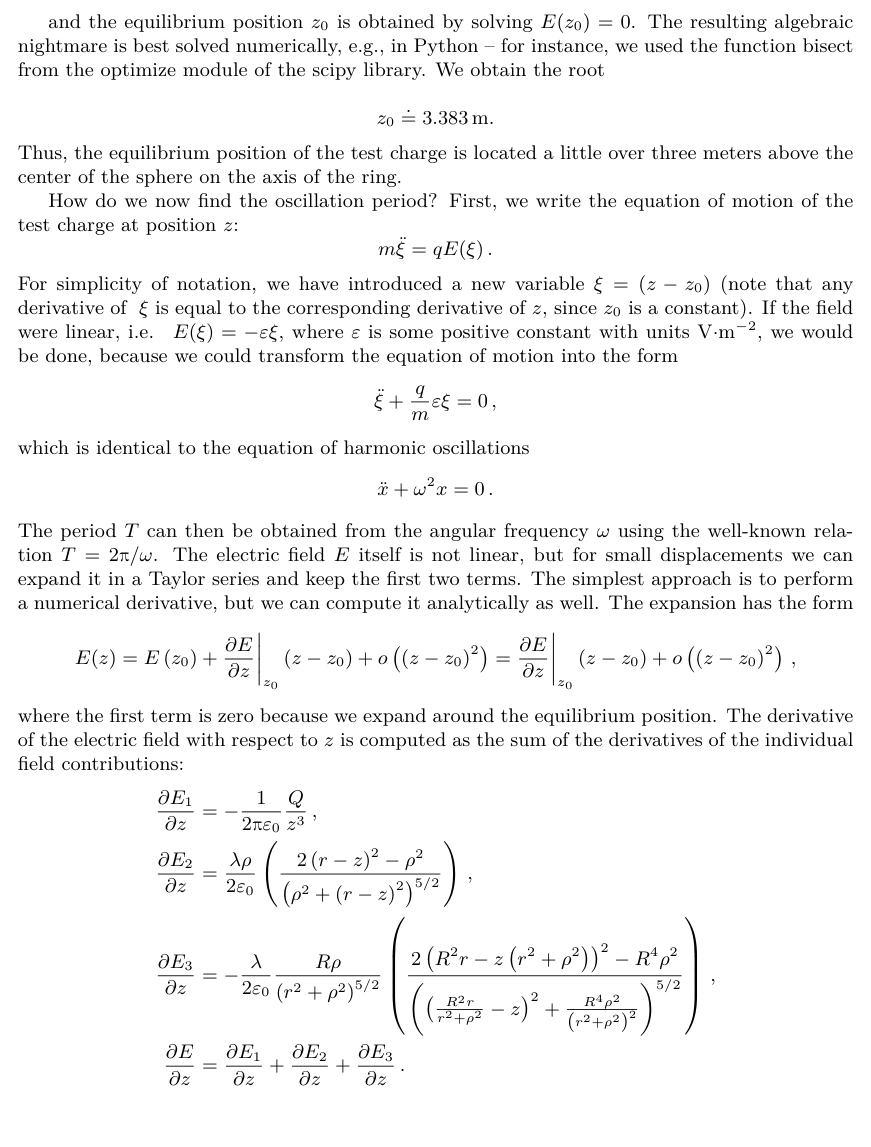
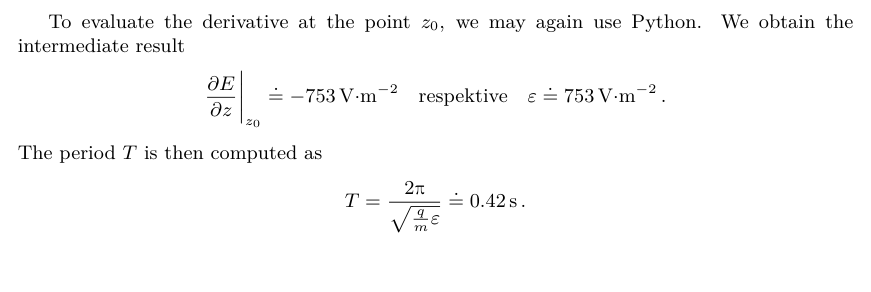
Official solution by FYKOS (Physics Brawl Online 2025), reproduced from the official PDF — p. 68, 69, 70, 71 — under CC BY-SA 3.0.
Topic: Electrostatics, Oscillations & Waves Metodi: Superposition Principle, Electric Potential Method, Simple Harmonic Motion Analysis Competenze: Mathematical Modeling Objects: Conducting Sphere, Point Charge Fonte: Testo (PDF) — p.68 · Soluzione ufficiale (PDF) — p.68
Anello carico in una sfera (9 punti)
Considera una sfera cava, perfettamente conduttrice, di raggio . Nel suo centro è posta una carica puntiforme . All’interno della sfera si colloca poi un anello circolare di raggio , in modo che il suo asse passi per il centro della sfera e che la distanza tra il centro della sfera e il centro dell’anello sia . L’anello è carico uniformemente con densità lineare di carica . Una carica di prova con rapporto carica/massa (che si suppone non alteri la distribuzione di carica sulla sfera) è posta sul segmento che congiunge i centri della sfera e dell’anello, e la si lascia stabilizzare nella sua posizione di equilibrio all’interno della sfera. Se la carica di prova viene poi spostata di poco, quale sarà il periodo delle sue piccole oscillazioni?
Risposta:
Soluzione: La soluzione ufficiale completa (in inglese) è nella versione originale di questo quesito e nel PDF ufficiale.
Topic: Electrostatics, Oscillations & Waves Metodi: Superposition Principle, Electric Potential Method, Simple Harmonic Motion Analysis Competenze: Mathematical Modeling Objects: Conducting Sphere, Point Charge Fonte: Testo (PDF) — p.68 · Soluzione ufficiale (PDF) — p.68
Easterly (8 points)
Kuba was successful on Easter Monday; because of that, a heavy cluster of ribbons was located at the end of his Easter whip. Determine the weight of this cluster, assuming the willow whip is a perfectly thin, massless, homogeneous rod of length (with ends A and B) and bending stiffness ; when the whip was held vertically at the end A (with the ribbons tied to the end B), it was deflected from the vertical axis by an angle , and the tangent at the free end B of the whip made an angle with the vertical, while the tangent at the held end A was vertical. The bending stiffness is defined by , where is the external bending moment and is the rod curvature.
Risposta:
Soluzione:
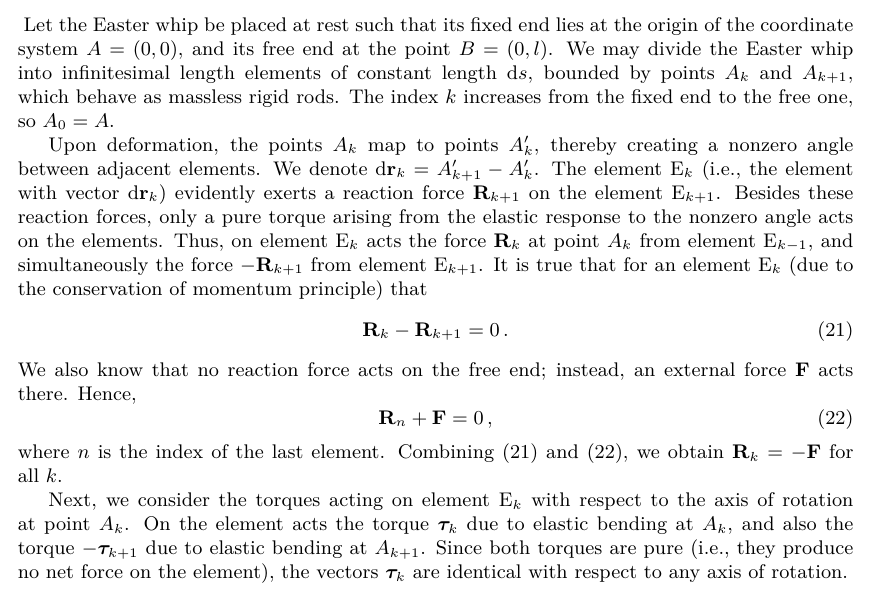
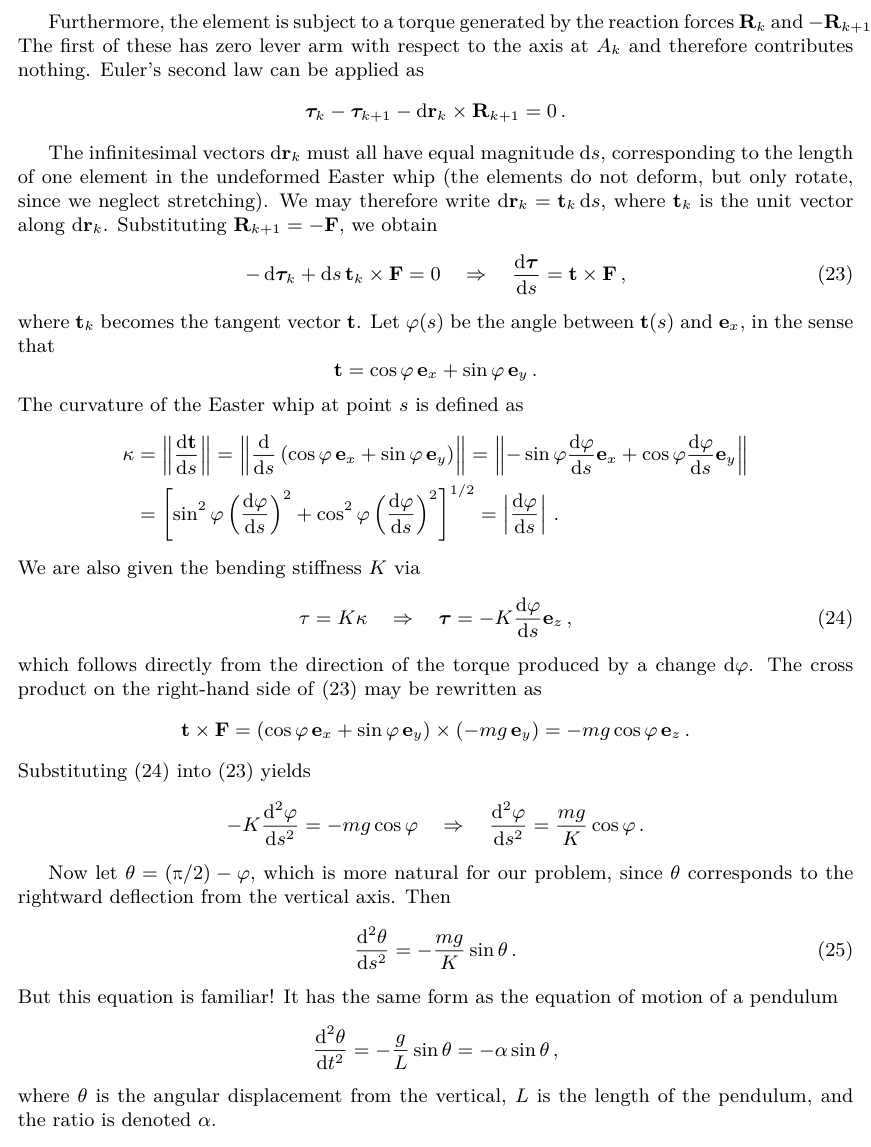
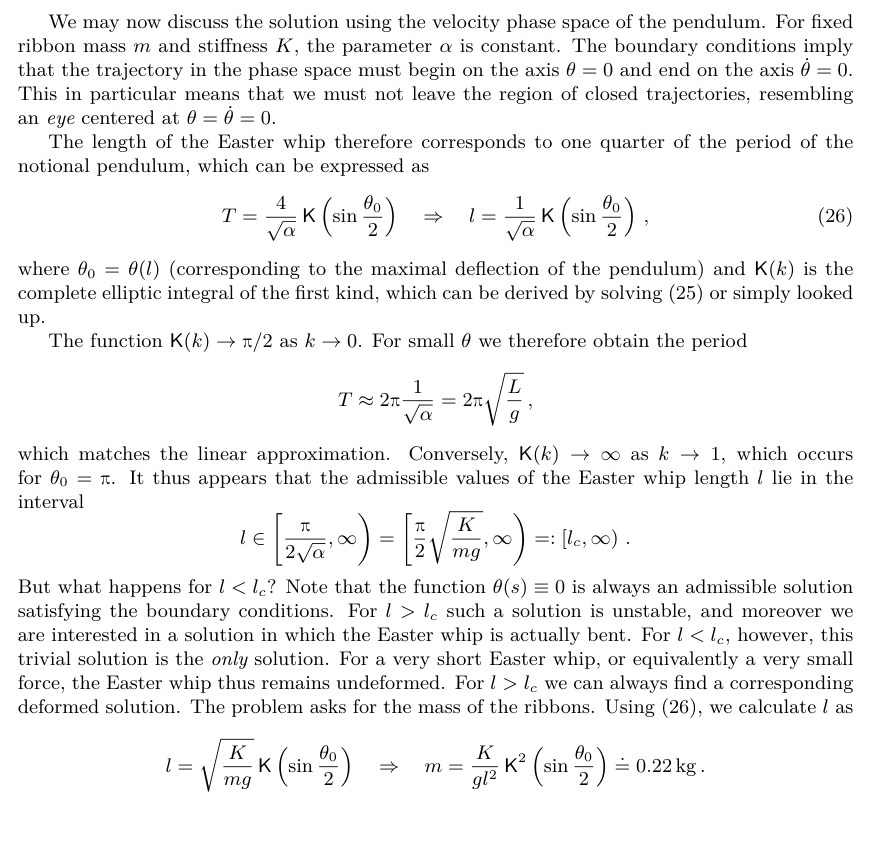
Official solution by FYKOS (Physics Brawl Online 2025), reproduced from the official PDF — p. 71, 72, 73 — under CC BY-SA 3.0.
Topic: Elasticity & Materials Metodi: Differential Equations, Torque & Angular Momentum Analysis Competenze: Mathematical Modeling Objects: Rod Fonte: Testo (PDF) — p.71 · Soluzione ufficiale (PDF) — p.71
Pasquetta (8 punti)
Kuba ha avuto successo il Lunedì dell’Angelo; per questo all’estremità della sua frusta pasquale c’era un pesante grappolo di nastri. Determina il peso di questo grappolo, supponendo che la frusta di salice sia un’asta perfettamente sottile, di massa trascurabile, omogenea, di lunghezza (con estremi A e B) e rigidità flessionale ; quando la frusta veniva tenuta verticale per l’estremo A (con i nastri legati all’estremo B), si piegava rispetto alla verticale di un angolo : la tangente all’estremo libero B formava un angolo con la verticale, mentre la tangente all’estremo A, quello tenuto in mano, era verticale. La rigidità flessionale è definita da , dove è il momento flettente esterno e la curvatura dell’asta.
Risposta:
Soluzione: La soluzione ufficiale completa (in inglese) è nella versione originale di questo quesito e nel PDF ufficiale.
Topic: Elasticity & Materials Metodi: Differential Equations, Torque & Angular Momentum Analysis Competenze: Mathematical Modeling Objects: Rod Fonte: Testo (PDF) — p.71 · Soluzione ufficiale (PDF) — p.71
Thermal neutrons (9 points)
Jindra wants to detect thermal neutrons more than anything else in the world. For this reason, he acquired a semiconductor pixel particle detector and lithium fluoride LiF. Jindra’s detector is a semiconductor slab with a layer of lithium fluoride on its top surface. Thermal neutrons hit the layer of lithium fluoride perpendicularly.
The lithium isotope reacts with thermal neutrons to produce an alpha particle and a tritium nucleus The cross-section of the reaction is . The tritium nucleus is emitted with a kinetic energy of , and the alpha particle is emitted with a kinetic energy of . Jindra’s detector indirectly detects neutrons by detecting alpha particles and tritium nuclei. The number of direct interactions of neutrons in the semiconductor is negligible. You may assume that every alpha particle or tritium nucleus entering the semiconductor detector is detected. The range of an alpha particle with energy in lithium fluoride is . The range of a tritium nucleus with energy in lithium fluoride is . The particle paths are straight and do not bend.
Jindra wants to find such a thickness of the LiF layer that he achieves the highest possible neutron detection efficiency (i.e., the number of detected neutrons divided by the number of incident neutrons), yet at the same time, he does not want to use more LiF than necessary. What is the highest achievable detection efficiency?
The density of lithium fluoride is . Lithium contains of atoms. The rest are atoms of the isotope , which do not react with neutrons.
Risposta:
Soluzione:
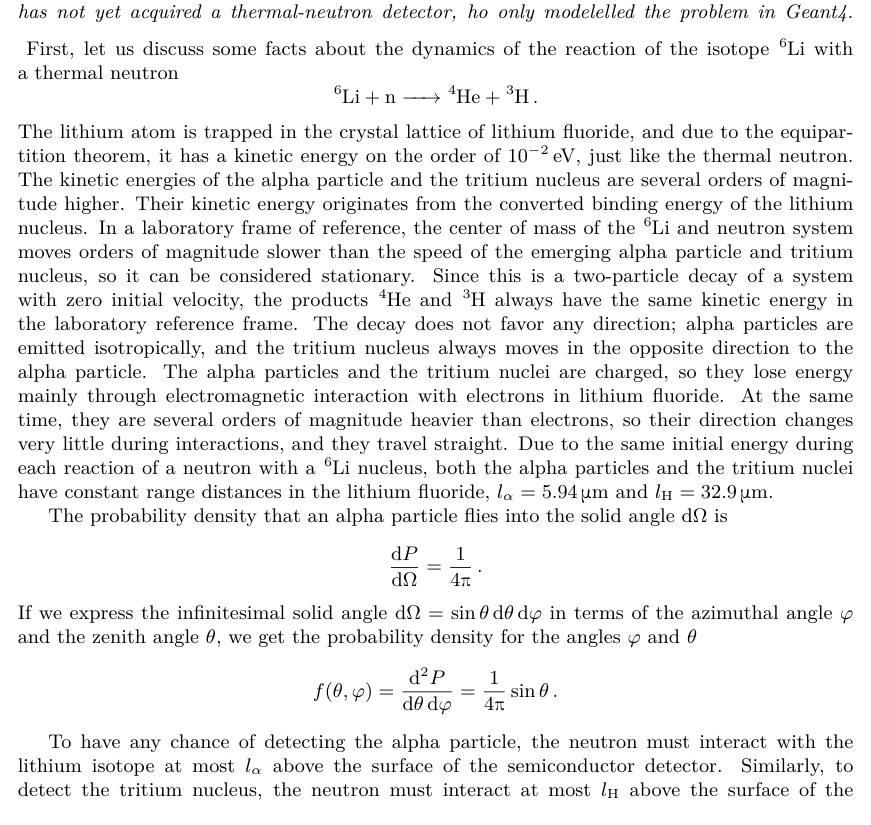
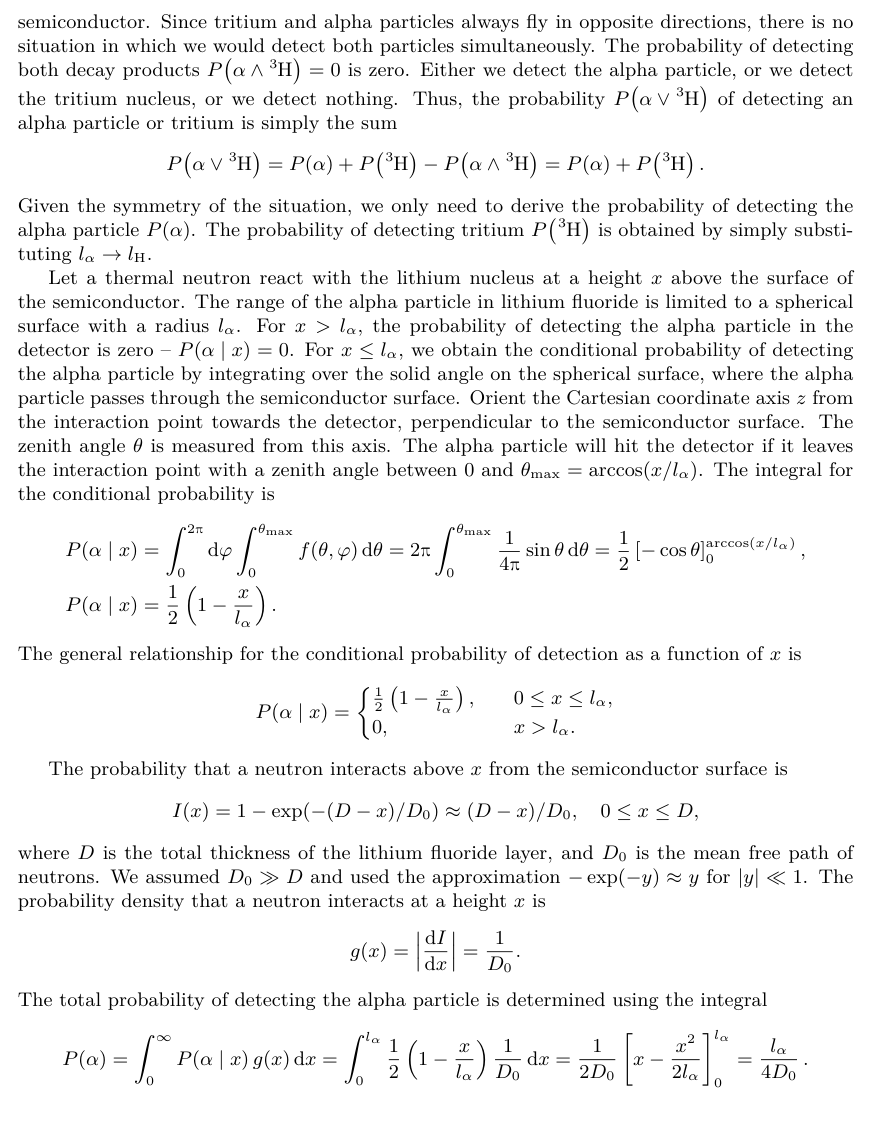
Official solution by FYKOS (Physics Brawl Online 2025), reproduced from the official PDF — p. 74, 75, 76 — under CC BY-SA 3.0.
Topic: Nuclear & Particle Physics Metodi: Physical Modeling, Calculus-Integration Competenze: Mathematical Modeling Objects: Nucleus, Particle Beam Fonte: Testo (PDF) — p.73 · Soluzione ufficiale (PDF) — p.74
Neutroni termici (9 punti)
Jindra desidera rivelare neutroni termici più di ogni altra cosa al mondo. Per questo si è procurato un rivelatore di particelle a pixel a semiconduttore e del fluoruro di litio LiF. Il rivelatore di Jindra è una lastra di semiconduttore con uno strato di fluoruro di litio sulla faccia superiore. I neutroni termici colpiscono perpendicolarmente lo strato di fluoruro di litio.
L’isotopo del litio reagisce con i neutroni termici producendo una particella alfa e un nucleo di trizio La sezione d’urto della reazione è . Il nucleo di trizio viene emesso con energia cinetica , la particella alfa con energia cinetica . Il rivelatore di Jindra rivela i neutroni indirettamente, rivelando particelle alfa e nuclei di trizio; il numero di interazioni dirette dei neutroni nel semiconduttore è trascurabile. Puoi supporre che ogni particella alfa o nucleo di trizio che entra nel rivelatore a semiconduttore venga rivelato. Il percorso (range) di una particella alfa da nel fluoruro di litio è , quello di un nucleo di trizio da è . Le traiettorie delle particelle sono rettilinee.
Jindra vuole trovare lo spessore dello strato di LiF che dà la massima efficienza di rivelazione dei neutroni possibile (numero di neutroni rivelati diviso numero di neutroni incidenti), senza però usare più LiF del necessario. Qual è la massima efficienza di rivelazione ottenibile?
La densità del fluoruro di litio è . Il litio contiene una frazione di atomi di ; il resto sono atomi dell’isotopo , che non reagiscono con i neutroni.
Risposta:
Soluzione: La soluzione ufficiale completa (in inglese) è nella versione originale di questo quesito e nel PDF ufficiale.
Topic: Nuclear & Particle Physics Metodi: Physical Modeling, Calculus-Integration Competenze: Mathematical Modeling Objects: Nucleus, Particle Beam Fonte: Testo (PDF) — p.73 · Soluzione ufficiale (PDF) — p.74
Attractive Petr (8 points)
As we well know, David repels women with a force that acts radially outward from him and depends only on the distance, with a constant of proportionality of . On the other hand, there is always a cluster of women around Petr. David wanted to measure how Petr attracts women and found that Petr’s charm is a radial attractive force with a constant of proportionality of .
Now, David is standing in a plane surface at a distance of from Petr, when a woman appears in the same plane near them. Determine the area of the region in which she can appear so that she would be attracted to Petr, i.e., so that the resulting force acting on her would form an angle smaller than a right angle with the line connecting her and Petr. Do not consider any other forces than those mentioned.
Risposta:
Soluzione:
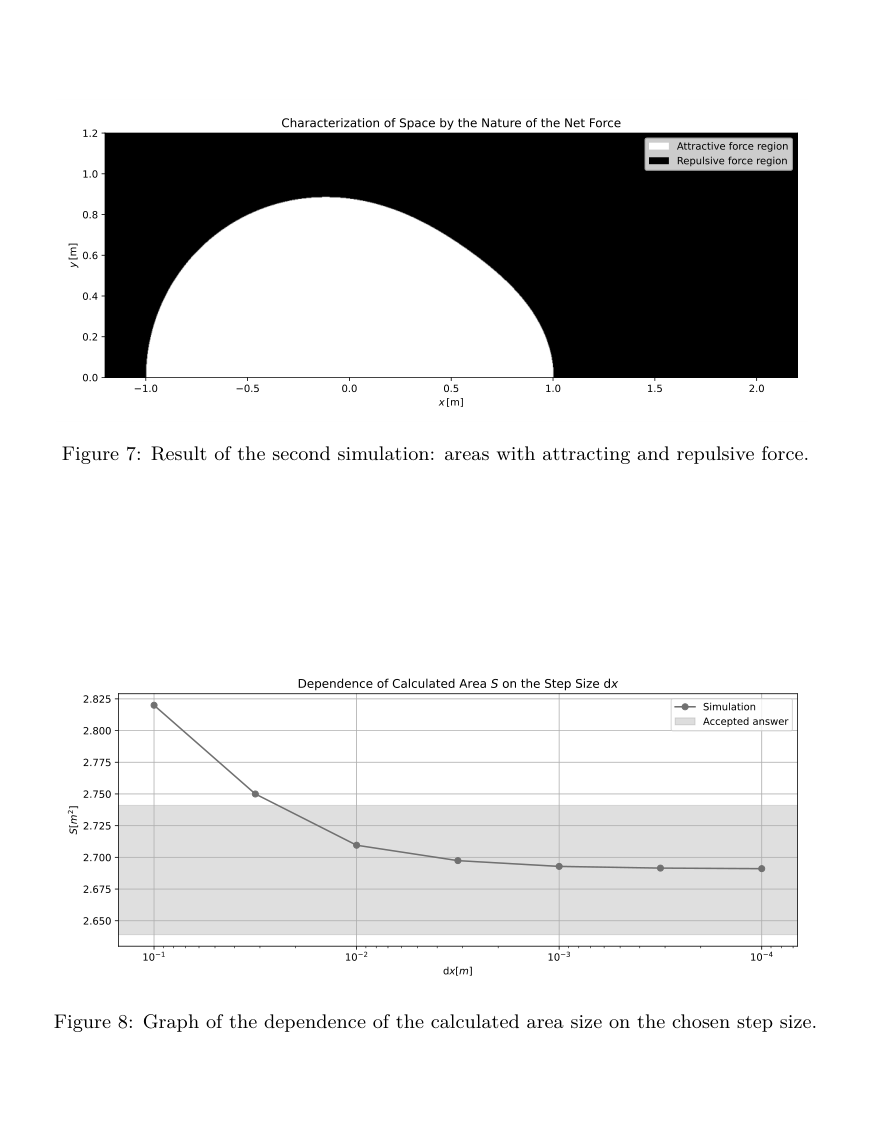
Official solution by FYKOS (Physics Brawl Online 2025), reproduced from the official PDF — p. 77, 78, 79, 80 — under CC BY-SA 3.0.
Topic: Newtonian Mechanics, Mathematics Metodi: Superposition Principle, Vector Decomposition Competenze: Mathematical Modeling Objects: Point Charge Fonte: Testo (PDF) — p.76 · Soluzione ufficiale (PDF) — p.77
Petr attraente (8 punti)
Come ben sappiamo, David respinge le donne con una forza radiale diretta in verso uscente da lui, che dipende solo dalla distanza, con costante di proporzionalità . Attorno a Petr, invece, c’è sempre un capannello di donne. David ha voluto misurare come Petr attrae le donne e ha scoperto che il fascino di Petr è una forza radiale attrattiva con costante di proporzionalità .
Ora David si trova su una superficie piana a da Petr, quando nello stesso piano, vicino a loro, compare una donna. Determina l’area della regione in cui può comparire in modo da essere attratta da Petr, cioè in modo che la forza risultante su di lei formi un angolo minore di un angolo retto con la retta che la congiunge a Petr. Non considerare forze diverse da quelle citate.
Risposta:
Soluzione: La soluzione ufficiale completa (in inglese) è nella versione originale di questo quesito e nel PDF ufficiale.
Topic: Newtonian Mechanics, Mathematics Metodi: Superposition Principle, Vector Decomposition Competenze: Mathematical Modeling Objects: Point Charge Fonte: Testo (PDF) — p.76 · Soluzione ufficiale (PDF) — p.77
The fullest spoon (9 points)
The inner volume of a spoon is an ellipsoid with semi-axes , and and height (see figure). Let us pour salt on it, which has a critical angle of repose . What is the maximum volume of salt we can carry on the spoon?
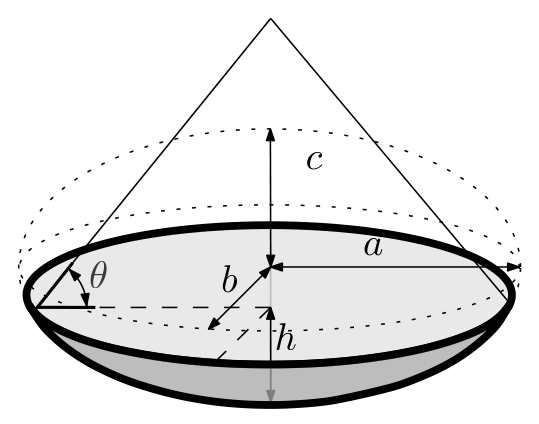
Risposta:
Soluzione:
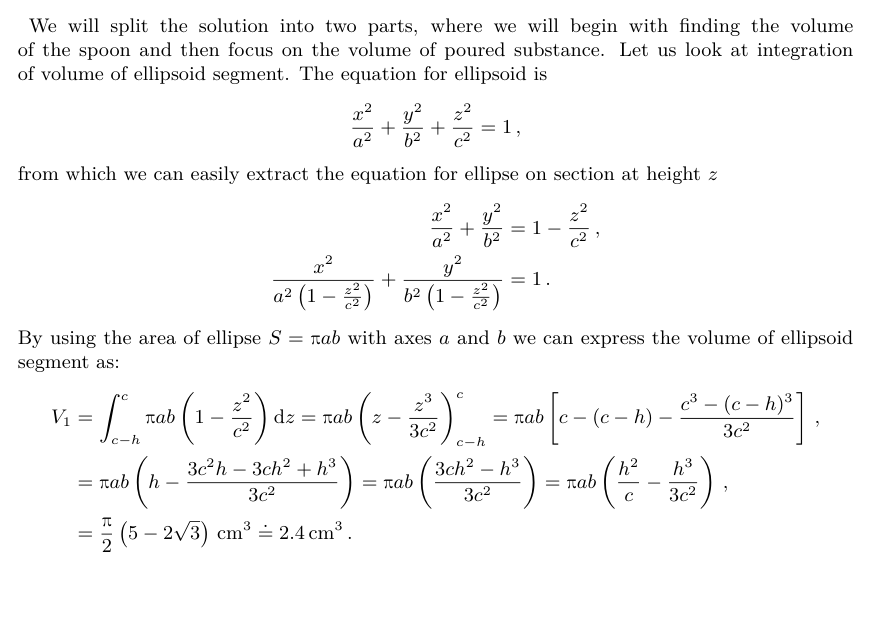
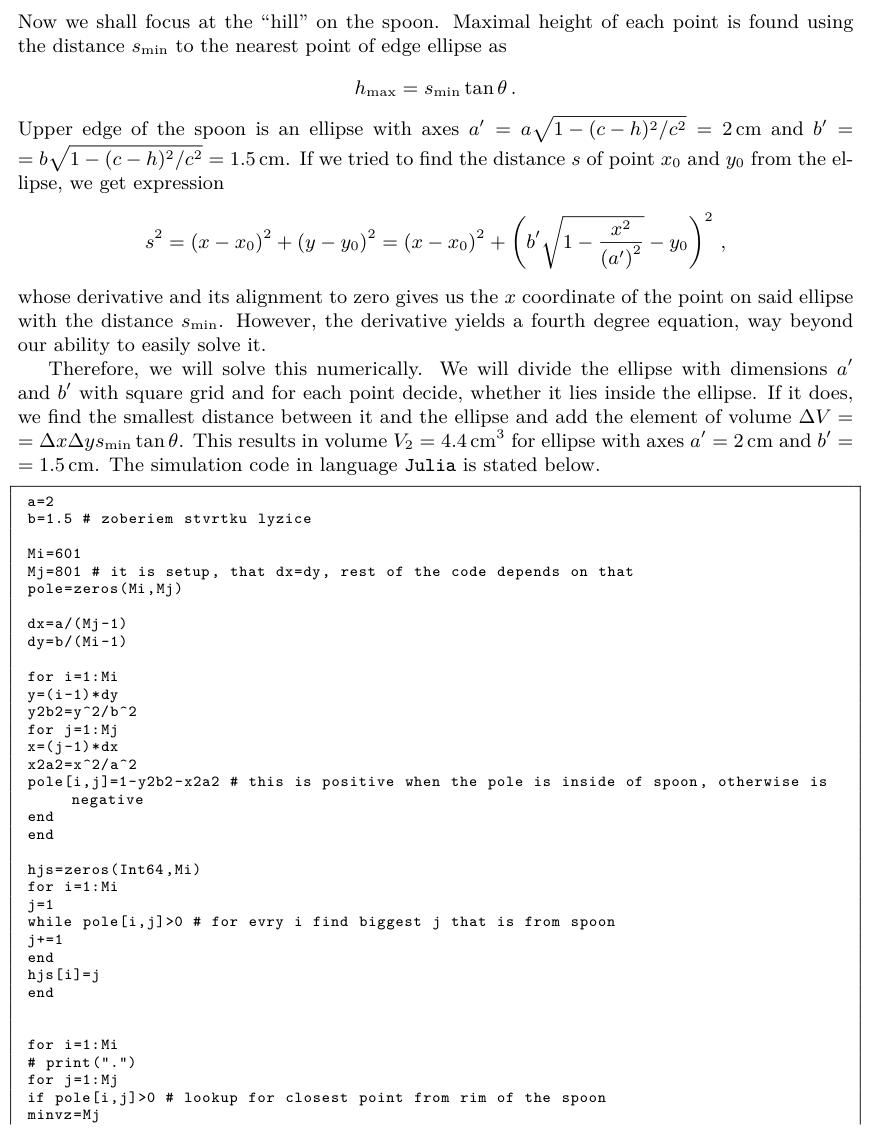
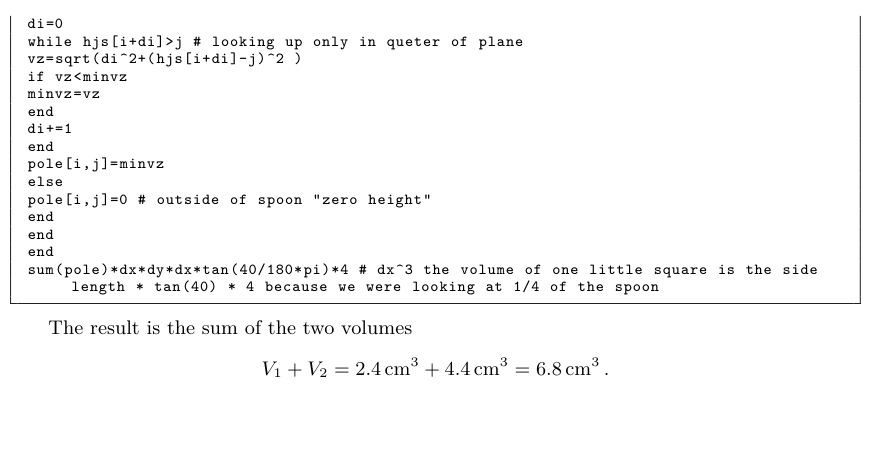
Official solution by FYKOS (Physics Brawl Online 2025), reproduced from the official PDF — p. 81, 82, 83 — under CC BY-SA 3.0.
Topic: Mathematics, Rigid Body Statics Metodi: Calculus-Integration, Physical Modeling Competenze: Mathematical Modeling, Diagrammatic Reasoning Objects: Container Fonte: Testo (PDF) — p.81 · Soluzione ufficiale (PDF) — p.81
Il cucchiaio più pieno (9 punti)
Il volume interno di un cucchiaio è un ellissoide di semiassi , e , con altezza (vedi figura). Versiamo sul cucchiaio del sale, che ha un angolo critico di riposo . Qual è il volume massimo di sale che possiamo trasportare sul cucchiaio?
Risposta:
Soluzione: La soluzione ufficiale completa (in inglese) è nella versione originale di questo quesito e nel PDF ufficiale.
Topic: Mathematics, Rigid Body Statics Metodi: Calculus-Integration, Physical Modeling Competenze: Mathematical Modeling, Diagrammatic Reasoning Objects: Container Fonte: Testo (PDF) — p.81 · Soluzione ufficiale (PDF) — p.81
Faraday’s collector (8 points)
Consider a conductive circular target of radius , onto which positively charged ions impinge perpendicularly with areal flux and charge magnitude equal to the elementary charge. However, upon impact of one ion, on average secondary electrons are released, which leave the surface with a distribution described by the probability density per unit solid angle with respect to spherical coordinates centered at the point of impact. The angle here is measured from the surface of the disk toward the normal. What current do we measure in the grounded linear conductor connected to the disk if we also make a fence around the target of height , which is conductively connected to the disk and is able to capture these electrons? Assume that the motions of the particles are not influenced by any electric field.
Risposta:
Soluzione:
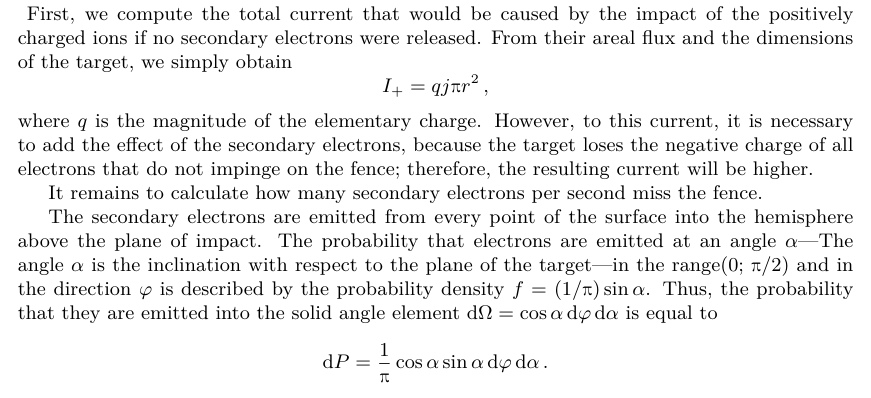
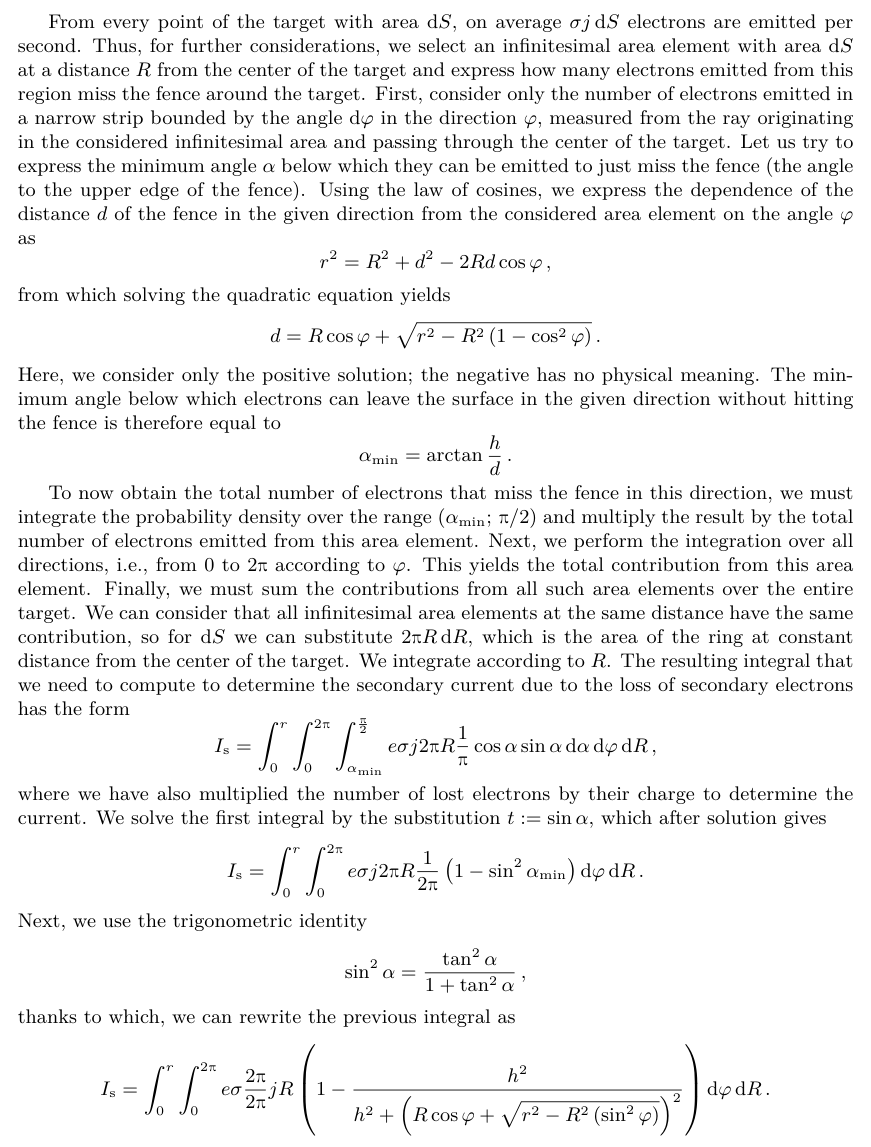
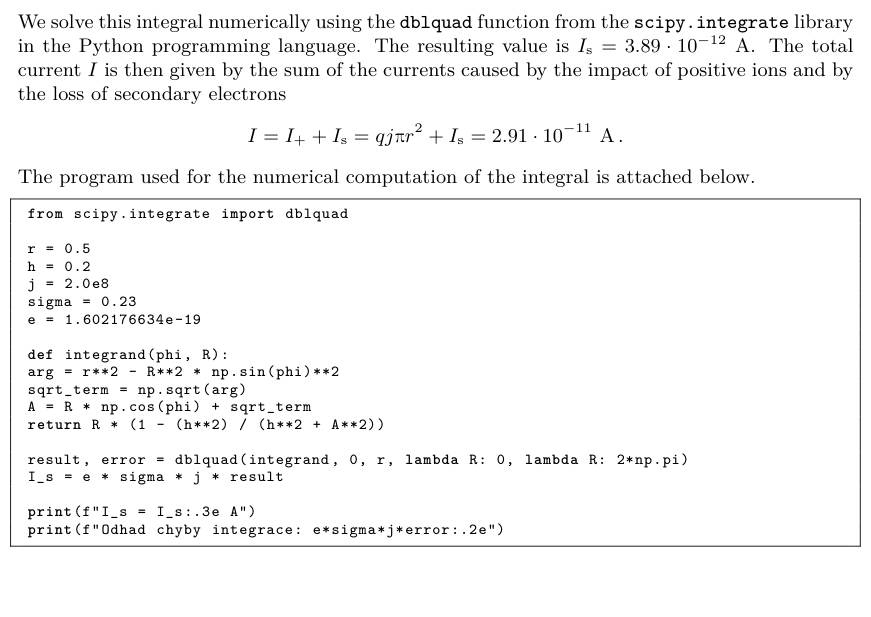
Official solution by FYKOS (Physics Brawl Online 2025), reproduced from the official PDF — p. 83, 84, 85 — under CC BY-SA 3.0.
Topic: Electromagnetism, Mathematics Metodi: Calculus-Integration, Statistical Averaging Competenze: Mathematical Modeling Objects: Electron Fonte: Testo (PDF) — p.83 · Soluzione ufficiale (PDF) — p.83
Il collettore di Faraday (8 punti)
Considera un bersaglio circolare conduttore di raggio , sul quale incidono perpendicolarmente ioni positivi con flusso per unità di area e carica pari in modulo alla carica elementare. All’impatto di uno ione vengono però liberati in media elettroni secondari, che lasciano la superficie con una distribuzione descritta dalla densità di probabilità per unità di angolo solido, in coordinate sferiche centrate nel punto d’impatto. L’angolo è misurato dalla superficie del disco verso la normale. Quale corrente misuriamo nel conduttore lineare collegato a terra e al disco se attorno al bersaglio costruiamo anche un recinto di altezza , collegato elettricamente al disco e in grado di catturare questi elettroni? Supponi che il moto delle particelle non sia influenzato da alcun campo elettrico.
Risposta:
Soluzione: La soluzione ufficiale completa (in inglese) è nella versione originale di questo quesito e nel PDF ufficiale.
Topic: Electromagnetism, Mathematics Metodi: Calculus-Integration, Statistical Averaging Competenze: Mathematical Modeling Objects: Electron Fonte: Testo (PDF) — p.83 · Soluzione ufficiale (PDF) — p.83
Escape across a frozen dam (9 points)
A hiker was trying to flee from a hungry wolf in winter, and his path led past a lowered frozen dam. The animal was at his heels, so he had to plan his route as efficiently as possible. He was going to climb the concrete dam, where he would be safe. There were thick reeds all along the bank, but suddenly, he saw a clear area of ice. He ran onto the frozen surface at in a direction parallel to the dam, from which he was away. What is the shortest time to reach safety if the coefficient of friction between the ice and his boots is and if he has to stop at the dam to climb it, which will take another ?
Risposta:
Soluzione:
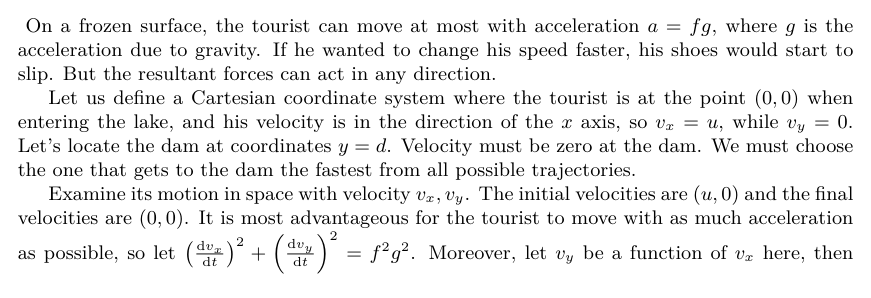
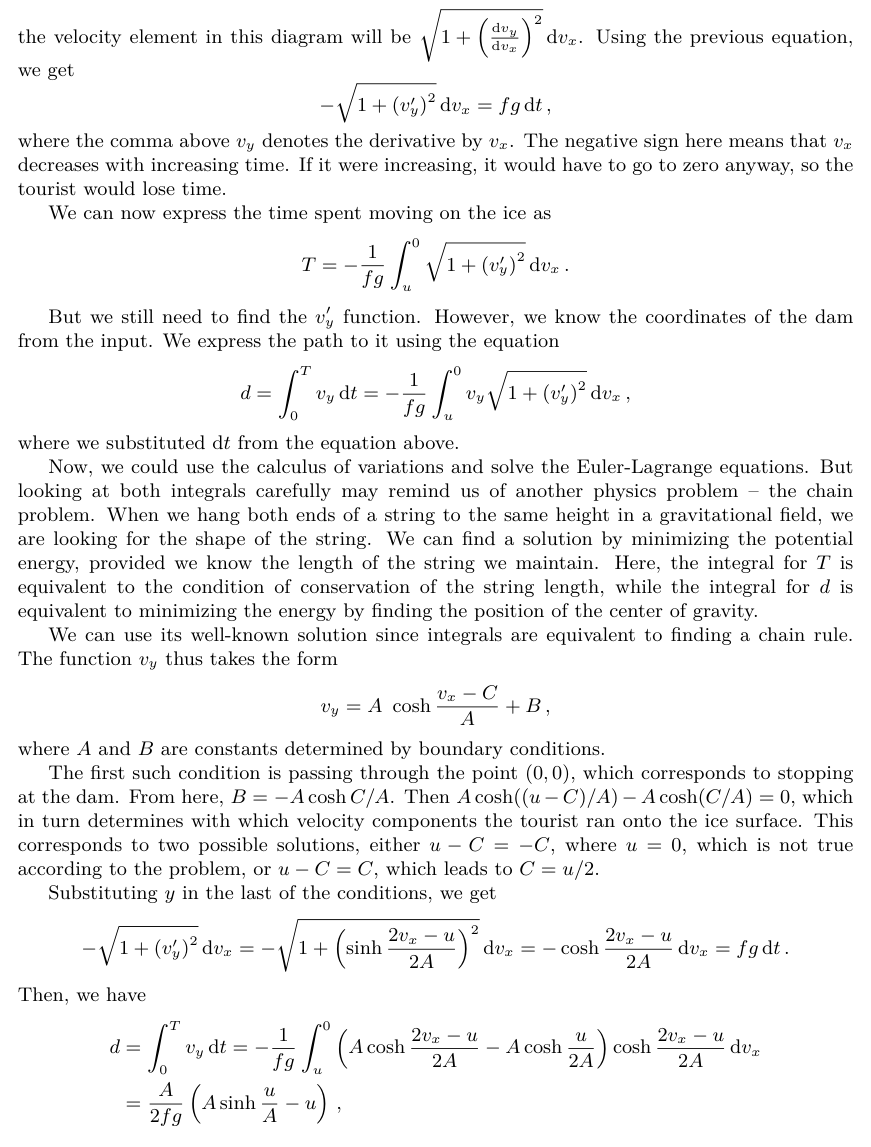
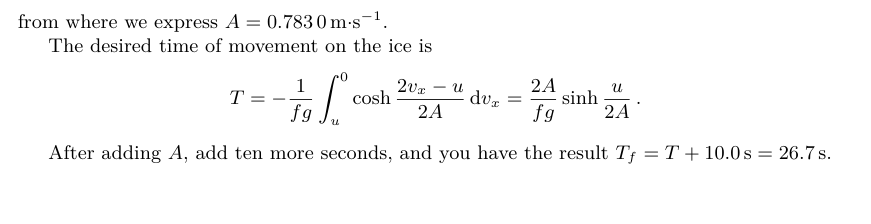
Official solution by FYKOS (Physics Brawl Online 2025), reproduced from the official PDF — p. 85, 86, 87 — under CC BY-SA 3.0.
Topic: Newtonian Mechanics, Mathematics Metodi: Calculus-Integration, Kinematic Equations Competenze: Mathematical Modeling Objects: — Fonte: Testo (PDF) — p.85 · Soluzione ufficiale (PDF) — p.85
Fuga sulla diga ghiacciata (9 punti)
D’inverno un escursionista cercava di sfuggire a un lupo affamato e il suo percorso passava accanto a un bacino ghiacciato con il livello abbassato. L’animale gli era alle calcagna, quindi doveva pianificare il percorso nel modo più efficiente possibile: voleva arrampicarsi sulla diga di cemento, dove sarebbe stato al sicuro. Lungo tutta la riva c’era un fitto canneto, ma all’improvviso ha visto un tratto di ghiaccio libero. È corso sulla superficie ghiacciata a in direzione parallela alla diga, dalla quale distava . Qual è il tempo minimo per mettersi in salvo se il coefficiente di attrito tra il ghiaccio e i suoi scarponi è e se deve fermarsi alla diga per arrampicarsi, il che richiede altri ?
Risposta:
Soluzione: La soluzione ufficiale completa (in inglese) è nella versione originale di questo quesito e nel PDF ufficiale.
Topic: Newtonian Mechanics, Mathematics Metodi: Calculus-Integration, Kinematic Equations Competenze: Mathematical Modeling Objects: — Fonte: Testo (PDF) — p.85 · Soluzione ufficiale (PDF) — p.85
B.1 — Mighty power bank in action (3 points)
We are buying a power bank for 30 USD. What is the minimum fraction of the total price represented by the lithium it contains, given that the market price of lithium is ? The power bank operates using Li-ion battery technology.
Risposta:
Soluzione:
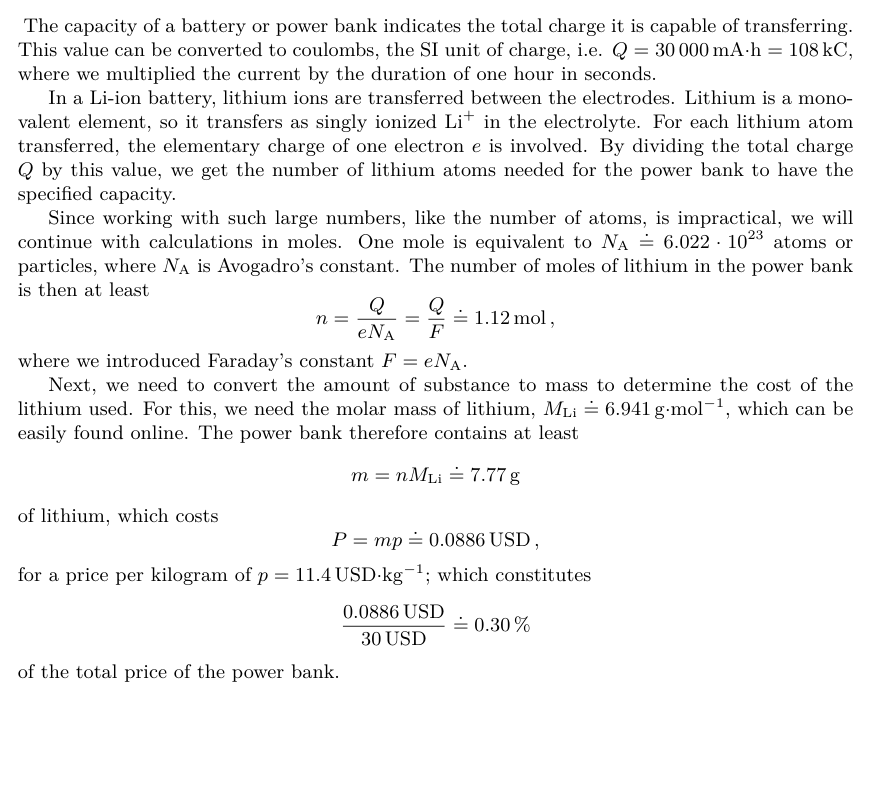
Official solution by FYKOS (Physics Brawl Online 2025), reproduced from the official PDF — p. 87 — under CC BY-SA 3.0.
Topic: Chemistry, Circuits Metodi: Physical Modeling Competenze: Mathematical Modeling, Unit Conversion Objects: Battery Fonte: Testo (PDF) — p.87 · Soluzione ufficiale (PDF) — p.87
B.1 — Power bank potente in azione (3 punti)
Acquistiamo un power bank da per 30 USD. Qual è la frazione minima del prezzo totale che corrisponde al litio contenuto, sapendo che il prezzo di mercato del litio è ? Il power bank usa la tecnologia delle batterie agli ioni di litio.
Risposta:
Soluzione: La soluzione ufficiale completa (in inglese) è nella versione originale di questo quesito e nel PDF ufficiale.
Topic: Chemistry, Circuits Metodi: Physical Modeling Competenze: Mathematical Modeling, Unit Conversion Objects: Battery Fonte: Testo (PDF) — p.87 · Soluzione ufficiale (PDF) — p.87
B.2 — Heavy charging (3 points)
Manufacturers may consider lithium still quite expensive, and so they begin producing power banks that use sodium. By how much would the mass of a power bank increase to have the same capacity of ? All other components of the device remain unchanged.
Risposta:
Soluzione:
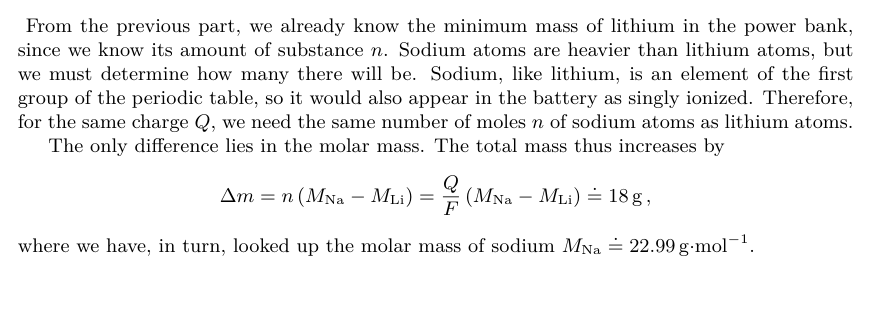
Official solution by FYKOS (Physics Brawl Online 2025), reproduced from the official PDF — p. 88 — under CC BY-SA 3.0.
Topic: Chemistry, Circuits Metodi: Physical Modeling Competenze: Mathematical Modeling, Unit Conversion Objects: Battery Fonte: Testo (PDF) — p.88 · Soluzione ufficiale (PDF) — p.88
B.2 — Ricarica pesante (3 punti)
I produttori potrebbero ritenere il litio ancora piuttosto costoso e cominciare a produrre power bank al sodio. Di quanto aumenterebbe la massa di un power bank con la stessa capacità di ? Tutti gli altri componenti del dispositivo restano invariati.
Risposta:
Soluzione: La soluzione ufficiale completa (in inglese) è nella versione originale di questo quesito e nel PDF ufficiale.
Topic: Chemistry, Circuits Metodi: Physical Modeling Competenze: Mathematical Modeling, Unit Conversion Objects: Battery Fonte: Testo (PDF) — p.88 · Soluzione ufficiale (PDF) — p.88
B.3 — I don’t have the capacity for that (4 points)
A power bank is connected to a DC source of through a cable. It charges from 0 to 50% capacity in . Determine the cable’s resistance per unit length (measured in ), assuming that the charging circuitry of the power bank requires a constant voltage of , independent of the current.
Risposta:
Soluzione:
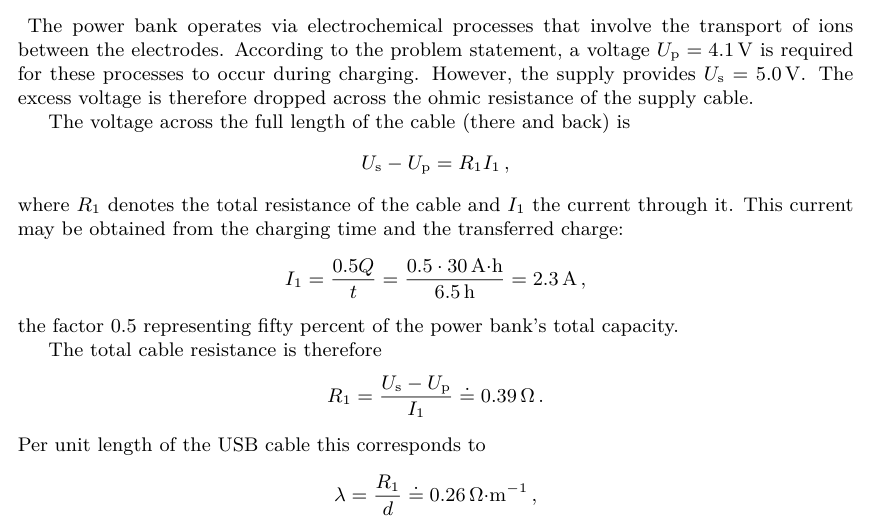
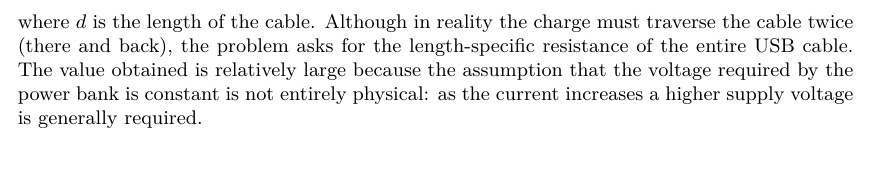
Official solution by FYKOS (Physics Brawl Online 2025), reproduced from the official PDF — p. 88, 89 — under CC BY-SA 3.0.
Topic: Circuits Metodi: Kirchhoff’s Laws Competenze: Mathematical Modeling, Unit Conversion Objects: Battery, Wire Fonte: Testo (PDF) — p.88 · Soluzione ufficiale (PDF) — p.88
B.3 — Non ho la capacità per questo (4 punti)
Un power bank da è collegato a una sorgente in continua da tramite un cavo lungo . Si carica dallo 0 al 50% della capacità in . Determina la resistenza per unità di lunghezza del cavo (in ), supponendo che il circuito di ricarica del power bank richieda una tensione costante di , indipendente dalla corrente.
Risposta:
Soluzione: La soluzione ufficiale completa (in inglese) è nella versione originale di questo quesito e nel PDF ufficiale.
Topic: Circuits Metodi: Kirchhoff’s Laws Competenze: Mathematical Modeling, Unit Conversion Objects: Battery, Wire Fonte: Testo (PDF) — p.88 · Soluzione ufficiale (PDF) — p.88
B.4 — (in)efficient powerbank (4 points)
The electrochemical reactions in our power bank provide a voltage of . However, the output generates a USB voltage of . If the energy loss during this conversion is , what is the effective capacity of the power bank for charging a mobile phone?
Risposta:
Soluzione:
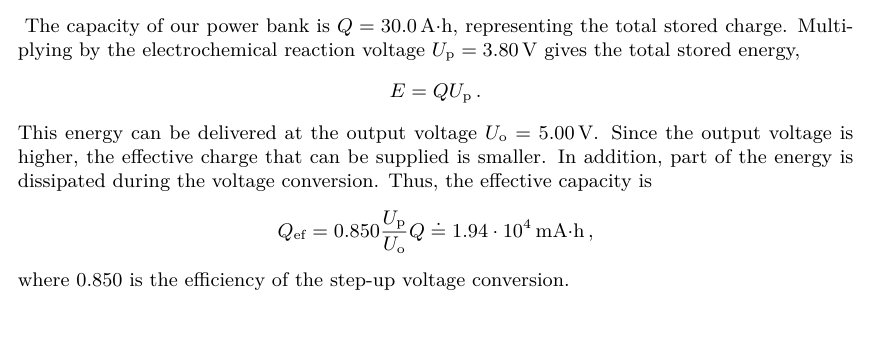
Official solution by FYKOS (Physics Brawl Online 2025), reproduced from the official PDF — p. 89 — under CC BY-SA 3.0.
Topic: Circuits Metodi: Energy Conservation Method Competenze: Mathematical Modeling, Unit Conversion Objects: Battery Fonte: Testo (PDF) — p.89 · Soluzione ufficiale (PDF) — p.89
B.4 — Power bank (in)efficiente (4 punti)
Le reazioni elettrochimiche nel nostro power bank da forniscono una tensione di , ma l’uscita fornisce una tensione USB di . Se la perdita di energia in questa conversione è del , qual è la capacità effettiva del power bank per ricaricare un cellulare?
Risposta:
Soluzione: La soluzione ufficiale completa (in inglese) è nella versione originale di questo quesito e nel PDF ufficiale.
Topic: Circuits Metodi: Energy Conservation Method Competenze: Mathematical Modeling, Unit Conversion Objects: Battery Fonte: Testo (PDF) — p.89 · Soluzione ufficiale (PDF) — p.89
P.1 — Knocking the opposing boule away (4 points)
Jirka is playing pétanque with Jarda. Unfortunately, Jarda is currently winning, meaning that one of his boules is very close to the small wooden target ball (the so-called jack). The only way Jirka can turn the game in his favor is to knock Jarda’s boule away so that it ends up as far from the jack as possible. Therefore, he throws his boule so that it hits Jarda’s boule with a horizontal speed of . How far will Jarda’s boule roll if, after the collision, it is acted upon by a constant resistive force of magnitude , where is the mass of the boule, is the gravitational acceleration, and ? Both boules are identical, the collision is perfectly elastic, and after the collision the boules move along the same straight line as Jirka’s boule before impact (so the collision can be treated as a one-dimensional elastic collision of point masses).
Risposta:
Soluzione:
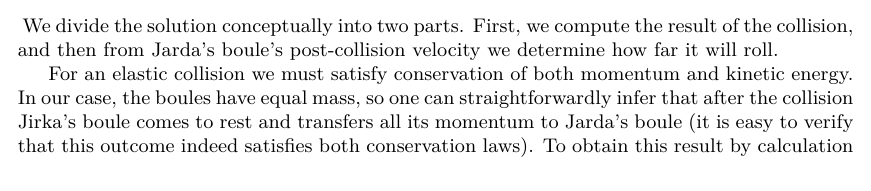
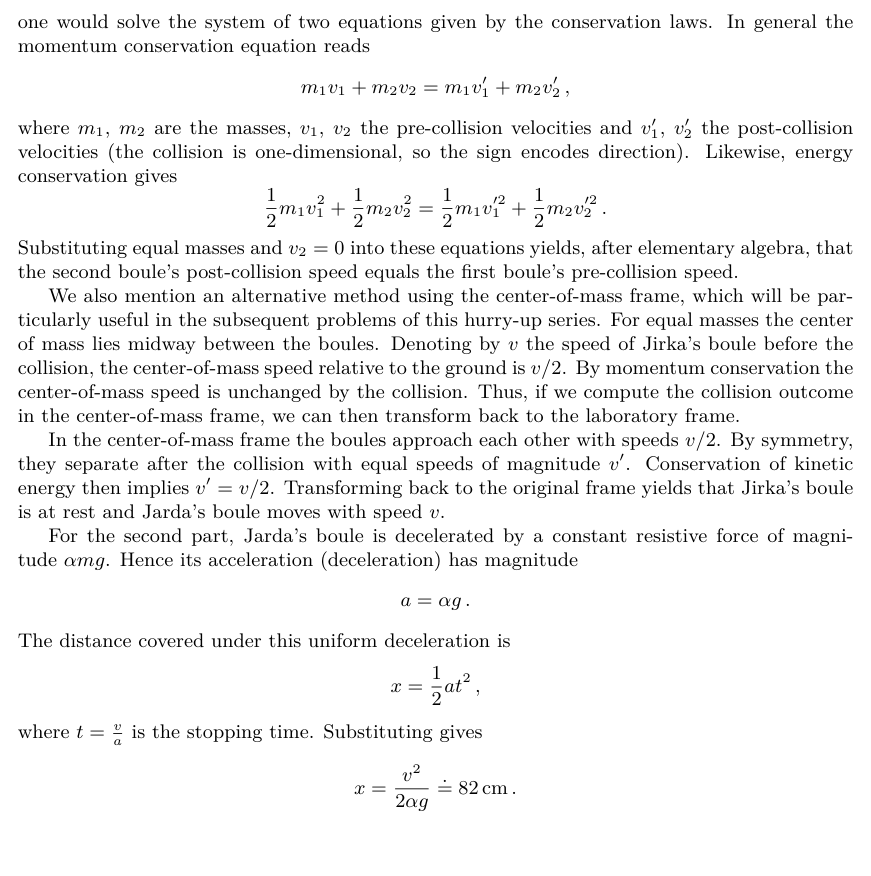
Official solution by FYKOS (Physics Brawl Online 2025), reproduced from the official PDF — p. 89, 90 — under CC BY-SA 3.0.
Topic: Conservation of Momentum, Newtonian Mechanics Metodi: Conservation of Momentum, Kinematic Equations Competenze: Mathematical Modeling Objects: Ball Fonte: Testo (PDF) — p.89 · Soluzione ufficiale (PDF) — p.89
P.1 — Bocciare la boccia avversaria (4 punti)
Jirka gioca a pétanque con Jarda. Purtroppo Jarda sta vincendo: una delle sue bocce è vicinissima al piccolo pallino di legno (il cosiddetto boccino). L’unico modo per Jirka di ribaltare la partita è bocciare la boccia di Jarda in modo che finisca il più lontano possibile dal boccino. Lancia quindi la sua boccia in modo che colpisca quella di Jarda con velocità orizzontale . Quanto rotolerà la boccia di Jarda se dopo l’urto agisce su di essa una forza resistente costante di modulo , dove è la massa della boccia, l’accelerazione di gravità e ? Le due bocce sono identiche, l’urto è perfettamente elastico e dopo l’urto le bocce si muovono lungo la stessa retta della boccia di Jirka prima dell’impatto (l’urto si può quindi trattare come urto elastico unidimensionale tra punti materiali).
Risposta:
Soluzione: La soluzione ufficiale completa (in inglese) è nella versione originale di questo quesito e nel PDF ufficiale.
Topic: Conservation of Momentum, Newtonian Mechanics Metodi: Conservation of Momentum, Kinematic Equations Competenze: Mathematical Modeling Objects: Ball Fonte: Testo (PDF) — p.89 · Soluzione ufficiale (PDF) — p.89
P.2 — Slowing our ball down (5 points)
After Jirka’s brilliant throw in the ongoing pétanque match, Jarda lost his advantage. However, it is now his turn, and he is devising a risky plan. One of Jirka’s boules is located just from the jack. Jarda knows that the collision of the boules is not perfectly elastic, so his boule will continue moving at a low speed even after a collision. Jarda intends to throw his boule in such a way that it will deflect Jirka’s boule and still roll to the jack (Jarda believes that Jirka’s deflected boule will not knock the jack away). What must be the speed of Jarda’s boule just before the collision in order for it to travel the distance of after the collision? Consider the collision as a collision of identical point masses in a straight line. A resistive force acts on the rolling boule with magnitude , where , as in the previous problem. Jarda measured before the game that two identical pétanque boules always lose kinetic energy during a straight-line collision, where is the maximum amount of kinetic energy that the identical boules could lose in a collision without violating the law of conservation of momentum.
Risposta:
Soluzione:
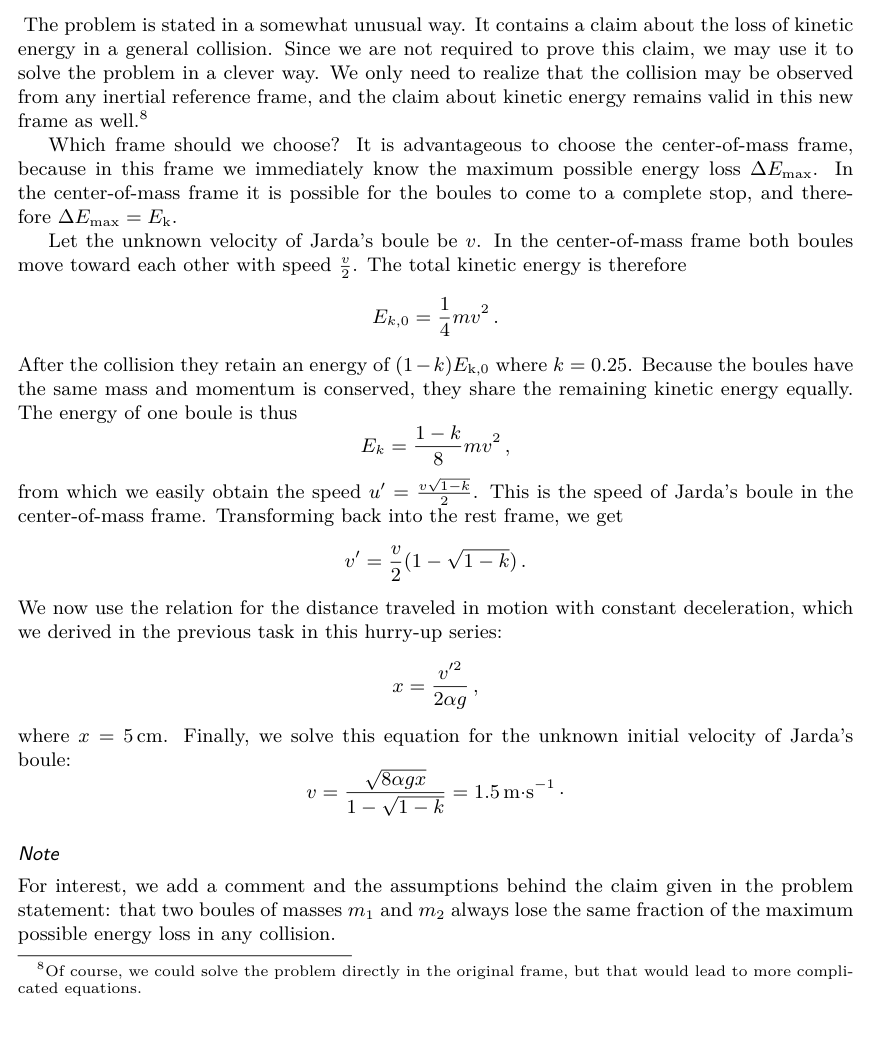
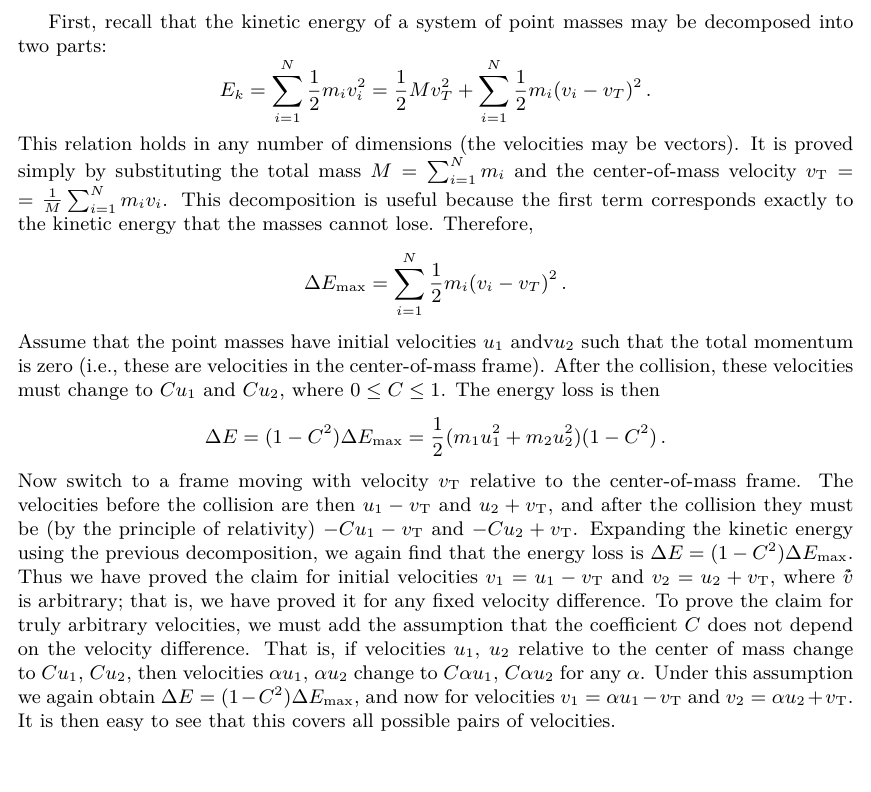
Official solution by FYKOS (Physics Brawl Online 2025), reproduced from the official PDF — p. 91, 92 — under CC BY-SA 3.0.
Topic: Conservation of Momentum, Conservation of Energy Metodi: Conservation of Momentum, Energy Conservation Method Competenze: Mathematical Modeling Objects: Ball Fonte: Testo (PDF) — p.90 · Soluzione ufficiale (PDF) — p.91
P.2 — Rallentare la nostra boccia (5 punti)
Dopo il brillante tiro di Jirka nella partita di pétanque in corso, Jarda ha perso il suo vantaggio. Ora però tocca a lui e sta architettando un piano rischioso. Una delle bocce di Jirka si trova a soli dal boccino. Jarda sa che l’urto tra le bocce non è perfettamente elastico, quindi la sua boccia continuerà a muoversi lentamente anche dopo l’urto. Jarda vuole lanciare la sua boccia in modo da spostare quella di Jirka e arrivare comunque fino al boccino (Jarda è convinto che la boccia di Jirka spostata non colpirà il boccino). Quale deve essere la velocità della boccia di Jarda subito prima dell’urto perché dopo l’urto percorra ? Considera l’urto come un urto rettilineo tra punti materiali identici. Sulla boccia che rotola agisce una forza resistente di modulo , con , come nel problema precedente. Prima della partita Jarda ha misurato che due bocce identiche, in un urto rettilineo, perdono sempre un’energia cinetica , dove è la massima energia cinetica che le bocce identiche potrebbero perdere in un urto senza violare la conservazione della quantità di moto.
Risposta:
Soluzione: La soluzione ufficiale completa (in inglese) è nella versione originale di questo quesito e nel PDF ufficiale.
Topic: Conservation of Momentum, Conservation of Energy Metodi: Conservation of Momentum, Energy Conservation Method Competenze: Mathematical Modeling Objects: Ball Fonte: Testo (PDF) — p.90 · Soluzione ufficiale (PDF) — p.91
P.3 — Scattered balls (3 points)
Tension between Jirka and Jarda is rising. In their ongoing game of pétanque, there are only a few throws left, and Jarda has taken the lead thanks to his trick with a partially elastic collision. For Jirka to make up the deficit, he must likewise exploit more complex physical behavior in collisions of the boules. He therefore throws his next boule so that it does not collide with Jarda’s boule along a straight line, but “in a plane”. What is the maximum angle that the lines of the boules’ trajectories can form after the collision? In other words, what is the maximum angle between the velocity vectors of the boules after the collision, if we model it as a collision of identical point masses in the plane, assuming only conservation of energy and momentum? Only consider situations in which both boules have nonzero velocities after the collision.
Risposta:
Soluzione:

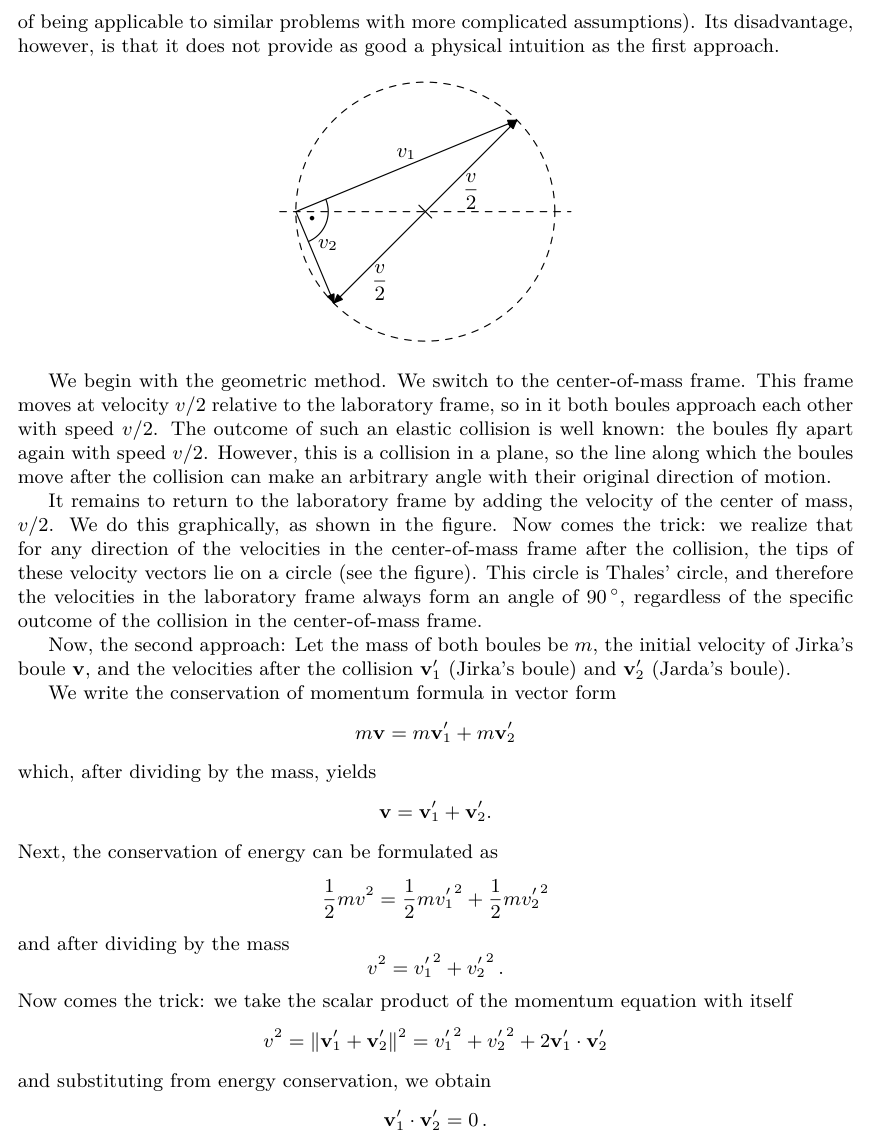
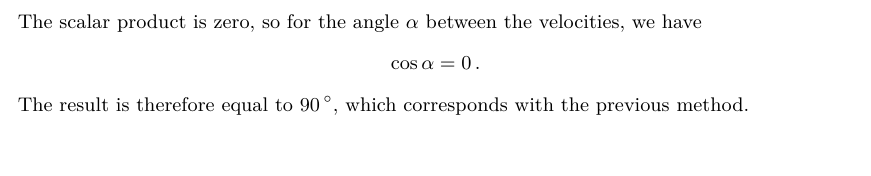
Official solution by FYKOS (Physics Brawl Online 2025), reproduced from the official PDF — p. 92, 93, 94 — under CC BY-SA 3.0.
Topic: Conservation of Momentum Metodi: Conservation of Momentum, Vector Decomposition Competenze: Physical Reasoning Objects: Ball Fonte: Testo (PDF) — p.92 · Soluzione ufficiale (PDF) — p.92
P.3 — Bocce sparpagliate (3 punti)
La tensione tra Jirka e Jarda sale. Nella loro partita di pétanque restano pochi tiri e Jarda è passato in vantaggio grazie al suo trucco con l’urto parzialmente elastico. Per recuperare, Jirka deve a sua volta sfruttare comportamenti fisici più complessi negli urti tra le bocce. Lancia quindi la sua boccia successiva in modo che non urti quella di Jarda lungo una retta, ma “nel piano”. Qual è l’angolo massimo che possono formare le traiettorie delle bocce dopo l’urto? In altre parole, qual è l’angolo massimo tra i vettori velocità delle bocce dopo l’urto, se lo modelliamo come urto nel piano tra punti materiali identici, assumendo solo la conservazione dell’energia e della quantità di moto? Considera solo le situazioni in cui entrambe le bocce hanno velocità non nulla dopo l’urto.
Risposta:
Soluzione: La soluzione ufficiale completa (in inglese) è nella versione originale di questo quesito e nel PDF ufficiale.
Topic: Conservation of Momentum Metodi: Conservation of Momentum, Vector Decomposition Competenze: Physical Reasoning Objects: Ball Fonte: Testo (PDF) — p.92 · Soluzione ufficiale (PDF) — p.92
P.4 — Scattered balls reloaded (5 points)
Jirka planned his last throw in the ongoing game of pétanque so that after the collision, his and Jarda’s boules would roll apart such that both trajectories form an angle of with the original direction of Jirka’s boule (in the previous problem you convinced yourselves that this is indeed possible for the collision of two point masses in a plane). However, in his planning, Jirka forgot that pétanque boules are not point masses but rigid bodies, which, in the case of non-zero friction, affects the result.
Consider therefore the following situation: Jirka throws his boule so that its center moves along a straight line whose distance from the center of Jarda’s boule is , where is the radius of the boules. The speed of Jirka’s boule immediately before the collision is . The boules are identical, and the collision of the boules is elastic in the normal direction (with respect to the point of contact of both boules). In the tangential direction, large friction acts, so immediately after the collision, the relative speed of the contact points in the tangential direction is zero. At what angle do the boules roll apart under these assumptions?
Assume that Jirka’s boule is not rotating about its vertical axis just before the collision; any possible rotation in other directions (e.g., due to rolling) will not affect the result. Effectively, the angular velocity of Jirka’s boule just before the collision can be considered zero.
Risposta:
Soluzione:
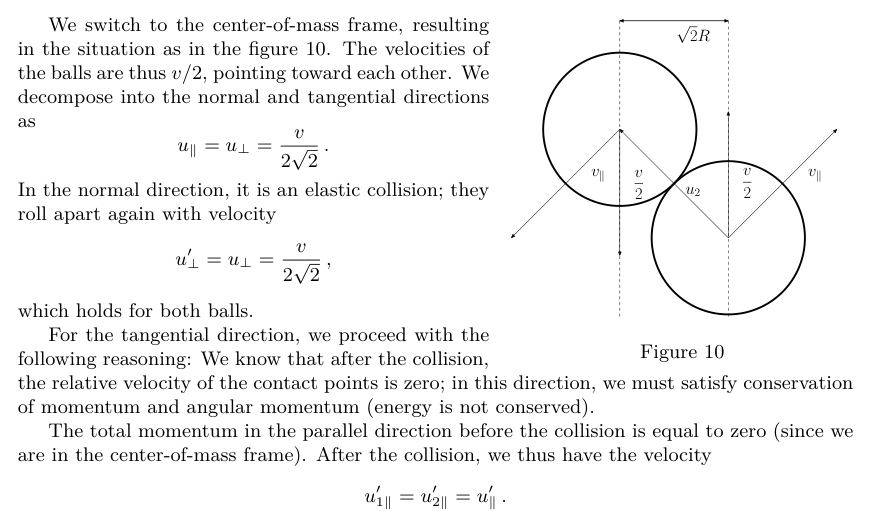
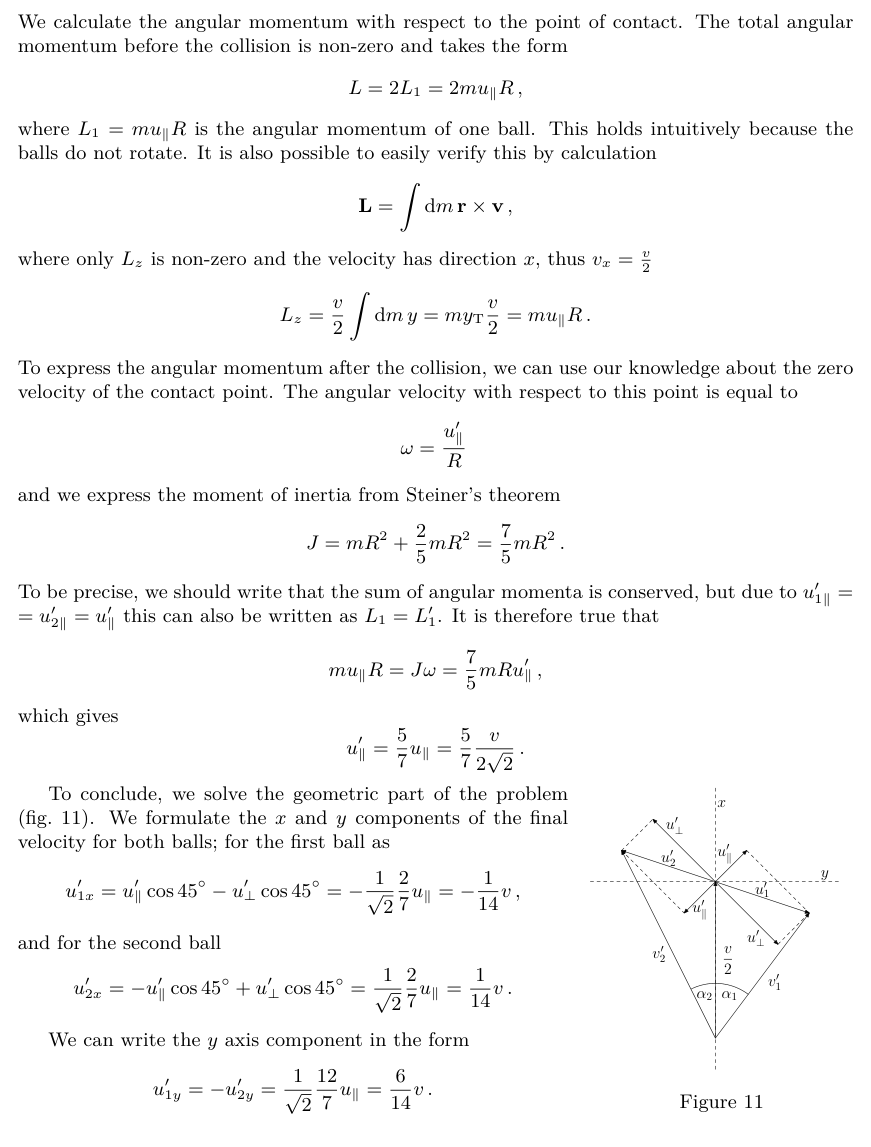
Official solution by FYKOS (Physics Brawl Online 2025), reproduced from the official PDF — p. 94, 95, 96 — under CC BY-SA 3.0.
Topic: Conservation of Momentum, Rotational Dynamics Metodi: Conservation of Momentum, Torque & Angular Momentum Analysis, Impulse-Momentum Theorem Competenze: Mathematical Modeling Objects: Ball, Sphere Fonte: Testo (PDF) — p.94 · Soluzione ufficiale (PDF) — p.94
P.4 — Bocce sparpagliate (reloaded) (5 punti)
Jirka ha pianificato l’ultimo tiro della partita di pétanque in modo che dopo l’urto la sua boccia e quella di Jarda si separino con traiettorie che formano entrambe un angolo di con la direzione iniziale della boccia di Jirka (nel problema precedente vi siete convinti che ciò è effettivamente possibile per l’urto di due punti materiali nel piano). Nel pianificare, però, Jirka ha dimenticato che le bocce non sono punti materiali ma corpi rigidi, e questo, in presenza di attrito, cambia il risultato.
Considera quindi la situazione seguente: Jirka lancia la sua boccia in modo che il suo centro si muova lungo una retta che dista dal centro della boccia di Jarda, dove è il raggio delle bocce. La velocità della boccia di Jirka subito prima dell’urto è . Le bocce sono identiche e l’urto è elastico nella direzione normale (rispetto al punto di contatto delle due bocce). In direzione tangenziale agisce un forte attrito, tale che subito dopo l’urto la velocità relativa dei punti di contatto in direzione tangenziale è nulla. Con quale angolo si separano le bocce in queste ipotesi?
Supponi che subito prima dell’urto la boccia di Jirka non ruoti attorno al proprio asse verticale; eventuali rotazioni in altre direzioni (per esempio dovute al rotolamento) non influiscono sul risultato. In pratica la velocità angolare della boccia di Jirka subito prima dell’urto si può considerare nulla.
Risposta:
Soluzione: La soluzione ufficiale completa (in inglese) è nella versione originale di questo quesito e nel PDF ufficiale.
Topic: Conservation of Momentum, Rotational Dynamics Metodi: Conservation of Momentum, Torque & Angular Momentum Analysis, Impulse-Momentum Theorem Competenze: Mathematical Modeling Objects: Ball, Sphere Fonte: Testo (PDF) — p.94 · Soluzione ufficiale (PDF) — p.94
R.1 — Telescope illumination (4 points)
Consider a section (spherical cap) of a concave spherical mirror with radius and radius of the base of the cap . In front of this mirror, place a circular opaque screen of radius at a distance from the mirror’s vertex, such that the center of the screen lies on the principal axis of the spherical mirror. Compute the ratio of the illuminated to the non-illuminated area on the screen’s side facing the mirror. Assume that the light is incident parallel to the principal axis of the mirror. Feel free to use approximations valid for when solving this problem.
Risposta: (0.445 with the simpler approximation; ≈ 0.474 by exact ray tracing — all accepted)
Soluzione:
Official solution by FYKOS (Physics Brawl Online 2025), reproduced from the official PDF — p. 96, 97, 98 — under CC BY-SA 3.0.
Topic: Geometric Optics Metodi: Ray Tracing, Thin Lens & Mirror Equation, Small-Angle Approximation Competenze: Mathematical Modeling, Diagrammatic Reasoning Objects: Mirror, Screen Fonte: Testo (PDF) — p.96 · Soluzione ufficiale (PDF) — p.96
R.1 — Illuminazione del telescopio (4 punti)
Considera una porzione (calotta sferica) di uno specchio sferico concavo di raggio , con raggio della base della calotta . Davanti allo specchio poni uno schermo circolare opaco di raggio a distanza dal vertice dello specchio, con il centro dello schermo sull’asse principale dello specchio. Calcola il rapporto tra l’area illuminata e quella non illuminata sulla faccia dello schermo rivolta verso lo specchio. Supponi che la luce incida parallelamente all’asse principale dello specchio. Puoi usare approssimazioni valide per .
Risposta: (0.445 con l’approssimazione più semplice; ≈ 0.474 con il tracciamento esatto dei raggi — tutti accettati)
Soluzione: La soluzione ufficiale completa (in inglese) è nella versione originale di questo quesito e nel PDF ufficiale.
Topic: Geometric Optics Metodi: Ray Tracing, Thin Lens & Mirror Equation, Small-Angle Approximation Competenze: Mathematical Modeling, Diagrammatic Reasoning Objects: Mirror, Screen Fonte: Testo (PDF) — p.96 · Soluzione ufficiale (PDF) — p.96
R.2 — Shining on a teaspoon (4 points)
Consider a section (spherical cap) of a concave spherical mirror with radius and radius of the base of the cap . A point source of light, which illuminates the reflective surface, is located at a distance from the vertex of the mirror. A screen is placed at a distance from the vertex of the mirror and is perpendicular to the principal axis. Calculate the radius of the image formed on the screen. Assume that the entire image can fit on the screen.
Risposta:
Soluzione:
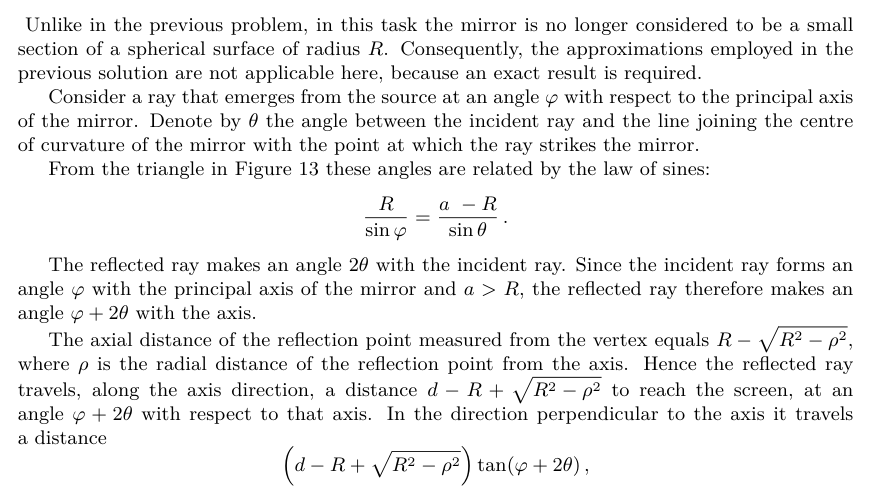
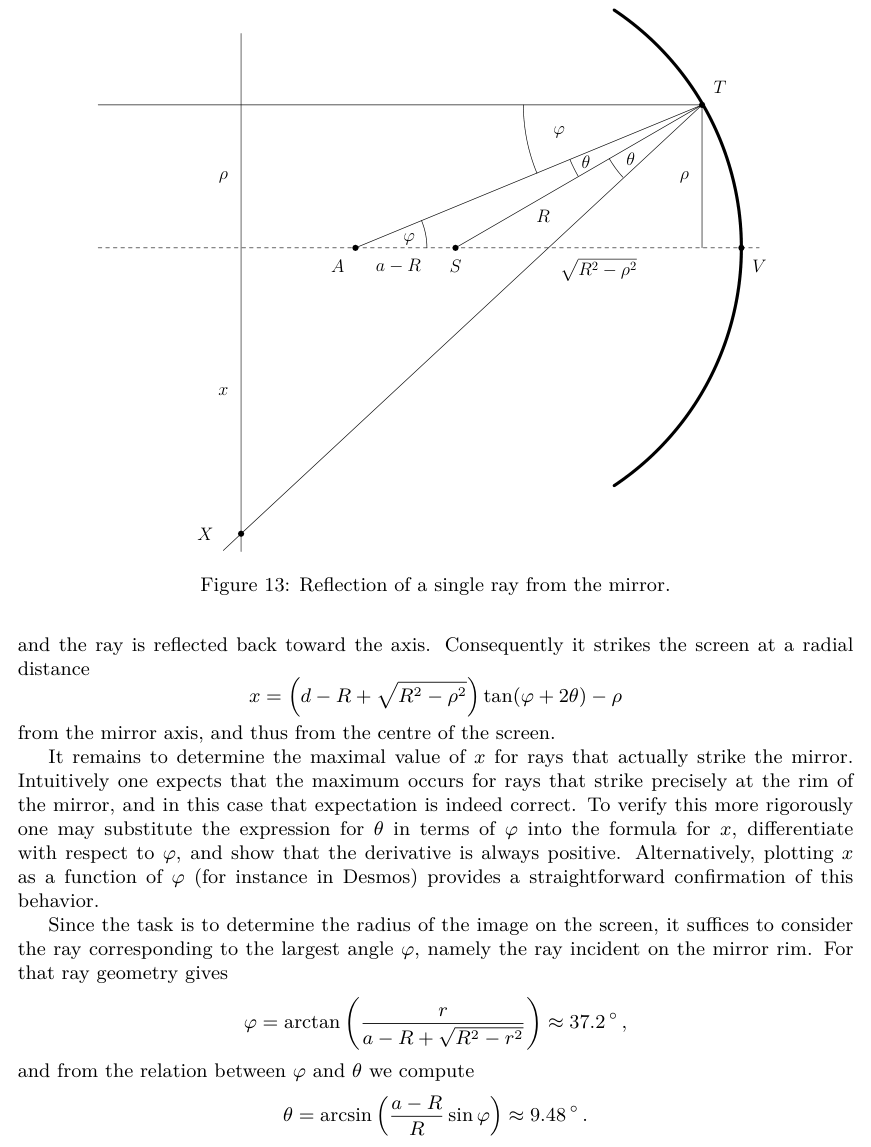

Official solution by FYKOS (Physics Brawl Online 2025), reproduced from the official PDF — p. 98, 99, 100 — under CC BY-SA 3.0.
Topic: Geometric Optics Metodi: Ray Tracing Competenze: Mathematical Modeling, Diagrammatic Reasoning Objects: Mirror, Screen Fonte: Testo (PDF) — p.98 · Soluzione ufficiale (PDF) — p.98
R.2 — Illuminare un cucchiaino (4 punti)
Considera una porzione (calotta sferica) di uno specchio sferico concavo di raggio , con raggio della base della calotta . Una sorgente di luce puntiforme, che illumina la superficie riflettente, si trova a distanza dal vertice dello specchio. Uno schermo è posto a distanza dal vertice dello specchio, perpendicolare all’asse principale. Calcola il raggio dell’immagine che si forma sullo schermo. Supponi che l’immagine stia tutta sullo schermo.
Risposta:
Soluzione: La soluzione ufficiale completa (in inglese) è nella versione originale di questo quesito e nel PDF ufficiale.
Topic: Geometric Optics Metodi: Ray Tracing Competenze: Mathematical Modeling, Diagrammatic Reasoning Objects: Mirror, Screen Fonte: Testo (PDF) — p.98 · Soluzione ufficiale (PDF) — p.98
R.3 — Reflector off the focal point (7 points)
A car headlight consists of a parabolic mirror whose shape originated by rotating the parabola , , where and . A negligibly small incoherent light source is located at its focus. Assume a screen is placed perpendicularly to the paraboloid axis at a distance from the top edge of the reflector (plane ). However, the bulb is not exactly at the focus but on the paraboloid axis at a distance from it (closer to the paraboloid vertex). By how much does the radius of the bright circle at the center of the screen, where both direct light from the source and light reflected by the paraboloid fall, increase in this case?
Risposta:
Soluzione:
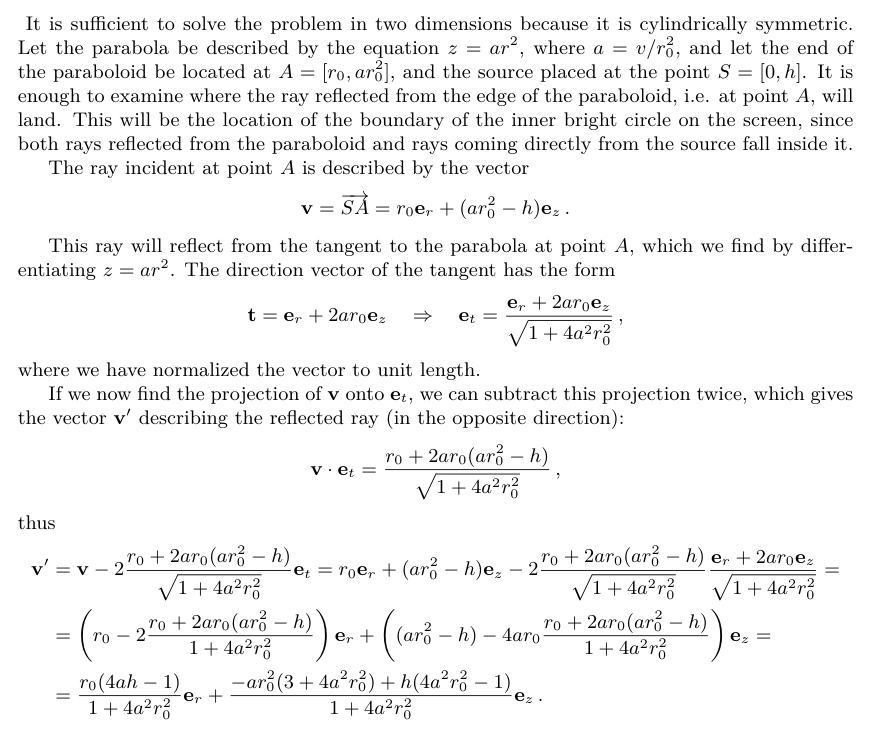
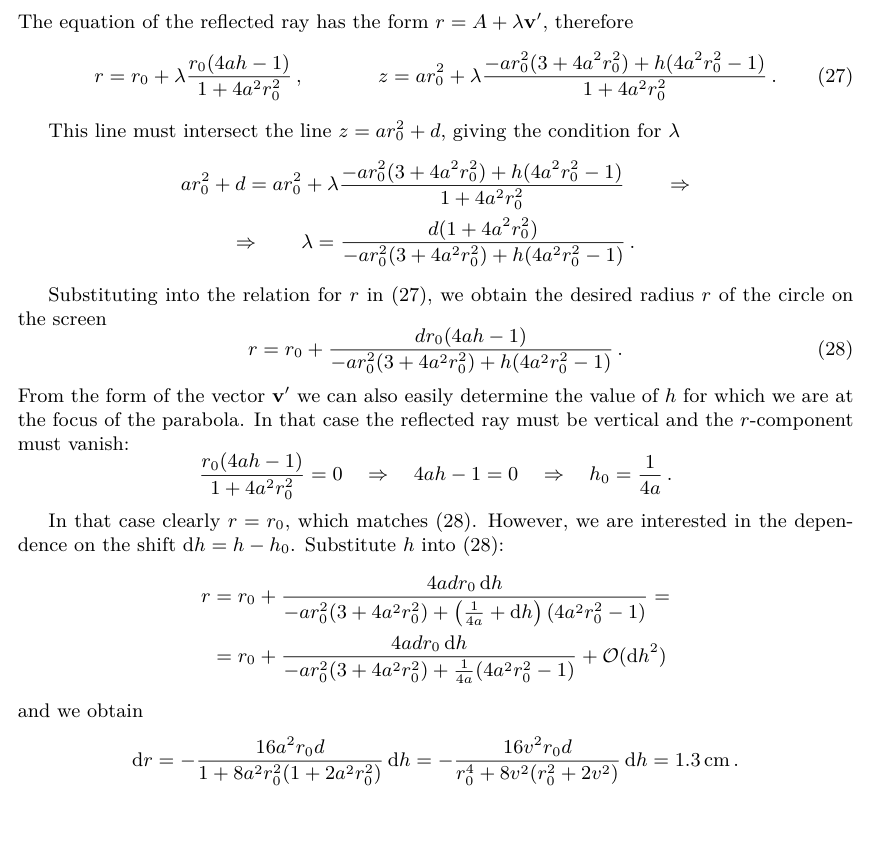
Official solution by FYKOS (Physics Brawl Online 2025), reproduced from the official PDF — p. 100, 101 — under CC BY-SA 3.0.
Topic: Geometric Optics Metodi: Ray Tracing, Approximation & Series Expansion Competenze: Mathematical Modeling Objects: Mirror, Screen Fonte: Testo (PDF) — p.100 · Soluzione ufficiale (PDF) — p.100
R.3 — Riflettore fuori fuoco (7 punti)
Il faro di un’auto è costituito da uno specchio parabolico ottenuto ruotando la parabola , , con e . Nel suo fuoco si trova una sorgente di luce incoerente di dimensioni trascurabili. Supponi che uno schermo sia posto perpendicolarmente all’asse del paraboloide a distanza dal bordo superiore del riflettore (piano ). La lampadina però non è esattamente nel fuoco, ma sull’asse del paraboloide a distanza da esso (più vicina al vertice del paraboloide). Di quanto aumenta in questo caso il raggio del cerchio luminoso al centro dello schermo, nel quale arrivano sia la luce diretta della sorgente sia quella riflessa dal paraboloide?
Risposta:
Soluzione: La soluzione ufficiale completa (in inglese) è nella versione originale di questo quesito e nel PDF ufficiale.
Topic: Geometric Optics Metodi: Ray Tracing, Approximation & Series Expansion Competenze: Mathematical Modeling Objects: Mirror, Screen Fonte: Testo (PDF) — p.100 · Soluzione ufficiale (PDF) — p.100
R.4 — Spotlight at full power (7 points)
A headlight in a car consists of a parabolic mirror formed by rotating the parabola , , where , about its axis. A negligibly small, incoherent light source with radiant intensity in the visible spectrum is located at its focus. Assume that at a distance from the upper edge of the reflector (the plane ), a screen is placed perpendicular to the paraboloid axis. A bright circular region is visible on the screen, illuminated both by rays reflected from the paraboloid and by rays arriving directly from the source. Determine the magnitude of the jump in intensity at the boundary of this circle.
Risposta:
Soluzione:
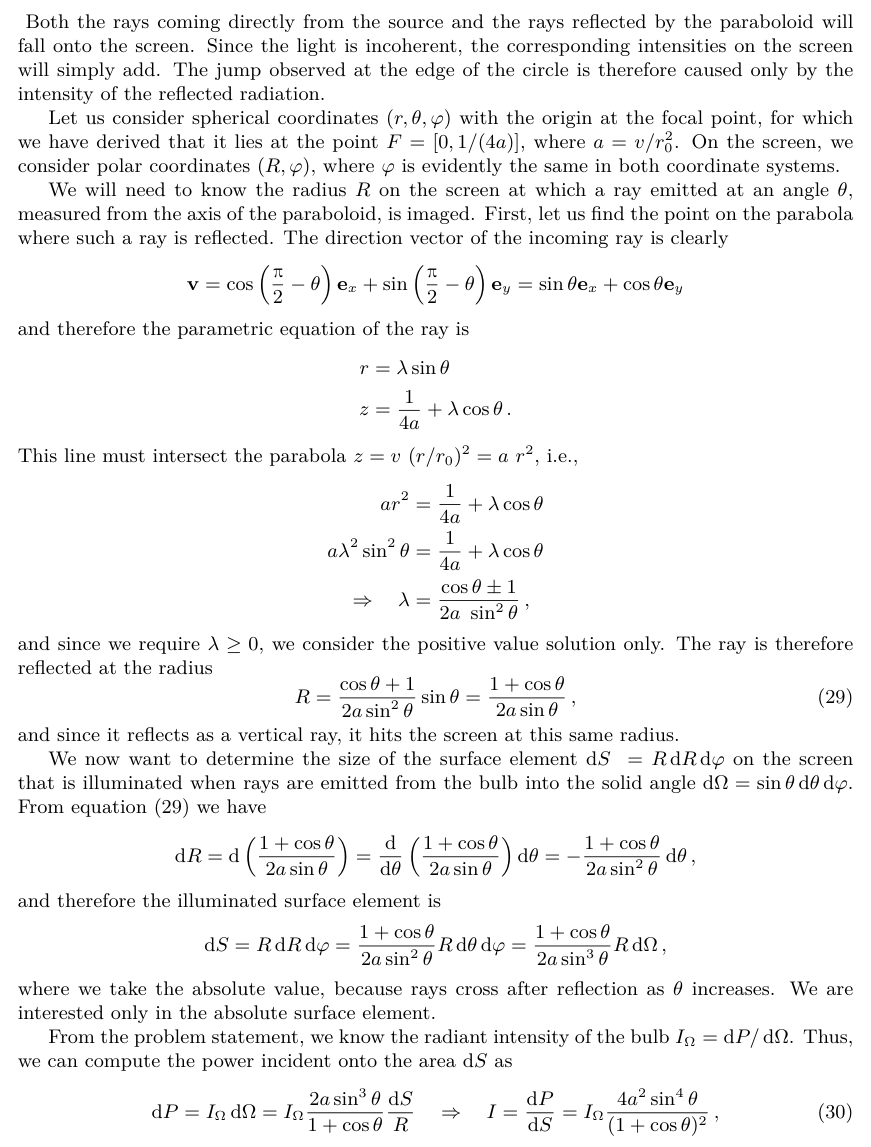
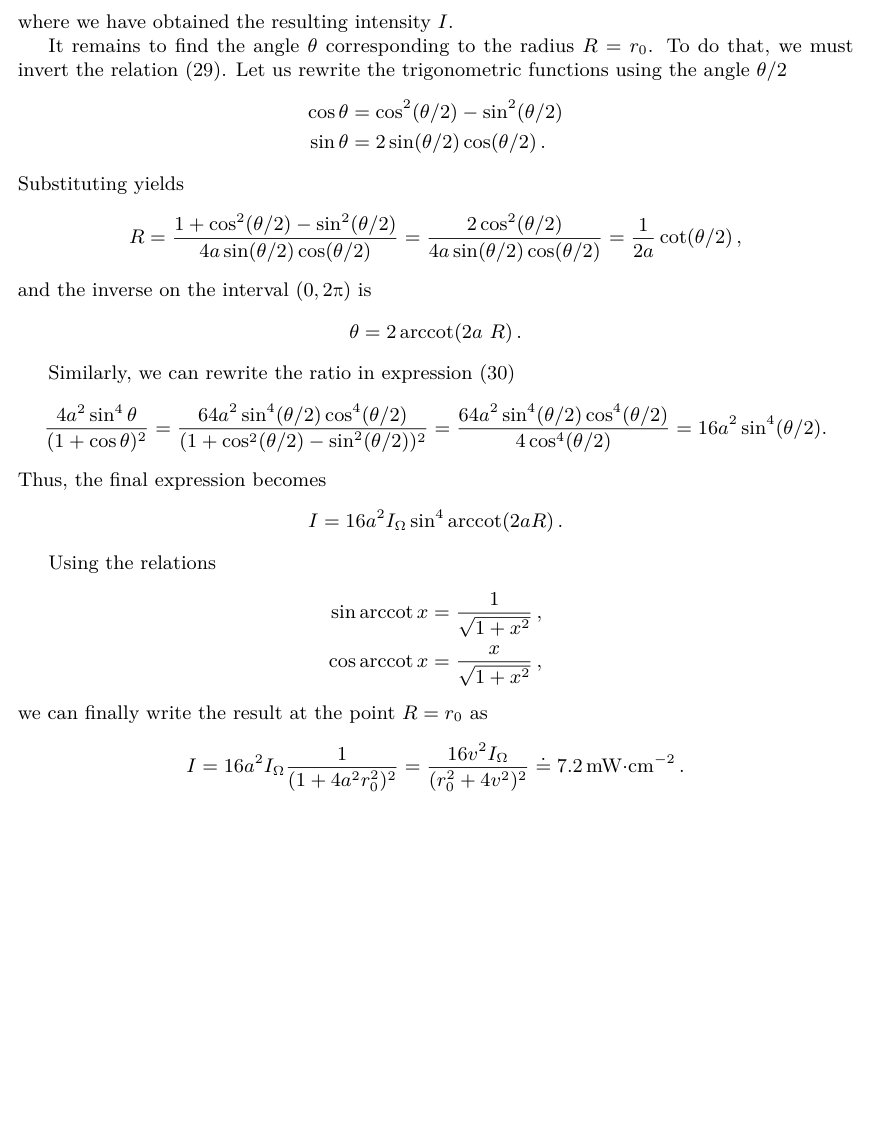
Official solution by FYKOS (Physics Brawl Online 2025), reproduced from the official PDF — p. 102, 103 — under CC BY-SA 3.0.
Topic: Geometric Optics Metodi: Ray Tracing, Calculus-Integration Competenze: Mathematical Modeling Objects: Mirror, Screen Fonte: Testo (PDF) — p.101 · Soluzione ufficiale (PDF) — p.102
R.4 — Faro a piena potenza (7 punti)
Il faro di un’auto è costituito da uno specchio parabolico ottenuto ruotando attorno al suo asse la parabola , , con . Nel fuoco si trova una sorgente di luce incoerente di dimensioni trascurabili, con intensità radiante nello spettro visibile. Supponi che a distanza dal bordo superiore del riflettore (piano ) sia posto uno schermo perpendicolare all’asse del paraboloide. Sullo schermo è visibile una regione circolare luminosa, illuminata sia dai raggi riflessi dal paraboloide sia da quelli che arrivano direttamente dalla sorgente. Determina l’entità del salto di intensità al bordo di questo cerchio.
Risposta:
Soluzione: La soluzione ufficiale completa (in inglese) è nella versione originale di questo quesito e nel PDF ufficiale.
Topic: Geometric Optics Metodi: Ray Tracing, Calculus-Integration Competenze: Mathematical Modeling Objects: Mirror, Screen Fonte: Testo (PDF) — p.101 · Soluzione ufficiale (PDF) — p.102
Official numeric answers (FYKOS solutions, Physics Brawl Online 2025).
| Problem | Title | Risposta |
|---|---|---|
| 1 | Mowing (3 points) | |
| 2 | Different period (3 points) | |
| 3 | Playing with gas (3 points) | |
| 4 | Fast serve (4 points) | |
| 5 | Old power supply (3 points) | |
| 6 | Firmly connected mathematical pendulums (3 points) | |
| 7 | Icy cold LED lights (3 points) | |
| 8 | Lost gas (4 points) | |
| 9 | Brokenly charged (4 points) | |
| 10 | Creative DnD Hero (4 points) | |
| 11 | Staircases in Atomium (3 points) | |
| 12 | The strength of LED strips (4 points) | (repulsive) |
| 13 | Skipping pizza (4 points) | |
| 14 | Voltage on the voltmeter (4 points) | |
| 15 | Radar operator problems (4 points) | |
| 16 | Spinning electrons (4 points) | |
| 17 | Overturned outhouse (4 points) | |
| 18 | Potassium cube (4 points) | |
| 19 | Thermodynamical pulleys (4 points) | |
| 20 | Wired wheel (5 points) | |
| 21 | Particles (4 points) | |
| 22 | Modified solar system (5 points) | |
| 23 | Harmonical friction (5 points) | |
| 24 | Tense oscillations (5 points) | |
| 25 | Bizzare yo-yo adventure (5 points) | |
| 26 | Falling square (5 points) | (no induced current) |
| 27 | Ion thrust engine (4 points) | |
| 28 | Action scene with motorbike and truck (5 points) | |
| 29 | Water turn (6 points) | |
| 30 | Chasing the Sun (5 points) | (sunrise at about 6:18) |
| 31 | Gas flow (5 points) | |
| 32 | Warming up by work (5 points) | |
| 33 | Lever–pulleys (5 points) | |
| 34 | A straw (6 points) | |
| 35 | Waging a war with windmills (6 points) | |
| 36 | Conducting corner (7 points) | |
| 37 | FTL (6 points) | |
| 38 | Speed of a shadow (6 points) | |
| 39 | Heavenly bowling (7 points) | |
| 40 | Leaking liquids (6 points) | |
| 41 | The cosmos getting far, far away (7 points) | |
| 42 | Underwater light (7 points) | |
| 43 | Hmm, where did i put that? (8 points) | |
| 44 | Racing against the rain (6 points) | (shorter in winter) |
| 45 | Blowing up a balloon reloaded (7 points) | (final radius ) |
| 46 | A spring and a magnet (8 points) | |
| 47 | Underwater light reloaded (9 points) | |
| 48 | Thermodynamic lottery (8 points) | |
| 49 | Giant metronome (9 points) | |
| 50 | Charged hoop in a sphere (9 points) | |
| 51 | Easterly (8 points) | |
| 52 | Thermal neutrons (9 points) | |
| 53 | Attractive Petr (8 points) | |
| 54 | The fullest spoon (9 points) | |
| 55 | Faraday’s collector (8 points) | |
| 56 | Escape across a frozen dam (9 points) | |
| 57 | B.1 — Mighty power bank in action (3 points) | |
| 58 | B.2 — Heavy charging (3 points) | |
| 59 | B.3 — I don’t have the capacity for that (4 points) | |
| 60 | B.4 — (in)efficient powerbank (4 points) | |
| 61 | P.1 — Knocking the opposing boule away (4 points) | |
| 62 | P.2 — Slowing our ball down (5 points) | |
| 63 | P.3 — Scattered balls (3 points) | |
| 64 | P.4 — Scattered balls reloaded (5 points) | |
| 65 | R.1 — Telescope illumination (4 points) | (0.445 with the simpler approximation; ≈ 0.474 by exact ray tracing — all accepted) |
| 66 | R.2 — Shining on a teaspoon (4 points) | |
| 67 | R.3 — Reflector off the focal point (7 points) | |
| 68 | R.4 — Spotlight at full power (7 points) |
Fonte: Testo e soluzioni (PDF)
Risposte numeriche ufficiali (soluzioni FYKOS, Physics Brawl Online 2025).
| Problema | Titolo | Risposta |
|---|---|---|
| 1 | Falciatura (3 punti) | |
| 2 | Periodo diverso (3 punti) | |
| 3 | Giocando con il gas (3 punti) | |
| 4 | Servizio veloce (4 punti) | |
| 5 | Vecchio alimentatore (3 punti) | |
| 6 | Pendoli matematici rigidamente collegati (3 punti) | |
| 7 | LED gelidi (3 punti) | |
| 8 | Gas perduto (4 punti) | |
| 9 | Carica spezzata (4 punti) | |
| 10 | Eroe creativo di D&D (4 punti) | |
| 11 | Le scale dell’Atomium (3 punti) | |
| 12 | La forza delle strisce LED (4 punti) | (repulsiva) |
| 13 | Pizza saltellante (4 punti) | |
| 14 | La tensione sul voltmetro (4 punti) | |
| 15 | I problemi dell’operatore radar (4 punti) | |
| 16 | Elettroni che girano (4 punti) | |
| 17 | Gabinetto rovesciato (4 punti) | |
| 18 | Cubo di potassio (4 punti) | |
| 19 | Carrucole termodinamiche (4 punti) | |
| 20 | Ruota con la molla (5 punti) | |
| 21 | Particelle (4 punti) | |
| 22 | Sistema solare modificato (5 punti) | |
| 23 | Attrito armonico (5 punti) | |
| 24 | Oscillazioni sotto tensione (5 punti) | |
| 25 | Bizzarra avventura dello yo-yo (5 punti) | |
| 26 | Quadrato in caduta (5 punti) | (nessuna corrente indotta) |
| 27 | Propulsore a ioni (4 punti) | |
| 28 | Scena d’azione con moto e camion (5 punti) | |
| 29 | Virata in acqua (6 punti) | |
| 30 | Inseguendo il Sole (5 punti) | (alba verso le 6:18) |
| 31 | Flusso di gas (5 punti) | |
| 32 | Scaldarsi con il lavoro (5 punti) | |
| 33 | Leva e carrucole (5 punti) | |
| 34 | Una cannuccia (6 punti) | |
| 35 | Combattere contro i mulini a vento (6 punti) | |
| 36 | Angolo conduttore (7 punti) | |
| 37 | FTL (6 punti) | |
| 38 | Velocità di un’ombra (6 punti) | |
| 39 | Bowling celeste (7 punti) | |
| 40 | Liquidi che colano (6 punti) | |
| 41 | Il cosmo che si allontana (7 punti) | |
| 42 | Luce sott’acqua (7 punti) | |
| 43 | Hmm, dove l’ho messa? (8 punti) | |
| 44 | Gara contro la pioggia (6 punti) | (più corto d’inverno) |
| 45 | Gonfiare un palloncino (reloaded) (7 punti) | (raggio finale ) |
| 46 | Una molla e un magnete (8 punti) | |
| 47 | Luce sott’acqua (reloaded) (9 punti) | |
| 48 | Lotteria termodinamica (8 punti) | |
| 49 | Metronomo gigante (9 punti) | |
| 50 | Anello carico in una sfera (9 punti) | |
| 51 | Pasquetta (8 punti) | |
| 52 | Neutroni termici (9 punti) | |
| 53 | Petr attraente (8 punti) | |
| 54 | Il cucchiaio più pieno (9 punti) | |
| 55 | Il collettore di Faraday (8 punti) | |
| 56 | Fuga sulla diga ghiacciata (9 punti) | |
| 57 | B.1 — Power bank potente in azione (3 punti) | |
| 58 | B.2 — Ricarica pesante (3 punti) | |
| 59 | B.3 — Non ho la capacità per questo (4 punti) | |
| 60 | B.4 — Power bank (in)efficiente (4 punti) | |
| 61 | P.1 — Bocciare la boccia avversaria (4 punti) | |
| 62 | P.2 — Rallentare la nostra boccia (5 punti) | |
| 63 | P.3 — Bocce sparpagliate (3 punti) | |
| 64 | P.4 — Bocce sparpagliate (reloaded) (5 punti) | |
| 65 | R.1 — Illuminazione del telescopio (4 punti) | (0.445 con l’approssimazione più semplice; ≈ 0.474 con il tracciamento esatto dei raggi — tutti accettati) |
| 66 | R.2 — Illuminare un cucchiaino (4 punti) | |
| 67 | R.3 — Riflettore fuori fuoco (7 punti) | |
| 68 | R.4 — Faro a piena potenza (7 punti) |
Fonte: Testo e soluzioni (PDF)