Sistemi stellari binari — Fotometria
Due stelle che ruotano intorno al loro centro di massa formano un sistema stellare binario. Quasi metà delle stelle della nostra galassia sono sistemi stellari binari. Dalla Terra non è facile riconoscere la natura binaria di questi sistemi perché la distanza fra le due stelle è molto minore della loro distanza da noi e quindi non si possono risolvere le due stelle con i telescopi. Perciò dobbiamo usare tecniche fotometriche o spettrometriche per osservare le variazioni nell’intensità o nello spettro di una certa stella per determinare se si tratta di un sistema binario oppure no.
Fotometria di stelle binarie
Se siamo esattamente nel piano del moto delle due stelle allora in certi momenti una stella occulterà l’altra passandole davanti e l’intensità di tutto il sistema, rilevata dal nostro punto di osservazione, cambierà nel tempo. Questi sistemi binari sono detti binari eclittici.
Fai l’ipotesi che le due stelle si muovano su orbite circolari intorno al centro di massa del sistema con velocità angolare costante , e che noi siamo esattamente nel piano di moto del sistema binario. Fai anche l’ipotesi che le temperature superficiali delle stelle siano e , e i raggi corrispondenti siano rispettivamente e .
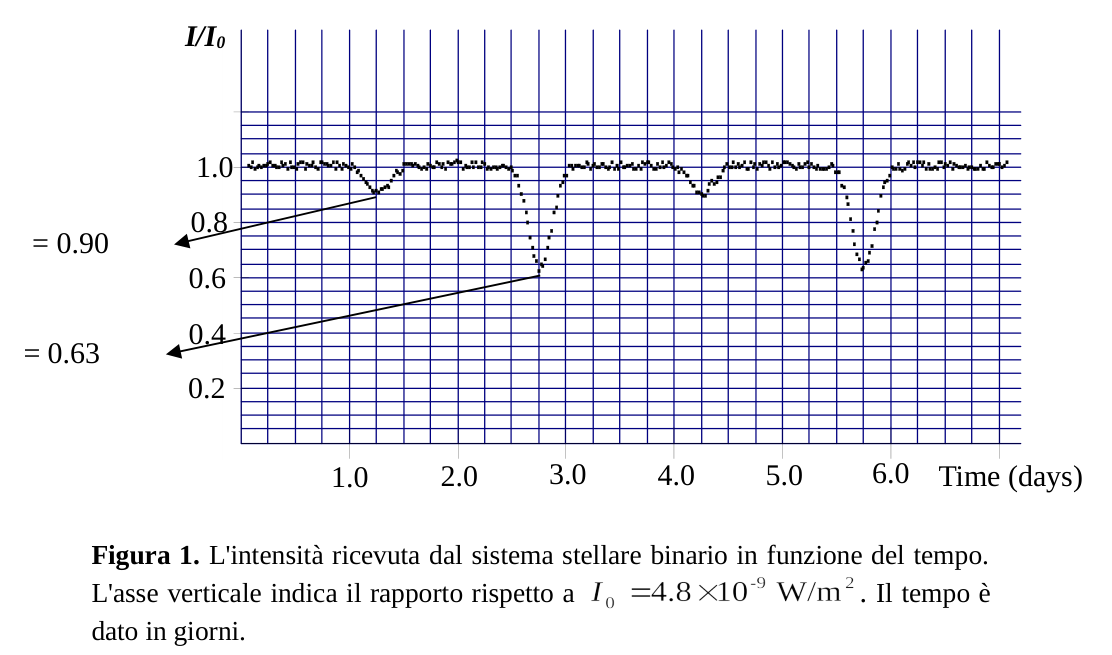
L’intensità totale della luce misurata dalla Terra è mostrata in funzione del tempo in Figura 1. Misure accurate mostrano che le intensità della luce provenienti dalle stelle e che corrispondono ai minimi sono, rispettivamente, il 90% e il 63% dell’intensità massima , che arriva da entrambe le stelle. Sull’asse verticale del diagramma di Figura 1 è riportato il rapporto e sull’asse orizzontale il tempo è indicato in giorni.
Figura 1. L’intensità ricevuta dal sistema stellare binario in funzione del tempo. L’asse verticale indica il rapporto . Il tempo è dato in giorni.
1.1 Trova il periodo del moto orbitale. Dai la risposta in secondi con due cifre significative. Qual è la frequenza angolare del sistema, misurata in rad/s? (0.8 punti)
Con una buona approssimazione, la radiazione che si riceve da una stella è una radiazione uniforme di corpo nero che potrebbe provenire da un disco piano con un raggio uguale a quello della stella. Perciò l’intensità ricevuta è proporzionale a , dove è l’area del disco e la temperatura superficiale della stella.
1.2 Mediante la Figura 1 trova i rapporti e . (1.6 punti)
p.1 — Curva di luce: intensita relativa nel tempo
Topic: Astrophysics, Gravitation, Wave Optics Metodi: Kepler’s Laws, Newton’s Law of Gravitation, Simple Harmonic Motion Analysis, Ray Tracing, Interference & Diffraction Analysis Competenze: Experimental Data Analysis, Graph Linearization, Mathematical Modeling Objects: Star Fonte: Testo (PDF) — p.1 Soluzione: Soluzioni (PDF)
Sistemi stellari binari — Fotometria
Two stars orbiting their center of mass form a binary star system. Almost half of the stars in our galaxy are binary star systems. From Earth, it’s not easy to recognize the binary nature of these systems because the distance between the two stars is much smaller than their distance from us and so you can’t solve the two stars with telescopes. So we have to use photometric or spectrometric techniques to observe changes in the intensity or spectrum of a certain star to determine whether or not it’s a binary system.
Fotometria di stelle binarie
If we are exactly in the plane of motion of the two stars then at certain moments one star will obscure the other by passing them ahead and the intensity of the entire system, as detected from our point of view, will change over time. These binary systems are called eclithic binaries.
Suppose that the two stars are moving in circular orbits around the center of mass of the system with constant angular velocity , and that we are exactly in the plane of motion of the binary system. Also assume that the surface temperatures of the stars are and , and the corresponding rays are and respectively.
The total intensity of light measured by the Earth is shown as a function of time in Figure 1. Accurate measurements show that the light intensities from the stars corresponding to the minimum are 90% and 63% of the maximum intensity , which comes from both stars, respectively. The vertical axis of the diagram in Figure 1 shows the ratio and the horizontal axis shows the time in days.
Figure 1. Lintensity received by the binary star system depending on the time. The vertical axis shall indicate the ratio . Time is given in days.
1.1 Trova il periodo del moto orbitale. Give the answer in seconds with two significant digits. What is the angular frequency of the system, measured in rad/s? (0.8 punti)
With a good approximation, the radiation you receive from a star is a uniform black-body radiation that could come from a flat disk with a radius equal to that of the star. Therefore, the received intensity is proportional to , where is the disk area and the surface temperature of the star.
1.2 Using Figure 1 find the ratios and . (1.6 punti)
**p.1 ** Curve of light: relative intensity over time
Topic: Astrophysics, Gravitation, Wave Optics Metodi: Kepler’s Laws, Newton’s Law of Gravitation, Simple Harmonic Motion Analysis, Ray Tracing, Interference & Diffraction Analysis Competenze: Experimental Data Analysis, Graph Linearization, Mathematical Modeling Objects: Star Fonte: Testo (PDF) — p.1 Soluzione: Soluzioni (PDF)
Spettrometria di sistemi binari
In questa sezione calcoleremo le proprietà astronomiche di una stella binaria usando dei dati spettrometrici sperimentali del sistema binario. Gli atomi assorbono, o emettono, radiazione a certe lunghezze d’onda caratteristiche. Di conseguenza lo spettro osservato di una stella contiene linee di assorbimento dovute agli atomi che si trovano nell’atmosfera stellare.
Il Sodio ha una linea spettrale gialla caratteristica (linea D1) con lunghezza d’onda di ().
Esaminiamo lo spettro di assorbimento del Sodio atomico a questa lunghezza d’onda per il sistema binario descritto nella sezione precedente. Lo spettro luminoso che riceviamo dalla stella binaria è spostato per effetto Doppler perché le stelle si muovono rispetto a noi. Ciascuna stella ha una diversa velocità, di conseguenza la lunghezza d’onda assorbita apparirà spostata di una quantità diversa per ciascuna stella.
Occorrono misure di lunghezza d’onda molto accurate per osservare lo spostamento Doppler perché la velocità delle stelle è molto minore di quella della luce. La velocità del centro di massa del sistema binario che stiamo considerando in questo problema è molto minore delle velocità orbitali delle stelle. Per questa ragione tutti gli spostamenti Doppler possono essere attribuiti alla velocità orbitale delle stelle.
Nella Tabella 1 ci sono le lunghezze d’onda misurate per questa riga nella luce proveniente dalle due stelle nel sistema binario che abbiamo osservato.
Tabella 1: Spettro di assorbimento per la linea D1 del Sodio delle due stelle del sistema binario osservato.
| (giorni) | 0.3 | 0.6 | 0.9 | 1.2 | 1.5 | 1.8 | 2.1 | 2.4 |
|---|---|---|---|---|---|---|---|---|
| (Å) | 5897.5 | 5897.7 | 5897.2 | 5896.2 | 5895.1 | 5894.3 | 5894.1 | 5894.6 |
| (Å) | 5893.1 | 5892.8 | 5893.7 | 5896.2 | 5897.3 | 5898.7 | 5899.0 | 5898.1 |
| (giorni) | 2.7 | 3.0 | 3.3 | 3.6 | 3.9 | 4.2 | 4.5 | 4.8 |
|---|---|---|---|---|---|---|---|---|
| (Å) | 5895.6 | 5896.7 | 5897.3 | 5897.7 | 5897.2 | 5896.2 | 5895.0 | 5894.3 |
| (Å) | 5896.4 | 5894.5 | 5893.1 | 5892.8 | 5893.7 | 5896.2 | 5897.4 | 5898.7 |
(Nota: non è necessario riportare in grafico i valori della tabella.)
2.1 Siano e le velocità orbitali di ciascuna stella. Trova e . La velocità della luce è . Ignora tutti gli effetti relativistici. (1.8 punti)
2.2 Trova il rapporto fra le masse delle due stelle . (0.7 punti)
2.3 Siano e le distanze di ciascuna stella dal centro di massa del sistema: trova e . (0.8 punti)
2.4 Sia la distanza fra le due stelle: trova . (0.2 punti)
Topic: Astrophysics, Oscillations & Waves Metodi: Physical Modeling, Experimental Data Analysis, Conservation of Momentum Competenze: Physical Reasoning, Experimental Data Analysis Objects: Star, Atom Fonte: Testo (PDF) — p.2 Soluzione: Soluzioni (PDF)
Spettrometria di sistemi binari
In this section, we’re going to calculate the astronomical properties of a binary star using experimental spectrometric data from the binary system. Atoms absorb, or emit, radiation at certain characteristic wavelengths. As a result, the observed spectrum of a star contains absorption lines due to the atoms found in the star’s atmosphere.
Sodium has a characteristic yellow spectral line (line D1) with a wavelength of ().
Let us examine the absorption spectrum of sodium at this wavelength for the binary system described in the previous section. The light spectrum we get from the binary star is shifted by the Doppler effect because the stars are moving relative to us. Each star has a different velocity, so the absorbed wavelength will appear to be shifted by a different amount for each star.
Very accurate wavelength measurements are needed to observe Doppler displacement because the speed of stars is much less than that of light. The center of mass velocity of the binary system we’re considering in this problem is much less than the orbital velocities of the stars. For this reason all Doppler shifts can be attributed to the orbital velocity of the stars.
In Table 1 we have the wavelengths measured for this line in the light from the two stars in the binary system that we observed.
**Table 1: ** Absorption spectrum for Sodium line D1 of the two stars of the observed binary system.
| (giorni) | 0.3 | 0.6 | 0.9 | 1.2 | 1.5 | 1.8 | 2.1 | 2.4 |
|---|---|---|---|---|---|---|---|---|
| (Å) | 5897.5 | 5897.7 | 5897.2 | 5896.2 | 5895.1 | 5894.3 | 5894.1 | 5894.6 |
| (Å) | 5893.1 | 5892.8 | 5893.7 | 5896.2 | 5897.3 | 5898.7 | 5899.0 | 5898.1 |
| (giorni) | 2.7 | 3.0 | 3.3 | 3.6 | 3.9 | 4.2 | 4.5 | 4.8 |
|---|---|---|---|---|---|---|---|---|
| (Å) | 5895.6 | 5896.7 | 5897.3 | 5897.7 | 5897.2 | 5896.2 | 5895.0 | 5894.3 |
| (Å) | 5896.4 | 5894.5 | 5893.1 | 5892.8 | 5893.7 | 5896.2 | 5897.4 | 5898.7 |
(Note: the table values do not need to be graphed.)
2.1 The orbital velocities of each star are and . Find and . The speed of light is . He ignores all the relativistic effects. (1.8 punti)
2.2 Trova il rapporto fra le masse delle due stelle . (0.7 punti)
2.3 Siano e le distanze di ciascuna stella dal centro di massa del sistema: trova e . (0.8 punti)
2.4 Whether is the distance between the two stars: find . (0.2 punti)
Topic: Astrophysics, Oscillations & Waves Metodi: Physical Modeling, Experimental Data Analysis, Conservation of Momentum Competenze: Physical Reasoning, Experimental Data Analysis Objects: Star, Atom Fonte: Testo (PDF) — p.2 Soluzione: Soluzioni (PDF)
Masse delle stelle
La sola forza che agisce fra le due stelle è quella gravitazionale.
3.1 Trova le masse e di ciascuna stella con una cifra significativa. La costante di gravitazione universale è: . (1.2 punti)
Topic: Astrophysics, Gravitation Metodi: Newton’s Law of Gravitation, Physical Modeling Competenze: Physical Reasoning, Mathematical Modeling Objects: Star Fonte: Testo (PDF) — p.3 Soluzione: Soluzioni (PDF)
Masse delle stelle
The only force acting between the two stars is gravitational.
3.1 Trova le masse e di ciascuna stella con una cifra significativa. The universal gravity constant is . (1.2 punti)
Topic: Astrophysics, Gravitation Metodi: Newton’s Law of Gravitation, Physical Modeling Competenze: Physical Reasoning, Mathematical Modeling Objects: Star Fonte: Testo (PDF) — p.3 Soluzione: Soluzioni (PDF)
Caratteristiche generali delle stelle
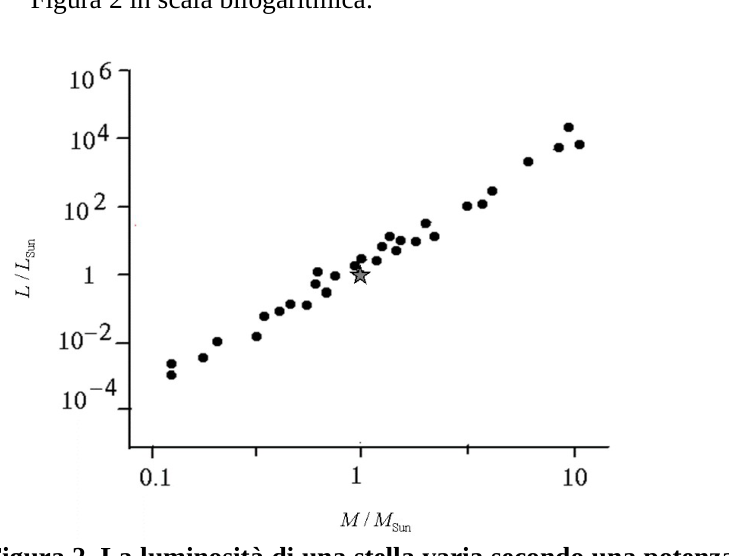
Le stelle per lo più generano energia attraverso lo stesso meccanismo; per questa ragione esiste una relazione empirica fra la loro massa e la loro luminosità , che è la potenza radiante totale della stella. Questa relazione si può scrivere nella forma
dove è la massa solare e è la luminosità solare. Questa relazione è mostrata nel grafico di Figura 2 in scala bilogaritmica.
Figura 2. La luminosità di una stella varia secondo una potenza della sua massa. Il grafico è in scala bilogaritmica. Il simbolo a forma di stella rappresenta il Sole che ha una massa di e una luminosità di .
4.1 Trova con una cifra significativa. (0.6 punti)
4.2 Siano e le luminosità delle stelle del sistema binario studiato nelle sezioni precedenti: trova e . (0.6 punti)
4.3 A che distanza da noi si trova questo sistema stellare? Esprimi il risultato in anni luce. Per trovare la distanza puoi usare i dati in Figura 1. L’anno luce è la distanza che la luce percorre in un anno. (0.9 punti)
4.4 Dal nostro punto di osservazione, qual è la distanza angolare massima fra le due stelle? (0.4 punti)
4.5 Qual è la minima dimensione dell’apertura di un telescopio ottico per poter separare le immagini di queste due stelle? (0.4 punti)
p.3 — Relazione massa-luminosita in scala bilogaritmica
Topic: Astrophysics, Geometric Optics Metodi: Physical Modeling, Graph Linearization, Newton’s Law of Gravitation Competenze: Physical Reasoning, Graph Linearization, Mathematical Modeling Objects: Star Fonte: Testo (PDF) — p.3 Soluzione: Soluzioni (PDF)
Caratteristiche generali delle stelle
Stars mostly generate energy through the same mechanism; for this reason there is an empirical relationship between their mass and their brightness , which is the total radiant power of the star. This report can be written in the form
where is the mass of the sun and is the sun’s luminosity. This relationship is shown in the diagram in Figure 2 on a bilogarithmic scale.
**Figure 2. ** The brightness of a star varies according to a power of its mass. The graph is on a bilogarithmic scale. The star-shaped symbol represents the Sun which has a mass of and a brightness of .
4.1 Trova con una cifra significativa. (0.6 punti)
4.2 The brightness of the stars of the binary system studied in the previous sections are and : find and . (0.6 punti)
4.3 A che distanza da noi si trova questo sistema stellare? Express the result in light years. To find the distance you can use the data in Figure 1. A light year is the distance light travels in a year. (0.9 punti)
4.4 Dal nostro punto di osservazione, qual è la distanza angolare massima fra le due stelle? (0.4 punti)
4.5 Qual è la minima dimensione dell’apertura di un telescopio ottico per poter separare le immagini di queste due stelle? (0.4 punti)
p.3 — Relazione massa-luminosita in scala bilogaritmica
Topic: Astrophysics, Geometric Optics Metodi: Physical Modeling, Graph Linearization, Newton’s Law of Gravitation Competenze: Physical Reasoning, Graph Linearization, Mathematical Modeling Objects: Star Fonte: Testo (PDF) — p.3 Soluzione: Soluzioni (PDF)