Spheres in Contact (Prof. Tiberius O. Cheche — University of Bucharest)
A system of three identical rigid spheres of radius are put in contact on a horizontal table, in a gravitational field of intensity , as shown in the figure. At the initial moment the system is released. Considering a frictionless motion obtain:
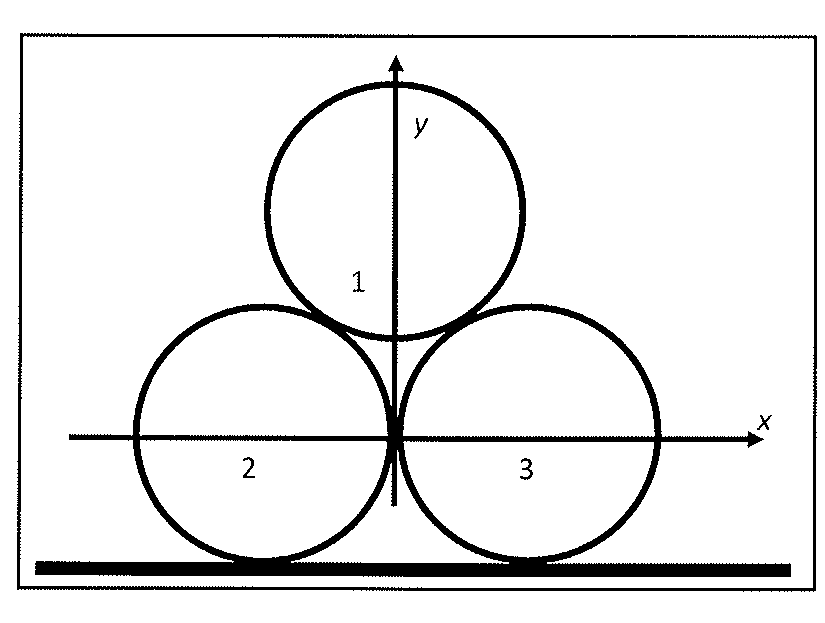 Figure: three identical spheres in contact on a horizontal table; sphere 1 rests on top of spheres 2 and 3. The axis is vertical through the center of sphere 1 and the axis is horizontal.
a) Velocity of the spheres at the detachment time as function of coordinate (see the figure);
b) as function of , where is the speed of sphere 3 (see the figure); justify the correctness of solutions for the speed of the spheres;
c) The maximum possible height of sphere 1 after it elastically collides the horizontal table;
One considers the real solution of the equation is known, namely, .
Fonte: Testo (PDF) — p.1 Topic: Newtonian Mechanics, Conservation of Energy Metodi: Conservation of Energy, Free-Body Diagram, Conservation of Momentum, Vector Decomposition Competenze: Physical Reasoning, Mathematical Modeling Objects: Sphere
Sfere di contatto * Tiberius O. Ceca Università di Bucarest)*
Un sistema di tre identiche sfere rigide di raggio sono messe in contatto su una tabella orizzontale, in un campo gravitazionale di intensità , come mostrato nella figura. Al momento iniziale il sistema viene rilasciato. Considerando un movimento senza attrito ottenere:
Figura: tre sfere identiche in contatto su una tabella orizzontale; la sfera 1 riposa sopra le sfere 2 e 3. L’asse è verticale attraverso il centro della sfera 1 e l’asse è orizzontale.*
a) Velocità delle sfere al momento del distacco in funzione delle coordinate (cfr. figura);
b) in funzione di , dove è la velocità della sfera 3 (vedi figura); giustificare la correttezza delle soluzioni per la velocità delle sfere;
c) L’altezza massima possibile della sfera 1 dopo che essa si schianta elasticamente con la tabella orizzontale;
Si considera che la soluzione reale dell’equazione sia conosciuta, vale a dire .
Fonte: Testo (PDF) — p.1 Topic: Newtonian Mechanics, Conservation of Energy Metodi: Conservation of Energy, Free-Body Diagram, Conservation of Momentum, Vector Decomposition Competenze: Physical Reasoning, Mathematical Modeling Objects: Sphere
The apparent air temperature in a windy winter day (Prof. Valeriu Filip — University of Bucharest)
In a calm winter day (with no wind) thermometers indicate the average air temperature of . However, human subjects (whose average skin temperature is ) perceive approximately in these conditions.
Assume in that same day a strong turbulence occurs, a strong wind, with no change in the actual air temperature. Estimate the new perception of the human body in this modified environment. In other words, find out which value should have the outside temperature of a calm atmosphere in order to make people feel the same cold than the air of that windy day.
Fonte: Testo (PDF) — p.2 Topic: Thermodynamics, Order-of-Magnitude Estimation Metodi: Physical Modeling, Order-of-Magnitude Estimation, Dimensional Analysis Competenze: Estimation & Approximation, Physical Reasoning Objects: —
La temperatura atmosferica apparente in una giornata invernale ventuosa * Valeriu Filip Università di Bucarest)*
In una giornata invernale tranquilla (senza vento) i termometri indicano la temperatura media dell’aria di . Tuttavia, i soggetti umani (la cui temperatura media della pelle è ) percepiscono circa in queste condizioni.
Supponiamo che in quel stesso giorno si verifichi una forte turbolenza, un forte vento, senza alcun cambiamento nella temperatura effettiva dell’aria. Estimare la nuova percezione del corpo umano in questo ambiente modificato. In altre parole, scopri quale valore dovrebbe avere la temperatura esterna di un’atmosfera calma per far sentire le persone lo stesso freddo dell’aria di quel giorno a vento.
Fonte: Testo (PDF) — p.2 Topic: Thermodynamics, Order-of-Magnitude Estimation Metodi: Physical Modeling, Order-of-Magnitude Estimation, Dimensional Analysis Competenze: Estimation & Approximation, Physical Reasoning Objects: —
Huygens cycloidal pendulum (Prof. Iulia Ghiu — University of Bucharest)
The Dutch mathematician and physicist Christiaan Huygens invented the cycloidal pendulum clock in December 1656; he was 27 years old. The Rijksmuseum voor de Geschiedenis der Natuurwetenschapen in Leiden has the clock made by Huygens in 1657, which has cycloidal chops, this being the oldest pendulum clock.
The cycloidal pendulum is described by a particle that moves without friction on a vertical cycloid. The parametric equations of the cycloid are (see the figure below):
with . We consider that the particle starts moving from rest from its highest point from the left, i.e. and .
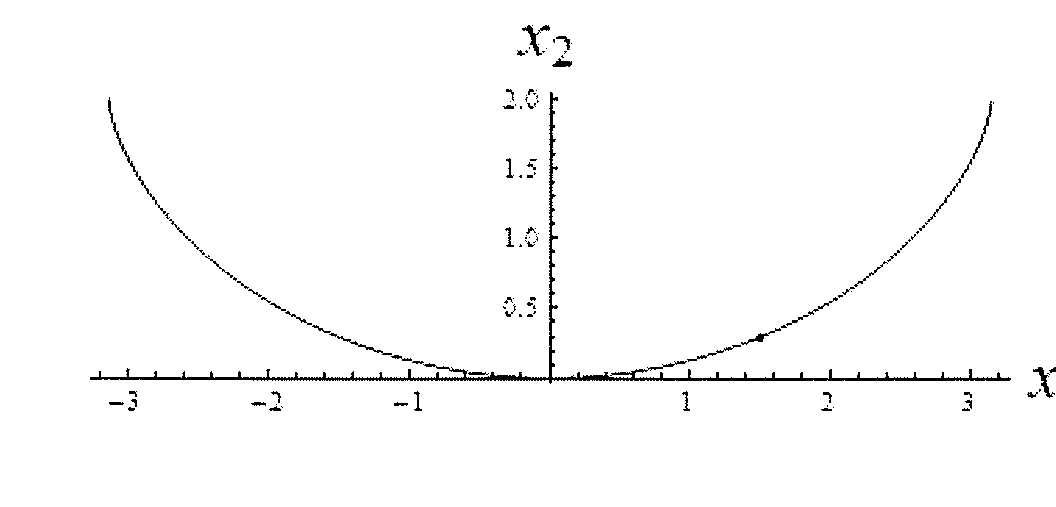 Figure: plot of the vertical cycloid versus over .
- Find the expression of the Lagrange function.
- Determine the law of motion.
- Find the period of oscillation.
Fonte: Testo (PDF) — p.3 Topic: Oscillations & Waves, Newtonian Mechanics Metodi: Simple Harmonic Motion Analysis, Differential Equations, Conservation of Energy, Calculus-Integration Competenze: Mathematical Modeling, Physical Reasoning Objects: Pendulum
Pedolo cicloidale di Huygens * Iulia Ghiu Università di Bucarest)*
Il matematico e fisico olandese Christiaan Huygens inventò l’orologio a pendolo cicloidale nel dicembre 1656; aveva 27 anni. Il Rijksmuseum voor de Geschiedenis der Natuurwetenschapen di Leiden ha l’orologio realizzato da Huygens nel 1657, che ha coppie cicloidiche, il più antico orologio a pendolo.
Il pendolo cicloidale ** è descritto da una particella che si muove senza attrito su un cicloide verticale. Le equazioni parametriche del cicloide sono (vedere figura seguente):
con . Consideramo che la particella comincia a muoversi dal riposo dal suo punto più alto a sinistra, cioè e .
Figura: tracciato della cicloide verticale contro su .
- Trova l’espressione della funzione di Lagrange.
- Determina la legge del movimento.
- Trova il periodo di oscillazione.
Fonte: Testo (PDF) — p.3 Topic: Oscillations & Waves, Newtonian Mechanics Metodi: Simple Harmonic Motion Analysis, Differential Equations, Conservation of Energy, Calculus-Integration Competenze: Mathematical Modeling, Physical Reasoning Objects: Pendulum
Piezoelectric voltage from super-currents (Prof. Petrica Cristea — University of Bucharest)
A cylinder shaped piezo stacked transducer is made of circular (radius ) well insulated superconducting turns, embedded in a piezoelectric ceramic with no magnetic properties (FIG.1). Without super-current flowing in turns, they are separated by some small distance . The ceramic material obeys Hooke’s law and its stiffness is . Under stretching or compression of ceramic with along the cylinder axis, a voltage drop develops between the top and the bottom of the stack, where is a constant specific to the ceramic material. Such an effect is known as piezoelectric effect. Note that a superconducting material exhibits exactly zero electric resistance. Superconductivity was discovered by Dutch physicist H. Kamerlingh Onnes on April 8, 1911 in Leiden. To solve the problem, you only need the basic knowledge of mechanics, electricity and magnetism.
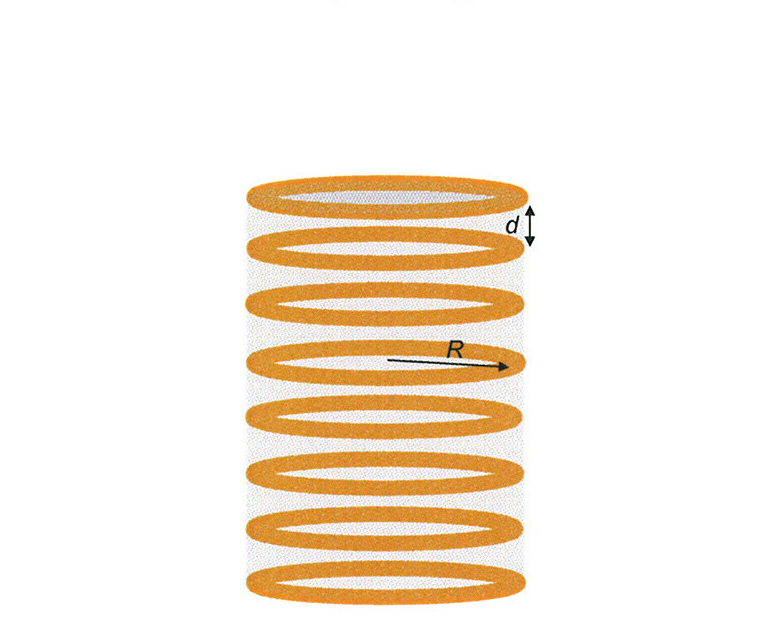 FIG.1: A piezo stacked transducer made of circular (radius ) superconducting turns, embedded in a piezoelectric ceramic. The turns are separated by a distance .
- Show that when super-currents flow in turns, a voltage drop develops across the stacked transducer.
- Use simple considerations to find if the voltage exhibits even or odd dependence on .
- With some super-current flowing in turns, analyze what will happen to the magnetic flux, when trying to compress or stretch the piezo stacked transducer.
- Find the piezoelectric voltage dependence on super-current.
Fonte: Testo (PDF) — p.4 Topic: Electromagnetic Induction, Electromagnetism Metodi: Faraday’s Law of Induction, Hooke’s Law, Symmetry Argument, Physical Modeling Competenze: Physical Reasoning, Mathematical Modeling Objects: Cylinder, Coil
Voltazione piezoelettrica da supertorenti (Prof. Petrica Cristea Università di Bucarest)
A cylinder shaped piezo stacked transducer is made of circular (radius ) well insulated superconducting turns, embedded in a piezoelectric ceramic with no magnetic properties (FIG.1). Senza supertorente che fluisce a turno, sono separati da una piccola distanza . Il materiale ceramico obbedisce alla legge di Hooke e la sua rigidità è . Se la ceramica viene allungata o compressa con lungo l’asse del cilindro, si sviluppa una caduta di tensione tra la parte superiore e la parte inferiore del pile, dove è una costante specifica del materiale ceramico. Tale effetto è conosciuto come effetto piezoelettrico **. Si noti che un materiale superconduttore * presenta una resistenza elettrica esattamente zero *. La superconduttività fu scoperta dal fisico olandese H. Kamerlingh Onnes l’8 aprile 1911 a Leiden. Per risolvere il problema, è necessario solo conoscere le basi della meccanica, dell’elettricità e del magnetismo.
FIG.1: Trasduttore piezo-impiccato di torni superconduttori circolari (radio ) , incorporato in ceramica piezoelettrica. Le curve sono separate da una distanza .
- Mostra che quando le supertorenti fluiscono a turno, si sviluppa una caduta di tensione attraverso il trasduttore impilato.
- Utilizzi semplici considerazioni per determinare se la tensione presenta una dipendenza pari o pari da .
- Con qualche super corrente che scorre a turno, analizzare cosa accadrà al flusso magnetico, quando si tenta di comprimere o allungare il trasduttore piezo staccato.
- Trova la dipendenza della tensione piezoelettrica da super corrente.
Fonte: Testo (PDF) — p.4 Topic: Electromagnetic Induction, Electromagnetism Metodi: Faraday’s Law of Induction, Hooke’s Law, Symmetry Argument, Physical Modeling Competenze: Physical Reasoning, Mathematical Modeling Objects: Cylinder, Coil
Sum rules (Prof. Virgil Baran — University of Bucharest)
Consider a quantum system defined by the Hamiltonian having the eigenenergies and eigenstates which form a complete orthonormal basis, .
The excitation strength function associated with a Hermitian excitation operator is defined as:
Show that the moments of the strength function can be written as the expectation value on the ground state of an operator function depending on and .
Indicate the physical meaning of and prove that it can be expressed as , which represents the energy weighted sum rule.
Suppose that our system consists of nucleons interacting through momentum independent forces. Consider the application upon the system of a perturbation of the form , where is the position operator associated to the nucleon . Prove that in this case
Provide a physical interpretation of the right hand side of this equation. Having in mind the physical meaning of you provided earlier, indicate which fundamental law of nature is encoded in the energy weighted sum rule.
The dipolar response of atomic nuclei will be explored at the ELI-NP facility in Magurele with gamma rays obtained from the process of Compton backscattering. In this case
where is the component of the position operator for protons, and similarly for in the case of neutrons. Here , with the total number of neutrons and the total number of protons. Then the dipolar cross section for the absorption of a photon with energy can be expressed as:
If we assume, as above, that the nucleons interact through momentum independent forces determine the total cross section for this process.
Fonte: Testo (PDF) — p.5 Topic: Modern-Quantum Physics, Nuclear & Particle Physics Metodi: Statistical Averaging, Calculus-Integration, Symmetry Argument, Conservation Laws Competenze: Mathematical Modeling, Physical Reasoning Objects: Nucleus, Photon
Regolazioni di somma * Virgil Baran Università di Bucarest)*
Considera un sistema quantistico definito dal sistema hamiltoniano che ha le proprie energie e gli stati propri che formano una base ortonormale completa, .
La funzione di forza di eccitazione associata ad un operatore di eccitazione ermetica è definita come:
Mostra che i momenti della funzione di resistenza possono essere scritti come il valore di attesa in stato di base di una funzione operatrice a seconda di e .
Indicare il significato fisico di e dimostrare che può essere espresso come , che rappresenta la regola della somma ponderata dell’energia.
Supponiamo che il nostro sistema sia costituito da nucleoni che interagiscono attraverso forze indipendenti da impulso. Considerare l’applicazione sul sistema di una perturbazione della forma , dove è l’operatore di posizione associato al nucleone . Prove che in questo caso
Fornire un’interpretazione fisica del lato destro di questa equazione. Tenendo conto del significato fisico di che hai fornito in precedenza, indicare quale legge fondamentale della natura è codificata nella regola della somma ponderata dell’energia.
La risposta dipolare dei nuclei atomici verrà esplorata presso l’impianto ELI-NP di Magurele con raggi gamma ottenuti dal processo di scattering di Compton. In questo caso
in cui è la componente dell’operatore di posizione per i protoni, e allo stesso modo per nel caso dei neutroni. Qui , con il numero totale di neutroni e il numero totale di protoni. Poi la sezione di intersezione dipolare per l’assorbimento di un fotone con energia può essere espressa come:
Se supponiamo, come sopra, che i nucleoni interagiscano attraverso forze indipendenti di impulso determinano la sezione trasversale totale per questo processo.
Fonte: Testo (PDF) — p.5 Topic: Modern-Quantum Physics, Nuclear & Particle Physics Metodi: Statistical Averaging, Calculus-Integration, Symmetry Argument, Conservation Laws Competenze: Mathematical Modeling, Physical Reasoning Objects: Nucleus, Photon
Dynamical symmetries (Prof. Virgil Baran — University of Bucharest)
Consider the motion of a particle with mass in a central field determined by the Hamiltonian:
where is the momentum operator and . For this potential, within classical dynamics, an additional conserved quantity is the Runge-Lenz vector. Motivate why in quantum mechanics the appropriate definition for the Runge-Lenz operator is
and not as in the classical expression.
i) Prove that is a constant of motion also in the quantum case.
ii) Show that behaves like a vector operator under rotations and that .
In addition to the rotational symmetry due to the fact that the Coulomb potential is radial, the conservation of enlarges the symmetry group of the Hydrogen atom to . However, the additional symmetry does not have a geometrical correspondence as in the case of rotations, and hence is named ‘dynamical’.
Fonte: Testo (PDF) — p.6 Topic: Modern-Quantum Physics, Electrostatics Metodi: Symmetry Argument, Conservation Laws, Bohr Model & Quantization, Vector Decomposition Competenze: Mathematical Modeling, Physical Reasoning Objects: Atom
Ssimmetrie dinamiche * Virgil Baran Università di Bucarest)*
Considera il movimento di una particella con massa in un campo centrale determinato dall’Hamiltoniano:
dove è l’operatore di impulso e . Per questo potenziale, all’interno della dinamica classica, una quantità conservata aggiuntiva è il vettore Runge-Lenz. Motivare perché nella meccanica quantistica la definizione appropriata per l’operatore Runge-Lenz è
e non come nell’espressione classica.
i) dimostrare che è una costante di movimento anche nel caso quantistico.
ii) Indicare che si comporta come un operatore vettoriale sotto rotazioni e che .
Oltre alla simmetria rotazionale , a causa del fatto che il potenziale di Coulomb è radiale, la conservazione di amplia il gruppo di simmetria dell’atomo di idrogeno a . Tuttavia, la simmetria aggiuntiva non ha una corrispondenza geometrica come nel caso delle rotazioni, e quindi viene chiamata “dinamica”.
Fonte: Testo (PDF) — p.6 Topic: Modern-Quantum Physics, Electrostatics Metodi: Symmetry Argument, Conservation Laws, Bohr Model & Quantization, Vector Decomposition Competenze: Mathematical Modeling, Physical Reasoning Objects: Atom
Neutron star (Prof. Alexandru Jipa — University of Bucharest)
It is done the semi-empirical mass formula:
The following are required:
(a) to add of that formula a term which give the potential energy due to gravitational attraction and to establish the form of this potential energy;
(b) to apply this new form of formula for a neutron star and to find out the smallest radius of neutron star, under the following hypothesis:
(i) the nuclear density is the same everywhere;
(ii) the neutron star does not contain other constituents.
It is given: ; ; ; ; .
Fonte: Testo (PDF) — p.7 Topic: Nuclear & Particle Physics, Astrophysics Metodi: Newton’s Law of Gravitation, Energy Conservation Method, Physical Modeling, Calculus-Integration Competenze: Mathematical Modeling, Physical Reasoning Objects: Star, Nucleus
La stella di neutroni è la stella di neutroni. Alexandru Jipa Università di Bucarest)*
Si fa la formula semi-empirica della massa:
Sono richiesti i seguenti elementi:
- aggiungere a tale formula un termine che indichi l’energia potenziale dovuta all’attrazione gravitazionale e stabilire la forma di tale energia potenziale;
b) applicare questa nuova formula per una stella di neutroni e determinare il più piccolo raggio di stella di neutroni, secondo la seguente ipotesi:
-
la densità nucleare è uguale ovunque;
-
la stella di neutroni non contiene altri componenti.
È dato: ; ; ; ; .
Fonte: Testo (PDF) — p.7 Topic: Nuclear & Particle Physics, Astrophysics Metodi: Newton’s Law of Gravitation, Energy Conservation Method, Physical Modeling, Calculus-Integration Competenze: Mathematical Modeling, Physical Reasoning Objects: Star, Nucleus
Elementary particles (Prof. Ionel Lazanu — University of Bucharest)
The resonance (their mass is ) has a full with of .
a) How far on average would such a particle of kinetic energy travel before decaying?
b) This resonance decay following the process: . Determine the following properties of : i) electric charge; ii) baryon number, lepton number, isospin, strangeness, it is boson or fermion; iii) lower limit on its mass in ; iv) identify this particle.
c) Show the relationship between the pion energy in the laboratory frame () and its angle relative to the beam (), for small angles.
d) In the frame of the quark model draw the diagram of the decay process.
Fonte: Testo (PDF) — p.8 Topic: Nuclear & Particle Physics, Special Relativity Metodi: Relativistic Energy-Momentum, Conservation Laws, Mass-Energy Equivalence, Small-Angle Approximation Competenze: Physical Reasoning, Mathematical Modeling Objects: Particle Beam
Particelle elementari * Ionel Lazanu Università di Bucarest)*
La risonanza (la loro massa è ) ha un punteggio di .
a) Quanto lontano in media si sarebbe spostato una particella di energia cinetica prima di decadere?
b) Questa decadenza di risonanza dopo il processo: . Determinare le seguenti proprietà di : i) carica elettrica; ii) numero di barioni, numero di leptoni, isospina, estraneità, è bosone o fermione; iii) limite inferiore della sua massa in ; iv) identificare questa particella.
c) Indicare la relazione tra l’energia pionistica del telaio di laboratorio () e il suo angolo rispetto al fascio (), per angoli piccoli.
d) Nel quadro del modello di quarks disegna il diagramma del processo di decadimento.
Fonte: Testo (PDF) — p.8 Topic: Nuclear & Particle Physics, Special Relativity Metodi: Relativistic Energy-Momentum, Conservation Laws, Mass-Energy Equivalence, Small-Angle Approximation Competenze: Physical Reasoning, Mathematical Modeling Objects: Particle Beam
Rapidity and reference systems (Prof. Alexandru Jipa — University of Bucharest)
Are given a reference frame and another reference frame . If the movement is performed over a single axis, with the relative speed , demonstrate that there is the following relationship between rapidities in the two reference systems: , where
Fonte: Testo (PDF) — p.9 Topic: Special Relativity, Mathematics Metodi: Lorentz Transformation, Approximation & Series Expansion, Relativistic Energy-Momentum Competenze: Mathematical Modeling, Physical Reasoning Objects: —
Sistemi di velocità e di riferimento * Alexandru Jipa Università di Bucarest)*
Si riceve un quadro di riferimento e un altro quadro di riferimento . Se il movimento è effettuato su un singolo asse, con la velocità relativa , dimostrare che esiste la seguente relazione tra le velocità nei due sistemi di riferimento: , dove
Fonte: Testo (PDF) — p.9 Topic: Special Relativity, Mathematics Metodi: Lorentz Transformation, Approximation & Series Expansion, Relativistic Energy-Momentum Competenze: Mathematical Modeling, Physical Reasoning Objects: —
Langmuir law
A container which contains an ideal gas at the temperature and pressure is considered; on a portion of the surface of the container there are adsorption centers, the number of these adsorption centers being very small comparing with the number total of particles; the adsorbed particles remain located, without translations, and for extraction of a particle from an adsorption center into the gaseous phase it is necessary the energy . We consider that in the gaseous phase the particles behave as material points with the mass (i.e. they have only translation degrees of freedom), and in the adsorbed phase the particles behave as harmonic isotropic oscillator with the frequency .
In condition of equilibrium, when a small part of the particles are adsorbed, and the rest of them are in the gaseous phase, we define the covering ratio with the relation
where is number of adsorption centers and is average number of the adsorbed particles.
-
If we consider that the gaseous system is a particles reservoir for the adsorbed system (i.e. the system of the adsorbed particles is in grand-canonical conditions) we ask to determine:
a) the chemical potential of the gaseous phase, considered in canonical conditions, but expressed as function of the temperature and the pressure ;
b) the grand-canonical average number of adsorbed particles , in function of the chemical potential imposed by the gaseous phase;
c) the covering ratio , obtained from the previous results.
-
If we consider the canonical formalism, where the two subsystems have the numbers of particles and we ask to obtain the covering ratio by passing the following stages:
a) the derivation of the canonical chemical potential of the gaseous phase and ;
b) the derivation of the canonical chemical potential of the adsorbed system ;
c) using the condition of chemical equilibrium between the two subsystems , it results the covering ratio ;
d) we ask to show that the two methods (the grand-canonical and the canonical ones) lead to identical results.
Fonte: Testo (PDF) — p.10 Topic: Thermodynamics, Kinetic Theory Metodi: Statistical Averaging, Kinetic Theory of Gases, Ideal Gas Law, Calculus-Integration Competenze: Mathematical Modeling, Physical Reasoning Objects: Container, Gas
Langmuir law
Si considera un contenitore contenente un gas ideale a temperatura e pressione ; su una parte della superficie del contenitore si trovano centri di adsorzione , il numero di questi centri di adsorzione essendo molto piccolo rispetto al numero totale di particelle; le particelle adsorbite rimangono situate, senza traduzioni, e per l’estrazione di una particella da un centro di adsorzione nella fase gassosa è necessaria l’energia . Considerano che nella fase gassosa le particelle si comportano come punti materiali con la massa (cioè Le particelle hanno solo gradi di libertà di trasformazione) e nella fase adsorbita si comportano come oscillatori isotropici armonici con la frequenza .
In condizioni di equilibrio, quando una piccola parte delle particelle è adsorbita e il resto è in fase gassosa, definiamo il rapporto di copertura ** con la relazione
dove è il numero di centri di adsorzione e è il numero medio delle particelle adsorbite.
- Se consideriamo che il sistema gassoso è un serbatoio di particelle per il sistema adsorbito (cioè Il sistema delle particelle adsorbate è in condizioni grancanoniche) chiediamo di determinare:
a) il potenziale chimico della fase gassosa, considerato in condizioni canoniche, ma espresso in funzione della temperatura e della pressione ;
b) il numero medio grancanonico di particelle adsorbate , in funzione del potenziale chimico imposto dalla fase gassosa;
c) il rapporto di copertura , ottenuto dai risultati precedenti.
- Se consideriamo il formalismo canonico, dove i due sottosistemi hanno i numeri di particelle e chiediamo di ottenere il rapporto di copertura passando le seguenti fasi:
a) la derivazione del potenziale chimico canonico della fase gassosa e ;
b) la derivazione del potenziale chimico canonico del sistema adsorbito ;
c) utilizzando la condizione di equilibrio chimico tra i due sottosistemi , si ottiene il rapporto di copertura ;
d) chiediamo di dimostrare che i due metodi (il grancanonico e il canonico) portano a risultati identici.
Fonte: Testo (PDF) — p.10 Topic: Thermodynamics, Kinetic Theory Metodi: Statistical Averaging, Kinetic Theory of Gases, Ideal Gas Law, Calculus-Integration Competenze: Mathematical Modeling, Physical Reasoning Objects: Container, Gas