The Stellar Engine Solution
An emergency meeting has been called, and your team has been summoned to the Omega Threat Level Situation Room.
A shocking discovery has been made; in 100 million years a foreign star will collide with your own and destroy your civilisation. You know that there is a ‘safe zone’ five light years away and decide that the best course of action is to move the star, rather than leaving the station. The government agrees to let you build a device which will move the star, but they want the costs and the impact on the civilisation’s daily lives as well to remain as low as possible.
The device will use the momentum imparted by stellar photons to move the star and in turn your civilisation. The device will be made of reflectors, an ultra-thin reflecting material, which your team will shape into a parabolic mirror and placed a distance from the star. When the photons hit the mirror, they will be reflected having imparted momentum, hitting and leaving the surface.
Your team christens the device the big-shiny-moving-star-inator (or on Earth a Shkadov thruster), it is a statite meaning it will not orbit the star but remain at a fixed position (due to a balance of gravity and radiation pressure).
Useful data:
- Blueberry’s peak spectrum wavelength, nm
- Blueberry’s mass, kg
- Blueberry’s radius, m
- Blueberry-to-statite distance, m
- Stefan-Boltzmann constant,
- Wein’s law,
- One light year m
- One million years s
The surface area of a spherical cap is given by , where is the height (or depth) of the mirror.
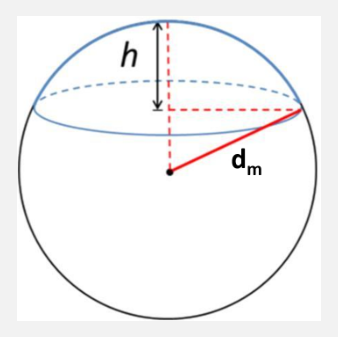
(a) (8 marks) Work out the surface area of the big-shiny-moving-star-inator that:
- (i) (7 marks) meets the government’s criteria.
- (ii) (1 mark) would take the shortest time to travel.
State any assumptions you have made to get to your answer.
The big-shiny-moving-star-inator is a statite: it will remain at a fixed position rather than orbiting around the star. The radiation pressure is given below, where is the intensity at the mirror (flux) and is the speed of light.
(b) (2 marks) Show that the position of the big-shiny-moving-star-inator will not affect its ability to be a statite.
Fonte: Testo (PDF) — p.3 Topic: Astrophysics, Gravitation Metodi: Newton’s Law of Gravitation, Physical Modeling, Order-of-Magnitude Estimation, Symmetry Argument Competenze: Physical Reasoning, Mathematical Modeling, Estimation & Approximation Objects: Mirror, Star, Photon
The Stellar Engine Solution
An emergency meeting has been called, and your team has been summoned to the Omega Threat Level Situation Room.
Una scoperta scioccante è stata fatta. Tra 100 milioni di anni una stella straniera colpirà con la vostra e distruggerà la vostra civiltà. Sapete che c’è una ‘zona sicura’ a cinque anni luce e decidete che la migliore via d’azione è spostare la stella, piuttosto che lasciare la stazione. Il governo accetta di permetterti di costruire un dispositivo che muova la stella, ma vuole che i costi e l’impatto sulla vita quotidiana della civiltà restino il più bassi possibili.
Il dispositivo userà l’impulso dei fotoni stellari per muovere la stella e a sua volta la vostra civiltà. Il dispositivo sarà realizzato con riflettori, un materiale riflettente ultra-sottile, che il tuo team formerà in uno specchio parabolico e posizionerà a una distanza dalla stella. Quando i fotoni colpiranno lo specchio, saranno riflessi con impartito impulso, colpendo e lasciando la superficie.
Il tuo team chiama il dispositivo * grande-brillante-movente-stella-inatore* (o sulla Terra un *Shkadov propulsor *), è uno statito che significa che non orbiterà intorno alla stella ma rimarrà in una posizione fissa (a causa di un equilibrio di gravità e pressione della radiazione).
Dati utili:
- lunghezza d’onda di spettro di picco di mirtillo, nm
- massa di mirtillo, kg
- raggio di mirtillo, m
- Distanza da mirtillo a statite, m
- costante di Stefan-Boltzmann,
- Legge di Wein,
- Un anno luce m
- One million years s
L’area superficiale di un tappo sferico è data da , dove è l’altezza (o la profondità) dello specchio.
**(a) (8 marchi) ** Esaminare la superficie del * grande e luminoso in movimento stella-inatore * che:
- **i) (7 marks) ** soddisfa i criteri del governo.
- ** (ii) (1 punto) ** richiederebbe il tempo di viaggio più breve.
Indicate le ipotesi che avete formulato per arrivare alla vostra risposta.
Il * grande e luminoso stella-inatore in movimento* è uno statite: rimarrà in posizione fissa piuttosto che orbitare attorno alla stella. La pressione radiologica è indicata di seguito, dove è l’intensità allo specchio (fluo) e è la velocità della luce.
*(b) (2 punti) ** Mostra che la posizione del * grande e luminoso-movente star-inator non influenzerà la sua capacità di essere statita.
Fonte: Testo (PDF) — p.3 Topic: Astrophysics, Gravitation Metodi: Newton’s Law of Gravitation, Physical Modeling, Order-of-Magnitude Estimation, Symmetry Argument Competenze: Physical Reasoning, Mathematical Modeling, Estimation & Approximation Objects: Mirror, Star, Photon
An Alternative Space Craft
Another group of scientists on Cheesecake is investigating a different strategy of relocating to a star called Raspberry using a combustion engine.
The main idea is to develop the most energy-efficient fuel and produce a large amount of it to power the combustion engine. As a reference to the most efficient combustion reaction, scientists consider hydrogen, producing . Other reactions will provide a similar level of efficiency.
(a) (4 marks) Derive the relation between the achievable and fuel exhaust velocities. This relation should purely rely on momentum conservation in the absence of external force. Identify how the final velocity depends on the masses of the empty spacecraft () and fuel ().
(b) (4 marks) Find the upper limit estimation of the achievable velocity in terms of the speed of light. It may help you know that the number of atoms in the observable universe is assumed to be .
(c) (2 marks) Find the combustion reaction energy which allows achieving at least final velocity.
Fonte: Testo (PDF) — p.5 Topic: Conservation of Momentum, Special Relativity Metodi: Conservation of Momentum, Mass-Energy Equivalence, Calculus-Integration, Order-of-Magnitude Estimation Competenze: Mathematical Modeling, Estimation & Approximation, Physical Reasoning Objects: —
Una nave spaziale alternativa
Un altro gruppo di scienziati di Cheesecake sta studiando una strategia diversa di trasferimento a una stella chiamata Raspberry usando un motore a combustione.
L’idea principale è quella di sviluppare il combustibile più efficiente e produrre una grande quantità di questo per alimentare il motore a combustione. Come riferimento alla reazione di combustione più efficiente, gli scienziati considerano l’idrogeno, producendo . Altre reazioni forniranno un livello di efficienza simile.
**(a) (4 marchi) ** Derivare la relazione tra le velocità di scarico raggiungibili e il combustibile. Tale relazione dovrebbe basarsi puramente sulla conservazione del momento in assenza di forza esterna. Indicare come la velocità finale dipenda dalle masse della sonda spaziale vuota () e dal combustibile ().
**(b) (4 punti) ** Trova la stima limite superiore della velocità raggiungibile in termini di velocità della luce. Potrebbe aiutarvi a sapere che il numero di atomi nell’universo osservabile è supposto di essere .
**(c) (2 punti) ** Trova l’energia della reazione di combustione che consente di raggiungere almeno la velocità finale .
Fonte: Testo (PDF) — p.5 Topic: Conservation of Momentum, Special Relativity Metodi: Conservation of Momentum, Mass-Energy Equivalence, Calculus-Integration, Order-of-Magnitude Estimation Competenze: Mathematical Modeling, Estimation & Approximation, Physical Reasoning Objects: —
What If… All Energy Was Electrical?
When attempting to build a new form of electrical generator, scientists at Cheesecake study the equivalence between the electron’s mass and its electrical properties.
Any system energy is related to its mass by the Einstein relation . In this way, we can assign to, for example, electric field energy to its effective mass. Let us assume that the entire mass of an electron is “electric”.
Useful data:
- electron mass kg;
- electron charge C;
- speed of light ;
- Coulomb’s law constant ;
- electric constant (vacuum permittivity) .
(a) (5 marks) Determine the “electric” radius of the electron, assuming that the electron charge is evenly distributed over its surface.
In the most accurate experiments, Coulomb’s law has been validated for radius as small as m.
(b) (5 marks) Compare actual electron mass and effective “mass” of the electric field outside the sphere of m radius.
Fonte: Testo (PDF) — p.6 Topic: Electrostatics, Modern-Quantum Physics Metodi: Coulomb’s Law, Electric Potential Method, Mass-Energy Equivalence, Calculus-Integration Competenze: Mathematical Modeling, Physical Reasoning Objects: Electron
E se… Tutta l’energia era elettrica?
Quando si tenta di costruire una nuova forma di generatore elettrico, gli scienziati di Cheesecake studiano l’equivalenza tra la massa dell’elettrone e le sue proprietà elettriche.
Ogni energia del sistema è correlata alla sua massa con la relazione di Einstein . In questo modo, possiamo assegnare, ad esempio, l’energia del campo elettrico alla sua massa effettiva. Supponiamo che l’intera massa di un elettrone sia “elettrica”.
Dati utili:
- massa di elettroni kg;
- carica di elettroni C;
- velocità della luce ;
- costante della legge di Coulomb ;
- costante elettrica (permissibilità al vuoto) .
**(a) (5 marchi) ** Determina il raggio “elettrico” dell’elettrone, supponendo che la carica elettronica sia distribuita uniformemente sulla sua superficie.
Nei più precisi esperimenti, la legge di Coulomb è stata convalidata per un raggio di m.
**(b) (5 marchi) ** Confronta la massa effettiva degli elettroni e la “massa” effettiva del campo elettrico al di fuori della sfera di raggio m.
Fonte: Testo (PDF) — p.6 Topic: Electrostatics, Modern-Quantum Physics Metodi: Coulomb’s Law, Electric Potential Method, Mass-Energy Equivalence, Calculus-Integration Competenze: Mathematical Modeling, Physical Reasoning Objects: Electron
Refuelling with Hemisphere Hydrodynamics
You have been brought in by the engineering department to look at the funnels used for refuelling the station’s shuttles. You meet up with your friend Tigger who has already put on his orange overalls (that are always covered in black horizontal grease stains).
Tigger decided to learn some hydrodynamics, playing with a semi-spherical funnel. The funnel has an inner radius , mass and can be filled with a liquid of density .
For all tasks, you may need the volume of a spherical cap formula (refer to figure 4 for notations):
- in terms of sphere radius and cap height ;
- in terms of cap radius and height .
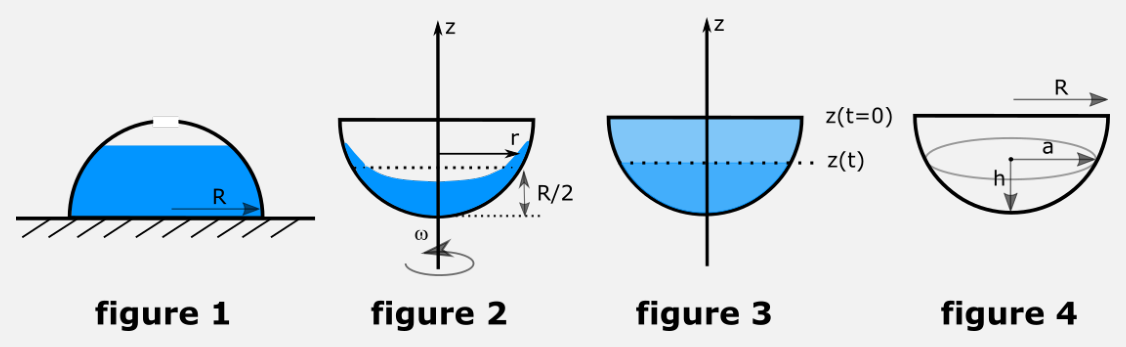 figure 1, figure 2, figure 3, figure 4
(a) (4 marks) Tigger places the funnel upside down on a rubber base, so, the connection between the funnel edge and the surface is hermetic. Through the hole in the top, Tigger pours the liquid in, measuring the total volume. At some moment, the hydrostatic pressure pushes the funnel up, and the liquid starts leaking. Identify the total liquid volume when this happens. Assume that this volume is strictly less than the total funnel volume. Refer to figure 1.
(b) (4 marks) Another experiment Tigger performed is about the half-full funnel that spins with constant angular velocity . Your task is to find the equation of a liquid free surface that is formed by the balance between hydrostatic and centrifugal forces. As the system is axially symmetrical, it is sufficient to find the liquid level as a function of radial coordinate . Refer to figure 2.
(c) (2 marks) In the last experiment, Tigger heated up the full funnel with the heater of power . Your task is to find the level of the liquid will decrease with time. For simplicity, you can assume that the liquid is at its boiling temperature, and the unit mass heat of evaporation is . Refer to figure 3.
Fonte: Testo (PDF) — p.7 Topic: Fluid Mechanics, Thermodynamics Metodi: Hydrostatic Equilibrium, Calculus-Integration, Free-Body Diagram, Physical Modeling Competenze: Mathematical Modeling, Physical Reasoning, Diagrammatic Reasoning Objects: Container
Ricarica con Hemisphere Hydrodynamics
Sei stato portato dal dipartimento di ingegneria per vedere i funelli utilizzati per rifornire le navette della stazione. Incontri il tuo amico Tigger che ha già messo le sue mutande arancione (che sono sempre coperte da macchie di grasso orizzontale nere).*
Tigger ha deciso di imparare l’idrodinamica, giocando con un funnel semisferico. Il funile ha un raggio interno , massa e può essere riempito di un liquido di densità .
Per tutte le attività, è possibile che sia necessario il volume di una formula di tappo sferica (per le notazioni si veda la figura 4):
- in termini di raggio di sfera e altezza del tappo ;
- in termini di raggio e altezza del tappo .
figura 1, figura 2, figura 3, figura 4
**(a) (4 marchi) ** Tigger pone il funnel a testa in giù su una base di gomma, quindi la connessione tra il bordo del funnel e la superficie è ermetica. Attraverso il buco in cima, Tigger versò il liquido, misurando il volume totale. In un certo momento, la pressione idrostatica spinge l’imbranaggio e il liquido inizia a perdere. Indicare il volume totale del liquido quando ciò accade. Supponiamo che questo volume sia strettamente inferiore al volume totale del funnel. Si riferisce alla figura 1.
**(b) (4 punti) ** Un altro esperimento eseguito da Tigger è circa il funnel a metà piena che ruota con una velocità angolare costante . Il tuo compito è trovare l’equazione di una superficie libera di liquido che è formata dall’equilibrio tra forze idrostatiche e centrifugate. Poiché il sistema è assimetrico, è sufficiente trovare il livello di liquido come funzione della coordinata radial . Si riferisce alla figura 2.
** c) (2 punti) ** Nell’ultimo esperimento, Tigger ha riscaldato l’intero funnel con il riscaldatore di potenza . Il tuo compito è scoprire che il livello del liquido diminuirà nel tempo. Per semplicità, si può presumere che il liquido sia a temperatura di ebollizione e che il calore di massa unitario dell’evaporazione sia . Si riferisce alla figura 3.
Fonte: Testo (PDF) — p.7 Topic: Fluid Mechanics, Thermodynamics Metodi: Hydrostatic Equilibrium, Calculus-Integration, Free-Body Diagram, Physical Modeling Competenze: Mathematical Modeling, Physical Reasoning, Diagrammatic Reasoning Objects: Container
Simple Harmonic Mattresses
The space station’s maintenance team need your help, they have had complaints about the living quarters’ mattresses. They would like you to research how different combinations of springs affect the bounciness of the mattresses.
This question is concerned with the oscillations of a single particle, mass , moving on a smooth horizontal table under the influence of two or more perfect springs. Each spring obeys Hooke’s law with stiffness and has natural length . In all diagrams, the system is in its equilibrium position.
For the system comprising just one spring with motion in the direction , as shown in figure 1,
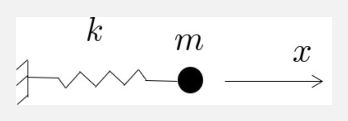 Figure 1: Single spring-mass system.
the period, , is, in terms of and , given by
In the following parts you are asked to obtain the appropriate period, , in the form
In each case the equilibrium position is defined by the length with .
(a) (2 marks) Consider the system with two springs as shown in figure 2.
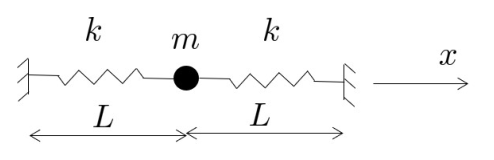 Figure 2: System with two springs along direction of motion.
Find the value of .
For the remaining parts, you should consider small amplitude oscillations in the appropriate direction , i.e. . You may find it convenient to write and evaluate distances correct to first order in , i.e. ignore terms and higher, and then write down the appropriate equation of motion.
(b) (3 marks) This part involves two springs, as shown in figure 3.
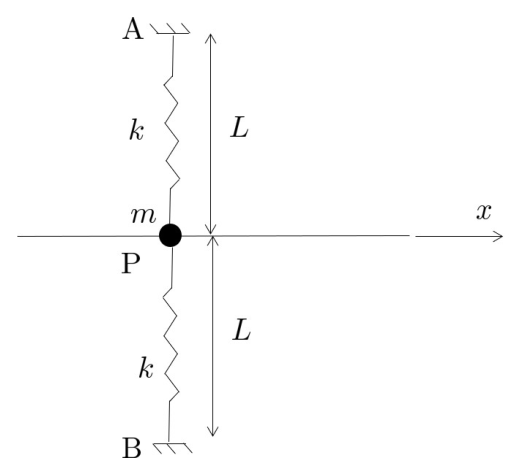 Figure 3: System with two springs perpendicular to direction of motion.
Find the value of .
(c) (2 marks) You may find the result in this section to be of help in sections (iv) and (v).
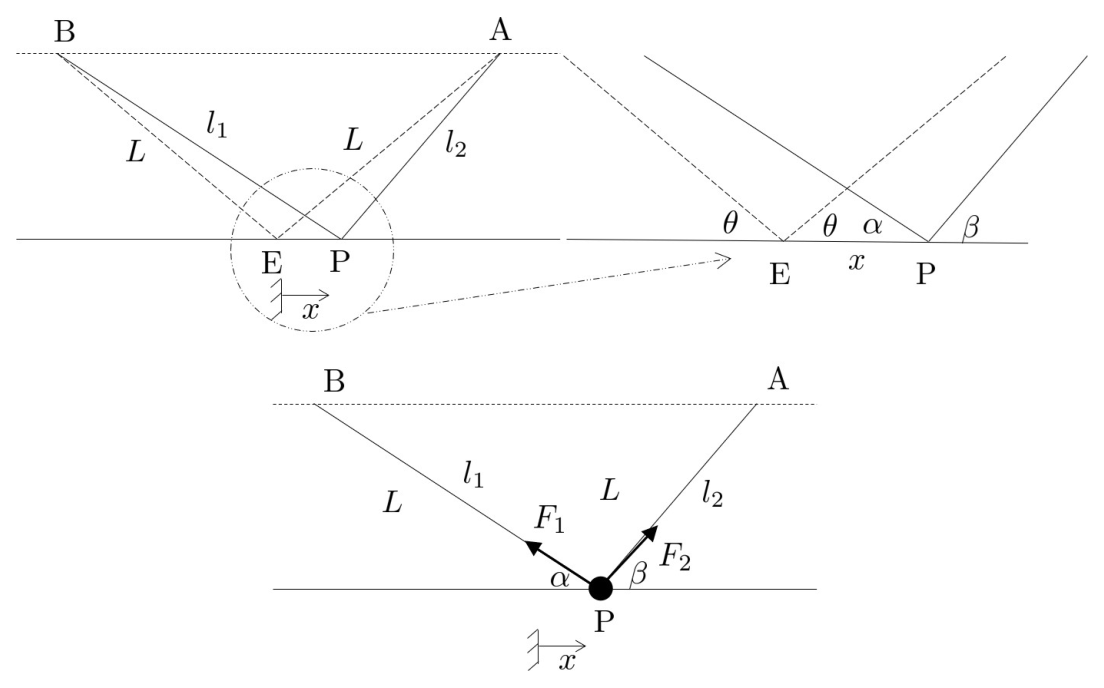 Figure 4: (a) Definition of , , and ; (b) forces and .
The situation shown in figure 4(a) shows a point, P, a small distance, , from the point E. Show: Either Or Suppose that we have a symmetric system of springs such that the motion is always along the direction as shown in figure 4. Two such springs are shown in figures 4(a) and (b). Using the results above, show that the magnitude of the force in each spring is given, to first order, by and that the tension force, , and the compression force, , yield a combined, first order, component in the -direction
(d) (2 marks) This part involves four springs along the diagonals of a square, ABCD, as shown in figure 5.
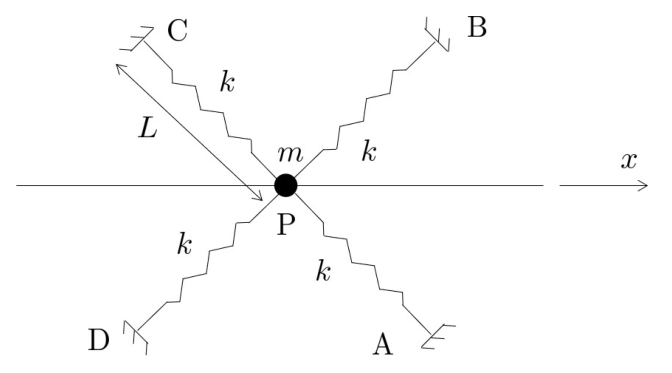 Figure 5: System with four springs along the diagonals of a square.
Find the value of .
(e) (1 mark) This final part involves six springs arranged in a regular hexagonal form, ABCDEF, as shown in figure 6.
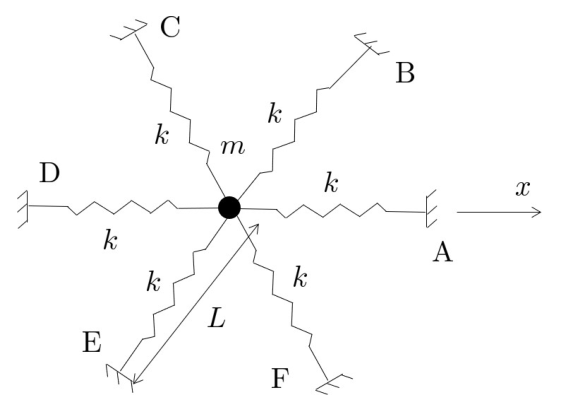 Figure 6: System with six springs in a regular hexagon.
Find the value of .
Fonte: Testo (PDF) — p.8 Topic: Oscillations & Waves, Newtonian Mechanics Metodi: Simple Harmonic Motion Analysis, Hooke’s Law, Approximation & Series Expansion, Vector Decomposition Competenze: Mathematical Modeling, Physical Reasoning, Diagrammatic Reasoning Objects: Spring, Block
Semplice materasso armonico
Il team di manutenzione della stazione spaziale ha bisogno del vostro aiuto, hanno avuto lamentele sui materassi dei locali. Essi vorrebbero che tu studiasse come le diverse combinazioni di molla influenzino la bobina dei materassi.*
Questa domanda riguarda le oscillazioni di una singola particella, di massa , che si muove su una tavola orizzontale liscia sotto l’influenza di due o più sorgenti perfette. Ogni primavera obbedisce alla legge di Hooke con rigidità e ha una lunghezza naturale . In tutti i diagrammi, il sistema è in posizione di equilibrio.
Per il sistema che comprende solo una molla con movimento nella direzione , come mostrato alla figura 1,
Figura 1: Sistema a massa solare di molla.
il periodo è, in termini di e , dato da:
Le seguenti parti ti chiedono di ottenere il termine appropriato, , nella forma
In ogni caso la posizione di equilibrio è definita dalla lunghezza con .
**(a) (2 punti) ** Considerate il sistema con due molla come mostrato nella figura 2.
Figura 2: Sistema con due mollacci lungo la direzione di movimento.
Trova il valore di .
Per le altre parti, si devono considerare oscillazioni * di piccola amplitudine * nella direzione appropriata , ovvero . Potresti trovare conveniente scrivere e valutare le distanze corrette al primo ordine in , ovvero ignorare i termini e superiori, e poi scrivere l’equazione di movimento appropriata.
**(b) (3 punti) ** Questa parte comprende due molle, come mostrato alla figura 3.
Figura 3: Sistema con due molla perpendicolare alla direzione di movimento.
Trova il valore di .
** c) (2 punti) ** Il risultato di questa sezione può essere utile nelle sezioni (iv) e (v).
Figura 4: (a) Definizione di , , e ; (b) forze e .
La situazione mostrata alla figura 4 ((a) mostra un punto, P, a distanza small, , dal punto E. - Lo spettacolo: O Or Supponiamo di avere un sistema simmetrico di molla in modo tale che il movimento sia sempre lungo la direzione come mostrato nella figura 4. Due di queste sorgenti sono illustrate nelle figure 4 (a) e (b). Usando i risultati di cui sopra, mostrare che la grandezza della forza in ogni primavera è data, al primo ordine, da e che la forza di tensione, , e la forza di compressione, , producono un componente combinato di primo ordine nella direzione
**(d) (2 marchi) ** Questa parte comprende quattro molle lungo le diagonali di un quadrato, ABCD, come mostrato alla figura 5.
Figura 5: Sistema con quattro molle lungo le diagonali di un quadrato.
Trova il valore di .
**(e) (1 segno) ** Questa parte finale comprende sei molle disposte in forma esagonale regolare, ABCDEF, come mostrato alla figura 6.
Figura 6: Sistema con sei mollacci in un esagono regolare.
Trova il valore di .
Fonte: Testo (PDF) — p.8 Topic: Oscillations & Waves, Newtonian Mechanics Metodi: Simple Harmonic Motion Analysis, Hooke’s Law, Approximation & Series Expansion, Vector Decomposition Competenze: Mathematical Modeling, Physical Reasoning, Diagrammatic Reasoning Objects: Spring, Block
The Firefly Dance
A team of biologists on the space station are struggling to understand the patterns they see from the fireflies in their lab. It is up to you as physicists to show them biologists up and investigate the synchronization of fireflies.
Fireflies provide one of the most spectacular examples of synchronization in nature. Male fireflies gather on trees and flash on and off in unison at night in order to attract female fireflies.
A simple model of synchronization of fireflies’ flashing rhythm in response to stimuli can be given as follows. Let be the phase of the firefly’s flashing rhythm, with being the instant when a flash is emitted. Assume that in the absence of external stimuli, the firefly goes through this cycle at an off and at a constant frequency , so that , where .
Now suppose there exists an external periodic stimulus whose phase satisfies the same differential equation but different frequency , i.e.
\dot\Theta = \Omega, \tag{1}
where is when the flash of the external stimulus is on. This stimulus can be e.g. another firefly, or even artificial LED light. We can model the firefly’s response to this stimulus as follows:
- If the stimulus is ahead in the cycle, then we assume that the firefly speeds up in attempt to synchronize.
- Conversely, the firefly tries to slow down if the stimulus is behind (i.e. firefly is flashing too early).
A simple model that incorporates these assumptions is
\dot\theta = \omega + A\sin(\Theta - \theta), \quad A > 0. \tag{2}
Clearly, if is ahead of , i.e. then the firefly speeds up (). The parameter is called the reacting strength of the firefly, which measures the ability of the firefly to modify its instantaneous frequency.
We say that the firefly has been entrained by the stimulus if it successfully matches the frequency of the stimulus.
(a) (1 mark) By defining two dimensionless quantities (dimensionless time) and , construct a single differential equation for a function that describes the dynamics of synchronization given by the model above.
What quantity is ? (Hint: two words)
(b) (2 marks) Sketch the phase diagrams (), where for the three cases: (i) , (ii) , and (iii) . On the -axis of each diagram, draw an arrow to the right if and to the left when . Hence, show that for these fixed points, one of which is stable, (ii) has one stable and one unstable fixed points, while (iii) has no fixed point at all.
(c) (1 mark) Use the results so far to argue that for the firefly will eventually flash simultaneously.
(d) (1 mark) In the similar spirit as part (c), argue that for the firefly will be phase-locked to the stimulus. Your answer should explain why the term “phase-locking” is used in this regime and the nature of the phase locking itself.
(e) (1 mark) For , the firefly is said to be phase-drifted relative to the stimulus. However, the phase drift is not uniform. When is the phase drift, the fastest and the slowest in terms of the phases of the firefly and the stimulus?
(f) (2 marks) The model makes a testable and specific predictions. Show that the range of entrainment, which is the range of frequency of the firefly flashing for which it can be entrained, is given by
The parameter is typically determined by experiments.
(g) (2 marks) For , calculate the period of the phase drift , which is the time taken for the stimulus and the firefly to flash simultaneously again (but they never synchronize). Hence, explain physically why this period is ill-defined or should be regarded as infinity for .
Fonte: Testo (PDF) — p.12 Topic: Oscillations & Waves, Mathematics Metodi: Differential Equations, Dimensional Analysis, Physical Modeling, Calculus-Integration Competenze: Mathematical Modeling, Diagrammatic Reasoning, Physical Reasoning Objects: —
The Firefly Dance
A team of biologists on the space station are struggling to understand the patterns they see from the fireflies in their lab. It is up to you as physicists to show them biologists up and investigate the synchronization of fireflies.
Le luci di fuoco sono uno degli esempi più spettacolari di sincronizzazione nella natura. I maschi si radunano sugli alberi e si accendono e si spegnevano in unisono di notte per attirare le femmine.
Un modello semplice di sincronizzazione del ritmo lampeggiante delle luci di fuoco in risposta agli stimoli può essere dato come segue. La fase deve essere la fase del ritmo lampeggiante della volpe da fuoco, con l’istante in cui viene emesso un lampeggio. Supponiamo che, in assenza di stimoli esterni, la volpe di fuoco attraversare questo ciclo a una frequenza costante , in modo che , dove .
Ora supponiamo che esista uno stimolo periodico esterno la cui fase soddisfa la stessa equazione differenziale ma una frequenza diversa , cioè
\dot\Theta = \Omega, \tag{1}
quando è quando il flash dello stimolo esterno è acceso. Questo stimolo può essere, per esempio: un’altra volpe di fuoco, o persino una luce artificiale LED. Possiamo modellare la risposta della volpe a questo stimolo come segue:
- Se lo stimolo è avanti nel ciclo, allora supponiamo che la volpe si accelera nel tentativo di sincronizzare.
- Al contrario, la volpe tenta di rallentare se lo stimolo è in ritardo (cioè la volpe di fuoco lampeggia troppo presto).
Un modello semplice che incorpora queste ipotesi è
\dot\theta = \omega + A\sin(\Theta - \theta), \quad A > 0. \tag{2}
In caso di è preceduto da , ovvero , la volpe di fuoco accelera (). Il parametro è chiamato * resistenza alla reazione* della volpe da fuoco, che misura la capacità della volpe da fuoco di modificare la sua frequenza istantanea.
We say that the firefly has been entrained by the stimulus if it successfully matches the frequency of the stimulus.
**(a) (1 segno) ** Definendo due quantità senza dimensioni (tempo senza dimensioni) e , costruire un’equazione differenziale single per una funzione che descriva la dinamica di sincronizzazione data dal modello di cui sopra.
Qual è la quantità ? **(Insigno: ** due parole)
**(b) (2 marchi) ** Segnare i diagrammi di fase (), dove per i tre casi: (i) , (ii) e (iii) . Sulla parte di ciascun diagramma, disegnare una freccia a destra se e a sinistra se . Quindi, dimostrare che per questi punti fissi, uno dei quali è stabile, (ii) ha un punto fisso stabile e uno instabile, mentre (iii) non ha alcun punto fisso.
*(c) (1 segno) ** Utilizzare i risultati finora per sostenere che per la mosca di fuoco infine lampeggia * contemporaneamente.
**(d) (1 punto) ** In senso simile alla parte (c), sostenere che per la mosca di fuoco sarà *fase bloccata * allo stimolo. La risposta dovrebbe spiegare perché il termine “blocco di fase” è usato in questo regime e la natura del blocco di fase stesso.
**(e) (1 segno) ** Per , si dice che la volpe di fuoco sia * a deriva di fase * rispetto allo stimolo. Tuttavia, la deriva di fase non è uniforme. Quando è la deriva di fase, la più veloce e la più lenta in termini di fasi della volpe e dello stimolo?
**(f) (2 punti) ** Il modello fa una previsione verificabile e specifica. Indicare che il range di intrattenimento ****, che è il range di frequenza del lampeggiamento della volpe da fuoco per il quale può essere intrattenuto, è dato da
Il parametro è determinato tipicamente da esperimenti.
**(g) (2 marchi) ** Per calcolare il periodo di deriva di fase , che è il tempo necessario per il fulmine dello stimolo e della mosca di fuoco di nuovo contemporaneamente (ma non si sincronizzano mai). Pertanto, spiegare fisicamente perché questo periodo è poco definito o dovrebbe essere considerato come infinito per .
Fonte: Testo (PDF) — p.12 Topic: Oscillations & Waves, Mathematics Metodi: Differential Equations, Dimensional Analysis, Physical Modeling, Calculus-Integration Competenze: Mathematical Modeling, Diagrammatic Reasoning, Physical Reasoning Objects: —
Bending Light in a Plane
One of the concerns with moving the space station is that it might end up in a black hole and transport us to a different reality that exists only in two-dimensions. With concerns mounting, you have been tasked to investigate how light would behave in this two-dimensional world.
Imagine living in a (two-dimensional) world where the refractive index varies as a function of height: A person in this world stands at the origin () and shines a light beam directed at upward.
(a) (9 marks) Determine the equation of the path of the light beam. (Hint: light always travel in the path that takes the least time.)
(b) (1 mark) Plot the path of the light beam.
Fonte: Testo (PDF) — p.14 Topic: Geometric Optics, Mathematics Metodi: Snell’s Law, Ray Tracing, Calculus-Integration, Differential Equations Competenze: Mathematical Modeling, Physical Reasoning, Diagrammatic Reasoning Objects: —
Luminazione di inclinazione in un aereo
One of the concerns with moving the space station is that it might end up in a black hole and transport us to a different reality that exists only in two-dimensions. With concerns mounting, you have been tasked to investigate how light would behave in this two-dimensional world.
Immaginate di vivere in un mondo (bidimensionale) in cui l’indice di rifrazione varia in funzione dell’altezza: A person in this world stands at the origin () and shines a light beam directed at upward.
**a) (9 marchi) ** Determina l’equazione del percorso del fascio luminoso. (Signore: la luce viaggia sempre nel percorso che richiede il minor tempo.)
**(b) (1 segno) ** Tracciare il percorso del fascio luminoso.
Fonte: Testo (PDF) — p.14 Topic: Geometric Optics, Mathematics Metodi: Snell’s Law, Ray Tracing, Calculus-Integration, Differential Equations Competenze: Mathematical Modeling, Physical Reasoning, Diagrammatic Reasoning Objects: —
A Magnetic Spa Day
Researchers at Cheesecake are developing on the concept of a super-efficient magnet-based engine. For these purposes, they study a magnetic dipole-dipole interaction in a hot environment.
Suppose and are two classical dipole moments, separated by a vector . The potential energy from the dipole-dipole interaction is where and .
(a) (2 marks) By parameterising the vectors and in spherical polar coordinates in the usual way and choosing a coordinate system where is in the direction, show that the potential may be parameterised as
(b) (7 marks) Suppose the dipoles are both in thermal equilibrium with a heat bath at temperature , and consider the limit of large temperature where
Calculate the mean force between the dipoles in the direction to leading order in . Is this force attractive or repulsive?
(c) (1 mark) In the same limit as above, explain why the mean force in the perpendicular directions will be zero.
Fonte: Testo (PDF) — p.15 Topic: Magnetism, Thermodynamics Metodi: Statistical Averaging, Approximation & Series Expansion, Calculus-Integration, Vector Decomposition Competenze: Mathematical Modeling, Physical Reasoning Objects: Magnetic Dipole
Un giorno di spa magnetico
I ricercatori di Cheesecake stanno sviluppando il concetto di un motore a base di magneti super-efficienti. Per questi scopi, studiano un’interazione di dipolo-dipolo magnetico in un ambiente caldo.*
Supponiamo che e siano due momenti di dipole classici, separati da un vettore . L’energia potenziale dell’interazione dipolo-dipolo è dove e .
**(a) (2 punti) ** Parametrizzando i vettori e nelle coordinate polari sferiche nel modo usuale e scegliendo un sistema di coordinate in cui è nella direzione , dimostrare che il potenziale può essere parametrizzato come
**(b) (7 marchi) ** Supponiamo che i dipoli siano entrambi in equilibrio termico con un bagno termico a temperatura , e consideriamo il limite di temperatura elevata dove
Calcolare la forza media tra i dipoli nella direzione all’ordine di conduzione in . Questa forza è attraente o repulsiva?
**(c) (1 segno) ** Nella stessa limitazione di cui sopra, spiegare perché la forza media nelle direzioni perpendicolari sarà zero.
Fonte: Testo (PDF) — p.15 Topic: Magnetism, Thermodynamics Metodi: Statistical Averaging, Approximation & Series Expansion, Calculus-Integration, Vector Decomposition Competenze: Mathematical Modeling, Physical Reasoning Objects: Magnetic Dipole
Droplets in SPACE
You are conducting some experiments on liquid droplets in Cheesecake’s ‘zero gravity’ lab. After work, you crack open a few drinks with your mates. When Tigger spilt his drink, you realised that he’d had a bit much, but you also noticed droplets starting to form in thin air coming from the spilt drink.
In this task, you are not expected to know exact expressions for the capillary force for specific geometry. You rather should base your derivation on the logic of important parameters measurement units.
A free-floating spherical droplet (in the absence of gravity) can experience deformation oscillations, which are driven by the surface tension forces and liquid inertia.
(a) (5 marks) Your task is to estimate the main mode eigenfrequency of the droplet oscillation.
The same liquid being evaporated condensates at the space station’s ceiling and form a group of growing droplets. Consider the balance between surface tension force, which keeps the droplet in place, and gravity force, which pulls the droplet down.
(b) (5 marks) Your task is to estimate the maximal possible radius of the droplet which stays on the ceiling.
Fonte: Testo (PDF) — p.16 Topic: Fluid Mechanics, Oscillations & Waves Metodi: Dimensional Analysis, Order-of-Magnitude Estimation, Physical Modeling, Hydrostatic Equilibrium Competenze: Estimation & Approximation, Physical Reasoning, Mathematical Modeling Objects: Droplet
Gattole in SPACE
Lei sta conducendo alcuni esperimenti su goccioline liquide nel laboratorio di gravità zero di Cheesecake. Dopo il lavoro, fai un paio di drink con i tuoi amici. Quando Tigger ha versato la sua bevanda, hai capito che aveva bevuto un po’ troppo, ma hai anche notato che le goccioline iniziarono a formarsi nell’aria sottile provenienti dalla bevanda versata.
In questo compito non si prevede che si conoscano espressioni esatte per la forza capillare per una geometria specifica. Dovreste basare la vostra derivazione sulla logica di importanti unità di misura dei parametri.
Una goccia sferica in flotta libera (in assenza di gravità) può subire oscillazioni di deformazione, determinate dalle forze di tensione superficiale e dall’inerzia liquida.
**a) (5 punti) ** Il tuo compito è stimare la frequenza propria della oscillazione della goccia in modalità principale.
Lo stesso liquido evaporato si condensa al soffitto della stazione spaziale e forma un gruppo di gocce in crescita. Considerate l’equilibrio tra la forza di tensione superficiale, che mantiene la goccia in posizione, e la forza gravitazionale, che tira giù la goccia.
**(b) (5 punti) ** Il vostro compito è quello di stimare il raggio massimo possibile della goccia che rimane sul soffitto.
Fonte: Testo (PDF) — p.16 Topic: Fluid Mechanics, Oscillations & Waves Metodi: Dimensional Analysis, Order-of-Magnitude Estimation, Physical Modeling, Hydrostatic Equilibrium Competenze: Estimation & Approximation, Physical Reasoning, Mathematical Modeling Objects: Droplet
Oscillators on a Train
While on the train going to give your report on all previous investigations, you take the opportunity to conduct one more investigation with your pocket oscillator.
You are sitting on a train, and have an oscillator which consists of a point mass moving in a harmonic well in the reference frame of the train. The period of the oscillator is exactly one second; and its orientation coincides with the direction of motion of the train (i.e. the train will also move in the direction). The train starts at rest in the station, and will reach its cruising speed of 30 metres per second by a constant acceleration over exactly one minute. For this scenario, you are to take the mass of the point mass to be exactly one standard Anthony.
(a) (2 marks) Calculate the period of the oscillator during the accelerating period of the journey.
(b) (4 marks) While sitting in the station, you place the point mass at rest at the bottom of the harmonic well . When the train leaves the station and starts to accelerate, the mass will start to move, undergoing oscillations. Calculate the amplitude of these oscillations.
(c) (3 marks) Calculate the amplitude of oscillations after the train reaches its cruising speed.
(d) (1 mark) Does your answer to the last part depend only on the final speed reached, or does it also depend on the acceleration used to get there? Briefly discuss why this makes sense.
Fonte: Testo (PDF) — p.17 Topic: Oscillations & Waves, Newtonian Mechanics Metodi: Simple Harmonic Motion Analysis, Differential Equations, Free-Body Diagram, Energy Conservation Method Competenze: Mathematical Modeling, Physical Reasoning Objects: —
Oscilatori su un treno
Mentre sei in treno per presentare la tua relazione su tutte le precedenti indagini, cogli l’opportunità di effettuare un’altra indagine con l’oscillatore di tasca.
Si è seduti su un treno e si dispone di un oscillatore composto da una massa di punto che si muove in un pozzo armonico nel quadro di riferimento del treno. Il periodo dell’oscillatore è esattamente di un secondo; e la sua orientamento coincide con la direzione di movimento del treno (cioè il treno si muoverà anche nella direzione ). Il treno parte in riposo nella stazione e raggiungerà la sua velocità di crociera di 30 metri al secondo con una costante accelerazione in un minuto. Per questo scenario, si deve prendere la massa della massa puntaria per essere esattamente uno standard Anthony.
**a) (2 marchi) ** Calcolare il periodo dell’oscillatore durante il periodo di accelerazione del viaggio.
**(b) (4 punti) ** Mentre si sta seduto nella stazione, si colloca la massa puntaria in riposo in fondo al pozzo armonico . Quando il treno lascia la stazione e inizia ad accelerare, la massa inizierà a muoversi, subendo oscillazioni. Calcolare l’ampiezza di queste oscillazioni.
**(c) (3 marchi) ** Calcolare l’ampiezza delle oscillazioni dopo che il treno ha raggiunto la sua velocità di crociera.
**(d) (1 punto) ** La risposta alla ultima parte dipende solo dalla velocità finale raggiunta, o dipende anche dall’accelerazione utilizzata per arrivare lì? Ravviate brevemente perché questo ha senso.
Fonte: Testo (PDF) — p.17 Topic: Oscillations & Waves, Newtonian Mechanics Metodi: Simple Harmonic Motion Analysis, Differential Equations, Free-Body Diagram, Energy Conservation Method Competenze: Mathematical Modeling, Physical Reasoning Objects: —