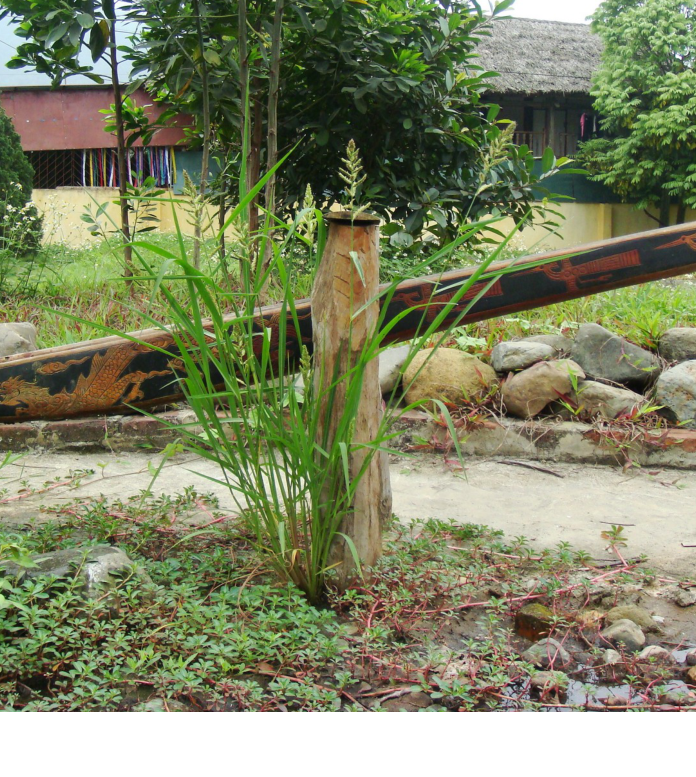
- Costruzione. Il mortaio per brillare il riso consta delle parti seguenti: Il mortaio, in sostanza un recipiente di legno che contiene il riso. La leva, che è un tronco d’albero lavorato con un’estremità più grande ed una più piccola. Essa può ruotare intorno ad un asse orizzontale. Un pestello è attaccato perpendicolarmente all’estremità più piccola della leva. Esso è lungo quanto basta per toccare il riso nel mortaio quando la leva è orizzontale. La parte più larga della leva è scavata in modo da formare un secchio. La forma di questo secchio è critica per il funzionamento del mortaio.
p.2 — Figura 1: mortaio ad acqua per riso
Topic: Newtonian Mechanics, Rotational Dynamics, Rigid Body Statics Metodi: Torque & Angular Momentum Analysis, Free-Body Diagram, Hydrostatic Equilibrium Competenze: Physical Reasoning, Mathematical Modeling, Diagrammatic Reasoning Objects: Lever, Container Fonte: Testo (PDF) — p.1 Soluzione: Soluzioni (PDF)
- It’s building. The rice-glare mortar consists of the following parts: The mortar, basically a wooden container containing rice. The levers, which is a trunk of wood worked with a larger end and a more I’m not going to lie. It can rotate around a horizontal axis. A pin is attached perpendicular to the smaller end of the lever. It is long enough to touch the rice in the mortar when the lever is horizontal. The widest part of the lever is dug to form a bucket. The form of This bucket is critical to the functioning of the mortar.
The following table shows the manufacturer’s specifications for the product:
Topic: Newtonian Mechanics, Rotational Dynamics, Rigid Body Statics Metodi: Torque & Angular Momentum Analysis, Free-Body Diagram, Hydrostatic Equilibrium Competenze: Physical Reasoning, Mathematical Modeling, Diagrammatic Reasoning Objects: Lever, Container Fonte: Testo (PDF) — p.1 Soluzione: Soluzioni (PDF)
- Modi di funzionamento Il mortaio può trovarsi in due modi.
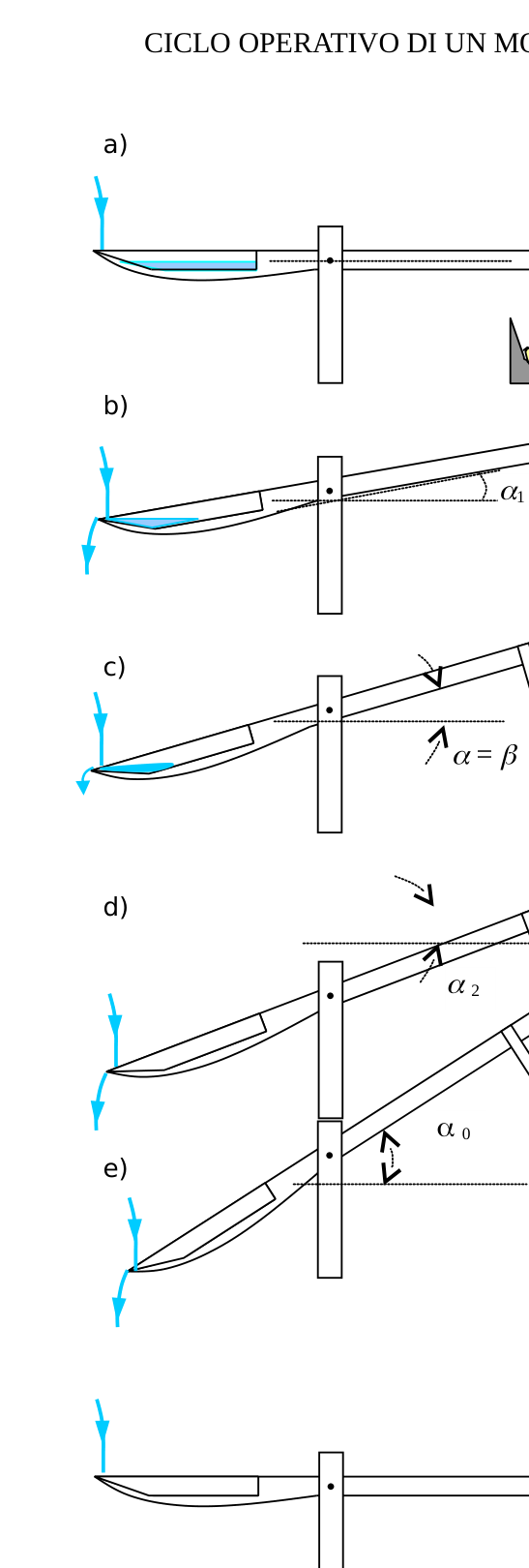
Modo operativo. In questo modo, il mortaio passa attraverso un ciclo operativo come illustrato in figura 2. L’energia per brillare il riso viene dal lavoro compiuto dal pestello sul riso durante la fase (f) della figura 2. Se, per qualche ragione, il pestello non tocca il riso, diciamo che il mortaio non lavora. Modo di riposo con la leva sollevata. Durante la fase (c) del ciclo operativo (Figura 2), man mano che aumenta l’angolo di inclinazione della leva, diminuisce la quantità d’acqua nel secchio. Ad un certo momento la quantità d’acqua rimasta è appena sufficiente per controbilanciare il peso della leva. Si indichi con l’angolo di inclinazione in questo istante. Se la leva viene posta ad un angolo e la sua velocità angolare iniziale è nulla, allora essa rimane indefinitamente in questa posizione. Questo è il modo di riposo con leva sollevata. La stabilità in questa posizione dipende dalla portata d’acqua che giunge nel secchio, . Se è più grande di un certo valore , questo modo di riposo è permanente, e il mortaio non può passare al modo operativo. In altre 1 39th International Physics Olympiad - Hanoi - Vietnam - 2008 Theoretical Problem No. 1
parole, è la portata minima perché il mortaio non lavori. 2 Figura 1 Un mortaio per brillare il riso azionato ad acqua 39th International Physics Olympiad - Hanoi - Vietnam - 2008 Theoretical Problem No. 1
CICLO OPERATIVO DI UN MORTAIO PER RISO AZIONATO AD ACQUA a) All’inizio nel secchio non c’è acqua e il pestello appoggia, fermo, nel mortaio. L’acqua inizia a fluire nel secchio con un basso flusso, ma per un po’ di tempo la leva resta ferma. b) Ad un certo istante la quantità d’acqua raccolta è sufficiente perché la leva si alzi. A causa dell’inclinazione, l’acqua si sposta verso la parte più esterna del secchio, facendo alzare la leva più rapidamente. L’acqua inizia a colare via dal secchio quando . c) Man mano che aumenta, l’acqua continua a colar via. Ad un certo angolo di inclinazione, , il momento della coppia netta è nullo. d) continua a crescere, l’acqua continua a colar via finché non ne resta più nel secchio. e) continua ad aumentare per inerzia. Il flusso d’acqua continua a giungere sulla leva, ma a causa della forma del secchio quest’acqua cola via immediatamente. Il moto per inerzia della leva prosegue finché giunge ad un valore massimo . 3
1 2 0 a) b) d) e) c) 39th International Physics Olympiad - Hanoi - Vietnam - 2008 Theoretical Problem No. 1
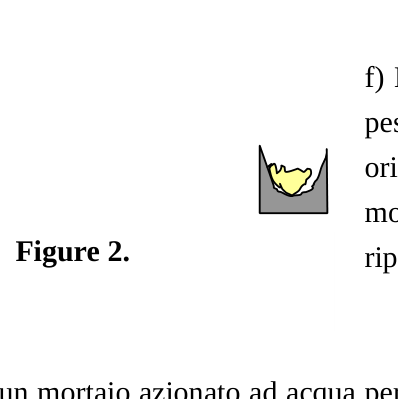
f) Non essendoci più acqua nel secchio, il peso della leva la riporta in posizione orizzontale. Il pestello dà un botta al mortaio (col riso dentro) e il ciclo riprende. C. Il problema
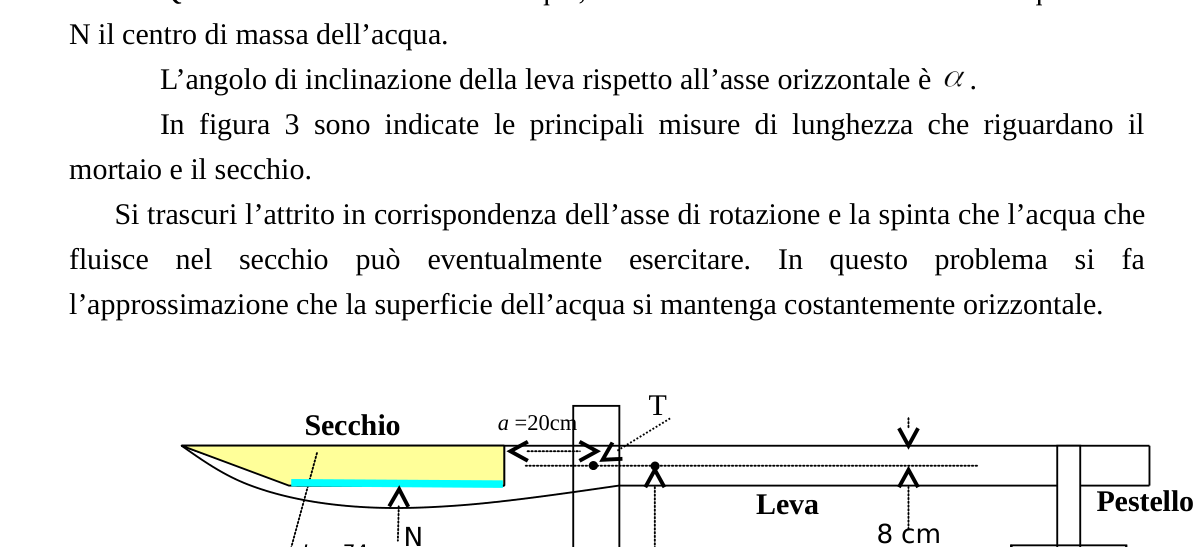
Si consideri un mortaio azionato ad acqua per brillare il riso con i seguenti parametri (si veda la figura 3): La massa della leva (compreso il pestello ma senz’acqua) è 30 kg. Il centro di massa della leva è G. La leva ruota intorno all’asse T (la cui proiezione in figura è nel punto T). Il momento d’inerzia della leva intorno a T è 12 kg m2. Quando nel secchio c’è dell’acqua, indichiamo con la massa dell’acqua e con N il centro di massa dell’acqua. L’angolo di inclinazione della leva rispetto all’asse orizzontale è . In figura 3 sono indicate le principali misure di lunghezza che riguardano il mortaio e il secchio. Si trascuri l’attrito in corrispondenza dell’asse di rotazione e la spinta che l’acqua che fluisce nel secchio può eventualmente esercitare. In questo problema si fa l’approssimazione che la superficie dell’acqua si mantenga costantemente orizzontale.
- La struttura del mortaio Inizialmente il secchio è vuoto e la leva è orizzontale. L’acqua scorre nel secchio finché la leva inizia ad alzarsi. In questo momento la quantità d’acqua nel secchio è 1.0 kg. 1.1. Si trovi la distanza fra il centro di massa G e l’asse di rotazione T. Sappiamo che 4 Figure 2. Figura 3. Struttura e dimensioni del mortaio per il riso Pestello a =20cm L = 74 cm =300 b=15c m Leva Mortaio Secchio T 8 cm
N h= 12 cm G f) 39th International Physics Olympiad - Hanoi - Vietnam - 2008 Theoretical Problem No. 1
quando il secchio è vuoto GT è orizzontale 1.2. L’acqua inizia a colar via dal secchio quando l’angolo fra la leva e l’asse orizzontale vale . Il secchio finisce di svuotarsi completamente quando vale . Si trovino e . 1.3. Sia il momento della coppia totale (rispetto all’asse T) dovuta al peso della leva e dell’acqua nel secchio. è zero quando . Si trovi e la massa di acqua nel secchio in quell’istante. 2. Parametri del modo operativo Supponiamo che l’acqua scorra nel secchio con una portata costante e piccola. Una volta che la leva si mette in moto, l’ulteriore quantità di acqua che giunge nel secchio è trascurabile. In questa parte si trascuri anche il cambiamento del momento d’inerzia durante il ciclo operativo. 2.1. Si faccia un grafico del momento della coppia in funzione dell’angolo , cioè , nel corso di un ciclo operativo. Si scrivano esplicitamente i valori di per gli angoli , , e per = 0. 2.2. Dal grafico fatto al punto precedente e nelle approssimazioni già indicate, si discuta e si dia un’interpretazione geometrica del valore dell’energia totale associata a e il lavoro che il pestello compie sul riso. 2.3. Dal grafico che rappresenta in funzione di , si dia una stima di e (si trascuri l’energia cinetica dell’acqua che entra ed esce dal secchio). Si possono sostituire le curve con righe a zig zag se ciò semplica i calcoli.
p.3 — Figura 2: ciclo operativo del mortaio
p.4 — Figura 2: fase finale del ciclo
Topic: Rotational Dynamics, Conservation of Energy, Newtonian Mechanics Metodi: Torque & Angular Momentum Analysis, Energy Conservation Method, Free-Body Diagram Competenze: Diagrammatic Reasoning, Mathematical Modeling, Physical Reasoning Objects: Lever, Container Fonte: Testo (PDF) — p.1 Soluzione: Soluzioni (PDF)
- The following information shall be provided: There are two ways to find the mortar.
Operating mode. In this way, the mortar goes through an operational cycle as as shown in Figure 2. The energy to brighten rice comes from the work done by the piston on the rice during the process of the phase (f) of Figure 2. If, for some reason, the pest does not touch the rice, let us say that the The mortar doesn’t work. Rest mode with the lever lifted. During the phase (c) of the operating cycle (Figure 2), as the angle increases the levers slope decreases the quantity Water in the bucket. At some point the amount of water left is barely sufficient to counterbalance the lever weight. Indicate with The angle of inclination at this moment. If the lever is placed at an angle And its speed. The initial angle is nothing, so it stays in this position indefinitely. This is the resting mode with raised lever. Stability in this position depends on scope of water coming out of a jar, . Se It’s bigger than a certain value. This one . The rest mode is permanent, and the mortar cannot be switched to operating mode. Other 1 The first of these is the International Physics Olympiad in Hanoi, Vietnam. Theoretical Problem No. 1
words, It’s the minimum capacity because the mortar isn’t working. 2 The following is the list of the following: A water-powered rice brightening mortar The first of these is the International Physics Olympiad in Hanoi, Vietnam. Theoretical Problem No. 1
The operating cycle of a water-powered rice mill (a) At the beginning there is no water in the bucket and the The stick is holding, standing, in the mortar. Water starts flowing into the bucket with a low flow, but for a while the The lever stays still. (b) At a given moment the amount of water The collection is enough for the lever to lift. Because of the slope, the water is Moving towards the outermost part of the The bucket, making the lever up more I’m going to get it right. The water starts to flow away. From the bucket when . (c) As long as The water rises Keep slipping away. At a certain angle of inclination, , the time of the net pair is zero. d) The water keeps growing. I’m gonna have to slide it away until there’s no more of it in the I’m going to get a bucket. e) It keeps increasing by inertia. Il The water flow continues to reach the levy, but because of the shape of the bucket This water flows away immediately. Il a continuous-lever power output of not more than 0,5% Until reaches a maximum value . 3
1 2 0 a) b) d) e) c) The first of these is the International Physics Olympiad in Hanoi, Vietnam. Theoretical Problem No. 1
(f) Since there is no more water in the bucket, the The weight of the lever returns it to position The horizontal. The punch hits the The grain must be soaked in water. It’s coming back. C. The problem
Consider a water-powered grain mill to brighten rice with the following parameters: (see Figure 3): The mass of the lever (including the piston but without water) is 30 kg. The center of mass of the lever is G. The lever rotates around the T axis (which The projection in Figure T is shown. The moment of inertia of the lever around T is 12 kg m2. When there is water in the bucket, we indicate with The mass of the water and with N the center of mass of the water. The angle of inclination of the lever relative to the horizontal axis is . Figure 3 shows the main length measures for the The mortar and the bucket. The friction between the axis of rotation and the thrust of the water is neglected. If you’re not able to get the fluid in the bucket, you can exercise. In this problem, we do The approximation that the surface of the water is constantly horizontal.
- The structure of the mortar Initially the bucket is empty and the lever is horizontal. The water flows in the bucket until The lever starts to rise. At this time the amount of water in the bucket is 1.0 kg. 1.1. Find the distance between the center of mass G and the axis of rotation T. We know that 4 Figure two. Figure 3 is shown. Structure and size of the rice mill Other a =20cm L = 74 cm =300 b=15c m It ‘s gone . Other Other T 8 cm
N h= 12 cm G f) The first of these is the International Physics Olympiad in Hanoi, Vietnam. Theoretical Problem No. 1
When the bucket is empty, GT is horizontal. 1.2. Water starts to flow out of the bucket when the angle between the lever and the bucket The horizontal value . The bucket will empty completely when is valid . Si Find them e . 1.3. Both the moment of total torque (in relation to the T axis) due to weight of the levy and the water in the bucket. is zero when . You ‘re here . and mass of water in the bucket at that moment. 2. Parameters of the operating mode Suppose the water flows into the bucket with a reach It’s constant and small. One of them. Once the levy is started, the additional amount of water entering the bucket is It’s negligible. This part also ignores the change in momentum. during the operating cycle. 2.1. Make a chart of the moment of the torque in terms of angle , that is , during an operational cycle. The values of the for The angles , , and for = 0. 2.2. From the chart given in the previous point and the approximations already given, The total energy value is discussed and given a geometric interpretation associated with and work The whipping of the rice. 2.3. From the graph that represents In accordance with , give an estimate of e (the kinetic energy of the water entering and leaving the bucket is neglected). Si They can replace the curves with zigzag lines if that simplifies the calculations.
The manufacturer shall ensure that the manufacturer is able to provide the manufacturer with the necessary information.
The following table shows the results of the study:
Topic: Rotational Dynamics, Conservation of Energy, Newtonian Mechanics Metodi: Torque & Angular Momentum Analysis, Energy Conservation Method, Free-Body Diagram Competenze: Diagrammatic Reasoning, Mathematical Modeling, Physical Reasoning Objects: Lever, Container Fonte: Testo (PDF) — p.1 Soluzione: Soluzioni (PDF)
- Il modo di riposo
Sia la portata costante d’acqua che scorre nel secchio: in questo caso non si deve trascurare la quantità d’acqua che scorre nel secchio durante il moto della leva. 3.1. Si faccia l’ipotesi che il secchio sia sempre pieno quanto basta perché l’acqua 5 39th International Physics Olympiad - Hanoi - Vietnam - 2008 Theoretical Problem No. 1
scorra via. 3.1.1. Si tracci un grafico del momento della coppia in funzione dell’angolo in prossimità di . A quale tipo di equilibrio corrisponde la posizione della leva? 3.1.2. Si trovi un’espressione analitica del momento della coppia in funzione di , ponendo , con piccolo. 3.1.3. Si scriva l’equazione del moto della leva, lasciata con velocità iniziale nulla nella posizione (con piccolo). Si faccia vedere che questo moto è, con buona approssimazione, oscillatorio armonico. Se ne determini il periodo . 3.2. Per un certo valore di , il secchio rimane pieno d’acqua in modo da versarne sempre via solo se la leva si muove abbastanza piano. C’è un limite superiore all’ampiezza delle oscillazioni, che dipende da . Si trovi il valore minimo di (espresso in kg/s) in modo che la leva possa fare un moto oscillatorio armonico di ampiezza 1o. 3.3. Si faccia l’ipotesi che sia abbastanza grande perché quando la leva si muove di moto libero e l’angolo di inclinazione scende da a ci sia sempre dell’acqua che scorre via dal secchio. Tuttavia se è troppo grande il mortaio non può lavorare. Trattando il moto della leva come oscillatorio armonico, si stimi la minima portata d’acqua perché il mortaio da riso non lavori. 6
p.4 — Figura 3: struttura e dimensioni del mortaio
Topic: Oscillations & Waves, Rotational Dynamics, Fluid Mechanics Metodi: Simple Harmonic Motion Analysis, Torque & Angular Momentum Analysis, Small-Angle Approximation Competenze: Mathematical Modeling, Physical Reasoning, Diagrammatic Reasoning Objects: Lever, Container Fonte: Testo (PDF) — p.5 Soluzione: Soluzioni (PDF)
- The Way of Rest
Both the constant flow of water in the bucket: in this case you must not neglect the amount of water flowing in the bucket during the drive. 3.1. Assume that the bucket is always full enough to water the water 5 The first of these is the International Physics Olympiad in Hanoi, Vietnam. Theoretical Problem No. 1
It’s running away. 3.1.1. You draw a graph of the moment of the torque in terms of angle near . What kind of balance does the position correspond to? of the
- What? 3.1.2. It is an analytical expression of the moment. of the pair in function of , by putting , with
- It’s a little boy. 3.1.3. Write the equation of the lever’s motion, left with zero initial speed in position (with (Little). Let’s see what this bike is, with Good approximation, harmonic oscillation. If the period is determined . 3.2. For a certain value of , the bucket remains full of water so that it can be poured It’s always gone if the lever moves slowly enough. There is an upper limit The frequency of the oscillations, which depends on the . Find the minimum value di (expressed in kg/s) so that the lever can perform a harmonic oscillating motion of 1° wide. 3.3. The Commission will take the view that the It’s big enough because when the lever moves The angle of inclination descends from the a There’s always water that’s It’s flowing out of the bucket. However, if The mortar is too big to work. The minimum torque shall be estimated by treating the lever movement as a harmonic oscillator. Water Because the rice mill doesn’t work. 6
**p.4 ** Figure 3: structure and size of the mortar
Topic: Oscillations & Waves, Rotational Dynamics, Fluid Mechanics Metodi: Simple Harmonic Motion Analysis, Torque & Angular Momentum Analysis, Small-Angle Approximation Competenze: Mathematical Modeling, Physical Reasoning, Diagrammatic Reasoning Objects: Lever, Container Fonte: Testo (PDF) — p.5 Soluzione: Soluzioni (PDF)