Sezione 1 — Circuiti elettrici
L’apparato sperimentale è composto da:
- Una base di supporto con il fotoresistore LDR, un supporto per la provetta e un supporto per la lampadina (12 V, 0,1 A).
- Un potenziometro (resistenza variabile) da 1 k a 10 giri.
- Una pila da 12 V.
- Tre multimetri (uno come ohmetro, uno come voltmetro, uno come amperometro).
- Una provetta con liquido filtrante, un filtro grigio, un righello.
Lo schema elettrico completo è rappresentato in Fig. F-4.
Domanda: Disegnare nel Foglio Risposte 1 tutti i circuiti elettrici completi, dentro i riquadri e tra i riquadri stessi, considerando il caso in cui il circuito è completamente montato. Eseguire i disegni tenendo in considerazione le indicazioni contenute nella Fig. F-4.
Topic: Circuits Metodi: Free-Body Diagram, Equivalent Circuit Reduction Competenze: Diagrammatic Reasoning, Physical Reasoning Objects: Resistor, Battery Fonte: Testo (PDF) — p.4 Soluzione: Soluzioni (PDF)
Section 1 Electrical circuits
The test apparatus shall consist of:
- A support base with LDR photoresistor, a test tube and a light bulb (12 V, 0.1 A).
- A power meter (variable resistance) from 1 k at 10 turns.
- A 12V battery.
- Three multimeters (one as an ohm, one as a voltmeter, one as an ampere meter).
- A test tube with a filter liquid, a gray filter, a rhinel.
The complete electrical pattern is shown in Fig. F-4.
Question: Draw in Answer Sheet 1 all complete electrical circuits, within the frames and between the frames, considering the case where the circuit is fully assembled. Drawings shall be executed taking into account the instructions in Fig. F-4.
Topic: Circuits Metodi: Free-Body Diagram, Equivalent Circuit Reduction Competenze: Diagrammatic Reasoning, Physical Reasoning Objects: Resistor, Battery Fonte: Testo (PDF) — p.4 Soluzione: Soluzioni (PDF)
Sezione 2 — Misura della temperatura del filamento
La resistenza elettrica di un filamento conduttore è data da
dove è la resistività del conduttore, la lunghezza e la sezione trasversale del filamento.
Per il tungsteno, nell’intervallo 300 K – 3655 K, la resistività segue la legge empirica (nel SI):
Trascurando la dilatazione termica si ottiene:
Per misurare è necessario determinare , che si ottiene misurando a temperatura ambiente .
Domande
a) Misurare con un multimetro la temperatura ambiente .
b) Non è una buona idea usare l’ohmetro per misurare a temperatura perché introduce una piccola corrente indeterminata che aumenta la temperatura del filamento. Invece, collegare la pila al potenziometro e prendere un numero sufficiente di letture della corrente per tensioni comprese tra i valori più bassi ottenibili fino a 1 V (almeno 15 misure sotto i 100 mV). Ricavare per ciascuna coppia di valori e . Disegnare un grafico di in funzione di .
c) Dal grafico del punto b), selezionare un appropriato intervallo di punti su cui costruire un fit lineare per ottenere, mediante estrapolazione, il valore quando . Ricavare e .
d) Calcolare i valori numerici di e con espresso in e in K, usando la relazione (6).
Topic: Modern-Quantum Physics, Circuits Metodi: Experimental Data Analysis, Graph Linearization, Error Propagation, Kinematic Equations Competenze: Experimental Data Analysis, Graph Linearization Objects: Resistor, Battery, Wire Fonte: Testo (PDF) — p.4 Soluzione: Soluzioni (PDF)
Section 2 Measurement of the filament temperature
The electrical resistance of a conductive filament is given by:
where is the resistance of the conductor, the length and the cross section of the filament.
For tungsten, in the range 300 K 3655 K, the resistivity follows the empirical law (in SI):
By neglecting thermal dilation, the following results are obtained:
To measure it is necessary to determine , which is obtained by measuring at room temperature .
# Questions
(a) Measure the ambient temperature with a multimeter.
(b) It is not a good idea to use the ohm to measure at temperature because it introduces a small undetermined current that increases the filament temperature. Instead, connect the battery to the power meter and take a sufficient number of current readings for voltages between the lowest values to be achieved up to 1 V (at least 15 measurements below 100 mV). Find for each pair of values and . Draw a graph of as a function of .
(c) From the graph in point (b), select an appropriate point range on which to construct a linear fit to obtain, by extrapolation, the value when . Ricavare e .
(d) Calculate the numerical values of and with expressed in and in K, using the relation (6).
Topic: Modern-Quantum Physics, Circuits Metodi: Experimental Data Analysis, Graph Linearization, Error Propagation, Kinematic Equations Competenze: Experimental Data Analysis, Graph Linearization Objects: Resistor, Battery, Wire Fonte: Testo (PDF) — p.4 Soluzione: Soluzioni (PDF)
Sezione 3 — Proprietà ottiche del filtro
Il filtro liquido nella provetta è costituito da una soluzione acquosa di solfato di rame e di colorante anilina arancione. Lo scopo del sale è di assorbire la radiazione infrarossa emessa dal filamento.
La trasmittanza del filtro (rapporto tra intensità luminosa trasmessa e quella incidente) è mostrata nella Figura F-6 in funzione della lunghezza d’onda.
Domanda
Determinare e dalla Figura F-6.
Nota: è la larghezza totale a metà altezza (FWHM) e è la lunghezza d’onda nel punto di massimo della trasmittanza.
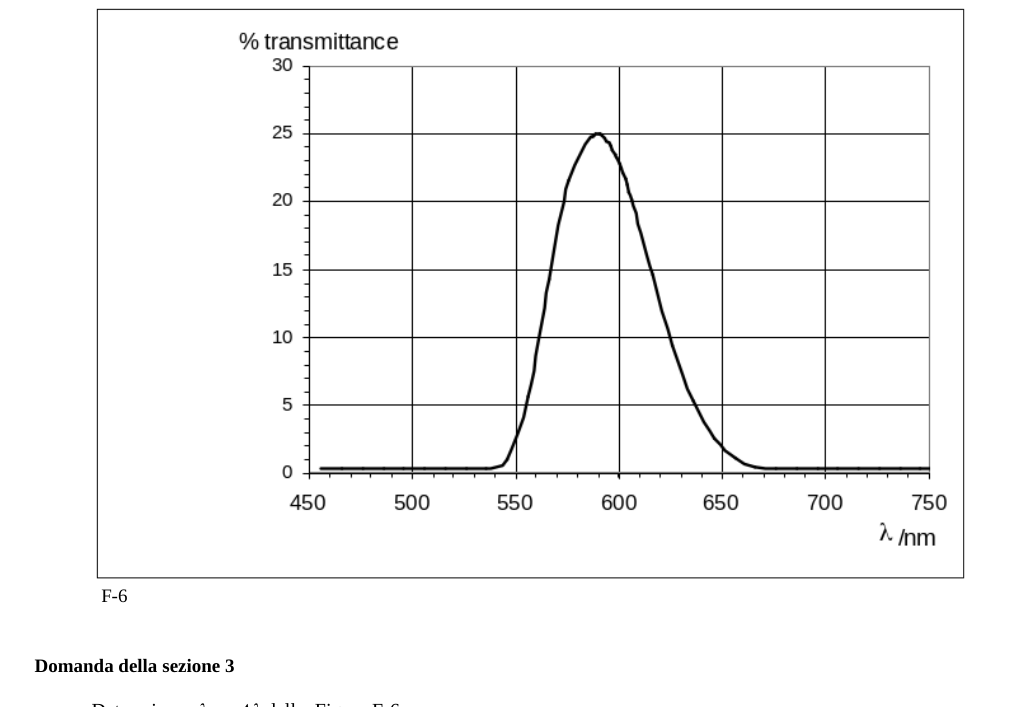 Trasmittanza del filtro liquido vs lunghezza d’onda
Topic: Wave Optics, Modern-Quantum Physics Metodi: Experimental Data Analysis, Graph Linearization Competenze: Experimental Data Analysis, Physical Reasoning Objects: — Fonte: Testo (PDF) — p.5 Soluzione: Soluzioni (PDF)
Section 3 Optical properties of the filter
The liquid filter in the test is an aqueous solution of copper sulphate and aniline orange dye. The purpose of salt is to absorb the infrared radiation emitted by the filament.
The transmittance of the filter (relation between transmitted light intensity and that incident) is shown in Figure F-6 as a function of wavelength.
# # Question
Determine and from Figure F-6.
Note: is the total width at half-height (FWHM) and is the wavelength at the maximum transmitting point.
The following is the list of the parameters of the test:
Topic: Wave Optics, Modern-Quantum Physics Metodi: Experimental Data Analysis, Graph Linearization Competenze: Experimental Data Analysis, Physical Reasoning Objects: — Fonte: Testo (PDF) — p.5 Soluzione: Soluzioni (PDF)
Sezione 4 — Proprietà del fotoresistore (LDR) e determinazione della costante di Planck
Il filamento a tungsteno della lampadina emette luce secondo la legge di Planck. Per lunghezze d’onda molto minori di quella al massimo dello spettro, si applica l’approssimazione di Wien:
dove è la costante di Planck ridotta (da determinare).
La resistenza del fotoresistore (LDR) segue la legge:
dove è l’illuminamento e è un parametro adimensionale ( nel caso reale). Combinando con la dipendenza dalla temperatura del filamento si ottiene:
Per determinare : misurare senza filtro grigio, poi inserire il filtro grigio (trasmittanza 51,2%), misurare . Poiché :
Domande
a) Assicurarsi che l’LDR resti al buio completo per almeno 10 minuti. Collegare la pila al potenziometro e aumentare lentamente la tensione della lampadina. Misurare le coppie con (almeno 12 misure); attendere 10 minuti dopo V prima della prima misura, e 5 minuti tra le misure successive. Ricavare dell’LDR per ciascuna coppia.
b) Una volta ottenuto il valore minimo di , inserire il filtro grigio, ricoprire la base e registrare la nuova resistenza . Calcolare e usando la (8).
c) Modificare l’Eq. (3) per ottenere la dipendenza lineare di da . Scrivere l’equazione ottenuta come Eq. (9).
d) Con i dati del punto a), costruire la tabella e disegnare il grafico dell’Eq. (9) ( in funzione di ).
e) Dal grafico, sapendo che , calcolare e con qualsiasi metodo (sono ammesse le funzioni statistiche della calcolatrice).
Dati: velocità della luce ; costante di Boltzmann .
Topic: Modern-Quantum Physics, Thermodynamics, Circuits Metodi: Experimental Data Analysis, Graph Linearization, Error Propagation, Photon Energy Relation Competenze: Experimental Data Analysis, Graph Linearization Objects: Resistor, Battery Fonte: Testo (PDF) — p.6 Soluzione: Soluzioni (PDF)
Section 4 Photoresistor properties (LDR) and determination of the Planck constant
The tungsten filament of the bulb emits light according to Planck’s law. For wavelengths much smaller than the maximum wavelength of the spectrum, the Wien approximation shall apply:
where is the reduced Planck constant (to be determined).
The resistance of the photoresistor (LDR) follows the law:
where is the illumination and is an additional parameter ( in the real case). Combining with the dependence on the filament temperature, the following results are obtained:
To determine : measure without a grey filter, then insert the grey filter (transmission rate 51,2%), measure . Because :
# Questions
(a) Ensure that the LDR remains completely dark for at least 10 minutes. Connect the battery to the power meter and slowly increase the voltage of the bulb. Measure the pairs with (at least 12 measurements); wait 10 minutes after V before the first measurement, and 5 minutes between subsequent measurements. The LDR shall be for each pair.
(b) Once the minimum is reached, insert the gray filter, cover the base and record the new resistance. Calculate and using (8).
(c) Change the Eq. (3) to obtain the linear dependence of on . Write the equation as Eq. (9).
(d) Using the data in point (a), construct the table and draw the graph of the equation. (9) ( in funzione di ).
(e) From the graph, knowing that , calculate and by any method (statistical functions of the calculator are allowed).
Dati: velocità della luce ; costante di Boltzmann .
Topic: Modern-Quantum Physics, Thermodynamics, Circuits Metodi: Experimental Data Analysis, Graph Linearization, Error Propagation, Photon Energy Relation Competenze: Experimental Data Analysis, Graph Linearization Objects: Resistor, Battery Fonte: Testo (PDF) — p.6 Soluzione: Soluzioni (PDF)