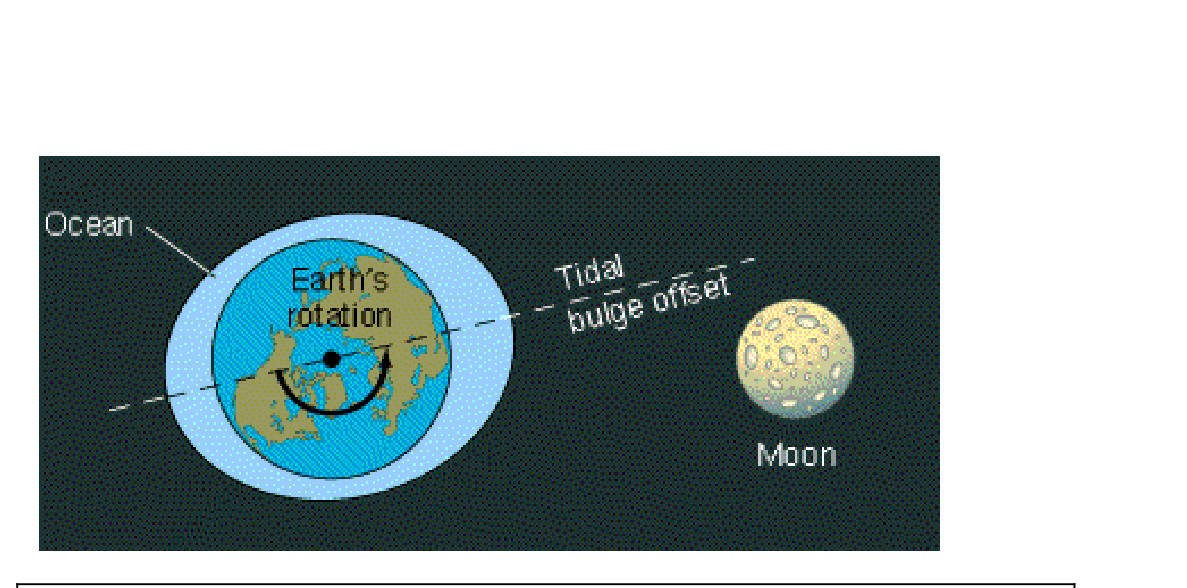
- Conservazione del momento angolare. Sia il momento angolare del sistema Terra-Luna adesso, cioè in questo momento di tempo. Si facciano, ora, le seguenti assunzioni: i) si ottiene dalla soma del momento angolare del moto rotatorio della terra su se stessa e quello del moto rotatorio della Luna attorno alla Terra; ii) l’orbita della Luna è circolare e la Luna stessa può essere considerata puntiforme; iii) l’asse di rotazione della Terra e quello di rivoluzione della Luna attorno alla Terra sono paralleli e perpendicolari al piano dell’orbita lunare; iv) per semplificare i calcoli, il moto circolare della Luna avviene attorno al centro della Terra e non attorno al centro di massa. In tutto il problema, tutti i momenti d’inerzia, i momenti delle forze e i momenti angolari sono definiti rispetto all’asse della Terra; v) l’influenza del sole viene trascurata. 1a Ricava la formula che esprime adesso, cioè in questo momento di tempo, il momento angolare totale del sistema Terra-Luna. Esprimi il risultato in funzione: a) del momento d’inerzia, , della Terra; b) della velocità angolare, , della Terra in questo momento di tempo; c) il momento d’inerzia della Luna, , in questo momento di tempo, rispetto all’asse di rotazione terrestre; d) la velocità angolare della Luna, , in questo momento di tempo. 0.2 Figura 2. L’attrazione gravitazionale della Luna produce due massimi di marea che si presentano come due rigonfiamenti sulla superficie terrestre. A causa della rotazione terrestre, la linea che congiunge i due massimi di marea passando per il centro della Terra non passa anche per il centro della Luna. Il fatto che la linea congiungente i massimi di marea e quella che passa per i centri di Terra e Luna non siano coincidenti produce il momento di una forza che è causa del trasferimento del momento angolare dal moto rotatorio della Terra su se stessa al moto della Luna attorno alla Terra. Il disegno non è in scala Il processo di trasferimento di momento angolare terminerà quando il periodo di rotazione della Terra e il periodo di rivoluzione della Luna attorno alla Terra saranno uguali. In quel momento i due massimi di marea saranno allineati con i centri della Terra e della Luna e il momento delle forze sarà nullo. 1b Ricava la formula che esprime il momento angolare totale finale del sistema Terra-Luna, , quando viene a cessare, cioè, il traferimento del momento angolare. Le assunzioni da fare per sviluppare il calcolo sono le stesse indicate prima della domanda 1a. Esprimi il risultato in funzione: a) del momento d’inerzia della Terra, ; b) della velocità angolare, , della Terra nella rotazione su se stessa e della Luna nella rotazione attorno alla Terra; c) il momento d’inerzia finale della Luna, . 0.2 1c Trascurando il contributo della rotazione della Terra al momento angolare finale totale, ricava la formula che esprime, in questa situazione, la conservazione del momento angolare. 0.3
p.1 — Raggio laser puntato verso osservatorio
p.2 — Attrazione gravitazionale e rigonfiamenti di marea
Topic: Rotational Dynamics, Gravitation, Newtonian Mechanics Metodi: Torque & Angular Momentum Analysis, Conservation of Momentum, Kinematic Equations Competenze: Mathematical Modeling, Diagrammatic Reasoning Objects: Planet, Satellite Fonte: Testo (PDF) — p.2 Soluzione: Soluzioni (PDF)
- Preserving the moment of angular momentum. Sia il momento angolare del sistema Terra-Luna adesso, cioè in questo momento di Time is running out. Si facciano, ora, le seguenti assunzioni: i) si ottiene dalla soma del momento angle of rotation of the earth on itself and that of the moon’s rotation (ii) the Moon’s orbit is circular and the Moon itself may be (iii) the axis of rotation of the Earth and that of the Earth’s revolution The moons around the Earth are parallel and perpendicular to the plane of the lunar orbit; To simplify the calculations, the moon’s circular motion is around the center of the Earth. And not around the mass center. In the whole problem, in all the moments of inertia, force moments and angular moments are defined relative to the Earth’s axis; The influence of the sun is neglected. 1a It takes the formula that it expresses now, that is, at this moment in time, the total angular moment of the Earth-Moon system. Express the result in Function: (a) the moment of inertia, , of the Earth; (b) the velocity angular, , of the Earth at this time; The Moon’s motion, , at this time, relative to the axis (d) the angular velocity of the Moon, , in this I’m going to take a moment. 0.2 Figure two. The gravitational pull of the Moon produces two tidal highs that They appear as two swellings on the Earth’s surface. The Earth rotation, the line connecting the two tidal peaks passing through the The center of the Earth doesn’t even pass through the center of the Moon. The fact that the line The first is the tidal peak and the one that passes through the centers of Earth and Moon. The momentum of a force that is caused by the transfer of the angular momentum from the rotational motion of the Earth on itself to the motion of the Moon around the Earth. The drawing is not in scale. The angular momentum transfer process will end when the period of The rotation of the Earth and the period of revolution of the Moon around the Earth will be They’re the same. At that point the two tidal peaks will be aligned with the centres of the Earth and the Moon and the moment of the forces will be null. 1b It takes the formula that expresses the final total angular moment of the The Earth-Moon system, , when it comes to ceasing, that is, the transfer of the Earth’s magnetic field to the Earth. It’s the corner time. The assumptions to be made in developing the calculation are the following: the same as those indicated before Question 1a. Express the result in a function: del momento d’inerzia della Terra, ; b) della velocità angolare, , of the Earth in its rotation and of the Moon in its rotation around it. (c) the final moment of inertia of the Moon, . 0.2 1c By ignoring the contribution of the Earth’s rotation to the angular momentum The final total is the formula which, in this situation, expresses the The time of the angle is preserved. 0.3
p.1 — Raggio laser puntato verso osservatorio
p.2 — Attrazione gravitazionale e rigonfiamenti di marea
Topic: Rotational Dynamics, Gravitation, Newtonian Mechanics Metodi: Torque & Angular Momentum Analysis, Conservation of Momentum, Kinematic Equations Competenze: Mathematical Modeling, Diagrammatic Reasoning Objects: Planet, Satellite Fonte: Testo (PDF) — p.2 Soluzione: Soluzioni (PDF)
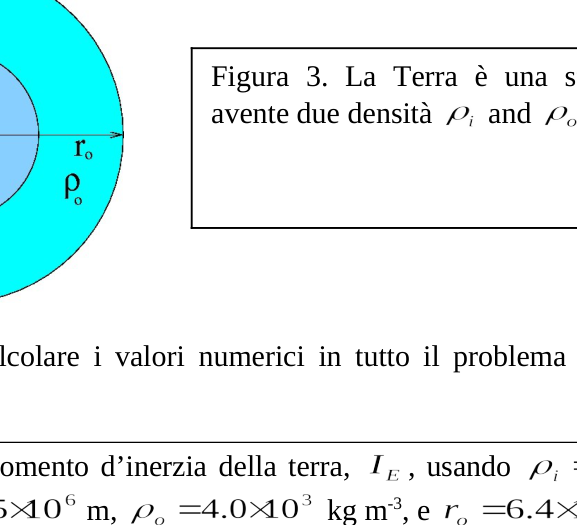
- Distanza finale e velocità angolare finale del sistema Terra-Luna. Si assuma che valgano sempre le equazioni della gravitazione universale e della meccanica newtoniana per un’orbita circolare, in particolare per l’orbita della Luna attorno alla Terra. Si trascuri il contributo della rotazione della Terra al momento angolare finale totale. 2a Ricava, nello stato finale, la formula del moto circolare della Luna attorno alla Terra dovuto alla forza di gravità. Esprimi il risultato in funzione di , , e della distanza finale Terra-Luna . è la massa della Terra e la costante gravitazionale. 0.2 2b Ricava l’espressione della distanza, , tra la Terra e la Luna alla fine del processo. Esprimi il risultato in funzione dei parametri noti (momento angolare totale), and (rispettivamente le masse della Terra e della Luna) e della costante di gravitazione . 0.5 2c Ricava l’espressione della velocità angolare finale, , della Terra e della Luna al termine del processo. Esprimi il risultato in funzione dei parametri noti , , e . 0.5 Di seguito si domanda di calcolare i valori numerici di e . Per fare ciò serve calcolare il momento d’inerzia della Terra. 2d Ricava la formula del momento d’inerzia, , della Terra, supponendo che sia una sfera avente densità omogenea nei punti che vanno dalla distanza 0 fino ad una distanza dal centro e avente la densità omogenea per i punti con distanza dal centro compresa fra e , il raggio della superficie terrestre (vedi la figura 3). 0.5
Si richiede di calcolare i valori numerici in tutto il problema sempre con due cifre significative. 2e Calcola il momento d’inerzia della terra, , usando , , , e . 0.2 Le masse della Terra e della Luna sono, rispettivamente, ed . La distanza Terra-Luna in questo momento di tempo è . La velocità di rotazione della Terra è, in questo momento, . La velocità con cui la Luna ruota attualmente attorno alla Terra è , la costante di gravitazione universale è . 2f Calcola il valore numerico del momento angolare totale, , del sistema. 0.2 2g Calcola il valore numerico della distanza finale, , che separa Terra e Luna esprimendo il risultato sia in metri che in unità pari alla distanza attuale . 0.3 2h Calcola il valore numerico della velocità angolare finale, , esprimendo il risultato in e calcola la durata del giorno usando la durata del giorno attuale come unità di misura. 0.3 Figura 3. La Terra è una sfera avente due densità and . A questo punto si chiede di verificare che l’approssimazione fatta di trascurare la rotazione terrestre nel calcolo del momento angolare totale finale è accettabile. Per farlo si calcola il rapporto tra il momento angolare della Terra e quello della luna: dovrebbe risultarne una quantità piccola. 2i Calcola il valore numerico del rapporto tra i momenti angolari finali della Terra e della Luna. 0.2
p.4 — Terra sferica con densita r1 e r2
Topic: Rotational Dynamics, Gravitation, Newtonian Mechanics Metodi: Newton’s Law of Gravitation, Conservation of Momentum, Calculus-Integration, Torque & Angular Momentum Analysis Competenze: Mathematical Modeling, Physical Reasoning, Significant Figures Objects: Planet, Satellite Fonte: Testo (PDF) — p.3 Soluzione: Soluzioni (PDF)
- End distance and end angular velocity of the Earth-Moon system. It is assumed that the equations of universal gravity and the Newtonian mechanics for a circular orbit, particularly for the orbit of the Moon around the Earth. The contribution of the Earth’s rotation to the present is neglected. The total final angular. 2a It captures, in its final state, the formula for the circular motion of the Moon around the Earth. Earth because of gravity. Express the result in terms of , , e della distanza finale Terra-Luna . is the mass della Terra e la costante gravitazionale. 0.2 2b It takes the distance, , between Earth and the Moon at the end The trial. Express the result according to the known parameters (total angular momentum), and (respectively the masses of the Earth and Moon) and the gravitational constant . 0.5 2c It is the expression of the final angular velocity, , of the Earth and The moon at the end of the trial. Express the result according to the The following parameters are known: , , and . 0.5 The following numerical values of and are required to be calculated. To do this, you need Calculate the moment of inertia of the Earth. 2d It takes the formula of the Earth’s moment of inertia, , assuming che sia una sfera avente densità omogenea nei punti che vanno dalla distance 0 to a distance from the centre and having the density homogeneous for points with a distance from the centre between and , the radius of the earth’s surface (see Figure 3). 0.5
You need to calculate the numerical values in the whole problem with two digits They’re meaningful. 2e Calculate the earth’s moment of inertia, , using , , , e . 0.2 The masses of the Earth and the Moon are and . The Earth-Moon distance at this time is . The Earth’s rotation rate is, at this moment, . The speed at which the Moon is currently orbiting the Earth is , la costante di gravitazione universale è . 2f Calculate the numerical value of the total angular momentum, , of the system. 0.2 2g Calculate the numerical value of the final distance, , separating Earth and Moon, expressed in meters and units of distance The following is the list of the current . 0.3 2h Calculate the numerical value of the final angular velocity, , by The result in and calculates the duration of the day using the duration of the day current as a unit of measurement. 0.3 Figure 3 is shown. The Earth is a sphere having two densities and . The Commission has therefore asked the Commission to verify that the approximation made to the The ground rotation in the calculation of the final total angular moment is acceptable. To do that The ratio of the Earth’s angular moment to the moon’s angular moment is calculated. It’s a small amount. 2i Calculates the numerical value of the ratio between the end angles of the Earth and the Moon. 0.2
**p.4 ** Spherical earth with density r1 and r2
Topic: Rotational Dynamics, Gravitation, Newtonian Mechanics Metodi: Newton’s Law of Gravitation, Conservation of Momentum, Calculus-Integration, Torque & Angular Momentum Analysis Competenze: Mathematical Modeling, Physical Reasoning, Significant Figures Objects: Planet, Satellite Fonte: Testo (PDF) — p.3 Soluzione: Soluzioni (PDF)
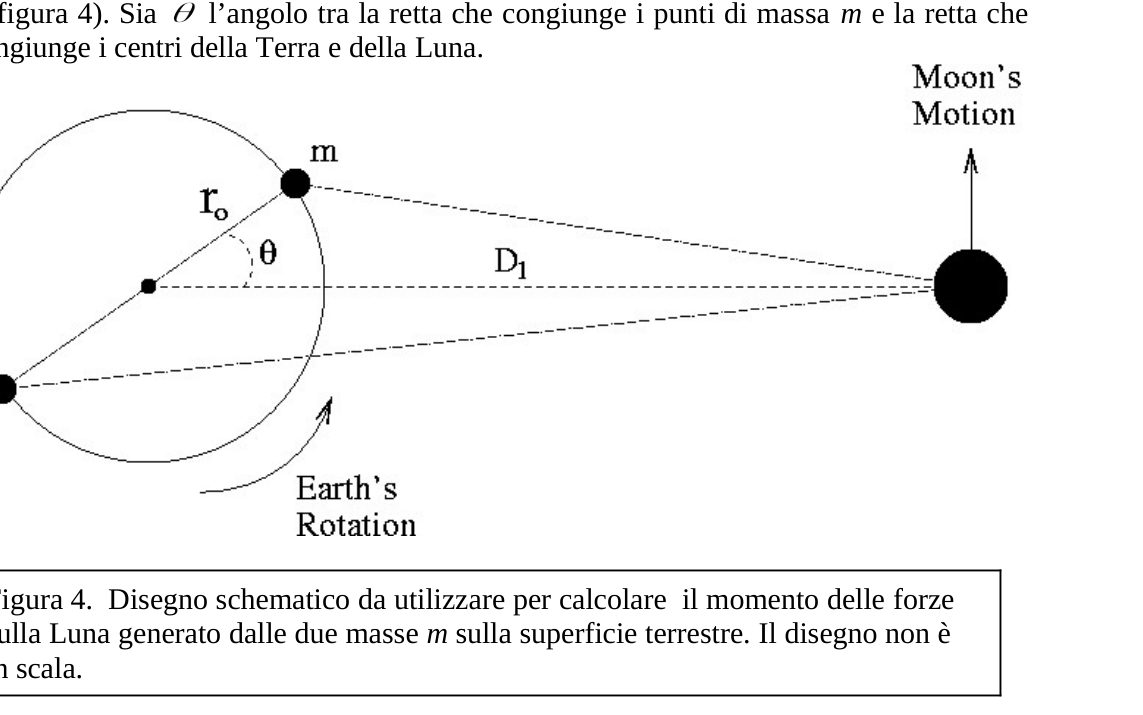
- Quanto si allontana la Luna in un anno? Adesso si chiede di calcolare quanto la Luna si allontana dalla Terra in un anno. Per prima cosa è necessario ricavare una formula per calcolare il momento delle forze che agiscono in questo momento sulla Luna. A tale scopo si supponga che i due rigonfiamenti sulla Terra generati dai due massimi di marea si possano considerare come due punti materiali di massa m ciascuno situato sulla superficie della Terra (vedi la figura 4). Sia l’angolo tra la retta che congiunge i punti di massa m e la retta che congiunge i centri della Terra e della Luna. 3a Calcola , il modulo della forza generata sulla Luna dalla massa puntiforme m ad essa più vicina procedendo algebricamente senza approssimazioni. 0.4 3b Calcola , il modulo della forza generata sulla Luna dalla massa 0.4 Figura 4. Disegno schematico da utilizzare per calcolare il momento delle forze sulla Luna generato dalle due masse m sulla superficie terrestre. Il disegno non è in scala. puntiforme m da essa più lontana procedendo algebricamente senza approssimazioni. A questo punto si può calcolare il momento prodotto dalle due masse m per via algebrica e, per ora, senza fare approssimazioni. 3c Calcola il modulo di , il momento prodotto dalla massa più vicina alla Luna. 0.4 3d Calcola il modulo di , il momento prodotto dalla massa più lontana dalla Luna. 0.4 3e Calcola un’espressione algebrica per il modulo del momento risultante, , prodotto dalle due masse. Poiché , a questo punto si deve approssimare il risultato ottenuto al più piccolo ordine significativo utilizzando la formula , valida se . 1.0 3f Calcola ora il valore numerico del modulo del momento risultante , sapendo che ed (si noti che questa massa è circa volte la massa della Terra). 0.5 Poiché il momento di una forza è la derivata del momento angolare rispetto al tempo, si richiede di calcolare l’aumento della distanza Terra-Luna in un anno, nel momento attuale del moto. Perciò è necessario esprimere il momento angolare della Luna nel momento attuale del moto in funzione solo di , , e . 3g Trova di quanto aumenta la distanza Terra-Luna in un anno a partire dalla configurazione attuale del sistema. 1.0 Infine si procede a determinare di quanto aumenta la durata di un giorno in un anno a partire dallo stato attuale. 3h Trova di quanto diminuisce la velocità angolare della Terra, , in un anno e di quanto aumenta di conseguenza la durata di un giorno. 1.0
p.5 — Schema rotazione Terra e moto Luna
Topic: Rotational Dynamics, Gravitation, Newtonian Mechanics Metodi: Torque & Angular Momentum Analysis, Approximation & Series Expansion, Newton’s Law of Gravitation, Conservation of Momentum Competenze: Mathematical Modeling, Physical Reasoning Objects: Planet, Satellite Fonte: Testo (PDF) — p.5 Soluzione: Soluzioni (PDF)
- How far away does the moon go in a year? Now you’re asking to calculate how far the moon moves away from the Earth in a year. For First, you need to get a formula to calculate the momentum of the forces that They’re on the moon right now. To this end, it is assumed that the two The two tidal peaks can be considered as the as two material points of mass m each located on the Earth’s surface (see The following table shows the following: Whether is the angle between the straight line joining the points of mass m and the straight line which It connects the centers of the Earth and the Moon. 3a Calculate , the modulus of the force generated on the Moon by mass The point m is closest to it by algebraically proceeding without The following is the list of the approximations: 0.4 3b Calculate , the modulus of the force generated on the Moon by mass 0.4 Figure 4 is shown. Schematic drawing to be used to calculate the moment of forces The moon is generated by two masses m above the Earth’s surface. The drawing is not I’m going to scale. point m further from it by algebraically proceeding without The following is the list of the approximations: At this point, the momentum produced by the two masses m can be calculated by Algebraic and, for now, no approximations. 3c Calculate the modulus of momentum produced by the mass closest to the The moon. 0.4 3d Calculate the modulus, the momentum produced by the farthest mass from the moon. 0.4 3e Calculate an algebraic expression for the resulting momentum formula, , produced by the two masses. Since , at this point you must Approximate the result obtained to the smallest significant order using the formula , valid if . 1.0 3f Now calculate the numerical value of the resulting momentum form , Knowing that and (note that this mass is approximately times the mass of the Earth). 0.5 Since the moment of a force is the derivative of angular moment with respect to time, we It requires that the Earth-Moon distance increase in one year be calculated at the time of current motorcycle. So we need to express the angular moment of the Moon in current engine speed in function only of , , and . 3g Find out how much Earth-Moon distance increases in a year from the current configuration of the system. 1.0 Finally, it is decided how much longer a day in a year is The Commission will take the necessary measures to ensure that the Commission is able to take the necessary measures to ensure that the Commission is able to take the necessary measures to ensure that the Commission is able to take the necessary measures. 3h Find how much the Earth’s angular velocity decreases, , in a year and how much the length of a day increases accordingly. 1.0
The following table shows the results of the calculation of the total number of observations:
Topic: Rotational Dynamics, Gravitation, Newtonian Mechanics Metodi: Torque & Angular Momentum Analysis, Approximation & Series Expansion, Newton’s Law of Gravitation, Conservation of Momentum Competenze: Mathematical Modeling, Physical Reasoning Objects: Planet, Satellite Fonte: Testo (PDF) — p.5 Soluzione: Soluzioni (PDF)
- Dov’è l’energia meccanica che manca al bilancio? Mentre il momento angolare del sistema si conserva, l’energia meccanica totale (la somma dell’energia rotazionale e di quella gravitazionale) non resta costante. Si analizza questo aspetto del problema in questa sezione. 4a Ricava un’espressione per l’energia meccanica totale, E, (rotazionale e gravitazionale) del sistema Terra-Luna nel momento attuale del moto. Esprimi il risultato solo in funzione di , , , , e . 0.4 4b Ricava un’espressione per esprimere la variazione di energia , , in funzione delle variazioni di e di . Calcola il valore numerico di in un anno, adoperando le variazioni di e di calcolate nei punti 3g e 3h. 0.4 La prossima parte del problema consente di verificare che la diminuzione di energia meccanica è consistente con una stima dell’energia dissipata in calore nelle maree che la Luna produce sulla Terra. In questa stima si assume che l’aumento medio del livello marino per effetto della marea sia 0.5 m, cioè che uno strato d’acqua di copra tutta la superficie della Terra (per semplicità si suppone che tutta la superficie della terra sia ricoperta d’acqua). Inoltre questo accade due volte al giorno. Si suppone, anche, che il 10% dell’energia gravitazionale venga dissipato come calore generato per viscosità quando la marea decresce. La densità dell’acqua è , e l’accelerazione di gravità sulla superficie della Terra è . 4c Quanto vale la massa di questo strato superficiale di acqua? 0.2 4d Calcola quanta energia viene dissipata in un anno. Confronta questo valore con l’energia meccanica persa in un anno dal sistema Terra-Luna mel momento di moto attuale. 0.3
Topic: Conservation of Energy, Rotational Dynamics, Gravitation Metodi: Energy Conservation Method, Torque & Angular Momentum Analysis, Physical Modeling, Approximation & Series Expansion Competenze: Mathematical Modeling, Physical Reasoning, Estimation & Approximation Objects: Planet, Satellite Fonte: Testo (PDF) — p.6 Soluzione: Soluzioni (PDF)
- Where is the mechanical energy that is missing from the budget? While the angular momentum of the system is maintained, the total mechanical energy (the The sum of the rotational and gravitational energies) does not remain constant. Si The Commission will examine this aspect of the problem in this section. 4a It is an expression for the total mechanical energy, E, (rotational and gravitational force) of the Earth-Moon system at the current moment of motion. Express the result only as a function of , , , , and . 0.4 4b It takes an expression to express the energy change , , in The function of the variations of and . Calculate the numerical value of in one year, using the variations of and calculated in 3g and 3h points. 0.4 The next part of the problem is to check that the decrease in energy Mechanics consists of an estimate of the energy dissipated in heat at tides that The moon produces on Earth. This estimate assumes that the average increase in the level of sea level by tidal effect is 0.5 m, i.e. a water layer of It covers the entire surface of the Earth (for simplicity’s sake, we assume that the entire surface is The land is covered with water. And this happens twice a day. It’s supposed to be, The Commission also proposed that 10% of the gravitational energy be dissipated as heat generated by the Viscosity when the tide drops. The density of the water is , and The gravitational acceleration on the Earth’s surface is . 4c What is the mass of this surface water layer? 0.2 4d Calculates how much energy is dissipated in a year. Compare this value of the mechanical energy lost in one year by the Earth-Moon system The current moment of motion. 0.3
Topic: Conservation of Energy, Rotational Dynamics, Gravitation Metodi: Energy Conservation Method, Torque & Angular Momentum Analysis, Physical Modeling, Approximation & Series Expansion Competenze: Mathematical Modeling, Physical Reasoning, Estimation & Approximation Objects: Planet, Satellite Fonte: Testo (PDF) — p.6 Soluzione: Soluzioni (PDF)