RAFFREDDAMENTO LASER MEDIANTE EFFETTO DOPPLER E MELASSE OTTICHE
Scopo di questo problema è di tracciare una semplice teoria per spiegare il cosiddetto raffreddamento laser e le melasse ottiche. Il fenomeno consiste nel raffreddare un fascio di atomi neutri, per lo più alcalini, colpendolo con raggi di luce laser che si propagano a coppie in senso opposto e che hanno la medesima frequenza. Questo risultato è stato riconosciuto nella assegnazione del premio Nobel a S. Chu, P. Phillips e C. Cohen-Tannoudji nel 1997.
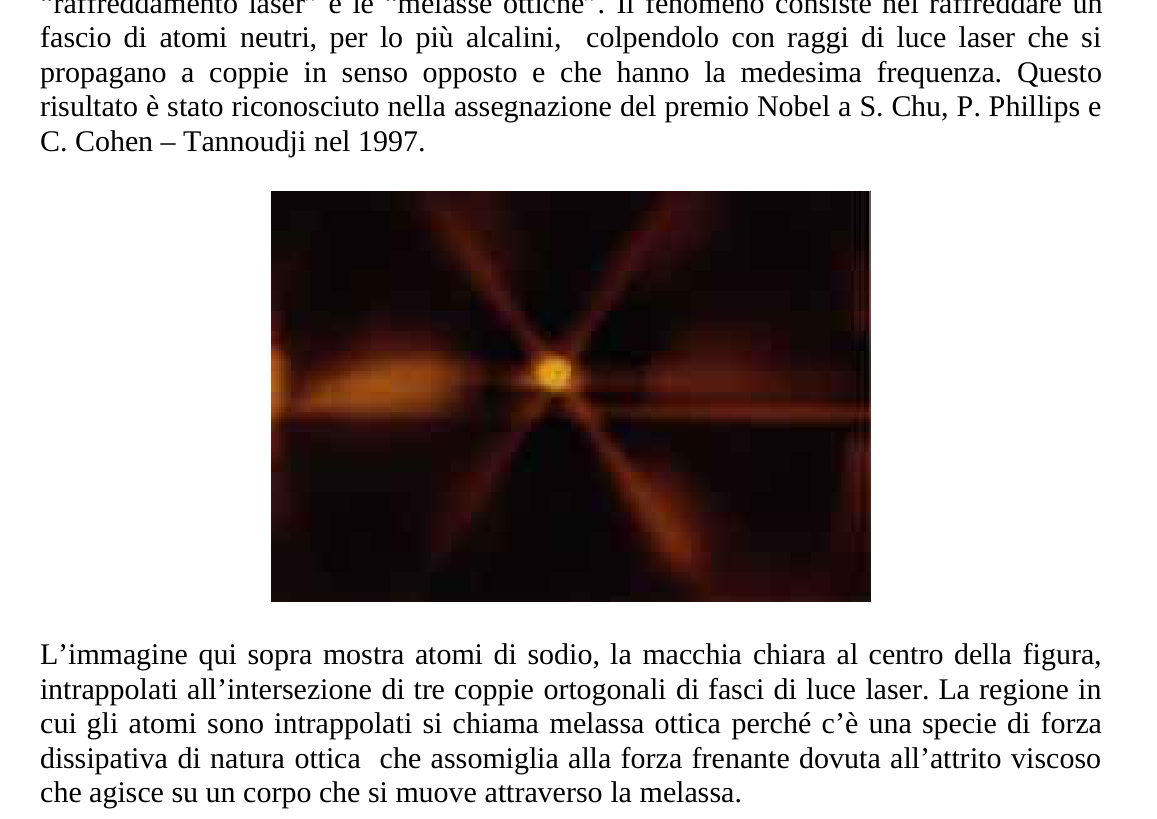
L’immagine qui sopra mostra atomi di sodio, la macchia chiara al centro della figura, intrappolati all’intersezione di tre coppie ortogonali di fasci di luce laser. La regione in cui gli atomi sono intrappolati si chiama melassa ottica perché è una specie di forza dissipativa di natura ottica che assomiglia alla forza frenante dovuta all’attrito viscoso che agisce su un corpo che si muove attraverso la melassa.
In questo problema prenderai in considerazione, in una sola dimensione, le linee fondamentali del legame esistente fra il fenomeno di un fotone incidente su un atomo e la natura del meccanismo dissipativo.
PARTE I: LINEE FONDAMENTALI DEL RAFFREDDAMENTO LASER
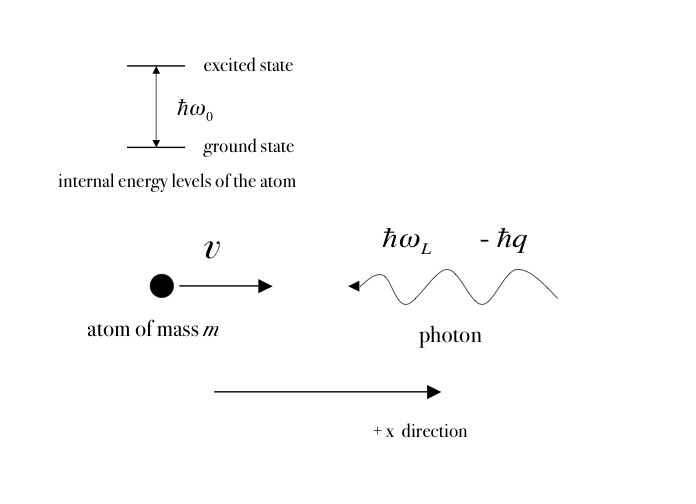
Considera un atomo di massa che si muove in una direzione con velocità . Per semplicità considereremo una situazione unidimensionale, in pratica ignoreremo le dimensioni e (vedi figura 1). L’atomo ha due livelli di energia interna. Nello stato ad energia inferiore il valore dell’energia è arbitrariamente posto uguale a zero; di conseguenza l’energia dello stato eccitato è espressa da , dove è la frequenza di risonanza della transizione atomica. L’atomo inizialmente si trova nel suo stato di energia minima. Un singolo fascio di luce laser, di frequenza rispetto a un osservatore fermo in laboratorio, viene indirizzato in direzione e la luce incide sull’atomo. La luce laser è composta di fotoni, ciascuno con energia e quantità di moto . Un fotone può venire assorbito dall’atomo e successivamente emesso spontaneamente; l’emissione può avvenire con la medesima probabilità in direzione e in direzione . L’atomo si muove a velocità non relativistica, e quindi ( indica la velocità della luce); per questa ragione nel seguito trascurerai per questo rapporto tutte le potenze superiori alla prima. Assumi pure che , il che significa che la quantità di moto dell’atomo è molto maggiore della quantità di moto di un singolo fotone. Tieni conto di queste informazioni e, quando scrivi le risposte alle domande, mantieni solo i termini di primo grado per ambedue queste quantità.
Figura 1. Schizzo di un atomo di massa e velocità iniziale che si muove in direzione e si scontra con un fotone di energia e quantità di moto . L’atomo ha due livelli di energia interna che differiscono fra loro di .
Supponi che la frequenza della luce laser sia fissata in modo che, quando osservata nel riferimento dell’atomo in movimento, sia in risonanza con la frequenza caratteristica della transizione dell’atomo da uno all’altro dei suoi livelli di energia.
1. Assorbimento
Scrivi ora le seguenti risposte:
(1a) Scrivi la condizione di risonanza per la quale si ha l’assorbimento del fotone.
(1b) Scrivi, nel riferimento del laboratorio, la quantità di moto dell’atomo dopo avvenuto l’assorbimento.
(1c) Scrivi, nel riferimento del laboratorio, l’energia totale dell’atomo dopo avvenuto l’assorbimento.
p.1 — Immagine di atomi raffreddati in melassa ottica
p.2 — Atomo con livelli energetici colpito da fotone
Topic: Modern-Quantum Physics, Conservation of Momentum, Conservation of Energy Metodi: Photon Energy Relation, Conservation of Momentum, Conservation of Energy Competenze: Physical Reasoning, Mathematical Modeling Objects: Atom, Photon Fonte: Testo (PDF) — p.2 Soluzione: Soluzioni (PDF)
Laser-mediated cooling effect on double and optical molasses
The purpose of this problem is to trace a simple theory to explain the so-called laser cooling and optical molasses. The phenomenon consists in cooling a beam of neutral, mostly alkaline atoms, by hitting them with laser beams that propagate in opposite pairs and have the same frequency. This achievement was recognized in the awarding of the Nobel Prize to S. Chu, P. Phillips and C. The Commission has also adopted a number of measures to combat the use of the ‘contracting’ mechanism.
The image above shows sodium atoms, the clear spot in the center of the figure, trapped at the intersection of three orthogonal pairs of laser beams. The region where the atoms are trapped is called optical melasses because it is a kind of dissipative force of optical nature that resembles the braking force due to viscous friction that acts on a body moving through the melasses.
In this problem you will consider, in one dimension, the basic lines of the existing link between the phenomenon of a photon incident on an atom and the nature of the dissipative mechanism.
Part I: The basics of laser cooling
Consider an atom of mass moving in a direction with speed . For simplicity’s sake, we will consider a one-dimensional situation, in practice we will ignore the dimensions and (see Figure 1). The atom has two levels of internal energy. In the lower energy state the energy value is arbitrarily placed at zero; consequently the excited state energy is expressed as , where is the resonance frequency of the atomic transition. The atom is initially in its state of minimum energy. A single beam of laser light, with a frequency relative to a stationary laboratory observer, is directed in the direction and the light hits the atom. The laser light is composed of photons, each with energy and motion quantity . A photon can be absorbed by the atom and then spontaneously emitted; the emission can occur with the same probability in the direction and in the direction . The atom moves at a nonrelativistic speed, and therefore ( indicates the speed of light); for this reason, in the following you will overlook for this ratio all powers greater than the first. Also assume that , which means that the amount of motion of the atom is much greater than the amount of motion of a single photon. Take this information into account and, when you write the answers to the questions, keep only the first-degree terms for both of these amounts.
The following information is provided for in the Annex to this Regulation: Sketch of an atom of mass and initial velocity moving in the direction and colliding with a photon of energy and quantity of motion . The atom has two internal energy levels that differ from each other by .*
Assume that the laser light frequency is fixed so that, when observed in the reference of the moving atom, it is in resonance with the characteristic frequency of the atom’s transition from one to the other of its energy levels.
1. The following table shows the results of the study:
Now write down the following answers:
Write down the resonance condition for which the photon is absorbed.
**(1b) ** Write in the laboratory reference the amount of motion of the atom after absorption.
**(1c) ** Write in the laboratory reference the total energy of the atom after absorption.
**p.1 ** Image of cooled atoms in optical molasses
Atom with energy levels affected by photons
Topic: Modern-Quantum Physics, Conservation of Momentum, Conservation of Energy Metodi: Photon Energy Relation, Conservation of Momentum, Conservation of Energy Competenze: Physical Reasoning, Mathematical Modeling Objects: Atom, Photon Fonte: Testo (PDF) — p.2 Soluzione: Soluzioni (PDF)
2. Emissione spontanea di un fotone nella direzione
Un certo tempo dopo aver assorbito il fotone l’atomo può emettere un fotone in direzione .
(2a) Scrivi, nel riferimento del laboratorio, l’energia del fotone emesso in direzione .
(2b) Scrivi, nel riferimento del laboratorio, la quantità di moto del fotone emesso in direzione .
(2c) Scrivi, nel riferimento del laboratorio, la quantità di moto dell’atomo dopo il processo di emissione del fotone in direzione .
(2d) Scrivi, nel sistema di riferimento del laboratorio, l’energia totale dell’atomo, , dopo che ha avuto luogo il processo di emissione in direzione .
Topic: Modern-Quantum Physics, Conservation of Momentum, Conservation of Energy Metodi: Photon Energy Relation, Conservation of Momentum, Conservation of Energy Competenze: Physical Reasoning, Mathematical Modeling Objects: Atom, Photon Fonte: Testo (PDF) — p.3 Soluzione: Soluzioni (PDF)
2. Spontaneous emission of a photon in the direction
Some time after absorbing the photon the atom can emit a photon in the direction .
**(2a) ** Write in the laboratory reference the energy of the photon emitted in the direction .
**(2b) ** Write in the laboratory reference the amount of motion of the photon emitted in the direction .
**(2c) ** Write in the laboratory reference the amount of motion of the atom after the photon emission process in the direction .
**(2d) ** Write in the laboratory reference system the total energy of the atom, , after the emission process in the direction has taken place.
Topic: Modern-Quantum Physics, Conservation of Momentum, Conservation of Energy Metodi: Photon Energy Relation, Conservation of Momentum, Conservation of Energy Competenze: Physical Reasoning, Mathematical Modeling Objects: Atom, Photon Fonte: Testo (PDF) — p.3 Soluzione: Soluzioni (PDF)
3. Emissione spontanea di un fotone in direzione
Un certo tempo dopo l’assorbimento del fotone incidente l’atomo può emettere invece un fotone in direzione .
(3a) Scrivi, nel riferimento del laboratorio, l’energia del fotone emesso in direzione .
(3b) Scrivi, nel riferimento del laboratorio, la quantità di moto del fotone emesso in direzione .
(3c) Scrivi, nel riferimento del laboratorio, la quantità di moto dell’atomo dopo il processo di emissione del fotone in direzione .
(3d) Scrivi, nel sistema di riferimento del laboratorio, l’energia totale dell’atomo, , dopo che ha avuto luogo il processo di emissione in direzione .
Topic: Modern-Quantum Physics, Conservation of Momentum, Conservation of Energy Metodi: Photon Energy Relation, Conservation of Momentum, Conservation of Energy Competenze: Physical Reasoning, Mathematical Modeling Objects: Atom, Photon Fonte: Testo (PDF) — p.3 Soluzione: Soluzioni (PDF)
3. Spontaneous emission of a photon in the direction
Some time after the absorption of the incident photon the atom can instead emit a photon in the direction .
**(3a) ** Write in the laboratory reference the energy of the photon emitted in the direction .
**(3b) ** Write in the laboratory reference the amount of motion of the photon emitted in the direction .
**(3c) ** Write in the laboratory reference the amount of motion of the atom after the photon emission process in the direction .
Write in the laboratory reference system the total energy of the atom, , after the emission process in the direction has taken place.
Topic: Modern-Quantum Physics, Conservation of Momentum, Conservation of Energy Metodi: Photon Energy Relation, Conservation of Momentum, Conservation of Energy Competenze: Physical Reasoning, Mathematical Modeling Objects: Atom, Photon Fonte: Testo (PDF) — p.3 Soluzione: Soluzioni (PDF)
4. Emissione media dopo l’assorbimento
L’emissione spontanea di un fotone in direzione o ha luogo con la medesima probabilità. Tenendo conto di ciò, rispondi alle seguenti domande:
(4a) Scrivi l’energia media di un fotone, , dopo che è stato emesso.
(4b) Scrivi il valore medio della quantità di moto di un fotone, , dopo che è stato emesso.
(4c) Scrivi l’energia totale media di un atomo, , dopo il processo di emissione.
(4d) Scrivi la quantità di moto media di un atomo, , dopo il processo di emissione.
Topic: Modern-Quantum Physics, Conservation of Momentum, Conservation of Energy Metodi: Photon Energy Relation, Conservation of Momentum, Statistical Averaging Competenze: Physical Reasoning, Mathematical Modeling Objects: Atom, Photon Fonte: Testo (PDF) — p.4 Soluzione: Soluzioni (PDF)
4. Average emissions after absorption
The spontaneous emission of a photon in the direction or occurs with the same probability. In view of this, answer the following questions:
(4a) Scrivi l’energia media di un fotone, , dopo che è stato emesso.
**(4b) ** Write the mean value of the amount of motion of a photon, , after it has been emitted.
(4c) Scrivi l’energia totale media di un atomo, , dopo il processo di emissione.
(4d) Scrivi la quantità di moto media di un atomo, , dopo il processo di emissione.
Topic: Modern-Quantum Physics, Conservation of Momentum, Conservation of Energy Metodi: Photon Energy Relation, Conservation of Momentum, Statistical Averaging Competenze: Physical Reasoning, Mathematical Modeling Objects: Atom, Photon Fonte: Testo (PDF) — p.4 Soluzione: Soluzioni (PDF)
5. Trasferimento di energia e di quantità di moto
In un processo completo di assorbimento ed emissione di un fotone del tipo descritto c’è un trasferimento complessivo di quantità di moto e energia fra la radiazione laser e l’atomo.
(5a) Scrivi la variazione media di energia dell’atomo, , dopo un processo completo di assorbimento ed emissione di un fotone.
(5b) Scrivi la variazione media di quantità di moto di un atomo, , dopo un processo completo di assorbimento ed emissione di un fotone.
Topic: Modern-Quantum Physics, Conservation of Momentum, Conservation of Energy Metodi: Photon Energy Relation, Conservation of Momentum, Conservation of Energy Competenze: Physical Reasoning, Mathematical Modeling Objects: Atom, Photon Fonte: Testo (PDF) — p.4 Soluzione: Soluzioni (PDF)
5. Transfer of energy and quantity of motor
In a complete process of absorption and emission of a photon of the type described there is an overall transfer of quantity of motion and energy between the laser radiation and the atom.
Write down the mean change in energy of the atom, , after a complete process of absorption and emission of a photon.
**(5b) ** Write the mean change in the amount of motion of an atom, , after a complete process of photonic absorption and emission.
Topic: Modern-Quantum Physics, Conservation of Momentum, Conservation of Energy Metodi: Photon Energy Relation, Conservation of Momentum, Conservation of Energy Competenze: Physical Reasoning, Mathematical Modeling Objects: Atom, Photon Fonte: Testo (PDF) — p.4 Soluzione: Soluzioni (PDF)
6. Trasferimento di energia e di quantità di moto da parte di un fascio di luce laser lungo la direzione
Considera ora che un fascio di luce laser con frequenza incida sull’atomo lungo la direzione , mentre anche l’atomo si muove in direzione con velocità . Rispondi ora alle seguenti domande quando vi sia una condizione di risonanza fra la transizione fra due livelli interni di energia dell’atomo e il fascio di luce laser, risonanza nel sistema di riferimento dell’atomo in moto.
(6a) Scrivi la variazione media di energia dell’atomo dopo un completo processo di assorbimento e emissione di un fotone.
(6b) Scrivi la variazione media di quantità di moto di un atomo, , dopo un processo completo di assorbimento ed emissione di un fotone.
PARTE II: DISSIPAZIONE E PRIMI FONDAMENTI DELLE MELASSE OTTICHE
Sappiamo esserci un’incertezza nei processi quantistici. Perciò il fatto che l’atomo può emettere spontaneamente un fotone in un intervallo finito di tempo dopo l’assorbimento, ha come conseguenza che la condizione di risonanza non deve essere rispettata esattamente come invece si è fatto finora. Ciò significa che le frequenze dei fasci di luce laser e possono avere qualsivoglia valore e il processo di assorbimento–emissione avviene tuttavia. Questi processi avvengono con diverse probabilità (quantistiche) e, come ci si può aspettare, la probabilità massima si avrà con le condizioni esatte di risonanza. Il tempo trascorso in media fra un singolo processo di assorbimento e il processo di emissione si chiama vita media dello stato dell’atomo nel livello eccitato di energia ed è indicato con .
Considera ora una certa quantità di atomi in riposo nel sistema di riferimento del laboratorio, e considera anche un fascio di luce laser con frequenza che incide sugli atomi. Gli atomi assorbono ed emettono continuamente così che in media vi sono atomi nello stato eccitato (e pertanto atomi si trovano nello stato fondamentale di energia minima). Un calcolo effettuato in base alla meccanica quantistica porta al seguente risultato:
dove è la frequenza di risonanza della transizione atomica e è la cosiddetta frequenza di Rabi; è proporzionale all’intensità del fascio di luce laser. Come accennato più sopra puoi osservare che questo numero è diverso da zero anche se la frequenza di risonanza è diversa dalla frequenza del fascio laser . Un altro modo per esprimere i risultati precedenti consiste nel dire che il numero di processi di assorbimento–emissione per unità di tempo è pari a .
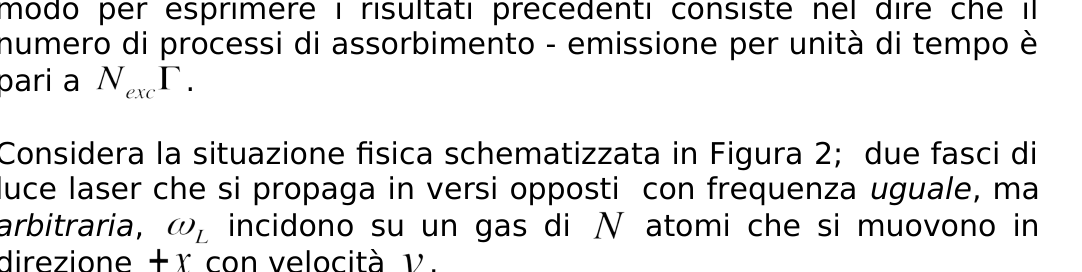
Considera la situazione fisica schematizzata in Figura 2: due fasci di luce laser che si propagano in versi opposti con frequenza uguale, ma arbitraria, incidono su un gas di atomi che si muovono in direzione con velocità .
Figura 2. Due fasci di luce laser che si propagano in versi opposti con frequenza uguale, ma arbitraria, incidono su un gas di atomi che si muovono in direzione con velocità .
p.6 — Atomi colpiti da due fasci laser opposti
Topic: Modern-Quantum Physics, Special Relativity, Conservation of Momentum Metodi: Photon Energy Relation, Conservation of Momentum, Lorentz Transformation Competenze: Physical Reasoning, Mathematical Modeling Objects: Atom, Photon, Gas Fonte: Testo (PDF) — p.5 Soluzione: Soluzioni (PDF)
6. Transfer of energy and amount of motion by a laser beam along the direction
Consider now that a laser beam of light with frequency affects the atom along the direction , while the atom also moves in the direction with speed . Answer the following questions now when there is a resonance condition between the transition between two internal energy levels of the atom and the laser beam, resonance in the reference system of the moving atom.
Write down the mean change in energy of the atom after a complete process of absorption and emission of a photon.
Write down the mean change in the amount of motion of an atom, , after a complete process of photonic absorption and emission.
Part II: Disposition and first foundations of the Otic Melas
We know there’s uncertainty in quantum processes. So the fact that the atom can spontaneously emit a photon in a finite amount of time after absorption has the consequence that the resonance condition does not have to be met exactly as it has been done so far. This means that the frequencies of the and laser beams can have any value and the absorptionemission process does however take place. These processes occur with different (quantum) probabilities and, as one might expect, the maximum probability will be with the exact resonance conditions. The average time between a single absorption process and the emission process is called the ** mean life** of the atom’s state at the excited energy level and is indicated by .
It now considers a certain amount of atoms at rest in the laboratory reference system, and also considers a laser beam of light with frequency that affects the atoms. Atoms absorb and emit continuously so that on average there are atoms in the excited state (and therefore atoms are in the minimum energy base state). A calculation made using quantum mechanics results in the following result:
where is the resonance frequency of the atomic transition and is the so-called Rabi frequency; is proportional to the intensity of the laser beam. As mentioned above, you can observe that this number is different from zero even if the resonance frequency is different from the frequency of the laser beam . Another way to express the above results is to say that the number of absorption processes per unit time is .
Consider the physical situation outlined in Figure 2: two laser beams of light propagating in opposite directions with equal but arbitrary frequency affect a gas of atoms moving in the direction with speed .
The following information is provided for in the Annex to this Regulation: Two laser beams of light propagating in opposite directions with equal but arbitrary frequency affect a gas of atoms moving in the direction at speed.*
Atoms affected by two opposite laser beams
Topic: Modern-Quantum Physics, Special Relativity, Conservation of Momentum Metodi: Photon Energy Relation, Conservation of Momentum, Lorentz Transformation Competenze: Physical Reasoning, Mathematical Modeling Objects: Atom, Photon, Gas Fonte: Testo (PDF) — p.5 Soluzione: Soluzioni (PDF)
7. Forza esercitata sul fascio atomico dai laser
(7a) Tenendo conto delle informazioni trovate finora, determina la forza che i laser esercitano sul fascio di atomi. Devi assumere che .
Topic: Newtonian Mechanics, Modern-Quantum Physics, Conservation of Momentum Metodi: Impulse-Momentum Theorem, Conservation of Momentum, Physical Modeling Competenze: Physical Reasoning, Mathematical Modeling Objects: Atom, Photon, Particle Beam Fonte: Testo (PDF) — p.6 Soluzione: Soluzioni (PDF)
7. Force exerted on the atomic beam by lasers
**(7a) ** Taking into account the information so far, it determines the force that lasers exert on the beam of atoms. Devi assumere che .
Topic: Newtonian Mechanics, Modern-Quantum Physics, Conservation of Momentum Metodi: Impulse-Momentum Theorem, Conservation of Momentum, Physical Modeling Competenze: Physical Reasoning, Mathematical Modeling Objects: Atom, Photon, Particle Beam Fonte: Testo (PDF) — p.6 Soluzione: Soluzioni (PDF)
8. Limite per velocità bassa
(8a) Supponi ora che la velocità degli atomi sia abbastanza piccola così che puoi approssimare la forza sviluppandola fino al primo ordine in . Con questi limiti ed approssimazioni trova una espressione per la forza che hai determinato al punto (7a).
In base a questo ultimo risultato puoi trovare le condizioni per accelerare gli atomi, rallentarli o non influire affatto su di essi mediante la radiazione.
(8b) Scrivi la condizione per ottenere una forza positiva, quindi accelerare gli atomi.
(8c) Scrivi la condizione per ottenere una forza nulla.
(8d) Scrivi la condizione per ottenere una forza negativa, quindi rallentare gli atomi.
(8e) Assumi ora che gli atomi si muovano con velocità (dunque in direzione ). Scrivi la condizione per ottenere una forza che rallenta gli atomi.
Topic: Newtonian Mechanics, Modern-Quantum Physics Metodi: Approximation & Series Expansion, Impulse-Momentum Theorem, Physical Modeling Competenze: Physical Reasoning, Mathematical Modeling, Estimation & Approximation Objects: Atom, Photon Fonte: Testo (PDF) — p.6 Soluzione: Soluzioni (PDF)
8. Limitations for low speed
(8a) Supponi ora che la velocità degli atomi sia abbastanza piccola così che puoi approssimare la forza sviluppandola fino al primo ordine in . With these limits and approximations find an expression for the force you determined in point (7a).
Based on this latest result, you can find the conditions to accelerate atoms, slow them down, or not affect them at all by radiation.
(8b) Scrivi la condizione per ottenere una forza positiva, quindi accelerare gli atomi.
(8c) Scrivi la condizione per ottenere una forza nulla.
(8d) Scrivi la condizione per ottenere una forza negativa, quindi rallentare gli atomi.
**8e) ** Assume now that atoms are moving at (therefore in direction). Write down the condition for obtaining a force that slows down atoms.
Topic: Newtonian Mechanics, Modern-Quantum Physics Metodi: Approximation & Series Expansion, Impulse-Momentum Theorem, Physical Modeling Competenze: Physical Reasoning, Mathematical Modeling, Estimation & Approximation Objects: Atom, Photon Fonte: Testo (PDF) — p.6 Soluzione: Soluzioni (PDF)
9. Melasse ottiche
(9a) Nel caso di una forza negativa l’effetto è quello di una forza di attrito dissipativa. Supponi che inizialmente, all’istante , il gas di atomi abbia velocità . Sempre con il limite della bassa velocità trova la velocità degli atomi dopo che i fasci di luce laser hanno agito su di essi per un intervallo di tempo .
(9b) Supponi ora che il gas di atomi sia in equilibrio termico alla temperatura . Trova la temperatura dopo che i fasci di luce laser hanno agito per un intervallo di tempo .
Questo modello comunque non è valido quando si raggiungono temperature arbitrariamente basse.
Topic: Newtonian Mechanics, Thermodynamics, Kinetic Theory Metodi: Differential Equations, Kinetic Theory of Gases, Physical Modeling Competenze: Physical Reasoning, Mathematical Modeling Objects: Atom, Gas Fonte: Testo (PDF) — p.7 Soluzione: Soluzioni (PDF)
9. Optical molasses
In the case of a negative force the effect is that of a dissipative friction force. Suppose that at the beginning, at the instant , the atomic gas has a velocity . Also with the low speed limit it finds the speed of the atoms after the laser beams have acted on them for a time interval .
**9b) ** Now suppose that the gas of atoms is in thermal equilibrium at . Find the temperature after the laser beams have been acting for a time interval .
This model is however not valid when temperatures are reached at arbitrarily low temperatures.
Topic: Newtonian Mechanics, Thermodynamics, Kinetic Theory Metodi: Differential Equations, Kinetic Theory of Gases, Physical Modeling Competenze: Physical Reasoning, Mathematical Modeling Objects: Atom, Gas Fonte: Testo (PDF) — p.7 Soluzione: Soluzioni (PDF)