- Una stima classica della temperatura al centro delle stelle.
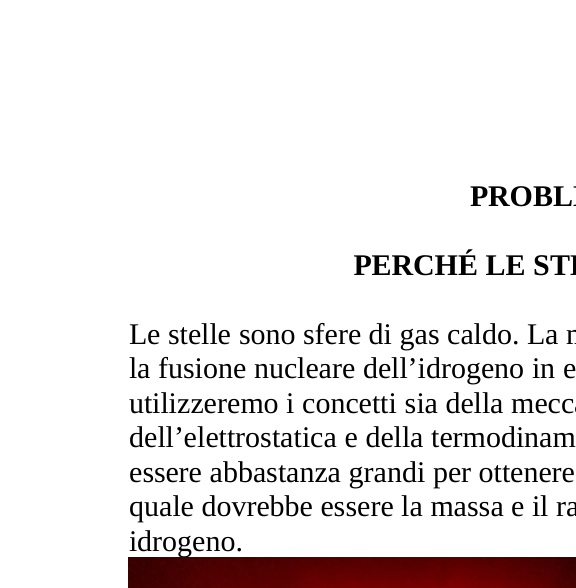
Figura 1. Il nostro Sole, come la maggior parte delle stelle, risplende a causa della fusione termonucleare dell’idrogeno in elio nel suo nucleo.
COSTANTI UTILI
Costante gravitazionale =
Costante di Boltzmann =
Costante di Planck =
Massa del protone =
Massa dell’elettrone =
Unità della carica elettrica =
Costante dielettrica del vuoto =
Raggio del Sole =
Massa del Sole =
Assumi che il gas che forma la stella sia idrogeno puro ionizzato (elettroni e protoni in uguale quantità), e che esso si comporti come un gas perfetto. Da un punto di vista classico, per fondere due protoni, essi devono essere avvicinati fino a una distanza dell’ordine di in modo che la forza forte nucleare che opera su corte distanze, ed è una forza attrattiva, possa diventare dominante. Comunque, per portare i due protoni molto vicini, essi devono prima vincere l’azione repulsiva della forza di Coulomb. Assumi classicamente che i due protoni (considerati come oggetti puntiformi) si stiano muovendo nella stessa direzione e verso contrario ciascuno con velocità , che è la velocità quadratica media (rms) dei protoni, in una collisione frontale unidimensionale.
1a Quale deve essere la temperatura del gas, , in modo che la distanza di massimo avvicinamento dei protoni, , sia di ? Fornisci questo e tutti i valori numerici in questo problema con almeno due cifre significative. 1.5
p.1 — Il Sole, stella che fonde idrogeno
Topic: Thermodynamics, Electrostatics, Kinetic Theory Metodi: Ideal Gas Law, Coulomb’s Law, Energy Conservation Method Competenze: Mathematical Modeling, Physical Reasoning, Estimation & Approximation Objects: Star, Nucleus Fonte: Testo (PDF) — p.1 Soluzione: Soluzioni (PDF)
- A classic estimate of the temperature at the center of the stars.
Figure 1 is shown. Our Sun, like most stars, shines because of the thermonuclear fusion of hydrogen into helium in its core.
Useful costs
Costante gravitazionale =
The Boltzmann constant is
Costante di Planck =
The mass of the proton =
The mass of the electron =
The unit of electrical charge =
Costante dielettrica del vuoto =
The total amount of the solar radius is equal to
The mass of the Sun =
Assume that the gas that forms the star is pure ionized hydrogen (electrons and protons in equal quantities), and that it behaves like a perfect gas. From a classical point of view, to merge two protons, they must be brought close to a distance of the order of so that the strong nuclear force acting over short distances, and being an attractive force, can become dominant. However, to bring the two protons very close together, they must first overcome the repulsive action of Coulomb’s force. It assumes classically that the two protons (considered to be pointed objects) are moving in the same direction and opposite each with speed , which is the average square velocity (rms) of the protons, in a one-dimensional frontal collision.
1a What is the temperature of the gas, , so that the maximum distance of approach of protons, , is ? Give this and all the numerical values in this problem with at least two significant digits. 1.5
p.1 — Il Sole, stella che fonde idrogeno
Topic: Thermodynamics, Electrostatics, Kinetic Theory Metodi: Ideal Gas Law, Coulomb’s Law, Energy Conservation Method Competenze: Mathematical Modeling, Physical Reasoning, Estimation & Approximation Objects: Star, Nucleus Fonte: Testo (PDF) — p.1 Soluzione: Soluzioni (PDF)
- Concludere che la precedente stima della temperatura è errata.
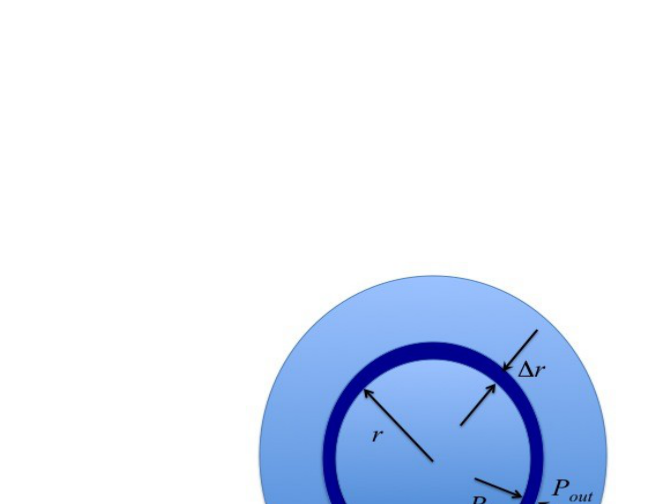
Per controllare se la precedente stima della temperatura è ragionevole, è necessario un metodo indipendente per stimare la temperatura al centro di una stella. La struttura delle stelle è molto complicata, ma possiamo ottenere una comprensione significativa facendo alcune ipotesi. Le stelle sono in equilibrio, cioè esse non si espandono o si contraggono poiché la forza diretta verso l’interno dovuta alla gravità è equilibrata dalla forza diretta verso l’esterno dovuta alla pressione (vedi figura 2). Per uno strato di gas l’equazione dell’equilibrio idrostatico ad una data distanza dal centro della stella, è data da
dove è la pressione del gas, la costante gravitazionale, la massa della stella compresa entro una sfera di raggio , e è la densità del gas nello strato considerato. Una stima dell’ordine di grandezza della temperatura nel nucleo della stella può essere ottenuta a partire dai valori dei parametri al centro e alla superficie della stella, facendo le seguenti approssimazioni:
dove e sono rispettivamente la pressione al centro e alla superficie della stella. Poiché , possiamo assumere che
Entro la stessa approssimazione, possiamo scrivere
dove è il raggio totale della stella, e
con massa totale della stella. La densità può essere approssimata dal suo valore al centro,
Puoi assumere che la pressione sia quella di un gas perfetto.
2a Trova un’equazione per la temperatura al centro della stella, , in funzione solamente del raggio e della massa della stella e delle costanti fisiche. 0.5
Possiamo usare ora la seguente previsione di questo modello come criterio per verificare la sua validità:
2b Utilizzando l’equazione trovata in (2a) scrivi il rapporto atteso per una stella in funzione solamente delle costanti fisiche e di . 0.5
Figura 2. Le stelle sono in equilibrio idrostatico, con la differenza di pressione che bilancia la gravità. .
2c Utilizza il valore di ricavato nella parte (1a) e trova il valore numerico del rapporto atteso per una stella. 0.5
2d Ora, calcola il rapporto e verifica che questo valore è molto più piccolo di quello trovato in (2c). 0.5
p.3 — Stella in equilibrio idrostatico
Topic: Gravitation, Thermodynamics, Newtonian Mechanics Metodi: Hydrostatic Equilibrium, Ideal Gas Law, Order-of-Magnitude Estimation Competenze: Mathematical Modeling, Physical Reasoning, Estimation & Approximation Objects: Star Fonte: Testo (PDF) — p.2 Soluzione: Soluzioni (PDF)
- Conclusion that the previous estimate of temperature is wrong.
To check whether the previous temperature estimate is reasonable, an independent method for estimating the temperature at the center of a star is needed. The structure of stars is very complicated, but we can get a meaningful understanding by making some assumptions. Stars are in equilibrium, that is, they do not expand or contract because the force directed inward due to gravity is balanced by the force directed outward due to pressure (see Figure 2). For a gas layer the equation of hydrostatic equilibrium at a given distance from the center of the star is given by
where is the gas pressure, the gravitational constant, the mass of the star within a sphere of radius , and is the density of the gas in the layer considered. An estimate of the order of magnitude of the temperature in the star’s core can be obtained from the values of the parameters at the star’s centre and surface by making the following approximations:
where and are the pressure at the centre and surface of the star, respectively. Since , we can assume that
To the same approximation, we can write
where is the total radius of the star, and
with total mass of the star. The density can be approximated by its value at the center,
You can assume the pressure is the same as a perfect gas.
2a Find an equation for the temperature at the center of the star, , based only on the radius and mass of the star and the physical constants. 0.5
We can now use the following prediction of this model as a criterion to verify its validity:
2b Using the equation in (2a) write the expected ratio for a star functioning only of physical constants and . 0.5
Figure two. The stars are in hydrostatic equilibrium, with the pressure difference balancing gravity. .
2c Use the value of from part (1a) and find the numerical value of the expected ratio for a star. 0.5
2d Now, calculate the ratio and check that this value is much smaller than the one found in (2c). 0.5
The following table shows the results of the calculation of the total number of stars in the sample:
Topic: Gravitation, Thermodynamics, Newtonian Mechanics Metodi: Hydrostatic Equilibrium, Ideal Gas Law, Order-of-Magnitude Estimation Competenze: Mathematical Modeling, Physical Reasoning, Estimation & Approximation Objects: Star Fonte: Testo (PDF) — p.2 Soluzione: Soluzioni (PDF)
- Una stima quantistica della temperatura al centro delle stelle.
La grande discrepanza trovata in (2d) suggerisce che la stima classica di ottenuta nella parte (1a) non sia corretta. La soluzione a questa discrepanza la si trova quando si considerano gli effetti della meccanica quantistica, che ci dice che i protoni si comportano come onde e che un singolo protone si estende su uno spazio dell’ordine di , la lunghezza d’onda di de Broglie. Ciò implica che se , la distanza di massimo avvicinamento dei protoni, è dell’ordine di , i protoni, in senso quantistico, si sovrappongo e possono fondersi.
3a Assumendo che sia la condizione che permette la fusione, trova, per un protone con velocità , un’equazione per in funzione solamente delle costanti fisiche. 1.0
3b Stima numericamente il valore di ottenuto in (3a). 0.5
3c Utilizza il valore di ricavato in (3b) per trovare il valore numerico del rapporto atteso per una stella, impiegando la formula ricavata in (2b). Verifica che questo valore è del tutto simile al rapporto misurato . 0.5
Veramente, le stelle che si trovano nella cosiddetta sequenza principale (che fondono idrogeno e sono dette normali) seguono approssimativamente questo rapporto per un’ampia gamma di masse.
Topic: Modern-Quantum Physics, Thermodynamics, Astrophysics Metodi: de Broglie Relation, Ideal Gas Law, Order-of-Magnitude Estimation Competenze: Mathematical Modeling, Estimation & Approximation, Physical Reasoning Objects: Star, Nucleus Fonte: Testo (PDF) — p.4 Soluzione: Soluzioni (PDF)
- A quantum estimate of the temperature at the center of the stars.
The large discrepancy found in (2d) suggests that the classical estimate of obtained in Part (1a) is incorrect. The solution to this discrepancy is found when we consider the effects of quantum mechanics, which tells us that protons behave like waves and that a single proton extends over a space of the order of , the de Broglie wavelength. This means that if , the maximum distance of approach of protons, is of the order of , the protons, quantum-wise, overlap and can merge.
3a Assuming that is the condition that allows fusion, for a proton with a speed , find an equation for in terms of only physical constants. 1.0
3b Calculate numerically the value of obtained in (3a). 0.5
3c Use the value of obtained in (3b) to find the numerical value of the expected ratio for a star using the formula obtained in (2b). Check that this value is quite similar to the measured ratio . 0.5
Indeed, stars in the so-called main sequence (which melt hydrogen and are called normal) follow approximately this ratio for a wide range of masses.
Topic: Modern-Quantum Physics, Thermodynamics, Astrophysics Metodi: de Broglie Relation, Ideal Gas Law, Order-of-Magnitude Estimation Competenze: Mathematical Modeling, Estimation & Approximation, Physical Reasoning Objects: Star, Nucleus Fonte: Testo (PDF) — p.4 Soluzione: Soluzioni (PDF)
- Il rapporto massa/raggio delle stelle.
Il precedente accordo trovato suggerisce che l’approccio quantistico alla stima della temperatura al centro del Sole è corretto.
4a Utilizza il precedente risultato per dimostrare che per qualsiasi stella che fonde idrogeno, il rapporto della massa rispetto al raggio è lo stesso e dipende solamente dalle costanti fisiche. Trova l’equazione per il rapporto per stelle che fondono idrogeno. 0.5
Topic: Modern-Quantum Physics, Astrophysics, Thermodynamics Metodi: de Broglie Relation, Ideal Gas Law, Physical Modeling Competenze: Mathematical Modeling, Estimation & Approximation, Physical Reasoning Objects: Star Fonte: Testo (PDF) — p.4 Soluzione: Soluzioni (PDF)
- The mass-radius ratio of the stars.
The previous agreement found suggests that the quantum approach to estimating the temperature at the center of the Sun is correct.
4a It uses the previous result to show that for any hydrogen-melting star, the mass ratio to the radius is the same and depends only on the physical constants. Find the equation for the ratio for hydrogen-melting stars. 0.5
Topic: Modern-Quantum Physics, Astrophysics, Thermodynamics Metodi: de Broglie Relation, Ideal Gas Law, Physical Modeling Competenze: Mathematical Modeling, Estimation & Approximation, Physical Reasoning Objects: Star Fonte: Testo (PDF) — p.4 Soluzione: Soluzioni (PDF)
- La massa e il raggio della stella più piccola.
Il risultato trovato in (4a) suggerisce che ci potrebbero essere stelle di qualsiasi massa a condizione che una simile relazione sia comunque rispettata; tuttavia, ciò non è vero. È noto che il gas all’interno delle stelle normali che fondono idrogeno si comporta approssimativamente come un gas perfetto. Ciò significa che , la tipica separazione tra elettroni è in media più ampia di , la loro lunghezza d’onda di de Broglie tipica. Se fossero più vicini, gli elettroni si troverebbero in uno stato cosiddetto degenere e le stelle dovrebbero comportarsi diversamente. Notare la differenza nei modi in cui trattiamo i protoni e gli elettroni all’interno delle stelle. Per i protoni, le loro onde di de Broglie dovrebbero sovrapporsi strettamente affinché essi si scontrino allo scopo di fondersi, mentre per gli elettroni le loro onde di de Broglie dovrebbero non sovrapporsi al fine di continuare a comportarsi come un gas perfetto. La densità nelle stelle aumenta al diminuire del raggio. Ciò nonostante, per la stima di questo ordine di grandezza assumi che esse siano della stessa densità. Puoi inoltre usare che .
5a Trova un’equazione per , la densità media del numero di elettroni all’interno della stella. 0.5
5b Trova un’equazione per , la separazione tipica tra elettroni all’interno della stella. 0.5
5c Usa la condizione per scrivere un’equazione per il raggio della più piccola stella normale possibile. Prendi la temperatura al centro della stella come la temperatura tipica in tutta la parte interna della stella. 1.5
5d Trova il valore numerico del raggio della più piccola stella normale possibile, sia in metri sia in unità di raggio solare. 0.5
5e Trova il valore numerico della massa della più piccola stella normale possibile, sia in kg sia in unità di masse solari. 0.5
Topic: Modern-Quantum Physics, Astrophysics, Thermodynamics Metodi: de Broglie Relation, Order-of-Magnitude Estimation, Ideal Gas Law Competenze: Mathematical Modeling, Estimation & Approximation, Physical Reasoning Objects: Star, Electron Fonte: Testo (PDF) — p.5 Soluzione: Soluzioni (PDF)
- The mass and radius of the smallest star.
The result found in (4a) suggests that there could be stars of any mass provided that such a relationship is still observed; however, this is not true. It is known that the gas inside normal hydrogen-melting stars behaves approximately like a perfect gas. This means that , the typical electron separation is on average wider than , their typical de Broglie wavelength. If they were closer, the electrons would be in a state called degeneration, and the stars would behave differently. Notice the difference in the way we treat protons and electrons inside stars. For protons, their de Broglie waves should overlap tightly so that they collide for the purpose of merging, while for electrons their de Broglie waves should not overlap in order to continue to behave like a perfect gas. The density in stars increases as the radius decreases. Nevertheless, for the estimation of this order of magnitude, assume that they are of the same density. You can also use that .
5a Find an equation for , the average density of the number of electrons inside the star. 0.5
5b Find an equation for , the typical electron separation within the star. 0.5
5c Use the condition to write an equation for the radius of the smallest normal star possible. Take the temperature at the center of the star as the typical temperature throughout the star’s interior. 1.5
5d Find the numerical value of the radius of the smallest normal star possible, both in meters and solar radius units. 0.5
5e Find the numerical value of the mass of the smallest possible normal star, both in kg and in solar mass units. 0.5
Topic: Modern-Quantum Physics, Astrophysics, Thermodynamics Metodi: de Broglie Relation, Order-of-Magnitude Estimation, Ideal Gas Law Competenze: Mathematical Modeling, Estimation & Approximation, Physical Reasoning Objects: Star, Electron Fonte: Testo (PDF) — p.5 Soluzione: Soluzioni (PDF)
- Fondere nuclei di elio nelle stelle più vecchie.
Quando le stelle saranno diventate più vecchie esse avranno fuso in elio (He) la maggior parte dell’idrogeno presente nel loro nucleo, così esse saranno costrette a iniziare a fondere elio in elementi più pesanti per poter continuare a risplendere. Un nucleo di elio ha due protoni e due neutroni, così esso ha carica doppia e approssimativamente quattro volte la massa di un protone. Abbiamo osservato prima che è la condizione che si deve avere affinché i protoni fondano.
6a Individua la condizione equivalente per i nuclei di elio e trova , la velocità quadratica media (rms) dei nuclei di elio, e , la temperatura necessaria per la fusione dell’elio. 0.5
Topic: Modern-Quantum Physics, Thermodynamics, Electrostatics Metodi: de Broglie Relation, Ideal Gas Law, Coulomb’s Law Competenze: Mathematical Modeling, Estimation & Approximation, Physical Reasoning Objects: Star, Nucleus Fonte: Testo (PDF) — p.6 Soluzione: Soluzioni (PDF)
- Fuse helium nuclei into the oldest stars.
When stars become older they will have melted most of the hydrogen in their core into helium (He), so they will be forced to start melting helium into heavier elements in order to continue to shine. A helium nucleus has two protons and two neutrons, so it has a charge twice and about four times the mass of a proton. Abbiamo osservato prima che è la condizione che si deve avere affinché i protoni fondano.
6a Find the equivalent condition for helium nuclei and find , the mean square velocity (rms) of helium nuclei, and , the temperature required for helium fusion. 0.5
Topic: Modern-Quantum Physics, Thermodynamics, Electrostatics Metodi: de Broglie Relation, Ideal Gas Law, Coulomb’s Law Competenze: Mathematical Modeling, Estimation & Approximation, Physical Reasoning Objects: Star, Nucleus Fonte: Testo (PDF) — p.6 Soluzione: Soluzioni (PDF)