v
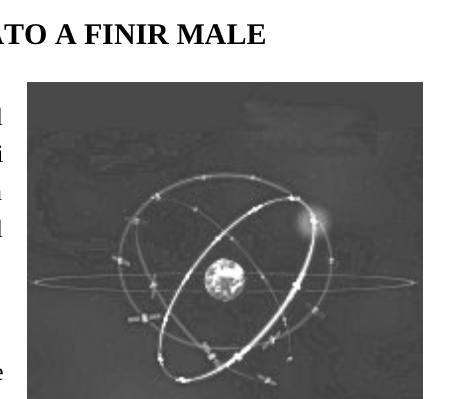
0 v 0 r F-1 m 36th Olimpiade Internazionale di Fisica. Salamanca (Spagna) 2005 Problema Teorico n. 1 - UN SATELLITE DESTINATO A FINIR MALE Le manovre eseguite più frequentemente su una navicella in orbita consistono nel far variare la velocità lungo la direzione di volo, cioè nel produrre accelerazioni per raggiungere orbite più alte o frenate per iniziare il rientro nell’atmosfera. In questo problema studieremo invece le variazioni d’orbita quando la spinta del motore è applicata in direzione radiale. Per i calcoli numerici usare i seguenti dati: raggio terrestre , accelerazione di gravità sulla superficie terrestre . Assumere, inoltre, che la durata di un giorno siderale sia . Consideriamo un satellite geostazionario1 per telecomunicazioni, di massa m, posto in orbita equatoriale circolare di raggio . Questi satelliti sono dotati di un “motore d’apogeo”, che dovrebbe produrre la spinta tangenziale necessaria per raggiungere l’orbita finale. Parte 1 1.1 Calcolare il valore numerico di . 1.2 Scrivere prima l’espressione analitica della velocità del satellite espressa in funzione di g, e , successivamente calcolare il suo valore numerico. 1.3 Ricavare, in funzione di , m, g e , le espressioni del momento angolare e dell’energia meccanica . Una volta raggiunta l’orbita circolare geostazionaria (vedi Figura F-1), con il satellite stabilizzato nella posizione voluta, pronto a svolgere la propria funzione, un errore dei controllori a terra fa sì che il motore d’apogeo si accenda nuovamente. La spinta che viene data è diretta verso la Terra e nonostante la pronta reazione dei controllori a terra per spegnere subito il motore, una variazione di velocità , non voluta, viene impressa al satellite. Caratterizziamo questa spinta con il parametro . La durata dell’accensione del motore è trascurabile rispetto a qualunque tempo caratteristico del moto, cosicché può essere considerata come istantanea. Parte 2 Supporre che sia . 2.1 Determinare, in funzione di e , i parametri della nuova orbita2: il semilato retto e l’eccentricità . 2.2 Calcolare l’angolo tra l’asse maggiore della nuova orbita ed il vettore posizione del punto in cui è avvenuta per errore l’accensione del motore. 2.3 Fornire, in funzione di e , un’espressione analitica delle distanze di perigeo e di apogeo dal centro della Terra, quindi calcolarne i valori numerici per . 2.4 Determinare il periodo della nuova orbita, T, in funzione di e quindi calcolarne il valore numerico per . 1 Il suo periodo di rivoluzione è . 2 Vedere il “suggerimento”. Th 1- Pagina 1 di 4 R.S.E.F. Image: ESA
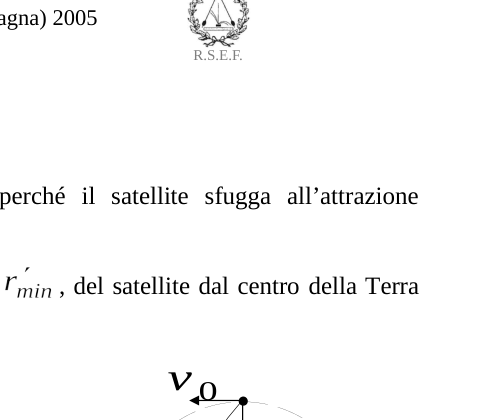
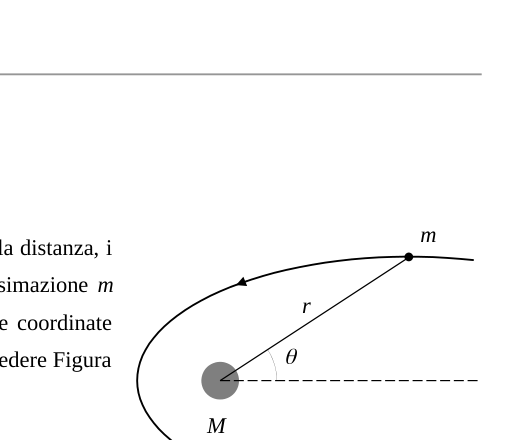
36th Olimpiade Internazionale di Fisica. Salamanca (Spagna) 2005 Parte 3 3.1 Calcolare il valore minimo di (indicato con ) necessario perché il satellite sfugga all’attrazione gravitazionale terrestre. 3.2 Determinare in tale condizione, in funzione di , la minima distanza, , del satellite dal centro della Terra lungo la nuova traiettoria. Parte 4 Supporre ora . 4.1 Determinare, in funzione di e , la velocità, , del satellite quando si trova a distanza infinita. 4.2 Ricavare, in funzione di e , il “parametro d’impatto” b della direzione asintotica di fuga. (Vedere Figura F-2). 4.3 Determinare l’angolo della direzione asintotica di fuga in funzione di ; quindi calcolarne il valore numerico per . SUGGERIMENTO Per effetto di una forza centrale inversamente proporzionale al quadrato della distanza, i corpi descrivono traiettorie rappresentate da ellissi, parabole, iperboli. Nell’approssimazione m << M la massa M si trova in uno dei due fuochi. Assumendo come origine delle coordinate questo fuoco, l’equazione polare generale di queste curve può essere scritta come (vedere Figura F-3)
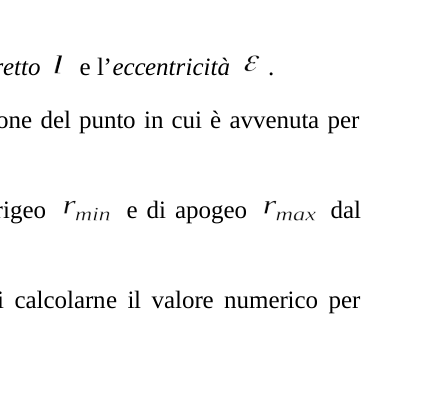
dove l è una costante positiva chiamata semilato retto e è l’eccentricità della curva. In funzione delle costanti del moto: e dove G è la costante di gravitazione universale, L è il modulo del momento angolare (o momento della quantità di moto) della massa orbitante rispetto all’origine delle coordinate ed E è la sua energia meccanica, avendo assunto che l’energia potenziale valga zero a distanza infinita. Si possono avere i seguenti casi: i) Se , la curva è un’ellisse (in particolare una circonferenza per ). ii) Se , la curva è una parabola. iii) Se , la curva è un’iperbole. Th 1- Pagina 2 di 4 R.S.E.F. m M
r F-3
v
0 v
v b 0r F-2
36th Olimpiade Internazionale di Fisica. Salamanca (Spagna) 2005 CODICE DEL PAESE CODICE DELLO STUDENTE NUMERO DI PAGINA NUMERO TOTALE DI PAGINE Problema Teorico n. 1 - FOGLIO RISPOSTE Domanda Formule e idee fondamentali utilizzate Risultati in forma analitica Risultati numerici Punti 1.1 0.3 1.2 0.4 1.3 0.4 0.4 2.1 0.4 0.5 2.2 1.0 2.3 1.2 2.4 0.7 3.1 0.5 3.2 1.0 4.1 1.0 4.2 1.0 4.3 1.2 Th 1- Pagina 3 di 4 R.S.E.F.
36th Olimpiade Internazionale di Fisica. Salamanca (Spagna) 2005 Th 1- Pagina 4 di 4 R.S.E.F.
p.1 — Orbita del satellite attorno alla Terra
p.1 — Geometria orbita con velocita v0 e r0
p.2 — Variazione di velocita in direzione gravitazionale
p.2 — Suggerimento: orbita ellittica con fuoco
Topic: Gravitation, Newtonian Mechanics, Conservation of Energy Metodi: Newton’s Law of Gravitation, Conservation Laws, Conservation of Energy, Kepler’s Laws Competenze: Mathematical Modeling, Physical Reasoning, Diagrammatic Reasoning Objects: Satellite, Planet Fonte: Testo (PDF) — p.1
v
0 v 0 r F-1 m 36th International Olympics in physics. The Commission shall adopt delegated acts in accordance with Article 21 of Regulation (EC) No 1290/2005. Theoretical problem n. 1 - A satellite destined to end badly The most frequently performed manoeuvres on an orbiting craft consist of: to vary the speed along the flight direction, i.e. to produce acceleration to reach higher or brake orbits to start reentry into the atmosphere. In This problem is instead going to study the variations in orbit when the momentum of the The engine shall be applied in the radial direction. For numerical calculations use the following data: The following is the list of the following: , gravity acceleration on the surface of the land . Assume, furthermore, that the duration of a sidereal day is . Consider a geostationary satellite1 for telecommunications, mass m, placed in a radius-circular equatorial orbit . These satellites are equipped of a dapogeo engine, which should produce the tangential thrust needed to reach the final orbit. Part 1 1.1 Calculate the numerical value of . 1.2 Write the analytical expression of speed first the satellite expressed in g, e , The number of the number of the number of the number of the number of the number of the number of the number of the number of the number of the number of the number of the number of the number of the number of the number of the number of the number of the number of the number of the number of the number of the number of the number of the number of the number of the number of the number of the number of the number of the number of the number of the number of the number of the number of the number of the number of the number of the number of the number of the number of the number of the number of the number of the number of the number of the number of the number of the number of the number of the number of the number of the number of the number of the number of the number of the number of the number of the number of the number of the number of the number of the number of the number of the number of the number of the number of the number of the number of the number of the number of the number of the number of the number of the number of the number of the number of the number of the number of the number of the number of the number of the number of the number of the number of the number of the number of the number of the number of the number of the number of the number of the number of the number of the number of the number of the number of the number of the number of the number of the number of the number of the number of the number of the number of the number of the number of the number of the number of the number of the number of the number of the number of the number of the number of the number of the number of the number of the number of the number of the number of the number of the number of the number of the number of the number of the number of the number of the number of the number of the number of the number of the number of the number of the number of the number of the number of the number of the number of the number of the number of the number. 1.3 The Commission shall adopt the following measures: , m, g e , the angular momentum and mechanical energy . Once the geostationary circular orbit has been reached (see Figure F-1), the satellite will be The Commission has already established a number of measures to ensure that the The ground controllers cause the apogee engine to start again. The impetus that comes The data is directed towards the Earth and despite the prompt reaction of ground controllers to shut down The engine is running, the speed changes. It’s printed on the satellite. Let’s characterize this thrust with the parameter . The duration of the lights The engine is negligible compared to any characteristic time of the motorcycle, so it can be It’s considered instantaneous. Part 2 Suppose that it is . 2.1 Determine, in accordance with and , the parameters of the new orbit2: the half-right and eccentricity . 2.2 Calculate the angle between the major axis of the new orbit and the vector position of the point where it occurred for Engine power failure. 2.3 Provision, in accordance with and , an analytical expression of perigee distances and the height of the height from So we’re going to calculate the numerical values for the Earth’s center. . 2.4 Determine the period of the new orbit, T, according to And then we calculate the numerical value of the . 1 Its period of revolution is . 2 See also suggestion. Th 1- Page 1 of 4 R.S.E.F. Image provided by ESA
36th International Olympics in physics. The Commission shall adopt delegated acts in accordance with Article 21 of this Regulation. The following information shall be provided: 3.1 Calculate the minimum value of (indicated by: ) necessary for the satellite to escape the attraction The gravitational pull of the Earth. 3.2 In such a situation, it is necessary to determine, in accordance with the , the minimum distance, , satellite from the center of the Earth along the new trajectory. Part 4 Suppose now . 4.1 Determine, in accordance with and , the speed, , satellite when you It’s at infinite distance. 4.2 The Commission shall adopt the following measures: and , the directional impact parameter b Asynthetic flight. (See Figure F-2). 4.3 Determine the angle the asynchronous direction of escape as a function of; Then calculate the numerical value for . The Commission shall adopt implementing acts in accordance with Article 21 of this Regulation. By means of a central force inversely proportional to the square of the distance, the The body describes trajectories represented by ellipses, parabolas, hyperbolas. In the approximation m “M mass M is in one of the two fires. Assuming as origin the coordinates This fire, the general polar equation of these curves can be written as (see Figure F-3)
where l is a positive constant called a semicircular and is the eccentricity of the curve. In operation of the motorcycle constants: e where G is the universal gravitational constant, L is the modulus of angular momentum (or momentum of quantity of motion) of the mass The orbiting object is the orbiting object of the coordinates and E is its mechanical energy, assuming that the potential energy is zero at It’s an infinite distance. The following cases may occur: i) Se , the curve is a ellisse (in particular a circumference for ). ii) Se The curve is a parabola. (iii) the following: Se , the curve is a hyperbole. Th 1- Page 2 of 4 R.S.E.F. m M
r F-3
v
0 v
v b 0r F-2
36th International Olympics in physics. The Commission shall adopt delegated acts in accordance with Article 21 of this Regulation. The country code The Student Code Page number Total number of pages Theoretical problem n. 1 - FLOW RESPONSED to the Commission Question by Mr. Forms and ideas The following points are added: used Results in analytical form The number of results Points 1.1 0.3 1.2 0.4 1.3 0.4 0.4 2.1 0.4 0.5 2.2 1.0 2.3 1.2 2.4 0.7 3.1 0.5 3.2 1.0 4.1 1.0 4.2 1.0 4.3 1.2 Th 1- Page 3 of 4 R.S.E.F.
36th International Olympics in physics. The Commission shall adopt delegated acts in accordance with Article 21 of Regulation (EC) No 1290/2005. Th 1- Page 4 of 4 R.S.E.F.
The following is the list of the satellites in orbit around the Earth:
**p.1 ** Geometry in orbit at speed v0 and r0
The following shall be added to the list of the following:
Suggestion: elliptical orbit with fire
Topic: Gravitation, Newtonian Mechanics, Conservation of Energy Metodi: Newton’s Law of Gravitation, Conservation Laws, Conservation of Energy, Kepler’s Laws Competenze: Mathematical Modeling, Physical Reasoning, Diagrammatic Reasoning Objects: Satellite, Planet Fonte: Testo (PDF) — p.1