C1. Como se muestra en la figura, sobre un cuerpo , de masa , se encuentra un cuerpo , de masa . Determinar la fuerza que debe actuar sobre para que se deslice sobre . Entre el plano horizontal y no hay coeficiente de rozamiento y entre y es .
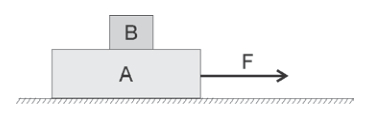 Body B on top of body A
Topic: Newtonian Mechanics Metodi: Free-Body Diagram, Newton’s Law of Gravitation, Kinematic Equations Competenze: Physical Reasoning, Mathematical Modeling Objects: Block Fonte: Testo (PDF) — p.1
C1. Come mostrato nella figura, su un corpo di massa si trova un corpo di massa . Determinare la forza che deve agire su per far scivolare su . Tra il piano orizzontale e non c’è un coefficiente di ruggine e tra e è .
Body B on top of body A
Topic: Newtonian Mechanics Metodi: Free-Body Diagram, Newton’s Law of Gravitation, Kinematic Equations Competenze: Physical Reasoning, Mathematical Modeling Objects: Block Fonte: Testo (PDF) — p.1
As shown in Figure, on a body , of mass , a body , of mass is found. Determine the force to be applied to in order for to slide over . Between the horizontal plane and there is no friction coefficient and between and it is .
Body B on top of body A
Topic: Newtonian Mechanics Metodi: Free-Body Diagram, Newton’s Law of Gravitation, Kinematic Equations Competenze: Physical Reasoning, Mathematical Modeling Objects: Block Fonte: Testo (PDF) — p.1
C2. A una lámina circular homogénea de radio , se le ha practicado un orificio de radio , como se indica en la figura. Determinar la posición del centro de masas de la lámina resultante.
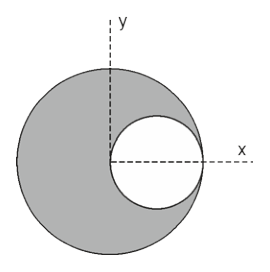 Circular plate with circular hole
Topic: Newtonian Mechanics, Rigid Body Statics Metodi: Superposition Principle, Symmetry Argument, Physical Modeling Competenze: Physical Reasoning, Mathematical Modeling Objects: Disk Fonte: Testo (PDF) — p.2
C2. Un foglio circolare omogeneo radio è stato perforato da un radio , come indicato nella figura. Determinare la posizione del centro di massa della lamina risultante.
Platte circolare con buco circolare
Topic: Newtonian Mechanics, Rigid Body Statics Metodi: Superposition Principle, Symmetry Argument, Physical Modeling Competenze: Physical Reasoning, Mathematical Modeling Objects: Disk Fonte: Testo (PDF) — p.2
C2. A radio homogeneous circular sheet has been drilled a radio hole, as shown in Figure 1. Determine the position of the centre of mass of the resulting sheet.
Circular plate with circular hole
Topic: Newtonian Mechanics, Rigid Body Statics Metodi: Superposition Principle, Symmetry Argument, Physical Modeling Competenze: Physical Reasoning, Mathematical Modeling Objects: Disk Fonte: Testo (PDF) — p.2
C3. Dos muelles idénticos poseen en sus extremos masas de valores respectivos y , descansando sobre una superficie horizontal sin rozamiento. Ambas masas se separan simultáneamente de su posición de equilibrio una distancia .
a) ¿Qué relación hay entre el tiempo que tardan ambos sistemas en dar una oscilación completa?
b) ¿Qué relación hay entre las energías potenciales de ambas partículas cuando están a la máxima distancia del punto de equilibrio?
Topic: Oscillations & Waves, Conservation of Energy Metodi: Simple Harmonic Motion Analysis, Energy Conservation Method, Hooke’s Law Competenze: Physical Reasoning, Mathematical Modeling Objects: Spring Fonte: Testo (PDF) — p.3
C3. Due stelle identiche hanno nelle loro masse estremiste rispettive valori e , riposando su una superficie orizzontale senza ruggine. Entrambe le masse si separano simultaneamente dalla loro posizione di equilibrio da una distanza .
a) Qual è la relazione tra il tempo impiegato da entrambi i sistemi per ottenere un oscillazione completa?
b) Qual è la relazione tra le energie potenziali di entrambe le particelle quando sono a massima distanza dal punto di equilibrio?
Topic: Oscillations & Waves, Conservation of Energy Metodi: Simple Harmonic Motion Analysis, Energy Conservation Method, Hooke’s Law Competenze: Physical Reasoning, Mathematical Modeling Objects: Spring Fonte: Testo (PDF) — p.3
Two identical docks have at their extremes the respective values of and , resting on a horizontal surface without friction. Both masses are separated from their equilibrium position by a distance simultaneously.
(a) What is the relationship between the time it takes for both systems to give a complete oscillation?
(b) What is the relationship between the potential energies of both particles when they are at the maximum distance from the equilibrium point?
Topic: Oscillations & Waves, Conservation of Energy Metodi: Simple Harmonic Motion Analysis, Energy Conservation Method, Hooke’s Law Competenze: Physical Reasoning, Mathematical Modeling Objects: Spring Fonte: Testo (PDF) — p.3
C4. Obtener el campo eléctrico y el potencial eléctrico en el centro de un pentágono de 1 metro de lado que posee en cuatro de sus vértices, tal como se señala en la figura, una carga de . Dibujar en la figura la dirección y el sentido del campo.
Datos:
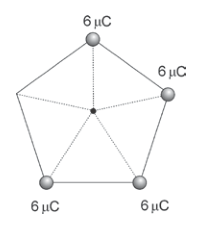 Regular pentagon with 4 charges at vertices
Topic: Electrostatics Metodi: Superposition Principle, Coulomb’s Law, Electric Potential Method Competenze: Physical Reasoning, Mathematical Modeling Objects: Point Charge Fonte: Testo (PDF) — p.4
C4. Ottenere il campo elettrico e il potenziale elettrico nel centro di un pentagono di 1 metro laterale che possiede su quattro dei suoi vertici, come indicato nella figura, una carica di . Disegnare nella figura la direzione e il senso del campo.
Dati:
Regular pentagon with 4 charges at vertices
Topic: Electrostatics Metodi: Superposition Principle, Coulomb’s Law, Electric Potential Method Competenze: Physical Reasoning, Mathematical Modeling Objects: Point Charge Fonte: Testo (PDF) — p.4
C4. Obtain the electric field and electric potential at the centre of a 1 metre side pentagon which has a charge of at four of its vertices, as shown in Figure 1. Draw the direction and direction of the field in the figure.
Datos:
Regular pentagon with 4 charges at vertices
Topic: Electrostatics Metodi: Superposition Principle, Coulomb’s Law, Electric Potential Method Competenze: Physical Reasoning, Mathematical Modeling Objects: Point Charge Fonte: Testo (PDF) — p.4
P1. Una bolita que consideramos como una masa puntual se mueve con una velocidad constante de 2 m/s sobre un plano horizontal hasta que encuentra un orificio de paredes metálicas de 20 cm de diámetro, en el que cae. La bolita choca elásticamente contra la pared del mismo cayendo con sucesivos rebotes en sus paredes. Obtener:
a) Distancia que ha caído cuando se produce el rebote número 4 y tiempo que tarda desde que sale de hasta que se produce.
b) Expresión que proporciona la distancia que ha caído en el rebote y tiempo que tarda desde que sale de hasta que se produce. Aplíquese la expresión obtenida para obtener la profundidad que alcanza la bolita cuando se produce el choque número 10.
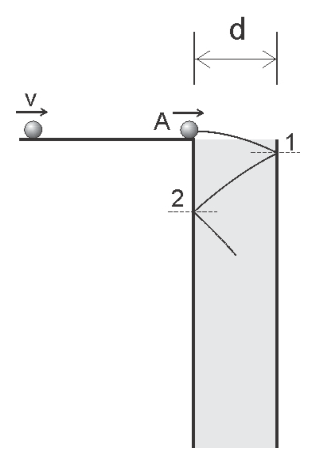 Ball bouncing inside a vertical tube
Topic: Newtonian Mechanics Metodi: Kinematic Equations, Conservation of Energy, Physical Modeling Competenze: Physical Reasoning, Mathematical Modeling Objects: Ball, Tube Fonte: Testo (PDF) — p.5
Un’ottica che consideriamo una massa puntuale si muove a una velocità costante di 2 m/s su un piano orizzontale fino a trovare un foro di pareti metalliche di 20 cm di diametro, in cui cade. La pallina colpisce elasticamente il muro del stesso cadendo con successivi rimbalzi sulle sue pareti. Ottenere:
a) Distanza che è caduta quando si verifica il rimbalzo numero 4 e tempo che ci vuole da quando si esce da fino a quando si verifica.
b) Espressione che fornisce la distanza che è caduta nel rimbalzo e il tempo che ci vuole da quando si esce da fino a quando si verifica. Applicare l’espressione ottenuta per ottenere la profondità raggiunta dalla pallina quando si verifica l’impatto numero 10.
Ball bouncing inside a vertical tube
Topic: Newtonian Mechanics Metodi: Kinematic Equations, Conservation of Energy, Physical Modeling Competenze: Physical Reasoning, Mathematical Modeling Objects: Ball, Tube Fonte: Testo (PDF) — p.5
A ball we consider a point mass moves at a constant speed of 2 m/s over a horizontal plane until it finds a hole in metal walls 20 cm in diameter, into which it falls. The ball collides elastically against the wall of the same falling with successive bounces on its walls. Obtaining:
(a) The distance that has fallen when rebound number 4 occurs and the time it takes from to rebound.
(b) Expression that gives the distance that has fallen in the rebound and the time it takes from the exit of until it occurs. Apply the resulting expression to obtain the depth to which the ball reaches when impact number 10 occurs.
The ball bouncing inside a vertical tube
Topic: Newtonian Mechanics Metodi: Kinematic Equations, Conservation of Energy, Physical Modeling Competenze: Physical Reasoning, Mathematical Modeling Objects: Ball, Tube Fonte: Testo (PDF) — p.5
P3 [Gravitación].
a) Compara las fuerzas de atracción gravitatoria que ejercen la Luna y la Tierra sobre un cuerpo de masa que se halla situado en la superficie de la Tierra. ¿A qué conclusión llegas?
b) Si el peso de un cuerpo en la superficie de la Tierra es de 100 kp, ¿cuál sería el peso de ese mismo cuerpo en la superficie de la Luna?
Datos: La masa de la Tierra es 81 veces la masa de la Luna. La distancia entre los centros de la Tierra y la Luna es de 60 radios terrestres. El radio de la Luna es 0,27 veces el radio de la Tierra.
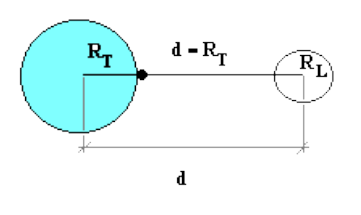 Earth and Moon gravitational diagram
Topic: Gravitation, Newtonian Mechanics Metodi: Newton’s Law of Gravitation, Free-Body Diagram, Dimensional Analysis Competenze: Physical Reasoning, Mathematical Modeling Objects: Planet, Satellite Fonte: Testo (PDF) — p.6
P3 [Gravità].
a) Compara le forze di attrazione gravitazionali esercitate dalla Luna e dalla Terra su un corpo di massa situato sulla superficie della Terra. Che conclusione hai?
b) Se il peso di un corpo sulla superficie della Terra è di 100 kp, quanto sarebbe il peso di quel corpo sulla superficie della Luna?
Dati: la massa della Terra è 81 volte quella della Luna. La distanza tra il centro della Terra e la Luna è di 60 radii terrestri. Il raggio della Luna è 0,27 volte quello della Terra.
Grafica gravitazionale della Terra e della Luna
Topic: Gravitation, Newtonian Mechanics Metodi: Newton’s Law of Gravitation, Free-Body Diagram, Dimensional Analysis Competenze: Physical Reasoning, Mathematical Modeling Objects: Planet, Satellite Fonte: Testo (PDF) — p.6
The following is the list of the types of energy sources used:
(a) Compare the gravitational forces exerted by the Moon and the Earth on a mass body located on the Earth’s surface. What do you think?
(b) If a body on the surface of the Earth weighs 100 kp, what would the weight of that same body on the surface of the Moon be?
Data: The mass of the Earth is 81 times the mass of the Moon. The distance between the Earth’s centers and the Moon is 60 terrestrial radii. The moon’s radius is 0.27 times the radius of the Earth.
The following table shows the results of the calculations:
Topic: Gravitation, Newtonian Mechanics Metodi: Newton’s Law of Gravitation, Free-Body Diagram, Dimensional Analysis Competenze: Physical Reasoning, Mathematical Modeling Objects: Planet, Satellite Fonte: Testo (PDF) — p.6
P3 [Electromagnetismo]. Un electrón penetra con una velocidad m/s en una región en la que coexisten un campo eléctrico V/m y un campo magnético T.
a) Calcula la aceleración que experimenta el electrón cuando penetra en el campo.
b) Si comenzamos a contar el espacio en , ¿al cabo de cuánto tiempo la velocidad solo tiene componente en la dirección del eje de las ?
Topic: Electromagnetism, Electrostatics, Magnetism Metodi: Lorentz Force Analysis, Free-Body Diagram, Kinematic Equations Competenze: Physical Reasoning, Mathematical Modeling Objects: Electron Fonte: Testo (PDF) — p.7
P3 [Electromagnetismo]. Un elettrone penetra a velocità m/s in una regione in cui coesistono un campo elettrico V/m e un campo magnetico T.
a) Calcola l’accelerazione che l’elettrone prova quando penetra nel campo.
b) Se iniziamo a contare lo spazio in , dopo quanto tempo la velocità ha solo componente nella direzione dell’asse delle ?
Topic: Electromagnetism, Electrostatics, Magnetism Metodi: Lorentz Force Analysis, Free-Body Diagram, Kinematic Equations Competenze: Physical Reasoning, Mathematical Modeling Objects: Electron Fonte: Testo (PDF) — p.7
P3 [Electromagnetism]. An electron penetrates at a speed m/s into a region in which an electric field V/m and a magnetic field T coexist.
(a) Calculates the acceleration the electron experiences when it penetrates the field.
b) If we start counting space in , after how long does the velocity only have a component in the direction of the axis of the ?
Topic: Electromagnetism, Electrostatics, Magnetism Metodi: Lorentz Force Analysis, Free-Body Diagram, Kinematic Equations Competenze: Physical Reasoning, Mathematical Modeling Objects: Electron Fonte: Testo (PDF) — p.7