1. Un problema a tre corpi e LISA
Due masse e gravitano in orbite circolari, rispettivamente di raggio e , attorno al loro centro di massa. Esprimere la velocità angolare della retta che congiunge e in funzione di , , , e della costante di gravitazione universale .
[1.5 punti]
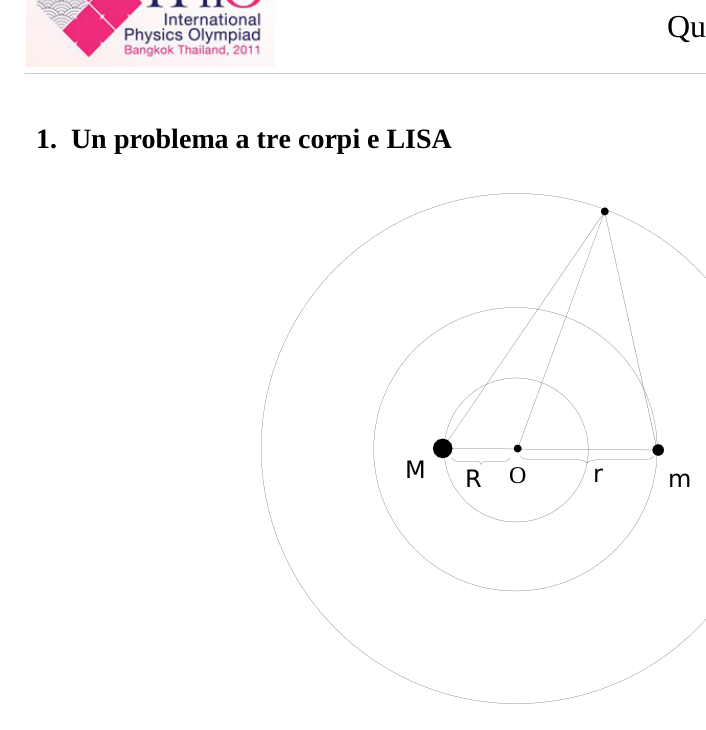 Orbite complanari di tre corpi O M m R r
Topic: Gravitation, Newtonian Mechanics Metodi: Newton’s Law of Gravitation, Kinematic Equations Competenze: Physical Reasoning, Mathematical Modeling Objects: — Fonte: Testo (PDF) — p.1 Soluzione: Soluzioni (PDF)
**1. A three-body problem and LISA
Two masses and gravitate in circular orbits, respectively of radius and , around their centre of mass. Express the angular velocity of the line joining and in terms of , , , and the universal gravitational constant .
The following table shows the total number of units of the vehicle:
The following table shows the results of the calculations:
Topic: Gravitation, Newtonian Mechanics Metodi: Newton’s Law of Gravitation, Kinematic Equations Competenze: Physical Reasoning, Mathematical Modeling Objects: — Fonte: Testo (PDF) — p.1 Soluzione: Soluzioni (PDF)
In figura 1 è mostrato un terzo corpo di massa infinitesima che si muove in un’orbita circolare complanare alle altre due orbite, attorno allo stesso centro di massa. Il nuovo corpo è fermo relativamente ad e ad e si assuma che non sia collineare alle altre due masse. Trovare il valore dei seguenti parametri in funzione di e :
[3.5 punti]
- Distanza tra e .
- Distanza tra e .
- Distanza tra e il centro di massa.
Topic: Gravitation, Newtonian Mechanics Metodi: Newton’s Law of Gravitation, Free-Body Diagram, Conservation Laws Competenze: Physical Reasoning, Mathematical Modeling Objects: — Fonte: Testo (PDF) — p.1 Soluzione: Soluzioni (PDF)
Figure 1 shows a third infinitesimal mass body moving in a circular orbit parallel to the other two orbits, around the same center of mass. The new body is stable relative to and and is assumed not to be collinear to the other two masses. Find the value of the following parameters in relation to and :
The following table shows the results of the calculation of the total cost of the vehicle:
- Distance between and .
- Distance between and .
- Distance between and the centre of mass.
Topic: Gravitation, Newtonian Mechanics Metodi: Newton’s Law of Gravitation, Free-Body Diagram, Conservation Laws Competenze: Physical Reasoning, Mathematical Modeling Objects: — Fonte: Testo (PDF) — p.1 Soluzione: Soluzioni (PDF)
Si consideri il caso e si assuma che si conservi il momento angolare di . Se si imprime a una piccola perturbazione radiale (lungo ), qual è, in funzione di , la frequenza angolare dell’oscillazione di attorno alla posizione radiale imperturbata?
[3.2 punti]
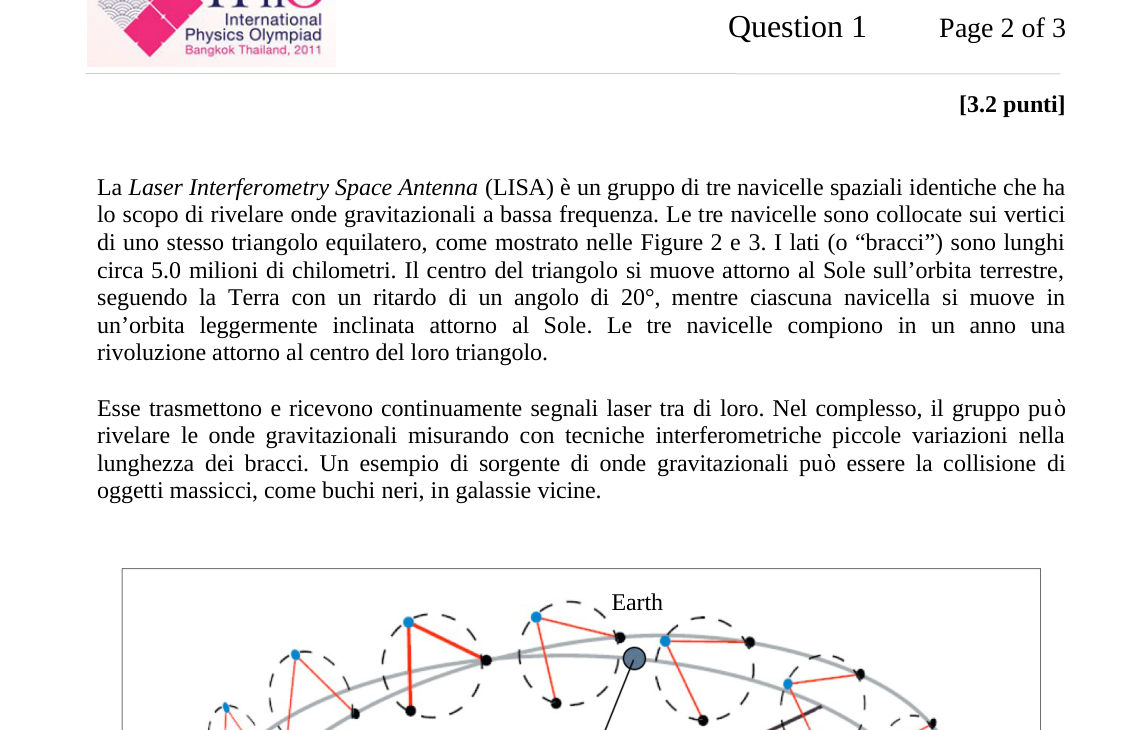 Orbita LISA attorno al Sole, 20° dalla Terra
Topic: Gravitation, Oscillations & Waves Metodi: Simple Harmonic Motion Analysis, Conservation Laws, Newton’s Law of Gravitation Competenze: Physical Reasoning, Mathematical Modeling Objects: — Fonte: Testo (PDF) — p.2 Soluzione: Soluzioni (PDF)
Consider the case and assume that the angular momentum of is preserved. If a small radial disturbance (length ) is printed at , what is, according to , the angular frequency of oscillation of around the uninterrupted radial position?
The following information shall be provided:
LISA orbit around the Sun, 20° from the Earth
Topic: Gravitation, Oscillations & Waves Metodi: Simple Harmonic Motion Analysis, Conservation Laws, Newton’s Law of Gravitation Competenze: Physical Reasoning, Mathematical Modeling Objects: — Fonte: Testo (PDF) — p.2 Soluzione: Soluzioni (PDF)
La Laser Interferometry Space Antenna (LISA) è un gruppo di tre navicelle spaziali identiche che ha lo scopo di rivelare onde gravitazionali a bassa frequenza. Le tre navicelle sono collocate sui vertici di uno stesso triangolo equilatero, come mostrato nelle Figure 2 e 3. I lati (o “bracci”) sono lunghi circa km. Il centro del triangolo si muove attorno al Sole sull’orbita terrestre, seguendo la Terra con un ritardo di un angolo di 20°, mentre ciascuna navicella si muove in un’orbita leggermente inclinata attorno al Sole. Le tre navicelle compiono in un anno una rivoluzione attorno al centro del loro triangolo.
Esse trasmettono e ricevono continuamente segnali laser tra di loro. Nel complesso, il gruppo può rivelare le onde gravitazionali misurando con tecniche interferometriche piccole variazioni nella lunghezza dei bracci. Un esempio di sorgente di onde gravitazionali può essere la collisione di oggetti massicci, come buchi neri, in galassie vicine.
Trovare la velocità relativa di ciascuna navicella rispetto alle altre due considerando le navicelle in moto nel loro piano.
[1.8 punti]
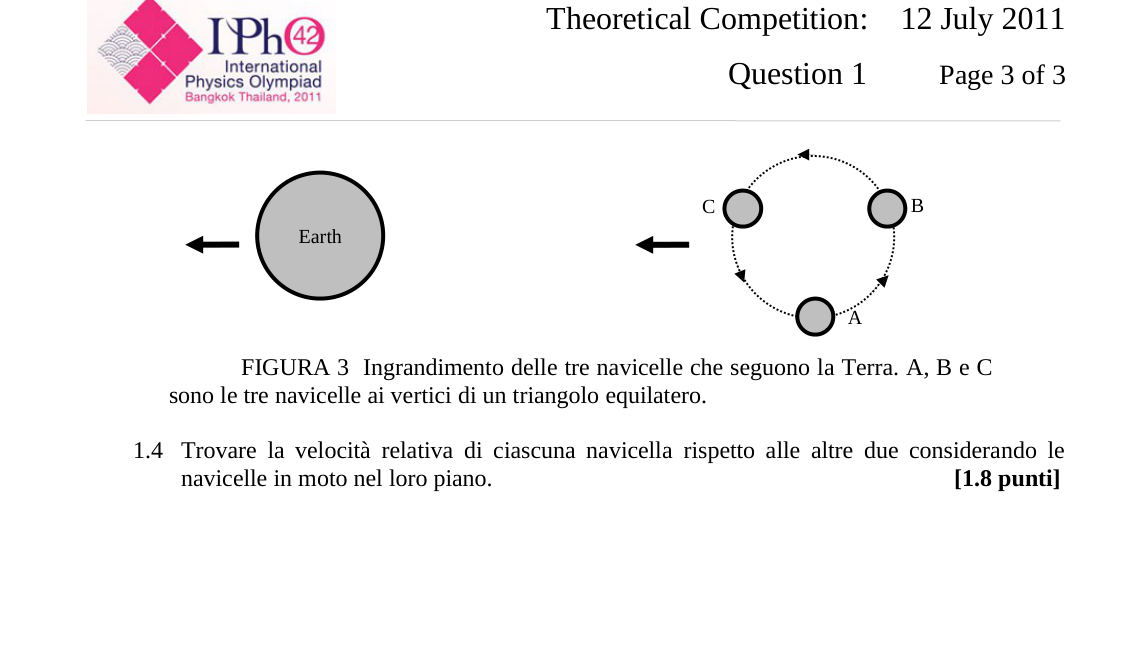 Navicelle A B C ai vertici triangolo equilatero
Topic: Gravitation, Astrophysics Metodi: Kinematic Equations, Newton’s Law of Gravitation, Kepler’s Laws Competenze: Physical Reasoning, Mathematical Modeling Objects: Satellite Fonte: Testo (PDF) — p.2 Soluzione: Soluzioni (PDF)
The Laser Interferometry Space Antenna (LISA) is a group of three identical spacecraft designed to detect low frequency gravitational waves. The three vessels are placed on the vertices of the same equilateral triangle, as shown in Figures 2 and 3. The sides (or ‘arms’) are about km long. The center of the triangle moves around the Sun in Earth orbit, following Earth with a delay of an angle of 20°, while each ship moves in a slightly inclined orbit around the Sun. The three ships make a revolution around the center of their triangle in one year.
They continuously transmit and receive laser signals to each other. Overall, the group can detect gravitational waves by measuring small variations in arm length with interferometric techniques. An example of a source of gravitational waves may be the collision of massive objects, such as black holes, in nearby galaxies.
Find the relative speed of each vessel relative to the other two vessels by considering the moving vessels in their plane.
The following table shows the results of the calculation of the risk weight of the product:
Navicles A B C at the vertices of an equilateral triangle
Topic: Gravitation, Astrophysics Metodi: Kinematic Equations, Newton’s Law of Gravitation, Kepler’s Laws Competenze: Physical Reasoning, Mathematical Modeling Objects: Satellite Fonte: Testo (PDF) — p.2 Soluzione: Soluzioni (PDF)