BARtico
Dario spezzetta tutta la calotta antartica, che ha approssimativamente diametro e spessore , in cubetti di ghiaccio di dimensione utile ad essere usati nelle bevande del suo bar. Quanto vale ?
Unità di misura: adimensionale. Precisione richiesta: .
Topic: Order-of-Magnitude Estimation Metodi: Order-of-Magnitude Estimation, Dimensional Analysis Competenze: Estimation & Approximation, Significant Figures Objects: — Fonte: Testo (PDF) — p.3 Soluzione: Soluzioni (PDF)
BARtico
Dario breaks up the entire Antarctic ice cap, which has approximately diameter and thickness , into ice cubes of a size suitable to be used in the drinks at his bar. What is the value of ?
Unit of measurement: dimensionless. Required precision: .
Topic: Order-of-Magnitude Estimation Metodi: Order-of-Magnitude Estimation, Dimensional Analysis Competenze: Estimation & Approximation, Significant Figures Objects: — Fonte: Testo (PDF) — p.3 Soluzione: Soluzioni (PDF)
Asse terrestre
L’asse terrestre è inclinato di rispetto alla normale al piano dell’orbita. Due pannelli solari identici vengono posizionati paralleli alla superficie terrestre, uno all’equatore e uno al polo nord. A mezzogiorno del solstizio d’estate, quanto vale il rapporto tra la potenza solare ricevuta dal pannello all’equatore e quella ricevuta dal pannello al polo nord? Nota: si trascuri ogni influenza dovuta all’atmosfera terrestre e si assuma che il Sole sia abbastanza lontano da considerare paralleli i suoi raggi che giungono a Terra.
Unità di misura: adimensionale. Precisione richiesta: .
Topic: Astrophysics, Geometric Optics Metodi: Vector Decomposition, Physical Modeling Competenze: Diagrammatic Reasoning, Mathematical Modeling Objects: Star, Planet Fonte: Testo (PDF) — p.3 Soluzione: Soluzioni (PDF)
Asse terrestre
The Earth’s axis is tilted from the normal to the plane of orbit. Two identical solar panels are placed parallel to the Earth’s surface, one at the equator and one at the north pole. At noon on the summer solstice, what is the ratio of solar power received from the equator panel to that received from the north pole panel? Note: Any influence due to the earth’s atmosphere is ignored and the Sun is assumed to be far enough away to consider parallels to its rays reaching Earth.
Unità di misura: adimensionale. Precisione richiesta: .
Topic: Astrophysics, Geometric Optics Metodi: Vector Decomposition, Physical Modeling Competenze: Diagrammatic Reasoning, Mathematical Modeling Objects: Star, Planet Fonte: Testo (PDF) — p.3 Soluzione: Soluzioni (PDF)
Fuga dal prisma
La regione di spazio tridimensionale è occupata da un materiale di indice di rifrazione , mentre nel resto dello spazio c’è un materiale di indice di rifrazione . Si invia verso la prima regione un raggio di luce che si muove nel piano -. Qual è il più piccolo valore di per cui, qualunque sia l’angolo incidente, il raggio non esce più dalla regione dopo esservi entrato?
Unità di misura: adimensionale. Precisione richiesta: .
Topic: Geometric Optics Metodi: Snell’s Law, Symmetry Argument Competenze: Diagrammatic Reasoning, Mathematical Modeling Objects: — Fonte: Testo (PDF) — p.3 Soluzione: Soluzioni (PDF)
Escape from the prism
The region of three-dimensional space is occupied by a refractive index material , while the rest of the space is covered by a refractive index material . A beam of light moving in the plane - is sent to the first region. What is the smallest value of so that, whatever the angle of incidence, the beam does not leave the region after being entered?
Unità di misura: adimensionale. Precisione richiesta: .
Topic: Geometric Optics Metodi: Snell’s Law, Symmetry Argument Competenze: Diagrammatic Reasoning, Mathematical Modeling Objects: — Fonte: Testo (PDF) — p.3 Soluzione: Soluzioni (PDF)
Sorgente monodirezionale
Un soldato vuole costruire un’antenna mono-direzionale, in modo da poter comunicare con la propria base senza essere ascoltato da quella nemica. La posizione del soldato giace sulla congiungente le due basi, molto lontano da entrambe. L’antenna è costituita da due emettitori di onde sferiche, posti a distanza tra di loro e aventi un certo sfasamento relativo. Il soldato regola questi due parametri affinché, a grande distanza lungo la congiungente, in un verso il segnale abbia la massima intensità possibile, mentre nell’altro verso il segnale sia praticamente nullo. Sapendo che i due emettitori producono onde di ampiezza uguale e lunghezza d’onda , quanto deve valere , come minimo, affinché l’antenna funzioni correttamente?
Unità di misura: m. Precisione richiesta: .
Topic: Oscillations & Waves, Wave Optics Metodi: Superposition Principle, Interference & Diffraction Analysis Competenze: Mathematical Modeling, Physical Reasoning Objects: — Fonte: Testo (PDF) — p.3 Soluzione: Soluzioni (PDF)
Sorgente monodirezionale
A soldier wants to build a one-way antenna so he can communicate with his own base without being heard by that enemy. The soldier’s position lies at the junction of the two bases, far from both. The antenna shall consist of two spherical wave emitters, placed at a distance from each other and having a certain relative phase . The soldier adjusts these two parameters so that, at a great distance along the junction, the signal is as intense as possible in one direction, while the signal is virtually zero in the other. Since the two emitters produce waves of equal width and wavelength , how much must be at least for the antenna to function properly?
Unità di misura: m. Precisione richiesta: .
Topic: Oscillations & Waves, Wave Optics Metodi: Superposition Principle, Interference & Diffraction Analysis Competenze: Mathematical Modeling, Physical Reasoning Objects: — Fonte: Testo (PDF) — p.3 Soluzione: Soluzioni (PDF)
Astronauta giocoliere
Un’enorme navicella spaziale ha la forma di un cilindro cavo di raggio e ruota attorno al suo asse a una velocità angolare tale che un astronauta in piedi sulla parete senta un’accelerazione pari a . Un astronauta in tale posizione lancia una pallina verso l’alto con una velocità di . La pallina atterra sul pavimento dell’astronave in una posizione diversa da quella in cui si trova l’astronauta. Quanto deve camminare egli, come minimo, per raggiungere la pallina?
Unità di misura: m. Precisione richiesta: .
Topic: Newtonian Mechanics, Rotational Dynamics Metodi: Kinematic Equations, Vector Decomposition Competenze: Diagrammatic Reasoning, Mathematical Modeling Objects: Cylinder, Ball Fonte: Testo (PDF) — p.3 Soluzione: Soluzioni (PDF)
Astronauta giocoliere
Un’enorme navicella spaziale ha la forma di un cilindro cavo di raggio e ruota attorno al suo asse a una velocità angolare tale che un astronauta in piedi sulla parete senta un’accelerazione pari a . An astronaut in this position throws a ball upwards at a speed of . The ball lands on the spacecraft floor in a different position from the spacecraft. How far does he have to walk, at least, to reach the ball?
Unità di misura: m. Precisione richiesta: .
Topic: Newtonian Mechanics, Rotational Dynamics Metodi: Kinematic Equations, Vector Decomposition Competenze: Diagrammatic Reasoning, Mathematical Modeling Objects: Cylinder, Ball Fonte: Testo (PDF) — p.3 Soluzione: Soluzioni (PDF)
Molecole nell’atmosfera
Si supponga che l’atmosfera terrestre sia composta da molecole identiche, ciascuna di massa pari a volte quella del protone. Quanto vale ?
Unità di misura: adimensionale. Precisione richiesta: .
Topic: Order-of-Magnitude Estimation, Kinetic Theory Metodi: Order-of-Magnitude Estimation, Ideal Gas Law Competenze: Estimation & Approximation, Unit Conversion Objects: Gas Fonte: Testo (PDF) — p.4 Soluzione: Soluzioni (PDF)
Molecole nell’atmosfera
Assume that the Earth’s atmosphere is composed of identical molecules, each of which has a mass equal to times that of the proton. Quanto vale ?
Unità di misura: adimensionale. Precisione richiesta: .
Topic: Order-of-Magnitude Estimation, Kinetic Theory Metodi: Order-of-Magnitude Estimation, Ideal Gas Law Competenze: Estimation & Approximation, Unit Conversion Objects: Gas Fonte: Testo (PDF) — p.4 Soluzione: Soluzioni (PDF)
Circuito simmetrico
Si consideri il circuito in figura. Tutte le resistenze sono uguali e valgono . Quanto vale la resistenza equivalente tra i punti e ?
Unità di misura: . Precisione richiesta: .
p.4 — Symmetric circuit of equal resistances
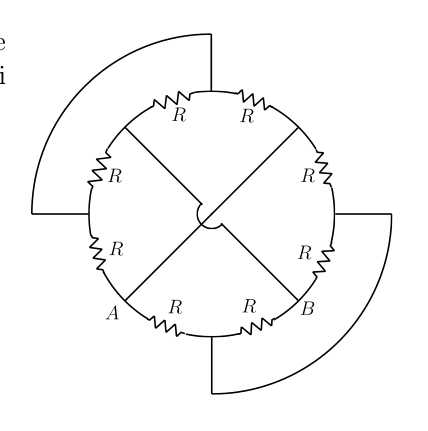
Topic: Circuits Metodi: Symmetry Argument, Kirchhoff’s Laws, Equivalent Circuit Reduction Competenze: Diagrammatic Reasoning, Mathematical Modeling Objects: Resistor Fonte: Testo (PDF) — p.4 Soluzione: Soluzioni (PDF)
Circuito simmetrico
Consider the circuit in the figure. All resistances are equal and are . What is the equivalent resistance between and ?
Unità di misura: . Precisione richiesta: .
p.4 — Symmetric circuit of equal resistances
Topic: Circuits Metodi: Symmetry Argument, Kirchhoff’s Laws, Equivalent Circuit Reduction Competenze: Diagrammatic Reasoning, Mathematical Modeling Objects: Resistor Fonte: Testo (PDF) — p.4 Soluzione: Soluzioni (PDF)
Hula hoop
Francesco gioca con un bracciale, di circonferenza , facendolo roteare, senza strisciare, attorno ad un dito della sua mano, approssimabile a un cilindro di raggio . Un determinato punto del bracciale si trova inizialmente a contatto col dito. Come minimo, quanti giri attorno al dito deve fare il centro del bracciale affinché il punto torni nuovamente a contatto col dito? Nota: il numero di giri non è necessariamente intero.
Unità di misura: adimensionale. Precisione richiesta: .
Topic: Rotational Dynamics, Newtonian Mechanics Metodi: Physical Modeling, Symmetry Argument Competenze: Diagrammatic Reasoning, Mathematical Modeling Objects: Cylinder Fonte: Testo (PDF) — p.4 Soluzione: Soluzioni (PDF)
Hula hoop
Francesco plays with a bracelet, of circumference, making it rotate, without cracking, around a finger of his hand, approximate to a cylinder of radius. A certain point on the bracelet is initially in contact with the finger. At a minimum, how many turns around the finger does the centre of the bracelet have to do for the point to come back into contact with the finger? Note: the number of turns is not necessarily an integer.
Unità di misura: adimensionale. Precisione richiesta: .
Topic: Rotational Dynamics, Newtonian Mechanics Metodi: Physical Modeling, Symmetry Argument Competenze: Diagrammatic Reasoning, Mathematical Modeling Objects: Cylinder Fonte: Testo (PDF) — p.4 Soluzione: Soluzioni (PDF)
Pianeta ristretto
Un satellite è inizialmente in orbita circolare di raggio attorno ad un pianeta di massa . Improvvisamente, la massa del pianeta diminuisce del . Quanto dista il punto più lontano della nuova orbita del satellite dal centro del pianeta?
Unità di misura: . Precisione richiesta: .
Topic: Gravitation, Newtonian Mechanics Metodi: Conservation of Energy, Conservation of Momentum, Kepler’s Laws Competenze: Mathematical Modeling, Physical Reasoning Objects: Satellite, Planet Fonte: Testo (PDF) — p.4 Soluzione: Soluzioni (PDF)
Pianeta ristretto
A satellite is initially in a radius circular orbit around a planet of mass . Suddenly, the planet’s mass is shrinking by . How far is the farthest point of the satellite’s new orbit from the center of the planet?
Unità di misura: . Precisione richiesta: .
Topic: Gravitation, Newtonian Mechanics Metodi: Conservation of Energy, Conservation of Momentum, Kepler’s Laws Competenze: Mathematical Modeling, Physical Reasoning Objects: Satellite, Planet Fonte: Testo (PDF) — p.4 Soluzione: Soluzioni (PDF)
Collasso di un atomo
Una carica elettrica sottoposta ad una accelerazione di modulo irraggia onde elettromagnetiche, emettendo una potenza totale . A causa di questo fatto, gli atomi non potrebbero essere stabili senza la meccanica quantistica, perché l’elettrone “cadrebbe” progressivamente sul nucleo. Supponendo che la perdita di energia sia abbastanza lenta da far sì che l’orbita dell’elettrone rimanga approssimativamente circolare in ogni istante, quanto tempo impiegherebbe un elettrone a cadere sul nucleo di un atomo di idrogeno, partendo da un’orbita iniziale di raggio pari al raggio di Bohr?
Unità di misura: . Precisione richiesta: .
Topic: Electrostatics, Modern-Quantum Physics Metodi: Differential Equations, Calculus-Integration, Energy Conservation Method Competenze: Mathematical Modeling, Physical Reasoning Objects: Electron, Nucleus, Atom Fonte: Testo (PDF) — p.4 Soluzione: Soluzioni (PDF)
Collasso di un atomo
An electric charge subjected to an acceleration of the module irradiates electromagnetic waves, emitting a total power . Because of this fact, atoms could not be stable without quantum mechanics, because the electron would gradually “fall” onto the nucleus. Assuming that the energy loss is slow enough to keep the electron’s orbit approximately circular at any given moment, how long would it take an electron to fall on the nucleus of a hydrogen atom, starting from an initial orbit of a radius equal to the radius of Bohr?
Unità di misura: . Precisione richiesta: .
Topic: Electrostatics, Modern-Quantum Physics Metodi: Differential Equations, Calculus-Integration, Energy Conservation Method Competenze: Mathematical Modeling, Physical Reasoning Objects: Electron, Nucleus, Atom Fonte: Testo (PDF) — p.4 Soluzione: Soluzioni (PDF)
Superman e la cannuccia
Superman tenta di bere l’acqua di un lago usando una cannuccia lunga più di , ma non ci riesce. Quanto vale, al massimo, l’altezza sul livello del lago raggiunta dall’acqua nella cannuccia?
Unità di misura: m. Precisione richiesta: .
Topic: Fluid Mechanics Metodi: Hydrostatic Equilibrium, Physical Modeling Competenze: Physical Reasoning, Mathematical Modeling Objects: Tube Fonte: Testo (PDF) — p.5 Soluzione: Soluzioni (PDF)
Superman e la cannuccia
Superman tenta di bere l’acqua di un lago usando una cannuccia lunga più di , ma non ci riesce. What is the maximum height above the lake level reached by the water in the straw?
Unità di misura: m. Precisione richiesta: .
Topic: Fluid Mechanics Metodi: Hydrostatic Equilibrium, Physical Modeling Competenze: Physical Reasoning, Mathematical Modeling Objects: Tube Fonte: Testo (PDF) — p.5 Soluzione: Soluzioni (PDF)
Rimbalzo su una pallina
All’interno di un tubo verticale di altezza e raggio viene lasciata cadere, da ferma, una palla di massa . Dopo un certo tempo , viene lasciata cadere, sempre da ferma, una seconda palla, di massa . La prima palla rimbalza sul suolo e poi colpisce la seconda palla, scaraventandola verso l’alto. Si supponga che tutti gli urti siano elastici, che ogni forma di attrito sia trascurabile e che il raggio delle palle sia pari a quello del tubo. Al variare di , sia l’altezza massima raggiungibile dalla seconda palla. Quanto vale ?
Unità di misura: adimensionale. Precisione richiesta: .
Topic: Conservation of Momentum, Conservation of Energy Metodi: Conservation of Momentum, Conservation of Energy, Kinematic Equations Competenze: Physical Reasoning, Mathematical Modeling Objects: Tube, Ball Fonte: Testo (PDF) — p.5 Soluzione: Soluzioni (PDF)
Rimbalzo su una pallina
Within a vertical tube of height and radius, a ball of mass is dropped from the stand. After a certain time , a second ball, of mass , is dropped, always standing. The first ball bounces to the ground and then hits the second ball, dropping it upwards. Suppose all the bumps are elastic, that any form of friction is negligible, and that the balls have a radius equal to that of the tube. If is changed, shall be the maximum height achieved by the second ball. Quanto vale ?
Unità di misura: adimensionale. Precisione richiesta: .
Topic: Conservation of Momentum, Conservation of Energy Metodi: Conservation of Momentum, Conservation of Energy, Kinematic Equations Competenze: Physical Reasoning, Mathematical Modeling Objects: Tube, Ball Fonte: Testo (PDF) — p.5 Soluzione: Soluzioni (PDF)
Il piccolo principe, di massa , vive su un asteroide sferico uniforme, di massa e raggio . Inizialmente l’asteroide è fermo e il piccolo principe è seduto a guardare il tramonto. Invidioso dei pianeti che ruotano attorno al proprio asse, egli decide di far sì che anche il suo asteroide ruoti su se stesso: perciò inizia a spostarsi, camminando a piccoli passi, lungo il suo equatore. Usando questa strategia, tuttavia, egli non riesce a dare all’asteroide una velocità angolare maggiore di un certo valore . Quanto vale ?
Unità di misura: . Precisione richiesta: .
Topic: Rotational Dynamics, Gravitation Metodi: Torque & Angular Momentum Analysis, Conservation Laws, Symmetry Argument Competenze: Mathematical Modeling, Physical Reasoning Objects: Planet Fonte: Testo (PDF) — p.5 Soluzione: Soluzioni (PDF)
The small prince, mass , lives on a uniform spherical asteroid, mass and radius . Initially the asteroid is stationary and the little prince is sitting watching the sunset. Envious of the planets that revolve around his axis, he decides to make his asteroid also rotate on itself: so he begins to move, walking at small steps, along his equator. Using this strategy, however, he is unable to give the asteroid an angular velocity greater than a certain value . Quanto vale ?
Unità di misura: . Precisione richiesta: .
Topic: Rotational Dynamics, Gravitation Metodi: Torque & Angular Momentum Analysis, Conservation Laws, Symmetry Argument Competenze: Mathematical Modeling, Physical Reasoning Objects: Planet Fonte: Testo (PDF) — p.5 Soluzione: Soluzioni (PDF)
Coefficiente adiabatico
Uno scienziato americano ha sintetizzato un nuovo gas e ne vuole studiare le proprietà termodinamiche. Per fare ciò, riempie di questo gas un contenitore isolato termicamente il cui volume può essere variato tramite un pistone. Lo scienziato effettua misure di pressione facendo espandere il gas molto lentamente in maniera reversibile, ottenendo i dati in tabella. Quanto vale il coefficiente di dilatazione adiabatica del gas?
| [psi] | [gal] |
|---|---|
| 17.24 | 0.70 |
| 13.95 | 0.80 |
| 12.06 | 0.90 |
| 9.95 | 1.00 |
| 9.18 | 1.10 |
| 7.19 | 1.20 |
| 6.92 | 1.30 |
| 6.34 | 1.40 |
| 5.24 | 1.50 |
| 4.65 | 1.60 |
| 4.62 | 1.70 |
| 4.06 | 1.80 |
| 3.55 | 1.90 |
| 3.37 | 2.00 |
| 3.33 | 2.10 |
| 3.03 | 2.20 |
Unità di misura: adimensionale. Precisione richiesta: .
Topic: Thermodynamics Metodi: Thermodynamic Cycle Analysis, Graph Linearization, Curve Fitting Competenze: Experimental Data Analysis, Graph Linearization, Unit Conversion Objects: Gas, Piston, Container Fonte: Testo (PDF) — p.5 Soluzione: Soluzioni (PDF)
Coefficiente adiabatico
An American scientist has synthesized a new gas and wants to study its thermodynamic properties. To do this, fill a heat-insulated container with this gas whose volume can be varied by a piston. The scientist takes pressure measurements by expanding the gas very slowly in a reversible way, obtaining the data in the table. What is the adiabatic dilation coefficient of the gas?
| [psi] | [gal] |
|---|---|
| 17.24 | 0.70 |
| 13.95 | 0.80 |
| 12.06 | 0.90 |
| 9.95 | 1.00 |
| 9.18 | 1.10 |
| 7.19 | 1.20 |
| 6.92 | 1.30 |
| 6.34 | 1.40 |
| 5.24 | 1.50 |
| 4.65 | 1.60 |
| 4.62 | 1.70 |
| 4.06 | 1.80 |
| 3.55 | 1.90 |
| 3.37 | 2.00 |
| 3.33 | 2.10 |
| 3.03 | 2.20 |
Unità di misura: adimensionale. Precisione richiesta: .
Topic: Thermodynamics Metodi: Thermodynamic Cycle Analysis, Graph Linearization, Curve Fitting Competenze: Experimental Data Analysis, Graph Linearization, Unit Conversion Objects: Gas, Piston, Container Fonte: Testo (PDF) — p.5 Soluzione: Soluzioni (PDF)