Aggiornamento software interstellare
Usando un innovativo sistema di accelerazione laser, gli scienziati del futuro hanno lanciato una piccola sonda interstellare a una frazione significativa della velocità della luce. La sonda si muove di moto rettilineo uniforme a velocità e ha il compito di studiare due stelle, che si trovano entrambe molto vicine alla traiettoria della sonda, rispettivamente a e anni luce dalla Terra. Appena la sonda passa presso una stella, scatta delle fotografie e le invia a Terra. Quando gli scienziati ricevono le foto della prima stella, si rendono conto che il software a bordo della sonda contiene un bug. Allora preparano in poche ore un aggiornamento software, che inviano immediatamente verso la sonda. Quanto può valere al massimo affinché la sonda riceva l’aggiornamento prima di visitare la seconda stella?
Unità di misura: m/s. Precisione richiesta: 0.5%.
Topic: Special Relativity Metodi: Lorentz Transformation, Kinematic Equations Competenze: Mathematical Modeling, Physical Reasoning Objects: Satellite, Star Fonte: Testo (PDF) — p.3 Soluzione: Soluzioni (PDF)
The following is the list of the most commonly used methods of measuring the performance of the measuring instrument:
Using an innovative laser acceleration system, scientists of the future have launched a small interstellar probe at a significant fraction of the speed of light. The probe moves in a uniform straight-line motion at speed and is tasked with studying two stars, both of which are very close to the probe’s trajectory, at and light years from Earth respectively. As soon as the probe passes near a star, it takes pictures and sends them to Earth. When scientists receive images of the first star, they realize that the software on board the probe contains a bug. Then they prepare a software update in a few hours, which they send immediately to the probe. What is the maximum amount that the probe can receive before visiting the second star?
The following is the maximum amount of the measurement: The following information is provided:
Topic: Special Relativity Metodi: Lorentz Transformation, Kinematic Equations Competenze: Mathematical Modeling, Physical Reasoning Objects: Satellite, Star Fonte: Testo (PDF) — p.3 Soluzione: Soluzioni (PDF)
Pianeti allineati
Due pianeti orbitano circolarmente, sullo stesso piano e nello stesso verso, attorno a una stella. In un certo istante iniziale, le posizioni dei tre corpi celesti giacciono su una stessa retta. L’allineamento successivo avviene quando il pianeta più esterno ha spazzato un angolo di nel suo moto attorno alla stella. Quanto vale il rapporto tra il raggio dell’orbita del pianeta esterno e il raggio dell’orbita del pianeta interno?
Unità di misura: adimensionale. Precisione richiesta: 0.5%.
Topic: Gravitation Metodi: Kepler’s Laws, Newton’s Law of Gravitation Competenze: Mathematical Modeling, Physical Reasoning Objects: Planet, Star Fonte: Testo (PDF) — p.3 Soluzione: Soluzioni (PDF)
The following table shows the number of rows of rows:
Two planets orbit a star in a circular orbit, on the same plane and in the same direction. At a certain initial moment, the positions of the three celestial bodies lie on the same straight. The next alignment occurs when the outermost planet has swept an angle of in its motion around the star. What is the ratio between the radius of the outer planet’s orbit and the radius of the inner planet’s orbit?
The measuring unit: * additional dimension. The following information is provided:
Topic: Gravitation Metodi: Kepler’s Laws, Newton’s Law of Gravitation Competenze: Mathematical Modeling, Physical Reasoning Objects: Planet, Star Fonte: Testo (PDF) — p.3 Soluzione: Soluzioni (PDF)
Pistone asimmetrico
Una mole di gas ideale è contenuta in un tubo disposto verticalmente, la cui forma è indicata in figura e la cui sezione vale nella parte inferiore e nella parte superiore. Due pistoni, connessi da un’asta inestensibile, delimitano la zona riempita dal gas. Sulle facce esterne dei pistoni agisce la pressione atmosferica. Il sistema, la cui massa complessiva vale , è immerso nel campo gravitazionale terrestre e si trova in equilibrio. Di quanto bisogna aumentare la temperatura del gas affinché i pistoni si spostino verso l’alto di , verso una nuova posizione di equilibrio?
Nota: si assuma che la pressione del gas sia uniforme all’interno del tubo.
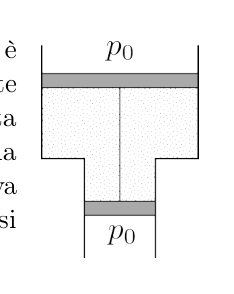 Tubo verticale a gradino: sezione inferiore e superiore ; due pistoni connessi da un’asta racchiudono il gas; pressione atmosferica sopra e sotto.
Unità di misura: K. Precisione richiesta: 0.5%.
Topic: Thermodynamics, Newtonian Mechanics Metodi: Ideal Gas Law, Free-Body Diagram, Hydrostatic Equilibrium Competenze: Mathematical Modeling, Physical Reasoning Objects: Gas, Tube, Piston Fonte: Testo (PDF) — p.3 Soluzione: Soluzioni (PDF)
The following table shows the methodology used for calculating the weight of the piston:
An ideal gas mole is contained in a vertical tube, the shape of which is shown in the figure and the section of which is at the bottom and at the top. Two pistons, connected by an unextended axle, delimit the gas-filled area. The atmospheric pressure acts on the outer faces of the pistons. The system, whose overall mass is , is immersed in the Earth’s gravitational field and is in equilibrium. How much more gas temperature must be increased for the pistons to move upwards of to a new equilibrium position?
Note: the gas pressure inside the tube is assumed to be uniform.
Step vertical tube: lower and upper ; two pistons connected by an axle enclose the gas; atmospheric pressure above and below.
The following is the list of the measurement units: The following information is provided:
Topic: Thermodynamics, Newtonian Mechanics Metodi: Ideal Gas Law, Free-Body Diagram, Hydrostatic Equilibrium Competenze: Mathematical Modeling, Physical Reasoning Objects: Gas, Tube, Piston Fonte: Testo (PDF) — p.3 Soluzione: Soluzioni (PDF)
Gli elettroni liberi all’interno di un conduttore possono oscillare collettivamente con una frequenza che dipende solo dalla costante dielettrica del vuoto, dalla carica elementare, dalla massa dell’elettrone e dalla loro densità numerica all’interno del conduttore. Dati due conduttori, tali che la densità degli elettroni nel primo è il triplo di quella nel secondo, quanto vale il rapporto tra la frequenza di oscillazione nel primo conduttore e quella nel secondo?
Unità di misura: adimensionale. Precisione richiesta: 0.5%.
Topic: Electrostatics, Oscillations & Waves Metodi: Dimensional Analysis, Simple Harmonic Motion Analysis Competenze: Mathematical Modeling, Physical Reasoning Objects: Electron Fonte: Testo (PDF) — p.3 Soluzione: Soluzioni (PDF)
Free electrons within a conductor can oscillate collectively with a frequency that depends only on the vacuum dielectric constant, the elementary charge, the electron mass and their numerical density within the conductor. Given two conductors, such that the electron density in the first is three times that of the second, what is the ratio of the oscillation frequency in the first conductor to that in the second?
The measuring unit: * additional dimension. The following information is provided:
Topic: Electrostatics, Oscillations & Waves Metodi: Dimensional Analysis, Simple Harmonic Motion Analysis Competenze: Mathematical Modeling, Physical Reasoning Objects: Electron Fonte: Testo (PDF) — p.3 Soluzione: Soluzioni (PDF)
Lavori inefficienti
Il giocattolo preferito di Manuele è caduto in fondo a una piscina di dimensioni . Il bambino però non sa nuotare, e per recuperarlo prova a svuotare completamente la vasca utilizzando un bicchiere. Supponendo che Manuele abbia a disposizione un’altra piscina vuota in cui trasferire l’acqua, quanti travasi deve fare con il suo bicchiere?
Unità di misura: adimensionale. Precisione richiesta: 100.0%.
Topic: Order-of-Magnitude Estimation, Fluid Mechanics Metodi: Order-of-Magnitude Estimation Competenze: Estimation & Approximation, Unit Conversion Objects: — Fonte: Testo (PDF) — p.4 Soluzione: Soluzioni (PDF)
Lavori inefficienti
Il giocattolo preferito di Manuele è caduto in fondo a una piscina di dimensioni . The child cannot swim, however, and to recover it he tries to empty the tub completely using a glass. Assuming Manuel has another empty pool to transfer water to, how many turns does he have to do with his glass?
Unità di misura: adimensionale. Precisione richiesta: 100.0%.
Topic: Order-of-Magnitude Estimation, Fluid Mechanics Metodi: Order-of-Magnitude Estimation Competenze: Estimation & Approximation, Unit Conversion Objects: — Fonte: Testo (PDF) — p.4 Soluzione: Soluzioni (PDF)
Tubo sul fondo di un lago
Sul fondo di un lago profondo , la cui superficie è sottoposta alla pressione atmosferica, è adagiato orizzontalmente un tubo sottile contenente una certa quantità di gas biatomico. Una delle due basi del tubo è sigillata, mentre un pistone mobile impedisce al gas di fuoriuscire dall’altra estremità. La distanza tra la base sigillata e il pistone mobile è . Le pareti del tubo e il pistone sono isolanti termici. Il tubo viene lentamente ruotato e posizionato verticalmente, in modo che poggi sulla sua base sigillata. Supponendo che il tubo sia sufficientemente lungo da permettere al pistone di muoversi senza fuoriuscirne, di quanto aumenta la distanza tra la base sigillata e il pistone?
Nota: si assuma che la pressione del gas sia uniforme all’interno del tubo.
Unità di misura: m. Precisione richiesta: 0.5%.
Topic: Thermodynamics, Fluid Mechanics Metodi: Ideal Gas Law, Hydrostatic Equilibrium, First Law of Thermodynamics Competenze: Mathematical Modeling, Physical Reasoning Objects: Gas, Tube, Piston Fonte: Testo (PDF) — p.4 Soluzione: Soluzioni (PDF)
Tube at the bottom of a lake
On the bottom of a deep lake , the surface of which is subjected to atmospheric pressure, a thin tube containing a certain amount of biatomic gas is laid horizontally. One of the two bases of the tube is sealed, while a moving piston prevents the gas from leaking from the other end. The distance between the sealed base and the moving piston is . The walls of the pipe and piston are thermal insulators. The tube is slowly rotated and positioned vertically, so that it rests on its sealed base. Assuming the pipe is long enough to allow the piston to move without leaking, how much longer does the distance between the sealed base and the piston increase?
Note: the gas pressure inside the tube is assumed to be uniform.
The following is the list of the measurement units: The following information is provided:
Topic: Thermodynamics, Fluid Mechanics Metodi: Ideal Gas Law, Hydrostatic Equilibrium, First Law of Thermodynamics Competenze: Mathematical Modeling, Physical Reasoning Objects: Gas, Tube, Piston Fonte: Testo (PDF) — p.4 Soluzione: Soluzioni (PDF)
Giramondo
Quando Lorenzo viaggia, è solito raccogliere l’aria dei posti che visita con una bottiglia da mezzo litro, che porta a casa per scopi collezionistici. La settimana scorsa era a Giza per visitare le piramidi, dove la pressione era pari a quella atmosferica e la temperatura valeva . L’anno scorso è andato in Perù per visitare Machu Picchu, dove la pressione era e il termometro segnava . Quanto vale il rapporto tra il numero di molecole contenute nella bottiglia del viaggio a Giza e quelle contenute nella bottiglia del viaggio a Machu Picchu?
Unità di misura: adimensionale. Precisione richiesta: 0.5%.
Topic: Thermodynamics, Kinetic Theory Metodi: Ideal Gas Law, Kinetic Theory of Gases Competenze: Mathematical Modeling, Unit Conversion Objects: Gas Fonte: Testo (PDF) — p.4 Soluzione: Soluzioni (PDF)
The following table shows the results of the evaluation:
When Lorenzo travels, he usually collects air from places he visits with a half-liter bottle, which he brings home for collecting purposes. Last week he was in Giza to visit the pyramids, where the pressure was equal to that of the atmosphere and the temperature was . Last year he went to Peru to visit Machu Picchu, where the pressure was and the thermometer was . What is the ratio between the number of molecules in the bottle of the trip to Giza and those in the bottle of the trip to Machu Picchu?
The measuring unit: * additional dimension. The following information is provided:
Topic: Thermodynamics, Kinetic Theory Metodi: Ideal Gas Law, Kinetic Theory of Gases Competenze: Mathematical Modeling, Unit Conversion Objects: Gas Fonte: Testo (PDF) — p.4 Soluzione: Soluzioni (PDF)
Tre autisti
Fabio e Gimmy stanno viaggiando sulle rispettive automobili lungo la stessa strada rettilinea, rispettivamente con velocità costanti di modulo e . Daniele viaggia su un’altra strada rettilinea con velocità di modulo , in modo che la distanza che lo separa da Fabio sia sempre uguale alla distanza che lo separa da Gimmy. A che velocità si muove Daniele rispetto a Fabio?
Unità di misura: km/h. Precisione richiesta: 0.5%.
Topic: Newtonian Mechanics Metodi: Vector Decomposition, Kinematic Equations Competenze: Mathematical Modeling, Diagrammatic Reasoning Objects: — Fonte: Testo (PDF) — p.4 Soluzione: Soluzioni (PDF)
The following is the list of the vehicles used:
Fabio and Gimmy are travelling in their respective cars along the same straight road, respectively at constant speed of and . Daniel travels on another straight road with modular speed , so that the distance that separates him from Fabio is always equal to the distance that separates him from Gimmy. How fast does Daniel move compared to Fabio?
The unit of measurement: * km/h. The following information is provided:
Topic: Newtonian Mechanics Metodi: Vector Decomposition, Kinematic Equations Competenze: Mathematical Modeling, Diagrammatic Reasoning Objects: — Fonte: Testo (PDF) — p.4 Soluzione: Soluzioni (PDF)
Branching ratio
Uno stato eccitato (che chiameremo “stato 0”) di un certo atomo può decadere in due possibili stati stabili: stato 1, emettendo un fotone di energia ; oppure stato 2, emettendo un fotone di energia . La probabilità che uno stato 0 decada, in uno qualunque dei due modi, è indipendente dal tempo. Un gran numero di atomi vengono preparati nello stato 0 e posti in una scatola le cui pareti sono perfettamente riflettenti per i fotoni di energia e trasparenti per quelli di energia . In tal modo, i fotoni di energia rimangono intrappolati nella scatola e perciò eccitano atomi dallo stato 1 allo stato 0, compensando perfettamente i relativi decadimenti. In tali condizioni, si osserva che il numero di atomi nello stato 0 si dimezza dopo giorni, per via di decadimenti verso stati 2. Si ripete l’esperimento con pareti riflettenti per i fotoni di energia e trasparenti per quelli di energia , osservando un tempo di dimezzamento pari a giorni. Usando pareti trasparenti per fotoni di tutte le energie, dopo quanti giorni si dimezzerebbe il numero di atomi nello stato 0?
Unità di misura: giorni. Precisione richiesta: 0.5%.
Topic: Modern-Quantum Physics, Nuclear & Particle Physics Metodi: Radioactive Decay Law, Differential Equations Competenze: Mathematical Modeling, Physical Reasoning Objects: Atom, Photon Fonte: Testo (PDF) — p.5 Soluzione: Soluzioni (PDF)
The following table shows the total number of branches:
An excited state (which we will call “state 0”) of a certain atom can decay into two possible stable states: state 1, emitting a photon of energy ; or state 2, emitting a photon of energy . The probability that a state of 0 decays, in either of the two ways, is time-independent. A large number of atoms are prepared in the state 0 and placed in a box whose walls are perfectly reflective for energy photons and transparent for energy photons . Thus, the energy photons remain trapped in the box and therefore excite atoms from state 1 to state 0, perfectly compensating for their decay. Under these conditions, it is observed that the number of atoms in state 0 halves after days due to decays to states 2. The experiment is repeated with reflective walls for energy photons and transparent for energy photons , observing a half-life of days. Using transparent walls for photons of all energies, how many days would it take to halve the number of atoms in the state of 0?
The unit of measurement: * days. The following information is provided:
Topic: Modern-Quantum Physics, Nuclear & Particle Physics Metodi: Radioactive Decay Law, Differential Equations Competenze: Mathematical Modeling, Physical Reasoning Objects: Atom, Photon Fonte: Testo (PDF) — p.5 Soluzione: Soluzioni (PDF)
Semisfere cariche
Una sfera di raggio , composta di materiale isolante, è posizionata nell’origine degli assi ed è stata divisa in due metà identiche, ciascuna uniformemente carica, con un taglio lungo il piano , come in figura. Nella regione attorno della sfera è presente un campo magnetico diretto lungo il verso negativo dell’asse . Un protone si muove nel piano . A grande distanza dalla sfera, esso ha velocità , diretta lungo il verso positivo dell’asse e verso il centro della sfera. La sua traiettoria lo porta a colpire con velocità un rivelatore posizionato sull’asse , a distanza dal centro della sfera. Sapendo che la semisfera posizionata a valori negativi delle ascisse ha carica , quanto vale la carica dell’altra semisfera?
Nota: per ridurre l’ingombro grafico, l’origine degli assi in figura è stata disegnata in un punto diverso dal centro della sfera, e la traiettoria raffigurata non è da considerarsi fedele alla realtà.
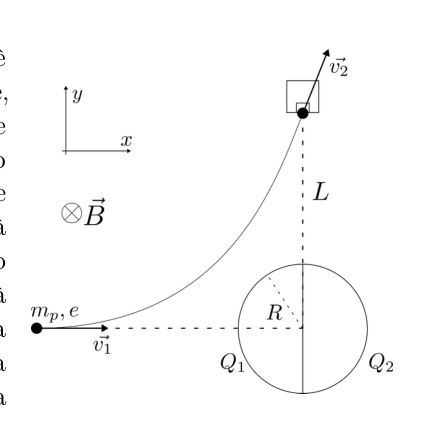 Sfera divisa in due semisfere ( a , a ); campo entrante (); protone con lungo , che colpisce un rivelatore sull’asse a distanza con velocità .
Unità di misura: C. Precisione richiesta: 0.5%.
Topic: Electrostatics, Magnetism, Newtonian Mechanics Metodi: Energy Conservation Method, Symmetry Argument, Lorentz Force Analysis Competenze: Mathematical Modeling, Diagrammatic Reasoning Objects: Sphere, Point Charge Fonte: Testo (PDF) — p.5 Soluzione: Soluzioni (PDF)
Semisfere cariche
A radius sphere , composed of insulating material, is positioned at the origin of the axes and has been divided into two identical halves, each uniformly loaded, with a cut along the plane, as shown in Figure 1. In the region around the sphere there is a magnetic field directed along the negative side of the axis. Un protone si muove nel piano . At a great distance from the sphere, it has speed , directed along the positive side of the axis and towards the centre of the sphere. Its trajectory leads it to hit a detector located on the axis at a speed , at a distance from the centre of the sphere. Since the hemisphere at negative axis values has a charge of , what is the charge of the other hemisphere?
Note: to reduce the graphic size, the origin of the axes in the figure has been drawn at a point other than the centre of the sphere, and the trajectory depicted is not to be considered true to reality.
Sphere divided into two hemispheres ( to , to ; incoming field (); proton with length , hitting a detector on the axis at a distance with speed .
Unità di misura: C. Precisione richiesta: 0.5%.
Topic: Electrostatics, Magnetism, Newtonian Mechanics Metodi: Energy Conservation Method, Symmetry Argument, Lorentz Force Analysis Competenze: Mathematical Modeling, Diagrammatic Reasoning Objects: Sphere, Point Charge Fonte: Testo (PDF) — p.5 Soluzione: Soluzioni (PDF)
Il cannocchiale di Barbossa
Il Capitano Barbossa ha un cannocchiale speciale, composto da due lenti sottili convergenti allineate lungo lo stesso asse. La particolarità del suo strumento è che l’ingrandimento non dipende dalla distanza dall’oggetto osservato. Se le due lenti distano e la distanza focale della lente più vicina agli occhi è , quanto vale, in modulo, l’ingrandimento del cannocchiale?
Unità di misura: adimensionale. Precisione richiesta: 0.5%.
Topic: Geometric Optics Metodi: Thin Lens & Mirror Equation, Ray Tracing Competenze: Diagrammatic Reasoning, Mathematical Modeling Objects: Lens Fonte: Testo (PDF) — p.5 Soluzione: Soluzioni (PDF)
The Barbossa cannochial
Captain Barbossa has a special cannochial, made up of two thin converging lenses aligned along the same axis. The peculiarity of its instrument is that the magnification does not depend on the distance from the object being observed. If the two lenses are apart and the focal length of the lens closest to the eyes is , how much is the magnification of the cannochial lens in the form?
The measuring unit: * additional dimension. The following information is provided:
Topic: Geometric Optics Metodi: Thin Lens & Mirror Equation, Ray Tracing Competenze: Diagrammatic Reasoning, Mathematical Modeling Objects: Lens Fonte: Testo (PDF) — p.5 Soluzione: Soluzioni (PDF)
Pile scariche
Una pila ministilo si può schematizzare come un generatore di tensione ideale pari a , collegato in serie a una resistenza . Questa resistenza dipende da quanto è stata utilizzata la pila, secondo la legge , dove e sono due costanti, mentre è la carica totale che ha attraversato il generatore. Si assuma che la pila venga usata in modo che la carica scorra nello stesso verso della tensione generata dalla pila. Una pila ministilo nuova viene collegata a un dispositivo, di resistenza , che smette di funzionare quando la differenza di potenziale ai suoi capi scende al di sotto di . Dopo quanto tempo il dispositivo smette di funzionare?
Unità di misura: s. Precisione richiesta: 0.5%.
Topic: Circuits Metodi: Differential Equations, Calculus-Integration, Kirchhoff’s Laws Competenze: Mathematical Modeling, Diagrammatic Reasoning Objects: Battery, Resistor Fonte: Testo (PDF) — p.6 Soluzione: Soluzioni (PDF)
The following table shows the results of the calculation of the total number of samples:
A mini-cell can be schematized as an ideal voltage generator of , serial connected to a resistance . This resistance depends on how much battery was used, according to the law, where and are two constants, while is the total charge that has passed through the generator. The battery is assumed to be used so that the charge flows in the same direction as the voltage generated by the battery. A new ministile battery is connected to a device, of strength, which stops working when the potential difference to its heads drops below . How long after that device stops working?
The following shall be added to the list of the units: The following information is provided:
Topic: Circuits Metodi: Differential Equations, Calculus-Integration, Kirchhoff’s Laws Competenze: Mathematical Modeling, Diagrammatic Reasoning Objects: Battery, Resistor Fonte: Testo (PDF) — p.6 Soluzione: Soluzioni (PDF)
Pista inclinata
In una competizione automobilistica, i concorrenti percorrono una pista perfettamente circolare, seguendo una traiettoria di raggio . Il coefficiente di attrito statico fra le ruote e l’asfalto vale . Per aumentare lo spettacolo, si decide di inclinare la pista di rispetto al piano orizzontale, come in figura, in modo che i concorrenti possano percorrerla a velocità più alta. In questo modo la pista è ora diventata la superficie laterale di un tronco di cono. Quanto vale il rapporto tra la velocità massima con cui si può percorrere la nuova curva e la velocità massima con si poteva percorrere quella vecchia?
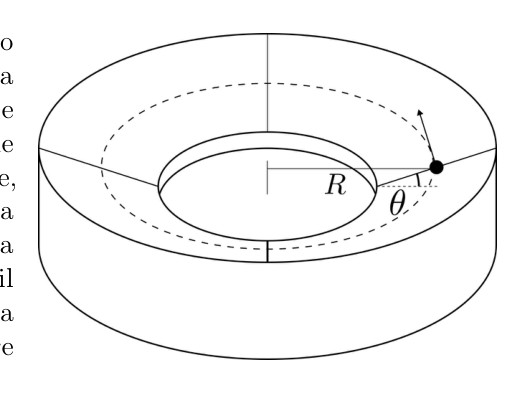 Pista circolare di raggio inclinata di (superficie laterale di un tronco di cono).
Unità di misura: adimensionale. Precisione richiesta: 0.5%.
Topic: Newtonian Mechanics Metodi: Free-Body Diagram, Vector Decomposition Competenze: Diagrammatic Reasoning, Mathematical Modeling Objects: — Fonte: Testo (PDF) — p.6 Soluzione: Soluzioni (PDF)
The following table shows the following:
In a motor racing event, competitors run a perfectly circular track, following a radius trajectory. The static friction coefficient between the wheels and the asphalt shall be . To increase the spectacle, the track is tilted from the horizontal plane, as shown in the figure, so that competitors can run at higher speeds. Thus the track has now become the lateral surface of a cone trunk. What is the ratio of the maximum speed at which one can travel the new curve to the maximum speed at which one could travel the old one?
Circular track of radius inclined by (side surface of a cone trunk).
The measuring unit: * additional dimension. The following information is provided:
Topic: Newtonian Mechanics Metodi: Free-Body Diagram, Vector Decomposition Competenze: Diagrammatic Reasoning, Mathematical Modeling Objects: — Fonte: Testo (PDF) — p.6 Soluzione: Soluzioni (PDF)
Pendolo in accelerazione
Un pendolo semplice, di lunghezza , è attaccato a un supporto che si muove orizzontalmente con accelerazione costante pari a . La massa del pendolo è inizialmente ferma rispetto al supporto. Dopo aver dato un lieve colpo alla massa, con quale periodo essa oscilla?
Unità di misura: s. Precisione richiesta: 0.5%.
Topic: Oscillations & Waves, Newtonian Mechanics Metodi: Simple Harmonic Motion Analysis, Small-Angle Approximation, Free-Body Diagram Competenze: Mathematical Modeling, Diagrammatic Reasoning Objects: Pendulum Fonte: Testo (PDF) — p.6 Soluzione: Soluzioni (PDF)
Hanging it in acceleration
A simple pendulum, in length, is attached to a support moving horizontally at a constant acceleration of . The mass of the pendulum is initially fixed relative to the support. After a slight blow to the mass, at what time does it oscillate?
The following shall be added to the list of the units: The following information is provided:
Topic: Oscillations & Waves, Newtonian Mechanics Metodi: Simple Harmonic Motion Analysis, Small-Angle Approximation, Free-Body Diagram Competenze: Mathematical Modeling, Diagrammatic Reasoning Objects: Pendulum Fonte: Testo (PDF) — p.6 Soluzione: Soluzioni (PDF)
Dilatazione dei tempi gravitazionale
Se due osservatori sono separati da una differenza di energia potenziale gravitazionale (per unità di massa) , la Relatività Generale predice che il tempo misurato dall’osservatore che si trova in un punto a potenziale più basso sia dilatato di un fattore rispetto al tempo misurato dall’altro osservatore. In base a misurazioni condotte sulla superficie, l’età della Terra è di miliardi di anni. Se la densità della Terra fosse uniforme, di quanto tempo sarebbe più giovane il nucleo rispetto alla superficie?
Unità di misura: anni. Precisione richiesta: 0.5%.
Topic: Gravitation, Special Relativity Metodi: Calculus-Integration, Newton’s Law of Gravitation Competenze: Mathematical Modeling, Physical Reasoning Objects: Planet Fonte: Testo (PDF) — p.6 Soluzione: Soluzioni (PDF)
The following is the list of the main characteristics of the test:
If two observers are separated by a difference of gravitational potential energy (per unit mass) , General Relativity predicts that the time measured by the observer at a point of lower potential is dilated by a factor compared to the time measured by the other observer. Based on surface measurements, the age of the Earth is billion years. If the density of the Earth were uniform, how much longer would the nucleus be younger than the surface?
The unit of measurement: * years. The following information is provided:
Topic: Gravitation, Special Relativity Metodi: Calculus-Integration, Newton’s Law of Gravitation Competenze: Mathematical Modeling, Physical Reasoning Objects: Planet Fonte: Testo (PDF) — p.6 Soluzione: Soluzioni (PDF)