Treni paralleli
In un tratto di ferrovia sono presenti due binari dritti e paralleli. Su di essi viaggiano, in direzioni opposte, due treni di lunghezze e , rispettivamente alle velocità di e . Un osservatore, posto molto lontano dai binari, vede le sagome dei due treni sovrapporsi per un certo tempo. Quanto tempo passa dal momento in cui vede le due sagome toccarsi al momento in cui le vede staccarsi?
Unità di misura: s. Precisione richiesta: 0.5%.
Topic: Newtonian Mechanics Metodi: Kinematic Equations, Vector Decomposition Competenze: Unit Conversion, Mathematical Modeling Objects: — Fonte: Testo (PDF) — p.3 Soluzione: Soluzioni (PDF)
The following information shall be provided:
In a railway section there are two straight and parallel tracks. On them, two and length trains travel in opposite directions at the speeds of and respectively. An observer, far from the tracks, sees the shapes of the two overlapping trains for a while. How long does it take from the moment you see the two shapes touch to the moment you see them unravel?
The following shall be added to the list of the units: The following information is provided:
Topic: Newtonian Mechanics Metodi: Kinematic Equations, Vector Decomposition Competenze: Unit Conversion, Mathematical Modeling Objects: — Fonte: Testo (PDF) — p.3 Soluzione: Soluzioni (PDF)
Messa a fuoco
Martina sta fotografando un albero posto a dall’obiettivo della macchina, quando decide di cambiare soggetto e puntare la Luna, che è ben visibile anche di giorno. La macchina che sta usando può essere schematizzata come una lente sottile convergente di lunghezza focale , posta davanti al sensore, che si può spostare tramite una vite. A ogni rotazione completa della vite, il sensore si sposta lungo l’asse ottico di . Supponendo che all’inizio l’albero sia a fuoco, di quale angolo Martina deve ruotare la vite per mettere a fuoco la Luna?
Unità di misura: . Precisione richiesta: 0.5%.
Topic: Geometric Optics Metodi: Thin Lens & Mirror Equation, Small-Angle Approximation Competenze: Diagrammatic Reasoning, Mathematical Modeling Objects: Lens Fonte: Testo (PDF) — p.3 Soluzione: Soluzioni (PDF)
Messa a fuoco
Martina is photographing a tree set at from the lens of the machine, when she decides to change the subject and point the moon, which is clearly visible even during the day. La macchina che sta usando può essere schematizzata come una lente sottile convergente di lunghezza focale , posta davanti al sensore, che si può spostare tramite una vite. At each full rotation of the screw, the sensor moves along the optical axis of . Assuming the tree is on fire at first, from which angle does Martina have to spin the screw to ignite the moon?
Unità di misura: . Precisione richiesta: 0.5%.
Topic: Geometric Optics Metodi: Thin Lens & Mirror Equation, Small-Angle Approximation Competenze: Diagrammatic Reasoning, Mathematical Modeling Objects: Lens Fonte: Testo (PDF) — p.3 Soluzione: Soluzioni (PDF)
Entropia di mescolamento
Due gas perfetti, di moli e , si trovano in equilibrio termico e meccanico in uno scompartimento cilindrico rigido e isolato termicamente, divisi da un pistone mobile che consente la conduzione del calore. Quando viene rimosso il pistone, e si lasciano i due gas mescolarsi, di quanto aumenta l’entropia del sistema?
Unità di misura: J/K. Precisione richiesta: 0.5%.
Topic: Thermodynamics, Kinetic Theory Metodi: Ideal Gas Law, Calculus-Integration Competenze: Mathematical Modeling Objects: Gas, Piston, Cylinder Fonte: Testo (PDF) — p.3 Soluzione: Soluzioni (PDF)
The following table shows the results of the test:
Two perfect gases, and , are in thermal and mechanical equilibrium in a rigid, heat-insulated cylindrical compartment, separated by a mobile piston that allows heat to be carried. When the piston is removed, and the two gases are allowed to mix, how much does the entropy of the system increase?
The following is the list of the measurement units: The following information is provided:
Topic: Thermodynamics, Kinetic Theory Metodi: Ideal Gas Law, Calculus-Integration Competenze: Mathematical Modeling Objects: Gas, Piston, Cylinder Fonte: Testo (PDF) — p.3 Soluzione: Soluzioni (PDF)
Termometro a vodka
Un semplice termometro è composto da un’ampolla, che contiene un liquido, e da un tubicino molto sottile. Se il termometro viene riempito con dell’alcol etilico, la distanza tra la tacca che indica , posta alla base del tubicino, e quella che indica vale . Se invece viene usata dell’acqua, tale distanza è . Quanto vale la distanza tra le due tacche se il termometro viene riempito con della vodka di gradazione alcolica pari al volume/volume?
Nota: sebbene acqua e alcol etilico formino in realtà una mistura non ideale, ai fini del problema si assuma che il volume della mistura sia pari alla somma dei volumi dei due liquidi.
Unità di misura: mm. Precisione richiesta: 0.5%.
Topic: Thermodynamics, Fluid Mechanics Metodi: Physical Modeling, Approximation & Series Expansion Competenze: Mathematical Modeling, Physical Reasoning Objects: Tube Fonte: Testo (PDF) — p.3 Soluzione: Soluzioni (PDF)
The manufacturer shall ensure that the product is not subject to any of the following conditions:
A simple thermometer consists of a vial, which contains a liquid, and a very thin tube. If the thermometer is filled with ethyl alcohol, the distance between the tip indicating at the base of the tube and the tip indicating shall be . If water is used, the distance is . What is the distance between the two teas if the thermometer is filled with alcohol-grade vodka equal to volume/volume?
Note: although water and ethyl alcohol actually form an unidirectional mixture, for the purposes of the problem the volume of the mixture is assumed to be equal to the sum of the volumes of the two liquids.
The unit of measurement: ** mm. The following information is provided:
Topic: Thermodynamics, Fluid Mechanics Metodi: Physical Modeling, Approximation & Series Expansion Competenze: Mathematical Modeling, Physical Reasoning Objects: Tube Fonte: Testo (PDF) — p.3 Soluzione: Soluzioni (PDF)
Gaia
Il satellite Gaia è in grado di misurare la posizione delle stelle che osserva con una precisione di microarcosecondi. A quale distanza bisognerebbe osservare lo spessore di un capello umano affinché esso sottenda un tale angolo?
Unità di misura: m. Precisione richiesta: 300.0%.
Topic: Astrophysics, Order-of-Magnitude Estimation Metodi: Small-Angle Approximation, Order-of-Magnitude Estimation Competenze: Estimation & Approximation, Unit Conversion Objects: Satellite, Star Fonte: Testo (PDF) — p.3 Soluzione: Soluzioni (PDF)
The Commission shall adopt implementing acts in accordance with Article 21 of this Regulation.
The Gaia satellite is able to measure the position of the stars it observes with an accuracy of microarcoseconds. How far should the thickness of a human hair be observed for it to be so angled?
The following is the list of the measurement units: The following information is provided:
Topic: Astrophysics, Order-of-Magnitude Estimation Metodi: Small-Angle Approximation, Order-of-Magnitude Estimation Competenze: Estimation & Approximation, Unit Conversion Objects: Satellite, Star Fonte: Testo (PDF) — p.3 Soluzione: Soluzioni (PDF)
Tre cariche
Tre punti materiali, di carica elettrica , e , sono vincolati a muoversi su una guida circolare. Nella configurazione di equilibrio, quanto vale l’angolo al centro sotteso dai due punti di carica ?
Unità di misura: rad. Precisione richiesta: 0.5%.
Topic: Electrostatics Metodi: Coulomb’s Law, Symmetry Argument, Free-Body Diagram Competenze: Diagrammatic Reasoning, Mathematical Modeling Objects: Point Charge Fonte: Testo (PDF) — p.4 Soluzione: Soluzioni (PDF)
The following is the list of the main components of the engine:
Three material points, of electric charge , and , are bound to move on a circular wheel. In the equilibrium configuration, what is the angle to the centre underneath the two charge points ?
The following is the list of the measurement units: The following information is provided:
Topic: Electrostatics Metodi: Coulomb’s Law, Symmetry Argument, Free-Body Diagram Competenze: Diagrammatic Reasoning, Mathematical Modeling Objects: Point Charge Fonte: Testo (PDF) — p.4 Soluzione: Soluzioni (PDF)
Prigioni aliene 2.0
Gli alieni del pianeta elektron hanno migliorato il loro bizzarro modo di imprigionare i detenuti: adesso riempiono una stanza con un campo magnetico verticale uniforme, di modulo , e tolgono l’aria. Preparano poi un fascio continuo di elettroni ad alta velocità che viene sparato all’interno della stanza con un angolo rispetto al campo magnetico. Gli elettroni percorreranno una traiettoria elicoidale, che può quindi considerarsi appartenente ad una superficie cilindrica. I fasci di elettroni ad alta energia sono molto pericolosi, per cui qualcuno che si trova all’interno del cilindro è impossibilitato a uscirne (le basi del cilindro sono chiuse da soffitto e pavimento). Con quale velocità bisogna sparare gli elettroni per fornire un’area calpestabile di ?
Unità di misura: m/s. Precisione richiesta: 0.5%.
Topic: Magnetism Metodi: Lorentz Force Analysis, Vector Decomposition Competenze: Mathematical Modeling, Physical Reasoning Objects: Particle Beam, Electron Fonte: Testo (PDF) — p.4 Soluzione: Soluzioni (PDF)
Prigioni aliene 2.0
Gli alieni del pianeta elektron hanno migliorato il loro bizzarro modo di imprigionare i detenuti: adesso riempiono una stanza con un campo magnetico verticale uniforme, di modulo , e tolgono l’aria. They then prepare a continuous high-speed beam of electrons that is fired inside the room at an angle to the magnetic field. The electrons will travel through a helicoidal trajectory, which can therefore be considered to be of a cylindrical surface. High-energy electron beams are very dangerous, so someone inside the cylinder is unable to get out (the cylinder’s bases are closed by ceiling and floor). How fast do electrons have to be fired to provide a tread area of ?
Unità di misura: m/s. Precisione richiesta: 0.5%.
Topic: Magnetism Metodi: Lorentz Force Analysis, Vector Decomposition Competenze: Mathematical Modeling, Physical Reasoning Objects: Particle Beam, Electron Fonte: Testo (PDF) — p.4 Soluzione: Soluzioni (PDF)
Cilindri in equilibrio
Due cilindri, di raggio e massa , sono appoggiati con le loro superfici laterali su un piano orizzontale. I loro assi, vincolati a restare paralleli e orizzontali, sono collegati da una molla di lunghezza a riposo nulla, massa trascurabile e costante elastica . Un terzo cilindro, identico ai primi, viene appoggiato sopra agli altri due, come in figura. Non è presente alcuna forma di attrito. Nella posizione di equilibrio (instabile) del sistema, quanto vale l’angolo al centro individuato dai punti di contatto tra i cilindri?
Unità di misura: rad. Precisione richiesta: 0.5%.
p.4 — Three cylinders with spring on plane
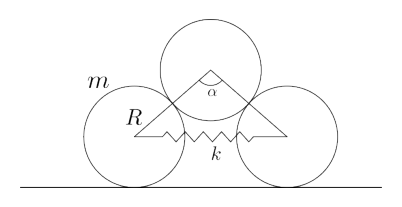
Topic: Newtonian Mechanics, Elasticity & Materials Metodi: Free-Body Diagram, Energy Conservation Method, Hooke’s Law Competenze: Diagrammatic Reasoning, Mathematical Modeling Objects: Cylinder, Spring Fonte: Testo (PDF) — p.4 Soluzione: Soluzioni (PDF)
The following table shows the number of cylinders in the cylinder:
Two cylinders, of radius and mass, shall be supported with their side surfaces on a horizontal plane. Their axes, bound to remain parallel and horizontal, are connected by a spring of zero rest length, negligible mass and constant elasticity . A third cylinder, identical to the first, is supported above the other two, as shown in the figure. There is no form of friction. In the system’s equilibrium (unstable) position, what is the angle to the centre as determined by the contact points between the cylinders?
The following is the list of the measurement units: The following information is provided:
**p.4 ** Three cylinders with spring on plane
Topic: Newtonian Mechanics, Elasticity & Materials Metodi: Free-Body Diagram, Energy Conservation Method, Hooke’s Law Competenze: Diagrammatic Reasoning, Mathematical Modeling Objects: Cylinder, Spring Fonte: Testo (PDF) — p.4 Soluzione: Soluzioni (PDF)
Momenti cubici
Il momento d’inerzia di un cubo con densità uniforme, rispetto a un asse congiungente i centri di facce opposte, vale . Rispetto al medesimo asse, il momento d’inerzia di un cubo cavo, avente la stessa massa del precedente e le facce uniformi e di spessore trascurabile, vale . Quanto vale ?
Unità di misura: adimensionale. Precisione richiesta: 0.5%.
Topic: Rotational Dynamics Metodi: Calculus-Integration, Symmetry Argument Competenze: Diagrammatic Reasoning, Mathematical Modeling Objects: — Fonte: Testo (PDF) — p.4 Soluzione: Soluzioni (PDF)
Momenti cubici
The moment of inertia of a cube with uniform density, relative to an axis connecting the centers of opposite faces, is . Compared to the same axis, the moment of inertia of a cable cube having the same mass as the previous one and uniform faces and negligible thickness is . Quanto vale ?
Unità di misura: adimensionale. Precisione richiesta: 0.5%.
Topic: Rotational Dynamics Metodi: Calculus-Integration, Symmetry Argument Competenze: Diagrammatic Reasoning, Mathematical Modeling Objects: — Fonte: Testo (PDF) — p.4 Soluzione: Soluzioni (PDF)
Automobilista distratto
Un automobilista distratto si accorge troppo tardi di un ostacolo sulla sua traiettoria orizzontale e rettilinea. Egli inizia a frenare il più forte possibile, senza che le ruote slittino, a una distanza di dall’ostacolo, e lo colpisce dopo. Quanto vale, al massimo, il coefficiente di attrito statico tra i suoi pneumatici e l’asfalto?
Unità di misura: adimensionale. Precisione richiesta: 0.5%.
Topic: Newtonian Mechanics Metodi: Free-Body Diagram, Kinematic Equations Competenze: Diagrammatic Reasoning, Mathematical Modeling Objects: Wheel Fonte: Testo (PDF) — p.4 Soluzione: Soluzioni (PDF)
The vehicle is not equipped with a motor vehicle.
A distracted driver notices too late of an obstacle on his horizontal, straight course. He starts braking as hard as possible, without the wheels slipping, at a distance of from the obstacle, and then hits it afterwards. What is the maximum static friction coefficient between your tires and the asphalt?
The measuring unit: ** additional dimension. The following information is provided:
Topic: Newtonian Mechanics Metodi: Free-Body Diagram, Kinematic Equations Competenze: Diagrammatic Reasoning, Mathematical Modeling Objects: Wheel Fonte: Testo (PDF) — p.4 Soluzione: Soluzioni (PDF)
Grafo completo di resistenze
Si consideri un circuito con nodi, in cui ogni nodo è collegato a ogni altro nodo da un filo di resistenza . Quanto vale la resistenza equivalente tra una qualunque coppia di nodi?
Unità di misura: . Precisione richiesta: 0.5%.
Topic: Circuits Metodi: Symmetry Argument, Kirchhoff’s Laws, Equivalent Circuit Reduction Competenze: Diagrammatic Reasoning, Mathematical Modeling Objects: Wire, Resistor Fonte: Testo (PDF) — p.5 Soluzione: Soluzioni (PDF)
Grafo completo di resistenze
Consider a circuit with nodes, where each node is connected to each other node by a resistance wire . What is the equivalent strength between any pair of knots?
Unità di misura: . Precisione richiesta: 0.5%.
Topic: Circuits Metodi: Symmetry Argument, Kirchhoff’s Laws, Equivalent Circuit Reduction Competenze: Diagrammatic Reasoning, Mathematical Modeling Objects: Wire, Resistor Fonte: Testo (PDF) — p.5 Soluzione: Soluzioni (PDF)
Mercurio nei cilindri
Tre cilindri identici, chiamati , e , sono alti e composti da un materiale ad alta conducibilità termica. Il fondo del cilindro è collegato agli altri due tramite tubi di sezione trascurabile, come in figura. Inizialmente, i cilindri e sono chiusi superiormente da un tappo ermetico, mentre il cilindro è aperto. L’ambiente è a temperatura costante e pressione atmosferica. Un quarto cilindro, uguale ai precedenti, viene riempito completamente di mercurio e travasato nel cilindro . Da qui, parte del mercurio si diffonde negli altri due cilindri attraverso i tubi, i quali non lasciano passare aria durante il processo. All’equilibrio termico e meccanico, siano , e le altezze delle colonne di mercurio nei tre cilindri. Il tappo del cilindro viene poi rimosso e le colonne di mercurio raggiungono un nuovo equilibrio, con altezze , e . Quanto vale ?
Nota: si ricorda che la pressione esercitata da una colonna di mercurio alta è pari alla pressione atmosferica.
Unità di misura: m. Precisione richiesta: 0.5%.
p.5 — Three connected mercury cylinders A B C
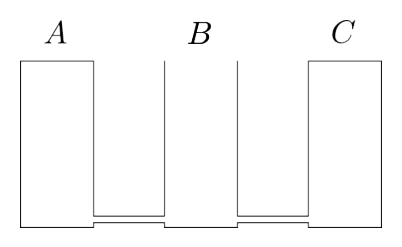
Topic: Fluid Mechanics, Thermodynamics Metodi: Hydrostatic Equilibrium, Physical Modeling Competenze: Diagrammatic Reasoning, Mathematical Modeling Objects: Cylinder, Tube Fonte: Testo (PDF) — p.5 Soluzione: Soluzioni (PDF)
Mercurio nei cilindri
Three identical cylinders, called , and , are high and made of a material with high thermal conductivity. The bottom of the cylinder is connected to the other two by means of a negligible section tube, as shown in Figure 1. Initially, the and cylinders are closed upperly by a sealed cap, while the cylinder is open. The environment is at constant temperature and atmospheric pressure. A fourth cylinder, similar to the previous ones, is filled completely with mercury and poured into the cylinder. From here, some of the mercury spreads to the other two cylinders through the pipes, which do not let air through the process. At thermal and mechanical equilibrium, the heights of the mercury columns in the three cylinders shall be , and . The cylinder cap is then removed and the mercury columns reach a new equilibrium, with heights , and . Quanto vale ?
Note: Please note that the pressure exerted by a high mercury column is equal to atmospheric pressure.
Unità di misura: m. Precisione richiesta: 0.5%.
p.5 — Three connected mercury cylinders A B C
Topic: Fluid Mechanics, Thermodynamics Metodi: Hydrostatic Equilibrium, Physical Modeling Competenze: Diagrammatic Reasoning, Mathematical Modeling Objects: Cylinder, Tube Fonte: Testo (PDF) — p.5 Soluzione: Soluzioni (PDF)
Gli esperimenti del Barone di Munchhausen
In una delle sue strabilianti avventure, il Barone di Münchhausen si trova in un lago, a bordo del suo vascello. Durante un momento di noia, il Barone ha ideato un nuovo protocollo di fuga in caso di abbordaggio, che consiste nel farsi lanciare lontano, viaggiando seduto su una palla di cannone. Per verificarne la validità, effettua dei lanci di prova: dopo ogni cannonata, viaggia un po’ in aria per poi cadere in acqua ed essere recuperato dai suoi aiutanti. Dopo lanci, si convince dell’affidabilità del metodo e torna sottocoperta. A seguito dell’esperimento, il livello dell’acqua si è abbassato di . Sapendo che le grandi palle di cannone sul vascello del Barone sono fatte di ferro, di densità , e hanno un diametro di , quanto vale l’area della superficie del lago?
Unità di misura: . Precisione richiesta: 0.5%.
Topic: Fluid Mechanics Metodi: Hydrostatic Equilibrium, Physical Modeling Competenze: Mathematical Modeling, Physical Reasoning Objects: Ball Fonte: Testo (PDF) — p.5 Soluzione: Soluzioni (PDF)
Gli esperimenti del Barone di Munchhausen
In one of his stunning adventures, the Baron of Münchhausen is in a lake, aboard his ship. During a time of boredom, the Baron devised a new escape protocol in case of a landing, which consists of being thrown away, traveling sitting on a cannonball. To verify its validity, he makes test-firing shots: after each cannonade, he travels a little in the air and then falls into the water and is recovered by his helpers. After launches, he is convinced of the method’s reliability and goes back undercover. As a result of the experiment, the water level dropped by . Knowing that the large cannon balls on the Baron’s vessel are made of iron, density , and diameter , what is the surface area of the lake worth?
Unità di misura: . Precisione richiesta: 0.5%.
Topic: Fluid Mechanics Metodi: Hydrostatic Equilibrium, Physical Modeling Competenze: Mathematical Modeling, Physical Reasoning Objects: Ball Fonte: Testo (PDF) — p.5 Soluzione: Soluzioni (PDF)
Urto tra satelliti
Un satellite si muove su un’orbita circolare attorno a un pianeta sferico di raggio , privo di atmosfera. Un altro satellite, con massa identica a quella del primo, cade radialmente verso il pianeta, partendo con velocità nulla da una distanza molto grande. I due satelliti si scontrano in modo completamente anaelastico, fondendosi in un unico corpo, il quale si muove su una nuova orbita tangente alla superficie del pianeta. Quanto valeva il raggio dell’orbita circolare del primo satellite?
Unità di misura: km. Precisione richiesta: 0.5%.
Topic: Gravitation, Conservation of Momentum Metodi: Conservation of Momentum, Conservation of Energy, Newton’s Law of Gravitation Competenze: Mathematical Modeling, Physical Reasoning Objects: Satellite, Planet Fonte: Testo (PDF) — p.5 Soluzione: Soluzioni (PDF)
The following is the list of the countries of the European Union:
A satellite moves in a circular orbit around a spherical planet with a radius , without atmosphere. Another satellite, with the same mass as the first, falls radially toward the planet, leaving at zero speed from a very large distance. The two satellites collide completely anaelastically, merging into a single body, which moves on a new tangent orbit to the planet’s surface. What was the radius of the first satellite’s circular orbit worth?
The unit of measurement: ** km. The following information is provided:
Topic: Gravitation, Conservation of Momentum Metodi: Conservation of Momentum, Conservation of Energy, Newton’s Law of Gravitation Competenze: Mathematical Modeling, Physical Reasoning Objects: Satellite, Planet Fonte: Testo (PDF) — p.5 Soluzione: Soluzioni (PDF)