Two identical balls are at rest and side by side at the top of a hill. You let one ball, , start rolling down the hill. A little later, you start the second ball, , rolling down the hill along a line parallel to that of the first ball. The second ball rolls down the hill along a line parallel to the first ball . Which of the following statements is true?
- (A) only the displacement and velocity are the same for both balls.
- (B) only the displacement and acceleration are the same for both balls.
- (C) only the velocity and acceleration are the same for both balls.
- (D) the displacement, velocity and acceleration are the same for both balls.
- (E) the displacement, velocity and acceleration are all different for both balls.
Fonte: Testo (PDF) — p.3 Topic: Newtonian Mechanics Metodi: Kinematic Equations Competenze: Physical Reasoning Objects: Ball
Due palle identiche sono in riposo e fianco a fianco in cima a una collina. Lasciate che una palla, , comincia a rotolare giù per la collina. Un po’ più tardi, si inizia la seconda palla, , rotolare giù la collina lungo una linea parallela a quella della prima palla. La seconda palla si snoda sulla collina lungo una linea parallela alla prima palla . Quale delle seguenti affermazioni è vera?
- **(A) ** solo lo spostamento e la velocità sono uguali per entrambe le palle.
- **(B) ** solo lo spostamento e l’accelerazione sono uguali per entrambe le palle.
- **(C) ** solo la velocità e l’accelerazione sono uguali per entrambe le palle.
- **(D) ** lo spostamento, la velocità e l’accelerazione sono uguali per entrambe le palle.
- **(E) ** lo spostamento, la velocità e l’accelerazione sono tutti diversi per entrambe le palle.
Fonte: Testo (PDF) — p.3 Topic: Newtonian Mechanics Metodi: Kinematic Equations Competenze: Physical Reasoning Objects: Ball
Consider a train that can speed up with an acceleration of and slow down with a deceleration of . Find the minimum time for the train to travel between two stations apart. You may assume that the train has to stop at every station.
- (A)
- (B)
- (C)
- (D)
- (E)
Fonte: Testo (PDF) — p.3 Topic: Newtonian Mechanics Metodi: Kinematic Equations Competenze: Physical Reasoning Objects: —
Considerate un treno che può accelerare con un’accelerazione di e rallentare con un decelerazione di . Trova il tempo minimo per il viaggio del treno tra due stazioni . Potreste presumere che il treno debba fermarsi a ogni stazione.
- (A)
- (B)
- (C)
- (D)
- (E)
Fonte: Testo (PDF) — p.3 Topic: Newtonian Mechanics Metodi: Kinematic Equations Competenze: Physical Reasoning Objects: —
A man pushes against a rigid, immovable wall. Which of the following statement is most accurate concerning this situation?
- (A) The man can never exert a force on the wall that exceeds his weight.
- (B) If the man pushes on the wall with a force of , we can be sure that the wall pushes back on him.
- (C) Since the wall cannot move, it cannot exert any force on him.
- (D) The man cannot be in equilibrium since he is exerting a net force on the wall.
- (E) The friction force on the man’s feet is directed away from the wall.
Fonte: Testo (PDF) — p.3 Topic: Newtonian Mechanics Metodi: Free-Body Diagram Competenze: Physical Reasoning Objects: —
Un uomo spinge contro un muro rigido e immobile. Quale delle seguenti affermazioni è più accurata in merito a questa situazione?
L’uomo non può mai esercitare una forza sul muro che superi il suo peso.
- **(B) ** Se l’uomo spinge sul muro con una forza di , possiamo essere sicuri che il muro lo spinge indietro.
- **(C) ** Poiché il muro non può muoversi, non può esercitare alcuna forza su di lui.
- **(D) ** L’uomo non può essere in equilibrio poiché esercita una forza netta sul muro.
- **(E) ** La forza di attrito sui piedi dell’uomo è diretta lontano dal muro.
Fonte: Testo (PDF) — p.3 Topic: Newtonian Mechanics Metodi: Free-Body Diagram Competenze: Physical Reasoning Objects: —
The same constant force is used to accelerate two carts of the same mass on frictionless tracks. The force applied to cart A is used to accelerate it over a distance . When the same force is applied to cart B over a distance , which statement is true?
- (A) .
- (B) .
- (C) .
- (D) .
- (E) .
Fonte: Testo (PDF) — p.4 Topic: Conservation of Energy Metodi: Energy Conservation Method Competenze: Physical Reasoning Objects: Cart
La stessa forza costante viene utilizzata per accelerare due carri della stessa massa su binari senza attrito. La forza applicata al carrello A viene utilizzata per accelerarlo su una distanza . Quando la stessa forza viene applicata al carrello B su una distanza , quale affermazione è vera?
- (A) .
- (B) .
- (C) .
- (D) .
- (E) .
Fonte: Testo (PDF) — p.4 Topic: Conservation of Energy Metodi: Energy Conservation Method Competenze: Physical Reasoning Objects: Cart
A block of mass is hung from a light vertical spring of spring constant , which is hung in turn from another spring of spring constant . The amount by which each spring stretches is . The total elastic potential energy of the system when at rest is:
- (A)
- (B)
- (C)
- (D)
- (E)
Fonte: Testo (PDF) — p.4 Topic: Elasticity & Materials Metodi: Hooke’s Law Competenze: Physical Reasoning Objects: Block, Spring
Un blocco di massa è appeso a una leggera molla verticale della costante molla , che è appesa a sua volta ad un’altra molla della costante molla . La quantità di cui si estende ogni primavera è . L’energia potenziale elastica totale del sistema in riposo è:
- (A)
- (B)
- (C)
- (D)
- (E)
Fonte: Testo (PDF) — p.4 Topic: Elasticity & Materials Metodi: Hooke’s Law Competenze: Physical Reasoning Objects: Block, Spring
Two boys in a canoe toss a baseball back and forth. What effect will this have on the canoe?
- (A) None, because the ball remains in the canoe.
- (B) The canoe will drift in the direction of the boy who throws the ball harder each time.
- (C) The canoe will drift in the direction of the boy who throws the ball with less force each time.
- (D) The canoe will oscillate back and forth always moving opposite to the ball.
- (E) The canoe will oscillate but the net movement of the canoe will be zero because the internal forces sum to zero.
Note: ignore the friction forces in opposite directions upon the person throwing the ball.
Fonte: Testo (PDF) — p.4 Topic: Conservation of Momentum Metodi: Conservation of Momentum Competenze: Physical Reasoning Objects: Ball
Due ragazzi in una canoa lanciano una palla da baseball avanti e indietro. Che effetto avrà questo sulla canoa?
- **(A) ** Nessuna, perché la palla rimane nella canoa. La canoa si allontana in direzione del ragazzo che lancia la palla più forte ogni volta. La canoa si sposta in direzione del ragazzo che lancia la palla con meno forza ogni volta.
- **(D) ** La canoa oscilla avanti e indietro sempre in movimento opposto alla palla.
- **(E) ** La canoa oscillerà ma il movimento netto della canoa sarà zero perché le forze interne si sommano a zero.
Nota: ignora le forze di attrito in direzioni opposte sulla persona che lancia la palla.
Fonte: Testo (PDF) — p.4 Topic: Conservation of Momentum Metodi: Conservation of Momentum Competenze: Physical Reasoning Objects: Ball
A sample of water at undergoes the following sequential process (ignore the container):
Process 1: An amount of thermal energy is removed from the water.
Process 2: An additional amount of thermal energy is removed from the water.
In the final equilibrium state after process 2, half of all the water has become ice at , while the rest remains liquid at . What is the temperature of the sample after process 1? Evaporation can be ignored and you may use the information given in page 2.
- (A)
- (B)
- (C)
- (D)
- (E) There is not enough information to answer this question.
Fonte: Testo (PDF) — p.5 Topic: Thermodynamics Metodi: Physical Modeling Competenze: Physical Reasoning Objects: —
Un campione di acqua a subisce il seguente processo sequenziale (ignorare il contenitore):
Processo 1: viene rimossa dall’acqua una quantità di energia termica .
Processo 2: viene rimossa dall’acqua una quantità aggiuntiva di energia termica .
Nel stato di equilibrio finale dopo il processo 2, la metà di tutta l’acqua è diventata ghiaccio a , mentre il resto rimane liquido a . Qual è la temperatura del campione dopo la procedura 1? L’evaporazione può essere ignorata e si può utilizzare le informazioni riportate a pagina 2.
- (A)
- (B)
- (C)
- (D)
- **(E) ** Non ci sono informazioni sufficienti per rispondere a questa domanda.
Fonte: Testo (PDF) — p.5 Topic: Thermodynamics Metodi: Physical Modeling Competenze: Physical Reasoning Objects: —
The ideal gas law, , describes the condition of gases best when
- (A) density of the gas is low.
- (B) pressure is high.
- (C) gas is colourless.
- (D) gas is monatomic.
- (E) temperature is close to absolute zero.
Fonte: Testo (PDF) — p.5 Topic: Kinetic Theory Metodi: Ideal Gas Law Competenze: Physical Reasoning Objects: Gas
La legge dei gas ideali, , descrive meglio la condizione dei gas quando
- **(A) ** densità del gas è bassa.
- **(B) ** pressione è elevata.
- **(C) ** gas è incolore.
- **(D) ** gas è monatomico.
- **(E) ** temperatura è vicina allo zero assoluto.
Fonte: Testo (PDF) — p.5 Topic: Kinetic Theory Metodi: Ideal Gas Law Competenze: Physical Reasoning Objects: Gas
A room is heated by a radiator that has a constant but unknown temperature . When the outside temperature is , the room temperature is . However, when the outside temperature drops to , the room temperature is . What is the temperature of the radiator? (Hint: The rate of heat transfer is approximately proportional to the temperature difference.)
- (A)
- (B)
- (C)
- (D)
- (E)
Fonte: Testo (PDF) — p.5 Topic: Thermodynamics Metodi: Physical Modeling Competenze: Physical Reasoning Objects: —
Una stanza è riscaldata da un radiatore con una temperatura costante ma sconosciuta . Quando la temperatura esterna è , la temperatura ambiente è . Tuttavia, quando la temperatura esterna scende a , la temperatura ambiente è . Qual è la temperatura del radiatore? (Signore: il tasso di trasferimento di calore è approssimativamente proporzionale alla differenza di temperatura).
- (A)
- (B)
- (C)
- (D)
- (E)
Fonte: Testo (PDF) — p.5 Topic: Thermodynamics Metodi: Physical Modeling Competenze: Physical Reasoning Objects: —
The image of an erect candle, formed using a convex mirror, is always
- (A) virtual, inverted, and smaller than the candle.
- (B) virtual, inverted, and larger than the candle.
- (C) virtual, erect, and larger than the candle.
- (D) virtual, erect, and smaller than the candle.
- (E) none of the above.
Fonte: Testo (PDF) — p.6 Topic: Geometric Optics Metodi: Thin Lens & Mirror Equation Competenze: Physical Reasoning Objects: Mirror
L’immagine di una candela eretta, formata con uno specchio convexo, è sempre
- **(A) ** virtuale, invertito e più piccolo della candela.
- **(B) ** virtuale, invertito e più grande della candela.
- **(C) ** virtuale, eretta e più grande della candela.
- **(D) ** virtuale, eretta e più piccola della candela.
- **(E) ** nessuna delle seguenti.
Fonte: Testo (PDF) — p.6 Topic: Geometric Optics Metodi: Thin Lens & Mirror Equation Competenze: Physical Reasoning Objects: Mirror
Which of the following choices best explains why a certain colour of light will allow the observer to see the greatest detail when using a microscope?
- (A) Blue light because it has the shortest wavelength.
- (B) Blue light because it travels fastest through the microscopic lens.
- (C) Red light because our eyes are most sensitive to this colour.
- (D) Red light because it is less likely to be scattered.
- (E) Red light because it has the longest wavelength.
Fonte: Testo (PDF) — p.6 Topic: Wave Optics Metodi: Interference & Diffraction Analysis Competenze: Physical Reasoning Objects: Lens
Quale delle seguenti scelte spiega meglio il motivo per cui un certo colore di luce permetterà all’osservatore di vedere i maggiori dettagli quando si utilizza un microscopio?
- **(A) ** Luce blu perché ha la lunghezza d’onda più breve.
- **(B) ** Luce blu perché viaggia più velocemente attraverso la lente microscopica.
- **(C) ** Luce rossa perché i nostri occhi sono più sensibili a questo colore.
- **(D) ** Luce rossa perché è meno probabile che sia dispersa.
- **(E) ** Luce rossa perché ha la lunghezza d’onda più lunga.
Fonte: Testo (PDF) — p.6 Topic: Wave Optics Metodi: Interference & Diffraction Analysis Competenze: Physical Reasoning Objects: Lens
Which of the following properties could NOT be demonstrated by sound travelling in the air?
- (A) reflection
- (B) refraction
- (C) polarization
- (D) diffraction
- (E) all the above properties can be demonstrated by sound
Fonte: Testo (PDF) — p.6 Topic: Oscillations & Waves Metodi: Physical Modeling Competenze: Physical Reasoning Objects: —
Quali delle seguenti proprietà NON possono essere dimostrate dal suono viaggiando in aria?
- **(A) ** riflessione
- **(B) ** rifrazione
- **(C) ** polarizzazione
- **(D) ** diffrazione
- **(E) ** tutte le proprietà di cui sopra possono essere dimostrate dal suono
Fonte: Testo (PDF) — p.6 Topic: Oscillations & Waves Metodi: Physical Modeling Competenze: Physical Reasoning Objects: —
A beam of light from the air is incident on a transparent block of material. The angle of incidence is while the angle of refraction is . What is the velocity of light in the transparent material?
- (A)
- (B)
- (C)
- (D)
- (E) It is not possible to get these angles.
Fonte: Testo (PDF) — p.7 Topic: Geometric Optics Metodi: Snell’s Law Competenze: Physical Reasoning Objects: —
Un raggio di luce proveniente dall’aria incide su un blocco di materiale trasparente. L’angolo di incidenza è mentre l’angolo di rifrazione è . Qual è la velocità della luce nel materiale trasparente?
- (A)
- (B)
- (C)
- (D)
- **(E) ** Non è possibile ottenere questi angoli.
Fonte: Testo (PDF) — p.7 Topic: Geometric Optics Metodi: Snell’s Law Competenze: Physical Reasoning Objects: —
The S-waves (transverse) and P-waves (longitudinal) produced by earthquakes travel at different speeds through the earth. If the S-waves travel about while the P-waves travel at nearly , how far away must an earthquake be for the P-waves to arrive minutes before the S-waves?
- (A)
- (B)
- (C)
- (D)
- (E)
Fonte: Testo (PDF) — p.7 Topic: Oscillations & Waves Metodi: Kinematic Equations Competenze: Physical Reasoning Objects: —
Le onde S (trasversali) e P (longitudinali) prodotte dai terremoti viaggiano a velocità diverse attraverso la terra. Se le onde S viaggiano intorno a mentre le onde P viaggiano a quasi , a che distanza deve essere un terremoto per far arrivare le onde P minuti prima delle onde S?
- (A)
- (B)
- (C)
- (D)
- (E)
Fonte: Testo (PDF) — p.7 Topic: Oscillations & Waves Metodi: Kinematic Equations Competenze: Physical Reasoning Objects: —
Three wave pulses travel along the same string held at the same tension as shown in the diagram below. Which of the following is true?
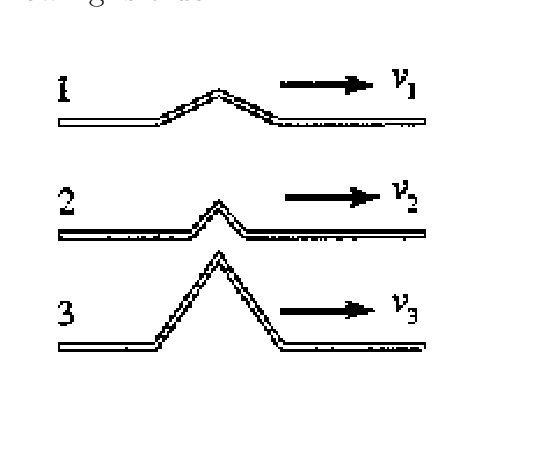 Three wave pulses (1, 2, 3) of increasing height travelling rightward along strings at speeds , , .
- (A)
- (B)
- (C)
- (D)
- (E) The comparison of speed cannot be made from the information given.
Fonte: Testo (PDF) — p.7 Topic: Oscillations & Waves Metodi: Wave Equation Competenze: Physical Reasoning Objects: String
Tre impulsi d’onda viaggiano lungo la stessa corda tenuta alla stessa tensione come mostrato nel diagramma di seguito. Quale di queste parole è vero?
Tre impulsi d’onda (1, 2, 3) di altezza in aumento che viaggiano a destra lungo le corde a velocità , , .
- (A)
- (B)
- (C)
- (D)
- **(E) ** Il confronto della velocità non può essere fatto a partire dalle informazioni fornite.
Fonte: Testo (PDF) — p.7 Topic: Oscillations & Waves Metodi: Wave Equation Competenze: Physical Reasoning Objects: String
As shown in the figure, a neutral conductor is mounted on an insulator and brought close to a negatively charged conductor C. When electrostatic equilibrium has been achieved, which of the following mathematical statements regarding the potential of the A and B ends of the conductor is true? (Assume ground to be of zero potential.)
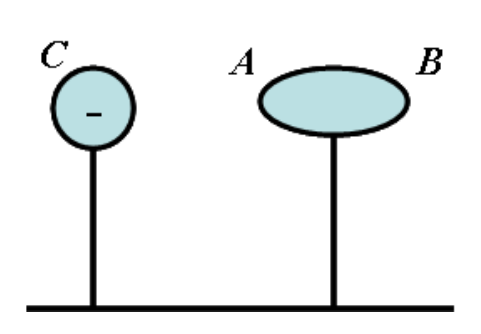 A negatively charged conductor C on the left; a neutral conductor with ends A (near C) and B (far from C) mounted on an insulator.
- (A)
- (B)
- (C)
- (D)
- (E)
Fonte: Testo (PDF) — p.8 Topic: Electrostatics Metodi: Electric Potential Method Competenze: Physical Reasoning Objects: —
Come mostrato nella figura, un conduttore neutro è montato su un isolante e avvicinato a un conduttore C carico negativo. Quando è stato raggiunto l’equilibrio elettrostatico, quale delle seguenti affermazioni matematiche relative al potenziale delle estremità A e B del conduttore è vero? (Supponiamo che il terreno abbia potenziale zero.)
Un conduttore a carica negativa C a sinistra; un conduttore neutro con le estremità A (vicino a C) e B (lungi da C) montate su un isolante.
- (A)
- (B)
- (C)
- (D)
- (E)
Fonte: Testo (PDF) — p.8 Topic: Electrostatics Metodi: Electric Potential Method Competenze: Physical Reasoning Objects: —
2 charged particles and are launched in quick succession from into a uniform electric field with the same velocity and in a direction perpendicular to the electric field. Under the influence of the electric field, and are noticed to impact on and respectively where . The ratio of the magnitude of the charges on and is . In this case, the ratio of the masses of and is
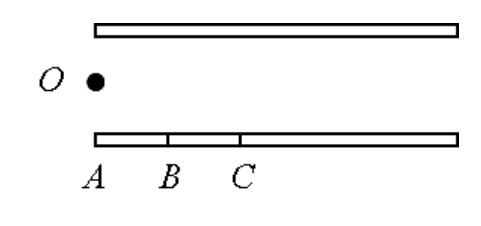 Particles launched from point travel horizontally and land at points , , along a line, with .
- (A)
- (B)
- (C)
- (D)
- (E)
Fonte: Testo (PDF) — p.8 Topic: Electrostatics Metodi: Kinematic Equations Competenze: Physical Reasoning Objects: Point Charge
2 particelle cariche e vengono lanciate in rapida successione da in un campo elettrico uniforme con la stessa velocità e in direzione perpendicolare al campo elettrico. Sotto l’influenza del campo elettrico, si nota un impatto su e rispettivamente su e , dove . Il rapporto tra la magnitudine delle cariche su e è . In questo caso, il rapporto tra le masse di e è
Le particelle lanciate dal punto viaggiano orizzontalmente e atterrano nei punti , , lungo una linea, con .
- (A)
- (B)
- (C)
- (D)
- (E)
Fonte: Testo (PDF) — p.8 Topic: Electrostatics Metodi: Kinematic Equations Competenze: Physical Reasoning Objects: Point Charge
Which of the following statements is correct regarding equipotential lines?
- (A) No work is done by external force when a charge moves along equipotential lines.
- (B) No force is required to move a charge from one equipotential line to another equipotential line.
- (C) No work is done to move a charge from one equipotential line to another equipotential line.
- (D) Electric field lines are the same as the equipotential lines.
- (E) Electric field lines can be parallel to the equipotential lines.
Fonte: Testo (PDF) — p.8 Topic: Electrostatics Metodi: Electric Potential Method Competenze: Physical Reasoning Objects: —
Quale delle seguenti affermazioni è corretta riguardo alle linee equipotenziali?
- **(A) ** Quando una carica si muove lungo linee equipotenziali non si effettua alcun lavoro con forza esterna.
- **(B) ** Non è necessaria alcuna forza per spostare una carica da una linea equipotenziale ad un’altra linea equipotenziale.
- **(C) ** Non è stato effettuato alcun lavoro per spostare una carica da una linea equipotenziale ad un’altra linea equipotenziale.
- **(D) ** Le linee di campo elettrico sono le stesse delle linee equipotenziali.
- **(E) ** Le linee di campo elettrico possono essere parallele alle linee equipotenziali.
Fonte: Testo (PDF) — p.8 Topic: Electrostatics Metodi: Electric Potential Method Competenze: Physical Reasoning Objects: —
Wire and wire carry currents and respectively in the same direction. If , the magnitudes of the forces acting on wire () and wire () are related by
- (A)
- (B)
- (C)
- (D)
- (E)
Fonte: Testo (PDF) — p.9 Topic: Magnetism Metodi: Ampère’s Law Competenze: Physical Reasoning Objects: Wire
Il filo e il filo trasportano rispettivamente correnti e nella stessa direzione. Se , le magnitudini delle forze che agiscono su filo () e filo () sono correlate da:
- (A)
- (B)
- (C)
- (D)
- (E)
Fonte: Testo (PDF) — p.9 Topic: Magnetism Metodi: Ampère’s Law Competenze: Physical Reasoning Objects: Wire
Two identical bar magnets are dropped from equal heights but with different polarity to the ground. The ground below magnet is bare, i.e., not covered with any special material while the ground below magnet is covered with an aluminium plate. Which magnet strikes first?
- (A) Magnet
- (B) Magnet
- (C) Both strikes at the same time.
- (D) The magnet that has the N pole toward the ground.
- (E) The magnet that has the S pole toward the ground.
Fonte: Testo (PDF) — p.9 Topic: Electromagnetic Induction Metodi: Lenz’s Law Competenze: Physical Reasoning Objects: Magnet
Due magneti identici vengono abbassati da altezza uguale ma con polarità diversa al suolo. Il terreno sotto il magnete è nudo, cioè non coperto da alcun materiale speciale, mentre il terreno sotto il magnete è coperto da una piastra di alluminio. Quale magnete colpisce per primo?
- **(A) ** Magnete
- **(B) ** Magnete
- **(C) ** Entrambi i colpi allo stesso tempo.
- **(D) ** Il magnete che ha il polo N verso il suolo.
- **(E) ** Il magnete che ha il polo S verso il suolo.
Fonte: Testo (PDF) — p.9 Topic: Electromagnetic Induction Metodi: Lenz’s Law Competenze: Physical Reasoning Objects: Magnet
A lead bullet, specific heat, is initially at . It is fired vertically upwards with a speed of , and on returning to the starting point strikes a cake of ice at . How much ice is melted? Assume that all the energy is used to melt the ice and the ice is in melting only.
- (A)
- (B)
- (C)
- (D)
- (E)
Fonte: Testo (PDF) — p.9 Topic: Conservation of Energy Metodi: Energy Conservation Method Competenze: Physical Reasoning Objects: Projectile
Un proiettile di piombo , calore specifico, è inizialmente . Si spara verticalmente verso l’alto con una velocità di e, al ritorno al punto di partenza, colpisce una torta di ghiaccio a . Quanto ghiaccio si è sciolto? Supponiamo che tutta l’energia venga impiegata per sciogliere il ghiaccio e il ghiaccio sia solo in scioglimento.
- (A)
- (B)
- (C)
- (D)
- (E)
Fonte: Testo (PDF) — p.9 Topic: Conservation of Energy Metodi: Energy Conservation Method Competenze: Physical Reasoning Objects: Projectile
A man of mass on an initially stationary boat gets off the boat by leaping to the left in an exactly horizontal direction. Immediately after the leap, the boat, of mass , is observed to be moving to the right at speed . How much work did the man do during the leap (both to his own body and to the boat)?
- (A) .
- (B) .
- (C) .
- (D) .
- (E) .
Fonte: Testo (PDF) — p.10 Topic: Conservation of Momentum Metodi: Conservation of Momentum, Energy Conservation Method Competenze: Physical Reasoning Objects: —
Un uomo di massa su una barca inizialmente fermata scende dalla barca saltando a sinistra in una direzione esattamente orizzontale. Subito dopo il salto, la barca, di massa , si osserva che si muove a destra a velocità . Quanto lavoro fece l’uomo durante il salto (sia per il suo corpo che per la barca)?
- (A) .
- (B) .
- (C) .
- (D) .
- (E) .
Fonte: Testo (PDF) — p.10 Topic: Conservation of Momentum Metodi: Conservation of Momentum, Energy Conservation Method Competenze: Physical Reasoning Objects: —
Given that the radius of the Earth is , the total mass of the Earth’s atmosphere is approximately
- (A) .
- (B) .
- (C) .
- (D) .
- (E) .
Fonte: Testo (PDF) — p.10 Topic: Order-of-Magnitude Estimation Metodi: Order-of-Magnitude Estimation Competenze: Physical Reasoning Objects: Planet
Dato che il raggio di radio della Terra è , la massa totale dell’atmosfera terrestre è di circa
- (A) .
- (B) .
- (C) .
- (D) .
- (E) .
Fonte: Testo (PDF) — p.10 Topic: Order-of-Magnitude Estimation Metodi: Order-of-Magnitude Estimation Competenze: Physical Reasoning Objects: Planet
A baseball is thrown vertically upward and feels no air resistance. As it is rising,
- (A) both its momentum and its mechanical energy are conserved.
- (B) both its momentum and its kinetic energy are conserved.
- (C) its kinetic energy is conserved but its momentum is not conserved.
- (D) the gravitational potential energy is not conserved but its momentum is conserved.
- (E) its momentum is not conserved but its mechanical energy is conserved.
Fonte: Testo (PDF) — p.10 Topic: Conservation of Momentum Metodi: Conservation Laws Competenze: Physical Reasoning Objects: Ball
Una palla da baseball viene gettata verticalmente in su e non sente alcuna resistenza dell’aria. Mentre si alza,
- **(A) ** sia la sua dinamica che l’energia meccanica sono conservate.
- **(B) ** sia la sua dinamica che l’energia cinetica sono conservate.
- **(C) ** la sua energia cinetica è conservata ma il suo impulso non è conservato.
- **(D) ** l’energia potenziale gravitazionale non è conservata ma il suo impulso è conservato.
- **(E) ** il suo impulso non è conservato ma la sua energia meccanica è conservata.
Fonte: Testo (PDF) — p.10 Topic: Conservation of Momentum Metodi: Conservation Laws Competenze: Physical Reasoning Objects: Ball
In the figure below, a length of uniform wire is bent into a right triangle. The two shorter sides lie on the and axes as shown below. You may neglect the thickness of the wire. The - and -coordinates of the centre of mass, in cm, are closest to
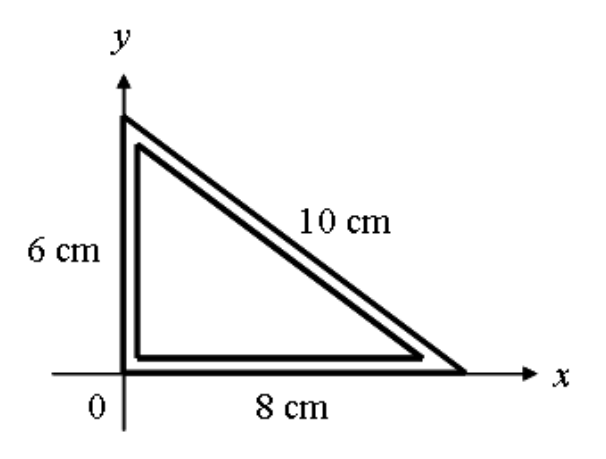 A right triangle of wire with vertices at the origin, with legs of along and along , and hypotenuse .
- (A)
- (B)
- (C)
- (D)
- (E)
Fonte: Testo (PDF) — p.11 Topic: Newtonian Mechanics Metodi: Physical Modeling Competenze: Physical Reasoning Objects: Wire
Nella figura seguente, una lunghezza di filo uniforme è piegata in un triangolo rettangolo. I due lati più brevi si trovano sugli assi e come mostrato di seguito. Potresti trascurare lo spessore del filo. Le coordinate - e del centro di massa, in cm, sono le più vicine a
Un triangolo rettangolo di filo con vertici all’origine, con gambe di lungo e lungo , e ipotenusa .
- (A)
- (B)
- (C)
- (D)
- (E)
Fonte: Testo (PDF) — p.11 Topic: Newtonian Mechanics Metodi: Physical Modeling Competenze: Physical Reasoning Objects: Wire
A student drifting down Singapore River, assumed to be straight with a current of , falls off from his raft. He grabs a piling of Coleman Bridge besides him and holds on for . He then swims after the raft with a speed relative to the water of . The distance of the raft downstream from the bridge when the student catches it is
- (A)
- (B)
- (C)
- (D)
- (E)
Fonte: Testo (PDF) — p.11 Topic: Newtonian Mechanics Metodi: Kinematic Equations Competenze: Physical Reasoning Objects: —
Uno studente che sbarca lungo il fiume Singapore, presumendo di essere retto con una corrente di , cade dalla sua zattera. Prende un’ampolla di Coleman Bridge accanto a lui e si ferma per . In seguito, si sta batendo dopo la balena con una velocità relativa all’acqua di . La distanza della balena a valle dal ponte quando lo studente lo cattura è
- (A)
- (B)
- (C)
- (D)
- (E)
Fonte: Testo (PDF) — p.11 Topic: Newtonian Mechanics Metodi: Kinematic Equations Competenze: Physical Reasoning Objects: —
The soccer ball approaches a player at . At what velocity should the player’s foot move in order to stop the ball upon contact? Assume that the mass of the foot is much greater than the mass of the ball and the collision is elastic.
- (A) in the direction opposite to the original velocity of the ball
- (B) in the direction opposite to the original velocity of the ball
- (C) in the same direction as the original velocity of the ball
- (D) , i.e., he should hold his foot very still.
- (E) This feat cannot be done.
Fonte: Testo (PDF) — p.11 Topic: Conservation of Momentum Metodi: Conservation of Momentum Competenze: Physical Reasoning Objects: Ball
La palla di calcio si avvicina a un giocatore a . A che velocità deve muovere il piede del giocatore per fermare la palla al contatto? Supponiamo che la massa del piede sia molto maggiore della massa della palla e che la collisione sia elastica.
- **(A) ** nella direzione opposta alla velocità originale della palla
- **(B) ** nella direzione opposta alla velocità iniziale della palla
- **(C) ** nella stessa direzione della velocità originale della palla
- **(D) ** , cioè deve tenere il piede molto fermo.
- **(E) ** Questa operazione non può essere realizzata.
Fonte: Testo (PDF) — p.11 Topic: Conservation of Momentum Metodi: Conservation of Momentum Competenze: Physical Reasoning Objects: Ball
3 forces that are the same in magnitude but different in direction acts on a mass . These forces magnitudes and directions form a triangle as shown. The net force experience by this mass is
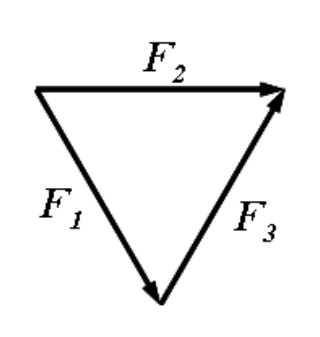 Three forces , , arranged head-to-tail forming a closed triangle.
- (A)
- (B)
- (C)
- (D)
- (E)
Fonte: Testo (PDF) — p.12 Topic: Newtonian Mechanics Metodi: Vector Decomposition Competenze: Physical Reasoning Objects: —
3 forze che sono uguali in magnitudine ma diverse in direzione agiscono su una massa . Queste forze, le magnitudini e le direzioni formano un triangolo come mostrato. L’esperienza di forza netta di questa massa è
Tre forze , , disposte testa a coda formando un triangolo chiuso.
- (A)
- (B)
- (C)
- (D)
- (E)
Fonte: Testo (PDF) — p.12 Topic: Newtonian Mechanics Metodi: Vector Decomposition Competenze: Physical Reasoning Objects: —
The diagram below shows an immersed test-tube with its open end facing downwards and an air bubble trapped in the test-tube. At a certain height, the test-tube is not moving. If we pour more water into the beaker, the test-tube will
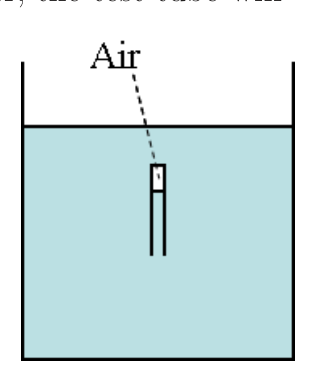 A test-tube floating open-end-down in a beaker of water, with an air pocket trapped at its upper closed end.
- (A) remains where it is.
- (B) accelerate upwards.
- (C) accelerate downwards.
- (D) oscillate about a point.
- (E) do any of the above depending on the amount of water poured in.
Fonte: Testo (PDF) — p.12 Topic: Fluid Mechanics Metodi: Hydrostatic Equilibrium Competenze: Physical Reasoning Objects: Tube, Bubble, Container
Il diagramma di seguito mostra un tubo di prova immerso con la sua estremità aperta rivolta verso il basso e una bolla d’aria intrappolata nel tubo di prova. A una certa altezza, il tubo di prova non si muove. Se versamo più acqua nel bicchiere, il tubo di prova
Un tubo di prova che galleggia a fondo aperto in una tazza d’acqua, con una tasca d’aria bloccata alla sua estremità superiore chiusa.
- **(A) ** rimane dove si trova.
- **(B) ** accelerare verso l’alto.
- **(C) ** accelerare verso il basso.
- **(D) ** oscilla circa un punto.
- **(E) ** fare qualsiasi di queste cose a seconda della quantità di acqua versata.
Fonte: Testo (PDF) — p.12 Topic: Fluid Mechanics Metodi: Hydrostatic Equilibrium Competenze: Physical Reasoning Objects: Tube, Bubble, Container
In an experiment for measuring , a particle is thrown vertically up in an evacuated tube and allowed to fall down. is the time interval when the particle crosses a lower level in the tube while going up and while falling down. Similarly is the time interval when it crosses an upper level while going up and while falling down. is the distance between two levels as shown in the figure. The correct value of is:
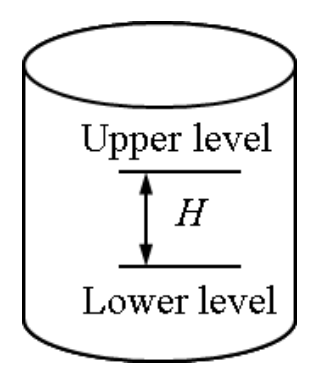 A vertical tube marked with an upper level and a lower level separated by a height .
- (A)
- (B)
- (C)
- (D)
- (E)
Fonte: Testo (PDF) — p.12 Topic: Newtonian Mechanics Metodi: Kinematic Equations Competenze: Physical Reasoning Objects: Tube
In un esperimento per la misurazione , una particella viene gettata verticalmente in un tubo evacuato e lasciata cadere. è l’intervallo di tempo in cui la particella attraversa un livello inferiore nel tubo mentre sale e mentre cade. Allo stesso modo è l’intervallo di tempo in cui il veicolo attraversa un livello superiore durante la salita e la caduta. è la distanza tra due livelli come mostrato nella figura. Il valore corretto di è:
Un tubo verticale segnalato con un livello superiore e un livello inferiore separati da un’altezza .
- (A)
- (B)
- (C)
- (D)
- (E)
Fonte: Testo (PDF) — p.12 Topic: Newtonian Mechanics Metodi: Kinematic Equations Competenze: Physical Reasoning Objects: Tube
A ball of mass is thrown with a speed of . The ball strikes a bat and it is hit straight back along the same line at the same speed of . Variation of the interaction force as long as the ball remains in contact with the bat is shown in the figure. The maximum force exerted by the bat on the ball is:
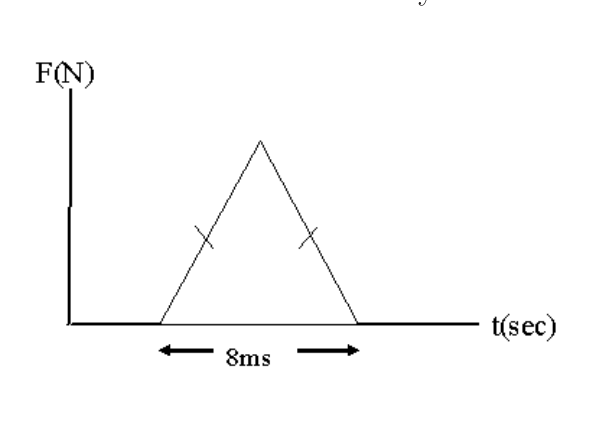 Force versus time : a triangular pulse rising from to a peak and back to over a contact time of .
- (A)
- (B)
- (C)
- (D)
- (E)
Fonte: Testo (PDF) — p.13 Topic: Conservation of Momentum Metodi: Impulse-Momentum Theorem Competenze: Physical Reasoning Objects: Ball
Una palla di massa viene lanciata a una velocità . La palla colpisce un bastone e viene colpita direttamente indietro lungo la stessa linea alla stessa velocità di . La variazione della forza di interazione finché la palla rimane in contatto con il pipistrello è mostrata nella figura. La forza massima esercitata dalla mazza sulla palla è:
Forza contro tempo : un impulso triangolare che sale da a picco e torna a in un tempo di contatto di .
- (A)
- (B)
- (C)
- (D)
- (E)
Fonte: Testo (PDF) — p.13 Topic: Conservation of Momentum Metodi: Impulse-Momentum Theorem Competenze: Physical Reasoning Objects: Ball
A juggler throws balls into air. He throws one whenever the previous one is at the highest point. How high do the balls rise if he throws balls each second? Acceleration due to gravity is .
- (A)
- (B)
- (C)
- (D)
- (E)
Fonte: Testo (PDF) — p.13 Topic: Newtonian Mechanics Metodi: Kinematic Equations Competenze: Physical Reasoning Objects: Ball
Un malato lancia palle in aria. Ne lancia uno quando il precedente è al punto più alto. How high do the balls rise if he throws balls each second? L’accelerazione dovuta alla gravità è .
- (A)
- (B)
- (C)
- (D)
- (E)
Fonte: Testo (PDF) — p.13 Topic: Newtonian Mechanics Metodi: Kinematic Equations Competenze: Physical Reasoning Objects: Ball
A fireworks rocket explodes at height , the peak of its vertical trajectory. It throws out burning fragments in all directions, but all at the same speed . Pellets of solidified metal fall to the ground without air resistance. Find the smallest angle that the final velocity of an impacting pellet makes with the horizontal.
- (A) degrees
- (B)
- (C)
- (D)
- (E)
Fonte: Testo (PDF) — p.13 Topic: Newtonian Mechanics Metodi: Kinematic Equations, Conservation of Energy Competenze: Physical Reasoning Objects: Projectile
Un razzo fuochi d’artificio esplode ad un’altezza , il picco della sua traiettoria verticale. It throws out burning fragments in all directions, but all at the same speed . Le pelli di metallo solidificato cadono a terra senza resistenza all’aria. Trova l’angolo più piccolo che la velocità finale di un pellet che colpisce fa con l’orizzontale.
- **(A) ** gradi
- (B)
- (C)
- (D)
- (E)
Fonte: Testo (PDF) — p.13 Topic: Newtonian Mechanics Metodi: Kinematic Equations, Conservation of Energy Competenze: Physical Reasoning Objects: Projectile
A rock is thrown vertically upward with initial speed . Assume a frictional force proportional to the speed of the rock, and neglect the upthrust exerted by air. Which of the following is correct?
- (A) The acceleration of the rock is always .
- (B) The acceleration of the rock is equal to only at the top of the flight.
- (C) The acceleration of the rock is always less than .
- (D) The speed of the rock upon return to its starting point is .
- (E) The rock can attain a terminal speed greater than before it returns to its starting point.
Fonte: Testo (PDF) — p.14 Topic: Newtonian Mechanics Metodi: Free-Body Diagram Competenze: Physical Reasoning Objects: —
Una roccia viene lanciata verticalmente verso l’alto con velocità iniziale . Supponiamo una forza di attrito proporzionale alla velocità della roccia, e trascuriamo la spinta verso l’alto esercitata dall’aria. Quale di queste parole è corretta?
- **(A) ** L’accelerazione della roccia è sempre .
- **(B) ** L’accelerazione della roccia è uguale a solo in cima al volo.
- **(C) ** L’accelerazione della roccia è sempre inferiore a .
- **(D) ** La velocità della roccia al ritorno al suo punto di partenza è .
- **(E) ** La roccia può raggiungere una velocità terminale superiore a prima di tornare al suo punto di partenza.
Fonte: Testo (PDF) — p.14 Topic: Newtonian Mechanics Metodi: Free-Body Diagram Competenze: Physical Reasoning Objects: —
An object is moving to the right in a straight line with a constant speed. Which of the following statements must be correct.
- (A) There are no forces acting on the object.
- (B) There is a larger number of forces acting on the object to the right than to the left.
- (C) There is only one force acting on the object and it is acting to the right.
- (D) The kinetic energy of the object is pointing to the right.
- (E) The momentum of the object is pointing to the right.
Fonte: Testo (PDF) — p.14 Topic: Newtonian Mechanics Metodi: Free-Body Diagram Competenze: Physical Reasoning Objects: —
Un oggetto si muove a destra in linea retta con una velocità costante. Qual è la seguente affermazione ** che deve essere corretta **?
- **(A) ** Non ci sono forze che agiscono sull’oggetto.
- **(B) ** Ci sono un numero maggiore di forze che agiscono sull’oggetto a destra che a sinistra.
- **(C) ** C’è solo una forza che agisce sull’oggetto ed essa agisce a destra.
- **(D) ** L’energia cinetica dell’oggetto punta a destra.
- **(E) ** L’impulso dell’oggetto sta puntando a destra.
Fonte: Testo (PDF) — p.14 Topic: Newtonian Mechanics Metodi: Free-Body Diagram Competenze: Physical Reasoning Objects: —
The magnitude of the resistive force on a cruising plane is directly proportional to where is the planes velocity. If the power expended by the plane is when the plane is cruising at velocity , what will be the power expended by the plane when the plane is cruising at velocity ?
- (A)
- (B)
- (C)
- (D)
- (E) It cannot possibly be determined.
Fonte: Testo (PDF) — p.14 Topic: Newtonian Mechanics Metodi: Physical Modeling Competenze: Physical Reasoning Objects: —
La grandezza della forza di resistenza in un aereo di crociera è direttamente proporzionale a , dove è la velocità dei aerei. Se la potenza spesa dall’aereo è quando l’aereo percorre a velocità , quale sarà la potenza spesa dall’aereo quando l’aereo percorre a velocità ?
- (A)
- (B)
- (C)
- (D)
- **(E) ** Non è possibile determinarlo.
Fonte: Testo (PDF) — p.14 Topic: Newtonian Mechanics Metodi: Physical Modeling Competenze: Physical Reasoning Objects: —
The battery has appreciable internal resistance. What happens to the brightness of bulb after we close the switch ?
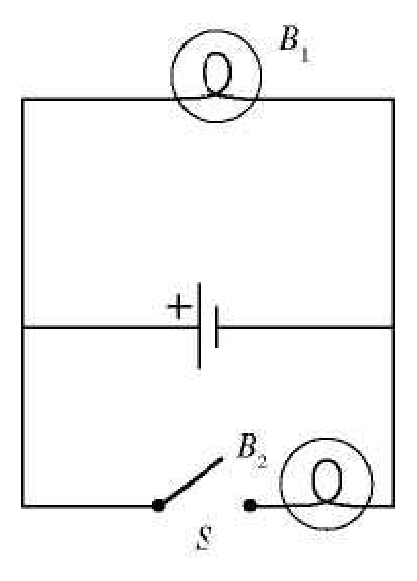 Circuit with two bulbs (top) and (bottom right), a battery, and a switch .
- (A) The brightness does not change.
- (B) The brightness decreases temporary but gradually increases back to its original brightness.
- (C) The brightness increases temporary but gradually decreases back to its original brightness.
- (D) The brightness increases permanently.
- (E) The brightness decreases permanently.
Fonte: Testo (PDF) — p.15 Topic: Circuits Metodi: Kirchhoff’s Laws Competenze: Physical Reasoning Objects: Battery, Switch
La batteria ha una resistenza interna apprezzabile. Che cosa succede alla luminosità della lampadina dopo aver chiuso il interruttore ?
Circuito con due lampadine (alto) e (basso a destra), batteria e interruttore .
- **(A) ** La luminosità non cambia.
- **(B) ** La luminosità diminuisce temporaneamente ma aumenta gradualmente di nuovo alla sua luminosità originale.
- **(C) ** La luminosità aumenta temporaneamente ma diminuisce gradualmente alla sua luminosità originale.
- **(D) ** La luminosità aumenta in modo permanente.
- **(E) ** La luminosità diminuisce in modo permanente.
Fonte: Testo (PDF) — p.15 Topic: Circuits Metodi: Kirchhoff’s Laws Competenze: Physical Reasoning Objects: Battery, Switch
Two very large parallel sheets carry equal but opposite uniform surface charge densities. A point charge that is placed near the middle of the sheets equidistant from both of them feels an electrical force due to the sheets. If this charge is now moved to half its original distance from the positive plate, the force it will feel is closest to:
- (A)
- (B)
- (C)
- (D)
- (E)
Fonte: Testo (PDF) — p.15 Topic: Electrostatics Metodi: Gauss’s Law Competenze: Physical Reasoning Objects: Capacitor, Point Charge
Due fogli paralleli molto grandi hanno densità di carica superficiale uguali ma opposte. Una carica puntaria che si trova vicino al centro dei fogli, a pari distanza da entrambi, prova una forza elettrica dovuta ai fogli. Se questa carica viene spostata alla metà della sua distanza originale dalla piastra positiva, la forza che sentirà è la più vicina a:
- (A)
- (B)
- (C)
- (D)
- (E)
Fonte: Testo (PDF) — p.15 Topic: Electrostatics Metodi: Gauss’s Law Competenze: Physical Reasoning Objects: Capacitor, Point Charge
The current of the circuit in the resistor is . What is the current in the resistor?
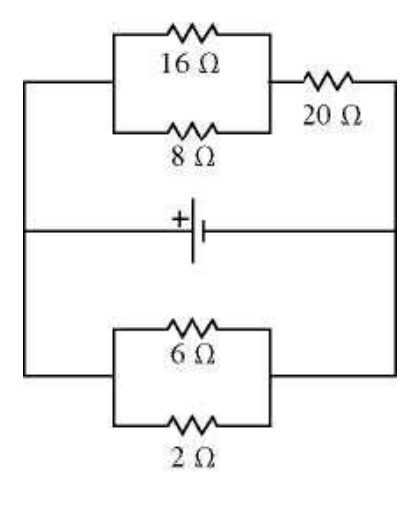 Circuit with a and resistor on the top branch, an resistor and battery in the middle, and a and resistor on the bottom branch.
- (A)
- (B)
- (C)
- (D)
- (E)
Fonte: Testo (PDF) — p.15 Topic: Circuits Metodi: Kirchhoff’s Laws Competenze: Physical Reasoning Objects: Resistor, Battery
La corrente del circuito nella resistenza è . Qual è la corrente nella resistenza ?
Circuito con resistenza e sul ramo superiore, resistenza e batteria nel mezzo, resistenza e sul ramo inferiore.
- (A)
- (B)
- (C)
- (D)
- (E)
Fonte: Testo (PDF) — p.15 Topic: Circuits Metodi: Kirchhoff’s Laws Competenze: Physical Reasoning Objects: Resistor, Battery
If you rub a balloon on your sweater and then press it to a wall, it will often stick there. Why does this happen?
- (A) Rubbing removes a surface layer of grease, allowing the rubber to come in sufficiently close contact with the wall so that air pressure hold it there.
- (B) Rubbing the balloon charges it electrostatically, and this charge on the balloon induces an opposite charge on the wall. The attraction between induced charge and the charge on the balloon holds it there.
- (C) A wall typically has a net electric charge on it, and rubbing the balloon charges it electrostatically. The interaction between the wall charge and the balloon charge holds the balloon to the wall.
- (D) Rubbing the balloon causes moisture to condense on it, and surface tension causes the balloon to stick to wall.
- (E) Rubbing the balloon surface causes it to become slightly conducting. When the balloon is touched to the wall, electrons flow from the balloon to the wall. This sets up an electric field which bonds weakly to the wall.
Fonte: Testo (PDF) — p.16 Topic: Electrostatics Metodi: Physical Modeling Competenze: Physical Reasoning Objects: —
Se strofinate un pallone sul vostro maglione e poi lo premete su un muro, spesso rimarrà lì. Perché succede?
- **(A) ** La frattura rimuove uno strato superficiale di grasso, consentendo alla gomma di entrare in contatto sufficientemente stretto con la parete in modo che la pressione dell’aria la tenga lì.
- **(B) ** La fretta del palloncino lo carica elettrostaticamente e questa carica sul palloncino induce una carica opposta sulla parete. L’attrazione tra la carica indotta e la carica sul palloncino la tiene lì.
- **(C) ** Una parete ha tipicamente una carica elettrica netta su di essa, e la fretta del palloncino la carica elettrostaticamente. L’interazione tra la carica della parete e la carica del palloncino tiene il palloncino alla parete.
- **(D) ** La frattura del palloncino provoca la condensazione dell’umidità e la tensione superficiale provoca che il palloncino si attacchi alla parete.
- **(E) ** La frattura della superficie del palloncino provoca una leggera conduzione. Quando il palloncino viene toccato al muro, gli elettroni fluiscono dal palloncino al muro. Questo crea un campo elettrico che si lega debilmente al muro.
Fonte: Testo (PDF) — p.16 Topic: Electrostatics Metodi: Physical Modeling Competenze: Physical Reasoning Objects: —
If the magnetic field vector is directed toward the north and an electron is moving toward the east, the magnetic force on the electron is
- (A) East
- (B) West
- (C) South
- (D) Up
- (E) Down
Fonte: Testo (PDF) — p.16 Topic: Magnetism Metodi: Lorentz Force Analysis Competenze: Physical Reasoning Objects: Electron
Se il vettore del campo magnetico è diretto verso nord e un elettrone si muove verso est, la forza magnetica sull’elettrone è
- **(A) ** Est
- **(B) ** Occidente
- **(C) ** Sud
- (D) Up
- **(E) ** In basso
Fonte: Testo (PDF) — p.16 Topic: Magnetism Metodi: Lorentz Force Analysis Competenze: Physical Reasoning Objects: Electron
If a charged pion that decays in second in its own rest frame is to travel in the laboratory before decaying, the pion’s speed must be most nearly
- (A)
- (B)
- (C)
- (D)
- (E)
Fonte: Testo (PDF) — p.16 Topic: Special Relativity Metodi: Lorentz Transformation Competenze: Physical Reasoning Objects: —
Se un pion carico che si decompone in secondo nel suo frame di riposo deve viaggiare in laboratorio prima di decompondersi, la velocità del pion deve essere più vicina
- (A)
- (B)
- (C)
- (D)
- (E)
Fonte: Testo (PDF) — p.16 Topic: Special Relativity Metodi: Lorentz Transformation Competenze: Physical Reasoning Objects: —
In the Einstein’s photoelectric equation , the quantity is the
- (A) minimum energy required to free an electron from its binding to the cathode material.
- (B) energy difference between the two lowest electron orbits in the atoms of the photocathode.
- (C) total light energy absorbed by the photocathode during the measurement.
- (D) minimum energy a photon must have in order to be absorbed by the photocathode.
- (E) average energy of all electrons in the photocathode.
Fonte: Testo (PDF) — p.17 Topic: Modern-Quantum Physics Metodi: Photon Energy Relation Competenze: Physical Reasoning Objects: Photon, Electron
Nella equazione fotoelettrica di Einstein , la quantità è la
- **(A) ** energia minima necessaria per liberare un elettrone dal suo legame al materiale catodico.
- **(B) ** differenza di energia tra le due orbite elettroniche più basse degli atomi del fotocatodo.
- **(C) ** l’energia luminosa totale assorbita dal fotocatodo durante la misura.
- **(D) ** energia minima che un fotone deve avere per essere assorbito dal fotocatodo.
- **(E) ** energia media di tutti gli elettroni nel fotocatodo.
Fonte: Testo (PDF) — p.17 Topic: Modern-Quantum Physics Metodi: Photon Energy Relation Competenze: Physical Reasoning Objects: Photon, Electron
The minimum sensitivity of the human eye is about . If the diameter of the pupil of the eye is , how many photons/s of wavelength must enter the eye for a distant star to be visible?
- (A)
- (B)
- (C)
- (D)
- (E)
Fonte: Testo (PDF) — p.17 Topic: Modern-Quantum Physics Metodi: Photon Energy Relation Competenze: Physical Reasoning Objects: Photon, Star
La sensibilità minima dell’ occhio umano è di circa . Se il diametro della pupilla dell’occhio è , quanti fotoni/s di lunghezza d’onda devono entrare nell’occhio per rendere visibile una stella lontana?
- (A)
- (B)
- (C)
- (D)
- (E)
Fonte: Testo (PDF) — p.17 Topic: Modern-Quantum Physics Metodi: Photon Energy Relation Competenze: Physical Reasoning Objects: Photon, Star
A very slow moving electron has its kinetic energy increased to four times its original value. What happens to the electron’s corresponding de Broglie wavelength?
- (A) The wavelength is decreased by a factor of .
- (B) The wavelength is decreased by a factor of .
- (C) There is no change in the wavelength.
- (D) The wavelength is increased by a factor of .
- (E) The wavelength is increased by a factor of .
Fonte: Testo (PDF) — p.17 Topic: Modern-Quantum Physics Metodi: de Broglie Relation Competenze: Physical Reasoning Objects: Electron
Un elettrone che si muove molto lentamente ha la sua energia cinetica aumentata fino a quattro volte il suo valore originale. Che succede alla lunghezza d’onda di Broglie corrispondente dell’elettrone?
- **(A) ** La lunghezza d’onda è ridotta di un fattore .
- **(B) ** La lunghezza d’onda è ridotta di un fattore .
- **(C) ** Non vi è alcuna variazione della lunghezza d’onda.
- **(D) ** La lunghezza d’onda è aumentata di un fattore .
- **(E) ** La lunghezza d’onda è aumentata di un fattore .
Fonte: Testo (PDF) — p.17 Topic: Modern-Quantum Physics Metodi: de Broglie Relation Competenze: Physical Reasoning Objects: Electron
Light is emitted due to transition from the to the level of a hydrogen atom in the Bohr model. If the transition were from the to level instead, the emitted light would have
- (A) lower frequency
- (B) less energy
- (C) longer wavelength
- (D) greater speed
- (E) greater momentum
Fonte: Testo (PDF) — p.18 Topic: Modern-Quantum Physics Metodi: Bohr Model & Quantization Competenze: Physical Reasoning Objects: Atom, Photon
La luce viene emessa a causa della transizione dal livello al livello di un atomo di idrogeno nel modello di Bohr. Se invece il passaggio fosse stato dal livello al livello , la luce emessa avrebbe
- **(A) ** bassa frequenza
- **(B) ** meno energia
- **(C) ** lunghezza d’onda più lunga
- **(D) ** maggiore velocità
- **(E) ** maggiore impulso
Fonte: Testo (PDF) — p.18 Topic: Modern-Quantum Physics Metodi: Bohr Model & Quantization Competenze: Physical Reasoning Objects: Atom, Photon
When a radioactive nucleus emits an alpha particle and a gamma ray, the number of
- (A) protons increases by one while the number of neutrons decreases by one.
- (B) protons decreases by one while the number of neutrons increases by one.
- (C) protons and neutrons each decrease by two.
- (D) protons decreases by one while the number of neutrons decreases by three.
- (E) protons and neutrons remain unchanged.
Fonte: Testo (PDF) — p.18 Topic: Nuclear & Particle Physics Metodi: Radioactive Decay Law Competenze: Physical Reasoning Objects: Nucleus, Photon
Quando un nucleo radioattivo emette una particella alfa e un raggio gamma, il numero di
- **(A) ** i protoni aumentano di uno mentre il numero di neutroni diminuisce di uno.
- **(B) ** i protoni diminuiscono di uno mentre il numero di neutroni aumenta di uno.
- **(C) ** protoni e neutroni diminuiscono di due ciascuno.
- **(D) ** i protoni diminuiscono di uno mentre il numero di neutroni diminuisce di tre.
- **(E) ** protoni e neutroni rimangono invariati.
Fonte: Testo (PDF) — p.18 Topic: Nuclear & Particle Physics Metodi: Radioactive Decay Law Competenze: Physical Reasoning Objects: Nucleus, Photon
The following fusion reaction occurs in the sun:
The masses of the nuclei are:
Was energy absorbed or released? What is the value of this energy?
- (A) zero
- (B) Absorbed,
- (C) Released,
- (D) Absorbed,
- (E) Released,
Fonte: Testo (PDF) — p.18 Topic: Nuclear & Particle Physics Metodi: Mass-Energy Equivalence Competenze: Physical Reasoning Objects: Nucleus
Il sole si presenta la seguente reazione di fusione:
Le masse dei nuclei sono:
L’energia è stata assorbita o rilasciata? Qual è il valore di questa energia?
- **(A) ** zero
- **(B) ** Assorbito,
- **(C) ** rilasciato,
- **(D) ** Assorbito,
- **(E) ** rilasciato,
Fonte: Testo (PDF) — p.18 Topic: Nuclear & Particle Physics Metodi: Mass-Energy Equivalence Competenze: Physical Reasoning Objects: Nucleus
According to the special theory of relativity, which one of the following quantities has the same value for all observers?
- (A) the length of an object.
- (B) the speed of an object.
- (C) the duration of a time interval.
- (D) the speed of light in a vacuum.
- (E) the mass of an object.
Fonte: Testo (PDF) — p.19 Topic: Special Relativity Metodi: Lorentz Transformation Competenze: Physical Reasoning Objects: —
Secondo la teoria speciale della relatività, quale delle seguenti quantità ha lo stesso valore per tutti gli osservatori?
- **(A) ** la lunghezza di un oggetto.
- **(B) ** la velocità di un oggetto.
- **(C) ** la durata di un intervallo temporale.
- **(D) ** la velocità della luce in vuoto.
- **(E) ** la massa di un oggetto.
Fonte: Testo (PDF) — p.19 Topic: Special Relativity Metodi: Lorentz Transformation Competenze: Physical Reasoning Objects: —
A physicist observes a stationary bare nucleus undergoes radioactive decay in a uniform magnetic field. Two traces were made by the products’ paths as in the diagram shown. The diameter of the bigger circle to that of the smaller circle is . He ponders over the statements made by his colleagues.
I. The nucleus underwent decay. II. The recoil nucleus path follows the smaller circle in the anti-clockwise direction. III. The atomic number of the nucleus was originally . IV. The period of the recoil nucleus and the radioactive entity has the same period.
Which of the above statements is/are true?
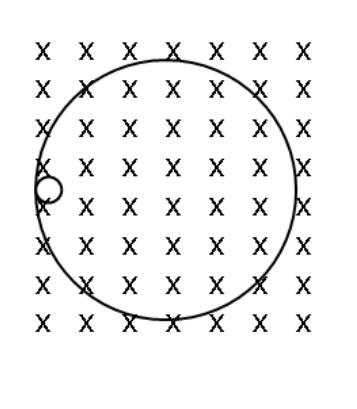 A region of uniform magnetic field directed into the page (crosses), with two circular particle traces of different radii.
- (A) I only
- (B) I and II only
- (C) I and IV only
- (D) II and IV only
- (E) II and III only
Fonte: Testo (PDF) — p.19 Topic: Nuclear & Particle Physics Metodi: Lorentz Force Analysis Competenze: Physical Reasoning Objects: Nucleus
Un fisico osserva che un nucleo nudo stazionario subisce un decadimento radioattivo in un campo magnetico uniforme. I percorsi dei prodotti hanno dato luogo a due tracce, come mostrato nel diagramma. Il diametro del cerchio più grande a quello del cerchio più piccolo è . He ponders over the statements made by his colleagues.
I. Il nucleo è stato sottoposto a decadimento . II. Il percorso del nucleo del retrocesso segue il cerchio più piccolo nella direzione antiorologiale. III. Il Il numero atomico del nucleo era originariamente . IV. Il periodo del nucleo di retrocesso e dell’entità radioattiva ha lo stesso periodo.
Quali delle affermazioni sopra indicate sono/sono vere?
Regione di campo magnetico uniforme diretto verso la pagina (cross), con due tracce di particelle circolari di diversi raggi.
- **(A) ** I solo
- **(B) ** I e II solo
- **(C) ** I e IV soltanto
- **(D) ** solo II e IV
- solo **(E) ** II e III
Fonte: Testo (PDF) — p.19 Topic: Nuclear & Particle Physics Metodi: Lorentz Force Analysis Competenze: Physical Reasoning Objects: Nucleus