A car accelerates from to at a rate of . How far does it travel while accelerating?
- (A)
- (B)
- (C)
- (D)
- (E)
Fonte: Testo (PDF) — p.3 Topic: Newtonian Mechanics Metodi: Kinematic Equations Competenze: Physical Reasoning Objects: —
Una vettura accelera da a a un ritmo di . Quanto viaggia mentre accelera?
- (A)
- (B)
- (C)
- (D)
- (E)
Fonte: Testo (PDF) — p.3 Topic: Newtonian Mechanics Metodi: Kinematic Equations Competenze: Physical Reasoning Objects: —
A marathon runner runs at a steady speed of . When the runner is from the finish, a bird begins flying from the runner to the finish at . When the bird reaches the finish line, it turns around and flies back to the runner, and then turns around again, repeating the back-and-forth trips until the runner reaches the finish line. How many kilometers does the bird travel?
- (A)
- (B)
- (C)
- (D)
- (E)
Fonte: Testo (PDF) — p.3 Topic: Newtonian Mechanics Metodi: Kinematic Equations Competenze: Physical Reasoning Objects: —
Un corridore di maratona corre a una velocità costante di . Quando il corridore è dalla fine, un uccello inizia a volare dal corridore alla fine a . Quando l’uccello raggiunge la linea di meta, si gira e vola di nuovo verso il corridore, e poi si gira di nuovo, ripetendo i viaggi avanti e indietro fino a quando il corridore raggiunge la linea di meta. Quanti chilometri viaggia l’uccello?
- (A)
- (B)
- (C)
- (D)
- (E)
Fonte: Testo (PDF) — p.3 Topic: Newtonian Mechanics Metodi: Kinematic Equations Competenze: Physical Reasoning Objects: —
A mass and a mass on a horizontal frictionless surface are connected by a massless string A. They are pulled horizontally across the surface by a second string B with a constant acceleration of . What is the magnitude of the net force on the mass?
- (A)
- (B)
- (C)
- (D)
- (E)
Fonte: Testo (PDF) — p.3 Topic: Newtonian Mechanics Metodi: Free-Body Diagram, Vector Decomposition Competenze: Physical Reasoning Objects: Block, String
Una massa e una massa su una superficie senza attrito orizzontale sono collegate da una corda A senza massa. Sono trascinate orizzontalmente sulla superficie da una seconda corda B con un’accelerazione costante di . Qual è la grandezza della forza netta sulla massa ?
- (A)
- (B)
- (C)
- (D)
- (E)
Fonte: Testo (PDF) — p.3 Topic: Newtonian Mechanics Metodi: Free-Body Diagram, Vector Decomposition Competenze: Physical Reasoning Objects: Block, String
Superman stands on the roof garden of a very tall building on Earth with one ball in each hand. If the red ball is thrown horizontally off the roof and the blue ball is simultaneously dropped over the edge, which statement is true? Neglect air resistance.
- (A) Both balls always hit the ground at the same time with the same speed.
- (B) The red ball strikes the ground first with a higher speed than the blue ball.
- (C) The blue ball strikes the ground first, but with a lower speed than the red ball.
- (D) Both balls always hit the ground at the same time, but the red ball has a higher speed just before it strikes the ground.
- (E) If the initial speed of the red ball is high enough, it may strike the ground later with a higher speed than the blue ball.
Fonte: Testo (PDF) — p.4 Topic: Newtonian Mechanics Metodi: Kinematic Equations Competenze: Physical Reasoning Objects: Ball, Projectile
Superman si trova sul giardino sul tetto di un edificio molto alto sulla Terra con una palla in ogni mano. Se la palla rossa viene gettata orizzontalmente dal tetto e la palla blu viene simultaneamente gettata sul bordo, quale affermazione è vera? - Non si tratta di resistenza all’aria.
- **(A) ** Entrambe le palle colpiscono sempre il terreno allo stesso tempo con la stessa velocità.
- **(B) ** La palla rossa colpisce il terreno prima con una velocità superiore alla palla blu.
- **(C) ** La palla blu colpisce prima il terreno, ma con una velocità inferiore alla palla rossa.
- **(D) ** Entrambe le palle colpiscono sempre il terreno allo stesso tempo, ma la palla rossa ha una velocità più alta poco prima di colpire il terreno.
- **(E) ** Se la velocità iniziale della palla rossa è sufficientemente alta, può colpire il terreno in seguito con una velocità superiore a quella della palla blu.
Fonte: Testo (PDF) — p.4 Topic: Newtonian Mechanics Metodi: Kinematic Equations Competenze: Physical Reasoning Objects: Ball, Projectile
A drum has a radius of and a moment of inertia of . The frictional torque of the drum axle is . A length of rope is wound around the rim. The drum is initially at rest. A constant force is applied to the free end of the rope until the rope is completely unwound and slips off. At that instant, the angular velocity of the drum is . The drum then decelerates and comes to a halt. The constant force applied to the rope is closest to
- (A)
- (B)
- (C)
- (D)
- (E)
Fonte: Testo (PDF) — p.4 Topic: Rotational Dynamics Metodi: Torque & Angular Momentum Analysis Competenze: Physical Reasoning Objects: Cylinder, String
Un tamburo ha un raggio di e un momento di inerzia di . La coppia di attrito dell’asse del tamburo è . Una lunghezza di corda è rotta intorno al bordo. Il tamburo è inizialmente a riposo. Si applica una forza costante alla fine libera della corda fino a quando la corda non si è completamente svolta e scivola. In quel momento, la velocità angolare del tamburo è . Il tamburo poi rallenta e si ferma. La forza costante applicata alla corda è la più vicina a
- (A)
- (B)
- (C)
- (D)
- (E)
Fonte: Testo (PDF) — p.4 Topic: Rotational Dynamics Metodi: Torque & Angular Momentum Analysis Competenze: Physical Reasoning Objects: Cylinder, String
A tether ball is on a string which makes an angle of with the vertical as it moves around the pole in a horizontal plane. If the mass of the ball is , what is the ball’s speed?
- (A)
- (B)
- (C)
- (D)
- (E)
Fonte: Testo (PDF) — p.4 Topic: Newtonian Mechanics Metodi: Free-Body Diagram, Vector Decomposition Competenze: Physical Reasoning Objects: Ball, String
Una palla di legame è su una corda che fa un angolo di con la verticale mentre si muove intorno al polo in piano orizzontale. Se la massa della palla è , qual è la velocità della palla?
- (A)
- (B)
- (C)
- (D)
- (E)
Fonte: Testo (PDF) — p.4 Topic: Newtonian Mechanics Metodi: Free-Body Diagram, Vector Decomposition Competenze: Physical Reasoning Objects: Ball, String
A block of mass is pulled along the floor by a force inclined at an angle as shown in the diagram. The magnitude of the force is such that the block moves with uniform velocity.
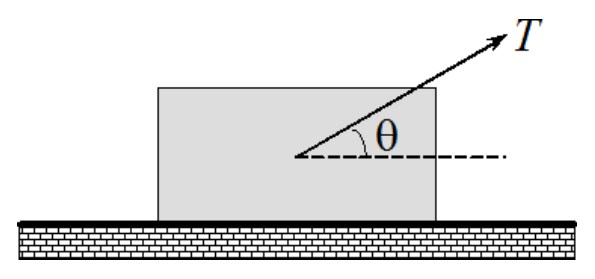
The coefficient of friction between the block and the floor is denoted by . The magnitude of the frictional force exerted on the block by the floor is given by
- (A)
- (B)
- (C)
- (D)
- (E)
Fonte: Testo (PDF) — p.5 Topic: Newtonian Mechanics Metodi: Free-Body Diagram, Vector Decomposition Competenze: Physical Reasoning Objects: Block
Un blocco di massa viene trascinato lungo il pavimento da una forza inclinata ad un angolo come mostrato nel diagramma. La grandezza della forza è tale che il blocco si muova con velocità uniforme.
Il coefficiente di attrito tra il blocco e il pavimento è indicato da . La forza di attrito esercitata sul blocco dal pavimento è data da:
- (A)
- (B)
- (C)
- (D)
- (E)
Fonte: Testo (PDF) — p.5 Topic: Newtonian Mechanics Metodi: Free-Body Diagram, Vector Decomposition Competenze: Physical Reasoning Objects: Block
A bullet is shot into a block, at rest on a frictionless horizontal surface. The bullet remains lodged in the block. The block moves toward a spring and compresses it by . The force constant of the spring is . The initial speed of the bullet is closest to
- (A) .
- (B) .
- (C) .
- (D) .
- (E) .
Fonte: Testo (PDF) — p.5 Topic: Conservation of Momentum Metodi: Conservation of Momentum, Energy Conservation Method Competenze: Physical Reasoning Objects: Block, Spring, Projectile
Un proiettile viene colpito in un blocco , a riposo su una superficie orizzontale senza attrito. Il proiettile rimane bloccato nel blocco. Il blocco si sposta verso una sorgente e la compresse di . La costante di forza della molla è . La velocità iniziale della pallottola è la più vicina a
- (A) .
- (B) .
- (C) .
- (D) .
- (E) .
Fonte: Testo (PDF) — p.5 Topic: Conservation of Momentum Metodi: Conservation of Momentum, Energy Conservation Method Competenze: Physical Reasoning Objects: Block, Spring, Projectile
In the diagram shown below, balls A and B (of mass and respectively) hanging on strings of the same length are touching each other when they are at their equilibrium positions. Ball A is then slightly pulled to the left and released. Which of the following statements are correct after the first collision?
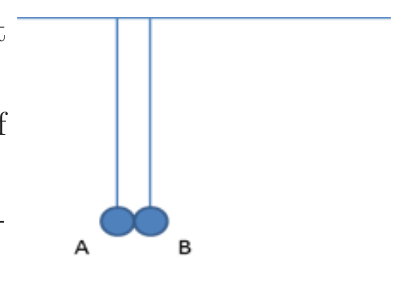
- (A) If , the next collision will be to the right of the equilibrium position.
- (B) If , the next collision will be to the right of the equilibrium position.
- (C) If , the next collision will be to the left of the equilibrium position.
- (D) The next collision will be at the equilibrium position.
- (E) There is not enough information in the question to determine any of the above statements.
Fonte: Testo (PDF) — p.5 Topic: Conservation of Momentum Metodi: Conservation of Momentum Competenze: Physical Reasoning Objects: Pendulum, Ball
Nel diagramma riportato di seguito, le palle A e B (di massa e rispettivamente) appese a stringhe della stessa lunghezza si toccano quando sono in posizione di equilibrio. La palla A viene poi leggermente tirata a sinistra e rilasciata. Quali delle seguenti affermazioni sono corrette dopo la prima collisione?
- **(A) ** Se , la prossima collisione sarà a destra della posizione di equilibrio.
- **(B) ** Se , la prossima collisione sarà a destra della posizione di equilibrio.
- **(C) ** Se , la prossima collisione sarà a sinistra della posizione di equilibrio.
- **(D) ** La prossima collisione sarà nella posizione di equilibrio.
- **(E) ** Non ci sono informazioni sufficienti nella domanda per determinare nessuna delle affermazioni di cui sopra.
Fonte: Testo (PDF) — p.5 Topic: Conservation of Momentum Metodi: Conservation of Momentum Competenze: Physical Reasoning Objects: Pendulum, Ball
Two identical masses are hung on strings of the same length. One mass is released from a height above its free-hanging position and strikes the second mass; the two stick together and move off. They rise to height given by
- (A) .
- (B) .
- (C) .
- (D) .
- (E) None of the above.
Fonte: Testo (PDF) — p.6 Topic: Conservation of Momentum Metodi: Conservation of Momentum, Energy Conservation Method Competenze: Physical Reasoning Objects: Pendulum
Due masse identiche sono appese a corde della stessa lunghezza. Una massa viene rilasciata da un’altezza sopra la sua posizione di libera sospensione e colpisce la seconda massa; le due si attaccano e si allontanano. Si elevano a un’altezza data da
- (A) .
- (B) .
- (C) .
- (D) .
- **(E) ** Nessuna delle seguenti.
Fonte: Testo (PDF) — p.6 Topic: Conservation of Momentum Metodi: Conservation of Momentum, Energy Conservation Method Competenze: Physical Reasoning Objects: Pendulum
A tennis ball bounces on the floor three times. If each time it loses of its energy due to heating, how high does it bounce after the third time, given that we released it from the floor?
- (A)
- (B)
- (C)
- (D)
- (E)
Fonte: Testo (PDF) — p.6 Topic: Conservation of Energy Metodi: Energy Conservation Method Competenze: Physical Reasoning Objects: Ball
Una palla da tennis rimbalza sul pavimento tre volte. Se ogni volta perde della sua energia a causa del riscaldamento, quanto alta rimbalza dopo la terza volta, dato che l’abbiamo rilasciato dal pavimento?
- (A)
- (B)
- (C)
- (D)
- (E)
Fonte: Testo (PDF) — p.6 Topic: Conservation of Energy Metodi: Energy Conservation Method Competenze: Physical Reasoning Objects: Ball
Two springs, and , have negligible masses and the spring constant of is that of . When a block is hung from the springs as shown below and the springs come to equilibrium again, the ratio of the work done in stretching to the work done in stretching is
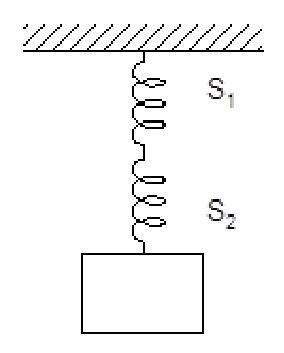
- (A)
- (B)
- (C)
- (D)
- (E)
Fonte: Testo (PDF) — p.6 Topic: Elasticity & Materials Metodi: Hooke’s Law, Energy Conservation Method Competenze: Physical Reasoning Objects: Spring, Block
Due sorgenti, e , hanno masse trascurabili e la costante sorgente di è di . Quando un blocco viene appeso alle sorgenti come mostrato di seguito e le sorgenti rientrano in equilibrio, il rapporto tra il lavoro svolto all’estensione e il lavoro svolto all’estensione è
- (A)
- (B)
- (C)
- (D)
- (E)
Fonte: Testo (PDF) — p.6 Topic: Elasticity & Materials Metodi: Hooke’s Law, Energy Conservation Method Competenze: Physical Reasoning Objects: Spring, Block
Under which of the following conditions can a ladder standing on a frictionless horizontal floor and leaning against a rough vertical wall be in equilibrium?
- (A) The normal force exerted by the floor on the ladder equals the normal force the wall exerts on the ladder.
- (B) The weight of the ladder is equal in magnitude to the frictional force the wall exerts on the ladder.
- (C) The normal force exerted by the floor on the ladder equals the weight of the ladder.
- (D) The normal force exerted by the floor on the ladder equals the frictional force the wall exerts on the ladder.
- (E) A ladder in this situation cannot be in equilibrium.
Fonte: Testo (PDF) — p.7 Topic: Rigid Body Statics Metodi: Free-Body Diagram, Torque & Angular Momentum Analysis Competenze: Physical Reasoning Objects: Rod
In quali delle seguenti condizioni può essere in equilibrio una scala che si trova su un pavimento orizzontale senza attrito e che si appoggia a un muro verticale rugoso?
- **(A) ** La forza normale esercitata dal pavimento sulla scala è uguale alla forza normale esercitata dal muro sulla scala.
- **(B) ** Il peso della scala è uguale in magnitudine alla forza di attrito esercitata dalla parete sulla scala.
- **(C) ** La forza normale esercitata dal pavimento sulla scala è uguale al peso della scala.
- **(D) ** La forza normale esercitata dal pavimento sulla scala è uguale alla forza di attrito esercitata dal muro sulla scala.
- **(E) ** Una scala in questa situazione non può essere in equilibrio.
Fonte: Testo (PDF) — p.7 Topic: Rigid Body Statics Metodi: Free-Body Diagram, Torque & Angular Momentum Analysis Competenze: Physical Reasoning Objects: Rod
A beaker of base contains water to a certain depth. A small block of dimensions is being placed into the beaker. The rise in the water level is . The density of the block is
- (A) that of water
- (B) that of water
- (C) that of water
- (D) that of water
- (E) that of water
Fonte: Testo (PDF) — p.7 Topic: Fluid Mechanics Metodi: Hydrostatic Equilibrium Competenze: Physical Reasoning Objects: Container, Block
Un bicchiere di base contiene acqua a una certa profondità. Un piccolo blocco di dimensioni viene inserito nel bicchiere. L’aumento del livello dell’acqua è . La densità del blocco è
- **(A) ** quella dell’acqua
- **(B) ** quella dell’acqua
- **(C) ** quella dell’acqua
- **(D) ** quella dell’acqua
- **(E) ** quella dell’acqua
Fonte: Testo (PDF) — p.7 Topic: Fluid Mechanics Metodi: Hydrostatic Equilibrium Competenze: Physical Reasoning Objects: Container, Block
Lithium vapour which is produced by heating lithium to the relatively low boiling point of forms a gas of molecules. Each molecule has a molecular mass of . The molecules in nitrogen gas () have a molecular mass of . If the and gases are at the same temperature, which of the following is true?
- (A) of of
- (B) of of
- (C) of of
- (D) of of
- (E) of of
Fonte: Testo (PDF) — p.7 Topic: Kinetic Theory Metodi: Kinetic Theory of Gases Competenze: Physical Reasoning Objects: Gas
Il vapore di litio prodotto mediante il riscaldamento del litio al punto di ebollizione relativamente basso di forma un gas di molecole . Ogni molecola ha una massa molecolare di . Le molecole del gas azoto () hanno una massa molecolare di . Se i gas e sono alla stessa temperatura, quale dei seguenti è vero?
- (A) of of
- (B) of of
- (C) of of
- (D) of of
- (E) of of
Fonte: Testo (PDF) — p.7 Topic: Kinetic Theory Metodi: Kinetic Theory of Gases Competenze: Physical Reasoning Objects: Gas
A sample of a monatomic ideal gas is taken through the cycle shown in figure below. At point a, the pressure, volume, and temperature are , , and respectively. ( for monatomic gas)
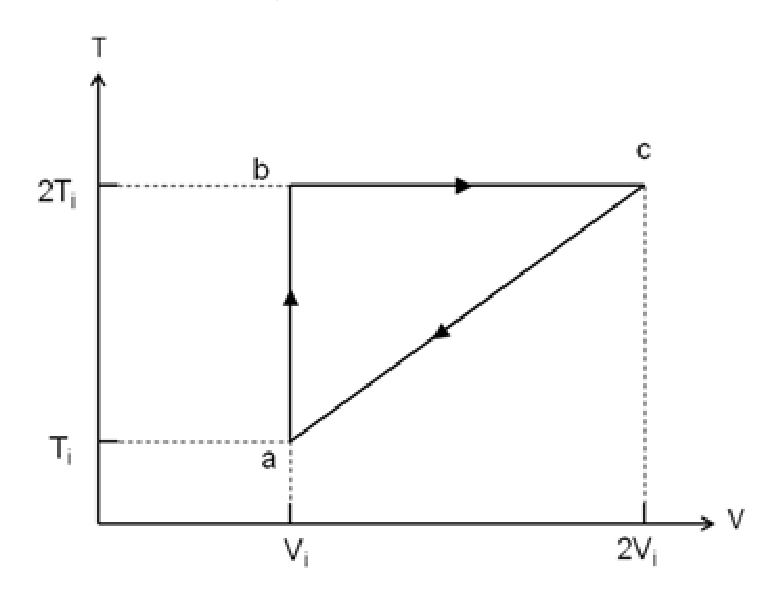
Which of the following about the processes ab, bc, ca is true?
- (A) Isobaric, isothermal, adiabatic
- (B) Isochoric, isobaric, isothermal
- (C) Isothermal, adiabatic, isobaric
- (D) Isochoric, isothermal, isobaric
- (E) Isobaric, isochoric, isothermal
Fonte: Testo (PDF) — p.8 Topic: Thermodynamics Metodi: Thermodynamic Cycle Analysis, Ideal Gas Law Competenze: Physical Reasoning Objects: Gas
Un campione di gas ideale monatomo viene prelevato nel ciclo mostrato nella figura seguente. Al punto a, la pressione, il volume e la temperatura sono rispettivamente , e . ( per il gas monatomo)
Quale dei seguenti processi ab, bc, ca è vero?
- **(A) ** Isobarico, isotermo, adiabatico
- **(B) ** Isocorico, isobarico, isotermo
- **(C) ** Isotermici, adiabatici, isobarici
- **(D) ** Isocorico, isotermo, isobarico
- **(E) ** Isobarico, isocorico, isotermo
Fonte: Testo (PDF) — p.8 Topic: Thermodynamics Metodi: Thermodynamic Cycle Analysis, Ideal Gas Law Competenze: Physical Reasoning Objects: Gas
For the sample in the previous question, what is the net heat input into the gas during the cycle?
- (A)
- (B)
- (C)
- (D)
- (E)
Fonte: Testo (PDF) — p.8 Topic: Thermodynamics Metodi: First Law of Thermodynamics, Thermodynamic Cycle Analysis Competenze: Physical Reasoning Objects: Gas
Per il campione della domanda precedente, quale è l’input di calore net nel gas durante il ciclo?
- (A)
- (B)
- (C)
- (D)
- (E)
Fonte: Testo (PDF) — p.8 Topic: Thermodynamics Metodi: First Law of Thermodynamics, Thermodynamic Cycle Analysis Competenze: Physical Reasoning Objects: Gas
Heat is added at a constant rate to a sample of pure substance that is initially a solid at temperature . The temperature of the sample as a function of time is shown in the graph below.
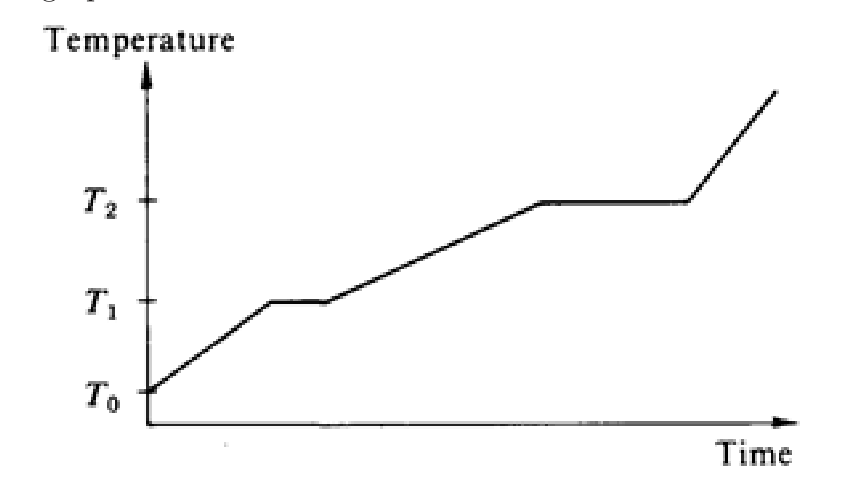
From the graph, one can conclude that the
- (A) substance sublimes directly from the solid phase to the vapor phase.
- (B) melting point is .
- (C) specific heat is greater for the liquid phase than for the solid phase.
- (D) heat of fusion and heat of vaporization are equal.
- (E) specific heat of the solid increases linearly with temperature.
Fonte: Testo (PDF) — p.9 Topic: Thermodynamics Metodi: Physical Modeling Competenze: Physical Reasoning Objects: —
Il calore viene aggiunto a velocità costante a un campione di sostanza pura che è inizialmente solida a temperatura . La temperatura del campione in funzione del tempo è indicata nel grafico seguente.
Dal grafico si può concludere che il
- **(A) ** sublimes direttamente dalla fase solida alla fase vapore.
- **(B) ** punto di fusione è .
- **(C) ** il calore specifico è maggiore per la fase liquida rispetto alla fase solida.
- ** D) ** il calore di fusione e il calore di vaporizzazione sono uguali.
- **(E) ** il calore specifico del solido aumenta linearmente con la temperatura.
Fonte: Testo (PDF) — p.9 Topic: Thermodynamics Metodi: Physical Modeling Competenze: Physical Reasoning Objects: —
Two completely identical samples of the same ideal gas are in equal volume containers with the same pressure and temperature in containers labeled A and B. The gas in container A performs non-zero work on the surroundings during an isobaric (constant pressure) process before the pressure is reduced isochorically (constant volume) to half its initial amount. The gas in container B has its pressure reduced isochorically (constant volume) to half its initial value and then the gas performs the same amount of work on the surroundings during an isobaric (constant pressure) process. After the processes are performed on the gases in containers A and B, which is at the higher temperature?
- (A) The gas in container A
- (B) The gas in container B
- (C) The gases have equal temperature
- (D) The value of the work is necessary to answer this question.
- (E) The value of the work is necessary, along with both the initial pressure and volume, in order to answer the question.
Fonte: Testo (PDF) — p.9 Topic: Thermodynamics Metodi: Ideal Gas Law, First Law of Thermodynamics Competenze: Physical Reasoning Objects: Gas, Container
Due campioni del gas ideale completamente identici sono contenuti in contenitori di uguale volume con la stessa pressione e temperatura in contenitori con la etichetta A e B. Il gas contenuto nel contenitore A svolge un lavoro non zero sull’ambiente circostante durante un processo isobarico (pressione costante) prima che la pressione sia ridotta isocoricamente (volume costante) alla metà della sua quantità iniziale. Il gas contenuto nel contenitore B ha la sua pressione ridotta isocoricamente (volume costante) alla metà del suo valore iniziale e quindi il gas svolge la stessa quantità di lavoro sul suo ambiente durante un processo isobarico (pressione costante). Dopo che i processi sono eseguiti sui gas nei contenitori A e B, che è alla temperatura più alta?
- **(A) ** Il gas contenuto nel contenitore A
- **(B) ** Il gas contenuto nel contenitore B
- **(C) ** I gas hanno la stessa temperatura
- **(D) ** Il valore del lavoro è necessario per rispondere a questa domanda.
- **(E) ** Per rispondere alla domanda è necessario il valore del lavoro , insieme alla pressione iniziale e al volume.
Fonte: Testo (PDF) — p.9 Topic: Thermodynamics Metodi: Ideal Gas Law, First Law of Thermodynamics Competenze: Physical Reasoning Objects: Gas, Container
For each breath that you take, approximately how many of the air molecules in this breath would also have been breathed by Albert Einstein during his lifetime (1879 – 1955)? The atmosphere is about thick and the density of air is about . The Earth’s radius is . You may also assume that the air consists mainly of nitrogen with molar mass of . Make reasonable assumptions for any other data that you may need!
- (A)
- (B)
- (C)
- (D)
- (E) Zero, or very little chance to breath in one such molecule.
Fonte: Testo (PDF) — p.10 Topic: Order-of-Magnitude Estimation Metodi: Order-of-Magnitude Estimation Competenze: Physical Reasoning Objects: —
Per ogni respiro che si respira, quante molecole di aria in questo respiro sarebbero state respire anche Albert Einstein durante la sua vita (1879 1955)? L’atmosfera è di circa spessore e la densità dell’aria è di circa . Il raggio di radius della Terra è . Si può anche supporre che l’aria sia costituita principalmente da azoto con massa molare di . Fate ipotesi ragionevoli per qualsiasi altro dato di cui possiate avere bisogno!
- (A)
- (B)
- (C)
- (D)
- **(E) ** Zero, o pochissima possibilità di respirare una di tali molecole.
Fonte: Testo (PDF) — p.10 Topic: Order-of-Magnitude Estimation Metodi: Order-of-Magnitude Estimation Competenze: Physical Reasoning Objects: —
The figure below shows a stretched string of length and closed-pipes P, Q, R, S are of lengths , , , and respectively. The string’s tension is adjusted until the speed of waves on the string equals the speed of sound waves in the air. The fundamental mode of oscillation is then set up on the string and the string is brought near each of the pipes.
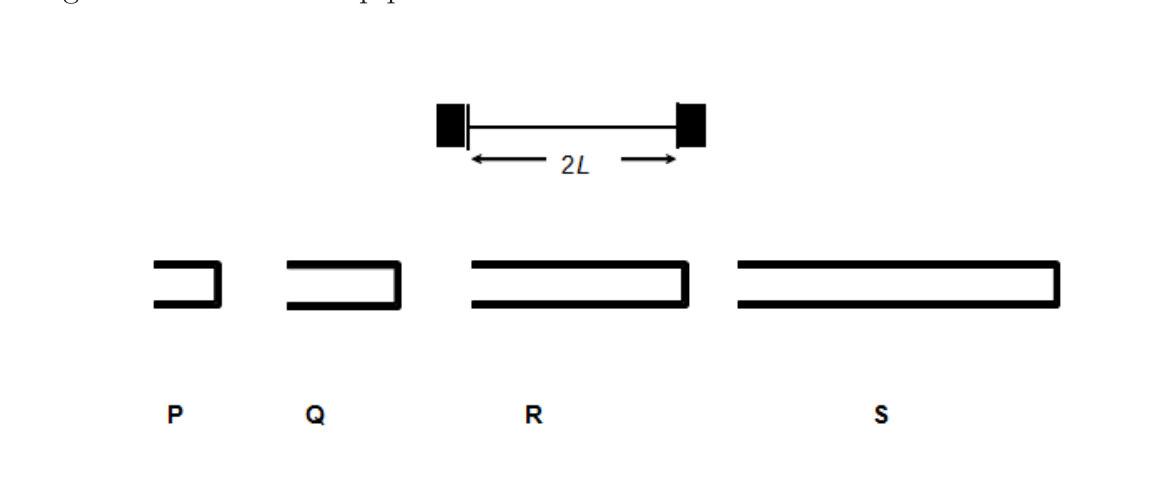
Which of the above pipe(s) is/are most likely to resonate when the string is placed near the pipes?
- (A) P only
- (B) Q only
- (C) P and R only
- (D) Q and S only
- (E) Q, R and S only
Fonte: Testo (PDF) — p.10 Topic: Oscillations & Waves Metodi: Wave Equation Competenze: Physical Reasoning Objects: String, Tube
La figura seguente mostra una stringa estesa di lunghezza e i tubi chiusi P, Q, R, S sono di lunghezza , , e rispettivamente. La tensione della corda viene regolata fino a quando la velocità delle onde sulla corda è uguale alla velocità delle onde sonore nell’aria. La modalità fondamentale di oscillazione viene quindi impostata sulla corda e la corda viene avvicinata a ciascun tubo.
Quale dei tubi sopra indicati risonerà più probabilmente quando la corda viene posta vicino ai tubi?
- **(A) ** P solo
- **(B) ** Q solo
- **(C) ** Solo P e R
- **(D) ** Solo Q e S
- **(E) ** solo Q, R e S
Fonte: Testo (PDF) — p.10 Topic: Oscillations & Waves Metodi: Wave Equation Competenze: Physical Reasoning Objects: String, Tube
A transverse wave is propagated in a string stretched along the -axis. The equation of the wave, in SI units, is given by:
The amplitude of the wave is
- (A)
- (B)
- (C)
- (D)
- (E)
Fonte: Testo (PDF) — p.11 Topic: Oscillations & Waves Metodi: Wave Equation Competenze: Physical Reasoning Objects: String
Un’onda trasversale si propaga in una corda allungata lungo l’asse . L’equazione dell’onda, in unità SI, è data da:
L’ampiezza dell’onda è
- (A)
- (B)
- (C)
- (D)
- (E)
Fonte: Testo (PDF) — p.11 Topic: Oscillations & Waves Metodi: Wave Equation Competenze: Physical Reasoning Objects: String
For the wave in the previous question, its frequency is closest to
- (A)
- (B)
- (C)
- (D)
- (E)
Fonte: Testo (PDF) — p.11 Topic: Oscillations & Waves Metodi: Wave Equation Competenze: Physical Reasoning Objects: —
Per l’onda nella domanda precedente, la sua frequenza è più vicina a
- (A)
- (B)
- (C)
- (D)
- (E)
Fonte: Testo (PDF) — p.11 Topic: Oscillations & Waves Metodi: Wave Equation Competenze: Physical Reasoning Objects: —
Two identical small conducting spheres are separated by . The spheres carry different amounts of charge and each sphere experiences an attractive electric force of . The total charge on the two spheres is . The two spheres are connected by a slender conducting wire, which is then removed. The electric force on each sphere is closest to:
- (A) Zero
- (B) , repulsive
- (C) , attractive
- (D) , repulsive
- (E) , attractive
Fonte: Testo (PDF) — p.11 Topic: Electrostatics Metodi: Coulomb’s Law Competenze: Physical Reasoning Objects: Conducting Sphere, Wire
Due piccole sfere di conduttore identiche sono separate da . Le sfere portano diverse quantità di carica e ciascuna sfera sperimenta una forza elettrica attraente di . La carica totale sulle due sfere è . Le due sfere sono collegate da un filo di conduttore sottile, che viene poi rimosso. La forza elettrica su ciascuna sfera è più vicina a:
- **(A) ** Zero
- **(B) ** , respingente
- **(C) ** , attraente
- **(D) ** , respingente
- **(E) ** , attraente
Fonte: Testo (PDF) — p.11 Topic: Electrostatics Metodi: Coulomb’s Law Competenze: Physical Reasoning Objects: Conducting Sphere, Wire
The diagram below shows equipotential lines produced by an unknown charge distribution. A, B, C, D and E are points in the plane. At which point does the electric field have the greatest magnitude?
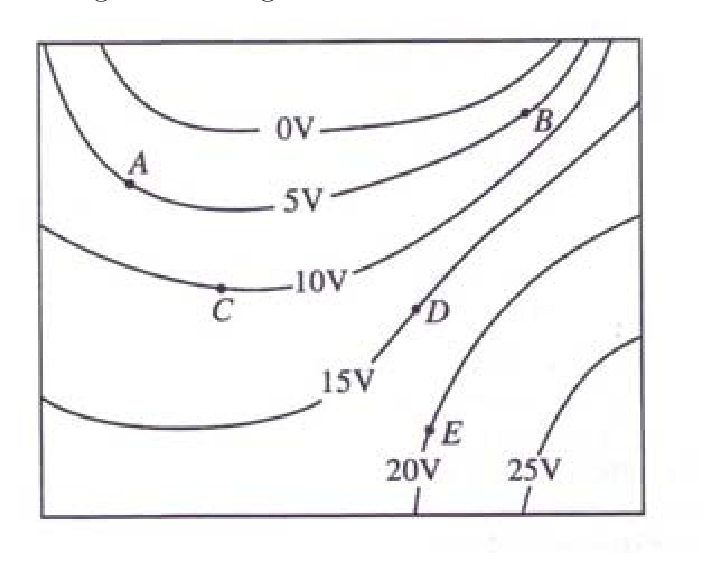
- (A) Point A
- (B) Point B
- (C) Point C
- (D) Point D
- (E) Point E
Fonte: Testo (PDF) — p.12 Topic: Electrostatics Metodi: Electric Potential Method Competenze: Physical Reasoning Objects: —
Il diagramma di seguito mostra le linee equipotenziali prodotte da una distribuzione di cariche sconosciuta. A, B, C, D ed E sono punti del piano. A quale punto il campo elettrico ha la maggiore magnitudine?
- **(A) ** punto A
- **(B) ** punto B
- **(C) ** punto C
- **(D) ** punto D
- **(E) ** punto E
Fonte: Testo (PDF) — p.12 Topic: Electrostatics Metodi: Electric Potential Method Competenze: Physical Reasoning Objects: —
The surface of a thin-walled cubic insulating (nonconducting) box is given a uniformly distributed positive surface charge. Which one of the following can be inferred about the electric field everywhere inside the insulating box due to this surface charge using Gauss’s law?
- (A) Its magnitude everywhere inside must be zero.
- (B) Its magnitude everywhere inside must be nonzero but uniform (the same).
- (C) Its direction everywhere inside must be radially outward from the center of the box.
- (D) Its direction everywhere inside must be perpendicular to one of the sides.
- (E) None of the above.
Fonte: Testo (PDF) — p.12 Topic: Electrostatics Metodi: Gauss’s Law, Symmetry Argument Competenze: Physical Reasoning Objects: —
La superficie di una scatola di isolamento cubo a pareti sottili (non conduttrice) ha una carica di superficie positiva uniformemente distribuita. Quale di queste cose può essere dedotto sul campo elettrico ovunque all’interno della scatola isolante a causa di questa carica superficiale utilizzando la legge di Gauss?
- **(A) ** La sua magnitudine dovunque dentro deve essere zero.
- **(B) ** La sua magnitudine dovunque all’interno deve essere non zero ma uniforme (lo stesso).
- **(C) ** La sua direzione dovunque all’interno deve essere radialmente verso l’esterno dal centro della scatola.
- **(D) ** La sua direzione dovunque all’interno deve essere perpendicolare a uno dei lati.
- **(E) ** Nessuna delle seguenti.
Fonte: Testo (PDF) — p.12 Topic: Electrostatics Metodi: Gauss’s Law, Symmetry Argument Competenze: Physical Reasoning Objects: —
One end of a Nichrome wire of length and cross-sectional area is attached to an end of another Nichrome wire of length and cross-sectional area . If the free end of the longer wire is at an electric potential of , and the free end of the shorter wire is at an electric potential of , the potential at the junction of the two wires is most nearly equal to
- (A)
- (B)
- (C)
- (D)
- (E)
Fonte: Testo (PDF) — p.12 Topic: Circuits Metodi: Equivalent Circuit Reduction Competenze: Physical Reasoning Objects: Wire
Un’estremità di un filo di nicromo di lunghezza e di superficie trasversale è attaccata ad un’altra estremità di un filo di nicromo di lunghezza e di superficie trasversale . Se l’estremità libera del filo più lungo è a un potenziale elettrico di , e l’estremità libera del filo più breve è a un potenziale elettrico di , il potenziale al giunzione dei due fili è quasi uguale a
- (A)
- (B)
- (C)
- (D)
- (E)
Fonte: Testo (PDF) — p.12 Topic: Circuits Metodi: Equivalent Circuit Reduction Competenze: Physical Reasoning Objects: Wire
The figure below shows the electric field lines in a region. Sadly, you do not know the charge inside the three regions marked (i), (ii), and (iii).
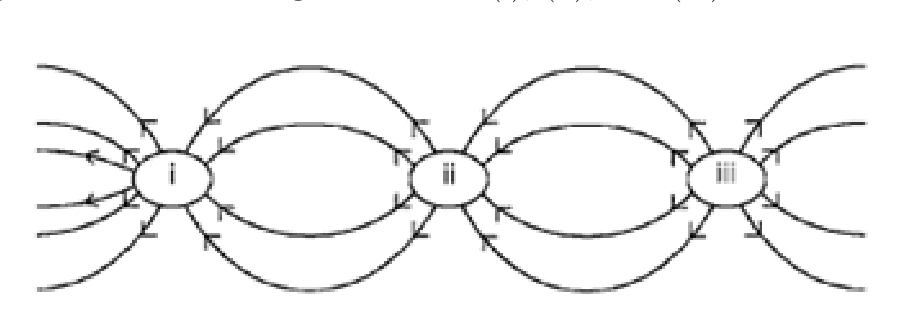
The above cross-sectional drawing is qualitatively correct. Which region (or regions) carries a net charge of the greatest magnitude?
- (A) (i) only
- (B) (ii) only
- (C) (iii) only
- (D) (ii) and (iii), which have equal net charge
- (E) (i), (ii) and (iii), which have equal net charge
Fonte: Testo (PDF) — p.13 Topic: Electrostatics Metodi: Gauss’s Law Competenze: Physical Reasoning Objects: —
La figura seguente mostra le linee di campo elettrico in una regione. Purtroppo non si conosce la carica all’interno delle tre regioni segnate (i), (ii) e (iii).
Il disegno trasversale di cui sopra è qualitativamente corretto. Quale regione (o regioni) ha la carica netta di maggiore ampiezza?
- solo **(A) ** (i)
- **(B) ** (ii) solo
- solo **(C) ** (iii)
- **(D) ** (ii) e (iii), che hanno uguale carica netta
- **(E) ** (i), (ii) e (iii), che hanno uguali carichi netti
Fonte: Testo (PDF) — p.13 Topic: Electrostatics Metodi: Gauss’s Law Competenze: Physical Reasoning Objects: —
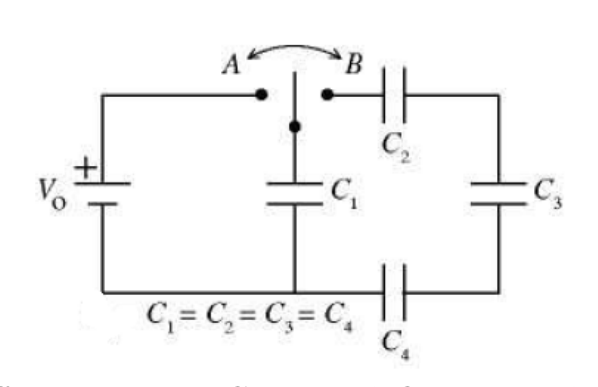
The four identical capacitors in the circuit shown below are initially uncharged. The switch is then thrown first to position A, and then to position B. After this is done:
- (A)
- (B)
- (C)
- (D)
- (E)
Note: are the potential differences across and are the final charges stored in respectively.
Fonte: Testo (PDF) — p.13 Topic: Circuits Metodi: Equivalent Circuit Reduction, Conservation Laws Competenze: Physical Reasoning Objects: Capacitor, Switch
I quattro condensatori identici del circuito illustrato di seguito sono inizialmente scaricati. Il switch viene poi gettato prima alla posizione A e poi alla posizione B. Dopo che questo è stato fatto:
- (A)
- (B)
- (C)
- (D)
- (E)
Nota: sono le differenze potenziali tra e sono le cariche finali memorizzate rispettivamente in .
Fonte: Testo (PDF) — p.13 Topic: Circuits Metodi: Equivalent Circuit Reduction, Conservation Laws Competenze: Physical Reasoning Objects: Capacitor, Switch
A long, thin, vertical wire has a net positive charge per unit length. In addition, there is a current in the wire. A charged particle moves with speed in a straight-line trajectory, parallel to the wire and at a distance from the wire. Assume that the only forces on the particle are those that result from the charge on and the current in the wire and that is much less than , the speed of light.
Suppose that the current in the wire is reduced to . Which of the following changes, made simultaneously with the change in the current, is necessary if the same particle is to remain in the same trajectory at the same distance from the wire?
- (A) Doubling the charge per unit length on the wire only
- (B) Doubling the charge on the particle only
- (C) Doubling both the charge per unit length on the wire and the charge on the particle
- (D) Doubling the speed of the particle
- (E) Introducing an additional magnetic field parallel to the wire
Fonte: Testo (PDF) — p.14 Topic: Magnetism Metodi: Lorentz Force Analysis, Biot-Savart Law Competenze: Physical Reasoning Objects: Wire, Point Charge
Un filo lungo, sottile e verticale ha una carica positiva netta per unità di lunghezza. Inoltre, nel filo c’è una corrente . Una particella carica si muove a velocità in una traiettoria rettilinea, parallela al filo e a distanza dal filo. Supponiamo che le uniche forze sulla particella siano quelle derivanti dalla carica e dalla corrente nel filo e che sia molto inferiore a , la velocità della luce.
Supponiamo che la corrente nel filo sia ridotta a . Qual delle seguenti modifiche, effettuate contemporaneamente al cambiamento della corrente, è necessaria se la stessa particella deve rimanere nella stessa traiettoria alla stessa distanza dal filo?
- **(A) ** Doppiamento della carica per unità di lunghezza sul filo solo
- **(B) ** Solo raddoppiando la carica della particella
- **(C) ** Doppiando sia la carica per unità di lunghezza del filo che la carica della particella
- **(D) ** raddoppiando la velocità della particella
- **(E) ** Introducendo un campo magnetico aggiuntivo parallelo al filo
Fonte: Testo (PDF) — p.14 Topic: Magnetism Metodi: Lorentz Force Analysis, Biot-Savart Law Competenze: Physical Reasoning Objects: Wire, Point Charge
Following on the question above, the particle is later observed to move in a straight-line trajectory, parallel to the wire but at a distance from the wire. If the wire carries a current and the charge per unit length is still , the speed of the particle is
- (A)
- (B)
- (C)
- (D)
- (E)
Fonte: Testo (PDF) — p.14 Topic: Magnetism Metodi: Lorentz Force Analysis Competenze: Physical Reasoning Objects: Wire, Point Charge
In seguito alla domanda di cui sopra, la particella viene successivamente osservata a muoversi in una traiettoria rettilinea, parallela al filo ma a una distanza dal filo. Se il filo porta una corrente e la carica per unità di lunghezza è ancora , la velocità della particella è
- (A)
- (B)
- (C)
- (D)
- (E)
Fonte: Testo (PDF) — p.14 Topic: Magnetism Metodi: Lorentz Force Analysis Competenze: Physical Reasoning Objects: Wire, Point Charge
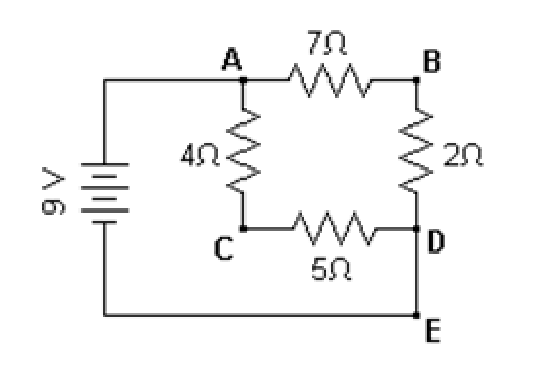
A -volt battery is connected to four resistors to form a simple circuit as shown below. What would be the electric potential at point C with respect to point B in the circuit?
- (A)
- (B)
- (C)
- (D)
- (E)
Fonte: Testo (PDF) — p.14 Topic: Circuits Metodi: Kirchhoff’s Laws Competenze: Physical Reasoning Objects: Battery, Resistor
Una batteria di 10 volt è collegata a quattro resistori per formare un circuito semplice come mostrato di seguito. Qual è il potenziale elettrico del punto C rispetto al punto B del circuito?
- (A)
- (B)
- (C)
- (D)
- (E)
Fonte: Testo (PDF) — p.14 Topic: Circuits Metodi: Kirchhoff’s Laws Competenze: Physical Reasoning Objects: Battery, Resistor
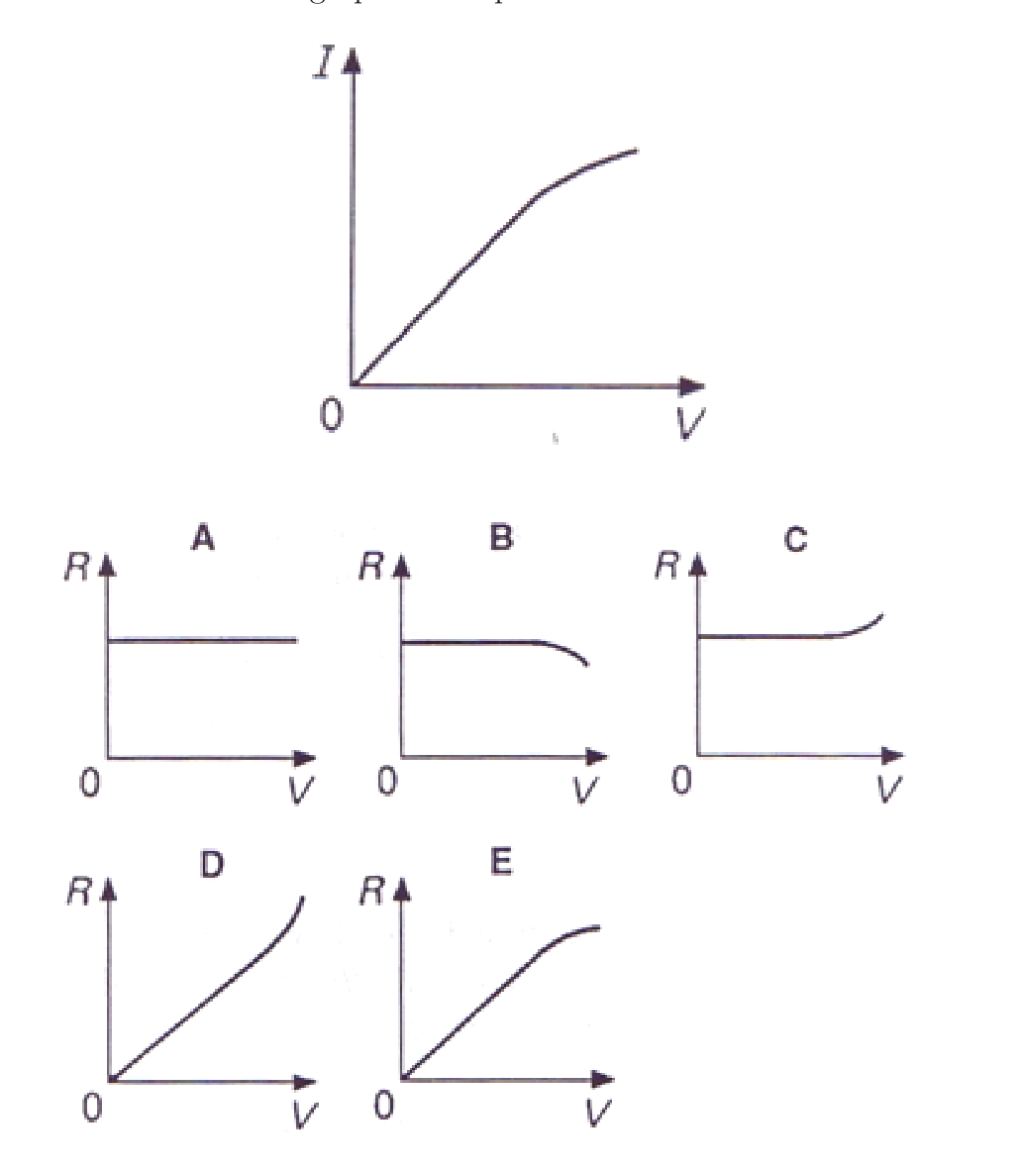
The current flowing through a component varies with the potential difference across it as shown. Which graph best represents how the resistance varies with ?
Fonte: Testo (PDF) — p.15 Topic: Circuits Metodi: Graph Linearization Competenze: Physical Reasoning Objects: —
La corrente che scorre attraverso un componente varia con la differenza potenziale attraverso esso come mostrato. Quale grafico rappresenta meglio come la resistenza varia con ?
Fonte: Testo (PDF) — p.15 Topic: Circuits Metodi: Graph Linearization Competenze: Physical Reasoning Objects: —
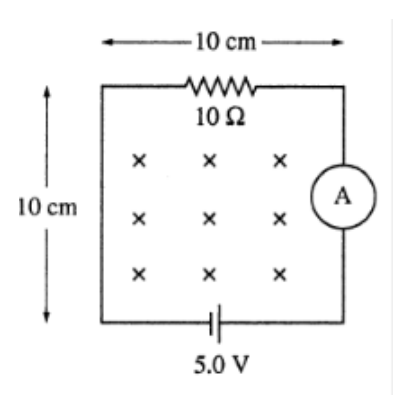
The circuit shown below is in a uniform magnetic field that is into the page and is decreasing in magnitude at the rate of . The magnitude and direction of the current in the loop is given by
- (A) counter-clockwise
- (B) clockwise
- (C) counter-clockwise
- (D) clockwise
- (E) counter clockwise
Fonte: Testo (PDF) — p.15 Topic: Electromagnetic Induction Metodi: Faraday’s Law of Induction, Lenz’s Law Competenze: Physical Reasoning Objects: Wire
Il circuito mostrato di seguito è in un campo magnetico uniforme che si trova nella pagina e si sta riducendo di magnitudo al ritmo di . La grandezza e la direzione della corrente nel ciclo sono indicate da
- **(A) ** in senso contrario all’orologio
- **(B) ** in senso orario
- **(C) ** in senso contrario all’orologio
- **(D) ** in senso orario
- **(E) ** contro il senso orario
Fonte: Testo (PDF) — p.15 Topic: Electromagnetic Induction Metodi: Faraday’s Law of Induction, Lenz’s Law Competenze: Physical Reasoning Objects: Wire
A materials scientist performs an experiment where he attempts to measure the resistance of a material by applying a potential difference across the material and measuring the current passing through the material. The results are displayed in the graph as shown. Which of the following are correct conclusions?
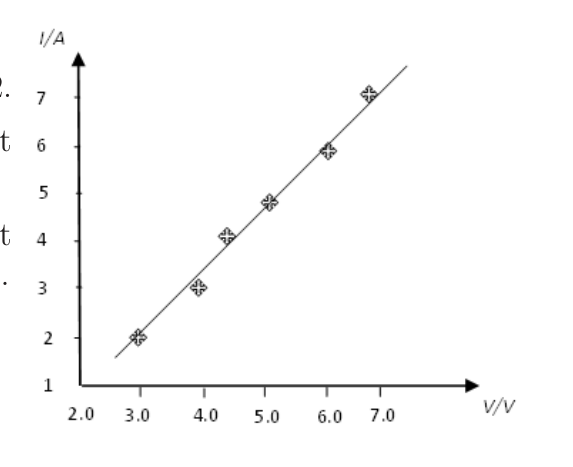
i. The resistance of the material is about . ii. The resistance of the material is about . iii. The resistance of the material is not constant as the potential difference across it changes. iv. The material is an ohmic conductor. v. The material is not an ohmic conductor.
- (A) i and iv
- (B) ii and iv
- (C) i and v
- (D) iii and iv
- (E) iii and v
Fonte: Testo (PDF) — p.16 Topic: Circuits Metodi: Graph Linearization Competenze: Physical Reasoning Objects: —
Un materials scientist esegue un esperimento nel quale cerca di misurare la resistenza di un materiale applicando una differenza potenziale attraverso il materiale e misurando la corrente che passa attraverso il materiale. I risultati sono visualizzati nel grafico. Quali delle seguenti conclusioni sono corrette?
i. La resistenza del materiale è di circa . ii. La resistenza del materiale è di circa . iii. La resistenza del materiale non è costante in quanto la differenza potenziale su tutto cambia. iv. Il materiale è un conduttore ohmico. v. Il materiale non è un conduttore ohmico.
- **(A) ** i e iv
- **(B) ** ii e iv
- **(C) ** i e v
- **(D) ** iii e iv
- **(E) ** iii e v
Fonte: Testo (PDF) — p.16 Topic: Circuits Metodi: Graph Linearization Competenze: Physical Reasoning Objects: —
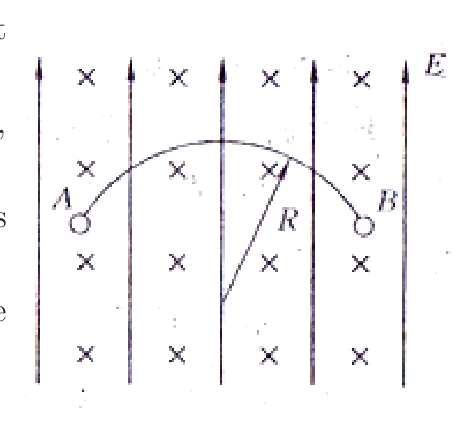
An E-field and a B-field crosses each other as shown in the figure below, with the E-field pointing vertically upward. The E-field is tuned such that the force it exerts on each drop balances the drop’s own weight. Oil Drops A and B both carry charges of the same magnitude and sign and are of the same mass. A is stationary and B moves in a circular path with radius and speed . If A and B are to collide and combine, the final charged drop will
- (A) exhibit linear motion with half the speed that B used to have.
- (B) exhibit uniform circular motion with radius, .
- (C) exhibit uniform circular motion with radius .
- (D) exhibit uniform circular motion with half the period that B used to have.
- (E) None of the above.
Fonte: Testo (PDF) — p.16 Topic: Magnetism Metodi: Lorentz Force Analysis, Conservation of Momentum Competenze: Physical Reasoning Objects: Droplet
Un campo E e un campo B si incrociano, come mostrato nella figura di seguito, con il campo E che punta verticalmente verso l’alto. Il campo E è regolato in modo tale che la forza che esercita su ogni goccia bilanci il peso della goccia. Le gocce di olio A e B portano entrambi cariche della stessa magnitudo e segno e sono della stessa massa. A è stazionario e B si muove in un percorso circolare con raggio e velocità . Se A e B si scontrano e si combinano, l’ultima goccia carica
- **(A) ** mostrano un movimento lineare con la metà della velocità che B aveva prima.
- **(B) ** presentano un movimento circolare uniforme con raggio .
- **(C) ** presentano un movimento circolare uniforme con raggio .
- **(D) ** presentano un movimento circolare uniforme con la metà del periodo che B aveva.
- **(E) ** Nessuna delle seguenti.
Fonte: Testo (PDF) — p.16 Topic: Magnetism Metodi: Lorentz Force Analysis, Conservation of Momentum Competenze: Physical Reasoning Objects: Droplet
As you walk away from a plane mirror on a wall, your image
- (A) gets smaller.
- (B) may or may not get smaller, depending on where the observer is positioned.
- (C) is always a real image, no matter how far you are from the mirror.
- (D) changes from being a virtual image to a real image as you pass the focal point.
- (E) is always the same size.
Fonte: Testo (PDF) — p.17 Topic: Geometric Optics Metodi: Ray Tracing Competenze: Physical Reasoning Objects: Mirror
Mentre cammini lontano da uno specchio aereo su un muro, la tua immagine
- **(A) ** si riduce.
- **(B) ** può ridursi o meno, a seconda della posizione dell’osservatore.
- **(C) ** è sempre un’immagine reale, non importa quanto lontano si sia dallo specchio.
- **(D) ** cambia da essere un’immagine virtuale a un’immagine reale quando si passa il punto focale.
- **(E) ** è sempre la stessa dimensione.
Fonte: Testo (PDF) — p.17 Topic: Geometric Optics Metodi: Ray Tracing Competenze: Physical Reasoning Objects: Mirror
A camera is used to take a photograph of the flat mirror image of an object placed at position X in the diagram shown. On which point should the camera be focused on?
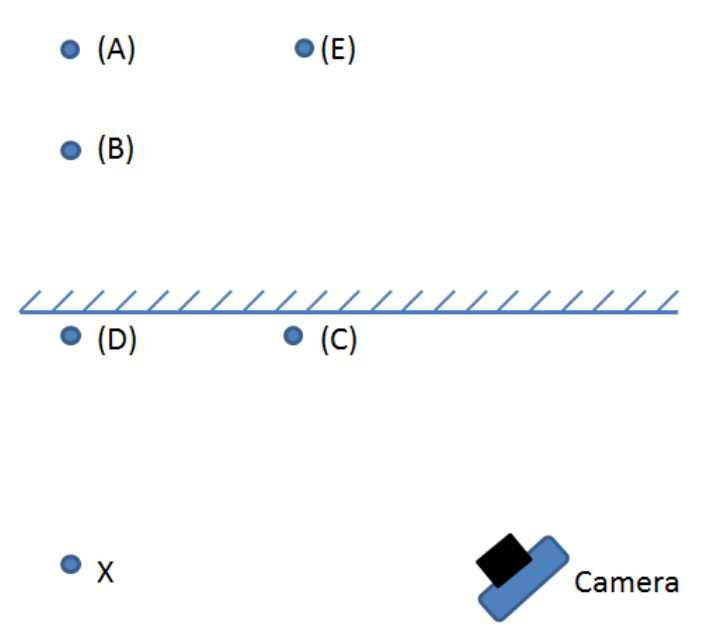
- (A) Point A
- (B) Point B
- (C) Point C
- (D) Point D
- (E) Point E
Fonte: Testo (PDF) — p.17 Topic: Geometric Optics Metodi: Ray Tracing Competenze: Physical Reasoning Objects: Mirror
Una fotocamera viene utilizzata per scattare una fotografia della immagine a specchio piatto di un oggetto posizionato nella posizione X nel diagramma mostrato. Su quale punto dovrebbe concentrarsi la fotocamera?
- **(A) ** punto A
- **(B) ** punto B
- **(C) ** punto C
- **(D) ** punto D
- **(E) ** punto E
Fonte: Testo (PDF) — p.17 Topic: Geometric Optics Metodi: Ray Tracing Competenze: Physical Reasoning Objects: Mirror
Unpolarized light is incident on two ideal polarizers in series. The polarizers are oriented so that no light emerges through the second polarizer. A third polarizer is now inserted between the first two and its orientation direction is continuously rotated through . The maximum fraction of the incident power transmitted through all three polarizers is
- (A) zero
- (B)
- (C)
- (D)
- (E)
Fonte: Testo (PDF) — p.17 Topic: Wave Optics Metodi: Physical Modeling Competenze: Physical Reasoning Objects: —
La luce non polarizzata è un incidente su due polarizzatori ideali in serie. I polarizzatori sono orientati in modo che non emerga luce attraverso il secondo polarizzatore. Ora viene inserito un terzo polarizzatore tra i primi due e la sua direzione di orientamento viene continuamente rotata attraverso . La frazione massima della potenza incidente trasmessa attraverso tutti e tre i polarizzatori è
- **(A) ** zero
- (B)
- (C)
- (D)
- (E)
Fonte: Testo (PDF) — p.17 Topic: Wave Optics Metodi: Physical Modeling Competenze: Physical Reasoning Objects: —
A light bulb is efficient (i.e. of its output is invisible infra-red radiation and only is visible light). A person can see the light with the naked eye from a distance of on a dark night. If the area of the pupil of the person’s eye is , what power of the visible light is received by the eye of the person?
- (A)
- (B)
- (C)
- (D)
- (E)
Fonte: Testo (PDF) — p.18 Topic: Wave Optics Metodi: Physical Modeling Competenze: Physical Reasoning Objects: —
Una lampadina è efficiente (cioè: della sua uscita è radiazione infrarossa invisibile e solo è luce visibile). Una persona può vedere la luce ad occhio nudo da una distanza di in una notte buia. Se l’area della pupilla dell’occhio è , quale potenza della luce visibile riceve l’occhio dell’uomo?
- (A)
- (B)
- (C)
- (D)
- (E)
Fonte: Testo (PDF) — p.18 Topic: Wave Optics Metodi: Physical Modeling Competenze: Physical Reasoning Objects: —
We are given the imaginary situation where scientists have discovered a new phenomenon called ‘haon’. Various observations about haon are listed below.
i. Haon can be reflected. ii. Haon can be refracted. iii. Haon can be diffracted. iv. Interference effects can be produced with haon. v. Haon travels through vacuum at about .
“Haon can be treated as a wave phenomenon but it is not a form of electromagnetic radiation.” Which observations provide the BEST evidence for the statement?
- (A) i, ii and iii
- (B) i and v
- (C) iv and v
- (D) ii and iv
- (E) i, ii and iv
Fonte: Testo (PDF) — p.18 Topic: Oscillations & Waves Metodi: Physical Modeling Competenze: Physical Reasoning Objects: —
Ci viene data la situazione immaginaria in cui gli scienziati hanno scoperto un nuovo fenomeno chiamato “haon”. Diverse osservazioni riguardanti il suo effetto sono elencate di seguito.
i. Haon può essere riflesso. ii. Haon può essere rifraccato. iii. Haon può essere diffratto. iv. Gli effetti di interferenza possono essere prodotti con haon. v. Haon viaggia attraverso il vuoto a circa .
“Il haon può essere trattato come un fenomeno d’onda ma non è una forma di radiazione elettromagnetica”. Quali osservazioni forniscono la migliore prova per questa affermazione?
- **(A) ** i, ii e iii
- **(B) ** i e v
- **(C) ** iv e v
- **(D) ** ii e iv
- **(E) ** i, ii e iv
Fonte: Testo (PDF) — p.18 Topic: Oscillations & Waves Metodi: Physical Modeling Competenze: Physical Reasoning Objects: —
While standing outdoors one evening, you are exposed to the following four types of electromagnetic radiation: yellow light from a sodium street lamp, radio waves from an AM radio station, radio waves from an FM radio station, and microwaves from an antenna of a communications system. Rank these types of waves in terms of increasing photon energy, i.e., lowest energy first.
- (A) sodium light, AM, FM, microwave
- (B) AM, FM, sodium light, microwave
- (C) AM, FM, microwave, sodium light
- (D) microwave, sodium light, AM, FM
- (E) according to quantum physics, they are all of the same energy
Fonte: Testo (PDF) — p.19 Topic: Modern-Quantum Physics Metodi: Photon Energy Relation Competenze: Physical Reasoning Objects: Photon
Mentre si sta all’aperto una sera, si sono esposti ai seguenti quattro tipi di radiazioni elettromagnetiche: luce gialla da una lampada di sodio, onde radio da una stazione radio AM, onde radio da una stazione radio FM e microonde da un’antenna di un sistema di comunicazione. Rendi questi tipi di onde in termini di energia fotonica in aumento, cioè prima di tutto energia più bassa.
- **(A) ** luce di sodio, AM, FM, microonde
- **(B) ** AM, FM, luce di sodio, microonde
- **(C) ** AM, FM, microonde, luce di sodio
- **(D) ** microonde, luce di sodio, AM, FM
- **(E) ** secondo la fisica quantistica, sono tutti della stessa energia
Fonte: Testo (PDF) — p.19 Topic: Modern-Quantum Physics Metodi: Photon Energy Relation Competenze: Physical Reasoning Objects: Photon
A rocket (A) is moving with constant speed relative to the earth. A second rocket (B) overtakes the first rocket with a constant speed of as seen by a bug riding on Rocket A. Which of the following is true about the speed of the rocket B relative to earth?
- (A) Slightly smaller than .
- (B) Exactly .
- (C) Slightly larger than .
- (D) Don’t know, we do not have enough information.
- (E) None of the above.
Fonte: Testo (PDF) — p.19 Topic: Special Relativity Metodi: Lorentz Transformation Competenze: Physical Reasoning Objects: —
Un razzo (A) si muove a velocità costante rispetto alla terra. Un secondo razzo (B) supera il primo razzo con una velocità costante di come visto da un bug che cavalca il razzo A. Quale delle seguenti cose è vera riguardo alla velocità del razzo B rispetto alla Terra?
- **(A) ** leggermente inferiore a .
- **(B) ** Esattamente .
- **(C) ** leggermente più grande di .
- **(D) ** Non so, non abbiamo abbastanza informazioni.
- **(E) ** Nessuna delle seguenti.
Fonte: Testo (PDF) — p.19 Topic: Special Relativity Metodi: Lorentz Transformation Competenze: Physical Reasoning Objects: —
Rocket A is moving with constant speed relative to the earth. Rocket B overtakes the rocket A with a constant speed of (seen by the bug in rocket A). Which of the following is true about the clocks in the rockets with respect to the bug in rocket A?
- (A) Clocks in rocket A will tick at twice the rate of the clocks in rocket B.
- (B) Clocks in rocket A will tick at half the rate of the clocks in rocket B.
- (C) Clocks in rocket A will tick at a rate about one-fifth that of the clocks in rocket B.
- (D) Clocks in rocket A will tick at about the same rate as the clocks in rocket B.
- (E) None of the above.
Fonte: Testo (PDF) — p.19 Topic: Special Relativity Metodi: Lorentz Transformation Competenze: Physical Reasoning Objects: —
Il razzo A si muove a velocità costante rispetto alla terra. Il razzo B supera il razzo A con una velocità costante di (visto dal bug nel razzo A). Quale delle seguenti cose è vero riguardo agli orologi dei razzi rispetto al cimice del razzo A?
- **(A) ** Gli orologi del razzo A ticceranno al doppio delle velocità degli orologi del razzo B.
- **(B) ** Gli orologi del razzo A tendono a fare il doppio ritmo degli orologi del razzo B.
- **(C) ** Gli orologi del razzo A tendono a fare ticchetti a un ritmo di circa un quinto rispetto agli orologi del razzo B.
- **(D) ** Gli orologi del razzo A tendono a fare il ticchetto a circa la stessa velocità degli orologi del razzo B.
- **(E) ** Nessuna delle seguenti.
Fonte: Testo (PDF) — p.19 Topic: Special Relativity Metodi: Lorentz Transformation Competenze: Physical Reasoning Objects: —
Which of the following is a Lorentz transformation?
- (A)
- (B)
- (C)
- (D)
- (E) None of the above
Fonte: Testo (PDF) — p.20 Topic: Special Relativity Metodi: Lorentz Transformation Competenze: Physical Reasoning Objects: —
Quale delle seguenti è una trasformazione di Lorentz?
- (A)
- (B)
- (C)
- (D)
- **(E) ** Nessuna delle seguenti:
Fonte: Testo (PDF) — p.20 Topic: Special Relativity Metodi: Lorentz Transformation Competenze: Physical Reasoning Objects: —
A spaceship utilizes a large sail of highly reflective aluminium foil as an auxiliary propulsion system. If the sail area is and is orientated for maximum efficiency in starlight of intensity and wavelength , the resulting acceleration of the ship of mass would be about
- (A)
- (B)
- (C)
- (D)
- (E)
Fonte: Testo (PDF) — p.20 Topic: Modern-Quantum Physics Metodi: Photon Energy Relation Competenze: Physical Reasoning Objects: Photon
Una nave spaziale utilizza una grande vela di foglia di alluminio altamente riflettente come sistema di propulsione ausiliario. Se la superficie della vela è ed è orientata per ottenere l’efficienza massima alla luce stellare di intensità e lunghezza d’onda , l’accelerazione risultante della nave di massa sarebbe di circa
- (A)
- (B)
- (C)
- (D)
- (E)
Fonte: Testo (PDF) — p.20 Topic: Modern-Quantum Physics Metodi: Photon Energy Relation Competenze: Physical Reasoning Objects: Photon
A beam of alpha particles () is directed at a uranium () target. The radius of a uranium nucleus is . The closest approach between the centres of an alpha particle to a stationary uranium nucleus is . The kinetic energy of the incident alpha particle is closest to
- (A)
- (B)
- (C)
- (D)
- (E)
Fonte: Testo (PDF) — p.20 Topic: Nuclear & Particle Physics Metodi: Electric Potential Method, Energy Conservation Method Competenze: Physical Reasoning Objects: Particle Beam, Nucleus
Un fascio di particelle alfa () è diretto verso un obiettivo di uranio (). Il raggio di un nucleo di uranio è . Il più vicino approccio tra i centri di una particella alfa a un nucleo di uranio stazionario è . L’energia cinetica della particella alfa incidente è la più vicina a
- (A)
- (B)
- (C)
- (D)
- (E)
Fonte: Testo (PDF) — p.20 Topic: Nuclear & Particle Physics Metodi: Electric Potential Method, Energy Conservation Method Competenze: Physical Reasoning Objects: Particle Beam, Nucleus
An important observation that led Bohr to formulate his model of the hydrogen atom was the fact that
- (A) a low density gas emitted a series of sharp spectral lines.
- (B) neutrons formed diffraction patterns when scattered from a nickel crystal.
- (C) electrons were found to have a wave nature.
- (D) the peak of the blackbody radiation moved to shorter wavelength as the temperature was increased.
- (E) the emission of light by an atom does not appear to conserve energy.
Fonte: Testo (PDF) — p.21 Topic: Modern-Quantum Physics Metodi: Bohr Model & Quantization Competenze: Physical Reasoning Objects: Atom
Un’importante osservazione che portò Bohr a formulare il suo modello dell’atomo di idrogeno fu il fatto che
- **(A) ** un gas di bassa densità emetteva una serie di linee spettrali taglienti.
- **(B) ** i neutroni hanno formato modelli di diffrazione quando sono stati sparsi da un cristallo di nichel.
- **(C) ** elettroni sono stati trovati ad avere una natura ondulativa.
- **(D) ** il picco della radiazione del corpo nero si è spostato a lunghezza d’onda più breve con l’aumento della temperatura.
- **(E) ** l’emissione di luce da parte di un atomo non sembra conservare energia.
Fonte: Testo (PDF) — p.21 Topic: Modern-Quantum Physics Metodi: Bohr Model & Quantization Competenze: Physical Reasoning Objects: Atom
X-rays of wavelength scattered from a newly discovered crystalline material are observed to have a first order intensity maximum at an angle measured from the incident direction as shown in the figure below.
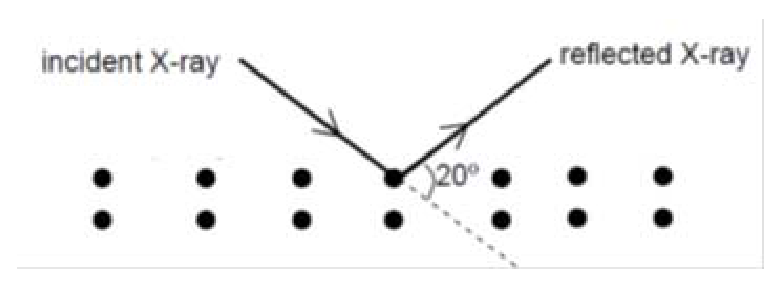
Assuming that the material is made of elemental atoms arranged in a cubic array, what is the number density of atoms in the material?
- (A)
- (B)
- (C)
- (D)
- (E)
Fonte: Testo (PDF) — p.21 Topic: Modern-Quantum Physics Metodi: Interference & Diffraction Analysis Competenze: Physical Reasoning Objects: —
I raggi X di lunghezza d’onda sparsi da un materiale cristallino appena scoperto hanno un massimo di intensità di primo ordine in un angolo misurato dalla direzione di incidenza come mostrato nella figura seguente.
Supponendo che il materiale sia costituito da atomi elementali disposti in una matrice cubica, qual è la densità di numero di atomi nel materiale?
- (A)
- (B)
- (C)
- (D)
- (E)
Fonte: Testo (PDF) — p.21 Topic: Modern-Quantum Physics Metodi: Interference & Diffraction Analysis Competenze: Physical Reasoning Objects: —
A radioactive nucleus with atomic number and atomic mass decays through a series of alpha, beta and gamma emissions to a stable nucleus with and . The number of alpha particles and the number of beta particles emitted during the entire process are
- (A) alpha particles and beta particles.
- (B) alpha particles and beta particles.
- (C) alpha particles and beta particles.
- (D) alpha particles and beta particles.
- (E) alpha particles and beta particles.
Fonte: Testo (PDF) — p.21 Topic: Nuclear & Particle Physics Metodi: Radioactive Decay Law, Conservation Laws Competenze: Physical Reasoning Objects: Nucleus
Un nucleo radioattivo con numero atomico e massa atomica decade attraverso una serie di emissioni alfa, beta e gamma in un nucleo stabile con e . Il numero di particelle alfa e il numero di particelle beta emesse durante l’intero processo sono:
- **(A) ** particelle alfa e particelle beta.
- **(B) ** particelle alfa e particelle beta.
- **(C) ** particelle alfa e particelle beta.
- **(D) ** particelle alfa e particelle beta.
- **(E) ** particelle alfa e particelle beta.
Fonte: Testo (PDF) — p.21 Topic: Nuclear & Particle Physics Metodi: Radioactive Decay Law, Conservation Laws Competenze: Physical Reasoning Objects: Nucleus