A constant force is applied to a body that is already moving. The force is directed at an angle of to the direction of the body’s velocity. What is most likely to happen is that
- (A) the body will stop moving.
- (B) the body will move in the direction of the force.
- (C) the body’s velocity will increase in magnitude but not change direction.
- (D) the body will gradually change direction more and more toward that of the force.
- (E) the body will first stop moving and then move in the direction of the force.
Fonte: Testo (PDF) — p.3 Topic: Newtonian Mechanics Metodi: Vector Decomposition, Free-Body Diagram Competenze: Physical Reasoning Objects: —
Una forza costante viene applicata a un corpo che si muove già. La forza è diretta ad un angolo di verso la direzione della velocità del corpo. Ciò che è più probabile che accada è che
- **(A) ** il corpo smetterà di muoversi.
- **(B) ** il corpo si muoverà nella direzione della forza.
- **(C) ** la velocità del corpo aumenterà in grandezza ma non cambierà direzione.
- **(D) ** il corpo cambierà gradualmente la direzione sempre più verso quella della forza.
- **(E) ** il corpo prima smetterà di muoversi e poi si muoverà nella direzione della forza.
Fonte: Testo (PDF) — p.3 Topic: Newtonian Mechanics Metodi: Vector Decomposition, Free-Body Diagram Competenze: Physical Reasoning Objects: —
A sphere of mass is suspended from two strings of unequal length as shown. The tensions and in the strings must satisfy which of the following relations?
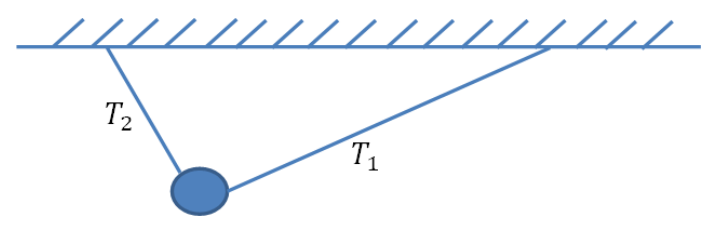 A sphere suspended from a ceiling by two strings of unequal length; the longer string carries tension and the shorter string carries tension .
- (A)
- (B)
- (C)
- (D)
- (E)
Fonte: Testo (PDF) — p.3 Topic: Rigid Body Statics Metodi: Free-Body Diagram, Vector Decomposition Competenze: Physical Reasoning Objects: Sphere, String
Una sfera di massa è sospesa da due stringhe di lunghezza diseguale come mostrato. Le tensioni e delle stringhe devono soddisfare quale delle seguenti relazioni?
Una sfera sospesa da un soffitto da due stringhe di lunghezza diseguale; la corda più lunga porta tensione e la corda più breve porta tensione .
- (A)
- (B)
- (C)
- (D)
- (E)
Fonte: Testo (PDF) — p.3 Topic: Rigid Body Statics Metodi: Free-Body Diagram, Vector Decomposition Competenze: Physical Reasoning Objects: Sphere, String
A car with mass kg starts from rest, driven by an engine with uniform power output of W. Forty seconds later, it is 400 m from the starting point and has a velocity . If the resistance experienced by the car is always 0.1 times of car weight, what is the value of ? Take to be .
- (A) 20 m/s
- (B) 23 m/s
- (C) 57 m/s
- (D) 60 m/s
- (E) 68 m/s
Fonte: Testo (PDF) — p.3 Topic: Conservation of Energy Metodi: Energy Conservation Method, Free-Body Diagram Competenze: Physical Reasoning Objects: —
Un’auto di massa kg parte dal riposo, guidata da un motore con potenza di uscita uniforme di W. Quarant’anni dopo, si trova a 400 m dal punto di partenza e ha una velocità . Se la resistenza della vettura è sempre 0,1 volte il peso della vettura, quale è il valore di ? Prendi per .
- (A) 20 m/s
- (B) 23 m/s
- (C) 57 m/s
- (D) 60 m/s
- (E) 68 m/s
Fonte: Testo (PDF) — p.3 Topic: Conservation of Energy Metodi: Energy Conservation Method, Free-Body Diagram Competenze: Physical Reasoning Objects: —
Raindrops fall vertically down to the ground with a speed of 10 m/s. If we place a hollow cylinder of cross-sectional area , height 10 cm on the ground, the height of water in the cylinder after 30 min is 1 cm. Suppose there is a gust under which the raindrops fall at to the vertical. How long would it take to fill the same cylinder up to the same level?
- (A) more than 30 min
- (B) 30 min
- (C) less than 15 min
- (D) 15 min
- (E) 26 min
Fonte: Testo (PDF) — p.4 Topic: Fluid Mechanics Metodi: Physical Modeling, Continuity Equation Competenze: Physical Reasoning Objects: Droplet, Cylinder
Le gocce di pioggia cadono verticalmente a terra a una velocità di 10 m/s. Se posizioniamo un cilindro vuoto di superficie trasversale , alto 10 cm sul terreno, l’altezza dell’acqua nel cilindro dopo 30 minuti è di 1 cm. Supponiamo che ci sia una frontale sotto la quale le gocce di pioggia cadono a verso la verticale. Quanto tempo ci vorrebbe per riempire lo stesso cilindro fino allo stesso livello?
- **(A) ** più di 30 minuti
- **(B) ** 30 min
- **(C) ** meno di 15 minuti
- **(D) ** 15 min
- **(E) ** 26 min
Fonte: Testo (PDF) — p.4 Topic: Fluid Mechanics Metodi: Physical Modeling, Continuity Equation Competenze: Physical Reasoning Objects: Droplet, Cylinder
A balloon is filled with of helium. How much mass can the balloon lift? The density of helium is that of air, and the density of air is that of water.
- (A) 36 kg
- (B) 145 kg
- (C) 215 kg
- (D) 250 kg
- (E) 415 kg
Fonte: Testo (PDF) — p.4 Topic: Fluid Mechanics Metodi: Hydrostatic Equilibrium Competenze: Physical Reasoning Objects: Gas
Un palloncino è riempito di di elio. Quanto massa può sollevare il palloncino? La densità dell’elio è di quella dell’aria e la densità dell’aria è di quella dell’acqua.
- (A) 36 kg
- (B) 145 kg
- (C) 215 kg
- (D) 250 kg
- (E) 415 kg
Fonte: Testo (PDF) — p.4 Topic: Fluid Mechanics Metodi: Hydrostatic Equilibrium Competenze: Physical Reasoning Objects: Gas
A block of mass is sliding on horizontal surface with a mass-less spring attaching it to a wall on the right. When it moves to the equilibrium position another mass falls and sticks onto it. Oscillation of the combined mass will have
i) smaller amplitude ii) same amplitude iii) larger period iv) same period
- (A) i) and iii)
- (B) i) and iv)
- (C) ii) and iii)
- (D) ii) and iv)
- (E) none of the above
Fonte: Testo (PDF) — p.4 Topic: Oscillations & Waves Metodi: Simple Harmonic Motion Analysis, Conservation of Momentum Competenze: Physical Reasoning Objects: Block, Spring
Un blocco di massa si scivola su superficie orizzontale con una molla di meno massa che lo attacca a una parete sulla destra. Quando si sposta alla posizione di equilibrio, un’altra massa cade e si attacca a essa. L’oscillazione della massa combinata avrà
i) amplitudine minore ii) la stessa amplitudine iii) periodo più lungo iv) lo stesso periodo
- **(A) ** i) e iii)
- **(B) ** i) e iv)
- **(C) ** ii) e iii)
- **(D) ** ii) e iv)
- **(E) ** nessuna delle seguenti:
Fonte: Testo (PDF) — p.4 Topic: Oscillations & Waves Metodi: Simple Harmonic Motion Analysis, Conservation of Momentum Competenze: Physical Reasoning Objects: Block, Spring
It is known that a photon of frequency and wavelength has energy and momentum , with as Planck’s constant. The speed of light, can be expressed as
- (A)
- (B)
- (C)
- (D)
- (E)
Fonte: Testo (PDF) — p.5 Topic: Modern-Quantum Physics Metodi: Photon Energy Relation, de Broglie Relation Competenze: Physical Reasoning Objects: Photon
È noto che un fotone di frequenza e lunghezza d’onda ha energia e impulso , con come costante di Planck. La velocità della luce, può essere espressa come
- (A)
- (B)
- (C)
- (D)
- (E)
Fonte: Testo (PDF) — p.5 Topic: Modern-Quantum Physics Metodi: Photon Energy Relation, de Broglie Relation Competenze: Physical Reasoning Objects: Photon
A nucleus turns into nucleus after an decay, then turns into nucleus after a decay, i.e.
Which of the following relations is not true?
- (A)
- (B)
- (C)
- (D)
- (E) All the above are true.
Fonte: Testo (PDF) — p.5 Topic: Nuclear & Particle Physics Metodi: Radioactive Decay Law, Conservation Laws Competenze: Physical Reasoning Objects: Nucleus
Un nucleo si trasforma in nucleo dopo un decadimento , quindi si trasforma in nucleo dopo un decadimento , cioè
Quale delle seguenti relazioni non è vera?
- (A)
- (B)
- (C)
- (D)
- **(E) ** Tutti i precedenti sono veri.
Fonte: Testo (PDF) — p.5 Topic: Nuclear & Particle Physics Metodi: Radioactive Decay Law, Conservation Laws Competenze: Physical Reasoning Objects: Nucleus
A battery of emf 1.50 V has an internal resistance of . When a wire with circular cross-section of 2 mm in diameter and 250 m long is connected across the terminals of this battery, the current in the circuit is 0.4 A. What is the resistivity of the material from which the wire is made?
- (A)
- (B)
- (C)
- (D)
- (E)
Fonte: Testo (PDF) — p.5 Topic: Circuits Metodi: Kirchhoff’s Laws, Equivalent Circuit Reduction Competenze: Physical Reasoning Objects: Battery, Wire
Una batteria di emf 1,50 V ha una resistenza interna di . Quando un filo con sezione trasversale circolare di 2 mm di diametro e 250 m di lunghezza è collegato attraverso i terminali di questa batteria, la corrente nel circuito è di 0,4 A. Qual è la resistività del materiale di cui è fatto il filo?
- (A)
- (B)
- (C)
- (D)
- (E)
Fonte: Testo (PDF) — p.5 Topic: Circuits Metodi: Kirchhoff’s Laws, Equivalent Circuit Reduction Competenze: Physical Reasoning Objects: Battery, Wire
Equal but opposite charges are placed on the plates of an air-filled parallel-plate capacitor. The plates are then pulled apart to twice their original separation. Which of the following statements about this capacitor are true?
I) The energy stored in the capacitor is doubled. II) The electric field between the plates has increased. III) The potential difference across the plates has doubled. IV) The capacitance has doubled.
- (A) II and IV only
- (B) I and III only
- (C) III and IV only
- (D) I and IV only
- (E) II and III only
Fonte: Testo (PDF) — p.6 Topic: Electrostatics Metodi: Electric Potential Method Competenze: Physical Reasoning Objects: Capacitor
Le cariche uguali ma opposte sono collocate sulle piastre di un condensatore di piastre parallele riempito di aria. Le piastre vengono poi smontate fino a raddoppiare la loro separazione originale. Quali delle seguenti affermazioni riguardanti questo condensatore sono vere?
I) L’energia immagazzinata nel condensatore è raddoppiata. II) Il campo elettrico tra le piastre è aumentato. III) La differenza potenziale tra le piastre è raddoppiata. IV) La capacità è raddoppiata.
- **(A) ** solo II e IV
- **(B) ** I e III solo
- solo **(C) ** III e IV
- **(D) ** I e IV soltanto
- solo **(E) ** II e III
Fonte: Testo (PDF) — p.6 Topic: Electrostatics Metodi: Electric Potential Method Competenze: Physical Reasoning Objects: Capacitor
For the system consisting of the 2 blocks shown in the figure below, a horizontal force is applied so that block does not fall due to its weight. The masses of and are 12.0 kg and 2.0 kg respectively. The horizontal surface is frictionless and the coefficient of static friction between the 2 blocks is 0.45. The minimum magnitude of is
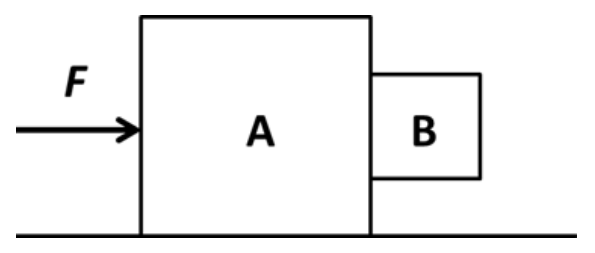 A horizontal force pushes block on a frictionless floor; the smaller block is pressed against the right vertical face of .
- (A)
- (B)
- (C)
- (D)
- (E)
Fonte: Testo (PDF) — p.6 Topic: Newtonian Mechanics Metodi: Free-Body Diagram, Vector Decomposition Competenze: Physical Reasoning Objects: Block
Per il sistema composto dai due blocchi riportati nella figura seguente, si applica una forza orizzontale in modo che il blocco non cadga a causa del suo peso. Le masse di e sono rispettivamente 12,0 kg e 2,0 kg. La superficie orizzontale è senza attrito e il coefficiente di attrito statico tra i due blocchi è di 0,45. La magnitudine minima di è
Una forza orizzontale spinge il blocco su un pavimento senza attrito; il blocco più piccolo viene premuto contro la faccia verticale destra di .
- (A)
- (B)
- (C)
- (D)
- (E)
Fonte: Testo (PDF) — p.6 Topic: Newtonian Mechanics Metodi: Free-Body Diagram, Vector Decomposition Competenze: Physical Reasoning Objects: Block
The pressure of a fixed mass of gas at constant volume is greater at higher temperature because the
- (A) molecules collide with the container walls more frequently.
- (B) number of intermolecular collisions increases.
- (C) molecules travel greater distances between collisions with one another.
- (D) size of each individual molecule increases.
- (E) number of molecules increases.
Fonte: Testo (PDF) — p.6 Topic: Kinetic Theory Metodi: Kinetic Theory of Gases Competenze: Physical Reasoning Objects: Gas, Container
La pressione di una massa fissa di gas a volume costante è maggiore a temperatura più elevata perché la temperatura di
- **(A) ** molecole collidono con le pareti del contenitore più frequentemente.
- **(B) ** aumenta il numero di collisioni intermolecolari.
- **(C) ** molecole viaggiano a più alte distanze tra collisioni tra loro.
- **(D) ** aumenta la dimensione di ciascuna singola molecola.
- **(E) ** aumenta il numero di molecole.
Fonte: Testo (PDF) — p.6 Topic: Kinetic Theory Metodi: Kinetic Theory of Gases Competenze: Physical Reasoning Objects: Gas, Container
A fixed mass of ideal gas of volume at temperature and pressure is heated and allowed to expand to a final volume and pressure . By how much does the translational kinetic energy of the gas molecules change?
- (A) increased by 4 times
- (B) increased by 2 times
- (C) no change
- (D) reduced by half
- (E) increased by times
Fonte: Testo (PDF) — p.7 Topic: Kinetic Theory Metodi: Ideal Gas Law, Kinetic Theory of Gases Competenze: Physical Reasoning Objects: Gas
Una massa fissa di gas ideale di volume a temperatura e pressione viene riscaldata e consentita di espandersi fino a un volume finale e pressione . Quanto cambia l’energia cinetica traslazionale delle molecole di gas?
- **(A) ** aumentato di 4 volte
- **(B) ** aumentato di 2 volte
- **(C) ** non modifica
- **(D) ** ridotto della metà
- **(E) ** aumentato di volte
Fonte: Testo (PDF) — p.7 Topic: Kinetic Theory Metodi: Ideal Gas Law, Kinetic Theory of Gases Competenze: Physical Reasoning Objects: Gas
With the following assumptions,
I) world’s population is about 6 billions, II) 10% of the world’s population use handphones III) a person spends an average of 30 mins on the cellphone each day,
estimate the number of people talking on their cell phones at this instant.
- (A)
- (B)
- (C)
- (D)
- (E)
Fonte: Testo (PDF) — p.7 Topic: Order-of-Magnitude Estimation Metodi: Order-of-Magnitude Estimation Competenze: Physical Reasoning Objects: —
Con le seguenti ipotesi,
I) la popolazione mondiale è di circa 6 miliardi, II) Il 10% della popolazione mondiale utilizza telefoni cellulari III) una persona trascorre una media di 30 minuti al giorno sul cellulare,
stimare il numero di persone che parlano con i loro cellulari in questo momento.
- (A)
- (B)
- (C)
- (D)
- (E)
Fonte: Testo (PDF) — p.7 Topic: Order-of-Magnitude Estimation Metodi: Order-of-Magnitude Estimation Competenze: Physical Reasoning Objects: —
A typical classroom van de Graaff generator has a metal sphere of diameter 15 cm that can be charged. Which of the following is the best approximate of the van de Graaff’s electric potential just before the air around the ball suffers a dielectric breakdown? The breakdown occurs in air at an electric field strength of .
- (A) V
- (B) V
- (C) V
- (D) V
- (E) V
Fonte: Testo (PDF) — p.7 Topic: Electrostatics Metodi: Electric Potential Method, Gauss’s Law Competenze: Physical Reasoning Objects: Conducting Sphere
Un tipico generatore van de Graaff in classe ha una sfera metallica di 15 cm di diametro che può essere caricabile. Quale delle seguenti è la migliore approssimativa del potenziale elettrico della van de Graaff poco prima che l’aria intorno alla palla subisca un guasto dielettrico? La rottura si verifica nell’aria a una forza di campo elettrico di .
- (A) V
- (B) V
- (C) V
- (D) V
- (E) V
Fonte: Testo (PDF) — p.7 Topic: Electrostatics Metodi: Electric Potential Method, Gauss’s Law Competenze: Physical Reasoning Objects: Conducting Sphere
A tractor moving forward at uniform speed on a horizontal ground has a front wheel diameter of 0.8 m and back wheel diameter of 1.25 m. The horizontal distance between the axles of the two wheels is 2 m. During a trip a pebble stuck to the front wheel flew off the wheel at the highest point. 0.2 s later, another pebble flew off the back wheel at its highest point too. The two pebbles landed on the same spot on the ground. Find the speed of the tractor.
- (A) 3 m/s
- (B) 5 m/s
- (C) 8 m/s
- (D) 10 m/s
- (E) 12 m/s
Fonte: Testo (PDF) — p.8 Topic: Newtonian Mechanics Metodi: Kinematic Equations Competenze: Physical Reasoning Objects: Wheel
Un trattore che si muove in avanti a velocità uniforme su un terreno orizzontale ha un diametro della ruota anteriore di 0,8 m e di 1,25 m di diametro della ruota posteriore. La distanza orizzontale tra gli assi delle due ruote è di 2 m. Durante un viaggio un cavimento attaccato alla ruota anteriore è volato fuori dalla ruota al punto più alto. 0,2 secondi dopo, un altro cavolone è volato dalla ruota posteriore al suo punto più alto. I due ciottoli sono atterrati nello stesso posto sul terreno. Trova la velocità del trattore.
- (A) 3 m/s
- (B) 5 m/s
- (C) 8 m/s
- (D) 10 m/s
- (E) 12 m/s
Fonte: Testo (PDF) — p.8 Topic: Newtonian Mechanics Metodi: Kinematic Equations Competenze: Physical Reasoning Objects: Wheel
A mole of ideal gas is heated in an insulated constant volume container until the root-mean-square velocity of its molecules is doubled. Its pressure would therefore increase by
- (A) 0.5
- (B) 1
- (C) 2
- (D) 4
- (E) 8
Fonte: Testo (PDF) — p.8 Topic: Kinetic Theory Metodi: Kinetic Theory of Gases, Ideal Gas Law Competenze: Physical Reasoning Objects: Gas, Container
Un mole di gas ideale viene riscaldato in un contenitore di volume costante isolato fino a quando la velocità quadrata-media delle sue molecole è raddoppiata. La sua pressione aumenterebbe quindi
- (A) 0.5
- (B) 1
- (C) 2
- (D) 4
- (E) 8
Fonte: Testo (PDF) — p.8 Topic: Kinetic Theory Metodi: Kinetic Theory of Gases, Ideal Gas Law Competenze: Physical Reasoning Objects: Gas, Container
In the circuit as shown below, the voltmeter measures a potential difference of 10 V and the voltmeter measures a potential difference of 15 V. Resistor has the same resistance as resistor . What is the potential difference across ?
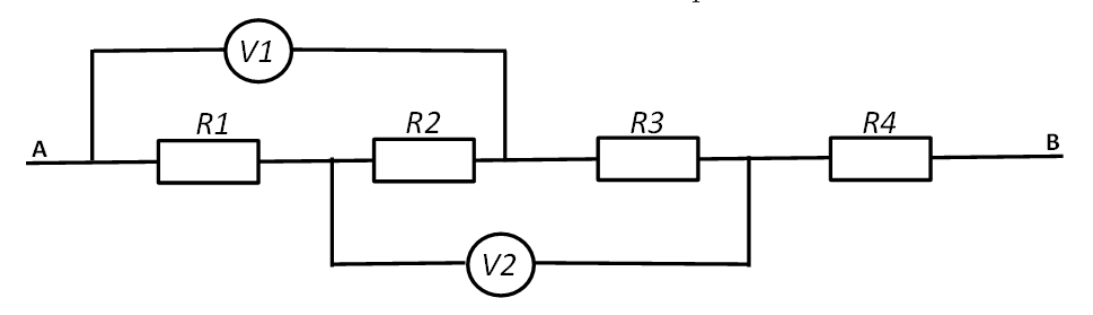 A circuit from to with four series resistors , , , ; voltmeter spans the section across and , and voltmeter spans the section across and .
- (A) 25 V
- (B) 30 V
- (C) 35 V
- (D) 32.5 V
- (E) There is not enough information.
Fonte: Testo (PDF) — p.8 Topic: Circuits Metodi: Kirchhoff’s Laws, Equivalent Circuit Reduction Competenze: Physical Reasoning Objects: Resistor
Nel circuito come mostrato di seguito, il voltmeter misura una differenza potenziale di 10 V e il voltmeter misura una differenza potenziale di 15 V. La resistenza è uguale a quella di resistenza . Qual è la differenza potenziale tra ?
Un circuito da a con quattro resistori di serie , , , ; il voltmeter si estende sulla sezione di e , e il voltmeter si estende sulla sezione di e .
- (A) 25 V
- (B) 30 V
- (C) 35 V
- (D) 32.5 V
- **(E) ** Non ci sono informazioni sufficienti.
Fonte: Testo (PDF) — p.8 Topic: Circuits Metodi: Kirchhoff’s Laws, Equivalent Circuit Reduction Competenze: Physical Reasoning Objects: Resistor
As shown in the diagram below, a heavy metal ball hangs freely from a string which is in turn attached to the ceiling. Another string hangs freely from the other end of the ball. Consider the situations where a pulling force applied to string is (i) increased slowly and (ii) large and sudden. Which of the following strings will break in these 2 situations?
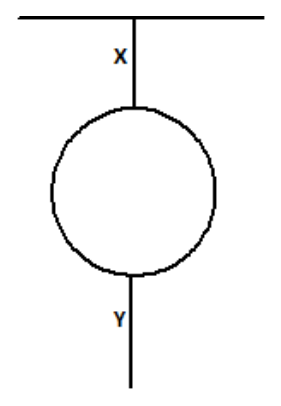 A heavy ball hangs from string attached to the ceiling, with string hanging from the bottom of the ball.
| Situation (i) | Situation (ii) | |
|---|---|---|
| (A) | X | Y |
| (B) | Y | X |
| (C) | X | X |
| (D) | Y | Y |
| (E) | This cannot be determined. |
Fonte: Testo (PDF) — p.9 Topic: Newtonian Mechanics Metodi: Free-Body Diagram, Impulse-Momentum Theorem Competenze: Physical Reasoning Objects: Ball, String
Come mostrato nel diagramma di seguito, una palla di metallo pesante si appende liberamente a una corda che è a sua volta attaccata al soffitto. Un’altra corda si appende liberamente dall’altra estremità della palla. Considerate le situazioni in cui la forza di trazione applicata alla corda è (i) aumentata lentamente e (ii) grande e improvvisa. Quale delle seguenti corde si rompe in queste due situazioni?
Una palla pesante appesa alla corda attaccata al soffitto, con la corda appesa alla parte inferiore della palla.
| Situation (i) | Situation (ii) | |
|---|---|---|
| (A) | X | Y |
| (B) | Y | X |
| (C) | X | X |
| (D) | Y | Y |
Non si può determinare # | |
Fonte: Testo (PDF) — p.9 Topic: Newtonian Mechanics Metodi: Free-Body Diagram, Impulse-Momentum Theorem Competenze: Physical Reasoning Objects: Ball, String
A 2-kg mass slides across a rough surface and its kinetic energy is plotted as a function of distance. What is the time that it took to slide across the surface?
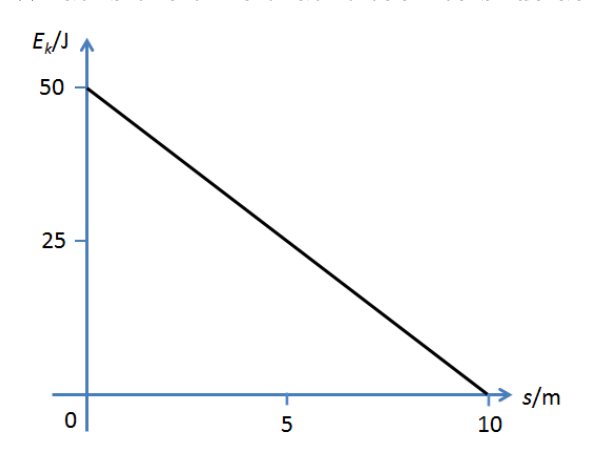 Graph of kinetic energy (in J) versus distance (in m): a straight line falling from 50 J at to 0 J at m.
- (A) 5 s
- (B) 4 s
- (C) s
- (D) 2 s
- (E) 10 s
Fonte: Testo (PDF) — p.9 Topic: Conservation of Energy Metodi: Energy Conservation Method, Kinematic Equations Competenze: Physical Reasoning Objects: —
Una massa di 2 kg si scivola su una superficie rugosa e la sua energia cinetica è tracciata in funzione della distanza. Quanto tempo ci è voluto per scivolare sulla superficie?
Grafica di energia cinetica (in J) contro distanza (in m): una linea retta che scende da 50 J a a 0 J a m.
- (A) 5 s
- (B) 4 s
- (C) s
- (D) 2 s
- (E) 10 s
Fonte: Testo (PDF) — p.9 Topic: Conservation of Energy Metodi: Energy Conservation Method, Kinematic Equations Competenze: Physical Reasoning Objects: —
An object falls freely through air. What is the ratio of
distance fallen in 1st sec : distance fallen in 2nd sec : distance fallen in 3rd sec?
You may neglect air resistance.
- (A)
- (B)
- (C)
- (D)
- (E)
Fonte: Testo (PDF) — p.9 Topic: Newtonian Mechanics Metodi: Kinematic Equations Competenze: Physical Reasoning Objects: —
Un oggetto cade liberamente attraverso l’aria. Qual è il rapporto di
Distanza scesa nel primo secondo: distanza scesa nel secondo: distanza scesa nel terzo secondo?
Potresti trascurare la resistenza dell’aria.
- (A)
- (B)
- (C)
- (D)
- (E)
Fonte: Testo (PDF) — p.9 Topic: Newtonian Mechanics Metodi: Kinematic Equations Competenze: Physical Reasoning Objects: —
Two identical rectangular bricks of length are piled with one on top of the other on a table. What is the maximum distance (see the figure below) that the top brick can be extended beyond the edge of the table for the system to remain balanced? (Note that the figure is not drawn to scale.)
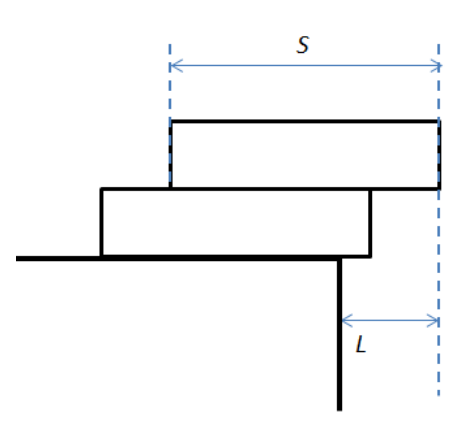 Two stacked bricks of length overhanging the edge of a table; the top brick extends a horizontal distance beyond the table edge.
- (A)
- (B)
- (C)
- (D)
- (E)
Fonte: Testo (PDF) — p.10 Topic: Rigid Body Statics Metodi: Torque & Angular Momentum Analysis Competenze: Physical Reasoning Objects: Block
Due mattoni rettangolari identici di lunghezza sono impilati su un tavolo, uno sopra l’altro. Qual è la distanza massima (vedi figura seguente) che il mattone superiore può estendere oltre il bordo del tavolo per mantenere il sistema in equilibrio? (Nota che la cifra non è indicata in scala.)
Due mattoni a pila di lunghezza che si appendono sul bordo di un tavolo; il mattone superiore si estende a una distanza orizzontale oltre il bordo del tavolo.
- (A)
- (B)
- (C)
- (D)
- (E)
Fonte: Testo (PDF) — p.10 Topic: Rigid Body Statics Metodi: Torque & Angular Momentum Analysis Competenze: Physical Reasoning Objects: Block
A beam of light strikes one mirror of a pair of right angle mirrors at an angle of incidence of as shown in the diagram. If the right angle mirror assembly is rotated such that the angle of incidence is now , what will happen to the angle of the beam that emerges from the right angle mirror assembly?
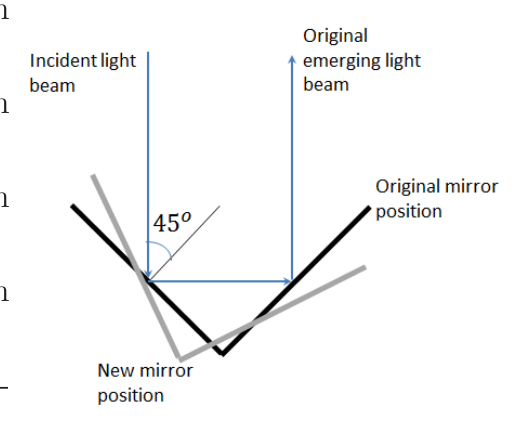 A pair of mirrors at right angles; an incident beam hits one mirror at and the emerging beam returns. A dashed configuration shows the original mirror and emerging-beam positions.
- (A) It will move through an angle of with respect to the original emerging beam.
- (B) It will move through an angle of with respect to the original emerging beam.
- (C) It will move through an angle of with respect to the original emerging beam.
- (D) It will move through an angle of with respect to the original emerging beam.
- (E) It will emerge parallel to the original emerging beam.
Fonte: Testo (PDF) — p.10 Topic: Geometric Optics Metodi: Ray Tracing Competenze: Physical Reasoning Objects: Mirror
Un fascio di luce colpisce uno specchio di una coppia di specchi ad angolo retto ad un angolo di incidenza di come mostrato nel diagramma. Se l’angolo di incidenza del ripiego a rettangolo è rotato in modo tale che il suo angolo di incidenza sia , cosa accadrà all’angolo del fascio che emerge dall’angolo di incidenza del ripiego a rettangolo?
Un paio di specchi ad angolo retto; un fascio incidente colpisce uno specchio a e il fascio emergente ritorna. Una configurazione a tracce mostra lo specchio originale e le posizioni dei raggi emergenti.
- **(A) ** Si muoverà in un angolo di rispetto al fascio emergente originale.
- **(B) ** Si muoverà in un angolo di rispetto al fascio emergente originale.
- **(C) ** Si muoverà in un angolo di rispetto al fascio emergente originale.
- **(D) ** Si muoverà in un angolo di rispetto al fascio emergente originale.
- **(E) ** Emergerà parallelo al fascio emergente originale.
Fonte: Testo (PDF) — p.10 Topic: Geometric Optics Metodi: Ray Tracing Competenze: Physical Reasoning Objects: Mirror
A circus clown weighing 1000 N walks across a tightrope that is 20 m in length. When the clown is at the center, the center sags by 1.0 m. What is the tension in the rope?
- (A) N
- (B) N
- (C) N
- (D) N
- (E) N
Fonte: Testo (PDF) — p.10 Topic: Rigid Body Statics Metodi: Free-Body Diagram, Vector Decomposition Competenze: Physical Reasoning Objects: String
Un clown di circo che pesa 1000 N cammina su una corda stretta di 20 metri di lunghezza. Quando il clown è al centro, il centro scende di 1,0 m. Qual e’ la tensione nella corda?
- (A) N
- (B) N
- (C) N
- (D) N
- (E) N
Fonte: Testo (PDF) — p.10 Topic: Rigid Body Statics Metodi: Free-Body Diagram, Vector Decomposition Competenze: Physical Reasoning Objects: String
100 g of ice at and 100 g of steam at interact thermally in a well-insulated container. The final state of the system is
- (A) an ice-water mixture at .
- (B) water at a temperature between and .
- (C) water at .
- (D) water at a temperature between and .
- (E) a water steam mixture at .
Fonte: Testo (PDF) — p.11 Topic: Thermodynamics Metodi: First Law of Thermodynamics Competenze: Physical Reasoning Objects: Container
100 g di ghiaccio a e 100 g di vapore a interagiscono termicamente in un contenitore ben isolato. Lo stato finale del sistema è:
- **(A) ** miscela di acqua ghiacciata a .
- **(B) ** acqua a una temperatura compresa tra e .
- **(C) ** acqua a .
- **(D) ** acqua a una temperatura compresa tra e .
- **(E) ** miscela di vapore idrico a .
Fonte: Testo (PDF) — p.11 Topic: Thermodynamics Metodi: First Law of Thermodynamics Competenze: Physical Reasoning Objects: Container
In a particular photoelectric experiment, it was found that when light of wavelength 187 nm is incident on the metal surface, the stopping potential is 2.70 V. What will be the stopping potential if light of wavelength 87 nm is used instead?
- (A) 0 V
- (B) 1.70 V
- (C) 4.94 V
- (D) 10.3 V
- (E) No electrons will be emitted
Fonte: Testo (PDF) — p.11 Topic: Modern-Quantum Physics Metodi: Photon Energy Relation Competenze: Physical Reasoning Objects: Photon, Electron
In un particolare esperimento fotoelettrico, è stato scoperto che quando la luce di lunghezza d’onda 187 nm incide sulla superficie metallica, il potenziale di arresto è di 2,70 V. Qual è il potenziale di arresto se invece si utilizza una luce di lunghezza d’onda 87 nm?
- (A) 0 V
- (B) 1.70 V
- (C) 4.94 V
- (D) 10.3 V
- **(E) ** Non saranno emessi elettroni
Fonte: Testo (PDF) — p.11 Topic: Modern-Quantum Physics Metodi: Photon Energy Relation Competenze: Physical Reasoning Objects: Photon, Electron
A truck of mass 20000 kg travelling at 50 km/h collided head-on with a car of mass 2500 kg travelling at 25 km/h. What is the ratio of the force exerted on the truck to the force exerted on the car during the collision?
- (A)
- (B)
- (C)
- (D)
- (E)
Fonte: Testo (PDF) — p.11 Topic: Newtonian Mechanics Metodi: Free-Body Diagram Competenze: Physical Reasoning Objects: —
Un camion di massa 20000 kg a 50 km/h si è schiantato di testa con un’auto di massa 2500 kg a 25 km/h. Qual è il rapporto tra la forza esercitata sul camion e la forza esercitata sull’auto durante la collisione?
- (A)
- (B)
- (C)
- (D)
- (E)
Fonte: Testo (PDF) — p.11 Topic: Newtonian Mechanics Metodi: Free-Body Diagram Competenze: Physical Reasoning Objects: —
In the figure depicting 2 situations below, solid objects and are moving towards the right and are stationary with respect to each other. There is significant friction between box and the ground and the accelerations and applied forces are as shown.
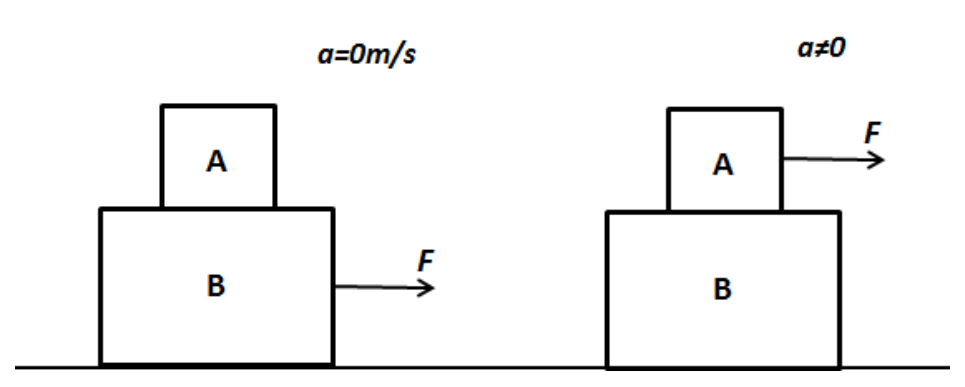 Two situations: in Situation 1, block rests on block which moves right with acceleration and a force is applied to . In Situation 2, block rests on with and a force is applied to .
Which of the following shows the correct sign of the work done on box by friction between box and respectively?
| Situation 1 | Situation 2 | |
|---|---|---|
| (A) | Positive | Negative |
| (B) | Positive | Positive |
| (C) | Negative | Positive |
| (D) | Zero | Negative |
| (E) | Zero | Positive |
Fonte: Testo (PDF) — p.12 Topic: Newtonian Mechanics Metodi: Free-Body Diagram, Energy Conservation Method Competenze: Physical Reasoning Objects: Block
Nella figura che mostra 2 situazioni di seguito, gli oggetti solidi e si muovono a destra e sono statici l’uno rispetto all’altro. C’è un significativo attrito tra la casella e il terreno e le accelerazioni e le forze applicate sono come illustrato.
Due situazioni: nella situazione 1, il blocco si basa sul blocco che si muove a destra con l’accelerazione e una forza viene applicata a . In situazione 2, il blocco si basa su con e viene applicata una forza a .
Qual è il segno corretto del lavoro svolto sulla casella mediante attrito tra la casella e rispettivamente?
♬ Situazione 1 ♬ Situazione 2 ♬ |---|---|---| ♬ ** ♬ A ♬ ** ♬ Positivo ♬ Negativo ♬
# # # # # # # # # # # # # # # # # # # # # # # # # # # # # # # # # # # # # # # # # # # # # # # # # # # # # # # # # # # # # # # # # # # # # # # # # # # # # # # # # # # # # # # # # # # # # # # # # # # # # # # # # # # # # # # # # # # # # # # # # # # # # # # # # # # # # # # # # # # # # # # # # # # # # # # # # # # # # # # # # # # # # # # # # # # # # # # # # # # # # # # # # # # # # # # # # # # # # # # # # # # # # # # # # # # # # # # # # # # # # # # # # # # # # # # # # # # # # # # # # # # # # # # # # # # # # # # # # # # # # # # # # # # # # # # # # # # # # # # # # # # # # # # # # # # # # # # # # # # # # # # # # # # # # # # # # # # # # # # # # # # # # # # # # # # # # # # # # # # # # # # # # # # # # # # # # # # # # # # # # # # # # # # # # # # # # # # # # # # # # # # # # # # # # # # # # # # # # # # # # # # # # # # # # # # # # # # # # # # # # # # # # # # # # # # # # # # # # # # # # # # # # # # # # # # # # # # # # # # # # # # # # # # # # # # # # # # # # # # # # # # # # # # # # # # # # # # # # # # # # # # # # # # # #
# # # # # # # # # # # # # # # # # # # # # # # # # # # # # # # # # # # # # # # # # # # # # # # # # # # # # # # # # # # # # # # # # # # # # # # # # # # # # # # # # # # # # # # # # # # # # # # # # # # # # # # # # # # # # # # # # # # # # # # # # # # # # # # # # # # # # # # # # # # # # # # # # # # # # # # # # # # # # # # # # # # # # # # # # # # # # # # # # # # # # # # # # # # # # # # # # # # # # # # # # # # # # # # # # # # # # # # # # # # # # # # # # # # # # # # # # # # # # # # # # # # # # # # # # # # # # # # # # # # # # # # # # # # # # # # # # # # # # # # # # # # # # # # # # # # # # # # # # # # # # # # # # # # # # # # # # # # # # # # # # # # # # # # # # # # # # # # # # # # # # # # # # # # # # # # # # # # # # # # # # # # # # # # # # # # # # # # # # # # # # # # # # # # # # # # # # # # # # # # # # # # # # # # # # # # # # # # # # # # # # # # # # # # # # # # # # # # # # # # # # # # # # # # # # # # # # # # # # # # # # # # # # # # # # # # # # # # # # # # # # # # # # # # # # # # # # # # # # # # # # # # # # # # # #
# # # # # # # # # # # # # # # # # # # # # # # # # # # # # # # # # # # # # # # # # # # # # # # # # # # # # # # # # # # # # # # # # # # # # # # # # # # # # # # # # # # # # # # # # # # # # # # # # # # # # # # # # # # # # # # # # # # # # # # # # # # # # # # # # # # # # # # # # # # # # # # # # # # # # # # # # # # # # # # # # # # # # # # # # # # # # # # # # # # # # # # # # # # # # # # # # # # # # # # # # # # # # # # # # # # # # # # # # # # # # # # # # # # # # # # # # # # # # # # # # # # # # # # # # # # # # # # # # # # # # # # # # # # # # # # # # # # # # # # # # # # # # # # # # # # # # # # # # # # # # # # # # # # # # # # # # # # # # # # # # # # # # # # # # # # # # # # # # # # # # # # # # # # # # # # # # # # # # # # # # # # # # # # # # # # # # # # # # # # # # # # # # # # # # # # # # # # # # # # # # # # # # # # # # # # # # # # # # # # # # # # # # # # # # # # # # # # # # # # # # # # # # # # # # # # # # # # # # # # # # # # # # # # # # # # # # # # # # # # # # # # # # # # # # # # # # # # # # # # # # # # # # # # # #
# # # # # # # # # # # # # # # # # # # # # # # # # # # # # # # # # # # # # # # # # # # # # # # # # # # # # # # # # # # # # # # # # # # # # # # # # # # # # # # # # # # # # # # # # # # # # # # # # # # # # # # # # # # # # # # # # # # # # # # # # # # # # # # # # # # # # # # # # # # # # # # # # # # # # # # # # # # # # # # # # # # # # # # # # # # # # # # # # # # # # # # # # # # # # # # # # # # # # # # # # # # # # # # # # # # # # # # # # # # # # # # # # # # # # # # # # # # # # # # # # # # # # # # # # # # # # # # # # # # # # # # # # # # # # # # # # # # # # # # # # # # # # # # # # # # # # # # # # # # # # # # # # # # # # # # # # # # # # # # # # # # # # # # # # # # # # # # # # # # # # # # # # # # # # # # # # # # # # # # # # # # # # # # # # # # # # # # # # # # # # # # # # # # # # # # # # # # # # # # # # # # # # # # # # # # # # # # # # # # # # # # # # # # # # # # # # # # # # # # # # # # # # # # # # # # # # # # # # # # # # # # # # # # # # # # # # # # # # # # # # # # # # # # # # # # # # # # # # # # # # # # # # # # # #
Fonte: Testo (PDF) — p.12 Topic: Newtonian Mechanics Metodi: Free-Body Diagram, Energy Conservation Method Competenze: Physical Reasoning Objects: Block
A source of 2-kilohertz sound is moving straight toward you at a speed 0.9 times the speed of sound. The frequency you receive is
- (A) 0.2 kHz
- (B) 1.0 kHz
- (C) 2.2 kHz
- (D) 3.8 kHz
- (E) 20 kHz
Fonte: Testo (PDF) — p.12 Topic: Oscillations & Waves Metodi: Wave Equation Competenze: Physical Reasoning Objects: —
Una fonte di 2 kilohertz di suono si sta muovendo dritto verso di voi a una velocità 0,9 volte la velocità del suono. La frequenza che ricevi è
- **(A) ** 0,2 kHz
- **(B) ** 1,0 kHz
- **(C) ** 2,2 kHz
- **(D) ** 3,8 kHz
- **(E) ** 20 kHz
Fonte: Testo (PDF) — p.12 Topic: Oscillations & Waves Metodi: Wave Equation Competenze: Physical Reasoning Objects: —
A wave generator located 4.0 m from a reflecting wall produces a standing wave in the string, as shown in the diagram below. If the speed of the wave is 30 m/s, what is its frequency?
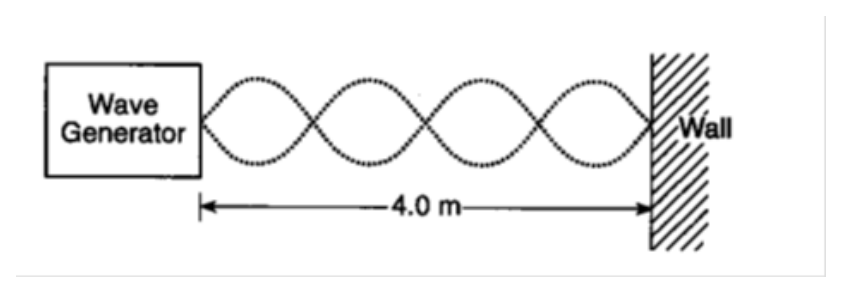 A wave generator 4.0 m from a wall produces a standing wave along the string with several loops between the generator and the wall.
- (A) 1.2 Hz
- (B) 15 Hz
- (C) 30 Hz
- (D) 40 Hz
- (E) 36 Hz
Fonte: Testo (PDF) — p.12 Topic: Oscillations & Waves Metodi: Wave Equation Competenze: Physical Reasoning Objects: String
Un generatore d’onda situato a 4,0 m da un muro riflettente produce un’onda in piedi nella corda, come mostrato nel diagramma di seguito. Se la velocità dell’onda è di 30 m/s, qual è la sua frequenza?
Un generatore d’onda a 4,0 m da una parete produce un’onda in piedi lungo la corda con diversi loop tra il generatore e la parete.
- (A) 1.2 Hz
- (B) 15 Hz
- (C) 30 Hz
- (D) 40 Hz
- (E) 36 Hz
Fonte: Testo (PDF) — p.12 Topic: Oscillations & Waves Metodi: Wave Equation Competenze: Physical Reasoning Objects: String
The following shows a wire coiled around an insulating, non-magnetic pipe with a current running in it. A conducting ring is placed near the centre of the coil with their axes aligned (see figure below). As the electrical current is decreased, which of the following happens?
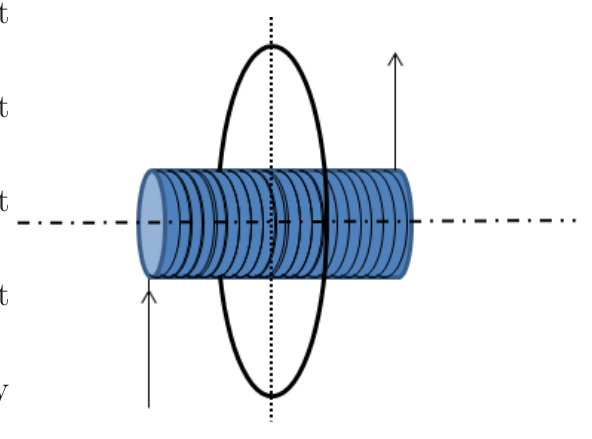 A current-carrying coil wound on a pipe, with a conducting ring placed coaxially near the centre of the coil.
- (A) The conducting ring experiences a force that tends to shrink the area of the circle.
- (B) The conducting ring experiences a force that tends to expand the area of the circle.
- (C) The conducting ring experiences a force that tends to move it to the right.
- (D) The conducting ring experiences a force that tends to move it to the left.
- (E) The conducting ring does not experience any force at all.
Fonte: Testo (PDF) — p.13 Topic: Electromagnetic Induction Metodi: Lenz’s Law Competenze: Physical Reasoning Objects: Coil, Tube
Il seguente mostra un filo avvolto intorno a un tubo isolante non magnetico con corrente che corre in esso. Un anello conduttore è posizionato vicino al centro della bobina con i suoi assi allineati (vedere figura seguente). Quando la corrente elettrica diminuisce, quale delle seguenti cose accade?
Un’onda di bobina portante corrente su un tubo, con un anello conduttore posizionato in modo coassiale vicino al centro della bobina.
- **(A) ** L’anello conduttore sperimenta una forza che tende a ridurre l’area del cerchio.
- **(B) ** L’anello conduttore sperimenta una forza che tende ad espandere l’area del cerchio.
- **(C) ** L’anello conduttore sperimenta una forza che tende a spostarlo a destra.
- **(D) ** L’anello conduttore sperimenta una forza che tende a spostarlo a sinistra.
- **(E) ** L’anello di conduttore non presenta alcuna forza.
Fonte: Testo (PDF) — p.13 Topic: Electromagnetic Induction Metodi: Lenz’s Law Competenze: Physical Reasoning Objects: Coil, Tube
The diagram below which shows a ray of monochromatic light ( Hz) passing through a glass prism. What is the speed of the light ray in the prism?
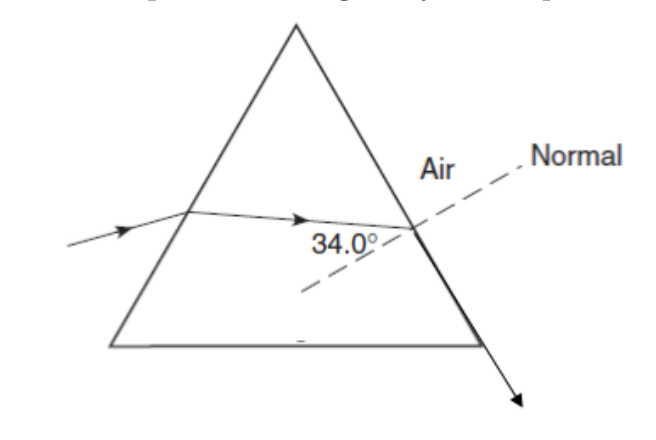 A ray of monochromatic light entering a triangular glass prism, refracting at an angle of .
- (A) m/s
- (B) m/s
- (C) m/s
- (D) m/s
- (E) m/s
Fonte: Testo (PDF) — p.13 Topic: Geometric Optics Metodi: Snell’s Law Competenze: Physical Reasoning Objects: Prism
Il diagramma che segue mostra un raggio di luce monocromatica ( Hz) che passa attraverso un prisma di vetro. Qual è la velocità del raggio di luce nel prisma?
Un raggio di luce monocromatica che entra in un prisma di vetro triangolare, che si rifracta ad un angolo di .
- (A) m/s
- (B) m/s
- (C) m/s
- (D) m/s
- (E) m/s
Fonte: Testo (PDF) — p.13 Topic: Geometric Optics Metodi: Snell’s Law Competenze: Physical Reasoning Objects: Prism
A space traveler is moving relative to the Earth at m/s (), as measured in the Earth’s frame of reference. Measured in the Earth’s frame of reference, in one year, what will happen to the space traveler?
- (A) travel 0.6 light year and age 0.6 year
- (B) travel 0.8 light year and age 0.6 year
- (C) travel 0.8 light year and age 1 year
- (D) travel 0.8 light year and age 1.67 year
- (E) travel 1 light year and age 1 year
Fonte: Testo (PDF) — p.13 Topic: Special Relativity Metodi: Lorentz Transformation Competenze: Physical Reasoning Objects: —
Un viaggiatore spaziale si muove rispetto alla Terra a m/s (), come misurato nel quadro di riferimento terrestre. Misurato nel quadro di riferimento terrestre, tra un anno, cosa succederà al viaggiatore spaziale?
- **(A) ** viaggio 0,6 anno luce e età 0,6 anni
- **(B) ** viaggio 0,8 anno luce e età 0,6 anni
- **(C) ** viaggio 0,8 anno luce e età 1 anno
- **(D) ** viaggio 0,8 anno luce e età 1,67 anni
- **(E) ** viaggio 1 anno luce e età 1 anno luce
Fonte: Testo (PDF) — p.13 Topic: Special Relativity Metodi: Lorentz Transformation Competenze: Physical Reasoning Objects: —
Can the lines in the figure below be equipotential lines (lines of same electric potential)?
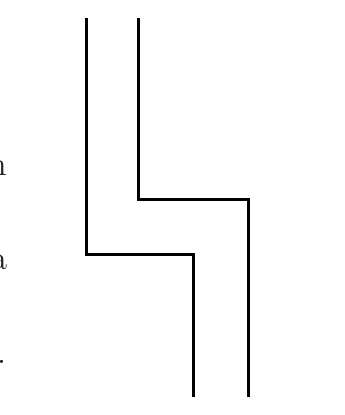 A set of lines (with sharp corners) drawn in a region of space, to be tested as possible equipotential lines.
- (A) No, because they are sharp corners
- (B) No, because they are isolated charges
- (C) Yes, because any lines within a charge distribution are equipotential lines.
- (D) Yes, because they can be lines on two surfaces of a conductor.
- (E) It is not possible to say without further information.
Fonte: Testo (PDF) — p.14 Topic: Electrostatics Metodi: Electric Potential Method Competenze: Physical Reasoning Objects: —
Le linee della figura seguente possono essere linee equipotenziali (linee dello stesso potenziale elettrico)?
Un insieme di linee (con angoli taglienti) disegnate in una regione dello spazio, da testare come possibili linee equipotenziali.
- **(A) ** No, perché sono angoli taglienti
- **(B) ** No, perché sono cariche isolate
- **(C) ** Sì, perché tutte le linee all’interno di una distribuzione di cariche sono linee equipotenziali.
- **(D) ** Sì, perché possono essere linee su due superfici di un conduttore.
- **(E) ** Non è possibile dire senza ulteriori informazioni.
Fonte: Testo (PDF) — p.14 Topic: Electrostatics Metodi: Electric Potential Method Competenze: Physical Reasoning Objects: —
In the circuit shown below, the emfs of the batteries are given, as well as the currents in the outside branches and the resistance in the middle branch. What is the magnitude of the potential difference between and ?
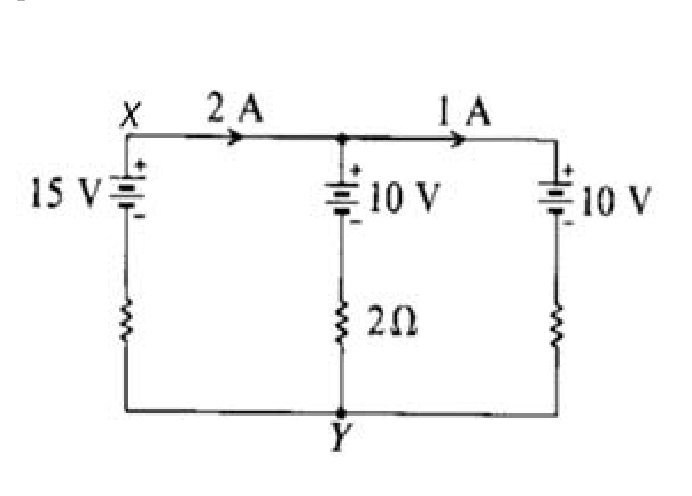 A three-branch circuit between nodes (top) and (bottom): the left branch has a 15 V battery, the middle branch has a 10 V battery in series with a resistor, and the right branch has a 10 V battery. The top branch carries 2 A into the middle node and 1 A out toward the right branch.
- (A) 16 V
- (B) 12 V
- (C) 15 V
- (D) 8 V
- (E) 4 V
Fonte: Testo (PDF) — p.14 Topic: Circuits Metodi: Kirchhoff’s Laws Competenze: Physical Reasoning Objects: Battery, Resistor
Nel circuito illustrato di seguito, vengono indicate le emfs delle batterie, nonché le correnti nei rami esterni e la resistenza nel ramo medio. Qual è la grandezza della differenza potenziale tra e ?
Un circuito a tre rami tra i nodi (alto) e (infine): il ramo sinistro ha una batteria da 15 V, il ramo medio ha una batteria da 10 V in serie con resistore da e il ramo destro ha una batteria da 10 V. Il ramo superiore porta 2 A nel nodo medio e 1 A verso il ramo destro.
- (A) 16 V
- (B) 12 V
- (C) 15 V
- (D) 8 V
- (E) 4 V
Fonte: Testo (PDF) — p.14 Topic: Circuits Metodi: Kirchhoff’s Laws Competenze: Physical Reasoning Objects: Battery, Resistor
A projectile of mass is fired horizontally from a spring gun that is initially at rest on a frictionless surface. The combined mass of the gun and projectile is . If the kinetic energy of the projectile after firing is , the gun will recoil with a kinetic energy equal to
- (A)
- (B)
- (C)
- (D)
- (E)
Fonte: Testo (PDF) — p.14 Topic: Conservation of Momentum Metodi: Conservation of Momentum Competenze: Physical Reasoning Objects: Spring, Projectile
Un proiettile di massa viene sparato orizzontalmente da un cannone a molla che è inizialmente a riposo su una superficie senza attrito. La massa combinata del fucile e del proiettile è . Se l’energia cinetica del proiettile dopo il fuoco è , il fucile si ritroverà con un’energia cinetica pari a
- (A)
- (B)
- (C)
- (D)
- (E)
Fonte: Testo (PDF) — p.14 Topic: Conservation of Momentum Metodi: Conservation of Momentum Competenze: Physical Reasoning Objects: Spring, Projectile
A ball is dropped from a height of 10 m onto a hard surface so that collision at the surface may be assumed to be elastic. Under such conditions, the motion of the ball is
- (A) Simple harmonic with a period of 1.4 s
- (B) Simple harmonic with a period of 2.8 s
- (C) Simple harmonic with an amplitude of 5.0 m
- (D) Periodic with a period of about 2.8 s but not simple harmonic
- (E) Motion with constant momentum
Fonte: Testo (PDF) — p.15 Topic: Oscillations & Waves Metodi: Simple Harmonic Motion Analysis, Kinematic Equations Competenze: Physical Reasoning Objects: Ball
Una palla viene lanciata da un’altezza di 10 m su una superficie dura in modo che la collisione alla superficie possa essere presunta come elastica. In tali condizioni, il movimento della palla è
- **(A) ** Armonica semplice con un periodo di 1,4 s
- **(B) ** Armonica semplice con un periodo di 2,8 s
- **(C) ** Armonica semplice con un’ampiezza di 5,0 m
- **(D) ** Periodica con un periodo di circa 2,8 s ma non semplice armonica
- **(E) ** Movimento con impulso costante
Fonte: Testo (PDF) — p.15 Topic: Oscillations & Waves Metodi: Simple Harmonic Motion Analysis, Kinematic Equations Competenze: Physical Reasoning Objects: Ball
An isolated capacitor with oil between its plates has a potential and charge . After the space between the plate is completely cleared of oil, the difference in potential is and the charge is . Which of the following pairs of relationships is correct?
- (A) and
- (B) and
- (C) and
- (D) and
- (E) and
Fonte: Testo (PDF) — p.15 Topic: Electrostatics Metodi: Electric Potential Method Competenze: Physical Reasoning Objects: Capacitor
Un condensatore isolato con olio tra le sue piastre ha un potenziale e una carica . Dopo che lo spazio tra la piastra è completamente ripudiato dall’olio, la differenza di potenziale è e la carica è . Quale delle seguenti coppie di relazioni è corretta?
- **(A) ** e
- **(B) ** e
- **(C) ** e
- **(D) ** e
- **(E) ** e
Fonte: Testo (PDF) — p.15 Topic: Electrostatics Metodi: Electric Potential Method Competenze: Physical Reasoning Objects: Capacitor
As shown in the diagram, 2 columns of air and of equal lengths are locked in a U-tube manometer by liquid mercury. If more liquid mercury is poured in through the opening, which of the following is true of the new lengths and ?
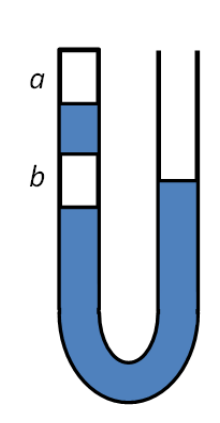 A U-tube manometer: the sealed left arm contains two trapped air columns (upper) and (lower) of equal length, separated and locked by mercury; the right arm is open.
- (A)
- (B)
- (C)
- (D)
- (E) Unable to determine
Fonte: Testo (PDF) — p.15 Topic: Fluid Mechanics Metodi: Hydrostatic Equilibrium, Ideal Gas Law Competenze: Physical Reasoning Objects: Manometer, Gas
Come mostrato nel diagramma, due colonne di aria e di lunghezza uguale sono bloccate in un manometro a tubo U con mercurio liquido. Se viene versato più mercurio liquido attraverso l’apertura, quale delle seguenti è vero per le nuove lunghezze e ?
Un manometro a tubo U: il braccio sinistro sigillato contiene due colonne d’aria intrappolate (alto) e (inferiore) di uguale lunghezza, separate e bloccate dal mercurio; il braccio destro è aperto.
- (A)
- (B)
- (C)
- (D)
- **(E) ** Non è possibile determinare
Fonte: Testo (PDF) — p.15 Topic: Fluid Mechanics Metodi: Hydrostatic Equilibrium, Ideal Gas Law Competenze: Physical Reasoning Objects: Manometer, Gas
A charged particle moves in a circular path in a magnetic field of T. As shown in the diagram below, the particle takes s to travel from to and then continues to take another s to go from to . The distance between and is 0.30 m and the charge on the particles is C. The momentum of the particle is
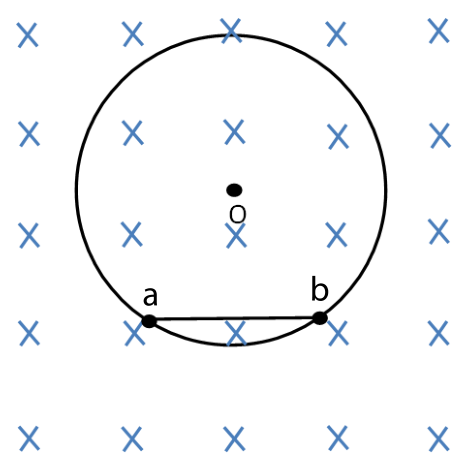 A charged particle moving on a circular path (centre ) in a uniform magnetic field directed into the page (shown by crosses); points and lie on the circle near the bottom, separated by a chord.
- (A) kg m/s
- (B) kg m/s
- (C) kg m/s
- (D) kg m/s
- (E) kg m/s
Fonte: Testo (PDF) — p.16 Topic: Magnetism Metodi: Lorentz Force Analysis Competenze: Physical Reasoning Objects: Point Charge
Una particella carica si muove in percorso circolare in un campo magnetico di T. As shown in the diagram below, the particle takes s to travel from to and then continues to take another s to go from to . La distanza tra e è di 0,30 m e la carica sulle particelle è C. L’impulso della particella è
Una particella carica che si muove su un percorso circolare (centro ) in un campo magnetico uniforme diretto verso la pagina (indicato da croci); i punti e si trovano sul cerchio vicino alla parte inferiore, separati da un’accorda.
- (A) kg m/s
- (B) kg m/s
- (C) kg m/s
- (D) kg m/s
- (E) kg m/s
Fonte: Testo (PDF) — p.16 Topic: Magnetism Metodi: Lorentz Force Analysis Competenze: Physical Reasoning Objects: Point Charge
A diatomic molecule consists of two point masses, and , separated by a distance . If is the distance from to the center of mass, what is the moment of inertia about an axis parallel to the molecular axis and passes through the center of mass. Note that the molecular axis is the line joining the two atoms in the diatomic molecule.
- (A)
- (B)
- (C)
- (D)
- (E)
Fonte: Testo (PDF) — p.16 Topic: Rotational Dynamics Metodi: Torque & Angular Momentum Analysis Competenze: Physical Reasoning Objects: Atom
Una molecola diatomica è composta da due masse puntate, e , separate da una distanza . Se è la distanza da al centro di massa, qual è il momento di inerzia su un asse parallelo all’asse molecolare e che passa attraverso il centro di massa. Si noti che l’asse molecolare è la linea che unisce i due atomi nella molecola diatomica.
- (A)
- (B)
- (C)
- (D)
- (E)
Fonte: Testo (PDF) — p.16 Topic: Rotational Dynamics Metodi: Torque & Angular Momentum Analysis Competenze: Physical Reasoning Objects: Atom
Rutherford’s experiment shows that when a gold sheet is bombarded with alpha particle, most of the particles pass through, with only a few being reflected back. Which of the following is a correct interpretation of the results?
- (A) Atoms have equal numbers of positive and negative charges.
- (B) Electrons in atoms are arranged in shells.
- (C) Neutrons are at the center of an atom.
- (D) Neutrons and protons in atoms have nearly equal mass.
- (E) The positive charge of an atom is concentrated in a small region.
Fonte: Testo (PDF) — p.16 Topic: Nuclear & Particle Physics Metodi: Physical Modeling Competenze: Physical Reasoning Objects: Atom, Nucleus
L’esperimento di Rutherford mostra che quando un foglio d’oro viene bombardato con particelle alfa, la maggior parte delle particelle passa attraverso, con solo poche riflessioni indietro. Quale delle seguenti interpretazioni corretta dei risultati?
- **(A) ** Gli atomi hanno uguali numeri di cariche positive e negative.
- **(B) ** Gli elettroni negli atomi sono disposti in conchiglie. I neutroni sono al centro di un atomo.
- **(D) ** I neutroni e i protoni negli atomi hanno quasi la stessa massa.
- **(E) ** La carica positiva di un atomo è concentrata in una piccola regione.
Fonte: Testo (PDF) — p.16 Topic: Nuclear & Particle Physics Metodi: Physical Modeling Competenze: Physical Reasoning Objects: Atom, Nucleus
For an ideal gas, the specific heat at constant pressure is greater than the specific heat at constant volume because the
- (A) gas does work on its environment when its pressure remains constant while its temperature is increased.
- (B) heat input per degree increase in temperature is the same in processes for which either the pressure or the volume is kept constant.
- (C) pressure of the gas remains constant when its temperature remains constant.
- (D) increase in the gas’s internal energy is greater when the pressure remains constant than when the volume remains constant.
- (E) heat needed is greater when the volume remains constant than when the pressure remains constant
Fonte: Testo (PDF) — p.17 Topic: Thermodynamics Metodi: First Law of Thermodynamics Competenze: Physical Reasoning Objects: Gas
Per un gas ideale, il calore specifico a pressione costante è superiore al calore specifico a volume costante perché il calore specifico a pressione costante è superiore al calore specifico a volume costante .
- **(A) ** il gas funziona sul suo ambiente quando la sua pressione rimane costante mentre la sua temperatura aumenta.
- **(B) ** l’ingresso di calore per aumento di temperatura di grado è lo stesso nei processi per i quali la pressione o il volume sono mantenuti costanti.
- **(C) ** la pressione del gas rimane costante quando la sua temperatura rimane costante.
- **(D) ** l’aumento dell’energia interna del gas è maggiore quando la pressione rimane costante rispetto a quando il volume rimane costante.
- **(E) ** il calore necessario è maggiore quando il volume rimane costante rispetto a quando la pressione rimane costante
Fonte: Testo (PDF) — p.17 Topic: Thermodynamics Metodi: First Law of Thermodynamics Competenze: Physical Reasoning Objects: Gas
The figure shows a radioactive substance being held in a small lead box with a hole where , and rays emit from the hole. The rays trace out the paths indicated in the diagram. The rays finally impact on a screen at points , and . It can be seen that . Which of the following electric/magnetic fields can possibly have been applied in the space just above the hole and between the lead box and the screen?
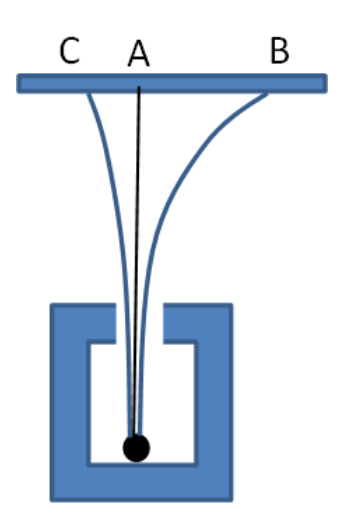 A radioactive source in a lead box emits rays through a hole; three rays diverge and strike a screen at points , and (left to right), with the middle ray () going straight up and the outer rays curving to and , where .
I. Uniform Magnetic field pointing into the paper II. Uniform Magnetic field pointing out of the paper III. Uniform Electric field pointing to the right IV. Uniform Electric field pointing to the left
- (A) I or III
- (B) I or IV
- (C) II only
- (D) II or III
- (E) II or IV
Fonte: Testo (PDF) — p.17 Topic: Nuclear & Particle Physics Metodi: Lorentz Force Analysis Competenze: Physical Reasoning Objects: Screen
La figura mostra una sostanza radioattiva contenuta in una piccola scatola di piombo con un buco in cui i raggi , e emettono dal buco. I raggi tracciano i percorsi indicati nel diagramma. I raggi infine colpiscono uno schermo nei punti , e . Si può vedere che . Quale dei seguenti campi elettrici/magnetistici può essere stato applicato nello spazio appena sopra il buco e tra la scatola di piombo e lo schermo?
Una fonte radioattiva in una scatola di piombo emette raggi attraverso un buco; tre raggi divergono e colpiscono lo schermo nei punti , e (da sinistra a destra), con il raggio medio () diretto verso l’alto e i raggi esterni curvi a e , dove .
I. Campo magnetico uniforme che punta sulla carta II. Campo magnetico uniforme che indica la carta III. Il Campo elettrico uniforme che punta a destra IV. Campo elettrico uniforme che punta a sinistra
- **(A) ** I o III
- (B) I or IV
- solo **(C) ** II
- **(D) ** II o III
- (E) II or IV
Fonte: Testo (PDF) — p.17 Topic: Nuclear & Particle Physics Metodi: Lorentz Force Analysis Competenze: Physical Reasoning Objects: Screen
The water level in a reservoir is maintained at a constant level. What is the exit velocity in an outlet pipe 3.0 m below the water surface?
- (A) 2.4 m/s
- (B) 3.0 m/s
- (C) 5.4 m/s
- (D) 7.7 m/s
- (E) 49 m/s
Fonte: Testo (PDF) — p.17 Topic: Fluid Mechanics Metodi: Bernoulli’s Equation Competenze: Physical Reasoning Objects: Tube
Il livello dell’acqua in un serbatoio è mantenuto a un livello costante. Qual è la velocità di uscita in un tubo di uscita a 3,0 m sotto la superficie dell’acqua?
- (A) 2.4 m/s
- (B) 3.0 m/s
- (C) 5.4 m/s
- (D) 7.7 m/s
- (E) 49 m/s
Fonte: Testo (PDF) — p.17 Topic: Fluid Mechanics Metodi: Bernoulli’s Equation Competenze: Physical Reasoning Objects: Tube
A thermodynamic system is taken from an initial state along the path as shown in the PV-diagram above. For the process to , and
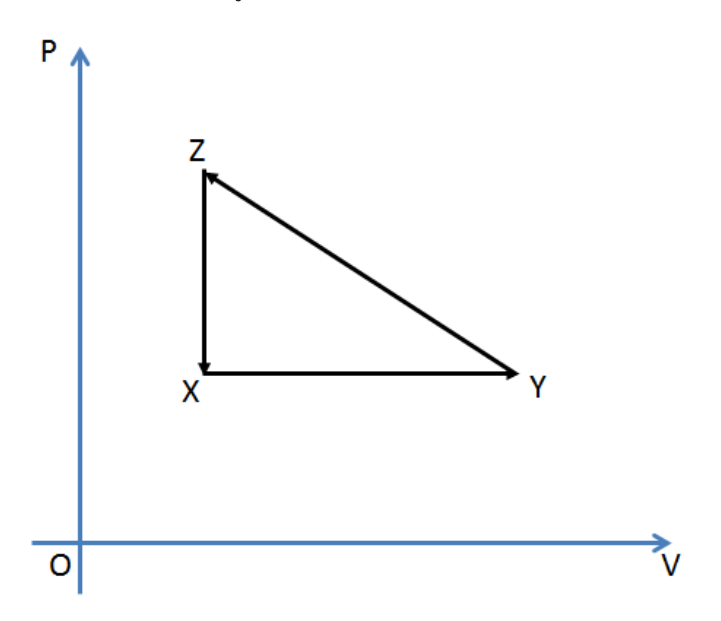 A PV-diagram (pressure vs volume ) showing a triangular cycle : at bottom left, at bottom right (horizontal ), directly above , with the path along the hypotenuse and vertical.
- (A) and
- (B) and
- (C) and
- (D) and
- (E) and
Fonte: Testo (PDF) — p.18 Topic: Thermodynamics Metodi: First Law of Thermodynamics Competenze: Physical Reasoning Objects: —
Si prende un sistema termodinamico da uno stato iniziale lungo il percorso come mostrato nel diagramma fotovoltaico di cui sopra. per il processo a , e
Un diagramma fotovoltaico (pressione vs volume ) che mostra un ciclo triangolare : in basso a sinistra, in basso a destra (orizzontale ), direttamente sopra , con il percorso lungo l’ipotenusa e verticale.
- **(A) ** e
- **(B) ** e
- **(C) ** e
- **(D) ** e
- **(E) ** e
Fonte: Testo (PDF) — p.18 Topic: Thermodynamics Metodi: First Law of Thermodynamics Competenze: Physical Reasoning Objects: —
If , then for the process to ,
- (A) and
- (B) and
- (C) and
- (D) and
- (E) and
Fonte: Testo (PDF) — p.18 Topic: Thermodynamics Metodi: First Law of Thermodynamics Competenze: Physical Reasoning Objects: —
Se , per il processo a ,
- **(A) ** e
- **(B) ** e
- **(C) ** e
- **(D) ** e
- **(E) ** e
Fonte: Testo (PDF) — p.18 Topic: Thermodynamics Metodi: First Law of Thermodynamics Competenze: Physical Reasoning Objects: —
The total energy of a blackbody radiation source is collected for one minute and used to heat water. The temperature increases from to . If the absolute temperature of the blackbody source is doubled, what is the final temperature of the water?
- (A)
- (B)
- (C)
- (D)
- (E)
Fonte: Testo (PDF) — p.19 Topic: Modern-Quantum Physics Metodi: Physical Modeling Competenze: Physical Reasoning Objects: —
L’energia totale di una fonte di radiazioni del corpo nero viene raccolta per un minuto e utilizzata per riscaldare l’acqua. La temperatura aumenta da a . Se la temperatura assoluta della fonte del corpo nero è raddoppiata, qual è la temperatura finale dell’acqua?
- (A)
- (B)
- (C)
- (D)
- (E)
Fonte: Testo (PDF) — p.19 Topic: Modern-Quantum Physics Metodi: Physical Modeling Competenze: Physical Reasoning Objects: —
Two waves are described by
and
What is the wavelength of the resultant wave?
- (A) 1 m
- (B) 2 m
- (C) 3 m
- (D) 4 m
- (E) 6 m
Fonte: Testo (PDF) — p.19 Topic: Oscillations & Waves Metodi: Wave Equation, Superposition Principle Competenze: Physical Reasoning Objects: —
Due onde sono descritte da:
e
Qual è la lunghezza d’onda dell’onda risultante?
- (A) 1 m
- (B) 2 m
- (C) 3 m
- (D) 4 m
- (E) 6 m
Fonte: Testo (PDF) — p.19 Topic: Oscillations & Waves Metodi: Wave Equation, Superposition Principle Competenze: Physical Reasoning Objects: —
Approximately how much uranium (in kg) must undergo fission per day to provide 1000 MW of power? (Assume an efficiency of 30%). The nuclear reaction is
where , , , and .
- (A) 1.0
- (B) 3.5
- (C) 2.3
- (D) 4.6
- (E) 0.1
Fonte: Testo (PDF) — p.19 Topic: Nuclear & Particle Physics Metodi: Mass-Energy Equivalence, Order-of-Magnitude Estimation Competenze: Physical Reasoning Objects: Nucleus
Circa quanto uranio (in kg) deve subire fissione al giorno per fornire 1000 MW di energia? (Assumiamo un’efficienza del 30%). La reazione nucleare è
in cui , , , e .
- (A) 1.0
- (B) 3.5
- (C) 2.3
- (D) 4.6
- (E) 0.1
Fonte: Testo (PDF) — p.19 Topic: Nuclear & Particle Physics Metodi: Mass-Energy Equivalence, Order-of-Magnitude Estimation Competenze: Physical Reasoning Objects: Nucleus