Which of the following is not a universal constant?
- (A) Mass of the electron
- (B) Speed of the light
- (C) Acceleration due to gravity at Earth’s surface
- (D) Charge of electron
- (E) Universal gas constant
Fonte: Testo (PDF) — p.3 Topic: Mathematics Metodi: Physical Modeling, Dimensional Analysis Competenze: Physical Reasoning Objects: —
Qual è la seguente costante universale?
- **(A) ** Massa dell’elettrone
- **(B) ** Velocità della luce
- **(C) ** Accelerazione dovuta alla gravità alla superficie terrestre
- **(D) ** Carica di elettrone
- **(E) ** Costante universale del gas
Fonte: Testo (PDF) — p.3 Topic: Mathematics Metodi: Physical Modeling, Dimensional Analysis Competenze: Physical Reasoning Objects: —
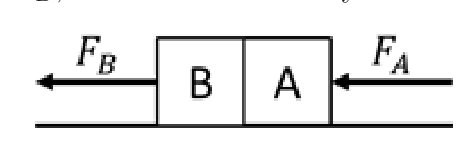
Two blocks and , of the same mass , are placed on a smooth horizontal table as shown in the figure below. Forces and are acting on the two blocks as shown. Given that , the force exerted by block on block
- (A) is zero.
- (B) is pointing to the left.
- (C) is pointing to the right.
- (D) may be pointing either to the left or to the right.
- (E) is greater than the force exerted by block on .
Fonte: Testo (PDF) — p.3 Topic: Newtonian Mechanics Metodi: Free-Body Diagram Competenze: Physical Reasoning Objects: Block
Due blocchi e , della stessa massa , sono posizionati su una tabella orizzontale liscia come mostrato nella figura seguente. Le forze e agiscono sui due blocchi come mostrato. Poiché , la forza esercitata dal blocco sul blocco
- **(A) ** è zero.
- **(B) ** è indicato a sinistra.
- **(C) ** indica a destra.
- **(D) ** può indicare a sinistra o a destra.
- **(E) ** è superiore alla forza esercitata dal blocco su .
Fonte: Testo (PDF) — p.3 Topic: Newtonian Mechanics Metodi: Free-Body Diagram Competenze: Physical Reasoning Objects: Block
Consider two carts, and , of masses and respectively, are initially at rest on an air track. If you push both carts with the same force and for the same duration of time, the ratio of final momentum of cart to final momentum of cart is
- (A) .
- (B) .
- (C) .
- (D) .
- (E) .
Fonte: Testo (PDF) — p.3 Topic: Conservation of Momentum Metodi: Impulse-Momentum Theorem Competenze: Physical Reasoning Objects: Cart
Considerate che due carri, e , rispettivamente di massa e , sono inizialmente in riposo su una pista aerea. Se si spingono entrambi i carri con la stessa forza e per lo stesso periodo di tempo, il rapporto tra la velocità finale del carrello e la velocità finale del carrello è
- (A) .
- (B) .
- (C) .
- (D) .
- (E) .
Fonte: Testo (PDF) — p.3 Topic: Conservation of Momentum Metodi: Impulse-Momentum Theorem Competenze: Physical Reasoning Objects: Cart
Suppose 1.0 kg of clay travelling at speed smashes into 1.0 kg of clay which is not moving. They stick and become one 2.0 kg lump of clay. What proportion of the kinetic energy in the originally moving lump was turned into heat and sound during the collision?
- (A) 0%
- (B) 25%
- (C) 50%
- (D) 75%
- (E) 100%
Fonte: Testo (PDF) — p.4 Topic: Conservation of Momentum Metodi: Conservation of Momentum, Energy Conservation Method Competenze: Physical Reasoning Objects: —
Supponiamo che 1,0 kg di argilla che viaggia a velocità si schiantino in 1,0 kg di argilla che non si muove. Si attaccano e diventano un pezzo di argilla da 2,0 kg. Quale percentuale dell’energia cinetica del grumo in movimento originariamente è stata trasformata in calore e suono durante la collisione?
- (A) 0%
- (B) 25%
- (C) 50%
- (D) 75%
- (E) 100%
Fonte: Testo (PDF) — p.4 Topic: Conservation of Momentum Metodi: Conservation of Momentum, Energy Conservation Method Competenze: Physical Reasoning Objects: —
A particle with mass and initial speed is subject to a velocity dependent damping force of the form where is a constant. The stopping time can be expressed as where , and are the exponents. can be assumed to be dimensionless. , and are respectively
- (A)
- (B)
- (C)
- (D)
- (E)
Fonte: Testo (PDF) — p.4 Topic: Mathematics Metodi: Dimensional Analysis Competenze: Physical Reasoning Objects: —
Una particella con massa e velocità iniziale è soggetta a una forza di attenuazione a seconda della velocità della forma , dove è una costante. Il tempo di arresto può essere espresso come , dove , e sono gli esponenti. può essere presumita come senza dimensioni. , e sono rispettivamente
- (A)
- (B)
- (C)
- (D)
- (E)
Fonte: Testo (PDF) — p.4 Topic: Mathematics Metodi: Dimensional Analysis Competenze: Physical Reasoning Objects: —
A boat is traveling in a river at speed relative to still water, with the speed of the water current as . When the boat steers perpendicularly to the bank at speed , it reaches the opposite bank at time . When the boat steers at an angle upstream such that it will reach directly opposite of its starting point with the same speed, the time taken is . What is the ratio of to ?
- (A)
- (B)
- (C)
- (D)
- (E) none of the above
Fonte: Testo (PDF) — p.4 Topic: Newtonian Mechanics Metodi: Vector Decomposition Competenze: Physical Reasoning Objects: —
Una barca si muove in un fiume a velocità rispetto all’acqua ferma, con la velocità della corrente d’acqua . Quando la barca si dirige perpendicolare alla riva a velocità , raggiunge la riva opposta a tempo . Quando la barca si dirige ad un’angolazione a monte in modo tale che raggiunga direttamente opposta al suo punto di partenza con la stessa velocità, il tempo impiegato è . Qual è il rapporto tra e ?
- (A)
- (B)
- (C)
- (D)
- **(E) ** nessuna delle seguenti:
Fonte: Testo (PDF) — p.4 Topic: Newtonian Mechanics Metodi: Vector Decomposition Competenze: Physical Reasoning Objects: —
A small graphite block stays at rest on a piece of paper. The paper is now moved and both the paper and the block move at the same constant velocity horizontally. After moving for a time , the paper stops suddenly. Given that the kinetic friction between the graphite block and the paper is , what is the length of the marking that the block made on the piece of paper when the graphite block eventually stops? Assuming the mass loss of the graphite block is negligible throughout the motion.
- (A)
- (B)
- (C)
- (D)
- (E)
Fonte: Testo (PDF) — p.5 Topic: Newtonian Mechanics Metodi: Free-Body Diagram, Kinematic Equations Competenze: Physical Reasoning Objects: Block
Un piccolo blocco di grafite rimane a riposo su un pezzo di carta. La carta viene ora spostata e sia la carta che il blocco si muovono alla stessa velocità costante orizzontalmente. After moving for a time , the paper stops suddenly. Dato che la frizione cinetica tra il blocco di grafite e la carta è , quale è la lunghezza del marchio che il blocco ha fatto sul pezzo di carta quando il blocco di grafite si ferma? Supponendo che la perdita di massa del blocco di grafite sia trascurabile durante il movimento.
- (A)
- (B)
- (C)
- (D)
- (E)
Fonte: Testo (PDF) — p.5 Topic: Newtonian Mechanics Metodi: Free-Body Diagram, Kinematic Equations Competenze: Physical Reasoning Objects: Block
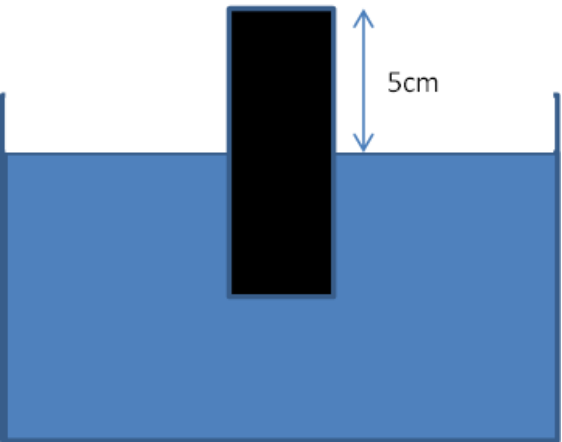
Diane walked into her physics lab to find her demonstrator Erica standing in front of a 10 cm long cylinder floating upright in a tank of a clear fluid as shown in the diagram. They then put the tank with the cylinder in a chamber and increased the air pressure in the chamber to 100 atm while keeping the temperature constant. What will happen to the floating cylinder?
Assume that the fluid is incompressible, and that air is an ideal gas (density at 1 atm).
- (A) The cylinder will float higher in the liquid by 6 mm.
- (B) The cylinder will sink lower in the liquid by 6 mm.
- (C) The cylinder will float higher in the liquid by 4.4 mm.
- (D) The cylinder will sink lower in the liquid by 4.4 mm.
- (E) The cylinder will neither sink lower nor float higher in the liquid.
Fonte: Testo (PDF) — p.5 Topic: Fluid Mechanics Metodi: Hydrostatic Equilibrium, Ideal Gas Law Competenze: Physical Reasoning Objects: Cylinder, Container, Gas
Diane entrò nel suo laboratorio di fisica e trovò la sua dimostratrice Erica in piedi davanti a un cilindro lungo 10 cm che galleggiava in verticale in un serbatoio di fluido trasparente come mostrato nel diagramma. Poi hanno messo il serbatoio con il cilindro in una camera e aumentato la pressione dell’aria nella camera a 100 atm mantenendo la temperatura costante. Che ne sarà del cilindro galleggiante?
Supponiamo che il fluido sia incompressibile e che l’aria sia un gas ideale (densità a 1 atm).
- **(A) ** Il cilindro fluttuerà più in alto nel liquido di 6 mm.
- **(B) ** Il cilindro affonderà 6 mm più in basso nel liquido.
- **(C) ** Il cilindro fluttuerà più in alto nel liquido di 4,4 mm.
- **(D) ** Il cilindro affonderà più in basso nel liquido di 4,4 mm.
- **(E) ** Il cilindro non affonderà più in basso né galleggierà più in alto nel liquido.
Fonte: Testo (PDF) — p.5 Topic: Fluid Mechanics Metodi: Hydrostatic Equilibrium, Ideal Gas Law Competenze: Physical Reasoning Objects: Cylinder, Container, Gas
Automobiles are made nowadays to be energy-absorbing in the event of a crash. It means that the components of the body are designed to be anything but elastic, and to be sacrificed while dissipating kinetic energy. Sometimes this is described loosely by the size of the crumple-zone ahead or behind the passengers of the car. A Datsun had a crumple zone of roughly 1.5 m, and about 1 m of it had been used up when it hit a concrete wall at about 30 km/hour. What is the minimum force needed to bring the 1000 kg car to rest in this distance?
- (A)
- (B)
- (C)
- (D)
- (E)
Fonte: Testo (PDF) — p.6 Topic: Conservation of Energy Metodi: Energy Conservation Method Competenze: Physical Reasoning Objects: —
Le automobili sono oggi fatte per assorbire energia in caso di incidente. Significa che i componenti del corpo sono progettati per essere qualsiasi cosa, ma elastico, e per essere sacrificato mentre dissipa energia cinetica. A volte questo è descritto vagamente dalla dimensione della zona di crommello davanti o dietro i passeggeri dell’auto. Un Datsun aveva una zona di crolla di circa 1,5 m, e circa 1 m di esso era stato usato quando ha colpito un muro di cemento a circa 30 km/h. Qual è la forza minima necessaria per far riposare la macchina da 1000 kg a questa distanza?
- (A)
- (B)
- (C)
- (D)
- (E)
Fonte: Testo (PDF) — p.6 Topic: Conservation of Energy Metodi: Energy Conservation Method Competenze: Physical Reasoning Objects: —
A person rides on a bicycle at 10 m/s heading eastwards. He feels that the wind is blowing from the north at 10 m/s. The velocity of the wind relative to the ground is
- (A) 14 m/s, with direction pointing southwest
- (B) 14 m/s, with direction pointing southeast
- (C) 10 m/s, with direction pointing north
- (D) 10 m/s, with direction pointing south
- (E) 20 m/s, with direction pointing northeast
Fonte: Testo (PDF) — p.6 Topic: Newtonian Mechanics Metodi: Vector Decomposition Competenze: Physical Reasoning Objects: —
Una persona si sposta in bicicletta a 10 m/s in direzione orientale. Sente che il vento soffia da nord a 10 metri al secondo. La velocità del vento rispetto al suolo è
- **(A) ** 14 m/s, con direzione verso sudovest
- **(B) ** 14 m/s, con direzione verso sud-est
- **(C) ** 10 m/s, con direzione verso nord
- **(D) ** 10 m/s, con direzione verso sud
- **(E) ** 20 m/s, con direzione orientata a nordest
Fonte: Testo (PDF) — p.6 Topic: Newtonian Mechanics Metodi: Vector Decomposition Competenze: Physical Reasoning Objects: —
Four samples of a colloidal aqueous mixture each weighing 12.0 g are placed in the rotor of a high speed centrifuge, equally spaced around the circumference of the rotor. The samples are located 10 cm from the axis of rotation of the rotor. If the centrifuge motor delivers a constant torque of 0.25 N m and the empty rotor has a moment of inertia of , how long does it take for the rotor to accelerate to its operating state of 18000 rpm (rotations per minute)? You may neglect the change in the position of the sample during acceleration.
- (A) 7.6 s
- (B) 456 s
- (C) 453 s
- (D) 7.3 s
- (E) 435 s
Fonte: Testo (PDF) — p.6 Topic: Rotational Dynamics Metodi: Torque & Angular Momentum Analysis Competenze: Physical Reasoning Objects: —
Quattro campioni di miscela acquosa colloidale di peso di 12,0 g sono collocati nel rotore di una centrifugatrice ad alta velocità, spaziati uniformemente intorno alla circonferenza del rotore. I campioni sono situati a 10 cm dall’asse di rotazione del rotore. Se il motore di centrifuga fornisce una coppia costante di 0,25 N m e il rotore vuoto ha un momento di inerzia di , quanto tempo ci vuole per accelerare il rotore fino a raggiungere il suo stato di funzionamento di 18000 giri al minuto (rottamenti al minuto)? Si può trascurare il cambiamento della posizione del campione durante l’accelerazione.
- (A) 7.6 s
- (B) 456 s
- (C) 453 s
- (D) 7.3 s
- (E) 435 s
Fonte: Testo (PDF) — p.6 Topic: Rotational Dynamics Metodi: Torque & Angular Momentum Analysis Competenze: Physical Reasoning Objects: —
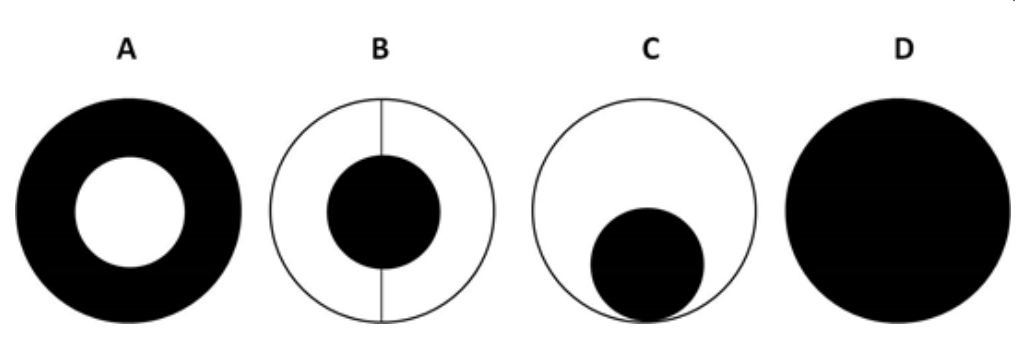
Four cylinders with the same mass , length and outer radius but different cross sections as shown in the figure roll down the same slope without slipping from rest at the same time. The shaded regions indicate a uniform distribution of mass, while the unshaded regions are hollow and thin lines (in B) indicate supportive structure that is rigid and negligible in mass or dimension. The inner radius of cylinder A, and the radius of the solid cross sections in B and C are both . Which cylinder will arrive at the bottom of the slope first?
- (A) A
- (B) B
- (C) C
- (D) D
- (E) They arrive at the same time.
Fonte: Testo (PDF) — p.7 Topic: Rotational Dynamics Metodi: Torque & Angular Momentum Analysis, Energy Conservation Method Competenze: Physical Reasoning Objects: Cylinder, Inclined Plane
Quattro cilindri con la stessa massa , lunghezza e raggio esterno , ma sezioni incrociate diverse come mostrato nella figura, ruotano sulla stessa pendenza senza scivolare allo stesso tempo dal riposo. Le regioni ombrate indicano una distribuzione uniforme della massa, mentre le regioni non ombrate sono vuote e le linee sottili (in B) indicano una struttura di supporto rigida e trascurabile in massa o dimensione. Il raggio interno del cilindro A e il raggio dei tratti di incrocio solido in B e C sono entrambi . Quale cilindro arriverà prima al fondo della pendenza?
- (A) A
- (B) B
- (C) C
- (D) D
- **(E) ** Arrivano nello stesso momento.
Fonte: Testo (PDF) — p.7 Topic: Rotational Dynamics Metodi: Torque & Angular Momentum Analysis, Energy Conservation Method Competenze: Physical Reasoning Objects: Cylinder, Inclined Plane
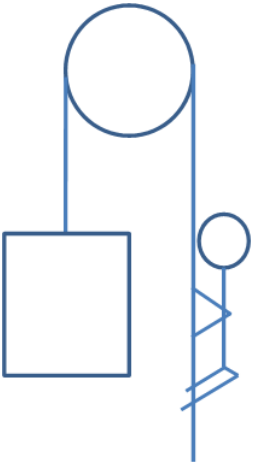
In the diagram below, the man (of mass ) is at the same initial horizontal level as the counterweight (also of mass ). As the man accelerates and starts to climb up the rope, which of the following correctly reflects the motion of the man and the counterweight? We need not consider the mass of the rope nor the friction in the pulley system.
- (A) The man accelerates upwards and the counterweight accelerates downwards.
- (B) The man accelerates upwards and the counterweight does not move.
- (C) The man and the weight accelerates together upwards and reaches the ceiling at the same time.
- (D) The man and the weight accelerates together upwards but the man moves more speedily then the weight.
- (E) The man and weight accelerates together upwards but the weight moves more speedily than the man.
Fonte: Testo (PDF) — p.7 Topic: Newtonian Mechanics Metodi: Free-Body Diagram Competenze: Physical Reasoning Objects: String, Pulley
Nel diagramma di seguito, l’uomo (di massa ) è allo stesso livello orizzontale iniziale del contrappeso (anche di massa ). Mentre l’uomo accelera e inizia a salire la corda, quale di queste riflette correttamente il movimento dell’uomo e il contrapeso? Non dobbiamo considerare la massa della corda né il attrito del sistema di pollice.
- **(A) ** L’uomo accelera verso l’alto e il contrappeso accelera verso il basso.
- **(B) ** L’uomo accelera verso l’alto e il contrappeso non si muove.
- **(C) ** L’uomo e il peso accelerano insieme verso l’alto e raggiungono il soffitto allo stesso tempo. L’uomo e il peso si accelerano insieme verso l’alto, ma l’uomo si muove più velocemente del peso. L’uomo e il peso si accelerano insieme verso l’alto, ma il peso si muove più velocemente dell’uomo.
Fonte: Testo (PDF) — p.7 Topic: Newtonian Mechanics Metodi: Free-Body Diagram Competenze: Physical Reasoning Objects: String, Pulley
A force is used to pull 3 objects A, B, C across a frictionless surface. The three objects are connected by strings. When a small object is placed on top of B and with force unchanged, what will happen to the tensions and respectively?
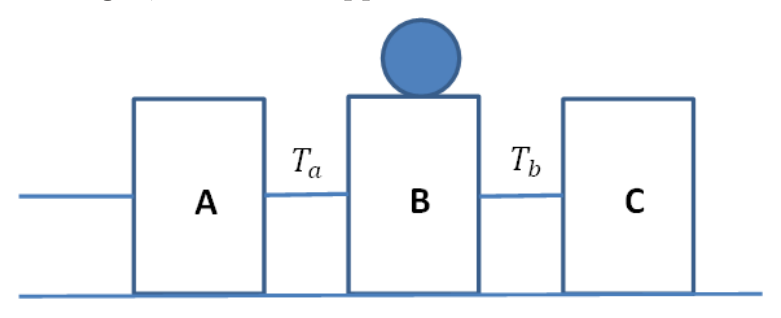
- (A) increases and decreases
- (B) increases and increases
- (C) decreases and decreases
- (D) decreases and increases
- (E) and remains the same
Fonte: Testo (PDF) — p.8 Topic: Newtonian Mechanics Metodi: Free-Body Diagram Competenze: Physical Reasoning Objects: Block, String
Una forza viene utilizzata per trascinare 3 oggetti A, B e C su una superficie senza attrito. I tre oggetti sono collegati da stringhe. Quando un piccolo oggetto viene posizionato sopra B e con forza invariata, cosa accadrà alle tensioni e rispettivamente?
- **(A) ** aumenta e diminuisce
- **(B) ** e
- **(C) ** diminuisce e diminuisce
- **(D) ** diminuisce e aumenta
- **(E) ** e rimangono uguali
Fonte: Testo (PDF) — p.8 Topic: Newtonian Mechanics Metodi: Free-Body Diagram Competenze: Physical Reasoning Objects: Block, String
A particle exhibiting uniform circular motion with radius has its speed increased 3 times and the centripetal force is hence increased by 64 N. The original centripetal force is
- (A) 16 N
- (B) 12 N
- (C) 8 N
- (D) 6 N
- (E) 18 N
Fonte: Testo (PDF) — p.8 Topic: Newtonian Mechanics Metodi: Physical Modeling Competenze: Physical Reasoning Objects: —
Una particella che presenta un movimento circolare uniforme con raggio ha la sua velocità aumentata 3 volte e la forza centripetal aumenta quindi di 64 N. La forza centripetale originale è
- (A) 16 N
- (B) 12 N
- (C) 8 N
- (D) 6 N
- (E) 18 N
Fonte: Testo (PDF) — p.8 Topic: Newtonian Mechanics Metodi: Physical Modeling Competenze: Physical Reasoning Objects: —
Which of the following about static friction is correct?
- (A) There is always a non-zero static friction between two stationary objects in contact with each other.
- (B) The static friction between two objects is always greater than the kinetic friction between these two objects.
- (C) The direction of the static friction must be in the direction of motion.
- (D) Depending on the forces applied to an object in contact with another object, the value of static friction can change.
- (E) When the normal force on the object increases, the static friction must increase.
Fonte: Testo (PDF) — p.8 Topic: Newtonian Mechanics Metodi: Free-Body Diagram Competenze: Physical Reasoning Objects: —
Quale delle seguenti osservazioni sulla frizione statica è corretta?
- **(A) ** C’è sempre un attrito statico non zero tra due oggetti fermi in contatto tra loro.
- **(B) ** La frizione statica tra due oggetti è sempre maggiore della frizione cinetica tra questi due oggetti.
- **(C) ** La direzione della frizione statica deve essere in direzione di movimento.
- **(D) ** A seconda delle forze applicate ad un oggetto in contatto con un altro oggetto, il valore di attrito statico può cambiare.
- **(E) ** Quando la forza normale sull’oggetto aumenta, l’attrito statico deve aumentare.
Fonte: Testo (PDF) — p.8 Topic: Newtonian Mechanics Metodi: Free-Body Diagram Competenze: Physical Reasoning Objects: —
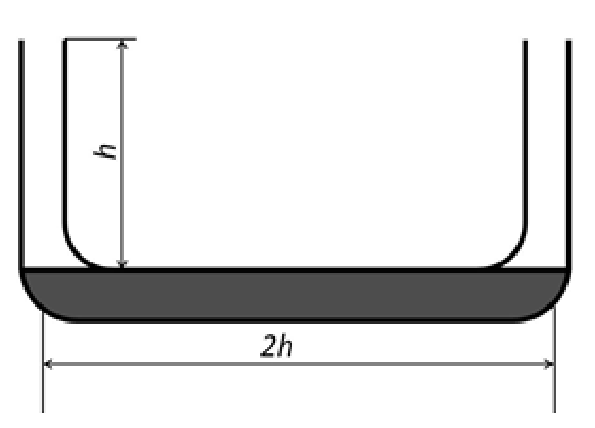
A U shaped glass tube consists of two open-ended vertical glass tubes of height and a horizontal tube of length joined together. Diameter of the tube is much smaller than , and the horizontal tube is initially filled with mercury with density as shown below. The atmospheric pressure is . Subsequently the two ends of the tube are sealed. The tube is then accelerated to the right until the mercury occupies a length of inside the horizontal tube. The acceleration of the tube is
- (A)
- (B)
- (C)
- (D)
- (E)
Fonte: Testo (PDF) — p.9 Topic: Fluid Mechanics Metodi: Hydrostatic Equilibrium, Ideal Gas Law Competenze: Physical Reasoning Objects: Tube, Gas
Un tubo di vetro a forma di U è costituito da due tubi verticali di vetro a bordo aperto di altezza e da un tubo orizzontale di lunghezza uniti. Il diametro del tubo è molto più piccolo di e il tubo orizzontale è inizialmente riempito di mercurio con densità come mostrato di seguito. La pressione atmosferica è . Successivamente le due estremità del tubo sono sigillate. Il tubo viene quindi accelerato a destra fino a quando il mercurio occupa una lunghezza di all’interno del tubo orizzontale. L’accelerazione del tubo è
- (A)
- (B)
- (C)
- (D)
- (E)
Fonte: Testo (PDF) — p.9 Topic: Fluid Mechanics Metodi: Hydrostatic Equilibrium, Ideal Gas Law Competenze: Physical Reasoning Objects: Tube, Gas
Two masses, and , are joined by a massless spring of force constant and placed on a horizontal frictionless surface. The system is released from rest when the separation between the masses is . If the unstretched length of the spring is , the speed of the mass when the two masses are at the distance apart is
- (A)
- (B)
- (C)
- (D)
- (E)
Fonte: Testo (PDF) — p.9 Topic: Conservation of Energy Metodi: Energy Conservation Method, Conservation of Momentum Competenze: Physical Reasoning Objects: Spring
Due masse, e , sono unite da una sorgente senza massa di forza costante e collocate su una superficie orizzontale senza attrito. Il sistema viene rilasciato dal riposo quando la separazione tra le masse è . Se la lunghezza non estesa della molla è , la velocità della massa quando le due masse sono a distanza è
- (A)
- (B)
- (C)
- (D)
- (E)
Fonte: Testo (PDF) — p.9 Topic: Conservation of Energy Metodi: Energy Conservation Method, Conservation of Momentum Competenze: Physical Reasoning Objects: Spring
In a room without air-conditioning, a ceiling fan with varying power may be used. When we consider the pulling force on the ceiling by the fan, as compared to weight of the fan, which of the following statement is correct?
- (A) When the fan is operating at high power, the pulling force is equal to the weight.
- (B) When the fan is operating at low power, the pulling force is greater than the weight.
- (C) The pulling force is equal to the weight, irrespective of the output power of the fan.
- (D) The pulling force is smaller than the weight, irrespective of the output power of the fan.
- (E) The pulling force is greater than the weight, irrespective of the output power of the fan.
Fonte: Testo (PDF) — p.10 Topic: Newtonian Mechanics Metodi: Conservation of Momentum, Physical Modeling Competenze: Physical Reasoning Objects: —
In una stanza senza aria condizionata, può essere utilizzato un ventilatore al soffitto con potenza variabile. Quando consideriamo la forza di trazione del soffitto del ventilatore, rispetto al peso del ventilatore, quale delle seguenti affermazioni è corretta?
- **(A) ** Quando il ventilatore opera ad alta potenza, la forza di trazione è uguale al peso.
- **(B) ** Quando il ventilatore opera a bassa potenza, la forza di trazione è superiore al peso.
- **(C) ** La forza di trazione è uguale al peso, indipendentemente dalla potenza di uscita del ventilatore.
- **(D) ** La forza di trazione è inferiore al peso, indipendentemente dalla potenza di uscita del ventilatore.
- **(E) ** La forza di trazione è superiore al peso, indipendentemente dalla potenza di uscita del ventilatore.
Fonte: Testo (PDF) — p.10 Topic: Newtonian Mechanics Metodi: Conservation of Momentum, Physical Modeling Competenze: Physical Reasoning Objects: —
A fast moving small bullet of mass hits and passes through a heavy stationary wooden block of mass . When the bullet passes through the block,
- (A) and experience the same impulse.
- (B) The mutual force between the bullet and the wooden block will do the same amount of work.
- (C) The bullet’s speed will reduce by the same amount as the increase in the wooden block’s speed.
- (D) The bullet’s momentum will reduce by the same amount as the increase in the wooden block’s momentum.
- (E) The bullet’s temperature will increase by the same amount as the increase in the wooden block’s temperature.
Fonte: Testo (PDF) — p.10 Topic: Conservation of Momentum Metodi: Impulse-Momentum Theorem Competenze: Physical Reasoning Objects: Block, Projectile
Un proiettile di massa in rapido movimento colpisce e passa attraverso un pesante blocco di legno fermo di massa . Quando il proiettile passa attraverso il blocco,
- **(A) ** e sperimentano lo stesso impulso.
- **(B) ** La forza reciproca tra il proiettile e il blocco di legno farà la stessa quantità di lavoro.
- **(C) ** La velocità del proiettile diminuirà di uguale quantità all’aumento della velocità del blocco di legno.
- **(D) ** Il momento del proiettile diminuirà di pari entità all’aumento del momento del blocco di legno.
- **(E) ** La temperatura del proiettile aumenterà di una quantità pari all’aumento della temperatura del blocco di legno.
Fonte: Testo (PDF) — p.10 Topic: Conservation of Momentum Metodi: Impulse-Momentum Theorem Competenze: Physical Reasoning Objects: Block, Projectile
An ideal gas exerts a pressure of 60 Pa when its temperature is 400 K and the number density of molecules is . Another sample of the same gas exerts a pressure of 30 Pa when its temperature is 300 K. How many molecules are present in unit volume of this second sample?
- (A)
- (B)
- (C)
- (D)
- (E)
Fonte: Testo (PDF) — p.10 Topic: Kinetic Theory Metodi: Ideal Gas Law Competenze: Physical Reasoning Objects: Gas
Un gas ideale esercita una pressione di 60 Pa quando la sua temperatura è di 400 K e la densità di numero delle molecole è . Un altro campione dello stesso gas esercita una pressione di 30 Pa quando la sua temperatura è di 300 K. Quante molecole sono presenti nell’unità di volume di questo secondo campione?
- (A)
- (B)
- (C)
- (D)
- (E)
Fonte: Testo (PDF) — p.10 Topic: Kinetic Theory Metodi: Ideal Gas Law Competenze: Physical Reasoning Objects: Gas
The next 2 questions use the information given in the paragraph below.
Green light of wavelength 500 nm and of intensity 0.50 W/m² is shone on a solar cell of area 0.040 m². The solar cell generates sufficient power to drive a small microfluidic device that heats 0.050 g of water from 300 K to 301 K in 1.0 minute.
The number of photons that reach the solar cell per second is
- (A)
- (B)
- (C)
- (D)
- (E)
Fonte: Testo (PDF) — p.11 Topic: Modern-Quantum Physics Metodi: Photon Energy Relation Competenze: Physical Reasoning Objects: Photon
Le seguenti due domande utilizzano le informazioni fornite nel paragrafo seguente.
La luce verde di lunghezza d’onda 500 nm e di intensità 0,50 W/m2 è illuminata su una cella solare di superficie di 0,040 m2. La cella solare genera energia sufficiente a guidare un piccolo dispositivo microfluidico che riscaldano 0,050 g di acqua da 300 K a 301 K in 1,0 minuto.
Il numero di fotoni che raggiungono la cella solare al secondo è
- (A)
- (B)
- (C)
- (D)
- (E)
Fonte: Testo (PDF) — p.11 Topic: Modern-Quantum Physics Metodi: Photon Energy Relation Competenze: Physical Reasoning Objects: Photon
(Uses the paragraph given before Problema 22.)
What is the efficiency of the solar cells in this case? You can ignore the electrical resistance in the wires.
- (A) 0.18%
- (B) 11%
- (C) 18%
- (D) 35%
- (E) 100%
Fonte: Testo (PDF) — p.11 Topic: Modern-Quantum Physics Metodi: Photon Energy Relation, Energy Conservation Method Competenze: Physical Reasoning Objects: —
*(Utilizza il paragrafo precedente Problema 22.) *
Qual è l’efficienza delle celle solari in questo caso? Puoi ignorare la resistenza elettrica dei fili.
- (A) 0.18%
- (B) 11%
- (C) 18%
- (D) 35%
- (E) 100%
Fonte: Testo (PDF) — p.11 Topic: Modern-Quantum Physics Metodi: Photon Energy Relation, Energy Conservation Method Competenze: Physical Reasoning Objects: —
The crest of a Parasaurolophus dinosaur skull contains a nasal cavity (its bony crest) that forms a long tube open at one end. The dinosaur is believed to have produced sound by passing air through the cavity and setting up the fundamental mode in it. By modeling the cavity as a tube open at one end and 2.50 m in length, what fundamental frequency and first harmonic could have been produced? Take the speed of the sound in air to be and ignore edge effects.
- (A) 136 Hz, 272 Hz
- (B) 34 Hz, 138 Hz
- (C) 34 Hz, 102 Hz
- (D) 68 Hz, 102 Hz
- (E) 68 Hz, 138 Hz
Fonte: Testo (PDF) — p.11 Topic: Oscillations & Waves Metodi: Wave Equation Competenze: Physical Reasoning Objects: Tube
La cresta di un cranio di dinosauro Parasaurolophus contiene una cavità nasale (la cresta ossea) che forma un lungo tubo aperto ad una estremità. Si ritiene che il dinosauro abbia prodotto il suono passando aria attraverso la cavità e mettendo in atto la modalità fondamentale in essa. Modellare la cavità come un tubo aperto ad una estremità e lungo 2,50 m, quale frequenza fondamentale e prima armonica potrebbero essere state prodotte? Prendete la velocità del suono nell’aria a e ignorate gli effetti di bordo.
- (A) 136 Hz, 272 Hz
- (B) 34 Hz, 138 Hz
- (C) 34 Hz, 102 Hz
- (D) 68 Hz, 102 Hz
- (E) 68 Hz, 138 Hz
Fonte: Testo (PDF) — p.11 Topic: Oscillations & Waves Metodi: Wave Equation Competenze: Physical Reasoning Objects: Tube
White light, consisting of all wavelengths between 400 nm and 700 nm shines through a diffraction grating with 150 lines/mm, separating into a spectrum of colour on a screen 2.50 m away. The first observed colour of the third order rainbow, as measured from the center of the screen, lines up with one of the wavelength, of the second order rainbow. What is ?
- (A) 400 nm
- (B) 450 nm
- (C) 500 nm
- (D) 600 nm
- (E) 700 nm
Fonte: Testo (PDF) — p.12 Topic: Wave Optics Metodi: Interference & Diffraction Analysis Competenze: Physical Reasoning Objects: Diffraction Grating, Screen
La luce bianca, costituita da tutte le lunghezze d’onda comprese tra 400 nm e 700 nm, brilla attraverso una griglia di diffrazione con 150 linee/mm, separata in uno spettro di colori su uno schermo a 2,50 m di distanza. Il primo colore osservato dell’arcobaleno di terzo ordine, misurato dal centro dello schermo, si allinea con uno dei lunghezzi d’onda, dell’arcobaleno di secondo ordine. Che cos’è ?
- (A) 400 nm
- (B) 450 nm
- (C) 500 nm
- (D) 600 nm
- (E) 700 nm
Fonte: Testo (PDF) — p.12 Topic: Wave Optics Metodi: Interference & Diffraction Analysis Competenze: Physical Reasoning Objects: Diffraction Grating, Screen
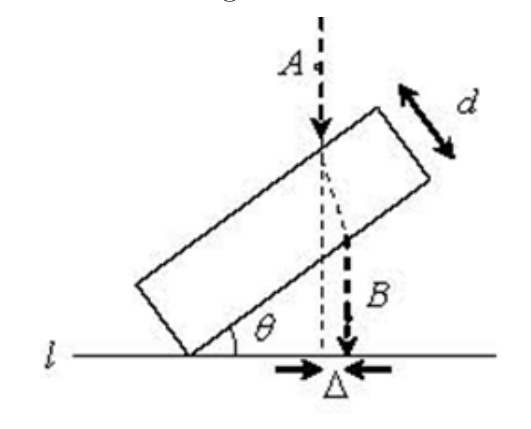
As shown below, two nails A and B are placed with a separation cm when observed along the normal to the straight line . A piece of glass with thickness cm and continuous density is then placed between the nails at to the line . The two nails now seem to be along the same line when observed normal to . The index of refraction of the glass is
- (A) 1.33
- (B) 1.41
- (C) 1.50
- (D) 1.62
- (E) 1.73
Fonte: Testo (PDF) — p.12 Topic: Geometric Optics Metodi: Snell’s Law, Physical Modeling Competenze: Physical Reasoning Objects: —
Come mostrato di seguito, due chiodi A e B sono posizionati con una separazione cm quando osservati lungo la linea normale a retta . Un pezzo di vetro di spessore cm e di densità continua viene poi posto tra le unghie a fino alla linea . Le due unghie sembrano ora essere sulla stessa linea quando osservate normali a . L’indice di rifrazione del vetro è
- (A) 1.33
- (B) 1.41
- (C) 1.50
- (D) 1.62
- (E) 1.73
Fonte: Testo (PDF) — p.12 Topic: Geometric Optics Metodi: Snell’s Law, Physical Modeling Competenze: Physical Reasoning Objects: —
A monochromatic light ray in air () enters a glass prism (). In the glass prism
- (A) both the frequency and the wavelength are the same as in air.
- (B) the frequency is the same but the wavelength is smaller than in air.
- (C) the frequency is the same but the wavelength is larger than in air.
- (D) the wavelength is the same but the frequency is smaller than in air.
- (E) the wavelength is the same but the frequency is larger than in air.
Fonte: Testo (PDF) — p.12 Topic: Geometric Optics Metodi: Snell’s Law, Wave Equation Competenze: Physical Reasoning Objects: Prism
Un raggio di luce monocromatico nell’aria () entra in un prisma di vetro (). Nel prisma di vetro
- **(A) ** sia la frequenza che la lunghezza d’onda sono le stesse dell’aria.
- **(B) ** la frequenza è la stessa ma la lunghezza d’onda è più piccola dell’aria.
- **(C) ** la frequenza è la stessa ma la lunghezza d’onda è maggiore di quella dell’aria.
- **(D) ** la lunghezza d’onda è la stessa ma la frequenza è inferiore a quella dell’aria.
- **(E) ** la lunghezza d’onda è la stessa ma la frequenza è maggiore di quella dell’aria.
Fonte: Testo (PDF) — p.12 Topic: Geometric Optics Metodi: Snell’s Law, Wave Equation Competenze: Physical Reasoning Objects: Prism
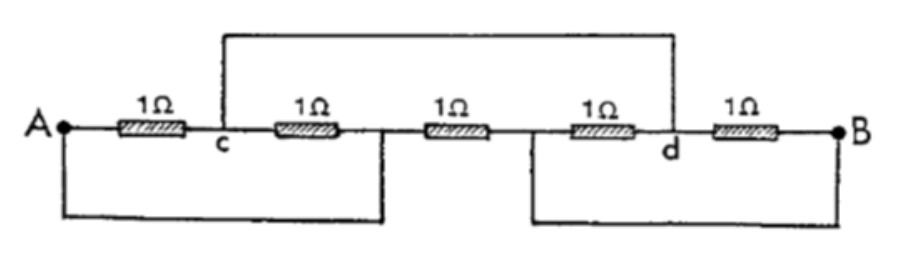
Determine the resulting resistance between A and B as in the diagram below. Resistance in the wires are negligible.
- (A)
- (B)
- (C)
- (D)
- (E)
Fonte: Testo (PDF) — p.13 Topic: Circuits Metodi: Equivalent Circuit Reduction Competenze: Physical Reasoning Objects: Resistor, Wire
Determinare la resistenza risultante tra A e B come riportato nel diagramma seguente. La resistenza dei fili è trascurabile.
- (A)
- (B)
- (C)
- (D)
- (E)
Fonte: Testo (PDF) — p.13 Topic: Circuits Metodi: Equivalent Circuit Reduction Competenze: Physical Reasoning Objects: Resistor, Wire
An alpha particle (a He nucleus, containing two protons and two neutrons and having a mass of kg) travelling horizontally at 35.6 km/s enters a uniform, vertical 1.10 T magnetic field. What is the diameter of the path followed by this alpha particle?
- (A) 0.67 mm
- (B) 1.34 mm
- (C) 1.58 mm
- (D) 2.15 mm
- (E) 5.36 mm
Fonte: Testo (PDF) — p.13 Topic: Magnetism Metodi: Lorentz Force Analysis Competenze: Physical Reasoning Objects: Nucleus
Una particella alfa (nucleo He, contenente due protoni e due neutroni e di massa kg) che viaggia orizzontalmente a 35,6 km/s entra in un campo magnetico uniforme e verticale di 1,10 T. Qual è il diametro del percorso seguito da questa particella alfa?
- (A) 0.67 mm
- (B) 1.34 mm
- (C) 1.58 mm
- (D) 2.15 mm
- (E) 5.36 mm
Fonte: Testo (PDF) — p.13 Topic: Magnetism Metodi: Lorentz Force Analysis Competenze: Physical Reasoning Objects: Nucleus
You require a 2.0 g copper sphere with a charge of exactly . What fraction of the electrons must be removed from this copper sphere in order to give it the stated charge? Atomic number of copper is 29; mass number of copper is 63.5.
- (A)
- (B)
- (C)
- (D)
- (E)
Fonte: Testo (PDF) — p.13 Topic: Electrostatics Metodi: Physical Modeling Competenze: Physical Reasoning Objects: Sphere
È necessario una sfera di rame di 2,0 g con una carica di . Quale frazione di elettroni deve essere rimossa da questa sfera di rame per dare la carica indicata? Il numero atomico del rame è 29; il numero di massa del rame è 63,5.
- (A)
- (B)
- (C)
- (D)
- (E)
Fonte: Testo (PDF) — p.13 Topic: Electrostatics Metodi: Physical Modeling Competenze: Physical Reasoning Objects: Sphere
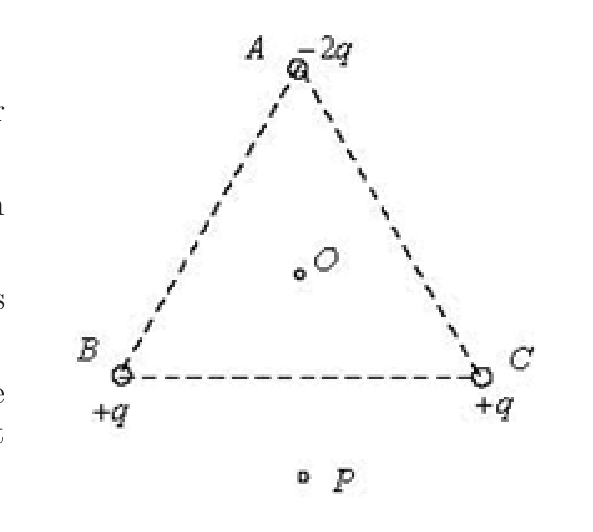
An equilateral triangle has charges placed on the three apex. is placed at point A, each placed on B and C, . The center of the triangle is at point O, and point P is its mirror image about line BC. Which of the following statements is correct?
- (A) Electric field is zero at point O.
- (B) Electric potential at point O is higher than that at point P.
- (C) Electric field at point O is stronger than that at point P.
- (D) Electric field along the line PO always points from P to O.
- (E) An external force that separates the three charges slowly till infinitely apart would have done negative total work.
Fonte: Testo (PDF) — p.14 Topic: Electrostatics Metodi: Superposition Principle, Symmetry Argument Competenze: Physical Reasoning Objects: Point Charge
Un triangolo equilaterale ha cariche posizionate sul tripice. è posto al punto A, , ognuno posto su B e C, . Il centro del triangolo è al punto O, e il punto P è la sua immagine speculare sulla linea BC. Quale delle seguenti affermazioni è corretta?
- **(A) ** Il campo elettrico è zero al punto O.
- **(B) ** Il potenziale elettrico al punto O è superiore a quello al punto P.
- **(C) ** Il campo elettrico al punto O è più forte di quello al punto P.
- **(D) ** Il campo elettrico lungo la linea PO punta sempre da P a O. Una forza esterna che separa le tre cariche lentamente fino a infinite distanza avrebbe fatto un lavoro totale negativo.
Fonte: Testo (PDF) — p.14 Topic: Electrostatics Metodi: Superposition Principle, Symmetry Argument Competenze: Physical Reasoning Objects: Point Charge
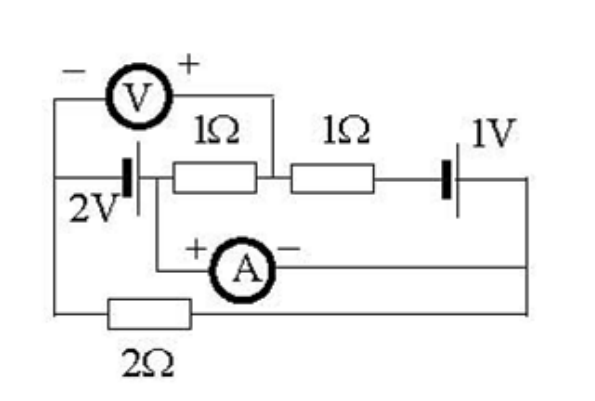
The readings from the voltmeter and ammeter from the circuit shown below are
- (A) 2.0 V, 1.0 A
- (B) 1.0 V, 0.5 A
- (C) 1.5 V, 0.5 A
- (D) 1.5 V, 1.0 A
- (E) 1.0 V, 2.0 A
Fonte: Testo (PDF) — p.14 Topic: Circuits Metodi: Kirchhoff’s Laws Competenze: Physical Reasoning Objects: Galvanometer, Battery, Resistor
Le letture del voltometro e dell’ampimetro del circuito mostrato di seguito sono:
- (A) 2.0 V, 1.0 A
- (B) 1.0 V, 0.5 A
- (C) 1.5 V, 0.5 A
- (D) 1.5 V, 1.0 A
- (E) 1.0 V, 2.0 A
Fonte: Testo (PDF) — p.14 Topic: Circuits Metodi: Kirchhoff’s Laws Competenze: Physical Reasoning Objects: Galvanometer, Battery, Resistor
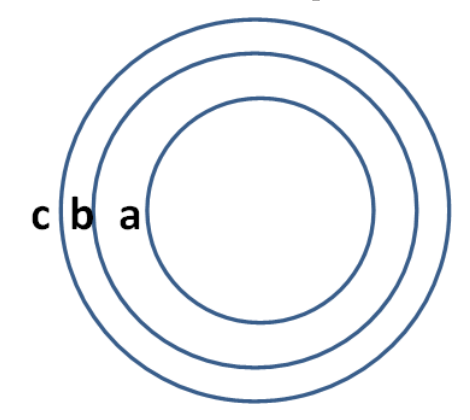
As shown in the diagram, , , are three concentric circular wire loops with radii . The three loops have the same resistances. When a clockwise current through is suddenly increased, the induced current in loops and is
- (A) Clockwise,
- (B) Anti-clockwise,
- (C) Clockwise,
- (D) Anti-clockwise,
- (E) Zero
Fonte: Testo (PDF) — p.14 Topic: Electromagnetic Induction Metodi: Lenz’s Law, Faraday’s Law of Induction Competenze: Physical Reasoning Objects: Wire, Coil
Come mostrato nel diagramma, , , sono tre circuiti circolari concentrici di filo con raggio . Le tre cicle hanno le stesse resistenze. Quando una corrente in senso orario attraverso è improvvisamente aumentata, la corrente indotta nei loop e è
- **(A) ** In senso orario,
- **(B) ** Anti-orologio,
- **(C) ** In senso orario,
- **(D) ** In senso antiorario,
- **(E) ** Zero
Fonte: Testo (PDF) — p.14 Topic: Electromagnetic Induction Metodi: Lenz’s Law, Faraday’s Law of Induction Competenze: Physical Reasoning Objects: Wire, Coil
When a light bulb is connected to a constant D.C. source, the output power is 40 W. If the light bulb is connected to the same source in series with another resistor , the output power of the resistor is 3.6 W. Take the resistance of the light bulb to be a constant smaller than , the output power of the light bulb now is closest to
- (A) 0.3 W
- (B) 0.9 W
- (C) 14.4 W
- (D) 16.4 W
- (E) 32.4 W
Fonte: Testo (PDF) — p.15 Topic: Circuits Metodi: Equivalent Circuit Reduction Competenze: Physical Reasoning Objects: Resistor
Quando una lampadina è collegata a una DC costante fonte, la potenza di uscita è di 40 W. Se la lampadina è collegata alla stessa fonte in serie con un altro resistore , la potenza di uscita del resistore è di 3,6 W. Se si assume che la resistenza della lampadina sia una costante inferiore a , la potenza di uscita della lampadina è ora più vicina a
- (A) 0.3 W
- (B) 0.9 W
- (C) 14.4 W
- (D) 16.4 W
- (E) 32.4 W
Fonte: Testo (PDF) — p.15 Topic: Circuits Metodi: Equivalent Circuit Reduction Competenze: Physical Reasoning Objects: Resistor
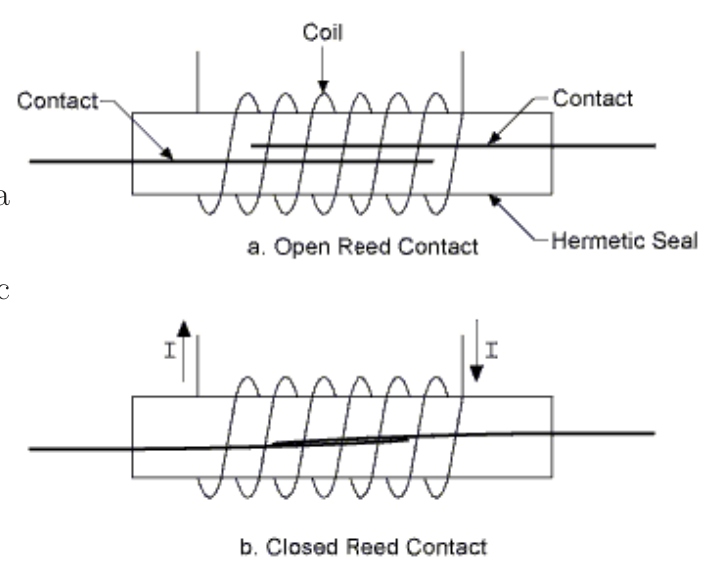
The figure below shows a reed switch which consists of a pair of springy contacts made from magnetic material sealed in a glass tube. The reed switch can be placed in a coil to form a relay switch whereby current in the coil controls the opening and closing of the switch. Which of the following phenomena is not utilized in a reed switch relay?
- (A) Magnetic field of a current
- (B) Effect of magnetic field on a current
- (C) Interaction between magnetic poles
- (D) Magnetization
- (E) None of the above
Fonte: Testo (PDF) — p.15 Topic: Magnetism Metodi: Physical Modeling Competenze: Physical Reasoning Objects: Switch, Coil, Spring
La figura seguente mostra un interruttore di canna che consiste in un paio di contatti springy realizzati in materiale magnetico sigillato in un tubo di vetro. Il switch di canna può essere inserito in una bobina per formare un switch di relè, con il quale la corrente nella bobina controlla l’apertura e la chiusura del switch. Qual è il fenomeno ** non ** utilizzato in un relè di interruttore di canna?
- **(A) ** Campo magnetico di una corrente
- **(B) ** Effetto del campo magnetico su una corrente
- **(C) ** Interazione tra i poli magnetici
- **(D) ** Magnetizzazione
- **(E) ** Nessuna delle seguenti:
Fonte: Testo (PDF) — p.15 Topic: Magnetism Metodi: Physical Modeling Competenze: Physical Reasoning Objects: Switch, Coil, Spring
If the mass of a planet is doubled while its radius and the radius of orbit of its moon remain unchanged, the speed of the moon is
- (A) increased by a factor of
- (B) increased by a factor of 2.
- (C) not changed.
- (D) reduced by a factor of
- (E) reduced by a factor of 2.
Fonte: Testo (PDF) — p.15 Topic: Gravitation Metodi: Newton’s Law of Gravitation Competenze: Physical Reasoning Objects: Planet, Satellite
Se la massa di un pianeta è raddoppiata mentre il suo raggio e il raggio di orbita della sua luna rimangono invariati, la velocità della luna è
- **(A) ** aumentato di un fattore
- **(B) ** aumentato di un fattore 2.
- **(C) ** non modificato.
- **(D) ** ridotto di un fattore
- **(E) ** ridotto di un fattore 2.
Fonte: Testo (PDF) — p.15 Topic: Gravitation Metodi: Newton’s Law of Gravitation Competenze: Physical Reasoning Objects: Planet, Satellite
An ideal gas is heated such that it expands at constant pressure. The gas does work . What is the amount of heat added to the gas?
- (A)
- (B)
- (C) zero
- (D) more than
- (E) less than
Fonte: Testo (PDF) — p.16 Topic: Thermodynamics Metodi: First Law of Thermodynamics Competenze: Physical Reasoning Objects: Gas
Un gas ideale viene riscaldato in modo tale che si espandono a pressione costante. Il gas funziona . Quanto calore viene aggiunto al gas?
- (A)
- (B)
- **(C) ** zero
- **(D) ** più di
- **(E) ** inferiore a
Fonte: Testo (PDF) — p.16 Topic: Thermodynamics Metodi: First Law of Thermodynamics Competenze: Physical Reasoning Objects: Gas
In the equation ,
- (A) is measured in degrees Celsius.
- (B) is the resistance of the system.
- (C) has different values for different gases.
- (D) is the velocity of the flowing gas.
- (E) is the number of moles of gas.
Fonte: Testo (PDF) — p.16 Topic: Thermodynamics Metodi: Ideal Gas Law Competenze: Physical Reasoning Objects: Gas
In questa equazione ,
- **(A) ** è misurato in gradi Celsius.
- **(B) ** è la resistenza del sistema.
- **(C) ** ha valori diversi per diversi gas.
- **(D) ** è la velocità del gas che scorre.
- **(E) ** è il numero di mol di gas.
Fonte: Testo (PDF) — p.16 Topic: Thermodynamics Metodi: Ideal Gas Law Competenze: Physical Reasoning Objects: Gas
The oxygen (molar mass = 32 g/mol) and nitrogen (molar mass = 28 g/mol) molecules in this room have equal average
- (A) kinetic energies, but the oxygen molecules are faster.
- (B) kinetic energies, but the oxygen molecules are slower.
- (C) kinetic energies and speeds.
- (D) speeds, but the oxygen molecules have a higher average kinetic energy.
- (E) None of the above is correct.
Fonte: Testo (PDF) — p.16 Topic: Kinetic Theory Metodi: Kinetic Theory of Gases Competenze: Physical Reasoning Objects: Gas
Le molecole di ossigeno (massa molare = 32 g/mol) e di azoto (massa molare = 28 g/mol) in questa stanza hanno una media uguale
- **(A) ** energie cinetiche, ma le molecole di ossigeno sono più veloci.
- **(B) ** energie cinetiche, ma le molecole di ossigeno sono più lente.
- **(C) ** energie cinetiche e velocità.
- **(D) ** velocità, ma le molecole di ossigeno hanno un’energia cinetica media superiore.
- **(E) ** Nessuna delle indicazioni sopra esposte è corretta.
Fonte: Testo (PDF) — p.16 Topic: Kinetic Theory Metodi: Kinetic Theory of Gases Competenze: Physical Reasoning Objects: Gas
An aquarium contains a 5-cm layer of water () floating on top of carbon tetrachloride (). The angle of incidence into the water from the air is , what is the angle of refraction into the carbon tetrachloride?
- (A)
- (B)
- (C)
- (D)
- (E)
Fonte: Testo (PDF) — p.16 Topic: Geometric Optics Metodi: Snell’s Law Competenze: Physical Reasoning Objects: Container
Un acquario contiene un strato di 5 cm di acqua () che galleggia sopra il tetracloruro di carbonio (). L’angolo di incidenza nell’acqua dall’aria è , qual è l’angolo di rifrazione nel tetrachloruro di carbonio?
- (A)
- (B)
- (C)
- (D)
- (E)
Fonte: Testo (PDF) — p.16 Topic: Geometric Optics Metodi: Snell’s Law Competenze: Physical Reasoning Objects: Container
You may have noticed that when you get out of the swimming pool and stand dripping wet in a light breeze, you feel much colder than you would feel after you dry off. Why is this?
- (A) The moisture on your skin has good thermal conductivity.
- (B) Water has a relatively large specific heat capacity.
- (C) This is purely a psychological effect resulting from the way in which sensory nerves in the skin are stimulated.
- (D) The water on your skin is colder than the surrounding air.
- (E) Heat is required to evaporate water from your skin and most of this heat comes from your body.
Fonte: Testo (PDF) — p.17 Topic: Thermodynamics Metodi: Physical Modeling Competenze: Physical Reasoning Objects: —
Forse hai notato che quando usci dalla piscina e ti trovi bagnato in una leggera brezza, ti senti molto più freddo di quanto non ti senti dopo aver secato. Perché è così?
- **(A) ** L’ umidità sulla pelle ha una buona conducibilità termica.
- **(B) ** L’acqua ha una capacità termico specifica relativamente elevata.
- **(C) ** Questo è un effetto puramente psicologico derivante dal modo in cui i nervi sensoriali della pelle sono stimolati.
- **(D) ** L’ acqua sulla pelle è più fredda dell’ aria circostante.
- **(E) ** È necessario calore per evaporare l’ acqua dalla pelle e la maggior parte di questo calore proviene dal corpo.
Fonte: Testo (PDF) — p.17 Topic: Thermodynamics Metodi: Physical Modeling Competenze: Physical Reasoning Objects: —
If you have ever had to wade across a rocky creek while hiking in the mountains, you would have probably noticed that by the time you get to the deep water in the centre of the creek the rocks do not seem to hurt your bare feet so much. What is the reason for this?
- (A) The greater pressure on one’s feet in deep water means that the rocks cannot dig in so much.
- (B) The velocity of the water is less in deep regions than in shallow regions.
- (C) One tends to stand on tiptoe in deep water, thereby reducing the area of the foot in contact with the rocks.
- (D) Deeper water is colder, and hence more dense, than shallow water.
- (E) One experience a greater buoyant force (upthrust) in deeper water.
Fonte: Testo (PDF) — p.17 Topic: Fluid Mechanics Metodi: Hydrostatic Equilibrium Competenze: Physical Reasoning Objects: —
Se avete mai dovuto attraversare un ruscello roccioso mentre camminate in montagna, probabilmente avete notato che quando arrivate alle acque profonde nel centro del ruscello le rocce non sembrano far tanto male ai vostri piedi nudi. Qual è il motivo di questo?
- **(A) ** La maggiore pressione sui piedi in acqua profonda significa che le rocce non possono scavare così tanto.
- **(B) ** La velocità dell’acqua è inferiore nelle regioni profonde rispetto alle regioni poco profonde.
- **(C) ** Si tende a stare in piedi in profondità, riducendo così l’area del piede in contatto con le rocce.
- **(D) ** Le acque profonde sono più fredde e quindi più dense di quelle poco profonde.
- **(E) ** Si sperimenta una maggiore forza galleggiante (spinta verso l’alto) in acque più profonde.
Fonte: Testo (PDF) — p.17 Topic: Fluid Mechanics Metodi: Hydrostatic Equilibrium Competenze: Physical Reasoning Objects: —
An ocean wave directed straight in strikes a sea wall perpendicularly to its path and is reflected. The incoming wave travels 0.79 m/s and has a period of 4.8 s. The wave has an antinode at the wall. How far from the wall is the nearest node in the standing wave setup?
- (A) 0.95 m
- (B) 0.47 m
- (C) 0.71 m
- (D) 1.4 m
- (E) 0.76 m
Fonte: Testo (PDF) — p.17 Topic: Oscillations & Waves Metodi: Wave Equation Competenze: Physical Reasoning Objects: —
Un’onda oceanica diretta dritta colpisce un muro marino perpendicolare al suo percorso e si riflette. L’onda in entrata percorre 0,79 m/s e ha un periodo di 4,8 s. L’onda ha un antinodo al muro. Quanto lontano dal muro è il nodo più vicino nell’impostazione delle onde in piedi?
- (A) 0.95 m
- (B) 0.47 m
- (C) 0.71 m
- (D) 1.4 m
- (E) 0.76 m
Fonte: Testo (PDF) — p.17 Topic: Oscillations & Waves Metodi: Wave Equation Competenze: Physical Reasoning Objects: —
Which of the following is an accurate statement?
- (A) A system like a vibrating string has only one resonant frequency.
- (B) In order for a singer to break a wine glass by singing, she must adjust the amplitude of the sound she makes so that it is exactly equal to the amplitude of vibration of the wine glass.
- (C) The resonant frequency of a system is the name given to the lowest possible frequency at which the system will naturally vibrate.
- (D) The organ pipe has an infinite number of resonant frequencies.
- (E) When an oscillatory system is driven by a sinusoidal force, the response amplitude of the system will be the same as the amplitude of the driving force.
Fonte: Testo (PDF) — p.18 Topic: Oscillations & Waves Metodi: Physical Modeling Competenze: Physical Reasoning Objects: String, Tube
Quale delle seguenti affermazioni è accurata?
- **(A) ** Un sistema come una corda vibrante ha solo una frequenza di risonanza.
- **(B) ** Per poter rompere un bicchiere di vino cantando, un cantante deve regolare l’ampiezza del suono che produce in modo che sia esattamente uguale all’ampiezza di vibrazione del bicchiere.
- **(C) ** La frequenza di risonanza di un sistema è il nome dato alla frequenza più bassa possibile alla quale il sistema vibrante naturalmente.
- **(D) ** Il tubo di organo ha un numero infinito di frequenze di risonanza.
- **(E) ** Quando un sistema oscillatorio è guidato da una forza sinusoidale, l’ampiezza di risposta del sistema sarà la stessa dell’ampiezza della forza motrice.
Fonte: Testo (PDF) — p.18 Topic: Oscillations & Waves Metodi: Physical Modeling Competenze: Physical Reasoning Objects: String, Tube
Two uncharged metal spheres, A and B, are mounted on insulating support rods. A third metal sphere, C, carrying a positive charge, is then placed near sphere B. Now a copper wire is momentarily connected between A and B and then removed. Finally, sphere C is removed. In this final state,
- (A) spheres A and B are still uncharged.
- (B) sphere A carries positive charge while B carries negative charge.
- (C) sphere A carries negative charge while B carries positive charge.
- (D) spheres A and B both carry positive charge.
- (E) spheres A and B both carry negative charge.
Fonte: Testo (PDF) — p.18 Topic: Electrostatics Metodi: Physical Modeling Competenze: Physical Reasoning Objects: Conducting Sphere, Wire
Due sfere metalliche non cariche, A e B, sono montate su bastone di supporto isolanti. Una terza sfera metallica, C, con carica positiva, viene poi posta vicino alla sfera B. Ora un filo di rame è momentaneamente collegato tra A e B e poi rimosso. Infine, la sfera C viene rimossa. In questo stato finale,
- **(A) ** le sfere A e B sono ancora non cariche.
- **(B) ** la sfera A ha carica positiva mentre B ha carica negativa.
- **(C) ** la sfera A porta carica negativa mentre la B porta carica positiva.
- **(D) ** sfere A e B hanno entrambi carica positiva.
- **(E) ** sfere A e B hanno entrambi carica negativa.
Fonte: Testo (PDF) — p.18 Topic: Electrostatics Metodi: Physical Modeling Competenze: Physical Reasoning Objects: Conducting Sphere, Wire
In Bohr’s model for hydrogen atom, the energy levels are eV. Given the product of speed of light and Planck’s constant eV·m, and the elementary charge is C, which of the following wavelength cannot be produced by energy transition of a hydrogen atom?
- (A) 82 nm
- (B) 122 nm
- (C) 397 nm
- (D) 410 nm
- (E) 102 nm
Fonte: Testo (PDF) — p.18 Topic: Modern-Quantum Physics Metodi: Bohr Model & Quantization, Photon Energy Relation Competenze: Physical Reasoning Objects: Atom, Photon
Nel modello di Bohr per l’atomo di idrogeno, i livelli di energia sono eV. Data la velocità della luce e la costante di Planck eV·m, e la carica elementare è C, quale delle seguenti lunghezze d’onda non può essere prodotta dalla transizione energetica di un atomo di idrogeno?
- (A) 82 nm
- (B) 122 nm
- (C) 397 nm
- (D) 410 nm
- (E) 102 nm
Fonte: Testo (PDF) — p.18 Topic: Modern-Quantum Physics Metodi: Bohr Model & Quantization, Photon Energy Relation Competenze: Physical Reasoning Objects: Atom, Photon
Two identical bar magnets are dropped from equal heights. Magnet A is dropped from above bare earth, whereas magnet B is dropped from above a copper plate. Which magnet will strike the surface first?
- (A) Magnet A
- (B) Magnet B
- (C) Both will strike at the same time.
- (D) Whichever has the N pole toward the ground.
- (E) Whichever has the S pole toward the ground.
Fonte: Testo (PDF) — p.19 Topic: Electromagnetic Induction Metodi: Lenz’s Law Competenze: Physical Reasoning Objects: Magnet
Due magneti identici vengono abbassati da altezza uguale. Il magnete A viene scaricato da una superficie di terra, mentre il magnete B viene scaricato da una piastra di rame. Quale magnete colpirà prima la superficie?
- **(A) ** Magnete A
- **(B) ** Magnete B
- **(C) ** Entrambi colpiranno allo stesso tempo.
- **(D) ** Qualunque abbia il polo N verso il suolo.
- **(E) ** Qualunque abbia il polo S verso il suolo.
Fonte: Testo (PDF) — p.19 Topic: Electromagnetic Induction Metodi: Lenz’s Law Competenze: Physical Reasoning Objects: Magnet
Of the several nuclear reactions listed below, which is possible? (, and stands for alpha, beta and gamma radiation/particle respectively.)
- (A)
- (B)
- (C)
- (D)
- (E) None of the above is correct.
Fonte: Testo (PDF) — p.19 Topic: Nuclear & Particle Physics Metodi: Conservation Laws Competenze: Physical Reasoning Objects: Nucleus
Tra le reazioni nucleari elencate di seguito, quale è possibile? (, e sono rispettivamente radiati alfa, beta e gamma/particella.)
- (A)
- (B)
- (C)
- (D)
- **(E) ** Nessuna delle indicazioni sopra esposte è corretta.
Fonte: Testo (PDF) — p.19 Topic: Nuclear & Particle Physics Metodi: Conservation Laws Competenze: Physical Reasoning Objects: Nucleus
If a charged pion that decays in second in its own rest frame is to travel 30 m in the laboratory before decaying, the pion’s speed must be most nearly
- (A)
- (B)
- (C)
- (D)
- (E)
Fonte: Testo (PDF) — p.19 Topic: Special Relativity Metodi: Lorentz Transformation Competenze: Physical Reasoning Objects: —
Se un pion carico che si decompone in secondo nel suo frame di riposo deve percorrere 30 m in laboratorio prima di decompondersi, la velocità del pion deve essere più vicina
- (A)
- (B)
- (C)
- (D)
- (E)
Fonte: Testo (PDF) — p.19 Topic: Special Relativity Metodi: Lorentz Transformation Competenze: Physical Reasoning Objects: —
Is it possible for the momentum of an object of mass to be where is the speed of light in vacuum?
- (A) No, because no object can travel at speed to achieve that.
- (B) No, only massless objects can travel at speed of light.
- (C) Yes, some special massive objects can travel at speed and will have this momentum.
- (D) Yes, if its speed
- (E) Yes, if the speed
Fonte: Testo (PDF) — p.19 Topic: Special Relativity Metodi: Relativistic Energy-Momentum Competenze: Physical Reasoning Objects: —
È possibile che la dinamica di un oggetto di massa sia dove è la velocità della luce nel vuoto?
- **(A) ** No, perché nessun oggetto può viaggiare a velocità per raggiungere questo obiettivo.
- **(B) ** No, solo oggetti senza massa possono viaggiare a velocità della luce.
- **(C) ** Sì, alcuni oggetti di massa speciale possono viaggiare a velocità e avranno questo impulso.
- **(D) ** Sì, se la sua velocità
- **(E) ** Sì, se la velocità
Fonte: Testo (PDF) — p.19 Topic: Special Relativity Metodi: Relativistic Energy-Momentum Competenze: Physical Reasoning Objects: —