The image shows two immiscible liquids and with a block of another material . What can you say about the densities , , of these materials?
- (A)
- (B)
- (C)
- (D)
- (E)
Fonte: Testo (PDF) — p.3 Topic: Fluid Mechanics Metodi: Hydrostatic Equilibrium Competenze: Physical Reasoning Objects: Block
L’immagine mostra due liquidi immiscibili e con un blocco di un altro materiale . Che cosa si può dire delle densità , , di questi materiali?
- (A)
- (B)
- (C)
- (D)
- (E)
Fonte: Testo (PDF) — p.3 Topic: Fluid Mechanics Metodi: Hydrostatic Equilibrium Competenze: Physical Reasoning Objects: Block
By how much will the sea level rise if both the Antarctic ( million km³) and Greenland ( million km³) ice sheets are melted? Assume the ocean covers an area of million km². (Density of pure water kg/m³, density of ice kg/m³.)
- (A) meters
- (B) meters
- (C) meters
- (D) meters
- (E) meters
Fonte: Testo (PDF) — p.3 Topic: Fluid Mechanics Metodi: Physical Modeling Competenze: Physical Reasoning Objects: —
Quanto aumenterà il livello del mare se si sciolgono sia i ghiacci dell’Antartide ( milione di km3) che quelli della Groenlandia ( milioni di km3)? Supponiamo che l’oceano copra un’area di milione di km2. (Densità di acqua pura kg/m3, densità di ghiaccio kg/m3.)
- **(A) ** metri
- **(B) ** metri
- **(C) ** metri
- **(D) ** metri
- **(E) ** metri
Fonte: Testo (PDF) — p.3 Topic: Fluid Mechanics Metodi: Physical Modeling Competenze: Physical Reasoning Objects: —
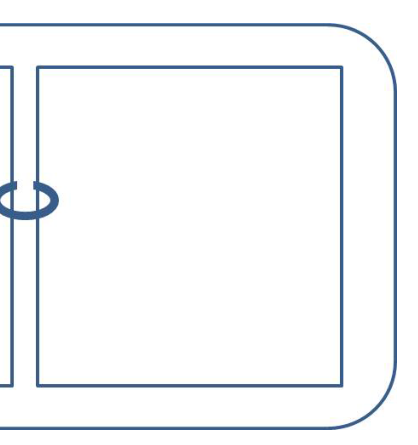
As shown in the diagram, the setup comprises of a metal box with a metal pole at the center. The mass of the metal box and pole is . A ring of mass slides down the pole with an acceleration . The frictional force between the ring and the pole is . The force of the box on the floor, when the ring is sliding down, is hence
- (A)
- (B)
- (C)
- (D)
- (E)
Fonte: Testo (PDF) — p.3 Topic: Newtonian Mechanics Metodi: Free-Body Diagram Competenze: Physical Reasoning Objects: Rod
Come mostrato nel diagramma, la struttura è costituita da una scatola di metallo con un palo di metallo al centro. La massa della scatola e del palo metallico è . Un anello di massa scorre verso il polo con un’accelerazione . La forza di attrito tra l’anello e il polo è . La forza della scatola sul pavimento, quando l’anello scivola verso il basso, è quindi
- (A)
- (B)
- (C)
- (D)
- (E)
Fonte: Testo (PDF) — p.3 Topic: Newtonian Mechanics Metodi: Free-Body Diagram Competenze: Physical Reasoning Objects: Rod
Suppose rain falls vertically into an open cart moving along a straight horizontal track with negligible friction as shown below.
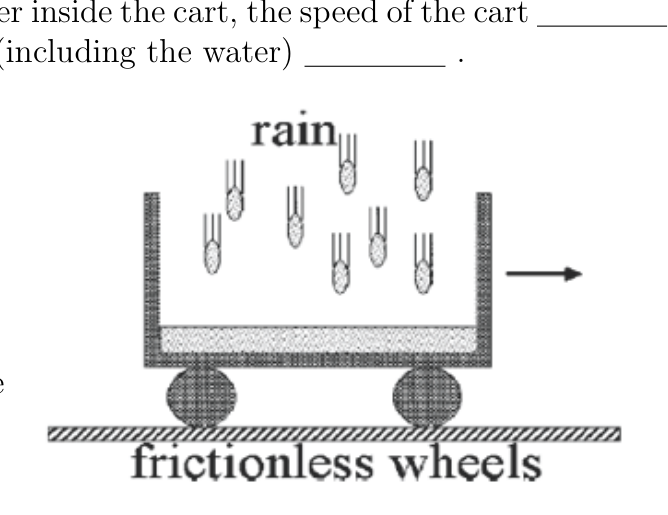
As a result of the accumulating water inside the cart, the speed of the cart ______ and the kinetic energy of the cart (including the water) ______.
- (A) increases, decreases
- (B) increases, stays the same
- (C) decreases, decreases
- (D) decreases, stays the same
- (E) does not change, stays the same
Fonte: Testo (PDF) — p.4 Topic: Conservation of Momentum Metodi: Conservation of Momentum Competenze: Physical Reasoning Objects: Cart
Supponiamo che pioggia cade verticalmente in un carrello aperto che si muove lungo una pista orizzontale dritta con un attrito trascurabile come mostrato di seguito.
A causa dell’accumulo di acqua all’interno del carrello, la velocità del carrello ______ e l’energia cinetica del carrello (compresa l’acqua) ______.
- **(A) ** aumenta, diminuisce
- **(B) ** aumenta, rimane lo stesso
- **(C) ** diminuisce, diminuisce
- **(D) ** diminuisce, rimane la stessa
- **(E) ** non cambia, rimane lo stesso
Fonte: Testo (PDF) — p.4 Topic: Conservation of Momentum Metodi: Conservation of Momentum Competenze: Physical Reasoning Objects: Cart
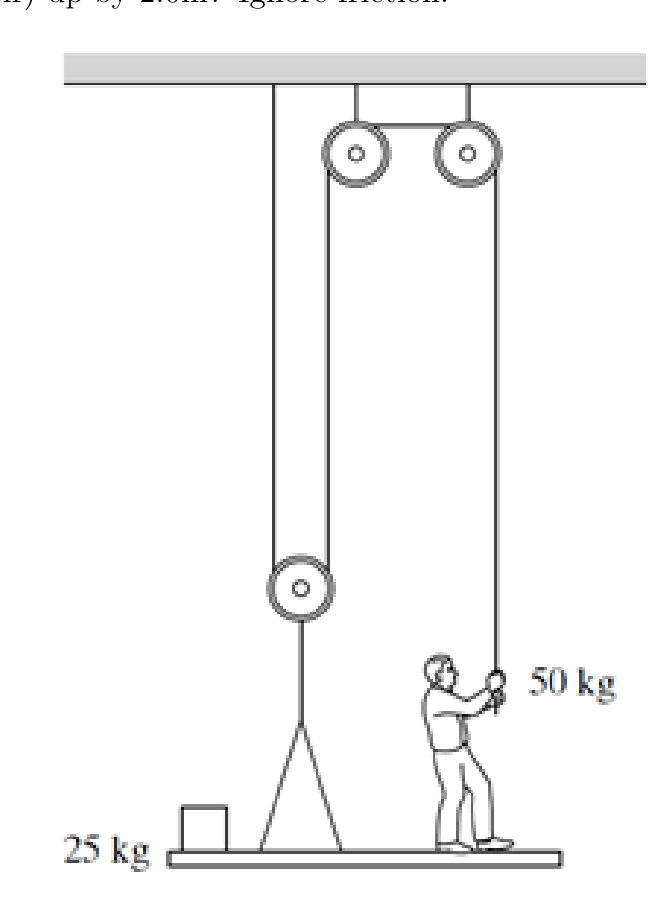
A kg person stands on a kg platform. He pulls on the rope that is attached to the platform via the frictionless pulley system shown here. If he pulls the platform up at a steady rate, with how much work does the person do in order to pull the platform (and himself) up by m? Ignore friction.
- (A) J
- (B) J
- (C) J
- (D) J
- (E) J
Fonte: Testo (PDF) — p.4 Topic: Conservation of Energy Metodi: Energy Conservation Method Competenze: Physical Reasoning Objects: String, Pulley
Una persona di kg si trova su una piattaforma di kg. Si tira sulla corda che è attaccata alla piattaforma tramite il sistema di pollice senza attrito mostrato qui. Se si fa un’alzata della piattaforma a ritmo costante, con quanto lavoro si fa per far salire la piattaforma (e se stesso) di m? Ignora gli attriti.
- (A) J
- (B) J
- (C) J
- (D) J
- (E) J
Fonte: Testo (PDF) — p.4 Topic: Conservation of Energy Metodi: Energy Conservation Method Competenze: Physical Reasoning Objects: String, Pulley
Consider two resistors and connected in parallel. is a fixed resistor and is a variable resistor. Which of the following is true about the effective resistance ?
- (A)
- (B)
- (C)
- (D)
- (E) None of the above.
Fonte: Testo (PDF) — p.5 Topic: Circuits Metodi: Equivalent Circuit Reduction Competenze: Physical Reasoning Objects: Resistor
Si consideri che due resistori e siano collegati in parallelo. è una resistenza fissa e è una resistenza variabile. Qual è la verità sulla resistenza efficace ?
- (A)
- (B)
- (C)
- (D)
- **(E) ** Nessuna delle seguenti.
Fonte: Testo (PDF) — p.5 Topic: Circuits Metodi: Equivalent Circuit Reduction Competenze: Physical Reasoning Objects: Resistor
The oxygen (molar mass g/mol) and nitrogen (molar mass g/mol) molecules in this room have equal average
- (A) kinetic energies but the oxygen molecules move faster.
- (B) kinetic energies but the oxygen molecules move slower.
- (C) kinetic energies and speeds.
- (D) speeds but the oxygen molecules have a higher average kinetic energy.
- (E) speeds but the oxygen molecules have a lower average kinetic energy.
Fonte: Testo (PDF) — p.5 Topic: Kinetic Theory Metodi: Kinetic Theory of Gases Competenze: Physical Reasoning Objects: Gas
Le molecole di ossigeno (massa molare g/mol) e di azoto (massa molare g/mol) presenti in questa stanza hanno una media uguale
- **(A) ** energie cinetiche ma le molecole di ossigeno si muovono più velocemente.
- **(B) ** energie cinetiche ma le molecole di ossigeno si muovono più lentamente.
- **(C) ** energie cinetiche e velocità.
- **(D) ** velocità ma le molecole di ossigeno hanno un’energia cinetica media superiore.
- **(E) ** velocità ma le molecole di ossigeno hanno un’energia cinetica media inferiore.
Fonte: Testo (PDF) — p.5 Topic: Kinetic Theory Metodi: Kinetic Theory of Gases Competenze: Physical Reasoning Objects: Gas
An isobaric process is one in which the pressure remains constant. In an isobaric expansion,
- (A) no work is done.
- (B) work is done on the gas.
- (C) work is done by the gas.
- (D) the temperature of the gas decreases.
- (E) no heat enters or leaves the system.
Fonte: Testo (PDF) — p.5 Topic: Thermodynamics Metodi: First Law of Thermodynamics Competenze: Physical Reasoning Objects: Gas
Un processo isobarico è quello in cui la pressione rimane costante. In una espansione isobarica,
- **(A) ** nessun lavoro è stato svolto.
- **(B) ** è eseguito il lavoro sul gas.
- **(C) ** il lavoro è svolto dal gas.
- **(D) ** la temperatura del gas diminuisce.
- **(E) ** non entra né esce del sistema calore.
Fonte: Testo (PDF) — p.5 Topic: Thermodynamics Metodi: First Law of Thermodynamics Competenze: Physical Reasoning Objects: Gas
In which process will the internal energy of the system not change?
- (A) An adiabatic expansion of an ideal gas.
- (B) An isothermal compression of an ideal gas.
- (C) An isobaric expansion of an ideal gas.
- (D) An isovolumetric (isochoric) compression of an ideal gas.
- (E) The freezing of some liquid at its melting point.
Fonte: Testo (PDF) — p.5 Topic: Thermodynamics Metodi: First Law of Thermodynamics Competenze: Physical Reasoning Objects: Gas
In quale processo l’energia interna del sistema non cambierà?
- **(A) ** Una espansione adiabatica di un gas ideale.
- **(B) ** Compressione isotermica di un gas ideale.
- **(C) ** Un’espansione isobarica di un gas ideale.
- **(D) ** Compressione isovolumetrica (isocorica) di un gas ideale.
- **(E) ** Il congelamento di un liquido al suo punto di fusione.
Fonte: Testo (PDF) — p.5 Topic: Thermodynamics Metodi: First Law of Thermodynamics Competenze: Physical Reasoning Objects: Gas
Calculate the force on a cm length of wire carrying a current of A at a direction as shown below. The magnetic field strength is T.
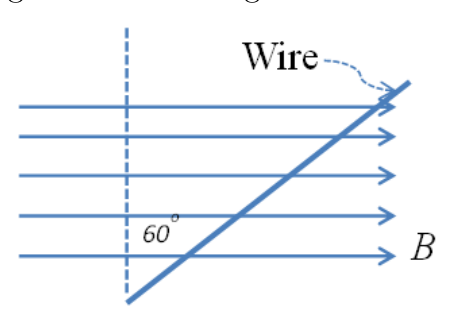
- (A) N
- (B) N
- (C) N
- (D) N
- (E) N
Fonte: Testo (PDF) — p.6 Topic: Magnetism Metodi: Lorentz Force Analysis Competenze: Physical Reasoning Objects: Wire
Calcolare la forza su un filo di cm di lunghezza che trasporta una corrente di A in una direzione come mostrato di seguito. La resistenza del campo magnetico è T.
- (A) N
- (B) N
- (C) N
- (D) N
- (E) N
Fonte: Testo (PDF) — p.6 Topic: Magnetism Metodi: Lorentz Force Analysis Competenze: Physical Reasoning Objects: Wire
Rank the penetration range of the following radiations, from the least penetrating radiation to the most penetrating radiation.
- (A) Heavy charged particles, gamma rays, positrons
- (B) Electrons, gamma rays, heavy charged particles
- (C) Gamma rays, heavy charged particles, electrons
- (D) Positrons, heavy charged particles, gamma rays
- (E) Heavy charged particles, electrons, gamma rays
Fonte: Testo (PDF) — p.6 Topic: Nuclear & Particle Physics Metodi: Physical Modeling Competenze: Physical Reasoning Objects: —
Rendi il raggio di penetrazione delle seguenti radiazioni, dalla radiazione meno penetrante alla radiazione più penetrante.
- **(A) ** Particelle cariche pesanti, raggi gamma, positroni
- **(B) ** Electroni, raggi gamma, particelle cariche pesanti
- **(C) ** raggi gamma, particelle cariche pesanti, elettroni
- **(D) ** Positroni, particelle cariche pesanti, raggi gamma
- **(E) ** Particelle, elettroni, raggi gamma carichi pesanti
Fonte: Testo (PDF) — p.6 Topic: Nuclear & Particle Physics Metodi: Physical Modeling Competenze: Physical Reasoning Objects: —
As shown in the figure below, a ball is thrown out horizontally from a slope. The slope makes an angle with the ground. At the first throw, the ball is ejected with a speed and at the second throw, it is ejected with a speed . The angles that the ball made with the slope are measured to be and respectively. If is greater than ,
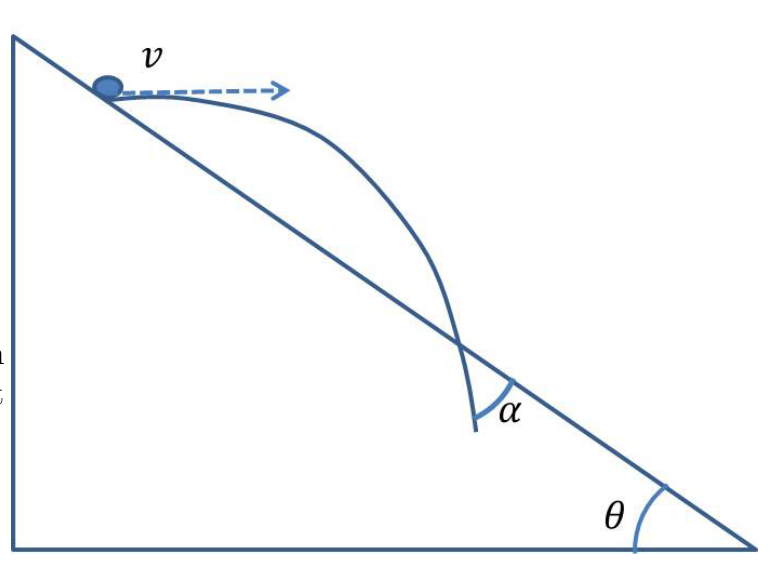
- (A)
- (B)
- (C)
- (D)
- (E) It is not possible to infer much as the mass of the ball is not given.
Fonte: Testo (PDF) — p.6 Topic: Newtonian Mechanics Metodi: Kinematic Equations Competenze: Physical Reasoning Objects: Ball, Inclined Plane
Come mostra la figura qui sotto, una palla viene lanciata orizzontalmente da una pendenza. La pendenza fa un angolo con il terreno. Il primo lancio prevede l’espulsione della palla con una velocità e il secondo lancio prevede l’espulsione con una velocità . Gli angoli che la palla fa con la pendenza sono misurati rispettivamente a e . Se è superiore a ,
- (A)
- (B)
- (C)
- (D)
- **(E) ** Non è possibile dedurre molto poiché non è data la massa della palla.
Fonte: Testo (PDF) — p.6 Topic: Newtonian Mechanics Metodi: Kinematic Equations Competenze: Physical Reasoning Objects: Ball, Inclined Plane
In the circuit given below, bulb is found to have burnt out. Which of the following voltmeters will give a reading of V?
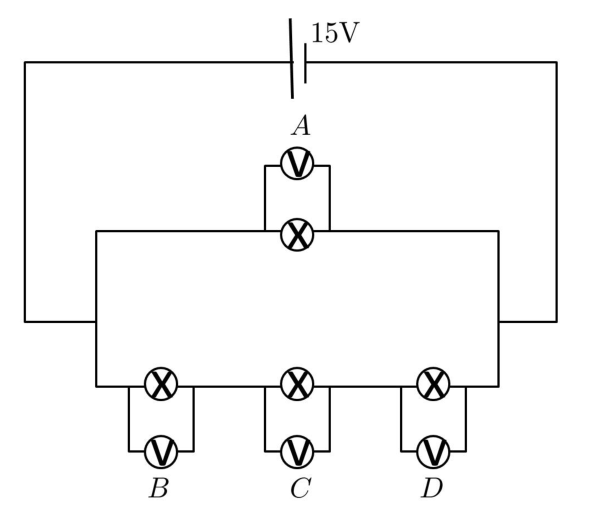
- (A) only.
- (B) and only.
- (C) only.
- (D) , and
- (E) All will give a V reading.
Fonte: Testo (PDF) — p.7 Topic: Circuits Metodi: Kirchhoff’s Laws Competenze: Physical Reasoning Objects: —
Nel circuito di seguito, si è scoperto che la lampadina si è bruciata. Quale dei seguenti voltometri fornirà una lettura di V?
- solo **(A) ** .
- solo **(B) ** e .
- solo **(C) ** .
- **(D) ** , e
- **(E) ** Tutti darebbero una lettura V.
Fonte: Testo (PDF) — p.7 Topic: Circuits Metodi: Kirchhoff’s Laws Competenze: Physical Reasoning Objects: —
A uniform circular piece of metal has initial radius . A circular piece is cut out of the center of the metal. The temperature of the metal is now raised so that the side lengths are increased by . What has happened to the area of the circular hole cut out of the center of the metal?
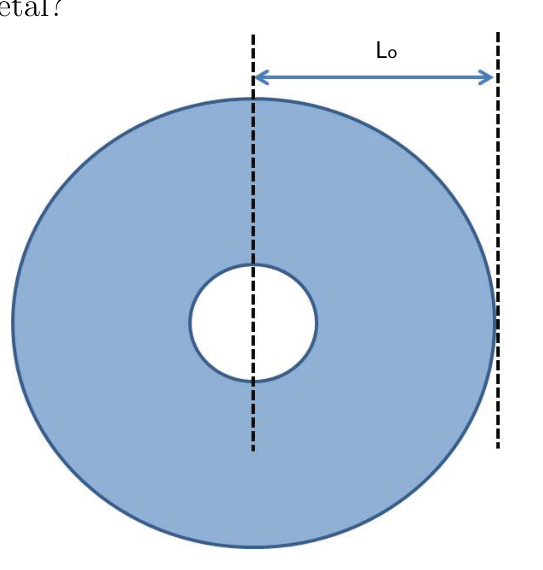
- (A) It is increased by .
- (B) It is increased by .
- (C) It is increased by .
- (D) It is decreased by .
- (E) It is decreased by .
Fonte: Testo (PDF) — p.7 Topic: Thermodynamics Metodi: Physical Modeling Competenze: Physical Reasoning Objects: Disk
Un pezzo di metallo circolare uniforme ha un raggio iniziale . Un pezzo circolare viene tagliato fuori dal centro del metallo. La temperatura del metallo viene ora sollevata in modo che le lunghezze laterali siano aumentate di . Cosa è successo alla zona del buco circolare tagliato fuori dal centro del metallo?
- **(A) ** È aumentato di .
- **(B) ** È aumentato di .
- **(C) ** È aumentato di .
- **(D) ** È ridotto di .
- **(E) ** È ridotto di .
Fonte: Testo (PDF) — p.7 Topic: Thermodynamics Metodi: Physical Modeling Competenze: Physical Reasoning Objects: Disk
Given a wave produced by a simple harmonic oscillator whose displacement in meters is given by the equation , what is the frequency of the wave?
- (A) Hz
- (B) Hz
- (C) Hz
- (D) Hz
- (E) Hz
Fonte: Testo (PDF) — p.7 Topic: Oscillations & Waves Metodi: Wave Equation Competenze: Physical Reasoning Objects: —
Data l’onda prodotta da un semplice oscillatore armonico il cui spostamento in metri è dato dall’equazione , qual è la frequenza dell’onda?
- (A) Hz
- (B) Hz
- (C) Hz
- (D) Hz
- (E) Hz
Fonte: Testo (PDF) — p.7 Topic: Oscillations & Waves Metodi: Wave Equation Competenze: Physical Reasoning Objects: —
Non-polarized light first passes through one polarizing filter and then through a second. If the intensity of light emerging from the second filter is of the light that struck the first filter, at what angle must the axes of the two filters be with respect to one another?
- (A)
- (B)
- (C)
- (D)
- (E)
Fonte: Testo (PDF) — p.8 Topic: Wave Optics Metodi: Physical Modeling Competenze: Physical Reasoning Objects: —
La luce non polarizzata passa prima attraverso un filtro polarizzante e poi attraverso un secondo. Se l’intensità della luce che emerge dal secondo filtro è della luce che ha colpito il primo filtro, a quale angolo devono essere gli assi dei due filtri rispetto l’uno all’altro?
- (A)
- (B)
- (C)
- (D)
- (E)
Fonte: Testo (PDF) — p.8 Topic: Wave Optics Metodi: Physical Modeling Competenze: Physical Reasoning Objects: —
The largest number of W light bulbs (arranged in parallel) that can safely be run from a V supply with a A fuse is
- (A)
- (B)
- (C)
- (D)
- (E)
Fonte: Testo (PDF) — p.8 Topic: Circuits Metodi: Equivalent Circuit Reduction Competenze: Physical Reasoning Objects: —
Il maggior numero di lampadine W (disposizionate in parallelo) che possono essere eseguite in sicurezza da un’alimentazione V con un Un fusibile è
- (A)
- (B)
- (C)
- (D)
- (E)
Fonte: Testo (PDF) — p.8 Topic: Circuits Metodi: Equivalent Circuit Reduction Competenze: Physical Reasoning Objects: —
Microwaves from an emitter are incident on a metal plate (). A probe is used to search for the reflected wave. Please see figure below. What is the distance such that the probe will receive microwaves of maximum intensity?
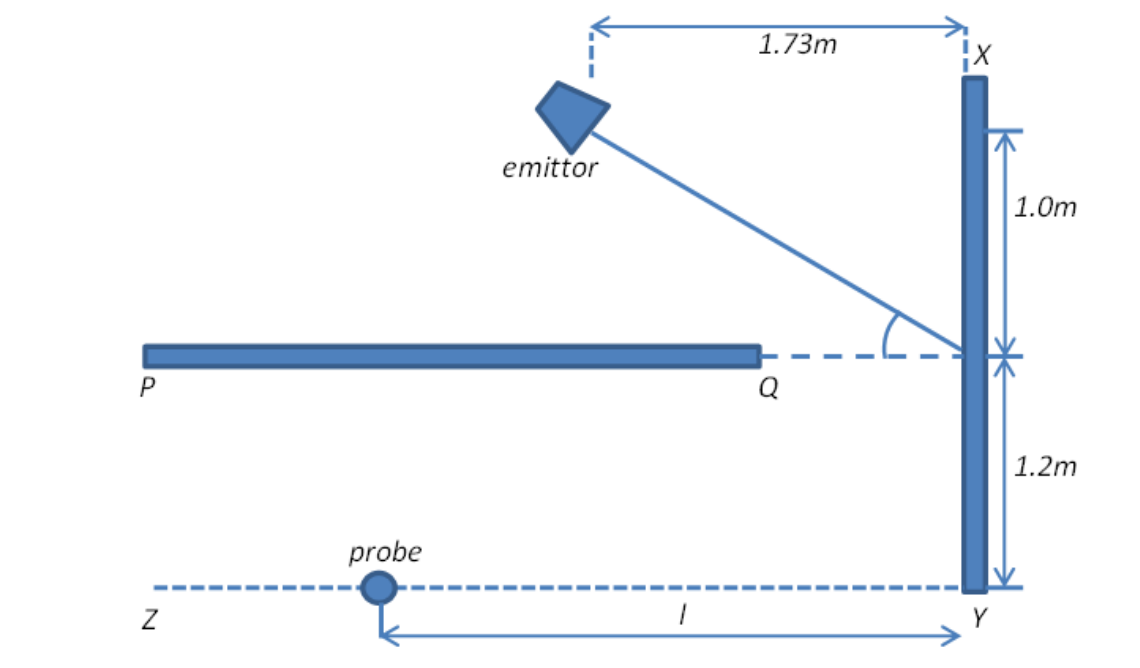
- (A) m
- (B) m
- (C) m
- (D) m
- (E) m
Fonte: Testo (PDF) — p.8 Topic: Wave Optics Metodi: Interference & Diffraction Analysis Competenze: Physical Reasoning Objects: —
Le microonde provenienti da un emittente sono incidenti su una piastra metallica (). Una sonda viene utilizzata per cercare l’onda riflessa. Si prega di vedere la figura qui sotto. Qual è la distanza tale che la sonda riceva microonde di massima intensità?
- (A) m
- (B) m
- (C) m
- (D) m
- (E) m
Fonte: Testo (PDF) — p.8 Topic: Wave Optics Metodi: Interference & Diffraction Analysis Competenze: Physical Reasoning Objects: —
In the question before this, the emitter’s frequency can be tuned. The probe is brought to a point m and is then removed. What should be the frequency of the emitted waves be so that microwave signals of maximum intensity can be picked up?
- (A) MHz
- (B) MHz
- (C) MHz
- (D) MHz
- (E) MHz
Fonte: Testo (PDF) — p.9 Topic: Wave Optics Metodi: Interference & Diffraction Analysis Competenze: Physical Reasoning Objects: —
Nella domanda precedente, la frequenza dell’emittente può essere regolata. La sonda viene portata a un punto m e viene quindi rimossa. Qual dovrebbe essere la frequenza delle onde emesse per poter percepire segnali a microonde di massima intensità?
- **(A) ** MHz
- **(B) ** MHz
- **(C) ** MHz
- **(D) ** MHz
- **(E) ** MHz
Fonte: Testo (PDF) — p.9 Topic: Wave Optics Metodi: Interference & Diffraction Analysis Competenze: Physical Reasoning Objects: —
Before a train enters a tunnel, it is important that it sounds its horn. The train velocity is km/h and the speed of sound is taken to be m/s. The echo of the horn signal is reflected off the surface of the cliff through which the tunnel runs. The echo is heard s after the driver sounds the horn. The distance of the train from the cliff at the time when the echo is heard is
- (A) m
- (B) m
- (C) m
- (D) m
- (E) m
Fonte: Testo (PDF) — p.9 Topic: Oscillations & Waves Metodi: Kinematic Equations Competenze: Physical Reasoning Objects: —
Prima che un treno entri in un tunnel, è importante che suoni il suo corno. La velocità del treno è km/h e la velocità del suono è presunta come m/s. L’eco del segnale del corno si riflette sulla superficie della scogliera attraverso la quale il tunnel attraversa. L’eco viene udito dopo che il conducente suona il corno. La distanza del treno dalla scogliera al momento in cui l’eco viene udito è
- (A) m
- (B) m
- (C) m
- (D) m
- (E) m
Fonte: Testo (PDF) — p.9 Topic: Oscillations & Waves Metodi: Kinematic Equations Competenze: Physical Reasoning Objects: —
In a Millikan oil drop experiment, an oil drop kg is held stationary between a pair of electric plates held at cm apart. The potential difference across the plates is V. What is the size of the charge on the oil droplet?
- (A) C
- (B) C
- (C) C
- (D) C
- (E) C
Fonte: Testo (PDF) — p.9 Topic: Electrostatics Metodi: Electric Potential Method Competenze: Physical Reasoning Objects: Droplet, Capacitor
In un esperimento di goccia di olio Millikan, una goccia di olio kg viene tenuta fermata tra una coppia di piastre elettriche tenute a cm di distanza. La differenza potenziale tra le piastre è V. Qual è la dimensione della carica sulla goccia di olio?
- (A) C
- (B) C
- (C) C
- (D) C
- (E) C
Fonte: Testo (PDF) — p.9 Topic: Electrostatics Metodi: Electric Potential Method Competenze: Physical Reasoning Objects: Droplet, Capacitor
When we stand on the ground, the ground pushes upwards against us with a normal contact force. The nature of this force is
- (A) electromagnetic
- (B) nuclear strong
- (C) gravitational
- (D) nuclear weak
- (E) electromotive force
Fonte: Testo (PDF) — p.10 Topic: Electromagnetism Metodi: Physical Modeling Competenze: Physical Reasoning Objects: —
Quando siamo in piedi a terra, la terra spinge verso l’alto contro di noi con una normale forza di contatto. La natura di questa forza è
- **(A) ** elettromagnetici
- **(B) ** nucleare
- **(C) ** gravitazionale
- **(D) ** nucleare debole
- **(E) ** forza elettromotrice
Fonte: Testo (PDF) — p.10 Topic: Electromagnetism Metodi: Physical Modeling Competenze: Physical Reasoning Objects: —
A body at rest explodes breaking into three pieces which move off at different velocities, all in the same horizontal plane. The following figure shows the experimental results as drawn from a stroboscopic photograph of the event. The time interval between flashes was s. The pieces and travel at right angles to each other and are collected after the explosion and their masses are found to be kg and kg respectively. Piece was unfortunately lost after the explosion. What is the mass of piece ?
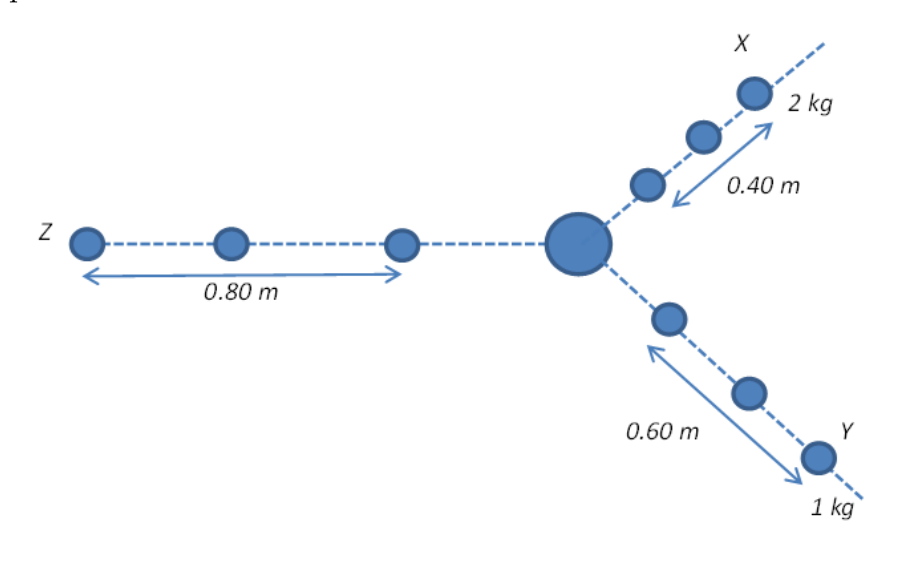
- (A) kg
- (B) kg
- (C) kg
- (D) kg
- (E) kg
Fonte: Testo (PDF) — p.10 Topic: Conservation of Momentum Metodi: Conservation of Momentum, Vector Decomposition Competenze: Physical Reasoning Objects: —
Un corpo in riposo esplode, si spezza in tre pezzi che si muovono a velocità diverse, tutti nello stesso piano orizzontale. La figura seguente mostra i risultati sperimentali tratti da una fotografia stroboscopica dell’evento. L’ intervallo di tempo tra i lampi è stato s. I pezzi e si spostano a angolo retto l’uno verso l’altro e vengono raccolti dopo l’esplosione e le loro masse risultano essere rispettivamente kg e kg. Piece was unfortunately lost after the explosion. Qual è la massa del pezzo ?
- (A) kg
- (B) kg
- (C) kg
- (D) kg
- (E) kg
Fonte: Testo (PDF) — p.10 Topic: Conservation of Momentum Metodi: Conservation of Momentum, Vector Decomposition Competenze: Physical Reasoning Objects: —
A person stands at a distance m from a mirror hung vertically on the wall. He can only see the upper half of his body. In order to see the entire length of his body, what should he do?
- (A) Place himself m away from the mirror
- (B) Place himself m away from the mirror
- (C) Place himself m away from the mirror
- (D) Place himself m away from the mirror
- (E) It would be a futile attempt to just move himself forward or backward from the mirror.
Fonte: Testo (PDF) — p.10 Topic: Geometric Optics Metodi: Ray Tracing Competenze: Physical Reasoning Objects: Mirror
Una persona si trova a una distanza m da uno specchio appeso verticalmente sulla parete. Può vedere solo la metà superiore del suo corpo. Per vedere tutta la lunghezza del suo corpo, cosa doveva fare?
- (A) Place himself m away from the mirror
- (B) Place himself m away from the mirror
- (C) Place himself m away from the mirror
- (D) Place himself m away from the mirror
- (E) It would be a futile attempt to just move himself forward or backward from the mirror.
Fonte: Testo (PDF) — p.10 Topic: Geometric Optics Metodi: Ray Tracing Competenze: Physical Reasoning Objects: Mirror
In the sketch below, the mercury is at the same level in the sealed, connected tubes , and . The cross sectional surface areas are such that and the air column above the mercury . If we are to let a small amount of mercury flow out of a valve at , which of the following will happen?
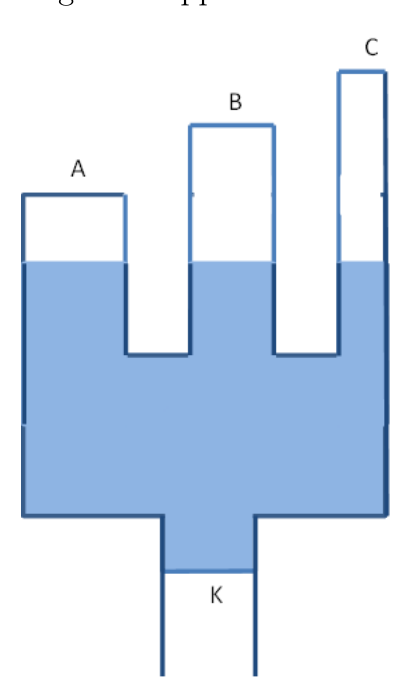
- (A) The mercury level at will be highest.
- (B) The mercury level at will be the highest.
- (C) The mercury level at will be the highest.
- (D) The mercury levels will be the same.
- (E) Not possible to predict the result given the circumstances.
Fonte: Testo (PDF) — p.11 Topic: Fluid Mechanics Metodi: Hydrostatic Equilibrium Competenze: Physical Reasoning Objects: Manometer, Tube
Nella figura di seguito, il mercurio è allo stesso livello nei tubi sigillati e collegati , e . Le superfici di sezione incrociata sono tali da e la colonna d’aria sopra il mercurio . Se lasciamo che una piccola quantità di mercurio esci da una valvola a , quale delle seguenti cose accadrà?
- **(A) ** Il livello di mercurio a sarà più elevato.
- **(B) ** Il livello di mercurio a sarà il più alto.
- **(C) ** Il livello di mercurio a sarà il più alto.
- **(D) ** I livelli di mercurio saranno gli stessi.
- **(E) ** Non è possibile prevedere il risultato date le circostanze.
Fonte: Testo (PDF) — p.11 Topic: Fluid Mechanics Metodi: Hydrostatic Equilibrium Competenze: Physical Reasoning Objects: Manometer, Tube
In the diagram as shown, the resistor loads have the same power rating. They are attached in the circuit as shown. The respective number of windings in the ratio is thus
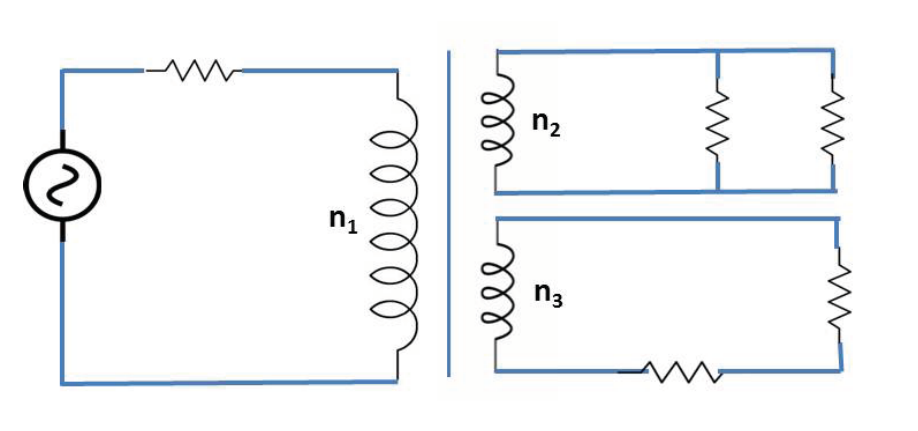
- (A)
- (B)
- (C)
- (D)
- (E)
Fonte: Testo (PDF) — p.11 Topic: Circuits Metodi: Equivalent Circuit Reduction Competenze: Physical Reasoning Objects: Coil, Resistor
Nel diagramma, come mostrato, i carichi della resistenza hanno la stessa potenza. Sono collegati al circuito come mostrato. Il numero rispettivo di arrotondamenti nel rapporto è quindi
- (A)
- (B)
- (C)
- (D)
- (E)
Fonte: Testo (PDF) — p.11 Topic: Circuits Metodi: Equivalent Circuit Reduction Competenze: Physical Reasoning Objects: Coil, Resistor
As shown in the diagram below, a mass with charge is sliding down the slope at constant velocity . When the mass enters the region with the uniform electric field ,
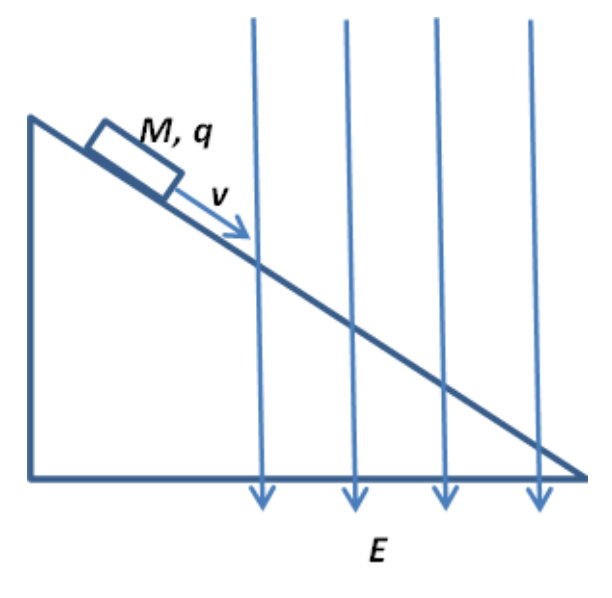
- (A) the mass will continue to slide down at constant velocity .
- (B) the velocity of the mass will increase as it slides down the slope.
- (C) the velocity of the mass will decrease as it slides down the slope.
- (D) the mass will come to a stop immediately.
- (E) the mass will reverse direction and accelerate up the slope.
Fonte: Testo (PDF) — p.12 Topic: Electrostatics Metodi: Free-Body Diagram, Vector Decomposition Competenze: Physical Reasoning Objects: Inclined Plane, Point Charge
Come mostrato nel diagramma di seguito, una massa con carica scende verso il basso della pendenza a velocità costante . Quando la massa entra nella regione con il campo elettrico uniforme ,
- **(A) ** la massa continuerà a scivolare verso il basso a velocità costante .
- **(B) ** la velocità della massa aumenterà mentre scorre lungo la pendenza.
- **(C) ** la velocità della massa diminuirà mentre scorre lungo la pendenza.
- **(D) ** la massa si fermerà immediatamente.
- **(E) ** la massa inverserà la direzione e accellerà la pendenza.
Fonte: Testo (PDF) — p.12 Topic: Electrostatics Metodi: Free-Body Diagram, Vector Decomposition Competenze: Physical Reasoning Objects: Inclined Plane, Point Charge
In the question above, we consider the case of applying an additional magnetic field pointing into the paper in the region where the electric field exists. We would expect that in the region where the fields exist,
- (A) the mass will continue to slide down at constant velocity .
- (B) the velocity of the mass will increase as it slides down the slope.
- (C) the velocity of the mass will decrease as it slides down the slope.
- (D) the mass will come to a stop immediately.
- (E) the mass will reverse direction and accelerate up the slope.
Fonte: Testo (PDF) — p.12 Topic: Electromagnetism Metodi: Lorentz Force Analysis, Free-Body Diagram Competenze: Physical Reasoning Objects: Inclined Plane, Point Charge
Nella domanda di cui sopra, consideriamo il caso di applicare un campo magnetico aggiuntivo che punta sulla carta nella regione in cui esiste il campo elettrico. Ci aspetteremmo che nella regione dove esistono i campi,
- **(A) ** la massa continuerà a scivolare verso il basso a velocità costante .
- **(B) ** la velocità della massa aumenterà mentre scorre lungo la pendenza.
- **(C) ** la velocità della massa diminuirà mentre scorre lungo la pendenza.
- **(D) ** la massa si fermerà immediatamente.
- **(E) ** la massa inverserà la direzione e accellerà la pendenza.
Fonte: Testo (PDF) — p.12 Topic: Electromagnetism Metodi: Lorentz Force Analysis, Free-Body Diagram Competenze: Physical Reasoning Objects: Inclined Plane, Point Charge
In the circuit below, the resistances of and are known. By assuming the ammeter has negligible resistance, the circuit can be used to measure the e.m.f and the internal resistance of the cell. However, the resistance of the ammeter can be significant. Under such circumstances, the measurements of e.m.f and are such that
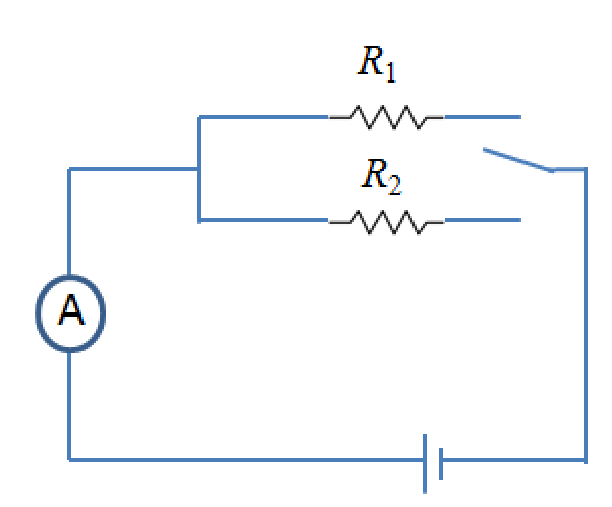
- (A) the measured e.m.f is lower than the true value and the measured is lower than its true value.
- (B) the measured e.m.f is lower than the true value and the measured is its true value.
- (C) the measured e.m.f is the true value and the measured is lower than its true value.
- (D) the measured e.m.f is the true value and the measured is higher than its true value.
- (E) the measured values of the e.m.f and are accurate.
Fonte: Testo (PDF) — p.13 Topic: Circuits Metodi: Kirchhoff’s Laws Competenze: Physical Reasoning Objects: Resistor, Battery
Nel circuito di seguito sono note le resistenze di e . Supponendo che l’ampilometro abbia una resistenza trascurabile, il circuito può essere utilizzato per misurare l’e.m.f e la resistenza interna della cella. Tuttavia, la resistenza dell’ampilometro può essere significativa. In tali circostanze, le misurazioni di e.m.f e sono tali da
- **(A) ** l’e.m.f misurato è inferiore al valore reale e il misurato è inferiore al suo valore reale.
- **(B) ** l’e.m.f misurato è inferiore al valore reale e il valore misurato è il suo valore reale.
- **(C) ** l’e.m.f misurato è il valore reale e il misurato è inferiore al suo valore reale.
- **(D) ** l’e.m.f misurata è il valore reale e il misurato è superiore al suo valore reale.
- **(E) ** i valori misurati delle e.m.f e sono precisi.
Fonte: Testo (PDF) — p.13 Topic: Circuits Metodi: Kirchhoff’s Laws Competenze: Physical Reasoning Objects: Resistor, Battery
A red ball is resting on a blue carpet. If white light is shone on them and they are viewed through a green filter, which of the following will the observer see?
- (A) A black ball on a black carpet
- (B) A red ball on a blue carpet
- (C) A green ball on a green carpet
- (D) A yellow ball on a cyan carpet
- (E) A magenta ball on a cyan carpet
Fonte: Testo (PDF) — p.13 Topic: Wave Optics Metodi: Physical Modeling Competenze: Physical Reasoning Objects: Ball
Una palla rossa sta appoggiando su un tappeto blu. Se si illumina una luce bianca e si vedono attraverso un filtro verde, quale di queste osservazioni vedrà l’osservatore?
- **(A) ** Una palla nera su un tappeto nero
- **(B) ** Una palla rossa su un tappeto blu
- **(C) ** Una palla verde su un tappeto verde
- **(D) ** Una palla gialla su un tappeto di cian
- **(E) ** Una palla magenta su un tappeto di cian
Fonte: Testo (PDF) — p.13 Topic: Wave Optics Metodi: Physical Modeling Competenze: Physical Reasoning Objects: Ball
According to a thermodynamic model of the cooking process, the time required to cook a joint of meat mass is given by the formula
where , and are respectively the density, specific heat capacity and thermal conductivity of the meat and is a dimensionless constant with a value of . Using dimensional analysis, the value of is
- (A)
- (B)
- (C)
- (D)
- (E)
Fonte: Testo (PDF) — p.14 Topic: Thermodynamics Metodi: Dimensional Analysis Competenze: Physical Reasoning Objects: —
Secondo un modello termodinamico del processo di cottura, il tempo necessario per cucinare un’insieme di massa è indicato dalla formula
dove , e rappresentano rispettivamente la densità, la capacità termica specifica e la conducibilità termica della carne e è una costante senza dimensioni con un valore di . L’analisi dimensionale indica che il valore di è
- (A)
- (B)
- (C)
- (D)
- (E)
Fonte: Testo (PDF) — p.14 Topic: Thermodynamics Metodi: Dimensional Analysis Competenze: Physical Reasoning Objects: —
Water in a central heating system enters a kW boiler at a temperature of and leaves at a temperature of . How much water flows through the boiler each second?
- (A) g/s
- (B) g/s
- (C) g/s
- (D) g/s
- (E) g/s
Fonte: Testo (PDF) — p.14 Topic: Thermodynamics Metodi: First Law of Thermodynamics Competenze: Physical Reasoning Objects: Container
L’acqua di un sistema di riscaldamento centrale entra in una caldaia kW a una temperatura di e si lascia a una temperatura di . Quanta acqua scorre attraverso la caldaia ogni secondo?
- (A) g/s
- (B) g/s
- (C) g/s
- (D) g/s
- (E) g/s
Fonte: Testo (PDF) — p.14 Topic: Thermodynamics Metodi: First Law of Thermodynamics Competenze: Physical Reasoning Objects: Container
The count rate from a radioactive source is measured at one minute intervals. The results are recorded as follows:
| Time / s | |||
|---|---|---|---|
| Counts per second |
What is the approximate value of the half-life?
- (A) s
- (B) s
- (C) s
- (D) s
- (E) s
Fonte: Testo (PDF) — p.14 Topic: Nuclear & Particle Physics Metodi: Radioactive Decay Law Competenze: Physical Reasoning Objects: Nucleus
Il tasso di conteggio da una fonte radioattiva è misurato a intervalli di un minuto. I risultati sono riportati come segue:
| Time / s | |||
|---|---|---|---|
| Counts per second |
Qual è il valore approssimativo della metavita?
- (A) s
- (B) s
- (C) s
- (D) s
- (E) s
Fonte: Testo (PDF) — p.14 Topic: Nuclear & Particle Physics Metodi: Radioactive Decay Law Competenze: Physical Reasoning Objects: Nucleus
A candle is lighted in a gas jar as shown below. If the jar swings in a circle about at a constant speed, in which direction will the flame of the candle point?
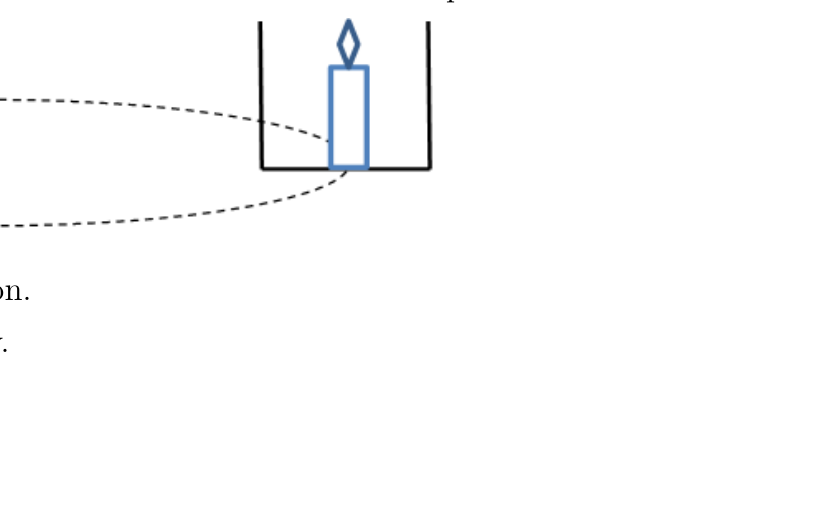
- (A) Forward, in the direction of motion.
- (B) Backward, opposite to its velocity.
- (C) Still vertically upwards.
- (D) Inward, points towards .
- (E) Outwards, away from .
Fonte: Testo (PDF) — p.15 Topic: Newtonian Mechanics Metodi: Physical Modeling Competenze: Physical Reasoning Objects: Container
Una candela viene accesa in un vaso di gas come mostrato di seguito. Se il vaso oscilla in un cerchio di circa a una velocità costante, in quale direzione la fiamma della candela punta?
- **(A) ** In avanti, nella direzione del movimento.
- **(B) ** In ritardo, opposto alla sua velocità.
- **(C) ** Ancora verticalmente verso l’alto.
- **(D) ** In direzione, puntando verso .
- **(E) ** All’esterno, lontano da .
Fonte: Testo (PDF) — p.15 Topic: Newtonian Mechanics Metodi: Physical Modeling Competenze: Physical Reasoning Objects: Container
As shown in the following figure, each resistor has a resistance of . What is the effective resistance between point and ?
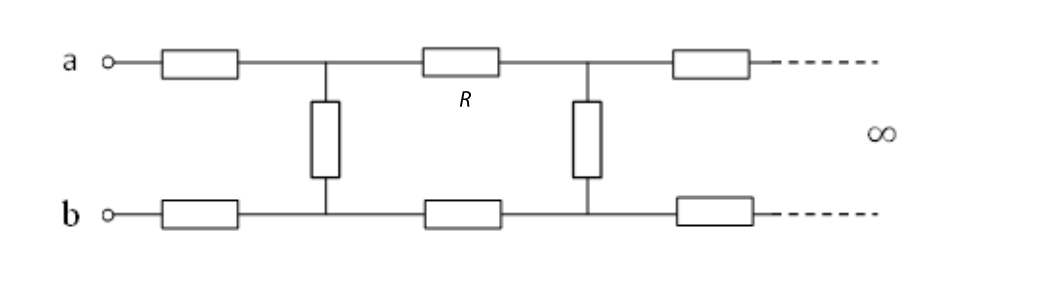
- (A)
- (B)
- (C)
- (D)
- (E)
Fonte: Testo (PDF) — p.15 Topic: Circuits Metodi: Equivalent Circuit Reduction, Symmetry Argument Competenze: Physical Reasoning Objects: Resistor
Come mostrato nella figura seguente, ogni resistore ha una resistenza di . Qual è la resistenza effettiva tra il punto e ?
- (A)
- (B)
- (C)
- (D)
- (E)
Fonte: Testo (PDF) — p.15 Topic: Circuits Metodi: Equivalent Circuit Reduction, Symmetry Argument Competenze: Physical Reasoning Objects: Resistor
A thunder cloud and the earth’s surface may be regarded as a pair of charged parallel plates separated by a distance . The capacitance of the system is . When a lightning strike of mean current and time duration occurs, the electric field strength between the cloud and the earth is reduced by

- (A)
- (B)
- (C)
- (D)
- (E)
Fonte: Testo (PDF) — p.15 Topic: Electrostatics Metodi: Physical Modeling Competenze: Physical Reasoning Objects: Capacitor
Una nuvola di tuoni e la superficie terrestre possono essere considerate come una coppia di piastre parallele cariche separate da una distanza . La capacità del sistema è . Quando si verifica un fulmine di corrente media e durata temporale , la forza del campo elettrico tra la nuvola e la terra viene ridotta di
- (A)
- (B)
- (C)
- (D)
- (E)
Fonte: Testo (PDF) — p.15 Topic: Electrostatics Metodi: Physical Modeling Competenze: Physical Reasoning Objects: Capacitor
A spring balance reads g when an iron ring is weighed in water. What will the balance read if the ring is now weighed in oil? The densities for water, oil and iron are kg/m³, kg/m³ and kg/m³ respectively.
- (A) g
- (B) g
- (C) g
- (D) g
- (E) g
Fonte: Testo (PDF) — p.16 Topic: Fluid Mechanics Metodi: Hydrostatic Equilibrium Competenze: Physical Reasoning Objects: Spring
Il bilanciamento delle molle si legge g quando un anello di ferro è pesato in acqua. Cosa leggera’ la bilancia se l’anello viene pesato con olio? Le densità per l’acqua, il petrolio e il ferro sono rispettivamente kg/m3, kg/m3 e kg/m3.
- (A) g
- (B) g
- (C) g
- (D) g
- (E) g
Fonte: Testo (PDF) — p.16 Topic: Fluid Mechanics Metodi: Hydrostatic Equilibrium Competenze: Physical Reasoning Objects: Spring
A system of particles, each of which is either an electron or a proton, has a net charge of C. What is the total mass of this system?
- (A) kg
- (B) kg
- (C) kg
- (D) kg
- (E) kg
Fonte: Testo (PDF) — p.16 Topic: Electrostatics Metodi: Physical Modeling Competenze: Physical Reasoning Objects: Electron, Nucleus
Un sistema di particelle , ognuna delle quali è un elettrone o un protone, ha una carica netta di C. Qual è la massa totale di questo sistema?
- (A) kg
- (B) kg
- (C) kg
- (D) kg
- (E) kg
Fonte: Testo (PDF) — p.16 Topic: Electrostatics Metodi: Physical Modeling Competenze: Physical Reasoning Objects: Electron, Nucleus
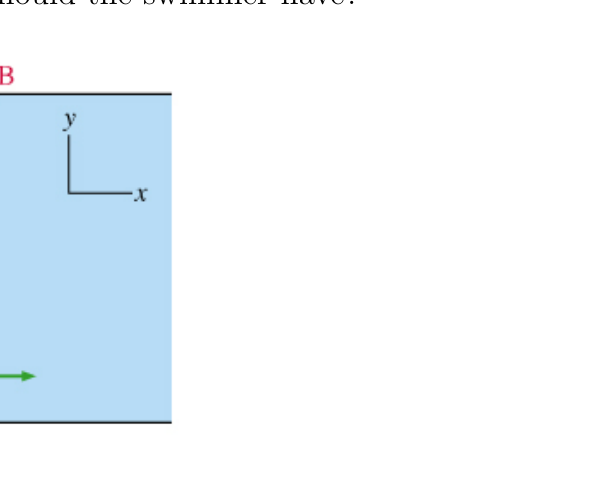
A swimmer wants to cross a river, from point to point , as shown in the figure. The distances and are m and m respectively. The speed of the river current, is km/h. Suppose that the swimmer’s velocity relative to the water makes an angle of with the line as indicated in the figure. To directly reach point , what speed , relative to the water, should the swimmer have?
- (A) km/h
- (B) km/h
- (C) km/h
- (D) km/h
- (E) km/h
Fonte: Testo (PDF) — p.16 Topic: Newtonian Mechanics Metodi: Vector Decomposition Competenze: Physical Reasoning Objects: —
Un nuotatore vuole attraversare un fiume, dal punto al punto , come mostrato nella figura. Le distanze e sono rispettivamente m e m. La velocità della corrente fluviale, , è km/h. Supponiamo che la velocità del nuotatore rispetto all’acqua faccia un angolo di con la linea come indicato nella figura. Per raggiungere direttamente il punto , quale velocità , rispetto all’acqua, dovrebbe avere il nuotatore?
- (A) km/h
- (B) km/h
- (C) km/h
- (D) km/h
- (E) km/h
Fonte: Testo (PDF) — p.16 Topic: Newtonian Mechanics Metodi: Vector Decomposition Competenze: Physical Reasoning Objects: —
Two projectiles of same mass are fired from the ground and they land at the same horizontal level. Ratio of their minimum kinetic energies is and the ratio of maximum heights attained by them is also . Find the ratio of their horizontal ranges.
- (A)
- (B)
- (C)
- (D)
- (E) None of the above
Fonte: Testo (PDF) — p.17 Topic: Newtonian Mechanics Metodi: Kinematic Equations Competenze: Physical Reasoning Objects: Projectile
Due proiettili della stessa massa vengono sparati dal suolo e atterrano allo stesso livello orizzontale. Il rapporto delle loro energie cinetiche minime è e il rapporto delle altezze massime raggiunte da loro è anche . Trova il rapporto tra le loro intervalli orizzontali.
- (A)
- (B)
- (C)
- (D)
- **(E) ** Nessuna delle seguenti:
Fonte: Testo (PDF) — p.17 Topic: Newtonian Mechanics Metodi: Kinematic Equations Competenze: Physical Reasoning Objects: Projectile
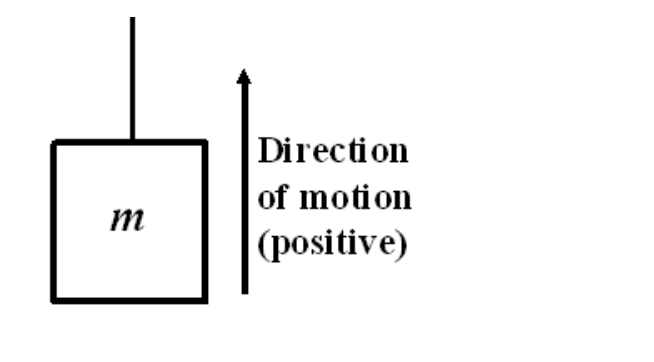
A block of mass is attached to a horizontal inextensible string and is moving upwards as shown in the figure below. Breaking strength of the string is . The maximum positive and negative accelerations that the block can have are
- (A) and respectively.
- (B) and respectively.
- (C) and respectively.
- (D) and respectively.
- (E) and respectively.
Fonte: Testo (PDF) — p.17 Topic: Newtonian Mechanics Metodi: Free-Body Diagram Competenze: Physical Reasoning Objects: Block, String
Un blocco di massa è attaccato a una corda orizzontale inestensibile e si muove verso l’alto come mostrato nella figura seguente. La forza di rottura della corda è . Le accelerazioni massime positive e negative che il blocco può avere sono:
- **(A) ** e rispettivamente.
- **(B) ** e rispettivamente.
- **(C) ** e rispettivamente.
- **(D) ** e rispettivamente.
- **(E) ** e rispettivamente.
Fonte: Testo (PDF) — p.17 Topic: Newtonian Mechanics Metodi: Free-Body Diagram Competenze: Physical Reasoning Objects: Block, String
A uniform chain of length and mass is lying on a smooth table. One third of its length is hanging vertically down over the edge of the table and the remaining two third is on the table. If is the acceleration due to gravity, what is the work required to pull the hanging part onto the table?
- (A)
- (B)
- (C)
- (D)
- (E)
Fonte: Testo (PDF) — p.17 Topic: Conservation of Energy Metodi: Energy Conservation Method Competenze: Physical Reasoning Objects: String
Una catena uniforme di lunghezza e massa si trova su un tavolo liscio. Un terzo della sua lunghezza è appeso verticalmente sul bordo del tavolo e i due terzi restanti sono sul tavolo. Se è l’accelerazione dovuta alla gravità, quale è il lavoro necessario per tirare la parte appesa sul tavolo?
- (A)
- (B)
- (C)
- (D)
- (E)
Fonte: Testo (PDF) — p.17 Topic: Conservation of Energy Metodi: Energy Conservation Method Competenze: Physical Reasoning Objects: String
Two satellites and have the same kinetic energy. Which of the statement is false?
- (A) The satellite with greater mass has longer period.
- (B) The satellite with greater mass has larger radius.
- (C) The satellite with greater angular velocity has smaller radius.
- (D) The satellite with greater velocity has higher total energy.
- (E) None of the above
Fonte: Testo (PDF) — p.18 Topic: Gravitation Metodi: Newton’s Law of Gravitation Competenze: Physical Reasoning Objects: Satellite
Due satelliti e hanno la stessa energia cinetica. Quale di queste dichiarazioni è falsa?
- **(A) ** Il satellite con una massa maggiore ha un periodo di tempo più lungo.
- **(B) ** Il satellite con maggiore massa ha un raggio più ampio.
- **(C) ** Il satellite con maggiore velocità angolare ha un raggio inferiore.
- **(D) ** Il satellite con maggiore velocità ha un’energia totale superiore.
- **(E) ** Nessuna delle seguenti:
Fonte: Testo (PDF) — p.18 Topic: Gravitation Metodi: Newton’s Law of Gravitation Competenze: Physical Reasoning Objects: Satellite
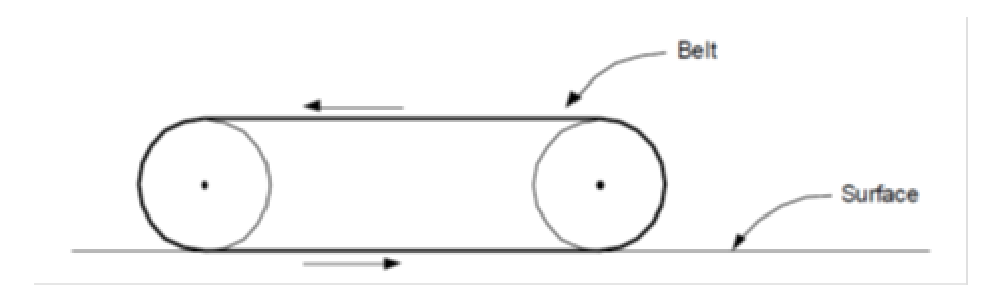
An electric sander has a continuous belt that rubs against a wood surface as shown schematically below. The sander is per cent efficient and draws a current of A from a V power. The belt speed is m/s. If the sander is pushing against the wood with a normal force of N, the coefficient of friction is most nearly
- (A)
- (B)
- (C)
- (D)
- (E)
Fonte: Testo (PDF) — p.18 Topic: Newtonian Mechanics Metodi: Free-Body Diagram Competenze: Physical Reasoning Objects: —
Un lampadino elettrico ha una cintura continua che si strofinano contro una superficie di legno come illustrato schematicamente qui sotto. Il lampadino è efficace al per cento e attinge una corrente di A da una potenza V. La velocità della cintura è m/s. Se il lampadino spinge contro il legno con una forza normale di N, il coefficiente di attrito è quasi
- (A)
- (B)
- (C)
- (D)
- (E)
Fonte: Testo (PDF) — p.18 Topic: Newtonian Mechanics Metodi: Free-Body Diagram Competenze: Physical Reasoning Objects: —
A rocket () is moving with constant speed relative to the earth. A second rocket () overtakes the first rocket () with a constant speed of m/s (seen by observer in first rocket ). Which of the following is true about the speed of the second rocket () relative to earth?
- (A) smaller than m/s
- (B) larger than m/s
- (C) exactly m/s
- (D) m/s
- (E) None of the above.
Fonte: Testo (PDF) — p.18 Topic: Special Relativity Metodi: Lorentz Transformation Competenze: Physical Reasoning Objects: —
Un razzo () si muove a velocità costante rispetto alla terra. Un secondo razzo () supera il primo razzo () con una velocità costante di m/s (visto dall’osservatore nel primo razzo ). Quale delle seguenti cose è vera riguardo alla velocità del secondo razzo () rispetto alla Terra?
- **(A) ** inferiore a m/s
- **(B) ** più grande di m/s
- **(C) ** esattamente m/s
- (D) m/s
- **(E) ** Nessuna delle seguenti.
Fonte: Testo (PDF) — p.18 Topic: Special Relativity Metodi: Lorentz Transformation Competenze: Physical Reasoning Objects: —
If on average, each fission reaction of U releases MeV of energy, how many nuclei of U are split in a -MW reactor in one second?
- (A)
- (B)
- (C)
- (D)
- (E)
Fonte: Testo (PDF) — p.19 Topic: Nuclear & Particle Physics Metodi: Mass-Energy Equivalence Competenze: Physical Reasoning Objects: Nucleus
Se in media ogni reazione di fissione di U rilascia MeV di energia, quanti nuclei di U sono divisi in un reattore -MW in un secondo?
- (A)
- (B)
- (C)
- (D)
- (E)
Fonte: Testo (PDF) — p.19 Topic: Nuclear & Particle Physics Metodi: Mass-Energy Equivalence Competenze: Physical Reasoning Objects: Nucleus
The speed of sound is m/s in air and m/s in water. A sound of Hz is made under the water and travels to the air. In the air,
- (A) the frequency remains the same but the wavelength is shorter.
- (B) the frequency is higher but the wavelength remains the same.
- (C) the frequency will be lower but the wavelength is longer.
- (D) the frequency will be lower and the wavelength is shorter.
- (E) both the frequency and wavelengths remain the same.
Fonte: Testo (PDF) — p.19 Topic: Oscillations & Waves Metodi: Wave Equation Competenze: Physical Reasoning Objects: —
La velocità del suono è m/s nell’aria e m/s nell’acqua. Un suono di Hz viene prodotto sotto l’acqua e viaggia verso l’aria. In aria,
- **(A) ** la frequenza rimane la stessa ma la lunghezza d’onda è più breve.
- **(B) ** la frequenza è più alta ma la lunghezza d’onda rimane la stessa.
- **(C) ** la frequenza sarà inferiore ma la lunghezza d’onda è più lunga.
- **(D) ** la frequenza sarà inferiore e la lunghezza d’onda più breve.
- **(E) ** sia la frequenza che le lunghezze d’onda rimangono le stesse.
Fonte: Testo (PDF) — p.19 Topic: Oscillations & Waves Metodi: Wave Equation Competenze: Physical Reasoning Objects: —
Suppose you wanted to start a fire using sunlight and a mirror. Which of the following statements is most accurate?
- (A) It would be best to use a plane mirror.
- (B) It would be best to use a convex mirror.
- (C) It would be best to use a concave mirror, with the object to be ignited positioned at the centre of curvature of the mirror.
- (D) It would be best to use a concave mirror, with the object to be ignited positioned halfway between the mirror and its centre of curvature.
- (E) It is impossible to start a fire as mirrors form only virtual images.
Fonte: Testo (PDF) — p.19 Topic: Geometric Optics Metodi: Ray Tracing Competenze: Physical Reasoning Objects: Mirror
Supponiamo che tu voglia accendere un fuoco usando la luce solare e uno specchio. Quale delle seguenti affermazioni è più accurata?
- **(A) ** Sarebbe meglio usare uno specchio a piano.
- **(B) ** È meglio usare uno specchio convexo.
- **(C) ** È meglio usare uno specchio concavo, con l’oggetto da accendere posizionato al centro della curvatura dello specchio.
- **(D) ** È meglio usare uno specchio concavo, con l’oggetto da accendere posizionato a metà strada tra lo specchio e il suo centro di curvatura.
- **(E) ** È impossibile accendere un fuoco poiché gli specchi formano solo immagini virtuali.
Fonte: Testo (PDF) — p.19 Topic: Geometric Optics Metodi: Ray Tracing Competenze: Physical Reasoning Objects: Mirror
In order for an atom to emit light, it must be
- (A) in the gaseous state.
- (B) stimulated by external radiation.
- (C) in its ground state.
- (D) in an excited state.
- (E) fluorescent.
Fonte: Testo (PDF) — p.19 Topic: Modern-Quantum Physics Metodi: Bohr Model & Quantization Competenze: Physical Reasoning Objects: Atom, Photon
Per un atomo emettere luce, deve essere
- **(A) ** in stato gassoso.
- **(B) ** stimolata da radiazioni esterne.
- **(C) ** nello stato di base.
- **(D) ** in stato eccitato.
- **(E) ** fluorescente.
Fonte: Testo (PDF) — p.19 Topic: Modern-Quantum Physics Metodi: Bohr Model & Quantization Competenze: Physical Reasoning Objects: Atom, Photon
The particle nature of light is best illustrated by which of the following?
- (A) The scattering of alpha particles from gold foil.
- (B) The fact that hot objects emit electromagnetic radiation.
- (C) The diffraction pattern observed when a beam of electrons is scattered by a crystal.
- (D) The fact that a rainbow consists of a continuous spectrum of colours.
- (E) The ejection of electrons from a metal surface illuminated by light.
Fonte: Testo (PDF) — p.20 Topic: Modern-Quantum Physics Metodi: Photon Energy Relation Competenze: Physical Reasoning Objects: Photon, Electron
La natura particulare della luce è meglio illustrata da quale dei seguenti?
- **(A) ** La dispersione delle particelle alfa dalla carta d’oro.
- **(B) ** Il fatto che gli oggetti caldi emettono radiazioni elettromagnetiche.
- **(C) ** Il modello di diffrazione osservato quando un fascio di elettroni è disperso da un cristallo.
- **(D) ** Il fatto che un arcobaleno sia costituito da un continuato spettro di colori.
- **(E) ** L’espulsione di elettroni da una superficie metallica illuminata dalla luce.
Fonte: Testo (PDF) — p.20 Topic: Modern-Quantum Physics Metodi: Photon Energy Relation Competenze: Physical Reasoning Objects: Photon, Electron