Two identical masses, A and B, are tied to strings and placed on a horizontal frictionless disc as in the figure below. The two masses are then set to move about the centre of the disc with the same angular velocity . Given that the tension of the string connecting mass A to the center of the disc is , determine the tension of the string connecting mass B to mass A.
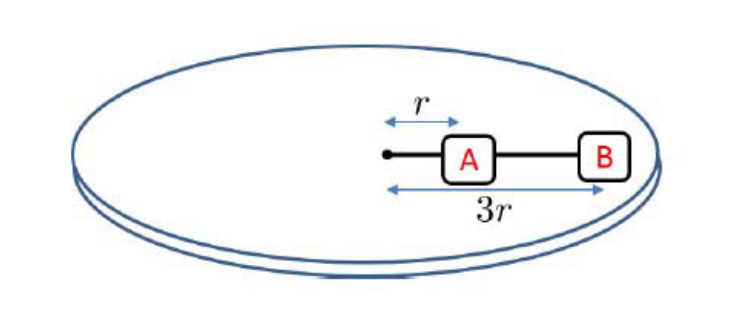
- (A)
- (B)
- (C)
- (D)
- (E)
Fonte: Testo (PDF) — p.3 Topic: Newtonian Mechanics Metodi: Vector Decomposition, Free-Body Diagram Competenze: Physical Reasoning Objects: Block, String, Disk
Due masse identiche, A e B, sono legate a corde e posizionate su un disco orizzontale senza attrito come nella figura di seguito. Le due masse sono quindi impostate per muoversi intorno al centro del disco con la stessa velocità angolare . Dato che la tensione della massa di stringhe A che collega il disco al centro è , determinare la tensione della massa di stringhe B a massa A.
- (A)
- (B)
- (C)
- (D)
- (E)
Fonte: Testo (PDF) — p.3 Topic: Newtonian Mechanics Metodi: Vector Decomposition, Free-Body Diagram Competenze: Physical Reasoning Objects: Block, String, Disk
A cube is attached to a spring and allowed to be half immersed in a beaker of liquid, as shown in the diagram below. The density of the cube is higher than that of the liquid. Let the volume of the beaker be , the volume of the cube be and the spring constant be . At this point, the extension of the spring is . The acceleration of gravity is denoted as . An additional volume of the same liquid is now poured into the beaker until the cube is fully submerged. The extension of the spring changes to . Besides some of the other variables, i.e., , , , and , given in this question, which other quantity do we need to know if we want to compute the difference between the two extensions, ?
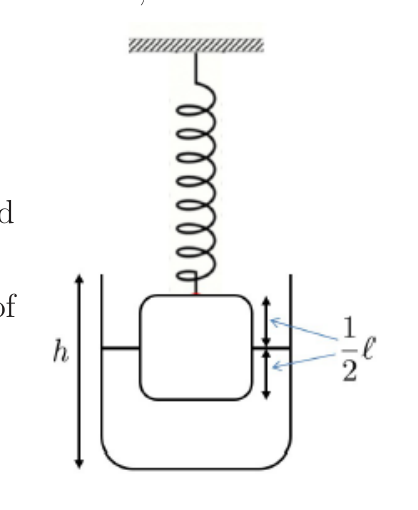
- (A) Density of the cube only.
- (B) Density of the liquid only.
- (C) Ratio of the densities of the cube and the liquid only.
- (D) Difference between the densities of the cube and the liquid only.
- (E) Mass of the cube.
Fonte: Testo (PDF) — p.3 Topic: Fluid Mechanics Metodi: Hydrostatic Equilibrium, Hooke’s Law Competenze: Physical Reasoning Objects: Block, Spring, Container
Un cubo è attaccato a una sorgente e può essere messo a metà in una tazza di liquido, come mostrato nel diagramma di seguito. La densità del cubo è superiore a quella del liquido. Il volume del bicchiere deve essere , il volume del cubo e la costante di primavera . A questo punto, l’estensione della molla è . L’accelerazione della gravità è indicata come . Un ulteriore volume dello stesso liquido viene versato nel bicchiere fino a che il cubo non è completamente sommerso. L’estensione della molla cambia a . Oltre ad alcune delle altre variabili, vale a dire , , , e , date in questa domanda, quale altra quantità dobbiamo sapere se vogliamo calcolare la differenza tra le due estensioni, ?
- **(A) ** Solo densità del cubo.
- **(B) ** Solo densità del liquido.
- **(C) ** Rapporto delle densità del cubo e del solo liquido.
- **(D) ** Differenza tra la densità del cubo e solo del liquido.
- **(E) ** Massa del cubo.
Fonte: Testo (PDF) — p.3 Topic: Fluid Mechanics Metodi: Hydrostatic Equilibrium, Hooke’s Law Competenze: Physical Reasoning Objects: Block, Spring, Container
Two bulbs X and Y are connected by a tube P as shown below. Both bulbs have different air pressure, and there is a non zero pressure in P. Which of the following are possible values of and (in cm)?
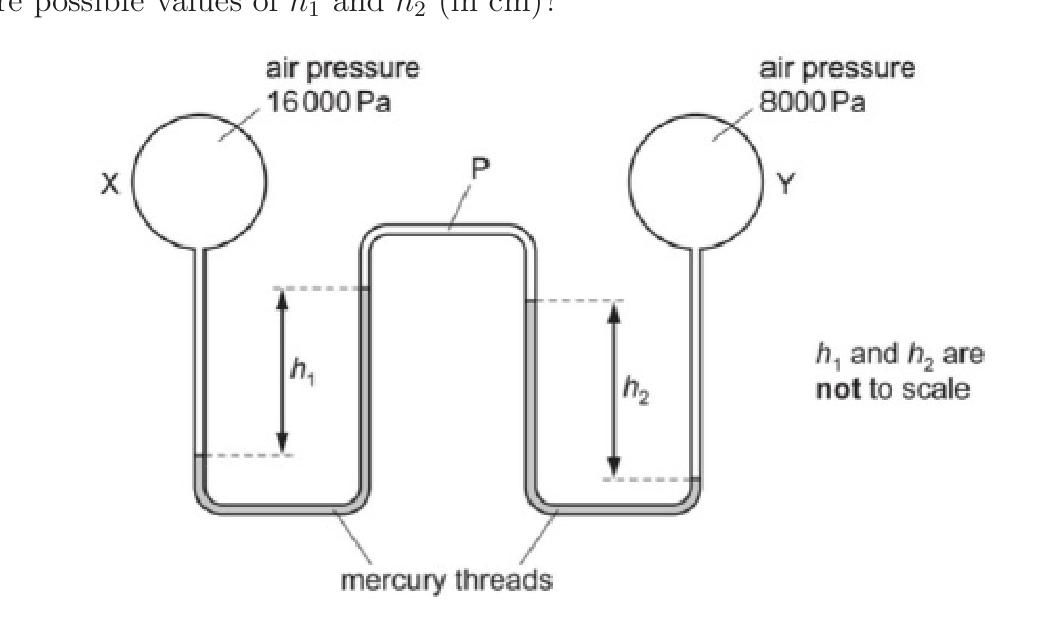
- (A)
- (B)
- (C)
- (D)
- (E)
Fonte: Testo (PDF) — p.4 Topic: Fluid Mechanics Metodi: Hydrostatic Equilibrium Competenze: Physical Reasoning Objects: Tube, Manometer
Due lampadine X e Y sono collegate da un tubo P come mostrato di seguito. Entrambe le lampadine hanno una pressione d’aria diversa, e c’è una pressione non zero in P. Quali dei seguenti valori possibili di e (in cm)?
- (A)
- (B)
- (C)
- (D)
- (E)
Fonte: Testo (PDF) — p.4 Topic: Fluid Mechanics Metodi: Hydrostatic Equilibrium Competenze: Physical Reasoning Objects: Tube, Manometer
Gears A, B, C are aligned side by side in such a way that rotating gear A causes gear B to rotate which in turn causes gear C to rotate. Gear A has 40 number of teeth and is rotating at angular speed of 50 rev/s. The radius of gear B is 20% of gear C and gear C is rotating at 40% angular speed of gear A. All the gears have the same tooth and groove size. How many teeth does gear B have?
- (A) 10
- (B) 20
- (C) 40
- (D) 50
- (E) 80
Fonte: Testo (PDF) — p.4 Topic: Rotational Dynamics Metodi: Physical Modeling Competenze: Physical Reasoning Objects: Gear
Le engranaggi A, B e C sono allineati fianco a fianco in modo tale che la rotazione della engranaggio A fa girare la engranaggio B che a sua volta provoca la rotazione della engranaggio C. Il cambio A ha 40 denti e ruota a velocità angolare di 50 giri/s. Il raggio di rotazione del cambio B è del 20% del cambio C e il cambio C ruota al 40% della velocità angolare del cambio A. Tutti i marciapiedi hanno la stessa taglia di dente e di groove. Quanti denti ha il cambio B?
- (A) 10
- (B) 20
- (C) 40
- (D) 50
- (E) 80
Fonte: Testo (PDF) — p.4 Topic: Rotational Dynamics Metodi: Physical Modeling Competenze: Physical Reasoning Objects: Gear
A ball is placed on a roller coaster track, as shown in the following figure:
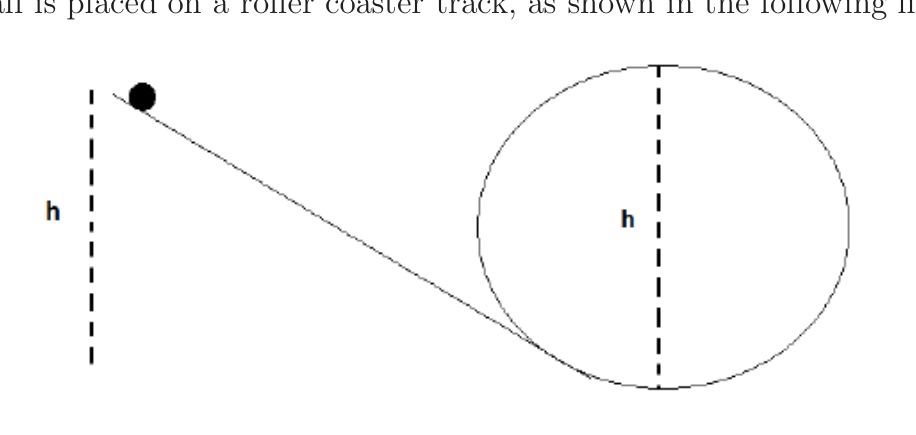
The object is initially at a height above the ground. The track has a loop, which can be assumed to be in a form of a circle with diameter . You may assume there is no friction between the object and the track. Which of the following statements is correct?
- (A) The object will be able to undergo one full loop along the track.
- (B) The object will stop when it reaches the top of the loop.
- (C) The object will not be able to reach the top of the loop.
- (D) The object will oscillate about the bottom part of the loop.
- (E) The total energy of the object increases because of gravity.
Fonte: Testo (PDF) — p.5 Topic: Conservation of Energy Metodi: Energy Conservation Method Competenze: Physical Reasoning Objects: Ball
Una palla viene posta su una pista di montagna russa, come mostrato nella figura seguente:
L’oggetto è inizialmente a un’altezza sopra il suolo. La pista ha un ciclo, che può essere presunto essere in forma di cerchio di diametro . Si può presumere che non ci sia attrito tra l’oggetto e la pista. Quale delle seguenti affermazioni è corretta?
- **(A) ** L’oggetto potrà passare un ciclo completo lungo la pista.
- **(B) ** L’oggetto si fermerà quando raggiungerà la parte superiore del loop.
- **(C) ** L’oggetto non sarà in grado di raggiungere la parte superiore del loop.
- **(D) ** L’oggetto oscillerà intorno alla parte inferiore del ciclo.
- **(E) ** L’energia totale dell’oggetto aumenta a causa della gravità.
Fonte: Testo (PDF) — p.5 Topic: Conservation of Energy Metodi: Energy Conservation Method Competenze: Physical Reasoning Objects: Ball
Three blocks A, B, and C are placed on the table and attached to one another according to the figure below.
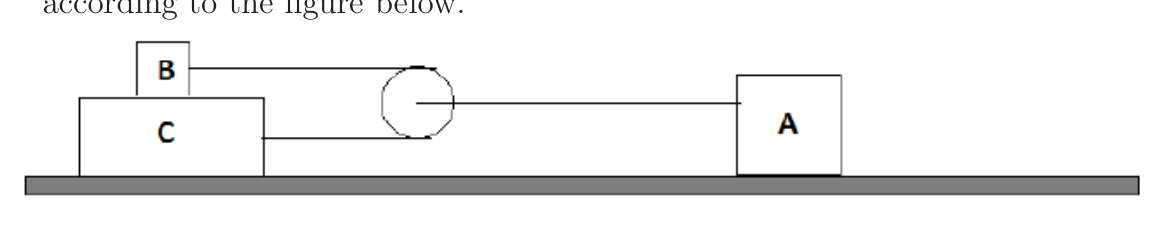
Suppose block A is pulled to the right, so that it moves to the right with acceleration . It is observed that both block B and C are also moving to the right with acceleration and , respectively, with . Find the relationship between , , and .
- (A)
- (B)
- (C)
- (D) They are independent.
- (E) There is not enough information.
Fonte: Testo (PDF) — p.5 Topic: Newtonian Mechanics Metodi: Physical Modeling, Free-Body Diagram Competenze: Physical Reasoning Objects: Block
Tre blocchi A, B e C sono posizionati sul tavolo e collegati tra loro secondo la figura seguente.
Supponiamo che il blocco A sia tirato a destra, in modo che si muova a destra con l’accelerazione . Si osserva che sia il blocco B che il blocco C si muovono anche a destra con l’accelerazione e , rispettivamente, con . Trova la relazione tra , e .
- (A)
- (B)
- (C)
- **(D) ** Sono indipendenti.
- **(E) ** Non ci sono informazioni sufficienti.
Fonte: Testo (PDF) — p.5 Topic: Newtonian Mechanics Metodi: Physical Modeling, Free-Body Diagram Competenze: Physical Reasoning Objects: Block
A block is placed on a smooth horizontal surface when a bullet hit it along the horizontal direction. The bullet stayed in the block at the depth . The friction between the block and the bullet is . The block moved over a distance of from the moment it was hit till the bullet is stuck. During the process, which of the statements is correct?
- (A) The kinetic energy of the block is increased by .
- (B) The kinetic energy of the bullet is reduced by .
- (C) The mechanical energy of the system is reduced by .
- (D) The mechanical energy of the system is reduced by .
- (E) None of the above
Fonte: Testo (PDF) — p.6 Topic: Conservation of Energy Metodi: Energy Conservation Method Competenze: Physical Reasoning Objects: Block, Projectile
Un blocco viene posizionato su una superficie orizzontale liscia quando un proiettile lo colpisce lungo la direzione orizzontale. Il proiettile è rimasto nel blocco alla profondità . La frizione tra il blocco e il proiettile è . Il blocco si è spostato a una distanza di dal momento in cui è stato colpito fino a quando il proiettile è bloccato. Durante il processo, quale delle affermazioni è corretta?
- **(A) ** L’energia cinetica del blocco è aumentata di .
- **(B) ** L’energia cinetica del proiettile è ridotta di .
- **(C) ** L’energia meccanica del sistema è ridotta di .
- **(D) ** L’energia meccanica del sistema è ridotta di .
- **(E) ** Nessuna delle seguenti:
Fonte: Testo (PDF) — p.6 Topic: Conservation of Energy Metodi: Energy Conservation Method Competenze: Physical Reasoning Objects: Block, Projectile
A beaker is placed on a weighing balance and four small spheres of the same size but different materials were placed in the beaker in turn. Spheres A and B are made of aluminium, Spheres C and D are made of styrofoam. Sphere B was hang from an inextensible string while Sphere D was attached to the bottom of the beaker by a light inextensible string so that both spheres were completely submerged in the middle of the beaker. For each sphere, it was released from the middle of the beaker and the weighing balance reading was taken after equilibrium was reached. Which of the following statements are true with regard to the weighing balance readings , , and ?
- (A)
- (B)
- (C)
- (D)
- (E) none of the above
Fonte: Testo (PDF) — p.6 Topic: Fluid Mechanics Metodi: Hydrostatic Equilibrium Competenze: Physical Reasoning Objects: Sphere, Container, String
Una coppa è posta su un bilanciatore e quattro piccole sfere della stessa dimensione, ma sono stati inseriti in coppa diversi materiali a loro volta. Le sfere A e B sono di alluminio, le sfere C e D sono di stirofoam. La sfera B era appesa a una corda inestensibile mentre la sfera D era attaccata al fondo del bicchiere da una corda leggera inestensibile in modo che entrambe le sfere fossero completamente immerse nel mezzo del bicchiere. Per ogni sfera, veniva rilasciata dal mezzo del calice e la lettura dell’equilibrio di pesatura veniva presa dopo aver raggiunto l’equilibrio. Quali delle seguenti affermazioni sono valide per quanto riguarda le letture di bilanci di peso , , e ?
- (A)
- (B)
- (C)
- (D)
- **(E) ** nessuna delle seguenti:
Fonte: Testo (PDF) — p.6 Topic: Fluid Mechanics Metodi: Hydrostatic Equilibrium Competenze: Physical Reasoning Objects: Sphere, Container, String
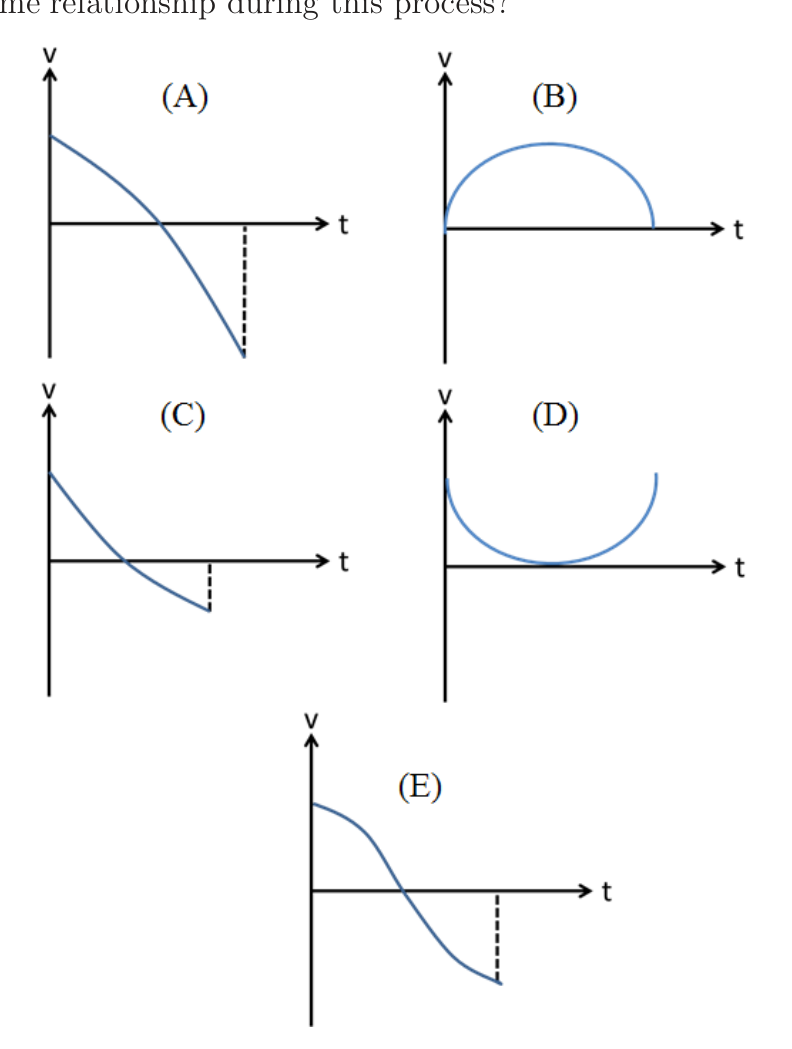
An object is thrown upwards from the ground, and caught again when it fell back to the same place. Which of the following graphs most closely represent the velocity-time relationship during this process?
Fonte: Testo (PDF) — p.7 Topic: Newtonian Mechanics Metodi: Kinematic Equations Competenze: Physical Reasoning Objects: —
Un oggetto viene gettato in su dalla terra, e catturato di nuovo quando è caduto sullo stesso posto. Quale dei seguenti grafici rappresenta più strettamente la relazione velocità-tempo durante questo processo?
Fonte: Testo (PDF) — p.7 Topic: Newtonian Mechanics Metodi: Kinematic Equations Competenze: Physical Reasoning Objects: —
At a point out of Earth and at a distance from its center, the Earth’s gravitational field is about . At the Earth’s surface, the field is about . Which of the following gives an approximate value of the radius of the Earth?
- (A)
- (B)
- (C)
- (D)
- (E)
Fonte: Testo (PDF) — p.7 Topic: Gravitation Metodi: Newton’s Law of Gravitation Competenze: Physical Reasoning Objects: Planet
A un punto fuori dalla Terra e a una distanza dal suo centro, il campo gravitazionale della Terra è di circa . Alla superficie terrestre, il campo è di circa . Quale delle seguenti dati dà un valore approssimativo del raggio della Terra?
- (A)
- (B)
- (C)
- (D)
- (E)
Fonte: Testo (PDF) — p.7 Topic: Gravitation Metodi: Newton’s Law of Gravitation Competenze: Physical Reasoning Objects: Planet
A force is resolved into two components and . Only the magnitude of and the direction of are known. Which of the following is the most accurate statement?
- (A) Only one combination of and exists.
- (B) There exists exactly two combinations of and .
- (C) There exists infinite combinations of and .
- (D) At least three combinations of and exist but the total number of combinations is finite.
- (E) Only one or two combinations of and exist.
Fonte: Testo (PDF) — p.8 Topic: Newtonian Mechanics Metodi: Vector Decomposition Competenze: Physical Reasoning Objects: —
Una forza è ripartita in due componenti e . Sono conosciute solo la magnitudine di e la direzione di . Quale delle seguenti affermazioni è più accurata?
- **(A) ** Esiste solo una combinazione di e .
- **(B) ** Esistono esattamente due combinazioni di e .
- **(C) ** Esistono infinite combinazioni di e .
- **(D) ** Esistono almeno tre combinazioni di e ma il numero totale di combinazioni è finito.
- **(E) ** Esistono solo una o due combinazioni di e .
Fonte: Testo (PDF) — p.8 Topic: Newtonian Mechanics Metodi: Vector Decomposition Competenze: Physical Reasoning Objects: —
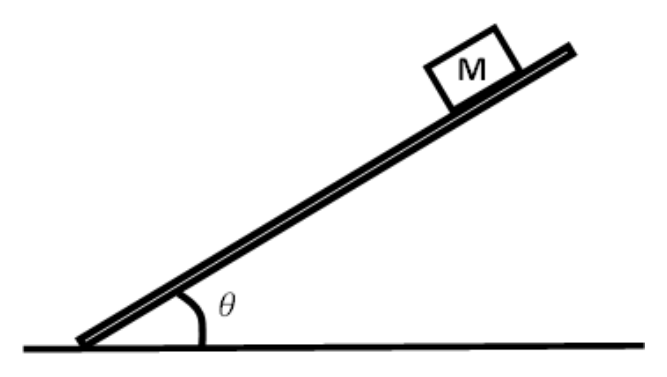
As shown in the figure below, the block with mass is stationary upon the plank and the angle of the slope is increased. Which of the following is true for the normal force of the block on the wooden plank, and the frictional force on the plank, ?
- (A) Both and increase.
- (B) Both and decrease.
- (C) increases and decreases.
- (D) decreases and increases.
- (E) The response differs when the value of is different.
Fonte: Testo (PDF) — p.8 Topic: Newtonian Mechanics Metodi: Free-Body Diagram, Vector Decomposition Competenze: Physical Reasoning Objects: Block, Inclined Plane
Come mostrato nella figura seguente, il blocco con massa è fermo sulla tavola e l’angolo della pendenza è aumentato. Qual è la forza normale del blocco sulla tavola di legno, , e la forza di attrito sulla tavola, ?
- **(A) ** Sia il che il aumentano.
- **(B) ** Sia che diminuiscono.
- **(C) ** aumenta e diminuisce.
- **(D) ** diminuisce e aumenta.
- **(E) ** La risposta è diversa quando il valore di è diverso.
Fonte: Testo (PDF) — p.8 Topic: Newtonian Mechanics Metodi: Free-Body Diagram, Vector Decomposition Competenze: Physical Reasoning Objects: Block, Inclined Plane
An object is travelling on a straight path and exhibiting a constant acceleration starts off with an initial velocity . It has traversed in the third second, its acceleration is
- (A)
- (B)
- (C)
- (D)
- (E)
Fonte: Testo (PDF) — p.8 Topic: Newtonian Mechanics Metodi: Kinematic Equations Competenze: Physical Reasoning Objects: —
Un oggetto che si muove su un percorso retto e che mostra una costante accelerazione inizia con una velocità iniziale . Ha attraversato nel terzo secondo, la sua accelerazione è
- (A)
- (B)
- (C)
- (D)
- (E)
Fonte: Testo (PDF) — p.8 Topic: Newtonian Mechanics Metodi: Kinematic Equations Competenze: Physical Reasoning Objects: —
A boat is travelling towards the east with speed . If two objects of equal masses are simultaneously ejected from the boat with speed (relative to ground) towards the east and the west, which of the following is true?
- (A) The speed of the boat increases.
- (B) The speed of the boat decreases.
- (C) The boat changes direction and speeds up.
- (D) The boat changes direction and slows down.
- (E) There is no change to the speed of the boat.
Fonte: Testo (PDF) — p.9 Topic: Conservation of Momentum Metodi: Conservation of Momentum Competenze: Physical Reasoning Objects: —
Una barca si dirige verso est con velocità . Se due oggetti di massa uguale vengono espulsi simultaneamente dalla barca con velocità (relativamente al suolo) verso est e ovest, quale delle seguenti è vero?
- **(A) ** La velocità della barca aumenta.
- **(B) ** La velocità della barca diminuisce.
- **(C) ** La barca cambia direzione e accelera.
- **(D) ** La barca cambia direzione e rallenta.
- **(E) ** Non vi è alcuna variazione della velocità della barca.
Fonte: Testo (PDF) — p.9 Topic: Conservation of Momentum Metodi: Conservation of Momentum Competenze: Physical Reasoning Objects: —
A ball of mass is dropped from a height, . At the point where its potential energy is equal to its kinetic energy, its instantaneous power is
- (A)
- (B)
- (C)
- (D)
- (E)
Fonte: Testo (PDF) — p.9 Topic: Conservation of Energy Metodi: Energy Conservation Method, Kinematic Equations Competenze: Physical Reasoning Objects: Ball
Una palla di massa viene abbassata da un’altezza . Quando la sua energia potenziale è uguale alla sua energia cinetica, la sua potenza istantanea è
- (A)
- (B)
- (C)
- (D)
- (E)
Fonte: Testo (PDF) — p.9 Topic: Conservation of Energy Metodi: Energy Conservation Method, Kinematic Equations Competenze: Physical Reasoning Objects: Ball
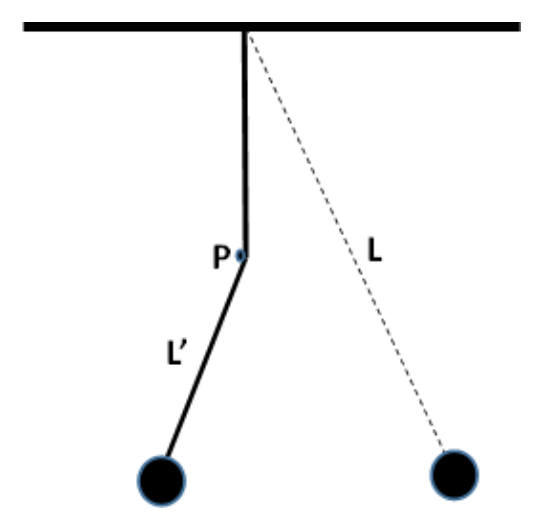
As shown in the diagram, a pendulum of length is hung from the ceiling and at a point P, a peg is placed. denotes the shortened length of the pendulum during part of its oscillation. The period of the pendulum’s oscillation is now
- (A)
- (B)
- (C)
- (D)
- (E)
Fonte: Testo (PDF) — p.9 Topic: Oscillations & Waves Metodi: Simple Harmonic Motion Analysis Competenze: Physical Reasoning Objects: Pendulum
Come mostrato nel diagramma, un pendolo di lunghezza è appeso al soffitto e, in un punto P, viene posto un cerchio. indica la lunghezza ridotta del pendolo durante una parte della sua oscillazione. Il periodo di oscillazione del pendolo è ora
- (A)
- (B)
- (C)
- (D)
- (E)
Fonte: Testo (PDF) — p.9 Topic: Oscillations & Waves Metodi: Simple Harmonic Motion Analysis Competenze: Physical Reasoning Objects: Pendulum
A hollow triangular holder of mass , with a ball of mass affixed to its interior via two massless springs, is placed vertically on a table, as shown in the diagram below. The ball is then made to vibrate up and down. At the instant when the normal contact forces between the table and the holder become zero, the acceleration of the ball is
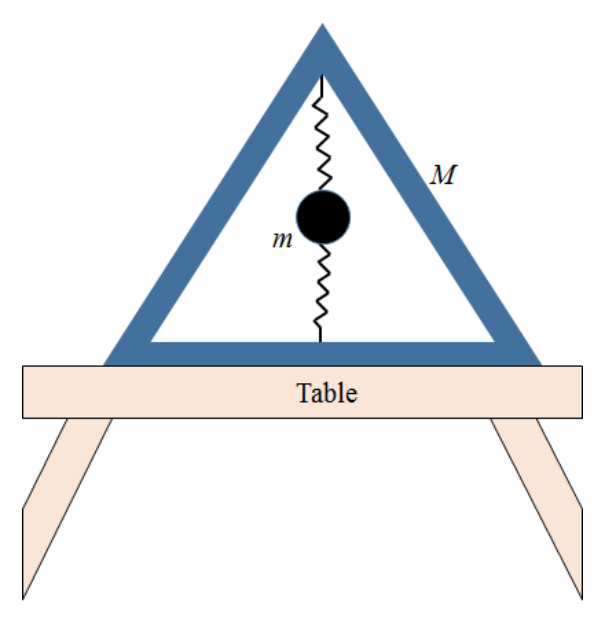
- (A) upwards,
- (B) downwards,
- (C) downwards,
- (D) zero
- (E) upwards,
Fonte: Testo (PDF) — p.10 Topic: Newtonian Mechanics Metodi: Free-Body Diagram Competenze: Physical Reasoning Objects: Spring, Ball
Un tenitore triangolare vuoto di massa , con una palla di massa fissata all’interno attraverso due sorgenti senza massa, è posizionato verticalmente su una tavola, come mostrato nel diagramma di seguito. La palla viene quindi fatta a vibrare su e giù. Nel momento in cui le normali forze di contatto tra il tavolo e il tenitore diventano zero, l’accelerazione della palla è
- **(A) ** verso l’alto,
- **(B) ** verso il basso,
- **(C) ** verso il basso,
- **(D) ** zero
- **(E) ** verso l’alto,
Fonte: Testo (PDF) — p.10 Topic: Newtonian Mechanics Metodi: Free-Body Diagram Competenze: Physical Reasoning Objects: Spring, Ball
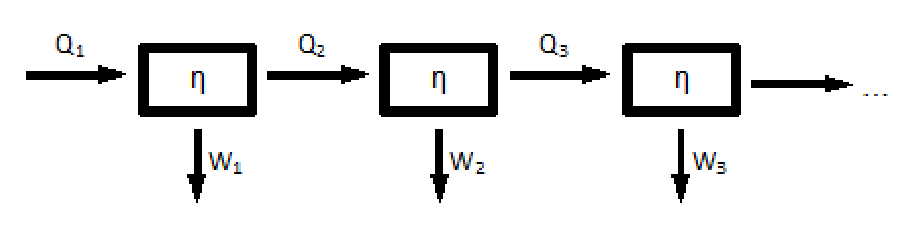
A heat engine takes in and converts part of the heat into mechanical work. The efficiency, or the work done per unit heat input of one such engine is . Suppose all the waste heat from one engine can be channelled into the subsequent similar engine as heat input, what is minimum engine units required to convert 99.99% of the original heat input into work?
- (A) 9
- (B) 16
- (C) 23
- (D) 34
- (E) 67
Fonte: Testo (PDF) — p.10 Topic: Thermodynamics Metodi: Thermodynamic Cycle Analysis Competenze: Physical Reasoning Objects: Heat Engine
Un motore termico assorbe e trasforma parte del calore in lavoro meccanico. L’efficienza, o il lavoro effettuato per unità di calore di un tale motore è . Supponiamo che tutto il calore residuo di un motore possa essere canalizzato nel motore successivo simile come input di calore, qual è l’unità minima del motore necessaria per convertire il 99,99% del calore originale in lavoro?
- (A) 9
- (B) 16
- (C) 23
- (D) 34
- (E) 67
Fonte: Testo (PDF) — p.10 Topic: Thermodynamics Metodi: Thermodynamic Cycle Analysis Competenze: Physical Reasoning Objects: Heat Engine
An ideal gas of volume and at pressure is supplied with of energy. The volume increases to , the pressure remains constant. The internal energy of the gas is
- (A) increased by 90 J
- (B) increased by 70 J
- (C) increased by 50 J
- (D) decreased by 50 J
- (E) decreased by 80 J
Fonte: Testo (PDF) — p.11 Topic: Thermodynamics Metodi: First Law of Thermodynamics Competenze: Physical Reasoning Objects: Gas
Un gas ideale di volume e a pressione è fornito con di energia. Il volume aumenta a , la pressione rimane costante. L’energia interna del gas è
- **(A) ** aumentato di 90 J
- **(B) ** aumentato di 70 J
- **(C) ** aumentato di 50 J
- **(D) ** diminuita di 50 J
- **(E) ** diminuita di 80 J
Fonte: Testo (PDF) — p.11 Topic: Thermodynamics Metodi: First Law of Thermodynamics Competenze: Physical Reasoning Objects: Gas
Two identical metal balls A and B, initially have the same radius and temperature . Ball A is placed on an insulating table, while ball B is hung by an insulating string, and the two balls are isolated, as shown in the figure below.
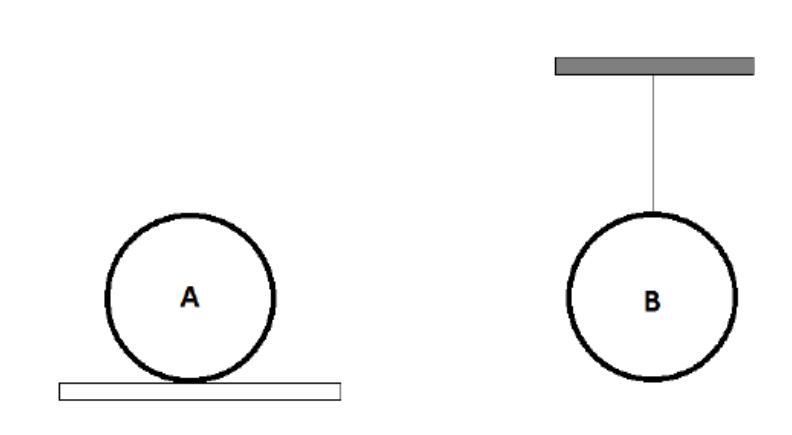
Suppose now the two balls are heated for 5 minutes. You may assume that the two balls absorb the same amount of heat. Let the final temperatures of ball A and B be denoted by and respectively. Which of the following statements is correct?
- (A) Both temperatures remains the same, i.e.,
- (B) Both temperatures increase, with
- (C) Both temperatures increase, with
- (D) Both temperatures increase, with .
- (E) Both balls will contract.
Fonte: Testo (PDF) — p.11 Topic: Thermodynamics Metodi: Physical Modeling Competenze: Physical Reasoning Objects: Sphere, String
Due palle di metallo identiche A e B, inizialmente con lo stesso raggio e temperatura . La palla A viene posta su un tavolo isolante, mentre la palla B è appesa da una corda isolante e le due palle sono isolate, come mostrato nella figura seguente.
Supponiamo che le due palle siano riscaldate per 5 minuti. Potresti supporre che le due palle assorbano la stessa quantità di calore. Le temperature finali della palla A e B devono essere indicate rispettivamente da e . Quale delle seguenti affermazioni è corretta?
- **(A) ** Entrambe le temperature rimangono uguali, cioè
- **(B) ** Entrambe le temperature aumentano, con
- **(C) ** Entrambe le temperature aumentano, con
- **(D) ** Entrambe le temperature aumentano, con .
- **(E) ** Entrambe le palle si contraggono.
Fonte: Testo (PDF) — p.11 Topic: Thermodynamics Metodi: Physical Modeling Competenze: Physical Reasoning Objects: Sphere, String
In a gas of diatomic molecules, there are two possible models for a classical description of a diatomic model. These 2 models are shown below.
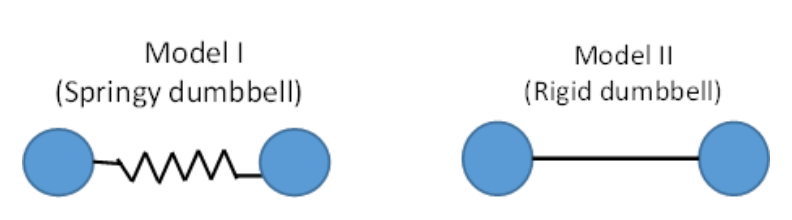
Which of the following statements is true?
- (A) Model I will result in the molar heat capacity of the gas being , where is the universal gas constant.
- (B) Model I has a smaller specific heat capacity than that of model II.
- (C) Model II is always correct.
- (D) Model I is always correct.
- (E) We can choose either model I or model II depending on the temperature.
Fonte: Testo (PDF) — p.12 Topic: Kinetic Theory Metodi: Kinetic Theory of Gases Competenze: Physical Reasoning Objects: Gas
In un gas di molecole diatomiche , esistono due possibili modelli per una descrizione classica di un modello diatomico. Questi due modelli sono mostrati qui sotto.
Quale delle seguenti affermazioni è vera?
- **(A) ** Il modello I si traduce in una capacità termico molare del gas , dove è la costante universale del gas.
- **(B) ** Il modello I ha una capacità termico specifica inferiore a quella del modello II.
- **(C) ** Il modello II è sempre corretto.
- **(D) ** Il modello I è sempre corretto.
- **(E) ** Possiamo scegliere il modello I o il modello II a seconda della temperatura.
Fonte: Testo (PDF) — p.12 Topic: Kinetic Theory Metodi: Kinetic Theory of Gases Competenze: Physical Reasoning Objects: Gas
A ray of red light travels through air and is refracted as it enters a glass prism as shown in the figure. An unknown liquid is in contact with the right side of the prism. The light then follows the path shown. Which one of the following statements concerning this situation is true?
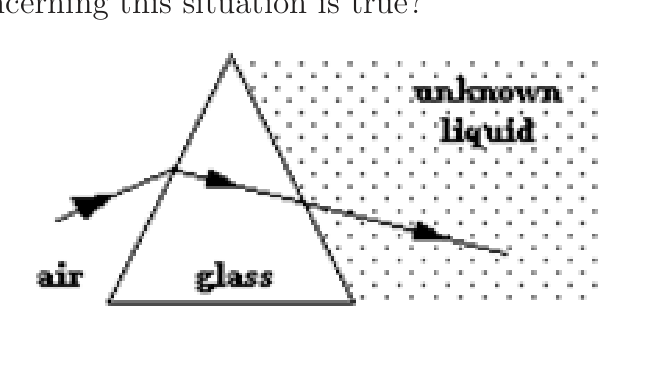
- (A) The speed of light is greater in the unknown liquid than in the glass prism.
- (B) The frequency of the light changes inside the glass prism.
- (C) The refractive index of the glass prism is smaller than that of air.
- (D) The refractive index of the unknown liquid is the same as that of air.
- (E) The refractive index of the unknown liquid is the same as that of the glass prism.
Fonte: Testo (PDF) — p.12 Topic: Geometric Optics Metodi: Snell’s Law Competenze: Physical Reasoning Objects: Prism
Un raggio di luce rossa attraversa l’aria e viene refratto quando entra in un prisma di vetro come mostrato nella figura. Un liquido sconosciuto è in contatto con il lato destro del prisma. La luce segue poi il percorso indicato. Quale delle seguenti affermazioni in merito a questa situazione è vera?
- **(A) ** La velocità della luce è maggiore nel liquido sconosciuto rispetto al prisma di vetro.
- **(B) ** La frequenza della luce cambia all’interno del prisma di vetro.
- **(C) ** L’indice di rifrazione del prisma di vetro è inferiore a quello dell’aria.
- **(D) ** L’indice di rifrazione del liquido sconosciuto è lo stesso di quello dell’aria.
- **(E) ** L’indice di rifrazione del liquido sconosciuto è lo stesso di quello del prisma di vetro.
Fonte: Testo (PDF) — p.12 Topic: Geometric Optics Metodi: Snell’s Law Competenze: Physical Reasoning Objects: Prism
To model the formation of a ‘cumzenithal arc’ in the sky, we consider the following geometry. Sunlight enters from the top of an ice crystal and exits from the side, as shown in the diagram below. What is the maximum angle of above which no ray from point A will reach point B? (Take the refractive index of ice to be 1.31.)
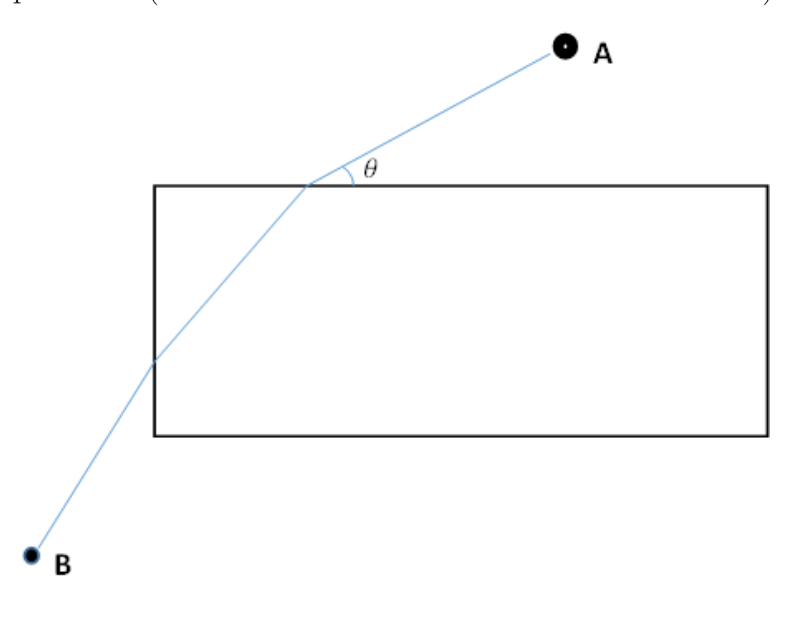
- (A) 32
- (B) 58
- (C) 50
- (D) 16
- (E) 44
Fonte: Testo (PDF) — p.13 Topic: Geometric Optics Metodi: Snell’s Law Competenze: Physical Reasoning Objects: —
Per modellare la formazione di un ‘arco cumzenitali’ nel cielo, consideriamo la seguente geometria. La luce solare entra dalla parte superiore di un cristallo di ghiaccio e esce dal lato, come mostrato nel diagramma di seguito. Qual è l’angolo massimo di sopra il quale nessun raggio dal punto A raggiungerà il punto B? (Considera l’indice di rifrazione del ghiaccio a 1,31.)
- (A) 32
- (B) 58
- (C) 50
- (D) 16
- (E) 44
Fonte: Testo (PDF) — p.13 Topic: Geometric Optics Metodi: Snell’s Law Competenze: Physical Reasoning Objects: —
Which of the listed phenomena best illustrates the fact that light is a transverse wave?
- (A) A beam of light in air is bent towards the normal upon entering water.
- (B) When a beam of light passes through a small circular aperture and onto a screen, the size of the spot of light on the screen increases as the aperture size decreases.
- (C) A beam of laser light passing through 2 closely spaced slits produces a series of bright and dark fringes.
- (D) A beam of sunlight that has passed through one polariser is blocked by a second polariser whose polarisation axis is perpendicular to that of the first.
- (E) A beam of light exerts a pressure on the surface it falls on.
Fonte: Testo (PDF) — p.13 Topic: Wave Optics Metodi: Physical Modeling Competenze: Physical Reasoning Objects: Screen, Slit
Quale dei fenomeni elencati illustra meglio il fatto che la luce è un’onda trasversale?
- **(A) ** Un raggio di luce nell’aria si piega verso la normalità quando entra nell’acqua.
- **(B) ** Quando un fascio di luce passa attraverso una piccola apertura circolare e si incontra su uno schermo, la dimensione della luce sullo schermo aumenta con la diminuzione della dimensione dell’apertura.
- **(C) ** Un fascio di luce laser che passa attraverso due fessure spaziate tra loro produce una serie di margini luminosi e scuri.
- **(D) ** Un raggio di luce solare che è passato attraverso un polarizzatore è bloccato da un secondo polarizzatore il cui asse di polarizzazione è perpendicolare a quello del primo.
- **(E) ** Un raggio di luce esercita una pressione sulla superficie su cui cade.
Fonte: Testo (PDF) — p.13 Topic: Wave Optics Metodi: Physical Modeling Competenze: Physical Reasoning Objects: Screen, Slit
In a pipe that is closed at one end and open at the other, a 425-Hz tuning fork resonates when the pipe is 40-cm long; this tuning fork does not resonate for any smaller pipes. For which of these closed pipe lengths will this tuning fork also resonate?
- (A) 20 cm
- (B) 80 cm
- (C) 120 cm
- (D) 160 cm
- (E) 425 cm
Fonte: Testo (PDF) — p.14 Topic: Oscillations & Waves Metodi: Wave Equation Competenze: Physical Reasoning Objects: Tube, Tuning Fork
In un tubo chiuso da un’estremità e aperto dall’altra, una forchetta di sintonia da 425 Hz risona quando il tubo è lungo 40 cm; questa forchetta di sintonia non risona per qualsiasi tubo più piccolo. Per quale di queste lunghezze di tubo chiuso risonerà anche questa forchetta di sintonia?
- (A) 20 cm
- (B) 80 cm
- (C) 120 cm
- (D) 160 cm
- (E) 425 cm
Fonte: Testo (PDF) — p.14 Topic: Oscillations & Waves Metodi: Wave Equation Competenze: Physical Reasoning Objects: Tube, Tuning Fork
A travelling wave is described by the following equation, where is in metres and is in seconds. What is the velocity of the wave?
- (A) to the left
- (B) to the left
- (C) to the left
- (D) to the right
- (E) to the right
Fonte: Testo (PDF) — p.14 Topic: Oscillations & Waves Metodi: Wave Equation Competenze: Physical Reasoning Objects: —
Un’onda itinerante è descritta con la seguente equazione, in cui è in metri e è in secondi. Qual è la velocità dell’onda?
- **(A) ** a sinistra
- **(B) ** a sinistra
- **(C) ** a sinistra
- **(D) ** a destra
- **(E) ** a destra
Fonte: Testo (PDF) — p.14 Topic: Oscillations & Waves Metodi: Wave Equation Competenze: Physical Reasoning Objects: —
The equally spaced vertical radio antenna shown in the diagram below (not drawn to scale) transmit equally and in phase at . If signals of equal intensity are received at A and at B, 50 kilometers away from each other and about 100 kilometers from the source, a possible spacing between the two adjacent antenna are
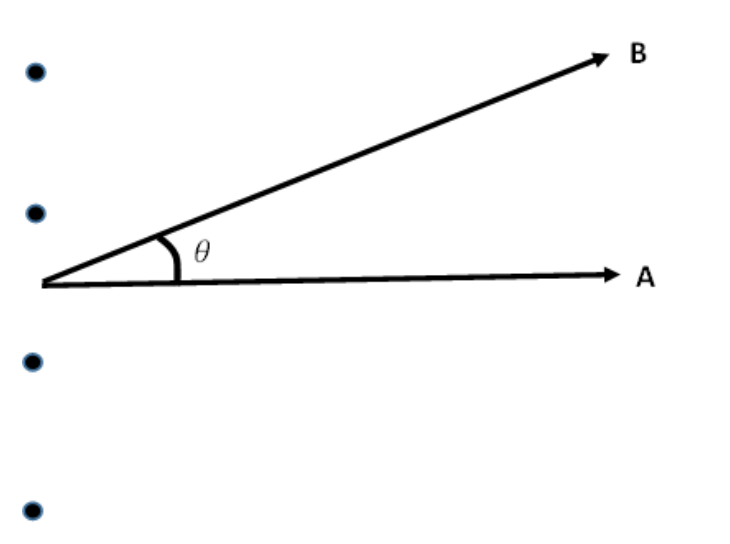
- (A) 110 m
- (B) 168 m
- (C) 335 m
- (D) 340 m
- (E) 670 m
Fonte: Testo (PDF) — p.14 Topic: Wave Optics Metodi: Interference & Diffraction Analysis Competenze: Physical Reasoning Objects: —
L’antenna radiofonica verticale con spazi uguali mostrata nel diagramma di seguito (non tracciata in scala) trasmette in modo uguale e in fase a . Se i segnali di uguale intensità vengono ricevuti a A e a B, a 50 chilometri l’uno dall’altro e a circa 100 chilometri dalla sorgente, un possibile spaziamento tra le due antenne adiacenti è
- (A) 110 m
- (B) 168 m
- (C) 335 m
- (D) 340 m
- (E) 670 m
Fonte: Testo (PDF) — p.14 Topic: Wave Optics Metodi: Interference & Diffraction Analysis Competenze: Physical Reasoning Objects: —
The Moon is approximately 380,000 km from Earth. The time a laser light beam takes to travel from the Earth to the Moon and back is most nearly
- (A) 2 microseconds.
- (B) 2 milliseconds.
- (C) 2 seconds.
- (D) 2 minutes.
- (E) 2 hours.
Fonte: Testo (PDF) — p.15 Topic: Order-of-Magnitude Estimation Metodi: Order-of-Magnitude Estimation Competenze: Physical Reasoning Objects: Planet, Satellite
La Luna è a circa 380.000 km dalla Terra. Il tempo necessario per un raggio laser per viaggiare dalla Terra alla Luna e indietro è quasi
- **(A) ** 2 microsecondi.
- **(B) ** 2 millisecondi.
- **(C) ** 2 secondi.
- **(D) ** 2 minuti.
- **(E) ** 2 ore.
Fonte: Testo (PDF) — p.15 Topic: Order-of-Magnitude Estimation Metodi: Order-of-Magnitude Estimation Competenze: Physical Reasoning Objects: Planet, Satellite
An object is placed 6.0 cm from a converging lens of focal length 9.0 cm. What is the magnitude of the magnification of the image produced?
- (A) 0.6
- (B) 1.5
- (C) 2.0
- (D) 3.0
- (E) 3.6
Fonte: Testo (PDF) — p.15 Topic: Geometric Optics Metodi: Thin Lens & Mirror Equation Competenze: Physical Reasoning Objects: Lens
Un oggetto è posizionato a 6,0 cm da una lente convergente di 9,0 cm di lunghezza focale. Qual è l’entità dell’ingrandimento dell’immagine prodotta?
- (A) 0.6
- (B) 1.5
- (C) 2.0
- (D) 3.0
- (E) 3.6
Fonte: Testo (PDF) — p.15 Topic: Geometric Optics Metodi: Thin Lens & Mirror Equation Competenze: Physical Reasoning Objects: Lens
has a refractive index of 1.38 relative to air. In order to minimize reflection of light with wavelength 550 nm from a glass lens, a layer of is coated on the lens. This layer of has a thickness of
- (A) 100 nm
- (B) 138 nm
- (C) 275 nm
- (D) 550 nm
- (E) 825 nm
Fonte: Testo (PDF) — p.15 Topic: Wave Optics Metodi: Interference & Diffraction Analysis Competenze: Physical Reasoning Objects: Lens
ha un indice di rifrazione di 1,38 rispetto all’aria. Per ridurre al minimo il riflesso della luce con lunghezza d’onda 550 nm da una lente di vetro, viene rivestito un strato di sulla lente. Questo strato di ha uno spessore di
- (A) 100 nm
- (B) 138 nm
- (C) 275 nm
- (D) 550 nm
- (E) 825 nm
Fonte: Testo (PDF) — p.15 Topic: Wave Optics Metodi: Interference & Diffraction Analysis Competenze: Physical Reasoning Objects: Lens
A transverse wave is travelling past two points A and B on a horizontal straight line. Two point particles under the influence of the wave are situated at A and B respectively, 60 cm apart. When the particle at point A is at moving upwards, the particle at point B is at the trough. If the speed of the wave is 24 m/s, the frequency of the wave cannot be
- (A) 30 Hz
- (B) 330 Hz
- (C) 350 Hz
- (D) 380 Hz
- (E) 490 Hz
Fonte: Testo (PDF) — p.16 Topic: Oscillations & Waves Metodi: Wave Equation Competenze: Physical Reasoning Objects: —
Un’onda trasversale sta attraversando due punti A e B su una linea retta orizzontale. Due particelle puntate sotto l’influenza dell’onda si trovano rispettivamente a A e B, a 60 cm di distanza. Quando la particella al punto A si muove verso l’alto, la particella al punto B si trova al fondo. Se la velocità dell’onda è di 24 m/s, la frequenza dell’onda non può essere
- (A) 30 Hz
- (B) 330 Hz
- (C) 350 Hz
- (D) 380 Hz
- (E) 490 Hz
Fonte: Testo (PDF) — p.16 Topic: Oscillations & Waves Metodi: Wave Equation Competenze: Physical Reasoning Objects: —
The refractive index of water is 1.33. A point light source in water can be seen directly above the water as a circular bright disc. At a certain period of time, the light source position is seen to be unchanged but the radius of the bright disc decreases and then increases to its original length. We can thus conclude that
- (A) The light source is continuously lowered till a certain depth.
- (B) The light source is continuously raised till a certain depth.
- (C) The light source is continuously raised and subsequently lowered back to its original depth.
- (D) The light source is continuously lowered and subsequently raised back to its original depth.
- (E) The light source is dimmed and then brightened.
Fonte: Testo (PDF) — p.16 Topic: Geometric Optics Metodi: Snell’s Law Competenze: Physical Reasoning Objects: —
L’indice di rifrazione dell’acqua è di 1,33. Una fonte di luce puntata in acqua può essere vista direttamente sopra l’acqua come un disco luminoso circolare. In un certo periodo di tempo, la posizione della fonte luminosa è vista essere invariata, ma il raggio del disco luminoso diminuisce e poi aumenta alla sua lunghezza originale. Possiamo quindi concludere che
- **(A) ** La fonte luminosa è continuamente abbassata fino a una certa profondità.
- **(B) ** La fonte luminosa è continuamente sollevata fino a una certa profondità.
- **(C) ** La fonte luminosa viene continuamente sollevata e successivamente abbassata alla sua profondità originale.
- **(D) ** La fonte luminosa viene continuamente abbassata e successivamente sollevata alla sua profondità originale.
- **(E) ** La fonte luminosa viene attenuata e poi illuminata.
Fonte: Testo (PDF) — p.16 Topic: Geometric Optics Metodi: Snell’s Law Competenze: Physical Reasoning Objects: —
Four identical batteries, each of emf and internal resistance , are joined in series to form a closed circuit. One of them, battery A, is joined with reverse polarity to the rest. The potential difference across each battery except A is
- (A)
- (B)
- (C)
- (D)
- (E)
Fonte: Testo (PDF) — p.16 Topic: Circuits Metodi: Kirchhoff’s Laws Competenze: Physical Reasoning Objects: Battery
Quattro batterie identiche, ciascuna emf e resistenza interna , sono unite in serie per formare un circuito chiuso. Una di queste, la batteria A, è unita con polarità inversa al resto. La differenza potenziale tra ogni batteria tranne A è
- (A)
- (B)
- (C)
- (D)
- (E)
Fonte: Testo (PDF) — p.16 Topic: Circuits Metodi: Kirchhoff’s Laws Competenze: Physical Reasoning Objects: Battery
Two identical conducting spheres A and B carry equal amounts of excess charge that have the same sign (Frame 1). They are separated by a distance (which may be assumed to be large compared to the dimension of the spheres). Sphere A exerts an electrostatic force on sphere B that has a magnitude . Another identical sphere C, on an insulating rod and is uncharged, is touched first to sphere A (Frame 2) and then sphere B (Frame 3) and is finally removed (Frame 4). The magnitude of the electrostatic force that sphere A exerts on sphere B in Frame 4 is approximately
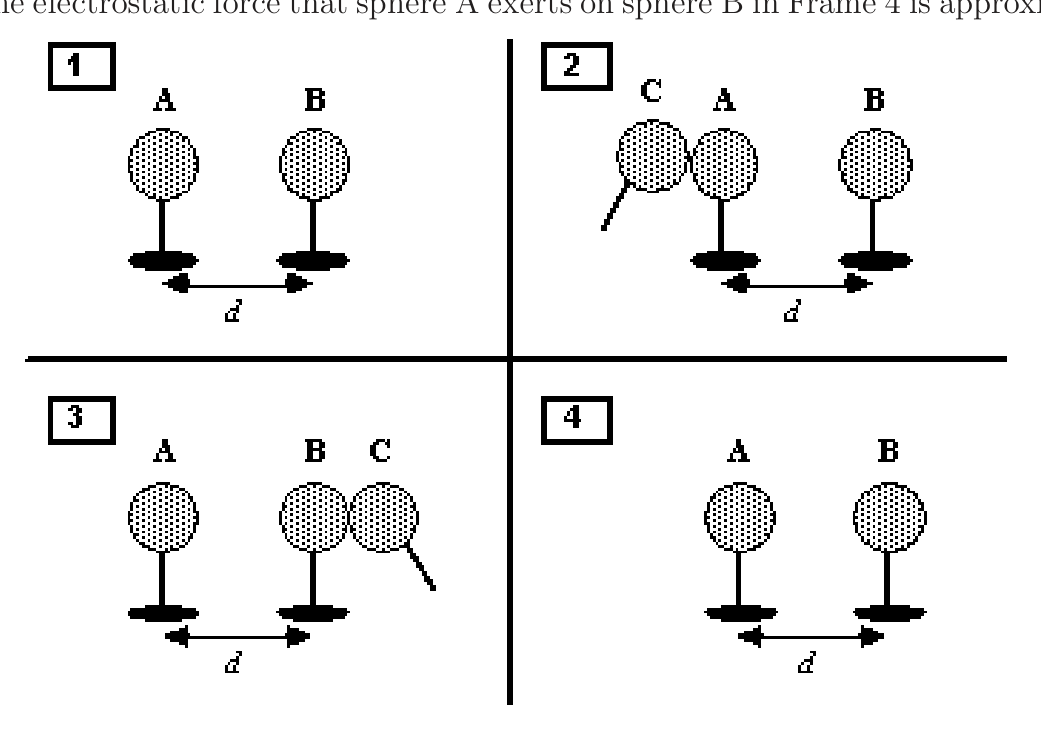
- (A) zero.
- (B) .
- (C) .
- (D) .
- (E) .
Fonte: Testo (PDF) — p.17 Topic: Electrostatics Metodi: Coulomb’s Law Competenze: Physical Reasoning Objects: Conducting Sphere, Rod
Due sfere di conduttore identiche A e B portano quantità uguali di carica in eccesso che hanno lo stesso segno (quadro 1). Sono separati da una distanza (che può essere presunta come grande rispetto alla dimensione delle sfere). La sfera A esercita una forza elettrostatica sulla sfera B che ha una magnitudine . Un’altra sfera identica C, su una canna isolante e non carica, viene prima toccata alla sfera A (quadro 2) e poi alla sfera B (quadro 3) e infine rimossa (quadro 4). La grandezza della forza elettrostatica che la sfera A esercita sulla sfera B nel quadro 4 è approssimativamente
- **(A) ** zero.
- (B) .
- (C) .
- (D) .
- (E) .
Fonte: Testo (PDF) — p.17 Topic: Electrostatics Metodi: Coulomb’s Law Competenze: Physical Reasoning Objects: Conducting Sphere, Rod
Four resistors and a 6-V battery are arranged as shown in the circuit diagram. Through which resistor(s) does the smallest current in the circuit pass through?
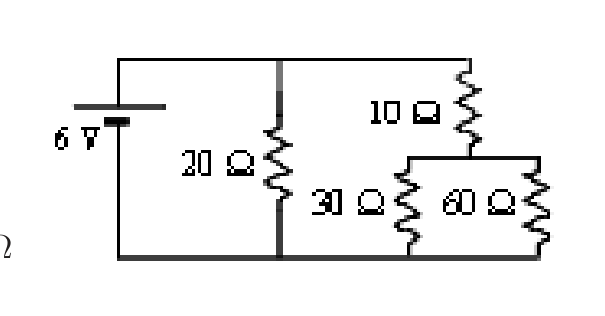
- (A) resistor
- (B) resistor
- (C) resistor
- (D) resistor
- (E) Same for both and resistors
Fonte: Testo (PDF) — p.17 Topic: Circuits Metodi: Equivalent Circuit Reduction Competenze: Physical Reasoning Objects: Resistor, Battery
Quattro resistori e una batteria a 6 V sono disposti come mostrato nel diagramma del circuito. Tra quali resistori passa la corrente più piccola del circuito?
- resistore **(A) **
- resistore **(B) **
- resistore **(C) **
- resistenza **(D) **
- **(E) ** Lo stesso per le resistenze e
Fonte: Testo (PDF) — p.17 Topic: Circuits Metodi: Equivalent Circuit Reduction Competenze: Physical Reasoning Objects: Resistor, Battery
Four large conducting plates, each of area , are placed an equal distance apart as shown in the following figure. Given that the permittivity of the medium filling the space between the plates is , what is the capacitance of this arrangement, assuming that the two terminals and of the capacitor are connected to the plates as shown?
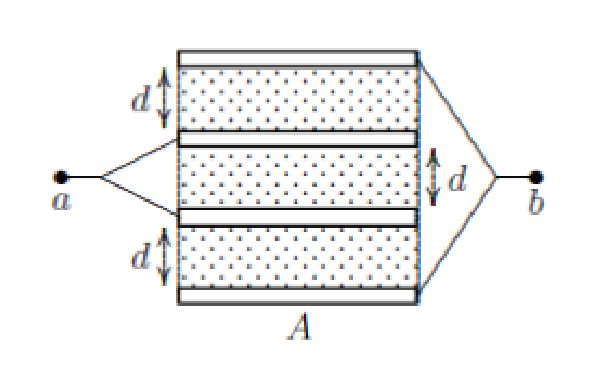
- (A)
- (B)
- (C)
- (D)
- (E)
Fonte: Testo (PDF) — p.18 Topic: Circuits Metodi: Equivalent Circuit Reduction Competenze: Physical Reasoning Objects: Capacitor
Quattro grandi piastre conduttrici, ciascuna di superficie , sono posizionate a distanza uguale tra loro, come mostrato nella figura seguente. Dato che la permissività del mezzo che riempie lo spazio tra le piastre è , qual è la capacità di tale disposizione, supponendo che i due terminali e del condensatore siano collegati alle piastre come mostrato?
- (A)
- (B)
- (C)
- (D)
- (E)
Fonte: Testo (PDF) — p.18 Topic: Circuits Metodi: Equivalent Circuit Reduction Competenze: Physical Reasoning Objects: Capacitor
A beam consisting of five types of ions labeled A, B, C, D, and E enters a region that contains a uniform magnetic field as shown in the figure. The field is perpendicular to the plane of the paper, but its precise direction is not given. All ions in the beam travel with the same speed. The table below gives the masses and charges of the ions.
| Ion | Mass | Charge |
|---|---|---|
| A | ||
| B | ||
| C | ||
| D | ||
| E |
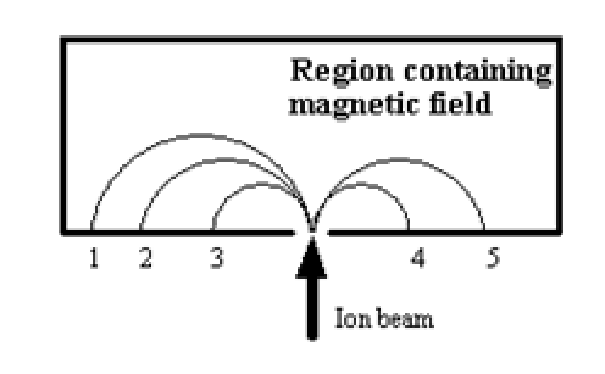
Which ion falls at position 3?
- (A) A
- (B) B
- (C) C
- (D) D
- (E) E
Fonte: Testo (PDF) — p.18 Topic: Magnetism Metodi: Lorentz Force Analysis Competenze: Physical Reasoning Objects: Particle Beam
Un fascio costituito da cinque tipi di ioni etichettati A, B, C, D ed E entra in una regione che contiene un campo magnetico uniforme come mostrato nella figura. Il campo è perpendicolare al piano della carta, ma non è indicato il suo orientamento preciso. Tutti gli ioni del raggio viaggiano alla stessa velocità. La tabella di seguito mostra le masse e le cariche degli ioni.
Il peso di massa
| --- | --- | --- | | A | | | | B | | | | C | | | | D | | | | E | | |
Quale ione cade alla posizione 3?
- (A) A
- (B) B
- (C) C
- (D) D
- (E) E
Fonte: Testo (PDF) — p.18 Topic: Magnetism Metodi: Lorentz Force Analysis Competenze: Physical Reasoning Objects: Particle Beam
Two point charges which are equal in magnitude but opposite in sign are placed at certain distance apart. By Coulomb’s Law, you have learned that they will experience an electric force pointing toward each other. Suppose now we place a neutral insulating rod in between the two charges, as shown in the figure below. Which of the following statements is correct?

- (A) The magnitude of the electric force acting on each charge will become zero.
- (B) The force will still be attractive, and the magnitude of the electric force acting on each charge will increase.
- (C) The force will still be attractive, and the magnitude of the electric force acting on each charge will decrease.
- (D) The force will become repulsive, and the magnitude of the electric force acting on each charge will increase.
- (E) The force will become repulsive, and the magnitude of the electric force acting on each charge will decrease.
Fonte: Testo (PDF) — p.19 Topic: Electrostatics Metodi: Coulomb’s Law Competenze: Physical Reasoning Objects: Point Charge, Rod
Due cariche di punti che sono uguali in magnitudo ma contrarie in segno sono posizionate a certa distanza. Con la Legge di Coulomb, hai imparato che avranno un’energia elettrica che si punta l’una verso l’altra. Supponiamo ora di posizionare una barra isolante neutrale tra le due cariche, come mostrato nella figura seguente. Quale delle seguenti affermazioni è corretta?
- **(A) ** La grandezza della forza elettrica che agisce su ogni carica diventerà zero.
- **(B) ** La forza sarà ancora attraente e l’entità della forza elettrica che agisce su ogni carica aumenterà.
- **(C) ** La forza sarà ancora attraente e la grandezza della forza elettrica che agisce su ogni carica diminuirà.
- **(D) ** La forza diventerà repulsiva, e la grandezza della forza elettrica che agisce su ogni carica aumenterà.
- **(E) ** La forza diventerà repulsiva e la grandezza della forza elettrica che agisce su ogni carica diminuirà.
Fonte: Testo (PDF) — p.19 Topic: Electrostatics Metodi: Coulomb’s Law Competenze: Physical Reasoning Objects: Point Charge, Rod
An infinite conducting cylinder of radius , has an infinite concentric cylindrical cavity of radius . The cross section is as shown below. The cylinder has no charge but a thin wire carrying positive charge per unit length runs along the center of the cylindrical hollow, parallel to the cylinder. What is the charge per unit length on the inner surface of the cylinder?
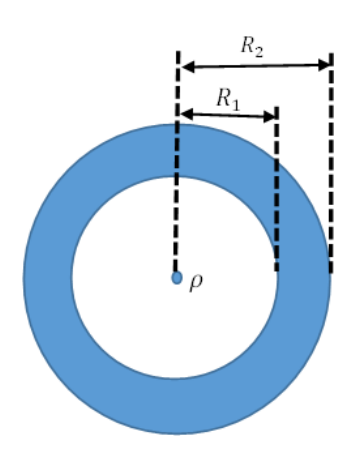
- (A)
- (B)
- (C)
- (D)
- (E)
Fonte: Testo (PDF) — p.19 Topic: Electrostatics Metodi: Gauss’s Law Competenze: Physical Reasoning Objects: Cylinder, Wire
Un cilindro conduttore infinito di raggio , ha una cavità cilindrica concentrica infinita di raggio . La sezione trasversale è mostrata di seguito. Il cilindro non ha carica ma un filo sottile che porta carica positiva per unità di lunghezza corre lungo il centro del buco cilindrico, parallelo al cilindro. Qual è la carica per unità di lunghezza sulla superficie interna del cilindro?
- (A)
- (B)
- (C)
- (D)
- (E)
Fonte: Testo (PDF) — p.19 Topic: Electrostatics Metodi: Gauss’s Law Competenze: Physical Reasoning Objects: Cylinder, Wire
An electron moves at constant speed in a uniform magnetic field. If the initial velocity of the electron is perpendicular to the magnetic field, the electron describes a path that is a
- (A) straight line
- (B) helix
- (C) circle
- (D) parabola
- (E) hyperbola
Fonte: Testo (PDF) — p.20 Topic: Magnetism Metodi: Lorentz Force Analysis Competenze: Physical Reasoning Objects: Electron
Un elettrone si muove a velocità costante in un campo magnetico uniforme. Se la velocità iniziale dell’elettrone è perpendicolare al campo magnetico, l’elettrone descrive un percorso che è un
- **(A) ** linea retta
- **(B) ** elice
- **(C) ** cerchio
- **(D) ** parabola
- **(E) ** iperbola
Fonte: Testo (PDF) — p.20 Topic: Magnetism Metodi: Lorentz Force Analysis Competenze: Physical Reasoning Objects: Electron
An alpha particle and a proton follows the same circular path in a uniform magnetic field. What is the ratio of the alpha particle’s velocity to the proton’s velocity? You can consider the case to be non-relativistic.
- (A)
- (B)
- (C)
- (D)
- (E)
Fonte: Testo (PDF) — p.20 Topic: Magnetism Metodi: Lorentz Force Analysis Competenze: Physical Reasoning Objects: Particle Beam
Una particella alfa e un protone seguono lo stesso percorso circolare in un campo magnetico uniforme. Qual è il rapporto tra la velocità della particella alfa e la velocità del protone? Puoi considerare il caso non relativistico.
- (A)
- (B)
- (C)
- (D)
- (E)
Fonte: Testo (PDF) — p.20 Topic: Magnetism Metodi: Lorentz Force Analysis Competenze: Physical Reasoning Objects: Particle Beam
A two-range d.c. voltmeter has a common negative terminal and two positive terminals, one to give a full scale deflection for 10 V and the other to give a full scale deflection of 3 V. The resistance of the voltmeter between the negative terminal and +3 V terminal is . The resistance between the negative terminal and the +10 V terminal is
- (A)
- (B)
- (C)
- (D)
- (E)
Fonte: Testo (PDF) — p.20 Topic: Circuits Metodi: Kirchhoff’s Laws Competenze: Physical Reasoning Objects: Resistor, Galvanometer
Un D.C. a due ranghi. Il voltmeter ha un terminale negativo comune e due terminali positivi, uno per dare una deviazione di scala completa di 10 V e l’altro per dare una deviazione di scala completa di 3 V. La resistenza del voltmeter tra il terminale negativo e il terminale +3 V è . La resistenza tra il terminale negativo e il terminale +10 V è
- (A)
- (B)
- (C)
- (D)
- (E)
Fonte: Testo (PDF) — p.20 Topic: Circuits Metodi: Kirchhoff’s Laws Competenze: Physical Reasoning Objects: Resistor, Galvanometer
The e.m.f induced in a coil by the changing magnetic flux is equal to the rate of change of the flux . Which of the following is a unit for magnetic flux ?
- (A)
- (B)
- (C)
- (D)
- (E)
Fonte: Testo (PDF) — p.21 Topic: Electromagnetic Induction Metodi: Dimensional Analysis Competenze: Physical Reasoning Objects: Coil
L’e.m.f indotto in una bobina dal flusso magnetico in variazione è uguale al tasso di variazione del flusso . Qual è l’unità di flusso magnetico ?
- (A)
- (B)
- (C)
- (D)
- (E)
Fonte: Testo (PDF) — p.21 Topic: Electromagnetic Induction Metodi: Dimensional Analysis Competenze: Physical Reasoning Objects: Coil
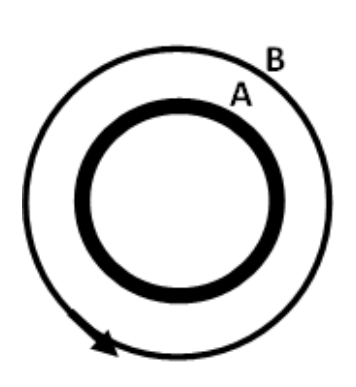
A plastic ring A is rubbed with rabbit fur and gains a negative charge. It is then placed inside a metal ring as shown in the diagram below. An electrical current can be induced in the metal ring B (anticlockwise as indicated in diagram) when A is
- (A) turning clockwise with constant angular velocity.
- (B) turning anti-clockwise with constant angular velocity.
- (C) turning clockwise with increasing angular velocity.
- (D) turning anti-clockwise with increasing angular velocity.
- (E) not turning.
Fonte: Testo (PDF) — p.21 Topic: Electromagnetic Induction Metodi: Lenz’s Law Competenze: Physical Reasoning Objects: —
Un anello di plastica A viene strofinato con pelliccia di coniglio e ottiene una carica negativa. È poi inserito all’interno di un anello di metallo come mostrato nel diagramma di seguito. Una corrente elettrica può essere indotta nell’anello metallico B (in senso antiorario come indicato nel diagramma) quando A è
- **(A) ** che ruota nel senso orario con velocità angolare costante.
- **(B) ** che ruota contro il senso dell’orologio con velocità angolare costante.
- **(C) ** rotando nel senso orario con velocità angolare crescente.
- **(D) ** rotando contro il senso dell’orologio con velocità angolare crescente.
- **(E) ** non si gira.
Fonte: Testo (PDF) — p.21 Topic: Electromagnetic Induction Metodi: Lenz’s Law Competenze: Physical Reasoning Objects: —
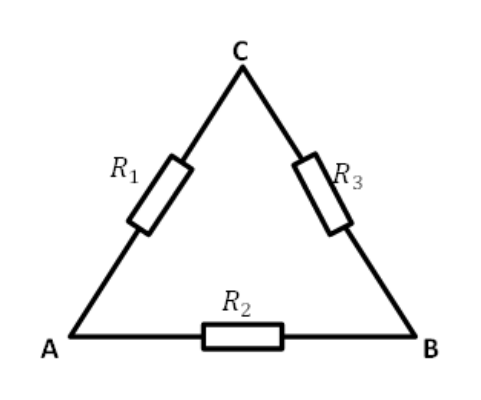
3 resistors of the same resistance forms a triangular circuit as shown. When one of the resistances is changed, measurements show that , . Which is the resistance that has been changed and what is its new resistance?
- (A)
- (B)
- (C)
- (D)
- (E)
Fonte: Testo (PDF) — p.21 Topic: Circuits Metodi: Equivalent Circuit Reduction Competenze: Physical Reasoning Objects: Resistor
3 resistori della stessa resistenza formano un circuito triangolare come mostrato. Quando una delle resistenze viene modificata, le misurazioni mostrano che , . Qual è la resistenza che è stata modificata e qual è la sua nuova resistenza?
- (A)
- (B)
- (C)
- (D)
- (E)
Fonte: Testo (PDF) — p.21 Topic: Circuits Metodi: Equivalent Circuit Reduction Competenze: Physical Reasoning Objects: Resistor
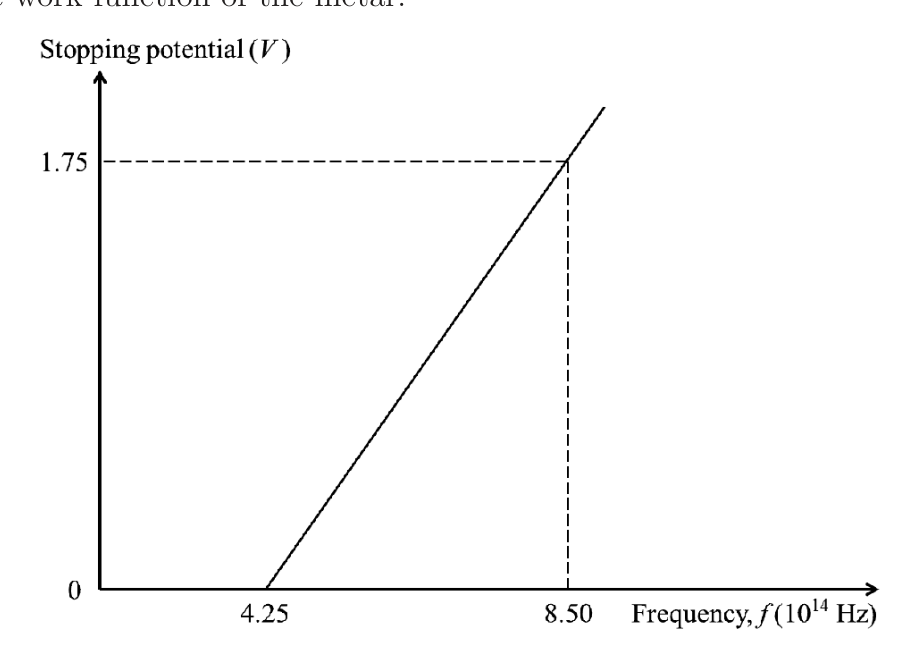
Consider a photoelectric effect experiment. The figure below shows the plot of the stopping potential against the frequency of the incident light falling on a metal surface. What is the work function of the metal?
- (A) 1.45 eV
- (B) 1.55 eV
- (C) 1.65 eV
- (D) 1.75 eV
- (E) 1.85 eV
Fonte: Testo (PDF) — p.22 Topic: Modern-Quantum Physics Metodi: Photon Energy Relation Competenze: Physical Reasoning Objects: Photon
Considerate un esperimento di effetto fotoelettrico. La figura seguente mostra il plot del potenziale di arresto rispetto alla frequenza della luce incidente che cade su una superficie metallica. Qual è la funzione di lavoro del metallo?
- (A) 1.45 eV
- (B) 1.55 eV
- (C) 1.65 eV
- (D) 1.75 eV
- (E) 1.85 eV
Fonte: Testo (PDF) — p.22 Topic: Modern-Quantum Physics Metodi: Photon Energy Relation Competenze: Physical Reasoning Objects: Photon
Which of the listed phenomena can be explained if we assume that light is a particle?
I) A beam of light strikes a mirror and its angle of incidence is measured to be the same as its angle of reflection.
II) When a beam of light passes through a small circular aperture and onto a screen, the size of the spot of light on the screen increases as the aperture size decreases.
III) A beam of laser light passing through 2 closely spaced slits produces a series of bright and dark fringes on a screen.
IV) Electrons are ejected from a metal surface only when it is illuminated by light with frequency above a certain value.
- (A) I and IV only
- (B) I, II and III only
- (C) IV only
- (D) II and III only
- (E) All of the above
Fonte: Testo (PDF) — p.22 Topic: Modern-Quantum Physics Metodi: Photon Energy Relation Competenze: Physical Reasoning Objects: Photon, Mirror, Slit, Screen
Quale dei fenomeni elencati può essere spiegato se supponiamo che la luce sia una particella?
I) Un raggio di luce colpisce uno specchio e l’angolo di incidenza è misurato come uguale all’angolo di riflessione.
II) Quando un fascio di luce passa attraverso una piccola apertura circolare e si incontra su uno schermo, la dimensione del punto luminoso sullo schermo aumenta con la diminuzione della dimensione dell’apertura.
III) Un raggio di luce laser che passa attraverso due fessure spaziate tra loro produce una serie di margini luminosi e scuri su uno schermo.
IV) Gli elettroni vengono espulsi da una superficie metallica solo quando viene illuminata da luce con una frequenza superiore a un certo valore.
- **(A) ** I e IV soltanto
- **(B) ** I, II e III soltanto
- solo **(C) ** IV
- **(D) ** solo II e III
- **(E) ** Tutti i suddetti elementi
Fonte: Testo (PDF) — p.22 Topic: Modern-Quantum Physics Metodi: Photon Energy Relation Competenze: Physical Reasoning Objects: Photon, Mirror, Slit, Screen
Which of the following lists contains a device that does NOT make use of the quantum nature of the universe?
- (A) cell phone, credit card with a chip, car keyless entry
- (B) calculator, DVD player, laser light show
- (C) laptop computer, digital clock, grocery checkout scanner
- (D) iPod, Internet, LED light
- (E) None of the above
Fonte: Testo (PDF) — p.23 Topic: Modern-Quantum Physics Metodi: Physical Modeling Competenze: Physical Reasoning Objects: —
Quale delle seguenti liste contiene un dispositivo che NON utilizza la natura quantistica dell’universo?
- **(A) ** cellulare, carta di credito con chip, ingresso senza chiave di auto
- Calcolatore, lettore DVD, spettacolo di luce laser
- computer portatile, orologio digitale, scanner di cassa del supermercato
- **(D) ** iPod, Internet, luce LED
- **(E) ** Nessuna delle seguenti:
Fonte: Testo (PDF) — p.23 Topic: Modern-Quantum Physics Metodi: Physical Modeling Competenze: Physical Reasoning Objects: —
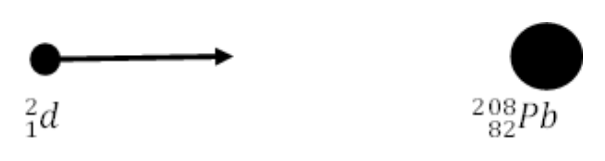
A deuteron is incident on a lead nucleus at Brookhaven National Laboratory. The terminal voltage of the accelerator is 15 MV. Find the distance of closest approach in a head-on collision.
- (A) 7.87 fm
- (B) 15.74 fm
- (C) 5.32 fm
- (D) 10.64 fm
- (E) 13.20 fm
Fonte: Testo (PDF) — p.23 Topic: Nuclear & Particle Physics Metodi: Energy Conservation Method Competenze: Physical Reasoning Objects: Nucleus
Un incidente di Deuteron è avvenuto su un nucleo di piombo al Brookhaven National Laboratory. La tensione terminale dell’acceleratore è di 15 MV. Trova la distanza di avvicinamento più vicina in una collisione frontale.
- (A) 7.87 fm
- (B) 15.74 fm
- (C) 5.32 fm
- (D) 10.64 fm
- (E) 13.20 fm
Fonte: Testo (PDF) — p.23 Topic: Nuclear & Particle Physics Metodi: Energy Conservation Method Competenze: Physical Reasoning Objects: Nucleus
2015 is the International Year of Light as declared by the United Nations. 100 years ago, the theory of General Relativity developed by Einstein showed how light was at the center of the very structure of space and time. Which of the following is NOT a true statement about the general theory of relativity?
- (A) True physical laws hold only in an inertial coordinate frame.
- (B) The gravitational equations can be applied to any coordinate system.
- (C) The gravitational equations are structure laws describing the changes of the gravitational field.
- (D) The universe is not Euclidean.
- (E) The ellipse of the planet Mercury rotates with respect to the sun.
Fonte: Testo (PDF) — p.23 Topic: Special Relativity Metodi: Physical Modeling Competenze: Physical Reasoning Objects: Planet, Star
Il 2015 è l’Anno internazionale della luce come dichiarato dalle Nazioni Unite. 100 anni fa, la teoria della Relatività Generale sviluppata da Einstein ha mostrato come la luce fosse al centro della struttura stessa dello spazio e del tempo. Quale delle seguenti non è una vera affermazione sulla teoria generale della relatività?
- **(A) ** Le vere leggi fisiche si riescono a mantenere solo in un quadro di coordinate inerziali.
- **(B) ** Le equazioni gravitazionali possono essere applicate a qualsiasi sistema di coordinate. Le equazioni gravitazionali sono leggi di struttura che descrivono i cambiamenti del campo gravitazionale.
- **(D) ** L’universo non è euclidico.
- **(E) ** L’ellisse del pianeta Mercurio ruota rispetto al sole.
Fonte: Testo (PDF) — p.23 Topic: Special Relativity Metodi: Physical Modeling Competenze: Physical Reasoning Objects: Planet, Star