A force is applied to a box to push it across the horizontal floor at a constant speed of . Assume air resistance is negligible. What can you say about the forces acting on the box?
- (A) If the force applied to the box is doubled, the constant speed of the box will double to .
- (B) The magnitude of force applied to keep the box moving at a constant speed must be more than the magnitude of its weight.
- (C) The force being applied to the box to keep it moving at constant speed makes an action-reaction pair with the frictional force that resists its motion.
- (D) The magnitude of force applied to keep the box moving at a constant speed must be equal to the magnitude of the frictional forces that resist its motion.
- (E) The magnitude of force applied to keep the box moving at a constant speed must overcome i.e. be more than the magnitude of the frictional forces that resist its motion.
Fonte: Testo (PDF) — p.3
Topic: Newtonian Mechanics Metodi: Free-Body Diagram, Physical Modeling Competenze: Physical Reasoning Objects: Block
Si applica una forza su una scatola per spingerla attraverso il pavimento orizzontale a una velocità costante **** di . Supponiamo che la resistenza all’aria sia trascurabile. Che cosa si può dire delle forze **** che agiscono sulla scatola?
- **(A) ** Se la forza applicata alla scatola è raddoppiata, la velocità costante della scatola raddoppierà a .
- **(B) ** La forza applicata per mantenere la scatola in movimento a velocità costante deve essere superiore alla sua massa.
- **(C) ** La forza applicata alla scatola per mantenerla in movimento a velocità costante crea una coppia di azione-reazione con la forza di attrito che resiste al suo movimento.
- **(D) ** La forza applicata per mantenere la scatola in movimento a velocità costante deve essere uguale alla forza di attrito che resiste al suo movimento.
- **(E) ** La forza applicata per mantenere la scatola in movimento a velocità costante deve superare, ovvero essere superiore alla grandezza delle forze di attrito che resistono al suo movimento.
Fonte: Testo (PDF) — p.3
Topic: Newtonian Mechanics Metodi: Free-Body Diagram, Physical Modeling Competenze: Physical Reasoning Objects: Block
If the force applied to the box in the preceding problem is suddenly discontinued, the box will;
- (A) stop suddenly.
- (B) continue at a constant velocity.
- (C) suddenly start slowing to a stop.
- (D) increase its speed for a very short period of time, then start slowing to a stop.
- (E) continue at a constant speed for a very short period of time and then slow to a stop.
Fonte: Testo (PDF) — p.3
Topic: Newtonian Mechanics Metodi: Free-Body Diagram, Physical Modeling Competenze: Physical Reasoning Objects: Block
Se la forza ** applicata** alla casella del problema precedente è suddenly discontinued, la casella si
- **(A) ** fermarsi improvvisamente.
- **(B) ** continua a velocità costante.
- **(C) ** improvvisamente iniziano a rallentare fino a fermarsi.
- **(D) ** aumentare la sua velocità per un periodo molto breve, quindi iniziare a rallentare fino a fermarsi.
- **(E) ** continuare a velocità costante per un periodo molto breve e poi lentamente a fermarsi.
Fonte: Testo (PDF) — p.3
Topic: Newtonian Mechanics Metodi: Free-Body Diagram, Physical Modeling Competenze: Physical Reasoning Objects: Block
A box with mass is lying motionless on a level surface. In the diagram, is the ground reaction force or normal force on the box and is the weight of the box. Which statement is incorrect?
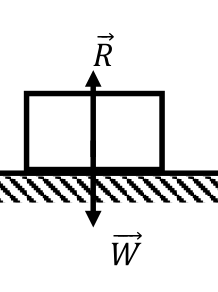
- (A) According to Newton’s law of motion, implies that the box will remain at rest.
- (B) According to Newton’s law of motion, .
- (C) According to Newton’s law of motion, .
- (D) According to Newton’s law of universal gravitation, .
- (E) According to Newton’s law of universal gravitation is related to the mass and radius of earth.
Fonte: Testo (PDF) — p.3
Topic: Newtonian Mechanics Metodi: Free-Body Diagram, Physical Modeling Competenze: Physical Reasoning Objects: Block
Una scatola di massa è immobile su una superficie piatta. Nel diagramma, è la forza di reazione del suolo o ** forza normale ** sulla scatola e è il ** peso ** della scatola. Quale dichiarazione è errato?
- **(A) ** Secondo la legge di Newton del movimento, implica che la scatola rimarrà a riposo.
- (B) According to Newton’s law of motion, .
- (C) According to Newton’s law of motion, .
- **(D) ** Secondo la legge di Newton della gravità universale, .
- **(E) ** Secondo la legge di Newton della gravità universale è correlato alla massa e al raggio della terra.
Fonte: Testo (PDF) — p.3
Topic: Newtonian Mechanics Metodi: Free-Body Diagram, Physical Modeling Competenze: Physical Reasoning Objects: Block
A box is pulled using a string up a radian slope at constant speed of . The string is cut suddenly and the box comes to a stop after moving up a further distance of . What is the value of the coefficient of friction?
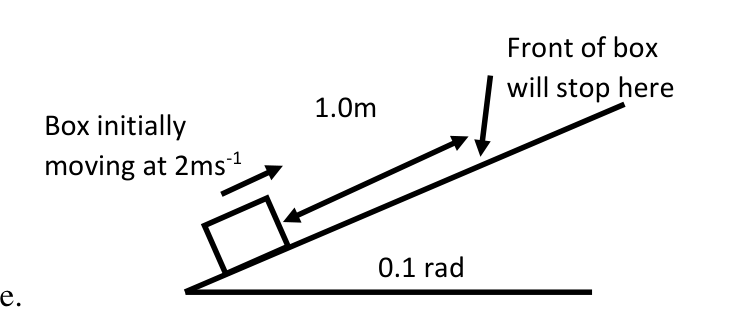
- (A)
- (B)
- (C)
- (D)
- (E) The situation is impossible.
Fonte: Testo (PDF) — p.4
Topic: Newtonian Mechanics Metodi: Free-Body Diagram, Kinematic Equations Competenze: Physical Reasoning Objects: Block, String, Inclined Plane
Una scatola viene tirata con una corda su una pendenza radiana a velocità costante di . La stringa viene tagliata ** improvvisamente ** e la scatola si ferma dopo aver avanzato ulteriormente di . Qual è il valore del coefficiente ** di attrito **?
- (A)
- (B)
- (C)
- (D)
- **(E) ** La situazione è impossibile.
Fonte: Testo (PDF) — p.4
Topic: Newtonian Mechanics Metodi: Free-Body Diagram, Kinematic Equations Competenze: Physical Reasoning Objects: Block, String, Inclined Plane
A train of mass expends of power to travel down a incline at a constant velocity of . How much power is required for the same train to travel up the incline at the same constant velocity of ?
- (A)
- (B)
- (C)
- (D)
- (E)
Fonte: Testo (PDF) — p.4
Topic: Conservation of Energy Metodi: Energy Conservation Method, Free-Body Diagram Competenze: Physical Reasoning Objects: Inclined Plane
Un treno di massa spende di potenza per ** viaggiare giù ** a una pendenza a una velocità costante di . Quanto potenza è necessaria per lo stesso treno per viaggiare ** su ** la pendenza alla stessa velocità costante di ?
- (A)
- (B)
- (C)
- (D)
- (E)
Fonte: Testo (PDF) — p.4
Topic: Conservation of Energy Metodi: Energy Conservation Method, Free-Body Diagram Competenze: Physical Reasoning Objects: Inclined Plane
Carts A and B are initially at rest in a frictionless, horizontal surface. A constant force is applied to each cart as it travels from its initial position. The mass of cart A is more than the mass of cart B. Consider the kinetic energy, , and momentum, , of the boxes at position X, a distance from the initial position. Subscripts A, B denote cart A or B. Which statement below is correct?
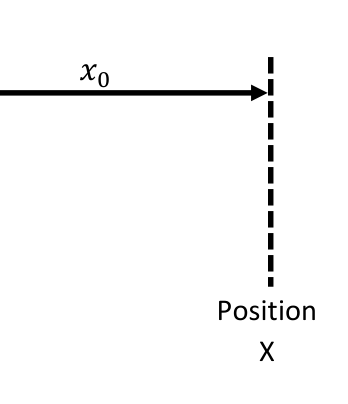
- (A) ,
- (B) ,
- (C) ,
- (D) ,
- (E) ,
Fonte: Testo (PDF) — p.5
Topic: Conservation of Energy Metodi: Energy Conservation Method, Impulse-Momentum Theorem Competenze: Physical Reasoning Objects: Cart
I carrelli A e B sono in primo riposo in una superficie orizzontale senza attrito. Ogni carrello viene applicato una forza costante mentre si muove dalla sua posizione iniziale. La massa **** del carrello A è più di della massa del carrello B. Si consideri l’energia cinetica, , e il momento, , delle scatole in posizione X, una distanza dalla posizione iniziale. Le sottoscrizioni A e B indicano il carrello A o B. Quale di queste indicazioni è corretta?
- (A) ,
- (B) ,
- (C) ,
- (D) ,
- (E) ,
Fonte: Testo (PDF) — p.5
Topic: Conservation of Energy Metodi: Energy Conservation Method, Impulse-Momentum Theorem Competenze: Physical Reasoning Objects: Cart
An object, , with mass and another object, , with twice the mass are dropped from rest, at the same starting position from the top of a large container and fall in a straight line through motionless viscous liquid. Drag is significant and assume that the two objects would eventually reach the same terminal velocity if the container were tall enough. Consider the case where the objects do not reach terminal velocity at the bottom of the container. Assume that the same type of drag acts on both objects. How does the time taken, and , for the objects and to reach the bottom compare?
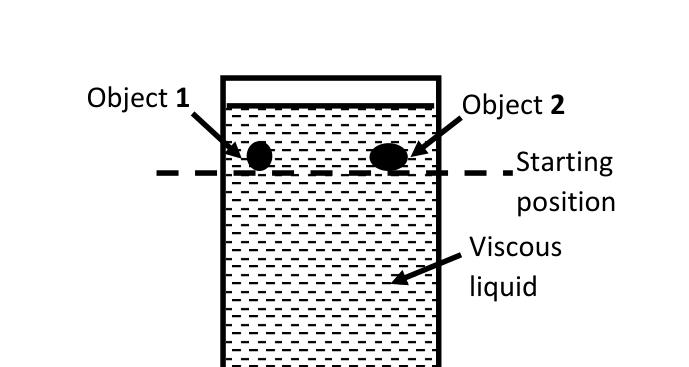
- (A)
- (B)
- (C)
- (D)
- (E)
Fonte: Testo (PDF) — p.5
Topic: Newtonian Mechanics Metodi: Free-Body Diagram, Physical Modeling Competenze: Physical Reasoning Objects: Container
Un oggetto, , di massa e un altro oggetto, , di massa doppia , vengono scaricati dal riposo, nella stessa posizione di partenza dalla parte superiore di un grande contenitore e cadono in linea retta attraverso un liquido viscoso immobile. Drag è significativo e ** presuppone che i due oggetti raggiungeranno alla fine la stessa velocità terminale se il contenitore fosse abbastanza alto**. Considerare il caso in cui gli oggetti ** non raggiungano la velocità terminale nella parte inferiore del contenitore. Supponiamo che il **same tipo ** di traguardo agisca su entrambi gli oggetti. Come si confronta il tempo impiegato, e , per raggiungere il fondo degli oggetti e ?
- (A)
- (B)
- (C)
- (D)
- (E)
Fonte: Testo (PDF) — p.5
Topic: Newtonian Mechanics Metodi: Free-Body Diagram, Physical Modeling Competenze: Physical Reasoning Objects: Container
A train moving on straight horizontal tracks slows down from to at a constant rate of . What distance does it travel while slowing down?
- (A)
- (B)
- (C)
- (D)
- (E)
Fonte: Testo (PDF) — p.6
Topic: Newtonian Mechanics Metodi: Kinematic Equations Competenze: Physical Reasoning Objects: —
Un treno in movimento su binari orizzontali dritti ** rallenta ** da a a una velocità costante **** di . Qual è la distanza che percorre mentre rallenta?
- (A)
- (B)
- (C)
- (D)
- (E)
Fonte: Testo (PDF) — p.6
Topic: Newtonian Mechanics Metodi: Kinematic Equations Competenze: Physical Reasoning Objects: —
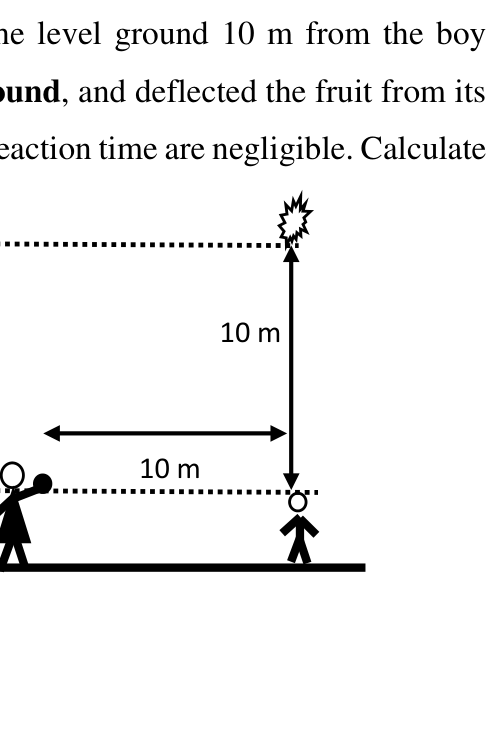
A fruit drops from a tree. A boy, tall, stands on the flat ground just under the fruit. The fruit was initially above the boy’s head. A woman standing on the level ground from the boy immediately throws a ball from a height of above the ground, and deflected the fruit from its path towards the boy’s head. Assume that air resistance and her reaction time are negligible. Calculate the minimum speed of the ball?
- (A)
- (B)
- (C)
- (D)
- (E)
Fonte: Testo (PDF) — p.6
Topic: Newtonian Mechanics Metodi: Kinematic Equations, Vector Decomposition Competenze: Physical Reasoning Objects: Ball, Projectile
Un frutto cade da un albero. A boy, tall, stands on the flat ground just under the fruit. The fruit was initially above the boy’s head. Una donna che si trova sul terreno piatto dal ragazzo lancia immediatamente una palla da un’altezza di ** sopra il terreno**, e deviato il frutto dal suo percorso verso la testa del ragazzo. Supponiamo che la resistenza dell’aria e il suo tempo di reazione siano trascurabili. Calculate the minimum speed of the ball?
- (A)
- (B)
- (C)
- (D)
- (E)
Fonte: Testo (PDF) — p.6
Topic: Newtonian Mechanics Metodi: Kinematic Equations, Vector Decomposition Competenze: Physical Reasoning Objects: Ball, Projectile
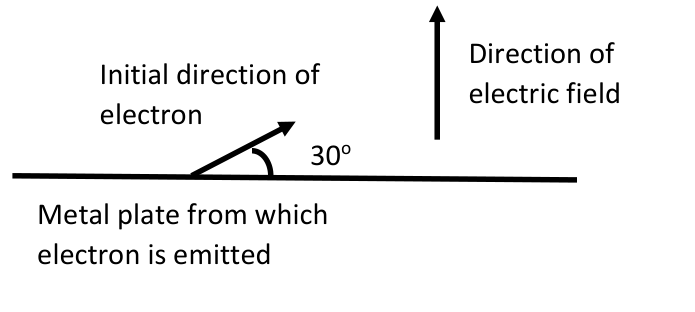
An electron is emitted from the surface of a metal plate at an angle of degrees from the surface. The electron’s initial kinetic energy is . A uniform electric field of is applied, direction as shown in the figure. What is the kinetic energy of the electron when it is furthest from the plate from which it was emitted?
- (A)
- (B)
- (C)
- (D)
- (E)
Fonte: Testo (PDF) — p.7
Topic: Electrostatics Metodi: Energy Conservation Method, Vector Decomposition Competenze: Physical Reasoning Objects: Electron
Un elettrone viene emesso dalla superficie di una piastra metallica ad un angolo di gradi dalla superficie. L’energia cinetica iniziale **** dell’elettrone è . Si applica un campo elettrico uniforme di , direzione mostrata nella figura. Qual è l’energia cinetica dell’elettrone quando è ** più lontano** dalla piastra da cui è stato emesso?
- (A)
- (B)
- (C)
- (D)
- (E)
Fonte: Testo (PDF) — p.7
Topic: Electrostatics Metodi: Energy Conservation Method, Vector Decomposition Competenze: Physical Reasoning Objects: Electron
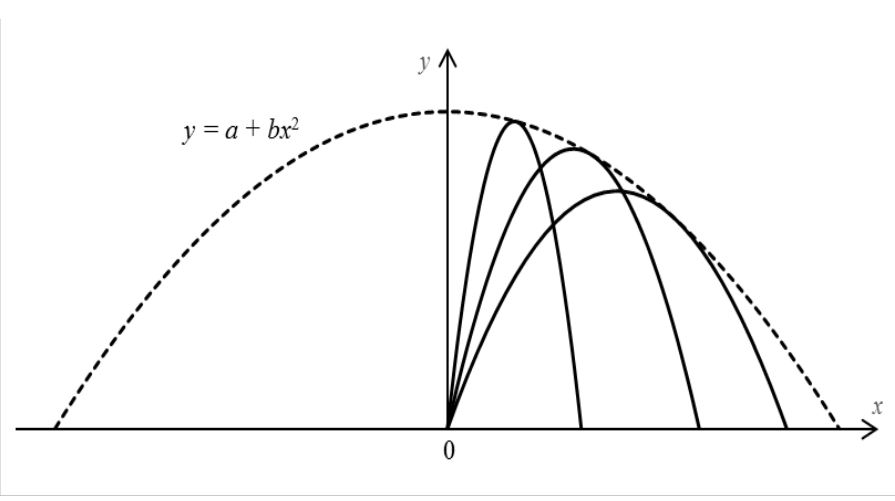
A projectile is launched at velocity into an ideal ballistic trajectory from the origin of a coordinate system. Given that: when the launch angle is varied, all the possible points that can be hit by the projectile are exactly contained within a parabola with equation where is the vertical height, is the horizontal displacement from the origin, while and are constants. What could be the expression for and ?
- (A)
- (B)
- (C)
- (D)
- (E)
Fonte: Testo (PDF) — p.7
Topic: Newtonian Mechanics Metodi: Kinematic Equations, Vector Decomposition Competenze: Physical Reasoning Objects: Projectile
Un proiettile viene lanciato a velocità in una traiettoria balistica ideale dall’origine di un sistema di coordinate. Dato che: quando l’angolo di lancio è variabile, tutti i punti possibili che il proiettile può colpire sono contenuti esattamente in una parabola **** con l’equazione dove è l’altezza verticale, è il spostamento orizzontale dall’origine, mentre e sono costanti. Qual è l’espressione **** per e ?
- (A)
- (B)
- (C)
- (D)
- (E)
Fonte: Testo (PDF) — p.7
Topic: Newtonian Mechanics Metodi: Kinematic Equations, Vector Decomposition Competenze: Physical Reasoning Objects: Projectile
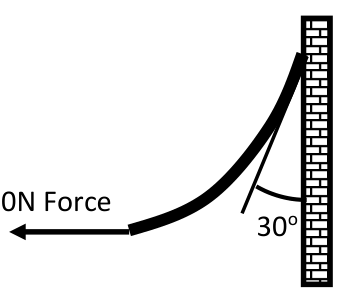
The upper end of a rope is fixed to a vertical wall. The upper end makes an angle of degrees with the wall when the lower end is pulled by a horizontal force of . What is the mass of the rope?
- (A)
- (B)
- (C)
- (D)
- (E)
Fonte: Testo (PDF) — p.8
Topic: Rigid Body Statics Metodi: Free-Body Diagram, Vector Decomposition Competenze: Physical Reasoning Objects: String
L’estremità superiore di una corda è fissata a un muro verticale. L’estremità superiore fa un angolo di gradi con la parete quando l’estremità inferiore è tirata da una forza orizzontale di . Qual è la massa della corda?
- (A)
- (B)
- (C)
- (D)
- (E)
Fonte: Testo (PDF) — p.8
Topic: Rigid Body Statics Metodi: Free-Body Diagram, Vector Decomposition Competenze: Physical Reasoning Objects: String
An ideal uniform spring of mass kg, unstretched length m and spring constant stretches by an extension of m when hung vertically. Which statement below is correct? (You may want to know that the sum of N terms in an arithmetic progression from to is )
- (A) The top half of the spring with mass kg has an extension m.
- (B) The top half of the spring with length m supports N.
- (C) The top half of the spring with mass kg has a spring constant of .
- (D) The extension of the whole spring is m.
- (E) The length of the whole spring is m.
Fonte: Testo (PDF) — p.8
Topic: Elasticity & Materials Metodi: Hooke’s Law, Physical Modeling Competenze: Physical Reasoning Objects: Spring
Una molla ideale uniforme di massa kg, lunghezza non allungata m e costante della molla si estende per un’estensione di m quando appesa in verticale. Quale di queste indicazioni è corretta? (Voi **** potreste sapere che la somma di N termini in una progressione aritmetica da a è )
- **(A) ** La metà superiore della molla con massa kg ha un’estensione m.
- **(B) ** La metà superiore della molla con lunghezza m supporta N.
- **(C) ** La metà superiore della molla con massa kg ha una costante di molla di .
- **(D) ** L’estensione di tutta la molla è m.
- **(E) ** La lunghezza di tutta la molla è m.
Fonte: Testo (PDF) — p.8
Topic: Elasticity & Materials Metodi: Hooke’s Law, Physical Modeling Competenze: Physical Reasoning Objects: Spring
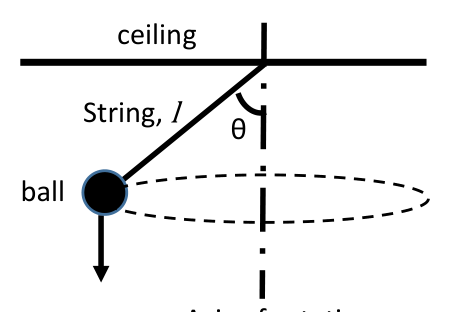
A ball with mass is hung from the ceiling with a massless string of length as shown in the diagram. It moves in uniform circular motion with angular velocity . What is the magnitude of tension in the string?
- (A)
- (B)
- (C)
- (D)
- (E)
Fonte: Testo (PDF) — p.9
Topic: Newtonian Mechanics Metodi: Free-Body Diagram, Vector Decomposition Competenze: Physical Reasoning Objects: Ball, String, Pendulum
Una palla di massa è appesa al soffitto con una stringa senza massa di lunghezza come mostrato nel diagramma. Si muove in **uniforme moto circolare ** con velocità angolare . Qual è la magnitudine della tensione **** nella stringa?
- (A)
- (B)
- (C)
- (D)
- (E)
Fonte: Testo (PDF) — p.9
Topic: Newtonian Mechanics Metodi: Free-Body Diagram, Vector Decomposition Competenze: Physical Reasoning Objects: Ball, String, Pendulum
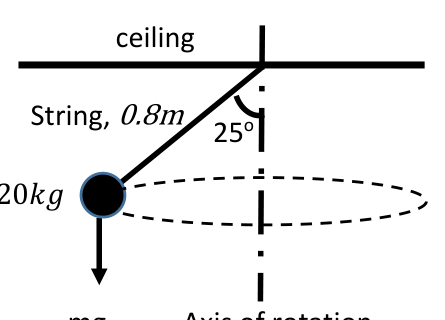
For the same situation as in the above question, with , . What is the angular velocity in order for the string to maintain a constant angle of to the vertical?
- (A)
- (B)
- (C)
- (D)
- (E)
Fonte: Testo (PDF) — p.9
Topic: Newtonian Mechanics Metodi: Free-Body Diagram, Vector Decomposition Competenze: Physical Reasoning Objects: Ball, String, Pendulum
Per la stessa situazione della domanda di cui sopra, con , . Qual è la velocità angolare **** per mantenere la corda in un angolo costante di verso la verticale?
- (A)
- (B)
- (C)
- (D)
- (E)
Fonte: Testo (PDF) — p.9
Topic: Newtonian Mechanics Metodi: Free-Body Diagram, Vector Decomposition Competenze: Physical Reasoning Objects: Ball, String, Pendulum
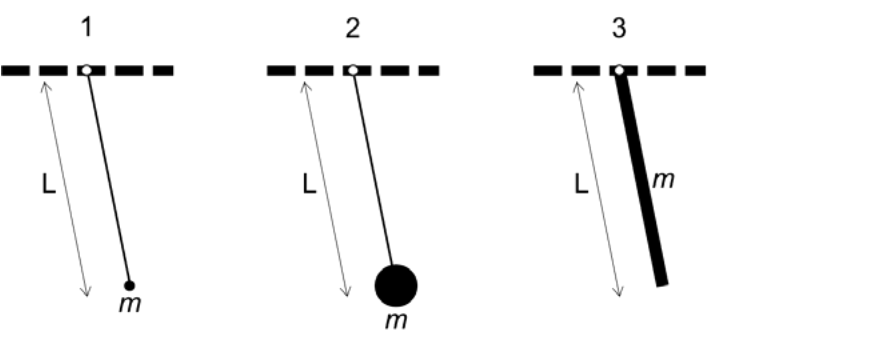
The diagram below shows pendulums of length . The first uses a point mass suspended from a string of length ; the second uses a sphere with radius and mass suspended such that the centre of mass of the sphere is length away from the pivot point; the last uses a rigid rod of length and mass pivoted at its end. Which of the following statements correctly describes the periods of these pendulums?
- (A) Period of
- (B) Period of
- (C) Period of
- (D) Period of
- (E) Period of
Fonte: Testo (PDF) — p.10
Topic: Oscillations & Waves Metodi: Simple Harmonic Motion Analysis, Torque & Angular Momentum Analysis Competenze: Physical Reasoning Objects: Pendulum, Sphere, Rod, String
Il diagramma di seguito mostra i penduli di lunghezza . Il primo utilizza una massa puntaria sospesa da una stringa di lunghezza ; il secondo utilizza una sfera con raggio e massa sospesa in modo tale che il centro di massa della sfera sia lunghezza lontano dal punto di pivot; l’ultimo utilizza una barra rigida di lunghezza e massa pivotata alla sua fine. Qual è la seguente affermazione che descrive correttamente i periodi di questi penduli ?
- **(A) ** Periodo di
- **(B) ** Periodo di
- **(C) ** Periodo di
- **(D) ** Periodo di
- **(E) ** Periodo di
Fonte: Testo (PDF) — p.10
Topic: Oscillations & Waves Metodi: Simple Harmonic Motion Analysis, Torque & Angular Momentum Analysis Competenze: Physical Reasoning Objects: Pendulum, Sphere, Rod, String
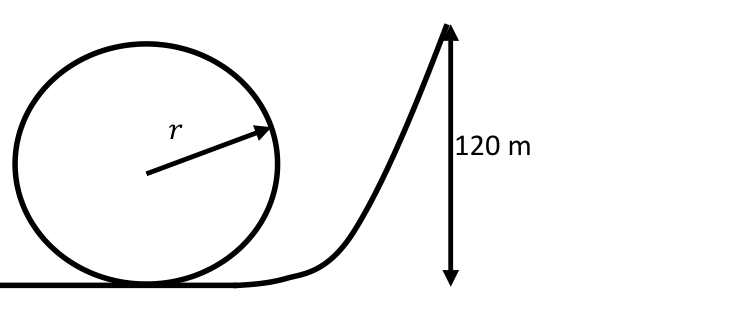
A roller coaster car is initially at rest at a height of above the ground. It goes to the ground and does a circular loop of radius . Assume that friction and energy losses are negligible, the car is small and is not attached to the track. What is the maximum radius so that the roller coaster does not leave the track?
- (A)
- (B)
- (C)
- (D)
- (E)
Fonte: Testo (PDF) — p.10
Topic: Conservation of Energy Metodi: Energy Conservation Method, Free-Body Diagram Competenze: Physical Reasoning Objects: Cart
Un’automobile è inizialmente in riposo ad un’altezza di sopra il suolo. Si avvicina al suolo e fa un ciclo circolare di raggio . Supponiamo che la friczione e le perdite energetiche siano trascurabili, che l’auto sia piccola e non sia collegata alla pista. Qual è il raggio massimo **** in modo che la montagna russa non lasci la pista?
- (A)
- (B)
- (C)
- (D)
- (E)
Fonte: Testo (PDF) — p.10
Topic: Conservation of Energy Metodi: Energy Conservation Method, Free-Body Diagram Competenze: Physical Reasoning Objects: Cart
Two masses and are attached to a light, unstretchable, string on a fixed rod as shown in the figure. Assume that friction is negligible. What is the acceleration of mass due to gravity?
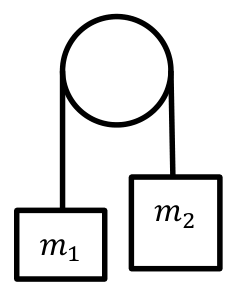
- (A) upwards
- (B) upwards
- (C) downwards
- (D) upwards
- (E) upwards
Fonte: Testo (PDF) — p.11
Topic: Newtonian Mechanics Metodi: Free-Body Diagram, Vector Decomposition Competenze: Physical Reasoning Objects: String, Rod
Due masse e sono attaccate a **una leggera, non allungata **, stringhe su una canna fissa come mostrato nella figura. Supponiamo che il frattamento sia trascurabile. Qual è l’accelerazione della massa dovuta alla gravità?
- **(A) ** verso l’alto
- **(B) ** in alto
- **(C) ** verso il basso
- **(D) ** in su
- **(E) ** in alto
Fonte: Testo (PDF) — p.11
Topic: Newtonian Mechanics Metodi: Free-Body Diagram, Vector Decomposition Competenze: Physical Reasoning Objects: String, Rod
In the figure, the two pulleys are at both ends are fixed in position and the pulley in between them is free to move. The masses , are attached to the ends of a long string and the string is placed across the two big pulleys. Then the small pulley with is gently placed on the initially horizontal string between the two big pulleys. Assume that the pulleys rotate smoothly and have negligible mass. Also assume that the string is long enough. What is the angle at equilibrium?
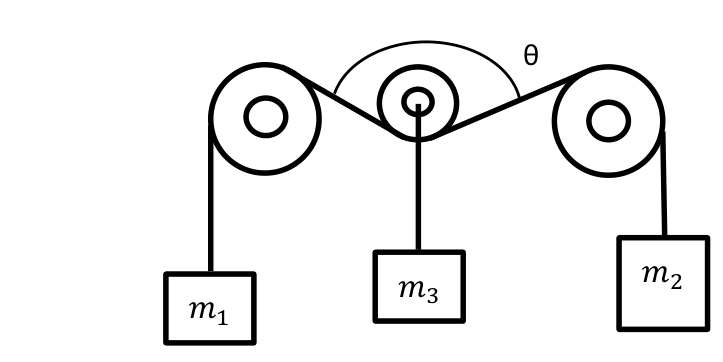
- (A)
- (B)
- (C)
- (D)
- (E) It never reaches equilibrium.
Fonte: Testo (PDF) — p.11
Topic: Rigid Body Statics Metodi: Free-Body Diagram, Vector Decomposition Competenze: Physical Reasoning Objects: Pulley, String
Nella figura, le due polli sono a ** entrambe le estremità ** sono fissate in posizione e la polla in ** tra le due è libero di muoversi. Le masse , sono attaccate alle estremità di una lunga corda e la corda è collocata tra le due grandi polli. Poi la piccola pollice con viene collocata delicatamente sulla corda inizialmente orizzontale tra le due grandi pollice. Supponiamo che le pollice ruotino senza problemi e abbiano una massa trascurabile. Supponiamo anche che la corda sia abbastanza lunga. Qual è l’angolo all’equilibrio?
- (A)
- (B)
- (C)
- (D)
- **(E) ** Non raggiunge mai l’equilibrio.
Fonte: Testo (PDF) — p.11
Topic: Rigid Body Statics Metodi: Free-Body Diagram, Vector Decomposition Competenze: Physical Reasoning Objects: Pulley, String
A person on the moon surface shoots a bullet vertically upwards with a speed of . Assume that the acceleration due to gravity on the moon’s surface is , the radius of the moon is and that air resistance is negligible. Calculate the height the bullet reaches above moon’s surface. (Hint: the potential energy of a mass may be taken as )
- (A)
- (B)
- (C)
- (D)
- (E)
Fonte: Testo (PDF) — p.12
Topic: Gravitation Metodi: Energy Conservation Method, Newton’s Law of Gravitation Competenze: Physical Reasoning Objects: Projectile, Planet
Una persona sulla superficie della luna **** spara un proiettile ** verticalmente verso l’ alto ** con una velocità . Supponiamo che l’accelerazione dovuta alla gravità sulla superficie della luna sia , il raggio della luna sia e che la resistenza all’aria sia trascurabile. Calcola la altezza che il proiettile raggiunge sopra la superficie lunare. (Signore: l’energia potenziale di una massa può essere presa come )
- (A)
- (B)
- (C)
- (D)
- (E)
Fonte: Testo (PDF) — p.12
Topic: Gravitation Metodi: Energy Conservation Method, Newton’s Law of Gravitation Competenze: Physical Reasoning Objects: Projectile, Planet
Initially, a box was sliding on frictionless surface at a constant velocity of in the x-direction. A constant force of was applied on the box in a fixed direction for a time duration of . After the speed of the box is . What is the magnitude of the change in momentum of the box?
- (A)
- (B)
- (C)
- (D)
- (E)
Fonte: Testo (PDF) — p.12
Topic: Conservation of Momentum Metodi: Impulse-Momentum Theorem, Vector Decomposition Competenze: Physical Reasoning Objects: Block
Inizialmente, una scatola scivolava su una superficie senza attrito a una costante ** velocità ** di nella direzione x. Una costante forza **** di è stata applicata sulla scatola in direzione fissa **** per una durata **> tempo ** di . Dopo la velocità **** della casella è . Qual è la magnitude del cambiamento di impulso ** della scatola?
- (A)
- (B)
- (C)
- (D)
- (E)
Fonte: Testo (PDF) — p.12
Topic: Conservation of Momentum Metodi: Impulse-Momentum Theorem, Vector Decomposition Competenze: Physical Reasoning Objects: Block
A metal ball with volume , density is tied to a string and gently lowered into a measuring cylinder with honey. The density of honey is . When the ball is submerged, the string is cut and the ball falls straight down. The measuring cylinder and honey has total mass and is on a weighing machine which has a readout in kg. Assume that the ball quickly reaches terminal velocity and the honey does not overflow or splash. What is the reading on the weighing machine when the ball is falling at constant velocity?
- (A)
- (B)
- (C)
- (D)
- (E)
Fonte: Testo (PDF) — p.13
Topic: Fluid Mechanics Metodi: Free-Body Diagram, Hydrostatic Equilibrium Competenze: Physical Reasoning Objects: Ball, String, Container
Una palla di metallo di volume , densità è legata a una corda e abbassata delicatamente in un cilindro di misura con miele. La densità del miele è . Quando la palla è **immersa **, la corda viene tagliata e la palla cade dritta in basso. Il cilindro di misura e il miele hanno una massa totale e sono installati su una pesante con una lettura in kg. Supponiamo che la palla raggiunga rapidamente la velocità terminale e che il miele non si esciga o si spargga. Qual è la lettura **** sulla macchina di pesatura quando la palla cade a velocità costante?
- (A)
- (B)
- (C)
- (D)
- (E)
Fonte: Testo (PDF) — p.13
Topic: Fluid Mechanics Metodi: Free-Body Diagram, Hydrostatic Equilibrium Competenze: Physical Reasoning Objects: Ball, String, Container
A ball is dropped on the floor and bounces up and down for an infinite number of times. When the ball is dropped from a height such that its center of mass is above its center of mass if it were just resting on the floor, it bounces back up to . Assume that energy losses are negligible except during the bounce. How much time does it take for the ball to stop bouncing from the time it was dropped? (Hint: for , )
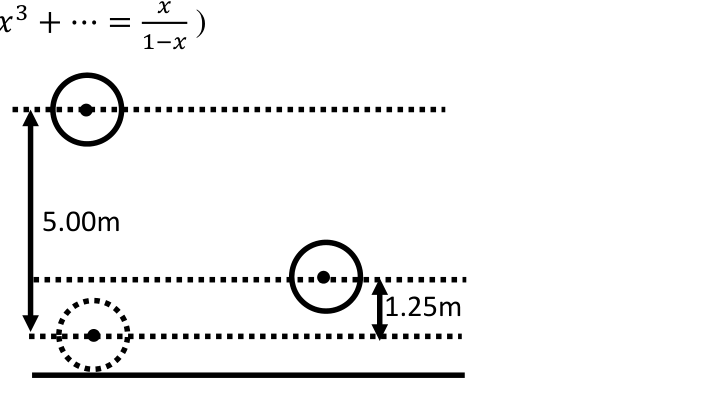
- (A)
- (B)
- (C)
- (D)
- (E) It never stops bouncing
Fonte: Testo (PDF) — p.13
Topic: Conservation of Energy Metodi: Energy Conservation Method, Kinematic Equations Competenze: Physical Reasoning Objects: Ball
Una palla viene gettata sul pavimento e rimbalza su e giù per un numero infinito di volte. Quando la palla viene abbassata da un’altezza tale che il suo centro di massa sia sopra il suo centro di massa se si riposasse sul pavimento, rimbalza fino a . Supponiamo che le perdite di energia ** siano trascurabili eccetto durante il rimbalzo **. Quanto tempo ci vuole per che la palla smetta di saltare dal momento in cui è stata lanciata? (Signore: per , )
- (A)
- (B)
- (C)
- (D)
- **(E) ** Non smette mai di rimbalzare
Fonte: Testo (PDF) — p.13
Topic: Conservation of Energy Metodi: Energy Conservation Method, Kinematic Equations Competenze: Physical Reasoning Objects: Ball
Case 1: A skater with speed slides towards stationary skater with mass . They hold hands when they reach each other and continue as one. Case 2: the skater is moving and the skater is stationary; the initial kinetic energy of the systems in both cases are the same. Assume friction is negligible. What is the ratio of the change in kinetic energy (i.e. the amount of energy converted to other forms) of the system in case 1 to that in case 2? i.e. (case 1 : case 2)
- (A)
- (B)
- (C)
- (D)
- (E)
Fonte: Testo (PDF) — p.14
Topic: Conservation of Momentum Metodi: Conservation of Momentum, Energy Conservation Method Competenze: Physical Reasoning Objects: —
Caso 1: Un pattinatore con velocità si sposta verso un pattinatore ** stazionario ** con massa . Si tengono le mani quando si raggiungono e continuano come una sola. Caso 2: il pattinatore si muove e il pattinatore è fermo; l’energia cinetica iniziale dei sistemi in entrambi i casi è la stessa. Supponiamo che la friczione sia trascurabile. Qual è il rapporto tra i cambiamenti ** nell’energia cinetica ** (cioè La quantità di energia convertita in altre forme) del sistema nel caso 1 a quello nel caso 2? i.e. (caso 1 : caso 2)
- (A)
- (B)
- (C)
- (D)
- (E)
Fonte: Testo (PDF) — p.14
Topic: Conservation of Momentum Metodi: Conservation of Momentum, Energy Conservation Method Competenze: Physical Reasoning Objects: —
A circular disc with an axle of diameter , is attached with strings to the ceiling. The disc is rotated so that the strings wind up along the axle so that the disc is raised up to the ceiling. The string is long such that that when the disc is released from rest, its center of mass falls . The disc does not slip from the string. Assume that the axle is massless and the disc has all of its mass at radius . Estimate the acceleration of the center of mass of the disc near the bottom of the fall.
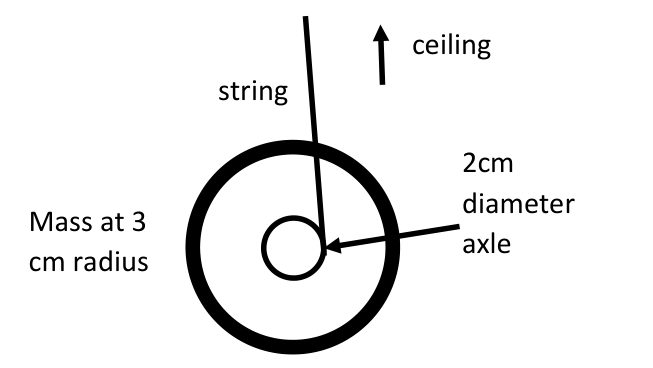
- (A)
- (B)
- (C)
- (D)
- (E)
Fonte: Testo (PDF) — p.14
Topic: Rotational Dynamics Metodi: Torque & Angular Momentum Analysis, Energy Conservation Method Competenze: Physical Reasoning Objects: Disk, String
Un disco circolare con asse di **diametro ** è attaccato al soffitto con stringhe. Il disco è girato in modo che le corde si rivolgano lungo l’asse in modo che il disco sia sollevato fino al soffitto. La stringa è lunga in modo tale che quando il disco viene rilasciato dal riposo, il suo centro di massa cade . Il disco non scivola dalla corda. Supponiamo che l’asse sia massaless e che il disco abbia tutta la sua massa al raggio **** . Estima l’accelerazione del centro di massa del disco vicino al fondo della caduta.
- (A)
- (B)
- (C)
- (D)
- (E)
Fonte: Testo (PDF) — p.14
Topic: Rotational Dynamics Metodi: Torque & Angular Momentum Analysis, Energy Conservation Method Competenze: Physical Reasoning Objects: Disk, String
A diameter, water pipe brings water from a reservoir high to a diameter nozzle at ground level. Assume that viscous forces are negligible. What is the maximum possible speed of the water jet at the nozzle?
- (A)
- (B)
- (C)
- (D)
- (E)
Fonte: Testo (PDF) — p.15
Topic: Fluid Mechanics Metodi: Bernoulli’s Equation, Continuity Equation Competenze: Physical Reasoning Objects: Tube
Un tubo di acqua di diametro porta l’acqua da un serbatoio alto a un ugello di diametro a livello del suolo. Supponiamo che le forze viscose siano trascurabili. Qual è la velocità massima possibile **** del getto d’acqua al nozzolo?
- (A)
- (B)
- (C)
- (D)
- (E)
Fonte: Testo (PDF) — p.15
Topic: Fluid Mechanics Metodi: Bernoulli’s Equation, Continuity Equation Competenze: Physical Reasoning Objects: Tube
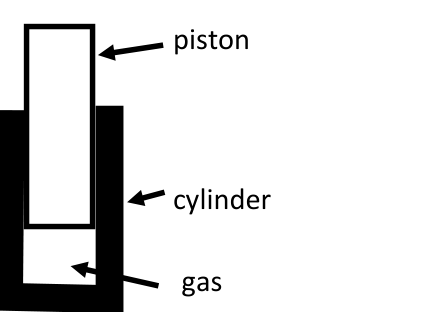
A fire piston consists of a cylinder and piston arrangement that traps air at , , in the cylinder. Initially the diameter piston is at a height above the bottom. The piston is suddenly pushed down so that it ends up at the height . The temperature of the air becomes . Assume that air is an ideal gas, the piston is air tight. Calculate the force due to the gas in the cylinder acting on the piston at the height of .
- (A)
- (B)
- (C)
- (D)
- (E) None of the above
Fonte: Testo (PDF) — p.15
Topic: Thermodynamics Metodi: Ideal Gas Law Competenze: Physical Reasoning Objects: Gas, Cylinder, Piston
Un pistone per il fuoco è costituito da un cilindro e da un’impostazione del pistone che intrappola l’aria a , , nel cilindro. Inizialmente il pistone di diametro è a un’altezza sopra il fondo. Il pistone viene improvvisamente spinto verso il basso in modo che finisca all’altezza . La temperatura dell’aria diventa . Supponiamo che l’aria sia un gas ideale, il pistone è a pressione dell’aria. Calcolare la forza ** dovuta al gas ** nel cilindro che agisce sul pistone ad un’altezza di .
- (A)
- (B)
- (C)
- (D)
- **(E) ** Nessuna delle seguenti:
Fonte: Testo (PDF) — p.15
Topic: Thermodynamics Metodi: Ideal Gas Law Competenze: Physical Reasoning Objects: Gas, Cylinder, Piston
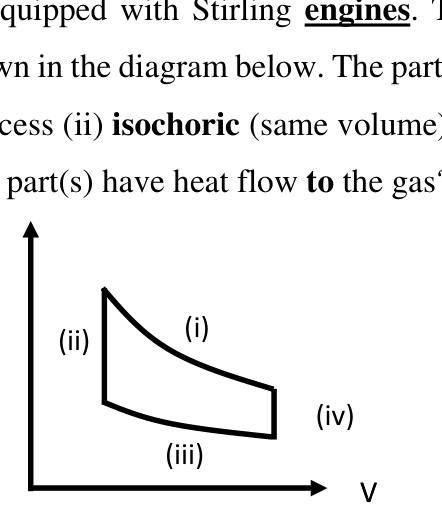
The Singapore Navy’s Archer class submarine are equipped with Stirling engines. The idealized Stirling cycle for fixed quantity of an ideal gas is shown in the diagram below. The parts of the cycle are labelled as: (i) isothermal (same temperature) process (ii) isochoric (same volume) process (iii) isothermal process and (iv) isochoric process. Which part(s) have heat flow to the gas?
- (A) (i) only
- (B) (ii) only
- (C) (i) and (ii)
- (D) (ii) and (iii)
- (E) (i) and (iv)
Fonte: Testo (PDF) — p.15
Topic: Thermodynamics Metodi: Thermodynamic Cycle Analysis, First Law of Thermodynamics Competenze: Physical Reasoning Objects: Heat Engine, Gas
I sottomarini della classe Archer della Marina di Singapore sono dotati di motori Stirling ****. Il ciclo di Stirling idealizzato per ** quantità fissa ** di un gas ideale **** è mostrato nel diagramma di seguito. Le parti del ciclo sono etichettate come: (i) processo isotermo (sema temperatura) (ii) processo isocorico (seme volume) (iii) processo isotermo e (iv) processo isocorico. Quali parti hanno un flusso di calore ** a ** del gas?
- solo **(A) ** (i)
- **(B) ** (ii) solo
- **(C) ** (i) e (ii)
- **(D) ** (ii) e (iii)
- **(E) ** (i) e (iv)
Fonte: Testo (PDF) — p.15
Topic: Thermodynamics Metodi: Thermodynamic Cycle Analysis, First Law of Thermodynamics Competenze: Physical Reasoning Objects: Heat Engine, Gas
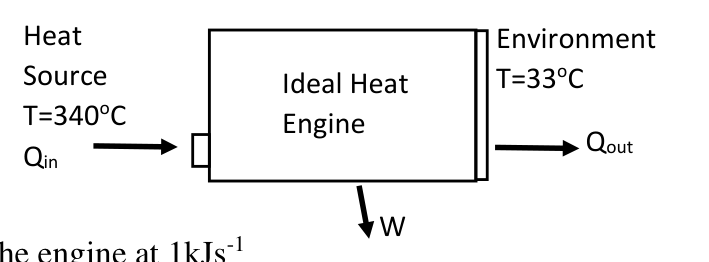
Assume the heat engine below is an ideal heat driven engine that has an efficiency , where is the temperature at which the heat enters the engine the cold temperature which the engine exhausts the waste heat. The thermal conductivity of stainless steel is . Heat enters the heat engine through a thick, area stainless steel. Assume that the heat source can maintain a temperature of (note: ) and the environment can maintain a cold temperature of . Also assume that the working gas is able to achieve thermal equilibrium with the appropriate surface. What could be the maximum efficiency of the engine when it is doing work at the average rate of ?
- (A)
- (B)
- (C)
- (D)
- (E) It is not possible to operate the engine at .
Fonte: Testo (PDF) — p.16
Topic: Thermodynamics Metodi: Thermodynamic Cycle Analysis Competenze: Physical Reasoning Objects: Heat Engine
Supponiamo che il motore termico di seguito sia un motore termico ideale con un’efficienza , dove è la temperatura alla quale il calore ** entra ** il motore la temperatura fredda ** che il motore ** scarica ** il calore di scarico. La conducibilità termica dell’acciaio inossidabile è . Il calore ** entra nel motore termico attraverso un acciaio inossidabile di spessore , . Supponiamo che la fonte di calore possa mantenere una temperatura di (nota: ) e che l’ambiente possa mantenere una temperatura di ** freddo** di . Supponiamo inoltre che il gas di lavoro sia in grado di raggiungere un equilibrio termico con la superficie appropriata. Qual è la massima efficienza del motore quando opera a velocità media di ?
- (A)
- (B)
- (C)
- (D)
- **(E) ** Non è possibile operare il motore a .
Fonte: Testo (PDF) — p.16
Topic: Thermodynamics Metodi: Thermodynamic Cycle Analysis Competenze: Physical Reasoning Objects: Heat Engine
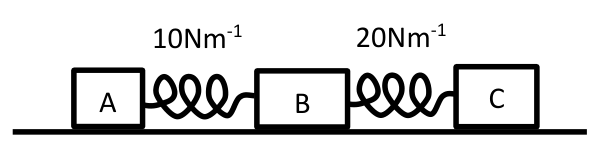
Three blocks A, B, C are arranged in a row on a frictionless surface. Blocks A and B are connected by a spring of spring constant while blocks B and C are connected by a spring of spring constant . Blocks A and C are pushed towards B and released in such a way that blocks A and C oscillate but block B remains stationary. If the mass of block A is , what is the mass of block C?
- (A)
- (B)
- (C)
- (D)
- (E)
Fonte: Testo (PDF) — p.16
Topic: Oscillations & Waves Metodi: Simple Harmonic Motion Analysis, Hooke’s Law Competenze: Physical Reasoning Objects: Block, Spring
Tre blocchi A, B e C sono disposti in fila su una superficie senza attrito. I blocchi A e B sono collegati da una costante di molla , mentre i blocchi B e C sono collegati da una costante di molla . I blocchi A e C sono spinti verso B e rilasciati in ** in modo tale che i blocchi A e C oscilla, ma il blocco B rimane fermo**. Se la massa del blocco A è , qual è la massa del blocco C?
- (A)
- (B)
- (C)
- (D)
- (E)
Fonte: Testo (PDF) — p.16
Topic: Oscillations & Waves Metodi: Simple Harmonic Motion Analysis, Hooke’s Law Competenze: Physical Reasoning Objects: Block, Spring
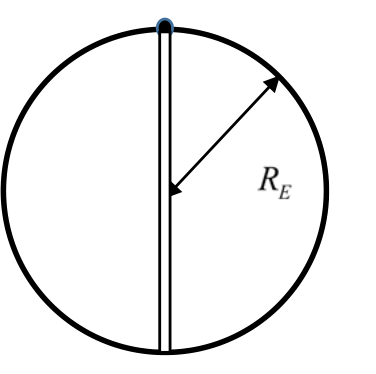
Suppose that the Earth is perfectly spherical, of uniform density, airless and non-rotating. A small smooth hole is drilled diametrically through the Earth, and a small mass is dropped from the surface into one end of this hole. (Hint: The mass experiences a force towards the center of the Earth of magnitude when it is at a distance from the center of the Earth, where the radius of the earth is ). How long will the mass take to reach the center of the Earth?
- (A)
- (B)
- (C)
- (D)
- (E)
Fonte: Testo (PDF) — p.17
Topic: Gravitation Metodi: Simple Harmonic Motion Analysis, Newton’s Law of Gravitation Competenze: Physical Reasoning Objects: Planet
Supponiamo che la Terra sia perfettamente sferica, di densità uniforme, senza aria e non rotazionale. Un piccolo buco liscio viene perforato diametralmente attraverso la Terra e una piccola massa viene scaricata dalla superficie in un’estremità di questo buco. (Signore: la massa sperimenta una forza verso il centro della Terra di magnitudo quando si trova a una distanza dal centro della Terra, dove il raggio della terra è ). Quanto tempo ci vorrà per raggiungere il centro della Terra?
- (A)
- (B)
- (C)
- (D)
- (E)
Fonte: Testo (PDF) — p.17
Topic: Gravitation Metodi: Simple Harmonic Motion Analysis, Newton’s Law of Gravitation Competenze: Physical Reasoning Objects: Planet
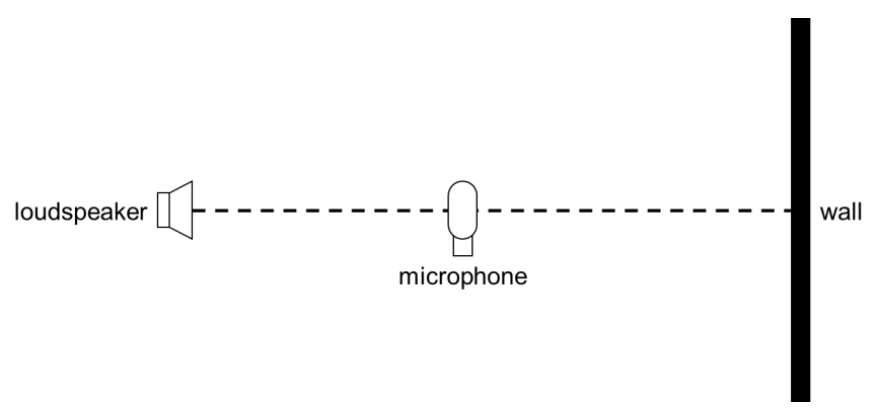
A loudspeaker is placed facing a wall a certain distance away. A constant tone of frequency is played in the loudspeaker. A microphone is moved along the line between the loudspeaker and the wall, and the intensity of the sound detected by the microphone is measured at several locations. It is found that the distance between positions where a minimum intensity is recorded is . What is the frequency ?
- (A)
- (B)
- (C)
- (D)
- (E)
Fonte: Testo (PDF) — p.17
Topic: Oscillations & Waves Metodi: Wave Equation, Interference & Diffraction Analysis Competenze: Physical Reasoning Objects: —
Un altoparlante è posizionato verso un muro a una certa distanza. Nel altoparlante viene riprodotto un tono costante di frequenza . Un microfono viene spostato lungo la linea tra il altoparlante e la parete e l’intensità del suono rilevato dal microfono viene misurata in diversi luoghi. Si constata che la distanza ** tra le posizioni ** in cui è registrata una intensità minima ** ** è . Qual è la frequenza ?
- (A)
- (B)
- (C)
- (D)
- (E)
Fonte: Testo (PDF) — p.17
Topic: Oscillations & Waves Metodi: Wave Equation, Interference & Diffraction Analysis Competenze: Physical Reasoning Objects: —
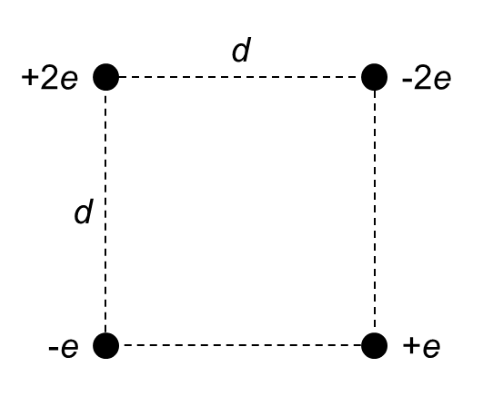
point charges are arranged at the corners of a square of side length . The charges are as indicated on the diagram. What is the electric potential and the magnitude of the electrostatic force felt by a point charge of placed at the centre of the square?
- (A)
- (B)
- (C)
- (D)
- (E)
Fonte: Testo (PDF) — p.18
Topic: Electrostatics Metodi: Coulomb’s Law, Electric Potential Method Competenze: Physical Reasoning Objects: Point Charge
Le cariche puntate sono disposte negli angoli di un quadrato di lunghezza laterale . Le cariche sono indicate sul diagramma. Qual è il potenziale elettrico e la grandezza della forza elettrostatica percepita da una carica di punto collocata al centro del quadrato?
- (A)
- (B)
- (C)
- (D)
- (E)
Fonte: Testo (PDF) — p.18
Topic: Electrostatics Metodi: Coulomb’s Law, Electric Potential Method Competenze: Physical Reasoning Objects: Point Charge
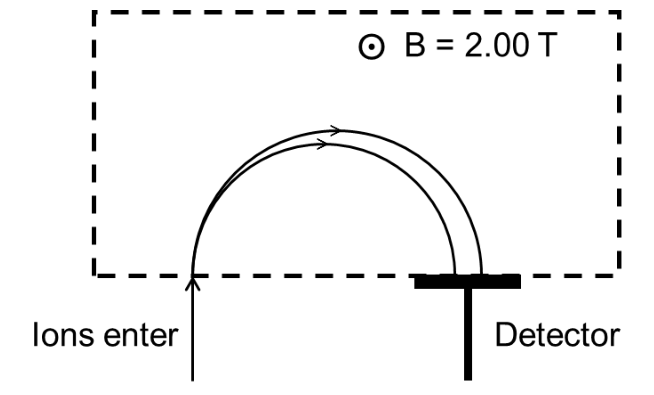
An ion of neon-20, (mass ) and an ion of neon-22, (mass ), each with a charge of , center perpendicularly into a rectangular region with a magnetic field of directed out of the page as shown in the diagram below. The ions enter at the same point and have the same initial velocity of . The ions are deflected by the magnetic field and impact a detector as shown. What is the distance between their impact points on the detector?
- (A)
- (B)
- (C)
- (D)
- (E)
Fonte: Testo (PDF) — p.18
Topic: Magnetism Metodi: Lorentz Force Analysis Competenze: Physical Reasoning Objects: Point Charge
Un ione di neon-20, (massa ) e un ion di neon-22, (massa ), ciascuno con carica di , centrato perpendicolare in una regione rettangolare con un campo magnetico di diretto fuori dalla pagina come mostrato nel diagramma di seguito. Gli ioni entrano nello stesso punto e hanno la stessa velocità iniziale **** di . Gli ioni vengono deviati dal campo magnetico e colpiscono un rilevatore come mostrato. Qual è la distanza ** tra ** i loro punti di impatto sul rilevatore?
- (A)
- (B)
- (C)
- (D)
- (E)
Fonte: Testo (PDF) — p.18
Topic: Magnetism Metodi: Lorentz Force Analysis Competenze: Physical Reasoning Objects: Point Charge
A capacitor is initially charged to voltage (i.e. the potential difference across its terminals is ) and charge . The energy stored in the capacitor is initially . It discharges through an inductor such that finally, the voltage is half the original i.e. . The final charge and energy stored in the capacitor is __________, __________ respectively.
- (A) ,
- (B) ,
- (C) ,
- (D) ,
- (E) ,
Fonte: Testo (PDF) — p.19
Topic: Circuits Metodi: Energy Conservation Method Competenze: Physical Reasoning Objects: Capacitor, Inductor
Un condensatore è initialement caricato a tensione (cioè la differenza potenziale tra i suoi terminali è ) e la carica . L’energia immagazzinata nel condensatore è inizialmente . Si scarica attraverso un induttore tale che **finalmente **, la tensione è metà l’originale, cioè . La carica finale e l’energia immagazzinata nel condensatore sono rispettivamente __________, __________.
- (A) ,
- (B) ,
- (C) ,
- (D) ,
- (E) ,
Fonte: Testo (PDF) — p.19
Topic: Circuits Metodi: Energy Conservation Method Competenze: Physical Reasoning Objects: Capacitor, Inductor
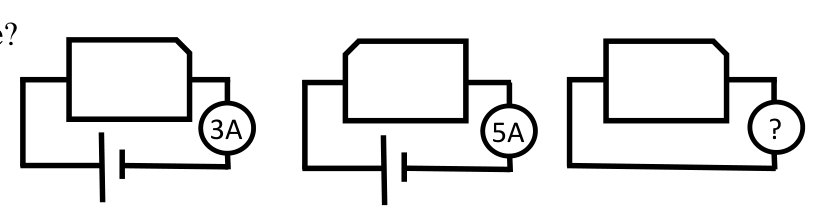
A black box consists of a battery with EMF less than 12 volts and a resistor connected in series with the two ends of the circuit sticking out of the black box. If the ends of the black box are connected to a power supply of , the current flowing through is . If the connection to the black box is reversed, the current flowing through is . What will be the current flowing through if the ends of the black box are connected by a wire?
- (A)
- (B)
- (C)
- (D)
- (E)
Fonte: Testo (PDF) — p.19
Topic: Circuits Metodi: Kirchhoff’s Laws Competenze: Physical Reasoning Objects: Battery, Resistor, Wire
Una scatola nera è costituita da una batteria con EMF inferiore a 12 volt e da una resistenza collegata in serie con le due estremità del circuito che si estinguono dalla scatola nera. Se le estremità della casella nera sono collegate ad un alimentatore di , la corrente che attraversa è . Se la connessione alla casella nera è invertita, la corrente che attraversa è . Qual è la corrente che attraversa se le estremità della scatola nera sono **connesse da un filo **?
- (A)
- (B)
- (C)
- (D)
- (E)
Fonte: Testo (PDF) — p.19
Topic: Circuits Metodi: Kirchhoff’s Laws Competenze: Physical Reasoning Objects: Battery, Resistor, Wire
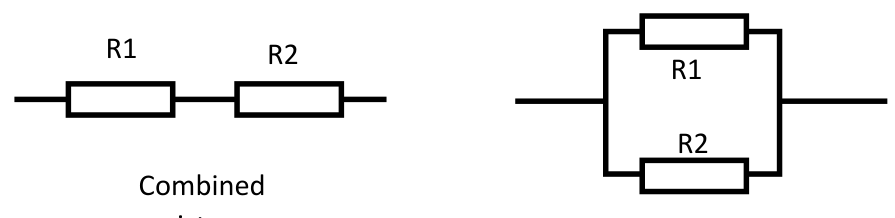
Two resistors when connected in series have a combined resistance of . When the same resistors are connected in parallel they have a combined resistance of . What is the difference in their resistance?
- (A)
- (B)
- (C)
- (D)
- (E)
Fonte: Testo (PDF) — p.19
Topic: Circuits Metodi: Equivalent Circuit Reduction Competenze: Physical Reasoning Objects: Resistor
Due resistori, collegati in serie, hanno una resistenza combinata di . Quando le stesse resistenze sono collegate in parallelo, hanno una resistenza combinata di . Qual è la differenza di **** nella loro resistenza?
- (A)
- (B)
- (C)
- (D)
- (E)
Fonte: Testo (PDF) — p.19
Topic: Circuits Metodi: Equivalent Circuit Reduction Competenze: Physical Reasoning Objects: Resistor
A battery with internal resistance of and a battery with internal resistance are available. We would like to choose only one of the batteries for heating up a resistor. What is the maximum electrical power which either of the batteries can supply to a resistor?
- (A)
- (B)
- (C)
- (D)
- (E)
Fonte: Testo (PDF) — p.20
Topic: Circuits Metodi: Equivalent Circuit Reduction Competenze: Physical Reasoning Objects: Battery, Resistor
Sono disponibili una batteria con resistenza interna di e una batteria con resistenza interna . Vorremmo scegliere solo una delle batterie per il riscaldamento di una resistenza. Qual è la potenza elettrica massima di **** che una delle batterie può ** fornire a una resistenza **?
- (A)
- (B)
- (C)
- (D)
- (E)
Fonte: Testo (PDF) — p.20
Topic: Circuits Metodi: Equivalent Circuit Reduction Competenze: Physical Reasoning Objects: Battery, Resistor
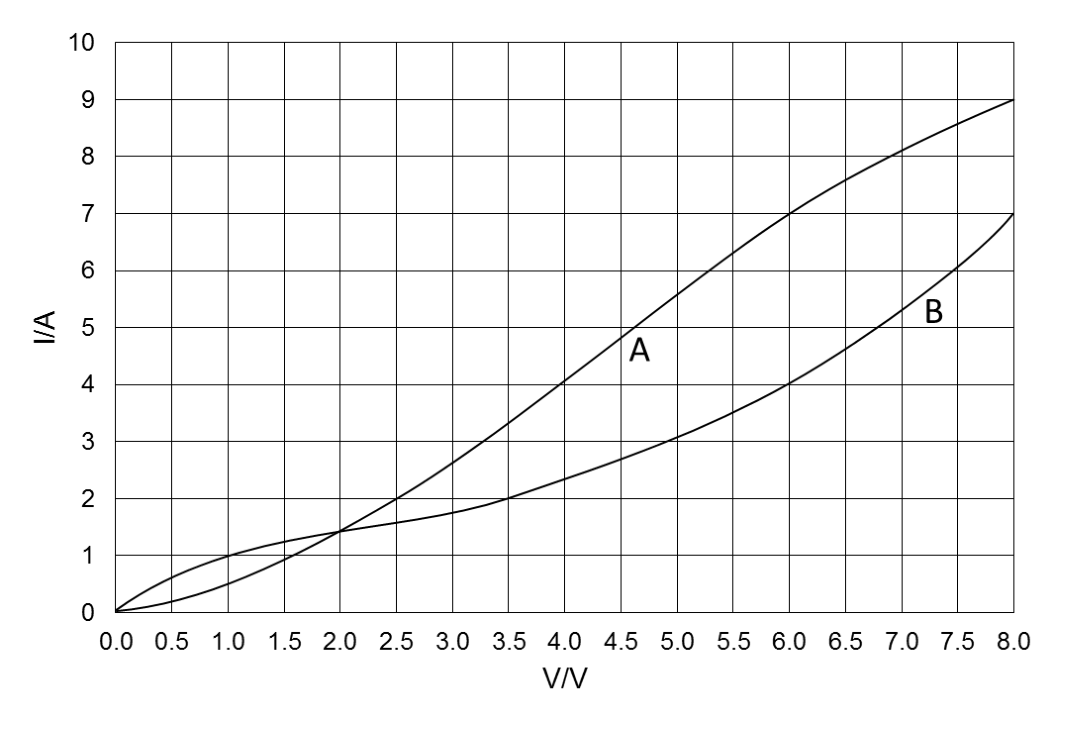
The following graph shows the I-V characteristics of the nonlinear resistors A and B. If A and B are connected in series to an ideal DC source, what is the current flowing in the circuit?
- (A)
- (B)
- (C)
- (D)
- (E)
Fonte: Testo (PDF) — p.20
Topic: Circuits Metodi: Kirchhoff’s Laws, Graph Linearization Competenze: Physical Reasoning Objects: Resistor
Il grafico seguente mostra le caratteristiche I-V delle resistenze ** non lineari ** A e B. Se A e B sono collegati in serie ad una fonte di corrente continua ideale , quale è la corrente che scorre nel circuito?
- (A)
- (B)
- (C)
- (D)
- (E)
Fonte: Testo (PDF) — p.20
Topic: Circuits Metodi: Kirchhoff’s Laws, Graph Linearization Competenze: Physical Reasoning Objects: Resistor
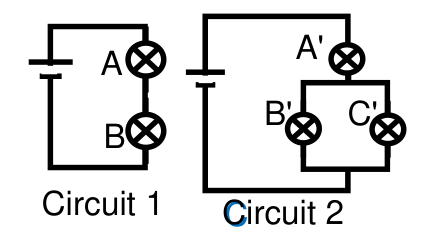
The circuits below contain identical bulbs and batteries. It is known that the bulbs resistance increase with temperature. Compare the brightness of bulbs A and B in circuit 1 to the brightness of bulb A′ and B′ in circuit 2.
- (A) ,
- (B) ,
- (C) ,
- (D) ,
- (E) ,
Fonte: Testo (PDF) — p.20
Topic: Circuits Metodi: Equivalent Circuit Reduction, Kirchhoff’s Laws Competenze: Physical Reasoning Objects: Battery
I circuiti di seguito riportati contengono **lampe e batterie identiche **. È noto che la resistenza delle lampadine aumenta con la temperatura. Confrontare la luminosità delle lampadine A e B nel circuito 1 con la luminosità delle lampadine A′ e B′ nel circuito 2.
- (A) ,
- (B) ,
- (C) ,
- (D) ,
- (E) ,
Fonte: Testo (PDF) — p.20
Topic: Circuits Metodi: Equivalent Circuit Reduction, Kirchhoff’s Laws Competenze: Physical Reasoning Objects: Battery
Two infinitely long wires lie perpendicular to each other and carry current in the directions shown in the diagram. The amount of current carried by each wire is also indicated. What is the direction and strength of the magnetic field at point Y, located from each wire?
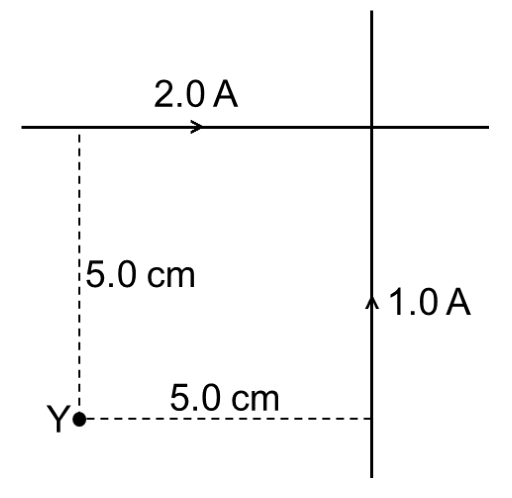
- (A) , into paper
- (B) , out of paper
- (C) , into paper
- (D) , out of paper
- (E)
Fonte: Testo (PDF) — p.21
Topic: Magnetism Metodi: Ampère’s Law, Superposition Principle Competenze: Physical Reasoning Objects: Wire
Due fili infinitamente lunghi si trovano perpendicolari e portano corrente nelle direzioni indicate nel diagramma. È indicato anche il volume di corrente trasportato da ciascun filo. Qual è la direzione **** e la forza **** del campo magnetico al punto Y, situato da ogni filo?
- **(A) ** , in carta
- **(B) ** , di carta
- **(C) ** , in carta
- **(D) ** , di carta
- (E)
Fonte: Testo (PDF) — p.21
Topic: Magnetism Metodi: Ampère’s Law, Superposition Principle Competenze: Physical Reasoning Objects: Wire
A bar magnet attached to the end of a spring performs simple harmonic motion above a coil of wires as shown in the diagram. The other end of the spring is attached to a fixed force sensor which was zeroed when the magnet was at its equilibrium position. The EMF across the coil of wires and the force are plotted against time. Which of the following statement is true?
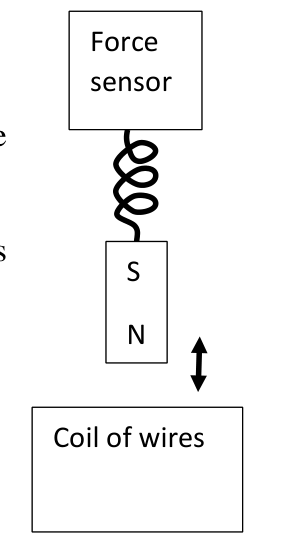
- (A) The magnitude of the EMF is maximum when the force is zero.
- (B) The magnitude of the EMF is maximum when the magnitude of the force is maximum.
- (C) The magnitude of the EMF is zero when the magnitude of the force is maximum.
- (D) The magnitude of the EMF is zero when the force is zero.
- (E) The EMF also has a perfectly sinusoidal waveform.
Fonte: Testo (PDF) — p.21
Topic: Electromagnetic Induction Metodi: Faraday’s Law of Induction, Simple Harmonic Motion Analysis Competenze: Physical Reasoning Objects: Magnet, Spring, Coil
Un magnete a barre collegato alla fine di una molla esegue un semplice movimento armonico ** sopra ** una bobina di fili come mostrato nel diagramma. L’altra estremità della molla è collegata a un sensore di forza fissa che è stato zeroed quando il magnete è stato in posizione di equilibrio. Il EMF attraverso la bobina dei fili e la forza sono tracciati contro il tempo. Quale delle seguenti affermazioni è vera?
- **(A) ** La magnitudine dell’EMF è massima quando la forza è zero.
- **(B) ** La grandezza del FEM è massima quando la grandezza della forza è massima.
- **(C) ** La magnitudine del FEM è zero quando la magnitudine della forza è massima.
- **(D) ** La magnitudine dell’EMF è zero quando la forza è zero.
- **(E) ** Il FEM ha anche una forma d’onda perfettamente sinusoidale.
Fonte: Testo (PDF) — p.21
Topic: Electromagnetic Induction Metodi: Faraday’s Law of Induction, Simple Harmonic Motion Analysis Competenze: Physical Reasoning Objects: Magnet, Spring, Coil
Robert is given a tiny light source, an focal length lens and a screen. The light source and screen are initially at the ends of a long optical rail and the lens is mounted between the light source and screen and may move freely between them. The components are all at the same fixed height above the rail and may not be removed from the long rail. Robert’s task is to find a way to magnify the light source and project a real image on to the screen using only the equipment given and without breaking or illegally modifying the equipment. The distance between the light source and the lens is called and the distance between the lens and the screen is called . The setup constrains . Which of the following is good advice for Robert?
- (A) Make as small as possible i.e. almost touching the lens and make as large as possible.
- (B) Make as large as possible and make as small as possible.
- (C) Make slightly larger than and adjust to get a clear image.
- (D) Make slightly smaller than and adjust to get a clear image.
- (E) Just give up.
Fonte: Testo (PDF) — p.22
Topic: Geometric Optics Metodi: Thin Lens & Mirror Equation Competenze: Physical Reasoning Objects: Lens, Screen
Robert riceve una piccola fonte di luce, un obiettivo di lunghezza focale e uno schermo. La fonte luminosa e lo schermo sono inizialmente situati alle estremità di una lunga rotaia ottica e la lente è montata tra la fonte luminosa e lo schermo e può muoversi liberamente tra di loro. Tutti i componenti sono a uguale altezza fissa sopra la rotaia e non possono essere rimossi dalla rotaia lunga . Il compito di Robert è trovare un modo per magnificare la fonte di luce e proiettare una immagine reale sullo schermo utilizzando solo l’attrezzatura data e senza rompere o modificare illegalmente l’attrezzatura. La distanza tra la fonte luminosa e la lente si chiama e la distanza tra la lente e lo schermo si chiama . La configurazione ** limita ** . Quale dei seguenti consigli è utile per Robert?
- **(A) ** Rendere il più piccolo possibile, cioè quasi toccando l’ obiettivo e rendendo il più grande possibile.
- **(B) ** Fate il più grande possibile e fate il più piccolo possibile.
- **(C) ** Fare leggermente più grande di e regolare per ottenere un’immagine chiara.
- **(D) ** Rendere leggermente più piccolo di e regolare per ottenere un’immagine chiara.
- Basta arrendersi.
Fonte: Testo (PDF) — p.22
Topic: Geometric Optics Metodi: Thin Lens & Mirror Equation Competenze: Physical Reasoning Objects: Lens, Screen
Two biconvex lenses with focal lengths and are placed apart. An object is placed away from the lens as shown in the diagram. What type of image is formed and what distance is it from the second lens?
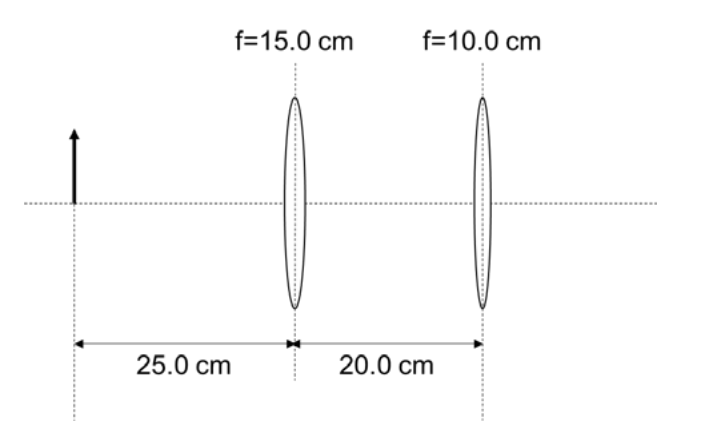
- (A) Real,
- (B) Virtual,
- (C) Real,
- (D) Real,
- (E) Virtual,
Fonte: Testo (PDF) — p.22
Topic: Geometric Optics Metodi: Thin Lens & Mirror Equation Competenze: Physical Reasoning Objects: Lens
Due lenti biconvex con lunghezze focali e sono posizionate a distanza . Un oggetto è posizionato lontano dalla lente come mostrato nel diagramma. Quale tipo di immagine si forma e quale ** distanza** è ** dalla seconda lente**?
- **(A) ** Real,
- **(B) ** Virtuale,
- **(C) ** Real,
- **(D) ** Real,
- **(E) ** Virtuale,
Fonte: Testo (PDF) — p.22
Topic: Geometric Optics Metodi: Thin Lens & Mirror Equation Competenze: Physical Reasoning Objects: Lens
Two identical resistors are connected in parallel to a DC source. In this configuration, each resistor consumes of power. What is the amount of power supplied if the two resistors are connected in series to a DC source?
- (A)
- (B)
- (C)
- (D)
- (E)
Fonte: Testo (PDF) — p.23
Topic: Circuits Metodi: Equivalent Circuit Reduction Competenze: Physical Reasoning Objects: Resistor
Due resistori identici sono collegati in parallelo a una fonte di corrente continua . In questa configurazione, ** ciascun resistore ** consuma di potenza. Qual è la quantità di potenza fornite se i due resistori **** sono collegati in serie a una fonte di corrente continua ?
- (A)
- (B)
- (C)
- (D)
- (E)
Fonte: Testo (PDF) — p.23
Topic: Circuits Metodi: Equivalent Circuit Reduction Competenze: Physical Reasoning Objects: Resistor
A thin rod is travelling at a velocity of relative to an observer. To the observer, the rod is measured to be long and angled to the direction of its travel. What is the proper length of the rod?
- (A)
- (B)
- (C)
- (D)
- (E)
Fonte: Testo (PDF) — p.23
Topic: Special Relativity Metodi: Lorentz Transformation Competenze: Physical Reasoning Objects: Rod
Una sottile canna si muove a una velocità di rispetto all’osservatore. **Per l’osservatore **, la canna è misurata come lunga e angolata ** ** nella direzione del suo viaggio. Qual è la lunghezza corretta della canna?
- (A)
- (B)
- (C)
- (D)
- (E)
Fonte: Testo (PDF) — p.23
Topic: Special Relativity Metodi: Lorentz Transformation Competenze: Physical Reasoning Objects: Rod
A white mouse leaps up steps at a time. Assume the mouse is a spherical blackbody with surface temperature of and density of water and takes to prepare for the next leap i.e. takes between landing and the next leap. Also assume that the surroundings is a black body at a temperature of . For the mouse, calculate the ratio of the average power associated with the gain in potential energy in leaping up the stairs to that associated with heat loss due to radiation.
- (A)
- (B)
- (C)
- (D)
- (E)
Fonte: Testo (PDF) — p.23
Topic: Modern-Quantum Physics Metodi: Conservation of Energy, Physical Modeling Competenze: Physical Reasoning Objects: —
Un mouse bianco salta passi alla volta. Supponiamo che il topo sia un corpo nero sferico **** con temperatura superficiale **** di e densità di acqua e che ci sia bisogno di per prepararsi al prossimo salto, ovvero tra l’atterraggio e il prossimo salto. Supponiamo anche che l’ambiente circostante sia un corpo nero a una temperatura di . Per il mouse calcolare il rapporto tra la potenza media associata al guadagno di energia potenziale nel salto verso l’alto delle scale e quella associata alla perdita di calore dovuta alla radiazione.
- (A)
- (B)
- (C)
- (D)
- (E)
Fonte: Testo (PDF) — p.23
Topic: Modern-Quantum Physics Metodi: Conservation of Energy, Physical Modeling Competenze: Physical Reasoning Objects: —
The table below gives some information about various nuclides. Based on the table, we can say that Strontium-90 in its ground state, ____________.
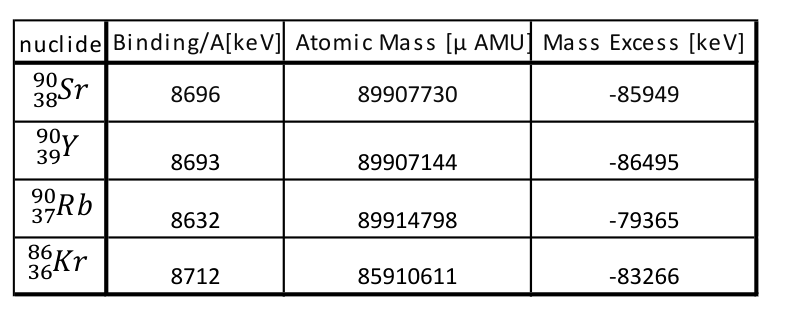
- (A) may naturally decay
- (B) may naturally decay
- (C) may naturally decay
- (D) may naturally decay
- (E) may be stable
Fonte: Testo (PDF) — p.24
Topic: Nuclear & Particle Physics Metodi: Radioactive Decay Law Competenze: Physical Reasoning Objects: Nucleus
La tabella seguente fornisce alcune informazioni sui vari nuclidi. Sulla base della tabella, possiamo dire che lo Strontium-90 nel suo stato di base, ____________.
- **(A) ** può naturalmente decadere
- **(B) ** può naturalmente decadere
- **(C) ** può naturalmente decadere
- **(D) ** può naturalmente decadere
- **(E) ** può essere stabile
Fonte: Testo (PDF) — p.24
Topic: Nuclear & Particle Physics Metodi: Radioactive Decay Law Competenze: Physical Reasoning Objects: Nucleus
It is possible to fuse two nuclei of deuterium, together to produce helium-3, a neutron and some energy i.e. . Consider the situation where a deuteron with kinetic energy fuses with a stationary deuterium nucleus. What could be the maximum kinetic energy that the neutron can have?
- (A)
- (B)
- (C)
- (D)
- (E)
Fonte: Testo (PDF) — p.24
Topic: Nuclear & Particle Physics Metodi: Conservation of Energy, Conservation of Momentum Competenze: Physical Reasoning Objects: Nucleus
È possibile fondersi due nuclei di deuterio, insieme per produrre elio-3, un neutrone e un po’ di energia, cioè . Considerare la situazione in cui un deuteron con energia cinetica si fonde con un nucleo di deuterio stazionario. Qual potrebbe essere l’energia cinetica massima che il neutrone può avere?
- (A)
- (B)
- (C)
- (D)
- (E)
Fonte: Testo (PDF) — p.24
Topic: Nuclear & Particle Physics Metodi: Conservation of Energy, Conservation of Momentum Competenze: Physical Reasoning Objects: Nucleus
The following diagram shows the energy levels of a certain atom. Which of the following emission lines could NOT be produced solely from transitions between the energy levels?
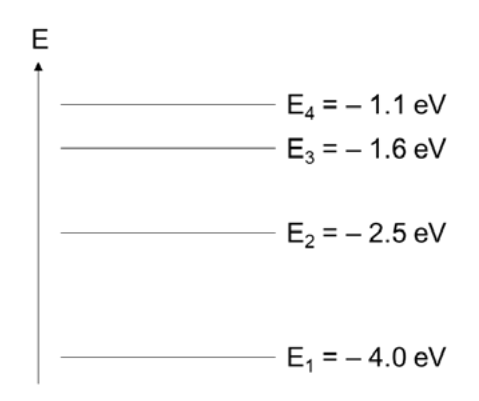
- (A)
- (B)
- (C)
- (D)
- (E)
Fonte: Testo (PDF) — p.24
Topic: Modern-Quantum Physics Metodi: Photon Energy Relation, Bohr Model & Quantization Competenze: Physical Reasoning Objects: Atom, Photon
Il seguente diagramma mostra i livelli di energia di un certo atomo. Quali delle seguenti linee di emissioni potrebbero essere prodotte esclusivamente da transizioni tra i livelli di energia?
- (A)
- (B)
- (C)
- (D)
- (E)
Fonte: Testo (PDF) — p.24
Topic: Modern-Quantum Physics Metodi: Photon Energy Relation, Bohr Model & Quantization Competenze: Physical Reasoning Objects: Atom, Photon