An electron in a vacuum, starting from rest, falls near the surface of the earth. Considering only the gravitational force acting on the electron, how long does it take for the electron to travel ?
- (A)
- (B)
- (C)
- (D)
- (E)
Fonte: Testo (PDF) — p.2
Topic: Newtonian Mechanics Metodi: Kinematic Equations Competenze: Physical Reasoning Objects: Electron
Un elettrone nel vuoto, partendo dal riposo, cade vicino alla superficie terrestre. Considerando solo la forza gravitazionale che agisce sull’elettrone, quanto tempo ci vuole per il movimento dell’elettrone ?
- (A)
- (B)
- (C)
- (D)
- (E)
Fonte: Testo (PDF) — p.2
Topic: Newtonian Mechanics Metodi: Kinematic Equations Competenze: Physical Reasoning Objects: Electron
In addition to the downwards gravitational field in question 1, there is an additional positive uniform electric field directed upwards in this region. Compared to question 1 and considering only the electric field and gravitational field, we can say that:
- (A) The electron will take the same time as before.
- (B) The electron will take a shorter time to fall .
- (C) The electron will take a longer time to fall .
- (D) The electron will move upwards.
- (E) It depends on whether the electric field or gravitational field is stronger.
Fonte: Testo (PDF) — p.2
Topic: Electrostatics Metodi: Free-Body Diagram, Kinematic Equations Competenze: Physical Reasoning Objects: Electron
Oltre al campo gravitazionale verso il basso di cui alla domanda 1, in questa regione esiste un campo elettrico positivo uniforme in più diretto verso l’alto. Rispetto alla domanda 1 e considerando solo il campo elettrico e il campo gravitazionale, possiamo dire che:
- **(A) ** L’elettrone richiederà lo stesso tempo di prima.
- **(B) ** L’elettrone avrà un tempo più breve per cadere .
- **(C) ** L’elettrone avrà più tempo per cadere . L’elettrone si muoverà verso l’alto.
- **(E) ** Dipende dal fatto che il campo elettrico o il campo gravitazionale sia più forte.
Fonte: Testo (PDF) — p.2
Topic: Electrostatics Metodi: Free-Body Diagram, Kinematic Equations Competenze: Physical Reasoning Objects: Electron
A uniform electric field is applied using apparatus fixed to the Earth in such a way that the electron remains motionless in the presence of both the electric and gravitational fields only. In relation to Newton’s 3rd law, the reaction pair to the electrostatic force acting on the electron is:
- (A) The gravitational force in the opposite direction acting on the electron.
- (B) The electrostatic force in the opposite direction acting on the electron.
- (C) The electrostatic force acting on the apparatus.
- (D) The gravitational force acting on the earth.
- (E) None of the above. In this case Newton’s 1st law is applicable, not the 3rd law.
Fonte: Testo (PDF) — p.2
Topic: Newtonian Mechanics Metodi: Free-Body Diagram Competenze: Physical Reasoning Objects: Electron
Un campo elettrico uniforme viene applicato utilizzando apparecchi fissati alla Terra in modo tale che l’elettrone rimanga immobile in presenza dei soli campi elettrici e gravitazionali. In relazione alla terza legge di Newton, la coppia di reazione alla forza elettrostatica che agisce sull’elettrone è:
- **(A) ** La forza gravitazionale nella direzione opposta che agisce sull’elettrone.
- **(B) ** La forza elettrostatica in direzione opposta che agisce sull’elettrone.
- **(C) ** La forza elettrostatica che agisce sull’apparecchio.
- **(D) ** La forza gravitazionale che agisce sulla terra.
- **(E) ** Nessuna delle seguenti. In questo caso la prima legge di Newton è applicabile, non la terza legge.
Fonte: Testo (PDF) — p.2
Topic: Newtonian Mechanics Metodi: Free-Body Diagram Competenze: Physical Reasoning Objects: Electron
A uniform electric field is applied in such a way that the electron moves upwards at a constant speed of in the presence of both the electric and gravitational fields only. The magnitude of the electric field is reduced to zero suddenly and the electron slows down to after moving up a further distance of:
- (A)
- (B)
- (C)
- (D)
- (E)
Fonte: Testo (PDF) — p.2
Topic: Newtonian Mechanics Metodi: Kinematic Equations Competenze: Physical Reasoning Objects: Electron
Un campo elettrico uniforme è applicato in modo tale che l’elettrone si muova verso l’alto a una velocità costante di in presenza di campi elettrici e gravitazionali. La magnitudine del campo elettrico viene ridotta a zero improvvisamente e l’elettrone rallenta a dopo aver avanzato a una distanza ulteriore di:
- (A)
- (B)
- (C)
- (D)
- (E)
Fonte: Testo (PDF) — p.2
Topic: Newtonian Mechanics Metodi: Kinematic Equations Competenze: Physical Reasoning Objects: Electron
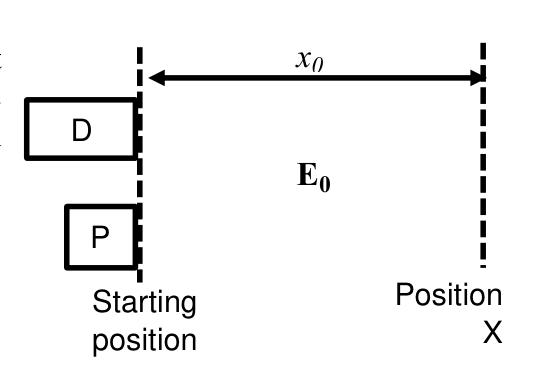
Deuteron and proton are initially moving in the same direction with the same non-relativistic initial momentum. They pass through a region of constant, strong, uniform electric field between the starting position and position . Consider only the effect of the electric field on each particle. Consider the momentum, , of the particles at position , a distance from the initial position (not necessarily at the same time). Subscripts , denote deuteron or proton . Which statement below is correct?
- (A)
- (B)
- (C)
- (D) Some of the above depending on .
- (E) Some of the above depending on the initial momentum, and .
Fonte: Testo (PDF) — p.2
Topic: Electrostatics Metodi: Impulse-Momentum Theorem Competenze: Physical Reasoning Objects: Nucleus
Deuteron e protone si muovono inizialmente nella stessa direzione con lo stesso impulso iniziale non relativistico. Passa attraverso una regione di campo elettrico costante, forte e uniforme tra la posizione di partenza e la posizione . Considerate solo l’effetto del campo elettrico su ciascuna particella. Considerare il momento, , delle particelle in posizione , una distanza dalla posizione iniziale (non necessariamente nello stesso momento). I sottoscrizioni , indicano deuteron o protone . Quale di queste affermazioni è corretta?
- (A)
- (B)
- (C)
- **(D) ** Alcuni dei suddetti punti dipendono da .
- **(E) ** Alcuni di questi, a seconda della velocità iniziale, e .
Fonte: Testo (PDF) — p.2
Topic: Electrostatics Metodi: Impulse-Momentum Theorem Competenze: Physical Reasoning Objects: Nucleus
A proton, 1 with kinetic energy , and another proton, 2, with twice the kinetic energy pass through a region of constant, uniform electric field between the starting position and position in the same direction as their motion. Consider the kinetic energy, and momentum, of the particles at position , a distance from the initial position (not necessarily at the same time). Subscripts 1, 2 denote proton 1 or proton 2. Which statement below is correct?
- (A)
- (B)
- (C)
- (D)
- (E)
Fonte: Testo (PDF) — p.3
Topic: Electrostatics Metodi: Impulse-Momentum Theorem, Energy Conservation Method Competenze: Physical Reasoning Objects: Nucleus
Un protone, 1 con energia cinetica , e un altro protone, 2, con il doppio dell’energia cinetica passano attraverso una regione di campo elettrico costante e uniforme tra la posizione di partenza e la posizione nella stessa direzione del loro movimento. Si consideri l’energia cinetica, e il momento, delle particelle in posizione , una distanza dalla posizione iniziale (non necessariamente contemporaneamente). I sottoscrizioni 1, 2 indicano protone 1 o protone 2. Quale di queste affermazioni è corretta?
- (A)
- (B)
- (C)
- (D)
- (E)
Fonte: Testo (PDF) — p.3
Topic: Electrostatics Metodi: Impulse-Momentum Theorem, Energy Conservation Method Competenze: Physical Reasoning Objects: Nucleus
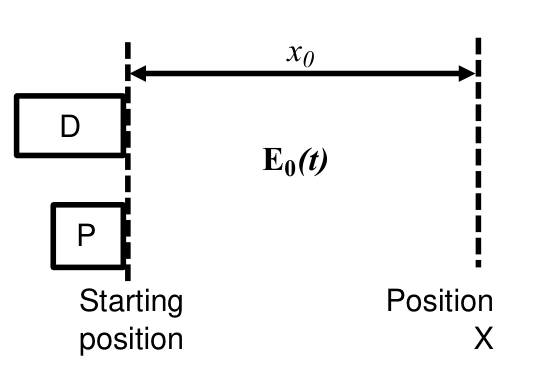
A deuteron, 1 with kinetic energy , and a proton, 2, with twice the kinetic energy of the deuteron pass through a region between the starting position and position . While the particles are passing through the region a uniform electric field in the same direction as their motion is switched on for time then switched off while the two particles are still within the region. Consider the kinetic energy, and momentum, of the particles when they are at position , a distance from the initial position (not necessarily at the same time). Subscripts 1, 2 denote deuteron 1 or proton 2. Which statement below is correct?
- (A)
- (B)
- (C)
- (D)
- (E)
Fonte: Testo (PDF) — p.3
Topic: Electrostatics Metodi: Impulse-Momentum Theorem, Energy Conservation Method Competenze: Physical Reasoning Objects: Nucleus
Un deuteron, 1 con energia cinetica , e un protone, 2, con il doppio dell’energia cinetica del deuteron passano attraverso una regione tra la posizione di partenza e la posizione . Mentre le particelle passano attraverso la regione un campo elettrico uniforme nella stessa direzione in cui il loro movimento è attivato per tempo , quindi spento mentre le due particelle sono ancora all’interno della regione. Si consideri l’energia cinetica, e il momento, delle particelle quando sono in posizione , una distanza dalla posizione iniziale (non necessariamente allo stesso tempo). I sottoscrizioni 1, 2 indicano il deuteron 1 o il protone 2. Quale di queste affermazioni è corretta?
- (A)
- (B)
- (C)
- (D)
- (E)
Fonte: Testo (PDF) — p.3
Topic: Electrostatics Metodi: Impulse-Momentum Theorem, Energy Conservation Method Competenze: Physical Reasoning Objects: Nucleus
A proton moves in the presence of an electric field only. At a certain time the magnitude of its velocity was . The magnitude of velocity decreases to at time , then decreases further to at time . It then increases again to at time before reaching at time . Considering the time from to , we can say with some certainty that:
- (A) The electric field strength is lower during time to as compared to during to .
- (B) The electric field vector changes direction at time .
- (C) The electric field vector is constant from to .
- (D) The electric field strength decreases from to then increases again from to .
- (E) The information is quite useless and we can’t make any of the above statements.
Fonte: Testo (PDF) — p.3
Topic: Electrostatics Metodi: Free-Body Diagram Competenze: Physical Reasoning Objects: Nucleus
Un protone si muove solo in presenza di un campo elettrico. In un certo momento la sua velocità era . La magnitudine della velocità diminuisce a al tempo , quindi diminuisce ulteriormente a al tempo . Poi aumenta di nuovo a al tempo prima di raggiungere al tempo . Considerando il tempo da a , possiamo dire con certezza che:
- **(A) ** La resistenza del campo elettrico è inferiore durante il tempo a rispetto a a .
- **(B) ** Il vettore del campo elettrico cambia direzione nel tempo .
- **(C) ** Il vettore del campo elettrico è costante da a .
- **(D) ** La forza del campo elettrico diminuisce da a e poi aumenta di nuovo da a .
- **(E) ** Le informazioni sono del tutto inutili e non possiamo fare nessuna delle affermazioni sopra.
Fonte: Testo (PDF) — p.3
Topic: Electrostatics Metodi: Free-Body Diagram Competenze: Physical Reasoning Objects: Nucleus
A proton moves in a circle with radius , within a region of constant uniform magnetic field, . What is the magnitude of the proton’s linear momentum?
- (A)
- (B)
- (C)
- (D)
- (E)
Fonte: Testo (PDF) — p.3
Topic: Magnetism Metodi: Lorentz Force Analysis Competenze: Physical Reasoning Objects: Nucleus
Un protone si muove in un cerchio con raggio , all’interno di una regione di campo magnetico uniforme costante, . Qual è la magnitudo del momento lineare del protone?
- (A)
- (B)
- (C)
- (D)
- (E)
Fonte: Testo (PDF) — p.3
Topic: Magnetism Metodi: Lorentz Force Analysis Competenze: Physical Reasoning Objects: Nucleus
An electron moves in a circle, radius , within a region of constant uniform magnetic field, . What is its kinetic energy?
- (A)
- (B)
- (C)
- (D)
- (E)
Fonte: Testo (PDF) — p.3
Topic: Magnetism Metodi: Lorentz Force Analysis Competenze: Physical Reasoning Objects: Electron
Un elettrone si muove in un cerchio, di raggio , all’interno di una regione di campo magnetico uniforme costante, . Qual è la sua energia cinetica?
- (A)
- (B)
- (C)
- (D)
- (E)
Fonte: Testo (PDF) — p.3
Topic: Magnetism Metodi: Lorentz Force Analysis Competenze: Physical Reasoning Objects: Electron
For the next few questions, we consider the case where the effect of the magnetic field is very strong. The motion of an electric charge in a magnetic field can be visualised as the superposition of a relatively fast circular motion (“gyrates”) around a point called the guiding center and a relatively slow drift of this point. However to understand the motion, you should consider all effects together in detail and follow the particle’s motion through at least four quarter cycles.
A proton gyrates in a constant, uniform magnetic field outwards through paper and a constant, uniform electric field is downwards. Which of the following statements is true?
- (A) The guiding center moves right.
- (B) The guiding center moves left.
- (C) The guiding center moves outwards.
- (D) The guiding center moves downwards.
- (E) The guiding center moves upwards.
Fonte: Testo (PDF) — p.4
Topic: Magnetism Metodi: Lorentz Force Analysis Competenze: Physical Reasoning Objects: Nucleus
Per le seguenti domande, consideriamo il caso in cui l’effetto del campo magnetico è molto forte. Il movimento di una carica elettrica in un campo magnetico può essere visualizzato come la sovrapposizione di un movimento circolare relativamente veloce (“girati”) intorno a un punto chiamato centro guida e una deriva relativamente lenta di questo punto. Tuttavia, per comprendere il movimento, è necessario considerare tutti gli effetti insieme in dettaglio e seguire il movimento della particella attraverso almeno quattro cicli trimestrali.*
Un protone gira in un campo magnetico costante e uniforme verso l’esterno attraverso la carta e un campo elettrico costante e uniforme è verso il basso. Quale delle seguenti affermazioni è vera?
- **(A) ** Il centro di guida si muove a destra.
- **(B) ** Il centro di guida si muove a sinistra.
- **(C) ** Il centro di guida si muove verso l’esterno.
- **(D) ** Il centro di guida si muove verso il basso.
- **(E) ** Il centro di guida si muove verso l’alto.
Fonte: Testo (PDF) — p.4
Topic: Magnetism Metodi: Lorentz Force Analysis Competenze: Physical Reasoning Objects: Nucleus
An electron gyrates in a constant, uniform magnetic field outwards through paper and a constant, uniform electric field is downwards. Which of the following statements is true?
- (A) The guiding center moves right.
- (B) The guiding center moves left.
- (C) The guiding center moves outwards.
- (D) The guiding center moves downwards.
- (E) The guiding center moves upwards.
Fonte: Testo (PDF) — p.4
Topic: Magnetism Metodi: Lorentz Force Analysis Competenze: Physical Reasoning Objects: Electron
Un elettrone gira in un campo magnetico costante e uniforme verso l’esterno attraverso la carta e un campo elettrico costante e uniforme è verso il basso. Quale delle seguenti affermazioni è vera?
- **(A) ** Il centro di guida si muove a destra.
- **(B) ** Il centro di guida si muove a sinistra.
- **(C) ** Il centro di guida si muove verso l’esterno.
- **(D) ** Il centro di guida si muove verso il basso.
- **(E) ** Il centro di guida si muove verso l’alto.
Fonte: Testo (PDF) — p.4
Topic: Magnetism Metodi: Lorentz Force Analysis Competenze: Physical Reasoning Objects: Electron
An electron gyrates in the presence of a constant uniform electric field with magnitude and magnetic field, with magnitude . The electric and magnetic fields are perpendicular to each other (see figure in Q12). The magnitude of velocity of the guiding center after time is:
- (A)
- (B)
- (C)
- (D)
- (E)
Fonte: Testo (PDF) — p.4
Topic: Magnetism Metodi: Lorentz Force Analysis Competenze: Physical Reasoning Objects: Electron
Un elettrone gira in presenza di un campo elettrico uniforme costante di magnitudo e di un campo magnetico di magnitudo . I campi elettrici e magnetici sono perpendicolari l’uno all’altro (vedere figura Q12). La magnitudine della velocità del centro di guida dopo il tempo è:
- (A)
- (B)
- (C)
- (D)
- (E)
Fonte: Testo (PDF) — p.4
Topic: Magnetism Metodi: Lorentz Force Analysis Competenze: Physical Reasoning Objects: Electron
A proton gyrates and spirals in a region of non-uniform magnetic field only. Its guiding center has an initial velocity and moves naturally from the region of higher magnetic field to a region of lower magnetic field and in the direction of the magnetic field. Which of the following statements is true?
- (A) The velocity of the guiding center does not change because there is no work done by the magnetic force which is perpendicular to the motion.
- (B) The velocity of the guiding center does not change because as it moves to a region with lower magnetic field, only the radius of the gyration increase.
- (C) The velocity of the guiding center decreases as the velocity of the proton decreases when it moves to a region with lower magnetic field.
- (D) The velocity of the guiding center increases as there is a magnetic force in the direction of the magnetic field.
- (E) The velocity of the guiding center increases as there is a force acting on the proton with direction from high to low magnetic field.
Fonte: Testo (PDF) — p.4
Topic: Magnetism Metodi: Lorentz Force Analysis Competenze: Physical Reasoning Objects: Nucleus
Un protone gira e spirale in una regione di campo magnetico non uniforme solo. Il suo centro guida ha una velocità iniziale e si muove naturalmente dalla regione del campo magnetico superiore a una regione del campo magnetico inferiore e nella direzione del campo magnetico. Quale delle seguenti affermazioni è vera?
- **(A) ** La velocità del centro di guida non cambia perché non si svolge alcun lavoro con la forza magnetica perpendicolare al movimento.
- **(B) ** La velocità del centro di guida non cambia perché mentre si muove verso una regione con un campo magnetico inferiore, aumenta solo il raggio di rotazione.
- **(C) ** La velocità del centro di guida diminuisce con la diminuzione della velocità del protone quando si sposta verso una regione con un campo magnetico inferiore.
- **(D) ** La velocità del centro di guida aumenta quando vi è una forza magnetica nella direzione del campo magnetico.
- **(E) ** La velocità del centro di guida aumenta quando vi è una forza che agisce sul protone con direzione dal campo magnetico alto a basso.
Fonte: Testo (PDF) — p.4
Topic: Magnetism Metodi: Lorentz Force Analysis Competenze: Physical Reasoning Objects: Nucleus
A proton is in a constant, but non-uniform magnetic field that points outwards through paper. The magnetic field gets stronger as we move downwards. Which of the following statements is true?
- (A) The guiding center moves outwards.
- (B) The guiding center moves downwards.
- (C) The guiding center moves upwards.
- (D) The guiding center moves left.
- (E) The guiding center moves right.
Fonte: Testo (PDF) — p.4
Topic: Magnetism Metodi: Lorentz Force Analysis Competenze: Physical Reasoning Objects: Nucleus
Un protone è in un campo magnetico costante, ma non uniforme che punta verso l’esterno attraverso la carta. Il campo magnetico si rafforza mentre ci muoviamo verso il basso. Quale delle seguenti affermazioni è vera?
- **(A) ** Il centro di guida si muove verso l’esterno.
- **(B) ** Il centro di guida si muove verso il basso.
- **(C) ** Il centro di guida si muove verso l’alto.
- **(D) ** Il centro di guida si muove a sinistra.
- **(E) ** Il centro di guida si muove a destra.
Fonte: Testo (PDF) — p.4
Topic: Magnetism Metodi: Lorentz Force Analysis Competenze: Physical Reasoning Objects: Nucleus
An electron is in a constant, but non-uniform magnetic field outwards through paper. The magnetic field gets stronger as we move downwards. Which of the following statements is true?
- (A) The guiding center moves right.
- (B) The guiding center moves left.
- (C) The guiding center moves outwards.
- (D) The guiding center moves downwards.
- (E) The guiding center moves upwards.
Fonte: Testo (PDF) — p.5
Topic: Magnetism Metodi: Lorentz Force Analysis Competenze: Physical Reasoning Objects: Electron
Un elettrone è in un campo magnetico costante, ma non uniforme verso l’esterno attraverso la carta. Il campo magnetico si rafforza mentre ci muoviamo verso il basso. Quale delle seguenti affermazioni è vera?
- **(A) ** Il centro di guida si muove a destra.
- **(B) ** Il centro di guida si muove a sinistra.
- **(C) ** Il centro di guida si muove verso l’esterno.
- **(D) ** Il centro di guida si muove verso il basso.
- **(E) ** Il centro di guida si muove verso l’alto.
Fonte: Testo (PDF) — p.5
Topic: Magnetism Metodi: Lorentz Force Analysis Competenze: Physical Reasoning Objects: Electron
In a metal, we may consider the electron as being affected by the electric field but because of collisions, the electron effectively has a velocity whose magnitude is directly proportional to the magnitude of the electric field. Such an electron as shown in the figure is in a linearly polarized, uniform, plane, electromagnetic wave, with electric field oscillating up and down and magnetic field right and left (when the electric field is up, the magnetic field is right). What is the direction of force averaged over one period of the wave?
- (A) The force on the electron is into paper.
- (B) The force on the electron is out of paper.
- (C) The force on the electron is up.
- (D) The force on the electron is down.
- (E) Average force is zero.
Fonte: Testo (PDF) — p.5
Topic: Electromagnetism Metodi: Lorentz Force Analysis Competenze: Physical Reasoning Objects: Electron
In un metallo, possiamo considerare l’elettrone come influenzato dal campo elettrico ma a causa delle collisioni, l’elettrone ha effettivamente una velocità la cui magnitudine è direttamente proporzionale alla magnitudine del campo elettrico. Un tale elettrone come mostrato nella figura è in un’onda elettromagnetica lineare polarizzata, uniforme, piana, con un campo elettrico oscillante su e giù e un campo magnetico a destra e a sinistra (quando il campo elettrico è in rialzo, il campo magnetico è a destra). Qual è la direzione della forza media in un periodo di onde?
- **(A) ** La forza sull’elettrone è in carta.
- **(B) ** La forza sull’elettrone è fuori carta.
- **(C) ** La forza sull’elettrone è aumentata.
- La forza sull’elettrone è diminuita.
- **(E) ** La forza media è zero.
Fonte: Testo (PDF) — p.5
Topic: Electromagnetism Metodi: Lorentz Force Analysis Competenze: Physical Reasoning Objects: Electron
Consider a large sphere of charge and radius . What is the magnitude of the potential difference between the surface of the sphere and a point a small distance outside (i.e. away from) the surface of the sphere? Assume .
- (A)
- (B)
- (C)
- (D)
- (E) None of the above
Fonte: Testo (PDF) — p.5
Topic: Electrostatics Metodi: Electric Potential Method, Approximation & Series Expansion Competenze: Physical Reasoning Objects: Conducting Sphere
Si consideri una grande sfera di carica e un raggio . Qual è la grandezza della differenza potenziale tra la superficie della sfera e un punto a una piccola distanza fuori (cioè lontano dalla superficie della sfera? Supponiamo .
- (A)
- (B)
- (C)
- (D)
- **(E) ** Nessuna delle seguenti:
Fonte: Testo (PDF) — p.5
Topic: Electrostatics Metodi: Electric Potential Method, Approximation & Series Expansion Competenze: Physical Reasoning Objects: Conducting Sphere
Consider a large sphere of fixed protons and freely moving electrons (plasma) with radius . The plasma is at temperature and the number density of protons and electrons in the bulk of the plasma is . What is the scale length over which the outer shell of electrons can extend from the rest of the assembly proportional to? Assume .
- (A)
- (B)
- (C)
- (D)
- (E)
Fonte: Testo (PDF) — p.5
Topic: Electrostatics Metodi: Dimensional Analysis Competenze: Physical Reasoning Objects: Electron, Nucleus
Considera una grande sfera di protoni fissi e elettroni in movimento libero (plasma) con raggio . Il plasma è a temperatura e la densità di numero di protoni ed elettroni nella massa plasmatica è . Qual è la lunghezza di scala su cui la conchiglia esterna di elettroni può estendersi dal resto dell’assemblaggio proporzionale a? Supponiamo .
- (A)
- (B)
- (C)
- (D)
- (E)
Fonte: Testo (PDF) — p.5
Topic: Electrostatics Metodi: Dimensional Analysis Competenze: Physical Reasoning Objects: Electron, Nucleus
Consider a large sphere of fixed protons and freely moving electrons (plasma) with radius . The plasma is at low temperature and the number density of protons and electrons in the bulk of the plasma is . What is the frequency at which the electrons in the thin outer shell oscillate when perturbed proportional to?
- (A)
- (B)
- (C)
- (D)
- (E)
Fonte: Testo (PDF) — p.5
Topic: Oscillations & Waves Metodi: Dimensional Analysis, Simple Harmonic Motion Analysis Competenze: Physical Reasoning Objects: Electron, Nucleus
Considera una grande sfera di protoni fissi e elettroni in movimento libero (plasma) con raggio . Il plasma è a bassa temperatura e la densità di numero di protoni ed elettroni nella maggior parte del plasma è . Qual è la frequenza con cui gli elettroni nell’ombra esterna oscilla quando sono perturbati in proporzione a?
- (A)
- (B)
- (C)
- (D)
- (E)
Fonte: Testo (PDF) — p.5
Topic: Oscillations & Waves Metodi: Dimensional Analysis, Simple Harmonic Motion Analysis Competenze: Physical Reasoning Objects: Electron, Nucleus
An electron with kinetic energy moves vertically upwards from the surface of the sun. Consider only gravity. Calculate the height the electron reaches above sun’s surface.
(Hint: the potential energy of a mass may be taken as .)
- (A)
- (B)
- (C)
- (D)
- (E)
Fonte: Testo (PDF) — p.6
Topic: Gravitation Metodi: Energy Conservation Method, Newton’s Law of Gravitation Competenze: Physical Reasoning Objects: Electron, Star
Un elettrone con energia cinetica si muove verticalmente verso l’alto dalla superficie del sole. Considera solo la gravità. Calcola l’altezza che l’elettrone raggiunge sopra la superficie del sole.
(Signore: l’energia potenziale di una massa può essere presa come .)
- (A)
- (B)
- (C)
- (D)
- (E)
Fonte: Testo (PDF) — p.6
Topic: Gravitation Metodi: Energy Conservation Method, Newton’s Law of Gravitation Competenze: Physical Reasoning Objects: Electron, Star
Consider two isolated hydrogen atoms coming from opposite directions, each with initial velocity, , of . They meet, are attracted to each other and form a hydrogen molecule with a bond length, , of and bond dissociation energy, , of . The perpendicular distance between the two atoms trajectory was initially when they were still far away from each other. Based on classical mechanics, in general the molecule may move linearly, rotate and/or vibrate. Assuming the amplitude of vibration is small compared to the bond length, what is the angular frequency of the rotation?
- (A)
- (B)
- (C)
- (D)
- (E)
Fonte: Testo (PDF) — p.6
Topic: Rotational Dynamics Metodi: Conservation of Momentum, Torque & Angular Momentum Analysis Competenze: Physical Reasoning Objects: Atom
Consideriamo due atomi di idrogeno isolati provenienti da direzioni opposte, ognuno con velocità iniziale, , di . Si incontrano, si attraggono l’uno all’altro e formano una molecola di idrogeno con una lunghezza di legame, , di e energia di dissociazione di legame, , di . La distanza perpendicolare tra le due traiezioni atomiche era inizialmente quando erano ancora lontane l’una dall’altra. In base alla meccanica classica, in generale la molecola può muoversi in modo lineare, ruotare e/o vibrare. Supponendo che l’ampiezza della vibrazione sia piccola rispetto alla lunghezza del legame, qual è la frequenza angolare della rotazione?
- (A)
- (B)
- (C)
- (D)
- (E)
Fonte: Testo (PDF) — p.6
Topic: Rotational Dynamics Metodi: Conservation of Momentum, Torque & Angular Momentum Analysis Competenze: Physical Reasoning Objects: Atom
Simplifying Thomson’s plum pudding model, consider a sphere with radius, , charge uniformly distributed within the sphere and a point charge with negligible radius and charge . Considering only electrostatics, how much kinetic energy does need to have initially, when it was far away, in order to just pass through in a head-on collision?
- (A)
- (B)
- (C)
- (D)
- (E)
Fonte: Testo (PDF) — p.6
Topic: Electrostatics Metodi: Energy Conservation Method, Electric Potential Method Competenze: Physical Reasoning Objects: Sphere, Point Charge
Per semplificare il modello di pudding di prugna di Thomson, si deve considerare una sfera con raggio , carica uniformemente distribuita all’interno della sfera e una carica puntologica con raggio e carica trascurabili. Considerando solo l’elettrostatica, quanta energia cinetica ha bisogno inizialmente, quando era lontano, per passare semplicemente attraverso in una collisione frontale?
- (A)
- (B)
- (C)
- (D)
- (E)
Fonte: Testo (PDF) — p.6
Topic: Electrostatics Metodi: Energy Conservation Method, Electric Potential Method Competenze: Physical Reasoning Objects: Sphere, Point Charge
A star has twice the temperature as the sun and produces times more power than the sun. What is its radius?
- (A)
- (B)
- (C)
- (D)
- (E)
Fonte: Testo (PDF) — p.6
Topic: Astrophysics Metodi: Dimensional Analysis Competenze: Physical Reasoning Objects: Star
Una stella ha il doppio della temperatura del sole e produce volte più energia del sole. Qual è il suo raggio?
- (A)
- (B)
- (C)
- (D)
- (E)
Fonte: Testo (PDF) — p.6
Topic: Astrophysics Metodi: Dimensional Analysis Competenze: Physical Reasoning Objects: Star
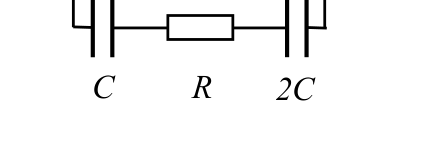
A capacitance is initially charged to voltage (i.e. the potential difference across its terminals is ) with charge . The energy stored in the capacitor is initially . It is connected via a resistance to another capacitor with capacitance . What is the final energy stored in the two capacitors after a long time ?
- (A)
- (B)
- (C)
- (D)
- (E)
Fonte: Testo (PDF) — p.6
Topic: Circuits Metodi: Conservation of Energy, Conservation Laws Competenze: Physical Reasoning Objects: Capacitor, Resistor
Una capacità è inizialmente carica a tensione (cioè: la differenza potenziale tra i suoi terminali è ) con carica . L’energia immagazzinata nel condensatore è inizialmente . È collegato attraverso una resistenza ad un altro condensatore con capacità . Qual è l’energia finale immagazzinata nei due condensatori dopo un lungo periodo di tempo ?
- (A)
- (B)
- (C)
- (D)
- (E)
Fonte: Testo (PDF) — p.6
Topic: Circuits Metodi: Conservation of Energy, Conservation Laws Competenze: Physical Reasoning Objects: Capacitor, Resistor
A container in the shape of a cube with dimensions is filled with water (on the surface of the earth). Which statement about the pressure at the bottom of the cube is most complete and correct?
- (A) The pressure due to the water is downwards acting in the center of the bottom surface.
- (B) The pressure due to the water is upwards acting in the center of the bottom surface.
- (C) The pressure due to the water is downwards.
- (D) The pressure due to the water is .
- (E) The pressure due to the water is downwards.
Fonte: Testo (PDF) — p.7
Topic: Fluid Mechanics Metodi: Hydrostatic Equilibrium Competenze: Physical Reasoning Objects: Container
Un contenitore a forma di cubo con dimensioni è riempito di acqua (sulla superficie terrestre). Quale affermazione sulla pressione al fondo del cubo è più completa e corretta?
- **(A) ** La pressione dovuta all’acqua è verso il basso, agendo nel centro della superficie inferiore.
- **(B) ** La pressione dovuta all’acqua è verso l’alto agendo nel centro della superficie inferiore.
- **(C) ** La pressione dovuta all’acqua è verso il basso.
- **(D) ** La pressione dovuta all’acqua è .
- **(E) ** La pressione dovuta all’acqua è verso il basso.
Fonte: Testo (PDF) — p.7
Topic: Fluid Mechanics Metodi: Hydrostatic Equilibrium Competenze: Physical Reasoning Objects: Container
Which of the following “forces” is conceptually different from the others in classical mechanics?
- (A) Magnetic force
- (B) Gravitational force
- (C) Elastic spring force
- (D) Frictional force
- (E) Centripetal force
Fonte: Testo (PDF) — p.7
Topic: Newtonian Mechanics Metodi: Free-Body Diagram Competenze: Physical Reasoning Objects: —
Quale delle seguenti “forze” è concettualmente differente dalle altre nella meccanica classica?
- **(A) ** Forza magnetica
- **(B) ** Forza gravitazionale
- **(C) ** Forza di molla elastica
- **(D) ** Forza di frizione
- **(E) ** Forza centripeta
Fonte: Testo (PDF) — p.7
Topic: Newtonian Mechanics Metodi: Free-Body Diagram Competenze: Physical Reasoning Objects: —
A photomultiplier consist of a cathode and anode and ten intermediate electrodes called dynodes in a vacuum tube. When an electron from the previous electrode hits a dynode, it immediately “knocks out” a few electrons with negligible starting velocity. The potential difference between each pair of electrodes is so that the total potential difference across the cathode and anode is . Assuming that when a photon falls on the cathode, an electron is immediately emitted and the distance between each pair of electrodes is , what is the time between light falling on the photocathode and a current being detected at the anode?
- (A)
- (B)
- (C)
- (D)
- (E)
Fonte: Testo (PDF) — p.7
Topic: Electromagnetism Metodi: Kinematic Equations, Electric Potential Method Competenze: Physical Reasoning Objects: Photon, Electron
Un fotomultipliatore consiste in un catodo e un anodo e dieci elettrodi intermedi chiamati dinodi in un tubo a vuoto. Quando un elettrone dell’elettrodo precedente colpisce un dinodo, immediatamente “scolpisce” alcuni elettroni con una velocità di partenza trascurabile. La differenza di potenziale tra ciascun paio di elettrodi è , in modo che la differenza totale di potenziale tra il catodo e l’anodo è . Supponendo che quando un fotone cade sul catodo, un elettrone viene immediatamente emesso e la distanza tra ogni coppia di elettrodi è , qual è il tempo tra la luce che cade sul fotocatodo e una corrente che viene rilevata all’anodo?
- (A)
- (B)
- (C)
- (D)
- (E)
Fonte: Testo (PDF) — p.7
Topic: Electromagnetism Metodi: Kinematic Equations, Electric Potential Method Competenze: Physical Reasoning Objects: Photon, Electron
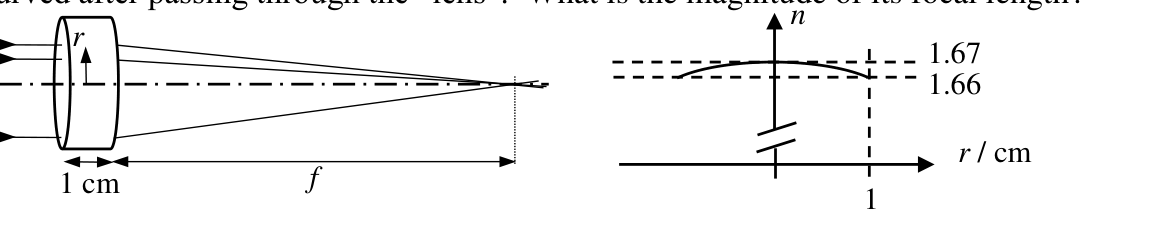
A cylinder with flat ends has radius and length . The cylinder is used as a lens as shown below. Its refractive index varies from the center to radius according to the formula , where is the distance from the center in cm. Since the refractive index is highest at the center, it is expected that the light wavefronts are curved after passing through the “lens”. What is the magnitude of its focal length?
- (A)
- (B)
- (C)
- (D)
- (E) Infinite
Fonte: Testo (PDF) — p.7
Topic: Geometric Optics Metodi: Thin Lens & Mirror Equation, Snell’s Law Competenze: Physical Reasoning Objects: Lens, Cylinder
Un cilindro con estremità piatte ha un raggio e una lunghezza . Il cilindro è usato come obiettivo come mostrato di seguito. Il suo indice di rifrazione varia dal centro al raggio secondo la formula , dove è la distanza dal centro in cm. Poiché l’indice di rifrazione è più alto al centro, si prevede che i fronti d’onda della luce siano curvi dopo aver attraversato la “lente”. Qual è la grandezza della sua distanza focale?
- (A)
- (B)
- (C)
- (D)
- **(E) ** Infinito
Fonte: Testo (PDF) — p.7
Topic: Geometric Optics Metodi: Thin Lens & Mirror Equation, Snell’s Law Competenze: Physical Reasoning Objects: Lens, Cylinder
A diameter, focal length curved mirror may be used to set fire to wood by simply focusing the sunlight onto the wood. What is the maximum intensity (power/area) at the wood? You may assume the sun is big and hot and the sky is clear.
- (A)
- (B)
- (C)
- (D)
- (E)
Fonte: Testo (PDF) — p.7
Topic: Geometric Optics Metodi: Thin Lens & Mirror Equation, Order-of-Magnitude Estimation Competenze: Physical Reasoning Objects: Mirror
Per accendere il legno si può utilizzare uno specchio curvo di diametro , di lunghezza focale, semplicemente concentrando la luce solare sul legno. Qual è l’intensità massima (potenza/area) del legno? Potresti supporre che il sole sia grande e caldo e che il cielo sia limpido.
- (A)
- (B)
- (C)
- (D)
- (E)
Fonte: Testo (PDF) — p.7
Topic: Geometric Optics Metodi: Thin Lens & Mirror Equation, Order-of-Magnitude Estimation Competenze: Physical Reasoning Objects: Mirror
A free electron oscillates in an oscillating electromagnetic wave with electric field amplitude , magnetic field amplitude and frequency . What is the electron’s maximum KE?
- (A)
- (B)
- (C)
- (D)
- (E)
Fonte: Testo (PDF) — p.8
Topic: Electromagnetism Metodi: Lorentz Force Analysis, Simple Harmonic Motion Analysis Competenze: Physical Reasoning Objects: Electron
Un elettrone libero oscilla in un’onda elettromagnetica oscillante con amplitudine di campo elettrico , amplitudine di campo magnetico e frequenza . Qual è il KE massimo dell’elettrone?
- (A)
- (B)
- (C)
- (D)
- (E)
Fonte: Testo (PDF) — p.8
Topic: Electromagnetism Metodi: Lorentz Force Analysis, Simple Harmonic Motion Analysis Competenze: Physical Reasoning Objects: Electron
A uniform current density (units of ) flows along a long cylinder of plasma of length and radius . A constant uniform magnetic field is applied in the same direction as the current density along the length of the cylinder. The magnitude of magnetic pressure acting on the curved surface of the cylinder of plasma is proportional to:
- (A)
- (B)
- (C)
- (D)
- (E)
Fonte: Testo (PDF) — p.8
Topic: Magnetism Metodi: Ampère’s Law, Dimensional Analysis Competenze: Physical Reasoning Objects: Cylinder
Una densità di corrente uniforme (unità di ) scorre lungo un lungo cilindro di plasma di lunghezza e raggio . Si applica un campo magnetico uniforme costante nella stessa direzione della densità di corrente lungo la lunghezza del cilindro. La grandezza della pressione magnetica che agisce sulla superficie curva del cilindro di plasma è proporzionale a:
- (A)
- (B)
- (C)
- (D)
- (E)
Fonte: Testo (PDF) — p.8
Topic: Magnetism Metodi: Ampère’s Law, Dimensional Analysis Competenze: Physical Reasoning Objects: Cylinder
For X-rays with photon energy much higher than the binding energy of electrons in a metal, the electrons may behave as “free” electrons in a plasma. The refractive index of a plasma is given by . Where is the electron density, is the angular frequency of the x-rays. X-rays with photon energy are Totally Externally Reflected off gold with a critical angle from the mirror’s surface. What fraction of the electrons in gold behave as “free” electrons for total external reflection?
Additional information: The density of gold is . It takes about to remove the electrons from the innermost shell of gold. There is conduction electron per atom of gold.
- (A)
- (B)
- (C)
- (D)
- (E)
Fonte: Testo (PDF) — p.8
Topic: Wave Optics Metodi: Snell’s Law, Physical Modeling Competenze: Physical Reasoning Objects: Photon, Electron
Per i raggi X con energia fotonica molto superiore all’energia di legame degli elettroni in un metallo, gli elettroni possono comportarsi come elettroni “liber” in un plasma. L’ indice di rifrazione di un plasma è indicato da . Se è la densità degli elettroni, è la frequenza angolare dei raggi X. I raggi X con energia fotonica sono totalmente riflessi esternamente dall’oro con un angolo critico dalla superficie dello specchio. Quale frazione degli elettroni nell’oro si comporta come elettroni “libertari” per il riflesso esterno totale?
Informazioni aggiuntive: la densità dell’oro è . Ci vuole circa per rimuovere gli elettroni dal più interno guscio d’oro. C’è un elettrone di conduttività per ogni atomo di oro.
- (A)
- (B)
- (C)
- (D)
- (E)
Fonte: Testo (PDF) — p.8
Topic: Wave Optics Metodi: Snell’s Law, Physical Modeling Competenze: Physical Reasoning Objects: Photon, Electron
Consider a tall house by in Korea, made of wood with average conductivity of and thickness (including the roof and the floor). Assume that the outside temperature is (including under the floor), the inside temperature (except for the floor) is kept at . Hot water is pumped through a radiator the same area as the floor in good thermal contact with the floor. Assume that the black body radiator only radiates heat upwards and there are no other heat sources in the house. What temperature should the floor be at?
- (A)
- (B)
- (C)
- (D)
- (E)
Fonte: Testo (PDF) — p.8
Topic: Thermodynamics Metodi: First Law of Thermodynamics, Energy Conservation Method Competenze: Physical Reasoning Objects: —
Considerate una casa alta di in Corea, in legno con una conducibilità media di e spessore (compresi il tetto e il pavimento). Supponiamo che la temperatura esterna sia (anche sotto il pavimento), la temperatura interna (esclusa il pavimento) è mantenuta a . L’acqua calda viene pompata attraverso un radiatore nella stessa area del pavimento in buon contatto termico con il pavimento. Supponiamo che il radiatore di corpo nero irradiare solo il calore verso l’alto e non ci sono altre fonti di calore in casa. A che temperatura dovrebbe essere il pavimento?
- (A)
- (B)
- (C)
- (D)
- (E)
Fonte: Testo (PDF) — p.8
Topic: Thermodynamics Metodi: First Law of Thermodynamics, Energy Conservation Method Competenze: Physical Reasoning Objects: —
Two coaxial cylinders, A and B may be rotated on the axis as shown in the figure. The inner non-conducting cylinder A is magnetized such that a magnetic field points uniformly outwards through the curved surface of conducting but non-magnetic cylinder B with radius and length . The potential difference between the top and bottom of cylinder B may be measured using a stationary voltmeter.
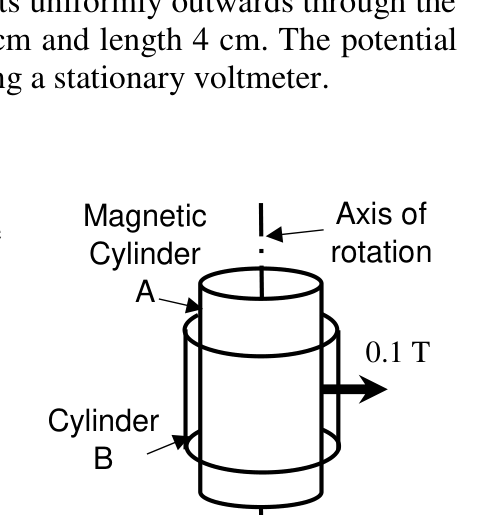
Consider the following cases:
- I — cylinder B rotates at , cylinder A is stationary,
- II — cylinder A and B rotate at together,
- III — cylinder B rotates at , cylinder A rotates at in the opposite way,
- IV — cylinder A rotates at , cylinder B is stationary,
Which is true?
- (A) Case III produces the largest potential difference and all other cases produce lower potential differences.
- (B) Cases I and II produce the same potential difference.
- (C) Cases I and IV produce the same potential difference.
- (D) Case II produces zero potential difference.
- (E) Not (all or one) but (some or none) of the above is true.
Fonte: Testo (PDF) — p.9
Topic: Electromagnetic Induction Metodi: Lorentz Force Analysis, Faraday’s Law of Induction Competenze: Physical Reasoning Objects: Cylinder
Due cilindri coassiali, A e B, possono essere ruotati sull’asse come mostrato nella figura. Il cilindro interno non conduttore A è magnetizzato in modo tale che un campo magnetico punta uniformemente verso l’esterno attraverso la superficie curva del cilindro conduttore ma non magnetico B con raggio e lunghezza . La differenza potenziale tra la parte superiore e quella inferiore del cilindro B può essere misurata con un voltmeter stazionario.
Considerate i seguenti casi:
- I cilindro B ruota a , cilindro A è stazionario,
- II cilindro A e B ruotano insieme a ,
- III cilindro B ruota a , cilindro A ruota a in senso opposto,
- IV cilindro A ruota a , cilindro B è stazionario,
Che e’ vero?
- **(A) ** Il caso III produce la differenza potenziale più grande e tutti gli altri casi producono differenze potenziali inferiori.
- **(B) ** I casi I e II producono la stessa differenza potenziale.
- **(C) ** I casi I e IV presentano la stessa differenza potenziale.
- **(D) ** Il caso II produce una differenza potenziale zero.
- **(E) ** Non (tutto o uno) ma (alcuni o nessuno) di quanto sopra è vero.
Fonte: Testo (PDF) — p.9
Topic: Electromagnetic Induction Metodi: Lorentz Force Analysis, Faraday’s Law of Induction Competenze: Physical Reasoning Objects: Cylinder
The Voyager spacecraft carried a small amount of initially pure on the covers of their golden records to facilitate dating. Part of the uranium series is shown below with the half-life labelled. What are the ratios of the number of to after years and years respectively?
- (A)
- (B)
- (C)
- (D)
- (E)
Fonte: Testo (PDF) — p.9
Topic: Nuclear & Particle Physics Metodi: Radioactive Decay Law Competenze: Physical Reasoning Objects: Nucleus
Le sonde Voyager trasportavano una piccola quantità di inizialmente puro sulle copertine dei loro dischi d’oro per facilitare la datazione. Parte della serie dell’uranio è mostrata di seguito con indicato il tempo di dimezzamento. Quali sono i rapporti tra il numero di e rispettivamente dopo anni e anni?
- (A)
- (B)
- (C)
- (D)
- (E)
Fonte: Testo (PDF) — p.9
Topic: Nuclear & Particle Physics Metodi: Radioactive Decay Law Competenze: Physical Reasoning Objects: Nucleus
Two tungsten filament bulbs are connected in parallel to a battery. In this configuration, one bulb consumes of power and the other . What is the amount of power supplied if the two bulbs are connected in series to the battery?
- (A)
- (B)
- (C)
- (D)
- (E)
Fonte: Testo (PDF) — p.9
Topic: Circuits Metodi: Equivalent Circuit Reduction, Kirchhoff’s Laws Competenze: Physical Reasoning Objects: Battery, Resistor
Due lampadine a filamento di tungsteno sono collegate in parallelo a una batteria . In questa configurazione, una lampadina consuma di potenza e l’altra . Qual è la quantità di alimentazione fornita se le due lampadine sono collegate in serie alla batteria ?
- (A)
- (B)
- (C)
- (D)
- (E)
Fonte: Testo (PDF) — p.9
Topic: Circuits Metodi: Equivalent Circuit Reduction, Kirchhoff’s Laws Competenze: Physical Reasoning Objects: Battery, Resistor
A type of helicopter can hover if its mechanical power output is . If an exact -scale replica (in all linear dimensions) of the helicopter is made using the same material, what is the mechanical power needed for the helicopter to hover?
- (A)
- (B)
- (C)
- (D)
- (E)
Fonte: Testo (PDF) — p.9
Topic: Order-of-Magnitude Estimation Metodi: Dimensional Analysis, Order-of-Magnitude Estimation Competenze: Physical Reasoning Objects: —
Un tipo di elicottero può galleggiare se la sua potenza meccanica è . Se viene realizzata una copia esatta (in tutte le dimensioni lineari) dell’elicottero su scala utilizzando lo stesso materiale, quale è la potenza meccanica necessaria per far galleggiare l’elicottero?
- (A)
- (B)
- (C)
- (D)
- (E)
Fonte: Testo (PDF) — p.9
Topic: Order-of-Magnitude Estimation Metodi: Dimensional Analysis, Order-of-Magnitude Estimation Competenze: Physical Reasoning Objects: —
The volumetric thermal expansion coefficient of iron is , and its specific heat capacity is . Assume these quantities are constant at all relevant temperatures.
A cubic block of iron with side length and mass is placed on a flat, unmoving, completely insulating table. of thermal energy is supplied to this iron block. Let the final temperature of this iron block be .
A second block of iron, identical to the first with the same initial temperature, is hung by an inextensible, completely insulating string from a fixed point on the wall. of thermal energy is also supplied to this iron block. Let the final temperature of the second iron block be . Calculate .
- (A)
- (B)
- (C)
- (D)
- (E)
Fonte: Testo (PDF) — p.10
Topic: Thermodynamics Metodi: Energy Conservation Method, First Law of Thermodynamics Competenze: Physical Reasoning Objects: Block, String
Il coefficiente di espansione termico volumetrico del ferro è e la sua capacità termico specifica è . Supponiamo che queste quantità siano costanti a tutte le temperature rilevanti.
Un blocco cubo di ferro con lunghezza laterale e massa è posizionato su un tavolo piatto, immobile e completamente isolante. Il blocco di ferro è alimentato da di energia termica. La temperatura finale di questo blocco di ferro deve essere .
Un secondo blocco di ferro, identico al primo con la stessa temperatura iniziale, è appeso da una corda inestensibile, completamente isolante da un punto fisso sul muro. Anche questo blocco di ferro è alimentato da di energia termica. La temperatura finale del secondo blocco di ferro deve essere . Calcolare .
- (A)
- (B)
- (C)
- (D)
- (E)
Fonte: Testo (PDF) — p.10
Topic: Thermodynamics Metodi: Energy Conservation Method, First Law of Thermodynamics Competenze: Physical Reasoning Objects: Block, String
A small tennis ball with mass sits atop a large basketball with mass , with . The balls are released from rest, with the bottom of the basketball at a height above the ground. The diameter of the tennis ball is and that of the basketball is , with . To what height does the tennis ball bounce above the ground? Assume all collisions are elastic.
- (A)
- (B)
- (C)
- (D)
- (E) There is insufficient information.
Fonte: Testo (PDF) — p.10
Topic: Conservation of Momentum Metodi: Conservation of Momentum, Conservation of Energy Competenze: Physical Reasoning Objects: Ball
Una piccola palla da tennis di massa si trova sopra una grande palla da basket di massa , con . Le palle vengono rilasciate dal riposo, con il fondo della palla da basket ad un’altezza sopra il terreno. Il diametro della palla da tennis è e quello della palla da basket è , con . A che altezza la palla da tennis rimbalza sopra il terreno? Supponiamo che tutte le collisioni siano elastiche.
- (A)
- (B)
- (C)
- (D)
- **(E) ** Non ci sono informazioni sufficienti.
Fonte: Testo (PDF) — p.10
Topic: Conservation of Momentum Metodi: Conservation of Momentum, Conservation of Energy Competenze: Physical Reasoning Objects: Ball
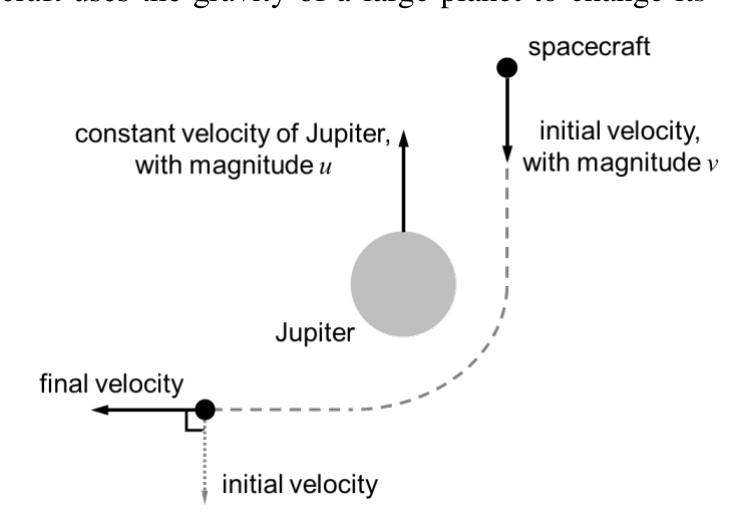
In a ‘gravitational slingshot’ maneuver, a spacecraft uses the gravity of a large planet to change its path and increase its speed. Such a maneuver can be analyzed as a collision.
A spacecraft is initially headed at speed towards Jupiter, which is moving at a speed in the opposite direction. The final velocity of the spacecraft is perpendicular to the initial velocity of the spacecraft. Assuming that , what is the final speed of the spacecraft in terms of ?
- (A)
- (B)
- (C)
- (D)
- (E)
Fonte: Testo (PDF) — p.10
Topic: Conservation of Momentum Metodi: Conservation of Momentum, Vector Decomposition Competenze: Physical Reasoning Objects: Satellite, Planet
In una manovra di “slingshot gravitazionale”, una nave spaziale utilizza la gravità di un grande pianeta per cambiare il suo percorso e aumentare la sua velocità. Una tale manovra può essere considerata una collisione.
Una sonda spaziale inizia a dirigersi a velocità verso Giove, che si muove a velocità nella direzione opposta. La velocità finale della sonda è perpendicolare alla velocità iniziale della sonda. Supponendo che , qual è la velocità finale della sonda in termini di ?
- (A)
- (B)
- (C)
- (D)
- (E)
Fonte: Testo (PDF) — p.10
Topic: Conservation of Momentum Metodi: Conservation of Momentum, Vector Decomposition Competenze: Physical Reasoning Objects: Satellite, Planet
A mass , with initial speed , collides elastically with a stationary mass . Find the maximum angle of deflection of the mass .
- (A)
- (B)
- (C)
- (D)
- (E) There is insufficient information to tell.
Fonte: Testo (PDF) — p.10
Topic: Conservation of Momentum Metodi: Conservation of Momentum, Conservation of Energy Competenze: Physical Reasoning Objects: —
Una massa , con velocità iniziale , si schianta elasticamente con una massa stazionaria . Trova l’angolo massimo di deviazione della massa .
- (A)
- (B)
- (C)
- (D)
- **(E) ** Non ci sono informazioni sufficienti per dirlo.
Fonte: Testo (PDF) — p.10
Topic: Conservation of Momentum Metodi: Conservation of Momentum, Conservation of Energy Competenze: Physical Reasoning Objects: —
Consider the alternating-current transformer above. Which of the following statements gives the correct explanation and phase difference between and ?
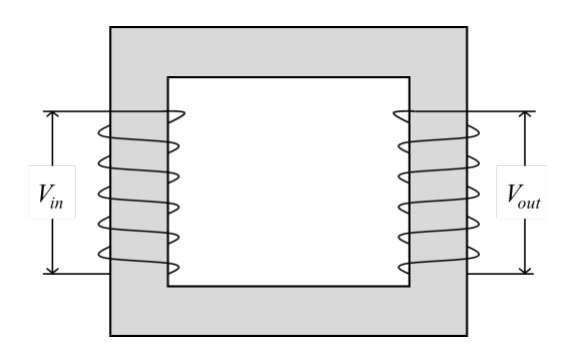
- (A) By Faraday’s Law, phase difference (i.e. and are in phase).
- (B) By Faraday and Lenz’s law, phase difference .
- (C) By analogy to simple harmonic motion, phase difference .
- (D) By Fleming’s Left hand rule, phase difference .
- (E) By Lenz’s Law, phase difference (i.e. and are in anti-phase).
Fonte: Testo (PDF) — p.11
Topic: Electromagnetic Induction Metodi: Faraday’s Law of Induction, Lenz’s Law Competenze: Physical Reasoning Objects: Coil
Considerate il trasformatore di corrente alternata di sopra. Qual è la spiegazione corretta e la differenza di fase tra e ?
- **(A) ** Secondo la legge di Faraday, la differenza di fase (cioè e sono in fase).
- **(B) ** Secondo la legge di Faraday e Lenz, differenza di fase .
- **(C) ** Per analogia con il semplice movimento armonico, differenza di fase .
- **(D) ** Con la regola di Fleming della mano sinistra, differenza di fase .
- **(E) ** Secondo la legge di Lenz, la differenza di fase (cioè e sono in antifase).
Fonte: Testo (PDF) — p.11
Topic: Electromagnetic Induction Metodi: Faraday’s Law of Induction, Lenz’s Law Competenze: Physical Reasoning Objects: Coil
An initially stationary polonium-214 nucleus undergoes alpha-decay to give two products: Given that the total kinetic energy of the products is , the kinetic energy of the alpha-particle () is . This can be found by applying the two equations of conservation of energy and conservation of momentum to solve for two variables (velocities of and ).
An initially stationary phosphorus-32 nucleus undergoes beta-decay to give three products: Given that the total kinetic energy of the products is , what is the kinetic energy of the beta-particle ()?
- (A)
- (B)
- (C)
- (D) (i.e. )
- (E) There is insufficient information to tell.
Fonte: Testo (PDF) — p.11
Topic: Nuclear & Particle Physics Metodi: Conservation Laws, Mass-Energy Equivalence Competenze: Physical Reasoning Objects: Nucleus
Un nucleo di polonio-214 inizialmente stazionario subisce un decadimento alfa per dare due prodotti: Poiché l’energia cinetica totale dei prodotti è , l’energia cinetica della particella alfa () è . Questo può essere riscontrato applicando le due equazioni di conservazione dell’energia e di conservazione del momento per risolvere due variabili (velocità di e ).
Un nucleo di fosforo-32 inizialmente stazionario subisce un decadimento beta per dare tre prodotti: Dato che l’energia cinetica totale dei prodotti è , quale è l’energia cinetica della particella beta ()?
- (A)
- (B)
- (C)
- (D) (i.e. )
- **(E) ** Non ci sono informazioni sufficienti per dirlo.
Fonte: Testo (PDF) — p.11
Topic: Nuclear & Particle Physics Metodi: Conservation Laws, Mass-Energy Equivalence Competenze: Physical Reasoning Objects: Nucleus
On which of the following faces should the uniform prism (whose cross-section is shown below) be placed so that it would have to be tilted by the largest angle before toppling? (The aim is to maximise the threshold angle, beyond which the prism topples. A prism is a 3-dimensional solid with a uniform cross-section.)
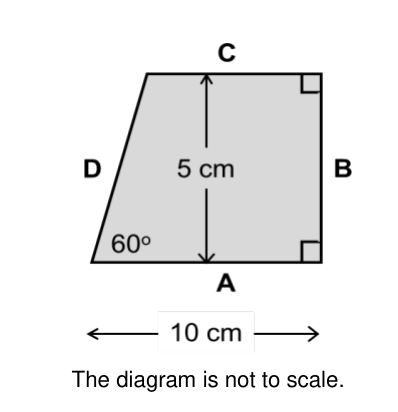
- (A–D) (As shown.)
- (E) There is no single face with the largest threshold angle (i.e. more than one face have the same threshold angle).
Fonte: Testo (PDF) — p.11
Topic: Rigid Body Statics Metodi: Torque & Angular Momentum Analysis, Free-Body Diagram Competenze: Physical Reasoning Objects: Block
Su quale delle seguenti facce dovrebbe essere posizionato il prisma uniforme (la cui sezione trasversale è mostrata di seguito) in modo che sia necessario inclinarlo con l’angolo più grande prima di abbattersi? (L’obiettivo è quello di massimizzare l’angolo di soglia, oltre il quale il prisma si abbatte. Un prisma è un solido tridimensionale con una sezione trasversale uniforme.)
- **(AD) ** (Come mostrato.)
- **(E) ** Non esiste una sola faccia con l’angolo di soglia più grande (cioè più di una faccia hanno la stessa angolazione di soglia).
Fonte: Testo (PDF) — p.11
Topic: Rigid Body Statics Metodi: Torque & Angular Momentum Analysis, Free-Body Diagram Competenze: Physical Reasoning Objects: Block
Moist air moves adiabatically across a mountain range. At the ground level, the atmospheric pressure is and the temperature is . Clouds begin to form at a height of above the ground, where the pressure is . Find the temperature of the air at this height. (Assume that moist air behaves like a diatomic ideal gas, with .)
- (A)
- (B)
- (C)
- (D)
- (E)
Fonte: Testo (PDF) — p.11
Topic: Thermodynamics Metodi: Ideal Gas Law, First Law of Thermodynamics Competenze: Physical Reasoning Objects: Gas
L’aria umida si muove adiabaticamente attraverso una catena montuosa. A livello del suolo, la pressione atmosferica è e la temperatura è . Le nuvole iniziano a formarsi ad un’altezza di sopra il suolo, dove la pressione è . Trova la temperatura dell’aria a questa altezza. (Supponiamo che l’aria umida si comporti come un gas ideale diatomico, con .)
- (A)
- (B)
- (C)
- (D)
- (E)
Fonte: Testo (PDF) — p.11
Topic: Thermodynamics Metodi: Ideal Gas Law, First Law of Thermodynamics Competenze: Physical Reasoning Objects: Gas
What is the correct graph of intensity against position for a far-field 4-slit interference setup?
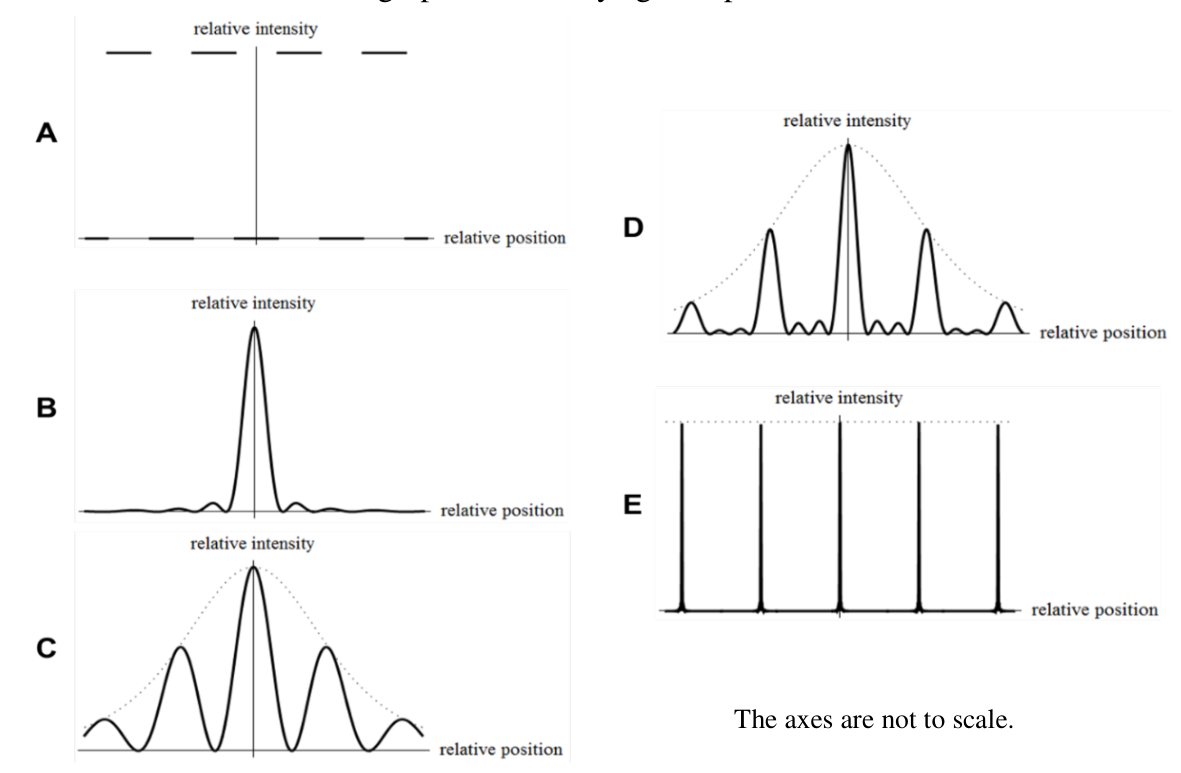
The axes are not to scale.
Fonte: Testo (PDF) — p.12
Topic: Wave Optics Metodi: Interference & Diffraction Analysis, Superposition Principle Competenze: Physical Reasoning Objects: Slit, Screen
Qual è il grafico corretto di intensità contro posizione per un campo lontano di interferenza a 4 fessure?
Gli assi non sono a scala.
Fonte: Testo (PDF) — p.12
Topic: Wave Optics Metodi: Interference & Diffraction Analysis, Superposition Principle Competenze: Physical Reasoning Objects: Slit, Screen
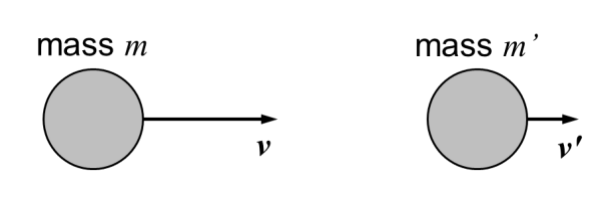
A mass collides elastically with another mass . The velocity of mass is and that of mass is . Both masses are moving at relativistic speeds. Which quantity is conserved before and after the collision? (; )
- (A)
- (B)
- (C)
- (D)
- (E)
Fonte: Testo (PDF) — p.12
Topic: Special Relativity Metodi: Relativistic Energy-Momentum, Conservation of Momentum Competenze: Physical Reasoning Objects: —
Una massa colpisce elasticamente con un’altra massa . La velocità di massa è e quella di massa è . Entrambe le masse si muovono a velocità relativistiche. Quali quantità sono conservate prima e dopo la collisione? (; )
- (A)
- (B)
- (C)
- (D)
- (E)
Fonte: Testo (PDF) — p.12
Topic: Special Relativity Metodi: Relativistic Energy-Momentum, Conservation of Momentum Competenze: Physical Reasoning Objects: —
A long, hard train collides with a small fly. Assume the mass of the fly is negligible compared to the mass of the train. The train and the fly were initially moving towards each other with the same magnitude of velocity. When they collide, the train and fly stick to each other and finally travel with the same velocity as each other. Which of the following statements is most true in relation to the above?
- (A) During the collision the velocity of the fly changes direction instantaneously to that of the train.
- (B) During the collision the fly stops moving at some point in time since the velocity changes in direction.
- (C) Since the velocity of the fly must be zero at some time during the collision and it is attached to the train, then the train also has zero velocity at that time.
- (D) After the collision the fly must have gained momentum from the train.
- (E) The train must have exerted a large force on the fly due to its large momentum. The force exerted on the fly is proportional to the momentum of the train.
Fonte: Testo (PDF) — p.12
Topic: Newtonian Mechanics Metodi: Impulse-Momentum Theorem, Conservation of Momentum Competenze: Physical Reasoning Objects: —
Un treno lungo e duro si schianta con una mosca. Supponiamo che la massa della mosca sia trascurabile rispetto alla massa del treno. Il treno e la mosca inizialmente si muovevano l’uno verso l’altro con la stessa velocità. Quando si scontrano, il treno e il volo si attaccano e finalmente viaggiano alla stessa velocità. Quali delle seguenti affermazioni sono più vere rispetto a quanto sopra?
- **(A) ** Durante la collisione la velocità della mosca cambia istantaneamente di direzione a quella del treno.
- **(B) ** Durante la collisione la mosca si ferma a un certo punto del tempo poiché la velocità cambia di direzione.
- **(C) ** Poiché la velocità della mosca deve essere zero in un certo momento durante la collisione e è collegata al treno, il treno ha anche velocità zero in quel momento.
- **(D) ** Dopo la collisione la mosca deve aver guadagnato impulso dal treno.
- **(E) ** Il treno deve aver esercitato una grande forza a volo a causa della sua grande impulsione. La forza esercitata in volo è proporzionale al momento del treno.
Fonte: Testo (PDF) — p.12
Topic: Newtonian Mechanics Metodi: Impulse-Momentum Theorem, Conservation of Momentum Competenze: Physical Reasoning Objects: —
Two long parallel wires are distance away from each other. One wire CC carries a constant current . At time , the current is immediately switched on in the other wire PC for time duration before it is switched off. Which of the following is most true and detailed in relation to the above situation?
- (A) When the current is switched on in PC, CC immediately experiences a magnetic force acting on it.
- (B) When the current is switched on in PC, PC immediately experiences a magnetic force acting on it.
- (C) Due to Newton’s 3rd law, CC & PC experience equal and opposite magnetic forces at the same time.
- (D) Due to Einstein’s special relativity, CC & PC experience equal and opposite forces at the same time.
- (E) Due to Heisenberg’s uncertainty principle, we cannot be certain that CC or PC experiences a magnetic force because we are not certain if their momentum has changed.
The axes are not to scale.
Fonte: Testo (PDF) — p.12
Topic: Electromagnetism Metodi: Lorentz Force Analysis, Biot-Savart Law Competenze: Physical Reasoning Objects: Wire
Two long parallel wires are distance away from each other. Un filo CC ha una corrente costante . Al momento , la corrente viene immediatamente accesa nell’altro PC a filo per una durata prima di essere spenta. Qual è la più vera e dettagliata delle seguenti situazioni?
- **(A) ** Quando la corrente è accesa in PC, CC subito subisce una forza magnetica che agisce su di essa.
- **(B) ** Quando la corrente viene attivata nel PC, il PC subisce immediatamente una forza magnetica che agisce su di esso.
- **(C) ** A causa della terza legge di Newton, CC & PC sperimentano forze magnetiche uguali e opposte allo stesso tempo.
- **(D) ** A causa della special relatività di Einstein, CC & PC sperimentano forze uguali e opposte allo stesso tempo.
- **(E) ** A causa del principio di incertezza di Heisenberg, non possiamo essere certi che CC o PC sperimentino una forza magnetica perché non siamo certi che la loro impulso sia cambiato.
Gli assi non sono a scala.
Fonte: Testo (PDF) — p.12
Topic: Electromagnetism Metodi: Lorentz Force Analysis, Biot-Savart Law Competenze: Physical Reasoning Objects: Wire