The figure shows the potential energy as a function of molecular separation for a diatomic molecule of reduced mass .
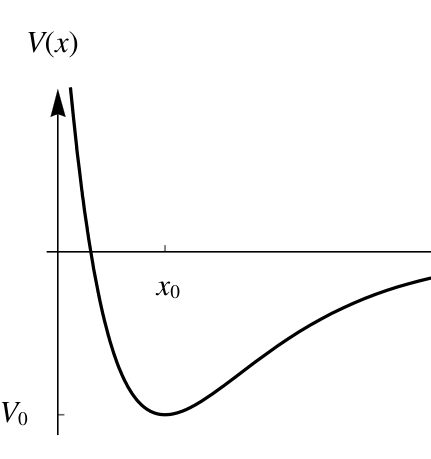
If , the vibrational frequency at the equilibrium position is ___.
(Hint: This series expansion may be useful: )
- (A)
- (B)
- (C)
- (D)
- (E)
Fonte: Testo (PDF) — p.2
Topic: Oscillations & Waves Metodi: Simple Harmonic Motion Analysis, Approximation & Series Expansion Competenze: Physical Reasoning Objects: Atom
La figura mostra l’energia potenziale come funzione di separazione molecolare per una molecola diatomica di massa ridotta .
Se , la frequenza vibrazionale nella posizione di equilibrio è ___.
(Signore: l’espansione di questa serie può essere utile: )
- (A)
- (B)
- (C)
- (D)
- (E)
Fonte: Testo (PDF) — p.2
Topic: Oscillations & Waves Metodi: Simple Harmonic Motion Analysis, Approximation & Series Expansion Competenze: Physical Reasoning Objects: Atom
A tiny spherical raindrop of diameter experiences a linear drag force while falling at speed , given by , where . What is its terminal speed?
- (A)
- (B)
- (C)
- (D)
- (E)
Fonte: Testo (PDF) — p.2
Topic: Fluid Mechanics Metodi: Free-Body Diagram, Physical Modeling Competenze: Physical Reasoning Objects: Droplet
Una piccolissima goccia di pioggia sferica di diametro subisce una forza di resistenza lineare mentre cade a velocità , data da , dove . Qual è la sua velocità terminale?
- (A)
- (B)
- (C)
- (D)
- (E)
Fonte: Testo (PDF) — p.2
Topic: Fluid Mechanics Metodi: Free-Body Diagram, Physical Modeling Competenze: Physical Reasoning Objects: Droplet
A plumb line is held steady while being carried in a moving train. The mass of the plumb bob is , and the train is accelerating in the forward direction at . What is the tension in the string?
- (A)
- (B)
- (C)
- (D)
- (E) Cannot be determined from the given information.
Fonte: Testo (PDF) — p.2
Topic: Newtonian Mechanics Metodi: Free-Body Diagram, Vector Decomposition Competenze: Physical Reasoning Objects: Pendulum, String
Una linea idraulica è tenuta ferma mentre viene trasportata in un treno in movimento. La massa del tubo di impianto è e il treno accelera in direzione anteriore a . Qual e’ la tensione nella corda?
- (A)
- (B)
- (C)
- (D)
- **(E) ** Non può essere determinato dalle informazioni fornite.
Fonte: Testo (PDF) — p.2
Topic: Newtonian Mechanics Metodi: Free-Body Diagram, Vector Decomposition Competenze: Physical Reasoning Objects: Pendulum, String
A sphere rolls without slipping down a rough inclined plane. The gain in rotational kinetic energy is due directly to the work done by ______.
- (A) Static friction
- (B) Kinetic friction
- (C) Weight
- (D) Normal contact force
- (E) Air resistance
Fonte: Testo (PDF) — p.2
Topic: Rotational Dynamics Metodi: Torque & Angular Momentum Analysis, Free-Body Diagram Competenze: Physical Reasoning Objects: Sphere, Inclined Plane
Una sfera ruota senza scivolare in un piano inclinato. Il guadagno di energia cinetica di rotazione è dovuto **direttamente ** al lavoro svolto da ______.
- **(A) ** Frizione statica
- **(B) ** Frizione cinetica
- **(C) ** Peso
- **(D) ** Forza di contatto normale
- **(E) ** Resistenza all’aria
Fonte: Testo (PDF) — p.2
Topic: Rotational Dynamics Metodi: Torque & Angular Momentum Analysis, Free-Body Diagram Competenze: Physical Reasoning Objects: Sphere, Inclined Plane
A thin wire is bent into the form of a three-sided shape as shown below. Each segment has equal length . The height of the centre of mass from the bottom of the shape is ______.

- (A)
- (B)
- (C)
- (D)
- (E)
Fonte: Testo (PDF) — p.3
Topic: Rigid Body Statics Metodi: Symmetry Argument, Vector Decomposition Competenze: Physical Reasoning Objects: Wire
Un filo sottile è piegato in forma di forma trilaterale come mostrato di seguito. Ogni segmento ha la stessa lunghezza . L’altezza del centro di massa dal fondo della forma è ______.
- (A)
- (B)
- (C)
- (D)
- (E)
Fonte: Testo (PDF) — p.3
Topic: Rigid Body Statics Metodi: Symmetry Argument, Vector Decomposition Competenze: Physical Reasoning Objects: Wire
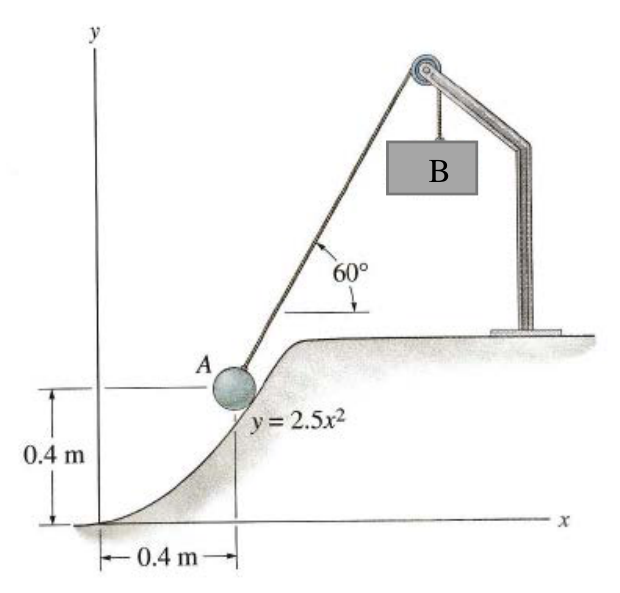
A sphere rests on the smooth parabolic surface which is given by the equation . The sphere just touches the surface at . Determine the mass of block needed to hold the sphere in equilibrium.
- (A)
- (B)
- (C)
- (D)
- (E)
Fonte: Testo (PDF) — p.3
Topic: Rigid Body Statics Metodi: Free-Body Diagram, Vector Decomposition Competenze: Physical Reasoning Objects: Sphere, Block
Una sfera si posa sulla superficie parabolica liscia, data dall’equazione . La sfera tocca la superficie solo a . Determinare la massa del blocco necessaria per mantenere la sfera in equilibrio.
- (A)
- (B)
- (C)
- (D)
- (E)
Fonte: Testo (PDF) — p.3
Topic: Rigid Body Statics Metodi: Free-Body Diagram, Vector Decomposition Competenze: Physical Reasoning Objects: Sphere, Block
A bug is just about to slip on a circular turntable of radius rotating at constant angular velocity. The bug is halfway between the centre and the edge and the coefficient of static friction is . What is the acceleration of the bug?
- (A)
- (B)
- (C)
- (D)
- (E)
Fonte: Testo (PDF) — p.3
Topic: Newtonian Mechanics Metodi: Free-Body Diagram, Vector Decomposition Competenze: Physical Reasoning Objects: Disk
Un bug sta per scivolare su una scheda giratoria circolare di raggio che ruota a velocità angolare costante. Il bug si trova a metà strada tra il centro e il bordo e il coefficiente di attrito statico è . Qual è l’accelerazione del cimice?
- (A)
- (B)
- (C)
- (D)
- (E)
Fonte: Testo (PDF) — p.3
Topic: Newtonian Mechanics Metodi: Free-Body Diagram, Vector Decomposition Competenze: Physical Reasoning Objects: Disk
The height of a circular geosynchronous orbit ( period) from the earth’s surface is approximately ___ Earth radii. (Hint: You may need the gravitational constant, mass of the Earth and the gravitational acceleration at the surface of the Earth. These are given in the list of constants.)
- (A)
- (B)
- (C)
- (D)
- (E)
Fonte: Testo (PDF) — p.3
Topic: Gravitation Metodi: Newton’s Law of Gravitation, Kepler’s Laws Competenze: Physical Reasoning Objects: Satellite, Planet
L’altezza di un’orbita geosincronica circolare (periodo ) dalla superficie terrestre è di circa ___ raggi terrestri. (Signore: Potresti aver bisogno della costante gravitazionale, della massa della Terra e dell’accelerazione gravitazionale alla superficie della Terra. Queste sono indicate nell’elenco delle costanti.)
- (A)
- (B)
- (C)
- (D)
- (E)
Fonte: Testo (PDF) — p.3
Topic: Gravitation Metodi: Newton’s Law of Gravitation, Kepler’s Laws Competenze: Physical Reasoning Objects: Satellite, Planet
The moment of inertia of a solid sphere of mass and radius , about an axis passing through its centre, is . The mass of a solid uniform octant (one-eighth) of a sphere of radius , is . The moment of inertia about an axis along one of the straight edges (e.g. axis) is ___.
- (A)
- (B)
- (C)
- (D)
- (E)
Fonte: Testo (PDF) — p.4
Topic: Rotational Dynamics Metodi: Symmetry Argument, Torque & Angular Momentum Analysis Competenze: Physical Reasoning Objects: Sphere
Il momento di inerzia di una sfera solida di massa e di raggio , circa un asse che attraversa il suo centro, è . La massa di un ottanto uniforme solido (uno ottavo) di una sfera di raggio è . Il momento di inerzia intorno ad un asse lungo uno dei bordi retti (es. L’asse ) è ___.
- (A)
- (B)
- (C)
- (D)
- (E)
Fonte: Testo (PDF) — p.4
Topic: Rotational Dynamics Metodi: Symmetry Argument, Torque & Angular Momentum Analysis Competenze: Physical Reasoning Objects: Sphere
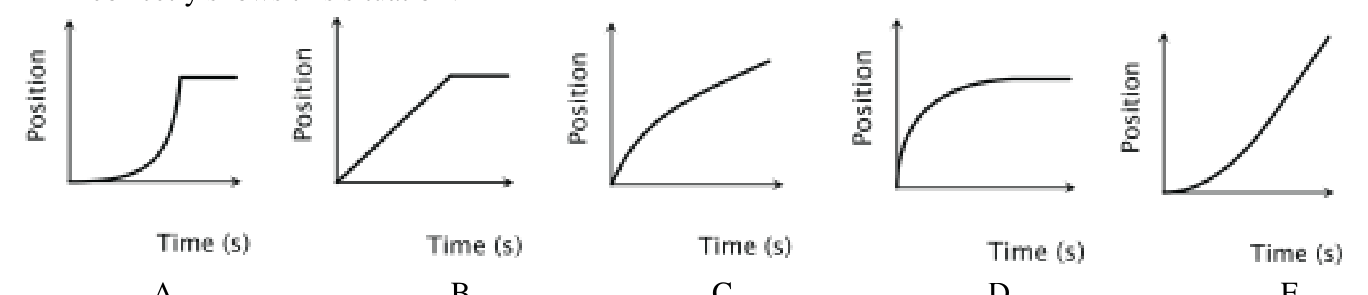
The position of an object moving along a linear track is plotted as a function of time. It started from rest and underwent a positive acceleration for some time, followed by a constant velocity. Which of the following graphs correctly shows this situation?
- (A) Graph A
- (B) Graph B
- (C) Graph C
- (D) Graph D
- (E) Graph E
Fonte: Testo (PDF) — p.4
Topic: Newtonian Mechanics Metodi: Kinematic Equations, Graph Linearization Competenze: Physical Reasoning Objects: —
La posizione di un oggetto che si muove lungo una traccia lineare è tracciata come funzione del tempo. Ha iniziato dal riposo e ha subito un’accelerazione positiva per un po’, seguita da una velocità costante. Quale dei grafici seguenti mostra correttamente questa situazione?
- **(A) ** Grafico A
- **(B) ** Grafico B
- **(C) ** Grafico C
- **(D) ** Grafico D
- **(E) ** Grafico E
Fonte: Testo (PDF) — p.4
Topic: Newtonian Mechanics Metodi: Kinematic Equations, Graph Linearization Competenze: Physical Reasoning Objects: —
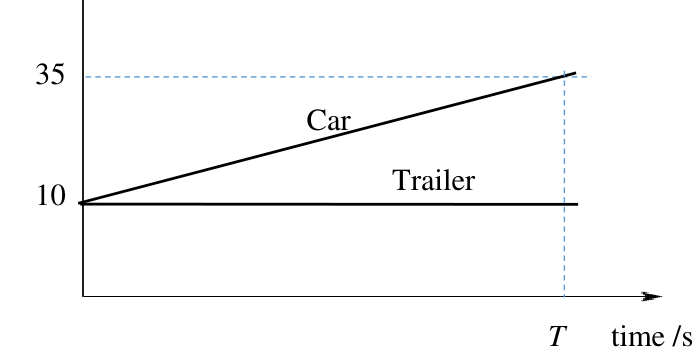
The minimum time for a car to safely overtake a long trailer is measured from the time the front of the car is level with the rear of the trailer, until the rear of the car is one full car-length ahead of the trailer. The car is long and the trailer is long. The graph shows the speed-time graphs of the car and the trailer. What is the minimum time ?
- (A)
- (B)
- (C)
- (D)
- (E)
Fonte: Testo (PDF) — p.4
Topic: Newtonian Mechanics Metodi: Kinematic Equations, Graph Linearization Competenze: Physical Reasoning Objects: —
Il tempo minimo per un’auto di superare in modo sicuro un rimorchio lungo è misurato dal momento in cui la parte anteriore della vettura è pari con la parte posteriore del rimorchio, fino a quando la parte posteriore della vettura è una lunghezza completa di una vettura davanti al rimorchio. L’auto è lunga e il rimorchio è lunga . Il grafico mostra i grafici della velocità della macchina e del rimorchio. Qual è il tempo minimo ?
- (A)
- (B)
- (C)
- (D)
- (E)
Fonte: Testo (PDF) — p.4
Topic: Newtonian Mechanics Metodi: Kinematic Equations, Graph Linearization Competenze: Physical Reasoning Objects: —
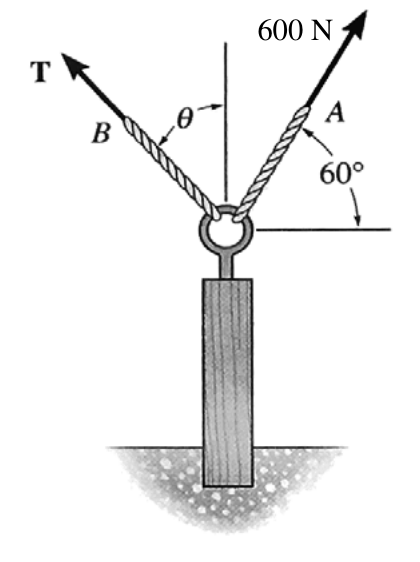
A wooden peg is to be pulled out of the ground using two ropes and . Rope is subject to a force of at to the horizontal. Rope is pulled at a fixed angle to the vertical. If the resultant force acting on the post is to be vertically, what should be the force on rope ?
- (A)
- (B)
- (C)
- (D)
- (E)
Fonte: Testo (PDF) — p.5
Topic: Rigid Body Statics Metodi: Vector Decomposition, Free-Body Diagram Competenze: Physical Reasoning Objects: String
Una cerniera in legno deve essere tirata fuori dal terreno utilizzando due corde e . La corda è soggetta a una forza di a orizzontale. La corda viene tirata ad angolo fisso verso la verticale. Se la forza risultante che agisce sul posto deve essere verticalmente, quale dovrebbe essere la forza sulla corda ?
- (A)
- (B)
- (C)
- (D)
- (E)
Fonte: Testo (PDF) — p.5
Topic: Rigid Body Statics Metodi: Vector Decomposition, Free-Body Diagram Competenze: Physical Reasoning Objects: String
Travelling with an initial speed of , a car accelerates at along a straight road. How long will it take to reach a speed of ?
- (A)
- (B)
- (C)
- (D)
- (E)
Fonte: Testo (PDF) — p.5
Topic: Newtonian Mechanics Metodi: Kinematic Equations Competenze: Physical Reasoning Objects: —
Se si viaggia a una velocità iniziale di , l’auto accelera a lungo una strada retta. Quanto tempo ci vorrà per raggiungere una velocità ?
- (A)
- (B)
- (C)
- (D)
- (E)
Fonte: Testo (PDF) — p.5
Topic: Newtonian Mechanics Metodi: Kinematic Equations Competenze: Physical Reasoning Objects: —
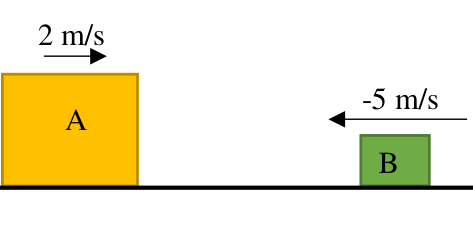
Two blocks move towards each other on a smooth table with the velocities as shown. Block has mass and moves at to the right. Block has mass and moves at to the left. The coefficient of restitution is the ratio of the final relative speed of separation to the initial relative speed of approach of two colliding objects. Take rightwards as positive. If , what is the velocity of block after impact?
- (A)
- (B)
- (C)
- (D)
- (E)
Fonte: Testo (PDF) — p.5
Topic: Conservation of Momentum Metodi: Conservation of Momentum Competenze: Physical Reasoning Objects: Block
Due blocchi si muovono l’uno verso l’altro su una tavola liscia con le velocità come mostrato. Il blocco ha massa e si muove a a destra. Il blocco ha massa e si muove a a sinistra. Il coefficiente di restituzione è il rapporto tra la velocità relativa finale di separazione e la velocità relativa iniziale di avvicinamento di due oggetti in collisione. Prendi a destra come positivo. Se , qual è la velocità del blocco dopo l’impatto?
- (A)
- (B)
- (C)
- (D)
- (E)
Fonte: Testo (PDF) — p.5
Topic: Conservation of Momentum Metodi: Conservation of Momentum Competenze: Physical Reasoning Objects: Block
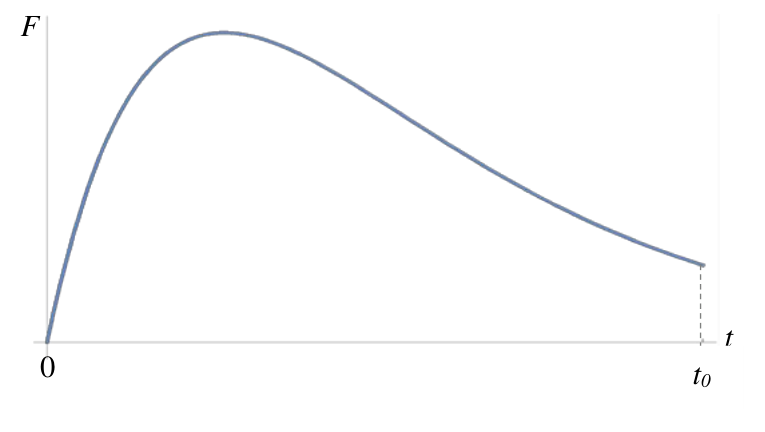
The twitch in an arm muscle develops a force which can be measured as a function of time , given by , where and are constants. The function is plotted in the figure. If the ratio , what is the impulse developed between time and time ? (Hint: Make use of this integral: .)
- (A)
- (B)
- (C)
- (D)
- (E) Indeterminate
Fonte: Testo (PDF) — p.6
Topic: Conservation of Momentum Metodi: Impulse-Momentum Theorem, Calculus-Integration Competenze: Physical Reasoning Objects: —
Il contrazione di un muscolo del braccio sviluppa una forza che può essere misurata come funzione del tempo , data da , dove e sono costanti. La funzione è tracciata nella figura. Se il rapporto , qual è l’impulso sviluppato tra il tempo e il tempo ? (Suggerimento: utilizzare questa integrale: .)
- (A)
- (B)
- (C)
- (D)
- **(E) ** Indeterminato
Fonte: Testo (PDF) — p.6
Topic: Conservation of Momentum Metodi: Impulse-Momentum Theorem, Calculus-Integration Competenze: Physical Reasoning Objects: —
Q16 and Q17 refer to the following. A car travels along a straight road with the speed shown by the – graph.
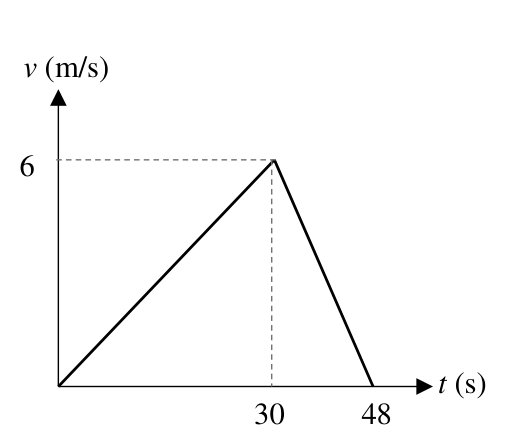
What is the acceleration of the car from to ?
- (A)
- (B)
- (C)
- (D)
- (E)
Fonte: Testo (PDF) — p.6
Topic: Newtonian Mechanics Metodi: Kinematic Equations, Graph Linearization Competenze: Physical Reasoning Objects: —
Q16 e Q17 si riferiscono ai seguenti elementi. Una vettura percorre una strada retta con la velocità indicata dal grafico v$$t.
Qual è l’accelerazione dell’auto da a ?
- (A)
- (B)
- (C)
- (D)
- (E)
Fonte: Testo (PDF) — p.6
Topic: Newtonian Mechanics Metodi: Kinematic Equations, Graph Linearization Competenze: Physical Reasoning Objects: —
Q16 and Q17 refer to the – graph shown in Problema 16.
What is the total displacement of the car after ?
- (A)
- (B)
- (C)
- (D)
- (E)
Fonte: Testo (PDF) — p.6
Topic: Newtonian Mechanics Metodi: Kinematic Equations, Calculus-Integration Competenze: Physical Reasoning Objects: —
Q16 e Q17 si riferiscono al grafico v$$t indicato nel Problema 16.
Qual è il spostamento totale della vettura dopo ?
- (A)
- (B)
- (C)
- (D)
- (E)
Fonte: Testo (PDF) — p.6
Topic: Newtonian Mechanics Metodi: Kinematic Equations, Calculus-Integration Competenze: Physical Reasoning Objects: —
A block slides down a smooth roof which is angled at to the horizontal. When it reaches , it has a speed of . It leaves the surface of the roof at and strikes the ground at a distance from the wall of the building. What is the distance ?
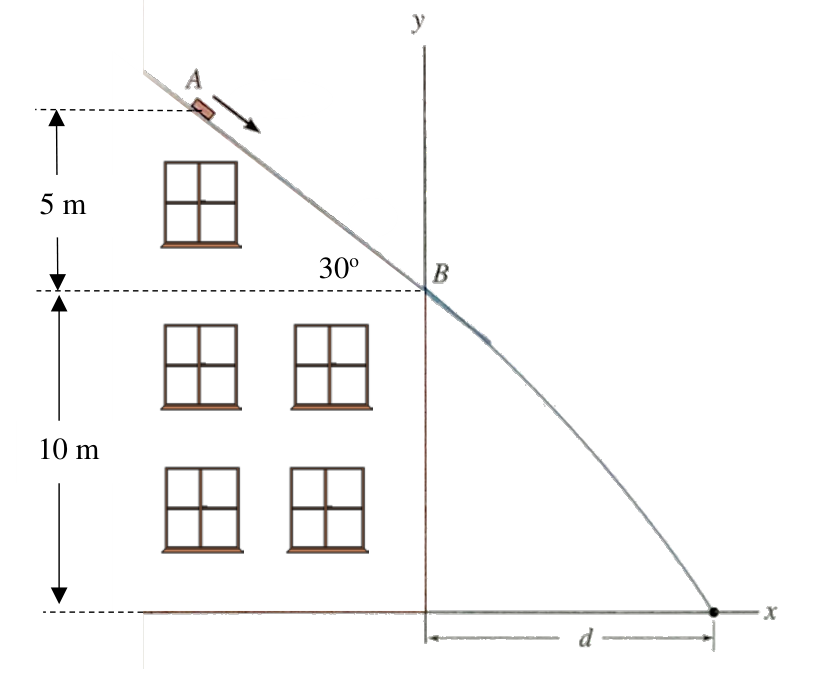
- (A)
- (B)
- (C)
- (D)
- (E)
Fonte: Testo (PDF) — p.7
Topic: Newtonian Mechanics Metodi: Kinematic Equations, Vector Decomposition Competenze: Physical Reasoning Objects: Block
Un blocco scivola un tetto liscio angolato a orizzontale. Quando raggiunge , ha una velocità di . La superficie del tetto è e colpisce il terreno a una distanza dalla parete dell’edificio. Qual è la distanza ?
- (A)
- (B)
- (C)
- (D)
- (E)
Fonte: Testo (PDF) — p.7
Topic: Newtonian Mechanics Metodi: Kinematic Equations, Vector Decomposition Competenze: Physical Reasoning Objects: Block
Two adventurous Physics students, each weighing , jump off a high bridge on a Bungee cord. The length of the cord is such that the students together will just touch the water and rebound. While Bungee cords become softer (more elastic) with increasing extension, for our calculations we can approximate the cord as having a constant stiffness of , and we can ignore the height of the students and where the cord is tied on their body. What is the unstretched length of the cord?
- (A)
- (B)
- (C)
- (D)
- (E)
Fonte: Testo (PDF) — p.7
Topic: Conservation of Energy Metodi: Conservation of Energy, Hooke’s Law Competenze: Physical Reasoning Objects: Spring
Due studenti di fisica avventurosi, ognuno di peso , saltano da un ponte alto su un cordone Bungee. La lunghezza del cavo è tale che gli studenti insieme toccano l’acqua e rimbalzano. Mentre le corde Bungee diventano più morbide (più elastiche) con l’aumento dell’estensione, per i nostri calcoli possiamo approssimare che il cavo abbia una rigidità costante di , e possiamo ignorare l’altezza degli studenti e dove il cavo è legato al loro corpo. Qual è la lunghezza del cordone?
- (A)
- (B)
- (C)
- (D)
- (E)
Fonte: Testo (PDF) — p.7
Topic: Conservation of Energy Metodi: Conservation of Energy, Hooke’s Law Competenze: Physical Reasoning Objects: Spring
A dog weighing is standing on a flatboat so that he is from the shore. The boat weighs and has uniform mass distribution. The dog walks on the boat towards the shore and stops. For this calculation, one can assume no friction or drag between the boat and the water. How far is the dog from the shore now?
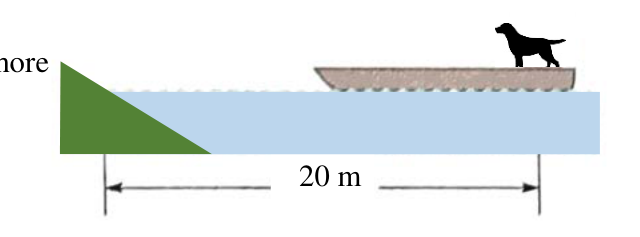
- (A)
- (B)
- (C)
- (D)
- (E)
Fonte: Testo (PDF) — p.7
Topic: Conservation of Momentum Metodi: Conservation of Momentum Competenze: Physical Reasoning Objects: —
Un cane di peso sta in piedi su una barca piatta in modo da essere dalla riva. Il pesante della barca è e ha una distribuzione di massa uniforme. The dog walks on the boat towards the shore and stops. Per questo calcolo, si può presumere che non ci sia attrito o travolgimento tra la barca e l’acqua. Quanto è lontano il cane dalla riva ora?
- (A)
- (B)
- (C)
- (D)
- (E)
Fonte: Testo (PDF) — p.7
Topic: Conservation of Momentum Metodi: Conservation of Momentum Competenze: Physical Reasoning Objects: —
The bob of a simple pendulum travels in one complete oscillation in a time of . Assuming that damping is negligible, when the same pendulum is made to travel in one complete oscillation, the time taken is ______.
- (A)
- (B) More than
- (C)
- (D) Less than
- (E)
Fonte: Testo (PDF) — p.8
Topic: Oscillations & Waves Metodi: Simple Harmonic Motion Analysis Competenze: Physical Reasoning Objects: Pendulum
Il bobino di un semplice pendolo viaggia in una oscillazione completa in un tempo di . Supponendo che l’ammortizzazione sia trascurabile, quando lo stesso pendolo viene fatto viaggiare in una oscillazione completa, il tempo impiegato è di ______.
- (A)
- **(B) ** Più di
- (C)
- **(D) ** Menore di
- (E)
Fonte: Testo (PDF) — p.8
Topic: Oscillations & Waves Metodi: Simple Harmonic Motion Analysis Competenze: Physical Reasoning Objects: Pendulum
A free electron oscillates about a fixed position in a uniform, oscillating electric field with frequency and amplitude . What is the distance travelled in one complete oscillation?
- (A)
- (B)
- (C)
- (D)
- (E)
Fonte: Testo (PDF) — p.8
Topic: Electrostatics Metodi: Kinematic Equations, Free-Body Diagram Competenze: Physical Reasoning Objects: Electron
Un elettrone libero oscilla in una posizione fissa in un campo elettrico uniforme e oscillante con frequenza e amplitudine . Qual è la distanza percorsa in una oscillazione completa?
- (A)
- (B)
- (C)
- (D)
- (E)
Fonte: Testo (PDF) — p.8
Topic: Electrostatics Metodi: Kinematic Equations, Free-Body Diagram Competenze: Physical Reasoning Objects: Electron
In a plum pudding model of the atom, suppose that there is a solid ball of uniformly distributed positive charge with total charge and radius , and that an electron “oscillates” in a tunnel through the center of the sphere. What is the time taken for an electron starting from rest somewhere in the tunnel to reach the center of the sphere? For this problem consider only electrostatic force and model the electron as a point.
- (A)
- (B)
- (C)
- (D)
- (E) Not enough information.
Fonte: Testo (PDF) — p.8
Topic: Electrostatics Metodi: Gauss’s Law, Simple Harmonic Motion Analysis Competenze: Physical Reasoning Objects: Atom, Sphere, Electron
In un modello di pudding di prugna dell’atomo, supponiamo che ci sia una sfera solida di carica positiva uniformemente distribuita con carica totale e raggio , e che un elettrone “oscilla” in un tunnel attraverso il centro della sfera. Quanto tempo ci vuole per un elettrone che parte da un riposo in qualche parte del tunnel per raggiungere il centro della sfera? Per questo problema, considera solo la forza elettrostatica e modella l’elettrone come punto.
- (A)
- (B)
- (C)
- (D)
- **(E) ** Non sufficienti informazioni.
Fonte: Testo (PDF) — p.8
Topic: Electrostatics Metodi: Gauss’s Law, Simple Harmonic Motion Analysis Competenze: Physical Reasoning Objects: Atom, Sphere, Electron
Mr. Oh describes a “simple harmonic oscillator” by the equation , where is in metres and is in seconds. Which of the following statement is best?
- (A) This simple harmonic oscillator has two very similar frequencies (ratio ).
- (B) This simple harmonic oscillator has one period and one frequency.
- (C) This simple harmonic oscillator has two very different frequencies (ratio ).
- (D) This simple harmonic oscillator has harmonics.
- (E) This cannot even be a simple harmonic oscillator.
Fonte: Testo (PDF) — p.8
Topic: Oscillations & Waves Metodi: Superposition Principle, Wave Equation Competenze: Physical Reasoning Objects: —
Mr. Oh descrive un “semplico oscillatore armonico” con l’equazione , dove è in metri e è in secondi. Quale delle seguenti affermazioni è meglio?
- **(A) ** Questo semplice oscillatore armonico ha due frequenze molto simili (ratio ).
- **(B) ** Questo semplice oscillatore armonico ha un periodo e una frequenza.
- **(C) ** Questo semplice oscillatore armonico ha due frequenze molto diverse (ratio ).
- **(D) ** Questo semplice oscillatore armonico ha armonici.
- **(E) ** Non può essere nemmeno un semplice oscillatore armonico.
Fonte: Testo (PDF) — p.8
Topic: Oscillations & Waves Metodi: Superposition Principle, Wave Equation Competenze: Physical Reasoning Objects: —
Mr. Oh describes another “simple harmonic oscillator” by the equation , where is in metres and is in seconds. What is the frequency of the “simple harmonic oscillator”?
- (A) This cannot even be a simple harmonic oscillator.
- (B)
- (C)
- (D)
- (E)
Fonte: Testo (PDF) — p.8
Topic: Oscillations & Waves Metodi: Superposition Principle, Wave Equation Competenze: Physical Reasoning Objects: —
Mr. Oh descrive un altro “semplico oscillatore armonico” con l’equazione , dove è in metri e è in secondi. Qual è la frequenza dell‘“ossilatore armonico semplice”?
- **(A) ** Non può essere nemmeno un semplice oscillatore armonico.
- (B)
- (C)
- (D)
- (E)
Fonte: Testo (PDF) — p.8
Topic: Oscillations & Waves Metodi: Superposition Principle, Wave Equation Competenze: Physical Reasoning Objects: —
Madam Wan describes a “wave” by the following equation , where and are in metres and is in seconds. What is the wavelength of the wave?
- (A)
- (B)
- (C)
- (D)
- (E)
Fonte: Testo (PDF) — p.9
Topic: Oscillations & Waves Metodi: Wave Equation Competenze: Physical Reasoning Objects: —
La signora Wan descrive un “ondata” con la seguente equazione , dove e sono in metri e è in secondi. Qual è la lunghezza d’onda dell’onda?
- (A)
- (B)
- (C)
- (D)
- (E)
Fonte: Testo (PDF) — p.9
Topic: Oscillations & Waves Metodi: Wave Equation Competenze: Physical Reasoning Objects: —
Ms. Toh describes a “wave” with the following equation , where is in metres and is in seconds. What is the direction of the wave’s phase velocity?
- (A) positive -direction
- (B) negative -direction
- (C) positive -direction
- (D) negative -direction
- (E) positive -direction
Fonte: Testo (PDF) — p.9
Topic: Oscillations & Waves Metodi: Wave Equation Competenze: Physical Reasoning Objects: —
Ms. Toh descrive un “onda” con la seguente equazione , dove è in metri e è in secondi. Qual è la direzione della velocità di fase dell’onda?
- **(A) ** direzione positiva
- **(B) ** negativo -direzione
- **(C) ** direzione positiva
- **(D) ** negativo -direzione
- **(E) ** direzione positiva
Fonte: Testo (PDF) — p.9
Topic: Oscillations & Waves Metodi: Wave Equation Competenze: Physical Reasoning Objects: —
Dr. Dre describes a “wave” by the following equation, where and are in metres and is in seconds: . Which of the following statement is best?
- (A) This wave has two very similar frequencies (ratio ).
- (B) This wave has two very different frequencies (ratio ).
- (C) This wave has one overall period and one frequency.
- (D) This is two waves with two different speeds.
- (E) This is not even a wave.
Fonte: Testo (PDF) — p.9
Topic: Oscillations & Waves Metodi: Wave Equation, Superposition Principle Competenze: Physical Reasoning Objects: —
Dr. Dre descrive un “ondata” con la seguente equazione, dove e sono in metri e è in secondi: . Quale delle seguenti affermazioni è meglio?
- **(A) ** Questa onda ha due frequenze molto simili (ratio ).
- **(B) ** Questa onda ha due frequenze molto diverse (ratio ).
- **(C) ** Questa onda ha un periodo complessivo e una frequenza.
- **(D) ** Si tratta di due onde con due velocità diverse.
- Non è nemmeno un’onda.
Fonte: Testo (PDF) — p.9
Topic: Oscillations & Waves Metodi: Wave Equation, Superposition Principle Competenze: Physical Reasoning Objects: —
Monsieur Fourier describes a “wave” by the following equation , where and are in metres and is in seconds. Which of the following is true?
- (A) The wave speed is .
- (B) The wave speed is .
- (C) The wave speed is .
- (D) The wave speed is .
- (E) None of the above.
Fonte: Testo (PDF) — p.9
Topic: Oscillations & Waves Metodi: Wave Equation Competenze: Physical Reasoning Objects: —
Monsieur Fourier descrive un “onda” con la seguente equazione , dove e sono in metri e in secondi. Quale di queste parole è vero?
- **(A) ** La velocità delle onde è .
- **(B) ** La velocità delle onde è .
- **(C) ** La velocità delle onde è .
- **(D) ** La velocità delle onde è .
- **(E) ** Nessuna delle seguenti.
Fonte: Testo (PDF) — p.9
Topic: Oscillations & Waves Metodi: Wave Equation Competenze: Physical Reasoning Objects: —
An ocean wave strikes a sea wall head on (i.e. the surface of the wall is parallel to the plane wavefronts). The incoming wave travels and has a period of . The wave has an antinode at the wall. How far from the wall is the nearest node in the standing wave set up?
- (A)
- (B)
- (C)
- (D)
- (E)
Fonte: Testo (PDF) — p.9
Topic: Oscillations & Waves Metodi: Wave Equation, Superposition Principle Competenze: Physical Reasoning Objects: —
Un’onda oceanica colpisce una parete del mare (cioè la superficie del muro è parallela ai fronti d’onda a piatto). L’onda in entrata viaggia e ha un periodo di . L’onda ha un antinodo al muro. Quanto lontano dal muro si trova il nodo più vicino nell’onda in piedi?
- (A)
- (B)
- (C)
- (D)
- (E)
Fonte: Testo (PDF) — p.9
Topic: Oscillations & Waves Metodi: Wave Equation, Superposition Principle Competenze: Physical Reasoning Objects: —
An electron is emitted at an angle of degrees from the surface of a metal plate as shown in the figure (other details also shown in the diagram). The electron’s initial kinetic energy is . A uniform electric field is applied such that the potential difference between the two plates is . Assume the plates are infinitely wide. The electron _____________.
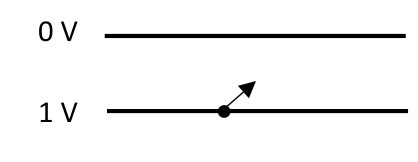
- (A) moves in a parabolic trajectory and returns to the plate where it started
- (B) moves in a parabolic trajectory and hits the second plate
- (C) moves in a circular trajectory and hits the second plate
- (D) moves in a circular trajectory and returns to the plate where it started
- (E) may or may not hit the other plate depending on the distance between the plates
Fonte: Testo (PDF) — p.10
Topic: Electrostatics Metodi: Free-Body Diagram, Kinematic Equations Competenze: Physical Reasoning Objects: Electron
Un elettrone viene emesso ad un angolo di gradi dalla superficie di una piastra metallica come mostrato nella figura (altri dettagli sono mostrati anche nel diagramma). L’energia cinetica iniziale dell’elettrone è . Si applica un campo elettrico uniforme in modo tale che la differenza potenziale tra le due lastre sia . Supponiamo che le piastre siano infinitamente larghe. L’elettrone _____________.
- **(A) ** si muove in una traiettoria parabolica e ritorna alla piastra da cui ha iniziato
- **(B) ** si muove in una traiettoria parabolica e colpisce la seconda piastra
- **(C) ** si muove in una traiettoria circolare e colpisce la seconda piastra
- **(D) ** si muove in una traiettoria circolare e ritorna alla piastra da cui è partita
- **(E) ** può o non può colpire l’altra piastra a seconda della distanza tra le piastre
Fonte: Testo (PDF) — p.10
Topic: Electrostatics Metodi: Free-Body Diagram, Kinematic Equations Competenze: Physical Reasoning Objects: Electron
A proton on the surface of the earth travels upwards in a downwards uniform electric field . Calculate the net force acting on the proton.
- (A) upwards
- (B) downwards
- (C) downwards
- (D) upwards
- (E) downwards
Fonte: Testo (PDF) — p.10
Topic: Electrostatics Metodi: Free-Body Diagram Competenze: Physical Reasoning Objects: —
Un protone sulla superficie terrestre viaggia verso l’alto in un campo elettrico uniforme verso il basso . Calcola la forza di rete che agisce sul protone.
- **(A) ** in alto
- **(B) ** verso il basso
- **(C) ** verso il basso
- **(D) ** in su
- **(E) ** verso il basso
Fonte: Testo (PDF) — p.10
Topic: Electrostatics Metodi: Free-Body Diagram Competenze: Physical Reasoning Objects: —
The diagram shows two small charged spheres and of small mass, which are hung by identical fine nylon threads from a fixed point . It is found that, in equilibrium, the angle is greater than the angle . Which one of the following statements is best?
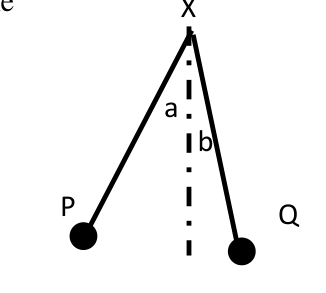
- (A) The charge on is numerically smaller than that on .
- (B) The charge on is numerically greater than that on .
- (C) The mass of is less than that of .
- (D) The mass of is greater than that of .
- (E) The charges on and are both positive.
Fonte: Testo (PDF) — p.10
Topic: Electrostatics Metodi: Coulomb’s Law, Free-Body Diagram Competenze: Physical Reasoning Objects: Sphere, String
Il diagramma mostra due piccole sfere cariche e di piccola massa, che sono appese da identici fili di nylon fino da un punto fisso . Si constata che, in equilibrio, l’angolo è maggiore dell’angolo . Quale delle seguenti affermazioni è meglio?
- **(A) ** La carica su è numericamente inferiore a quella su .
- **(B) ** La carica su è numericamente superiore a quella su .
- **(C) ** La massa di è inferiore a quella di .
- **(D) ** La massa di è maggiore di quella di .
- **(E) ** Le spese per e sono entrambe positive.
Fonte: Testo (PDF) — p.10
Topic: Electrostatics Metodi: Coulomb’s Law, Free-Body Diagram Competenze: Physical Reasoning Objects: Sphere, String
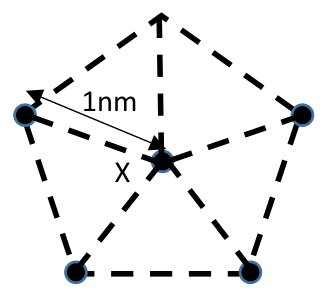
Consider five protons as shown in the diagram. One proton is at the center, , of the regular pentagon while the remaining four are at the vertices. What is the force acting on the proton at due to the other four protons?
- (A) upwards
- (B) downwards
- (C) upwards
- (D) downwards
- (E) upwards
Fonte: Testo (PDF) — p.10
Topic: Electrostatics Metodi: Coulomb’s Law, Superposition Principle Competenze: Physical Reasoning Objects: —
Considerate cinque protoni come mostrato nel diagramma. Un protone è al centro, , del pentagono regolare mentre i quattro rimanenti sono ai vertici. Qual è la forza che agisce sul protone a a causa degli altri quattro protoni?
- **(A) ** in alto
- **(B) ** verso il basso
- **(C) ** in alto
- **(D) ** verso il basso
- **(E) ** in alto
Fonte: Testo (PDF) — p.10
Topic: Electrostatics Metodi: Coulomb’s Law, Superposition Principle Competenze: Physical Reasoning Objects: —
Five protons are fixed at the vertices of a regular pentagon. A sixth proton, , moves from very far away to the center of the pentagon. The electrical potential energy associated with proton when it is at the center of the pentagon ____________________.
- (A) has not changed from what it was initially as the initial and final force acting on the proton is
- (B) cannot be calculated as it depends on the exact 3-D path which the proton takes
- (C) cannot be calculated as it depends on the initial and final speed of the proton
- (D) may be calculated as times the energy stored in a system of two point charges
- (E) may be calculated as times the energy stored in a system of one point charge
Fonte: Testo (PDF) — p.10
Topic: Electrostatics Metodi: Electric Potential Method, Superposition Principle Competenze: Physical Reasoning Objects: —
Cinque protoni sono fissati alle vertici di un pentagono regolare. Un sesto protone, , si muove da molto lontano al centro del pentagono. L’energia potenziale elettrica associata al protone quando è al centro del pentagono ____________________.
- **(A) ** non è cambiato da quanto era inizialmente, poiché la forza iniziale e finale che agisce sul protone è
- **(B) ** non può essere calcolato in quanto dipende dall’esatto percorso 3D che il protone prende
- **(C) ** non può essere calcolato in quanto dipende dalla velocità iniziale e finale del protone
- **(D) ** può essere calcolato come volte l’energia immagazzinata in un sistema di cariche a due punti
- **(E) ** può essere calcolato come volte l’energia immagazzinata in un sistema di carica a un punto
Fonte: Testo (PDF) — p.10
Topic: Electrostatics Metodi: Electric Potential Method, Superposition Principle Competenze: Physical Reasoning Objects: —
Two protons initially very far from each other move towards each other, each with an initial speed . Consider only the electrostatic forces between the particles. How close together can they get?
- (A)
- (B)
- (C)
- (D)
- (E)
Fonte: Testo (PDF) — p.11
Topic: Electrostatics Metodi: Energy Conservation Method, Electric Potential Method Competenze: Physical Reasoning Objects: —
Due protoni inizialmente molto lontani l’uno dall’altro si muovono l’uno verso l’altro, ognuno con una velocità iniziale . Considera solo le forze elettrostatiche tra le particelle. Quanto si possono avvicinare?
- (A)
- (B)
- (C)
- (D)
- (E)
Fonte: Testo (PDF) — p.11
Topic: Electrostatics Metodi: Energy Conservation Method, Electric Potential Method Competenze: Physical Reasoning Objects: —
A proton initially very far away, moves with initial speed towards an initially stationary proton. Consider only the electrostatic forces between the particles. How close together can they get?
- (A)
- (B)
- (C)
- (D)
- (E)
Fonte: Testo (PDF) — p.11
Topic: Electrostatics Metodi: Energy Conservation Method, Conservation of Momentum Competenze: Physical Reasoning Objects: —
Un protone inizialmente molto lontano, si muove con velocità iniziale verso un protone inizialmente stazionario. Considera solo le forze elettrostatiche tra le particelle. Quanto si possono avvicinare?
- (A)
- (B)
- (C)
- (D)
- (E)
Fonte: Testo (PDF) — p.11
Topic: Electrostatics Metodi: Energy Conservation Method, Conservation of Momentum Competenze: Physical Reasoning Objects: —
An electron initially very far away moves with initial speed towards an initially stationary proton. Based on its initial trajectory, the electron should have missed the proton by if there was no force between them. Now consider only the electrostatic force between the particles. How close together can they get?
- (A)
- (B)
- (C)
- (D)
- (E)
Fonte: Testo (PDF) — p.11
Topic: Electrostatics Metodi: Energy Conservation Method, Electric Potential Method Competenze: Physical Reasoning Objects: Electron
Un elettrone inizialmente molto lontano si muove con velocità iniziale verso un protone inizialmente stazionario. Sulla base della sua traiettoria iniziale, l’elettrone avrebbe dovuto perdere il protone di se non vi fosse forza tra di loro. Ora consideriamo solo la forza elettrostatica tra le particelle. Quanto si possono avvicinare?
- (A)
- (B)
- (C)
- (D)
- (E)
Fonte: Testo (PDF) — p.11
Topic: Electrostatics Metodi: Energy Conservation Method, Electric Potential Method Competenze: Physical Reasoning Objects: Electron
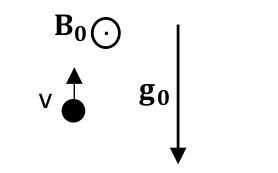
An electron initially moving straight up, moves in an almost circular path in a uniform magnetic field , the direction of the magnetic field is out of the paper. There is also a uniform downwards gravitational field . The next time when the electron is moving straight up again, it will be displaced slightly _____. (Hint: think carefully about the speed of the electron at various parts of its orbit and how that changes its orbit.)
- (A) right
- (B) left
- (C) up
- (D) down
- (E) out of the paper
Fonte: Testo (PDF) — p.12
Topic: Magnetism Metodi: Lorentz Force Analysis Competenze: Physical Reasoning Objects: Electron
Un elettrone inizialmente in movimento dritto verso l’alto, si muove in un percorso quasi circolare in un campo magnetico uniforme , la direzione del campo magnetico è fuori dalla carta. C’è anche un campo gravitazionale uniforme verso il basso . La prossima volta che l’elettrone si muove dritto verso l’alto, sarà spostato leggermente. (Signorato: pensa attentamente alla velocità dell’elettrone nelle varie parti della sua orbita e a come questo cambia la sua orbita.)
- **(A) ** destra
- **(B) ** sinistra
- (C) up
- **(D) ** in basso
- **(E) ** fuori carta
Fonte: Testo (PDF) — p.12
Topic: Magnetism Metodi: Lorentz Force Analysis Competenze: Physical Reasoning Objects: Electron
An electron is emitted from the surface of a metal plate at an angle of degrees from the surface. The electron’s initial kinetic energy is . A uniform magnetic field is applied in the direction as shown in the figure. How far is the electron when it is furthest from the plate from which it was emitted? Assume no other forces other than that due to the magnetic field.

- (A)
- (B)
- (C)
- (D)
- (E) No limit. It just keeps going.
Fonte: Testo (PDF) — p.12
Topic: Magnetism Metodi: Lorentz Force Analysis Competenze: Physical Reasoning Objects: Electron
Un elettrone viene emesso dalla superficie di una piastra metallica ad un angolo di gradi dalla superficie. L’energia cinetica iniziale dell’elettrone è . Si applica un campo magnetico uniforme nella direzione indicata nella figura. Quanto è lontano l’elettrone quando è più lontano dalla piastra da cui è stato emesso? Non assumere altre forze che non siano quelle dovute al campo magnetico.
- (A)
- (B)
- (C)
- (D)
- **(E) ** Nessun limite. Continua a fare così.
Fonte: Testo (PDF) — p.12
Topic: Magnetism Metodi: Lorentz Force Analysis Competenze: Physical Reasoning Objects: Electron
Two identical Light Emitting Diodes (LED) are connected in series with a resistor, , and a ideal battery. The potential difference across the LED and the current through the LED may be modelled by the equation where and . Using the model, calculate the value of the resistance if the current has to be kept at .
- (A)
- (B)
- (C)
- (D)
- (E)
Fonte: Testo (PDF) — p.12
Topic: Circuits Metodi: Kirchhoff’s Laws Competenze: Physical Reasoning Objects: Resistor, Battery
Due diodi di emissione di luce (LED) identici sono collegati in serie con una resistenza e una batteria ideale . La differenza potenziale tra il LED e la corrente attraverso il LED può essere modellata con l’equazione dove e . Con il modello calcolare il valore della resistenza se la corrente deve essere mantenuta a .
- (A)
- (B)
- (C)
- (D)
- (E)
Fonte: Testo (PDF) — p.12
Topic: Circuits Metodi: Kirchhoff’s Laws Competenze: Physical Reasoning Objects: Resistor, Battery
Two identical LED light bulbs are rated as , . That is, the electronics within the bulb provides a fixed of electrical power to the light emitting diodes in the bulb as long as the AC power supply can provide an RMS voltage anything between to . Assume the electronic circuit is efficient. What is the current when the two bulbs are connected in series to ?
- (A)
- (B)
- (C)
- (D)
- (E)
Fonte: Testo (PDF) — p.12
Topic: Circuits Metodi: Kirchhoff’s Laws Competenze: Physical Reasoning Objects: —
Due lampadine a LED identiche sono valutate come , . Cioè, l’elettronica all’interno della lampadina fornisce una fissa di potenza elettrica ai diodi emettitori di luce nella lampadina purché l’alimentazione a corrente alternata possa fornire una tensione RMS compresa tra e . Supponiamo che il circuito elettronico sia efficiente. Qual è la corrente quando le due lampadine sono collegate in serie a ?
- (A)
- (B)
- (C)
- (D)
- (E)
Fonte: Testo (PDF) — p.12
Topic: Circuits Metodi: Kirchhoff’s Laws Competenze: Physical Reasoning Objects: —
A battery of emf has an internal resistance of . When a wire with circular cross-section of in diameter and long is connected across the terminals of this battery, the current is . What is the resistivity of the material from which the wire is made?
- (A)
- (B)
- (C)
- (D)
- (E)
Fonte: Testo (PDF) — p.13
Topic: Circuits Metodi: Equivalent Circuit Reduction, Kirchhoff’s Laws Competenze: Physical Reasoning Objects: Battery, Wire
Una batteria di emf ha una resistenza interna di . Quando un filo con sezione incrociata circolare di di diametro e di lunghezza è collegato attraverso i terminali di questa batteria, la corrente è . Qual è la resistenza del materiale di cui è fatto il filo?
- (A)
- (B)
- (C)
- (D)
- (E)
Fonte: Testo (PDF) — p.13
Topic: Circuits Metodi: Equivalent Circuit Reduction, Kirchhoff’s Laws Competenze: Physical Reasoning Objects: Battery, Wire
When a capacitor is connected directly to an ideal AC voltage source with an amplitude of , the AC current has an amplitude . When an inductor is connected directly to the same source, the AC current has the same amplitude of . When a resistor is connected directly to the same source, the AC current has the same amplitude. When all three components are connected in series with the ideal AC voltage source with an amplitude of , the AC current’s amplitude is _____. Assume that the AC frequency is constant.
- (A)
- (B)
- (C)
- (D)
- (E)
Fonte: Testo (PDF) — p.13
Topic: Circuits Metodi: Equivalent Circuit Reduction Competenze: Physical Reasoning Objects: Capacitor, Inductor, Resistor
Quando un condensatore è collegato direttamente a una fonte di tensione AC ideale con un’ampiezza di , la corrente AC ha un’ampiezza . Quando un induttore è collegato direttamente alla stessa fonte, la corrente AC ha la stessa amplitudine di . Quando una resistenza è collegata direttamente alla stessa fonte, la corrente AC ha la stessa amplitudine. Quando tutti e tre i componenti sono collegati in serie con la fonte di tensione AC ideale con un’ampiezza di , l’ampiezza della corrente AC è _____. Supponiamo che la frequenza AC sia costante.
- (A)
- (B)
- (C)
- (D)
- (E)
Fonte: Testo (PDF) — p.13
Topic: Circuits Metodi: Equivalent Circuit Reduction Competenze: Physical Reasoning Objects: Capacitor, Inductor, Resistor
In hydrodynamics, mass flow rate is the rate of flow of mass and can be positive or negative but has no direction. In electricity, the rate of flow of charge is electric current. In a circuit, a battery is connected to a resistor so that there is an electric current. The electric current is __________________ flowing through the positive terminal of the battery and ___________ through the other terminal and _________________ through the whole surface of the battery including both terminals.
- (A) , ,
- (B) , ,
- (C) , ,
- (D) , ,
- (E) , , it doesn’t make sense to talk about the current
Fonte: Testo (PDF) — p.13
Topic: Circuits Metodi: Kirchhoff’s Laws Competenze: Physical Reasoning Objects: Battery, Resistor
In idrodinamica, la velocità di flusso di massa è la velocità di flusso di massa e può essere positiva o negativa ma non ha direzione. Nell’elettricità, il tasso di flusso di carica è corrente elettrica. In un circuito, una batteria è collegata a una resistenza in modo che vi sia una corrente elettrica. La corrente elettrica è __________________ che scorre attraverso il terminale positivo della batteria e ___________ attraverso l’altro terminale e _________________ attraverso tutta la superficie della batteria compresi entrambi i terminali.
- (A) , ,
- (B) , ,
- (C) , ,
- (D) , ,
- **(E) ** , , non ha senso parlare della corrente
Fonte: Testo (PDF) — p.13
Topic: Circuits Metodi: Kirchhoff’s Laws Competenze: Physical Reasoning Objects: Battery, Resistor
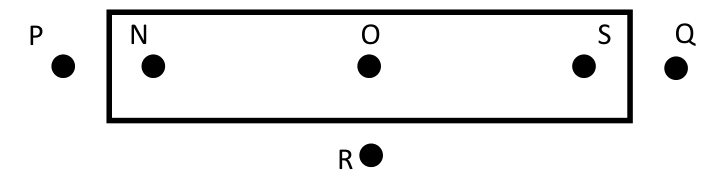
In the diagram, the magnitude of the magnetic field at various points around and within a bar magnet are labelled . The north pole is on the left and the south pole is on the right. All points are on the same plane which divides the magnet into two equal halves (one half above and the other half below the paper so that points , , and are inside the magnet). The perpendicular distance between each point and the nearest surface of the magnet is the same. Which ranking is correct?
- (A)
- (B)
- (C)
- (D)
- (E)
Fonte: Testo (PDF) — p.13
Topic: Magnetism Metodi: Symmetry Argument Competenze: Physical Reasoning Objects: Magnet
Nel diagramma, la magnitudine del campo magnetico in vari punti intorno e all’interno di un magnete a barre è etichettata . Il polo nord è a sinistra e il polo sud è a destra. Tutti i punti sono sullo stesso piano che divide il magnete in due metà uguali (una metà sopra e l’altra metà sotto la carta in modo che i punti , e siano all’interno del magnete). La distanza perpendicolare tra ogni punto e la superficie più vicina del magnete è la stessa. Quale classificazione è corretta?
- (A)
- (B)
- (C)
- (D)
- (E)
Fonte: Testo (PDF) — p.13
Topic: Magnetism Metodi: Symmetry Argument Competenze: Physical Reasoning Objects: Magnet
A thermoelectric heater operates by the Peltier effect. A model of a thermoelectric heater device makes use of a combination of only the three following components: (1) an ideal heat pump, which pumps heat from the cold side to the hot side using electricity as the “work”; (2) a resistance in series with the heat pump; (3) a heat conductor in parallel to the heat pump which allows heat to flow from the cold side to the hot side. For a device operated at , area , thickness , thermal conductivity and electrical resistance . If the hot side has to be at , this model predicts that the maximum positive temperature difference, which can be achieved (i.e. ) is around _________. (Hint: The maximum power supplied to the heat pump is limited by and . Coefficient of performance for heating is .)
- (A)
- (B)
- (C)
- (D)
- (E)
Fonte: Testo (PDF) — p.14
Topic: Thermodynamics Metodi: Thermodynamic Cycle Analysis, Physical Modeling Competenze: Physical Reasoning Objects: Heat Engine, Resistor
Un riscaldatore termoelettrico opera con l’effetto Peltier. Un modello di apparecchio termoelettrico utilizza una combinazione di tre componenti: (1) una pompa di calore ideale, che pompa il calore dal lato freddo al lato caldo utilizzando l’elettricità come “lavoro”; (2) una resistenza in serie con la pompa di calore; (3) un conduttore di calore parallelo alla pompa di calore che consente il flusso di calore dal lato freddo al lato caldo. Per un dispositivo a , superficie , spessore , conducibilità termica e resistenza elettrica . Se il lato caldo deve essere , questo modello prevede che la differenza massima di temperatura positiva, che può essere raggiunta (cioè ) è intorno a _________. (Signore: la potenza massima fornita alla pompa di calore è limitata da e . Il coefficiente di prestazioni per il riscaldamento è .)
- (A)
- (B)
- (C)
- (D)
- (E)
Fonte: Testo (PDF) — p.14
Topic: Thermodynamics Metodi: Thermodynamic Cycle Analysis, Physical Modeling Competenze: Physical Reasoning Objects: Heat Engine, Resistor
The first law of thermodynamics states that the change in internal energy is the heat _________________.
- (A) added to the system minus the work done by the system.
- (B) added to the system plus the work done by the system.
- (C) added to the system minus the work done on the system.
- (D) released by the system plus the work done on the system.
- (E) heat released by the system minus the work done by the system.
Fonte: Testo (PDF) — p.14
Topic: Thermodynamics Metodi: First Law of Thermodynamics Competenze: Physical Reasoning Objects: —
La prima legge della termodinamica afferma che il cambiamento di energia interna è il calore _________________.
- **(A) ** aggiunto al sistema meno il lavoro svolto dal sistema.
- **(B) ** aggiunto al sistema più il lavoro svolto dal sistema.
- **(C) ** aggiunto al sistema meno il lavoro svolto sul sistema.
- **(D) ** rilasciato dal sistema più il lavoro svolto sul sistema.
- **(E) ** calore rilasciato dal sistema meno il lavoro svolto dal sistema.
Fonte: Testo (PDF) — p.14
Topic: Thermodynamics Metodi: First Law of Thermodynamics Competenze: Physical Reasoning Objects: —
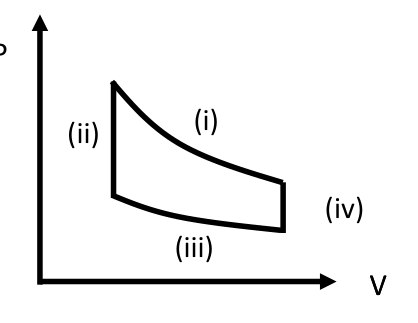
A refrigerator uses a fixed quantity of an ideal gas and undergoes a cycle, as shown in the diagram below. The parts of the cycle are labelled as: (i) isothermal (same temperature) process, (ii) isochoric (same volume) process, (iii) isothermal process, and (iv) isochoric process. Which part(s) of the cycle has/have heat flowing out of the gas?
- (A) (i) only.
- (B) (ii) only.
- (C) (i) and (iii).
- (D) (iii) and (iv).
- (E) (i) and (ii).
Fonte: Testo (PDF) — p.14
Topic: Thermodynamics Metodi: Thermodynamic Cycle Analysis, First Law of Thermodynamics Competenze: Physical Reasoning Objects: Gas, Heat Engine
Un frigorifero utilizza una quantità fissa di gas ideale e subisce un ciclo, come mostrato nel diagramma di seguito. Le parti del ciclo sono etichettate come: (i) processo isotermale (sema temperatura), (ii) processo isochorico (sema volume), (iii) processo isotermale e (iv) processo isochorico. Quale parte del ciclo ha/ha calore che scorre dal gas?
- solo **(A) ** (i).
- solo **(B) ** (ii).
- **(C) ** (i) e (iii).
- **(D) ** (iii) e (iv).
- **(E) ** (i) e (ii).
Fonte: Testo (PDF) — p.14
Topic: Thermodynamics Metodi: Thermodynamic Cycle Analysis, First Law of Thermodynamics Competenze: Physical Reasoning Objects: Gas, Heat Engine
Suppose that you own an unmarked gold bar. When you measured its mass, the scale that you used gives a reading of . The uncertainty of the scale is given as . However, the very next day, you found that there are 3 unmarked gold bars in the place where you had left your own gold bar. When you measured their mass using the same scale, you found that:
- gold bar
- gold bar
- gold bar
Which of these gold bars could possibly be your original unmarked gold bar?
- (A) None of them
- (B) Gold bar only
- (C) Either gold bar or gold bar only
- (D) Either gold bar or gold bar only
- (E) Any of them
Fonte: Testo (PDF) — p.14
Topic: Order-of-Magnitude Estimation Metodi: Error Propagation, Experimental Data Analysis Competenze: Physical Reasoning Objects: —
Supponiamo di possedere una barra d’oro senza segni. Quando si misura la sua massa, la scala che si utilizza dà una lettura di . L’incertezza della scala è data come . Tuttavia, il giorno dopo, hai scoperto che ci sono 3 barrette d’oro non contrassegnate nel posto dove avevi lasciato la tua barretta d’oro. Quando hai misurato la loro massa usando la stessa scala, hai scoperto che:
- barretta d’oro
- barretta d’oro
- barretta d’oro
Quale di queste barre d’oro potrebbe essere la tua barra d’oro originale senza segni?
- **(A) ** Nessuno di essi
- **(B) ** Solo barra d’oro
- **(C) ** O solo bar di oro o bar di oro
- **(D) ** O solo bar di oro o bar di oro
- **(E) ** Qualsiasi di esse
Fonte: Testo (PDF) — p.14
Topic: Order-of-Magnitude Estimation Metodi: Error Propagation, Experimental Data Analysis Competenze: Physical Reasoning Objects: —