Which of the following is the SI unit for the weight of an object?
- (A)
- (B)
- (C)
- (D)
- (E)
Fonte: Testo (PDF) — p.3 Topic: Newtonian Mechanics Metodi: Dimensional Analysis Competenze: Physical Reasoning Objects: —
Qual è l’unità SI per il peso di un oggetto?
- (A)
- (B)
- (C)
- (D)
- (E)
Fonte: Testo (PDF) — p.3 Topic: Newtonian Mechanics Metodi: Dimensional Analysis Competenze: Physical Reasoning Objects: —
A particle starts from point O and travels due east at a constant speed of for 70 m to reach point A. It then immediately travels due north from A at constant speed of for 8 s to reach point B. At B, it immediately turns and travels due west at uniform speed of for 40 m to reach point C.
What is the magnitude of the displacement of the particle at C with respect to O?
- (A) 30 m
- (B) 40 m
- (C) 50 m
- (D) 70 m
- (E) 150 m
Fonte: Testo (PDF) — p.3 Topic: Newtonian Mechanics Metodi: Vector Decomposition Competenze: Physical Reasoning Objects: —
Una particella parte dal punto O e si sposta verso est a velocità costante di per 70 m fino a raggiungere il punto A. Il veicolo si sposta immediatamente a nord da A a velocità costante di per 8 secondi per raggiungere il punto B. A B, si gira immediatamente e si muove verso ovest a velocità uniforme di per 40 m fino a raggiungere il punto C.
Qual è la magnitudine del spostamento della particella a C rispetto a O?
- (A) 30 m
- (B) 40 m
- (C) 50 m
- (D) 70 m
- (E) 150 m
Fonte: Testo (PDF) — p.3 Topic: Newtonian Mechanics Metodi: Vector Decomposition Competenze: Physical Reasoning Objects: —
What is the magnitude of the average velocity of the particle during its journey from O to C?
- (A)
- (B)
- (C)
- (D)
- (E)
Fonte: Testo (PDF) — p.3 Topic: Newtonian Mechanics Metodi: Kinematic Equations Competenze: Physical Reasoning Objects: —
Qual è la magnitudine della velocità media ** della particella durante il suo viaggio da O a C?
- (A)
- (B)
- (C)
- (D)
- (E)
Fonte: Testo (PDF) — p.3 Topic: Newtonian Mechanics Metodi: Kinematic Equations Competenze: Physical Reasoning Objects: —
A particle is projected vertically upwards from the base of a tall building with a speed of . At the same time, another particle is dropped from the top of the building. The two particles meet after sec and are found to have the same speed when they meet.
What is the value of ?
- (A) 2.13 s
- (B) 2.55 s
- (C) 3.40 s
- (D) 4.25 s
- (E) 5.10 s
Fonte: Testo (PDF) — p.3 Topic: Newtonian Mechanics Metodi: Kinematic Equations Competenze: Physical Reasoning Objects: Projectile
Una particella è proiettata verticalmente verso l’alto dalla base di un edificio alto con una velocità . Allo stesso tempo, un’altra particella viene scaricata dalla cima dell’edificio. Le due particelle si incontrano dopo sec e si scopre che hanno la stessa velocità quando si incontrano.
Qual è il valore di ?
- (A) 2.13 s
- (B) 2.55 s
- (C) 3.40 s
- (D) 4.25 s
- (E) 5.10 s
Fonte: Testo (PDF) — p.3 Topic: Newtonian Mechanics Metodi: Kinematic Equations Competenze: Physical Reasoning Objects: Projectile
What is the value of the building?
- (A) 128 m
- (B) 155 m
- (C) 170 m
- (D) 213 m
- (E) 255 m
Fonte: Testo (PDF) — p.3 Topic: Newtonian Mechanics Metodi: Kinematic Equations Competenze: Physical Reasoning Objects: Projectile
Qual è il valore dell’edificio?
- (A) 128 m
- (B) 155 m
- (C) 170 m
- (D) 213 m
- (E) 255 m
Fonte: Testo (PDF) — p.3 Topic: Newtonian Mechanics Metodi: Kinematic Equations Competenze: Physical Reasoning Objects: Projectile
A tractor of mass 2000 kg is pulling a trailer of mass 3000 kg up an incline of 1 in 10 along a line of greatest slope. I.e. if the angle of the incline is then . The frictional resistance to the motion is 4000 N and one-quarter of it acts on the tractor. At first both vehicles move with an acceleration of but eventually they move with a constant velocity of .
What is the driving force exerted by the engine of the tractor when both vehicles are accelerating?
- (A) 3940 N
- (B) 11500 N
- (C) 12400 N
- (D) 14400 N
- (E) 16400 N
Fonte: Testo (PDF) — p.3 Topic: Newtonian Mechanics Metodi: Free-Body Diagram, Vector Decomposition Competenze: Physical Reasoning Objects: Inclined Plane
Un trattore di massa 2000 kg sta trascinando un rimorchio di massa 3000 kg su un’inclinazione di 1 su 10 lungo una linea di pendice più alta. I.e. se l’angolo di inclinazione è , allora . La resistenza alla frizione al movimento è di 4000 N e un quarto di essa agisce sul trattore. All’inizio entrambi i veicoli si muovono con un’accelerazione di , ma alla fine si muovono con una velocità costante di .
Qual è la forza motrice esercitata dal motore del trattore quando entrambi i veicoli sono in accelerazione?
- (A) 3940 N
- (B) 11500 N
- (C) 12400 N
- (D) 14400 N
- (E) 16400 N
Fonte: Testo (PDF) — p.3 Topic: Newtonian Mechanics Metodi: Free-Body Diagram, Vector Decomposition Competenze: Physical Reasoning Objects: Inclined Plane
What is the force exerted by the tow-bar on the tractor when both vehicles are moving with a constant velocity of ?
- (A) 1940 N
- (B) 3940 N
- (C) 5940 N
- (D) 8900 N
- (E) 10400 N
Fonte: Testo (PDF) — p.3 Topic: Newtonian Mechanics Metodi: Free-Body Diagram Competenze: Physical Reasoning Objects: Inclined Plane
Qual è la forza esercitata dalla barra di trazione sul trattore quando entrambi i veicoli si muovono a una velocità costante di ?
- (A) 1940 N
- (B) 3940 N
- (C) 5940 N
- (D) 8900 N
- (E) 10400 N
Fonte: Testo (PDF) — p.3 Topic: Newtonian Mechanics Metodi: Free-Body Diagram Competenze: Physical Reasoning Objects: Inclined Plane
A ball of mass is projected vertically downwards with speed from a certain height and rebounds from the ground back to the same height. Neglecting air resistance, which of the following statements is/are correct?
(1) The collision between the ball and the ground is not perfectly elastic.
(2) The loss in energy of the ball during the collision is greater than .
(3) If the ball is projected vertically upwards from the same height and with speed , it would rebound to a greater height.
- (A) (1) only
- (B) (3) only
- (C) (1) & (2) only
- (D) (1) & (3) only
- (E) (1), (2) & (3) only
Fonte: Testo (PDF) — p.4 Topic: Conservation of Energy Metodi: Conservation Laws Competenze: Physical Reasoning Objects: Ball
Una palla di massa viene proiettata verticalmente verso il basso con velocità da una certa altezza e rimbalza dal suolo alla stessa altezza. Negli Stati membri, le autorità nazionali e le autorità nazionali possono stabilire che le misure adottate per la protezione dell’ambiente siano adeguate.
(1) La collisione tra la palla e il suolo non è perfettamente elastica.
(2) La perdita di energia della palla durante la collisione è superiore a .
(3) Se la palla è proiettata verticalmente verso l’alto dalla stessa altezza e con velocità , rimbalzerà ad una altezza maggiore.
- solo **(A) ** (1)
- solo **(B) ** (3)
- solo **(C) ** (1) e (2)
- **(D) ** (1) e (3) solo
- solo **(E) ** (1), (2) e (3)
Fonte: Testo (PDF) — p.4 Topic: Conservation of Energy Metodi: Conservation Laws Competenze: Physical Reasoning Objects: Ball
A car starts from rest and accelerates uniformly for 10 s. In the next 10 s, it travels at a uniform speed. What is the ratio of the distance travelled in the first 10 s to the distance travelled in the second 10 s?
- (A) 5
- (B) 10
- (C) 20
- (D) 50
- (E) 100
Fonte: Testo (PDF) — p.4 Topic: Newtonian Mechanics Metodi: Kinematic Equations Competenze: Physical Reasoning Objects: —
Una macchina parte dal riposo e accelera uniformemente per 10 secondi. Nei prossimi 10 secondi, viaggia a velocità uniforme. Qual è il rapporto tra la distanza percorsa nei primi 10 secondi e la distanza percorsa nei secondi 10 secondi?
- (A) 5
- (B) 10
- (C) 20
- (D) 50
- (E) 100
Fonte: Testo (PDF) — p.4 Topic: Newtonian Mechanics Metodi: Kinematic Equations Competenze: Physical Reasoning Objects: —
A train moving at slows down uniformly to in 5.0 s. What is the distance travelled by the train in the last second of its journey before it stops?
- (A) 1.0 m
- (B) 3.0 m
- (C) 6.0 m
- (D) 9.0 m
- (E) 10.0 m
Fonte: Testo (PDF) — p.4 Topic: Newtonian Mechanics Metodi: Kinematic Equations Competenze: Physical Reasoning Objects: —
Un treno in movimento a rallenta uniformemente fino a in 5,0 secondi. Qual è la distanza percorsa dal treno nell’ultimo secondo del suo viaggio prima di fermarsi?
- (A) 1.0 m
- (B) 3.0 m
- (C) 6.0 m
- (D) 9.0 m
- (E) 10.0 m
Fonte: Testo (PDF) — p.4 Topic: Newtonian Mechanics Metodi: Kinematic Equations Competenze: Physical Reasoning Objects: —
A constant external torque is applied to a flywheel which is initially at rest. The flywheel attains certain angular speed after 25 s. When the value of the constant external torque is doubled, the flywheel acquires the same angular speed from rest after 10 s. What is the average frictional torque exerted at the bearings of the flywheel?
- (A)
- (B)
- (C)
- (D)
- (E)
Fonte: Testo (PDF) — p.4 Topic: Rotational Dynamics Metodi: Torque & Angular Momentum Analysis Competenze: Physical Reasoning Objects: Wheel
Un coppia esterna costante viene applicata a un volante che è inizialmente a riposo. Il volante raggiunge una certa velocità angolare dopo 25 secondi. Quando il valore della coppia esterna costante è raddoppiato, il volante acquista la stessa velocità angolare dal riposo dopo 10 secondi. Qual è la coppia di attrito media esercitata sui cuscinetti del volante?
- (A)
- (B)
- (C)
- (D)
- (E)
Fonte: Testo (PDF) — p.4 Topic: Rotational Dynamics Metodi: Torque & Angular Momentum Analysis Competenze: Physical Reasoning Objects: Wheel
A particle P of mass 6.0 kg makes a head-on collision with another particle Q of mass 2.0 kg. The two particles separate after the collision. What is the ratio of change in the speed of P to the change in the speed of Q?
- (A)
- (B)
- (C) 1
- (D) 3
- (E) 6
Fonte: Testo (PDF) — p.4 Topic: Conservation of Momentum Metodi: Impulse-Momentum Theorem, Conservation of Momentum Competenze: Physical Reasoning Objects: —
Una particella P di massa 6,0 kg produce una collisione frontale con un’altra particella Q di massa 2,0 kg. Le due particelle si separano dopo la collisione. Qual è il rapporto tra il cambiamento della velocità di P e il cambiamento della velocità di Q?
- (A)
- (B)
- (C) 1
- (D) 3
- (E) 6
Fonte: Testo (PDF) — p.4 Topic: Conservation of Momentum Metodi: Impulse-Momentum Theorem, Conservation of Momentum Competenze: Physical Reasoning Objects: —
Fig. 1 shows the displacement-time graphs for two particles A and B.
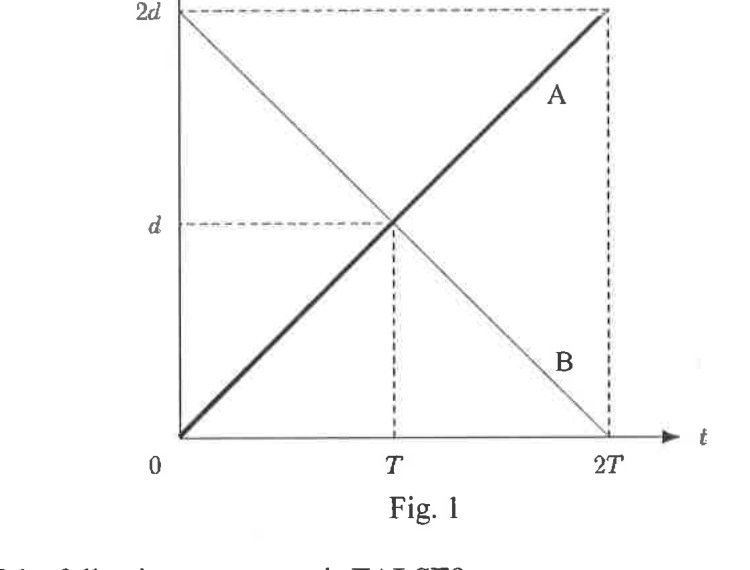 Fig. 1
Which of the following statements is FALSE?
- (A) The two particles meet at time .
- (B) The two particles move through the same distance in the time interval .
- (C) The distance between the two particles are equal at time and at time .
- (D) Both particles move with the same velocity.
- (E) Both particles move with the same constant acceleration.
Fonte: Testo (PDF) — p.5 Topic: Newtonian Mechanics Metodi: Kinematic Equations Competenze: Physical Reasoning Objects: —
Fig. - Cosa? 1 mostra i grafici del tempo di spostamento per due particelle A e B.
Fig. 1
Qual è la seguente affermazione FALSE?
- **(A) ** Le due particelle si incontrano al tempo .
- **(B) ** Le due particelle si muovono nella stessa distanza nell’intervallo temporale .
- **(C) ** La distanza tra le due particelle è uguale al tempo e al tempo .
- **(D) ** Entrambe le particelle si muovono con la stessa velocità.
- **(E) ** Entrambe le particelle si muovono con la stessa accelerazione costante.
Fonte: Testo (PDF) — p.5 Topic: Newtonian Mechanics Metodi: Kinematic Equations Competenze: Physical Reasoning Objects: —
The speed of a satellite orbiting near the surface of the earth is . The radius of the earth is about 4 times that of moon and the ratio of the average density of the earth to that of the moon is . What is the speed of a satellite orbiting near the surface of the moon?
- (A)
- (B)
- (C)
- (D)
- (E)
Fonte: Testo (PDF) — p.5 Topic: Gravitation Metodi: Newton’s Law of Gravitation Competenze: Physical Reasoning Objects: Satellite, Planet
La velocità di un satellite che orbita vicino alla superficie terrestre è . Il raggio della Terra è circa 4 volte quello della Luna e il rapporto tra la densità media della Terra e quella della Luna è . Qual è la velocità di un satellite che orbita vicino alla superficie della luna?
- (A)
- (B)
- (C)
- (D)
- (E)
Fonte: Testo (PDF) — p.5 Topic: Gravitation Metodi: Newton’s Law of Gravitation Competenze: Physical Reasoning Objects: Satellite, Planet
An object with mass is at distance from a point . The linear speed of the object is . It spins with angular velocity about its center of mass and its moment of inertia about its center of mass is . What is the simplest expression for the maximum magnitude of the objects angular momentum about point ?
- (A)
- (B)
- (C)
- (D)
- (E)
Fonte: Testo (PDF) — p.5 Topic: Rotational Dynamics Metodi: Torque & Angular Momentum Analysis Competenze: Physical Reasoning Objects: —
Un oggetto con massa è a distanza da un punto . La velocità lineare dell’oggetto è . Ruota con velocità angolare intorno al suo centro di massa e il suo momento di inerzia intorno al suo centro di massa è . Qual è l’espressione più semplice per la massima magnitudo degli oggetti, il momento angolare circa il punto ?
- (A)
- (B)
- (C)
- (D)
- (E)
Fonte: Testo (PDF) — p.5 Topic: Rotational Dynamics Metodi: Torque & Angular Momentum Analysis Competenze: Physical Reasoning Objects: —
A particle initially has momentum 44 . It is acted upon by a force perpendicular to its initial velocity for 10 s. The variation of the magnitude of the force with time is shown by the thick line in Fig. 2. At the end of the 10 s, the momentum of the particle is 71 . What is the value of ?
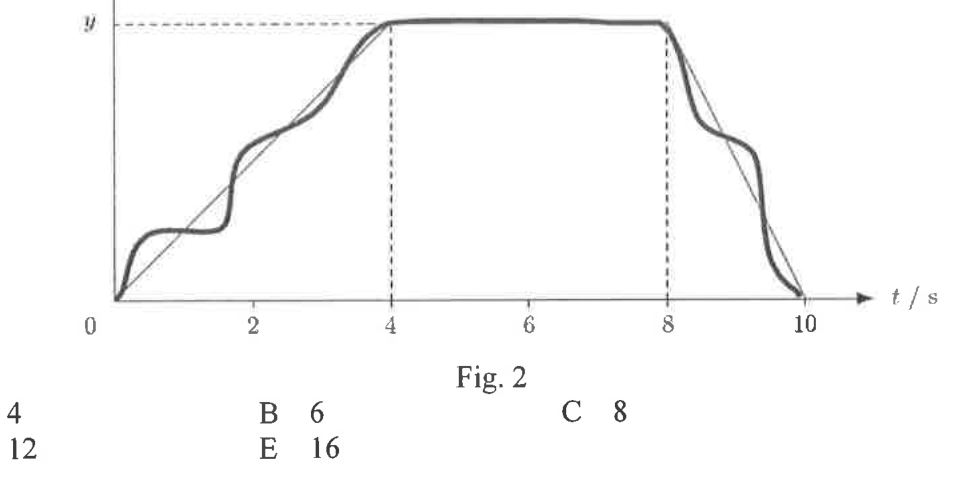 Fig. 2
- (A) 4
- (B) 6
- (C) 8
- (D) 12
- (E) 16
Fonte: Testo (PDF) — p.6 Topic: Conservation of Momentum Metodi: Impulse-Momentum Theorem, Vector Decomposition Competenze: Physical Reasoning Objects: —
Una particella ha inizialmente un momentum di 44 . È agito da una forza perpendicolare alla sua velocità iniziale per 10 secondi. La variazione della grandezza della forza nel tempo è mostrata dalla linea spessa nella figura. 2. Alla fine dei 10 s, la dinamica della particella è di 71 . Qual è il valore di ?
Fig. 2
- (A) 4
- (B) 6
- (C) 8
- (D) 12
- (E) 16
Fonte: Testo (PDF) — p.6 Topic: Conservation of Momentum Metodi: Impulse-Momentum Theorem, Vector Decomposition Competenze: Physical Reasoning Objects: —
When an object floats in water, it is found that 25.0% of its volume lies above the surface of water. When the same object floats in another liquid, it is found that only 14.8% of its volume lies above the liquid surface. Given that the density of water is , what is the density of the liquid?
- (A)
- (B)
- (C)
- (D)
- (E)
Fonte: Testo (PDF) — p.6 Topic: Fluid Mechanics Metodi: Hydrostatic Equilibrium Competenze: Physical Reasoning Objects: —
Quando un oggetto galleggia nell’acqua, si scopre che il 25,0% del suo volume si trova sopra la superficie dell’acqua. Quando lo stesso oggetto galleggia in un altro liquido, si scopre che solo il 14,8% del suo volume si trova sopra la superficie del liquido. Dato che la densità dell’acqua è , qual è la densità del liquido?
- (A)
- (B)
- (C)
- (D)
- (E)
Fonte: Testo (PDF) — p.6 Topic: Fluid Mechanics Metodi: Hydrostatic Equilibrium Competenze: Physical Reasoning Objects: —
A satellite is revolving round the earth in elliptical orbit. At perigee, the point of closest approach, it moves with 3 times the speed that it has at apogee, the point of greatest separation (See Fig. 3). At perigee it is 1000 km above the surface of the earth. The mass of the earth is kg and its radius is 6400 km. How high above the surface of the earth is it at apogee?
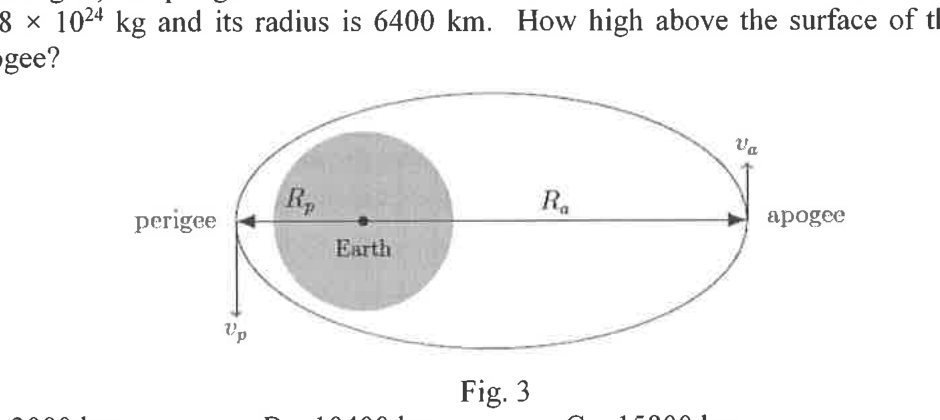 Fig. 3
- (A) 3000 km
- (B) 10400 km
- (C) 15800 km
- (D) 22400 km
- (E) 60400 km
Fonte: Testo (PDF) — p.6 Topic: Gravitation Metodi: Conservation Laws, Kepler’s Laws Competenze: Physical Reasoning Objects: Satellite, Planet
Un satellite ruota intorno alla Terra in orbita ellittica. Al perigeo, il punto di avvicinamento più vicino, si muove a 3 volte la velocità che ha al punto di apoggio, il punto di più grande separazione (vedi Figura. 3). Al perigeo si trova a 1000 km sopra la superficie terrestre. La massa della terra è kg e il suo raggio è di 6400 km. Quanto è alto sopra la superficie della terra all’apoggio?
Fig. 3
- (A) 3000 km
- (B) 10400 km
- (C) 15800 km
- (D) 22400 km
- (E) 60400 km
Fonte: Testo (PDF) — p.6 Topic: Gravitation Metodi: Conservation Laws, Kepler’s Laws Competenze: Physical Reasoning Objects: Satellite, Planet
A small object of mass 0.040 kg is attached to one end of an elastic string of unstretched length 0.50 m. The force constant of the elastic string is . The object is rotated steadily on a smooth table in a horizontal circle of radius 0.70m as shown in Fig. 4. What is the approximate speed of the object?
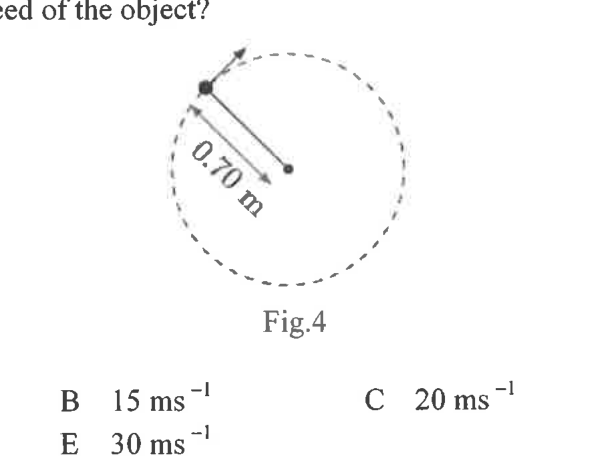 Fig.4
Fig.4
- (A)
- (B)
- (C)
- (D)
- (E)
Fonte: Testo (PDF) — p.7 Topic: Newtonian Mechanics Metodi: Free-Body Diagram, Hooke’s Law Competenze: Physical Reasoning Objects: Spring
Un piccolo oggetto di massa di 0,040 kg è attaccato ad una estremità di una corda elastica di lunghezza non estesa di 0,50 m. La costante di forza della corda elastica è . L’oggetto è girato costantemente su una tavola liscia in un cerchio orizzontale di raggio di 0,70 m come mostrato nella figura. 4. Qual è la velocità approssimativa dell’oggetto?
*Fig.4 *
- (A)
- (B)
- (C)
- (D)
- (E)
Fonte: Testo (PDF) — p.7 Topic: Newtonian Mechanics Metodi: Free-Body Diagram, Hooke’s Law Competenze: Physical Reasoning Objects: Spring
A ladder is propped against a wall making an angle with the floor as shown in Fig. 5. The wall is frictionless but the coefficients of static friction and of kinetic friction between the floor and the ladder are and respectively. What is the expression for the smallest angle if the ladder is not to slip?
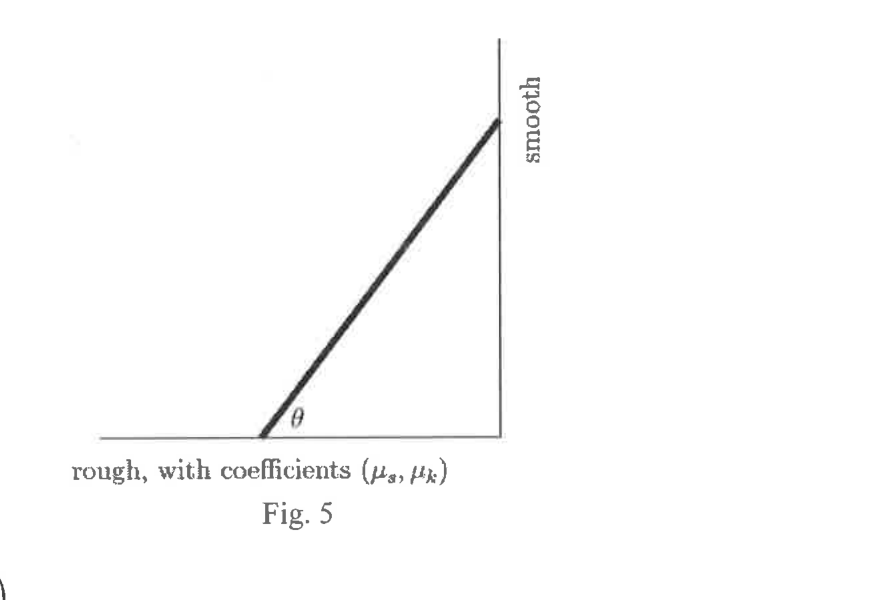 Fig. 5
- (A)
- (B)
- (C)
- (D)
- (E)
Fonte: Testo (PDF) — p.7 Topic: Rigid Body Statics Metodi: Torque & Angular Momentum Analysis, Free-Body Diagram Competenze: Physical Reasoning Objects: Rod
Una scala è appoggiata a un muro, facendo un angolo con il pavimento come mostrato nella figura. 5. Il muro è senza attrito, ma i coefficienti di attrito statico e di attrito cinetico tra il pavimento e la scala sono rispettivamente e . Qual è l’espressione per l’angolo più piccolo se la scala non deve scivolare?
Fig. 5
- (A)
- (B)
- (C)
- (D)
- (E)
Fonte: Testo (PDF) — p.7 Topic: Rigid Body Statics Metodi: Torque & Angular Momentum Analysis, Free-Body Diagram Competenze: Physical Reasoning Objects: Rod
A cylinder is rotating freely about its axis with kinetic energy . Its rotation is gradually reduced to a stop during the time interval by applying a constant opposing torque. At time after applying the torque, what is the kinetic energy of the rotating cylinder?
- (A)
- (B)
- (C)
- (D)
- (E)
Fonte: Testo (PDF) — p.8 Topic: Rotational Dynamics Metodi: Torque & Angular Momentum Analysis, Kinematic Equations Competenze: Physical Reasoning Objects: Cylinder
Un cilindro ruota liberamente intorno al suo asse con energia cinetica . La sua rotazione è gradualmente ridotta a un’ostazione durante l’intervallo temporale applicando una coppia costante opposta. Al momento dopo l’applicazione della coppia, qual è l’energia cinetica del cilindro rotante?
- (A)
- (B)
- (C)
- (D)
- (E)
Fonte: Testo (PDF) — p.8 Topic: Rotational Dynamics Metodi: Torque & Angular Momentum Analysis, Kinematic Equations Competenze: Physical Reasoning Objects: Cylinder
One end of an elastic string, having natural length is fixed at a point. When a particle of mass is attached to its free end, the string extends to a length as shown in Fig. 6.
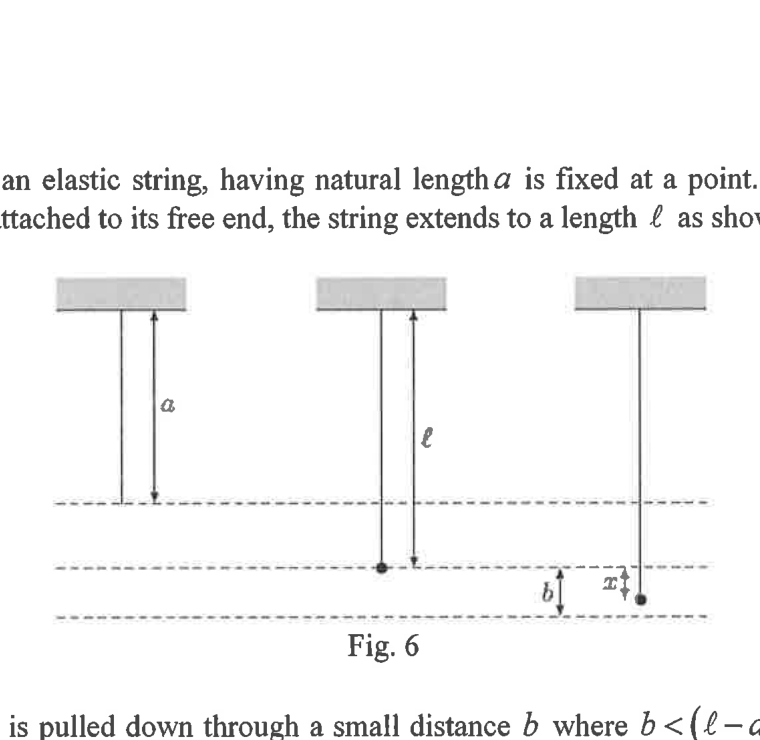 Fig. 6
The particle is pulled down through a small distance where and then released. Taking to be the instant when the particle is released, which of the following equations describe the resulting oscillation of the particle?
- (A)
- (B)
- (C)
- (D)
- (E)
Fonte: Testo (PDF) — p.8 Topic: Oscillations & Waves Metodi: Simple Harmonic Motion Analysis Competenze: Physical Reasoning Objects: Spring
Una estremità di una corda elastica, di lunghezza naturale , è fissata in un punto. Quando una particella di massa è attaccata alla sua estremità libera, la stringa si estende fino a una lunghezza come mostrato nella figura. 6.
Fig. 6
La particella viene trascinata a una piccola distanza , dove , e quindi rilasciata. Considerando come l’istante in cui la particella viene rilasciata, quale delle seguenti equazioni descrive l’oscillazione della particella risultante?
- (A)
- (B)
- (C)
- (D)
- (E)
Fonte: Testo (PDF) — p.8 Topic: Oscillations & Waves Metodi: Simple Harmonic Motion Analysis Competenze: Physical Reasoning Objects: Spring
Fig. 7 shows the variation of the acceleration, of a particle with its displacement, from a fixed point. Which one of the following graphs best illustrates the variation of its speed, with ?
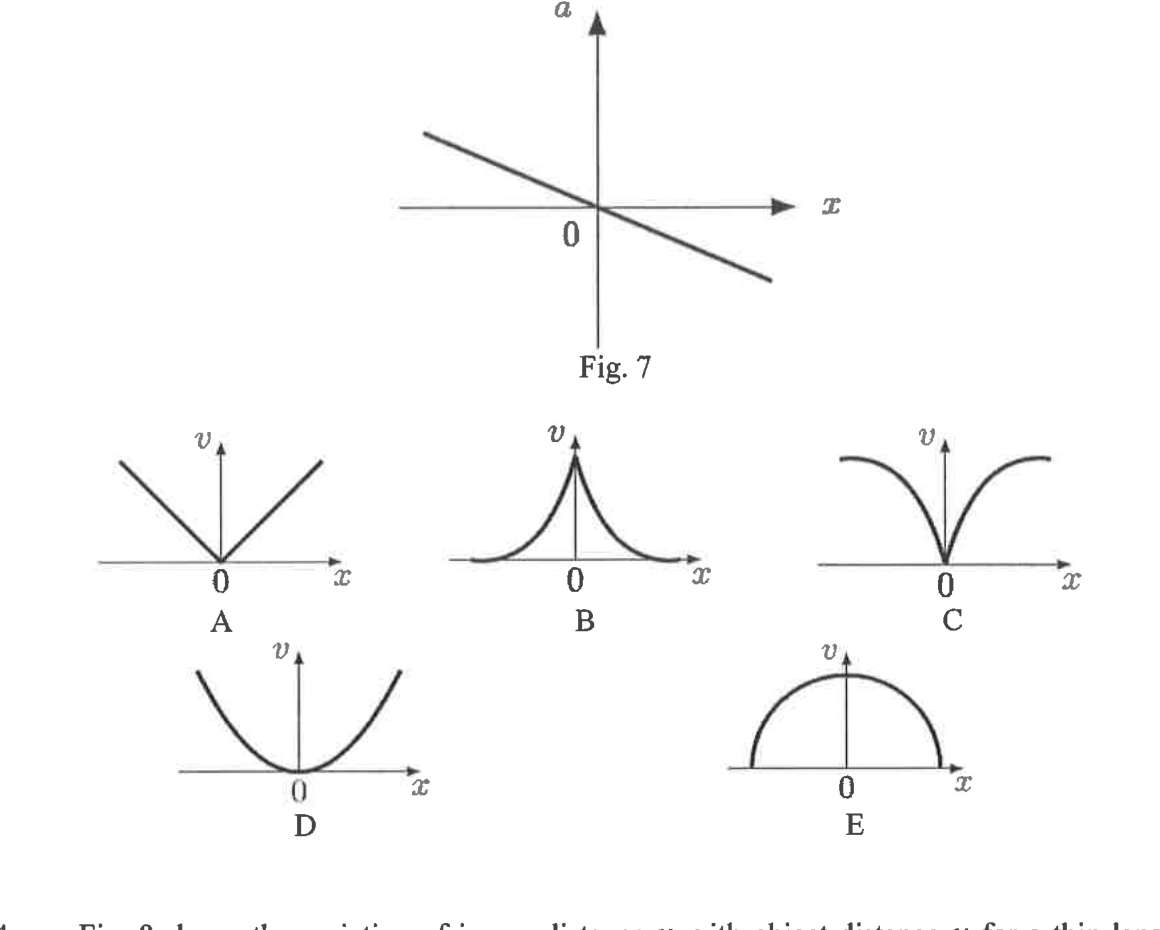 Fig. 7 (top) and the candidate – graphs A–E (bottom)
- (A) A
- (B) B
- (C) C
- (D) D
- (E) E
Fonte: Testo (PDF) — p.9 Topic: Newtonian Mechanics Metodi: Kinematic Equations Competenze: Physical Reasoning Objects: —
Fig. - Cosa? 7 indica la variazione dell’accelerazione, di una particella con il suo spostamento, da un punto fisso. Quale dei seguenti grafici illustra meglio la variazione della sua velocità ****, con ?
Fig. 7 (alto) e il candidato v$$x grafici AE (infine)
- (A) A
- (B) B
- (C) C
- (D) D
- (E) E
Fonte: Testo (PDF) — p.9 Topic: Newtonian Mechanics Metodi: Kinematic Equations Competenze: Physical Reasoning Objects: —
Fig. 8 shows the variation of image distance with object distance for a thin lens. I.e. if the object is at from the lens, its image will be located at on the other side of the lens.
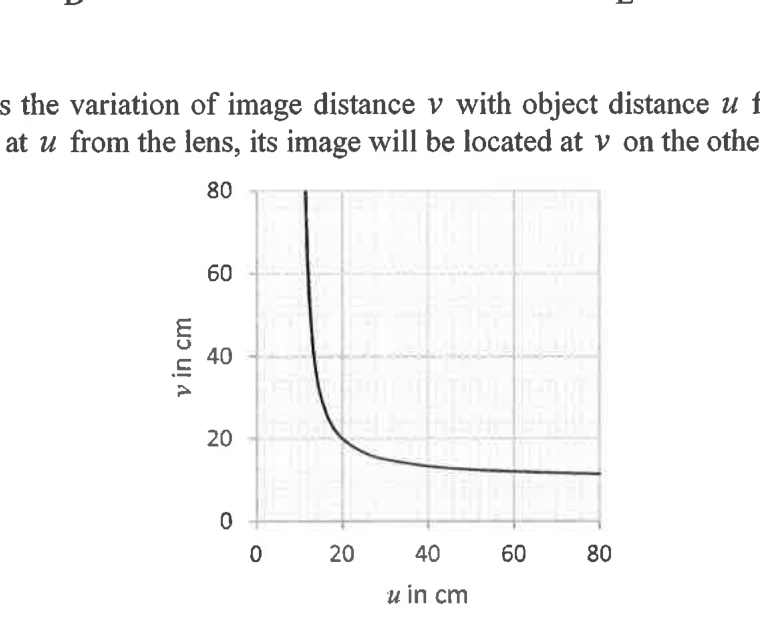 Fig. 8
From the graph, we may deduce that the lens is __________.
- (A) converging and of focal length 10 cm
- (B) converging and of focal length 20 cm
- (C) converging and of focal length 40 cm
- (D) diverging and of focal length 10 cm
- (E) diverging and of focal length 20 cm
Fonte: Testo (PDF) — p.9 Topic: Geometric Optics Metodi: Thin Lens & Mirror Equation, Graph Linearization Competenze: Physical Reasoning Objects: Lens
Fig. - Cosa? 8 mostra la variazione della distanza dell’immagine con la distanza dell’oggetto per un lente sottile. I.e. se l’oggetto è situato a dalla lente, la sua immagine si trova a dall’altra parte della lente.
Fig. 8
Dal grafico, possiamo dedurre che la lente è __________.
- **(A) ** convergente e di lunghezza focale di 10 cm
- **(B) ** convergente e di lunghezza focale di 20 cm
- **(C) ** convergente e di lunghezza focale 40 cm
- **(D) ** divergente e di lunghezza focale di 10 cm
- **(E) ** divergente e di lunghezza focale di 20 cm
Fonte: Testo (PDF) — p.9 Topic: Geometric Optics Metodi: Thin Lens & Mirror Equation, Graph Linearization Competenze: Physical Reasoning Objects: Lens
The focal length of an ideal converging lens DOES NOT depend on which of the following factors?
- (A) The power of the lens
- (B) The aperture of the lens
- (C) The radius of curvature of the lens
- (D) The material with which the lens is made of
- (E) The refractive index of the medium in which the lens is placed
Fonte: Testo (PDF) — p.10 Topic: Geometric Optics Metodi: Thin Lens & Mirror Equation Competenze: Physical Reasoning Objects: Lens
La distanza focale di un obiettivo convergente ideale ** NON ** dipende da quale dei seguenti fattori?
- **(A) ** La potenza della lente
- **(B) ** L’apertura della lente
- **(C) ** Il raggio di curvatura della lente
- **(D) ** Il materiale di cui è fatta l’obiettivo
- **(E) ** L’indice di rifrazione del mezzo in cui è collocata la lente
Fonte: Testo (PDF) — p.10 Topic: Geometric Optics Metodi: Thin Lens & Mirror Equation Competenze: Physical Reasoning Objects: Lens
A particle is oscillating in simple harmonic motion about a point .
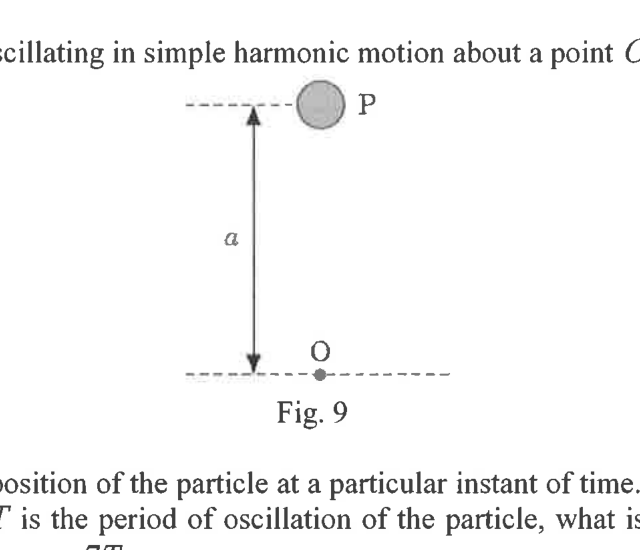 Fig. 9
Fig. 9 shows the position of the particle at a particular instant of time. The particle is at rest at this position. If is the period of oscillation of the particle, what is the displacement of the particle from at time later?
- (A) below
- (B) above
- (C) below
- (D) above
- (E) below
Fonte: Testo (PDF) — p.10 Topic: Oscillations & Waves Metodi: Simple Harmonic Motion Analysis Competenze: Physical Reasoning Objects: —
Una particella oscilla in semplice movimento armonico intorno a un punto .
Fig. 9
Fig. - Cosa? 9 mostra la posizione della particella in un momento specifico del tempo. La particella è in riposo in questa posizione. Se è il periodo di oscillazione della particella, qual è il spostamento della particella da al tempo successivo?
- **(A) ** inferiore a
- **(B) ** superiore a
- **(C) ** inferiore a
- **(D) ** superiore a
- **(E) ** inferiore a
Fonte: Testo (PDF) — p.10 Topic: Oscillations & Waves Metodi: Simple Harmonic Motion Analysis Competenze: Physical Reasoning Objects: —
When a tuning fork is sounded together with a standard tuning fork of frequency 256 Hz, the frequency of beats detected is 5 Hz. A small piece of plasticine is attached to the prong of tuning fork and then both tuning forks are sounded together, the frequency of beats becomes 2 Hz. What is the frequency of tuning fork ?
- (A) 251 Hz
- (B) 254 Hz
- (C) 256 Hz
- (D) 258 Hz
- (E) 261 Hz
Fonte: Testo (PDF) — p.10 Topic: Oscillations & Waves Metodi: Wave Equation Competenze: Physical Reasoning Objects: Tuning Fork
Quando una forchetta di sintonia viene suonata insieme a una forchetta di sintonia standard di frequenza 256 Hz, la frequenza dei battiti rilevati è di 5 Hz. Un piccolo pezzo di plastica viene attaccato alla punta della forchetta di sintonia e poi entrambe le forchette di sintonia vengono suonate insieme, la frequenza dei battiti diventa di 2 Hz. Qual è la frequenza di sintonizzazione della forchetta ?
- (A) 251 Hz
- (B) 254 Hz
- (C) 256 Hz
- (D) 258 Hz
- (E) 261 Hz
Fonte: Testo (PDF) — p.10 Topic: Oscillations & Waves Metodi: Wave Equation Competenze: Physical Reasoning Objects: Tuning Fork
A ray of red light has wavelength 493.5 nm when propagating in water. What will be its wavelength when the ray is propagating in a glass block? [Absolute refractive indices of water and glass are 1.33 and 1.52 respectively]
- (A) 324.7 nm
- (B) 431.8 nm
- (C) 564.0 nm
- (D) 603.1 nm
- (E) 656.4 nm
Fonte: Testo (PDF) — p.10 Topic: Geometric Optics Metodi: Snell’s Law Competenze: Physical Reasoning Objects: Photon
Un raggio di luce rossa ha una lunghezza d’onda di 493,5 nm quando si propaga in acqua. Qual sarà la sua lunghezza d’onda quando il raggio si propaga in un blocco di vetro? [L’indice di rifrazione assoluta dell’acqua e del vetro è rispettivamente di 1,33 e 1,52]
- (A) 324.7 nm
- (B) 431.8 nm
- (C) 564.0 nm
- (D) 603.1 nm
- (E) 656.4 nm
Fonte: Testo (PDF) — p.10 Topic: Geometric Optics Metodi: Snell’s Law Competenze: Physical Reasoning Objects: Photon
A monochromatic light ray passes through a glass prism and is found to undergo minimum deviation. What is the relationship between the angle of incidence and the angle of emergence in this situation?
- (A)
- (B)
- (C)
- (D)
- (E)
Fonte: Testo (PDF) — p.11 Topic: Geometric Optics Metodi: Snell’s Law, Symmetry Argument Competenze: Physical Reasoning Objects: Prism, Photon
Un raggio di luce monocromatico passa attraverso un prisma di vetro e si scopre che subisce una deviazione minima. Qual è la relazione tra l’angolo di incidenza e l’angolo di emergenza in questa situazione?
- (A)
- (B)
- (C)
- (D)
- (E)
Fonte: Testo (PDF) — p.11 Topic: Geometric Optics Metodi: Snell’s Law, Symmetry Argument Competenze: Physical Reasoning Objects: Prism, Photon
A compound microscope possesses an objective lens that is changeable. To increase the magnifying power of the instrument, what changes need to be made to the objective lens?
- (A) possesses a longer focal length and moved further away from the object.
- (B) possesses a shorter focal length and moved further away from the object.
- (C) possesses a shorter focal length and kept in the same position.
- (D) possesses a longer focal length and moved closer to the object.
- (E) possesses a shorter focal length and moved closer to the object.
Fonte: Testo (PDF) — p.11 Topic: Geometric Optics Metodi: Thin Lens & Mirror Equation Competenze: Physical Reasoning Objects: Lens
Un microscopio composto possiede una lente oggettiva che è variabile. Per aumentare la potenza di ingrandimento dell’istrumento, quali cambiamenti devono essere apportati alla lente obiettiva?
- **(A) ** ha una lunghezza focale più lunga e si è allontanata dall’oggetto.
- **(B) ** ha una distanza focale più breve e si è allontanata più lontano dall’oggetto.
- **(C) ** ha una lunghezza focale più breve e viene mantenuta nella stessa posizione.
- **(D) ** ha una lunghezza focale più lunga e si è spostata più vicino all’oggetto.
- **(E) ** ha una distanza focale più breve e si è spostata più vicino all’oggetto.
Fonte: Testo (PDF) — p.11 Topic: Geometric Optics Metodi: Thin Lens & Mirror Equation Competenze: Physical Reasoning Objects: Lens
Two loudspeakers at coordinates (-1.00 m, 0.00 m) and (1.00 m, 0.00 m) oscillate in phase at 340 Hz. The phase difference between the sound waves from the two speakers at coordinate (2.00 m, 4.00 m) is __________.
- (A) zero
- (B) 0.50 radian
- (C) 1.57 radian
- (D) 5.52 radian
- (E) 6.02 radian
Fonte: Testo (PDF) — p.11 Topic: Oscillations & Waves Metodi: Interference & Diffraction Analysis, Superposition Principle Competenze: Physical Reasoning Objects: —
Due altoparlanti a coordinate (-1,00 m, 0,00 m) e (1,00 m, 0,00 m) oscilano in fase a 340 Hz. La differenza di fase tra le onde sonore dei due altoparlanti a coordinata (2.00 m, 4.00 m) è __________.
- **(A) ** zero
- **(B) ** 0,50 radian
- **(C) ** 1,57 radian
- **(D) ** 5,52 radian
- **(E) ** 6,02 radian
Fonte: Testo (PDF) — p.11 Topic: Oscillations & Waves Metodi: Interference & Diffraction Analysis, Superposition Principle Competenze: Physical Reasoning Objects: —
A parallel beam of white light is incident normally on a diffraction grating. In the second-order and third-order spectra partially overlap. Which wavelength in the second-order spectrum appears at the same angle as the wavelength of 400 nm in the third-order spectrum?
- (A) 180 nm
- (B) 270 nm
- (C) 400 nm
- (D) 600 nm
- (E) 900 nm
Fonte: Testo (PDF) — p.11 Topic: Wave Optics Metodi: Interference & Diffraction Analysis Competenze: Physical Reasoning Objects: Diffraction Grating
Un fascio parallelo di luce bianca si verifica normalmente su una griglia di diffrazione. Nel secondo e terzo ordine gli spettri si sovrappongono parzialmente. Quale lunghezza d’onda dello spettro di secondo ordine appare all’angolo stesso della lunghezza d’onda di 400 nm dello spettro di terzo ordine?
- (A) 180 nm
- (B) 270 nm
- (C) 400 nm
- (D) 600 nm
- (E) 900 nm
Fonte: Testo (PDF) — p.11 Topic: Wave Optics Metodi: Interference & Diffraction Analysis Competenze: Physical Reasoning Objects: Diffraction Grating
A metal sphere has a diameter of 60.00 cm. It is charged until its surface charge density is . What is the electric potential at the surface of the sphere?
- (A) 122.0 V
- (B) 339.0 V
- (C) 406.8 V
- (D) 488.1 V
- (E) 813.5 V
Fonte: Testo (PDF) — p.11 Topic: Electrostatics Metodi: Electric Potential Method Competenze: Physical Reasoning Objects: Conducting Sphere
Una sfera metallica ha un diametro di 60,00 cm. È caricato fino a quando la densità di carica superficiale è . Qual è il potenziale elettrico alla superficie della sfera?
- (A) 122.0 V
- (B) 339.0 V
- (C) 406.8 V
- (D) 488.1 V
- (E) 813.5 V
Fonte: Testo (PDF) — p.11 Topic: Electrostatics Metodi: Electric Potential Method Competenze: Physical Reasoning Objects: Conducting Sphere
Two positive charges, each of magnitude are placed at a distance apart in a dielectric medium with relative permittivity 3. The two positive charges are then placed in vacuum at a distance apart. By how many times will the electrostatic force between the two positive charges increase?
- (A) 1.5 times
- (B) 2.25 times
- (C) 6 times
- (D) 12 times
- (E) 18 times
Fonte: Testo (PDF) — p.11 Topic: Electrostatics Metodi: Coulomb’s Law Competenze: Physical Reasoning Objects: Point Charge
Due cariche positive, ciascuna di magnitudo , sono posizionate a distanza da sé in un mezzo dielettrico con relativa permissività 3. Le due cariche positive vengono poi messe al vuoto a distanza . Quante volte aumenterà la forza elettrostatica tra le due cariche positive?
- **(A) ** 1,5 volte
- **(B) ** 2,25 volte
- **(C) ** 6 volte
- **(D) ** 12 volte
- **(E) ** 18 volte
Fonte: Testo (PDF) — p.11 Topic: Electrostatics Metodi: Coulomb’s Law Competenze: Physical Reasoning Objects: Point Charge
A negatively charged oil drop is held stationary between two horizontal charged metal plates as shown in Fig. 10.
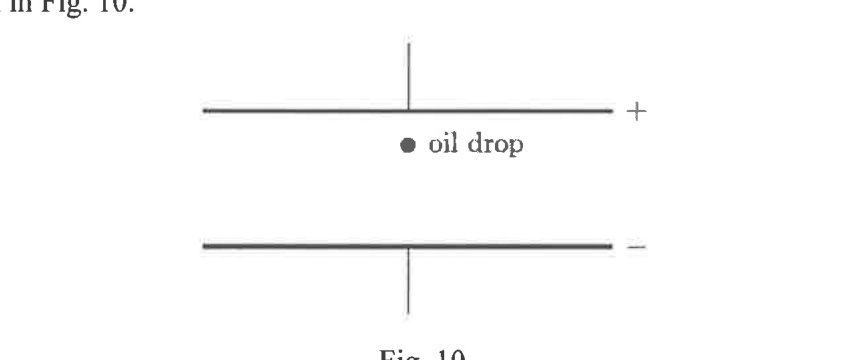 Fig. 10
The oil drop is now replaced with another oil drop with the same volume but having greater density and carries the same amount of negative charge as the previous drop. In order to keep the oil drop stationary, what change should be made?
- (A) Move the two plates further apart
- (B) Reverse the charges on the plate
- (C) Decrease the positive charge on the positive plate
- (D) Increase the potential difference between the two plates
- (E) Allow the oil drop to come closer to the negative plate
Fonte: Testo (PDF) — p.12 Topic: Electrostatics Metodi: Free-Body Diagram Competenze: Physical Reasoning Objects: Droplet, Capacitor
Una goccia di olio carica negativamente si tiene fermata tra due piastre di metallo caricate orizzontali come mostrato nella figura. 10.
Fig. 10
La goccia di olio viene ora sostituita da un’altra goccia di olio con lo stesso volume ma con una maggiore densità e con la stessa quantità di carica negativa della goccia precedente. Che cambiamento deve essere fatto per mantenere la goccia di olio in posizione?
- **(A) ** Spostare le due lastre più a distanza
- **(B) ** Invertire le cariche sulla targa
- **(C) ** Diminuire la carica positiva sulla piastra positiva
- **(D) ** Aumentare la differenza di potenziale tra le due lastre
- **(E) ** Lascia che la goccia di olio si avvicini alla piastra negativa
Fonte: Testo (PDF) — p.12 Topic: Electrostatics Metodi: Free-Body Diagram Competenze: Physical Reasoning Objects: Droplet, Capacitor
The plates of a parallel plate capacitor each have area 3 and a separation of 1.5 mm. The capacitor is charged to a potential difference of 12 kV. If the energy stored in the charged capacitor is used to lift a mass of 4 kg, what is the maximum vertical height through which it can be raised?
- (A) 1.62 cm
- (B) 3.25 cm
- (C) 4.88 cm
- (D) 6.50 cm
- (E) 9.75 cm
Fonte: Testo (PDF) — p.12 Topic: Circuits Metodi: Energy Conservation Method Competenze: Physical Reasoning Objects: Capacitor
Le piastre di un condensatore di piastre parallele hanno ciascuna superficie 3 e una separazione di 1,5 mm. Il condensatore è carico a una differenza potenziale di 12 kV. Se l’energia immagazzinata nel condensatore carico viene utilizzata per sollevare una massa di 4 kg, quale è l’altezza verticale massima attraverso la quale può essere sollevata?
- (A) 1.62 cm
- (B) 3.25 cm
- (C) 4.88 cm
- (D) 6.50 cm
- (E) 9.75 cm
Fonte: Testo (PDF) — p.12 Topic: Circuits Metodi: Energy Conservation Method Competenze: Physical Reasoning Objects: Capacitor
A capacitor X has a capacitance of and a voltage rating of 10V. In order to obtain an effective capacitance of and a voltage rating of 60V, using only capacitors identical to X, what is the simplest arrangement to be made?
- (A) Connect 2 capacitors in series with X
- (B) Connect 2 capacitors in parallel with X
- (C) Connect 1 capacitor in parallel with X and 5 more pairs of capacitors in series with the first pair
- (D) Connect 5 capacitors in series with X
- (E) Connect 6 capacitors in parallel with X
Fonte: Testo (PDF) — p.12 Topic: Circuits Metodi: Equivalent Circuit Reduction Competenze: Physical Reasoning Objects: Capacitor
Un condensatore X ha una capacità di e una tensione di 10V. Per ottenere una capacità efficace di e una tensione di 60V, utilizzando solo condensatori identici a X, quale è la disposizione più semplice da fare?
- **(A) ** Connettere 2 condensatori in serie con X
- **(B) ** Connettere 2 condensatori in parallelo con X
- **(C) ** Connettere 1 condensatore in parallelo con X e altre 5 coppie di condensatori in serie con il primo paio
- **(D) ** Connettere 5 condensatori in serie con X
- **(E) ** Connettere 6 condensatori in parallelo con X
Fonte: Testo (PDF) — p.12 Topic: Circuits Metodi: Equivalent Circuit Reduction Competenze: Physical Reasoning Objects: Capacitor
A capacitor is charged to a potential difference of . It is then discharged through a resistor having resistance . After a time interval of , the potential difference across the capacitor becomes where , the base of natural logarithm. What is the value of ?
- (A) 2.5 s
- (B) 5.0 s
- (C) 7.5 s
- (D) 12.5 s
- (E) 15.0 s
Fonte: Testo (PDF) — p.13 Topic: Circuits Metodi: Differential Equations Competenze: Physical Reasoning Objects: Capacitor, Resistor
Un condensatore è caricato ad una differenza potenziale di . Il sistema di scarico è quindi effettuato attraverso una resistenza . Dopo un intervallo di tempo di , la differenza potenziale nel condensatore diventa dove , la base del logaritmo naturale. Qual è il valore di ?
- (A) 2.5 s
- (B) 5.0 s
- (C) 7.5 s
- (D) 12.5 s
- (E) 15.0 s
Fonte: Testo (PDF) — p.13 Topic: Circuits Metodi: Differential Equations Competenze: Physical Reasoning Objects: Capacitor, Resistor
A p.d. of 1.0 V is applied to the ends of a uniform copper wire 91 cm long and with a diameter of 0.315 mm. How long does a free electron in the wire take to drift through a distance of 10 cm along the wire? [Free electron density in copper ; Resistivity of copper ]
- (A) 330 ps
- (B) 3 ns
- (C) 160 ns
- (D) 16 s
- (E) 22 s
Fonte: Testo (PDF) — p.13 Topic: Circuits Metodi: Physical Modeling Competenze: Physical Reasoning Objects: Wire, Electron
A p.d. di 1,0 V viene applicato alle estremità di un filo di rame uniforme di 91 cm di lunghezza e di diametro di 0,315 mm. Quanto tempo ci vuole per un elettrone libero nel filo per spostarsi a 10 cm lungo il filo? [densità di elettroni liberi in rame ; Resistenza del rame ]
- (A) 330 ps
- (B) 3 ns
- (C) 160 ns
- (D) 16 s
- (E) 22 s
Fonte: Testo (PDF) — p.13 Topic: Circuits Metodi: Physical Modeling Competenze: Physical Reasoning Objects: Wire, Electron
When a potential difference of is applied to a conducting rod of length and diameter , the electric current flowing in the conductor is . When the same potential difference is applied to a conducting pipe, made of the same material, but of length and outer diameter and inner diameter , what is the electric current flowing in this conductor?
- (A)
- (B)
- (C)
- (D)
- (E)
Fonte: Testo (PDF) — p.13 Topic: Circuits Metodi: Physical Modeling Competenze: Physical Reasoning Objects: Rod, Tube
Se una differenza di potenziale di è applicata a una canna di conduttore di lunghezza e di diametro , la corrente elettrica che scorre nel conduttore è . Quando si applica la stessa differenza di potenziale a un tubo conduttore, fatto dello stesso materiale, ma di lunghezza e di diametro esterno e di diametro interno , quale è la corrente elettrica che scorre in questo conduttore?
- (A)
- (B)
- (C)
- (D)
- (E)
Fonte: Testo (PDF) — p.13 Topic: Circuits Metodi: Physical Modeling Competenze: Physical Reasoning Objects: Rod, Tube
A uniform wire has a resistance of . It is bent into the shape of a square. What is the resistance between any two adjacent corners of the square?
- (A)
- (B)
- (C)
- (D)
- (E)
Fonte: Testo (PDF) — p.13 Topic: Circuits Metodi: Equivalent Circuit Reduction Competenze: Physical Reasoning Objects: Wire
Un filo uniforme ha una resistenza di . È piegato a forma di quadrato. Qual è la resistenza tra due angoli adiacenti del quadrato?
- (A)
- (B)
- (C)
- (D)
- (E)
Fonte: Testo (PDF) — p.13 Topic: Circuits Metodi: Equivalent Circuit Reduction Competenze: Physical Reasoning Objects: Wire
Two cylindrical wires A and B are made of the same material and have the same mass. The length of wire A is twice that of wire B. Electric currents of 2A and 3A are passed through the wires A and B respectively. What is the ratio of the power dissipation in wire A to that in wire B?
- (A)
- (B)
- (C)
- (D)
- (E)
Fonte: Testo (PDF) — p.13 Topic: Circuits Metodi: Physical Modeling Competenze: Physical Reasoning Objects: Wire
Due fili cilindrici A e B sono realizzati dallo stesso materiale e hanno la stessa massa. La lunghezza del filo A è il doppio del filo B. Le correnti elettriche di 2A e 3A vengono trasmesse rispettivamente attraverso i fili A e B. Qual è il rapporto tra la dissipazione di potenza del filo A e quella del filo B?
- (A)
- (B)
- (C)
- (D)
- (E)
Fonte: Testo (PDF) — p.13 Topic: Circuits Metodi: Physical Modeling Competenze: Physical Reasoning Objects: Wire
An electron is moving in a straight line in a region where there exists a magnetic field and an electric field perpendicular to each other. What will be the motion of the electron if the electric field is switched off?
- (A) The electron will move with the same speed in a circular path.
- (B) The electron will move with the same speed in a parabolic path.
- (C) The electron will move with the same speed in a straight line.
- (D) The electron will move with a reduced speed in a circular path.
- (E) The electron will move with a reduced speed in a straight line.
Fonte: Testo (PDF) — p.14 Topic: Magnetism Metodi: Lorentz Force Analysis Competenze: Physical Reasoning Objects: Electron
Un elettrone si muove in linea retta in una regione in cui esiste un campo magnetico e un campo elettrico perpendicolare tra loro. Qual sarà il movimento dell’elettrone se il campo elettrico viene spento?
- **(A) ** L’elettrone si muoverà con la stessa velocità in un percorso circolare.
- **(B) ** L’elettrone si muoverà con la stessa velocità in un percorso parabolico.
- **(C) ** L’elettrone si muoverà con la stessa velocità in linea retta.
- **(D) ** L’elettrone si muoverà a velocità ridotta in un percorso circolare.
- **(E) ** L’elettrone si muoverà a velocità ridotta in linea retta.
Fonte: Testo (PDF) — p.14 Topic: Magnetism Metodi: Lorentz Force Analysis Competenze: Physical Reasoning Objects: Electron
Two cells of e.m.f.’s and and of negligible internal resistance are connected with two variable resistors and as shown in Fig. 11. When the resistances of and are adjusted to and respectively, the galvanometer shows null deflection. What is the value of the ratio ?
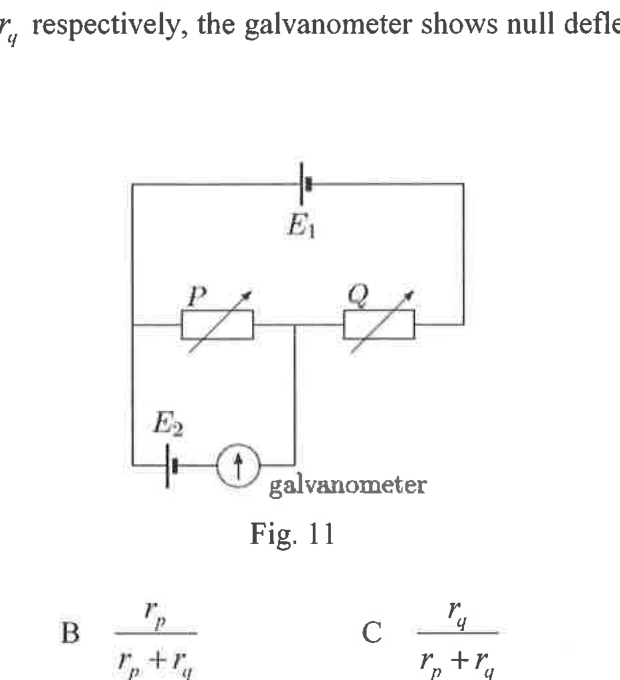 Fig. 11
- (A)
- (B)
- (C)
- (D)
- (E)
Fonte: Testo (PDF) — p.14 Topic: Circuits Metodi: Kirchhoff’s Laws Competenze: Physical Reasoning Objects: Battery, Resistor, Galvanometer
Due celle di e di e.m.f. e di resistenza interna trascurabile sono collegate a due resistenti variabili e come mostrato nella figura. 11. Quando le resistenze di e sono regolate rispettivamente a e , il galvanometro mostra una deviazione nulo. Qual è il valore del rapporto ?
Fig. 11
- (A)
- (B)
- (C)
- (D)
- (E)
Fonte: Testo (PDF) — p.14 Topic: Circuits Metodi: Kirchhoff’s Laws Competenze: Physical Reasoning Objects: Battery, Resistor, Galvanometer
A high-resistance voltmeter is connected across the a cell of e.m.f. and having internal resistance . A variable resistor is connected to the terminals of the cell as shown in Fig. 12.
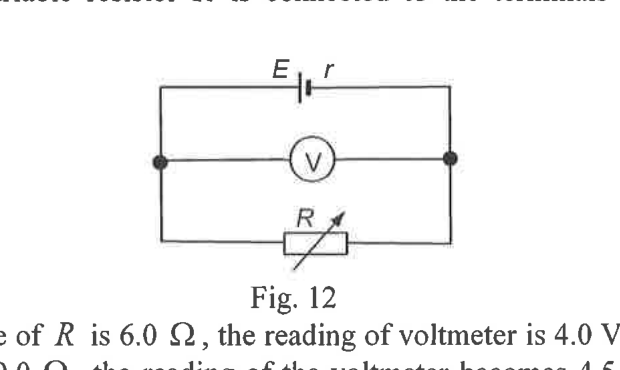 Fig. 12
When the resistance of is , the reading of voltmeter is 4.0 V. When the resistance of is increased to , the reading of the voltmeter becomes 4.5 V. What is the internal resistance of the cell?
- (A)
- (B)
- (C)
- (D)
- (E)
Fonte: Testo (PDF) — p.14 Topic: Circuits Metodi: Kirchhoff’s Laws Competenze: Physical Reasoning Objects: Resistor, Battery
Un voltometro ad alta resistenza è collegato attraverso la cellula di e.m.f. e con resistenza interna . Una resistenza variabile è collegata ai terminali della cella come mostrato nella figura. 12.
Fig. 12
Quando la resistenza di è , la lettura del voltmeter è di 4,0 V. Quando la resistenza di è aumentata a , la lettura del voltmeter diventa di 4,5 V. Qual è la resistenza interna della cellula?
- (A)
- (B)
- (C)
- (D)
- (E)
Fonte: Testo (PDF) — p.14 Topic: Circuits Metodi: Kirchhoff’s Laws Competenze: Physical Reasoning Objects: Resistor, Battery
A hot liquid with mass 2 kg is contained in a flask the heat capacity of which is negligible. Just before the liquid begins to solidify at a temperature of , it is found that its temperature falls at a rate of . The temperature of the liquid then remains constant for 32 minutes by which time the liquid has all solidified. Using SI units, what is the numerical value of the ratio of the specific latent heat of fusion to specific heat capacity?
- (A) 16
- (B) 25
- (C) 32
- (D) 40
- (E) 80
Fonte: Testo (PDF) — p.15 Topic: Thermodynamics Metodi: Energy Conservation Method Competenze: Physical Reasoning Objects: Container
Un liquido caldo di massa 2 kg è contenuto in un flacone la cui capacità termico è trascurabile. Poco prima che il liquido inizi a solidificarsi a una temperatura di , si scopre che la sua temperatura scende a un ritmo di . La temperatura del liquido rimane quindi costante per 32 minuti, tempo in cui il liquido si è solidificato. Utilizzando le unità SI, qual è il valore numerico del rapporto tra il calore latente specifico della fusione e la capacità termico specifica?
- (A) 16
- (B) 25
- (C) 32
- (D) 40
- (E) 80
Fonte: Testo (PDF) — p.15 Topic: Thermodynamics Metodi: Energy Conservation Method Competenze: Physical Reasoning Objects: Container
An ideal gas contained in a cylinder is compressed isothermally from volume and pressure to volume and pressure . Which one of the statements below is true for the gas?
- (A) Potential energy of the gas increases
- (B) Kinetic energy of the gas increases
- (C) Heat flows out from the gas
- (D) No work is done on the gas
- (E) The work done on the gas is
Fonte: Testo (PDF) — p.15 Topic: Thermodynamics Metodi: First Law of Thermodynamics Competenze: Physical Reasoning Objects: Gas, Cylinder
Un gas ideale contenuto in un cilindro viene compresso isotermicamente dal volume e dalla pressione al volume e alla pressione . Quale delle affermazioni di seguito è vero per il gas?
- **(A) ** L’energia potenziale del gas aumenta
- **(B) ** L’energia cinetica del gas aumenta
- **(C) ** Il calore esce dal gas
- **(D) ** Non si lavora sul gas
- **(E) ** Il lavoro svolto sul gas è
Fonte: Testo (PDF) — p.15 Topic: Thermodynamics Metodi: First Law of Thermodynamics Competenze: Physical Reasoning Objects: Gas, Cylinder
A constant-volume gas thermometer is used to determine the thermodynamic temperature of a water bath. The pressure of the gas corresponds to the temperature and to the triple point of water respectively and . The variation of with is shown in Fig. 13 below.
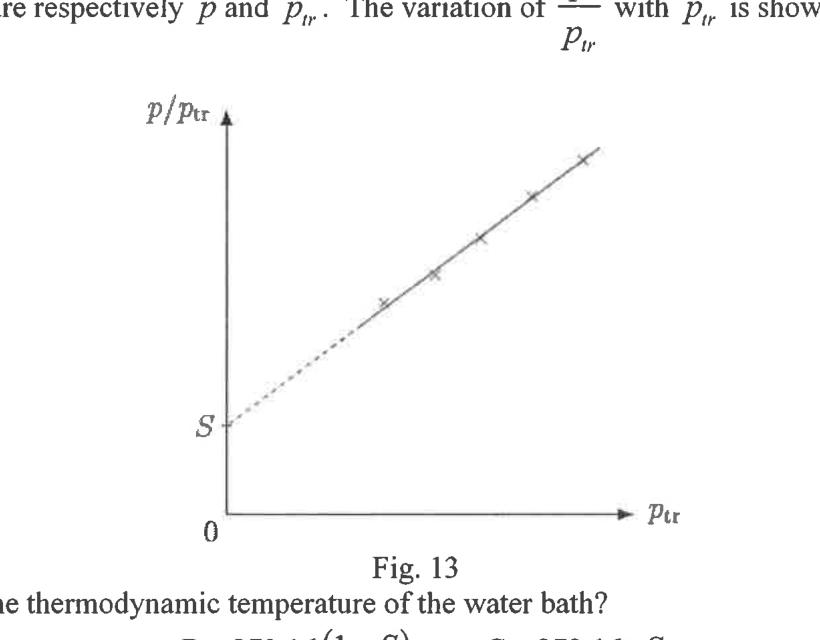 Fig. 13
What is the thermodynamic temperature of the water bath?
- (A)
- (B)
- (C)
- (D)
- (E)
Fonte: Testo (PDF) — p.15 Topic: Thermodynamics Metodi: Ideal Gas Law Competenze: Physical Reasoning Objects: Gas
Per determinare la temperatura termodinamica di un bagno d’acqua si utilizza un termometro a gas a volume costante. La pressione del gas corrisponde rispettivamente alla temperatura e al triple punto di acqua e . La variazione di con è mostrata nella figura. 13 sotto.
Fig. 13
Qual è la temperatura termodinamica del bagno d’acqua?
- (A)
- (B)
- (C)
- (D)
- (E)
Fonte: Testo (PDF) — p.15 Topic: Thermodynamics Metodi: Ideal Gas Law Competenze: Physical Reasoning Objects: Gas
A slab of insulating material is made up of a layer of Styrofoam thickness 5 mm with thermal conductivity of sandwiched between two sheets of wood 5 mm thick each with thermal conductivity . The rate of heat conduction per unit area through the whole slab is . What is the temperature difference between the two surfaces of the slab?
- (A) 0.6 K
- (B) 2.4 K
- (C) 4.8 K
- (D) 36 K
- (E) 96 K
Fonte: Testo (PDF) — p.16 Topic: Thermodynamics Metodi: Physical Modeling Competenze: Physical Reasoning Objects: —
Una lastra di materiale isolante è costituita da uno strato di stufato di spessore di 5 mm con conductività termica di inserito tra due fogli di legno di 5 mm di spessore ciascuno con conductività termica . Il tasso di conduzione del calore per unità di superficie attraverso l’intera lastra è . Qual è la differenza di temperatura tra le due superfici della lastra?
- (A) 0.6 K
- (B) 2.4 K
- (C) 4.8 K
- (D) 36 K
- (E) 96 K
Fonte: Testo (PDF) — p.16 Topic: Thermodynamics Metodi: Physical Modeling Competenze: Physical Reasoning Objects: —
Fig. 14 shows the variation of pressure with where represents volume for a fixed mass of a sample of monatomic ideal gas undergoing some change.
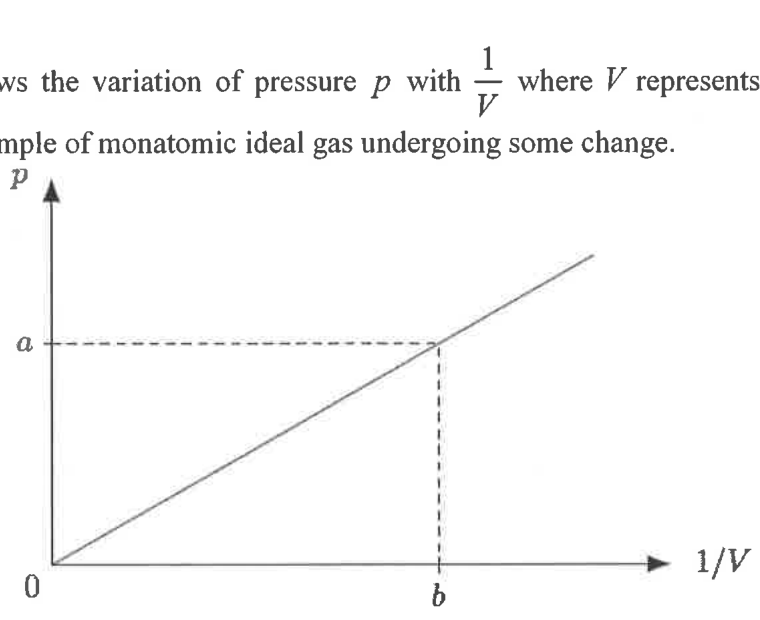 Fig. 14
If represents the average kinetic energy per molecule of the gas, which of the following expressions gives the number of molecules in the sample of the gas?
- (A)
- (B)
- (C)
- (D)
- (E)
Fonte: Testo (PDF) — p.16 Topic: Kinetic Theory Metodi: Kinetic Theory of Gases, Ideal Gas Law Competenze: Physical Reasoning Objects: Gas
Fig. - Cosa? 14 mostra la variazione della pressione con , dove rappresenta il volume per una massa fissa di un campione di gas ideale monatomo che subisce qualche modifica.
Fig. 14
Se rappresenta l’energia cinetica media per molecola del gas, quale delle seguenti espressioni dà il numero di molecole nel campione del gas?
- (A)
- (B)
- (C)
- (D)
- (E)
Fonte: Testo (PDF) — p.16 Topic: Kinetic Theory Metodi: Kinetic Theory of Gases, Ideal Gas Law Competenze: Physical Reasoning Objects: Gas