50 m and 3 s.
- (A) Yes, by applying his brake and coming to a stop before the intersection only.
- (B) Yes, by continuing to drive at the speed limit only.
- (C) Yes, both (A) and (B) work.
- (D) No, both (A) and (B) do not work, and he will run the red light.
Fonte: Testo (PDF) — p.3
Topic: Newtonian Mechanics Metodi: Kinematic Equations Competenze: Physical Reasoning Objects: —
50 m e 3 s.
- **(A) ** Sì, applicando il freno e fermandosi solo prima dell’intersezione.
- **(B) ** Sì, continuando a guidare solo al limite di velocità.
- **(C) ** Sì, funzionano entrambi (A) e (B).
- **(D) ** No, sia (A) che (B) non funzionano e lui eseguirà il semaforo rosso.
Fonte: Testo (PDF) — p.3
Topic: Newtonian Mechanics Metodi: Kinematic Equations Competenze: Physical Reasoning Objects: —
40 m and 2 s.
- (A) Yes, by continuing to drive at the speed limit only.
- (B) Yes, by applying his brake and coming to a stop before the intersection only.
- (C) Yes, both (A) and (B) work.
- (D) No, both (A) and (B) do not work, and he will run the red light.
Fonte: Testo (PDF) — p.3
Topic: Newtonian Mechanics Metodi: Kinematic Equations Competenze: Physical Reasoning Objects: —
40 m e 2 s.
- **(A) ** Sì, continuando a guidare solo al limite di velocità.
- **(B) ** Sì, applicando il freno e fermandosi solo prima dell’intersezione.
- **(C) ** Sì, funzionano entrambi (A) e (B).
- **(D) ** No, sia (A) che (B) non funzionano e lui eseguirà il semaforo rosso.
Fonte: Testo (PDF) — p.3
Topic: Newtonian Mechanics Metodi: Kinematic Equations Competenze: Physical Reasoning Objects: —
What is the minimum duration for the yellow light so that the law-abiding driver can avoid running the red light, either by continuing to drive at the speed limit or by applying his brake and coming to a stop before the intersection, when he is approaching one?
- (A)
- (B)
- (C)
- (D)
- (E)
Fonte: Testo (PDF) — p.3
Topic: Newtonian Mechanics Metodi: Kinematic Equations Competenze: Physical Reasoning Objects: —
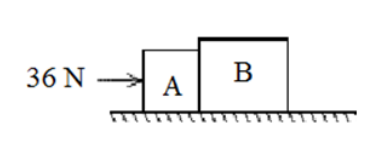
For questions 4 and 5. Two blocks, A and B, of masses and are in contact and are moving with velocity on a horizontal floor. The 36-N constant force is then applied to A for 5 seconds as shown. Ignore friction.
Qual è la durata minima della luce gialla per evitare che il conducente rispettoso della legge faccia il semaforo rosso, continuando a guidare al limite di velocità o appoggiando il freno e fermandosi prima dell’intersezione, quando si avvicina a una?
- (A)
- (B)
- (C)
- (D)
- (E)
Fonte: Testo (PDF) — p.3
Topic: Newtonian Mechanics Metodi: Kinematic Equations Competenze: Physical Reasoning Objects: —
*Per le domande 4 e 5. * Due blocchi, A e B, di massa e sono in contatto e si muovono con velocità su un pavimento orizzontale. La forza costante 36-N viene quindi applicata a A per 5 secondi come mostrato. Ignora gli attriti.
After 5 seconds, the momentum (in ) of block B is ___.
- (A)
- (B)
- (C)
- (D)
- (E)
Fonte: Testo (PDF) — p.4
Topic: Conservation of Momentum Metodi: Impulse-Momentum Theorem Competenze: Physical Reasoning Objects: Block
Dopo 5 secondi, la dinamica (in ) del blocco B è ___.
- (A)
- (B)
- (C)
- (D)
- (E)
Fonte: Testo (PDF) — p.4
Topic: Conservation of Momentum Metodi: Impulse-Momentum Theorem Competenze: Physical Reasoning Objects: Block
After 5 seconds, the net work done (in J) on block A is ___.
- (A)
- (B)
- (C)
- (D)
- (E)
Fonte: Testo (PDF) — p.4
Topic: Newtonian Mechanics Metodi: Kinematic Equations, Free-Body Diagram Competenze: Physical Reasoning Objects: Block
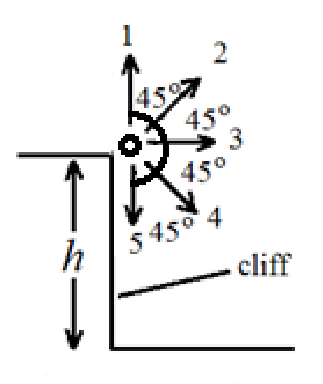
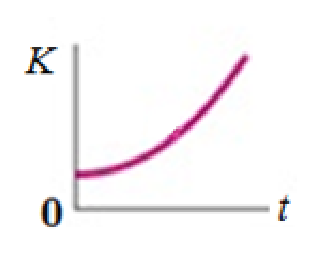
For questions 6 and 7. A ball is launched with a non-zero velocity in one of the five directions from the edge of a cliff. Direction 1 is vertically up and direction 5 is vertically down, and direction 3 is rightward horizontally while directions 2 (4) are mid-way between 1 and 3 (3 and 5). The ball’s kinetic energy varies with time as shown. Note that the gradient of the – graph is zero at .
Dopo 5 secondi, il lavoro netto svolto (in J) sul blocco A è ___.
- (A)
- (B)
- (C)
- (D)
- (E)
Fonte: Testo (PDF) — p.4
Topic: Newtonian Mechanics Metodi: Kinematic Equations, Free-Body Diagram Competenze: Physical Reasoning Objects: Block
*Per le domande 6 e 7. * Una palla viene lanciata con velocità non zero in una delle cinque direzioni dal bordo di una scogliera. La direzione 1 è verticalmente in su e la direzione 5 è verticalmente in basso, e la direzione 3 è orizzontale a destra, mentre le direzioni 2 (4) sono a metà strada tra 1 e 3 (3 e 5). L’energia cinetica della palla varia con il tempo come mostrato. Si noti che il gradiente del grafico K$$t è zero a .
Which is the direction of the initial velocity of the ball?
- (A)
- (B)
- (C)
- (D)
- (E)
Fonte: Testo (PDF) — p.4
Topic: Newtonian Mechanics Metodi: Kinematic Equations Competenze: Physical Reasoning Objects: Ball
Qual è la direzione della velocità iniziale della palla?
- (A)
- (B)
- (C)
- (D)
- (E)
Fonte: Testo (PDF) — p.4
Topic: Newtonian Mechanics Metodi: Kinematic Equations Competenze: Physical Reasoning Objects: Ball
Ignoring air resistance, the time taken for the ball to land at the bottom of the cliff is ___.
- (A)
- (B)
- (C)
- (D)
- (E)
Fonte: Testo (PDF) — p.5
Topic: Newtonian Mechanics Metodi: Kinematic Equations Competenze: Physical Reasoning Objects: Ball
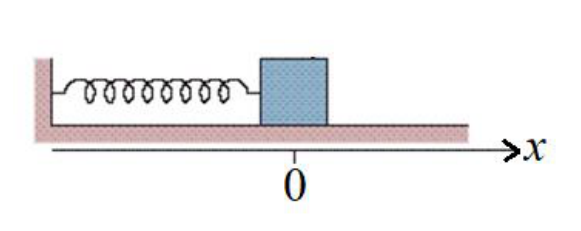
For questions 8 and 9. A spring that obeys Hooke’s law and a block of mass are set up as shown. When the block is at , the spring is at its natural length. The block is pulled out to , and a force of magnitude is required to hold it there. Then the block is released. Ignore friction.
Ignorando la resistenza dell’aria, il tempo necessario per che la palla atterri al fondo della scogliera è di ___.
- (A)
- (B)
- (C)
- (D)
- (E)
Fonte: Testo (PDF) — p.5
Topic: Newtonian Mechanics Metodi: Kinematic Equations Competenze: Physical Reasoning Objects: Ball
Per le domande 8 e 9. Sono montate come mostrato una sorgente che obbedisce alla legge di Hooke e un blocco di massa . Quando il blocco è , la molla è alla sua lunghezza naturale. Il blocco viene tirato fuori a e per tenerlo lì è richiesta una forza di magnitudine . Poi il blocco viene rilasciato. Ignora gli attriti.
How much is the work done by the spring on the block to move it from to ?
- (A)
- (B)
- (C)
- (D)
- (E) cannot be determined as the spring constant is not given
Fonte: Testo (PDF) — p.5
Topic: Conservation of Energy Metodi: Hooke’s Law Competenze: Physical Reasoning Objects: Spring, Block
Quanto lavoro è fatto dalla molla sul blocco per spostarla da a ?
- (A)
- (B)
- (C)
- (D)
- **(E) ** non può essere determinato poiché non è data la costante di primavera
Fonte: Testo (PDF) — p.5
Topic: Conservation of Energy Metodi: Hooke’s Law Competenze: Physical Reasoning Objects: Spring, Block
How much time does the spring take to move the block from to ?
- (A)
- (B)
- (C)
- (D)
- (E)
Fonte: Testo (PDF) — p.5
Topic: Oscillations & Waves Metodi: Simple Harmonic Motion Analysis Competenze: Physical Reasoning Objects: Spring, Block
Questions 10 and 11.
Quanto tempo ci vuole per spostare il blocco da a ?
- (A)
- (B)
- (C)
- (D)
- (E)
Fonte: Testo (PDF) — p.5
Topic: Oscillations & Waves Metodi: Simple Harmonic Motion Analysis Competenze: Physical Reasoning Objects: Spring, Block
Questioni 10 e 11.
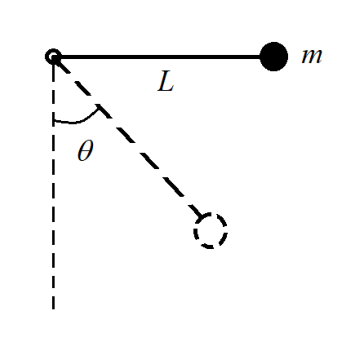
A simple pendulum, consisting of a string tied to a frictionless fixed pivot at one end and a bob of mass at the other end, is gently released from the horizontal position (i.e. ) as shown. After the release, the tension of the string is given by ___.
- (A)
- (B)
- (C)
- (D)
- (E)
Fonte: Testo (PDF) — p.6
Topic: Newtonian Mechanics Metodi: Conservation of Energy, Free-Body Diagram Competenze: Physical Reasoning Objects: Pendulum
Un semplice pendolo, costituito da una corda legata ad un pivot fisso senza attrito ad una estremità e da un bob di massa all’altra, viene liberato dolcemente dalla posizione orizzontale (cioè ) come mostrato. Dopo il rilascio, la tensione della corda viene data da ___.
- (A)
- (B)
- (C)
- (D)
- (E)
Fonte: Testo (PDF) — p.6
Topic: Newtonian Mechanics Metodi: Conservation of Energy, Free-Body Diagram Competenze: Physical Reasoning Objects: Pendulum
In order for the string not to break during the swing, it must be able to withstand a tension of ___.
- (A)
- (B)
- (C)
- (D)
- (E)
Fonte: Testo (PDF) — p.6
Topic: Newtonian Mechanics Metodi: Conservation of Energy, Free-Body Diagram Competenze: Physical Reasoning Objects: Pendulum
For questions 12 and 13.
Per non rompere la corda durante lo swing, deve essere in grado di resistere a una tensione di ___.
- (A)
- (B)
- (C)
- (D)
- (E)
Fonte: Testo (PDF) — p.6
Topic: Newtonian Mechanics Metodi: Conservation of Energy, Free-Body Diagram Competenze: Physical Reasoning Objects: Pendulum
Per le domande 12 e 13.
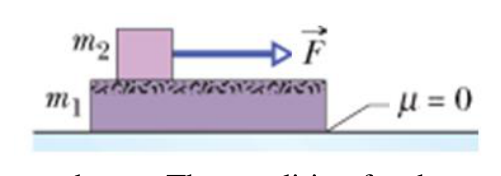
A slab of mass rests on a frictionless floor, and a block of mass rests on top of the slab. Between the block and slab, the coefficient of static friction is and the coefficient of kinetic friction is . A horizontal force of magnitude begins to pull directly on the block, as shown. The condition for the two masses to move as one piece is ___, where .
- (A)
- (B)
- (C)
- (D)
- (E) The two masses will always move as one piece since there is friction between them and no friction between the slab and the floor.
Hint: The kinetic friction on an object is given by where is the normal force on the object. The maximum static friction on an object is given by .
Fonte: Testo (PDF) — p.6
Topic: Newtonian Mechanics Metodi: Free-Body Diagram Competenze: Physical Reasoning Objects: Block
Una lastra di massa si posa su un pavimento senza attrito e un blocco di massa si posa sulla superficie della lastra. Tra il blocco e la lastra, il coefficiente di attrito statico è e il coefficiente di attrito cinetico è . Una forza orizzontale di magnitudo inizia a tirare direttamente sul blocco, come mostrato. La condizione per le due masse di muoversi come un pezzo è ___, dove .
- (A)
- (B)
- (C)
- (D)
- **(E) ** Le due masse si muovono sempre come un unico pezzo poiché c’è attrito tra di loro e non c’è attrito tra la lastra e il pavimento.
Signore: La frizione cinetica su un oggetto è data da dove è la forza normale sull’oggetto. La friczione statica massima su un oggetto è data da .
Fonte: Testo (PDF) — p.6
Topic: Newtonian Mechanics Metodi: Free-Body Diagram Competenze: Physical Reasoning Objects: Block
Suppose and , , and . What is the resulting acceleration (in ) of the block? Take .
- (A)
- (B)
- (C)
- (D)
- (E)
Fonte: Testo (PDF) — p.7
Topic: Newtonian Mechanics Metodi: Free-Body Diagram Competenze: Physical Reasoning Objects: Block
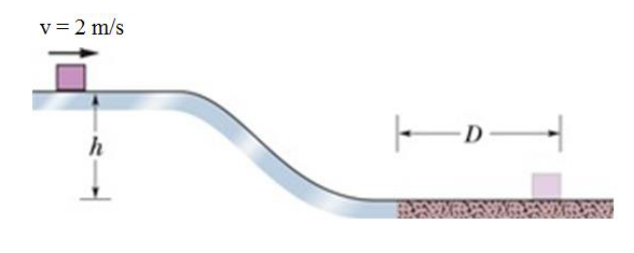
For questions 14–16. A block of mass slides with an initial velocity of along a horizontal track that descends through distance . The track is frictionless except for the lower section. There the block slides to a stop in a certain distance because of friction.
Supponiamo e , , e . Qual è l’accelerazione risultante (in ) del blocco? Prendi .
- (A)
- (B)
- (C)
- (D)
- (E)
Fonte: Testo (PDF) — p.7
Topic: Newtonian Mechanics Metodi: Free-Body Diagram Competenze: Physical Reasoning Objects: Block
Per le domande 1416. Un blocco di massa scorre con una velocità iniziale di lungo una pista orizzontale che scende attraverso la distanza . La pista è senza attrito, tranne che nella sezione inferiore. Lì il blocco si ferma a una certa distanza a causa dell’attrito.
If is halved, ___.
- (A) will be halved
- (B) will be unchanged
- (C) will be doubled
- (D) will be tripled
- (E) cannot be determined due to insufficient information
Fonte: Testo (PDF) — p.7
Topic: Conservation of Energy Metodi: Energy Conservation Method Competenze: Physical Reasoning Objects: Block
Se è dimezzato, ___.
- **(A) ** sarà dimezzato
- **(B) ** resterà invariato
- **(C) ** sarà raddoppiato
- **(D) ** sarà triplicato
- **(E) ** non può essere determinato a causa di informazioni insufficienti
Fonte: Testo (PDF) — p.7
Topic: Conservation of Energy Metodi: Energy Conservation Method Competenze: Physical Reasoning Objects: Block
If is doubled, ___.
- (A) will be halved
- (B) will be unchanged
- (C) will be doubled
- (D) will be tripled
- (E) cannot be determined due to insufficient information
Fonte: Testo (PDF) — p.7
Topic: Conservation of Energy Metodi: Energy Conservation Method Competenze: Physical Reasoning Objects: Block
Se è raddoppiato, ___.
- **(A) ** sarà dimezzato
- **(B) ** resterà invariato
- **(C) ** sarà raddoppiato
- **(D) ** sarà triplicato
- **(E) ** non può essere determinato a causa di informazioni insufficienti
Fonte: Testo (PDF) — p.7
Topic: Conservation of Energy Metodi: Energy Conservation Method Competenze: Physical Reasoning Objects: Block
If is doubled, the total thermal energy generated due to friction as the block slides to a stop ___.
- (A) is halved
- (B) is unchanged
- (C) is doubled
- (D) is tripled
- (E) cannot be determined due to insufficient information
Fonte: Testo (PDF) — p.8
Topic: Conservation of Energy Metodi: Energy Conservation Method Competenze: Physical Reasoning Objects: Block
For questions 17–21. A block of mass is placed on top of a block of mass . Holding block stationary, it is joined by a string which passes over the pulley to a block of mass hanging by the side of (and in contact with) block , and is at height above the floor. We will assume that the string is inextensible and massless, and all the contacts between objects in relative motion are frictionless. Furthermore, we will be concerned with the part of the motion before reaches the pulley.
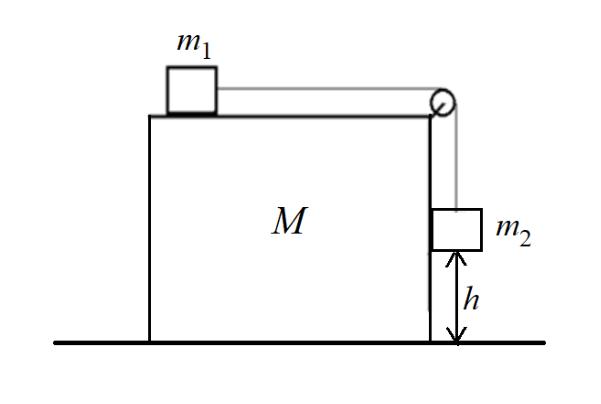
For questions 17 and 18, assume that is fixed to the floor, and the pulley is massless. After is released from rest, both and move smoothly with a constant acceleration and the string remains taut.
Se è raddoppiato, l’energia termica totale generata a causa dell’attrito quando il blocco scivola a un punto di arresto ___.
- **(A) ** è dimezzato
- **(B) ** è invariato
- **(C) ** è raddoppiato
- **(D) ** è triplicato
- **(E) ** non può essere determinato a causa di informazioni insufficienti
Fonte: Testo (PDF) — p.8
Topic: Conservation of Energy Metodi: Energy Conservation Method Competenze: Physical Reasoning Objects: Block
Per le domande 1721. Un blocco di massa è posizionato sopra un blocco di massa . blocco di tenuta stazionario, unito da una corda che passa sopra la polla a un blocco di massa appeso sul lato (e in contatto con) il blocco , e che è ad un’altezza sopra il pavimento. Supponiamo che la corda sia inespandibile e senza massa, e tutti i contatti tra oggetti in movimento relativo sono senza attrito. Furthermore, we will be concerned with the part of the motion before reaches the pulley.
Per le domande 17 e 18, supponiamo che sia fissato al pavimento e che la polla sia senza massa. Dopo che viene rilasciato dal riposo, sia che si muovono senza intoppi con una costante accelerazione e la corda rimane tensa.
What is the acceleration of blocks and ?
- (A)
- (B)
- (C)
- (D)
- (E)
Fonte: Testo (PDF) — p.8
Topic: Newtonian Mechanics Metodi: Free-Body Diagram Competenze: Physical Reasoning Objects: Block, Pulley, String
Qual è l’accelerazione dei blocchi e ?
- (A)
- (B)
- (C)
- (D)
- (E)
Fonte: Testo (PDF) — p.8
Topic: Newtonian Mechanics Metodi: Free-Body Diagram Competenze: Physical Reasoning Objects: Block, Pulley, String
What is the time taken for to reach the floor after is released from rest?
- (A)
- (B)
- (C)
- (D)
- (E)
Fonte: Testo (PDF) — p.9
Topic: Newtonian Mechanics Metodi: Free-Body Diagram, Kinematic Equations Competenze: Physical Reasoning Objects: Block, Pulley, String
For questions 19 and 20, all assumptions remain except that is no longer fixed to the floor but can move without friction on the floor.
Qual è il tempo impiegato da per raggiungere il suolo dopo che è rilasciato da fermo?
- (A)
- (B)
- (C)
- (D)
- (E)
Fonte: Testo (PDF) — p.9
Topic: Newtonian Mechanics Metodi: Free-Body Diagram, Kinematic Equations Competenze: Physical Reasoning Objects: Block, Pulley, String
Per le domande 19 e 20, tutte le ipotesi rimangono valide tranne che non è più fissato al suolo ma può muoversi senza attrito sul suolo.
By considering the motion (or non-motion) of the centre of mass and/or otherwise, when reaches the floor, what is the distance moved by ? State in which direction if it has moved.
- (A)
- (B) , leftward
- (C) , rightward
- (D) , leftward
- (E) , rightward
Fonte: Testo (PDF) — p.9
Topic: Conservation of Momentum Metodi: Conservation of Momentum Competenze: Physical Reasoning Objects: Block, Pulley, String
Considerando il movimento (o la non-movimento) del centro di massa e/o in altro modo, quando raggiunge il pavimento, quale è la distanza spostata da ? Indicare in quale direzione se si è spostata.
- (A)
- **(B) ** , a sinistra
- **(C) ** , a destra
- **(D) ** , a sinistra
- **(E) ** , a destra
Fonte: Testo (PDF) — p.9
Topic: Conservation of Momentum Metodi: Conservation of Momentum Competenze: Physical Reasoning Objects: Block, Pulley, String
By applying a constant rightward force on , both and can remain at rest relative to without having to hold them. This force is ___.
- (A)
- (B)
- (C)
- (D)
- (E) none of the above
Fonte: Testo (PDF) — p.9
Topic: Newtonian Mechanics Metodi: Free-Body Diagram Competenze: Physical Reasoning Objects: Block, Pulley, String
Applicando una forza a destra costante su , sia che possono rimanere a riposo rispetto a senza doverli tenere. Questa forza è ___.
- (A)
- (B)
- (C)
- (D)
- **(E) ** nessuna delle seguenti:
Fonte: Testo (PDF) — p.9
Topic: Newtonian Mechanics Metodi: Free-Body Diagram Competenze: Physical Reasoning Objects: Block, Pulley, String
For this question, assume that is fixed to the floor, and the mass and radius of the pulley are and , respectively. What is the acceleration of blocks and ? Hint: Take the moment of inertia of the pulley as .
- (A)
- (B)
- (C)
- (D)
- (E)
Fonte: Testo (PDF) — p.10
Topic: Rotational Dynamics Metodi: Torque & Angular Momentum Analysis Competenze: Physical Reasoning Objects: Block, Pulley, String
Per questa domanda, supponiamo che sia fissato al pavimento e che la massa e il raggio della pollice siano e , rispettivamente. Qual è l’accelerazione dei blocchi e ? *Signal: * Prendete il momento di inerzia della polla come .
- (A)
- (B)
- (C)
- (D)
- (E)
Fonte: Testo (PDF) — p.10
Topic: Rotational Dynamics Metodi: Torque & Angular Momentum Analysis Competenze: Physical Reasoning Objects: Block, Pulley, String
Water is flowing vertically downward from a tap at a moderate speed. As it falls, the water column’s diameter ___.
- (A) decreases
- (B) remains unchanged
- (C) increases
- (D) decreases in Northern Hemisphere but increases in Southern Hemisphere
- (E) increases in Northern Hemisphere but decreases in Southern Hemisphere
Fonte: Testo (PDF) — p.10
Topic: Fluid Mechanics Metodi: Continuity Equation Competenze: Physical Reasoning Objects: —
L’acqua scorre verticalmente verso il basso da un rubinetto a una velocità moderata. Quando cade, il diametro della colonna d’acqua ___.
- **(A) ** diminuisce
- **(B) ** rimane invariato
- **(C) ** aumenta
- **(D) ** diminuisce nell’emisfero settentrionale ma aumenta nell’emisfero meridionale
- **(E) ** aumenta nell’emisfero settentrionale ma diminuisce nell’emisfero meridionale
Fonte: Testo (PDF) — p.10
Topic: Fluid Mechanics Metodi: Continuity Equation Competenze: Physical Reasoning Objects: —
Water is dripping drop by drop from a tap into a bowl placed on a nearly horizontal surface as shown. The bowl is just a couple of cm below the tap. Eventually the bowl is filled and ___.
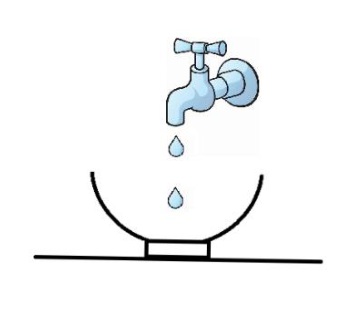
- (A) water will run off the edge of the bowl drop by drop in succession.
- (B) water will run off the edge of the bowl in a narrow stream for a little while and stop for a little while, and this pattern is repeated.
- (C) water will run off the edge of the bowl in a narrow stream continuously.
- (D) water will run off the edge of the bowl drop by drop in succession for several drops, then will stop for a little while, and this pattern is repeated.
Fonte: Testo (PDF) — p.10
Topic: Fluid Mechanics Metodi: Hydrostatic Equilibrium Competenze: Physical Reasoning Objects: Droplet, Container
L’acqua scorre goccia a goccia da un rubinetto in una ciotola posta su una superficie quasi orizzontale come mostrato. La ciotola e’ solo un paio di centimetri sotto il rubinetto. Alla fine la ciotola si riempie e ___.
- **(A) ** l’acqua scaturirà dal bordo della ciotola goccia dopo goccia.
- **(B) ** l’acqua scorre dal bordo della ciotola in un flusso stretto per un po’ e si ferma per un po’, e questo modello si ripete.
- **(C) ** l’acqua scorre continuamente dal bordo della ciotola in un flusso stretto.
- **(D) ** l’acqua scaturirà dal bordo della ciotola goccia per goccia per successive gocce per diversi, poi si fermerà per un po’, e questo modello si ripete.
Fonte: Testo (PDF) — p.10
Topic: Fluid Mechanics Metodi: Hydrostatic Equilibrium Competenze: Physical Reasoning Objects: Droplet, Container
How much weight can a Styrofoam cup of volume carry before it sinks in water? Assume the weight of Styrofoam is negligible and take the density of water as .
- (A)
- (B)
- (C)
- (D)
- (E)
Fonte: Testo (PDF) — p.11
Topic: Fluid Mechanics Metodi: Hydrostatic Equilibrium Competenze: Physical Reasoning Objects: Container
For questions 25 and 26. The specific gravity of a substance is defined as the ratio of the density of the substance to that of pure water. The specific gravity of pure ice is , and that of seawater is .
Quanto peso può portare una tazza di Styrofoam di volume prima di affondare in acqua? Supponiamo che il peso dello stirofoam sia trascurabile e prendiamo la densità dell’acqua come .
- (A)
- (B)
- (C)
- (D)
- (E)
Fonte: Testo (PDF) — p.11
Topic: Fluid Mechanics Metodi: Hydrostatic Equilibrium Competenze: Physical Reasoning Objects: Container
Per le domande 25 e 26. La gravità specifica di una sostanza è definita come il rapporto tra densità della sostanza e densità dell’acqua pura. La gravità specifica del ghiaccio puro è , e quella dell’acqua di mare è .
What percentage of an iceberg made up of pure ice is above the surface of the seawater?
- (A)
- (B)
- (C)
- (D)
- (E)
Fonte: Testo (PDF) — p.11
Topic: Fluid Mechanics Metodi: Hydrostatic Equilibrium Competenze: Physical Reasoning Objects: —
Quanta percentuale di un iceberg costituito da ghiaccio puro è sopra la superficie dell’acqua marina?
- (A)
- (B)
- (C)
- (D)
- (E)
Fonte: Testo (PDF) — p.11
Topic: Fluid Mechanics Metodi: Hydrostatic Equilibrium Competenze: Physical Reasoning Objects: —
A piece of pure ice is gently placed into a measuring cylinder containing seawater. The ice floats and the seawater level is noted. After the ice has melted, the seawater level will ___.
- (A) rise
- (B) stay the same
- (C) drop
- (D) depend on the amount of the pure ice, i.e. can be either (A) or (B) or (C)
Fonte: Testo (PDF) — p.11
Topic: Fluid Mechanics Metodi: Hydrostatic Equilibrium, Physical Modeling Competenze: Physical Reasoning Objects: Container
Un pezzo di ghiaccio puro viene messo delicatamente in un cilindro di misurazione contenente acqua di mare. Si notano i flotta di ghiaccio e il livello dell’acqua di mare. Dopo che il ghiaccio si è sciolto, il livello dell’acqua di mare ___.
- **(A) ** aumento
- **(B) ** rimane lo stesso
- **(C) **
- **(D) ** dipendono dalla quantità di ghiaccio puro, cioè può essere (A), (B) o (C)
Fonte: Testo (PDF) — p.11
Topic: Fluid Mechanics Metodi: Hydrostatic Equilibrium, Physical Modeling Competenze: Physical Reasoning Objects: Container
The solar irradiance (solar power per unit area) at the ground level is approximately when the sun is directly overhead. A solar panel has an efficiency of . Neglecting any differences in atmospheric losses, when the sun is above the horizon the power output (in ) from the solar panel placed flat at ground level is approximately ___.
- (A)
- (B)
- (C)
- (D)
- (E) cannot be estimated
Fonte: Testo (PDF) — p.12
Topic: Order-of-Magnitude Estimation Metodi: Order-of-Magnitude Estimation, Vector Decomposition Competenze: Physical Reasoning Objects: —
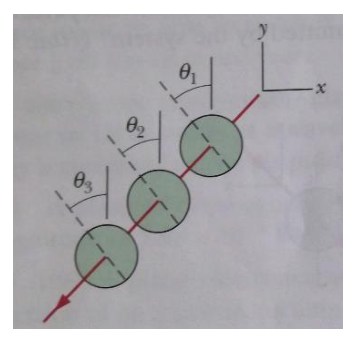
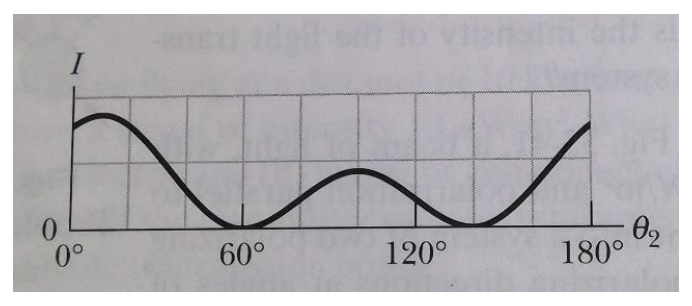
For questions 28 and 29. Unpolarized light is sent into a system of three polarizing sheets whose angles of polarizing directions are measured counter-clockwise from the positive -axis. The angles and are fixed, but can be varied. (Remark: The angles in the figure are not drawn to scale.) The intensity of the light emerging from sheet 3 as a function of is as shown below.
L’irradiazione solare (energia solare per unità di superficie) a livello del suolo è di circa quando il sole è direttamente sopra di esso. Un pannello solare ha un’efficienza di . Nonostante le differenze di perdite atmosferiche, quando il sole è sopra l’orizzonte, la potenza di uscita (in ) del pannello solare posizionato piatto a livello del suolo è di circa ___.
- (A)
- (B)
- (C)
- (D)
- **(E) ** non può essere stimato
Fonte: Testo (PDF) — p.12
Topic: Order-of-Magnitude Estimation Metodi: Order-of-Magnitude Estimation, Vector Decomposition Competenze: Physical Reasoning Objects: —
*Per le domande 28 e 29. * La luce non polarizzata viene inviata in un sistema di tre fogli polarizzanti i cui angoli di direzioni polarizzanti sono misurati in senso contro orario rispetto all’asse positivo . Gli angoli e sono fissi, ma possono essere variati. (Nota: gli angoli della figura non sono tracciati a scala.) L’intensità della luce che emerge dal foglio 3 come funzione di è mostrata di seguito.
Which of the following is a possible set of values for and ?
- (A) ,
- (B) ,
- (C) ,
- (D) ,
- (E) none of the above
Fonte: Testo (PDF) — p.12
Topic: Wave Optics Metodi: Interference & Diffraction Analysis, Physical Modeling Competenze: Physical Reasoning Objects: —
Qual è una delle seguenti serie di valori possibili per e ?
- (A) ,
- (B) ,
- (C) ,
- (D) ,
- **(E) ** nessuna delle seguenti:
Fonte: Testo (PDF) — p.12
Topic: Wave Optics Metodi: Interference & Diffraction Analysis, Physical Modeling Competenze: Physical Reasoning Objects: —
What percentage of the light’s initial intensity is transmitted by the three-sheet system when is ?
- (A)
- (B)
- (C)
- (D)
- (E)
Fonte: Testo (PDF) — p.13
Topic: Wave Optics Metodi: Interference & Diffraction Analysis, Superposition Principle Competenze: Physical Reasoning Objects: —
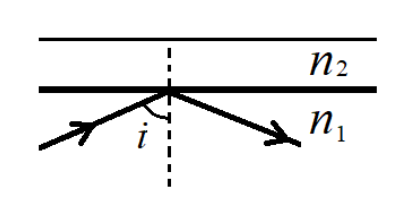
For questions 30–34. The figure below illustrates the basic idea on the transmission of data encoded in light signal via an optical fiber of length , which may be taken as comprised of three thin layers of material where the interfaces between the layers are smooth and flat. The middle layer is a transparent material of refractive index while the refractive index of the top and bottom layers is .
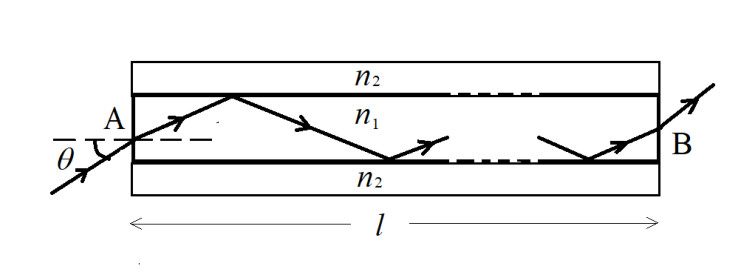
For questions 30 and 31: As illustrated by the figure here, consider the incidence of light at the interface for light coming from the layer of refractive index .
Qual è la percentuale di intensità iniziale della luce trasmessa dal sistema a tre fogli quando è ?
- (A)
- (B)
- (C)
- (D)
- (E)
Fonte: Testo (PDF) — p.13
Topic: Wave Optics Metodi: Interference & Diffraction Analysis, Superposition Principle Competenze: Physical Reasoning Objects: —
Per le domande 3034. La figura seguente illustra l’idea di base sulla trasmissione dei dati codificati in segnale luminoso tramite una fibra ottica di lunghezza , che può essere considerata come composta da tre strati sottili di materiale in cui le interfacce tra gli strati sono lisce e piatte. Lo strato medio è un materiale trasparente di indice di rifrazione mentre l’indice di rifrazione dei strati superiore e inferiore è .
*Per le domande 30 e 31: * Come illustrato dalla figura qui, considera l’incidenza della luce all’interfaccia per la luce proveniente dallo strato di indice di rifrazione .
For total internal reflection at the interface to occur, it is necessary that ___.
- (A)
- (B)
- (C)
- (D)
Fonte: Testo (PDF) — p.13
Topic: Geometric Optics Metodi: Snell’s Law, Physical Modeling Competenze: Physical Reasoning Objects: —
Per ottenere la riflessione interna totale all’interfaccia è necessario che ___.
- (A)
- (B)
- (C)
- (D)
Fonte: Testo (PDF) — p.13
Topic: Geometric Optics Metodi: Snell’s Law, Physical Modeling Competenze: Physical Reasoning Objects: —
If the angle of incidence is greater than a certain critical angle, total internal reflection occurs. The sine of the critical angle equals ___.
- (A)
- (B)
- (C)
- (D)
- (E)
Fonte: Testo (PDF) — p.13
Topic: Geometric Optics Metodi: Snell’s Law, Physical Modeling Competenze: Physical Reasoning Objects: —
For questions 32–34: When light is incident at an angle at the middle of layer A, light undergoes refraction and travels to the top interface. Under a certain condition, the light not only undergoes total internal reflection at the top interface, but travels to the bottom interface where it again undergoes total internal reflection, and this pattern is repeated until the light exits from the optical fibre at B. Assume that the optical fibre is surrounded by air that has refractive index .
Se l’angolo di incidenza è maggiore di un certo angolo critico, si verifica la riflessione interna totale. Il seno dell’angolo critico è uguale a ___.
- (A)
- (B)
- (C)
- (D)
- (E)
Fonte: Testo (PDF) — p.13
Topic: Geometric Optics Metodi: Snell’s Law, Physical Modeling Competenze: Physical Reasoning Objects: —
*Per le domande 3234: * Quando la luce incide in un angolo al centro dello strato A, la luce subisce una rifrazione e si sposta verso l’interfaccia superiore. In una certa condizione, la luce non solo subisce una riflessione interna totale all’interfaccia superiore, ma viaggia all’interfaccia inferiore dove subisce di nuovo una riflessione interna totale, e questo modello si ripete fino a quando la luce non esce dalla fibra ottica a B. Supponiamo che la fibra ottica sia circondata da aria con un indice di rifrazione .
The condition is ___.
- (A)
- (B)
- (C)
- (D)
Fonte: Testo (PDF) — p.14
Topic: Geometric Optics Metodi: Snell’s Law, Physical Modeling Competenze: Physical Reasoning Objects: —
La condizione è ___.
- (A)
- (B)
- (C)
- (D)
Fonte: Testo (PDF) — p.14
Topic: Geometric Optics Metodi: Snell’s Law, Physical Modeling Competenze: Physical Reasoning Objects: —
The incident angle can be any value between and if the following further condition holds, namely ___.
- (A)
- (B)
- (C)
- (D)
Fonte: Testo (PDF) — p.14
Topic: Geometric Optics Metodi: Snell’s Law, Physical Modeling Competenze: Physical Reasoning Objects: —
L’angolo di incidenza può essere qualsiasi valore tra e se la seguente condizione aggiuntiva è valida, vale a dire ___.
- (A)
- (B)
- (C)
- (D)
Fonte: Testo (PDF) — p.14
Topic: Geometric Optics Metodi: Snell’s Law, Physical Modeling Competenze: Physical Reasoning Objects: —
The time taken for the light to travel from A to B is ___.
- (A)
- (B)
- (C)
- (D)
- (E)
Fonte: Testo (PDF) — p.14
Topic: Geometric Optics Metodi: Snell’s Law, Physical Modeling Competenze: Physical Reasoning Objects: —
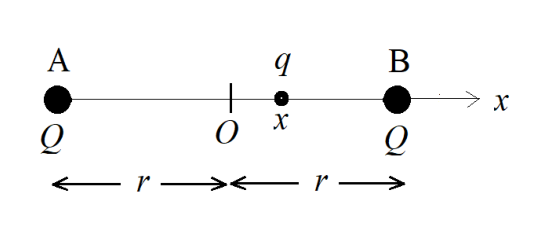
For questions 35 and 36. Two fixed positive point charges are apart, one at A and one at B. Let the mid-point between them be the origin of the -axis. A third positive charge of mass is placed at a point labelled , which is slightly to the right of the origin. Let denote .
(Hint: You may find the identity helpful. The term is very small compared to 1, and so may be ignored, i.e. can just be approximated as 1.)
Il tempo necessario per il viaggio della luce da A a B è di ___.
- (A)
- (B)
- (C)
- (D)
- (E)
Fonte: Testo (PDF) — p.14
Topic: Geometric Optics Metodi: Snell’s Law, Physical Modeling Competenze: Physical Reasoning Objects: —
*Per le domande 35 e 36. * Due cariche di punto positivo fisso sono a parte, una a A e una a B. Il punto medio tra loro è l’origine dell’asse . Una terza carica positiva di massa è collocata in un punto etichettato , leggermente a destra dell’origine. indichi .
*(Signore: Potresti trovare utile l’identità . Il termine è molto piccolo rispetto al 1, e può quindi essere ignorato, cioè può essere solo approssimato come 1.) *
The net force on at the point is given by ___.
- (A)
- (B)
- (C)
- (D)
- (E)
Fonte: Testo (PDF) — p.15
Topic: Electrostatics Metodi: Coulomb’s Law, Approximation & Series Expansion Competenze: Physical Reasoning Objects: Point Charge
La forza netta su al punto è data da ___.
- (A)
- (B)
- (C)
- (D)
- (E)
Fonte: Testo (PDF) — p.15
Topic: Electrostatics Metodi: Coulomb’s Law, Approximation & Series Expansion Competenze: Physical Reasoning Objects: Point Charge
The time taken for the charge to move to O is ___.
- (A)
- (B)
- (C)
- (D)
- (E)
Fonte: Testo (PDF) — p.15
Topic: Oscillations & Waves Metodi: Simple Harmonic Motion Analysis, Coulomb’s Law Competenze: Physical Reasoning Objects: Point Charge
Il tempo necessario per il trasferimento della carica a O è di ___.
- (A)
- (B)
- (C)
- (D)
- (E)
Fonte: Testo (PDF) — p.15
Topic: Oscillations & Waves Metodi: Simple Harmonic Motion Analysis, Coulomb’s Law Competenze: Physical Reasoning Objects: Point Charge
A compass is placed near a solenoid. When there is no current in the solenoid, the compass needle points due north as shown.
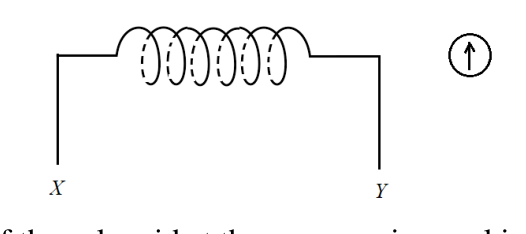
When there is current from X to Y, the magnetic field of the solenoid at the compass is equal in magnitude to the Earth’s magnetic field at that point. In which direction does the compass set?

- (A) needle points up (north)
- (B) needle points up-right (north-east)
- (C) needle points right (east)
- (D) needle points down-left (south-west)
- (E) needle points down (south)
Fonte: Testo (PDF) — p.16
Topic: Magnetism Metodi: Vector Decomposition, Physical Modeling Competenze: Physical Reasoning Objects: Solenoid, Magnet
Una bussola è posizionata vicino a un solenoide. Quando non c’è corrente nel solenoide, l’ago della bussola punta verso nord come mostrato.
Quando c’è corrente da X a Y, il campo magnetico del solenoide alla bussola è uguale in magnitudine al campo magnetico terrestre a quel punto. In che direzione la bussola si dirige?
- **(A) ** punti ago verso l’alto (nord)
- **(B) ** punti agoli verso destra (nord-est)
- **(C) ** punti ago a destra (est)
- **(D) ** punti ago a sinistra (sud-ovest)
- **(E) ** punti di ago verso il basso (sud)
Fonte: Testo (PDF) — p.16
Topic: Magnetism Metodi: Vector Decomposition, Physical Modeling Competenze: Physical Reasoning Objects: Solenoid, Magnet
You push a bar magnet with its north pole away from you toward a loop of conducting wire in front of you. The plane containing the loop is perpendicular to the magnet. As the north pole approaches the loop, the current in the loop is ___.
- (A) clockwise then counterclockwise
- (B) counterclockwise then clockwise
- (C) zero
- (D) clockwise
- (E) counterclockwise
Fonte: Testo (PDF) — p.16
Topic: Electromagnetic Induction Metodi: Lenz’s Law, Faraday’s Law of Induction Competenze: Physical Reasoning Objects: Magnet, Wire
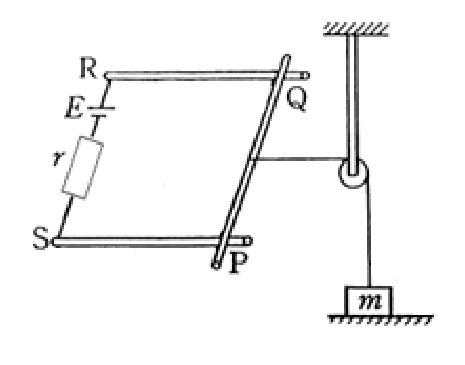
For questions 39–41. As shown in the figure, a metal rod is placed on two fixed conducting rails at points P and Q. R and S are the end points of the rails, so PQRS is a square circuit of side on a horizontal plane. Between RS is a battery of emf , a resistance and a switch (not shown). A mass resting on the floor is connected to the rod at the mid-point of PQ by a horizontal string which passes through a pulley and runs parallel to the rails.
Neglect the resistances of the rails, the rod and the contacts as well as the internal resistance of the battery. Neglect also the mass of the rod and string, and the friction between parts in relative motion. Take , , , , .
Now, we want to lift the mass by passing as small as possible a magnetic field through the circuit.
Spingi un magnete a barre con il suo polo nord lontano da te verso un circuito di filo conduttore davanti a te. Il piano contenente il ciclo è perpendicolare al magnete. Quando il polo nord si avvicina al ciclo, la corrente nel ciclo è ___.
- **(A) ** in senso orario e poi in senso contrario
- **(B) ** in senso contrario all’orologio e poi in senso orologio
- **(C) ** zero
- **(D) ** in senso orario
- **(E) ** in senso contrario all’orologio
Fonte: Testo (PDF) — p.16
Topic: Electromagnetic Induction Metodi: Lenz’s Law, Faraday’s Law of Induction Competenze: Physical Reasoning Objects: Magnet, Wire
Per le domande 3941. Come illustrato nella figura, una canna metallica è collocata su due binari di conduttore fissi ai punti P e Q. R e S sono i punti terminali dei binari, quindi PQRS è un circuito quadrato di lato su un piano orizzontale. Tra RS si trova una batteria di emf , una resistenza e un interruttore (non mostrato). Una massa appoggiata sul pavimento è collegata alla canna al punto medio del PQ da una corda orizzontale che passa attraverso una polla e corre parallela ai binari.
Non si deve considerare le resistenze delle rotaie, della canna e dei contatti, nonché la resistenza interna della batteria. Non si deve inoltre considerare la massa della canna e della corda, e la friczione tra le parti in movimento relativo. Prendete , , , , .
Ora, vogliamo sollevare la massa passando il più piccolo possibile un campo magnetico attraverso il circuito.
In which direction should the magnetic field point?
- (A) any direction will do
- (B) horizontal leftward
- (C) horizontal rightward
- (D) vertically downward
- (E) vertically upward
Fonte: Testo (PDF) — p.16
Topic: Electromagnetism Metodi: Lorentz Force Analysis, Vector Decomposition Competenze: Physical Reasoning Objects: Rod, Battery, Resistor, Pulley, String
In che direzione dovrebbe puntare il campo magnetico?
- **(A) ** qualsiasi direzione farà
- **(B) ** orizzontale verso sinistra
- **(C) ** orizzontale verso destra
- **(D) ** verticalmente verso il basso
- **(E) ** verticalmente verso l’alto
Fonte: Testo (PDF) — p.16
Topic: Electromagnetism Metodi: Lorentz Force Analysis, Vector Decomposition Competenze: Physical Reasoning Objects: Rod, Battery, Resistor, Pulley, String
Let the magnetic field be increased from zero at a constant rate so that the mass starts to move up at 1 second. The value of the magnetic field at this time is ___.
- (A)
- (B)
- (C)
- (D)
- (E)
Fonte: Testo (PDF) — p.17
Topic: Electromagnetism Metodi: Lorentz Force Analysis, Faraday’s Law of Induction Competenze: Physical Reasoning Objects: Rod, Battery, Resistor, Pulley, String
Il campo magnetico deve essere aumentato da zero a velocità costante in modo che la massa comincia a salire a 1 secondo. Il valore del campo magnetico in questo momento è ___.
- (A)
- (B)
- (C)
- (D)
- (E)
Fonte: Testo (PDF) — p.17
Topic: Electromagnetism Metodi: Lorentz Force Analysis, Faraday’s Law of Induction Competenze: Physical Reasoning Objects: Rod, Battery, Resistor, Pulley, String
If the rate of increase of the magnetic field approaches zero, the magnitude of the magnetic field required approaches ___.
- (A)
- (B)
- (C)
- (D)
- (E)
Fonte: Testo (PDF) — p.17
Topic: Electromagnetism Metodi: Lorentz Force Analysis, Free-Body Diagram Competenze: Physical Reasoning Objects: Rod, Battery, Resistor, Pulley, String
Se il tasso di aumento del campo magnetico si avvicina a zero, la grandezza del campo magnetico richiesto si avvicina a ___.
- (A)
- (B)
- (C)
- (D)
- (E)
Fonte: Testo (PDF) — p.17
Topic: Electromagnetism Metodi: Lorentz Force Analysis, Free-Body Diagram Competenze: Physical Reasoning Objects: Rod, Battery, Resistor, Pulley, String
A hole is cut from a sheet metal. When the temperature of the sheet metal increases, the hole ___.
- (A) gets smaller
- (B) remains the same size
- (C) gets bigger
- (D) can be (A) or (B) or (C) depending on the shape of the hole.
Fonte: Testo (PDF) — p.17
Topic: Thermodynamics Metodi: Physical Modeling, Symmetry Argument Competenze: Physical Reasoning Objects: —
Un buco è tagliato da un foglio di metallo. Quando la temperatura del foglio aumenta, il buco ___.
- **(A) ** si riduce
- **(B) ** rimane la stessa dimensione
- **(C) ** diventa più grande
- **(D) ** può essere (A) o (B) o (C) a seconda della forma del buco.
Fonte: Testo (PDF) — p.17
Topic: Thermodynamics Metodi: Physical Modeling, Symmetry Argument Competenze: Physical Reasoning Objects: —
An iron ring is to fit tightly on a cylindrical iron rod. At , the diameter of the rod is and the inside diameter of the ring is . To slip over the rod, the ring must be larger than the rod diameter by about . To what temperature must the ring be heated? Take the coefficient of linear expansion of iron .
- (A)
- (B)
- (C)
- (D)
- (E)
Fonte: Testo (PDF) — p.17
Topic: Thermodynamics Metodi: Physical Modeling, Dimensional Analysis Competenze: Physical Reasoning Objects: Rod
Un anello di ferro deve fissarsi strettamente su una canna di ferro cilindrica. Al , il diametro della canna è e il diametro interno dell’anello è . Per superare la canna, l’anello deve essere di circa di diametro superiore alla canna. A che temperatura deve essere riscaldato l’anello? Prendiamo il coefficiente di espansione lineare del ferro .
- (A)
- (B)
- (C)
- (D)
- (E)
Fonte: Testo (PDF) — p.17
Topic: Thermodynamics Metodi: Physical Modeling, Dimensional Analysis Competenze: Physical Reasoning Objects: Rod
It is recommended to use water of approximately to make green tea. This can be prepared by mixing litres of water at room temperature () with every litre of water at . Neglecting the small changes in the density of water as its temperature changes, the value of ___.
- (A) is
- (B) is
- (C) is
- (D) is
- (E) cannot be determined
Fonte: Testo (PDF) — p.18
Topic: Thermodynamics Metodi: First Law of Thermodynamics, Conservation of Energy Competenze: Physical Reasoning Objects: —
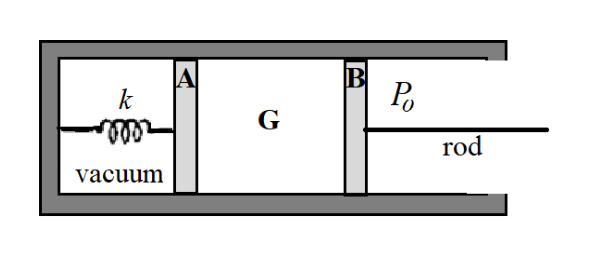
Questions 45–50. The figure shows the interior of an open-at-one-end cylinder of cross-sectional area . The cylinder is fixed and is partitioned into three sections by two smoothly movable partitions A and B of negligible mass. The leftmost section is a vacuum, the middle section is filled with an ideal gas G and the rightmost section is open, and therefore subject to the atmospheric pressure . A massless spring of spring constant connects partition A to the base of cylinder and a massless rod is connected to partition B. The cylinder and the partitions are made of heat-insulating materials.
Initially the system is at equilibrium with partitions A and B being stationary, G’s temperature and volume are and respectively, and the compression of the spring is .
Si raccomanda di utilizzare acqua di circa per preparare il tè verde. Questo prodotto può essere preparato miscelando litri di acqua a temperatura ambiente () con ogni litro di acqua a . Negli occhi dei piccoli cambiamenti nella densità dell’acqua a causa dei cambiamenti di temperatura, il valore di ___.
- (A) is
- (B) is
- (C) is
- (D) is
- **(E) ** non può essere determinato
Fonte: Testo (PDF) — p.18
Topic: Thermodynamics Metodi: First Law of Thermodynamics, Conservation of Energy Competenze: Physical Reasoning Objects: —
*Questioni 4550. * La figura mostra l’interno di un cilindro aperto a una estremità di superficie trasversale . Il cilindro è fissato e diviso in tre sezioni da due partizioni a massa trascurabile, A e B, che si muovono lisciomente. La sezione più sinistra è un vuoto, la sezione media è riempita di gas ideale G e la sezione più destra è aperta e quindi soggetta alla pressione atmosferica . Una molla senza massa di costante molla collega la partizione A alla base del cilindro e una canna senza massa è collegata alla partizione B. Il cilindro e le partizioni sono realizzati in materiali isolanti dal calore.
Inizialmente il sistema è in equilibrio con partizioni A e B stazionarie, la temperatura e il volume di G sono rispettivamente e , e la compressione della molla è .
The compression of the spring is given by ___.
- (A)
- (B)
- (C)
- (D)
- (E)
Fonte: Testo (PDF) — p.18
Topic: Thermodynamics Metodi: Free-Body Diagram, Hooke’s Law Competenze: Physical Reasoning Objects: Cylinder, Gas, Piston, Spring, Rod
Now the ideal gas G is heated up slowly (say by a heater inserted into the middle section while keeping the heat insulation) to temperature while you are keeping partition B fixed in position by holding and exerting a force on the rod. The spring is observed to have compressed by , i.e. its length now is shorter than its natural length by .
La compressione della molla è data da ___.
- (A)
- (B)
- (C)
- (D)
- (E)
Fonte: Testo (PDF) — p.18
Topic: Thermodynamics Metodi: Free-Body Diagram, Hooke’s Law Competenze: Physical Reasoning Objects: Cylinder, Gas, Piston, Spring, Rod
Ora il gas ideale G viene riscaldato lentamente (per esempio con un riscaldatore inserito nella sezione media mantenendo l’isolamento termico) a temperatura mentre si mantiene la partizione B fissa in posizione tenendo e esercitando una forza sulla canna. La molla è stata osservata come compresa da , cioè la sua lunghezza è ora inferiore a quella naturale di .*
The change in the internal energy of G (namely its internal energy when at minus its internal energy when at ) is given by ___.
- (A)
- (B)
- (C)
- (D)
- (E)
Fonte: Testo (PDF) — p.19
Topic: Thermodynamics Metodi: First Law of Thermodynamics, Ideal Gas Law Competenze: Physical Reasoning Objects: Cylinder, Gas, Piston, Spring, Rod
La variazione dell’energia interna di G (ad esempio, la sua energia interna a meno la sua energia interna a ) è data da ___.
- (A)
- (B)
- (C)
- (D)
- (E)
Fonte: Testo (PDF) — p.19
Topic: Thermodynamics Metodi: First Law of Thermodynamics, Ideal Gas Law Competenze: Physical Reasoning Objects: Cylinder, Gas, Piston, Spring, Rod
The amount of heat transferred to the ideal gas G is given by ___.
- (A)
- (B)
- (C)
- (D)
- (E)
Fonte: Testo (PDF) — p.19
Topic: Thermodynamics Metodi: First Law of Thermodynamics, Conservation of Energy Competenze: Physical Reasoning Objects: Cylinder, Gas, Piston, Spring, Rod
La quantità di calore trasferita al gas ideale G è data da ___.
- (A)
- (B)
- (C)
- (D)
- (E)
Fonte: Testo (PDF) — p.19
Topic: Thermodynamics Metodi: First Law of Thermodynamics, Conservation of Energy Competenze: Physical Reasoning Objects: Cylinder, Gas, Piston, Spring, Rod
After the ideal gas G reaches temperature , the heating is turned off. Partition B slowly moves a distance to the right and G’s temperature reduces to as you slowly reduce your force exerted on the rod to zero. What is the work done by G on your hand during this time as B and your hand move the distance ?
Let
- (A) I + III − IV
- (B) I + III + IV
- (C) II − IV
- (D) II + III − IV
- (E) IV
Fonte: Testo (PDF) — p.19
Topic: Thermodynamics Metodi: First Law of Thermodynamics, Ideal Gas Law Competenze: Physical Reasoning Objects: Gas, Piston, Spring
Dopo che il gas ideale G raggiunge la temperatura , il riscaldamento viene spento. Il setto B si sposta lentamente di una distanza verso destra e la temperatura di G si riduce a mentre riduci lentamente a zero la forza esercitata sull’asta. Qual è il lavoro compiuto da G sulla tua mano durante questo intervallo, mentre B e la tua mano si spostano della distanza ?
Siano
- (A) I + III − IV
- (B) I + III + IV
- (C) II − IV
- (D) II + III − IV
- (E) IV
Fonte: Testo (PDF) — p.19
Topic: Thermodynamics Metodi: First Law of Thermodynamics, Ideal Gas Law Competenze: Physical Reasoning Objects: Gas, Piston, Spring
Next, you let go of your hand that was holding the rod and heat is removed from G slowly by some appropriate means until G returns to its initial state of pressure and volume . How much heat is removed?
Let
- (A) I − III
- (B) I + III
- (C) II − III
- (D) II + III
- (E) IV
Fonte: Testo (PDF) — p.20
Topic: Thermodynamics Metodi: First Law of Thermodynamics, Ideal Gas Law Competenze: Physical Reasoning Objects: Gas, Piston
Successivamente, lasci la presa della mano che teneva l’asta e il calore viene rimosso lentamente da G con qualche mezzo appropriato finché G torna al suo stato iniziale di pressione e volume . Quanto calore viene rimosso?
Siano
- (A) I − III
- (B) I + III
- (C) II − III
- (D) II + III
- (E) IV
Fonte: Testo (PDF) — p.20
Topic: Thermodynamics Metodi: First Law of Thermodynamics, Ideal Gas Law Competenze: Physical Reasoning Objects: Gas, Piston
As described between questions 45 to 49, the complete cycle of processes that the ideal gas G undergoes, starting from and returning to the pressure and volume , is described by which of the following graphs?

- (A) graph (a)
- (B) graph (b)
- (C) graph (c)
- (D) graph (d)
- (E) graph (e)
Fonte: Testo (PDF) — p.20
Topic: Thermodynamics Metodi: Thermodynamic Cycle Analysis, First Law of Thermodynamics Competenze: Physical Reasoning Objects: Gas
Come descritto tra le domande 45-49, quale dei grafici seguenti descrive il ciclo completo di processi che il gas ideale G subisce, partendo da e tornando alla pressione e al volume ?
- **(A) ** grafico (a)
- **(B) ** grafico (b)
- **(C) ** grafico (c)
- **(D) ** grafico (d)
- **(E) ** grafico (e)
Fonte: Testo (PDF) — p.20
Topic: Thermodynamics Metodi: Thermodynamic Cycle Analysis, First Law of Thermodynamics Competenze: Physical Reasoning Objects: Gas