Four objects of different masses are dropped from rest from the heights shown below. Air resistance is negligible. Which object will have the largest average speed during its motion?
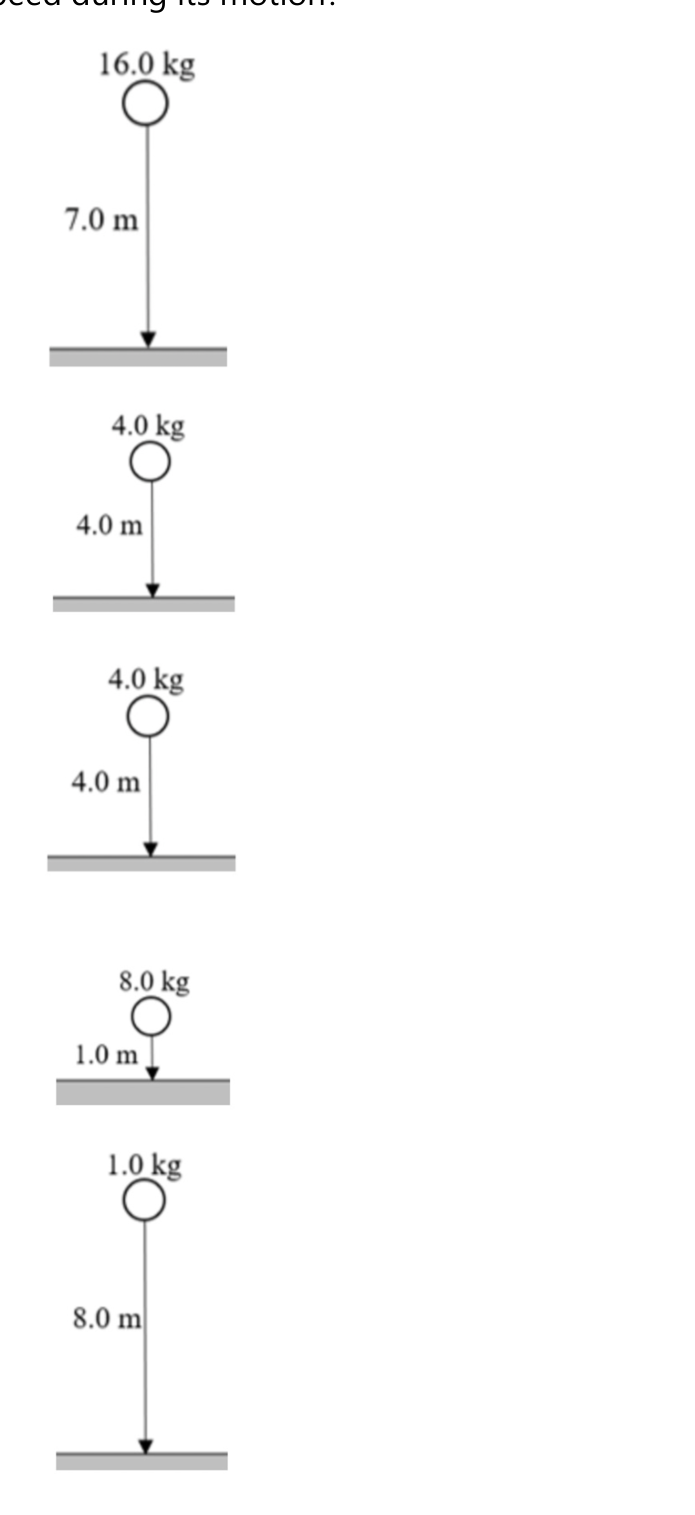
The five cases (a–e) are, respectively: (a) falling ; (b) falling ; (c) falling ; (d) falling ; (e) falling .
Fonte: Testo (PDF) — p.1
Topic: Newtonian Mechanics Metodi: Kinematic Equations, Conservation of Energy Competenze: Physical Reasoning Objects: —
Quattro oggetti di diverse masse vengono abbassati dal riposo dalle altezze mostrate sotto. La resistenza all’aria è trascurabile. Quale oggetto avrà la velocità media più alta durante il suo movimento?
I cinque casi (ae) sono: a) che cade ; b) che cade ; c) che cade ; d) che cade ; e) che cade .
Fonte: Testo (PDF) — p.1
Topic: Newtonian Mechanics Metodi: Kinematic Equations, Conservation of Energy Competenze: Physical Reasoning Objects: —
Two runners take part in a marathon. The graph below shows how the speed of each runner changes with time.
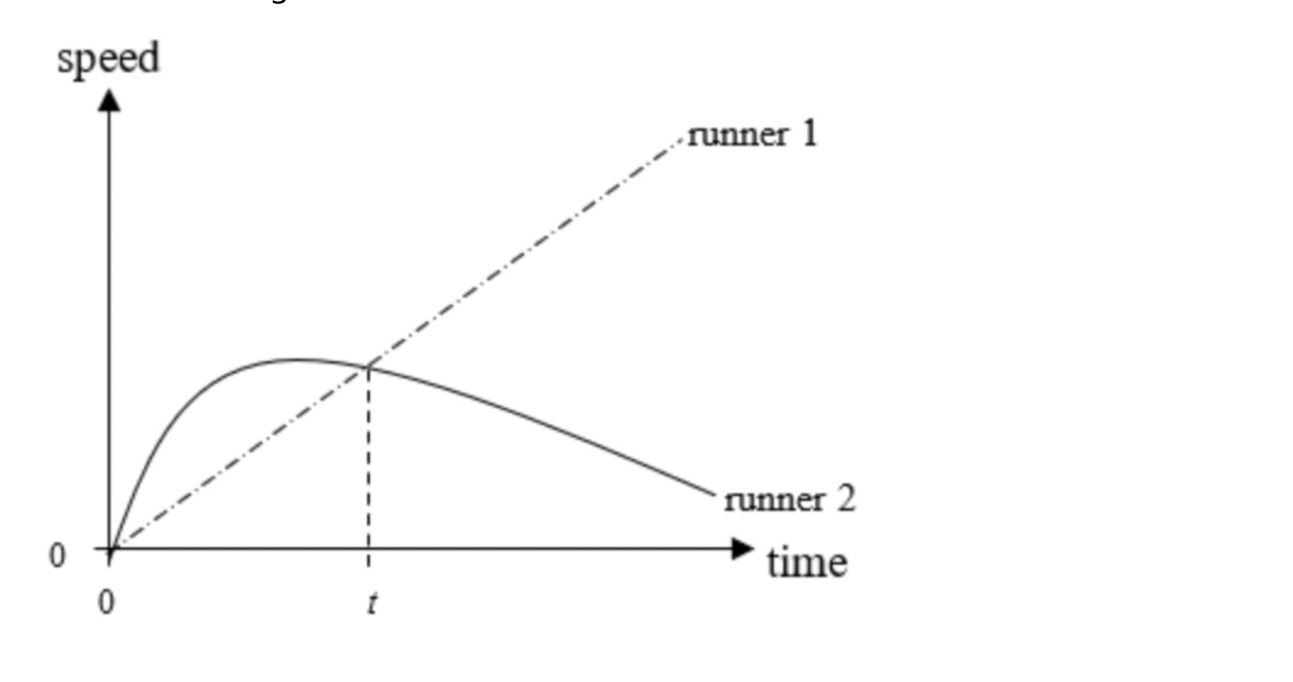
Which of the following statements are true at time ?
-
(i) Runner 1 just overtakes runner 2.
-
(ii) Both runners are at the same speed.
-
(iii) Runner 1 runs with zero acceleration.
-
(iv) Runner 2 is ahead of runner 1.
-
(A) (ii), (iii), and (iv)
-
(B) (ii) and (iv)
-
(C) (i) and (iii)
-
(D) (i) only
Fonte: Testo (PDF) — p.2
Topic: Newtonian Mechanics Metodi: Kinematic Equations, Experimental Data Analysis Competenze: Physical Reasoning Objects: —
Due corridori partecipano a una maratona. Il grafico qui sotto mostra come la velocità di ogni corridore cambia con il tempo.
Quali delle seguenti affermazioni sono vere al tempo ?
-
(i) Il corridore 1 supera il corridore 2.
-
(ii) Entrambi i corridori sono alla stessa velocità.
-
(iii) Correre 1 correre con zero accelerazione.
-
(iv) Il corridore 2 è davanti al corridore 1.
-
**(A) ** (ii), (iii) e (iv)
-
**(B) ** (ii) e (iv)
-
**(C) ** (i) e (iii)
-
**(D) ** (i) solo
Fonte: Testo (PDF) — p.2
Topic: Newtonian Mechanics Metodi: Kinematic Equations, Experimental Data Analysis Competenze: Physical Reasoning Objects: —
A truck is moving at a speed of and a car is moving at a speed of . If the truck’s kinetic energy is times that of the car’s, what is the ratio of the truck’s mass to the car’s mass?
- (A)
- (B)
- (C)
- (D)
Fonte: Testo (PDF) — p.3
Topic: Conservation of Energy Metodi: Energy Conservation Method Competenze: Physical Reasoning Objects: —
Un camion si muove a una velocità e un’auto a una velocità . Se l’energia cinetica del camion è volte quella dell’auto, qual è il rapporto tra la massa del camion e la massa dell’auto?
- (A)
- (B)
- (C)
- (D)
Fonte: Testo (PDF) — p.3
Topic: Conservation of Energy Metodi: Energy Conservation Method Competenze: Physical Reasoning Objects: —
The area under an object’s acceleration versus time graph over a fixed time interval is found to be . Which of the following must be true?
- (A) The object’s change in velocity during the time interval is .
- (B) The object’s velocity at the end of the time interval is .
- (C) The object’s average speed during the time interval is .
- (D) The object’s average velocity during the time interval is .
Fonte: Testo (PDF) — p.3
Topic: Newtonian Mechanics Metodi: Kinematic Equations Competenze: Physical Reasoning Objects: —
L’area sotto l’accelerazione di un oggetto rispetto al grafico temporale su un intervallo di tempo fisso è . Quale delle seguenti cose deve essere vera?
- **(A) ** Il cambiamento di velocità dell’oggetto durante l’intervallo temporale è .
- **(B) ** La velocità dell’oggetto alla fine dell’intervallo temporale è .
- **(C) ** La velocità media dell’oggetto durante l’intervallo temporale è .
- **(D) ** La velocità media dell’oggetto durante l’intervallo temporale è .
Fonte: Testo (PDF) — p.3
Topic: Newtonian Mechanics Metodi: Kinematic Equations Competenze: Physical Reasoning Objects: —
An object moves in a vertical circle, starting at the bottom, with an initial speed of . Its speed increases uniformly until it has moved clockwise through an angle of degrees. The average acceleration for this motion is directed straight upwards. What is the time taken for this motion?
- (A)
- (B)
- (C)
- (D)
Fonte: Testo (PDF) — p.4
Topic: Newtonian Mechanics Metodi: Kinematic Equations, Vector Decomposition Competenze: Physical Reasoning Objects: —
Un oggetto si muove in un cerchio verticale, partendo dal basso, con una velocità iniziale di . La sua velocità aumenta uniformemente fino a quando non si è spostata in senso orario attraverso un angolo di gradi. L’accelerazione media di questo movimento è diretta dritta verso l’alto. Quanto tempo ci vuole per questa mozione?
- (A)
- (B)
- (C)
- (D)
Fonte: Testo (PDF) — p.4
Topic: Newtonian Mechanics Metodi: Kinematic Equations, Vector Decomposition Competenze: Physical Reasoning Objects: —
In the year 2050, humans start to live on Mars. In order to launch a satellite of mass from Mars, a space agency plans to use a space gun. The satellite is accelerated uniformly along a vertical tube from rest to in . What is the applied launch force required to accelerate the satellite, assuming the satellite is launched vertically upwards? ()
- (A)
- (B)
- (C)
- (D)
Fonte: Testo (PDF) — p.4
Topic: Newtonian Mechanics Metodi: Free-Body Diagram, Kinematic Equations Competenze: Physical Reasoning Objects: Satellite, Planet
Nell’anno 2050, gli esseri umani inizieranno a vivere su Marte. Per lanciare un satellite di massa da Marte, un’agenzia spaziale prevede di utilizzare un cannone spaziale. Il satellite è accelerato uniformemente lungo un tubo verticale dal riposo a in . Qual è la forza di lancio applicata necessaria per accelerare il satellite, se il satellite viene lanciato verticalmente verso l’alto? ()
- (A)
- (B)
- (C)
- (D)
Fonte: Testo (PDF) — p.4
Topic: Newtonian Mechanics Metodi: Free-Body Diagram, Kinematic Equations Competenze: Physical Reasoning Objects: Satellite, Planet
A man stands on a scale in an elevator. The elevator accelerates at downwards and eventually descends at a constant speed. What does the scale read when the elevator is travelling at the constant speed?
- (A)
- (B)
- (C)
- (D)
Fonte: Testo (PDF) — p.5
Topic: Newtonian Mechanics Metodi: Free-Body Diagram Competenze: Physical Reasoning Objects: —
A man stands on a scale in an elevator. L’ascensore accelera a verso il basso e scende alla fine a una velocità costante. Cosa dice la scala quando l’ascensore viaggia a velocità costante?
- (A)
- (B)
- (C)
- (D)
Fonte: Testo (PDF) — p.5
Topic: Newtonian Mechanics Metodi: Free-Body Diagram Competenze: Physical Reasoning Objects: —
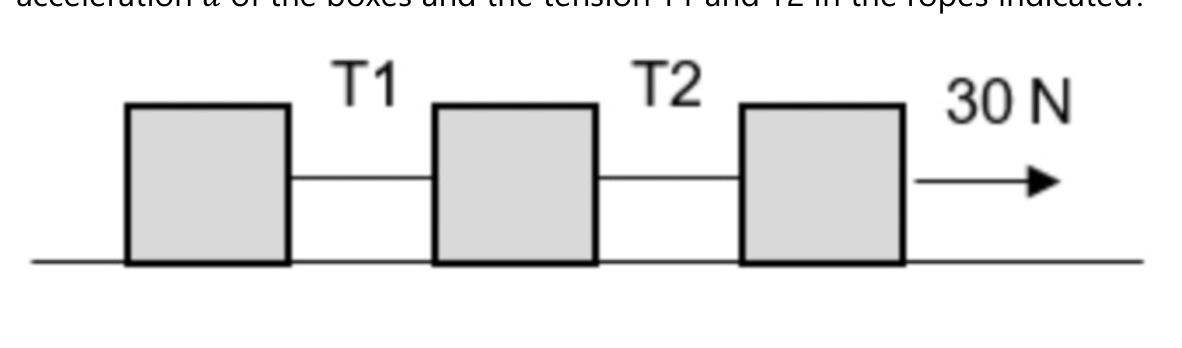
Three identical boxes of mass each are pulled by three taut ropes along a surface of negligible friction as shown in the figure below. What is the common acceleration of the boxes and the tension and in the ropes indicated?
- (A)
- (B)
- (C)
- (D)
Fonte: Testo (PDF) — p.5
Topic: Newtonian Mechanics Metodi: Free-Body Diagram Competenze: Physical Reasoning Objects: Block, String
Tre scatole identiche di massa sono state tirate ciascuna con tre corde strette lungo una superficie di attrito trascurabile come mostrato nella figura seguente. Qual è l’accelerazione comune delle scatole e la tensione e nelle corde indicate?
- (A)
- (B)
- (C)
- (D)
Fonte: Testo (PDF) — p.5
Topic: Newtonian Mechanics Metodi: Free-Body Diagram Competenze: Physical Reasoning Objects: Block, String
A ball of mass falls straight down and hits the ground with a speed of . It rebounds straight up with a speed of . If the magnitude of the average force exerted by the ground on the ball while they are in contact is , what is the duration for which the ball and the ground are in contact?
- (A)
- (B)
- (C)
- (D)
Fonte: Testo (PDF) — p.6
Topic: Conservation of Momentum Metodi: Impulse-Momentum Theorem Competenze: Physical Reasoning Objects: Ball
Una palla di massa cade dritta e colpisce il terreno con una velocità . Rimbolsa direttamente verso l’alto con una velocità di . Se la grandezza della forza media esercitata dal terreno sulla palla mentre sono in contatto è , per quale durata la palla e il terreno sono in contatto?
- (A)
- (B)
- (C)
- (D)
Fonte: Testo (PDF) — p.6
Topic: Conservation of Momentum Metodi: Impulse-Momentum Theorem Competenze: Physical Reasoning Objects: Ball
A negatively charged particle is moved along a horizontal line to the right from position to by an external agent at constant speed. The electric potential at these positions in space are and . Which statement is true about the work done by the external agent in moving the charge between these positions and the electric field component parallel to the direction of motion that the moving charged particle experiences?
- (A) The external agent does positive work and the electric field is directed to the right.
- (B) The external agent does positive work and the electric field is directed to the left.
- (C) The external agent does negative work and the electric field is directed to the right.
- (D) The external agent does negative work and the electric field is directed to the left.
Fonte: Testo (PDF) — p.6
Topic: Electrostatics Metodi: Electric Potential Method Competenze: Physical Reasoning Objects: Point Charge
Una particella carica negativamente viene spostata lungo una linea orizzontale a destra dalla posizione a da un agente esterno a velocità costante. Il potenziale elettrico in queste posizioni nello spazio è e . Quale affermazione è vera sul lavoro svolto dall’agente esterno nel spostare la carica tra queste posizioni e il componente del campo elettrico parallelo alla direzione di movimento che la particella carica in movimento sperimenta?
- **(A) ** L’agente esterno fa un lavoro positivo e il campo elettrico è diretto a destra.
- **(B) ** L’agente esterno fa un lavoro positivo e il campo elettrico è diretto a sinistra.
- **(C) ** L’agente esterno fa un lavoro negativo e il campo elettrico è diretto a destra.
- **(D) ** L’agente esterno fa un lavoro negativo e il campo elettrico è diretto a sinistra.
Fonte: Testo (PDF) — p.6
Topic: Electrostatics Metodi: Electric Potential Method Competenze: Physical Reasoning Objects: Point Charge
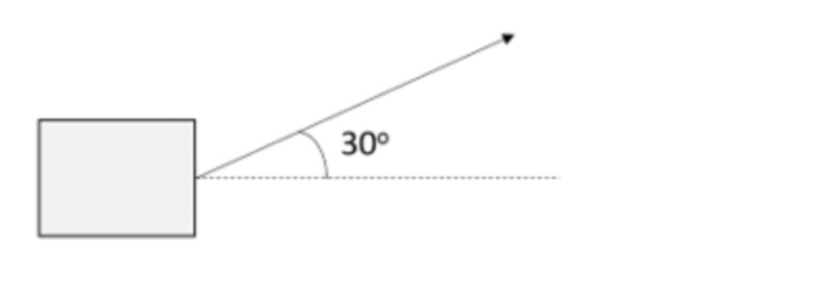
A block is dragged across the floor at a horizontal acceleration of by pulling a rope with tension at an angle of degrees above the horizontal. What is the magnitude of the frictional force acting on the block by the floor?
- (A)
- (B)
- (C)
- (D)
Fonte: Testo (PDF) — p.7
Topic: Newtonian Mechanics Metodi: Free-Body Diagram, Vector Decomposition Competenze: Physical Reasoning Objects: Block, String
Un blocco viene trascinato attraverso il pavimento ad un’accelerazione orizzontale di tirando una corda con tensione ad un angolo di gradi sopra l’orizzontale. Qual è la magnitudine della forza di attrito che agisce sul blocco vicino al pavimento?
- (A)
- (B)
- (C)
- (D)
Fonte: Testo (PDF) — p.7
Topic: Newtonian Mechanics Metodi: Free-Body Diagram, Vector Decomposition Competenze: Physical Reasoning Objects: Block, String
A wheel with an initial angular velocity of is subjected to a constant angular acceleration of . What is the time taken for it to complete revolutions?
- (A)
- (B)
- (C)
- (D)
Fonte: Testo (PDF) — p.7
Topic: Rotational Dynamics Metodi: Kinematic Equations Competenze: Physical Reasoning Objects: Wheel
Una ruota con una velocità angolare iniziale di è soggetta ad un’accelerazione angolare costante di . Quanto tempo ci vuole per completare le rivoluzioni ?
- (A)
- (B)
- (C)
- (D)
Fonte: Testo (PDF) — p.7
Topic: Rotational Dynamics Metodi: Kinematic Equations Competenze: Physical Reasoning Objects: Wheel
A geostationary satellite orbits at the same angular velocity as Earth at height above the surface of the Earth. A man standing on the surface of the Earth, at a distance from the centre of the Earth, experiences a tangential velocity of due to Earth’s rotation. What is the tangential velocity of the satellite from the centre of the Earth?
- (A)
- (B)
- (C)
- (D)
Fonte: Testo (PDF) — p.8
Topic: Gravitation Metodi: Physical Modeling Competenze: Physical Reasoning Objects: Satellite, Planet
Un satellite geostazionario orbita alla stessa velocità angolare della Terra ad un’altezza sopra la superficie terrestre. Un uomo che si trova sulla superficie della Terra, a una distanza dal centro della Terra, sperimenta una velocità tangenziale di a causa della rotazione terrestre. Qual è la velocità tangenziale del satellite dal centro della Terra?
- (A)
- (B)
- (C)
- (D)
Fonte: Testo (PDF) — p.8
Topic: Gravitation Metodi: Physical Modeling Competenze: Physical Reasoning Objects: Satellite, Planet
A solid cylinder of mass and radius is rolling without slipping on a horizontal surface with a speed of . What is the rotational kinetic energy of the cylinder? (The moment of inertia of a cylinder is .)
- (A)
- (B)
- (C)
- (D)
Fonte: Testo (PDF) — p.8
Topic: Rotational Dynamics Metodi: Torque & Angular Momentum Analysis, Energy Conservation Method Competenze: Physical Reasoning Objects: Cylinder
Un cilindro solido di massa e raggio ruota senza scivolare su una superficie orizzontale con una velocità . Qual è l’energia cinetica di rotazione del cilindro? (Il momento di inerzia di un cilindro è .)
- (A)
- (B)
- (C)
- (D)
Fonte: Testo (PDF) — p.8
Topic: Rotational Dynamics Metodi: Torque & Angular Momentum Analysis, Energy Conservation Method Competenze: Physical Reasoning Objects: Cylinder
A child is riding a free-spinning merry-go-round at the playground. He then moves towards the centre of the merry-go-round. What happens to the merry-go-round (with him as part of the system) due to his motion?
- (A) The angular velocity of the merry-go-round remains the same.
- (B) The angular velocity of the merry-go-round increases.
- (C) The merry-go-round stops rotating.
- (D) The angular velocity of the merry-go-round decreases.
Fonte: Testo (PDF) — p.9
Topic: Rotational Dynamics Metodi: Torque & Angular Momentum Analysis, Conservation Laws Competenze: Physical Reasoning Objects: Disk
Un bambino sta cavalcando un merry-go-round in giro libero sul parco giochi. Si sposta poi verso il centro del merry-go-round. Cosa succede al merry-go-round (con lui come parte del sistema) a causa del suo movimento?
- **(A) ** La velocità angolare del merry-go-round rimane la stessa.
- **(B) ** La velocità angolare del merry-go-round aumenta.
- **(C) ** Il merry-go-round si ferma a ruotare.
- **(D) ** La velocità angolare del merry-go-round diminuisce.
Fonte: Testo (PDF) — p.9
Topic: Rotational Dynamics Metodi: Torque & Angular Momentum Analysis, Conservation Laws Competenze: Physical Reasoning Objects: Disk
A sealed cup containing mostly water with a bit of air has a striped straw puncturing the side of the cup. The system has already reached equilibrium such that no more water is flowing out of the striped straw (see diagram part 1). A plain straw is now stuck in so violently through the lid that the lower end of this straw is below the level of the striped straw (see diagram part 2). As expected, the water level in the plain straw is below that of the water surface in the cup.
- (i) To what height should the lower end of the plain straw be raised such that the water starts flowing out of the horizontal striped straw (see diagram part 3)?
- (ii) If we want to lower the plain straw to stop the flow, will the critical height of its lower end remain the same as before (as in diagram part 2)?
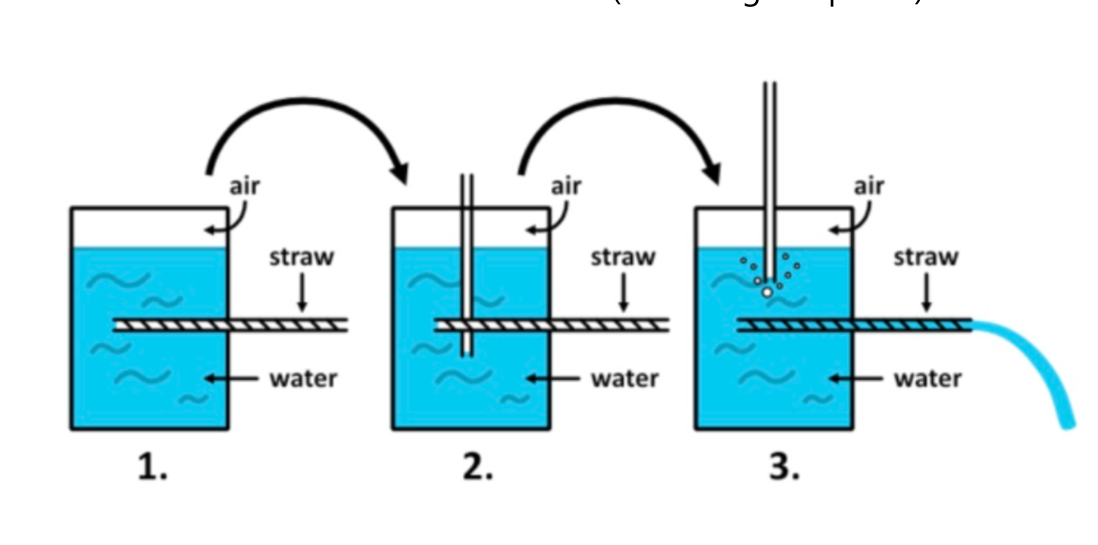
- (A) (i) Once you raise it above the striped straw, water starts flowing as air can enter and displace the water. (ii) The height you need to stop the flow is lower now as the water outside the straw now needs to reach equilibrium and will continue to flow.
- (B) (i) Once you raise it above the striped straw, water starts flowing as air can enter and displace the water. (ii) The height you need to stop the flow is lower depending on how much water was let out.
- (C) (i) Once you raise it above the striped straw, water starts flowing due to the pressure difference. (ii) Once it is below the striped straw the flow stops.
- (D) (i) Once you raise it above the striped straw, water starts flowing due to the pressure difference. (ii) It can be lowered to a point above the striped straw as the dynamic pressure of the flow lowers the pressure of the water.
Fonte: Testo (PDF) — p.10
Topic: Fluid Mechanics Metodi: Hydrostatic Equilibrium Competenze: Physical Reasoning Objects: Container, Tube
Una tazza sigillata contenente per lo più acqua e un po’ di aria ha una paglia a strisce che perforano il lato della tazza. Il sistema ha già raggiunto un equilibrio tale che non esce più acqua dalla paglia a righe (vedi diagramma parte 1). Una paglia semplice è ora bloccata così fortemente attraverso il coperchio che la parte inferiore di questa paglia è inferiore al livello della paglia a righe (vedere il diagramma parte 2). Come previsto, il livello dell’acqua nella paglia è inferiore a quello della superficie dell’acqua nella tazza.
- a) A che altezza dovrebbe essere sollevata la parte inferiore della paglia piana in modo che l’acqua inizi a scorrere dalla paglia a righe orizzontali (vedi diagramma parte 3)?
- (ii) Se vogliamo abbassare la paglia piana per fermare il flusso, la sua altezza critica della parte inferiore rimarrà la stessa come prima (come nel diagramma parte 2)?
- **(A) ** (i) Una volta sollevato sopra la paglia a righe, l’acqua inizia a scorrere in quanto l’aria può entrare e spostare l’acqua. (ii) L’altezza di cui occorre fermare il flusso è più bassa ora che l’acqua fuori dalla paglia deve raggiungere l’equilibrio e continuerà a scorrere.
- **(B) ** (i) Una volta sollevato sopra la paglia a righe, l’acqua inizia a scorrere in quanto l’aria può entrare e spostare l’acqua. (ii) L’altezza necessaria per fermare il flusso è inferiore a seconda della quantità di acqua rilasciata.
- **(C) ** (i) Una volta sollevato sopra la paglia a righe, l’acqua inizia a scorrere a causa della differenza di pressione. ii) Una volta che si trova al di sotto della paglia a righe, il flusso si ferma.
- **(D) ** (i) Una volta sollevato sopra la paglia a righe, l’acqua inizia a scorrere a causa della differenza di pressione. - può essere abbassato fino a un punto sopra la paglia a righe, poiché la pressione dinamica del flusso abbassa la pressione dell’acqua.
Fonte: Testo (PDF) — p.10
Topic: Fluid Mechanics Metodi: Hydrostatic Equilibrium Competenze: Physical Reasoning Objects: Container, Tube
Water flows from left to right through a horizontal pipe of circular cross-section at a speed of and a pressure of at position A. The cross-sectional area of the pipe narrows at point B (the cross-section of the pipe remains circular all throughout) and the speed of water there increases to . Ignoring gravity, viscous effects and other energy losses, what is the pressure of water at position B?
- (A)
- (B)
- (C)
- (D)
Fonte: Testo (PDF) — p.11
Topic: Fluid Mechanics Metodi: Bernoulli’s Equation, Continuity Equation Competenze: Physical Reasoning Objects: Tube
L’acqua scorre da sinistra a destra attraverso un tubo orizzontale di sezione incrociata circolare a una velocità e a una pressione alla posizione A. L’area trasversale del tubo si restringe al punto B (la sezione trasversale del tubo rimane circolare per tutto il tempo) e la velocità dell’acqua aumenta fino a . Ignorando la gravità, gli effetti viscosi e altre perdite energetiche, qual è la pressione dell’acqua alla posizione B?
- (A)
- (B)
- (C)
- (D)
Fonte: Testo (PDF) — p.11
Topic: Fluid Mechanics Metodi: Bernoulli’s Equation, Continuity Equation Competenze: Physical Reasoning Objects: Tube
What changes when a transverse wave passes from one medium to another?
- (A) Speed, wavelength
- (B) Speed, wavelength, frequency
- (C) Speed, frequency
- (D) Wavelength, frequency
Fonte: Testo (PDF) — p.11
Topic: Oscillations & Waves Metodi: Wave Equation Competenze: Physical Reasoning Objects: —
Cosa cambia quando un’onda trasversale passa da un mezzo ad un altro?
- **(A) ** Velocità, lunghezza d’onda
- **(B) ** Velocità, lunghezza d’onda, frequenza
- **(C) ** Velocità, frequenza
- **(D) ** Lunghezza d’onda, frequenza
Fonte: Testo (PDF) — p.11
Topic: Oscillations & Waves Metodi: Wave Equation Competenze: Physical Reasoning Objects: —
The sound from a loudspeaker passes through two materials to a microphone. Which combination of materials (material 1, material 2) gives the shortest time for the sound to reach the microphone?
- (A) Air, air
- (B) Air, aluminium
- (C) Water, air
- (D) Water, aluminium
Fonte: Testo (PDF) — p.12
Topic: Oscillations & Waves Metodi: Physical Modeling Competenze: Physical Reasoning Objects: —
Il suono di un altoparlante passa attraverso due materiali a un microfono. Quale combinazione di materiali (materiale 1, materiale 2) dà il tempo più breve per il suono di raggiungere il microfono?
- **(A) ** aria, aria
- **(B) ** aria, alluminio
- **(C) ** Acqua, aria
- **(D) ** Acqua, alluminio
Fonte: Testo (PDF) — p.12
Topic: Oscillations & Waves Metodi: Physical Modeling Competenze: Physical Reasoning Objects: —
Two identical linearly polarizing filters are placed one behind another, in front of a beam of natural light with intensity , with their transmission axes crossed at a relative angle of degrees. What is the maximum possible intensity of light that can be transmitted through the setup if additional filters are placed in between these two filters?
- (A)
- (B)
- (C)
- (D)
Fonte: Testo (PDF) — p.12
Topic: Wave Optics Metodi: Interference & Diffraction Analysis Competenze: Physical Reasoning Objects: —
Due filtri polarizzanti lineari identici sono posizionati uno dietro l’altro, di fronte a un fascio di luce naturale di intensità , con i loro assi di trasmissione incrociati ad un angolo relativo di gradi. Qual è l’intensità massima possibile di luce che può essere trasmessa attraverso l’installazione se vengono inseriti filtri aggiuntivi tra questi due filtri?
- (A)
- (B)
- (C)
- (D)
Fonte: Testo (PDF) — p.12
Topic: Wave Optics Metodi: Interference & Diffraction Analysis Competenze: Physical Reasoning Objects: —
A wave is described by the equation below. What is its period?
- (A)
- (B)
- (C)
- (D)
Fonte: Testo (PDF) — p.13
Topic: Oscillations & Waves Metodi: Superposition Principle Competenze: Physical Reasoning Objects: —
Una onda è descritta dall’equazione di seguito. Qual è il suo periodo?
- (A)
- (B)
- (C)
- (D)
Fonte: Testo (PDF) — p.13
Topic: Oscillations & Waves Metodi: Superposition Principle Competenze: Physical Reasoning Objects: —
Plates 1, 2, and 4 are charged plastic plates. Plate 3 is an electrically neutral copper plate. When plates 1 and 2 are brought close to each other, they repel. When plate 2 is brought close to plates 3 or 4, it is attracted. How do plates 2 and 4, and plates 3 and 4 interact when brought close together?
- (A) Plates 2 and 4 attract, plates 3 and 4 attract.
- (B) Plates 2 and 4 repel, plates 3 and 4 repel.
- (C) Plates 2 and 4 repel, plates 3 and 4 attract.
- (D) Plates 2 and 4 attract, plates 3 and 4 repel.
Fonte: Testo (PDF) — p.13
Topic: Electrostatics Metodi: Coulomb’s Law, Symmetry Argument Competenze: Physical Reasoning Objects: —
Le piastrelle 1, 2 e 4 sono piastrelle di plastica cariche. La piastra 3 è una piastra di rame elettricamente neutrale. Quando le placche 1 e 2 vengono avvicinate, si respingono. Quando la piastra 2 viene avvicinata alla piastra 3 o 4, essa viene attratta. Come interagiscono le piastre 2 e 4, e le piastre 3 e 4 quando vengono avvicinate?
- **(A) ** Le piastre 2 e 4 attraggono, le piastre 3 e 4 attraggono.
- **(B) ** Piastrelle 2 e 4 repellente, piastrelle 3 e 4 repellente.
- **(C) ** Le piastrelle 2 e 4 respingono, le piastrelle 3 e 4 attirano.
- **(D) ** Le piastre 2 e 4 attraggono, le piastre 3 e 4 respingono.
Fonte: Testo (PDF) — p.13
Topic: Electrostatics Metodi: Coulomb’s Law, Symmetry Argument Competenze: Physical Reasoning Objects: —
A neutral conducting block has four empty spaces, J, K, L, M within it. An external charge of is now placed in space J. Three other charges are placed in spaces K, L, M. A charge of has now collected on the outer surface of the block. Which of the following combination of charges for spaces K, L, M is possible?
- (A)
- (B)
- (C)
- (D)
Fonte: Testo (PDF) — p.14
Topic: Electrostatics Metodi: Gauss’s Law Competenze: Physical Reasoning Objects: Block, Point Charge
Un blocco di conduttore neutro ha quattro spazi vuoti, J, K, L, M all’interno. Una carica esterna di viene ora collocata nello spazio J. Altre tre cariche sono posizionate negli spazi K, L e M. Una carica di si è ora accumulata sulla superficie esterna del blocco. Quale delle seguenti combinazioni di cariche per gli spazi K, L, M è possibile?
- (A)
- (B)
- (C)
- (D)
Fonte: Testo (PDF) — p.14
Topic: Electrostatics Metodi: Gauss’s Law Competenze: Physical Reasoning Objects: Block, Point Charge
Two charged particles are placed near the origin of the coordinate system. Particle 1 carries charge and is on the x-axis at . Particle 2 carries an unknown charge and is on the y-axis at . The magnitude of the electric field at the origin is and the electric potential at the origin is . What is the charge of particle 2?
- (A)
- (B)
- (C)
- (D)
Fonte: Testo (PDF) — p.15
Topic: Electrostatics Metodi: Coulomb’s Law, Electric Potential Method Competenze: Physical Reasoning Objects: Point Charge
Due particelle cariche sono posizionate vicino all’origine del sistema di coordinate. La parte 1 ha carica e si trova sull’asse x a . La parte 2 ha una carica sconosciuta e si trova sull’asse y a . La magnitudine del campo elettrico all’origine è e il potenziale elettrico all’origine è . Qual è la carica della particella 2?
- (A)
- (B)
- (C)
- (D)
Fonte: Testo (PDF) — p.15
Topic: Electrostatics Metodi: Coulomb’s Law, Electric Potential Method Competenze: Physical Reasoning Objects: Point Charge
There is a point charge at the centre and at each corner of a regular hexagon. The hexagon has sides of length . What is the total electric potential energy of this configuration?
- (A)
- (B)
- (C)
- (D)
Fonte: Testo (PDF) — p.16
Topic: Electrostatics Metodi: Electric Potential Method, Superposition Principle Competenze: Physical Reasoning Objects: Point Charge
C’è una carica puntologica al centro e ad ogni angolo di un esagono regolare. L’esagono ha lati di lunghezza . Qual è l’energia elettrica potenziale totale di questa configurazione?
- (A)
- (B)
- (C)
- (D)
Fonte: Testo (PDF) — p.16
Topic: Electrostatics Metodi: Electric Potential Method, Superposition Principle Competenze: Physical Reasoning Objects: Point Charge
Two small loops of wires A and B are located close to a straight wire which carries a conventional current in the direction shown. Both loops are moved away from the straight wire. What are the orientations of the conventional current generated in each loop while this occurs?
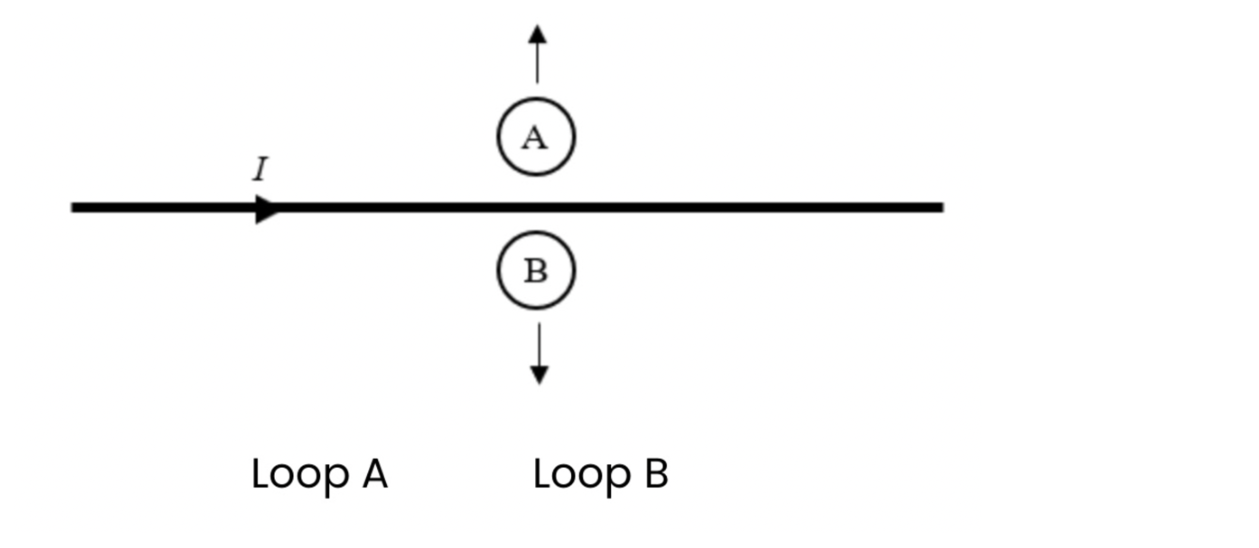
- (A) Loop A: Clockwise; Loop B: Anticlockwise
- (B) Loop A: Anti-clockwise; Loop B: clockwise
- (C) Loop A: No current; Loop B: No current
- (D) Loop A: Anti-clockwise; Loop B: Anti-clockwise
Fonte: Testo (PDF) — p.16
Topic: Electromagnetic Induction Metodi: Lenz’s Law, Faraday’s Law of Induction Competenze: Physical Reasoning Objects: Coil, Wire
Due piccoli circuiti di fili A e B sono situati vicino a un filo retto che porta una corrente convenzionale nella direzione indicata. Entrambi i circuiti sono spostati lontano dal filo retto. Quali sono gli orientamenti della corrente convenzionale generata in ogni ciclo mentre questo accade?
- **(A) ** Loop A: in senso orario; Loop B: in senso antiorario
- **(B) ** Loop A: antiorologio; Loop B: in senso orologio
- **(C) ** Loop A: Nessuna corrente; Loop B: Nessuna corrente
- **(D) ** Loop A: antiorologio; Loop B: antiorologio
Fonte: Testo (PDF) — p.16
Topic: Electromagnetic Induction Metodi: Lenz’s Law, Faraday’s Law of Induction Competenze: Physical Reasoning Objects: Coil, Wire
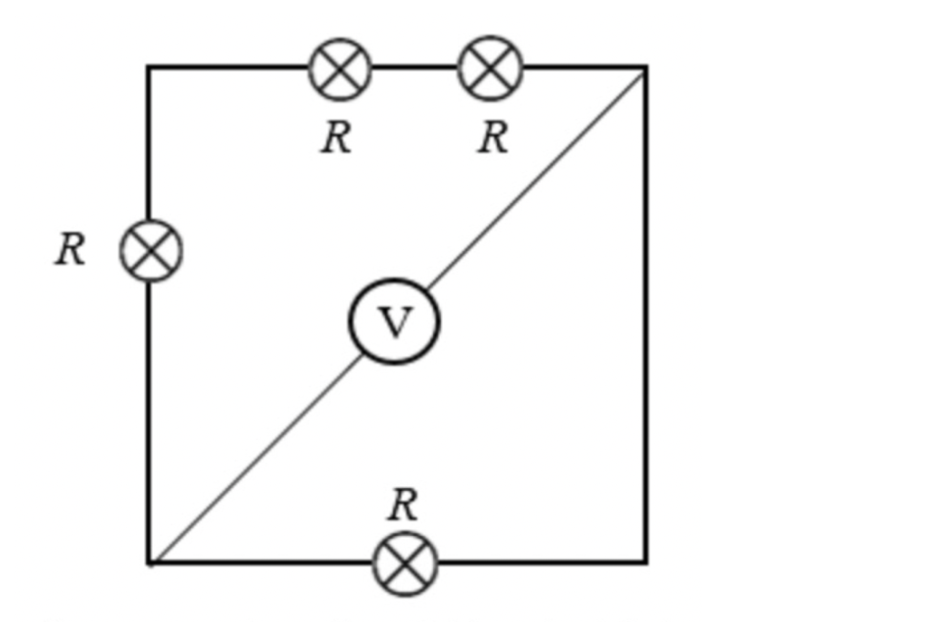
A magnetic field directed into the plane of the page is decreasing in time, producing a constant electromotive force in the square loop enclosing the field in the figure below. The square loop has identical lightbulbs, each of resistance . An ideal voltmeter is connected to the corners, as shown, through the centre of the loop. What is the magnitude of the voltmeter’s reading?
- (A)
- (B)
- (C)
- (D)
Fonte: Testo (PDF) — p.17
Topic: Electromagnetic Induction Metodi: Faraday’s Law of Induction, Kirchhoff’s Laws Competenze: Physical Reasoning Objects: Coil, Resistor
Un campo magnetico diretto verso il piano della pagina diminuisce nel tempo, producendo una forza elettromotrice costante nel ciclo quadrato che racchiude il campo nella figura seguente. Il ciclo quadrato ha lampadine identiche, ciascuna di resistenza . Un voltometro ideale è collegato agli angoli, come mostrato, attraverso il centro del circuito. Qual è la grandezza della lettura del voltmeter?
- (A)
- (B)
- (C)
- (D)
Fonte: Testo (PDF) — p.17
Topic: Electromagnetic Induction Metodi: Faraday’s Law of Induction, Kirchhoff’s Laws Competenze: Physical Reasoning Objects: Coil, Resistor
turns of wire are wrapped on a square frame with sides of . A uniform magnetic field is applied perpendicularly to the plane of the coil. If the field changes uniformly from to in , find the average value of the induced electromotive force in the wire.
- (A)
- (B)
- (C)
- (D)
Fonte: Testo (PDF) — p.17
Topic: Electromagnetic Induction Metodi: Faraday’s Law of Induction Competenze: Physical Reasoning Objects: Coil
Le curve di filo sono avvolte su un telaio quadrato con lati . Un campo magnetico uniforme viene applicato perpendicolare al piano della bobina. Se il campo cambia uniformemente da a in , si trova il valore medio della forza elettromotrice indotta nel filo.
- (A)
- (B)
- (C)
- (D)
Fonte: Testo (PDF) — p.17
Topic: Electromagnetic Induction Metodi: Faraday’s Law of Induction Competenze: Physical Reasoning Objects: Coil
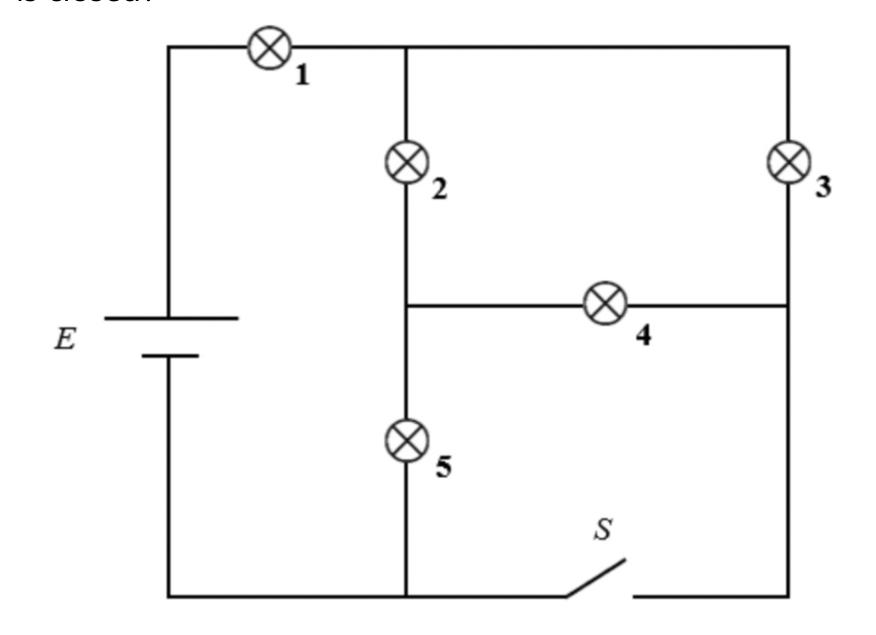
For the circuit shown, the five light bulbs have identical resistance (labelled bulbs 1 to 5) and the battery is assumed to be ideal with an electromotive force of . Which of the following statements describe(s) what happens after the switch is closed?
-
(i) Bulb 1 becomes brighter.
-
(ii) Bulbs 2 & 4 will be equally bright.
-
(iii) Bulbs 3 & 4 will be equally bright.
-
(iv) Bulbs 4 & 5 will be equally bright.
-
(A) (i) and (iv)
-
(B) All of the options
-
(C) (i), (ii), and (iv)
-
(D) (i) only
Fonte: Testo (PDF) — p.18
Topic: Circuits Metodi: Equivalent Circuit Reduction, Kirchhoff’s Laws Competenze: Physical Reasoning Objects: Resistor, Battery, Switch
Per il circuito illustrato, le cinque lampadine hanno la stessa resistenza (lampadine etichettate da 1 a 5) e la batteria è presumibilmente ideale con una forza elettromotrice di . Quale delle seguenti affermazioni descrive cosa accade dopo che il switch è chiuso?
-
(i) Il lampadino 1 diventa più luminoso.
-
(ii) Le lampadine 2 e 4 saranno uguali.
-
(iii) Le lampadine 3 e 4 saranno uguali.
-
(iv) Le lampadine 4 e 5 saranno uguali.
-
**(A) ** (i) e (iv)
-
**(B) ** Tutte le opzioni
-
**(C) ** (i), (ii) e (iv)
-
**(D) ** (i) solo
Fonte: Testo (PDF) — p.18
Topic: Circuits Metodi: Equivalent Circuit Reduction, Kirchhoff’s Laws Competenze: Physical Reasoning Objects: Resistor, Battery, Switch
A lead bullet travelling at penetrates an ice block at and stops within the ice block. The temperature of the bullet decreases by . How much ice has melted?
Specific heat capacity of lead and water is and . The latent heat of fusion of ice is .
- (A)
- (B)
- (C)
- (D)
Fonte: Testo (PDF) — p.19
Topic: Thermodynamics Metodi: Energy Conservation Method, First Law of Thermodynamics Competenze: Physical Reasoning Objects: Projectile, Block
Un proiettile di piombo che viaggia a penetra un blocco di ghiaccio a e si ferma all’interno del blocco di ghiaccio. La temperatura del proiettile diminuisce di . Quanti ghiacci si sono sciolti?
La capacità termica specifica del piombo e dell’acqua è e . Il calore latente della fusione del ghiaccio è .
- (A)
- (B)
- (C)
- (D)
Fonte: Testo (PDF) — p.19
Topic: Thermodynamics Metodi: Energy Conservation Method, First Law of Thermodynamics Competenze: Physical Reasoning Objects: Projectile, Block
The specific heat capacity of aluminium is . A mass of aluminium is heated for seconds by a heater. Which option gives the possible rise in temperature of the aluminium?
- (A)
- (B)
- (C)
- (D)
Fonte: Testo (PDF) — p.19
Topic: Thermodynamics Metodi: First Law of Thermodynamics Competenze: Physical Reasoning Objects: —
La capacità termico specifica dell’alluminio è . Una massa di alluminio viene riscaldata per secondi con un riscaldatore . Qual è l’opzione che dà l’eventuale aumento della temperatura dell’alluminio?
- (A)
- (B)
- (C)
- (D)
Fonte: Testo (PDF) — p.19
Topic: Thermodynamics Metodi: First Law of Thermodynamics Competenze: Physical Reasoning Objects: —
A scuba diver in a lake makes a spherical bubble with a radius of at a depth of . The radius of the bubble when it reaches the surface is . What is the value of ? Take the lake water to have a density of and the same temperature throughout.
- (A)
- (B)
- (C)
- (D)
Fonte: Testo (PDF) — p.20
Topic: Fluid Mechanics Metodi: Hydrostatic Equilibrium, Ideal Gas Law Competenze: Physical Reasoning Objects: Bubble
Un subacqueo in un lago crea una bolla sferica con un raggio di a una profondità di . Il raggio di radius della bolla quando raggiunge la superficie è . Qual è il valore di ? Si deve prendere l’acqua del lago per avere una densità di e la stessa temperatura in tutto.
- (A)
- (B)
- (C)
- (D)
Fonte: Testo (PDF) — p.20
Topic: Fluid Mechanics Metodi: Hydrostatic Equilibrium, Ideal Gas Law Competenze: Physical Reasoning Objects: Bubble
Which of the following statements about absolute zero is true?
- (A) All particles, including electrons of the atoms, stop moving.
- (B) The substance cannot get any colder.
- (C) Particles will have zero volume.
- (D) Internal energy of the system reaches zero.
Fonte: Testo (PDF) — p.20
Topic: Kinetic Theory Metodi: Kinetic Theory of Gases Competenze: Physical Reasoning Objects: —
Quale delle seguenti affermazioni sullo zero assoluto è vero?
- **(A) ** Tutte le particelle, compresi gli elettroni degli atomi, cessano di muoversi.
- **(B) ** La sostanza non può diventare più fredda.
- **(C) ** Le particelle avranno un volume zero.
- **(D) ** L’energia interna del sistema raggiunge lo zero.
Fonte: Testo (PDF) — p.20
Topic: Kinetic Theory Metodi: Kinetic Theory of Gases Competenze: Physical Reasoning Objects: —
A fully-inflated bicycle tyre at has a pressure of , as measured by a pressure gauge. This means that the pressure in the tyre is above atmospheric pressure. After cycling under the hot sun, the temperature of the air in the tyre increases by , without a significant change in tyre volume. What is the increase in the pressure gauge reading?
- (A)
- (B)
- (C)
- (D)
Fonte: Testo (PDF) — p.21
Topic: Thermodynamics Metodi: Ideal Gas Law Competenze: Physical Reasoning Objects: Gas
Un pneumatico a bicicletta completamente gonfiato a ha una pressione di , misurata con un pressurometro. Ciò significa che la pressione del pneumatico è superiore alla pressione atmosferica. Dopo aver ciclicato sotto il sole caldo, la temperatura dell’aria nel pneumatico aumenta di , senza un significativo cambiamento del volume del pneumatico. Qual è l’aumento della lettura del calcolo di pressione?
- (A)
- (B)
- (C)
- (D)
Fonte: Testo (PDF) — p.21
Topic: Thermodynamics Metodi: Ideal Gas Law Competenze: Physical Reasoning Objects: Gas
Alice is on a train that is moving at a constant velocity. She threw a package to Bob who is standing beside the train track below the train window. Bob observes that the package falls vertically and catches the package. What action did Alice perform?
- (A) Alice threw the package straight down the window of the moving train.
- (B) More information is needed to decide.
- (C) Alice threw the package towards the front of the moving train.
- (D) Alice threw the package towards the back of the moving train.
Fonte: Testo (PDF) — p.21
Topic: Newtonian Mechanics Metodi: Kinematic Equations, Vector Decomposition Competenze: Physical Reasoning Objects: —
Alice è su un treno che si muove a velocità costante. Ha gettato un pacchetto a Bob che sta al fianco della pista sotto la finestra del treno. Bob osserva che il pacchetto cade verticalmente e lo cattura. Che azione ha compiuto Alice?
Alice ha gettato il pacchetto dritto giù dalla finestra del treno in movimento.
- **(B) ** Per decidere sono necessarie ulteriori informazioni. Alice ha gettato il pacchetto verso la parte anteriore del treno in movimento. Alice ha gettato il pacchetto verso la parte posteriore del treno in movimento.
Fonte: Testo (PDF) — p.21
Topic: Newtonian Mechanics Metodi: Kinematic Equations, Vector Decomposition Competenze: Physical Reasoning Objects: —
A projectile of mass is launched from the ground and explodes at the top of its trajectory at a horizontal distance from the starting point of the motion, breaking into two pieces of mass ; . If lands back at the starting point, how far would land back on the ground with respect to the starting point?
- (A)
- (B)
- (C)
- (D)
Fonte: Testo (PDF) — p.22
Topic: Conservation of Momentum Metodi: Conservation of Momentum, Kinematic Equations Competenze: Physical Reasoning Objects: Projectile
Un proiettile di massa viene lanciato dal terreno e esplode in cima alla sua traiettoria a una distanza orizzontale dal punto di partenza del movimento, rompendo in due pezzi di massa ; . Se atterrisse al punto di partenza, a che distanza sarebbe atterrato sul terreno rispetto al punto di partenza?
- (A)
- (B)
- (C)
- (D)
Fonte: Testo (PDF) — p.22
Topic: Conservation of Momentum Metodi: Conservation of Momentum, Kinematic Equations Competenze: Physical Reasoning Objects: Projectile
A canoe, carrying two boys, is initially stationary in water. The boys in the canoe started throwing and catching a heavy ball back and forth between them. Assuming the air and water resistances are negligible, which statement about the centre of mass of the entire system of the canoe (including the ball and the boys) is correct?
- (A) The centre of mass moves in the direction opposite the motion of the ball in the air.
- (B) The centre of mass remains stationary at the same position all the time.
- (C) The centre of mass moves in the same direction as the motion of the ball in the air.
- (D) The centre of mass oscillates in simple harmonic motion horizontally.
Fonte: Testo (PDF) — p.22
Topic: Conservation of Momentum Metodi: Conservation of Momentum Competenze: Physical Reasoning Objects: Ball
Una canoa, che porta due ragazzi, è inizialmente fermata in acqua. I ragazzi della canoa iniziarono a lanciare e a prendere una pesante palla avanti e indietro tra loro. Supponendo che le resistenze all’aria e all’acqua siano trascurabili, quale affermazione sul centro di massa dell’intero sistema della canoa (compresa la palla e i ragazzi) è corretta?
- **(A) ** Il centro di massa si muove nella direzione opposta al movimento della palla nell’aria.
- **(B) ** Il centro di massa rimane sempre in posizione fissa.
- **(C) ** Il centro di massa si muove nella stessa direzione del movimento della palla nell’aria.
- **(D) ** Il centro di massa oscilla in semplice movimento armonico orizzontalmente.
Fonte: Testo (PDF) — p.22
Topic: Conservation of Momentum Metodi: Conservation of Momentum Competenze: Physical Reasoning Objects: Ball
Two boxes of mass and , starting from rest, were pushed for the same amount of time and using the same amount of force. What would be the ratio of the final momentum of the lighter box to that of the heavier box?
- (A)
- (B)
- (C)
- (D)
Fonte: Testo (PDF) — p.23
Topic: Conservation of Momentum Metodi: Impulse-Momentum Theorem Competenze: Physical Reasoning Objects: Block
Due scatole di massa e , a partire dal riposo, sono state spinte per lo stesso tempo e con la stessa forza. Qual è il rapporto tra la velocità finale della scatola più leggera e quella della scatola più pesante?
- (A)
- (B)
- (C)
- (D)
Fonte: Testo (PDF) — p.23
Topic: Conservation of Momentum Metodi: Impulse-Momentum Theorem Competenze: Physical Reasoning Objects: Block
A pendulum (consisting of a thread and a bob), originally at rest, experiences a strong and constant wind acting on the entire pendulum to the right. The wind is sufficiently strong to displace the pendulum. The thread has a finite and significant total mass, but the mass of the bob is larger than the mass of the thread. Which of the following diagrams correctly depicts the equilibrium position of the pendulum?
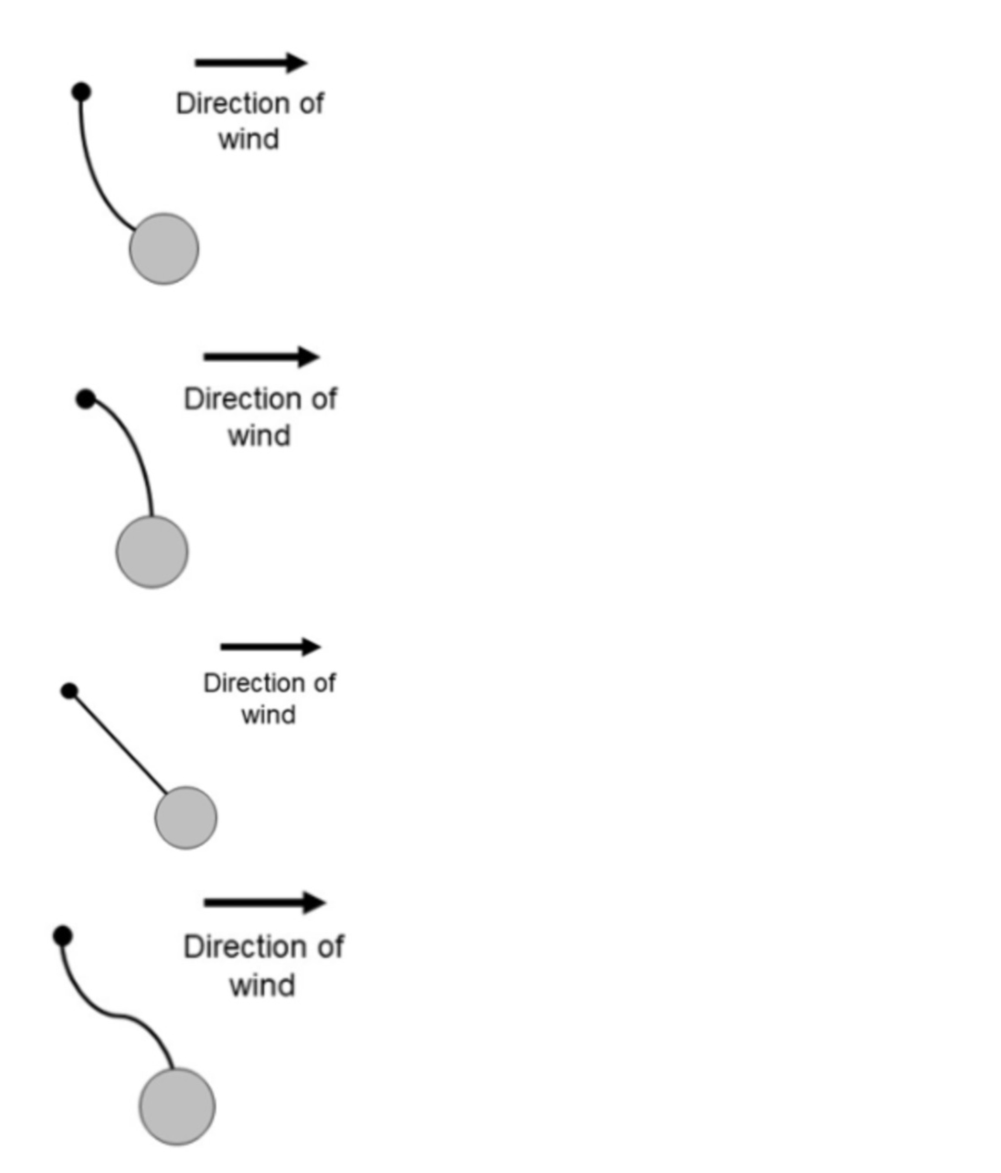
The four options (a–d, top to bottom) show different equilibrium shapes of the thread and bob under the rightward wind.
Fonte: Testo (PDF) — p.24
Topic: Rigid Body Statics Metodi: Free-Body Diagram, Torque & Angular Momentum Analysis Competenze: Physical Reasoning Objects: Pendulum
Un pendolo (composto da un filo e da un bobino), originariamente a riposo, sperimenta un vento forte e costante che agisce su tutto il pendolo a destra. Il vento è abbastanza forte da spostare il pendolo. Il filo ha una massa totale finita e significativa, ma la massa del bob è maggiore della massa del filo. Quale dei seguenti diagrammi raffigura correttamente la posizione di equilibrio del pendolo?
Le quattro opzioni (ad, da cima a fondo) mostrano diverse forme di equilibrio del filo e del bobino sotto il vento a destra.
Fonte: Testo (PDF) — p.24
Topic: Rigid Body Statics Metodi: Free-Body Diagram, Torque & Angular Momentum Analysis Competenze: Physical Reasoning Objects: Pendulum
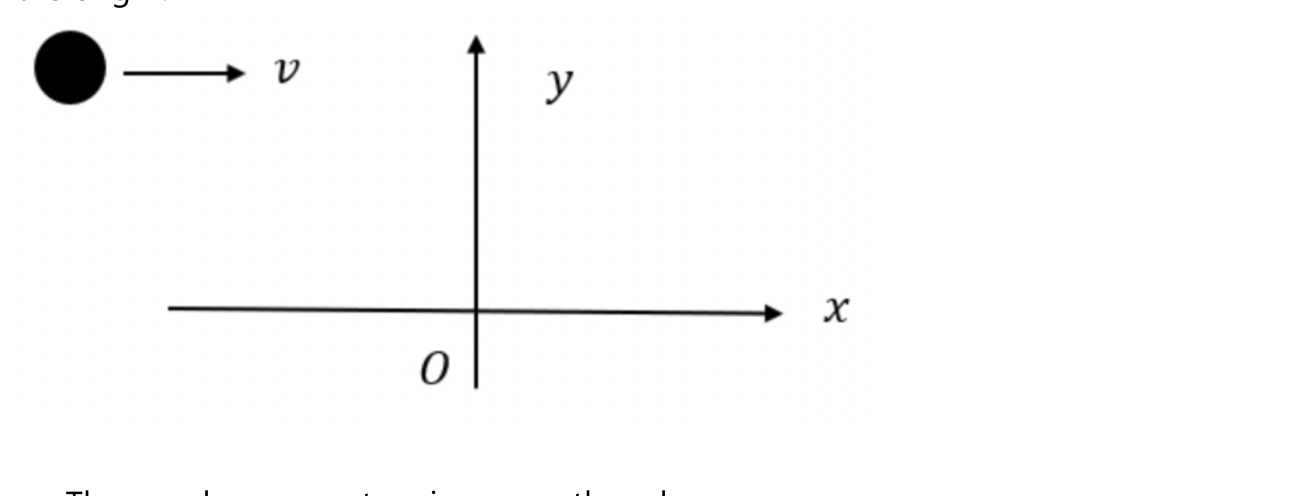
A particle is moving in the x-y plane with a constant velocity. What can we conclude about the angular momentum of the particle at any given time about the origin?
- (A) The angular momentum increases then decreases.
- (B) The angular momentum is a non-zero constant.
- (C) The angular momentum is .
- (D) The angular momentum decreases then increases.
Fonte: Testo (PDF) — p.25
Topic: Rotational Dynamics Metodi: Torque & Angular Momentum Analysis Competenze: Physical Reasoning Objects: —
Una particella si muove nel piano x-y con una velocità costante. Cosa possiamo concludere sul momento angolare della particella in un dato momento circa l’origine?
- **(A) ** Il momento angolare aumenta e poi diminuisce.
- **(B) ** Il momento angolare è una costante non zero.
- **(C) ** Il momento angolare è .
- **(D) ** Il momento angolare diminuisce e poi aumenta.
Fonte: Testo (PDF) — p.25
Topic: Rotational Dynamics Metodi: Torque & Angular Momentum Analysis Competenze: Physical Reasoning Objects: —
Suppose we have a spring of length with differing spring constants for extension and compression. For extensions it has spring constant , for compressions . A mass attached at the end of the spring extends it by a distance . What is the period of oscillation?
- (A)
- (B)
- (C)
- (D)
Fonte: Testo (PDF) — p.25
Topic: Oscillations & Waves Metodi: Simple Harmonic Motion Analysis, Hooke’s Law Competenze: Physical Reasoning Objects: Spring
Supponiamo di avere una molla di lunghezza con diverse costanti di molla per estensione e compressione. Per le estensioni ha costante resorte , per le compressioni . Una massa fissata alla fine della primavera la estende per una distanza . Qual è il periodo di oscillazione?
- (A)
- (B)
- (C)
- (D)
Fonte: Testo (PDF) — p.25
Topic: Oscillations & Waves Metodi: Simple Harmonic Motion Analysis, Hooke’s Law Competenze: Physical Reasoning Objects: Spring
A chinook helicopter flies at a height of overhead. The distance between the two rotor masts is (diagram not to scale). You observe that the intensity of sound keeps fluctuating, and note that the time between successive intensity maxima is seconds. The sound produced has a frequency of when it reaches your ears, and the speed of sound at the surface is . Assume the wavefront propagates in a circular fashion, and that the rotors are point sources of sound.
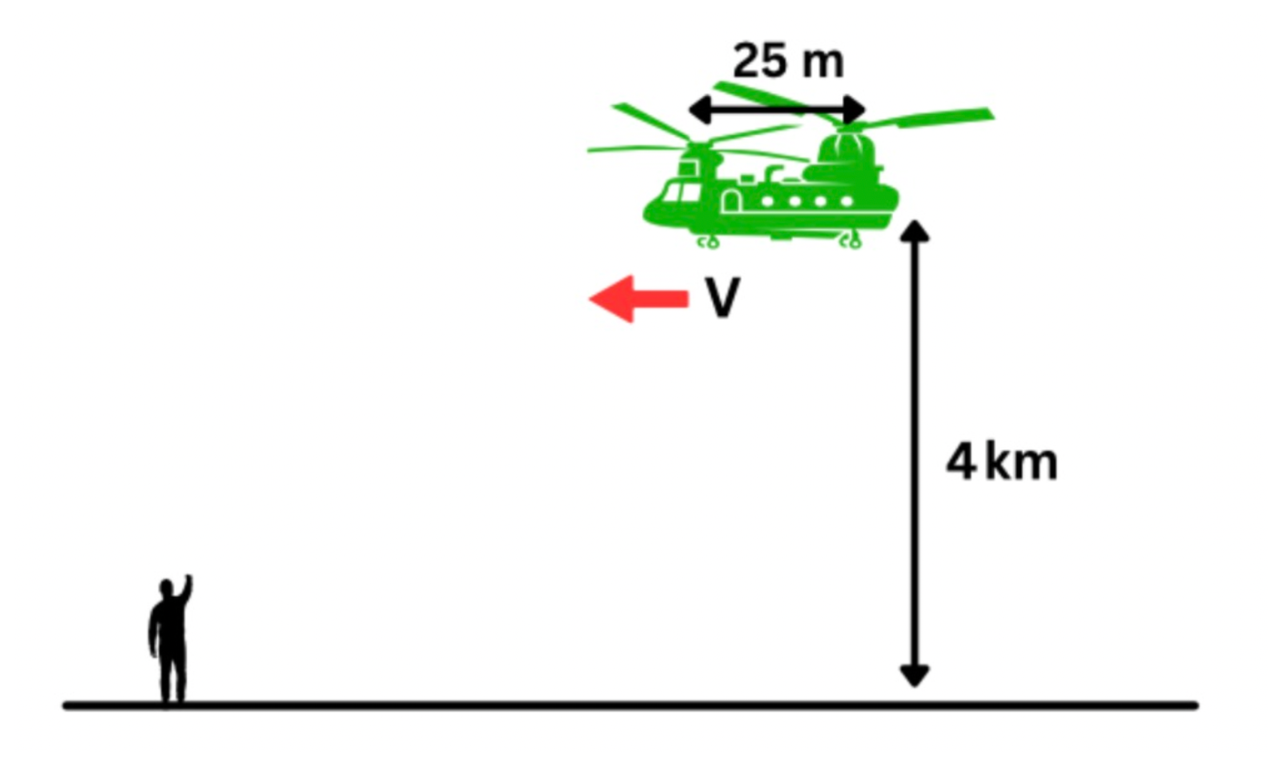
What is the approximate horizontal speed at which the chinook is travelling with respect to the ground, given that it is travelling straight towards you?
- (A)
- (B)
- (C)
- (D)
[Note: The actual separation between rotor blades is about . How does this affect your answer?]
Fonte: Testo (PDF) — p.26
Topic: Oscillations & Waves Metodi: Interference & Diffraction Analysis, Wave Equation Competenze: Physical Reasoning Objects: —
Un elicottero chinook vola ad un’altezza di sopra il capo. La distanza tra i due masti del rotore è (diagramma non a scala). Si osserva che l’intensità del suono continua a fluctuarsi e si nota che il tempo tra l’intensità massima successiva è secondi. Il suono prodotto ha una frequenza di quando raggiunge le orecchie e la velocità del suono a superficie è . Supponiamo che il fronte d’onda si propaga in modo circolare e che i rotori siano fonti di suono puntate.
Qual è la velocità orizzontale approssimativa con cui il chinook si sta muovendo rispetto al suolo, dato che si sta muovendo direttamente verso di voi?
- (A)
- (B)
- (C)
- (D)
[Nota: la separazione effettiva tra le lame del rotore è di circa . Come influisce questo sulla tua risposta?]
Fonte: Testo (PDF) — p.26
Topic: Oscillations & Waves Metodi: Interference & Diffraction Analysis, Wave Equation Competenze: Physical Reasoning Objects: —
An alpha particle has specific charge and is moving along the x-axis with velocity . It enters a region of electric potential , . What is the minimum value of to bring the alpha particle to momentary rest and what is the time that elapsed between the alpha particle entering and leaving the region?
- (A)
- (B)
- (C)
- (D)
Fonte: Testo (PDF) — p.27
Topic: Electrostatics Metodi: Electric Potential Method, Energy Conservation Method Competenze: Physical Reasoning Objects: Point Charge
Una particella alfa ha una carica specifica e si muove lungo l’asse x con velocità . It enters a region of electric potential , . Qual è il valore minimo di per portare la particella alfa a un momento di riposo e qual è il tempo che è passato tra l’ingresso e il uscita della particella alfa dalla regione?
- (A)
- (B)
- (C)
- (D)
Fonte: Testo (PDF) — p.27
Topic: Electrostatics Metodi: Electric Potential Method, Energy Conservation Method Competenze: Physical Reasoning Objects: Point Charge
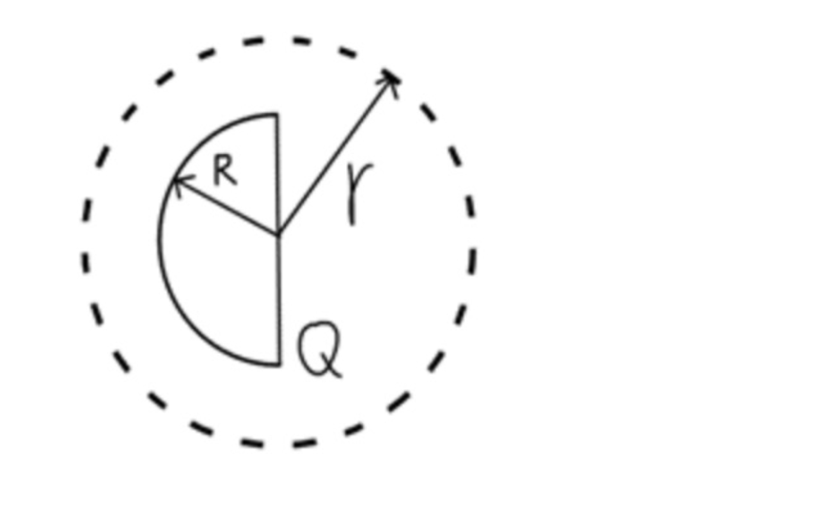
We have a solid hemisphere with charge uniformly distributed throughout the hemisphere. What is the average electric potential at a distance from the centre of the hemisphere as shown in the diagram?
- (A)
- (B)
- (C)
- (D)
Fonte: Testo (PDF) — p.28
Topic: Electrostatics Metodi: Electric Potential Method, Superposition Principle Competenze: Physical Reasoning Objects: —
Abbiamo un’emisfera solida con carica uniformemente distribuita in tutto l’emisfero. Qual è il potenziale elettrico medio a una distanza dal centro dell’emisfero come mostrato nel diagramma?
- (A)
- (B)
- (C)
- (D)
Fonte: Testo (PDF) — p.28
Topic: Electrostatics Metodi: Electric Potential Method, Superposition Principle Competenze: Physical Reasoning Objects: —
A positive point charge is located at vertex A of an equilateral triangle whose sides have length . A negative point charge is located at each of the two vertices B and C. Now, a point charge is placed at the centre of the triangle, at . What is the value of so that the total electrical force acting on the point charge at vertex A is zero?
- (A)
- (B)
- (C)
- (D)
Fonte: Testo (PDF) — p.29
Topic: Electrostatics Metodi: Coulomb’s Law, Vector Decomposition Competenze: Physical Reasoning Objects: Point Charge
Una carica di punto positivo si trova al vertice A di un triangolo equilaterale i cui lati hanno lunghezza . Una carica di punto negativo si trova a ciascuna delle due vertici B e C. Ora, una carica di punto è posizionata al centro del triangolo, a . Qual è il valore di in modo che la forza elettrica totale che agisce sulla carica di punto al vertice A sia zero?
- (A)
- (B)
- (C)
- (D)
Fonte: Testo (PDF) — p.29
Topic: Electrostatics Metodi: Coulomb’s Law, Vector Decomposition Competenze: Physical Reasoning Objects: Point Charge
The diagram shows two separate segments of wire (represented by solid and dotted lines) that are carrying a current from point A to B in the presence of a uniform magnetic field indicated by the arrows. Which of the following statements about the force due to the external magnetic field on the wires is correct?
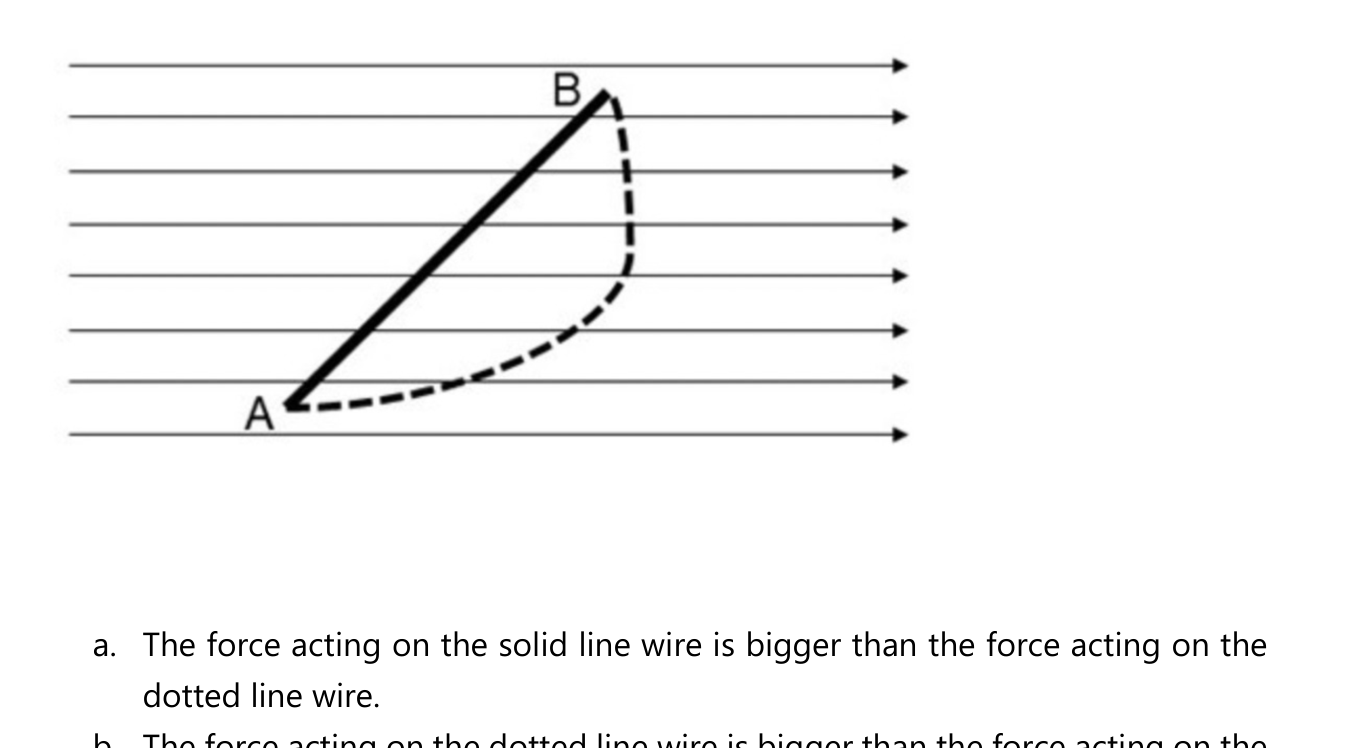
- (A) The force acting on the solid line wire is bigger than the force acting on the dotted line wire.
- (B) The force acting on the dotted line wire is bigger than the force acting on the solid line wire.
- (C) The force acting on both wires are zero.
- (D) The force acting on both wires are the same, but non-zero.
Fonte: Testo (PDF) — p.30
Topic: Magnetism Metodi: Lorentz Force Analysis Competenze: Physical Reasoning Objects: Wire
Il diagramma mostra due segmenti separati di filo (representati da linee solide e puntate) che trasportano una corrente dal punto A al punto B in presenza di un campo magnetico uniforme indicato dalle frecce. Quale delle seguenti affermazioni sulla forza dovuta al campo magnetico esterno sui fili è corretta?
- **(A) ** La forza che agisce sul filo di linea solida è maggiore della forza che agisce sul filo di linea puntata.
- **(B) ** La forza che agisce sul filo di linea puntata è maggiore della forza che agisce sul filo di linea solida.
- **(C) ** La forza che agisce su entrambi i fili è zero.
- **(D) ** La forza che agisce su entrambi i fili è la stessa, ma non zero.
Fonte: Testo (PDF) — p.30
Topic: Magnetism Metodi: Lorentz Force Analysis Competenze: Physical Reasoning Objects: Wire
An electromagnetic wave has a magnetic field given in Cartesian coordinates in the expression below.
At , , what is the direction of the electric field associated with this wave?
- (A)
- (B)
- (C)
- (D)
Fonte: Testo (PDF) — p.31
Topic: Electromagnetism Metodi: Lorentz Force Analysis, Wave Equation Competenze: Physical Reasoning Objects: —
Un’onda elettromagnetica ha un campo magnetico dato in coordinate cartesiane nell’espressione di seguito.
A , , qual è la direzione del campo elettrico associato a questa onda?
- (A)
- (B)
- (C)
- (D)
Fonte: Testo (PDF) — p.31
Topic: Electromagnetism Metodi: Lorentz Force Analysis, Wave Equation Competenze: Physical Reasoning Objects: —
What is the temperature at the centre of an equilateral triangle where the vertices are heated to maintain constant temperatures at the edges?
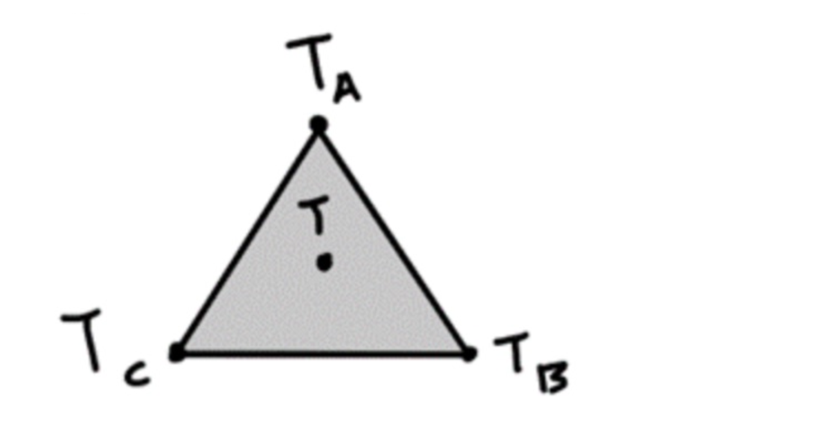
- (A) Average of the temperature at the vertices.
- (B) Average of the temperature throughout the entire face.
- (C) Average of the temperature along the edges.
- (D) All of the options.
Fonte: Testo (PDF) — p.31
Topic: Thermodynamics Metodi: Symmetry Argument, Statistical Averaging Competenze: Physical Reasoning Objects: —
Qual è la temperatura al centro di un triangolo equilaterale dove i vertici vengono riscaldati per mantenere temperature costanti ai bordi?
- **(A) ** Medio della temperatura ai vertici .
- **(B) ** Temperatura media di tutta la faccia.
- **(C) ** Temperatura media lungo i bordi .
- **(D) ** Tutte le opzioni.
Fonte: Testo (PDF) — p.31
Topic: Thermodynamics Metodi: Symmetry Argument, Statistical Averaging Competenze: Physical Reasoning Objects: —
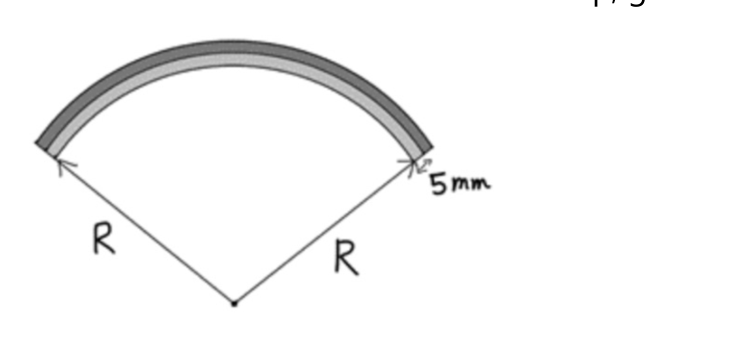
Two strips each of length and thickness have different thermal expansion coefficients and are welded together to form a bimetallic strip. One has a linear thermal expansion coefficient of , while the other has a coefficient of . The temperature increases by . Find the radius of curvature of the bimetallic strip, given it becomes an arc as shown.
- (A)
- (B)
- (C)
- (D)
Fonte: Testo (PDF) — p.32
Topic: Thermodynamics Metodi: Physical Modeling, Approximation & Series Expansion Competenze: Physical Reasoning Objects: —
Due strisce di lunghezza e spessore hanno diversi coefficienti di espansione termica e sono saldate insieme per formare una striscia bimetalica. Uno ha un coefficiente di espansione termica lineare di , mentre l’altro ha un coefficiente di . La temperatura aumenta di . Trova il raggio di curvatura della striscia bimetalica, dato che diventa un arco come mostrato.
- (A)
- (B)
- (C)
- (D)
Fonte: Testo (PDF) — p.32
Topic: Thermodynamics Metodi: Physical Modeling, Approximation & Series Expansion Competenze: Physical Reasoning Objects: —
When you fire a laser beam into a transparent material like glass, it is known that the laser beam will travel at some speed less than the speed of light. According to special relativity, this means that the speed of the laser beam through the medium will change based on the motion of an observer. For example, someone moving in the direction of the beam will observe it travelling slower! What can you conclude from this?
- (A) The index of refraction is a function of the motion of the observer.
- (B) There is no issue, the speed of light only must be constant in all frames for someone travelling within the same optical medium.
- (C) We cannot assume that the Maxwell’s equations are the same in all frames, so the speed of light can change in the observer’s frame.
- (D) Special relativity contradicts itself as the speed of light must be a constant in all frames. That is why we have general relativity.
Fonte: Testo (PDF) — p.32
Topic: Special Relativity Metodi: Lorentz Transformation Competenze: Physical Reasoning Objects: —
Quando si spara un raggio laser in un materiale trasparente come il vetro, si sa che il raggio laser viaggierà a una velocità inferiore alla velocità della luce. Secondo la relatività speciale, ciò significa che la velocità del fascio laser attraverso il mezzo cambierà in base al movimento di un osservatore. Ad esempio, qualcuno che si muove in direzione del fascio lo vedrà viaggiare più lentamente! Cosa ne puoi concludere?
- **(A) ** L’indice di rifrazione è una funzione del movimento dell’osservatore.
- **(B) ** Non c’è problema, la velocità della luce deve essere costante solo in tutti i fotogrammi per chi viaggia nel medesimo mezzo ottico.
- **(C) ** Non possiamo presumere che le equazioni di Maxwell siano uguali in tutti i quadri, quindi la velocità della luce può cambiare nel quadro dell’osservatore.
- **(D) ** La relatività speciale si contraddice in quanto la velocità della luce deve essere costante in tutti i quadri. Ecco perché abbiamo la relatività generale.
Fonte: Testo (PDF) — p.32
Topic: Special Relativity Metodi: Lorentz Transformation Competenze: Physical Reasoning Objects: —