A smooth hollow cone of half-angle is inverted with its axis vertical. A particle of mass rolls around in a horizontal circle within the inner surface of the cone. What is the magnitude of the normal force exerted by the cone on the particle?
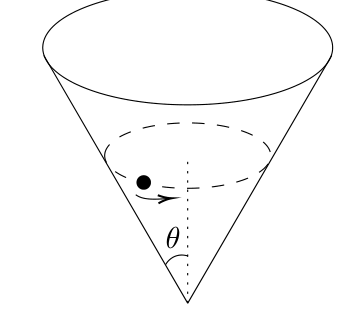 Inverted cone of half-angle with a particle moving in a horizontal circle on its inner surface.
- (A)
- (B)
- (C)
- (D)
- (E)
Fonte: Testo (PDF) — p.1
Topic: Newtonian Mechanics Metodi: Free-Body Diagram, Vector Decomposition Competenze: Physical Reasoning Objects: —
Un cono liscio e vuoto di semicongo è invertito con il suo asse verticale. Una particella di massa ruota in un cerchio orizzontale all’interno della superficie interna del cono. Qual è la grandezza della forza normale esercitata dal cono sulla particella?
Cono invertito di semicogli con una particella che si muove in un cerchio orizzontale sulla sua superficie interna.
- (A)
- (B)
- (C)
- (D)
- (E)
Fonte: Testo (PDF) — p.1
Topic: Newtonian Mechanics Metodi: Free-Body Diagram, Vector Decomposition Competenze: Physical Reasoning Objects: —
Chris is seated on a northbound train when he sees a southbound train approaching him with speed . At the same time, he sees a tree moving away from him at speed . At what speed does a passenger seated on the southbound train observe this tree to be moving?
- (A)
- (B)
- (C)
- (D)
- (E)
Fonte: Testo (PDF) — p.1
Topic: Newtonian Mechanics Metodi: Kinematic Equations, Vector Decomposition Competenze: Physical Reasoning Objects: —
Chris è seduto su un treno di direzione nord quando vede un treno di direzione sud avvicinarsi a velocità . Allo stesso tempo, vede un albero allontanarsi da lui a velocità . A che velocità un passeggero seduto sul treno che va verso sud osserva l’albero che si muove?
- (A)
- (B)
- (C)
- (D)
- (E)
Fonte: Testo (PDF) — p.1
Topic: Newtonian Mechanics Metodi: Kinematic Equations, Vector Decomposition Competenze: Physical Reasoning Objects: —
A particle travels in a straight path with constant acceleration. The particle has velocity at the start of its path and velocity at the end of its path. What is the velocity of the particle at the midpoint of its path?
- (A)
- (B)
- (C)
- (D)
- (E)
Fonte: Testo (PDF) — p.1
Topic: Newtonian Mechanics Metodi: Kinematic Equations Competenze: Physical Reasoning Objects: —
Una particella viaggia in un percorso diretto con una costante accelerazione. La particella ha velocità all’inizio del suo percorso e velocità alla fine del suo percorso. Qual è la velocità della particella al centro del suo percorso?
- (A)
- (B)
- (C)
- (D)
- (E)
Fonte: Testo (PDF) — p.1
Topic: Newtonian Mechanics Metodi: Kinematic Equations Competenze: Physical Reasoning Objects: —
identical blocks (where ) are placed side-by-side in a horizontal row on frictionless ground. The combined row of blocks is pushed from the left with a force . What is the force between the two rightmost blocks?
- (A)
- (B)
- (C)
- (D)
- (E)
Fonte: Testo (PDF) — p.2
Topic: Newtonian Mechanics Metodi: Free-Body Diagram Competenze: Physical Reasoning Objects: Block
blocchi identici (dove ) sono posizionati fianco a fianco in una riga orizzontale su terreno senza attrito. La fila combinata di blocchi viene spinta da sinistra con una forza . Qual è la forza tra i due blocchi più a destra?
- (A)
- (B)
- (C)
- (D)
- (E)
Fonte: Testo (PDF) — p.2
Topic: Newtonian Mechanics Metodi: Free-Body Diagram Competenze: Physical Reasoning Objects: Block
The following information applies to both questions 5 and 6.
A uniform chain of length is placed on a table, with a length hanging over the edge of the table. When the chain is released from rest, it begins sliding off the table.
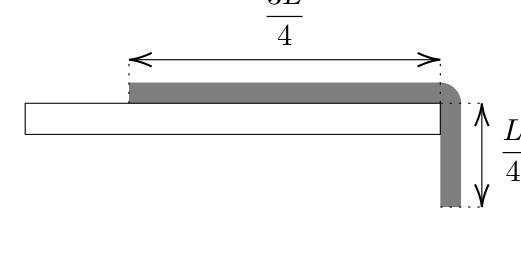 A uniform chain of length on a table, with a length hanging over the edge (and on the table).
Suppose that the tabletop is frictionless. What is the initial acceleration of the chain?
- (A)
- (B)
- (C)
- (D)
- (E)
Fonte: Testo (PDF) — p.2
Topic: Newtonian Mechanics Metodi: Free-Body Diagram Competenze: Physical Reasoning Objects: —
Le seguenti informazioni si applicano alle domande 5 e 6.
Si colloca su un tavolo una catena uniforme di lunghezza , con una lunghezza appesa sul bordo del tavolo. Quando la catena viene rilasciata dal riposo, inizia a scivolare dal tavolo.
Una catena uniforme di lunghezza su un tavolo, con una lunghezza appesa sul bordo (e sul tavolo).
Supponiamo che il tavolo sia senza attriti. Qual è l’accelerazione iniziale della catena?
- (A)
- (B)
- (C)
- (D)
- (E)
Fonte: Testo (PDF) — p.2
Topic: Newtonian Mechanics Metodi: Free-Body Diagram Competenze: Physical Reasoning Objects: —
(This question uses the same setup as Problem 5: a uniform chain of length on a table with a length hanging over the edge.)
Suppose now that the tabletop has friction. Given that the chain still slides off the table upon release, what is the maximum possible coefficient of static friction of the tabletop?
- (A)
- (B)
- (C)
- (D)
- (E)
Fonte: Testo (PDF) — p.2
Topic: Newtonian Mechanics Metodi: Free-Body Diagram Competenze: Physical Reasoning Objects: —
Questa domanda utilizza la stessa configurazione del problema 5: una catena uniforme di lunghezza su una tavola con una lunghezza appesa sul bordo.) *
Supponiamo che la scrivania abbia attrito. Dato che la catena scivola ancora dal tavolo dopo la liberazione, qual è il coefficiente massimo possibile di attrito statico del tavolo?
- (A)
- (B)
- (C)
- (D)
- (E)
Fonte: Testo (PDF) — p.2
Topic: Newtonian Mechanics Metodi: Free-Body Diagram Competenze: Physical Reasoning Objects: —
In a “circular pendulum”, a mass is suspended by a string of length and travels in a circular path at constant speed.
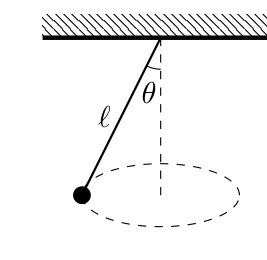 A conical (circular) pendulum: a mass on a string of length making angle with the vertical, tracing a horizontal circle.
Alice and Bob each propose a free-body diagram for the mass, as shown below.
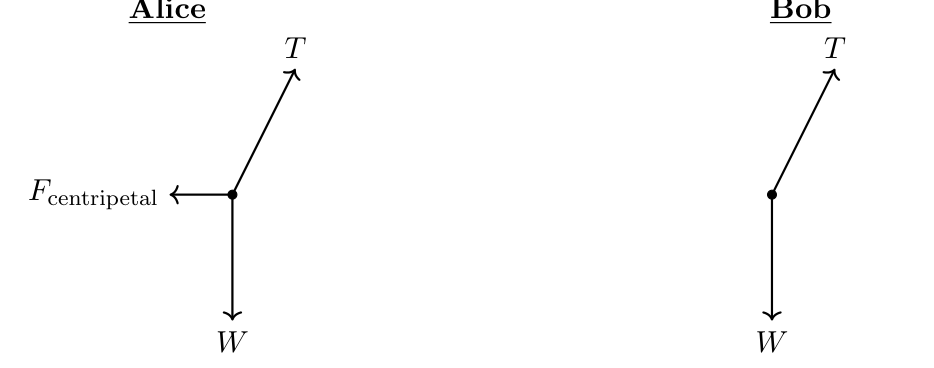 Alice’s free-body diagram shows tension , weight , and a horizontal ; Bob’s shows only tension and weight .
Whose free-body diagram is correct, and why?
- (A) Alice, as the mass must be in equilibrium.
- (B) Alice, as the centripetal force is a fictitious force that must be included.
- (C) Bob, as tension and weight are the only forces on the mass.
- (D) Bob, as tension and weight form an action-reaction pair.
- (E) Both are valid diagrams depending on the frame of reference chosen.
Fonte: Testo (PDF) — p.3
Topic: Newtonian Mechanics Metodi: Free-Body Diagram Competenze: Physical Reasoning Objects: Pendulum
In un “pendolo circolare”, una massa è sospesa da una corda di lunghezza e percorre un percorso circolare a velocità costante.
Un pendolo conico (circolare): una massa su una stringa di lunghezza che fa un angolo con la verticale, tracciando un cerchio orizzontale.
Alice e Bob propongono ognuno un diagramma di corpo libero per la massa, come mostrato di seguito.
Il diagramma di Alice mostra tensione , peso e una orizzontale ; Bob mostra solo tensione e peso .*
Di chi è corretto il diagramma del corpo libero, e perché?
- **(A) ** Alice, poiché la massa deve essere in equilibrio. Alice, come la forza centripetal è una forza fittizia che deve essere inclusa.
- **(C) ** Bob, come tensione e peso sono le uniche forze sulla massa.
- **(D) ** Bob, in quanto tensione e peso formano una coppia di reazione azione.
- **(E) ** Entrambi sono schemi validi a seconda del quadro di riferimento scelto.
Fonte: Testo (PDF) — p.3
Topic: Newtonian Mechanics Metodi: Free-Body Diagram Competenze: Physical Reasoning Objects: Pendulum
On board a shaky bus, Galen observes a glass of water and notices its surface to be tilted towards the right by an angle . What is the acceleration of the bus, and in which direction?
 A glass of water whose surface is tilted by an angle (rising towards the right).
- (A) towards the left
- (B) towards the right
- (C) towards the left
- (D) towards the right
- (E) downwards
Fonte: Testo (PDF) — p.3
Topic: Newtonian Mechanics Metodi: Free-Body Diagram, Vector Decomposition Competenze: Physical Reasoning Objects: —
A bordo di un autobus tremante, Galen osserva un bicchiere d’acqua e nota che la sua superficie è inclinata a destra da un angolo . Qual è l’accelerazione dell’autobus, e in che direzione?
Un bicchiere d’acqua la cui superficie è inclinata da un angolo (risalendo a destra).
- **(A) ** verso sinistra
- **(B) ** verso destra
- **(C) ** verso sinistra
- **(D) ** verso destra
- **(E) ** verso il basso
Fonte: Testo (PDF) — p.3
Topic: Newtonian Mechanics Metodi: Free-Body Diagram, Vector Decomposition Competenze: Physical Reasoning Objects: —
A tired delivery worker has a cube-shaped box of mass and side length on the ground, beside a step of height . In an attempt to bring the box up the step, he applies a horizontal force on the box. What is the smallest value of required for him to succeed?
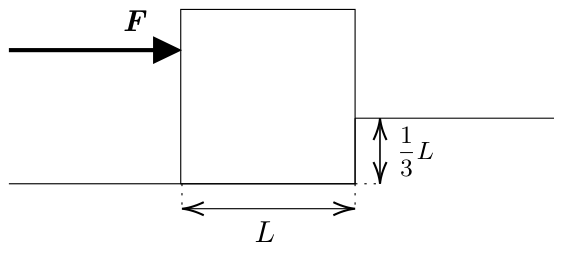 A cube of side pushed by a horizontal force against a step of height .
- (A)
- (B)
- (C)
- (D)
- (E)
Fonte: Testo (PDF) — p.4
Topic: Rigid Body Statics Metodi: Torque & Angular Momentum Analysis, Free-Body Diagram Competenze: Physical Reasoning Objects: Block
Un lavoratore stanco ha una scatola a forma di cubo di massa e lunghezza laterale sul terreno, accanto a un gradino di altezza . Nel tentativo di portare la scatola verso l’alto, si applica una forza orizzontale sulla scatola. Qual è il minimo valore di richiesto per avere successo?
Un cubo laterale spinto da una forza orizzontale contro un gradino di altezza .
- (A)
- (B)
- (C)
- (D)
- (E)
Fonte: Testo (PDF) — p.4
Topic: Rigid Body Statics Metodi: Torque & Angular Momentum Analysis, Free-Body Diagram Competenze: Physical Reasoning Objects: Block
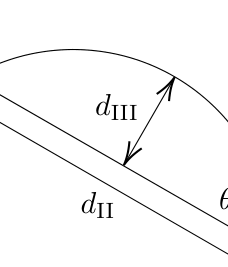
A ball is dropped from rest onto an inclined slope. Assuming there are no energy losses, which of the following statements are true about the ball’s motion as it bounces down the ramp?
I. The time interval between each bounce decreases over time. II. The distance between each bounce, , increases over time. III. The maximum distance reached by the ball from the ramp between each bounce, , remains constant over time. IV. The angle of the ball’s trajectory from the ramp at each bounce, , remains constant over time.
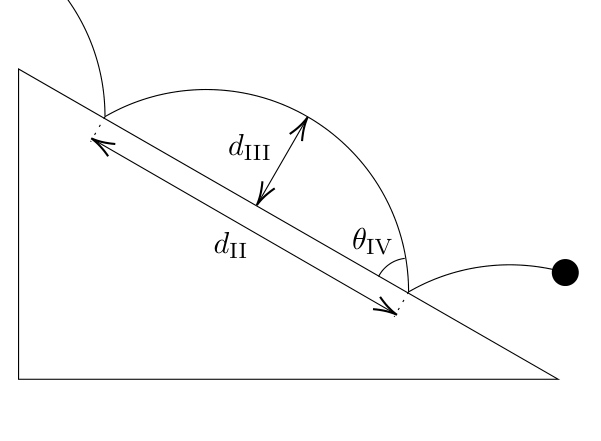 A ball bouncing down an inclined ramp, with the distance between bounces , the maximum distance from the ramp , and the bounce angle indicated.
- (A) I and II only
- (B) II and III only
- (C) III and IV only
- (D) I, II and III only
- (E) I, III and IV only
Fonte: Testo (PDF) — p.4
Topic: Newtonian Mechanics Metodi: Kinematic Equations Competenze: Physical Reasoning Objects: Ball, Inclined Plane
Una palla viene lanciata dal riposo su una pendice inclinata. Supponendo che non ci siano perdite di energia, quali delle seguenti affermazioni sono vere sul movimento della palla mentre rimbalza verso il basso?
I. L’intervallo di tempo tra ogni rimbalzo diminuisce nel tempo. II. La distanza tra ogni rimbalzo, , aumenta nel tempo. III. Il La distanza massima raggiunta dalla palla dalla rampa tra ogni rimbalzo, , rimane costante nel tempo. IV. L’angolo della traiettoria della palla dalla rampa a ogni rimbalzo, , rimane costante nel tempo.
Una palla che rimbalza in un’inclinazione della rampa, con la distanza tra i rimbalzi , la distanza massima dalla rampa e l’angolo di rimbalzo indicato.
- **(A) ** I e II solo
- solo **(B) ** II e III
- solo **(C) ** III e IV
- **(D) ** I, II e III soltanto
- **(E) ** I, III e IV soltanto
Fonte: Testo (PDF) — p.4
Topic: Newtonian Mechanics Metodi: Kinematic Equations Competenze: Physical Reasoning Objects: Ball, Inclined Plane
Paul fires an arrow at initial speed towards a target a distance away from him. He unfortunately makes the mistake of aiming directly at the target, and as a result, his arrow misses the target by a vertical distance . What is ?
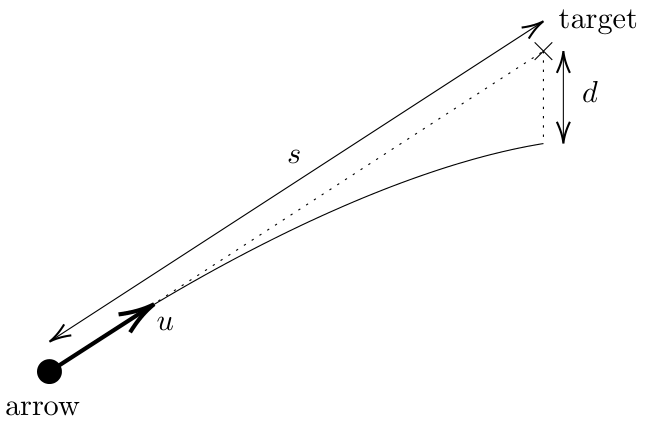 An arrow fired at speed aimed straight at a target a distance away; it lands a vertical distance below the target.
- (A)
- (B)
- (C)
- (D)
- (E)
Fonte: Testo (PDF) — p.5
Topic: Newtonian Mechanics Metodi: Kinematic Equations Competenze: Physical Reasoning Objects: Projectile
Paul tira una freccia a velocità iniziale verso un bersaglio a distanza da lui. Purtroppo commette l’errore di puntare direttamente al bersaglio, e di conseguenza, la sua freccia perde il bersaglio a una distanza verticale . Che cos’è ?
Una freccia sparata a velocità diretta dritta verso un bersaglio a una distanza ; atterra a una distanza verticale al di sotto del bersaglio.
- (A)
- (B)
- (C)
- (D)
- (E)
Fonte: Testo (PDF) — p.5
Topic: Newtonian Mechanics Metodi: Kinematic Equations Competenze: Physical Reasoning Objects: Projectile
Bobo and Nana are initially at rest on icy frictionless ground. Bobo has mass and Nana has mass . Bobo grabs a snowball of mass and throws it at Nana, who catches it. Bobo and Nana end up moving apart at speeds and respectively. What is the ratio ?
- (A)
- (B)
- (C)
- (D)
- (E)
Fonte: Testo (PDF) — p.5
Topic: Conservation of Momentum Metodi: Conservation of Momentum Competenze: Physical Reasoning Objects: Ball
Bobo e Nana inizialmente sono a riposo su un terreno ghiacciato senza attrito. Bobo ha massa e Nana ha massa . Bobo prende una palla di neve di massa e la lancia su Nana, che la cattura. Bobo e Nana finiscono per spostarsi a velocità rispettivamente e . Qual è il rapporto ?
- (A)
- (B)
- (C)
- (D)
- (E)
Fonte: Testo (PDF) — p.5
Topic: Conservation of Momentum Metodi: Conservation of Momentum Competenze: Physical Reasoning Objects: Ball
The frame of an umbrella is constructed by attaching 6 uniform rods, each of mass and length , to a common centre. The frame makes an angle to the horizontal when the umbrella is closed, and an angle when the umbrella is open, as drawn below. (Note: Not all 6 rods are drawn due to perspective.)
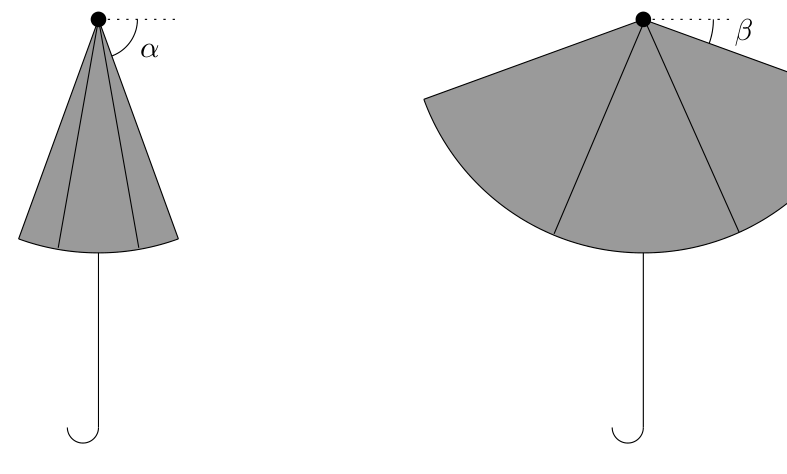 Left: closed umbrella with frame rods at angle to the horizontal. Right: open umbrella with frame rods at angle to the horizontal.
How much work needs to be done to open the umbrella? Assume that the umbrella’s central axis is kept vertical and stationary, and that the mass of its fabric is negligible compared to the mass of its frame.
- (A)
- (B)
- (C)
- (D)
- (E)
Fonte: Testo (PDF) — p.6
Topic: Conservation of Energy Metodi: Energy Conservation Method Competenze: Physical Reasoning Objects: Rod
Il telaio di un ombrello è costruito collegando a un centro comune 6 barre uniformi, ciascuna di massa e lunghezza . Il telaio crea un angolo verso l’orizzontale quando l’ombrello è chiuso e un angolo quando l’ombrello è aperto, come illustrato di seguito. (Nota: non tutte le 6 barre sono disegnate a causa della prospettiva.)
Sestra: ombrello chiuso con bastone di telaio all’angolo orizzontale. Destra: ombrello aperto con le barre del telaio all’angolo verso l’orizzontale.
Quanto lavoro serve per aprire l’ombrello? Supponiamo che l’asse centrale del parapetto sia mantenuto verticale e fermo e che la massa del tessuto sia trascurabile rispetto alla massa del suo telaio.
- (A)
- (B)
- (C)
- (D)
- (E)
Fonte: Testo (PDF) — p.6
Topic: Conservation of Energy Metodi: Energy Conservation Method Competenze: Physical Reasoning Objects: Rod
Three identical point masses are connected by strings of length in the vertical plane, as shown below. The two top masses are constrained to move horizontally along a frictionless track. If the system is released from rest at an initial angle from the horizontal, find the relative velocity of the two top masses just before they collide with each other.
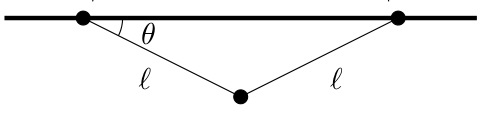 Two masses on a horizontal frictionless track, each connected by a string of length to a third mass hanging below; the strings make angle with the horizontal.
- (A)
- (B)
- (C)
- (D)
- (E)
Fonte: Testo (PDF) — p.6
Topic: Conservation of Energy Metodi: Energy Conservation Method Competenze: Physical Reasoning Objects: String
Tre masse di punti identiche sono collegate con stringhe di lunghezza nel piano verticale, come mostrato di seguito. Le due masse superiori sono costrette a muoversi orizzontalmente lungo una pista senza attrito. Se il sistema viene rilasciato dal riposo ad un angolo iniziale dall’orizzontale, si trova la velocità relativa delle due masse superiori poco prima che si coliscano tra loro.
Due masse su una pista orizzontale senza attrito, ciascuna connessa da una corda di lunghezza a una terza massa appesa sotto; le corde formano un angolo con l’orizzontale.
- (A)
- (B)
- (C)
- (D)
- (E)
Fonte: Testo (PDF) — p.6
Topic: Conservation of Energy Metodi: Energy Conservation Method Competenze: Physical Reasoning Objects: String
A mass is suspended at rest by an ideal spring of force constant . At this position, an extra mass is gently added so that the total mass is now , before it is released from rest. The spring-mass system subsequently oscillates, but eventually settles to a rest due to damping by resistive forces. How much work is done in total by these resistive forces?
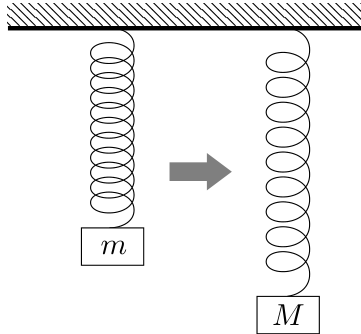 A spring with mass at rest; after an extra mass is added the total mass hangs lower.
- (A)
- (B)
- (C)
- (D)
- (E)
Fonte: Testo (PDF) — p.7
Topic: Conservation of Energy Metodi: Energy Conservation Method, Hooke’s Law Competenze: Physical Reasoning Objects: Spring
Una massa è sospesa a riposo da una costante di forza ideale . In questa posizione, viene aggiunta delicatamente una massa in più in modo che la massa totale sia ora , prima di essere rilasciata dal riposo. Il sistema di massa di molla oscilla successivamente, ma alla fine si stabilisce a riposo a causa dell’ammortizzazione da forze resistive. Quanto lavoro è fatto in totale da queste forze di resistenza?
Una molla con massa in riposo; dopo l’aggiunta di una massa extra la massa totale è inferiore.
- (A)
- (B)
- (C)
- (D)
- (E)
Fonte: Testo (PDF) — p.7
Topic: Conservation of Energy Metodi: Energy Conservation Method, Hooke’s Law Competenze: Physical Reasoning Objects: Spring
Brian wants to bridge two cliffs using a plank of length . The plank itself is essentially massless, but there is a mass attached to its front and a mass attached to its back. The bridge is formed by pushing the plank horizontally across the gap, until the full gap is covered by the plank. What is the maximum gap between the cliffs that can be bridged in this manner?
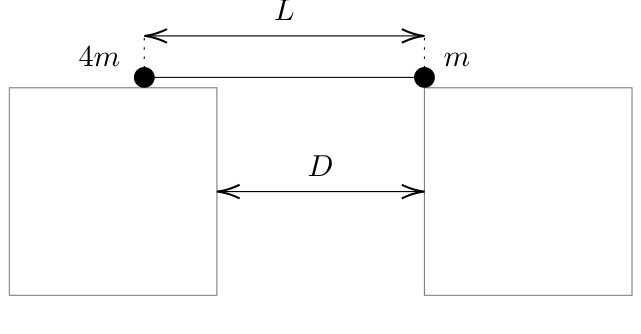 A plank of length with mass at its back and at its front, pushed across a gap between two cliffs.
- (A)
- (B)
- (C)
- (D)
- (E)
Fonte: Testo (PDF) — p.7
Topic: Rigid Body Statics Metodi: Torque & Angular Momentum Analysis Competenze: Physical Reasoning Objects: Beam
Brian vuole attraversare due scogliere usando una lavagna di lunghezza . La tavola stessa è essenzialmente senza massa, ma è collegata alla sua parte anteriore una massa e alla sua parte posteriore una massa . Il ponte si forma spingendo la tavola orizzontalmente attraverso il vuoto, fino a quando il vuoto completo non è coperto dalla tavola. Qual è il gap massimo tra le scogliere che possono essere pontificate in questo modo?
Una lavagna di lunghezza con massa alla sua parte posteriore e alla sua parte anteriore, spinta attraverso un intervallo tra due scogliere.
- (A)
- (B)
- (C)
- (D)
- (E)
Fonte: Testo (PDF) — p.7
Topic: Rigid Body Statics Metodi: Torque & Angular Momentum Analysis Competenze: Physical Reasoning Objects: Beam
A horizontal turntable of radius rotates with constant angular velocity . An ant, positioned a distance from the centre, initially rotates along with the turntable. All of a sudden, it decides to jump vertically (relative to itself). What is the minimum duration of its jump such that it escapes the turntable?
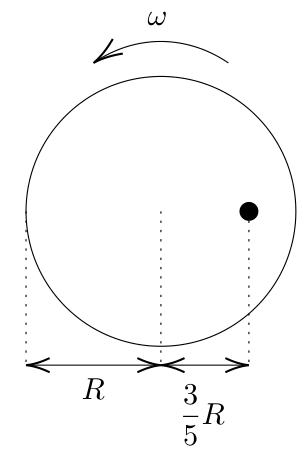 Top view of a turntable of radius rotating with angular velocity ; the ant is a distance from the centre.
- (A)
- (B)
- (C)
- (D)
- (E)
Fonte: Testo (PDF) — p.8
Topic: Newtonian Mechanics Metodi: Kinematic Equations Competenze: Physical Reasoning Objects: Disk
Una rotatoria orizzontale di raggio ruota con velocità angolare costante . Una formica, posizionata a una distanza dal centro, ruota inizialmente insieme alla scheda. Improvvisamente decide di saltare verticalmente (relativamente a se stesso). Qual è la durata minima del suo salto in modo tale da sfuggire al giradischi?
Vista superiore di una scheda a rotazione di raggio che ruota con velocità angolare ; la formica è a distanza dal centro.
- (A)
- (B)
- (C)
- (D)
- (E)
Fonte: Testo (PDF) — p.8
Topic: Newtonian Mechanics Metodi: Kinematic Equations Competenze: Physical Reasoning Objects: Disk
A car drives at a constant speed along a horizontal road of width that has a sharp bend as shown in the figure. The coefficient of static friction between the car and the road is . What is the maximum speed at which the car can negotiate the bend without slipping? Neglect the size of the car.
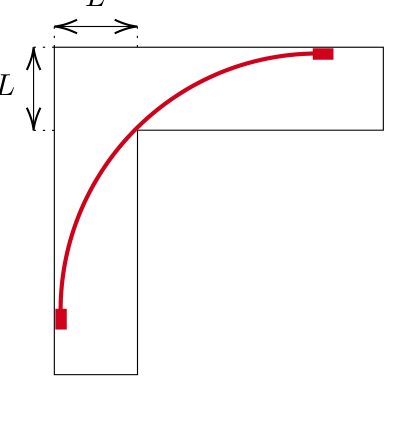 An L-shaped road of width with a sharp bend; the car’s path follows a curve through the bend.
- (A)
- (B)
- (C)
- (D)
- (E)
Fonte: Testo (PDF) — p.8
Topic: Newtonian Mechanics Metodi: Free-Body Diagram Competenze: Physical Reasoning Objects: —
Una vettura si muove a velocità costante lungo una strada orizzontale di larghezza che ha una curva acuta come mostrato nella figura. Il coefficiente di attrito statico tra l’auto e la strada è . Qual è la velocità massima con cui la macchina può negoziare la curva senza scivolare? - Non ti preoccupare della grandezza della macchina.
Una strada a forma di L di larghezza con curva nitida ; il percorso della vettura segue una curva attraverso la curva.
- (A)
- (B)
- (C)
- (D)
- (E)
Fonte: Testo (PDF) — p.8
Topic: Newtonian Mechanics Metodi: Free-Body Diagram Competenze: Physical Reasoning Objects: —
A mass is suspended from a light inextensible string of length . The top end of the string is driven to perform vertical oscillations with amplitude and period . It is observed that the mass oscillates identically to the top end of the string. What is the maximum possible amplitude ?
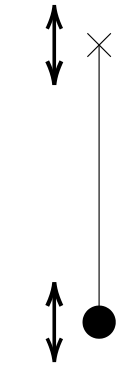 A mass on a vertical string whose top end is driven to oscillate vertically with amplitude ; the mass oscillates with the same amplitude.
- (A)
- (B)
- (C)
- (D)
- (E)
Fonte: Testo (PDF) — p.9
Topic: Oscillations & Waves Metodi: Simple Harmonic Motion Analysis Competenze: Physical Reasoning Objects: String
Una massa è sospesa da una stringa di lunghezza , che non si estende a leggero. L’estremità superiore della corda è guidata per eseguire oscillazioni verticali con amplitudine e periodo . Si osserva che la massa oscilla identicamente all’estremità superiore della corda. Qual è l’ampiezza massima possibile ?
Una massa su una corda verticale la cui estremità superiore è spinta ad oscillarsi verticalmente con l’ampiezza ; la massa oscilla con la stessa amplitudine.
- (A)
- (B)
- (C)
- (D)
- (E)
Fonte: Testo (PDF) — p.9
Topic: Oscillations & Waves Metodi: Simple Harmonic Motion Analysis Competenze: Physical Reasoning Objects: String
A uniform solid disc rests flat on a frictionless table. A brief tangential impulse is applied on the leftmost point of the disc. What is the resulting ratio of speeds of the leftmost and rightmost points of the disc, ?
(The moment of inertia of a uniform solid disc of mass and radius about its central axis is given by .)
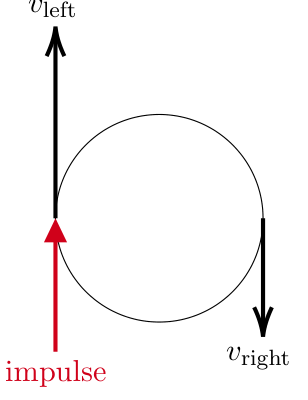 Top view of a disc on a frictionless table; an upward tangential impulse is applied at the leftmost point, giving velocities (up) and (down) at the two ends.
- (A)
- (B)
- (C)
- (D)
- (E)
Fonte: Testo (PDF) — p.9
Topic: Rotational Dynamics Metodi: Torque & Angular Momentum Analysis, Impulse-Momentum Theorem Competenze: Physical Reasoning Objects: Disk
Un disco solido uniforme si posa piatto su un tavolo senza attrito. Un breve impulso tangenziale viene applicato sul punto più sinistro del disco. Qual è il rapporto risultante delle velocità dei punti più a sinistra e più a destra del disco, ?
(Il momento di inerzia di un disco solido uniforme di massa e di raggio intorno al suo asse centrale è dato da .)
Vista superiore di un disco su una tavola senza attrito; viene applicato un impulso tangenziale verso l’alto nel punto più sinistro, dando velocità (solo) e (in basso) alle due estremità.
- (A)
- (B)
- (C)
- (D)
- (E)
Fonte: Testo (PDF) — p.9
Topic: Rotational Dynamics Metodi: Torque & Angular Momentum Analysis, Impulse-Momentum Theorem Competenze: Physical Reasoning Objects: Disk
A uniform solid sphere is placed at the top of a valley and released from rest. It rolls down, and upon reaching the end of the valley, a height below the top of the valley, it rises upward into the air. Throughout its motion, the sphere never experiences any energy dissipation and never slips. Yet, Chris claims that the sphere will never return to its original height, falling short by a distance . Is Chris right, and if so, what is ?
(The moment of inertia of a uniform solid sphere of mass and radius about its central axis is given by .)
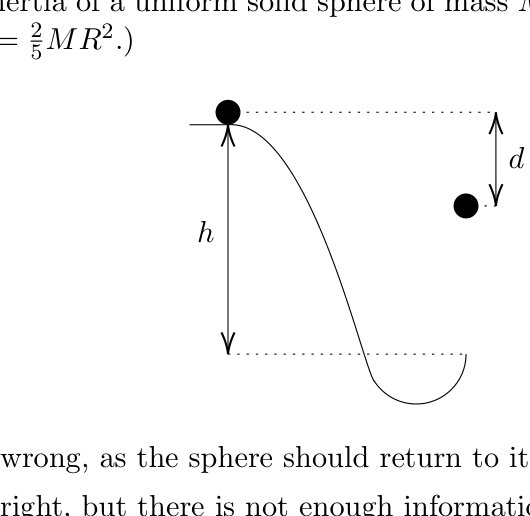 A solid sphere released from height at the top of a valley; it leaves the end of the valley and reaches a maximum height a distance below its original height.
- (A) Chris is wrong, as the sphere should return to its original height.
- (B) Chris is right, but there is not enough information to calculate .
- (C) Chris is right, .
- (D) Chris is right, .
- (E) Chris is right, .
Fonte: Testo (PDF) — p.10
Topic: Conservation of Energy Metodi: Energy Conservation Method Competenze: Physical Reasoning Objects: Sphere
Una sfera solida uniforme viene posta in cima a una valle e rilasciata dal riposo. Rolla giù e, raggiungendo la fine della valle, un’altezza sotto la parte superiore della valle, sale verso l’alto nell’aria. Durante il suo movimento, la sfera non sperimenta mai alcuna dissipazione di energia e non scivola mai. Tuttavia, Chris sostiene che la sfera non tornerà mai alla sua altezza originale, diminuendo di una distanza . Chris ha ragione, e se sì, cos’è ?
(Il momento di inerzia di una sfera solida uniforme di massa e di raggio intorno al suo asse centrale è dato da .)
Una sfera solida rilasciata da un’altezza in cima a una valle; essa lascia l’estremità della valle e raggiunge un’altezza massima a una distanza inferiore all’altezza originale.
- (A) Chris is wrong, as the sphere should return to its original height.
- **(B) ** Chris ha ragione, ma non ci sono informazioni sufficienti per calcolare .
- (C) Chris is right, .
- (D) Chris is right, .
- (E) Chris is right, .
Fonte: Testo (PDF) — p.10
Topic: Conservation of Energy Metodi: Energy Conservation Method Competenze: Physical Reasoning Objects: Sphere
Two satellites X and Y orbit the same planet and have equal masses. The orbit of satellite X is circular, whereas the orbit of satellite Y is elliptical. The major axis of satellite Y’s orbit has the same length as the diameter of satellite X’s orbit. Which of the following statements are true?
I. The period of the orbit is equal for both satellites. II. The total energy of the orbit is equal for both satellites. III. The angular momentum of the orbit (with respect to the planet) is equal for both satellites. IV. The speeds of Satellite Y at points 1, 2 and 3 of its orbit (as shown below) are related by .
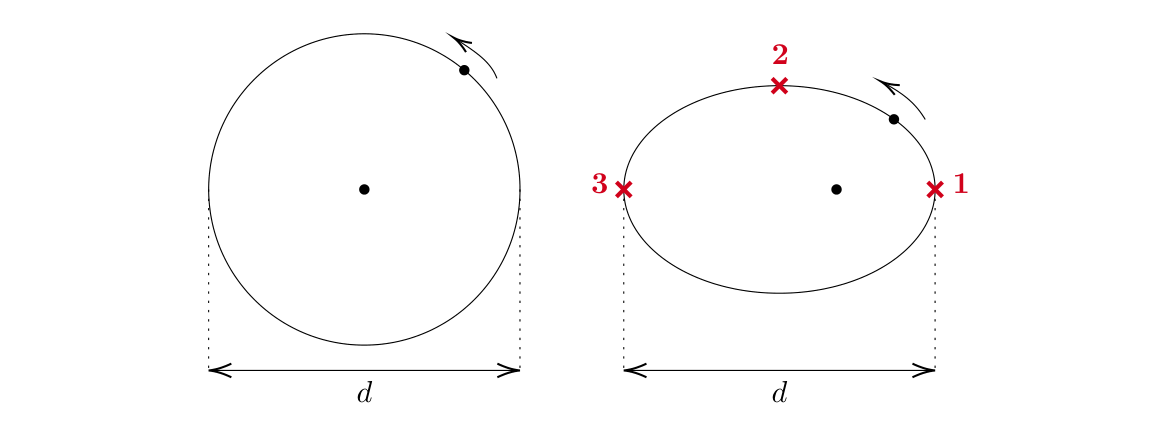 Satellite X in a circular orbit of diameter , and Satellite Y in an elliptical orbit whose major axis is also ; points 1 (right), 2 (top) and 3 (left) are marked on Y’s orbit.
- (A) III only
- (B) I and II only
- (C) I and IV only
- (D) III and IV only
- (E) II, III and IV only
Fonte: Testo (PDF) — p.10
Topic: Gravitation Metodi: Kepler’s Laws, Conservation Laws Competenze: Physical Reasoning Objects: Satellite, Planet
Due satelliti X e Y orbitano intorno allo stesso pianeta e hanno massa uguale. L’orbita del satellite X è circolare, mentre l’orbita del satellite Y è ellittica. L’asse principale dell’orbita del satellite Y ha la stessa lunghezza del diametro dell’orbita del satellite X. Quali delle seguenti affermazioni sono vere?
I. Il periodo dell’orbita è uguale per entrambi i satelliti. II. L’energia totale dell’orbita è uguale per entrambi i satelliti. III. Il La velocità angolare dell’orbita (rispetto al pianeta) è uguale per entrambi i satelliti. IV. Le velocità del satellite Y nei punti 1, 2 e 3 della sua orbita (come mostrato di seguito) sono correlate da .
Satellite X in orbita circolare di diametro e Satellite Y in orbita ellittica il cui asse principale è anche ; i punti 1 (destra), 2 (alto) e 3 (sinistra) sono segnati sull’orbita di Y.
- solo **(A) ** III
- **(B) ** I e II solo
- **(C) ** I e IV soltanto
- **(D) ** solo III e IV
- solo **(E) ** II, III e IV
Fonte: Testo (PDF) — p.10
Topic: Gravitation Metodi: Kepler’s Laws, Conservation Laws Competenze: Physical Reasoning Objects: Satellite, Planet
In an experiment gone very wrong, Shuhao accidentally created a clone of Earth with the same mass and radius as our Earth. The two Earths are initially stationary with a separation of between their centres. As they attract each other due to gravity, they eventually crash into each other. What is the velocity of each Earth at impact?
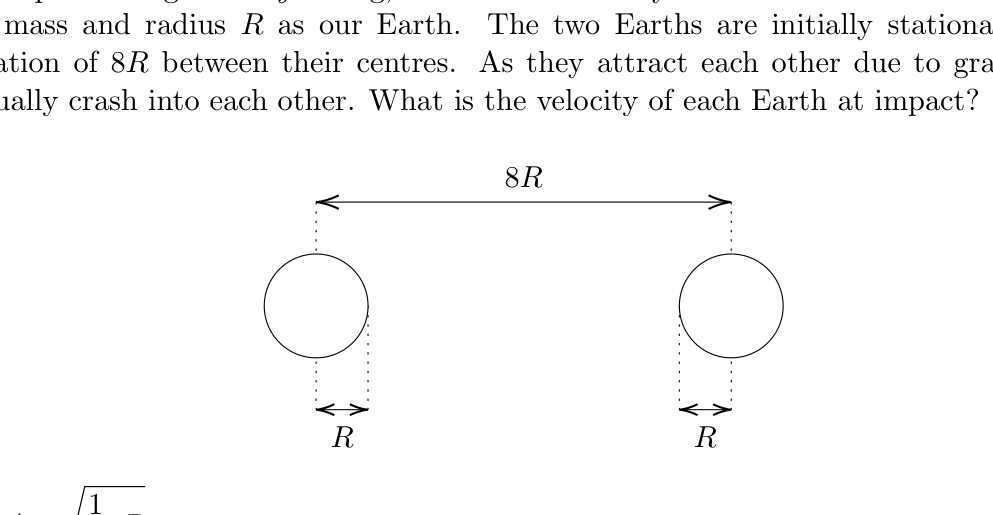 Two identical Earths, each of radius , initially at rest with a centre-to-centre separation of .
- (A)
- (B)
- (C)
- (D)
- (E)
Fonte: Testo (PDF) — p.11
Topic: Gravitation Metodi: Newton’s Law of Gravitation, Energy Conservation Method Competenze: Physical Reasoning Objects: Planet
In un esperimento che è andato molto male, Shuhao ha creato accidentalmente un clone della Terra con la stessa massa e il raggio della nostra Terra. Le due Terre sono inizialmente stazionarie con una separazione di tra i loro centri. Mentre si attraggono l’uno all’altro a causa della gravità, alla fine si schiantano. Qual è la velocità di ogni Terra all’impatto?
Due Terre identiche, ciascuna di raggio , inizialmente in riposo con una separazione centro-centro di .
- (A)
- (B)
- (C)
- (D)
- (E)
Fonte: Testo (PDF) — p.11
Topic: Gravitation Metodi: Newton’s Law of Gravitation, Energy Conservation Method Competenze: Physical Reasoning Objects: Planet
An L-shaped pipe is placed into a river flowing at speed , with the open end facing the current head-on. The water in the pipe is observed to rise to a height above the water surface of the river. Find .
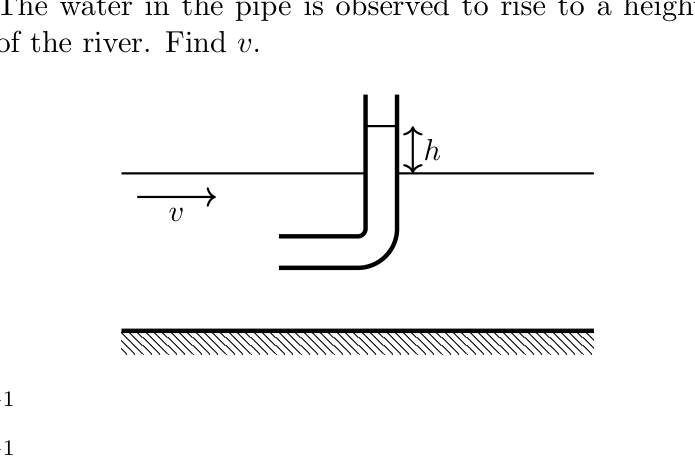 An L-shaped pipe in a river flowing at speed ; water rises a height above the river surface in the vertical part of the pipe.
- (A)
- (B)
- (C)
- (D)
- (E)
Fonte: Testo (PDF) — p.11
Topic: Fluid Mechanics Metodi: Bernoulli’s Equation Competenze: Physical Reasoning Objects: Tube
Un tubo a forma di L viene inserito in un fiume che scorre a velocità , con l’estremità aperta rivolta verso la corrente. L’acqua del tubo è osservata salire ad un’altezza sopra la superficie dell’acqua del fiume. Trova .
Un tubo a forma di L in un fiume che scorre a velocità ; l’acqua sale ad un’altezza sopra la superficie del fiume nella parte verticale del tubo.
- (A)
- (B)
- (C)
- (D)
- (E)
Fonte: Testo (PDF) — p.11
Topic: Fluid Mechanics Metodi: Bernoulli’s Equation Competenze: Physical Reasoning Objects: Tube
A wooden cube of density and side length floats in a fluid of density and undergoes a periodic vertical bobbing motion. Assuming the cube remains upright at all times, what is the period of the bobbing?
- (A)
- (B)
- (C)
- (D)
- (E)
Fonte: Testo (PDF) — p.12
Topic: Oscillations & Waves Metodi: Simple Harmonic Motion Analysis Competenze: Physical Reasoning Objects: —
Un cubo di legno di densità e lunghezza laterale galleggia in un fluido di densità e subisce un movimento periodico di bobinazione verticale. Supponendo che il cubo rimanga in verticale in ogni momento, quale è il periodo di bobbing?
- (A)
- (B)
- (C)
- (D)
- (E)
Fonte: Testo (PDF) — p.12
Topic: Oscillations & Waves Metodi: Simple Harmonic Motion Analysis Competenze: Physical Reasoning Objects: —
A ray of light enters a spherical droplet. Its resulting trajectory traces the shape of a regular hexagon. What is the minimum possible refractive index of this droplet?
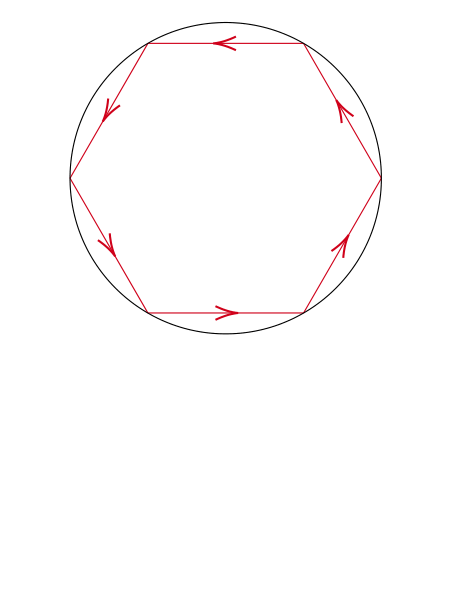 A light ray inside a spherical droplet tracing a regular hexagonal path through total internal reflections.
- (A)
- (B)
- (C)
- (D)
- (E)
Fonte: Testo (PDF) — p.12
Topic: Geometric Optics Metodi: Snell’s Law Competenze: Physical Reasoning Objects: Droplet
Un raggio di luce entra in una goccia sferica. La sua traiettoria risultante traccia la forma di un esagono regolare. Qual è l’indice minimo di rifrazione possibile di questa goccia?
Un raggio di luce all’interno di una goccia sferica che traccia un percorso esagonale regolare attraverso i riflessi interni totali.
- (A)
- (B)
- (C)
- (D)
- (E)
Fonte: Testo (PDF) — p.12
Topic: Geometric Optics Metodi: Snell’s Law Competenze: Physical Reasoning Objects: Droplet
A man of height stands facing a plane mirror hung vertically. The bottom of the mirror is at vertical distance above the man’s feet, while the top of the mirror is at vertical distance below the top of the man’s head. What percentage of his body is the man able to see in the mirror? Treat the man’s eye level to be approximately that of the top of his head.
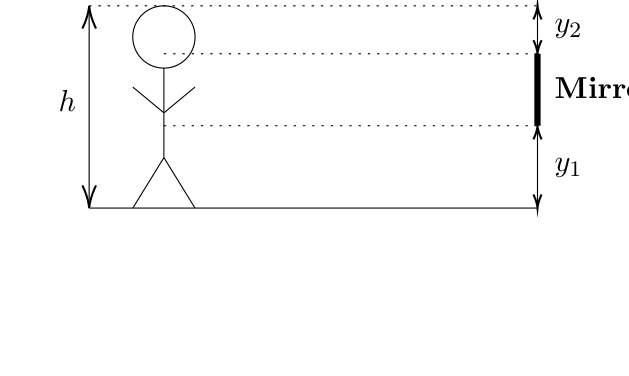 A man of height facing a vertical mirror whose bottom is above his feet and whose top is below the top of his head.
- (A)
- (B)
- (C)
- (D)
- (E)
Fonte: Testo (PDF) — p.13
Topic: Geometric Optics Metodi: Ray Tracing Competenze: Physical Reasoning Objects: Mirror
Un uomo di altezza si trova di fronte a uno specchio piano appeso verticalmente. La parte inferiore dello specchio è a distanza verticale sopra i piedi dell’uomo, mentre la parte superiore dello specchio è a distanza verticale sotto la parte superiore della testa dell’uomo. Quanta percentuale del suo corpo l’uomo è in grado di vedere nello specchio? Tratta il livello degli occhi dell’uomo da essere approssimativamente quello della parte superiore della testa.
Un uomo di altezza che si affaccia su uno specchio verticale il cui fondo è sopra i piedi e la cui parte superiore è sotto la parte superiore della testa.*
- (A)
- (B)
- (C)
- (D)
- (E)
Fonte: Testo (PDF) — p.13
Topic: Geometric Optics Metodi: Ray Tracing Competenze: Physical Reasoning Objects: Mirror
Rays from the Sun are brought through a convex lens with a focal length of and a circular cross section of diameter . This produces a bright spot on a screen placed a distance behind the lens. What is the diameter of this bright spot?
- (A)
- (B)
- (C)
- (D)
- (E)
Fonte: Testo (PDF) — p.13
Topic: Geometric Optics Metodi: Thin Lens & Mirror Equation, Ray Tracing Competenze: Physical Reasoning Objects: Lens, Screen
I raggi del Sole vengono trasportati attraverso una lente convexa con una lunghezza focale di e una sezione incrociata circolare di diametro . Ciò produce un punto luminoso su uno schermo posizionato a una distanza dietro l’obiettivo. Qual è il diametro di questo punto luminoso?
- (A)
- (B)
- (C)
- (D)
- (E)
Fonte: Testo (PDF) — p.13
Topic: Geometric Optics Metodi: Thin Lens & Mirror Equation, Ray Tracing Competenze: Physical Reasoning Objects: Lens, Screen
Consider a cube of side length . 7 identical charges and one additional charge are placed on the vertices of the cube, as shown below. Find the electric field at the centre of the cube.
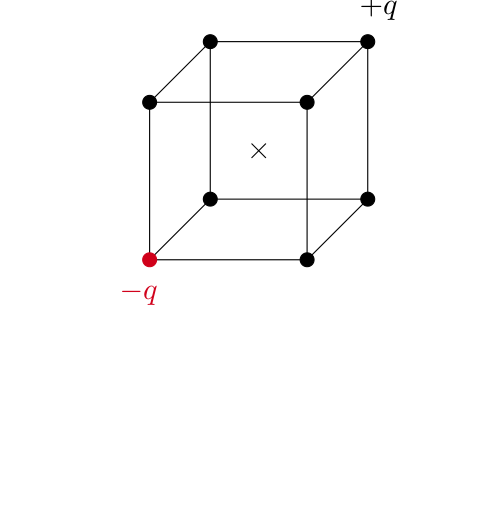 A cube of side with charge at seven vertices and charge at one (bottom-front-left) vertex; the centre is marked with a cross.
- (A)
- (B)
- (C)
- (D)
- (E)
Fonte: Testo (PDF) — p.13
Topic: Electrostatics Metodi: Coulomb’s Law, Superposition Principle Competenze: Physical Reasoning Objects: Point Charge
Considerate un cubo di lunghezza laterale . 7 cariche identiche e una carica aggiuntiva sono posizionate sulle vertici del cubo, come mostrato di seguito. Trova il campo elettrico al centro del cubo.
Un cubo laterale con carica a sette vertici e carica a un vertice (basso-front-left); il centro è contrassegnato da una croce.
- (A)
- (B)
- (C)
- (D)
- (E)
Fonte: Testo (PDF) — p.13
Topic: Electrostatics Metodi: Coulomb’s Law, Superposition Principle Competenze: Physical Reasoning Objects: Point Charge
Consider again a cube of side length . This time, a charge is spread uniformly across one of the insulating faces of the cube. A charge is now placed at the centre of the cube. Find the electric force exerted on the charge .
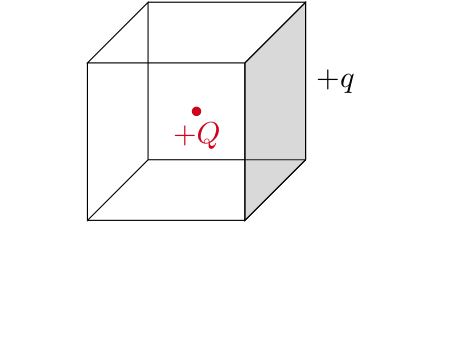 A cube of side with charge uniformly spread over one face and a point charge at the centre.
- (A)
- (B)
- (C)
- (D)
- (E)
Fonte: Testo (PDF) — p.14
Topic: Electrostatics Metodi: Gauss’s Law, Symmetry Argument Competenze: Physical Reasoning Objects: Point Charge
Considerate di nuovo un cubo di lunghezza laterale . Questa volta, una carica è distribuita uniformemente su una delle facce isolanti del cubo. Una carica viene ora posta al centro del cubo. Trova la forza elettrica esercitata sulla carica .
Un cubo laterale con carica uniformemente distribuita su una faccia e una carica puntaria al centro.
- (A)
- (B)
- (C)
- (D)
- (E)
Fonte: Testo (PDF) — p.14
Topic: Electrostatics Metodi: Gauss’s Law, Symmetry Argument Competenze: Physical Reasoning Objects: Point Charge
A conducting sphere of charge and radius is placed in the centre of a spherical conducting shell of charge and radius . What is the minimum work required to bring a small charge from the outer shell to the surface of the inner sphere?
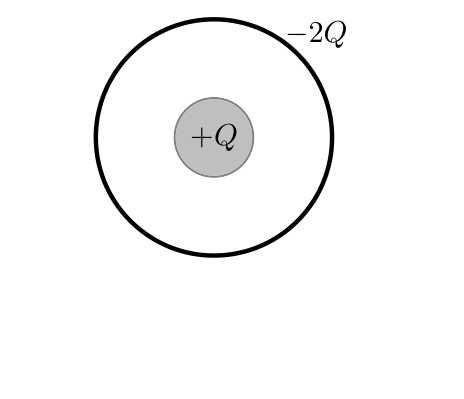 A conducting sphere of charge and radius concentric inside a conducting shell of charge and radius .
- (A)
- (B)
- (C)
- (D)
- (E)
Fonte: Testo (PDF) — p.14
Topic: Electrostatics Metodi: Electric Potential Method, Gauss’s Law Competenze: Physical Reasoning Objects: Conducting Sphere
Una sfera conduttrice di carica e di raggio è collocata al centro di una conchiglia di carica e di raggio conduttrice sferica. Qual è il lavoro minimo necessario per portare una piccola carica dalla conchiglia esterna alla superficie della sfera interna?
Sfera di carica conduttrice e raggio concentrico all’interno di una conchiglia di carica conduttrice e raggio .
- (A)
- (B)
- (C)
- (D)
- (E)
Fonte: Testo (PDF) — p.14
Topic: Electrostatics Metodi: Electric Potential Method, Gauss’s Law Competenze: Physical Reasoning Objects: Conducting Sphere
Find the power dissipated by the resistor in the circuit below.
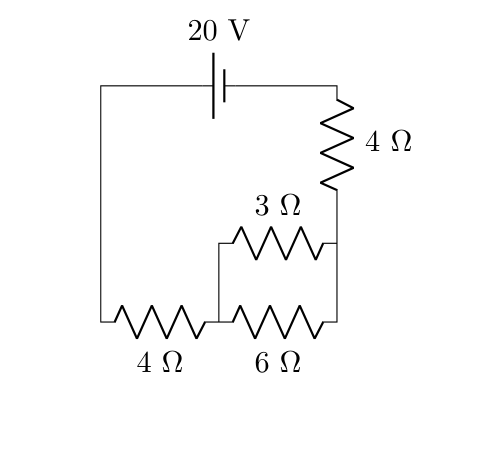 A circuit with a source, a resistor in series, and a parallel combination of a and a resistor, with another resistor in the loop.
- (A)
- (B)
- (C)
- (D)
- (E)
Fonte: Testo (PDF) — p.15
Topic: Circuits Metodi: Equivalent Circuit Reduction, Kirchhoff’s Laws Competenze: Physical Reasoning Objects: Resistor, Battery
Trova la potenza dissipata dal resistore nel circuito di seguito.
Un circuito con una fonte , una resistenza in serie e una combinazione parallela di una resistenza e una resistenza , con un’altra resistenza nel circuito.
- (A)
- (B)
- (C)
- (D)
- (E)
Fonte: Testo (PDF) — p.15
Topic: Circuits Metodi: Equivalent Circuit Reduction, Kirchhoff’s Laws Competenze: Physical Reasoning Objects: Resistor, Battery
A tetrahedron is made out of 6 identical resistors of resistance forming each of its edges, as shown below. What is the effective resistance between two adjacent vertices of the tetrahedron?
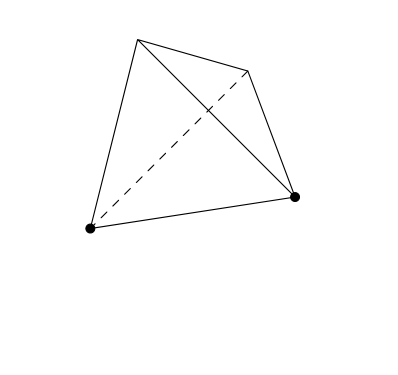 A regular tetrahedron with a resistor along each of its 6 edges; the effective resistance is measured between two adjacent vertices.
- (A)
- (B)
- (C)
- (D)
- (E)
Fonte: Testo (PDF) — p.15
Topic: Circuits Metodi: Equivalent Circuit Reduction, Symmetry Argument Competenze: Physical Reasoning Objects: Resistor
Un tetraedro è costituito da 6 resistenti identici di resistenza che formano ciascuno dei suoi bordi, come mostrato di seguito. Qual è la resistenza effettiva tra due vertici adiacenti del tetraedro?
Un tetraedro regolare con una resistenza lungo ciascuno dei suoi 6 bordi; la resistenza effettiva viene misurata tra due vertici adiacenti.
- (A)
- (B)
- (C)
- (D)
- (E)
Fonte: Testo (PDF) — p.15
Topic: Circuits Metodi: Equivalent Circuit Reduction, Symmetry Argument Competenze: Physical Reasoning Objects: Resistor
Three initially uncharged capacitors are connected with a battery as shown in the circuit below. The switch is first set to position A, and after a long time, the switch is then set to position B. Find the final charge on the capacitor.
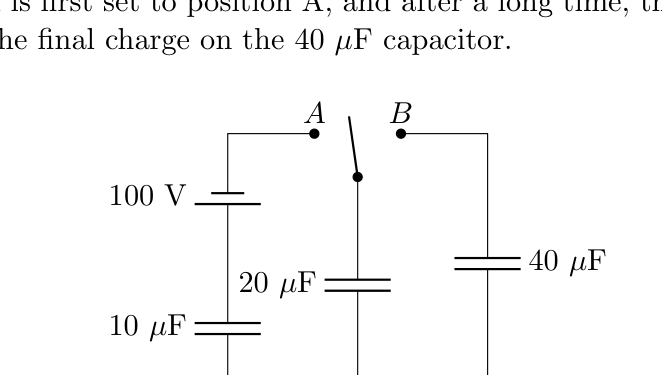 A battery with a switch between positions A and B; a and a capacitor on the left, and a capacitor on the right.
- (A)
- (B)
- (C)
- (D)
- (E)
Fonte: Testo (PDF) — p.16
Topic: Circuits Metodi: Equivalent Circuit Reduction, Conservation Laws Competenze: Physical Reasoning Objects: Capacitor, Battery, Switch
Tre condensatori inizialmente non caricati sono collegati a una batteria come mostrato nel circuito di seguito. Il commutatore viene impostato prima nella posizione A e dopo un lungo periodo viene impostato nella posizione B. Trova la carica finale sul condensatore .
A batteria con interruttore tra le posizioni A e B; un e un condensatore a sinistra, e un condensatore a destra.
- (A)
- (B)
- (C)
- (D)
- (E)
Fonte: Testo (PDF) — p.16
Topic: Circuits Metodi: Equivalent Circuit Reduction, Conservation Laws Competenze: Physical Reasoning Objects: Capacitor, Battery, Switch
Two horizontal wires A and B carry currents in perpendicular directions, with the top view shown in the diagram below. Wire B is fixed in place at a small distance below wire A, and wire A is free to rotate about a pivot at the point directly above wire B. What happens to wire A when it is released from rest?
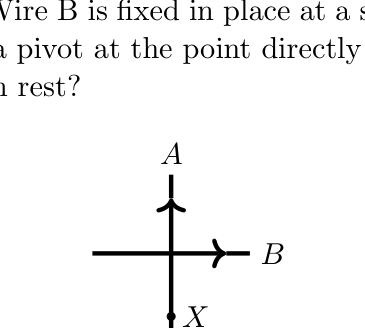 Top view: wire A runs vertically (current pointing up) with current B running horizontally to the right; the symbol X denotes the pivot/crossing point.
- (A) It will rotate counter-clockwise.
- (B) It will rotate clockwise.
- (C) It will rotate, causing point X (marked above) to move out of the page.
- (D) It will rotate, causing point X (marked above) to move into the page.
- (E) It will not rotate as there is no net torque.
Fonte: Testo (PDF) — p.16
Topic: Magnetism Metodi: Lorentz Force Analysis, Torque & Angular Momentum Analysis Competenze: Physical Reasoning Objects: Wire
Due fili orizzontali A e B trasportano correnti in direzioni perpendicolari, con la vista superiore mostrata nel diagramma di seguito. Il filo B è fissato in posizione a una piccola distanza sotto il filo A e il filo A è libero di ruotare intorno a un pivot al punto direttamente sopra il filo B. Cosa succede al cavo A quando viene rilasciato dal riposo?
Vista superiore: il filo A corre verticalmente (corrente che punta verso l’alto) con la corrente B che corre orizzontalmente a destra; il simbolo X indica il punto di rotazione/crosso.
- **(A) ** Rotterà contro il senso dell’orologio.
- **(B) ** Rotterà nel senso orario.
- **(C) ** Si ruoterà, causando il punto X (indicato sopra) a spostarsi fuori dalla pagina.
- **(D) ** Si ruoterà, causando il punto X (indicato sopra) di spostarsi nella pagina.
- **(E) ** Non ruoterà poiché non vi è coppia netta.
Fonte: Testo (PDF) — p.16
Topic: Magnetism Metodi: Lorentz Force Analysis, Torque & Angular Momentum Analysis Competenze: Physical Reasoning Objects: Wire
An electron is imparted an initial velocity in a region of uniform magnetic field directed into the page, as shown below. What is the subsequent motion of the electron?
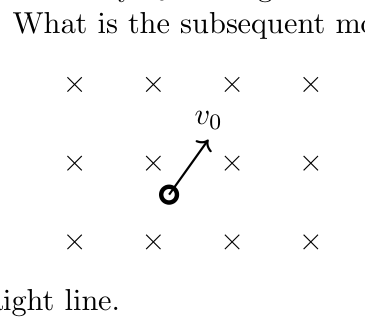 A uniform magnetic field directed into the page (crosses); the electron starts with velocity directed upward and to the right.
- (A) It will move in a straight line.
- (B) It will move in a clockwise circle.
- (C) It will move in a counter-clockwise circle.
- (D) It will move in a helix towards the top.
- (E) It will move in a helix towards the right.
Fonte: Testo (PDF) — p.16
Topic: Magnetism Metodi: Lorentz Force Analysis Competenze: Physical Reasoning Objects: Electron
Un elettrone viene impartito una velocità iniziale in una regione di campo magnetico uniforme diretta verso la pagina, come mostrato di seguito. Qual è il successivo movimento dell’elettrone?
Un campo magnetico uniforme diretto verso la pagina (cross); l’elettrone inizia con velocità diretto verso l’alto e a destra.
- **(A) ** Si muoverà in linea retta.
- **(B) ** Si muoverà in un cerchio in senso orario.
- **(C) ** Si muoverà in un cerchio in senso antiorario.
- **(D) ** Si muoverà in elicescia verso la cima.
- **(E) ** Si muoverà in elicescia verso destra.
Fonte: Testo (PDF) — p.16
Topic: Magnetism Metodi: Lorentz Force Analysis Competenze: Physical Reasoning Objects: Electron
Two identical thin, wide and parallel square metal plates each carry a uniform current in the same direction along their length. What is the force that one plate exerts on the other?
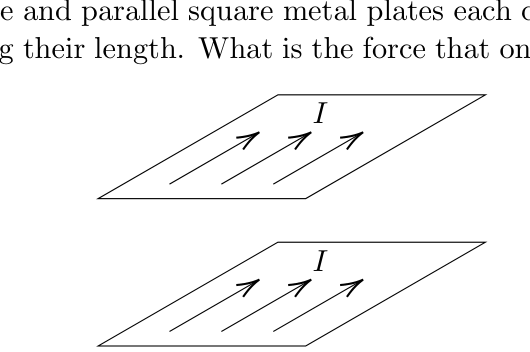 Two parallel square plates, one above the other, each carrying a uniform current in the same direction.
- (A)
- (B)
- (C)
- (D)
- (E)
Fonte: Testo (PDF) — p.17
Topic: Magnetism Metodi: Ampère’s Law, Lorentz Force Analysis Competenze: Physical Reasoning Objects: —
Due piastre di metallo sottili, larghe e quadrate parallele, uguali, portano ciascuna una corrente uniforme nella stessa direzione lungo la loro lunghezza. Qual è la forza che una piastra esercita sull’altra?
Due piastre quadrate parallele, una sopra l’altra, ciascuna con corrente uniforme nella stessa direzione.
- (A)
- (B)
- (C)
- (D)
- (E)
Fonte: Testo (PDF) — p.17
Topic: Magnetism Metodi: Ampère’s Law, Lorentz Force Analysis Competenze: Physical Reasoning Objects: —
A metal disc of radius is driven to rotate with constant angular velocity about its axis. A uniform magnetic field is directed perpendicular to the disc’s surface and covers its entire area. What is the induced voltage between the centre of the disc and its edge?
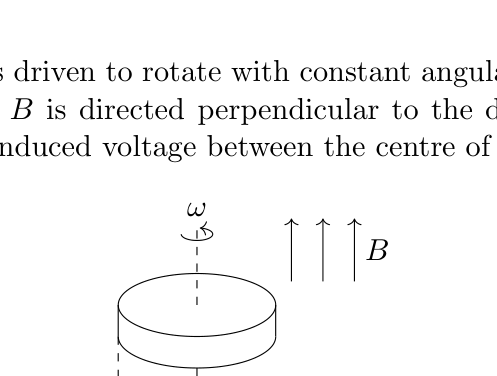 A disc of radius rotating with angular velocity in a uniform magnetic field perpendicular to its surface.
- (A)
- (B)
- (C)
- (D)
- (E)
Fonte: Testo (PDF) — p.17
Topic: Electromagnetic Induction Metodi: Faraday’s Law of Induction, Lorentz Force Analysis Competenze: Physical Reasoning Objects: Disk
Un disco metallico di raggio viene spinto a girare con una velocità angolare costante intorno al suo asse. Un campo magnetico uniforme è diretto perpendicolare alla superficie del disco e copre l’intera sua superficie. Qual è la tensione indotta tra il centro del disco e il suo bordo?
Un disco di raggio che ruota con velocità angolare in un campo magnetico uniforme perpendicolare alla sua superficie.
- (A)
- (B)
- (C)
- (D)
- (E)
Fonte: Testo (PDF) — p.17
Topic: Electromagnetic Induction Metodi: Faraday’s Law of Induction, Lorentz Force Analysis Competenze: Physical Reasoning Objects: Disk
Shaun strings two beads on a light uniform thread, one of mass fixed at the middle and another of mass fixed at the bottom, and suspends the thread from the top. He then “pokes” the top, creating a tiny transverse disturbance that sends a wave downward. As the wave moves through the thread, its wavelength changes from to . What is the ratio ?
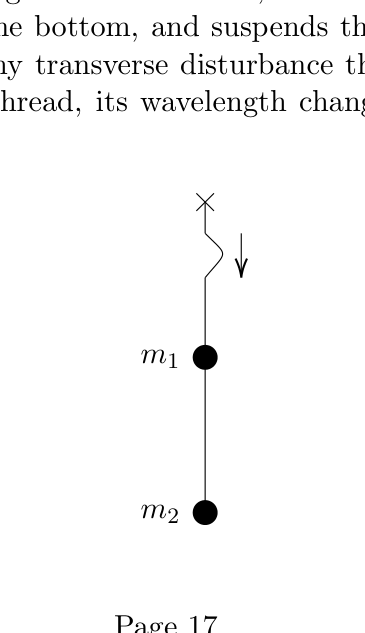 A thread suspended from the top, with bead at the middle and bead at the bottom; a transverse disturbance travels downward.
- (A)
- (B)
- (C)
- (D)
- (E)
Fonte: Testo (PDF) — p.17
Topic: Oscillations & Waves Metodi: Wave Equation Competenze: Physical Reasoning Objects: String
Shaun inserisce due perle su un filo leggero uniforme, uno di massa fissato al centro e un altro di massa fissato al basso, e sospende il filo dall’alto. Poi “svolge” la parte superiore, creando un piccolo disturbo trasversale che manda un’onda in basso. L’onda si muove attraverso il filo e la sua lunghezza d’onda passa da a . Qual è il rapporto ?
Un filo sospeso dall’alto, con una manciata al centro e una manciata alla base; un disturbo trasversale si sposta verso il basso.
- (A)
- (B)
- (C)
- (D)
- (E)
Fonte: Testo (PDF) — p.17
Topic: Oscillations & Waves Metodi: Wave Equation Competenze: Physical Reasoning Objects: String
The displacement of a transverse wave on a string of length can be written as a function of position () and time :
Which of the following statements are true?
I. . II. This string is fixed on one end only. III. The first term in the above expression for represents the first harmonic mode, while the second term represents the second harmonic mode. IV. The ratio of energies carried by the two modes is .
- (A) I only
- (B) I and III only
- (C) II and IV only
- (D) I, III and IV only
- (E) I, II, III and IV
Fonte: Testo (PDF) — p.18
Topic: Oscillations & Waves Metodi: Wave Equation, Superposition Principle Competenze: Physical Reasoning Objects: String
Il spostamento di un’onda trasversale su una stringa di lunghezza può essere scritto come funzione della posizione () e del tempo :
Quali delle seguenti affermazioni sono vere?
I. . II. Questa corda è fissata solo su un’estremità. III. Il Il primo termine nell’espressione di cui sopra per rappresenta la prima modalità armonica, mentre il secondo termine rappresenta la seconda modalità armonica. IV. Il rapporto di energie trasportate dalle due modalità è .
- **(A) ** I solo
- **(B) ** I e III solo
- solo **(C) ** II e IV
- **(D) ** I, III e IV soltanto
- **(E) ** I, II, III e IV
Fonte: Testo (PDF) — p.18
Topic: Oscillations & Waves Metodi: Wave Equation, Superposition Principle Competenze: Physical Reasoning Objects: String
Two sources are set in phase and produce beams of plane-polarised light that have equal amplitudes and are directed towards each other. A detector is placed at the midpoint of the two sources. If the light from both sources are set parallel polarisations, the detector measures a resulting amplitude of . If the light from both sources are instead set to have perpendicular polarisations, the detector measures…
- (A)
- (B)
- (C)
- (D)
- (E)
Fonte: Testo (PDF) — p.18
Topic: Wave Optics Metodi: Superposition Principle, Interference & Diffraction Analysis Competenze: Physical Reasoning Objects: —
Due fonti sono messe in fase e producono fasci di luce polarizzata a piano che hanno le stesse amplitudini e sono diretti l’una verso l’altra. Un rilevatore è posto al centro delle due fonti. Se la luce proveniente da entrambe le fonti è impostata con polarizzazioni parallele, il rilevatore misura un’ampiezza risultante di . Se invece la luce da entrambe le fonti è impostata per avere polarizzazioni perpendicolari, il rilevatore misura…
- (A)
- (B)
- (C)
- (D)
- (E)
Fonte: Testo (PDF) — p.18
Topic: Wave Optics Metodi: Superposition Principle, Interference & Diffraction Analysis Competenze: Physical Reasoning Objects: —
Consider a variation of Young’s double slit experiment where the light entering the two slits have different intensities and , with . Let the intensities of the resulting bright and dark fringes be and respectively. What is the ratio ?
- (A)
- (B)
- (C)
- (D)
- (E)
Fonte: Testo (PDF) — p.19
Topic: Wave Optics Metodi: Interference & Diffraction Analysis Competenze: Physical Reasoning Objects: Slit
Considera una variazione dell’esperimento di Young sulla doppia fessura in cui la luce che entra nelle due fessure ha intensità diverse e , con . Le intensità dei margini luminosi e scuri risultanti devono essere rispettivamente e . Qual è il rapporto ?
- (A)
- (B)
- (C)
- (D)
- (E)
Fonte: Testo (PDF) — p.19
Topic: Wave Optics Metodi: Interference & Diffraction Analysis Competenze: Physical Reasoning Objects: Slit
Consider now an ideal diffraction grating with slit spacing . Light of wavelength enters the grating normally. On a wide screen placed far away, only a total of 5 peaks of bright fringes can be observed across both sides of the entire screen. What is the maximum possible value of ?
- (A)
- (B)
- (C)
- (D)
- (E)
Fonte: Testo (PDF) — p.19
Topic: Wave Optics Metodi: Interference & Diffraction Analysis Competenze: Physical Reasoning Objects: Diffraction Grating, Screen
Considera ora una griglia di diffrazione ideale con spaziamento fra fessure . La luce di lunghezza d’onda entra normalmente nella griglia. Su uno schermo largo posizionato lontano, solo un totale di 5 picchi di margini brillanti possono essere osservati su entrambi i lati dell’intero schermo. Qual è il valore massimo possibile di ?
- (A)
- (B)
- (C)
- (D)
- (E)
Fonte: Testo (PDF) — p.19
Topic: Wave Optics Metodi: Interference & Diffraction Analysis Competenze: Physical Reasoning Objects: Diffraction Grating, Screen
Paul has a glass of water that contains a mass of water at temperature . He tries to cool it down by adding a mass of ice cubes. Assuming that no heat is exchanged with surroundings, what is the final temperature of Paul’s water?
- (A) , the ice does not melt completely.
- (B)
- (C)
- (D)
- (E)
Fonte: Testo (PDF) — p.19
Topic: Thermodynamics Metodi: First Law of Thermodynamics, Energy Conservation Method Competenze: Physical Reasoning Objects: —
Paul ha un bicchiere d’acqua che contiene una massa di acqua a temperatura . Cerca di raffreddarlo aggiungendo una massa di cubetti di ghiaccio. Supponendo che non si scambi il calore con l’ambiente circostante, quale è la temperatura finale dell’acqua di Paolo?
- **(A) ** , il ghiaccio non si scioglie completamente.
- (B)
- (C)
- (D)
- (E)
Fonte: Testo (PDF) — p.19
Topic: Thermodynamics Metodi: First Law of Thermodynamics, Energy Conservation Method Competenze: Physical Reasoning Objects: —
Three metal slabs are placed in thermal contact between a hot reservoir of temperature and a cold reservoir of temperature . The slabs have thermal conductivity , and respectively. The slabs have the same horizontal length and thickness, but slabs 2 and 3 each have half the vertical length of slab 1. Neglecting any temperature variation in the vertical direction, find the equilibrium temperature at the centre where all three slabs meet.
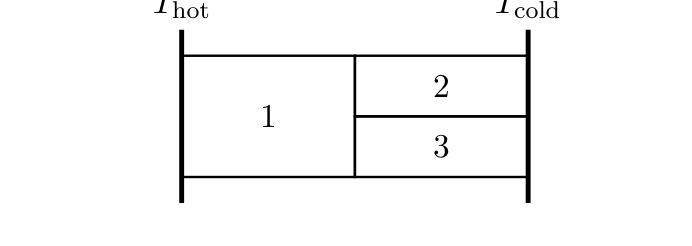 Slab 1 spans the full height between the hot reservoir and a vertical interface; slabs 2 (top) and 3 (bottom) lie in parallel between that interface and the cold reservoir .
- (A)
- (B)
- (C)
- (D)
- (E)
Fonte: Testo (PDF) — p.19
Topic: Thermodynamics Metodi: Physical Modeling, Equivalent Circuit Reduction Competenze: Physical Reasoning Objects: —
Tre lastre di metallo sono collocate in contatto termico tra un serbatoio caldo di temperatura e un serbatoio freddo di temperatura . Le lastre hanno una conducibilità termica , e rispettivamente. Le lastre hanno la stessa lunghezza e spessore orizzontali, ma le lastre 2 e 3 hanno ciascuna metà della lunghezza verticale della lastra 1. Non si deve considerare le variazioni di temperatura nella direzione verticale, ma si deve trovare la temperatura di equilibrio al centro, dove si incontrano le tre lastre.
La lastra 1 si estende a tutta l’altezza tra il serbatoio caldo e un’interfaccia verticale; le lastre 2 (alto) e 3 (infine) si trovano in parallelo tra tale interfaccia e il serbatoio freddo .
- (A)
- (B)
- (C)
- (D)
- (E)
Fonte: Testo (PDF) — p.19
Topic: Thermodynamics Metodi: Physical Modeling, Equivalent Circuit Reduction Competenze: Physical Reasoning Objects: —
A bimetallic strip is made up of two metals with linear expansion coefficients and , with . Each metal strip is initially straight with length and thickness , where . If the bimetallic strip is heated uniformly such that both its temperature rises by , causing it to bend with an angle of curvature as shown below. Find .
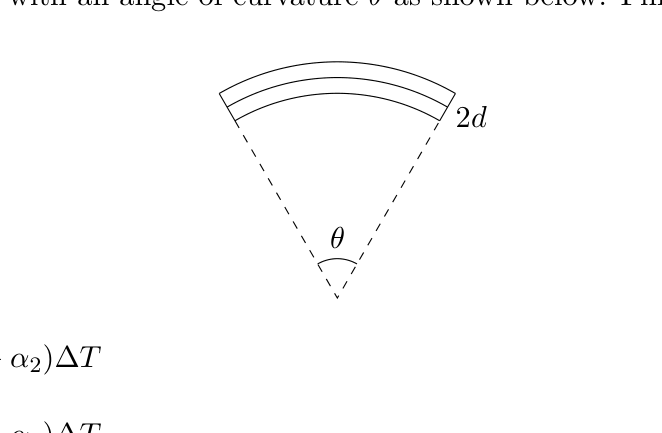 A bimetallic strip of total thickness bent into an arc subtending angle at the centre of curvature.
- (A)
- (B)
- (C)
- (D)
- (E)
Fonte: Testo (PDF) — p.20
Topic: Thermodynamics Metodi: Physical Modeling, Small-Angle Approximation Competenze: Physical Reasoning Objects: —
Una striscia bimetallica è composta da due metalli con coefficienti di espansione lineare e , con . Ogni striscia di metallo è inizialmente dritta con lunghezza e spessore , dove . Se la striscia bimetallica è riscaldata in modo uniforme in modo tale che sia la sua temperatura sia aumentata di , causando la sua piega con un angolo di curvatura come mostrato di seguito. Trova .
Una striscia bimetalica di spessore totale piegata in un angolo di sottendenza dell’arco al centro della curvatura.
- (A)
- (B)
- (C)
- (D)
- (E)
Fonte: Testo (PDF) — p.20
Topic: Thermodynamics Metodi: Physical Modeling, Small-Angle Approximation Competenze: Physical Reasoning Objects: —
A planet of radius and surface temperature orbits a sun of radius and surface temperature at a distance . Assuming that the planet and the sun are both ideal blackbodies, find the ratio at equilibrium.
- (A)
- (B)
- (C)
- (D)
- (E)
Fonte: Testo (PDF) — p.20
Topic: Astrophysics Metodi: Physical Modeling, Energy Conservation Method Competenze: Physical Reasoning Objects: Planet, Star
Un pianeta di raggio e temperatura superficiale orbita un sole di raggio e temperatura superficiale a distanza . Supponendo che il pianeta e il sole siano entrambi corpi neri ideali, trovi il rapporto in equilibrio.
- (A)
- (B)
- (C)
- (D)
- (E)
Fonte: Testo (PDF) — p.20
Topic: Astrophysics Metodi: Physical Modeling, Energy Conservation Method Competenze: Physical Reasoning Objects: Planet, Star
Two vessels of equal volumes are connected together by a tube and contain a total of ideal gas molecules. Initially, both vessels have ideal gas molecules at the same temperature. The vessels are then changed and maintained at and respectively. As a result, the molecules redistribute themselves across the two vessels. What is the net number of molecules that are eventually transferred between the vessels?
- (A)
- (B)
- (C)
- (D)
- (E)
Fonte: Testo (PDF) — p.21
Topic: Kinetic Theory Metodi: Ideal Gas Law Competenze: Physical Reasoning Objects: Container, Tube, Gas
Due recipienti di volume uguale sono collegati tra loro da un tubo e contengono un totale di molecole di gas ideale. Inizialmente, entrambi i vasi hanno molecole di gas ideali alla stessa temperatura. I recipienti vengono quindi modificati e mantenuti rispettivamente a e . Di conseguenza, le molecole si ridistribuiscono tra i due vasi. Qual è il numero netto di molecole che vengono trasferite tra i vasi?
- (A)
- (B)
- (C)
- (D)
- (E)
Fonte: Testo (PDF) — p.21
Topic: Kinetic Theory Metodi: Ideal Gas Law Competenze: Physical Reasoning Objects: Container, Tube, Gas
An ideal gas undergoes a heat cycle that is represented by the following – diagram.
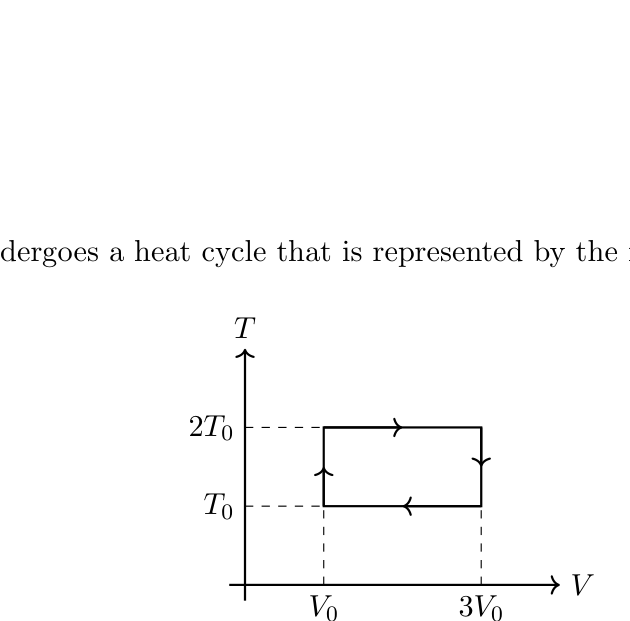 A rectangular cycle on a – diagram with temperatures and and volumes and ; the cycle is traversed in the indicated sense.
In one cycle, ____________ of work is done ____________.
- (A) , by the gas.
- (B) , on the gas.
- (C) , by the gas.
- (D) , on the gas.
- (E) , on the gas.
Fonte: Testo (PDF) — p.21
Topic: Thermodynamics Metodi: Thermodynamic Cycle Analysis, Ideal Gas Law Competenze: Physical Reasoning Objects: Gas
Un gas ideale subisce un ciclo termico rappresentato dal seguente diagramma T$$V.
Un ciclo rettangolare su un diagramma T$$V con temperature e e volumi e ; il ciclo è attraversato nel senso indicato.
In un ciclo, ____________ di lavoro viene fatto ____________.
- **(A) ** , per il gas.
- **(B) ** , sul gas.
- **(C) ** , per il gas.
- **(D) ** , sul gas.
- **(E) ** , sul gas.
Fonte: Testo (PDF) — p.21
Topic: Thermodynamics Metodi: Thermodynamic Cycle Analysis, Ideal Gas Law Competenze: Physical Reasoning Objects: Gas
Zeyuan has a balloon with perfectly elastic and insulating walls. He first fills the balloon at sea level with air at temperature and seals it airtight. He then immerses the balloon underwater to a depth of . Find the final temperature of the air in the balloon. Assume that air is diatomic.
- (A)
- (B)
- (C)
- (D)
- (E)
Fonte: Testo (PDF) — p.21
Topic: Thermodynamics Metodi: First Law of Thermodynamics, Ideal Gas Law Competenze: Physical Reasoning Objects: Gas
Zeyuan ha un palloncino con pareti perfettamente elastica e isolante. Prima di tutto riempie il palloncino a livello del mare con aria a temperatura e lo sigilla in forma asterico. Il pilota poi immerge il palloncino sotto l’acqua a una profondità di . Trova la temperatura finale dell’aria nel palloncino. Supponiamo che l’aria sia diatomica.
- (A)
- (B)
- (C)
- (D)
- (E)
Fonte: Testo (PDF) — p.21
Topic: Thermodynamics Metodi: First Law of Thermodynamics, Ideal Gas Law Competenze: Physical Reasoning Objects: Gas