A pendulum consists of a copper sphere of radius and density suspended from a string. Due to the drag from the air the amplitude of the oscillation decays with time as
where , is the initial amplitude of the pendulum and is the viscosity of air. The measurement of the amplitudes is accurate to 1% with other measurement provided below:
Evaluate the time taken for the amplitude to fall to 85% of the initial amplitude and the error in this quantity. State the parameter that contributes the biggest error to the final result. [8]
Fonte: Testo (PDF) — p.2 Topic: Oscillations & Waves Metodi: Error Propagation, Approximation & Series Expansion Competenze: Physical Reasoning, Mathematical Modeling, Experimental Data Analysis Objects: Pendulum, Sphere
Un pendolo è costituito da una sfera di rame di raggio e densità sospesa a un filo. A causa della resistenza dell’aria l’ampiezza dell’oscillazione decade nel tempo come
dove , è l’ampiezza iniziale del pendolo e è la viscosità dell’aria. La misura delle ampiezze è accurata all’1% con le altre misure fornite di seguito:
Valuta il tempo impiegato affinché l’ampiezza scenda all’85% dell’ampiezza iniziale e l’errore su questa quantità. Indica il parametro che contribuisce con l’errore maggiore al risultato finale. [8]
Fonte: Testo (PDF) — p.2 Topic: Oscillations & Waves Metodi: Error Propagation, Approximation & Series Expansion Competenze: Physical Reasoning, Mathematical Modeling, Experimental Data Analysis Objects: Pendulum, Sphere
In this question you are asked to make reasoned estimates and assumptions. These must be clearly stated.
(a) Figure 1 shows an equilateral glass prism illuminated by a 100 W laser beam of wavelength nm. The refractive index of the glass of the prism is 1.50 at nm. The path of the light in the prism is parallel to the base of the prism. Calculate the change in weight of the prism when the beam is switched on. [4]
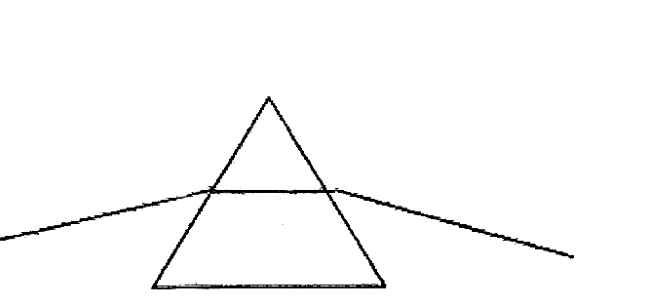 Figure 1: Equilateral glass prism.
(b) Optical tweezers, which are composed of two lasers beams, are able to manipulate small transparent spheres. Explain clearly how this can be done and why at least two beams are needed. [3]
(c) Small smoke particles in air are seen under a low magnification microscope to move randomly at a speed of 0.10 mm s. The speed of sound in air is 330 m s. Estimate the mass of the smoke particles. [3]
Fonte: Testo (PDF) — p.2 Topic: Order-of-Magnitude Estimation Metodi: Order-of-Magnitude Estimation, Physical Modeling Competenze: Physical Reasoning, Mathematical Modeling Objects: Prism, Sphere
In questa domanda vi viene chiesto di fare stime e ipotesi motivate. Queste devono essere chiaramente indicate.
a) La figura 1 mostra un prisma di vetro equilaterale illuminato da un raggio laser da 100 W di lunghezza d’onda nm. L’indice di rifrazione del vetro del prisma è di 1,50 a nm. Il percorso della luce nel prisma è parallelo alla base del prisma. Calcolare il cambiamento di peso del prisma quando il fascio è acceso. [4]
Figura 1: Prisma di vetro equilaterale.
b) Le pinzette ottiche, composte da due fasci laser, sono in grado di manipolare piccole sfere trasparenti. Spiegate chiaramente come si può fare questo e perché occorrono almeno due travi. [3]
c) Le piccole particelle di fumo nell’aria sono osservate sotto un microscopio a bassa ingrandimento per muoversi in modo casuale a una velocità di 0,10 mm s. La velocità del suono nell’aria è di 330 m s. Calcola la massa delle particelle di fumo. [3]
Fonte: Testo (PDF) — p.2 Topic: Order-of-Magnitude Estimation Metodi: Order-of-Magnitude Estimation, Physical Modeling Competenze: Physical Reasoning, Mathematical Modeling Objects: Prism, Sphere
Suppose that we have a string of equally spaced beads of mass such that their surfaces are separated by a distance . The beads are free to slide without friction on a thin wire. Suppose that there is a constant force acting on the first bead, initially at rest, and causing it to accelerate along the wire as shown in Figure 2. This force acts only on the first bead and might be created by a well directed, steady stream of air. The first bead will collide with the second, which will in turn collide with the third, and so on. Suppose that all collisions are elastic.
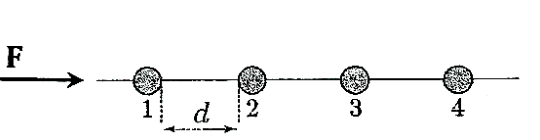 Figure 2: Beads on wire.
(i) What is the speed of the first bead immediately before and immediately after its collision with the second bead? [2]
(ii) What is the speed of the second bead immediately before and immediately after its collision with the third bead? [2]
(iii) Note that the constant force is always acting upon the first bead. What is the time interval between subsequent collisions between the first and second beads? What then is the average speed of the first bead? What is the speed of the “shock wave” that travels down the wire? [3]
(iv) If the whole process is repeated, but with collisions which are perfectly inelastic, what is the terminal speed of the shock wave formed? [3]
Fonte: Testo (PDF) — p.3 Topic: Conservation of Momentum Metodi: Conservation of Momentum, Impulse-Momentum Theorem Competenze: Physical Reasoning, Mathematical Modeling Objects: Wire
Supponiamo che abbiamo una catena di perle di massa spaziate ugualmente in modo tale che le loro superfici siano separate da una distanza . Le perle sono libere di scivolare senza attrito su un filo sottile. Supponiamo che vi sia una forza costante che agisce sulla prima mancia, inizialmente a riposo, e che la fa accelerare lungo il filo come mostrato nella figura 2. Questa forza agisce solo sul primo perlo e potrebbe essere creata da un flusso di aria ben diretto e costante. La prima perla colpirà con la seconda, che a sua volta colpirà con la terza, e così via. Supponiamo che tutte le collisioni siano elastiche.
Figura 2: Perle su filo.
(i) Qual è la velocità della prima perla immediatamente prima e immediatamente dopo la collisione con la seconda perla? [2]
(ii) Qual è la velocità della seconda perla immediatamente prima e immediatamente dopo la collisione con la terza perla? [2]
(iii) Si noti che la forza costante agisce sempre sulla prima perla. Qual è l’intervallo di tempo tra le collisioni successive tra la prima e la seconda perla? Qual è la velocità media della prima perla? Qual è la velocità dell‘“onda di shock” che scorre lungo il filo? [3]
(iv) Se l’intero processo viene ripetuto, ma con collisioni perfettamente inelasche, qual è la velocità terminale dell’onda di shock formata? [3]
Fonte: Testo (PDF) — p.3 Topic: Conservation of Momentum Metodi: Conservation of Momentum, Impulse-Momentum Theorem Competenze: Physical Reasoning, Mathematical Modeling Objects: Wire
A zoom lens system is a combination of lenses that produces a variable magnification while maintaining fixed object and image positions. The magnification is varied by moving one or more lenses along the axis. While multiple lenses are used in practice to obtain high-quality images, the effect of zooming in on an object can be demonstrated with a simple two-lens system. An object, two converging lenses, and a screen are mounted on an optical bench. The first lens, which is to the right of the object, has a focal length of 5.00 cm, and the second lens, which is to the right of the first lens, has a focal length of 10.0 cm. The screen is to the right of the second lens. Initially, an object is situated at a distance of 7.50 cm to the left of the first lens, and the image formed on the screen has a magnification of .
(i) Determine the distance between the object and the screen. [4]
(ii) Both lenses are now moved along their common axis, while the object and the screen maintain fixed positions, until the image formed on the screen has a magnification of . Find the displacement of each lens from its initial position in (i). [4]
(iii) Can the lenses be displaced in more than one way? [4]
Fonte: Testo (PDF) — p.3 Topic: Geometric Optics Metodi: Thin Lens & Mirror Equation, Ray Tracing Competenze: Physical Reasoning, Mathematical Modeling Objects: Lens, Screen
Un sistema di obiettivi zoom è una combinazione di obiettivi che produce una ingrandimento variabile mantenendo le posizioni fisse dell’oggetto e dell’immagine. L’ingrandimento è variato spostando uno o più obiettivi lungo l’asse. Mentre in pratica vengono utilizzati più obiettivi per ottenere immagini di alta qualità, l’effetto dello zoom su un oggetto può essere dimostrato con un semplice sistema a due obiettivi. Un oggetto, due lenti convergenti e uno schermo sono montati su una panchina ottica. La prima lente, che è a destra dell’oggetto, ha una lunghezza focale di 5,00 cm, e la seconda lente, che è a destra della prima lente, ha una lunghezza focale di 10,0 cm. Lo schermo è a destra della seconda lente. Inizialmente, un oggetto si trova a una distanza di 7,50 cm a sinistra della prima lente, e l’immagine formata sullo schermo ha un ingrandimento di .
- Determinare la distanza tra l’oggetto e lo schermo. [4]
(ii) Entrambi i cristalli sono ora spostati lungo il loro asse comune, mentre l’oggetto e lo schermo mantengono posizioni fisse, fino a quando l’immagine formata sullo schermo ha un ingrandimento di . Trova il spostamento di ciascuna lente dalla sua posizione iniziale nella lettera i). [4]
(iii) Le lenti possono essere spostate in più di un modo? [4]
Fonte: Testo (PDF) — p.3 Topic: Geometric Optics Metodi: Thin Lens & Mirror Equation, Ray Tracing Competenze: Physical Reasoning, Mathematical Modeling Objects: Lens, Screen
(i) A stick of mass density per unit length rests on a circle of radius (see Figure 3). The stick makes an angle with the horizontal and is tangent to the circle at its upper end. Friction exists at all points of contact, and assume that it is large enough to keep the system at rest. Find the friction force between the ground and the circle. [6]
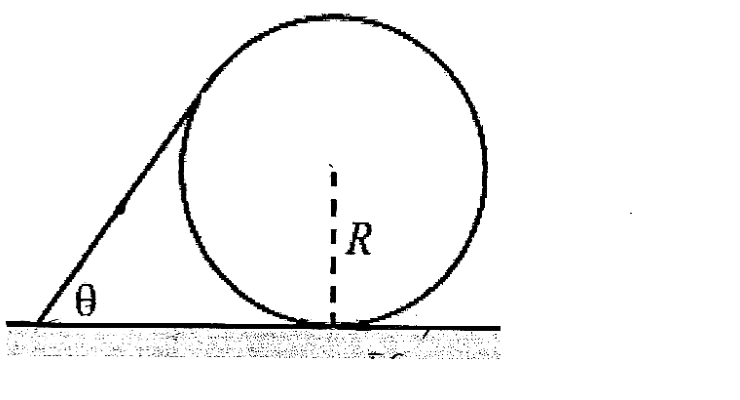 Figure 3: Stick on a circle.
(ii) A large number of sticks (with mass density per unit length ) and circles (with radius ) lean on each other, as shown in Figure 4. Each stick makes an angle with the horizontal and is tangent to a circle at its upper end. The sticks are hinged to the ground, and every other surface is frictionless [unlike in the first part of this question in (i)]. In the limit of a very large number of sticks and circles, what is the normal force between a stick and the circle it rests on, very far to the right? (Assume that the last circle leans against a wall, to keep it from moving.) [6]
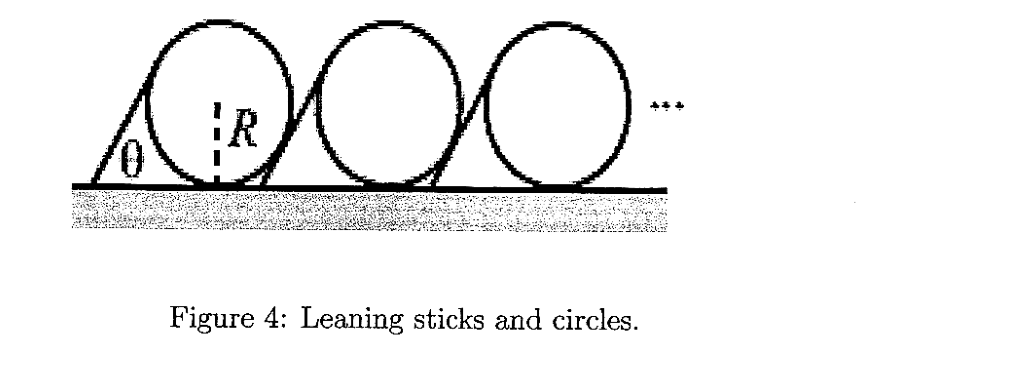 Figure 4: Leaning sticks and circles.
Fonte: Testo (PDF) — p.4 Topic: Rigid Body Statics Metodi: Free-Body Diagram, Torque & Angular Momentum Analysis Competenze: Physical Reasoning, Mathematical Modeling Objects: Rod, Disk
(i) Un bastone di densità di massa per unità di lunghezza si posa su un cerchio di raggio (vedere figura 3). Il bastone fa un angolo con l’orizzontale ed è tangente al cerchio alla sua estremità superiore. La frizione esiste in tutti i punti di contatto e si suppone che sia sufficientemente grande per mantenere il sistema a riposo. Trova la forza di attrito tra il terreno e il cerchio. [6]
Figura 3: Appiccicatevi su un cerchio.
(ii) Un gran numero di bastoni (con densità di massa per unità di lunghezza ) e di cerchi (con raggio ) si appoggiano l’uno sull’altro, come mostrato alla figura 4. Ogni bastone fa un angolo con l’orizzontale ed è tangente ad un cerchio alla sua estremità superiore. I bastoni sono inclinati a terra e ogni altra superficie è senza frattura [a differenza della prima parte di questa domanda in (i)]. Nel limite di un gran numero di bastoni e cerchi, qual è la forza normale tra un bastone e il cerchio su cui si poggia, molto lontano a destra? (Supponiamo che l’ultimo cerchio si appoggi a un muro, per impedire che si muova.) [6]
Figura 4: Basti e cerchi inclinati.
Fonte: Testo (PDF) — p.4 Topic: Rigid Body Statics Metodi: Free-Body Diagram, Torque & Angular Momentum Analysis Competenze: Physical Reasoning, Mathematical Modeling Objects: Rod, Disk
An aluminum rod 0.500 m in length and with a cross-sectional area of 2.50 cm is inserted into a thermally insulated vessel containing liquid helium at 4.20 K. The rod is initially at 300 K.
(i) If half of the rod is inserted into the helium, how many liters of helium boil off by the time the inserted half cools to 4.20 K? (Assume the upper half does not yet cool.) [4]
(ii) If the upper end of the rod is maintained at 300 K, what is the approximate boil-off rate of liquid helium after the lower half has reached 4.20 K? (Aluminum has thermal conductivity of 31.0 J s cm K at 4.2 K. You may ignore its temperature variation. Note that aluminum has a specific heat capacity of 902 J kg K and density of 2 700 kg m. The density of liquid helium is 125 kg m.) [4]
Fonte: Testo (PDF) — p.5 Topic: Thermodynamics Metodi: First Law of Thermodynamics, Physical Modeling Competenze: Physical Reasoning, Mathematical Modeling Objects: Rod
Una canna di alluminio di lunghezza 0,500 m e con una superficie di sezione trasversale di 2,50 cm viene inserita in un recipiente termicamente isolato contenente elio liquido a 4,20 K. La canna è inizialmente a 300 K.
(i) Se la metà della canna viene inserita nell’elio, quanti litri di elio si scaldano quando la metà inserita si raffredda a 4,20 K? (Supponiamo che la metà superiore non sia ancora raffreddata.) [4]
(ii) Se l’estremità superiore della canna viene mantenuta a 300 K, qual è il tasso approssimativo di ebollizione dell’elio liquido dopo che la metà inferiore ha raggiunto 4,20 K? (L’alluminio ha una conductività termica di 31,0 J s cm K a 4,2 K. Potresti ignorare la variazione della temperatura. Si noti che l’alluminio ha una capacità termico specifica di 902 J kg K e una densità di 2 700 kg m. La densità dell’elio liquido è di 125 kg m.) [4]
Fonte: Testo (PDF) — p.5 Topic: Thermodynamics Metodi: First Law of Thermodynamics, Physical Modeling Competenze: Physical Reasoning, Mathematical Modeling Objects: Rod
A soap film () is contained within a rectangular wire frame. The frame is held vertically so that the film drains downward and forms a wedge with flat faces. The thickness of the film at the top is essentially zero. The film is viewed in reflected white light with near-normal incidence, and the first violet ( nm) interference band is observed 3.00 cm from the top edge of the film.
(i) Locate the first red ( nm) interference band. [4]
(ii) Determine the film thickness at the positions of the violet and red bands. [3]
(iii) What is the wedge angle of the film? [3]
Fonte: Testo (PDF) — p.5 Topic: Wave Optics Metodi: Interference & Diffraction Analysis Competenze: Physical Reasoning, Mathematical Modeling Objects: Membrane
Un film di sapone () è contenuto in un telaio di filo rettangolare. Il telaio è tenuto verticalmente in modo che il film scorra verso il basso e forma una cuccia con facce piatte. Lo spessore del film in cima è essenzialmente zero. Il film viene visto in luce bianca riflessa con incidenza quasi normale e la prima banda di interferenza viola ( nm) è osservata a 3,00 cm dalla parte superiore del film.
(i) Indicare la prima banda di interferenza rossa ( nm). [4]
- Determinazione dello spessore del film nelle posizioni delle bande viola e rosse. [3]
(iii) Qual è l’angolo di ciglia del film? [3]
Fonte: Testo (PDF) — p.5 Topic: Wave Optics Metodi: Interference & Diffraction Analysis Competenze: Physical Reasoning, Mathematical Modeling Objects: Membrane
A solenoid of length has an inner radius and an outer radius . The current through the solenoid is .
(i) Show that the magnetic flux density, at the center of the solenoid is
where is the number of turns per square meter and and are functions of , and . Write down the expression for and . State the value of .
(ii) Show that the length of the wire is
where is the volume of the winding and , and are exponents that need to be determined. State the value of , and . [6]
(iii) Show that the field at the center of the solenoid can be written as
where depends on the geometry, is the dissipated power, is the filling factor or fraction of the coil cross section occupied by the conductor, is the radius of the wire and is the conductivity. [4]
Fonte: Testo (PDF) — p.5 Topic: Magnetism Metodi: Biot-Savart Law, Calculus-Integration, Dimensional Analysis Competenze: Physical Reasoning, Mathematical Modeling Objects: Solenoid, Wire, Coil
Un solenoide di lunghezza ha un raggio interno e un raggio esterno . La corrente attraverso il solenoide è .
(i) Indicare che la densità del flusso magnetico, al centro del solenoide è
in cui è il numero di giri per metro quadrato e e sono funzioni di , e . Scrittore dell’espressione per e . Indicare il valore di .
- dimostrare che la lunghezza del filo è
dove è il volume del rotolamento e , e sono esponenti da determinare. Indicare il valore di , e . [6]
(iii) Mostra che il campo al centro del solenoide può essere scritto come
se dipende dalla geometria, è la potenza dissipata, è il fattore di riempimento o la frazione della sezione trasversale della bobina occupata dal conduttore, è il raggio del filo e è la conducibilità. [4]
Fonte: Testo (PDF) — p.5 Topic: Magnetism Metodi: Biot-Savart Law, Calculus-Integration, Dimensional Analysis Competenze: Physical Reasoning, Mathematical Modeling Objects: Solenoid, Wire, Coil
(a) A large block, with a second block sitting on top, is connected to a spring and executes horizontal simple harmonic motion as it slides across a frictionless surface with an angular frequency . The coefficient of static friction between the two blocks is . Find the maximum amplitude of oscillation that the system can have if the upper block is not to slip. (Assume that the mass of the spring is negligible.) [6]
(b) A pencil of length , with the pencil point at one end and an eraser at the other end, is initially standing vertically on a table with the pencil point on the table. The pencil is let go and falls over. Derive a formula for the speed with which the eraser strikes the table, assuming that the pencil point does not move. [4]
Fonte: Testo (PDF) — p.6 Topic: Oscillations & Waves, Rotational Dynamics Metodi: Simple Harmonic Motion Analysis, Conservation of Energy, Torque & Angular Momentum Analysis Competenze: Physical Reasoning, Mathematical Modeling Objects: Spring, Block
(a) Un grande blocco, con un secondo blocco in cima, è collegato a una molla e esegue un semplice movimento armonico orizzontale mentre si scivola su una superficie senza attrito con una frequenza angolare . Il coefficiente di attrito statico tra i due blocchi è . Trova l’ampiezza massima di oscillazione che il sistema può avere se il blocco superiore non deve scivolare. (Supponiamo che la massa della sorgente sia trascurabile.) [6]
b) Una matita di lunghezza , con il punto della matita ad una estremità e un cancellatore all’altra, è inizialmente posta verticalmente su un tavolo con il punto della matita sul tavolo. La matita si lascia andare e cade. Derivare una formula per la velocità con cui l’aspiratore colpisce il tavolo, supponendo che il punto della matita non si muova. [4]
Fonte: Testo (PDF) — p.6 Topic: Oscillations & Waves, Rotational Dynamics Metodi: Simple Harmonic Motion Analysis, Conservation of Energy, Torque & Angular Momentum Analysis Competenze: Physical Reasoning, Mathematical Modeling Objects: Spring, Block
(a) The Oscillation Project with Emulsion-tRacking Apparatus (OPERA), an experiment designed to test neutrino oscillations and exploiting the high energy muon neutrinos produced at CERN Super Proton Synchrotron in Geneva and pointing towards Gran Sasso in Italy, reported that the time of flight measurements indicated that muon neutrinos travel at speed which is faster than the speed of light with , where is the speed of light in vacua. Show that it is possible for an observer moving relative to the Earth starting at CERN and moving towards Gran Sasso at some critical speed to see the muon neutrino moving backwards from Gran Sasso towards CERN and determine this critical speed. [4]
(b) A moving rod is observed to have a length of 2.00 m and to be oriented at an angle of 30.0° with respect to the direction of motion, as shown in Figure 5. The rod has a speed of 0.995c.
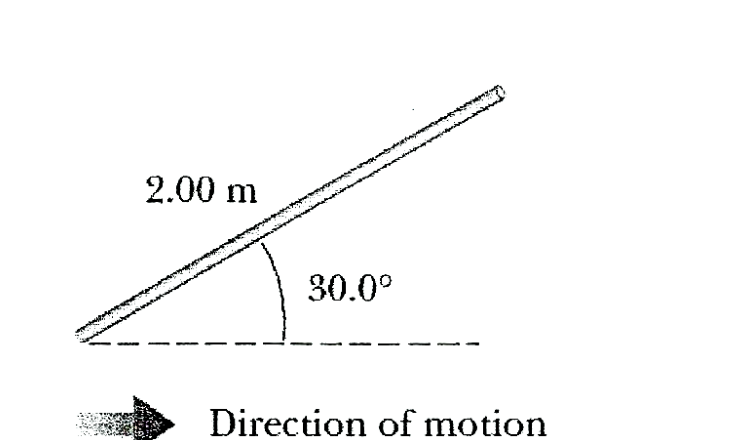 Figure 5: Relativistic Rod.
(i) Determine the proper length of the rod. [3]
(ii) What is the orientation angle in the proper frame? [3]
Fonte: Testo (PDF) — p.6 Topic: Special Relativity Metodi: Lorentz Transformation Competenze: Physical Reasoning, Mathematical Modeling Objects: Rod, Particle Beam
(a) Il progetto di oscillazione con apparecchio di emulsione-tracking (OPERA), un esperimento progettato per testare le oscillazioni dei neutrini e sfruttare i neutrini dei muoni ad alta energia prodotti al CERN Super Proton Synchrotron di Ginevra e che punta verso Gran Sasso in Italia, ha riferito che il tempo di volo ha indicato che i neutrini dei muoni viaggiano a velocità che è più veloce della velocità della luce con , mentre è la velocità della luce in vacuità. Mostrare che è possibile per un osservatore che si muove rispetto alla Terra a partire dal CERN e si muove verso Gran Sasso a una velocità critica vedere il neutrino muone che si muove indietro da Gran Sasso verso il CERN e determinare questa velocità critica. [4]
b) Si osserva che una canna in movimento ha una lunghezza di 2,00 m ed è orientata ad un angolo di 30.0° rispetto alla direzione del movimento, come mostrato alla figura 5. La canna ha una velocità di 0,995c.
Figura 5: Rod relativistico.
- Determinare la lunghezza corretta della canna. [3]
(ii) Qual è l’angolo di orientazione del corretto quadro? [3]
Fonte: Testo (PDF) — p.6 Topic: Special Relativity Metodi: Lorentz Transformation Competenze: Physical Reasoning, Mathematical Modeling Objects: Rod, Particle Beam