A platform scale is calibrated to indicate the mass in kg of an object placed on it. Particles fall from a height of and collide with the balance pan of the scale. Assuming that the collisions are elastic and that the particles rebound upwards with the same speed they had before hitting the pan, determine the average scale reading if each particle has mass and collisions occur at the rate of . [8]
Fonte: Testo (PDF) — p.2 Topic: Conservation of Momentum Metodi: Impulse-Momentum Theorem, Conservation of Momentum Competenze: Physical Reasoning, Mathematical Modeling Objects: —
Una scala di piattaforma è calibrata per indicare la massa in kg di un oggetto posizionato su di essa. Le particelle cadono da un’altezza di e si schiantano con la parte di equilibrio della scala. Supponendo che le collisioni siano elastiche e che le particelle rimbalzino verso l’alto con la stessa velocità con cui avevano prima di colpire la padella, determinare la lettura media della scala se ogni particella ha massa e le collisioni si verificano al ritmo di . [8]
Fonte: Testo (PDF) — p.2 Topic: Conservation of Momentum Metodi: Impulse-Momentum Theorem, Conservation of Momentum Competenze: Physical Reasoning, Mathematical Modeling Objects: —
A collection of identical blocks, each of mass , are connected by unstretchable ropes of negligible mass. The blocks are on a horizontal surface. An external force acts on Block 1, pulling it horizontally to the right with constant velocity. What is the tension in the rope connecting Block to Block , if

Figure 1: identical blocks.
(i) There is no friction between the blocks and the surface. [3]
(ii) The coefficient of kinetic friction between each block and the surface is ? ( large enough to accelerate the blocks despite the friction.) [5]
Fonte: Testo (PDF) — p.2 Topic: Newtonian Mechanics Metodi: Free-Body Diagram, Vector Decomposition Competenze: Physical Reasoning, Mathematical Modeling Objects: Block, String
Un insieme di blocchi identici, ognuno di massa , sono collegati da corde irregolari di massa trascurabile. I blocchi sono su una superficie orizzontale. Una forza esterna agisce sul blocco 1, tirandolo orizzontalmente a destra con velocità costante. Qual è la tensione nella corda che collega il blocco al blocco , se
Figura 1: blocchi identici.
- non vi è attrito tra i blocchi e la superficie. [3]
(ii) Il coefficiente di attrito cinetico tra ogni blocco e la superficie è ? ( abbastanza grande da accelerare i blocchi nonostante il attrito.) [5]
Fonte: Testo (PDF) — p.2 Topic: Newtonian Mechanics Metodi: Free-Body Diagram, Vector Decomposition Competenze: Physical Reasoning, Mathematical Modeling Objects: Block, String
A pendulum bob is constructed by taking a thin, uniform-density circular ring of mass and radius and affixing a straight, thin, uniform density rod of mass and length across its diameter as shown in the diagram. The pendulum hangs in a vertical plane from a frictionless pivot that can be attached to the ring at any point. The pivot allows the bob to swing either in the plane of the bob or in the plane perpendicular to the bob. Assume the angular amplitude is small.
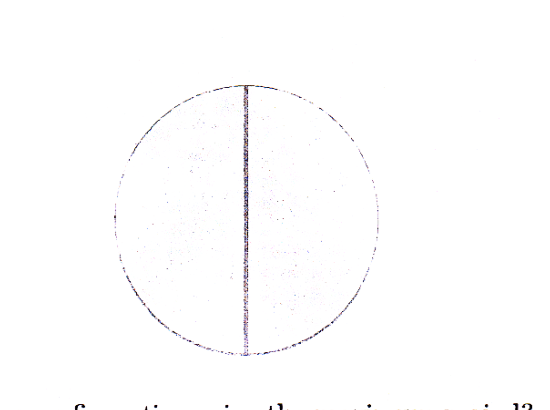
(i) What swinging configurations give the maximum period? [4]
(ii) What swinging configurations give the minimum period? [4]
(iii) Find the ratio of the maximum period to the minimum period. [2]
Fonte: Testo (PDF) — p.2 Topic: Oscillations & Waves, Rotational Dynamics Metodi: Simple Harmonic Motion Analysis, Torque & Angular Momentum Analysis, Small-Angle Approximation Competenze: Physical Reasoning, Mathematical Modeling Objects: Pendulum, Rod
Un bobino di pendolo è costruito prendendo un anello circolare sottile e uniforme di densità di massa e di raggio e fissando un bastone di densità uniforme e sottile di massa e lunghezza lungo il suo diametro come mostrato nel diagramma. Il pendolo è appeso in piano verticale da un pivot senza attrito che può essere attaccato all’anello in qualsiasi punto. Il pivot consente al bobino di oscillare sia nel piano del bobino che nel piano perpendicolare al bobino. Supponiamo che l’ampiezza angolare sia piccola.
I) Quali configurazioni oscillanti consentono il periodo massimo? [4]
(ii) Quali configurazioni oscillanti danno il periodo minimo? [4]
- Trovare il rapporto tra il periodo massimo e il periodo minimo. [2]
Fonte: Testo (PDF) — p.2 Topic: Oscillations & Waves, Rotational Dynamics Metodi: Simple Harmonic Motion Analysis, Torque & Angular Momentum Analysis, Small-Angle Approximation Competenze: Physical Reasoning, Mathematical Modeling Objects: Pendulum, Rod
The distance from the centre of the Earth to the poles is shorter than the radius of the equator. A one second pendulum is taken from the equator (at sea level) to the North Pole. Make a rough estimate of its change in period. You may assume for the purposes of your calculation that the Earth has a constant density. [6]
Fonte: Testo (PDF) — p.3 Topic: Gravitation Metodi: Newton’s Law of Gravitation, Simple Harmonic Motion Analysis, Approximation & Series Expansion Competenze: Physical Reasoning, Mathematical Modeling Objects: Pendulum, Planet
La distanza dal centro della Terra ai poli è inferiore al raggio dell’equatore. Un pendolo di un secondo viene portato dall’equatore (a livello del mare) al Polo Nord. Fai una stima approssimativa del suo cambiamento di periodo. Per i vostri calcoli, potete presumere che la Terra abbia una densità costante. [6]
Fonte: Testo (PDF) — p.3 Topic: Gravitation Metodi: Newton’s Law of Gravitation, Simple Harmonic Motion Analysis, Approximation & Series Expansion Competenze: Physical Reasoning, Mathematical Modeling Objects: Pendulum, Planet
A square lattice of identical resistances ( along each edge) is wrapped around an infinite cylinder in such a way that resistances are placed along the cross sectional circle of the cylinder. What are the resultant resistances between two adjacent lattice points in the “axial” and in the “circumferential” directions? [12]
First consider the cases , , and the limit .
Fonte: Testo (PDF) — p.3 Topic: Circuits Metodi: Equivalent Circuit Reduction, Symmetry Argument, Kirchhoff’s Laws Competenze: Physical Reasoning, Mathematical Modeling Objects: Resistor, Cylinder
Una rete quadrata di resistenze identiche ( lungo ogni bordo) è avvolta attorno a un cilindro infinito in modo tale che le resistenze siano posizionate lungo il cerchio sezionario incrociato del cilindro. Quali sono le resistenze risultanti tra due punti di reticola adiacenti nelle direzioni “axiali” e “circumferenziali”? [12]
Primo, consideriamo i casi , e il limite .
Fonte: Testo (PDF) — p.3 Topic: Circuits Metodi: Equivalent Circuit Reduction, Symmetry Argument, Kirchhoff’s Laws Competenze: Physical Reasoning, Mathematical Modeling Objects: Resistor, Cylinder
An infinitely long perfectly conducting straight wire of radius carries a constant current and charge density zero as seen by a fixed observer . The current due to an electron stream of uniform density moving with high (relativistic) velocity . A second observer travels parallel to the wire with high (relativistic) velocity . As seen by the second observer, ,
(a) What is the electromagnetic field? [3]
(b) What is the charge density in the wire implied by this field? [3]
(c) With what velocities do the electron and ion streams move? [4]
(d) How do you account for the presence of a charge density seen by but not by ? [4]
Fonte: Testo (PDF) — p.3 Topic: Special Relativity, Electromagnetism Metodi: Lorentz Transformation, Lorentz Force Analysis Competenze: Physical Reasoning, Mathematical Modeling Objects: Wire, Electron
Un filo retto di conduzione perfetta infinitamente lungo di raggio porta una corrente costante e una densità di carica zero come osservato da un osservatore fisso . La corrente dovuta a un flusso di elettroni di densità uniforme che si muove ad alta velocità (relativistica) . Un secondo osservatore viaggia parallelo al filo con una velocità elevata (relativistica) . Come osservato dal secondo osservatore, ,
(a) Che cos’è il campo elettromagnetico? [3]
b) Qual è la densità di carica del filo implicita da questo campo? [3]
c) A che velocità si muovono i flussi elettronici e ionici? [4]
d) Come si spiega la presenza di una densità di carica osservata da ma non da ? [4]
Fonte: Testo (PDF) — p.3 Topic: Special Relativity, Electromagnetism Metodi: Lorentz Transformation, Lorentz Force Analysis Competenze: Physical Reasoning, Mathematical Modeling Objects: Wire, Electron
When a perfect monatomic gas expands adiabatically the heat interchange with its surroundings the pressure and volume of the gas are related by the formula:
where in this case is and refer to the initial and final states of the volume and pressure of the gas. A helium balloon is released at atmospheric pressure. It is allowed to rise rapidly to a height such that the external pressure is half atmospheric pressure. The envelope of the balloon is at all times loose, of negligible mass, and regarded as a perfect heat insulator.
(i) Calculate the ratio of the initial to final volume of the balloon. [5]
(ii) If the initial temperature of the gas was , what will be its new temperature? [5]
Fonte: Testo (PDF) — p.3 Topic: Thermodynamics Metodi: First Law of Thermodynamics, Ideal Gas Law Competenze: Physical Reasoning, Mathematical Modeling Objects: Gas
Quando un gas monatomo perfetto si espande adiabaticamente, l’interscambio di calore con il suo ambiente, la pressione e il volume del gas sono correlati dalla formula:
in cui in questo caso è e si riferiscono agli stati iniziali e finali del volume e della pressione del gas. Un pallone di elio viene rilasciato a pressione atmosferica. È consentito di salire rapidamente ad una altezza tale che la pressione esterna sia pari a metà della pressione atmosferica. La busta del palloncino è sempre sciolta, di massa trascurabile, e considerata come un isolante termico perfetto.
-
Calcolare il rapporto tra il volume iniziale e il volume finale del palloncino. [5]
-
se la temperatura iniziale del gas è stata , quale sarà la sua nuova temperatura? [5]
Fonte: Testo (PDF) — p.3 Topic: Thermodynamics Metodi: First Law of Thermodynamics, Ideal Gas Law Competenze: Physical Reasoning, Mathematical Modeling Objects: Gas
It is well known in classical (nonrelativistic) electrodynamics that an electron traces out a circular orbit in a uniform magnetic field. But what if it is not all alone? Examine two electrons in a homogeneous magnetic field moving in the plane perpendicular to the field lines. Under suitably chosen initial conditions the two electrons are found to move along the same circular orbit. Determine the radius of this circle. Are there further periodic solutions? What happens in the case of an electron and a positron? Can the two annihilate (i.e. encounter), and if so, under what initial conditions? [12]
Fonte: Testo (PDF) — p.3 Topic: Magnetism Metodi: Lorentz Force Analysis, Coulomb’s Law, Symmetry Argument Competenze: Physical Reasoning, Mathematical Modeling Objects: Electron
È ben noto nell’elettrodinamica classica (non relativistica) che un elettrone traccia un’orbita circolare in un campo magnetico uniforme. Ma se non fosse tutto solo? Esaminare due elettroni in un campo magnetico omogeneo che si muove nel piano perpendicolare alle linee del campo. In condizioni iniziali adeguatamente scelte i due elettroni si trovano a muoversi lungo la stessa orbita circolare. Determina il raggio di questo cerchio. Esistono altre soluzioni periodiche? Cosa succede nel caso di un elettrone e un positrone? Potranno forse annientare (cioè In tal caso, quali sono le condizioni iniziali? [12]
Fonte: Testo (PDF) — p.3 Topic: Magnetism Metodi: Lorentz Force Analysis, Coulomb’s Law, Symmetry Argument Competenze: Physical Reasoning, Mathematical Modeling Objects: Electron
A cylindrical piece of steel, of diameter , is lowered very carefully on to water. Show that it may float horizontally with approximately half its volume above the free surface of the liquid. Assume that the angle of contact is radian. (Take the density of steel to be and the surface tension of water to be .) [8]
Fonte: Testo (PDF) — p.4 Topic: Fluid Mechanics Metodi: Hydrostatic Equilibrium, Free-Body Diagram, Physical Modeling Competenze: Physical Reasoning, Mathematical Modeling Objects: Cylinder
Un pezzo di acciaio cilindrico di diametro viene abbassato con molta attenzione sull’acqua. Mostrare che può galleggiare orizzontalmente con circa la metà del suo volume sopra la superficie libera del liquido. Supponiamo che l’angolo di contatto sia radian. (Pensiamo che la densità dell’acciaio sia e la tensione superficiale dell’acqua .) [8]
Fonte: Testo (PDF) — p.4 Topic: Fluid Mechanics Metodi: Hydrostatic Equilibrium, Free-Body Diagram, Physical Modeling Competenze: Physical Reasoning, Mathematical Modeling Objects: Cylinder
In a Young’s double slit experiment, the region between screen and slits is immersed in a liquid whose refractive index varies with time (in seconds) as until it reaches a steady state value . The distance between the slits and the screen is and the distance between the slits and is . A glass plate of thickness and refractive index is introduced in front of one of the slits. Note that the illuminations at and are from coherent sources with zero phase difference.
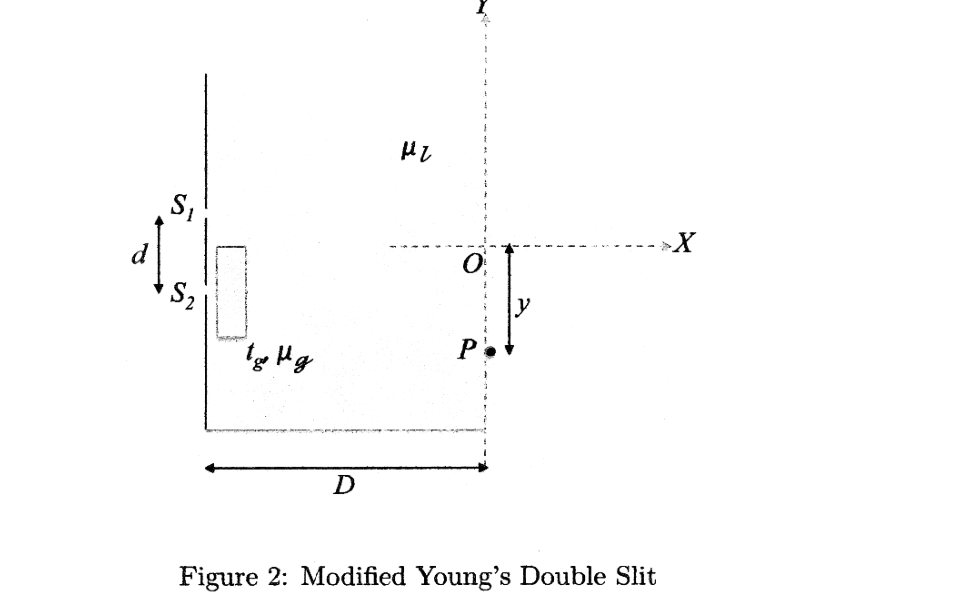
Figure 2: Modified Young’s Double Slit.
(i) Consider the point on the screen at a distance from (; ). Obtain the expression for the optical path difference in terms of the refractive indices. [3]
(ii) If is the central maximum, Obtain the expression for as a function of time . [3]
(iii) Obtain the time when the central maximum is at a point , equidistant from and , i.e. . [3]
(iv) Determine the speed, of the central maximum when it is at . [3]
Fonte: Testo (PDF) — p.4 Topic: Wave Optics Metodi: Interference & Diffraction Analysis, Calculus-Integration Competenze: Physical Reasoning, Mathematical Modeling Objects: Slit, Screen
Nell’esperimento di Young su due fessure, la regione tra schermo e fessure è immersa in un liquido il cui indice di rifrazione varia con il tempo (in secondi) da fino a raggiungere un valore di stato stazionario . La distanza tra le fessure e lo schermo è e la distanza tra le fessure e è . Si introduce una piastra di vetro di spessore e indice di rifrazione davanti a una delle fessure. Si noti che le illuminazioni a e provengono da fonti coerenti con differenza di fase zero.
Figura 2: Slit doppio di Young modificato.
(i) Considerare il punto sullo schermo a una distanza da (; ). Ottenere l’espressione per la differenza di percorso ottico in termini di indici di rifrazione. [3]
(ii) Se è il massimo centrale, Ottieni l’espressione per come funzione del tempo . [3]
(iii) Ottenere il tempo quando il massimo centrale è a un punto , equidistante da e , ovvero . [3]
(iv) Determinare la velocità, , del massimo centrale quando è . [3]
Fonte: Testo (PDF) — p.4 Topic: Wave Optics Metodi: Interference & Diffraction Analysis, Calculus-Integration Competenze: Physical Reasoning, Mathematical Modeling Objects: Slit, Screen