The first explosion of the atomic bomb was conducted near Alamogordo, New Mexico on July 16, 1945. Figure 1 shows a picture of the approximately spherical shockwave at 25 msec, with the tick marks indicating 100 m. Using dimensional analysis, find an expression for the radius of the shockwave, , as a function of the density of the medium (i.e. the air) through which the shock wave travels, the energy of the explosion, , and the time, , that elapsed since the explosion.
Assuming that the proportionality constant is unity (i.e. 1), as predicted by Sir Geoffrey Taylor, and assuming that the density of air, , is , and that the explosion of 1000 kg of TNT releases an energy of J, estimate, from the picture, the approximate energy of this explosion expressed as tons (1000 kg) of TNT equivalent. [8]
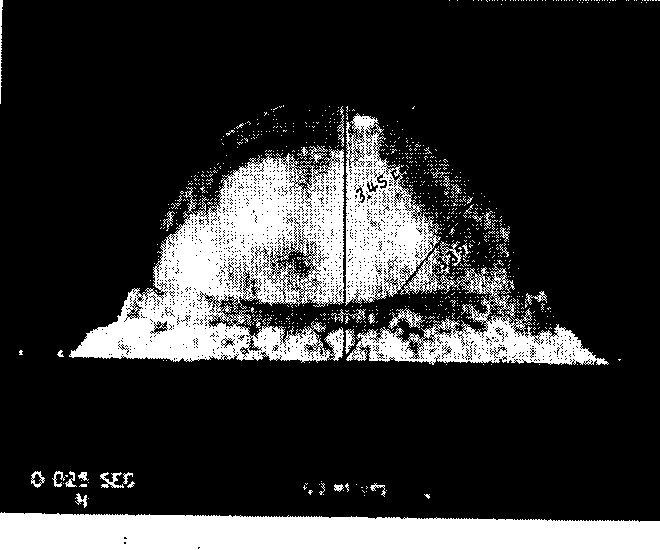 Figure 1: Camera shot of the bomb after 25 msec.
Fonte: Testo (PDF) — p.2 Topic: Order-of-Magnitude Estimation Metodi: Dimensional Analysis, Order-of-Magnitude Estimation Competenze: Physical Reasoning, Mathematical Modeling Objects: —
La prima esplosione della bomba atomica fu effettuata vicino ad Alamogordo, nel Nuovo Messico, il 16 luglio 1945. La figura 1 mostra un’immagine dell’onda d’urto sferica a 25 msec, con le marcature di 100 m. Usando l’analisi dimensionale, trovare un’espressione per il raggio dell’onda d’urto, , in funzione della densità del mezzo (cioè l’aria) attraverso la quale si sposta l’onda d’urto, l’energia dell’esplosione, , e il tempo, , trascorso dall’esplosione.
Supponendo che la costante di proporzionalità sia unità (cioè 1) come previsto da Sir Geoffrey Taylor, e supponendo che la densità dell’aria, , sia , e che l’esplosione di 1000 kg di TNT rilasci un’energia di J, si stima, dall’immagine, l’energia approssimativa di questa esplosione espressa in tonnellate (1000 kg) di equivalente TNT. [8]
Figura 1: Fotocamera della bomba dopo 25 secondi.
Fonte: Testo (PDF) — p.2 Topic: Order-of-Magnitude Estimation Metodi: Dimensional Analysis, Order-of-Magnitude Estimation Competenze: Physical Reasoning, Mathematical Modeling Objects: —
During a discussion in a physics meeting, Einstein used this problem to illustrate the notion of adiabatic invariant. A pendulum, made up of a ball of mass suspended from a pivot by a light string of length , is swinging freely in a vertical plane. By what factor does the amplitude of the oscillations change if the string is shortened very slowly by a factor of 2? [10]
Fonte: Testo (PDF) — p.2 Topic: Oscillations & Waves Metodi: Simple Harmonic Motion Analysis, Conservation of Energy Competenze: Physical Reasoning, Mathematical Modeling Objects: Pendulum
Durante una discussione in una riunione di fisica, Einstein usò questo problema per illustrare il concetto di invariante adiabatico. Un pendolo, costituito da una palla di massa sospesa da un pivot da una leggera corda di lunghezza , oscilla liberamente in piano verticale. Con quale fattore l’ampiezza delle oscillazioni cambia se la stringa viene ridotta molto lentamente di un fattore di 2? [10]
Fonte: Testo (PDF) — p.2 Topic: Oscillations & Waves Metodi: Simple Harmonic Motion Analysis, Conservation of Energy Competenze: Physical Reasoning, Mathematical Modeling Objects: Pendulum
A rocket is projected straight up and explodes into three equally massive fragments just as it reaches the top of its flight. One of the fragments is observed to come straight down to the ground in time while the other two land at time after the burst. Find the height at which the fragmentation occurred. [10]
Fonte: Testo (PDF) — p.2 Topic: Conservation of Momentum Metodi: Conservation of Momentum, Kinematic Equations Competenze: Physical Reasoning, Mathematical Modeling Objects: Projectile
Un razzo viene proiettato dritto in alto e esplode in tre frammenti uguali di massa appena raggiunge la cima del suo volo. Uno dei frammenti viene osservato per scendere direttamente al suolo nel tempo mentre gli altri due atterrano nel tempo dopo la rottura. Trova l’altezza a cui è avvenuta la frammentazione. [10]
Fonte: Testo (PDF) — p.2 Topic: Conservation of Momentum Metodi: Conservation of Momentum, Kinematic Equations Competenze: Physical Reasoning, Mathematical Modeling Objects: Projectile
An early but unfortunately incorrect model of the hydrogen atom suggested by J.J. Thomson postulated that the hydrogen atom is a positive cloud of charge uniformly distributed throughout a volume of a sphere of radius with the electron represented by an equal magnitude but negative point charge at the center of the sphere.
(i) Show that the electron is in equilibrium at the center and that if displaced a small distance would experience a restoring force of the form where is a constant. Determine . [3]
(ii) Find an expression for the frequency of the simple harmonic oscillations that the electron of mass would undergo if displaced a small distance from the center and released. [3]
(iii) Calculate a numerical value for that would result in a frequency of Hz, the frequency of light radiated in the most intense line of the hydrogen spectrum. [3]
Fonte: Testo (PDF) — p.3 Topic: Electrostatics Metodi: Gauss’s Law, Coulomb’s Law, Simple Harmonic Motion Analysis Competenze: Physical Reasoning, Mathematical Modeling Objects: Point Charge, Electron, Atom
Un modello antico ma purtroppo errato dell’atomo di idrogeno suggerito da J.J. Thomson postulato che l’atomo di idrogeno è una nuvola positiva di carica uniformemente distribuita in tutto un volume di una sfera di raggio con l’elettrone rappresentato da una grandezza uguale ma carica di punto negativo al centro della sfera.
(i) Mostra che l’elettrone è in equilibrio al centro e che se spostato una piccola distanza sperimenterebbe una forza di ripristino della forma dove è una costante. Determina . [3]
(ii) Trovare un’espressione per la frequenza delle semplici oscillazioni armoniche che l’elettrone di massa subirebbe se spostasse una piccola distanza dal centro e rilasciasse. [3]
(iii) Calcolare un valore numerico per che si traduca in una frequenza di Hz, la frequenza della luce irradiata nella linea più intensa dello spettro dell’idrogeno. [3]
Fonte: Testo (PDF) — p.3 Topic: Electrostatics Metodi: Gauss’s Law, Coulomb’s Law, Simple Harmonic Motion Analysis Competenze: Physical Reasoning, Mathematical Modeling Objects: Point Charge, Electron, Atom
A “perfect” rocket engine combines matter and antimatter in a controlled way to yield photons (high energy gamma rays) all of which are directed out of a spaceship. Suppose we start with a spaceship of initial mass at rest, and that at burnout, the remaining spaceship moves at speed and has mass equal to the fraction of the original mass. You may take the speed of light and .
(i) What is the total energy of this system initially? Let stand for the total energy of radiation after the burnout. Find an expression for the total energy of the system after the burnout and set up the conservation of energy equation. [2]
(ii) Write down the equation for the conservation of momentum. [2]
(iii) Show that . [2]
(iv) Show that so that . [3]
(v) What is the value of if ? Is it possible to construct a spaceship whose shell and payload with this ? [3]
(vi) Using obtained above for , show that the total energy of the emitted radiation is less than the mass of fuel consumed. Explain why. [3]
Fonte: Testo (PDF) — p.3 Topic: Special Relativity Metodi: Relativistic Energy-Momentum, Mass-Energy Equivalence, Conservation Laws Competenze: Physical Reasoning, Mathematical Modeling Objects: Photon
Un motore di razzo “perfetto” combina materia e antimateria in modo controllato per produrre fotoni (razioni gamma ad alta energia) che vengono tutti diretti fuori da una nave spaziale. Supponiamo che iniziamo con una nave spaziale di massa iniziale a riposo, e che al burnout, la nave spaziale rimanente si muova a velocità e ha massa uguale alla frazione della massa originale. È possibile prendere la velocità della luce e .
(i) Qual è l’energia totale di questo sistema inizialmente? Let indicare l’energia totale della radiazione dopo il burnout. Trova un’espressione per l’energia totale del sistema dopo l’esplosione e imposta l’equazione di conservazione dell’energia. [2]
(ii) Scrivi l’equazione per la conservazione dell’impulso. [2]
(iii) Indicare che . [2]
(iv) Indicare che in modo che . [3]
(v) Qual è il valore di se ? È possibile costruire una nave spaziale con questo ? [3]
(vi) Con ottenuto in precedenza per , dimostrare che l’energia totale delle radiazioni emesse è inferiore alla massa del combustibile consumato. Spiegate il motivo. [3]
Fonte: Testo (PDF) — p.3 Topic: Special Relativity Metodi: Relativistic Energy-Momentum, Mass-Energy Equivalence, Conservation Laws Competenze: Physical Reasoning, Mathematical Modeling Objects: Photon
On a smooth and insulating large ring of radius , there is a small ring of mass and carrying charge . The large ring is placed horizontally and in a uniform magnetic field of strength and perpendicular to the ring plane. Starting at , the magnetic field is changed to . Find the force of the small ring acting on the big ring afterwards and describe the motion of the small ring. [10]
Fonte: Testo (PDF) — p.3 Topic: Electromagnetic Induction Metodi: Faraday’s Law of Induction, Lorentz Force Analysis Competenze: Physical Reasoning, Mathematical Modeling Objects: Point Charge
Su un anello grande liscio e isolante di raggio , si trova un anello di massa e carica portante . L’anello grande è posizionato orizzontalmente e in un campo magnetico uniforme di forza e perpendicolare al piano dell’anello. A partire da , il campo magnetico viene modificato a . Trova la forza dell’anello piccolo che agisce sull’anello grande dopo e descrivi il movimento dell’anello piccolo. [10]
Fonte: Testo (PDF) — p.3 Topic: Electromagnetic Induction Metodi: Faraday’s Law of Induction, Lorentz Force Analysis Competenze: Physical Reasoning, Mathematical Modeling Objects: Point Charge
Three polarizing disks whose planes are parallel are centered on a common axis. The direction of the transmission axis in each case is shown in Figure 2 relative to the common vertical direction. A plane-polarized beam of light with parallel to the vertical reference direction is incident from the left on the first disk with intensity in some arbitrary units. Calculate the transmitted intensity when
(i) , , and ; [3]
(ii) , , and ; [3]
(iii) If and , find the angle so that maximum intensity passes through the three polarizers. [4]
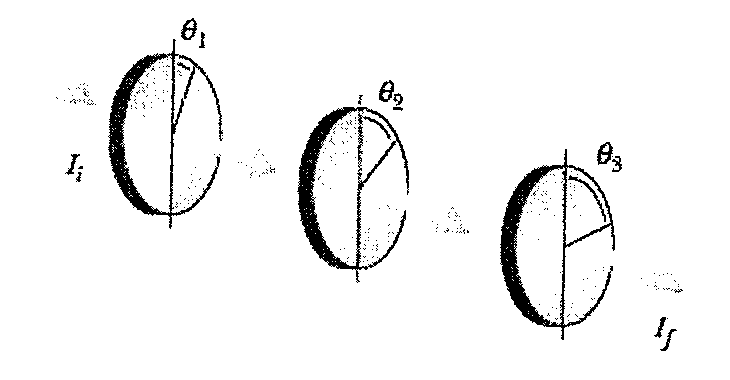 Figure 2: Three polarizing disks whose planes are parallel are centered on a common axis.
Fonte: Testo (PDF) — p.4 Topic: Wave Optics Metodi: Interference & Diffraction Analysis Competenze: Physical Reasoning, Mathematical Modeling Objects: Disk
Tre dischi polarizzanti i cui piani sono paralleli sono incentrati su un asse comune. La direzione dell’asse di trasmissione in ciascun caso è indicata nella figura 2 rispetto alla direzione verticale comune. Un fascio di luce polarizzato a piano con parallelo alla direzione verticale di riferimento è inciso da sinistra sul primo disco con intensità in alcune unità arbitrarie. Calcolare l’intensità trasmessa quando
(i) , e ; [3]
(ii) , e ; [3]
(iii) Se e , trovare l’angolo in modo che l’intensità massima passi attraverso i tre polarizzatori. [4]
Figura 2: Tre dischi polarizzanti i cui piani sono paralleli sono incentrati su un asse comune.
Fonte: Testo (PDF) — p.4 Topic: Wave Optics Metodi: Interference & Diffraction Analysis Competenze: Physical Reasoning, Mathematical Modeling Objects: Disk
Two parallel rails with negligible resistance are 10.0 cm apart and are connected by a resistor. The circuit also contains two metal rods having resistances of and sliding along the rails (see Figure 3). The rods are pulled away from the resistor at constant speeds of and , respectively. A uniform magnetic field of magnitude 0.0100 T is applied perpendicular to the plane of the rails. Determine the current in the resistor. [8]
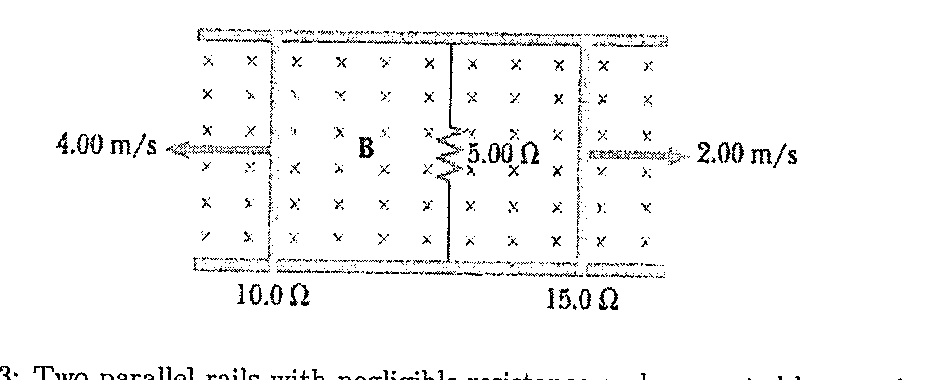 Figure 3: Two parallel rails with negligible resistance and connected by a resistor.
Fonte: Testo (PDF) — p.4 Topic: Electromagnetic Induction Metodi: Faraday’s Law of Induction, Kirchhoff’s Laws Competenze: Physical Reasoning, Mathematical Modeling Objects: Resistor, Rod
Due binari paralleli con una resistenza trascurabile sono separati di 10,0 cm e sono collegati da una resistenza . Il circuito contiene anche due barre di metallo con resistenze e che scivolano lungo le rotaie (vedere figura 3). Le barre sono allontanate dalla resistenza a velocità costanti rispettivamente e . Un campo magnetico uniforme di magnitudo 0,0100 T viene applicato perpendicolare al piano dei binari. Determina la corrente nella resistenza . [8]
Figura 3: Due binari paralleli con una resistenza trascurabile e collegati da una resistenza.
Fonte: Testo (PDF) — p.4 Topic: Electromagnetic Induction Metodi: Faraday’s Law of Induction, Kirchhoff’s Laws Competenze: Physical Reasoning, Mathematical Modeling Objects: Resistor, Rod
In Figure 4, the switch is closed for , and steady-state conditions are established. The switch is opened at .
(i) Find the initial voltage across just after . Which end of the coil is at the higher potential: or ? [3]
(ii) Sketch graphs of the currents in and in as a function of time, treating the steady-state directions as positive. Show the values before and after . [5]
(iii) How long after would across have the value 2.00 mA? [2]
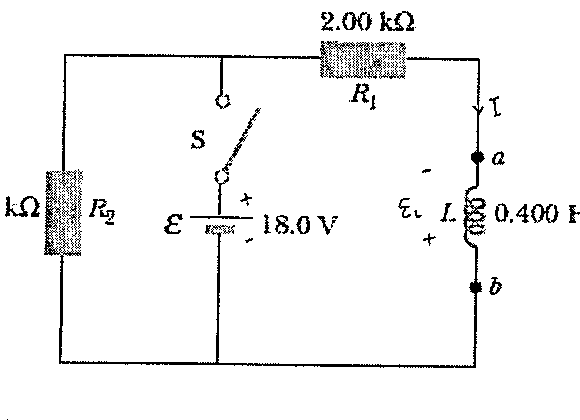 Figure 4: Circuit with EMF source V, , , H, and switch .
Fonte: Testo (PDF) — p.5 Topic: Circuits Metodi: Kirchhoff’s Laws, Differential Equations Competenze: Physical Reasoning, Mathematical Modeling Objects: Inductor, Resistor, Battery, Switch, Coil
Nella figura 4, il interruttore è chiuso per e sono stabilite condizioni di stato stazionario. Il interruttore è aperto a .
(i) Trova la tensione iniziale su subito dopo . Quale fine della bobina ha il potenziale più elevato: o ? [3]
(ii) Sketch grafici delle correnti in e in in funzione del tempo, trattando le direzioni dello stato stazionario come positive. Indicare i valori prima e dopo . [5]
(iii) Quanto tempo dopo su avrebbe il valore di 2,00 mA? [2]
Figura 4: Circuito con sorgente EMF V, , , H e interruttore .
Fonte: Testo (PDF) — p.5 Topic: Circuits Metodi: Kirchhoff’s Laws, Differential Equations Competenze: Physical Reasoning, Mathematical Modeling Objects: Inductor, Resistor, Battery, Switch, Coil
A transparent cylinder of radius m has a mirrored surface on its right half, as shown in Figure 5. A light ray traveling in air is incident on the left side of the cylinder. The incident light ray and exiting light ray are parallel and m. Determine the index of refraction of the material. [10]
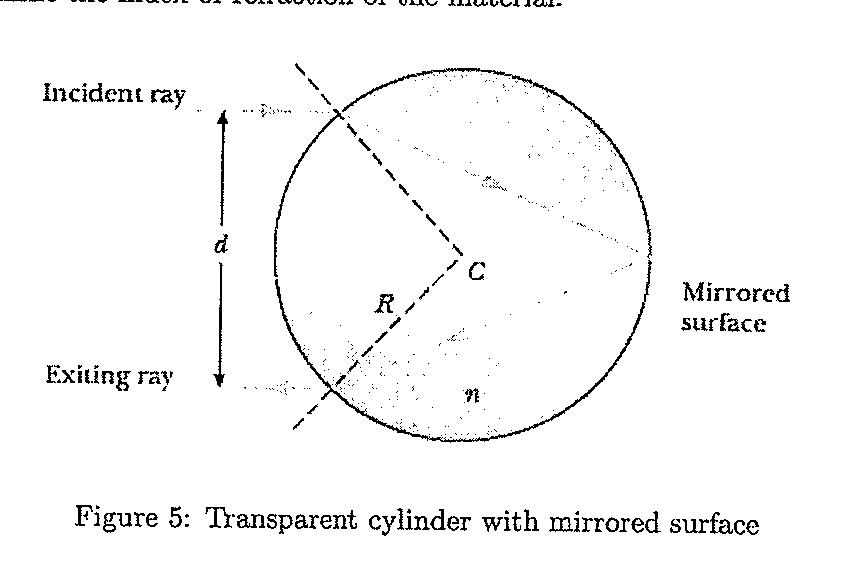 Figure 5: Transparent cylinder with mirrored surface.
Fonte: Testo (PDF) — p.5 Topic: Geometric Optics Metodi: Snell’s Law, Ray Tracing Competenze: Physical Reasoning, Mathematical Modeling Objects: Cylinder, Mirror
Un cilindro trasparente di raggio m ha una superficie specchiata nella sua metà destra, come mostrato alla figura 5. Un raggio di luce che viaggia in aria incide sul lato sinistro del cilindro. Il raggio luminoso incidente e il raggio luminoso uscente sono paralleli e m. Determinare l’indice di rifrazione del materiale. [10]
Figura 5: cilindro trasparente con superficie specchiata.
Fonte: Testo (PDF) — p.5 Topic: Geometric Optics Metodi: Snell’s Law, Ray Tracing Competenze: Physical Reasoning, Mathematical Modeling Objects: Cylinder, Mirror