Yo-Yo! A yo-yo of mass lies on a smooth horizontal table as shown below. The moment of inertia about the center may be taken as . A string is pulled with force from the inner radius as indicated below.
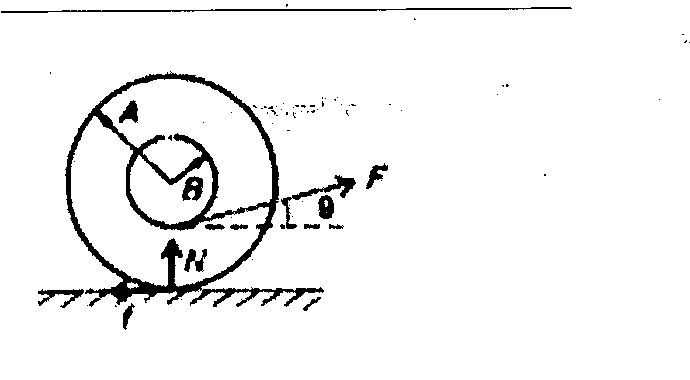 Figure 1: Yo-yo on a smooth table
(a) Draw diagrams to show which direction the yo-yo will roll if . [2]
(b) For what value of will the yo-yo slide without rolling independent of the roughness (coefficient of friction) of the table or the magnitude of ? [3]
(c) At what angle will the yo-yo roll, independent of the smoothness of the table? [5]
Fonte: Testo (PDF) — p.2 Topic: Rotational Dynamics Metodi: Free-Body Diagram, Torque & Angular Momentum Analysis Competenze: Physical Reasoning, Mathematical Modeling Objects: String
Yo-Yo! Un yo-yo di massa si trova su una tavola orizzontale liscia come mostrato di seguito. Il momento di inerzia intorno al centro può essere preso come . Una corda viene tirata con forza dal raggio interno come indicato di seguito.
Figura 1: Yo-yo su un tavolo liscio
(a) Disegnare diagrammi che mostrino in quale direzione il yo-yo si muoverà se . [2]
b) Per quale valore di il yo-yo scivola senza rotolare indipendentemente dalla rugosità (coefficiente di attrito) della tavola o dalla grandezza di ? [3]
(c) At what angle will the yo-yo roll, independent of the smoothness of the table? [5]
Fonte: Testo (PDF) — p.2 Topic: Rotational Dynamics Metodi: Free-Body Diagram, Torque & Angular Momentum Analysis Competenze: Physical Reasoning, Mathematical Modeling Objects: String
Yo-yo continued A yo-yo is pulled by its string along a horizontal surface without slipping. The horizontal velocity of the end of the string remains equal to . A bar is pivoted as shown and remains supported by the yo-yo. Find the angular speed of the bar as a function of the angle . The outer and the inner radii of the yo-yo are and respectively. [10]
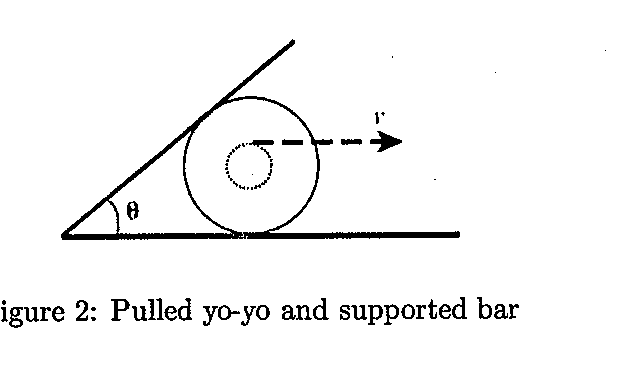 Figure 2: Pulled yo-yo and supported bar
Fonte: Testo (PDF) — p.2 Topic: Rotational Dynamics Metodi: Kinematic Equations, Vector Decomposition, Physical Modeling Competenze: Physical Reasoning, Mathematical Modeling Objects: String, Rod
Yo-yo continuato Un yo-yo viene tirato dalla sua corda lungo una superficie orizzontale senza scivolare. La velocità orizzontale della fine della corda rimane uguale a . Una barra è girata come mostrato e rimane sostenuta dal yo-yo. Trova la velocità angolare della barra come funzione dell’angolo . I raggi esterni e interni del yo-yo sono rispettivamente e . [10]
Figura 2: Yo-yo tirato e barra sostenuta
Fonte: Testo (PDF) — p.2 Topic: Rotational Dynamics Metodi: Kinematic Equations, Vector Decomposition, Physical Modeling Competenze: Physical Reasoning, Mathematical Modeling Objects: String, Rod
Cylindrical capacitors
(a) A long cylindrical conductor has a radius and a linear charge density . It is surrounded by a coaxial cylindrical conducting shell with inner radius and linear charge density . Calculate the capacitance per unit length for this capacitor, assuming that there is vacuum in the space between the cylinders. [4]
(b) Consider a cylindrical capacitor of length and of radii and as defined in (a), write down the conditions for which increasing by 10% would be more effective in increasing its capacitance than increasing by 10%. [6]
Fonte: Testo (PDF) — p.3 Topic: Electrostatics Metodi: Gauss’s Law, Electric Potential Method, Calculus-Integration Competenze: Physical Reasoning, Mathematical Modeling Objects: Capacitor, Cylinder
Capacitori cilindrici
a) Un conduttore cilindrico lungo ha un raggio e una densità di carica lineare . È circondato da una conchiglia di conduttori coaxiali cilindrici con raggio interno e densità di carica lineare . Calcolare la capacità per unità di lunghezza di questo condensatore, supponendo che ci sia un vuoto nello spazio tra i cilindri. [4]
b) Considerare un condensatore cilindrico di lunghezza e di raggi e come definito alla lettera a), scrivere le condizioni per le quali aumentare del 10% sarebbe più efficace nell’aumentare la sua capacità che aumentare del 10%. [6]
Fonte: Testo (PDF) — p.3 Topic: Electrostatics Metodi: Gauss’s Law, Electric Potential Method, Calculus-Integration Competenze: Physical Reasoning, Mathematical Modeling Objects: Capacitor, Cylinder
Spring with mass Problems involving springs often consider the springs to be massless. Of course, that is not true in reality. Here, we consider a spring with mass , equilibrium length , and spring constant .
(a) The spring above has one end fixed and the other end moving with speed . Assume the speed of points along the length of the spring varies linearly with distance from the fixed end. Assume also that the mass of the spring is distributed uniformly along the spring. Express the kinetic energy of the spring in terms of and . [5]
(b) Write down the conservation of energy equation of a spring-mass system where the mass is moving at the end of a massless spring. What is the angular frequency for such a system? [2]
(c) By considering the procedure in (b), what is the angular frequency of the spring mentioned in (a)? If the effective mass of the spring is defined as , what is in terms of ? [3]
Fonte: Testo (PDF) — p.3 Topic: Oscillations & Waves Metodi: Simple Harmonic Motion Analysis, Energy Conservation Method, Calculus-Integration Competenze: Physical Reasoning, Mathematical Modeling Objects: Spring
Spring with mass I problemi che riguardano le sorgenti spesso considerano le sorgenti come non massose. Naturalmente, in realtà non è così. Qui, consideriamo una molla con massa , lunghezza di equilibrio e costante molla .
a) La molla sopra è fissata con una estremità e l’altra è in movimento a velocità . Supponiamo che la velocità dei punti lungo la lunghezza della molla varia linealmente con la distanza dalla fine fissa. Supponiamo inoltre che la massa della molla sia distribuita uniformemente lungo la molla. Esprimere l’energia cinetica della molla in termini di e . [5]
b) Notare la conservazione dell’equazione energetica di un sistema di massa di molla in cui la massa si muove alla fine di una molla senza massa. Qual è la frequenza angolare per un tale sistema? [2]
c) Considerando la procedura di cui alla lettera b), quale è la frequenza angolare della sorgente di cui alla lettera a)? Se la massa effettiva della molla è definita come , quale è in termini di ? [3]
Fonte: Testo (PDF) — p.3 Topic: Oscillations & Waves Metodi: Simple Harmonic Motion Analysis, Energy Conservation Method, Calculus-Integration Competenze: Physical Reasoning, Mathematical Modeling Objects: Spring
Catching the wave
The speed of a travelling wave along a string is a function of its tension and its linear mass density in the form .
(a) Find and . [2]
(b) A uniform, almost inextensible string of length and total mass is suspended vertically and tapped at the top end so that a transverse impulse runs down it. At the same moment, a body is released from rest and falls freely from the top of the string. How far from the bottom does the body pass the impulse? [8]
Fonte: Testo (PDF) — p.3 Topic: Oscillations & Waves Metodi: Dimensional Analysis, Wave Equation, Kinematic Equations Competenze: Physical Reasoning, Mathematical Modeling Objects: String
Cattura dell’onda
La velocità di un’onda che viaggia lungo una corda è una funzione della sua tensione e della sua densità di massa lineare nella forma .
(a) Trova e . [2]
b) Una stringa uniforme, quasi inestensibile, di lunghezza e massa totale è sospesa in verticale e colpita all’estremità superiore in modo che un impulso trasversale si effonda in fondo. Allo stesso momento, un corpo viene rilasciato dal riposo e cade liberamente dalla cima della corda. Quanto lontano dal fondo il corpo passa l’impulso? [8]
Fonte: Testo (PDF) — p.3 Topic: Oscillations & Waves Metodi: Dimensional Analysis, Wave Equation, Kinematic Equations Competenze: Physical Reasoning, Mathematical Modeling Objects: String
Playing with Horizontal Plates A capacitor system is made of 2 horizontal square plates of sides separated by a distance .
(a) If the uniform electric force field between them is , what are the charges on the respective plates? Express your answer in terms of , and other fundamental constants. [3]
(b) What is the force which the plates exert on each other when the potential difference between them is ? [2]
(c) The upper plate is fixed and the lower plate is resting on a table top and is free to move. The potential difference is gradually increased till the lower plate suddenly jumps up. Calculate the value of at which this occurs, given that the lower plate is made of aluminium (density ) of thickness and that the initial separation is . [3]
(d) What is the energy per unit volume stored in the capacitor just before the lower plate jumps up? [2]
Fonte: Testo (PDF) — p.4 Topic: Electrostatics Metodi: Gauss’s Law, Free-Body Diagram, Electric Potential Method Competenze: Physical Reasoning, Mathematical Modeling Objects: Capacitor
Gioca con le piastre orizzontali Un sistema di condensatori è costituito da due piastre quadrate orizzontali di lati separate da una distanza .
(a) Se il campo di forza elettrica uniforme tra loro è , quali sono le cariche sulle rispettive piastre? Esprimere la risposta in termini di , e altre costanti fondamentali. [3]
b) Qual è la forza che le piastre si esercitano l’una sull’altra quando la differenza potenziale tra loro è ? [2]
c) La piastra superiore è fissata e la piastra inferiore si posa su un tavolo e si muove liberamente. La differenza di potenziale aumenta gradualmente fino a quando la piastra inferiore salta improvvisamente. Calcolare il valore di al quale si verifica questo, dato che la piastra inferiore è di alluminio (densità ) di spessore e che la separazione iniziale è . [3]
d) Qual è l’energia per unità di volume immagazzinata nel condensatore poco prima che la piastra inferiore salti? [2]
Fonte: Testo (PDF) — p.4 Topic: Electrostatics Metodi: Gauss’s Law, Free-Body Diagram, Electric Potential Method Competenze: Physical Reasoning, Mathematical Modeling Objects: Capacitor
(a) At low temperatures, the heat capacity of a substance is dependent on its temperature. A thermally insulated piece of the substance is heated under atmospheric pressure by an electric current so that it receives electric energy at a constant power . This leads to an increase of the absolute temperature of the substance with time as . Here, , and are constants. Determine the heat capacity of the substance as a function of temperature. [5]
(b) The index of refraction of glass can be increased by diffusing in impurities. It is then possible to make a lens of constant thickness. Given a disk of radius and thickness , express the index of refraction as a function of (refractive index at the centre of the lens), (radius from the centre of the lens), and . You may assume . [5]
Fonte: Testo (PDF) — p.4 Topic: Thermodynamics, Geometric Optics Metodi: First Law of Thermodynamics, Calculus-Integration, Thin Lens & Mirror Equation Competenze: Physical Reasoning, Mathematical Modeling Objects: Lens
- a) A basse temperature, la capacità termico di una sostanza dipende dalla sua temperatura. Un pezzo di sostanza isolato termicamente viene riscaldato sotto pressione atmosferica da una corrente elettrica in modo che riceva energia elettrica a una potenza costante . Ciò porta ad un aumento della temperatura assoluta della sostanza con il tempo come . Qui , e sono costanti. Determinare la capacità termico della sostanza in funzione della temperatura. [5]
b) L’indice di rifrazione del vetro può essere aumentato diffondendo nelle impurità. È quindi possibile realizzare una lente di spessore costante. Se si considera un disco di raggio e spessore , esprimere l’indice di rifrazione come funzione di (indice di rifrazione al centro della lente), (raggio dal centro della lente), e . Si può supporre . [5]
Fonte: Testo (PDF) — p.4 Topic: Thermodynamics, Geometric Optics Metodi: First Law of Thermodynamics, Calculus-Integration, Thin Lens & Mirror Equation Competenze: Physical Reasoning, Mathematical Modeling Objects: Lens
(a) After falling a time in the atmosphere, an outer shell of a meteorite of thickness will have been heated significantly. The thickness can be estimated by dimensional analysis as the following thermodynamic parameters: .
is the meteorite’s density. is the meteorite’s specific heat capacity. is the meteorite’s thermal conductivity.
Determine by dimensional analysis the value of the four powers , , and . [5]
(b) A beam of mesons per second with is observed to interact with a lead brick such that the mesons are being converted to mesons with the internal state of the lead brick identical before and after the reaction. The direction of motion of the incoming and outgoing may also be considered to be identical. Using
give the magnitude and direction of the average force exerted on the brick by this process. [5]
Fonte: Testo (PDF) — p.4 Topic: Nuclear & Particle Physics, Thermodynamics Metodi: Dimensional Analysis, Relativistic Energy-Momentum, Impulse-Momentum Theorem Competenze: Physical Reasoning, Mathematical Modeling Objects: Particle Beam
a) Dopo un’orbita nell’atmosfera, un guscio esterno di un meteorite di spessore sarà stato riscaldato in modo significativo. Lo spessore può essere stimato mediante analisi dimensionale come i seguenti parametri termodinamici: .
è la densità del meteorite. è la capacità termica specifica del meteorite. è la conducibilità termica del meteorite.
Determinare, mediante analisi dimensionale, il valore delle quattro potenze , , e . [5]
b) Si osserva un fascio di mesoni al secondo con che interagisce con un mattone di piombo in modo tale che i mesoni siano convertiti in mesoni con lo stato interno del mattone di piombo identico prima e dopo la reazione. La direzione di movimento della in entrata e della in uscita può essere considerata identica. Utilizzando
indicare la magnitudine e la direzione della forza media esercitata sul mattone da questo processo. [5]
Fonte: Testo (PDF) — p.4 Topic: Nuclear & Particle Physics, Thermodynamics Metodi: Dimensional Analysis, Relativistic Energy-Momentum, Impulse-Momentum Theorem Competenze: Physical Reasoning, Mathematical Modeling Objects: Particle Beam
Among the first successes of the interpretation by Ampere of magnetic phenomena, we have the computation of the magnetic field generated by wires carrying an electric current, as compared to early assumptions originally made by Biot and Savart.
A particularly interesting case is that of a very long thin wire, carrying a constant current , made out of two rectilinear sections and bent in the form of a “V”, with angular half-span (see figure). According to Ampere’s computations, the magnitude of the magnetic field in a given point lying on the axis of the “V”, outside of it and at a distance from its vertex, is proportional to . Ampere’s work was later embodied in Maxwell’s electromagnetic theory, and is universally accepted.
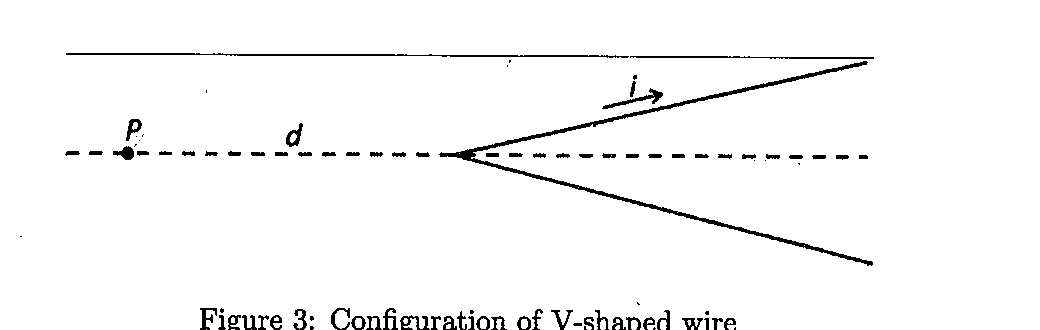 Figure 3: Configuration of V-shaped wire
Using our knowledge of electromagnetism
(a) find an expression of the magnetic field in terms of the given quantities and any other relevant constants. Also, indicate the direction of the magnetic field. [4]
(b) Compute the field at a point symmetric to with respect to the vertex i.e. along the axis and at the same distance but inside the “V”. [4]
Fonte: Testo (PDF) — p.5 Topic: Magnetism Metodi: Biot-Savart Law, Superposition Principle, Calculus-Integration Competenze: Physical Reasoning, Mathematical Modeling Objects: Wire
Tra i primi successi dell’interpretazione di Ampere dei fenomeni magnetici, abbiamo il calcolo del campo magnetico generato da fili che trasportano una corrente elettrica, rispetto alle prime ipotesi originariamente fatte da Biot e Savart.
Un caso particolarmente interessante è quello di un filo molto lungo e sottile, con corrente costante , costituito da due sezioni rettilineari e piegato sotto forma di “V”, con mezzo spans angolare (vedere figura). Secondo i calcoli di Ampere, la magnitudine del campo magnetico in un dato punto situato sull’asse della “V”, al di fuori di essa e a una distanza dal suo vertice, è proporzionale a . Il lavoro di Ampere fu poi incorporato nella teoria elettromagnetica di Maxwell, ed è universalmente accettato.
Figura 3: Configurazione del filo a forma di V
Usando le nostre conoscenze di elettromagnetismo
- trovare un’espressione del campo magnetico in termini di quantità e di altre costanti rilevanti. Indicare anche la direzione del campo magnetico. [4]
b) Calcolare il campo in un punto simmetrico a rispetto alla verticale, cioè lungo l’asse e alla stessa distanza , ma all’interno della “V”. [4]
Fonte: Testo (PDF) — p.5 Topic: Magnetism Metodi: Biot-Savart Law, Superposition Principle, Calculus-Integration Competenze: Physical Reasoning, Mathematical Modeling Objects: Wire
Radioactive dating of sample (element no 37) decays into the stable isotope (element no. 38) with a half life of year, relative to the stable isotope . At the point of formation, the ratio was identical for all minerals in the sample while the ratio was quite different. As time passes on, the amount of decreases by decay, while consequently the amount of increases. As a result, the ratio of will be different today. In the following figure(a), the points on the horizontal line refer to the ratio in different minerals at the formation of the sample.
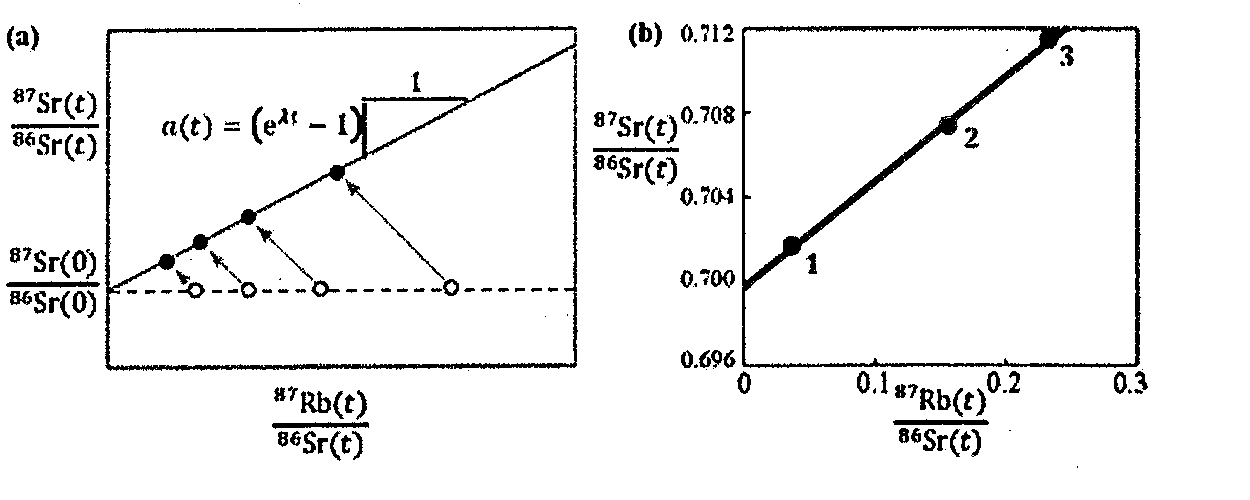 Figure 4: (a) The ratio in different minerals at the time of formation, (open circles) and at present time (filled circles) (b) The isochron-line for three different minerals taken from the sample at present time
(a) Write down the nuclear reaction depicting the decay scheme for the transformation of to . [2]
(b) Show that the present-time ratio was plotted versus the present-time ratio in different mineral samples from the same sample forms a straight line (the isochron line), with slope . Here is the time since the formation of the minerals, while is the decay constant inversely proportional to half-life . [5]
(c) Determine the age of the sample using the isochron line as in the above diagram. [3]
Fonte: Testo (PDF) — p.6 Topic: Nuclear & Particle Physics Metodi: Radioactive Decay Law, Graph Linearization, Curve Fitting Competenze: Physical Reasoning, Mathematical Modeling Objects: Nucleus
La datazione radioattiva del campione ** (elemento n. 37) si decompone nell’isotopo stabile (elemento n. 38) con una semivida di anno, rispetto all’isotopo stabile . Al momento della formazione, il rapporto era identico per tutti i minerali del campione, mentre il rapporto era molto diverso. Nel corso del tempo, l’ammontare di diminuisce in decadimento, mentre di conseguenza l’ammontare di aumenta. Di conseguenza, il rapporto di sarà diverso oggi. Nella figura seguente (a), i punti della linea orizzontale si riferiscono al rapporto nei diversi minerali alla formazione del campione.
Figura 4: (a) Il rapporto nei diversi minerali al momento della formazione, (cerchi aperti) e al momento presente (cerchi pieni) (b) La linea isochronica per tre diversi minerali prelevati dal campione al momento presente
a) Scrivere la reazione nucleare che descrive il schema di decadimento per la trasformazione di in . [2]
b) dimostrare che il rapporto attuale è stato tracciato rispetto al rapporto attuale in diversi campioni minerali dello stesso campione, formando una linea retta (la linea isocrona), con pendenza . Qui è il tempo dalla formazione dei minerali, mentre è la costante di decadimento inversamente proporzionale alla semivita . [5]
c) Determinare l’età del campione utilizzando la linea isochronico come nel diagramma sopra indicato. [3]
Fonte: Testo (PDF) — p.6 Topic: Nuclear & Particle Physics Metodi: Radioactive Decay Law, Graph Linearization, Curve Fitting Competenze: Physical Reasoning, Mathematical Modeling Objects: Nucleus