Hohmann transfer orbit and gravity assist
(a) A spacecraft is to be sent from Earth to Saturn. The Hohmann transfer is a manoeuvre that transfers the spacecraft from Earth’s orbit around the Sun (assumed to be circular) to Saturn’s orbit around the Sun (assumed to be circular also). This is done by pushing the spacecraft into an elliptical orbit that has its perihelion and aphelion touching Earth’s orbit and Saturn’s orbit, respectively.
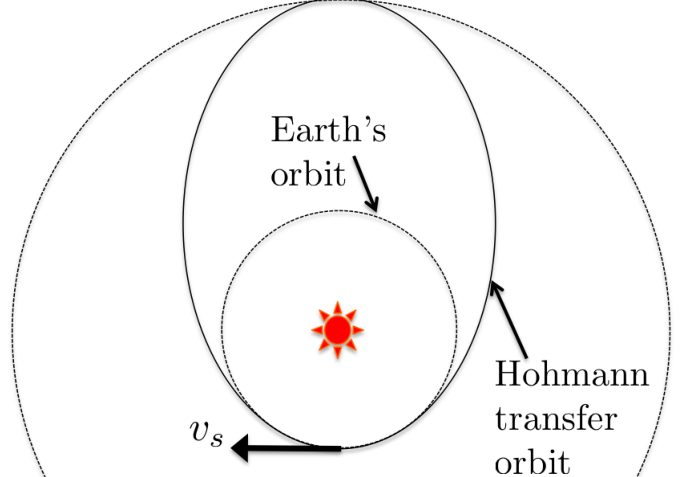
Figure 1: Hohmann transfer orbit from Earth to Saturn. is the velocity of the spacecraft.
(i) Assuming that the spacecraft is initially travelling at the velocity of Earth around the Sun, calculate the change in velocity for the spacecraft to transfer from Earth’s orbit to the elliptical orbit. Ignore the Earth’s and Saturn’s gravitational forces on the spacecraft. Use the constants below (and their corresponding symbols) in your working.
- Earth’s velocity around Sun:
- Earth’s orbital radius:
- Saturn’s orbital radius:
- Mass of Sun:
- Gravitational constant:
[4 marks]
(ii) Calculate the time it takes for the spacecraft to travel from Earth’s orbit to Saturn’s orbit.
[2 marks]
(b) The Cassini spacecraft was not sent to Saturn by a direct Hohmann transfer. Instead, it was first sent to Venus (via Hohmann transfer), where it gained speed, twice, using gravity assists by Venus. The first gravity assist by Venus changed the spacecraft’s velocity and transferred the spacecraft to a more eccentric orbit, such that the spacecraft returned to its orbital perihelion after Venus had completed its orbit twice, and the spacecraft received the second gravity assist by Venus at that point. Calculate the change in velocity of the spacecraft during the first Venus’ gravity assist.
- Venus’ orbital radius:
- Venus’ orbital period:
[6 marks]
Fonte: Testo (PDF) — p.3
Topic: Gravitation, Astrophysics Metodi: Kepler’s Laws, Newton’s Law of Gravitation, Conservation of Energy, Conservation of Momentum Competenze: Physical Reasoning, Mathematical Modeling Objects: Satellite, Planet, Star
Orbita di trasferimento e gravità di Hohmann
Un veicolo spaziale deve essere inviato dalla Terra a Saturno. Il trasferimento di Hohmann è una manovra che trasferisce la sonda spaziale dall’orbita terrestre intorno al Sole (presumendo di essere circolare) all’orbita di Saturno intorno al Sole (presumendo anche di essere circolare). Questo viene fatto spingendo la sonda in un’orbita ellittica che ha il suo perielione e l’afelione che toccano l’orbita terrestre e l’orbita di Saturno, rispettivamente.
Figura 1: Hohmann trasferisce l’orbita dalla Terra a Saturno. è la velocità della sonda spaziale.*
**(i) ** Supponendo che la sonda spaziale sia inizialmente in viaggio alla velocità della Terra attorno al Sole, calcolare il cambiamento di velocità per il trasferimento della sonda spaziale dall’orbita terrestre all’orbita ellittica. Ignorate le forze gravitazionali di Terra e Saturno sulla sonda spaziale. Utilizzare le costanti di seguito (e i loro simboli corrispondenti) nel vostro lavoro.
- Velocità della Terra attorno al Sole:
- Radius orbitale della Terra:
- Radius orbitale di Saturno:
- Massa del Sole:
- Costante gravitazionale:
- [4 segni] *
**(ii) ** Calcola il tempo necessario per il viaggio della sonda spaziale dall’orbita terrestre all’orbita di Saturno.
- [2 punti] *
La sonda Cassini non è stata inviata a Saturno con un trasferimento diretto di Hohmann. Invece, fu inviato per la prima volta a Venere (via trasferimento di Hohmann), dove guadagnò velocità, due volte, utilizzando l’assistenza gravitazionale di Venere. Il primo asporto gravitazionale di Venere cambiò la velocità della sonda e trasferì la sonda in un’orbita più eccentrica, in modo tale che la sonda ritornò al suo perielio orbitale dopo che Venere aveva completato la sua orbita due volte, e la sonda ricevette il secondo asporto gravitazionale di Venere a quel punto. Calcola il cambiamento di velocità della sonda durante il primo asporto gravitazionale di Venere.
- Radius orbitale di Venere:
- Periodo orbitale di Venere:
- [6 punti] *
Fonte: Testo (PDF) — p.3
Topic: Gravitation, Astrophysics Metodi: Kepler’s Laws, Newton’s Law of Gravitation, Conservation of Energy, Conservation of Momentum Competenze: Physical Reasoning, Mathematical Modeling Objects: Satellite, Planet, Star
Consider a rigid axially symmetric wheel with mass , moment of inertia about the axis of symmetry , and radius , moving in an upright position on a horizontal plane. The coefficient of kinetic friction between the wheel and the plane is .
(a) The wheel is initially spun about with constant angular speed , and is then released. It slips for a time and then rolls without slipping. Determine and the centre-of-mass speed of the rolling wheel.
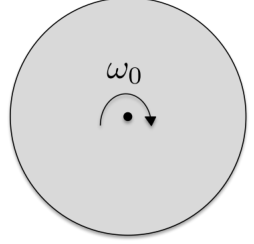
Figure 2: Rolling wheel with initial angular speed .
[4 marks]
(b) The wheel has an initial horizontal centre-of-mass speed in addition to an initial angular speed . Determine the time at which the wheel rolls without slipping and the centre of mass speed of the rolling wheel.
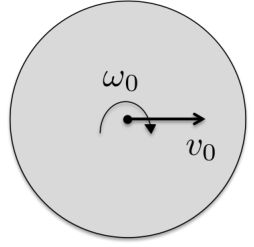
Figure 3: Rolling wheel with initial angular speed and initial horizontal centre-of-mass speed .
[4 marks]
(c) The wheel has an initial horizontal centre of mass speed and an initial backspin . Determine the possible motions of the wheel.
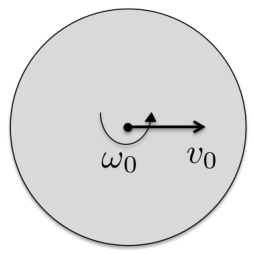
Figure 4: Rolling wheel with initial backspin of angular speed and initial horizontal centre-of-mass speed .
[4 marks]
Fonte: Testo (PDF) — p.4
Topic: Rotational Dynamics, Newtonian Mechanics Metodi: Torque & Angular Momentum Analysis, Free-Body Diagram, Kinematic Equations, Impulse-Momentum Theorem Competenze: Physical Reasoning, Diagrammatic Reasoning Objects: Wheel
Si consideri una ruota rigida assimetrica a massaggio , momento di inerzia intorno all’asse di simmetria e raggio , in movimento in posizione verticale su un piano orizzontale. Il coefficiente di attrito cinetico tra ruota e piano è .
**(a) ** La ruota viene inizialmente girata intorno a con velocità angolare costante , e viene quindi rilasciata. Si scivola per un tempo e poi si rulla senza scivolare. Determinare e la velocità di massa centrale della ruota a rotoli.
Figura 2: ruota rotante con velocità angolare iniziale .
- [4 segni] *
**(b) ** La ruota ha una velocità iniziale orizzontale di centro di massa oltre a una velocità angolare iniziale . Determinare il tempo in cui la ruota ruota senza scivolare e il centro della velocità di massa della ruota.
Figura 3: Ruota rotante con velocità angolare iniziale e velocità iniziale orizzontale del centro di massa .
- [4 segni] *
**(c) ** La ruota ha un centro orizzontale iniziale di velocità di massa e una rotazione posteriore iniziale . Determinare i possibili movimenti della ruota.
Figura 4: ruota rotante con rotazione posteriore iniziale di velocità angolare e velocità iniziale orizzontale di centro di massa .
- [4 segni] *
Fonte: Testo (PDF) — p.4
Topic: Rotational Dynamics, Newtonian Mechanics Metodi: Torque & Angular Momentum Analysis, Free-Body Diagram, Kinematic Equations, Impulse-Momentum Theorem Competenze: Physical Reasoning, Diagrammatic Reasoning Objects: Wheel
A circular coil with radius is connected with an equilateral triangle on the inside as shown in the figure below. The resistance for each section of the wire is labeled. A uniform magnetic field is pointing into the paper, perpendicular to the plane of the coil. is decreasing over time at a constant rate . Given . Find , the potential difference between points and .
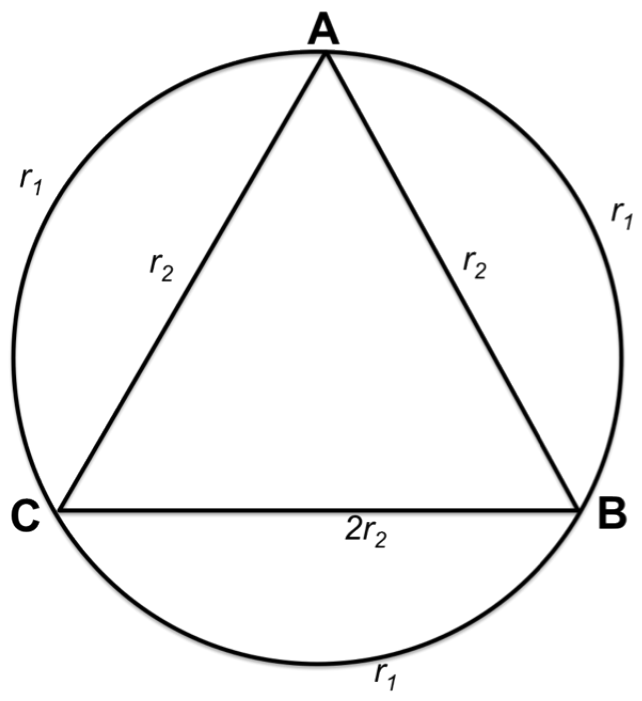
Figure 5: Circular coil with 3 wires forming an equilateral triangle inside the circle.
[10 marks]
Fonte: Testo (PDF) — p.5
Topic: Electromagnetic Induction, Circuits Metodi: Faraday’s Law of Induction, Kirchhoff’s Laws, Symmetry Argument Competenze: Physical Reasoning, Diagrammatic Reasoning Objects: Coil, Wire
Una bobina circolare con raggio è collegata ad un triangolo equilaterale all’interno, come mostrato nella figura seguente. La resistenza per ciascuna sezione del filo è etichettata. Un campo magnetico uniforme punta sulla carta, perpendicolare al piano della bobina. Il diminuisce nel tempo a un ritmo costante . Con . Trova , la differenza potenziale tra i punti e .
Figura 5: bobina circolare con 3 fili che formano un triangolo equilaterale all’interno del cerchio.
- [10 punti] *
Fonte: Testo (PDF) — p.5
Topic: Electromagnetic Induction, Circuits Metodi: Faraday’s Law of Induction, Kirchhoff’s Laws, Symmetry Argument Competenze: Physical Reasoning, Diagrammatic Reasoning Objects: Coil, Wire
An experiment was performed to determine the value of the gravitational acceleration on Earth. Two equal masses of mass hang at rest from the ends of a string on each side of a light pulley (see figure below). A mass is placed on the right-hand-side mass. After the heavier side has moved down from rest by , the small mass is removed. The system continues to move for the next , covering a distance of . Find the value of .
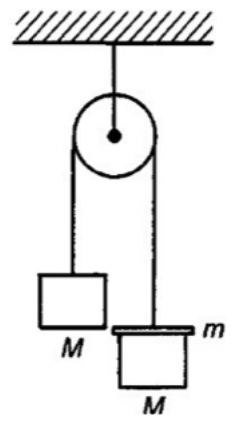
Figure 6: Pulley with a system of masses attached.
[10 marks]
Fonte: Testo (PDF) — p.6
Topic: Newtonian Mechanics Metodi: Free-Body Diagram, Kinematic Equations, Conservation of Momentum Competenze: Physical Reasoning, Mathematical Modeling Objects: Pulley, String, Block
È stato eseguito un esperimento per determinare il valore dell’accelerazione gravitazionale sulla Terra. Due masse uguali di massa appoggiate a riposo dalle estremità di una corda su ciascun lato di una pollice leggera (vedere figura seguente). La massa è collocata sulla massa laterale destra. Dopo che il lato più pesante si è spostato dal riposo di , la piccola massa viene rimossa. Il sistema continua a muoversi per il prossimo , coprendo una distanza di . Trova il valore di .
Figura 6: Pulley con un sistema di masse collegato.
- [10 punti] *
Fonte: Testo (PDF) — p.6
Topic: Newtonian Mechanics Metodi: Free-Body Diagram, Kinematic Equations, Conservation of Momentum Competenze: Physical Reasoning, Mathematical Modeling Objects: Pulley, String, Block
Consider the following decay
The available energy is given by
where , , and are the masses of Th-228, Ra-224 and the alpha particle respectively.
(a) Calculate the percentage of carried by the alpha particle.
[6 marks]
(b) In the above decay, the highest energy particle has energy and the next highest energy is . Find the energy of the first excited state of Ra-224.
[3 marks]
Fonte: Testo (PDF) — p.7
Topic: Nuclear & Particle Physics, Modern-Quantum Physics Metodi: Mass-Energy Equivalence, Conservation of Momentum, Conservation of Energy Competenze: Physical Reasoning, Mathematical Modeling Objects: Nucleus
Considerate il seguente declino
L’energia disponibile è data da
dove , e sono rispettivamente le masse di Th-228, Ra-224 e della particella alfa.
**(a) ** Calcolare la percentuale di trasportata dalla particella alfa.
- [6 marchi] *
**(b) ** Nella decadenza sopra indicata, la particella di energia più alta ha energia e la prossima energia più alta è . Trova l’energia del primo stato eccitato di Ra-224.
*[3 punti] *
Fonte: Testo (PDF) — p.7
Topic: Nuclear & Particle Physics, Modern-Quantum Physics Metodi: Mass-Energy Equivalence, Conservation of Momentum, Conservation of Energy Competenze: Physical Reasoning, Mathematical Modeling Objects: Nucleus
We know that a rainbow can be formed by a ray entering a water droplet and exiting it after suffering a total internal reflection. We can call this a ‘first-order’ rainbow. The question is regarding the possibility of a ‘zeroth’ order rainbow where parallel rays impinging on a spherical raindrop is refracted into the drop and then out again into the air directly (without total internal reflection).
(a) Sketch a diagram depicting such a situation in a raindrop. Find the angle of deviation in terms of the angle of incidence and angle of refraction .
[2 marks]
(b) Show that the ‘zeroth’ order rainbow, given the above conditions, cannot exist.
[3 marks]
In the following part of the question, we ask if a rainbow (or ‘bubblebow’) is able to be formed from the scattering of light in air bubbles in water. Again, we can consider parallel rays (i) entering the bubble and exiting without total internal reflection and (ii) entering and exiting with one (assumed) internal reflection at the gas-liquid interface.
[3 marks]
(c) Sketch a diagram/s depicting the two situations in the bubble. Find the angle of deviation in each case.
[3 marks]
(d) Work out if a rainbow (or ‘bubblebow’) can exist in each case.
[4 marks]
Fonte: Testo (PDF) — p.8
Topic: Geometric Optics Metodi: Snell’s Law, Ray Tracing, Calculus-Integration Competenze: Diagrammatic Reasoning, Physical Reasoning Objects: Droplet, Bubble
Sappiamo che un arcobaleno può essere formato da un raggio che entra in una goccia d’acqua e ne esce dopo aver subito un totale riflesso interno. Possiamo chiamare questo un arcobaleno di primo ordine. La questione riguarda la possibilità di un arcobaleno di ordine “zero” in cui i raggi paralleli che colpiscono una goccia di pioggia sferica vengono rifracciati nella goccia e poi rimandati direttamente in aria (senza riflessione interna totale).
**(a) ** Segnare un diagramma che raffronti una simile situazione in una goccia di pioggia. Trova l’angolo di deviazione in termini di angolo di incidenza e angolo di rifrazione .
- [2 punti] *
**(b) ** Mostra che l’arcobaleno di ordine “zero”, date le condizioni di cui sopra, non può esistere.
*[3 punti] *
Nella parte successiva della domanda, chiediamo se un arcobaleno (o ‘bubblebow’) possa essere formato dalla diffusione della luce nelle bolle d’aria nell’acqua. Ancora una volta, possiamo considerare i raggi paralleli (i) che entrano e usciranno nella bolla senza riflessione interna totale e (ii) che entrano e usciranno con un riflessione interna (presunta) all’interfaccia gas-liquido.
*[3 punti] *
**(c) ** Segna un diagramma/s che raffronti le due situazioni nella bolla. Trova l’angolo di deviazione in ogni caso.
*[3 punti] *
**(d) ** Indicare se in ogni caso può esistere un arcobaleno (o ‘bubblebow’).
- [4 segni] *
Fonte: Testo (PDF) — p.8
Topic: Geometric Optics Metodi: Snell’s Law, Ray Tracing, Calculus-Integration Competenze: Diagrammatic Reasoning, Physical Reasoning Objects: Droplet, Bubble
Two infinitely long concentric hollow cylinders have radii and . Both cylinders are insulators; the inner cylinder has a uniformly distributed charge per length of ; the outer cylinder has a uniformly distributed charge per length of .
The inner cylinder is rotating clockwise about its axis with an angular velocity , where is the speed of light. Assume that the permeability of the dielectric cylinder and the space between the cylinders is that of free space, .
(a) Determine the electric field for all regions.
[4 marks]
(b) Determine the magnetic field for all regions.
[4 marks]
(c) Determine the Poynting vector , for all regions.
[2 marks]
Fonte: Testo (PDF) — p.9
Topic: Electromagnetism, Electrostatics Metodi: Gauss’s Law, Ampère’s Law, Symmetry Argument Competenze: Physical Reasoning, Mathematical Modeling Objects: Cylinder
Due cilindri vuoti concentrici infinitamente lunghi hanno i raggi e . Entrambi i cilindri sono isolanti; il cilindro interno ha una carica uniformemente distribuita per lunghezza ; il cilindro esterno ha una carica uniformemente distribuita per lunghezza .
Il cilindro interno ruota in senso orario intorno al suo asse con una velocità angolare , dove è la velocità della luce. Supponiamo che la permeabilità del cilindro dielettrico e dello spazio tra i cilindri sia quella dello spazio libero, .
**(a) ** Determinare il campo elettrico per tutte le regioni.
- [4 segni] *
**(b) ** Determinare il campo magnetico per tutte le regioni.
- [4 segni] *
**(c) ** Determina il vettore di Poynting , per tutte le regioni.
- [2 punti] *
Fonte: Testo (PDF) — p.9
Topic: Electromagnetism, Electrostatics Metodi: Gauss’s Law, Ampère’s Law, Symmetry Argument Competenze: Physical Reasoning, Mathematical Modeling Objects: Cylinder
Consider a spaceship initially at rest in the lab frame. At a given instant, it starts to accelerate with constant proper acceleration . Assume that the lab clock () and spaceship clock () are synchronized such that this happens when .
[Note: Proper acceleration is defined such that: at , the spaceship is moving at speed relative to the frame it was in at time .]
(a) Determine the relative speed of the spaceship and the lab frame in terms of . Also, check the limit of the relative speed found when and comment.
[5 marks]
(b) Find the relation between and at later stage. Also, explore the relation for condition . Comment.
[5 marks]
Fonte: Testo (PDF) — p.10
Topic: Special Relativity Metodi: Lorentz Transformation, Differential Equations, Approximation & Series Expansion Competenze: Mathematical Modeling, Physical Reasoning Objects: —
Considerate una nave spaziale inizialmente in riposo nel quadro del laboratorio. In un determinato istante, inizia ad accelerare con una costante accelerazione corretta . Supponiamo che l’orologio di laboratorio () e l’orologio della nave spaziale () siano sincronizzati in modo tale che ciò accada quando .
[Nota: l’accelerazione corretta è definita in modo tale che: a , la nave spaziale si muova a velocità rispetto al telaio in cui era al tempo .]
**(a) ** Determina la velocità relativa della nave spaziale e del telaio del laboratorio in termini di . Inoltre, verificare il limite della velocità relativa trovata quando e commentare.
- [5 punti] *
**(b) ** Trova la relazione tra e in una fase successiva. Inoltre, esplorare la relazione per la condizione . Commento.
- [5 punti] *
Fonte: Testo (PDF) — p.10
Topic: Special Relativity Metodi: Lorentz Transformation, Differential Equations, Approximation & Series Expansion Competenze: Mathematical Modeling, Physical Reasoning Objects: —
An electron bubble in liquid helium (adapted from APhO 2010 Taipei)
When an electron is planted inside liquid helium, it can repel the atoms around it isotropically, thus forming a spherical surface, inside which contains nothing but the electron itself. This is known as an electron bubble.
The components of an electron’s position vector and momentum vector must obey Heisenberg’s uncertainty relations , where is the Planck constant.
Note that the uncertainty of a variable , denoted by is given by
where the overhead bar denotes the average (mean) of the quantity under it.
Consider an electron bubble in liquid helium with an equilibrium radius . The electron of mass moves freely inside the bubble with kinetic energy and exerts a pressure on the inner side of the bubble-liquid interface. The pressure exerted by liquid helium on the outer side of the interface is . The liquid is kept at a constant temperature close to and the surface tension is given by .
(a) Find a relation between , and .
[2 marks]
(b) Find a relation between and .
[4 marks]
(c) Let be the smallest possible value of consistent with Heisenberg’s uncertainty relations when the electron is inside the bubble of radius . Estimate as a function of .
[4 marks]
(d) Let be the equilibrium radius of the bubble when and . Obtain an expression for and calculate its value.
[2 marks]
Fonte: Testo (PDF) — p.11
Topic: Modern-Quantum Physics, Fluid Mechanics Metodi: Statistical Averaging, Order-of-Magnitude Estimation, Hydrostatic Equilibrium, Energy Conservation Method Competenze: Estimation & Approximation, Physical Reasoning, Mathematical Modeling Objects: Bubble, Electron
Una bolla di elettroni in elio liquido (adattata dall’APhO 2010 Taipei)
Quando un elettrone è piantato all’interno dell’elio liquido, può respingere gli atomi intorno a esso isotropicamente, formando così una superficie sferica, all’interno della quale non contiene altro che l’elettrone stesso. Questa è conosciuta come una bolla di elettroni.
I componenti del vettore di posizione e del vettore di impulso di un elettrone devono obbedire alle relazioni di incertezza di Heisenberg, dove è la costante di Planck.
Si noti che l’incertezza di una variabile , indicata da è data da
dove la barra di overhead indica la media (media) della quantità sotto la stessa.
Considera una bolla di elettroni in elio liquido con un raggio di equilibrio . L’elettrone di massa si muove liberamente all’interno della bolla con energia cinetica ed esercita una pressione sul lato interno dell’interfaccia bolla-liquido. La pressione esercitata dall’elio liquido sul lato esterno dell’interfaccia è . Il liquido è conservato a una temperatura costante vicina a e la tensione superficiale è data da .
**(a) ** Trovare una relazione tra , e .
- [2 punti] *
**(b) ** Trova una relazione tra e .
- [4 segni] *
**(c) ** deve essere il minimo possibile di coerente con le relazioni di incertezza di Heisenberg quando l’elettrone è all’interno della bolla di raggio . Estimare come funzione di .
- [4 segni] *
**(d) ** deve essere il raggio di equilibrio della bolla quando e . Ottenere un’espressione per e calcolare il suo valore.
- [2 punti] *
Fonte: Testo (PDF) — p.11
Topic: Modern-Quantum Physics, Fluid Mechanics Metodi: Statistical Averaging, Order-of-Magnitude Estimation, Hydrostatic Equilibrium, Energy Conservation Method Competenze: Estimation & Approximation, Physical Reasoning, Mathematical Modeling Objects: Bubble, Electron