A cylindrical rod has a radius of and length . It is made up of two sections, each of length . The material of one section is zinc and that of the other section is copper. The end of the rod made of zinc is pivoted to a fixed point . The rod is first held so that it is horizontal and then released. Determine the angular velocity of the rod when it is in the vertical position.
[Densities: zinc: ; copper: ]
[10 marks]
Fonte: Testo (PDF) — p.2 Topic: Rotational Dynamics, Conservation of Energy Metodi: Energy Conservation Method, Torque & Angular Momentum Analysis, Physical Modeling Competenze: Physical Reasoning, Mathematical Modeling Objects: Rod
Una canna cilindrica ha un raggio e una lunghezza . È costituito da due sezioni di lunghezza . Il materiale di una sezione è zinco e quello dell’altra è rame. L’estremità della canna di zinco è rotata a un punto fisso . La canna viene tenuta prima in modo che sia orizzontale e poi rilasciata. Determinare la velocità angolare della canna quando è in posizione verticale.
[Densità: zinco: ; rame: ]
- [10 punti] *
Fonte: Testo (PDF) — p.2 Topic: Rotational Dynamics, Conservation of Energy Metodi: Energy Conservation Method, Torque & Angular Momentum Analysis, Physical Modeling Competenze: Physical Reasoning, Mathematical Modeling Objects: Rod
(a) A student is sitting on a swing which is swinging back and forth with a constant angular amplitude of . The length of the swing is . A loudspeaker, placed at a short distance away from the swing, produces a sound with a constant frequency of . What are the maximum and minimum frequency of the sound heard by the student?
(Speed of sound waves )
[5 marks]
(b) A compound microscope contains two thin lenses of focal length and , respectively. The lenses are separated by a distance of . The final image is formed from the eye lens. Calculate
- (i) The distance of the object from the objective lens
- (ii) The magnifying power of the microscope.
[5 marks]
Fonte: Testo (PDF) — p.3 Topic: Oscillations & Waves, Geometric Optics Metodi: Simple Harmonic Motion Analysis, Thin Lens & Mirror Equation, Small-Angle Approximation Competenze: Physical Reasoning, Mathematical Modeling Objects: Pendulum, Lens
**(a) ** Uno studente è seduto su uno swing che va avanti e indietro con un’ampiezza angolare costante di . La lunghezza dello swing è . Un altoparlante, posizionato a breve distanza dallo swing, produce un suono con una frequenza costante di . Qual è la frequenza massima e minima del suono che l’allievo sente?
(Velocità delle onde sonore )
- [5 punti] *
**(b) ** Un microscopio composto contiene due lenti sottili di lunghezza focale e , rispettivamente. Le lenti sono separate da una distanza di . L’immagine finale si forma dalla lente oculare. Calcolo
- **(i) ** La distanza dell’oggetto dall’obiettivo
- **(ii) ** La potenza di ingrandimento del microscopio.
- [5 punti] *
Fonte: Testo (PDF) — p.3 Topic: Oscillations & Waves, Geometric Optics Metodi: Simple Harmonic Motion Analysis, Thin Lens & Mirror Equation, Small-Angle Approximation Competenze: Physical Reasoning, Mathematical Modeling Objects: Pendulum, Lens
One end of a thin conducting rod of length is pivoted to a fixed point. The rod has a resistance of and its two ends of the rod are connected to a resistor with resistance . The rod is rotating with a constant angular velocity in a uniform magnetic field of flux density . This direction of magnetic field is normal to the plane of rotation of the rod.
(a) What is the emf induced in the rod?
(b) Determine the electric power developed in the resistor.
(c) Describe, with evidence, the origin of the electric power developed in the resistor.
[10 marks]
Fonte: Testo (PDF) — p.5 Topic: Electromagnetic Induction, Circuits Metodi: Faraday’s Law of Induction, Lorentz Force Analysis, Kirchhoff’s Laws Competenze: Physical Reasoning, Mathematical Modeling Objects: Rod, Resistor
Una estremità di una sottile canna conduttrice di lunghezza è rotata verso un punto fisso. La canna ha una resistenza di e le sue due estremità della canna sono collegate a una resistenza di resistenza . La canna ruota con una velocità angolare costante in un campo magnetico uniforme di densità di flusso . Questa direzione del campo magnetico è normale per il piano di rotazione della canna.
Qual è l’emf indotto nella canna?
**(b) ** Determinare la potenza elettrica sviluppata nella resistenza.
**(c) ** Descrivere, con prove, l’origine della potenza elettrica sviluppata nella resistenza.
- [10 punti] *
Fonte: Testo (PDF) — p.5 Topic: Electromagnetic Induction, Circuits Metodi: Faraday’s Law of Induction, Lorentz Force Analysis, Kirchhoff’s Laws Competenze: Physical Reasoning, Mathematical Modeling Objects: Rod, Resistor
A free electron collides with a hydrogen atom which is in the ground state. After the collision, the hydrogen atom is excited and during the process of de-excitation, two photons are emitted. The wavelength of one of the photons emitted is . The electron, after the collision, has de Broglie wavelength of .
(a) What is the wavelength of the other photon emitted during the de-excitation?
(b) What is the speed of the free electron before collision?
[10 marks]
Fonte: Testo (PDF) — p.6 Topic: Modern-Quantum Physics Metodi: Bohr Model & Quantization, Photon Energy Relation, de Broglie Relation, Conservation of Energy Competenze: Physical Reasoning, Mathematical Modeling Objects: Electron, Atom, Photon
Un elettrone libero colpisce un atomo di idrogeno che è in stato di base. Dopo la collisione, l’atomo di idrogeno è eccitato e durante il processo di de-escitazione, vengono emessi due fotoni. La lunghezza d’onda di uno dei fotoni emessi è . L’elettrone, dopo la collisione, ha una lunghezza d’onda de Broglie di .
Qual è la lunghezza d’onda dell’altro fotone emesso durante la de-escitazione?
**(b) ** Qual è la velocità dell’elettrone libero prima della collisione?
- [10 punti] *
Fonte: Testo (PDF) — p.6 Topic: Modern-Quantum Physics Metodi: Bohr Model & Quantization, Photon Energy Relation, de Broglie Relation, Conservation of Energy Competenze: Physical Reasoning, Mathematical Modeling Objects: Electron, Atom, Photon
(a) An airplane flying horizontally with a constant speed of at a height of fires a projectile horizontally in its direction of motion at a speed of relative to the plane. At this instant, a vehicle is at a point on the ground horizontally from the airplane. The vehicle is moving with a constant speed of on a horizontal road in the direction of motion of the plane. What must be the minimum value of so that the projectile will hit the vehicle? If, at the instant when the projectile is fired, the value of is times its minimum value, what is the speed of the projectile when it hits the vehicle?
[7 marks]
(b) A satellite is orbiting the Earth above the equator. Its sense of revolution follows the rotation of the Earth. When the satellite is vertically above a point on the equator, it will take a photo of the region around . How many photos can the satellite take in hours?
[5 marks]
Fonte: Testo (PDF) — p.7 Topic: Newtonian Mechanics, Gravitation Metodi: Kinematic Equations, Kepler’s Laws, Newton’s Law of Gravitation, Vector Decomposition Competenze: Physical Reasoning, Mathematical Modeling Objects: Projectile, Satellite, Planet
**(a) ** Un aereo che vola orizzontalmente a velocità costante di ad un’altezza di spara un proiettile orizzontalmente nella sua direzione di movimento a velocità di rispetto al piano. In questo momento, un veicolo è in un punto del terreno orizzontalmente dall’aereo. Il veicolo si muove a velocità costante su una strada orizzontale nella direzione del movimento del piano. Qual è il valore minimo di per che il proiettile colpisca il veicolo? Se, all’istante in cui il proiettile viene sparato, il valore di è volte il suo valore minimo, quale è la velocità del proiettile quando colpisce il veicolo?
*[7 punti] *
**(b) ** Un satellite sta orbitando intorno alla Terra sopra l’equatore. Il suo senso di rivoluzione segue la rotazione della Terra. Quando il satellite è verticalmente sopra un punto sull’equatore, scatenerà una foto della regione intorno a . Quante foto può scattare il satellite in ore?
- [5 punti] *
Fonte: Testo (PDF) — p.7 Topic: Newtonian Mechanics, Gravitation Metodi: Kinematic Equations, Kepler’s Laws, Newton’s Law of Gravitation, Vector Decomposition Competenze: Physical Reasoning, Mathematical Modeling Objects: Projectile, Satellite, Planet
(a) A charged insulating sphere of radius has a uniform positive charge density throughout its entire volume. A very narrow tunnel is drilled along the sphere’s diameter. A charged particle of mass carrying a charge is placed at one end of the tunnel and released. Describe the subsequent motion of the charged particle. What is the speed of the particle when it passes through the centre of the sphere?
[6 marks]
(b) A particle of mass moves along a straight line joining two fixed points and . The particle is under the action of two forces and . acts towards the point and has magnitude where is the distance of the point from . acts towards the point and has magnitude where is the distance of the point from . Given that is a constant, show that the motion of is simple harmonic. Deduce an expression for the period of motion. During the oscillation, the particle is instantaneously at rest at the mid-point of . What is the amplitude of the oscillation and what is the kinetic energy of the particle when it is at , the point where it experiences zero net force?
[6 marks]
Fonte: Testo (PDF) — p.10 Topic: Oscillations & Waves, Electrostatics Metodi: Simple Harmonic Motion Analysis, Gauss’s Law, Differential Equations, Energy Conservation Method Competenze: Physical Reasoning, Mathematical Modeling Objects: Sphere, Point Charge
**(a) ** Una sfera isolante carica di raggio ha una densità di carica positiva uniforme per tutto il suo volume. Un tunnel molto stretto è perforato lungo il diametro della sfera. Una particella carica di massa con carica viene posta ad una estremità del tunnel e rilasciata. Descrivere il successivo movimento della particella carica. Qual è la velocità della particella quando passa attraverso il centro della sfera?
- [6 punti] *
**(b) ** Una particella di massa si muove lungo una linea retta che unisce due punti fissi e . La particella è sotto l’azione di due forze e . si dirige verso il punto e ha una magnitudine , dove è la distanza del punto da . si dirige verso il punto e ha una magnitudine , dove è la distanza del punto da . Dato che è una costante, mostrare che il movimento di è semplice armonico. Riduzione di un’espressione per il periodo di movimento. Durante l’oscillazione, la particella è istantaneamente in riposo al punto medio di . Qual è l’ampiezza dell’oscillazione e qual è l’energia cinetica della particella quando è a , il punto in cui essa sperimenta la forza netta zero?
- [6 punti] *
Fonte: Testo (PDF) — p.10 Topic: Oscillations & Waves, Electrostatics Metodi: Simple Harmonic Motion Analysis, Gauss’s Law, Differential Equations, Energy Conservation Method Competenze: Physical Reasoning, Mathematical Modeling Objects: Sphere, Point Charge
(a) A container, the volume of which is , contains an ideal gas at a pressure of and temperature . The lid of the container is opened, causing the gas to expand adiabatically until its pressure is . This results in a slight decrease in the mass of the gas in the container. The lid is then closed and the gas in the container is allowed to return to its initial temperature. Under this new equilibrium condition, the pressure of the gas is .
- (i) What will be the volume of the gas left in the container under the initial equilibrium condition; i.e. at pressure and temperature ?
- (ii) What is the value of , the ratio of the molar heat capacity of the gas at constant pressure to that at constant volume?
- (iii) State, with reasons, what is the atomicity of the molecules of the gas?
[6 marks]
(b) One end of a copper rod, with diameter and length , is in good thermal contact with a hot bath maintained at while the other end is immersed in a mixture of ice and water initially maintained at inside a container whose thermal capacity is negligible. Both the copper rod and the container are well-lagged. How long does it take for the temperature of the mixture to rise from to ?
[Thermal conductivity of copper ; Specific heat capacity of water ; Latent heat of fusion of water ]
[6 marks]
Fonte: Testo (PDF) — p.12 Topic: Thermodynamics, Kinetic Theory Metodi: Ideal Gas Law, First Law of Thermodynamics, Kinetic Theory of Gases, Physical Modeling Competenze: Physical Reasoning, Mathematical Modeling Objects: Container, Gas, Rod
**(a) ** Un contenitore, il cui volume è , contiene un gas ideale a una pressione di e temperatura . Il coperchio del contenitore si apre, causando l’espansione adiabatica del gas fino a raggiungere la pressione . Ciò comporta una lieve diminuzione della massa del gas contenuto nel contenitore. Il coperchio viene quindi chiuso e il gas contenuto nel contenitore viene lasciato tornare alla temperatura iniziale. In questa nuova condizione di equilibrio, la pressione del gas è .
- **(i) ** Qual è il volume del gas rimasto nel contenitore in condizioni di equilibrio iniziale; cioè a pressione e temperatura ?
- **(ii) ** Qual è il valore di , il rapporto tra la capacità termico molare del gas a pressione costante e quella a volume costante?
- ** (iii) ** Stato, con ragioni, qual è l’atomicità delle molecole del gas?
- [6 punti] *
**(b) ** Una estremità di una canna di rame, di diametro e lunghezza , è in buon contatto termico con un bagno caldo mantenuto a mentre l’altra estremità è immersa in una miscela di ghiaccio e acqua inizialmente mantenuta a all’interno di un contenitore la cui capacità termica è trascurabile. Sia la canna di rame che il contenitore sono ben ripiegati. Quanto tempo ci vuole per far salire la temperatura della miscela da a ?
[conduttività termica del rame ; Capacità termica specifica dell’acqua ; Calore latente di fusione dell’acqua ]
- [6 punti] *
Fonte: Testo (PDF) — p.12 Topic: Thermodynamics, Kinetic Theory Metodi: Ideal Gas Law, First Law of Thermodynamics, Kinetic Theory of Gases, Physical Modeling Competenze: Physical Reasoning, Mathematical Modeling Objects: Container, Gas, Rod
(a) Two identical sound sources and which emit sound waves with frequency are initially side by side together with a stationary observer. Source remains stationary with respect to the observer, while source accelerates from rest with a constant acceleration of until it reaches a point . After this, continues to move with a constant velocity that it attains at the point . When this happens, the observer finds that the frequency of sound coming source differs from that from source by . What is the distance of the point from the observer?
[Speed of sound waves in air ]
[5 marks]
(b)
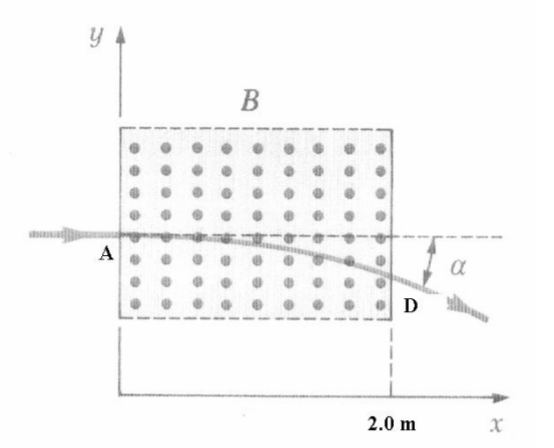
Fig. 1
A beam of proton with kinetic energy is travelling in the positive -direction. It enters a magnetic field of magnitude and the direction of the magnetic field is in the positive -direction. The magnetic field extends from to as shown in Fig. 1. Determine the angle between the initial velocity vector of the proton beam and the velocity vector after the beam emerges from the magnetic field.
[7 marks]
Fonte: Testo (PDF) — p.14 Topic: Magnetism, Oscillations & Waves Metodi: Lorentz Force Analysis, Kinematic Equations, Vector Decomposition Competenze: Physical Reasoning, Diagrammatic Reasoning Objects: Particle Beam
**(a) ** Due fonti sonore identiche e che emettono onde sonore con frequenza sono inizialmente fianco a fianco con un osservatore stazionario. La fonte rimane stazionaria rispetto all’osservatore, mentre la fonte accelera dal riposo con una costante accelerazione di fino a raggiungere un punto . Dopo questo, continua a muoversi con una velocità costante che raggiunge al punto . Quando ciò accade, l’osservatore constata che la frequenza della fonte del suono proveniente differisce da quella della fonte di . Qual è la distanza del punto dall’osservatore?
[Velocità delle onde sonore nell’aria ]
- [5 punti] *
(b)
Fig. 1
Un fascio di protone con energia cinetica si sta spostando nella direzione positiva . Il campo magnetico è di dimensioni e la direzione del campo magnetico è nella direzione positiva . Il campo magnetico si estende da a come mostrato nella figura. 1. Determinare l’angolo tra il vettore di velocità iniziale del fascio di protoni e il vettore di velocità dopo che il fascio è uscito dal campo magnetico.
*[7 punti] *
Fonte: Testo (PDF) — p.14 Topic: Magnetism, Oscillations & Waves Metodi: Lorentz Force Analysis, Kinematic Equations, Vector Decomposition Competenze: Physical Reasoning, Diagrammatic Reasoning Objects: Particle Beam
(a) Light with wavelength is incident on the surface of a metal. The electrons, which are emitted with maximum kinetic energy, enters a magnetic field the direction of which is normal to the velocity vectors of these electrons. The flux density of the magnetic field is . These electrons are found to describe a circular path of radius in the magnetic field. What is the work function of the metal?
[5 marks]
(b) Muons are particles which are created in the upper atmosphere via cosmic interactions. These particles travel vertically downward to the surface of the Earth at a speed of where represents the speed of light in vacuum. When muons are at rest, they have a half-life of . A muon counter is placed at the top of a mountain high. The counter records muons in hour.
- (i) According to classical concepts, what will be the number of muons counted in hour if the counter is placed at the foot of the mountain? [2 marks]
- (ii) In a typical experiment, a counter placed at the foot of the mountain record muons in hour. Why does the result of this experiment differ so much from your result in part (i)? [2 marks]
- (iii) What is the “height” of the mountain according to muons? [1 mark]
- (iv) While the muons are travelling downward to the earth, another particle also travels in the same direction with speed . What is the velocity of this particle in the muon’s inertial frame? [2 marks]
Fonte: Testo (PDF) — p.16 Topic: Special Relativity, Modern-Quantum Physics Metodi: Lorentz Transformation, Radioactive Decay Law, Photon Energy Relation, Lorentz Force Analysis Competenze: Physical Reasoning, Mathematical Modeling Objects: Photon, Electron
**(a) ** La luce con lunghezza d’onda incide sulla superficie di un metallo. Gli elettroni, emessi con energia cinetica massima, entrano in un campo magnetico la cui direzione è normale per i vettori di velocità di questi elettroni. La densità di flusso del campo magnetico è . Questi elettroni sono stati trovati per descrivere un percorso circolare di raggio nel campo magnetico. Qual è la funzione di lavoro del metallo?
- [5 punti] *
I muoni sono particelle che si creano nell’atmosfera superiore attraverso interazioni cosmiche. Queste particelle viaggiano verticalmente verso la superficie terrestre a una velocità , dove rappresenta la velocità della luce nel vuoto. Quando i muoni sono a riposo, hanno una emivita di . Un contatore di muoni è posizionato in cima a una montagna alta . Il contatore registra i muoni in ora.
- **(i) ** Secondo i concetti classici, qual sarà il numero di muoni contati in ora se il contatore è posto al piede della montagna? * [2 punti] *
- ** (ii) ** In un esperimento tipico, un contatore collocato al piede del record di montagna muoni in ora. Perché il risultato di questo esperimento differisce tanto dal vostro risultato nella parte (i)? * [2 punti] *
- **(iii) ** Qual è l‘“altezza” della montagna secondo i muoni? [1 segno]
- **(iv) ** Mentre i muoni viaggiano verso la terra, anche un’altra particella viaggia nella stessa direzione con velocità . Qual è la velocità di questa particella nel quadro inerziale del muone? * [2 punti] *
Fonte: Testo (PDF) — p.16 Topic: Special Relativity, Modern-Quantum Physics Metodi: Lorentz Transformation, Radioactive Decay Law, Photon Energy Relation, Lorentz Force Analysis Competenze: Physical Reasoning, Mathematical Modeling Objects: Photon, Electron