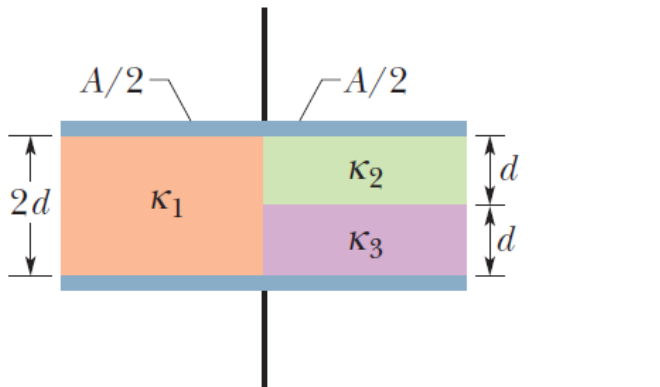
A parallel-plate capacitor is shown in the diagram with plate area and plate separation . The left half of the gap is filled with material of dielectric constant ; the top of the right half is filled with material of dielectric constant ; the bottom of the right half is filled with material of dielectric constant . What is the capacitance?
[4 marks]
Fonte: Testo (PDF) — p.2
Topic: Electrostatics Metodi: Gauss’s Law, Equivalent Circuit Reduction, Superposition Principle Competenze: Physical Reasoning, Mathematical Modeling Objects: Capacitor
Il diagramma mostra un condensatore a piastra parallela con superficie e separazione . La metà sinistra del vuoto è riempita di materiale di costante dielettrica ; la metà superiore della metà destra è riempita di materiale di costante dielettrica ; la parte inferiore della metà destra è riempita di materiale di costante dielettrica . Qual è la capacità?
4 punti
Fonte: Testo (PDF) — p.2
Topic: Electrostatics Metodi: Gauss’s Law, Equivalent Circuit Reduction, Superposition Principle Competenze: Physical Reasoning, Mathematical Modeling Objects: Capacitor
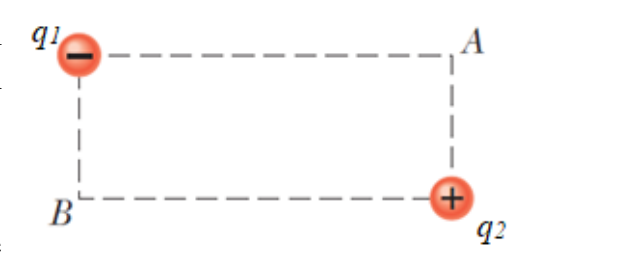
In the rectangle shown, the sides have lengths and , , and . With at infinity, what is the electric potential at
- (a) corner and [1 mark]
- (b) corner ? [1 mark]
- (c) How much work is required to move a charge from to along a diagonal of the rectangle? [1 mark]
- (d) Does this work increase or decrease the electric potential energy of the three-charge system? [1 mark]
Is more, less, or the same work required if is moved along a path that is
- (e) inside the rectangle but not on a diagonal and [0.5 marks]
- (f) outside the rectangle? [0.5 marks]
Fonte: Testo (PDF) — p.4
Topic: Electrostatics Metodi: Electric Potential Method, Coulomb’s Law, Superposition Principle, Energy Conservation Method Competenze: Physical Reasoning, Mathematical Modeling Objects: Point Charge
Nel rettangolo mostrato, i lati hanno lunghezze e , e . Con all’infinito, qual è il potenziale elettrico a
- **(a) ** angolo e [1 segno]
- **(b) ** angolo ? [1 punto]
- **(c) ** Quanto lavoro è necessario per spostare una carica da a lungo una diagonale del rettangolo? [1 punto]
- **(d) ** Questo lavoro aumenta o diminuisce l’energia elettrica potenziale del sistema a tre cariche? [1 punto]
È necessario più, meno o lo stesso lavoro se viene spostato lungo un percorso che è
- **(e) ** all’interno del rettangolo ma non su una diagonale e [0,5 punti]
- **(f) ** al di fuori del rettangolo? [0,5 punti]
Fonte: Testo (PDF) — p.4
Topic: Electrostatics Metodi: Electric Potential Method, Coulomb’s Law, Superposition Principle, Energy Conservation Method Competenze: Physical Reasoning, Mathematical Modeling Objects: Point Charge
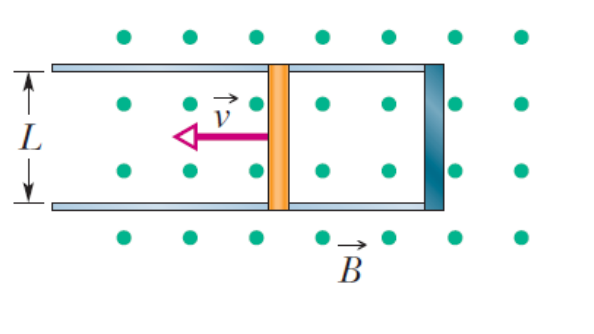
The conducting rod shown in the figure has length and is being pulled along horizontal, frictionless conducting rails at a constant velocity . The rails are connected at one end with a metal strip. A uniform magnetic field , directed out of the page, fills the region in which the rod moves. Assume that , , and . What are the
- (a) magnitude and [1 mark]
- (b) direction (up or down the page) of the emf induced in the rod? [0.5 marks]
- (c) magnitude and [0.5 marks]
- (d) direction of the current in the conducting loop? [0.5 marks]
Assume that the resistance of the rod is and that the resistance of the rails and metal strip is negligibly small.
- (e) At what rate is thermal energy being generated in the rod? [1 mark]
- (f) What external force on the rod is needed to maintain ? [1.5 marks]
- (g) At what rate does this force do work on the rod? [1 mark]
Fonte: Testo (PDF) — p.6
Topic: Electromagnetic Induction, Circuits Metodi: Faraday’s Law of Induction, Lenz’s Law, Lorentz Force Analysis, Conservation of Energy Competenze: Physical Reasoning, Diagrammatic Reasoning Objects: Rod
La canna di conduttoria mostrata nella figura ha una lunghezza e viene tirata lungo le vie di conduttoria orizzontali senza attrito a velocità costante . Le ferrovie sono collegate ad una estremità con una striscia di metallo. Un campo magnetico uniforme , diretto fuori dalla pagina, riempie la regione in cui si muove la canna. Supponiamo che , e . Che cosa sono
- **(a) ** di magnitudo e [1 marchio]
- **(b) ** direzione (solo o in basso) dell’emf indotto nella canna? [0,5 punti]
- ** c) ** di magnitudo e [0,5 marchi]
- **(d) ** direzione della corrente nel circuito di condotta? [0,5 punti]
Supponiamo che la resistenza della canna sia e che la resistenza dei binari e della striscia metallica sia trascurabilmente piccola.
- ** (e) ** A che velocità viene generata l’energia termica nella canna? [1 punto]
- **(f) ** Che forza esterna è necessaria sulla canna per mantenere ? [1,5 punti]
- **(g) ** A che velocità questa forza agisce sulla canna? [1 punto]
Fonte: Testo (PDF) — p.6
Topic: Electromagnetic Induction, Circuits Metodi: Faraday’s Law of Induction, Lenz’s Law, Lorentz Force Analysis, Conservation of Energy Competenze: Physical Reasoning, Diagrammatic Reasoning Objects: Rod
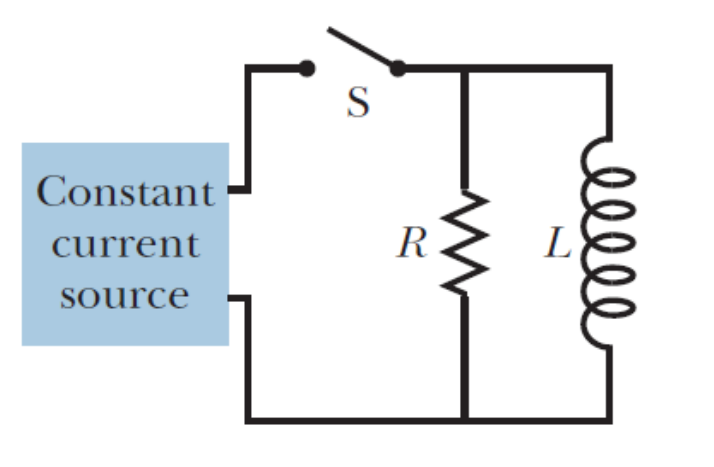
In the figure shown, after the switch is closed at time , the emf of the source is automatically adjusted to maintain a constant current through .
- (a) Find the current through the inductor as a function of time. [4 marks]
- (b) At what time is the current through the resistor equal to the current through the inductor? [1 mark]
Fonte: Testo (PDF) — p.8
Topic: Circuits, Electromagnetic Induction Metodi: Kirchhoff’s Laws, Differential Equations, Faraday’s Law of Induction Competenze: Mathematical Modeling, Physical Reasoning Objects: Switch, Inductor, Resistor
Nella figura mostrata, dopo che il interruttore è chiuso al momento , l’emf della fonte viene regolato automaticamente per mantenere una corrente costante fino a .
- ** a) ** Trova la corrente attraverso l’induttore in funzione del tempo. 4 punti
- **(b) ** A che ora la corrente attraverso la resistenza è uguale alla corrente attraverso l’induttore? [1 punto]
Fonte: Testo (PDF) — p.8
Topic: Circuits, Electromagnetic Induction Metodi: Kirchhoff’s Laws, Differential Equations, Faraday’s Law of Induction Competenze: Mathematical Modeling, Physical Reasoning Objects: Switch, Inductor, Resistor
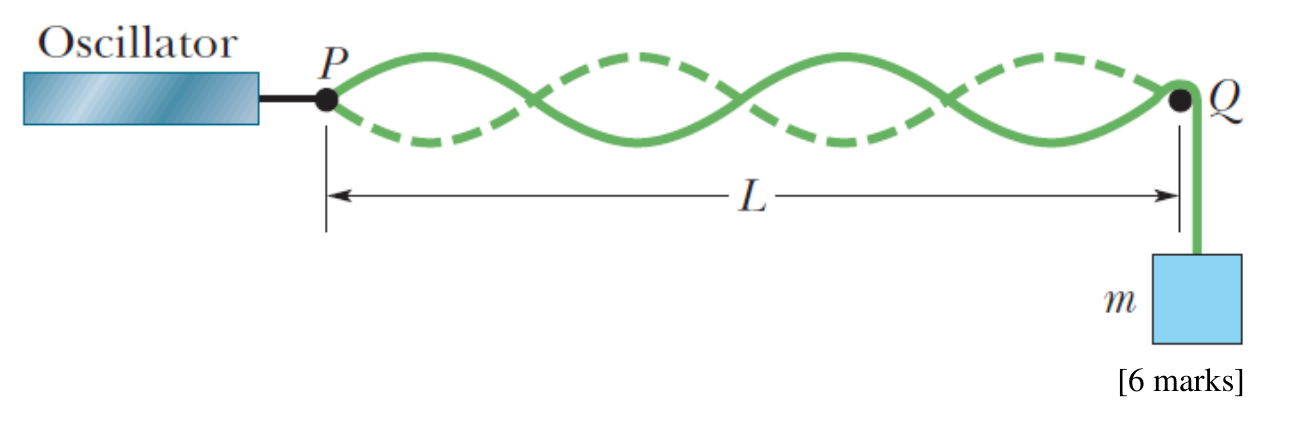
In the figure shown, a string, tied to a sinusoidal oscillator at and running over a support at , is stretched by a block of mass . The separation between and is , and the frequency of the oscillator is fixed at . The amplitude of the motion at is small enough for that point to be considered a node. A node also exists at . A standing wave appears when the mass of the hanging block is or , but not for any intermediate mass. What is the linear density of the string?
[6 marks]
Fonte: Testo (PDF) — p.10
Topic: Oscillations & Waves Metodi: Wave Equation, Free-Body Diagram, Physical Modeling Competenze: Physical Reasoning, Mathematical Modeling Objects: String, Block
Nella figura illustrata, una corda, legata ad un oscillatore sinusoidale a e che attraversa un supporto a , è estesa da un blocco di massa . La separazione tra e è e la frequenza dell’oscillatore è fissata a . L’ampiezza del movimento a è sufficientemente piccola per considerare quel punto un nodo. Un nodo esiste anche a . Un’onda in piedi appare quando la massa del blocco appeso è o , ma non per qualsiasi massa intermedia. Qual è la densità lineare della corda?
[6 punti]
Fonte: Testo (PDF) — p.10
Topic: Oscillations & Waves Metodi: Wave Equation, Free-Body Diagram, Physical Modeling Competenze: Physical Reasoning, Mathematical Modeling Objects: String, Block
Calculate the minimum kinetic energy an electron must have in order to be constrained within the nucleus, with a typical nuclear radius of . Assume that the uncertainty of this electron’s position is equal to the nuclear radius . Treat the electron relativistically.
[6 marks]
Fonte: Testo (PDF) — p.12
Topic: Modern-Quantum Physics, Special Relativity Metodi: de Broglie Relation, Relativistic Energy-Momentum, Order-of-Magnitude Estimation Competenze: Estimation & Approximation, Physical Reasoning Objects: Electron, Nucleus
Calcolare l’energia cinetica minima che un elettrone deve avere per essere confinato all’interno del nucleo, con un radio nucleare tipico di . Supponiamo che l’incertezza della posizione di questo elettrone sia pari al raggio nucleare . Tratta l’elettrone in modo relativistico.
[6 punti]
Fonte: Testo (PDF) — p.12
Topic: Modern-Quantum Physics, Special Relativity Metodi: de Broglie Relation, Relativistic Energy-Momentum, Order-of-Magnitude Estimation Competenze: Estimation & Approximation, Physical Reasoning Objects: Electron, Nucleus
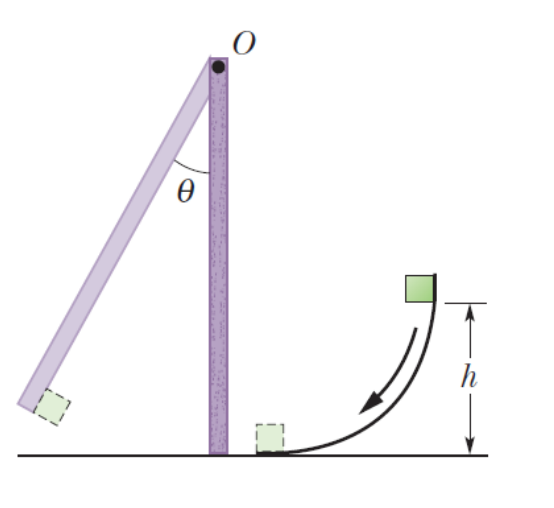
A small block slides down a frictionless surface through height and then sticks to a uniform rod of mass and length . The rod pivots about point through angle before momentarily stopping. Find .
[10 marks]
Fonte: Testo (PDF) — p.14
Topic: Rotational Dynamics, Conservation of Momentum Metodi: Torque & Angular Momentum Analysis, Conservation of Energy, Conservation of Momentum, Energy Conservation Method Competenze: Physical Reasoning, Mathematical Modeling Objects: Block, Rod
Un piccolo blocco scorre in superficie senza attrito attraverso l’altezza e si attacca quindi a una barra uniforme di massa e lunghezza . La canna ruota intorno al punto attraverso un angolo prima di fermarsi momentaneamente. Trova .
[10 punti]
Fonte: Testo (PDF) — p.14
Topic: Rotational Dynamics, Conservation of Momentum Metodi: Torque & Angular Momentum Analysis, Conservation of Energy, Conservation of Momentum, Energy Conservation Method Competenze: Physical Reasoning, Mathematical Modeling Objects: Block, Rod
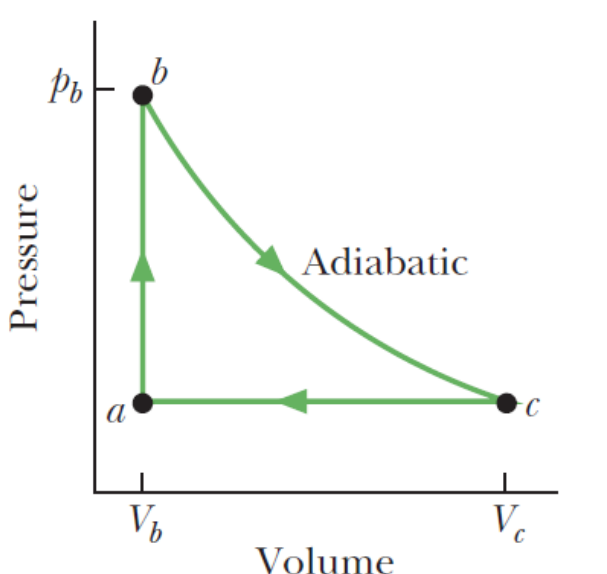
The figure shows a reversible cycle through which of a monatomic ideal gas is taken. Volume . Process is an adiabatic expansion, with and . For the cycle, find
- (a) the energy added to the gas as heat, [3 marks]
- (b) the energy leaving the gas as heat, [3 marks]
- (c) the net work done by the gas, and [1 mark]
- (d) the efficiency of the cycle. [1 mark]
Fonte: Testo (PDF) — p.17
Topic: Thermodynamics Metodi: Thermodynamic Cycle Analysis, First Law of Thermodynamics, Ideal Gas Law Competenze: Mathematical Modeling, Physical Reasoning Objects: Gas
La figura mostra un ciclo reversibile attraverso il quale viene assorbito di un gas ideale monatomo. Volume . Il processo è un’espansione adiabatica, con e . Per il ciclo, trovare
- **(a) ** l’energia aggiunta al gas in calore, [3 punti]
- **(b) ** l’energia che lascia il gas in calore, [3 punti]
- **(c) ** il lavoro netto svolto dal gas, e [1 punto]
- **(d) ** l’efficienza del ciclo. [1 punto]
Fonte: Testo (PDF) — p.17
Topic: Thermodynamics Metodi: Thermodynamic Cycle Analysis, First Law of Thermodynamics, Ideal Gas Law Competenze: Mathematical Modeling, Physical Reasoning Objects: Gas
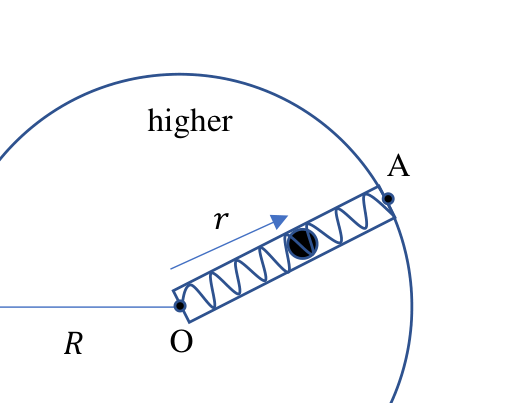
An ideal massless spring with spring constant and unstretched length is attached to point on the axis of a disc. It has a point mass attached at of the unstretched spring. The spring is stretched and the other end is attached to point on the edge of the disc at . The point mass is constrained to move radially only. The disc can rotate around the axis at a constant angular frequency . Take when is horizontal and is to the right and the disc is rotating anti-clockwise. Although some air resistance will help the system achieve a steady state, you may assume that air resistance is negligible in your working.
- (a) If the disc is horizontal and , derive an expression for the effective spring constant in terms of the given parameters. [5 marks]
- (b) If the disc is horizontal and rotating at constant angular velocity , derive an expression for , the equilibrium position of the mass. [5 marks]
- (c) If the disc is at an angle from the horizontal, what is the lowest angular frequency where the point mass can just about reach the edge of the disc at a steady state? [5 marks]
Fonte: Testo (PDF) — p.20
Topic: Oscillations & Waves, Newtonian Mechanics Metodi: Hooke’s Law, Simple Harmonic Motion Analysis, Free-Body Diagram, Vector Decomposition Competenze: Mathematical Modeling, Physical Reasoning Objects: Spring, Disk
Un molle ideale senza massa con costante molle e lunghezza non allungata è fissato al punto sull’asse di un disco. Ha una massa puntaria fissata a della molla non allungata. La molla è allungata e l’altra estremità è attaccata al punto sul bordo del disco a . La massa puntaria è limitata a muoversi solo in radial. Il disco può ruotare attorno all’asse a una frequenza angolare costante . Prendi quando è orizzontale e è a destra e il disco ruota in senso antiorario. Sebbene una certa resistenza all’aria aiuti il sistema a raggiungere uno stato di stabilità, si può presumere che la resistenza all’aria sia trascurabile nel vostro lavoro.
- **(a) ** Se il disco è orizzontale e , derivare un’espressione per la costante di molla effettiva in termini di parametri dati. 5 punti
- **(b) ** Se il disco è orizzontale e ruota a velocità angolare costante , derivare un’espressione per , la posizione di equilibrio della massa. 5 punti
- **(c) ** Se il disco è all’angolo dall’orizzontale, qual è la frequenza angolare più bassa in cui la massa puntaria può raggiungere quasi il bordo del disco in stato di stabilità? 5 punti
Fonte: Testo (PDF) — p.20
Topic: Oscillations & Waves, Newtonian Mechanics Metodi: Hooke’s Law, Simple Harmonic Motion Analysis, Free-Body Diagram, Vector Decomposition Competenze: Mathematical Modeling, Physical Reasoning Objects: Spring, Disk
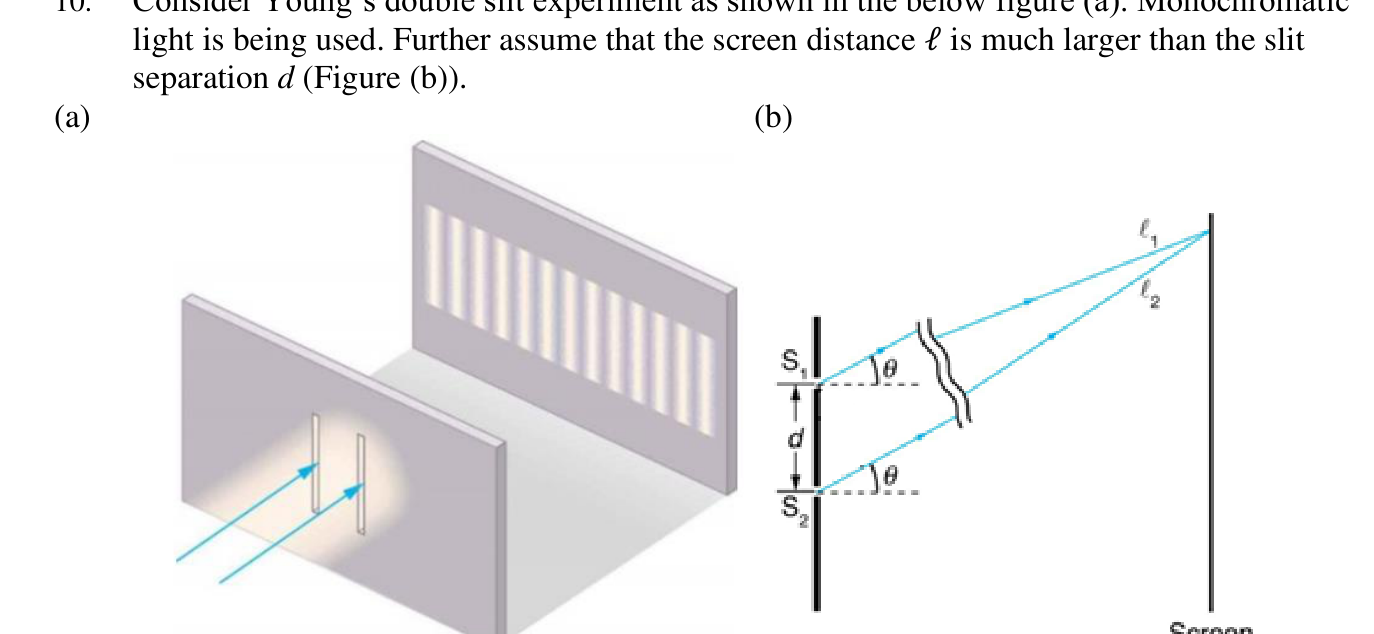
Consider Young’s double slit experiment as shown in the below figure (a). Monochromatic light is being used. Further assume that the screen distance is much larger than the slit separation (Figure (b)).
- (a) Under what condition does Young’s experiment show an interference pattern? [0.5 marks]
- (b) Determine the conditions for obtaining constructive and destructive interference. [2 marks]
- (c) Determine the distance between adjacent fringes (maxima), assuming that (Figure (b)) is small. [2 marks]
- (d) Determine the intensity of the diffraction pattern’s maxima. You may use . [4.5 marks]
Fonte: Testo (PDF) — p.24
Topic: Wave Optics Metodi: Interference & Diffraction Analysis, Superposition Principle, Small-Angle Approximation Competenze: Mathematical Modeling, Physical Reasoning Objects: Slit, Screen
Considerate l’esperimento di Young su due fessure come mostrato nella figura (a) di seguito. Si utilizza una luce monocromatica. Supponiamo inoltre che la distanza dello schermo sia molto maggiore della separazione fra fessure (Figura (b)).
In che condizione l’esperimento di Young mostra un modello di interferenza? [0,5 punti]
- **(b) ** Determinare le condizioni per ottenere interferenze costruttive e distruttive. [2 punti]
- **(c) ** Determina la distanza tra i margini adiacenti (maxima), supponendo che (Figura (b)) sia piccola. [2 punti]
- **(d) ** Determina l’intensità dei massimi del modello di diffrazione. È possibile utilizzare . [4,5 punti]
Fonte: Testo (PDF) — p.24
Topic: Wave Optics Metodi: Interference & Diffraction Analysis, Superposition Principle, Small-Angle Approximation Competenze: Mathematical Modeling, Physical Reasoning Objects: Slit, Screen