(a) A compound pendulum consists of a uniform thin rod of length and mass and a thin disc with diameter and mass attached to the end of the rod. The system can oscillate about a horizontal axis through the end of the rod perpendicular to the plane of the disc. Initially, the system hangs in equilibrium with the rod vertical. A small object of mass travelling horizontally with a speed of strikes the system at and sticks to it. What is the greatest angle which the rod makes with the downward vertical in the subsequent motion?
[8 marks]
[Moment of inertia of a disc, with mass and radius , about an axis through its centre is ; Moment of inertia of a thin rod, with mass and length , about an axis through its end is .]
(b) An alloy is made by combining different percentage by mass of gold and copper together. A block of such alloy has a weight of in air. When the block is completely immersed in a saturated salt solution which has a density of , its weight appears to become . Calculate the percentage by mass of gold and copper in the alloy.
[5 marks]
[kgf = kilogram-force. It is the weight of a kilogram under standard gravity. One . Densities (in ): gold: ; copper: .]
Fonte: Testo (PDF) — p.3
Topic: Rotational Dynamics, Fluid Mechanics Metodi: Conservation of Momentum, Torque & Angular Momentum Analysis, Conservation of Energy, Hydrostatic Equilibrium Competenze: Physical Reasoning, Mathematical Modeling Objects: Pendulum, Rod, Disk, Block
**(a) ** Un pendolo composto è costituito da una canna sottile uniforme di lunghezza e massa e da un disco sottile con diametro e massa attaccato alla punta della canna. Il sistema può oscillare intorno ad un asse orizzontale attraverso l’estremità della canna perpendicolare al piano del disco. Inizialmente, il sistema è appeso in equilibrio con la verticale della canna. Un piccolo oggetto di massa che viaggia orizzontalmente con una velocità di colpisce il sistema a e si attacca a esso. Qual è l’angolo più grande che la canna fa con la verticale verso il basso nel successivo movimento?
- [8 punti] *
[Momento di inerzia di un disco, con massa e raggio , circa un asse attraverso il suo centro è ; Momento di inerzia di una canna sottile, con massa e lunghezza , circa un asse attraverso la sua estremità è .]
**(b) ** Una lega è prodotta combinando diverse percentuali di massa di oro e rame. Un blocco di tale lega ha un peso nell’aria. Quando il blocco è completamente immerso in una soluzione di sale saturazione con una densità di , il suo peso appare . Calcolare la percentuale in massa di oro e rame nell’alleazione.
-
[5 punti] *
-
[kgf = forza di kg. È il peso di un chilogrammo sotto la gravità standard. Un . Densità (in ): oro: ; rame: .]*
Fonte: Testo (PDF) — p.3
Topic: Rotational Dynamics, Fluid Mechanics Metodi: Conservation of Momentum, Torque & Angular Momentum Analysis, Conservation of Energy, Hydrostatic Equilibrium Competenze: Physical Reasoning, Mathematical Modeling Objects: Pendulum, Rod, Disk, Block
(a) A wire is mounted on a sounding board and has a tension of . When it is set into vibration in the fundamental mode, the sound waves produce a beat with frequency with a tuning fork. When the tension in the wire is increased to , the beat frequency produced by the sound waves in the fundamental mode becomes with the tuning fork. Find the ratio .
[4 marks]
(b)(i) A uniform bar of length and weight is suspended by two springs and . Spring has a force constant of while the force constant of spring is . Both springs have a length of when they are not stretched. Spring is attached to the end of the bar and spring is attached to a point on the bar at a distance from end of the bar as shown in Fig. 1. What is the value of so that the bar can remain horizontal while in equilibrium?
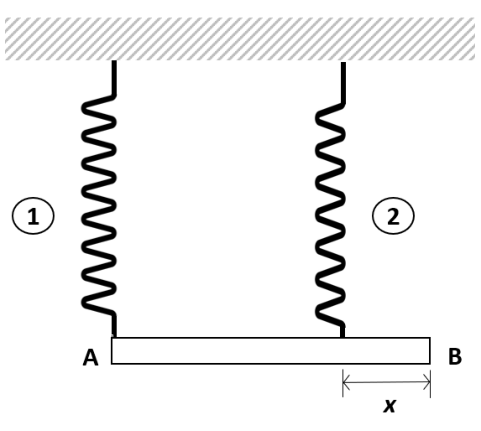 Fig. 1.
(b)(ii) The two springs are now attached to two vertical walls at apart. A small particle of mass is attached to the free ends of both springs as shown in Fig. 2. The particle can move over a smooth horizontal surface between the two walls.
-
What are the lengths of both springs when the system is in equilibrium?
-
If the particle is displaced through a small distance from the equilibrium position and released, what is the frequency of its oscillation?
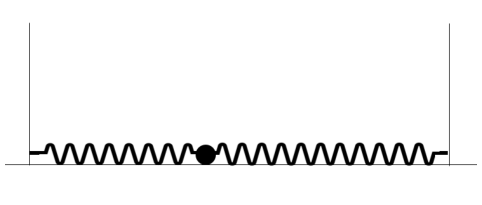 Fig. 2.
[8 marks]
Fonte: Testo (PDF) — p.4
Topic: Oscillations & Waves, Rigid Body Statics Metodi: Simple Harmonic Motion Analysis, Hooke’s Law, Wave Equation, Free-Body Diagram Competenze: Physical Reasoning, Mathematical Modeling Objects: Wire, Tuning Fork, Spring, Beam
**(a) ** Un filo è montato su una tavola di sondaggio e ha una tensione di . Quando viene impostato in vibrazione in modalità fondamentale, le onde sonore producono un battito con frequenza con una forchetta di sintonia . Quando la tensione del filo è aumentata a , la frequenza di battito prodotta dalle onde sonore in modalità fondamentale diventa con la biforca di sintonia. Trova il rapporto .
- [4 segni] *
**((b)(i) ** Una barra uniforme di lunghezza e peso è sospesa da due molla e . La forza di una fonte è di , mentre la forza di una fonte è di . Entrambe le sorgenti hanno una lunghezza quando non sono estese. La molla è attaccata alla fine della barra e la molla è attaccata a un punto della barra a una distanza dalla fine della barra come mostrato nella figura. 1. Qual è il valore di in modo che la barra possa rimanere orizzontale mentre è in equilibrio?
Fig. 1.
**(b)(ii) ** Le due sorgenti sono ora fissate a due pareti verticali a di distanza. Una piccola particella di massa è attaccata alle estremità libere di entrambe le molle come mostrato alla figura. 2. La particella può muoversi su una superficie orizzontale liscia tra le due pareti.
-
Quali sono le lunghezze di entrambe le sorgenti quando il sistema è in equilibrio?
-
Se la particella viene spostata a una piccola distanza dalla posizione di equilibrio e rilasciata, qual è la frequenza della sua oscillazione?
Fig. 2.
- [8 punti] *
Fonte: Testo (PDF) — p.4
Topic: Oscillations & Waves, Rigid Body Statics Metodi: Simple Harmonic Motion Analysis, Hooke’s Law, Wave Equation, Free-Body Diagram Competenze: Physical Reasoning, Mathematical Modeling Objects: Wire, Tuning Fork, Spring, Beam
(a) A uniform thin wire is suspended by two inelastic strings attached to its end. The wire has a mass of and its resistance is . The length of the wire is . The wire and the supporting strings are placed in a region where there is a uniform magnetic field of magnitude and direction perpendicular to the plane containing the strings and the wire, as shown in Fig. 3. What is the direction and magnitude of the potential difference that must be applied to the wire so that the tension in the strings becomes zero?
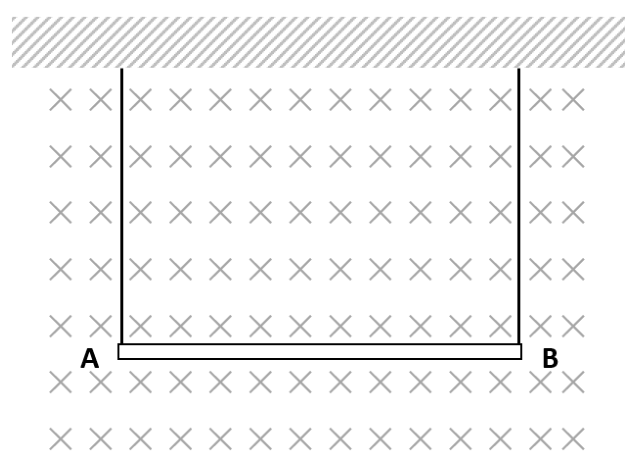 Fig. 3.
[4 marks]
(b) The surface charge density at a point on a circular thin disc, having diameter , can be described by the equation
where is the distance of the point from the centre of the disc. A point charge of is placed on the axis of the disc and at a distance from the centre of the disc. What is the magnitude and direction of the electrostatic force acting on this point charge due to the positive charge on the disc?
[7 marks]
[For a uniformly charged ring with radius , and carrying a total charge of , the electric field on the axial point, at a distance from the centre of the ring is where is a unit vector along the axis of the ring and pointing away from the centre of the ring.]
Fonte: Testo (PDF) — p.5
Topic: Magnetism, Electrostatics Metodi: Lorentz Force Analysis, Free-Body Diagram, Calculus-Integration, Superposition Principle Competenze: Physical Reasoning, Mathematical Modeling Objects: Wire, String, Disk, Point Charge
**(a) ** Un filo sottile uniforme è sospeso da due fili inelastici attaccati alla sua estremità. Il filo ha una massa di e la sua resistenza è . La lunghezza del filo è . Il filo e le corde di supporto sono posizionati in una regione in cui esiste un campo magnetico uniforme di magnitudo e la direzione perpendicolare al piano contenente le corde e il filo, come mostrato alla figura. 3. Qual è la direzione e la grandezza della differenza potenziale che deve essere applicata al filo in modo che la tensione nelle corde diventi zero?
Fig. 3.
- [4 segni] *
**(b) ** La densità di carica superficiale in un punto su un disco sottile circolare, di diametro , può essere descritta con l’equazione
dove è la distanza del punto dal centro del disco. Una carica puntologica di è posta sull’asse del disco e a una distanza dal centro del disco. Qual è la magnitudine e la direzione della forza elettrostatica che agisce su questa carica di punto a causa della carica positiva sul disco?
*[7 punti] *
*[Per un anello uniformemente carico con raggio , e con una carica totale di , il campo elettrico sul punto asseale, a distanza dal centro dell’anello è *
- dove è un vettore unitario lungo l’asse dell’anello e che punta lontano dal centro dell’anello.]*
Fonte: Testo (PDF) — p.5
Topic: Magnetism, Electrostatics Metodi: Lorentz Force Analysis, Free-Body Diagram, Calculus-Integration, Superposition Principle Competenze: Physical Reasoning, Mathematical Modeling Objects: Wire, String, Disk, Point Charge
(a) A spherical blackbody has a radius of and is placed in a constant temperature environment having temperature . The blackbody is heated by an internal heater which has a heating power of .
(i) What is the maximum temperature which the blackbody can attain?
(ii) After attaining the maximum temperature, the internal heater is switched off. If the density of the material of the blackbody is and its specific heat capacity is , what is the initial rate of fall of temperature of the blackbody?
[6 marks]
(b) Cylinder and its piston are thermally insulated from the surrounding and cylinder is in thermal contact with a heat reservoir at a constant temperature of . The two frictionless pistons are rigidly connected by a thin hollow rod (with negligible volume) and a valve that is closed. Initially, the piston of cylinder is fixed, and inside the cylinder it consists moles of monoatomic argon gas at a pressure higher than atmospheric pressure () and volume . Inside cylinder , there is an unknown amount ( moles) of diatomic oxygen gas at atmospheric pressure . When the piston of cylinder is freed, it moves very slowly until equilibrium is achieved with the volume of the argon gas being times higher, and the density of the oxygen has increased by a factor of two. The heat reservoir receives heat transfer of during the process.
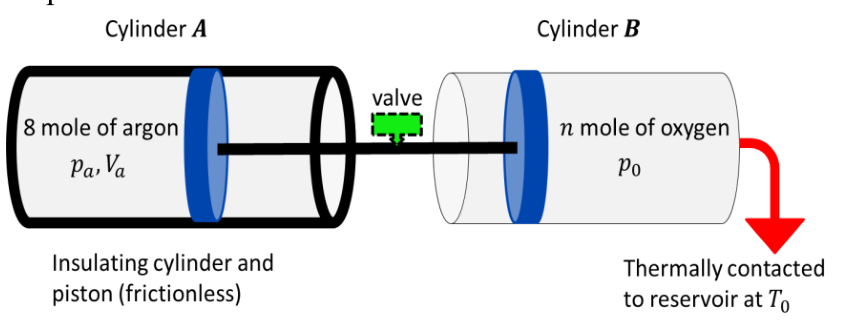
(i) Show that the change of the pressure and temperature of the argon are given by
where is the atmospheric pressure and is the initial temperature of the argon.
(ii) Finally, the valve on the thin hollow rod is opened. Calculate the final pressure of the mixture of the gases and express it in terms of , and .
[6 marks]
Fonte: Testo (PDF) — p.6
Topic: Thermodynamics, Kinetic Theory Metodi: First Law of Thermodynamics, Ideal Gas Law, Thermodynamic Cycle Analysis, Energy Conservation Method Competenze: Physical Reasoning, Mathematical Modeling Objects: Sphere, Cylinder, Piston, Gas
**(a) ** Un corpo nero sferico ha un raggio di e è collocato in un ambiente a temperatura costante con temperatura . Il corpo nero è riscaldato da un riscaldatore interno con una potenza di riscaldamento .
Qual è la temperatura massima che il corpo nero può raggiungere?
**(ii) ** Dopo aver raggiunto la temperatura massima, il riscaldatore interno viene spento. Se la densità del materiale del corpo nero è e la sua capacità termica specifica è , qual è il tasso iniziale di calo della temperatura del corpo nero?
- [6 punti] *
**(b) ** Il cilindro e il suo pistone sono isolati termicamente dal contesto circostante e il cilindro è in contatto termico con un serbatoio di calore a temperatura costante di . I due pistoni senza attrito sono rigidamente collegati da una sottile canna vuota (con un volume trascurabile) e da una valvola chiusa. Inizialmente, il pistone del cilindro è fissato e all’interno del cilindro è costituito da molli di argone monoatomico a una pressione superiore alla pressione atmosferica () e volume . All’interno del cilindro , vi è una quantità sconosciuta ( mol) di gas ossigeno diatomico a pressione atmosferica . Quando il pistone del cilindro viene rilasciato, si muove molto lentamente fino a che non si raggiunge l’equilibrio con un volume del gas argon volte superiore e la densità dell’ossigeno aumentata di due volte. Il serbatoio di calore riceve un trasferimento di calore di durante il processo.
**(i) ** Mostra che la variazione della pressione e della temperatura dell’argon è data da
dove è la pressione atmosferica e è la temperatura iniziale dell’argon.
**(ii) ** Infine, viene aperta la valvola sullo sottile bastone vuoto. Calcolare la pressione finale della miscela dei gas e esprimere in termini di , e .
- [6 punti] *
Fonte: Testo (PDF) — p.6
Topic: Thermodynamics, Kinetic Theory Metodi: First Law of Thermodynamics, Ideal Gas Law, Thermodynamic Cycle Analysis, Energy Conservation Method Competenze: Physical Reasoning, Mathematical Modeling Objects: Sphere, Cylinder, Piston, Gas
(a) A cube lies with one of its faces on the plane and three of its edges along the , & axes. The cube starts to slide horizontally along the -axis with constant speed . It is found that as a result of the motion, the density of the material of the cube appears to increase by . Calculate the value of .
[4 marks]
(b) An observer in the Earth frame observes two spaceships A and B pass each other in opposite directions. In the inertial frame in which both spaceships are at rest, the lengths of spaceship A and spaceship B are and respectively. The observer in the Earth frame measures that the speed of spaceship A is and that of spaceship B is . As measured by this observer, what is the time interval between the instant when the nose of spaceship A passes the nose of spaceship B and the instant when the tail of spaceship A passes the tail of spaceship B? What is the corresponding time interval measured by an observer sitting at the nose of spaceship A?
[6 marks]
Fonte: Testo (PDF) — p.7
Topic: Special Relativity Metodi: Lorentz Transformation, Kinematic Equations, Relativistic Energy-Momentum Competenze: Physical Reasoning, Mathematical Modeling Objects: —
**(a) ** Un cubo si trova con una sua faccia sul piano e tre dei suoi bordi lungo gli assi , e . Il cubo inizia a scivolare orizzontalmente lungo l’asse con velocità costante . Si scopre che a causa del movimento, la densità del materiale del cubo sembra aumentare di . Calcolare il valore di .
- [4 segni] *
Un osservatore nel quadro terrestre osserva due navi spaziali A e B che si attraversano in direzioni opposte. Nel quadro inerziale in cui entrambe le navi spaziali sono a riposo, le lunghezze di navi spaziali A e B sono rispettivamente e . L’osservatore nel quadro terrestre misura che la velocità della nave spaziale A è e quella della nave spaziale B è . Come misurato da questo osservatore, qual è l’intervallo di tempo tra l’istante in cui il naso della nave spaziale A passa il naso della nave spaziale B e l’istante in cui la coda della nave spaziale A passa la coda della nave spaziale B? Qual è l’intervallo di tempo corrispondente misurato da un osservatore seduto al naso della nave spaziale A?
- [6 marchi] *
Fonte: Testo (PDF) — p.7
Topic: Special Relativity Metodi: Lorentz Transformation, Kinematic Equations, Relativistic Energy-Momentum Competenze: Physical Reasoning, Mathematical Modeling Objects: —