(a) A cannon is placed at the edge of a vertical cliff. The muzzle of the cannon is above the level of sea water. It fires a shell with a muzzle velocity of . What should be the angle of elevation of the barrel of the cannon if the shell were to hit a stationary target at sea level and at a perpendicular distance of away from the vertical wall of the cliff?
[3 marks]
(b) At the instant when the shell is fired, the target starts to move away from the cliff along a line perpendicular to the face of the cliff, with a constant speed of . Suppose the angle of elevation of the barrel of the gun remains unchanged, what alteration must be made to the muzzle speed of the shell in order for it to hit the target?
[7 marks]
Fonte: Testo (PDF) — p.3
Topic: Newtonian Mechanics Metodi: Kinematic Equations, Vector Decomposition, Approximation & Series Expansion Competenze: Physical Reasoning, Mathematical Modeling Objects: Projectile
(a) A cannon is placed at the edge of a vertical cliff. Il muso del cannone è al di sopra del livello dell’acqua di mare. Scapa un guscio con una velocità di muzzle di . What should be the angle of elevation of the barrel of the cannon if the shell were to hit a stationary target at sea level and at a perpendicular distance of away from the vertical wall of the cliff?
*[3 punti] *
**(b) ** Nel momento in cui viene sparato il guscio, l’obiettivo inizia a allontanarsi dalla scogliera lungo una linea perpendicolare alla faccia della scogliera, con una velocità costante di . Supponiamo che l’angolo di alzata del canna della pistola rimanga invariato, quale modifica deve essere fatta alla velocità del guscio del proiettile per poter colpire l’obiettivo?
*[7 punti] *
Fonte: Testo (PDF) — p.3
Topic: Newtonian Mechanics Metodi: Kinematic Equations, Vector Decomposition, Approximation & Series Expansion Competenze: Physical Reasoning, Mathematical Modeling Objects: Projectile
(a) Two satellites and are orbiting around Earth in circular orbits above the equator (or co-centre with the equator). The orbit of is above the surface of Earth while that of is above the surface Earth. At a particular instant, both satellites are vertically above a point on the surface of Earth. After minutes, they are found to be vertically above another point on the surface of Earth. Determine the value of , taking the radius of Earth to be .
[3 marks]
(b) A sound source and a detector are placed at a distance of apart as shown in Fig. 1. The source produces sound waves with wavelength . A reflector is placed so that its plane is parallel to the line joining and . When the reflector is situated at position 1 (see Fig. 1), the direct wave from is found to be in phase at the detector with the wave from that is reflected from the reflector. The incident and reflected waves make the same angle with the reflector. When the reflector is moved slowly away from position 1, the sound detected at decreases in intensity and becomes zero for the first time when the detector reaches position 2 that is at a distance from position 1. Determine the value of .
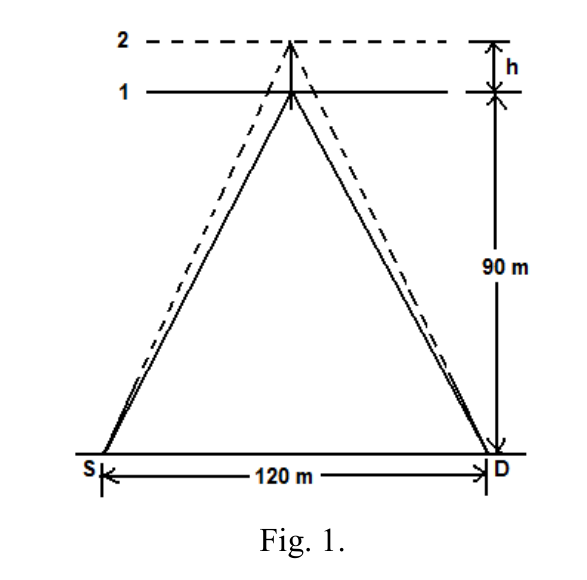
Fig. 1.
[6 marks]
Fonte: Testo (PDF) — p.5
Topic: Gravitation, Oscillations & Waves Metodi: Kepler’s Laws, Newton’s Law of Gravitation, Interference & Diffraction Analysis, Wave Equation Competenze: Physical Reasoning, Mathematical Modeling Objects: Satellite, Planet
**(a) ** Due satelliti e orbitano intorno alla Terra in orbite circolari sopra l’equatore (o co-centro con l’equatore). L’orbita di è sopra la superficie terrestre mentre quella di è sopra la superficie terrestre. In un particolare istante, entrambi i satelliti sono verticalmente sopra un punto sulla superficie terrestre. Dopo minuti, si scopre che sono verticalmente sopra un altro punto sulla superficie terrestre. Determinare il valore di , assumendo il raggio della Terra a .
*[3 punti] *
**(b) ** Una fonte sonora e un rilevatore sono posizionati a una distanza di tra loro come mostrato nella figura. 1. La fonte produce onde sonore con lunghezza d’onda . Un riflettore è posizionato in modo che il suo piano sia parallelo alla linea che unisce e . Quando il riflettore è situato nella posizione 1 (vedi figura 1. 1), si scopre che l’onda diretta proveniente dal è in fase al rilevatore con l’onda proveniente da che si riflette dal riflettore. L’incidente e le onde riflesse fanno lo stesso angolo con il riflettore. Quando il riflettore è spostato lentamente lontano dalla posizione 1, il suono rilevato a diminuisce di intensità e diventa zero per la prima volta quando il rilevatore raggiunge la posizione 2, che è a una distanza dalla posizione 1. Determinare il valore di .
Fig. 1.
- [6 marchi] *
Fonte: Testo (PDF) — p.5
Topic: Gravitation, Oscillations & Waves Metodi: Kepler’s Laws, Newton’s Law of Gravitation, Interference & Diffraction Analysis, Wave Equation Competenze: Physical Reasoning, Mathematical Modeling Objects: Satellite, Planet
(a) Three resistors, each of value , are arranged in two different arrangements as shown in Fig. 2. If the maximum allowable power for each individual resistor is , calculate the maximum power that can be dissipated by the circuits shown in Fig. 2(a) and 2(b).
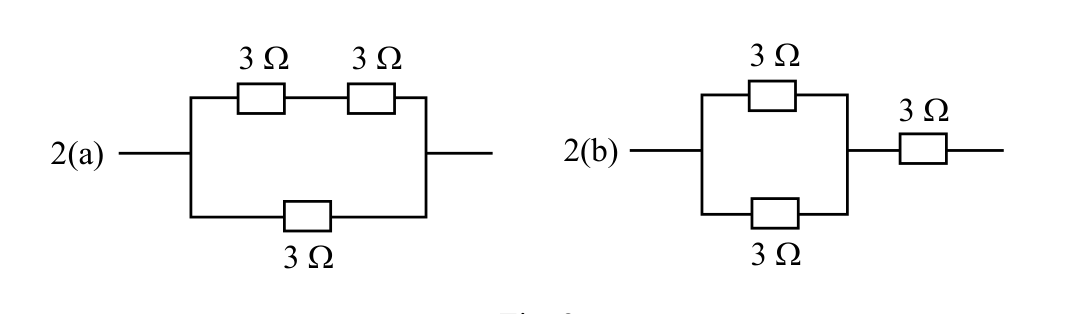
Fig. 2.
[4 marks]
(b) An insulating sphere with a diameter of carries a uniform charge density of throughout its entire volume. A small tunnel is drilled along a diameter of the sphere. A small particle with mass and carrying charge is placed at one end of the tunnel and released. Calculate:
- (i) the time taken by the particle to move to the other end of the tunnel.
- (ii) the speed of the particle when it reaches the centre of the sphere.
[7 marks]
Fonte: Testo (PDF) — p.7
Topic: Circuits, Electrostatics Metodi: Equivalent Circuit Reduction, Gauss’s Law, Simple Harmonic Motion Analysis, Coulomb’s Law Competenze: Physical Reasoning, Mathematical Modeling Objects: Resistor, Sphere, Point Charge
**(a) ** Tre resistori, ciascuno di valore , sono disposti in due diverse disposizioni come mostrato nella figura. 2. Se la potenza massima ammessa per ciascun resistore individuale è , calcolare la potenza massima che può essere dissipata dai circuiti indicati alla figura. 2 (a) e 2 (b).
Fig. 2.
- [4 segni] *
**(b) ** Una sfera isolante con un diametro di ha una densità di carica uniforme di per tutto il suo volume. Un piccolo tunnel è perforato lungo un diametro della sfera. Una piccola particella di massa e carica di trasporto viene collocata ad una estremità del tunnel e rilasciata. Calcola:
- i) il tempo necessario per il movimento della particella all’altra estremità del tunnel.
- (ii) la velocità della particella quando raggiunge il centro della sfera.
*[7 punti] *
Fonte: Testo (PDF) — p.7
Topic: Circuits, Electrostatics Metodi: Equivalent Circuit Reduction, Gauss’s Law, Simple Harmonic Motion Analysis, Coulomb’s Law Competenze: Physical Reasoning, Mathematical Modeling Objects: Resistor, Sphere, Point Charge
(a) mole of a diatomic ideal gas has a pressure of and occupies a volume of litres. It is heated at constant pressure so that its volume is doubled. What is the change in entropy of the gas during the process?
[3 marks]
(b) A vessel contains mole of a certain gas maintained at fixed temperature . Each of the gas particle can exist in one of four energy states with energies , , and respectively. According to the theory in classical statistical physics, in a large ensemble of particles, the probability, , that a particle possesses energy at temperature is:
where is the Boltzmann constant and is the normalization constant. It is found that of the gas particles in the vessel exists in the lowest energy state; i.e. and of them occupies the first excited state; i.e. . Estimate the number of gas particles existing in the state.
[6 marks]
Fonte: Testo (PDF) — p.9
Topic: Thermodynamics, Kinetic Theory Metodi: Ideal Gas Law, First Law of Thermodynamics, Statistical Averaging, Kinetic Theory of Gases Competenze: Physical Reasoning, Mathematical Modeling Objects: Gas, Container
**(a) ** mole di un gas ideale diatomico ha una pressione di e occupa un volume di litri. Il volume è raddoppiato a pressione costante. Qual è il cambiamento di entropia del gas durante il processo?
*[3 punti] *
**(b) ** Un recipiente contiene mole di un certo gas mantenuto a temperatura fissa . Ciascuna delle particelle di gas può esistere in uno dei quattro stati energetici con rispettivamente , , e . Secondo la teoria della fisica statistica classica, in un grande insieme di particelle, la probabilità, , che una particella possieda energia a temperatura è:
dove è la costante di Boltzmann e è la costante di normalizzazione. Si è rilevato che delle particelle di gas presenti nel recipiente esiste nello stato di energia più basso; cioè di cui e occupa il primo stato eccitato; . Calcolare il numero di particelle di gas esistenti nello stato .
- [6 marchi] *
Fonte: Testo (PDF) — p.9
Topic: Thermodynamics, Kinetic Theory Metodi: Ideal Gas Law, First Law of Thermodynamics, Statistical Averaging, Kinetic Theory of Gases Competenze: Physical Reasoning, Mathematical Modeling Objects: Gas, Container
(a) According to Niel Bohr’s theory, the energy of a hydrogen atom when it is in the stationary state with principal quantum number is given by
where & are the mass and charge of an electron, is the permittivity of free space and is the Planck’s constant.
A hydrogen atom is initially at rest. An electron in the hydrogen atom makes a transition from the state with to the state with . Calculate the recoil speed and recoil energy of the hydrogen during the process.
[Mass of hydrogen atom is ]
[6 marks]
(b) An observer in the inertial frame sees a red flash of light at the origin at time and a blue flash of light at and time . Another observer is situated at the origin of another inertial frame which moves in the direction of increasing with a speed of relative to . The axes of the two inertial frames are parallel at all times and their origins coincide at . If , what is the range of the values of so that observer sees the blue flash before seeing the red flash?
[5 marks]
Fonte: Testo (PDF) — p.11
Topic: Modern-Quantum Physics, Special Relativity Metodi: Bohr Model & Quantization, Photon Energy Relation, Conservation of Momentum, Lorentz Transformation Competenze: Physical Reasoning, Mathematical Modeling Objects: Atom, Electron
Secondo la teoria di Niel Bohr, l’energia di un atomo di idrogeno quando è in stato stazionario con numero quantistico principale è data da
dove & sono la massa e la carica di un elettrone, è la permissività dello spazio libero e è la costante di Planck.
Un atomo di idrogeno è inizialmente a riposo. Un elettrone nell’atomo di idrogeno fa una transizione dallo stato con allo stato con . Calcolare la velocità di retrocesso e l’energia di retrocesso dell’idrogeno durante il processo.
[massa di atomo di idrogeno ]
- [6 marchi] *
**(b) ** Un osservatore nel quadro inerziale vede un lampo rosso di luce all’origine al momento e un lampo blu di luce al momento e al momento . Un altro osservatore si trova all’origine di un altro quadro inerziale che si muove in direzione di aumento con una velocità di rispetto a . Gli assi dei due quadri inerziali sono sempre paralleli e le loro origini coincidono a . Se , qual è l’intervallo dei valori di in modo che l’osservatore veda il lampo blu prima di vedere il lampo rosso?
- [5 punti] *
Fonte: Testo (PDF) — p.11
Topic: Modern-Quantum Physics, Special Relativity Metodi: Bohr Model & Quantization, Photon Energy Relation, Conservation of Momentum, Lorentz Transformation Competenze: Physical Reasoning, Mathematical Modeling Objects: Atom, Electron