(a)(i) Figure 1.1 shows how the velocity varies with the displacement for a particle undergoing simple harmonic motion.
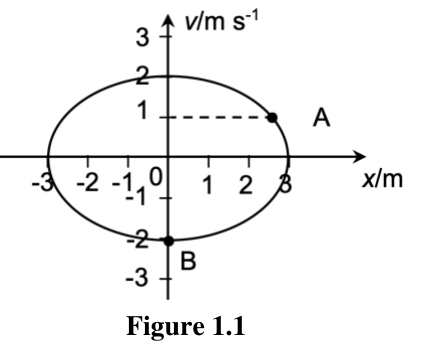 Figure 1.1
Determine the period of the motion. [2 marks]
(a)(ii) Calculate the time taken for the particle to move from the state represented by the point A to the state represented by the point B. [2 marks]
(b)(i) By using the expression , show that the potential energy of a particle of mass undergoing simple harmonic motion of angular frequency is given by . [3 marks]
(b)(ii) Figure 1.2 shows a pendulum bob of mass suspended from a string of length .
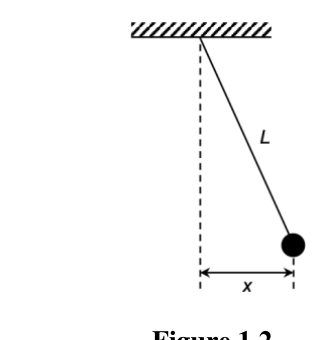 Figure 1.2
Show that the potential energy of the pendulum is given by (with respect to the equilibrium position) [1 mark]
(b)(iii) By combining the results of (b)(i) and (b)(ii), show that the period of a pendulum of length is for small-angle oscillations. [2 marks]
Fonte: Testo (PDF) — p.3
Topic: Oscillations & Waves Metodi: Simple Harmonic Motion Analysis, Conservation of Energy, Small-Angle Approximation Competenze: Diagrammatic Reasoning, Physical Reasoning Objects: Pendulum, String
La figura 1.1 mostra come la velocità varia con il spostamento per una particella che subisce un semplice movimento armonico.
Figura 1.1
Determinare il periodo della mozione. * [2 punti] *
**((a)(ii) ** Calcolare il tempo necessario per il movimento della particella dallo stato rappresentato dal punto A allo stato rappresentato dal punto B. * [2 punti] *
**(((((i) ** Utilizzando l’espressione , dimostrare che l’energia potenziale di una particella di massa sottoposta a un semplice movimento armonico di frequenza angolare è data da . *[3 punti] *
**(b)(ii) ** La figura 1.2 mostra un bobino di pendolo di massa sospeso da una corda di lunghezza .
Figura 1.2
Indicare che l’energia potenziale del pendolo è data da (rispetto alla posizione di equilibrio) [1 segno]
**(((iii) ** Combinando i risultati di (b) ((i) e (b) ((ii), dimostrare che il periodo di un pendolo di lunghezza è per oscillazioni a piccolo angolo. * [2 punti] *
Fonte: Testo (PDF) — p.3
Topic: Oscillations & Waves Metodi: Simple Harmonic Motion Analysis, Conservation of Energy, Small-Angle Approximation Competenze: Diagrammatic Reasoning, Physical Reasoning Objects: Pendulum, String
(a) A 2.5 kg block is placed on a horizontal rotating disk with a radius of 0.5 m. The disk rotates at a constant angular speed of 3 rad/s. The block is located 0.3 m from the centre of the disk. The coefficient of static friction between the block and the disk is 0.4.
Calculate the maximum static frictional force that can act on the block. [2 marks]
(b) Determine whether the block will slide or stay in place as the disk rotates. [3 marks]
(c) If the block remains stationary relative to the disk, calculate the minimum coefficient of friction required for the block to stay in place if it were moved to the edge of the disk (0.5 m from the centre). [2 marks]
(d) If the block is now moved to the edge (0.5 m from the centre) and the coefficient of friction remains 0.4, determine the speed of the block when it begins to slip relative to the rotating disk. [3 marks]
Fonte: Testo (PDF) — p.6
Topic: Newtonian Mechanics Metodi: Free-Body Diagram, Kinematic Equations, Vector Decomposition Competenze: Physical Reasoning, Mathematical Modeling Objects: Block, Disk
**(a) ** Un blocco di 2,5 kg è posizionato su un disco rotante orizzontale con un raggio di 0,5 m. Il disco ruota a una velocità angolare costante di 3 rad/s. Il blocco si trova a 0,3 m dal centro del disco. Il coefficiente di attrito statico tra il blocco e il disco è di 0,4.
Calcolare la forza massima di attrito statica che può agire sul blocco. * [2 punti] *
**(b) ** Determina se il blocco scivolerà o rimarrà in posizione mentre il disco ruota. *[3 punti] *
Se il blocco rimane fermo rispetto al disco, calcolare il coefficiente minimo di attrito necessario per mantenere il blocco in posizione se spostato sul bordo del disco (0,5 m dal centro). * [2 punti] *
Se il blocco è ora spostato al bordo (0,5 m dal centro) e il coefficiente di attrito rimane 0,4, determinare la velocità del blocco quando comincia a scivolare rispetto al disco rotante. *[3 punti] *
Fonte: Testo (PDF) — p.6
Topic: Newtonian Mechanics Metodi: Free-Body Diagram, Kinematic Equations, Vector Decomposition Competenze: Physical Reasoning, Mathematical Modeling Objects: Block, Disk
(a) As shown in Figure 3, a spring of spring constant is placed horizontally on the floor. One end of the spring is attached to a solid block of mass and the other end of the spring is compressed by a sphere of mass by a distance . Neglect all friction and neglect the mass of the spring as well as the mass of the plate between the sphere and the spring.
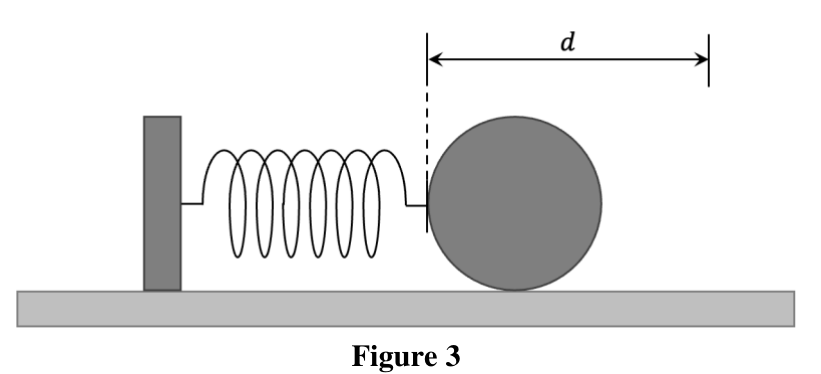 Figure 3
The block is fixed on the floor. Derive an expression for the speed of the sphere when it is at a distance from the initial position. [2 marks]
(b) The block is now free to move. Derive an expression for the speed of the sphere relative to the floor after it loses contact with the spring. [4 marks]
(c) The block is still free to move. Derive an expression for the distance the block has travelled when the sphere just loses contact with the spring. [4 marks]
Fonte: Testo (PDF) — p.8
Topic: Conservation of Momentum, Conservation of Energy Metodi: Conservation of Momentum, Conservation of Energy, Hooke’s Law Competenze: Mathematical Modeling, Physical Reasoning Objects: Spring, Block, Sphere
**(a) ** Come mostrato alla figura 3, una molla di costante molla è posizionata orizzontalmente sul pavimento. Una estremità della molla è attaccata a un blocco solido di massa e l’altra estremità della molla è compressa da una sfera di massa per una distanza . Trascurare ogni attrito e trascurare la massa della molla così come la massa della piastra tra la sfera e la molla.
Figura 3
Il blocco è fissato sul pavimento. Derivare un’espressione per la velocità della sfera quando è a una distanza dalla posizione iniziale. * [2 punti] *
**(b) ** Il blocco è ora libero di muoversi. Derivare un’espressione per la velocità della sfera rispetto al pavimento dopo che perde il contatto con la molla. * [4 segni] *
Il blocco è ancora libero di muoversi. Derivare un’espressione per la distanza percorsa dal blocco quando la sfera perde il contatto con la sorgente. * [4 segni] *
Fonte: Testo (PDF) — p.8
Topic: Conservation of Momentum, Conservation of Energy Metodi: Conservation of Momentum, Conservation of Energy, Hooke’s Law Competenze: Mathematical Modeling, Physical Reasoning Objects: Spring, Block, Sphere
Figure 4 shows a long, straight wire of negligible resistance bent into a V shape, with its two arms making an angle with each other, and placed horizontally in a vertical uniform magnetic field of strength . A rod of total mass , and resistance per unit length, is placed on the V-shaped conductor, at a distance from its vertex A, and perpendicular to the bisector of the angle .
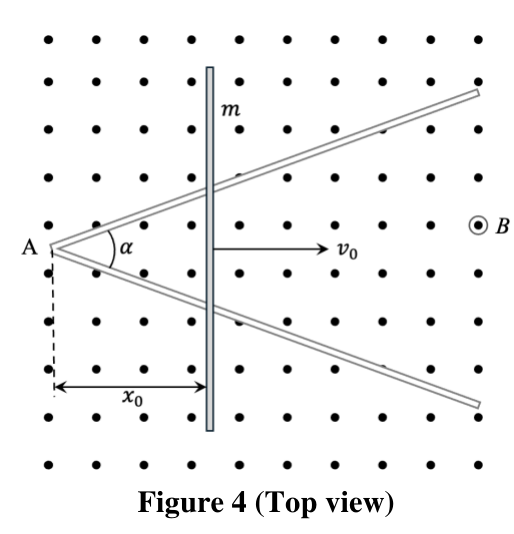 Figure 4 (Top view)
The rod started off with an initial velocity in the direction along the bisector, and away from A. The rod is long enough not to fall off the wire during the subsequent motion, and the electrical contact between the two is perfect, while friction between them is negligible.
Show that the rod will stop at [10 marks]
Fonte: Testo (PDF) — p.11
Topic: Electromagnetic Induction Metodi: Faraday’s Law of Induction, Lorentz Force Analysis, Impulse-Momentum Theorem, Differential Equations Competenze: Mathematical Modeling, Physical Reasoning Objects: Wire, Rod
La figura 4 mostra un lungo filo retto di resistenza trascurabile piegato in forma V, con le sue due braccia che si fanno un angolo e posizionato orizzontalmente in un campo magnetico verticale uniforme di resistenza . Un bastone di massa totale e resistenza per lunghezza unità è posizionato sul conduttore a forma di V, a distanza dal suo vertice A e perpendicolare al bisector dell’angolo .
*Figura 4 (visto in alto) *
La canna ha iniziato con una velocità iniziale nella direzione lungo il bisector, e lontano da A. La canna è abbastanza lunga da non cadere dal filo durante il successivo movimento, e il contatto elettrico tra i due è perfetto, mentre l’attrito tra loro è trascurabile.
Mostrare che la canna si fermerà a
- [10 punti] *
Fonte: Testo (PDF) — p.11
Topic: Electromagnetic Induction Metodi: Faraday’s Law of Induction, Lorentz Force Analysis, Impulse-Momentum Theorem, Differential Equations Competenze: Mathematical Modeling, Physical Reasoning Objects: Wire, Rod
(a)(i) A cargo spacecraft of mass has an initial circular orbit of radius about a planet of mass . A Hohmann transfer orbit is used to transfer it to a final circular orbit of radius using two engine burns.
Determine an expression for the minimum speed of the spacecraft required to enter the transfer orbit from the initial circular orbit in terms of , , and . [3 marks]
(a)(ii) Show that the increase in total energy of the spacecraft for the first burn is given by [2 marks]
(a)(iii) Determine an expression for the time of flight for the transfer from the initial to the final orbit in terms of , , and . [2 marks]
(b) Figure 5.1 shows a satellite with three solar panels folded in close to the satellite’s axis for the journey into space in the hold of the cargo spacecraft.
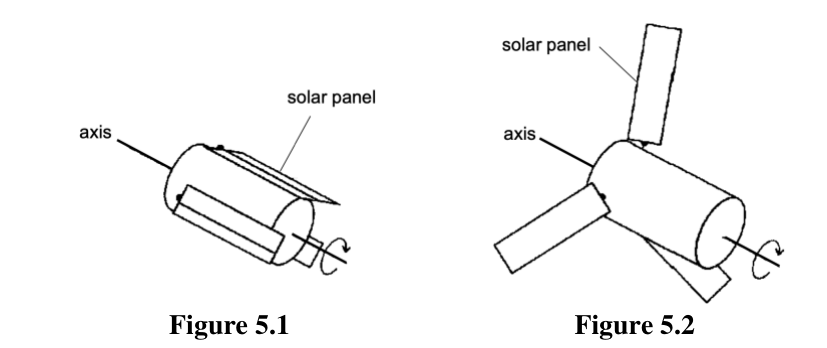 Figure 5.1 (left) and Figure 5.2 (right)
Just before it is released into space, the satellite is spun to rotate at . Once released, the solar panels are extended as shown in Figure 5.2.
- moment of inertia of the satellite about its axis with panels folded
- moment of inertia of the satellite about its axis with panels extended
Calculate the decrease in rotational kinetic energy after the solar panels have been extended. [3 marks]
Fonte: Testo (PDF) — p.13
Topic: Gravitation, Rotational Dynamics Metodi: Newton’s Law of Gravitation, Kepler’s Laws, Conservation Laws, Torque & Angular Momentum Analysis Competenze: Mathematical Modeling, Physical Reasoning Objects: Planet, Satellite
**((a)(i) ** Un veicolo spaziale cargo di massa ha un’orbita circolare iniziale di raggio intorno a un pianeta di massa . Per trasferirlo su un’orbita circolare finale di raggio si utilizza un’orbita di trasferimento Hohmann utilizzando due bruciature del motore.
Determinare un’espressione della velocità minima della sonda necessaria per entrare nell’orbita di trasferimento dall’orbita circolare iniziale in termini di , , e . *[3 punti] *
**(a) ((ii) ** Mostra che l’aumento dell’energia totale della sonda per la prima combustione è dato da
- [2 punti] *
**(((iii) ** Determinare un’espressione per il tempo di volo per il trasferimento dall’orbita iniziale alla orbita finale in termini di , , e . * [2 punti] *
**(b) ** La figura 5.1 mostra un satellite con tre pannelli solari piegati vicino all’asse del satellite per il viaggio nello spazio nella stagnazione della nave spaziale cargo.
*Figura 5.1 (sinistra) e 5.2 (destra) *
Poco prima di essere rilasciato nello spazio, il satellite viene girato per ruotare a . Una volta rilasciati, i pannelli solari vengono estesi come mostrato alla figura 5.2.
- momento di inerzia del satellite intorno al suo asse con pannelli piegati
- momento di inerzia del satellite intorno al suo asse con pannelli estesi
Calcolare la diminuzione dell’energia cinetica di rotazione dopo l’estensione dei pannelli solari. *[3 punti] *
Fonte: Testo (PDF) — p.13
Topic: Gravitation, Rotational Dynamics Metodi: Newton’s Law of Gravitation, Kepler’s Laws, Conservation Laws, Torque & Angular Momentum Analysis Competenze: Mathematical Modeling, Physical Reasoning Objects: Planet, Satellite
(a)(i) A 5.0 kg mass is hung with a long string from a frictionless, massless pulley of radius 0.10 m as shown in Figure 6. The axis of the pulley is attached to a 10-turns, rectangular loop in the horizontal plane which carries a current of 5.0 A in the direction shown. The entire loop has negligible mass and is in a uniform, horizontal magnetic field of flux density 0.50 T directed towards the left.
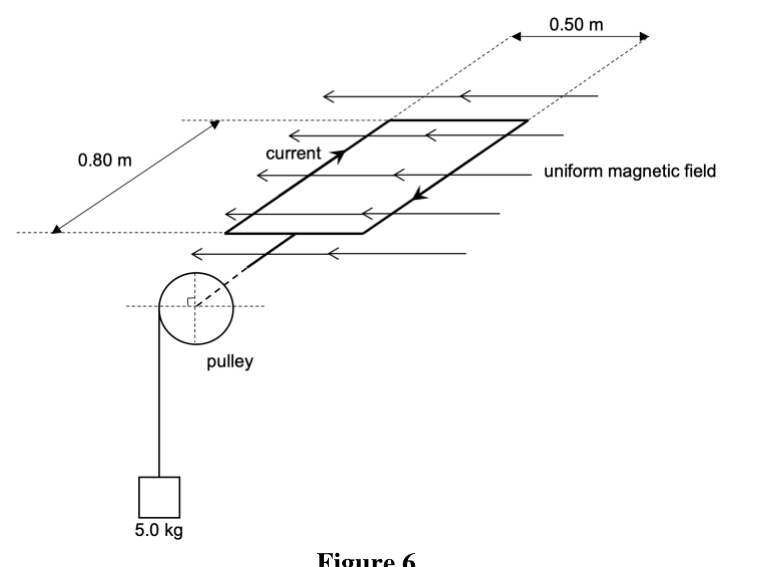 Figure 6
Determine the magnitude of the magnetic dipole moment. [2 marks]
(a)(ii) Determine the magnitude of the initial magnetic torque on the loop. [2 marks]
(b) Calculate the net torque acting on the pulley. [2 marks]
(c)(i) The magnetic torque causes the rectangular loop to rotate to a vertically upright position and the mass to move upwards.
Calculate the change in potential energy of the magnetic dipole. [2 marks]
(c)(ii) Calculate the speed of the mass at this position. [2 marks]
Fonte: Testo (PDF) — p.16
Topic: Magnetism, Conservation of Energy Metodi: Lorentz Force Analysis, Torque & Angular Momentum Analysis, Conservation of Energy Competenze: Physical Reasoning, Mathematical Modeling Objects: Pulley, String, Coil, Magnetic Dipole
**(a) (i) ** Una massa di 5,0 kg è appesa con una lunga corda da una pollice senza attrito e senza massa di raggio di 0,10 m come mostrato alla figura 6. L’asse della pollice è fissato ad un ciclo rettangolare a 10 giri nel piano orizzontale che porta una corrente di 5,0 A nella direzione indicata. L’intero ciclo ha una massa trascurabile ed è in un campo magnetico uniforme e orizzontale di densità di flusso 0,50 T diretto verso sinistra.
Figura 6
Determina la magnitudine del momento di dipolo magnetico. * [2 punti] *
**(a) ((ii) ** Determina la grandezza della coppia magnetica iniziale sul circuito. * [2 punti] *
**(b) ** Calcolare la coppia netta che agisce sulla pollice. * [2 punti] *
**(c)(i) ** La coppia magnetica fa girare il ciclo rettangolare in posizione verticale e la massa si muove verso l’alto.
Calcolare il cambiamento di energia potenziale del dipolo magnetico. * [2 punti] *
**(c)(ii) ** Calcolare la velocità della massa in questa posizione. * [2 punti] *
Fonte: Testo (PDF) — p.16
Topic: Magnetism, Conservation of Energy Metodi: Lorentz Force Analysis, Torque & Angular Momentum Analysis, Conservation of Energy Competenze: Physical Reasoning, Mathematical Modeling Objects: Pulley, String, Coil, Magnetic Dipole
(a) Consider a circuit consisting of a resistor of resistance , inductor of inductance and a capacitor of capacitance as shown in Figure 7. The capacitor is initially fully charged at time .
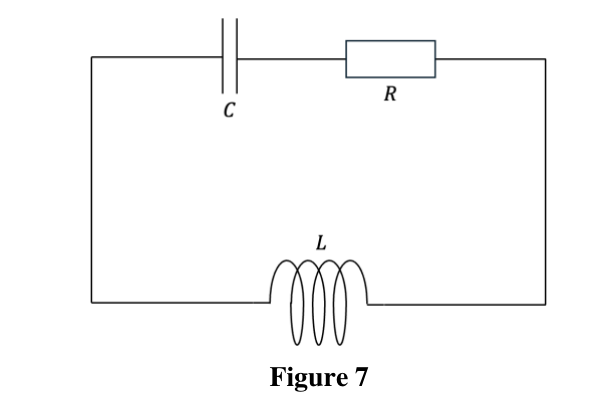 Figure 7
Given that the potential difference in the capacitor is governed by the differential equation
Show that is a solution to the differential equation above where . Hence, write down an equation for in terms of , and . [5 marks]
(b)(i) Given that , and , calculate the oscillation frequency of the circuit and the time taken for the amplitude of oscillation to decay to 10.0 % of its original value. [3 marks]
(b)(ii) Calculate the value of that would result in a critically damped circuit. [2 marks]
Fonte: Testo (PDF) — p.19
Topic: Circuits, Oscillations & Waves Metodi: Differential Equations, Kirchhoff’s Laws, Simple Harmonic Motion Analysis Competenze: Mathematical Modeling, Physical Reasoning Objects: Resistor, Inductor, Capacitor
**(a) ** Si consideri un circuito costituito da un resistore di resistenza , un induttore di induttanza e un condensatore di capacità come mostrato alla figura 7. Il condensatore è inizialmente completamente carico al tempo .
Figura 7
Dato che la differenza di potenziale nel condensatore è regolata dall’equazione differenziale
Mostra che è una soluzione dell’equazione differenziale sopra dove . Quindi, scrivete un’equazione per in termini di , e . * [5 punti] *
**((b)(i) ** Dato che , e , calcolare la frequenza di oscillazione del circuito e il tempo necessario per la decadenza dell’ampiezza di oscillazione al 10,0% del suo valore originale. *[3 punti] *
**(b)(ii) ** Calcolare il valore di che avrebbe come risultato un circuito gravemente umedezzato. * [2 punti] *
Fonte: Testo (PDF) — p.19
Topic: Circuits, Oscillations & Waves Metodi: Differential Equations, Kirchhoff’s Laws, Simple Harmonic Motion Analysis Competenze: Mathematical Modeling, Physical Reasoning Objects: Resistor, Inductor, Capacitor
(a) A spacecraft is moving at a constant velocity relative to an observer on Earth. The spacecraft is traveling in a straight line from point A to point B, which are 10 light-years apart as measured in Earth’s frame.
Calculate the time it takes for the spacecraft to travel from point A to point B as measured by the observer on Earth if the velocity of the spacecraft is , where is the speed of light. [2 marks]
(b) Determine the time experienced by a clock on the spacecraft for the journey from A to B. [3 marks]
(c) Suppose a light signal is sent from point A to point B just as the spacecraft passes point A. How much time does it take for the signal to reach point B as measured by:
- i. The observer on Earth.
- ii. The astronaut on the spacecraft.
[3 marks]
(d) Assume that when the spacecraft reaches point B, a signal is sent back to point A. According to the observer on Earth, do the events “spacecraft reaches point B” and “signal reaches point A” occur simultaneously? Explain your reasoning. [2 marks]
Fonte: Testo (PDF) — p.23
Topic: Special Relativity Metodi: Lorentz Transformation, Relativistic Energy-Momentum, Physical Modeling Competenze: Physical Reasoning, Mathematical Modeling Objects: —
**(a) ** Una nave spaziale si muove a velocità costante rispetto ad un osservatore sulla Terra. La sonda spaziale viaggia in linea retta dal punto A al punto B, che sono a 10 anni luce di distanza, come misurato nel quadro terrestre.
Calcolare il tempo necessario per il viaggio della sonda da punto A al punto B, misurato dall’osservatore sulla Terra, se la velocità della sonda è , dove è la velocità della luce. * [2 punti] *
**(b) ** Determinare il tempo vissuto da un orologio sulla sonda spaziale per il viaggio da A a B. *[3 punti] *
**(c) ** Supponiamo che un segnale luminoso venga inviato dal punto A al punto B proprio mentre la sonda spaziale passa il punto A. Quanto tempo ci vuole per raggiungere il punto B, come misurato da:
- i. L’osservatore sulla Terra.
- ii. L’astronauta sulla sonda spaziale.
*[3 punti] *
**(d) ** Supponiamo che quando la sonda raggiunge il punto B, un segnale venga inviato indietro al punto A. Secondo l’osservatore sulla Terra, gli eventi “la sonda spaziale raggiunge il punto B” e “il segnale raggiunge il punto A” si verificano contemporaneamente? Spiegate il vostro ragionamento. * [2 punti] *
Fonte: Testo (PDF) — p.23
Topic: Special Relativity Metodi: Lorentz Transformation, Relativistic Energy-Momentum, Physical Modeling Competenze: Physical Reasoning, Mathematical Modeling Objects: —
(a) One mole of helium gas, initially at state A where pressure is 101.3 kPa and temperature is 5.0 °C, undergoes a process in which pressure falls to half its initial value at constant volume to state B. It then expands at the same pressure, doubling its volume, to state C.
Calculate the total work done by the gas. [2 marks]
(b) Suppose the gas undergoes a process from state A to state C at constant temperature, determine the work done by the gas. [3 marks]
Fonte: Testo (PDF) — p.26
Topic: Thermodynamics Metodi: Ideal Gas Law, First Law of Thermodynamics, Calculus-Integration Competenze: Mathematical Modeling, Physical Reasoning Objects: Gas
**(a) ** Un mole di gas elio, inizialmente allo stato A, dove la pressione è di 101,3 kPa e la temperatura è di 5.0 °C, subisce un processo in cui la pressione scende alla metà del suo valore iniziale al volume costante allo stato B. Si espandono poi alla stessa pressione, raddoppiando il volume, per ottenere lo stato C.
Calcolare il lavoro totale svolto dal gas. * [2 punti] *
**(b) ** Supponiamo che il gas subisca un processo dallo stato A allo stato C a temperatura costante, determinando il lavoro svolto dal gas. *[3 punti] *
Fonte: Testo (PDF) — p.26
Topic: Thermodynamics Metodi: Ideal Gas Law, First Law of Thermodynamics, Calculus-Integration Competenze: Mathematical Modeling, Physical Reasoning Objects: Gas
(a) Figure 10 shows an opaque screen in which there are two narrow parallel slits, P and Q, separated by a distance .
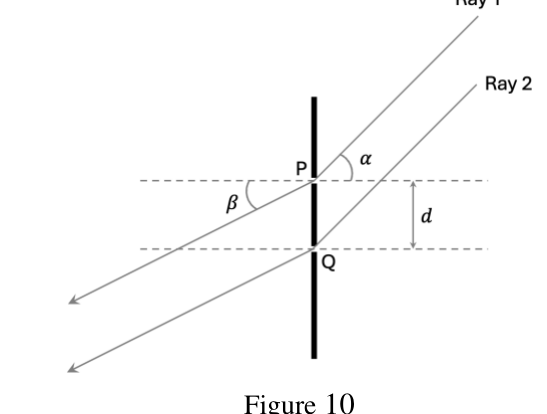 Figure 10
A beam of monochromatic light of wavelength is incident on the screen at an angle to the normal. Consider light emerging from the slits at an angle to the normal.
Find an expression for the total path difference between rays 1 and 2 as a result of passing through the slits. Hence find the condition for the light emerging at angle to be of maximum intensity. [2 marks]
(b) Show that, for small values of the angle , the angular separation between adjacent maxima in the emergent light is independent of the angle of incidence . [3 marks]
Fonte: Testo (PDF) — p.27
Topic: Wave Optics Metodi: Interference & Diffraction Analysis, Superposition Principle, Small-Angle Approximation Competenze: Physical Reasoning, Diagrammatic Reasoning Objects: Screen, Slit
**(a) ** La figura 10 mostra uno schermo opaco in cui ci sono due strette fessure parallele, P e Q, separate da una distanza .
Figura 10
Un fascio di luce monocromatica di lunghezza d’onda si incide sullo schermo ad un angolo rispetto alla normalità. Considera la luce che emerge dalle fessure ad un angolo verso la normalità.
Trova un’espressione per la differenza totale tra i raggi 1 e 2 a seguito del passaggio attraverso le fessure. Si deve quindi trovare la condizione per la luce che emerge all’angolo di essere di intensità massima. * [2 punti] *
**(b) ** Mostra che, per piccoli valori dell’angolo , la separazione angolare tra le massime adiacenti nella luce emergente è indipendente dall’angolo di incidenza . *[3 punti] *
Fonte: Testo (PDF) — p.27
Topic: Wave Optics Metodi: Interference & Diffraction Analysis, Superposition Principle, Small-Angle Approximation Competenze: Physical Reasoning, Diagrammatic Reasoning Objects: Screen, Slit