- Massa molecolare
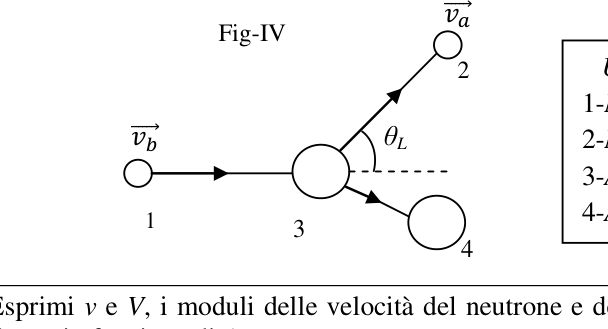
p.2 — Fig-IV urto neutrone-moderatore nel laboratorio
Topic: Nuclear & Particle Physics, Thermodynamics Metodi: Physical Modeling, Dimensional Analysis Competenze: Physical Reasoning, Unit Conversion Objects: — Fonte: Testo (PDF) — p.1 Soluzione: Soluzioni (PDF)
- The molecular weight
The test chemical is a chemical compound with a molecular formula of 0.3 μm.
Topic: Nuclear & Particle Physics, Thermodynamics Metodi: Physical Modeling, Dimensional Analysis Competenze: Physical Reasoning, Unit Conversion Objects: — Fonte: Testo (PDF) — p.1 Soluzione: Soluzioni (PDF)
- Densità
Topic: Nuclear & Particle Physics, Thermodynamics Metodi: Physical Modeling, Dimensional Analysis Competenze: Physical Reasoning, Unit Conversion Objects: — Fonte: Testo (PDF) — p.1 Soluzione: Soluzioni (PDF)
- Density
Topic: Nuclear & Particle Physics, Thermodynamics Metodi: Physical Modeling, Dimensional Analysis Competenze: Physical Reasoning, Unit Conversion Objects: — Fonte: Testo (PDF) — p.1 Soluzione: Soluzioni (PDF)
- Punto di fusione K
Topic: Thermodynamics, Nuclear & Particle Physics Metodi: Physical Modeling, Dimensional Analysis Competenze: Physical Reasoning, Unit Conversion Objects: — Fonte: Testo (PDF) — p.1 Soluzione: Soluzioni (PDF)
- Melting point K
Topic: Thermodynamics, Nuclear & Particle Physics Metodi: Physical Modeling, Dimensional Analysis Competenze: Physical Reasoning, Unit Conversion Objects: — Fonte: Testo (PDF) — p.1 Soluzione: Soluzioni (PDF)
- Conduttività termica
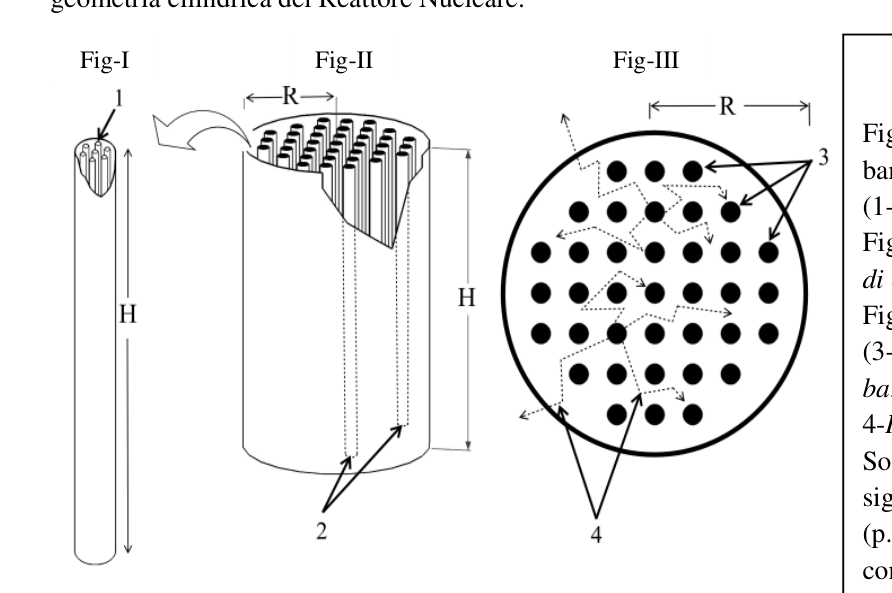
A1 Considera la seguente reazione di fissione di un atomo fermo di U , che assorbe un neutrone di energia cinetica trascurabile, Stima l’energia totale di fissione (in MeV) che viene rilasciata. Le masse nucleari sono: u; u; u; u con . Trascura lo sbilanciamento di carica. 0.8 A2 Stima il numero di atomi di U per unità di volume presenti nel composto UO. 0.5 A3 Assumi che la densità del flusso dei neutroni sia e sia uniforme nel combustibile. La sezione d’urto di fissione (area efficace del nucleo bersaglio) di un nucleo di U è . Se lo 80.00% dell’energia di fissione è disponibile come calore, stima il tasso (in W m) di produzione di calore per unità di volume nell’elemento di combustibile. J. 1.2 A4 La differenza di temperatura nello stato di equilibrio tra il centro () e la superficie () dell’elemento di combustibile si può esprimere come , dove è una costante adimensionale e è il raggio dell’elemento di combustibile. Ricava usando l’analisi dimensionale. Ricorda che è la conduttività termica del composto UO. 0.5 Disegno schematico di un Reattore Nucleare (NR) Fig-I: Vista ingrandita di una barra di combustibile (1-elementi di combustibile) Fig-II: Vista del NR (2-Barre di combustibile) Fig-III: Vista dall’alto del NR (3-Disposizione quadrata delle barre di combustibile e 4-Percorsi tipici dei neutroni). Sono mostrati solo gli elementi significativi per il problema (p.e. non compaiono le barre di controllo e il refrigerante). Fig-I Fig-II Fig-III
A5 La temperatura desiderata del refrigerante è K. Stima il limite superiore del raggio dell’elemento di combustibile. 1.0
B Il Moderatore Considera l’urto elastico bidimensionale tra un neutrone di massa 1 u e un atomo moderatore di massa u. Prima della collisione gli atomi moderatori sono considerati fermi nel sistema di riferimento del laboratorio (LF). Siano e le velocità del neutrone nel riferimento LF, rispettivamente prima e dopo l’urto. Sia la velocità del sistema di riferimento del centro di massa (CM) rispetto al riferimento LF e sia l’angolo di diffusione del neutrone nel riferimento CM. Tutte le particelle coinvolte nell’urto si muovono a velocità non relativistiche.
B1 Nella Fig-IV è mostrato schematicamente l’urto nel riferimento LF, dove rappresenta l’angolo di diffusione. Disegna schematicamente l’urto visto nel sistema di riferimento del CM. Segna nella figura le velocità delle particelle 1, 2 e 3 esprimendole in funzione di , e . Indica l’angolo di diffusione .
1.0 B2 Esprimi e , i moduli delle velocità del neutrone e dell’atomo moderatore nel riferimento del CM dopo l’urto, in funzione di e . 1.0 B3 Ricava un’espressione per , dove e sono le energie cinetiche del neutrone, nel riferimento del laboratorio LF, rispettivamente prima e dopo l’urto, e . 1.0 B4 Assumi che la precedente espressione valga per la molecola di DO. Calcola la massima perdita frazionale possibile di energia del neutrone , nel caso del moderatore di DO (20 u). 0.5
C
Il Reattore Nucleare Per far funzionare il reattore nucleare NR (in uno stato stazionario) con un dato flusso costante di neutroni , la perdita di neutroni deve essere compensata da un eccesso di produzione dei neutroni nel reattore. Per un reattore di geometrica cilindrica il tasso di perdita è e il tasso di eccesso di produzione è . Le costanti e dipendono dalle proprietà del materiale del reattore NR.
C1 Considera un reattore NR con m e . Considerando che per un dato volume il tasso di perdita deve essere reso minimo per un’efficiente utilizzazione del combustibile, ricava le dimensioni del reattore NR in condizione di stato stazionario. 1.5 C2 Le barre di combustibile sono disposte in uno schema quadrato (Fig-III) in cui le barre di combustibile più vicine distano 0.286 m. Il raggio efficace di una barra di combustibile (quello che avrebbe se fosse solida) vale m. Stima il numero di barre di combustibile presenti nel reattore e la massa di UO necessaria per far funzionare il reattore NR nello stato stazionario. 1.0
Urto nel riferimento del laboratorio 1-Neutrone prima dell’urto 2-Neutrone dopo l’urto 3-Atomo moderatore prima dell’urto 4-Atomo moderatore dopo l’urto 1 3 Fig-IV 2 4
p.1 — Schema reattore: barra, elemento combustibile, sezione cilindrica
Topic: Nuclear & Particle Physics, Thermodynamics, Conservation of Momentum Metodi: Mass-Energy Equivalence, Dimensional Analysis, Conservation of Energy, Conservation of Momentum Competenze: Physical Reasoning, Mathematical Modeling, Estimation & Approximation Objects: Nucleus, Atom Fonte: Testo (PDF) — p.1 Soluzione: Soluzioni (PDF)
- The heat conductivity
A1 Consider the following fission reaction of a stationary atom of U , which absorbs an energy neutron the kinetic energy of the system, Estimate the total fission energy (in MeV) released. The nuclear masses are: u; u; u; u con . It’s tracking the load imbalance. 0.8 A2 Estimate the number of atoms of U per unit volume present in the compound UO. 0.5 A3 Assume that the neutron flow density is and is uniform in fuel. La The fractional section (effective area of the target nucleus) of a U nucleus is . Se The rate of production of the Fusion Energy is estimated to be (in W m) heat per unit volume in the fuel element. J. 1.2 A4 The difference in temperature in equilibrium state between the centre () and the surface () of the element of The fuel can be expressed as , where is a dimensionless constant and is the The fuel element radius. It takes using dimensional analysis. Remember that is the The thermal conductivity of the compound UO. 0.5 Schematic drawing of a The following information is provided for in the Annex to this Regulation: Figure I: Enlarged view of a Fuel bar (Fluent) Figure II: View of the NR (2-bar) (Fluent) Figure III: View from the top of the NR (3-square arrangement of the fuel rods and 4-Typical neutron pathways). Only the elements are shown significant to the problem (p.e. The bars of the control and refrigerant). The following is the list of the countries of the European Union: Fig-II Figure III
A5 The desired temperature of the refrigerant is K. Estimate the upper limit of the beam The fuel element. 1.0
B The Moderator It considers the two-dimensional elastic shock between a neutron of mass 1 u and a moderating atom of mass u. Before the collision the moderating atoms are considered stationary in the laboratory reference system (LF). The neutron speeds in the reference LF are and , respectively, before and after impact. Sia The speed of the centre of mass (CM) reference system with respect to the reference LF and is the angle of the neutron diffusion in the CM reference. All particles involved in the impact move at speeds not exceeding The theory of relativity.
B1 In Figure IV the impact in the reference LF is shown schematically, where represents the angle of The Commission shall adopt the following measures: It diagrams the impact seen in the CM reference system. The following is the figure: the velocities of particles 1, 2 and 3 expressed as a function of , and . Indicate the angle of diffusion .
1.0 B2 The modules of the neutron and moderator atomic velocities in the CM reference are and after l’urto, in funzione di e . 1.0 B3 It is an expression for , where and are the kinetic energies of the neutron, in the reference of the LF laboratory, respectively before and after impact, and . 1.0 B4 Assume that the previous expression is true for the molecule of DO. Calculate the maximum fractional loss The neutron energy is possible in the case of the DO moderator (20 u). 0.5
C
The Nuclear Reactor To operate the NR nuclear reactor (in a stationary state) with a given constant flow of neutrons , the loss of neutrons must be compensated by excess neutron production in the reactor. For a cylindrical geometry reactor the rate of loss is and the rate of excess of The production is . The constants and depend on the properties of the NR reactor material.
C1 Consider an NR reactor with m and . Whereas for a given The rate of loss must be kept to a minimum for efficient fuel use, the size of the NR reactor in stationary condition. 1.5 C2 The fuel rods are arranged in a square pattern (Fig-III) in which the fuel rods are more The distance between the two is 0.286 m. The effective radius of a fuel rod (what it would have if it were solid) vale m. Estimate the number of fuel rods in the reactor and the mass of UO necessary to operate the NR reactor in stationary condition. 1.0
Urte in the laboratory reference 1-Neutron before impact 2-Neutron after impact 3-Atom moderator before impact 4-Atom moderator after impact 1 3 Figure IV 2 4
p.1 — Schema reattore: barra, elemento combustibile, sezione cilindrica
Topic: Nuclear & Particle Physics, Thermodynamics, Conservation of Momentum Metodi: Mass-Energy Equivalence, Dimensional Analysis, Conservation of Energy, Conservation of Momentum Competenze: Physical Reasoning, Mathematical Modeling, Estimation & Approximation Objects: Nucleus, Atom Fonte: Testo (PDF) — p.1 Soluzione: Soluzioni (PDF)