Theory Italiano (Italy) Q1-1 Due problemi di Meccanica (10 punti) Prima di iniziare questo problema, leggi le istruzioni di carattere generale fornite a parte. Parte A. Il disco nascosto (3.5 punti) Si consideri un disco solido di legno di raggio e spessore . Da qualche parte al suo interno il legno è stato sostituito da un disco di metallo di raggio e spessore . Il disco di metallo è posizionato in maniera tale che il suo asse di simmetria è parallelo all’asse di simmetria del disco di legno, e si trova alla stessa distanza dalle due facce del disco di legno. Sia la distanza tra . La densità del legno è , la densità del metallo è . La massa complessiva del disco di legno e del disco di metallo al suo interno è . In questo problema, il disco si trova su un piano in modo che può liberamente ruotare a destra e a sinistra. In Fig. 1 sono mostrate una vista laterale e una vista dall’alto del dispositivo. L’obiettivo di questo problema è di determinare la dimensione e la posizione del disco di metallo. Nel seguito, quando viene richiesto di esprimere il risultato in termini di quantità note, devi sempre assumere che le seguenti grandezze siano note: . (1) L’obiettivo è di determinare , e , attraverso misure indirette. S B r1 d r2 S B r1 h1 r2 h2 a) b) Figura 1: a) vista laterale b) vista dall’alto Sia la distanza tra il centro di massa dell’intero sistema e l’asse di simmetria del disco di legno. Allo scopo di determinare questa distanza, progettiamo il seguente esperimento: si collochi il disco di legno su una base orizzontale in modo tale che si trovi in equilibrio stabile. Ora si inclini leggermente la base di un angolo (vedasi Fig. 2). A causa della presenza dell’attrito statico il cilindro di legno può rotolare liberamente senza slittare. Esso rotolerà di poco verso il basso lungo il piano inclinato e poi si fermerà in una situazione di equilibrio stabile dopo essere ruotato di un angolo che è possibile misurare.
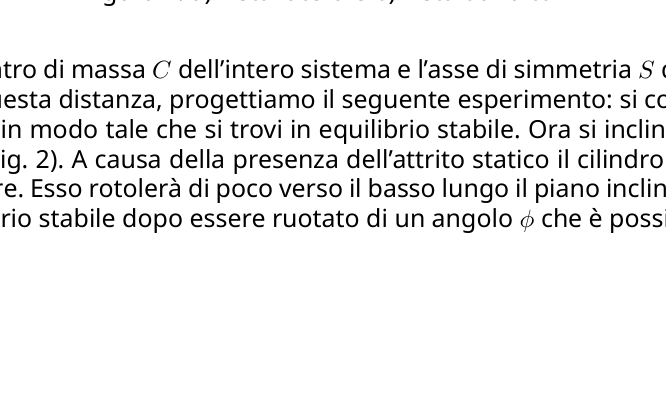
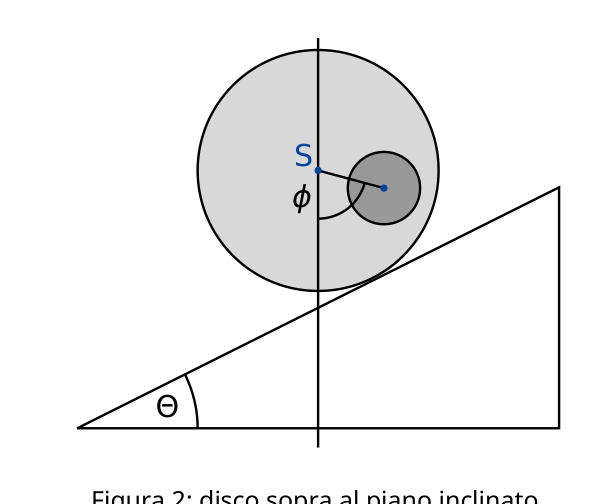
Theory Italiano (Italy) Q1-2 S Figura 2: disco sopra al piano inclinato. A.1 Scrivere un’espressione di in funzione delle grandezze indicate in (1), dell’angolo e dell’angolo di inclinazione del piano inclinato. 0.8pt Da ora in avanti si può assumere che il valore di sia noto. S Figura 3: Disco sospeso. Ora si vuole determinare il momento di inerzia del sistema rispetto all’asse di simmetria . Per questo scopo il disco di legno viene sospeso al suo asse di simmetria mediante un’asta rigida. Quindi il disco viene ruotato dalla sua posizione di equilibrio di un piccolo angolo , e lasciato andare. Vedere la figura 3 che mostra il montaggio. Si trova che descrive un moto periodico di periodo .
Theory Italiano (Italy) Q1-3 A.2 Trovare l’equazione del moto dell’angolo . Esprimere il momento di inerzia del sistema rispetto all’asse di simmetria in funzione di , e delle grandezze note indicate in (1). Si può assumere che ci si sposta dalla posizione di equilibrio solamente di piccole quantità cosicché è sempre molto piccolo. 0.5pt Dai risultati ricavati nelle domande A.1 e A.2, si vuole determinare la geometria e la posizione del disco di metallo interno al disco di legno. A.3 Ricavare un’espressione della distanza in funzione di e delle grandezze indicate in (1). Nella tua espressione puoi anche includere le grandezze e come variabili, poiché esse saranno successivamente determinate nella domanda A.5. 0.4pt A.4 Ricavare un’espressione per il momento di inerzia in funzione di e delle grandezze note indicate in (1). Nella tua espressione puoi anche includere le grandezze e come variabili, poiché esse saranno successivamente determinate nella domanda A.5. 0.7pt A.5 Usando tutti i risultati precedenti, scrivere un’espressione per e in funzione di , e delle grandezze note indicate in (1). Puoi esprimere come una funzione di . 1.1pt Parte B. Stazione Spaziale Rotante (6.5 punti) Alice è un’astronauta che vive in una stazione spaziale. La stazione spaziale è una gigantesca ruota di raggio che gira intorno al proprio asse, generando in questo modo una gravità artificiale per gli astronauti. Gli astronauti vivono nella parte interna del cerchione della ruota. Possono essere trascurati l’attrazione gravitazionale della stazione spaziale e localmente la curvatura della pavimentazione. B.1 Con quale velocità angolare la stazione spaziale deve ruotare in modo tale che gli astronauti percepiscano la stessa gravità che percepirebbero sulla superficie terrestre? 0.5pt Alice e il suo amico astronauta Bob hanno una disputa. Bob non crede che si trovino effettivamente dentro una stazione spaziale e ritiene di essere sulla Terra. Alice, usando argomenti di fisica, vuole dimostrare a Bob che si trovano dentro ad una stazione spaziale rotante. A tal fine, appende una massa ad una molla di costante elastica e la mette in oscillazione. La massa può oscillare solamente in direzione verticale e non può muoversi in direzione orizzontale. B.2 Assumendo che sulla Terra la gravità sia costante e valga , quale sarebbe la frequenza di oscillazione del sistema misurata da una persona che si trova sulla Terra? 0.2pt B.3 Qual è la frequenza di oscillazione misurata da Alice sulla stazione spaziale? 0.6pt Alice è convinta che il suo esperimento dimostri che si trovano dentro una stazione spaziale rotante. Bob rimane scettico. Egli controbatte che se si prendesse in considerazione la variazione della gravità sulla
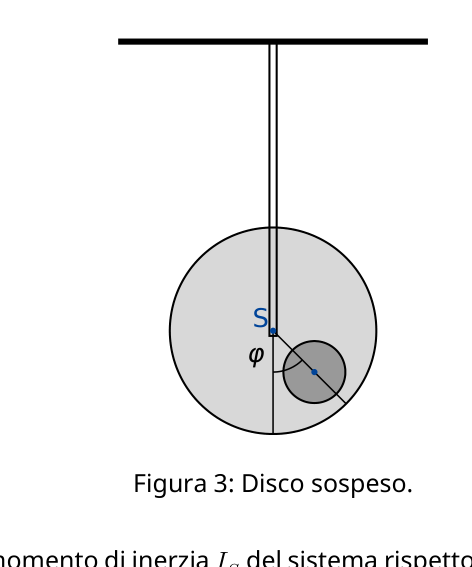
Theory Italiano (Italy) Q1-4 superficie terrestre si otterrebbero risultati analoghi. Nel successivo passaggio studieremo se Bob ha ragione. R Figura 4: Stazione spaziale B.4 Ricava un’espressione per la gravità per piccole altezze sopra la superficie terrestre e calcola la frequenza di oscillazione della massa oscillante (un’approssimazione lineare è più che sufficiente). Indica con il raggio della Terra. Trascura la rotazione della Terra. 0.8pt Effettivamente, per questa stazione spaziale Alice trova che il pendolo a molla oscilla con la frequenza prevista da Bob. B.5 Per quale raggio della stazione spaziale la frequenza di oscillazione è uguale alla frequenza di oscillazione sulla Terra? Esprimi la tua risposta in funzione di . 0.3pt Esasperata dalla testardaggine di Bob, Alice suggerisce un ulteriore esperimento per provare il suo punto di vista. A tal fine sale sulla cima di una torre di altezza rispetto al pavimento della stazione spaziale e lascia cadere una massa. Questo esperimento può essere spiegato sia nel sistema di riferimento rotante così come in un sistema di riferimento inerziale. In un sistema di riferimento rotante in modo uniforme, gli astronauti percepiscono una forza fittizia detta forza di Coriolis. La forza che agisce su un oggetto di massa che si muove con velocità in un riferimento rotante con velocità angolare costante è data da (2) In termini di grandezze scalari si ha (3)
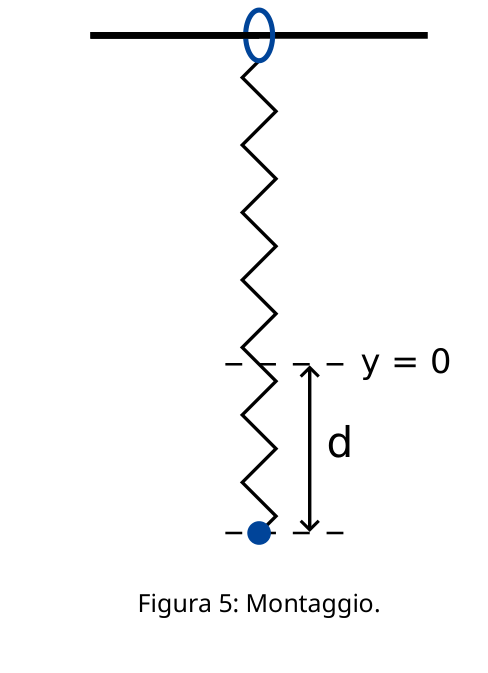
Theory Italiano (Italy) Q1-5 dove è l’angolo tra la velocità e l’asse di rotazione. La forza è perpendicolare sia alla velocità che all’asse di rotazione. Il verso della forza può essere determinato con la regola della mano destra, ma in quello che segue lo puoi scegliere a tuo piacimento. B.6 Calcola la velocità orizzontale e lo spostamento orizzontale (relativo alla base della torre, in direzione perpendicolare alla torre stessa) della massa nell’istante in cui tocca la pavimentazione. Puoi assumere che l’altezza della torre sia piccola, così che l’accelerazione misurata dagli astronauti sia costante durante la caduta. Inoltre puoi assumere che sia . 1.1pt Per ottenere un buon risultato, Alice decide di condurre questo esperimento da una torre molto più alta della precedente. Con sua sorpresa, la massa tocca la pavimentazione alla base della torre, così che . B.7 Trova la minima altezza della torre per la quale accade che . 1.3pt Alice è desiderosa di fare un ultimo tentativo per convincere Bob. Vuole usare il suo precedente oscillatore a molla per mostrare gli effetti della forza di Coriolis. A tal fine modifica il montaggio precedente: attacca la molla a un anello che può scivolare liberamente lungo un’asta orizzontale in direzione senza attrito. La molla oscilla in direzione . L’asta è parallela alla pavimentazione e perpendicolare all’asse di rotazione della stazione spaziale. Il piano è così perpendicolare all’asse di rotazione, con la direzione che punta diritta verso il centro di rotazione della stazione. y = 0 d Figura 5: Montaggio.
Theory Italiano (Italy) Q1-6 B.8 Alice spinge la massa a distanza verso il basso rispetto al punto di equilibrio , , e poi la lascia andare (vedi figura 5).
- Fornisci un’espressione algebrica per e . Puoi assumere che la quantità sia piccola, e trascurare la forza di Coriolis per il moto lungo l’asse .
- Disegna la traiettoria , evidenziando tutte le caratteristiche importanti come per esempio l’ampiezza. 1.7pt Alice e Bob continuano a litigare.
p.1 — Disco: vista laterale e dall’alto
p.2 — Disco sopra al piano inclinato
p.2 — Disco sospeso ad asta rigida
p.4 — Stazione spaziale rotante
p.5 — Montaggio molla con anello
Topic: Newtonian Mechanics, Rotational Dynamics, Oscillations & Waves Metodi: Free-Body Diagram, Torque & Angular Momentum Analysis, Simple Harmonic Motion Analysis, Small-Angle Approximation, Vector Decomposition, Kinematic Equations Competenze: Mathematical Modeling, Physical Reasoning, Diagrammatic Reasoning Objects: Disk, Inclined Plane, Spring Fonte: Testo (PDF) — p.1 Soluzione: Soluzioni (PDF)
Theory Italiano (Italy)
Q1-1 Two Mechanics Problems (10 points)
Before starting this problem, read the general instructions provided separately.
Part A. The Hidden Disk (3.5 points)
Consider a solid wooden disk of radius and thickness . Somewhere inside, the wood has been replaced by a metallic disk of radius and thickness . The metallic disk is positioned such that its symmetry axis is parallel to the symmetry axis of the wooden disk, and it lies at equal distance from both faces of the wooden disk. Let be the distance between and . The density of wood is , the density of metal is . The total mass of the wooden disk with the metallic disk inside it is .
In this problem, the disk lies on a plane such that it can freely rotate left and right. Figure 1 shows a side view and a top view of the device.
The goal of this problem is to determine the size and position of the metallic disk.
In what follows, whenever you are asked to express a result in terms of known quantities, always assume the following quantities are known: . (1)
The objective is to determine , , and through indirect measurements.
S B r1 d r2 S B r1 h1 r2 h2
a) b)
Figure 1: a) side view b) top view Let be the distance between the center of mass of the entire system and the axis of symmetry of the wooden disk. To determine this distance, we design the following experiment: place the wooden disk on a horizontal base such that it is in stable equilibrium. Now tilt the base slightly by an angle (see Figure 2). Due to static friction, the wooden cylinder can roll freely without slipping. It will roll a short distance downward along the inclined plane and then come to rest in a new stable equilibrium position after having rotated by an angle , which can be measured.
Theory Italiano (Italy) Q1-2 S Figure 2: disk on the inclined plane. A.1 Write an expression for in terms of the quantities indicated in (1), the angle , and the inclination angle of the inclined plane. 0.8pt From now on, it may be assumed that the value of is known. S Figure 3: Suspended disk.
Now we wish to determine the moment of inertia of the system about the axis of symmetry . To this end, the wooden disk is suspended from its axis of symmetry by a rigid rod. Then, the disk is rotated slightly away from its equilibrium position by an angle and released. See Figure 3, which shows the setup. It is found that undergoes periodic motion with period .
Theory Italiano (Italy) Q1-3 A.2 Find the equation of motion for the angle . Express the moment of inertia of the system about the axis of symmetry as a function of , , and the known quantities indicated in (1). It may be assumed that motion is restricted to small displacements from equilibrium, so that remains always very small. 0.5pt
From the results obtained in questions A.1 and A.2, determine the geometry and position of the internal metal disk within the wooden disk.
A.3 Derive an expression for the distance as a function of and the quantities indicated in (1). In your expression, you may also include and as variables, since these will be determined later in question A.5. 0.4pt
A.4 Derive an expression for the moment of inertia as a function of and the known quantities indicated in (1). In your expression, you may also include and as variables, since these will be determined later in question A.5. 0.7pt
A.5 Using all the previous results, write expressions for and as functions of , , and the known quantities indicated in (1). You may express as a function of . 1.1pt
Part B. Rotating Space Station (6.5 points) Alice is an astronaut living on a space station. The space station is a huge wheel of radius rotating around its own axis, thereby generating artificial gravity for the astronauts. The astronauts live on the inner surface of the wheel’s rim. Gravitational attraction from the space station itself and locally, the curvature of the floor can be neglected.
B.1 With what angular velocity must the space station rotate so that the astronauts perceive the same gravity as they would on Earth’s surface? 0.5pt
Alice and her fellow astronaut Bob are in disagreement. Bob does not believe they are actually inside a space station, and thinks he is on Earth. Alice wants to prove to Bob that they are inside a rotating space station, using arguments from physics. To this end, she hangs a mass from a spring with spring constant and sets it into vertical oscillation. The mass can only oscillate vertically and cannot move horizontally.
B.2 Assuming on Earth gravity is constant and equal to , what would be the oscillation frequency of the system as measured by a person on Earth? 0.2pt
B.3 What is the oscillation frequency measured by Alice on the space station? 0.6pt Alice is convinced that her experiment demonstrates they are inside a rotating space station. Bob remains skeptical. He counters that if one considered the variation of gravity on Earth’s surface, similar results would be obtained. In the following section we will examine whether Bob is correct.
R Figure 4: Space station
B.4 Derive an expression for gravity at small heights above Earth’s surface, and calculate the oscillation frequency of the oscillating mass (a linear approximation is more than sufficient). Let denote Earth’s radius. Neglect Earth’s rotation.
0.8pt
Indeed, for this space station Alice finds that the spring pendulum oscillates with the frequency predicted by Bob.
B.5 For what radius of the space station is the oscillation frequency equal to the oscillation frequency on Earth? Express your answer in terms of .
0.3pt
Frustrated by Bob’s stubbornness, Alice suggests a further experiment to prove her point of view. To this end, she climbs to the top of a tower of height above the floor of the space station and drops a mass. This experiment can be explained both in the rotating reference frame and in an inertial reference frame.
In a uniformly rotating reference frame, astronauts perceive a fictitious force known as the Coriolis force. The force acting on an object of mass moving with velocity in a rotating reference frame with constant angular velocity is given by (2) In terms of scalar quantities, one obtains (3)
Theory Italiano (Italy) Q1-5 where is the angle between the velocity and the axis of rotation. The force is perpendicular to both the velocity and the axis of rotation. The direction of the force may be determined using the right-hand rule, but for what follows you may choose it freely.
B.6 Calculate the horizontal velocity and the horizontal displacement (relative to the base of the tower, in a direction perpendicular to the tower itself) of the mass at the instant it hits the floor. You may assume that the height of the tower is small, so that the acceleration measured by the astronauts remains constant during the fall. Additionally, you may assume that .
1.1 pt
To obtain a good result, Alice decides to carry out this experiment from a much taller tower than the previous one. To her surprise, the mass hits the floor at the base of the tower, so that .
B.7 Find the minimum height of the tower for which it happens that .
1.3 pt
Alice is eager to make one final attempt to convince Bob. She wants to use her previous spring oscillator to demonstrate the effects of the Coriolis force. To this end, she modifies the previous setup: Attach the spring to a ring that can slide freely along a horizontal rod in direction without friction. The spring oscillates in direction . The rod is parallel to the floor and perpendicular to the rotation axis of the space station. The plane is thus perpendicular to the rotation axis, with direction pointing straight toward the center of rotation of the station.
y = 0 d Figure 5: Setup.
Theory Italiano (Italy) Q1-6 B.8
Alice pushes the mass a distance downward from the equilibrium point , , and then releases it (see Figure 5).
- Provide algebraic expressions for and . You may assume that the quantity is small, and neglect the Coriolis force for motion along axis .
- Draw the trajectory , highlighting all important features such as amplitude.
1.7pt Alice and Bob continue to argue.
p.1 — Disk: side view and top view
p.2 — Disk above inclined plane
p.2 — Disk suspended by rigid rod
p.4 — Rotating space station
p.5 — Spring setup with ring
Solution: Soluzioni (PDF)