PROBLEMA n. 1 – Trittico lunare 100 Punti
A — Al chiaro di Luna…
La potenza luminosa della luce solare raccolta dalla Luna (o dalla Terra, che si trova all’incirca alla stessa distanza) è data da essendo il flusso della radiazione solare alla distanza tra Sole e sistema Terra-Luna ed il raggio della Luna. La potenza irradiata dalla Luna sarà allora e il flusso di luce diffusa che raggiunge la Terra, nell’ipotesi di diffusione isotropa, è essendo la distanza Terra-Luna. La differenza delle magnitudini di Sole e Luna piena è avendo espresso in radianti il diametro angolare della Luna: rad . NOTA: L’ipotesi di isotropia della luce diffusa dalla Luna, introdotta allo scopo di semplificare il problema, è di fatto decisamente scorretta; come conseguenza di ciò il coefficiente così ottenuto risulta sovrastimato di un fattore circa 4.
B — L’orbita lunare
Quesito n. 1. Si consideri in ogni caso un istante in cui il satellite è sulla congiungente Sole–pianeta e compreso tra questi. In entrambi i casi rappresentati in figura nel testo la traiettoria presenta una curvatura rivolta verso il pianeta. Poiché il verso della curvatura della traiettoria coincide con il verso della forza applicata è necessario (e sufficiente) che la forza risultante sia diretta verso il pianeta. Dette ed i moduli delle forze gravitazionali tra Sole e satellite e tra pianeta e satellite deve essere L’orbita presenta i “riccioli” se, nel punto considerato, la velocità del satellite rispetto al Sole ha verso opposto a quella del pianeta; poiché tale velocità si ottiene come somma vettoriale della velocità del satellite rispetto al pianeta e di quella, , del pianeta rispetto al Sole, la condizione si esprime ponendo ovvero . Identificando la forza gravitazionale con quella centripeta nel moto circolare si ha e la condizione data sopra si esprime come In tabella sono calcolate le espressioni precedenti ed è indicato il corrispondente tipo di traiettoria: Phobos, Callisto e Titano oscillano attorno ai rispettivi pianeti con movimento di andamento sinusoidale; Io e Mimas orbitano descrivendo i “riccioli”.
| Pianeta | Satellite | Traiettoria | ||||
|---|---|---|---|---|---|---|
| Terra | Luna | 0.385 | 0.450 | – | ||
| Marte | Phobos | 24.2 | 189 | (a) | ||
| Giove | Io | 1.84 | 1.76 | (b) | ||
| Callisto | 0.413 | 162 | 0.393 | (a) | ||
| Saturno | Mimas | 7.69 | 2.20 | (b) | ||
| Titano | 1.17 | 389 | 0.334 | (a) |
Topic: Astrophysics, Gravitation, Newtonian Mechanics Metodi: Newton’s Law of Gravitation, Kinematic Equations, Vector Decomposition Competenze: Mathematical Modeling, Physical Reasoning, Estimation & Approximation Objects: Planet, Satellite, Star Fonte: Testo (PDF) — p.1 Soluzione: Soluzioni (PDF)
The Commission has already taken a number of measures. 1 Lunar triticus 100 points
A By the light of the moon…
The luminous power of sunlight collected from the Moon (or from the Earth, which is located at about the same distance) is given by where is the solar radiation flow at the distance between the Sun and the Earth-Moon system and is the Moon’s radius. The power radiated by the Moon will then be and the diffuse light flow that reaches the Earth, in the hypothesis isotropic diffusion, is being the distance Earth to the Moon. The difference between the magnitude of the Sun and the full Moon is having radiantly expressed the angular diameter of the Moon: rad . NOTE: The hypothesis of isotropy of the moonlight, introduced to simplify the problem, is that the moon is not a source of light. The resulting is an overestimation of the A factor of about 4.
B Moon orbit
Question No. 1. Consider, in any event, a moment when the satellite is on the conjunctive Sun and one of these. In In both cases, the trajectory is curved towards the planet. Since the direction of curvature of the trajectory coincides with the direction of force applied, it is necessary to The resulting force is directed towards the planet. These and modules of gravitational forces between the Sun and satellite and between planet and satellite must be The orbit presents the constellations if, at the point considered, the satellite’s speed with respect to the Sun is in the opposite direction. a quella del pianeta; poiché tale velocità si ottiene come somma vettoriale della velocità del satellite rispetto The planet and the planet’s relative to the Sun, the condition is expressed as or . Identifying the gravitational force with that centripede in the circular motion has And the condition above is expressed as The following table shows the previous expressions and shows the corresponding trajectory type: Callistus and Titan oscillate around their respective planets with sinusoidal motion; I and Mimas They orbit by describing the “crossbars”.
| Pianeta | Satellite | Traiettoria | ||||
|---|---|---|---|---|---|---|
| Terra | Luna | 0.385 | 0.450 | – | ||
| Marte | Phobos | 24.2 | 189 | (a) | ||
| Giove | Io | 1.84 | 1.76 | (b) | ||
| I’m not going to be able to do this. | ||||||
| Saturno | Mimas | 7.69 | 2.20 | (b) | ||
| You know, I’m not going to be able to do this. |
Topic: Astrophysics, Gravitation, Newtonian Mechanics Metodi: Newton’s Law of Gravitation, Kinematic Equations, Vector Decomposition Competenze: Mathematical Modeling, Physical Reasoning, Estimation & Approximation Objects: Planet, Satellite, Star Fonte: Testo (PDF) — p.1 Soluzione: Soluzioni (PDF)
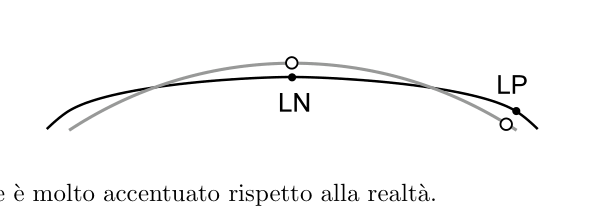
Quesito n. 2. Dalla tabella appare che per la Luna nessuna delle due condizioni è verificata; l’orbita della Luna presenta dunque la concavità sempre diretta verso il Sole, con raggio di curvatura minimo nella fase di Luna Piena e massimo nella fase di Luna Nuova, come nella figura a fianco. Notare che, per chiarezza, il rapporto dei raggi delle orbite è molto accentuato rispetto alla realtà.
C — Influenza lunare
Quesito n. 1. Il punto essenziale da considerare è la distinzione tra il centro della Terra e il centro di massa del sistema Terra–Luna che, come detto, si muove di moto circolare uniforme; trascurando gli effetti dovuti ad altre cause, il valore medio della durata dell’anno tropico coinciderebbe quindi con il periodo di rivoluzione del centro di massa; questo si trova a circa 4600 km di distanza dal centro della Terra, sulla congiungente Terra–Luna, come si ricava facilmente. Infatti in un riferimento con origine nel centro della Terra, dette ed le masse di Terra e Luna rispettivamente, il centro di massa T–L si trova calcolando con e . Al Primo Quarto, Terra e Luna sono allineate con la tangente all’orbita della Terra e il centro della Terra è in anticipo sul centro di massa di circa 2.6 minuti dato che Quindi l’equinozio (geocentrico!) avviene 2.6 minuti prima del passaggio del centro di massa. Poiché in un anno ci sono circa 12.5 cicli lunari, il successivo equinozio avviene (approssimativamente) in fase di Ultimo Quarto, guadagnando così altrettanto perché adesso il centro della Terra transita sulla linea del punto gamma dopo il centro di massa: l’anno risulta più lungo della media di circa minuti.
Quesito n. 2. Nell’anno successivo gli effetti sono opposti; l’anno è più corto di circa e, detta la durata media dell’anno tropico, la differenza tra i due anni – a causa della Luna – risulta NOTA: Come detto, ci sono molti altri effetti perturbativi sul moto della Terra, cosicché la durata di anni tropici successivi varia in modo molto più accentuato e irregolare.
p.2 — Orbita lunare, curvatura verso il Sole (LN, LP)
Topic: Gravitation, Astrophysics, Newtonian Mechanics Metodi: Newton’s Law of Gravitation, Physical Modeling, Conservation of Momentum Competenze: Mathematical Modeling, Physical Reasoning Objects: Planet, Satellite Fonte: Testo (PDF) — p.2 Soluzione: Soluzioni (PDF)
Question No. 2. The table shows that neither of these conditions is observed for the Moon; the Moon’s orbit therefore presents the concavity always directed towards the Sun, with a minimum radius of curvature in the Full Moon phase and maximum in the phase of the New Moon, as in the figure next to it. Note that, for clarity, the ratio of orbital rays is very high relative to reality.
C Lunar flu
Question No. 1. The essential point to consider is the distinction between the center of the Earth and the center of mass of the system EarthMoon which, as stated, moves in a uniform circular motion; neglecting the effects due to other causes, The average duration of the tropical year would therefore coincide with the period of the central revolution of the This is about 4600 km from the Earth’s center, on the EarthMoon connecting, as It’s easy to get rich. In fact, in a reference originating in the center of the Earth, the masses of the Earth are called and and Moon respectively, the mass center TL is calculated by with and . In the first quarter, Earth and Moon are aligned with the tangent to Earth’s orbit and the Earth’s center is The mass centre is approximately 2.6 minutes in advance, as So the equinox (geocentric!) takes place 2.6 minutes before the mass center passes. Since there are about 12.5 lunar cycles in a year, the next equinox takes place (approximately) in the year of the moon. The first is the Earth’s orbit around the Sun. Gamma point after the centre of mass: the year is longer than the average of about minutes.
Question No. 2. The effects are opposite in the following year; the year is shorter than about and, so called , the average duration is less than the average year. The difference between the two years due to the Moon is NOTE: As I said, there are many other disruptive effects on the motion of the Earth, so the duration of years The following tropical seasons vary much more accentually and irregularly.
The following table shows the total number of days in which the monthly average monthly average monthly average monthly average monthly average monthly average monthly average monthly average monthly average monthly average monthly average monthly average monthly average monthly average monthly average monthly average monthly average monthly average monthly average monthly average monthly average monthly average monthly average monthly average monthly average monthly average monthly average monthly average monthly average monthly average monthly average monthly average monthly average monthly average monthly average monthly average monthly average monthly average monthly average monthly average monthly average monthly average monthly average monthly average monthly average monthly average monthly average monthly average monthly average monthly average monthly average monthly average monthly average monthly average monthly average monthly average monthly average monthly average monthly average monthly average monthly average monthly average monthly average monthly average monthly average monthly average monthly average monthly average monthly average monthly average monthly average monthly monthly average monthly average monthly average monthly average monthly average monthly average monthly average monthly average monthly average monthly average monthly average monthly average monthly monthly average monthly monthly monthly average monthly monthly monthly average monthly monthly average monthly monthly monthly average monthly monthly monthly average monthly monthly monthly monthly monthly monthly average monthly monthly monthly monthly monthly monthly monthly average monthly monthly monthly monthly monthly monthly monthly monthly monthly monthly monthly monthly monthly monthly monthly monthly monthly monthly monthly monthly monthly monthly monthly monthly monthly monthly monthly monthly monthly monthly monthly monthly monthly monthly monthly monthly monthly monthly monthly monthly monthly monthly monthly monthly monthly monthly monthly monthly monthly monthly monthly monthly monthly monthly monthly monthly monthly monthly monthly monthly monthly monthly monthly monthly monthly monthly monthly monthly monthly monthly monthly monthly monthly monthly monthly monthly monthly monthly monthly monthly monthly monthly monthly monthly monthly monthly monthly monthly monthly monthly monthly
Topic: Gravitation, Astrophysics, Newtonian Mechanics Metodi: Newton’s Law of Gravitation, Physical Modeling, Conservation of Momentum Competenze: Mathematical Modeling, Physical Reasoning Objects: Planet, Satellite Fonte: Testo (PDF) — p.2 Soluzione: Soluzioni (PDF)
PROBLEMA n. 2 – Motore solare 100 Punti
Quesito n. 1. Poiché si trascurano le aberrazioni, l’immagine solare è semplicemente un disco il cui diametro è legato a quello della sorgente dal rapporto di ingrandimento dello specchio. La distanza solare è tale da poter assumere che l’immagine si formi alla distanza focale dello specchio: Se lo specchio viene mantenuto correttamente orientato, il cilindro deve quindi avere almeno un diametro di base pari ad . Con i dati forniti, cm.
Quesito n. 2. La radiazione solare investe lo specchio, in direzione ortogonale, secondo un cerchio di diametro . La potenza in arrivo su quest’area è e siccome non ci sono perdite per riflessione sullo specchio, questa è anche la potenza ottica sulla base del cilindro. Con i dati forniti, kW.
Quesito n. 3. A regime il cilindro costituisce un termostato a temperatura in equilibrio fra la potenza entrante e la potenza uscente, dovuta in parte alle perdite radiative e nella restante parte alla potenza termica assorbita dalla macchina. Poiché il cilindro è metallico e la sua temperatura è uniforme, la superficie radiante è quella totale. La superficie totale del cilindro equilatero è quindi le perdite radiative sono La potenza si può ricavare calcolando dapprima il rendimento, che è Se la potenza meccanica è , allora Abbiamo quindi in ultima analisi che
Topic: Thermodynamics, Geometric Optics Metodi: First Law of Thermodynamics, Thermodynamic Cycle Analysis, Thin Lens & Mirror Equation Competenze: Mathematical Modeling, Physical Reasoning Objects: Mirror, Cylinder, Heat Engine, Star Fonte: Testo (PDF) — p.3 Soluzione: Soluzioni (PDF)
The Commission has already taken a number of measures. 2 Solar engine 100 points
Question No. 1. Because aberrations are ignored, the solar image is simply a disk whose diameter is bound to the the source from the magnification ratio of the mirror. The distance from the sun is such that it can take that the image is formed at the focal length of the mirror: If the mirror is kept properly oriented, the cylinder must therefore have a diameter of at least base pari ad . With the data provided, cm.
Question No. 2. The solar radiation inserts the mirror in an orthogonal direction, according to a circle of diameter . The Power Arriving in this area is And since there are no reflection losses on the mirror, this is also the optical power based on the The cylinder. With the data provided, kW.
Question No. 3. The cylinder is a thermostat at in equilibrium between the input power and the Output power due partly to radiative losses and partly to absorbed thermal power out of the car. Since the cylinder is metallic and its temperature is uniform, the radiant surface is the The total. The total surface area of the equilateral cylinder is So the radiative losses are The power can be obtained by first calculating the yield, which is If the mechanical power is , then We have therefore in the end
Topic: Thermodynamics, Geometric Optics Metodi: First Law of Thermodynamics, Thermodynamic Cycle Analysis, Thin Lens & Mirror Equation Competenze: Mathematical Modeling, Physical Reasoning Objects: Mirror, Cylinder, Heat Engine, Star Fonte: Testo (PDF) — p.3 Soluzione: Soluzioni (PDF)
Quesito n. 4. L’equazione precedente può essere esplicitata per ricavare : da cui si ricava kW.
Topic: Thermodynamics, Geometric Optics Metodi: First Law of Thermodynamics, Thermodynamic Cycle Analysis, Physical Modeling Competenze: Mathematical Modeling, Physical Reasoning Objects: Heat Engine, Mirror, Cylinder Fonte: Testo (PDF) — p.3 Soluzione: Soluzioni (PDF)
Question No. 4. The previous equation can be expressed to : from which kW is obtained.
Topic: Thermodynamics, Geometric Optics Metodi: First Law of Thermodynamics, Thermodynamic Cycle Analysis, Physical Modeling Competenze: Mathematical Modeling, Physical Reasoning Objects: Heat Engine, Mirror, Cylinder Fonte: Testo (PDF) — p.3 Soluzione: Soluzioni (PDF)
Quesito n. 5. Conviene esprimere la funzione nella forma più compatta, in questo modo con kW, kW . La derivazione rispetto a dell’equazione precedente, per trovare il massimo, porterebbe ad un’equazione di grado (v. sotto). Per via numerica si può calcolare iniziando dal valore già ottenuto per , con un passo di a scendere. Infatti facendo il calcolo a si nota che le perdite radiative (rapidamente variabili perché dipendono da ) sono nettamente maggiori di ; quindi la temperatura di è sicuramente più alta del valore che ottimizza la potenza meccanica. Si trova che il massimo sta tra e , come appare evidente riportando i valori su un grafico, dato che .
| 1400 | 1673 | 4.30 |
| 1200 | 1473 | 8.27 |
| 1000 | 1273 | 9.05 |
| 800 | 1073 | 9.20 |
| 600 | 873 | 8.75 |
| 900 | 1173 | 9.20 |
| 850 | 1123 | 9.22 |
A questo punto (v. tabella a destra) si può procedere con metodo dicotomico, ma si trova che il valore a è uguale, entro la terza cifra, a quello a . Il valore di a è appena di poco superiore e quindi può essere accettato. Ad esso corrisponde una potenza meccanica di 9.22 kW. Con questo procedimento i calcoli numerici vengono ripetuti solo sette volte. Un modo alternativo consiste nel calcolare la derivata della e cercare per via numerica il valore di per cui essa si annulla: si può usare anche qui, in modo equivalente, il metodo dicotomico. Un metodo iterativo molto efficace si può seguire scrivendo l’equazione precedente in questa forma Poiché si ottiene una prima approssimazione di ponendo e iterando successivamente in questo modo: e La sequenza può essere limitata alle prime due iterazioni, come mostrato in tabella:
| 1076 | 1126 | 853 | 9.205 |
| 1126 | 1124 | 851 | 9.222 |
| 1124 | 1124 | 851 | 9.222 |
Topic: Thermodynamics Metodi: Differential Equations, Approximation & Series Expansion, Physical Modeling Competenze: Mathematical Modeling, Physical Reasoning, Estimation & Approximation Objects: Heat Engine, Cylinder Fonte: Testo (PDF) — p.4 Soluzione: Soluzioni (PDF)
Question No. 5. It is appropriate to express the function in the most compact form, thus with kW, kW . The derivation from of the previous equation, to find the maximum, would lead to an equation of grado (v. (see below). Per via numerica si può calcolare iniziando dal valore già ottenuto per , con un passo di a scendere. In fact, when calculating at , you notice that radiative losses (quickly variable because they depend on ) are significantly higher than ; therefore the temperature of is definitely higher than the value that optimizes the mechanical power. The maximum is found to be between and , as is evident by returning the values on a graph, given che .
| 1400 | 1673 | 4.30 |
| 1200 | 1473 | 8.27 |
| 1000 | 1273 | 9.05 |
| 800 | 1073 | 9.20 |
| 600 | 873 | 8.75 |
| 900 | 1173 | 9.20 |
| 850 | 1123 | 9.22 |
At this point (v. The value of the value of the value of the value of the value of the value of the value of the value of the value of the value of the value of the value of the value of the value of the value of the value of the value of the value of the value of the value of the value of the value of the value of the value of the value of the value of the value of the value of the value of the value of the value of the value of the value of the value of the value of the value of the value of the value of the value of the value of the value of the value of the value of the value of the value of the value of the value of the value of the value of the value of the value of the is equal, within the third digit, to . The value of to is just slightly higher and So it can be accepted. It has a mechanical output of 9.22 kW. With this procedure, numerical calculations are repeated only seven times. An alternative method is to calculate the derivative of and numerically look for the value of It shall therefore be annulled: The dictomy method can also be used here, in an equivalent way. A very effective iterative method can be followed by writing the previous equation in this form Since is obtained by first approximating by placing and then iterating into This way: e The sequence may be limited to the first two iterations, as shown in the table:
| 1076 | 1126 | 853 | 9.205 |
| 1126 | 1124 | 851 | 9.222 |
| 1124 | 1124 | 851 | 9.222 |
Topic: Thermodynamics Metodi: Differential Equations, Approximation & Series Expansion, Physical Modeling Competenze: Mathematical Modeling, Physical Reasoning, Estimation & Approximation Objects: Heat Engine, Cylinder Fonte: Testo (PDF) — p.4 Soluzione: Soluzioni (PDF)
PROBLEMA n. 3 – Sollevamento pesi 100 Punti
Quesito n. 1. Poiché il cerchione ha resistenza trascurabile, con il collegamento proposto la corrente scorrerà in tutti i bracci dal centro alla periferia o dalla periferia al centro, a seconda della polarità. L’intensità di corrente in ciascun raggio risulta . La tensione del filo tende a far girare la ruota in senso orario, quindi, per avere l’equilibrio, il momento della forza magnetica agente sui raggi deve essere orientato in senso opposto. La forza magnetica applicata a ciascun braccio è dove è un vettore orientato nel verso della corrente: questa dovrà quindi scorrere dal cerchione verso l’asse della ruota. Quindi il polo della batteria collegato all’asse dovrà essere quello negativo. Siccome la forza magnetica è uniformemente distribuita, la si può considerare applicata nel centro di ciascun raggio, e il modulo del momento magnetico complessivo risulta quindi . Per avere l’equilibrio dovrà quindi essere , da cui si ricava:
Topic: Magnetism, Rotational Dynamics, Circuits Metodi: Lorentz Force Analysis, Torque & Angular Momentum Analysis, Free-Body Diagram Competenze: Diagrammatic Reasoning, Mathematical Modeling, Physical Reasoning Objects: Wheel, Battery, Block, String Fonte: Testo (PDF) — p.5 Soluzione: Soluzioni (PDF)
The Commission has already taken a number of measures. 3 Weight lifting 100 points
Question No. 1. Since the ring has negligible resistance, with the proposed connection the current will flow through all the arms from the centre to the periphery or from the periphery to the centre, depending on the polarity. The current intensity in each The radius is . The wire voltage tends to turn the wheel clockwise, so for balance, the moment of The magnetic force acting on the rays shall be oriented in the opposite direction. The magnetic force applied to each The arm is where is a vector oriented towards the current: this will then have to flow from the Turn to the wheel axle. So the battery pole connected to the axis will have to be the negative one. Since the magnetic force is evenly distributed, it can be considered as applied in the centre of each raggio, e il modulo del momento magnetico complessivo risulta quindi . To obtain the balance it must therefore be , from which it is obtained:
Topic: Magnetism, Rotational Dynamics, Circuits Metodi: Lorentz Force Analysis, Torque & Angular Momentum Analysis, Free-Body Diagram Competenze: Diagrammatic Reasoning, Mathematical Modeling, Physical Reasoning Objects: Wheel, Battery, Block, String Fonte: Testo (PDF) — p.5 Soluzione: Soluzioni (PDF)
Quesito n. 2. Le cariche presenti nei raggi della ruota in moto subiscono una forza uguale alla forza di Lorentz il cui modulo è . Per una carica a distanza dall’asse . La forza elettromotrice indotta ai capi di ciascun raggio risulta quindi: Per quanto riguarda il verso della f.e.m. indotta, se la ruota gira in senso antiorario è tale da favorire una corrente che va dall’asse verso il bordo.
Topic: Electromagnetic Induction, Magnetism, Circuits Metodi: Lorentz Force Analysis, Faraday’s Law of Induction, Calculus-Integration Competenze: Mathematical Modeling, Physical Reasoning Objects: Wheel Fonte: Testo (PDF) — p.5 Soluzione: Soluzioni (PDF)
Question No. 2. The loads present in the radii of the moving wheel shall have a force equal to the Lorentz force whose modulus è . For a charge at a distance from the axis. The electromotive force induced at the heads of each The radius is therefore: As for the f.e.m. verse. induced, if the wheel turns against the clock, it is such that it favours a current running from the axis to the edge.
Topic: Electromagnetic Induction, Magnetism, Circuits Metodi: Lorentz Force Analysis, Faraday’s Law of Induction, Calculus-Integration Competenze: Mathematical Modeling, Physical Reasoning Objects: Wheel Fonte: Testo (PDF) — p.5 Soluzione: Soluzioni (PDF)
Quesito n. 3. Poiché il valore di è superiore a quello trovato al punto 1, il momento delle forze magnetiche è inizialmente maggiore del momento dato dalla tensione del filo e l’oggetto viene sollevato con una certa accelerazione. All’aumentare della velocità cresce la f.e.m. indotta che si sottrae a quella fornita dal generatore. Di conseguenza la corrente in ciascun raggio non è più , ma assume il valore (che dipende dalla velocità): All’aumentare della velocità diminuisce il momento magnetico . Si raggiunge quindi un equilibrio dinamico quando i due momenti sono uguali: da cui e infine: Si nota che la corrente, in condizioni stazionarie, torna al valore .
Topic: Magnetism, Rotational Dynamics, Electromagnetic Induction Metodi: Lorentz Force Analysis, Torque & Angular Momentum Analysis, Free-Body Diagram Competenze: Diagrammatic Reasoning, Mathematical Modeling, Physical Reasoning Objects: Wheel, Battery, Block, String Fonte: Testo (PDF) — p.5 Soluzione: Soluzioni (PDF)
Question No. 3. Since the value of is higher than that found in point 1, the moment of magnetic forces is initially The wire is raised at a certain speed. The higher the speed, the higher the f.e.m. induced by the generator. Therefore, the current in each beam is no longer , but takes the value (depending on the speed): The speed increases and the magnetic momentum decreases. A dynamic balance is then achieved when the two moments are equal: from which And finally: It is noted that the current, under stationary conditions, returns to .
Topic: Magnetism, Rotational Dynamics, Electromagnetic Induction Metodi: Lorentz Force Analysis, Torque & Angular Momentum Analysis, Free-Body Diagram Competenze: Diagrammatic Reasoning, Mathematical Modeling, Physical Reasoning Objects: Wheel, Battery, Block, String Fonte: Testo (PDF) — p.5 Soluzione: Soluzioni (PDF)
Quesito n. 4. Il rendimento è dato dal rapporto tra la potenza necessaria per il sollevamento della massa a velocità costante e la potenza erogata dal generatore:
Topic: Magnetism, Rotational Dynamics, Circuits Metodi: Physical Modeling, Lorentz Force Analysis, Energy Conservation Method Competenze: Physical Reasoning, Mathematical Modeling Objects: Wheel, Battery Fonte: Testo (PDF) — p.5 Soluzione: Soluzioni (PDF)
Question No. 4. The yield is given by the ratio of the power required to lift the mass at a constant speed And the power of the generator.
Topic: Magnetism, Rotational Dynamics, Circuits Metodi: Physical Modeling, Lorentz Force Analysis, Energy Conservation Method Competenze: Physical Reasoning, Mathematical Modeling Objects: Wheel, Battery Fonte: Testo (PDF) — p.5 Soluzione: Soluzioni (PDF)
Quesito n. 5. Valgono ancora le considerazioni svolte al punto 3, ma questa volta con . Risulta quindi:
Topic: Magnetism, Rotational Dynamics, Electromagnetic Induction Metodi: Physical Modeling, Lorentz Force Analysis, Torque & Angular Momentum Analysis Competenze: Physical Reasoning, Mathematical Modeling Objects: Wheel, Block, String Fonte: Testo (PDF) — p.5 Soluzione: Soluzioni (PDF)
Question No. 5. The considerations in point 3 are still valid, but this time with . It follows:
Topic: Magnetism, Rotational Dynamics, Electromagnetic Induction Metodi: Physical Modeling, Lorentz Force Analysis, Torque & Angular Momentum Analysis Competenze: Physical Reasoning, Mathematical Modeling Objects: Wheel, Block, String Fonte: Testo (PDF) — p.5 Soluzione: Soluzioni (PDF)
Quesito n. 6. Come già accennato, in condizioni di velocità costante il momento delle forze magnetiche equilibra il momento della tensione e quindi la corrente assume il valore calcolato al punto 1 sia in salita che in discesa. La variazione di temperatura è proporzionale al calore sviluppato per effetto Joule e quindi proporzionale a e al periodo di rotazione. Di conseguenza il riscaldamento in un giro sarà maggiore quando la velocità è minore. Essendo per la velocità è maggiore in salita e il riscaldamento è maggiore in discesa; viceversa per , come accade con i valori numerici assegnati. NOTA: Il problema è stato sviluppato da un’idea di Andrea Stefanini dell’I.T.I. di Livorno, al quale il Gruppo Olimpiadi rivolge un sentito ringraziamento per la collaborazione. Materiale prodotto dal gruppo OLIMPIADI PROGETTO PROGETTO OLIMPIADI Segreteria Olimpiadi Italiane della Fisica presso Liceo Scientifico “U. Morin” VENEZIA MESTRE fax: 041.584.1272 e-mail: olifis@libero.it
Zanichelli editore
La Gara Nazionale è realizzata con il sostegno di Ministero dell’Istruzione, dell’Università e della Ricerca Comune di Senigallia Liceo Scientifico “E. Medi” di Senigallia
Topic: Magnetism, Rotational Dynamics, Thermodynamics Metodi: Physical Modeling, Torque & Angular Momentum Analysis, Free-Body Diagram Competenze: Physical Reasoning, Mathematical Modeling, Diagrammatic Reasoning Objects: Wheel Fonte: Testo (PDF) — p.6 Soluzione: Soluzioni (PDF)
Question No. 6. As already mentioned, under constant speed conditions the momentum of the magnetic forces balances the momentum of the magnetic force. The voltage and current shall be as calculated in point 1 both up and down. The temperature change is proportional to the heat developed by the Joule effect and therefore proportional to the a e al periodo di rotazione. As a result, the heat in one spin will be higher when the speed is
- What? Being for the speed is higher up and the heating is higher down; for , As happens with assigned numeric values. NOTE: The problem was developed by Andrea Stefanini of the ITI. The Commission has not yet adopted a proposal for a regulation on the Olympia is very grateful for your cooperation. Material produced by the group Olympic Games Project Olympic Project Italian Olympic Secretariat for Physics I’m a student at the University of Southern California. The death The Commission has already adopted a proposal for a regulation. The Commission shall adopt implementing acts in accordance with Article 21 of this Regulation. The Commission has also adopted a number of measures to combat fraud.
Zanichelli publisher
The National Race is being held with the support of Ministry of Education, University and Research Municipality of Senigallia High School of Science E. Medi of Senegal
Topic: Magnetism, Rotational Dynamics, Thermodynamics Metodi: Physical Modeling, Torque & Angular Momentum Analysis, Free-Body Diagram Competenze: Physical Reasoning, Mathematical Modeling, Diagrammatic Reasoning Objects: Wheel Fonte: Testo (PDF) — p.6 Soluzione: Soluzioni (PDF)