Trittico lunare (chiaro di Luna, orbita, influenza lunare)
PROBLEMA n. 1 — Trittico lunare (100 Punti)
A — Al chiaro di Luna… (30 Punti)
La magnitudine visuale apparente di un corpo celeste è una misura della quantità di energia luminosa che, per unità di tempo e di superficie, arriva sulla Terra; detta tale quantità e quella relativa ad un corpo avente (per convenzione) magnitudine nulla, si definisce:
Assumendo come ipotesi semplificativa che la Luna rifletta la luce del Sole in modo isotropo nel semispazio della superficie illuminata e utilizzando solo i dati osservativi riportati qui sotto, stimare il coefficiente medio di riflettività della superficie lunare, definito come il rapporto tra la luce diffusa e quella incidente.
DATI: magnitudine visuale apparente del Sole ; magnitudine visuale apparente della Luna piena ; diametro angolare apparente della Luna .
NOTA: Tener conto del fatto che la distanza Terra–Luna è molto minore della distanza Sole–Terra.
B — L’orbita lunare (40 Punti)
Si faccia l’ipotesi che i pianeti si muovano di moto circolare uniforme attorno al Sole e i satelliti di moto circolare uniforme attorno ai pianeti; si consideri inoltre noti complanari e nello stesso verso.
In questo condizioni, in un riferimento inerziale solidale con il Sole (quindi eliocentrico), il satellite descrive una curva detta “epicicloide” il cui aspetto varia a seconda dei parametri geometrici e cinematici dei moti.
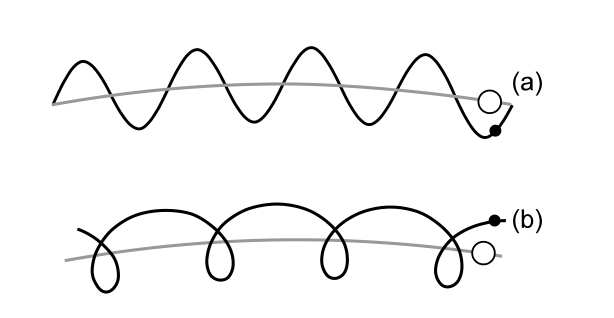
È abbastanza frequente trovare delle illustrazioni della traiettoria della Luna nel riferimento eliocentrico che mostrano: (a) curve di andamento sinusoidale, oscillanti attorno all’orbita della Terra; (b) curve che formano dei “riccioli” attorno alla stessa orbita.
In figura sono rappresentati esempi delle due curve, la cui concavità è rivolta sempre verso la Terra, una che sono entrambe errate nel caso della Luna.
- Determinare le condizioni dinamiche e cinematiche per cui ciascuna di queste due situazioni si manifesta, esprimendole in termini del rapporto tra le masse del corpo centrale e quella del satellite e di quello del rapporto tra i raggi delle orbite del pianeta e del satellite ( e ).
- Utilizzando la seguente tabella, individuare un esempio per ciascuna delle due traiettorie descritte sopra e con particolari caratteristiche geometriche presenta invece l’epicicloide descritta dalla Luna, dandone una rappresentazione grafica qualitativa.
[Tabella con , in UA, satelliti e in UA per Terra (Luna), Marte (Phobos), Giove (Io, Callisto), Saturno (Mimas, Titano).]
C — Influenza lunare (30 Punti)
La durata dell’anno (propriamente detto tropico) è l’intervallo tra due successivi equinozi di primavera; questo sono gli istanti in cui il piano equatoriale terrestre passa per il centro del Sole. La durata dell’anno (di centro della Terra), attraversa l’equatore celeste nel coincidente punto gamma. Tra i numerosi fattori che determinano variazioni della durata dell’anno vi è anche stimare il contributo della Luna che, secondo una massa non trascurabile rispetto a quella della Terra, perturba in modo apprezzabile il moto del centro della Terra; ricordare che la rotazione della Luna attorno alla Terra avviene nello stesso verso della rotazione della Terra attorno al Sole.
Semplificando fortemente la situazione reale, si assuma che il centro di massa del sistema Terra–Luna si muova di moto circolare uniforme attorno al Sole, che la Luna si muova di moto circolare uniforme rispetto alla Terra, sullo stesso piano, compiendo (circa) 12 giri e mezzo ogni anno.
- Mostrare che l’anno dura di più nella media se il giorno dell’Equinozio di Primavera coincide con la fase di Primo Quarto della Luna.
- Valutare la differenza in minuti tra tale anno e il successivo.
Dati necessari (e sufficienti): rapporto tra le masse della Terra e della Luna ; raggio dell’orbita della Luna ; velocità della Terra .
p.1 — Traiettorie del satellite attorno al Sole
Topic: Astrophysics, Gravitation, Newtonian Mechanics Metodi: Order-of-Magnitude Estimation, Kepler’s Laws, Newton’s Law of Gravitation Competenze: Mathematical Modeling, Estimation & Approximation, Physical Reasoning Objects: Satellite, Planet, Star Fonte: Testo (PDF) — p.1 Soluzione: Soluzioni (PDF)
Trittico lunare (chiaro di Luna, orbita, influenza lunare)
PROBLEMA n. 1 Lunar triangle (100 points)
A — Al chiaro di Luna… (30 Punti)
The apparent visual magnitude of a celestial body is a measure of the amount of light energy that, per unit time and surface, reaches the Earth; this amount is and that of a body with (by convention) zero magnitude is , defined as:
Assuming as a simplified assumption that the Moon reflects sunlight isotropically in the semispace of the illuminated surface and using only the observational data below, estimate the mean Moon surface reflectivity coefficient, defined as the ratio between diffused light and that incident.
DATES: apparent visual magnitude of the Sun ; apparent visual magnitude of the Full Moon ; apparent angular diameter of the Moon .
NOTA: Tener conto del fatto che la distanza Terra–Luna è molto minore della distanza Sole–Terra.
B — L’orbita lunare (40 Punti)
Suppose that the planets move in uniform circular motion around the Sun and the satellites in uniform circular motion around the planets; consider also known planar and in the same direction.
Under these conditions, in an inertial reference in solidarity with the Sun (hence heliocentric), the satellite describes a curve called an “epicycloid” whose appearance varies according to the geometric and kinematic parameters of the motions.
It is quite common to find illustrations of the Moon’s trajectory in the heliocentric reference that show: (a) sinusoidal curves of motion, oscillating around the Earth’s orbit; (b) curves that form “twistles” around the same orbit.
The following are examples of the two curves, the concave of which is always facing the Earth, one of which is both wrong in the case of the Moon.
- Determine the dynamic and kinematic conditions under which each of these two situations occurs, expressing them in terms of the ratio between the masses of the central body and that of the satellite and the ratio between the planetary and satellite orbital rays ( and ).
- Using the following table, identify an example for each of the two trajectories described above and with particular geometric characteristics instead present the moon described epicycloid, giving it a qualitative graphical representation.
[Tabella con , in UA, satelliti e in UA per Terra (Luna), Marte (Phobos), Giove (Io, Callisto), Saturno (Mimas, Titano).]
C — Influenza lunare (30 Punti)
The duration of the year (properly called tropical) is the interval between two successive spring equinoxes; these are the moments when the Earth’s equatorial plane passes through the center of the Sun. The duration of the year (from the center of the Earth), crosses the celestial equator at the coinciding gamma point. Among the many factors that determine variations in the length of the year is also estimating the contribution of the Moon which, according to a mass not negligible compared to that of the Earth, appreciably disturbs the motion of the Earth’s center; remember that the rotation of the Moon around the Earth takes place in the same direction as the Earth’s rotation around the Sun.
Simplifying the real situation strongly assumes that the center of mass of the EarthLunar system moves uniformly around the Sun, that the Moon moves uniformly around the Earth, on the same plane, completing (about) 12 and a half laps each year.
- Show that the year lasts longer on average if the day of the Spring Equinox coincides with the First Quarter phase of the Moon.
- Assess the difference in minutes between that year and the next.
Necessary (and sufficient) data: Earth-Moon mass ratio ; Moon orbit radius ; Earth speed .
p.1 — Traiettorie del satellite attorno al Sole
Topic: Astrophysics, Gravitation, Newtonian Mechanics Metodi: Order-of-Magnitude Estimation, Kepler’s Laws, Newton’s Law of Gravitation Competenze: Mathematical Modeling, Estimation & Approximation, Physical Reasoning Objects: Satellite, Planet, Star Fonte: Testo (PDF) — p.1 Soluzione: Soluzioni (PDF)
Motore solare (specchio sferico e macchina termica)
PROBLEMA n. 2 — Motore solare (100 Punti)
Per azionare un motore a energia solare si utilizza un grande specchio sferico concavo, con l’asse orientato verso il Sole. Un meccanismo mantiene questo orientamento nel corso della giornata. La luce solare viene raccolta sulla base di un cilindro metallico nero equilatero (cioè con l’altezza uguale al diametro) che si trova nel fuoco dello specchio. Il diametro e del cilindro ha le dimensioni minime per raccogliere tutta la luce solare riflessa.
Dal cilindro viene prelevato, mediante una serpentina al suo interno, calore che aziona una macchina termica il cui termostato inferiore si trova a temperatura ambiente e il cui rendimento è il 30% di quello di una macchina di Carnot che opera fra gli stessi termostati. Il cilindro perde inoltre calore per irraggiamento.
- Qual è il diametro del cilindro?
- Qual è la potenza ottica che cade sul cilindro?
- Si trovi un’equazione che leghi la temperatura di regime del cilindro (supposta costante su tutto il suo volume) alla potenza meccanica generata dalla macchina termica.
- Se la temperatura del cilindro si mantiene a , qual è la potenza meccanica erogata dalla macchina?
- Per via numerica, descrivendo anche il procedimento seguito, si trovi a quale valore dovrebbe essere stabilizzata la temperatura del cilindro per fare in modo che la potenza meccanica erogata sia – entro l’1% – la massima possibile, e ai calcoli il corrispondente valore di tale potenza meccanica.
Si facciano i calcoli numerici utilizzando i seguenti valori: diametro dello specchio ; unità astronomica (distanza Terra–Sole) ; irradianza solare al suolo ; raggio di curvatura dello specchio ; diametro dello specchio ; temperatura ambiente ; costante di Stefan .
NOTA: Si trascurino le aberrazioni dello specchio sferico, le perdite in riflessione sullo specchio, le perdite non radiative da parte del cilindro, l’ombreggiamento prodotto dai suoi sostegni, il riscaldamento del cilindro da parte della luce solare diretta.
Topic: Geometric Optics, Thermodynamics Metodi: Thin Lens & Mirror Equation, Thermodynamic Cycle Analysis, Energy Conservation Method Competenze: Mathematical Modeling, Physical Reasoning Objects: Mirror, Cylinder, Heat Engine Fonte: Testo (PDF) — p.2 Soluzione: Soluzioni (PDF)
**Solar engine (spherical mirror and heat engine) **
The Commission has already adopted a proposal for a regulation on the protection of the environment. The total value of the engine used for the production of the product shall be the sum of the total value of the engine used.
To power a solar-powered motor, a large concave spherical mirror is used, with the axis facing the Sun. A mechanism maintains this orientation throughout the day. The sunlight is collected on the basis of an equilateral black metal cylinder (i.e. with the same height as the diameter) that is located in the mirror fire. The diameter and cylinder are small enough to absorb all the reflected sunlight.
The heat from the cylinder is collected by means of a hose inside the cylinder, which drives a heat engine whose lower thermostat is at room temperature and whose output is 30% of that of a Carnot machine operating between the same thermostats. The cylinder also loses heat by irradiation.
- What is the diameter of the cylinder ?
- What is the optical power that falls on the cylinder?
- An equation is found that relates the temperature of the cylinder’s system (assuming constant over its entire volume) to the mechanical power generated by the thermal machine.
- If the temperature of the cylinder is maintained at , what is the mechanical power delivered by the machine?
- By numerical means, describing also the procedure followed, the temperature of the cylinder should be established at what value to ensure that the mechanical power delivered is within the 1% maximum possible, and the corresponding value of that mechanical power is calculated.
The numerical calculations are made using the following values: mirror diameter ; astronomical unit (EarthSole distance) ; solar irradiance to the ground ; mirror curvature radius ; mirror diameter ; ambient temperature ; Stefan constant .
NOTE: The aberrations of the spherical mirror, the reflected leaks on the mirror, the non-radiative leaks on the cylinder, the shading produced by its supports, the heating of the cylinder by direct sunlight are not to be overlooked.
Topic: Geometric Optics, Thermodynamics Metodi: Thin Lens & Mirror Equation, Thermodynamic Cycle Analysis, Energy Conservation Method Competenze: Mathematical Modeling, Physical Reasoning Objects: Mirror, Cylinder, Heat Engine Fonte: Testo (PDF) — p.2 Soluzione: Soluzioni (PDF)
Sollevamento pesi (motore elettrico a ruota in campo magnetico)
PROBLEMA n. 3 — Sollevamento pesi (100 Punti)
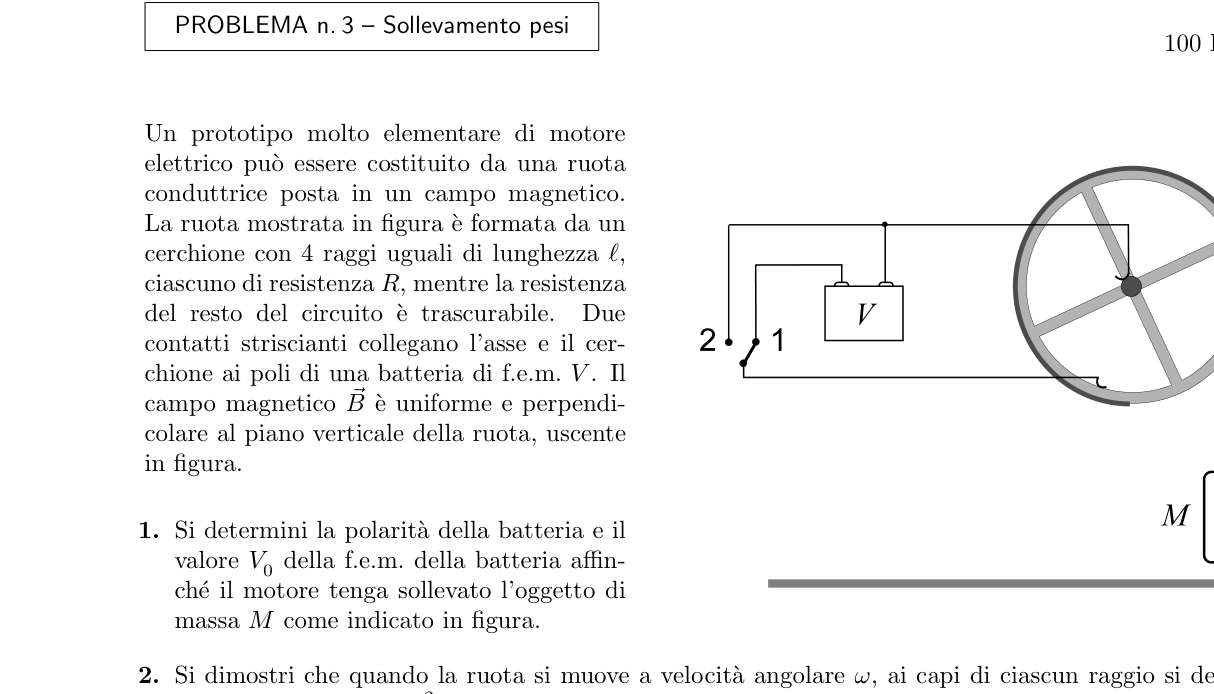
Un prototipo molto elementare di motore elettrico può essere costituito da una ruota conduttrice posta in un campo magnetico. La ruota mostrata in figura è formata da un cerchione con 4 raggi uguali di lunghezza , ciascuno di resistenza , mentre la resistenza del resto del circuito è trascurabile. Due contatti striscianti collegano l’asse e il cerchione ad una batteria di f.e.m. . Il campo magnetico è uniforme e perpendicolare al piano della ruota, come mostrato in figura.
- Si determini la polarità della batteria e il valore della f.e.m. della batteria affinché il motore tenga sollevato l’oggetto di massa come indicato in figura.
- Si dimostri che quando la ruota si muove a velocità angolare , ai capi di ciascun raggio si determina una f.e.m. indotta , indicandone il verso, a seconda che la rotazione faccia salire o scendere l’oggetto appeso al filo.
- Messo in moto il motore, con , dopo una brevissima fase transitoria l’oggetto viene sollevato a velocità costante; si calcoli tale velocità.
- Calcolare il rendimento della macchina.
- Se ad un certo istante il generatore viene escluso spostando il commutatore dalla posizione 1 alla 2, anche il moto di caduta dell’oggetto si arresta. Si calcoli la velocità nel moto di caduta frenato.
- Durante il funzionamento la ruota del motore si scalda; supponendo di poter trascurare il calore ceduto con l’esterno, valutare se l’incremento di temperatura della ruota ad ogni giro è maggiore quando l’oggetto viene sollevato o quando cade frenato.
Per i calcoli si usino i seguenti valori numerici: ; ; ; ; ; .
p.3 — Ruota conduttrice nel campo magnetico con massa
Topic: Electromagnetic Induction, Circuits, Magnetism Metodi: Faraday’s Law of Induction, Lorentz Force Analysis, Kirchhoff’s Laws Competenze: Mathematical Modeling, Diagrammatic Reasoning Objects: Wheel, Battery, Block, String Fonte: Testo (PDF) — p.3 Soluzione: Soluzioni (PDF)
**Weight lifting (magnetic-field electric motor) **
The Commission has already adopted a proposal for a regulation on the protection of the environment. The weight of the vehicle shall be determined by the weight of the vehicle.
A very basic prototype of an electric motor can be made up of a conductive wheel placed in a magnetic field. The wheel shown in the figure is made up of a circle with 4 equal beams of length , each of resistance , while the resistance of the rest of the circuit is negligible. Two crawling contacts connect the shaft and the ring to a f.e.m. battery. . The magnetic field is uniform and perpendicular to the plane of the wheel as shown in Figure 1.
- Determine the battery polarity and the value of the f.e.m. the battery so that the engine holds the mass object as shown in Figure 1.
- It is shown that when the wheel moves at angular speed , an f.e.m. is determined at the ends of each beam. Induced , indicating the direction, depending on whether the rotation causes the object suspended from the wire to rise or fall.
- When the engine is started, with , the object is lifted at a constant speed after a very short transitional phase; this speed is calculated.
- Calculate the performance of the machine.
- If at a certain moment the generator is turned off by moving the switch from position 1 to 2, the object’s fall motion also stops. The speed is calculated in the brake fall motor.
- During operation the engine wheel is heated; assuming that the heat from the outside can be ignored, consider whether the temperature increase of the wheel at each turn is greater when the object is lifted or when it falls brake.
The following numerical values shall be used for the calculations: ; ; ; ; ; .
**p.3 ** A magnetic field conductive wheel with mass
Topic: Electromagnetic Induction, Circuits, Magnetism Metodi: Faraday’s Law of Induction, Lorentz Force Analysis, Kirchhoff’s Laws Competenze: Mathematical Modeling, Diagrammatic Reasoning Objects: Wheel, Battery, Block, String Fonte: Testo (PDF) — p.3 Soluzione: Soluzioni (PDF)