PROBLEMA n. 1 – Attenti alla colla! 100 Punti Quesito n. 1. Poiché l’attrito è trascurabile, l’energia si conserva. Misurando l’energia potenziale gravitazionale a partire dal piano orizzontale passante per l’asse di rotazione, la legge di conservazione dell’energia si scrive:
Semplificando, possiamo ricavare la velocità angolare, :
Topic: Rotational Dynamics, Conservation of Energy, Newtonian Mechanics Metodi: Energy Conservation Method, Torque & Angular Momentum Analysis, Kinematic Equations Competenze: Mathematical Modeling, Physical Reasoning Objects: Rod, Sphere Fonte: Testo (PDF) — p.1 Soluzione: Soluzioni (PDF)
The Commission has already taken a number of measures. 1 Watch the glue! 100 points Question No. 1. Since friction is negligible, energy is conserved. Measuring the gravitational potential energy at From the horizontal plane passing through the rotating axis, the law of conservation of energy is He writes:
Simplifying, we can get the angular velocity, :
Topic: Rotational Dynamics, Conservation of Energy, Newtonian Mechanics Metodi: Energy Conservation Method, Torque & Angular Momentum Analysis, Kinematic Equations Competenze: Mathematical Modeling, Physical Reasoning Objects: Rod, Sphere Fonte: Testo (PDF) — p.1 Soluzione: Soluzioni (PDF)
Quesito n. 2. Scriviamo la seconda legge della dinamica per la sferetta 1, più lontana dall’asse di rotazione. Poiché le forze che agiscono su di essa sono il peso, , e la forza esercitata dall’asta, abbiamo:
Scomponendo lungo la direzione radiale e quella tangenziale abbiamo:
dove e indicano rispettivamente la componente centripeta e quella tangenziale dell’accelerazione. Occupiamoci dapprima della componente radiale. L’accelerazione centripeta risulta:
Sostituendo questo valore nella prima delle (2) si ottiene facilmente l’espressione data nel testo:
Consideriamo ora la componente tangenziale. Il manubrio nel suo complesso è un corpo rigido avente momento d’inerzia:
e il suo peso totale (di modulo ) può pensarsi concentrato nel centro di massa, la cui distanza dall’asse di rotazione, , è (v. figura):
L’unica forza esterna, agente sul manubrio, che ha un momento non nullo rispetto all’asse di rotazione è il peso totale. L’equazione della rotazione del manubrio risulta allora:
dove indica l’accelerazione angolare. Usando la (3) e la (4) possiamo ricavare :
E di conseguenza:
Sostituendo la (6) nella seconda delle (2) otteniamo:
NOTA: Soluzioni alternative per il calcolo di Scriviamo la componente tangenziale della seconda legge della dinamica per la sferetta 2:
Poiché la sferetta 2 dista metà della prima rispetto all’asse di rotazione, risulta:
Inoltre, poiché l’asta ha massa trascurabile, sono trascurabili anche il suo peso e il suo momento d’inerzia. Ne segue che il momento delle forze esterne ad essa applicate dev’essere nullo, e dunque:
Sostituendo la (2’) e la (3’) nella (1’) otteniamo:
Mettendo in sistema questa equazione con la seconda delle (2) è facile ricavare il risultato richiesto. Un terzo modo per arrivare al risultato richiesto consiste nel ricavare l’espressione (5) dell’accelerazione angolare derivando rispetto al tempo la velocità angolare, espressa nella (1) in termini dell’angolo . Si trova
p.1 — Manubrio inclinato con sferette 1 e 2, angolo theta
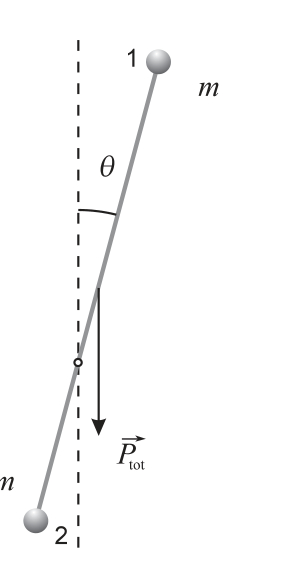
Topic: Rotational Dynamics, Newtonian Mechanics Metodi: Free-Body Diagram, Torque & Angular Momentum Analysis, Vector Decomposition Competenze: Diagrammatic Reasoning, Mathematical Modeling, Physical Reasoning Objects: Rod, Sphere Fonte: Testo (PDF) — p.1 Soluzione: Soluzioni (PDF)
Question No. 2. Let’s write the second law of dynamics for the sphere 1, farther away from the axis of rotation. Because The forces acting on it are the weight, , and the force exerted by the axle, we have:
If we break down the radial and tangential directions, we have:
where and indicate the centrifugal and the tangential components of the acceleration respectively. Let’s get to the radial component first. The centripede acceleration is as follows:
Substituting this value in the first of the (2) easily gives the expression given in the text:
Let’s now consider the tangential component. The manoeuvre as a whole is a rigid body with moment of inertia:
and its total weight (of ) can be thought of as concentrated in the centre of the mass, the distance from the axis of rotation, , is (v. Figure:
The only external force, agent on the handlebar, which has a non-zero momentum relative to the axis of rotation It’s the total weight. The equation of rotation of the handle then follows:
where indicates angular acceleration. Using (3) and (4) we can obtain :
And as a result:
Substituting (6) for the second of (2) gives:
NOTE: Alternative solutions for the calculation of Let’s write the tangential component of the second law of dynamics for sphere 2:
Since sphere 2 is halfway from the first relative to the axis of rotation, it follows:
In addition, since the auction has negligible mass, its weight and momentum are negligible. It follows that the moment of the external forces applied to it must be zero, and therefore:
Substituting the (2’) and the (3’) in the (1’) we get:
Putting this equation into the system with the second of the (2) is easy to obtain the desired result. A third way to obtain the desired result is to obtain the expression (5) of acceleration angular by deriving the angular velocity, expressed in (1) in terms of the angle , from time. It ‘s there .
**p.1 ** Tilted handle with spheres 1 and 2, angle theta
Topic: Rotational Dynamics, Newtonian Mechanics Metodi: Free-Body Diagram, Torque & Angular Momentum Analysis, Vector Decomposition Competenze: Diagrammatic Reasoning, Mathematical Modeling, Physical Reasoning Objects: Rod, Sphere Fonte: Testo (PDF) — p.1 Soluzione: Soluzioni (PDF)
Quesito n. 3. Possiamo ora ricavare il modulo di :
Il distacco della sferetta 1 avviene quando
ovvero quando:
Questa equazione ha come unica soluzione accettabile:
Topic: Rotational Dynamics, Newtonian Mechanics Metodi: Free-Body Diagram, Vector Decomposition, Physical Modeling Competenze: Mathematical Modeling, Physical Reasoning Objects: Rod, Sphere Fonte: Testo (PDF) — p.2 Soluzione: Soluzioni (PDF)
Question No. 3. We can now get the form:
The detachment of sphere 1 occurs when
or when:
This equation has as its only acceptable solution:
Topic: Rotational Dynamics, Newtonian Mechanics Metodi: Free-Body Diagram, Vector Decomposition, Physical Modeling Competenze: Mathematical Modeling, Physical Reasoning Objects: Rod, Sphere Fonte: Testo (PDF) — p.2 Soluzione: Soluzioni (PDF)
Quesito n. 4. Al momento del distacco della sferetta 1, l’altra sferetta ha una velocità:
Anche durante il moto del manubrio “monco” l’energia si conserva. Uguagliando l’energia tra l’istante del distacco e quello dell’inversione del moto abbiamo:
Inserendo in questa espressione la (7) e semplificando otteniamo:
Il moto della sferetta 2 è dunque un’oscillazione di ampiezza angolare .
Topic: Conservation of Energy, Rotational Dynamics Metodi: Energy Conservation Method, Conservation Laws Competenze: Physical Reasoning, Mathematical Modeling Objects: Rod, Sphere Fonte: Testo (PDF) — p.3 Soluzione: Soluzioni (PDF)
Question No. 4. When the sphere 1 is detached, the other sphere has a velocity:
Even during the maneuver of the monkey, energy is conserved. Equating the energy between the instant The difference between the detachment and the reverse engine is:
If we put (7) and simplify this expression, we get:
The motion of the sphere 2 is therefore an oscillation of angular width .
Topic: Conservation of Energy, Rotational Dynamics Metodi: Energy Conservation Method, Conservation Laws Competenze: Physical Reasoning, Mathematical Modeling Objects: Rod, Sphere Fonte: Testo (PDF) — p.3 Soluzione: Soluzioni (PDF)
Quesito n. 5. Uguagliando l’energia della sferetta 2 tra l’istante dell’arresto e quello in cui passa per il punto più basso della sua traiettoria (in cui ha la sua massima velocità, ) abbiamo:
da cui:
Scriviamo la seconda legge della dinamica per la sferetta:
Nel punto considerato i tre vettori hanno un’unica componente radiale, e l’equazione precedente si scrive:
Per il terzo principio della dinamica, questo è anche il modulo della forza che la sferetta esercita sull’asta in questa posizione. Siccome l’asta ha massa trascurabile, l’unica altra forza che agisce su di essa è quella esercitata dal vincolo, e la risultante delle due forze dev’essere nulla. Se ne deduce che la forza che il vincolo esercita sull’asta è anch’essa di , e dunque il rapporto richiesto è 4.63.
Topic: Newtonian Mechanics, Conservation of Energy, Rotational Dynamics Metodi: Energy Conservation Method, Free-Body Diagram, Kinematic Equations Competenze: Physical Reasoning, Mathematical Modeling Objects: Rod, Sphere Fonte: Testo (PDF) — p.3 Soluzione: Soluzioni (PDF)
Question No. 5. Equating the energy of sphere 2 between the moment of stopping and the moment it passes through the most below its trajectory (where it has its maximum speed, ) we have:
of which:
Let’s write the second law of dynamics for the sphere:
In the point considered the three vectors have a single radial component, and the previous equation is written:
For the third principle of dynamics, this is also the form of the force that the sphere exerted on the axis In this position. Since the auction has negligible mass, the only other force acting on it is the The resulting force must be zero. It follows that the force that the The bond on the auction is also , and therefore the required ratio is 4.63.
Topic: Newtonian Mechanics, Conservation of Energy, Rotational Dynamics Metodi: Energy Conservation Method, Free-Body Diagram, Kinematic Equations Competenze: Physical Reasoning, Mathematical Modeling Objects: Rod, Sphere Fonte: Testo (PDF) — p.3 Soluzione: Soluzioni (PDF)
PROBLEMA n. 2 Zig-zagando… 50 Punti Quesito n. 1. Si considerino 10 spostamenti consecutivi a partire da un punto qualsiasi, per esempio, dalla posizione indicata con il numero 1. Una misura della loro lunghezza in quadretti, avendo stimato il quarto di quadretto, e trasformata nella loro scala effettiva è riportata nella tabella sottostante. Prima posizione utilizzata: n. 1
| Posizione | Spostamento n. | lunghezza in figura (quadretti) | lunghezza effettiva () | () |
|---|---|---|---|---|
| 1 | - | - | - | - |
| 2 | 1 | 3.25 | 10.40 | 108.16 |
| 3 | 2 | 1.25 | 4.00 | 16.00 |
| 4 | 3 | 3.00 | 9.60 | 92.16 |
| 5 | 4 | 2.75 | 8.80 | 77.44 |
| 6 | 5 | 3.50 | 11.20 | 125.44 |
| 7 | 6 | 4.00 | 12.80 | 163.84 |
| 8 | 7 | 2.25 | 7.20 | 51.84 |
| 9 | 8 | 1.50 | 4.80 | 23.04 |
| 10 | 9 | 1.75 | 5.60 | 31.36 |
| 11 | 10 | 1.50 | 4.80 | 23.04 |
Lo spostamento quadratico medio vale . Sostituendo e s nella formula di Einstein, si ottiene una stima del Numero di Avogadro
Topic: Kinetic Theory, Thermodynamics Metodi: Statistical Averaging, Experimental Data Analysis, Physical Modeling Competenze: Experimental Data Analysis, Mathematical Modeling, Physical Reasoning Objects: — Fonte: Testo (PDF) — p.4 Soluzione: Soluzioni (PDF)
The Commission has already taken a number of measures. Two zigzagging… 50 points Question No. 1. Consider 10 consecutive movements from any point, for example, from the position indicated by the number 1. A measure of their length in squares, having estimated a quarter of the The following table shows the number of units of the same size and the number of units of the same size. First position used: n. 1
♪ Position ♪ Move n. | lunghezza in figura (quadretti) | lunghezza effettiva () | () | | --- | --- | --- | --- | --- | | 1 | - | - | - | - | | 2 | 1 | 3.25 | 10.40 | 108.16 | | 3 | 2 | 1.25 | 4.00 | 16.00 | | 4 | 3 | 3.00 | 9.60 | 92.16 | | 5 | 4 | 2.75 | 8.80 | 77.44 | | 6 | 5 | 3.50 | 11.20 | 125.44 | | 7 | 6 | 4.00 | 12.80 | 163.84 | | 8 | 7 | 2.25 | 7.20 | 51.84 | | 9 | 8 | 1.50 | 4.80 | 23.04 | | 10 | 9 | 1.75 | 5.60 | 31.36 | | 11 | 10 | 1.50 | 4.80 | 23.04 |
The average square displacement is . Substituting and s in Einstein’s formula, you get an estimate of Avogadro’s number
Topic: Kinetic Theory, Thermodynamics Metodi: Statistical Averaging, Experimental Data Analysis, Physical Modeling Competenze: Experimental Data Analysis, Mathematical Modeling, Physical Reasoning Objects: — Fonte: Testo (PDF) — p.4 Soluzione: Soluzioni (PDF)
Quesito n. 2. L’incertezza sperimentale della misura dipende dall’imprecisione della lettura degli spostamenti nel grafico e dall’errore statistico. Nella soluzione precedente il primo tipo di errore () è stato assunto dell’ordine di 1/4 di quadretto. Questa incertezza, legata alla determinazione della posizione nel reticolato di ciascun punto considerato, è essenzialmente casuale e produce un errore relativo variabile da un minimo del 6 % (1/4 di quadretto su uno spostamento di 4.00 quadretti in tabella) ad un massimo del 20 % (1/4 di quadretto su uno spostamento di 1.25 quadretti in tabella). Circa l’errore statistico () si deve tener presente che la relazione vale a condizione che sia calcolato su un gran numero di spostamenti della particella, e quindi l’incertezza dipende dal fatto che il numero di spostamenti utilizzati nel calcolo è finito e in realtà piccolo (10). Tale incertezza può essere stimata ripetendo la serie di misure diverse volte su diverse sequenze di spostamenti con lo stesso numero di punti. Secondo l’analisi statistica degli errori, per un insieme di misure ripetute, la migliore stima della grandezza – della quale l’insieme delle misure prese rappresenta un campione – è data dalla media aritmetica e la migliore stima dell’incertezza dalla deviazione standard della media. Possono essere trascurate altre cause di incertezza (come i valori delle costanti di partenza, la non perfetta conformità dell’immagine, e cosı` via) che in questo contesto sono certamente trascurabili rispetto a e . Fra queste ultime, se una di esse risulta molto minore dell’altra, può essere anche trascurata; in caso contrario, trattandosi di due incertezze di natura casuale e non sistematica, e concettualmente indipendenti l’una dall’altra, una stima complessiva dell’incertezza di misura può essere data da
Topic: Kinetic Theory, Thermodynamics Metodi: Error Propagation, Statistical Averaging, Experimental Data Analysis Competenze: Error Propagation, Experimental Data Analysis, Mathematical Modeling Objects: — Fonte: Testo (PDF) — p.4 Soluzione: Soluzioni (PDF)
Question No. 2. The experimental uncertainty of the measurement depends on the inaccurate reading of the movements in the graph And the statistical error. In the previous solution the first type of error () was assumed to be of the order of 1/4 square. This uncertainty, linked to the determination of the position in the grid of each point considered, is essentially random and produces a relative error variable of at least 6 % (1/4 of a square) on a shift of 4.00 squares in a table) to a maximum of 20% (1/4 of a square on a table) The number of units in the table is 1.25 squares. For the statistical error () it must be noted that the report is valid if: che sia calcolato su un gran numero di spostamenti della particella, e quindi l’incertezza dipende dal The number of moves used in the calculation is finite and actually small (10). Such uncertainty The measurement series can be estimated by repeating the series of measures several times over different sequences of movements with the the same number of points. According to the statistical error analysis, for a set of repeated measures, the best estimate of the size of which the whole of the measures taken is a sample is The average is the best estimate of the uncertainty from the standard deviation of the mean. Other causes of uncertainty (such as the values of the starting constants, the The image is perfectly consistent, and so on, which in this context are certainly negligible respect a e . In the latter case, if one of them is much smaller than the other, it may also be neglected; If not, it is two uncertainties of a random and non-systematic nature, and conceptually independent of each other, an overall estimate of the measurement uncertainty can be given by
Topic: Kinetic Theory, Thermodynamics Metodi: Error Propagation, Statistical Averaging, Experimental Data Analysis Competenze: Error Propagation, Experimental Data Analysis, Mathematical Modeling Objects: — Fonte: Testo (PDF) — p.4 Soluzione: Soluzioni (PDF)
PROBLEMA n. 3 – Pierino in laboratorio 100 Punti
Topic: Electromagnetism, Magnetism Metodi: Lorentz Force Analysis, Physical Modeling Competenze: Physical Reasoning Objects: — Fonte: Testo (PDF) — p.5 Soluzione: Soluzioni (PDF)
The Commission has already taken a number of measures. 3 I’m in the lab 100 points
Topic: Electromagnetism, Magnetism Metodi: Lorentz Force Analysis, Physical Modeling Competenze: Physical Reasoning Objects: — Fonte: Testo (PDF) — p.5 Soluzione: Soluzioni (PDF)
Quesito n. 1. La forza prodotta sullo ione dai campi – elettrico e magnetico – e la sua accelerazione sono, in termini vettoriali:
Il modulo dell’accelerazione è quindi
Topic: Electromagnetism, Magnetism Metodi: Lorentz Force Analysis, Free-Body Diagram, Vector Decomposition Competenze: Diagrammatic Reasoning, Mathematical Modeling Objects: Point Charge Fonte: Testo (PDF) — p.5 Soluzione: Soluzioni (PDF)
Question No. 1. The force produced on the ion by the electric and magnetic fields and its acceleration are, in terms of Vektors:
The acceleration model is therefore
Topic: Electromagnetism, Magnetism Metodi: Lorentz Force Analysis, Free-Body Diagram, Vector Decomposition Competenze: Diagrammatic Reasoning, Mathematical Modeling Objects: Point Charge Fonte: Testo (PDF) — p.5 Soluzione: Soluzioni (PDF)
Quesito n. 2. Perché il moto sia uniforme deve essere nulla l’accelerazione; nell’espressione precedente si deve imporre , mentre può essere qualsiasi. La minima energia cinetica si ha per cioè quando la particella si muove ortogonalmente sia ad che a
Topic: Electromagnetism, Magnetism Metodi: Lorentz Force Analysis, Free-Body Diagram, Vector Decomposition Competenze: Physical Reasoning, Mathematical Modeling Objects: Point Charge Fonte: Testo (PDF) — p.5 Soluzione: Soluzioni (PDF)
Question No. 2. For the motorcycle to be uniform, acceleration must be zero; in the previous expression, , while can be any. The minimum kinetic energy is for , i.e. when the particle moves orthogonal to which at
Topic: Electromagnetism, Magnetism Metodi: Lorentz Force Analysis, Free-Body Diagram, Vector Decomposition Competenze: Physical Reasoning, Mathematical Modeling Objects: Point Charge Fonte: Testo (PDF) — p.5 Soluzione: Soluzioni (PDF)
Quesito n. 3. Tracciata una terna di assi cartesiani ortogonali, le due piastre del condensatore devono essere parallele al piano e l’asse del solenoide parallelo all’asse . Poiché si vuole che in una stessa regione spaziale siano presenti entrambi i campi, si hanno due alternative: alloggiare il solenoide tra le armature del condensatore oppure inserire il condensatore nella parte interna del solenoide; con le condizioni poste nel testo del problema è possibile realizzare solo la prima disposizione, come mostrato nella figura seguente, a sinistra.
p.5 — Assi cartesiani e due circuiti condensatore-solenoide
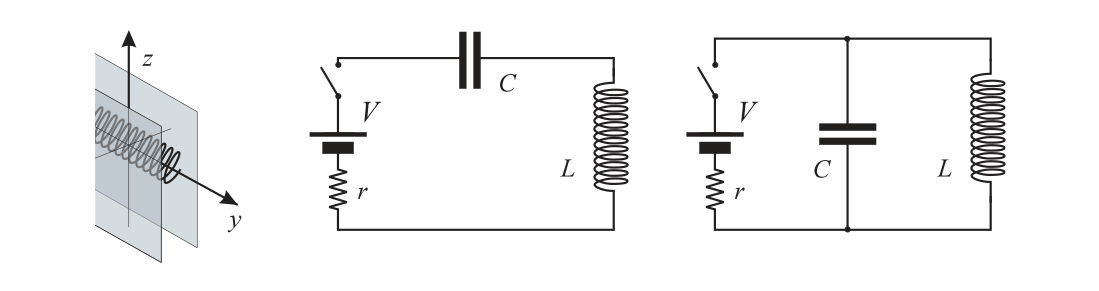
Topic: Electrostatics, Magnetism Metodi: Ampère’s Law, Electric Potential Method, Symmetry Argument Competenze: Diagrammatic Reasoning, Physical Reasoning Objects: Capacitor, Solenoid Fonte: Testo (PDF) — p.5 Soluzione: Soluzioni (PDF)
Question No. 3. Draw a straight Cartesian axis, the two plates of the capacitor shall be parallel al piano e l’asse del solenoide parallelo all’asse . Because you want to have the same space region If both fields are present, there are two alternatives: condenser or insert the condenser into the inner part of the solenoid; The text of the problem can only be made in the first sentence, as shown in the following figure,
- Right to left.
**p.5 ** Cartesian axes and two solenoid-condenser circuits
Topic: Electrostatics, Magnetism Metodi: Ampère’s Law, Electric Potential Method, Symmetry Argument Competenze: Diagrammatic Reasoning, Physical Reasoning Objects: Capacitor, Solenoid Fonte: Testo (PDF) — p.5 Soluzione: Soluzioni (PDF)
Quesito n. 4. La configurazione in serie (al centro nella figura precedente) consente di caricare il condensatore, ma la corrente a regime è nulla (e di conseguenza ); quella in parallelo (a destra) consente una corrente di regime non nulla e costante nel solenoide: di conseguenza la f.e.m. indotta è nulla ed essendo nulla la resistenza del solenoide sono nulle sia la d.d.p. che la carica sul condensatore (quindi ).
Topic: Circuits, Electrostatics, Magnetism Metodi: Kirchhoff’s Laws, Ampère’s Law, Electric Potential Method Competenze: Physical Reasoning, Diagrammatic Reasoning Objects: Capacitor, Solenoid Fonte: Testo (PDF) — p.5 Soluzione: Soluzioni (PDF)
Question No. 4. The serial configuration (center in the figure above) allows the capacitor to be loaded, but the The current at the current is zero (and therefore ); the current at the parallel (right) allows a current The following is the list of the following: Induced is nothing and being nothing is the The solenoid resistance is zero and the D.D.P. che la carica sul condensatore (quindi ).
Topic: Circuits, Electrostatics, Magnetism Metodi: Kirchhoff’s Laws, Ampère’s Law, Electric Potential Method Competenze: Physical Reasoning, Diagrammatic Reasoning Objects: Capacitor, Solenoid Fonte: Testo (PDF) — p.5 Soluzione: Soluzioni (PDF)
Quesito n. 5. Per fare in modo che a regime il condensatore sia carico mentre scorre corrente nel solenoide occorre comunque modificare uno dei due circuiti con l’aggiunta di un resistore. La cosa si può fare in due modi: nel circuito “serie” (al centro) si deve aggiungere il resistore in parallelo al condensatore; nel circuito “parallelo” (a destra) lo si deve aggiungere in serie all’induttanza. Il circuito usato è quello mostrato in figura. Comunque, in entrambi i modi, a regime, la corrente nel solenoide è
e la d.d.p. sul condensatore è uguale a quella ai capi della resistenza , ovvero
La velocità (minima se diretta lungo l’asse ) risulta quindi
notare che è indipendente da .
Topic: Circuits, Electrostatics, Magnetism Metodi: Kirchhoff’s Laws, Ampère’s Law, Electric Potential Method Competenze: Mathematical Modeling, Diagrammatic Reasoning Objects: Capacitor, Solenoid, Resistor Fonte: Testo (PDF) — p.5 Soluzione: Soluzioni (PDF)
Question No. 5. To ensure that the capacitor is loaded as it flows The current in the solenoid must be changed in any case one of the two circuits with the addition of a resistor. This can be done in two ways: The ‘series’ circuit (in the centre) must be added to the resistor in parallel to the Condenser; in the parallel circuit (right) it must be added in The Commission has already adopted a number of proposals. The circuit used is the one shown in the figure. However, in both ways, under the regime, the current in the solenoid is
e la d.d.p. on the capacitor is equal to that of the resistance , i.e.
The speed (minimum if directed along the axis) is therefore
Note that it is independent of .
Topic: Circuits, Electrostatics, Magnetism Metodi: Kirchhoff’s Laws, Ampère’s Law, Electric Potential Method Competenze: Mathematical Modeling, Diagrammatic Reasoning Objects: Capacitor, Solenoid, Resistor Fonte: Testo (PDF) — p.5 Soluzione: Soluzioni (PDF)
Quesito n. 6. Invertendo la relazione precedente e sostituendo i dati del problema si ha
Topic: Circuits, Electrostatics, Magnetism Metodi: Kirchhoff’s Laws, Ampère’s Law, Electric Potential Method Competenze: Mathematical Modeling, Physical Reasoning Objects: Solenoid, Resistor Fonte: Testo (PDF) — p.6 Soluzione: Soluzioni (PDF)
Question No. 6. By reversing the previous report and replacing the problem data, we have
Topic: Circuits, Electrostatics, Magnetism Metodi: Kirchhoff’s Laws, Ampère’s Law, Electric Potential Method Competenze: Mathematical Modeling, Physical Reasoning Objects: Solenoid, Resistor Fonte: Testo (PDF) — p.6 Soluzione: Soluzioni (PDF)
Quesito n. 7. Si può osservare che, con i valori dati, e dunque porre nelle espressioni precedenti . L’energia dissipata dalla resistenza è quella immagazzinata a regime nel circuito; è data dalla somma di due termini relativi al condensatore e all’induttanza:
dove
da cui
PROBLEMA n. 4 – Luci e ombre 50 Punti La luce che incide sulla faccia verticale la attraversa senza essere deviata, a qualunque altezza. Essa incide quindi orizzontalmente sulla superficie curva. La normale a questa superficie ha semplicemente la direzione radiale.
Topic: Circuits, Electrostatics, Electromagnetism Metodi: Energy Conservation Method, Kirchhoff’s Laws, Equivalent Circuit Reduction Competenze: Mathematical Modeling, Physical Reasoning Objects: Capacitor, Solenoid, Resistor Fonte: Testo (PDF) — p.6 Soluzione: Soluzioni (PDF)
Question No. 7. It can be observed that, with the data values, and therefore put in the previous expressions . The energy dissipated by the resistance is that stored at the circuit; it is given by the sum of two terms relating to capacitor and inductance:
Where
from which
The Commission has already taken a number of measures. 4 Lights and shadows 50 points The light that hits the vertical face passes through it without being deflected, at any height. It The curve of the curve is the curve of the curve. The normal at this surface has simply the radial direction.
Topic: Circuits, Electrostatics, Electromagnetism Metodi: Energy Conservation Method, Kirchhoff’s Laws, Equivalent Circuit Reduction Competenze: Mathematical Modeling, Physical Reasoning Objects: Capacitor, Solenoid, Resistor Fonte: Testo (PDF) — p.6 Soluzione: Soluzioni (PDF)
Quesito n. 1. Si consideri un raggio di luce che incide sulla superficie curva ad un’altezza , quindi con un angolo di incidenza (vedi figura, a sinistra). Per i valori di più elevati si ha riflessione totale, e la luce, dopo riflessioni multiple, va a cadere sotto il cilindro. Per valori di al di sotto del valore limite per riflessione totale, la luce emerge deviata verso il basso e quindi incide sul tavolo. Quanto minore è , tanto minore è la deviazione verso il basso e tanto più lontano avviene l’incidenza sul piano del tavolo, come si evidenzia anche nello studio di una caustica. Si tratta quindi di trovare l’angolo limite per riflessione totale . Esso è dato da . Il raggio di luce uscente è tangente alla superficie e, detta la distanza, chiesta dal problema, fra il bordo posteriore del cilindro e la posizione di incidenza di tale raggio sulla superficie del tavolo, si ha (vedi ancora la figura a sinistra) che . Sostituendo, si ha che
da cui
p.6 — Rifrazione nel cilindro e lente sottile equivalente
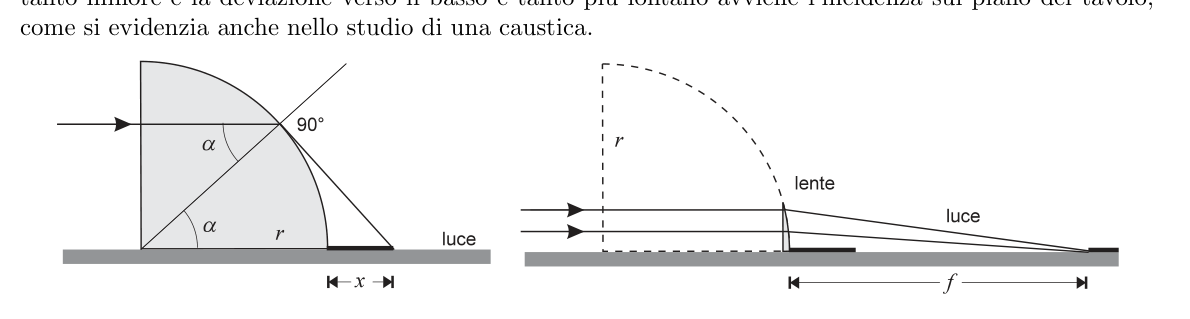
Topic: Geometric Optics Metodi: Snell’s Law, Ray Tracing Competenze: Diagrammatic Reasoning, Mathematical Modeling Objects: Cylinder, Lens Fonte: Testo (PDF) — p.6 Soluzione: Soluzioni (PDF)
Question No. 1. Consider a beam of light that hits the curved surface at a height , so with a angle of incidence (see figure to the left). For values of higher, total reflection is given, and the Light, after multiple reflections, falls under the cylinder. For values below the limit value For total reflection, the light emerges deflected downward and then hits the table. The smaller the , The smaller the downward deviation, the further away the incidence on the table plane. And this is also evident in the study of causticity. The reference angle for total reflection is therefore to be found. It is given by . Il The outgoing light beam is tangent to the surface and, said the distance required by the problem, between the edge The rear of the cylinder and the position of the impact of this beam on the table surface shall be: The figure on the left) is . By replacing it, you have that
from which
p.6 Cylinder refraction and equivalent thin lens
Topic: Geometric Optics Metodi: Snell’s Law, Ray Tracing Competenze: Diagrammatic Reasoning, Mathematical Modeling Objects: Cylinder, Lens Fonte: Testo (PDF) — p.6 Soluzione: Soluzioni (PDF)
Quesito n. 2. Per valori decrescenti di al di sotto di si ha un progressivo allontanarsi del punto di incidenza, e l’incidenza più distante si deve avere per valori molto piccoli di . Per valori molto piccoli possiamo considerare la porzione di prisma attraversata come: una lastra a facce piane e parallele (che non influenza la direzione dei raggi luminosi ortogonali ad essa) più una lente piano–convessa che per sufficientemente piccoli possiamo considerare sottile (vedi figura, a destra). Si tratta allora di trovare la distanza focale di questa lente, che al limite risulta posizionata proprio sul bordo posteriore del cilindro. Per una lente sottile, dall’equazione dei costruttori di lenti si ricava
ovvero cm. La luce incide quindi sul tavolo in una fascia compresa fra 1.71 e 10.0 cm di distanza dal bordo posteriore del cilindro. NOTA: Soluzione alternativa del Quesito 2 Per trovare il punto di incidenza più distante possibile, si deve trovare tale posizione per molto piccolo, cioè si può calcolare il punto di incidenza di un generico fascio corrispondente ad un angolo , eseguendo il passaggio al limite per . Per sufficientemente piccoli (cioè trascurando i termini in e superiori negli sviluppi in serie delle funzioni trigonometriche coinvolte) il punto di incidenza del fascio sulla superficie curva del cilindro si trova ad un’altezza dal piano del tavolo, sulla verticale del bordo posteriore del cilindro (cioè a distanza dall’asse pari a ). L’angolo di rifrazione è (per la legge di Snell, passando al limite) e quindi l’angolo fra tale raggio e la superficie del tavolo è . La distanza dal bordo del cilindro, a cui il raggio rifratto incide sul tavolo, è fornita dalla relazione
quindi
come si era ottenuto con la soluzione precedente. Materiale prodotto dal gruppo PROGETTO OLIMPIADI Segreteria Olimpiadi Italiane della Fisica presso Liceo Scientifico “U. Morin” VENEZIA MESTRE fax: 041.584.1272 e-mail: olifis@libero.it
Zanichelli editore
La Gara Nazionale è realizzata con il sostegno di Ministero dell’Istruzione, dell’Università e della Ricerca Comune di Senigallia Liceo Scientifico “E. Medi” di Senigallia
PROBLEMA n. 2 Zig-zagando… 50 Punti Misure di tutti gli spostamenti in figura. Nella tabella seguente sono riportati tutti i valori del Numero di Avogadro, ottenuti a partire da successive posizioni iniziali.
| Posizione | Spostamento n. | lunghezza (quadretti) | lunghezza effettiva () | () | () | () |
|---|---|---|---|---|---|---|
| 1 | - | - | - | - | ||
| 2 | 1 | 3.25 | 10.400 | 108.16 | ||
| 3 | 2 | 1.25 | 4.0000 | 16.000 | ||
| 4 | 3 | 3.00 | 9.6000 | 92.160 | ||
| 5 | 4 | 2.75 | 8.8000 | 77.440 | ||
| 6 | 5 | 3.50 | 11.200 | 125.44 | ||
| 7 | 6 | 4.00 | 12.800 | 163.84 | ||
| 8 | 7 | 2.25 | 7.2000 | 51.840 | ||
| 9 | 8 | 1.50 | 4.8000 | 23.040 | ||
| 10 | 9 | 1.75 | 5.6000 | 31.360 | ||
| 11 | 10 | 1.50 | 4.8000 | 23.040 | 712.32 | 6.27 |
| 12 | 11 | 2.25 | 7.2000 | 51.840 | 656.00 | 6.08 |
| 13 | 12 | 4.00 | 12.800 | 163.84 | 803.84 | 5.56 |
| 14 | 13 | 3.25 | 10.400 | 108.16 | 819.84 | 5.45 |
| 15 | 14 | 2.25 | 7.2000 | 51.840 | 794.24 | 5.62 |
| 16 | 15 | 3.00 | 9.6000 | 92.160 | 760.96 | 5.87 |
| 17 | 16 | 1.50 | 4.8000 | 23.040 | 620.16 | 7.20 |
| 18 | 17 | 3.50 | 11.200 | 125.44 | 693.76 | 6.44 |
| 19 | 18 | 1.25 | 4.0000 | 16.000 | 686.72 | 6.50 |
| 20 | 19 | 1.25 | 4.0000 | 16.000 | 671.36 | 6.65 |
| 21 | 20 | 2.75 | 8.8000 | 77.440 | 725.76 | 6.15 |
| 22 | 21 | 1.00 | 3.2000 | 10.240 | 684.16 | 6.53 |
| 23 | 22 | 1.00 | 3.2000 | 10.240 | 530.56 | 8.41 |
| 24 | 23 | 1.00 | 3.2000 | 10.240 | 432.64 | 10.3 |
| 25 | 24 | 4.00 | 12.800 | 163.84 | 544.64 | 8.20 |
| 26 | 25 | 2.50 | 8.0000 | 64.000 | 516.48 | 8.65 |
| 27 | 26 | 2.50 | 8.0000 | 64.000 | 557.44 | 8.01 |
| 28 | 27 | 1.75 | 5.6000 | 31.360 | 463.36 | 9.64 |
| 29 | 28 | 2.25 | 7.2000 | 51.840 | 499.20 | 8.95 |
| 30 | 29 | 3.75 | 12.000 | 144.00 | 627.20 | 7.12 |
| 31 | 30 | 4.00 | 12.800 | 163.84 | 713.60 | 6.26 |
| 32 | 31 | 1.50 | 4.8000 | 23.040 | 726.40 | 6.15 |
| 33 | 32 | 2.25 | 7.2000 | 51.840 | 768.00 | 5.82 |
| 34 | 33 | 3.00 | 9.6000 | 92.160 | 849.92 | 5.26 |
| 35 | 34 | 2.50 | 8.0000 | 64.000 | 750.08 | 5.95 |
| 36 | 35 | 2.25 | 7.2000 | 51.840 | 737.92 | 6.05 |
| 37 | 36 | 4.50 | 14.400 | 207.36 | 881.28 | 5.07 |
| 38 | 37 | 2.00 | 6.4000 | 40.960 | 890.88 | 5.01 |
| 39 | 38 | 5.25 | 16.800 | 282.24 | 1121.3 | 3.98 |
| 40 | 39 | 3.25 | 10.400 | 108.16 | 1085.4 | 4.11 |
| 41 | 40 | 2.25 | 7.2000 | 51.840 | 973.44 | 4.59 |
| 42 | 41 | 0.75 | 2.4000 | 5.7600 | 956.16 | 4.67 |
| 43 | 42 | 0.50 | 1.6000 | 2.5600 | 906.88 | 4.93 |
| 44 | 43 | 3.75 | 12.000 | 144.00 | 958.72 | 4.66 |
| 45 | 44 | 0.75 | 2.4000 | 5.7600 | 900.48 | 4.96 |
| 46 | 45 | 1.50 | 4.8000 | 23.040 | 871.68 | 5.12 |
| 47 | 46 | 5.25 | 16.800 | 282.24 | 946.56 | 4.72 |
| 48 | 47 | 2.25 | 7.2000 | 51.840 | 957.44 | 4.66 |
Il Numero di Avogadro ottenuto facendo la media dei 47 valori di fornisce il risultato
Topic: Geometric Optics Metodi: Snell’s Law, Ray Tracing, Thin Lens & Mirror Equation Competenze: Mathematical Modeling, Physical Reasoning, Diagrammatic Reasoning Objects: Cylinder, Lens Fonte: Testo (PDF) — p.7 Soluzione: Soluzioni (PDF)
Question No. 2. For decreasing values of below , a gradual deviation from the incidence point is achieved, and the most distant incidence must be for very small values of . For very small values we can consider the portion of prism that is crossed as: a plate at Flat and parallel faces (not affecting the direction of the orthogonal light rays to them) plus a lens piano–convessa che per sufficientemente piccoli possiamo considerare sottile (vedi figura, a destra). The objective of this lens is to find the focal length of this lens, which is located at the limit of the lens. on the rear edge of the cylinder. For a thin lens, the lens manufacturers’ equation gives
or cm. The light then hits the table in a band between 1.71 and 10.0 cm away from the rear edge. The cylinder. NOTE: Alternative solution to Question 2 To find the most distant possible point of impact, we must find this position for very small, i.e. the incidence point of a generic beam corresponding to an angle can be calculated, by crossing the limit for . For sufficiently small (i.e. disregarding the terms in and above in the series developments of the The point of impact of the beam on the curved surface of the cylinder is is located at a height from the table plane, on the vertical rear edge of the cylinder (i.e. distance from the axis ). The angle of refraction is (by Snell’s law, passing to the limit) and therefore the angle between that radius and the table surface is . The distance from the cylinder edge, at which the refracted beam hits the table, is given by the ratio
So, what do you mean?
The Commission has already taken a number of measures to ensure that the Commission is able to take all necessary measures to ensure that the Commission is able to take all necessary measures to ensure that the Commission is able to take all necessary measures to ensure that the Commission is able to take all necessary measures to ensure that the Commission is able to take all necessary measures to ensure that the Commission is able to take all necessary measures to ensure that the Commission is able to take all necessary measures to ensure that the Commission is able to take all necessary measures to ensure that the Commission is able to take all necessary measures to ensure that the necessary measures are taken. Material produced by the group Olympic Project Italian Olympic Secretariat for Physics The first is the study of the scientific method. I’m going to die. The Commission has already adopted a proposal for a regulation. The Commission shall adopt implementing acts in accordance with Article 21 of this Regulation. The Commission has also adopted a number of measures to combat fraud.
Zanichelli publisher
The National Race is being held with the support of Ministry of Education, University and Research Municipality of Senigallia High School of Science “E. Medi’ of Senegal
The Commission has already taken a number of measures. Two zigzagging… 50 points Measurements of all movements in the figure. The following table lists all the values of Avogadro’s number obtained from the following The following is the list of the positions:
♪ Position ♪ Move n. | lunghezza (quadretti) | lunghezza effettiva () | () | () | () | | --- | --- | --- | --- | --- | --- | --- | | 1 | - | - | - | - | | | | 2 | 1 | 3.25 | 10.400 | 108.16 | | | | 3 | 2 | 1.25 | 4.0000 | 16.000 | | | | 4 | 3 | 3.00 | 9.6000 | 92.160 | | | | 5 | 4 | 2.75 | 8.8000 | 77.440 | | | | 6 | 5 | 3.50 | 11.200 | 125.44 | | | | 7 | 6 | 4.00 | 12.800 | 163.84 | | | | 8 | 7 | 2.25 | 7.2000 | 51.840 | | | | 9 | 8 | 1.50 | 4.8000 | 23.040 | | | | 10 | 9 | 1.75 | 5.6000 | 31.360 | | | | 11 | 10 | 1.50 | 4.8000 | 23.040 | 712.32 | 6.27 | | 12 | 11 | 2.25 | 7.2000 | 51.840 | 656.00 | 6.08 | | 13 | 12 | 4.00 | 12.800 | 163.84 | 803.84 | 5.56 | | 14 | 13 | 3.25 | 10.400 | 108.16 | 819.84 | 5.45 | | 15 | 14 | 2.25 | 7.2000 | 51.840 | 794.24 | 5.62 | | 16 | 15 | 3.00 | 9.6000 | 92.160 | 760.96 | 5.87 | | 17 | 16 | 1.50 | 4.8000 | 23.040 | 620.16 | 7.20 | | 18 | 17 | 3.50 | 11.200 | 125.44 | 693.76 | 6.44 | | 19 | 18 | 1.25 | 4.0000 | 16.000 | 686.72 | 6.50 | | 20 | 19 | 1.25 | 4.0000 | 16.000 | 671.36 | 6.65 | | 21 | 20 | 2.75 | 8.8000 | 77.440 | 725.76 | 6.15 | | 22 | 21 | 1.00 | 3.2000 | 10.240 | 684.16 | 6.53 | | 23 | 22 | 1.00 | 3.2000 | 10.240 | 530.56 | 8.41 | | 24 | 23 | 1.00 | 3.2000 | 10.240 | 432.64 | 10.3 | | 25 | 24 | 4.00 | 12.800 | 163.84 | 544.64 | 8.20 | | 26 | 25 | 2.50 | 8.0000 | 64.000 | 516.48 | 8.65 | | 27 | 26 | 2.50 | 8.0000 | 64.000 | 557.44 | 8.01 | | 28 | 27 | 1.75 | 5.6000 | 31.360 | 463.36 | 9.64 | | 29 | 28 | 2.25 | 7.2000 | 51.840 | 499.20 | 8.95 | | 30 | 29 | 3.75 | 12.000 | 144.00 | 627.20 | 7.12 | | 31 | 30 | 4.00 | 12.800 | 163.84 | 713.60 | 6.26 | | 32 | 31 | 1.50 | 4.8000 | 23.040 | 726.40 | 6.15 | | 33 | 32 | 2.25 | 7.2000 | 51.840 | 768.00 | 5.82 | | 34 | 33 | 3.00 | 9.6000 | 92.160 | 849.92 | 5.26 | | 35 | 34 | 2.50 | 8.0000 | 64.000 | 750.08 | 5.95 | | 36 | 35 | 2.25 | 7.2000 | 51.840 | 737.92 | 6.05 | | 37 | 36 | 4.50 | 14.400 | 207.36 | 881.28 | 5.07 | | 38 | 37 | 2.00 | 6.4000 | 40.960 | 890.88 | 5.01 | | 39 | 38 | 5.25 | 16.800 | 282.24 | 1121.3 | 3.98 | | 40 | 39 | 3.25 | 10.400 | 108.16 | 1085.4 | 4.11 | | 41 | 40 | 2.25 | 7.2000 | 51.840 | 973.44 | 4.59 | | 42 | 41 | 0.75 | 2.4000 | 5.7600 | 956.16 | 4.67 | | 43 | 42 | 0.50 | 1.6000 | 2.5600 | 906.88 | 4.93 | | 44 | 43 | 3.75 | 12.000 | 144.00 | 958.72 | 4.66 | | 45 | 44 | 0.75 | 2.4000 | 5.7600 | 900.48 | 4.96 | | 46 | 45 | 1.50 | 4.8000 | 23.040 | 871.68 | 5.12 | | 47 | 46 | 5.25 | 16.800 | 282.24 | 946.56 | 4.72 | | 48 | 47 | 2.25 | 7.2000 | 51.840 | 957.44 | 4.66 |
The Avogadro Number obtained by averaging the 47 values of gives the result
Topic: Geometric Optics Metodi: Snell’s Law, Ray Tracing, Thin Lens & Mirror Equation Competenze: Mathematical Modeling, Physical Reasoning, Diagrammatic Reasoning Objects: Cylinder, Lens Fonte: Testo (PDF) — p.7 Soluzione: Soluzioni (PDF)