Attenti alla colla! — 100 Punti
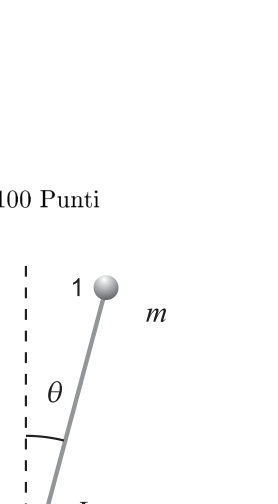
Un manubrio è costituito da due piccole sferette di uguale massa , incollate alle estremità di una sottile asticciola rigida, di lunghezza , avente massa trascurabile rispetto a quella delle sferette. Si trattino le sferette come puntiformi.
Il manubrio può ruotare liberamente, con attrito trascurabile, in un piano verticale, attorno ad un asse orizzontale passante per un punto dell’asticella distante da un’estremità, come in figura. Inizialmente il manubrio si trova, fermo, nella sua posizione di equilibrio instabile. Ad un certo istante, per una piccolissima perturbazione, il manubrio comincia a ruotare.
- Si determini la velocità angolare in funzione di e dell’angolo che la parte più lunga dell’asticella forma con la verticale ascendente (vedi figura).
La sferetta 1, più lontana dall’asse di rotazione, è incollata male, e nel corso della rotazione, quando la forza che la tiene attaccata all’asticella raggiunge un valore pari a volte il peso della sferetta, si stacca.
- Detta la forza che l’asticella esercita sulla sferetta 1, si dimostri che le sue componenti radiale e tangenziale sono date rispettivamente dalle relazioni seguenti:
dove si sono assunti positivi rispettivamente il verso centripeto e quello delle crescenti.
-
Si trovi il valore dell’angolo a cui si verifica il distacco.
-
Dopo il distacco, si descriva il moto della sferetta rimanente (sferetta 2), determinando in particolare la posizione in cui essa inverte il suo moto (si supponga che questa sferetta non si stacchi).
-
Si calcoli il rapporto tra la forza che il vincolo esercita sull’asticella quando la sferetta 2 (dopo il distacco della prima) passa per il punto più basso della sua traiettoria e il peso della sferetta.
p.1 — Manubrio con asticciola e angolo theta
Topic: Rotational Dynamics, Newtonian Mechanics, Conservation of Energy Metodi: Energy Conservation Method, Torque & Angular Momentum Analysis, Free-Body Diagram, Vector Decomposition Competenze: Mathematical Modeling, Diagrammatic Reasoning, Physical Reasoning Objects: Sphere, Rod Fonte: Testo (PDF) — p.1 Soluzione: Soluzioni (PDF)
Attenti alla colla! — 100 Punti
A manubrium consists of two small spheres of equal mass , glued to the ends of a thin rigid bolt, in length, with a mass negligible compared to that of the spheres. The spheres are treated as spherical.
Il manubrio può ruotare liberamente, con attrito trascurabile, in un piano verticale, attorno ad un asse orizzontale passante per un punto dell’asticella distante da un’estremità, come in figura. Initially the handlebar is stationary in its unstable position of equilibrium. At a certain moment, due to a very small disturbance, the handlebar begins to rotate.
- The angular velocity is determined by and the angle that the longer part of the glass forms with the upward vertical (see figure).
The sphere 1, further away from the axis of rotation, is badly glued, and during rotation, when the force holding it to the axle reaches a value of times the weight of the sphere, it is detached.
- When the force exerted by the shaft on the sphere 1, it is shown that its radial and tangential components are given by the following ratios respectively:
where the centreflex and the rising lines were positive respectively.
-
The value of the angle at which the detachment occurs shall be found.
-
After detachment, the motion of the remaining sphere (sphere 2) is described, determining in particular the position in which it reverses its motion (assuming that this sphere does not detach).
-
The ratio of the force exerted by the bond on the sphere when sphere 2 (after detachment of the first) passes through the lowest point of its trajectory and the weight of the sphere is calculated.
**p.1 ** Handle with hinges and theta angle
Topic: Rotational Dynamics, Newtonian Mechanics, Conservation of Energy Metodi: Energy Conservation Method, Torque & Angular Momentum Analysis, Free-Body Diagram, Vector Decomposition Competenze: Mathematical Modeling, Diagrammatic Reasoning, Physical Reasoning Objects: Sphere, Rod Fonte: Testo (PDF) — p.1 Soluzione: Soluzioni (PDF)
Zig-zagando… — 50 Punti
Il moto irregolare di particelle microscopiche molto più grandi delle molecole del liquido in cui sono immerse è detto moto browniano, in quanto fu osservato per la prima volta nel 1828 da R. Brown. Nella teoria formulata da A. Einstein nel 1905, il moto browniano di una particella è descritto utilizzando il coefficiente di diffusione legato alla viscosità del liquido dalla relazione (detta appunto di Einstein):
dove è la costante universale dei gas perfetti (il cui valore all’epoca era già noto), la temperatura assoluta, la viscosità del liquido, il raggio della particella e il Numero di Avogadro.
A sua volta il coefficiente di diffusione è legato al valore medio su varie traiettorie del quadrato dello spostamento subito dalla particella nel tempo , cioè:
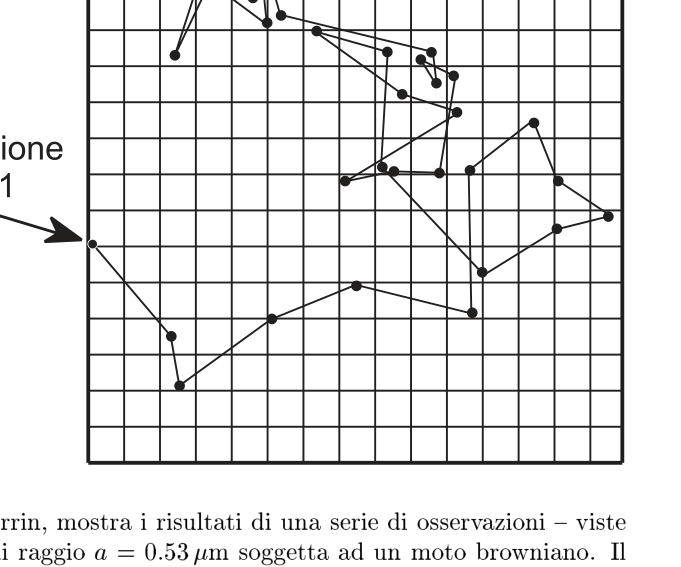
La teoria di Einstein fu presto seguita dalle conferme sperimentali di J. Perrin (1908). In una di queste, il fenomeno venne utilizzato per determinare il Numero di Avogadro. La figura, riprodotta dal libro “Les atomes” di Perrin, mostra i risultati di una serie di osservazioni — viste al microscopio — della migrazione di una particella di raggio soggetta ad un moto browniano. Il fattore di scala della figura è tale che il lato di un quadretto corrisponde a . I punti rappresentano la posizione osservata della particella ad intervalli di tempo costanti . La temperatura dell’acqua è e la sua viscosità è .
-
Misurando almeno 10 spostamenti consecutivi della particella (partendo da un punto qualunque in figura) ricavare una stima del Numero di Avogadro .
Avvertenza: Nella soluzione è richiesta l’annotazione della prima posizione utilizzata (a partire da quella indicata con il n. 1 in figura); inoltre tutte le misure eseguite devono essere riportate in una tabella del tipo:
Spostamento n. lunghezza in figura (quadretti) lunghezza effettiva (m) () … … … … -
In che modo si potrebbe valutare l’incertezza sulla precedente stima del Numero di Avogadro?
p.2 — Traiettoria a zig-zag del moto browniano
Topic: Kinetic Theory, Thermodynamics Metodi: Statistical Averaging, Experimental Data Analysis, Error Propagation Competenze: Experimental Data Analysis, Error Propagation, Graph Linearization Objects: Droplet Fonte: Testo (PDF) — p.2 Soluzione: Soluzioni (PDF)
Zig-zagando… — 50 Punti
The irregular motion of microscopic particles much larger than the molecules of the liquid in which they are immersed is called the brownian motion, as it was first observed in 1828 by R. Brown, please. In the theory formulated by A. Einstein in 1905, the Brownian motion of a particle is described using the diffusion coefficient related to the viscosity of the liquid by the relation (namely Einstein):
where is the universal constant of perfect gases (whose value at the time was already known), the absolute temperature, the viscosity of the liquid, the particle radius and the Avogadro Number.
The diffusion coefficient is related to the mean value on various trajectories of the square of the time shift of the particle , i.e.:
Einstein’s theory was soon followed by J. Perrin (1908) is a writer. In one of these, the phenomenon was used to determine Avogadro’s Number. The figure, reproduced in Perrin’s book “Les atomes”, shows the results of a series of observations seen under the microscope of the migration of a radius particle subject to a brownian motion. The scale factor of the figure is such that the side of a square corresponds to . The points represent the observed position of the particle at constant time intervals . The water temperature is and its viscosity is .
- By measuring at least 10 consecutive movements of the particle (starting from any point in the figure) an estimate of Avogadro’s Number is obtained.
**Warning: ** The solution requires the first position used (starting from the one indicated by n. The following table shows all the measures taken:
| ♪ I’m not moving ♪ | lunghezza in figura (quadretti) | lunghezza effettiva (m) | () |
|---|---|---|---|
| … | … | … | … |
- How could the uncertainty about the previous estimate of Avogadro’s Number be assessed?
p.2 — Traiettoria a zig-zag del moto browniano
Topic: Kinetic Theory, Thermodynamics Metodi: Statistical Averaging, Experimental Data Analysis, Error Propagation Competenze: Experimental Data Analysis, Error Propagation, Graph Linearization Objects: Droplet Fonte: Testo (PDF) — p.2 Soluzione: Soluzioni (PDF)
Pierino in laboratorio — 100 Punti
Pierino ha studiato a scuola cosa è un selettore di velocità: un dispositivo nel quale qualunque particella carica (ione) si muove di moto rettilineo uniforme solo se la sua velocità ha un valore determinato.
Si considera una regione in cui sono contemporaneamente presenti un campo elettrico e un campo magnetico stazionari, uniformi e ortogonali tra loro; un sistema di assi cartesiani ortogonali viene fissato in modo che l’asse sia nella direzione e verso di e l’asse nella direzione e verso di . Indicando come di consueto con , e i versori (vettori unitari) orientati lungo i tre assi cartesiani , e , si può dunque scrivere e .
Se uno ione (di cui è noto il rapporto carica–massa ) si muove in tale regione con una generica velocità istantanea , allora il suo moto è accelerato.
-
Quanto vale, in modulo, la sua accelerazione istantanea?
Suggerimento: Si ricorda che il prodotto vettoriale gode della proprietà distributiva rispetto alla somma: .
-
Per quali velocità iniziali sono possibili moti rettilinei uniformi dello ione e quale di questi corrisponde alla minima energia cinetica della particella?
Pierino pensa che un tale dispositivo si possa realizzare usando semplicemente un generatore reale di f.e.m. (, con resistenza interna ), un grosso condensatore a facce piane parallele (di superficie e distanza ) e un solenoide ( spire, raggio , lunghezza e resistenza nulla).
-
Disegnare schematicamente la disposizione “spaziale” degli oggetti che Pierino vorrebbe usare.
-
Disegnare gli schemi dei circuiti che si hanno disponendo i tre componenti in serie o in parallelo e spiegare per quale motivo in nessuno dei due casi si può realizzare il dispositivo descritto che funzioni a regime, cioè per valori stazionari dei campi.
Dopo averci pensato un po’ Pierino si accorge che è possibile realizzare il dispositivo con l’aggiunta di un resistore opportunamente inserito in uno qualunque dei due circuiti; decide di usare quello con gli elementi disposti in parallelo.
-
Disegnare lo schema del circuito definitivo e calcolare (in funzione dei parametri indicati in precedenza) il valore della velocità che dovrebbe avere lo ione per muoversi di moto uniforme perpendicolarmente ai due campi.
-
Assumendo i seguenti valori numerici dei parametri dei componenti del circuito:
dire quale resistenza dovrebbe essere usata affinché la velocità costante dello ione sia prossima a .
- Dal momento in cui si disconnette il generatore lasciando il resto del circuito collegato fino al completo spegnimento del dispositivo, quanta energia viene convertita in calore nella resistenza?
Topic: Electromagnetism, Circuits, Magnetism Metodi: Lorentz Force Analysis, Kirchhoff’s Laws, Equivalent Circuit Reduction, Energy Conservation Method Competenze: Physical Reasoning, Mathematical Modeling, Diagrammatic Reasoning Objects: Point Charge, Capacitor, Solenoid, Resistor, Battery Fonte: Testo (PDF) — p.3 Soluzione: Soluzioni (PDF)
The test results shall be presented in accordance with the following formula:
Pierino studied at school what a speed selector is: a device in which any charged particle (ion) moves in a uniform straight-line motion only if its speed has a certain value.
A region is considered to be one in which a stationary, uniform and orthogonal electric and magnetic field are present at the same time; an orthogonal Cartesian axis system is fixed so that the axis is in the direction and direction of and the axis is in the direction and direction of . Indicating as usual with , and the vectors (unit vectors) oriented along the three cardiac axes , and , we can therefore write and .
If an ion (of which the charge-mass ratio is known) moves in that region at a general instantaneous velocity , then its motion is accelerated.
- How much is its instantaneous acceleration in form?
Suggest: Please note that the vector product has the distribution property in relation to the sum: .
- For what initial speeds are uniform straight-line motions of the ion possible, and which of these corresponds to the minimum kinetic energy of the particle?
Pierino thinks such a device can be made using a real f.e.m. generator. (, with internal resistance ), a large parallel flat-faced capacitor (surface and distance ) and a solenoid ( spire, radius , length and resistance zero).
-
Schematically draw the “space” arrangement of the objects Pierino would like to use.
-
Draw the circuits in which the three components are arranged in series or in parallel and explain why the device described can be made to operate at the current rate, i.e. at stationary values of the fields.
After thinking a little about it, Pierino realizes that it is possible to make the device by adding a resistor that is properly inserted into any of the two circuits; he decides to use that with the elements arranged in parallel.
-
Draw the final circuit diagram and calculate (in accordance with the parameters indicated above) the value of the velocity that the ion should have to move uniformly perpendicular to the two fields.
-
Assuming the following numerical values of the circuit component parameters:
indicate what resistance should be used to ensure that the constant ion velocity is close to .
- From the moment the generator is disconnected and the rest of the circuit is connected until the device is completely turned off, how much energy is converted into heat in the resistance?
Topic: Electromagnetism, Circuits, Magnetism Metodi: Lorentz Force Analysis, Kirchhoff’s Laws, Equivalent Circuit Reduction, Energy Conservation Method Competenze: Physical Reasoning, Mathematical Modeling, Diagrammatic Reasoning Objects: Point Charge, Capacitor, Solenoid, Resistor, Battery Fonte: Testo (PDF) — p.3 Soluzione: Soluzioni (PDF)
Luci ed ombre — 50 Punti
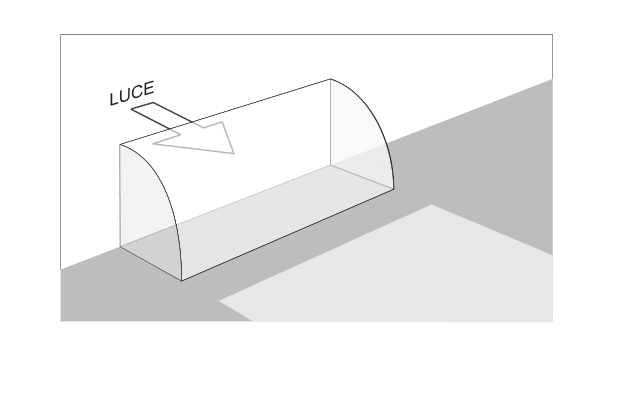
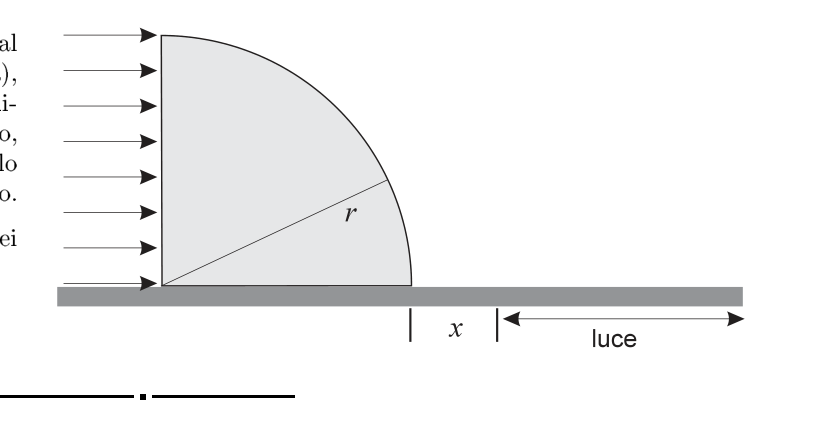
Un fascio collimato di luce monocromatica, assimilabile ad un’onda piana, incide ortogonalmente sulla faccia piana verticale di un componente di vetro lucidato (indice di rifrazione: ) avente la forma di un quarto di cilindro di raggio , appoggiato con l’altra faccia piana su di un tavolo (vedi figura). La luce viene deviata per rifrazione e va a incidere sulla superficie del tavolo, dove forma un’area illuminata, di larghezza pari all’altezza del cilindro. Una parte della luce viene anche riflessa sul tavolo al di sotto del cilindro, ma di essa in questo problema non ci occupiamo.
-
Qual è la distanza minima, a partire dal bordo posteriore del cilindro ( in figura), a cui la superficie del tavolo risulta illuminata? Fra i raggi che incidono sul tavolo, quello che giunge a distanza è quello inizialmente più alto sul piano del tavolo.
-
E quella massima, che si ha nel caso dei raggi in arrivo radenti al tavolo?
p.4 — Vista prospettica del quarto di cilindro sul tavolo
p.4 — Sezione con raggi rifratti, raggio r e distanza x
Topic: Geometric Optics Metodi: Snell’s Law, Ray Tracing, Vector Decomposition Competenze: Mathematical Modeling, Diagrammatic Reasoning, Physical Reasoning Objects: Cylinder Fonte: Testo (PDF) — p.4 Soluzione: Soluzioni (PDF)
The following is the list of the categories of the categories of vehicles used:
A monochrome, flat wave-like, collimated beam of light, which is orthogonal to the vertical flat surface of a polished glass component (refraction index: ) shaped like a quarter cylinder of radius , resting with the other flat surface on a table (see figure). The light is deflected by refraction and it hits the surface of the table, where it forms an illuminated area, the width of which is equal to the height of the cylinder. Part of the light is also reflected on the table below the cylinder, but that’s not what we’re dealing with here.
-
What is the minimum distance from the rear edge of the cylinder ( in figure) at which the surface of the table is illuminated? Among the beams that impact the table, the one that reaches the distance is the one initially higher on the table plane.
-
And that maxim, which you get in the case of incoming rays coming at the table?
**p.4 ** Perspective view of the fourth cylinder on the table
**p.4 ** Section with reflected rays, radius r and distance x
Topic: Geometric Optics Metodi: Snell’s Law, Ray Tracing, Vector Decomposition Competenze: Mathematical Modeling, Diagrammatic Reasoning, Physical Reasoning Objects: Cylinder Fonte: Testo (PDF) — p.4 Soluzione: Soluzioni (PDF)