PROBLEMA n. 1 – Equilibrismi… (100 Punti)
Quesito n. 1.
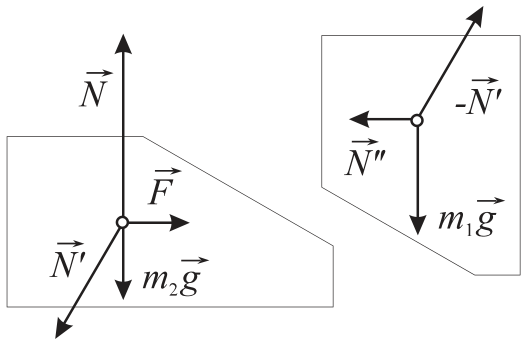
In assenza di attriti, le forze applicate al blocco di massa sono: il peso (verticale), la reazione vincolare dal piano orizzontale (verticale), la reazione vincolare da parte del blocco di massa (obliqua) e la forza (orizzontale).
Le forze applicate al blocco di massa sono: il peso (verticale), la reazione vincolare dal piano verticale (orizzontale), la reazione vincolare da parte del blocco di massa (obliqua).
Topic: Newtonian Mechanics, Rigid Body Statics Metodi: Free-Body Diagram, Vector Decomposition, Kinematic Equations Competenze: Diagrammatic Reasoning, Mathematical Modeling, Physical Reasoning Objects: Block Fonte: Testo (PDF) — p.1 Soluzione: Soluzioni (PDF)
PROBLEM no. 1 – Equilibrismi… (100 Points)
Question no. 1.
In the absence of friction, the forces acting on the block of mass are: its weight (vertical), the normal reaction force from the horizontal plane (vertical), the normal reaction force due to the block of mass (oblique), and the force (horizontal).
The forces acting on the block of mass are: its weight (vertical), the normal reaction force from the vertical plane (horizontal), and the normal reaction force due to the block of mass (oblique).
Solution: Soluzioni (PDF)
Quesito n. 2.
All’equilibrio le forze su ciascun blocco devono avere risultante nulla. In componenti, prendendo l’asse orizzontale da sinistra a destra e l’asse verticale dal basso verso l’alto, e indicando con l’intensità di in condizioni di equilibrio, si ha:
Dalla prima e la quarta di queste equazioni, con facili sostituzioni, si ha
Topic: Newtonian Mechanics, Rigid Body Statics Metodi: Free-Body Diagram, Vector Decomposition, Conservation Laws Competenze: Mathematical Modeling, Physical Reasoning Objects: Block Fonte: Testo (PDF) — p.1 Soluzione: Soluzioni (PDF)
Question no. 2.
At equilibrium, the net force on each block must be zero. In components, taking the -axis horizontal from left to right and the -axis vertical from bottom to top, and denoting by the magnitude of under equilibrium conditions, one obtains:
From the first and fourth of these equations, by simple substitutions, one obtains:
Solution: Soluzioni (PDF)
Quesito n. 3.
Con una forza maggiore, pari a , non si ha più equilibrio; il corpo di massa si muove con accelerazione orizzontale e il corpo di massa si muove con accelerazione verticale. Le equazioni precedenti, pertanto, si modificano così:
Inoltre, per considerazioni geometriche, fra gli spostamenti, e quindi le accelerazioni, dei due blocchi vale la relazione , cioè . Sostituendo nella prima e quarta equazione qui sopra, si ricava:
Topic: Newtonian Mechanics Metodi: Free-Body Diagram, Vector Decomposition, Kinematic Equations Competenze: Diagrammatic Reasoning, Mathematical Modeling, Physical Reasoning Objects: Block Fonte: Testo (PDF) — p.1 Soluzione: Soluzioni (PDF)
Question no. 3.
With a greater force, equal to , equilibrium is no longer maintained; the body of mass moves with horizontal acceleration , and the body of mass moves with vertical acceleration . The previous equations therefore change as follows:
Moreover, from geometric considerations, the relationship between the displacements, and therefore the accelerations, of the two blocks is , that is . Substituting into the first and fourth equations above, we obtain:
Solution: Soluzioni (PDF)
Quesito n. 4.
Il blocco di massa ha un’accelerazione e pertanto, a partire dall’istante in cui la forza raddoppia l’intensità, ha una velocità . La potenza da applicare, pertanto, è . Essa cresce linearmente nel tempo con un coefficiente .
Nota: Sostituendo ad il valore già arrotondato, così come è stato riportato sopra al punto 3, si otterrebbe che è ugualmente accettabile.
Topic: Newtonian Mechanics, Conservation of Energy Metodi: Kinematic Equations, Free-Body Diagram, Energy Conservation Method Competenze: Mathematical Modeling, Physical Reasoning Objects: Block Fonte: Testo (PDF) — p.2 Soluzione: Soluzioni (PDF)
Question no. 4.
The block of mass has an acceleration and therefore, starting from the instant when the force doubles in magnitude, it has a velocity . The power to be applied is thus . It increases linearly with time, with a coefficient .
Note: Substituting with the already rounded value, as reported above in point 3, would yield , which is equally acceptable.
Solution: Soluzioni (PDF)
Quesito n. 5.
In presenza di forze di attrito, e (rispettivamente), sulle superfici orizzontale e verticale che si aggiungono alle altre forze già considerate, la forza minima per ottenere l’equilibrio dev’essere minore di , per cui l’attrito orizzontale dev’essere rivolto nel verso positivo delle per ostacolare il moto del blocco di massa verso sinistra, e quello verticale verso l’alto per ostacolare il moto del blocco di massa verso il basso, moti che si avrebbero in assenza di e di attriti.
Quindi le equazioni precedenti si modificano così:
I valori massimi possibili di e sono rispettivamente e . Indichiamo i loro valori effettivi con e . Questa volta servono tutte e quattro le equazioni precedenti; si ricava
Il valore di decresce in modo monotono al crescere sia di che di , per cui per minimizzare (finché esso è positivo, naturalmente) occorre assumere i valori massimi possibili sia di che di . L’ultima formula diviene pertanto:
Topic: Newtonian Mechanics, Rigid Body Statics Metodi: Free-Body Diagram, Vector Decomposition, Physical Modeling Competenze: Diagrammatic Reasoning, Mathematical Modeling, Physical Reasoning Objects: Block Fonte: Testo (PDF) — p.2 Soluzione: Soluzioni (PDF)
Question no. 5.
In the presence of friction forces, and (respectively) on the horizontal and vertical surfaces that are added to the other forces already considered, the minimum force required to achieve equilibrium must be less than , so that the horizontal friction must act in the positive direction of to hinder the motion of the block of mass toward the left, and the vertical friction must act upward to hinder the motion of the block of mass downward, motions that would occur in the absence of and friction.
Therefore, the previous equations are modified as follows:
The maximum possible values of and are respectively and . We denote their actual values by and . This time all four of the previous equations are needed; it follows that
The value of decreases monotonically with increasing and , so to minimize (as long as it remains positive, naturally) one must assume the maximum possible values for both and . The last formula therefore becomes:
Solution: Soluzioni (PDF)
PROBLEMA n. 2 – Occhio alle induttanze! (50 Punti)
Quesito n. 1.
Alla chiusura dell’interruttore la corrente per l’induttanza si mantiene istantaneamente nulla e l’equazione della maglia attiva dà
A regime invece la f.e.m. ai capi dell’induttanza è nulla, dunque la resistenza vista dal generatore è , per cui l’equazione del circuito equivalente dà
che, sostituendo l’espressione precedente di , si riduce a
da cui
Topic: Circuits, Electromagnetic Induction Metodi: Kirchhoff’s Laws, Equivalent Circuit Reduction, Physical Modeling Competenze: Diagrammatic Reasoning, Mathematical Modeling, Physical Reasoning Objects: Inductor, Resistor, Switch, Battery Fonte: Testo (PDF) — p.3 Soluzione: Soluzioni (PDF)
PROBLEM no. 2 – Watch out for inductances! (50 Points)
Question no. 1.
At the closing of the switch, the current through the inductance remains instantaneously zero and the equation for the active mesh gives
In steady state, instead, the electromotive force across the inductance is zero, so the resistance seen by the generator is , hence the equation for the equivalent circuit gives
which, substituting the previous expression for , reduces to
from which
Solution: Soluzioni (PDF)
Quesito n. 2.
L’energia magnetica immagazzinata nel circuito è , essendo la corrente nel ramo dell’induttanza. A regime la d.d.p. ai capi dell’induttanza è nulla e dunque basta considerare il parallelo delle resistenze ed : ne segue immediatamente che la corrente in è doppia dell’altra e pari a della corrente totale.
Più formalmente tale corrente è determinata dalle equazioni (dette del partitore di corrente):
Appena riaperto l’interruttore l’energia magnetica viene dissipata dalle resistenze ed , in parti proporzionali ai valori delle due resistenze, dato che la corrente è la stessa in ogni punto della maglia: dunque ; .
Nella resistenza si dissipa quindi dell’energia immagazzinata: dunque
Topic: Circuits, Electromagnetic Induction Metodi: Kirchhoff’s Laws, Equivalent Circuit Reduction, Energy Conservation Method Competenze: Mathematical Modeling, Physical Reasoning, Diagrammatic Reasoning Objects: Inductor, Resistor, Switch Fonte: Testo (PDF) — p.3 Soluzione: Soluzioni (PDF)
Question no. 2.
The magnetic energy stored in the circuit is , where is the current in the inductance branch. At steady state, the voltage across the inductance is zero and thus it suffices to consider the parallel combination of the resistances and : it immediately follows that the current in is double the other and equal to of the total current.
More formally, this current is determined by the equations (known as the current divider equations):
Immediately after the switch is reopened, the magnetic energy is dissipated by the resistances and , in parts proportional to their resistance values, since the current is the same at every point of the loop: thus ; .
Therefore, in resistance , one-third of the stored energy is dissipated: hence
Solution: Soluzioni (PDF)
Quesito n. 3.
La tensione ai capi dell’induttanza, , appena si apre il circuito, quando la corrente è si determina dall’equazione di maglia
che è maggiore della f.e.m. del generatore.
Osservazione: Nel caso in esame, con , si ha che
mentre si è visto che
La condizione su per cui sarà all’apertura del circuito è data da
Topic: Circuits, Electromagnetic Induction Metodi: Kirchhoff’s Laws, Faraday’s Law of Induction, Physical Modeling Competenze: Mathematical Modeling, Physical Reasoning Objects: Inductor, Resistor, Switch Fonte: Testo (PDF) — p.3 Soluzione: Soluzioni (PDF)
Question no. 3.
The voltage across the inductance, , just after the circuit is opened, when the current is , is determined from the loop equation
which is greater than the electromotive force of the generator.
Observation: In the case under consideration, with , it holds that
while it has been shown that
The condition on for which it will be at the opening of the circuit is given by
Solution: Soluzioni (PDF)
PROBLEMA n. 3 – Che caldo quest’estate! (100 Punti)
Quesito n. 1.
Il flusso di energia che entra nell’appartamento, sotto forma di calore, per conduzione è dato da . Il flusso di energia che il condizionatore estrae dall’appartamento è dato da dove è l’efficienza di un frigorifero ideale (cioè di un frigorifero che utilizza il ciclo di Carnot). Dal momento che il condizionatore funziona tra due sorgenti, l’appartamento a temperatura e l’ambiente esterno a temperatura , l’efficienza di un frigorifero di Carnot che funziona tra le stesse sorgenti è data da per cui, ricomponendo la relazione del flusso in uscita, si ha
Topic: Thermodynamics, Conservation of Energy Metodi: Thermodynamic Cycle Analysis, First Law of Thermodynamics, Physical Modeling Competenze: Mathematical Modeling, Physical Reasoning Objects: Heat Engine Fonte: Testo (PDF) — p.4 Soluzione: Soluzioni (PDF)
PROBLEM no. 3 – What a hot summer this year! (100 Points)
Question no. 1.
The energy flux entering the apartment, in the form of heat due to conduction, is given by . The energy flux extracted by the air conditioner from the apartment is given by , where is the efficiency of an ideal refrigerator (i.e., a refrigerator that uses the Carnot cycle). Since the air conditioner operates between two reservoirs, the apartment at temperature and the external environment at temperature , the efficiency of a Carnot refrigerator operating between the same reservoirs is given by , so that, substituting back into the expression for the outgoing flux, one obtains
Solution: Soluzioni (PDF)
Quesito n. 2.
In condizioni stazionarie, il flusso in ingresso è uguale al flusso in uscita. Dunque si ha
con e avendo posto .
Delle due radici, una sola è minore della temperatura esterna, per cui si ha .
Topic: Thermodynamics, Conservation of Energy Metodi: Thermodynamic Cycle Analysis, First Law of Thermodynamics, Differential Equations Competenze: Mathematical Modeling, Physical Reasoning Objects: Heat Engine Fonte: Testo (PDF) — p.4 Soluzione: Soluzioni (PDF)
Question no. 2.
In steady-state conditions, the incoming flux is equal to the outgoing flux. Therefore one has
with and having set .
Of the two roots, only one is lower than the external temperature, so one has .
Topic: Thermodynamics, Conservation of Energy Metodi: Thermodynamic Cycle Analysis, First Law of Thermodynamics, Differential Equations Competenze: Mathematical Modeling, Physical Reasoning Objects: Heat Engine Fonte: Testo (PDF) — p.4 Soluzione: Soluzioni (PDF)
Quesito n. 3.
Quando si spegne il condizionatore d’aria c’è soltanto il flusso di energia dall’esterno verso l’interno dell’appartamento. Si ha
Ad ogni intervallo di tempo , si ha una variazione di temperatura data da
Con questa espressione, partendo dal valore iniziale di , si possono calcolare e ogni 15 minuti, come mostrato nella seguente tabella.
| Tempo [min] | [C] | [C] | [C] |
|---|---|---|---|
| 0 | 18.0 | ||
| 15 | 14.0 | 3.4 | 21.4 |
| 30 | 10.6 | 2.6 | 24.0 |
| 45 | 8.0 | 1.9 | 25.9 |
| 60 | 6.1 | 1.5 | 27.4 |
La temperatura (approssimata) dell’appartamento dopo un’ora è di .
Topic: Thermodynamics, Conservation of Energy Metodi: First Law of Thermodynamics, Differential Equations, Physical Modeling Competenze: Mathematical Modeling, Physical Reasoning, Estimation & Approximation Objects: Heat Engine Fonte: Testo (PDF) — p.4 Soluzione: Soluzioni (PDF)
Question no. 3.
When the air conditioner is turned off, there is only energy flow from outside to inside the apartment. One has
At each time interval , the temperature variation is given by
With this expression, starting from the initial value of , and can be calculated every 15 minutes, as shown in the following table.
| Time [min] | [C] | [C] | [C] |
|---|---|---|---|
| 0 | 18.0 | ||
| 15 | 14.0 | 3.4 | 21.4 |
| 30 | 10.6 | 2.6 | 24.0 |
| 45 | 8.0 | 1.9 | 25.9 |
| 60 | 6.1 | 1.5 | 27.4 |
The (approximate) temperature of the apartment after one hour is .
Soluzione: Soluzioni (PDF)
Quesito n. 4.
Si considerino due termini consecutivi della successione: e il seguente
Operando come sopra, si può scrivere che
ovvero, sostituendo in termini di e
La successione è quindi una progressione geometrica di ragione per cui
Topic: Thermodynamics Metodi: Differential Equations, Approximation & Series Expansion, Physical Modeling Competenze: Mathematical Modeling, Physical Reasoning Objects: Heat Engine Fonte: Testo (PDF) — p.4 Soluzione: Soluzioni (PDF)
Question no. 4.
Consider two consecutive terms of the sequence: and the following one
Proceeding as above, one can write that
that is, substituting in terms of and
The sequence is therefore a geometric progression with ratio , so that
Topic: Thermodynamics Metodi: Differential Equations, Approximation & Series Expansion, Physical Modeling Competenze: Mathematical Modeling, Physical Reasoning Objects: Heat Engine Fonte: Testo (PDF) — p.4 Soluzione: Soluzioni (PDF)
Quesito n. 5.
Si pone adesso e dopo incrementi temporali, cioè al tempo si ha
Per posto si ha che , e ci si riconduce al limite notevole .
Infatti
Topic: Thermodynamics Metodi: Differential Equations, Approximation & Series Expansion, Calculus-Integration Competenze: Mathematical Modeling, Physical Reasoning Objects: Heat Engine Fonte: Testo (PDF) — p.5 Soluzione: Soluzioni (PDF)
Question no. 5.
One now sets and after time increments, that is at time , one obtains
For , setting , one has that , and one reduces to the well-known limit .
Indeed
Solution: Soluzioni (PDF)
Quesito n. 6.
Il tempo caratteristico del processo è dato dalla costante tempo s.
La temperatura dell’appartamento dopo un’ora (ovvero per s) risulta quindi
Topic: Thermodynamics, Conservation of Energy Metodi: Differential Equations, Calculus-Integration, Physical Modeling Competenze: Mathematical Modeling, Physical Reasoning Objects: Heat Engine Fonte: Testo (PDF) — p.5 Soluzione: Soluzioni (PDF)
Question no. 6.
The characteristic time of the process is given by the time constant s.
The temperature of the apartment after one hour (i.e., for s) therefore results in
Solution: Soluzioni (PDF)
PROBLEMA n. 4 – Una misura al volo. (50 Punti)
Quesito n. 1.
Poiché il campo elettrico è uniforme, la forza che agisce su un elettrone (o su uno ione) è costante, di modulo pari a ; inoltre il moto avviene nella direzione e nel verso del campo. In un generico istante ciascun elettrone avrà percorso una distanza . Ne segue che il lavoro fatto su un singolo elettrone, in funzione del tempo, risulta:
Un’espressione analoga vale ovviamente per gli ioni.
Topic: Electrostatics, Modern-Quantum Physics Metodi: Kinematic Equations, Free-Body Diagram, Physical Modeling Competenze: Mathematical Modeling, Physical Reasoning Objects: Capacitor, Electron, Point Charge Fonte: Testo (PDF) — p.5 Soluzione: Soluzioni (PDF)
PROBLEM no. 4 – A flight measurement. (50 Points)
Question no. 1.
Since the electric field is uniform, the force acting on an electron (or on an ion) is constant and has a magnitude equal to ; furthermore, the motion occurs in the direction and sense of the field. At a generic time , each electron will have traveled a distance . It follows that the work done on a single electron, as a function of time, is:
An analogous expression clearly holds for the ions.
Solution: Soluzioni (PDF)
Quesito n. 2.
Poiché il rivelatore può essere considerato come un condensatore isolato, l’energia occorrente per far migrare elettroni e ioni viene prelevata da quella immagazzinata nel condensatore. Potremo dunque scrivere:
Da qui:
Poiché il segnale è molto minore di , potremo porre, con buona approssimazione, nell’espressione precedente, ottenendo infine:
Topic: Electrostatics, Modern-Quantum Physics Metodi: Energy Conservation Method, Electric Potential Method, Approximation & Series Expansion Competenze: Mathematical Modeling, Physical Reasoning Objects: Capacitor, Electron, Point Charge Fonte: Testo (PDF) — p.5 Soluzione: Soluzioni (PDF)
Question no. 2.
Since the detector can be considered as an isolated capacitor, the energy required to move electrons and ions is drawn from that stored in the capacitor. We can therefore write:
From this:
Since the signal is much smaller than , we can approximate, with good accuracy, in the previous expression, obtaining finally:
Solution: Soluzioni (PDF)
Quesito n. 3.
Nell’istante gli elettroni raggiungono l’anodo, e da quel momento in poi non assorbono più energia. Il segnale cresce ancora, ma contribuiscono solamente gli ioni:
Topic: Electrostatics, Modern-Quantum Physics Metodi: Kinematic Equations, Physical Modeling, Energy Conservation Method Competenze: Mathematical Modeling, Physical Reasoning Objects: Capacitor, Electron, Point Charge Fonte: Testo (PDF) — p.6 Soluzione: Soluzioni (PDF)
Question no. 3.
At the instant electrons reach the anode, and from that moment onward they no longer absorb energy. The signal continues to increase, but only the ions contribute:
Solution: Soluzioni (PDF)
Quesito n. 4.
All’istante gli ioni raggiungono il catodo. A quel punto il segnale diventa:
Come si può vedere, il valore finale dipende solamente dalla capacità del condensatore e dal numero di coppie elettroni-ioni prodotte dal passaggio della particella ionizzante.
Si noti che a questo risultato si può arrivare molto facilmente osservando che, dopo che tutta la carica “prodotta” dalla ionizzazione, è stata raccolta, la carica sulle armature diminuisce di una quantità , e il potenziale diminuisce di una quantità .
Topic: Electrostatics, Modern-Quantum Physics Metodi: Electric Potential Method, Physical Modeling, Conservation Laws Competenze: Mathematical Modeling, Physical Reasoning Objects: Capacitor, Electron, Point Charge Fonte: Testo (PDF) — p.6 Soluzione: Soluzioni (PDF)
Question no. 4.
At the instant the ions reach the cathode. At that point, the signal becomes:
As can be seen, the final value depends only on the capacitance of the capacitor and on the number of electron-ion pairs produced by the passage of the ionizing particle.
Note that this result can be reached very easily by observing that, after all the charge “produced” by ionization has been collected, the charge on the plates decreases by an amount , and the potential decreases by an amount .
Solution: Soluzioni (PDF)
Quesito n. 5.
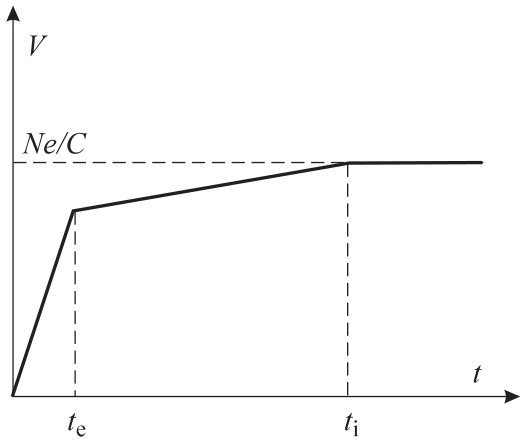
Il grafico qualitativo del segnale raccolto dal rivelatore risulta allora:
 Materiale prodotto dal gruppo
Segreteria Olimpiadi Italiane della Fisica presso Liceo Scientifico “U. Morin” VENEZIA MESTRE fax: 041.584.1272 e-mail: olifis@libero.it
Topic: Electrostatics, Modern-Quantum Physics Metodi: Physical Modeling, Kinematic Equations Competenze: Diagrammatic Reasoning, Physical Reasoning Objects: Capacitor, Electron, Point Charge Fonte: Testo (PDF) — p.6 Soluzione: Soluzioni (PDF)
Question no. 5.
The qualitative graph of the signal collected by the detector then becomes:
Material produced by the group
Secretariat of the Italian Physics Olympiad
located at Liceo Scientifico “U. Morin”
VENEZIA MESTRE
fax: 041.584.1272
e-mail: olifis@libero.it
Solution: Soluzioni (PDF)