PROBLEMA n. 1 – Equilibrismi. (100 Punti)
Il blocco di massa in figura appoggia su un piano orizzontale ed è in contatto con un blocco di massa , posto contro un piano verticale e non in contatto col piano orizzontale. Il contatto fra i due blocchi avviene lungo un piano ortogonale al piano di figura e che forma col piano orizzontale un angolo . Al blocco di massa viene applicata una forza orizzontale, rivolta come in figura.
- Supponendo che non vi sia attrito, si faccia un diagramma di tutte le forze agenti su ciascuno dei due blocchi.
- Qual è l’intensità della forza occorrente perché il sistema rimanga in equilibrio?
- Se ad un certo istante () l’intensità della forza viene raddoppiata rispetto al valore calcolato al punto 2, qual è l’accelerazione con cui il blocco di massa si muove verso l’alto?
- Qual è, in funzione del tempo, la potenza meccanica che occorre applicare al blocco di massa perché il valore di calcolato al punto 3 si mantenga costante nel tempo?
- Se c’è invece attrito sul piano orizzontale e quello verticale (con lo stesso coefficiente di attrito statico ), restando priva di attrito la superficie obliqua, qual è il valore minimo di per avere equilibrio?
Per i calcoli numerici si usino i seguenti valori: , , , , .
Topic: Newtonian Mechanics, Rigid Body Statics Metodi: Free-Body Diagram, Vector Decomposition, Kinematic Equations Competenze: Diagrammatic Reasoning, Mathematical Modeling, Physical Reasoning Objects: Block, Inclined Plane Fonte: Testo (PDF) — p.1 Soluzione: Soluzioni (PDF)
PROBLEM no. 1 – Equilibria. (100 Points)
The block of mass in the figure rests on a horizontal plane and is in contact with a block of mass , placed against a vertical plane and not in contact with the horizontal plane. The contact between the two blocks occurs along a plane orthogonal to the plane of the figure and forming an angle with the horizontal plane. A force , horizontal and directed as shown in the figure, is applied to the block of mass .
- Assuming there is no friction, draw a diagram showing all the forces acting on each of the two blocks.
- What is the magnitude of the force required for the system to remain in equilibrium?
- If at a certain instant () the magnitude of the force is doubled compared to the value calculated in point 2, what is the acceleration with which the block of mass moves upward?
- What is, as a function of time, the mechanical power that must be applied to the block of mass in order for the value of calculated in point 3 to remain constant over time?
- If instead there is friction on the horizontal plane and on the vertical plane (with the same coefficient of static friction ), while the inclined surface remains free of friction, what is the minimum value of for equilibrium?
For numerical calculations use the following values: , , , , .
Solution: Soluzioni (PDF)
PROBLEMA n. 2 – Occhio alle induttanze! (50 Punti)
Nel circuito in figura sono noti solo i valori delle resistenze e , mentre , la f.e.m e l’induttanza sono incognite. Finché l’interruttore è aperto la corrente nel circuito è nulla ovunque.
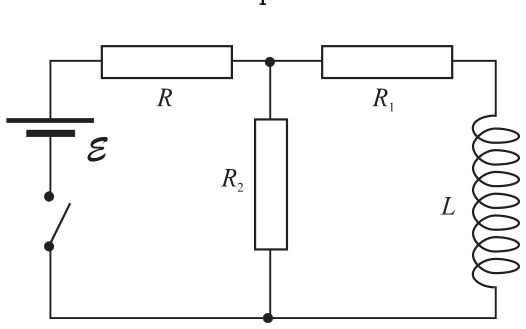 Alla chiusura dell’interruttore la corrente istantanea erogata dal generatore è , mentre a regime la stessa corrente è aumentata a .
- Determinare i valori incogniti che possono essere ricavati da queste due misure. Dopo aver riaperto l’interruttore, si misura l’energia , dissipata dalla resistenza .
- Utilizzare questo dato per ricavare l’ultimo elemento incognito del circuito.
- È possibile che, al momento della riapertura dell’interruttore, ai capi dell’induttanza si possa avere una d.d.p. maggiore della f.e.m. del generatore inserito nel circuito? Motivare adeguatamente la risposta.
Topic: Circuits, Electromagnetic Induction Metodi: Kirchhoff’s Laws, Equivalent Circuit Reduction, Energy Conservation Method Competenze: Physical Reasoning, Mathematical Modeling, Diagrammatic Reasoning Objects: Resistor, Inductor, Battery, Switch Fonte: Testo (PDF) — p.1 Soluzione: Soluzioni (PDF)
PROBLEM no. 2 – Watch out for inductances! (50 Points)
In the circuit shown in the figure, only the values of the resistances and are known, while , the e.m.f. , and the inductance are unknown. As long as the switch is open, the current in the circuit is zero everywhere.
At the moment of closing the switch, the instantaneous current supplied by the generator is , while in steady state this same current has increased to .
- Determine the unknown values that can be deduced from these two measurements. After having reopened the switch, the energy dissipated by the resistance is measured.
- Use this information to determine the last unknown element of the circuit.
- Is it possible that, at the moment of reopening the switch, a voltage greater than the e.m.f. of the generator inserted in the circuit may appear across the inductance? Justify your answer adequately.
Solution: Soluzioni (PDF)
PROBLEMA n. 3 – Che caldo quest’estate! (100 Punti)
In questo problema si vuole discutere del raffreddamento di un appartamento per mezzo di un condizionatore d’aria, solo allo scopo di farsi un’idea dei fenomeni e di stimare le grandezze in gioco.
Per fare questo in modo semplice occorre introdurre schematizzazioni ed approssimazioni piuttosto drastiche: considereremo che tutto l’appartamento sia, in ogni istante, alla stessa temperatura, che lo scambio di calore avvenga solamente per conduzione e che, per valutare i processi di scambio termico tra l’appartamento e l’ambiente esterno, si possano usare solo delle stime di capacità termica del sistema e di conduttanza delle pareti.
In una giornata estiva, un appartamento è raffreddato mediante un condizionatore d’aria che tratteremo come una macchina termica fatta funzionare a rovescio (frigorifero). Il condizionatore trasferisce una quantità di calore pari ad una frazione della quantità di calore trasferita da una macchina di Carnot che funziona a rovescio fra le stesse temperature.
-
Facendo riferimento alle grandezze i cui valori sono riportati sotto, determinare un’espressione per il flusso termico in ingresso e per quello in uscita dall’appartamento in funzione di , , , , e della temperatura istantanea dell’appartamento.
-
Se si lascia acceso ininterrottamente il condizionatore fino a raggiungere uno stato di regime stazionario, quale sarà la temperatura dell’appartamento?
A un certo istante (sia ), quando la temperatura interna dell’appartamento è C, il condizionatore viene spento e l’appartamento inizia a riscaldarsi. Ci si chiede quale sarà la sua temperatura dopo un’ora.
Un modo approssimato di procedere è quello di usare l’espressione – trovata prima – del flusso termico verso l’esterno per calcolare i successivi incrementi di temperatura , a partire da , assumendo incrementi finiti e costanti di tempo min ciascuno.
-
Calcolare la temperatura dell’appartamento dopo che è trascorsa un’ora.
-
Mostrare in generale che, se gli incrementi temporali sono costanti (posto quindi ), la successione delle differenze è una progressione geometrica.
Il calcolo della temperatura dell’appartamento è più corretto se si divide l’intervallo di tempo totale (per esempio un’ora) in intervalli di tempo di uguale ampiezza (), facendo poi tendere all’infinito.
-
Trovare in questo modo la funzione .
-
Calcolare la costante di tempo del processo e la temperatura dell’appartamento dopo un’ora.
Dati per la risoluzione del problema:
| Quantità | Valore |
|---|---|
| Conduttanza termica complessiva delle pareti dell’appartamento | |
| Capacità termica complessiva dell’appartamento | |
| Temperatura esterna | C |
| Potenza elettrica utilizzata dal condizionatore | |
| Efficienza del condizionatore reale, rispetto a quella del frigorifero ideale fra le stesse temperature |
Topic: Thermodynamics Metodi: Thermodynamic Cycle Analysis, First Law of Thermodynamics, Differential Equations Competenze: Mathematical Modeling, Estimation & Approximation, Physical Reasoning Objects: Heat Engine Fonte: Testo (PDF) — p.2 Soluzione: Soluzioni (PDF)
PROBLEM no. 3 – It’s so hot this summer! (100 Points)
In this problem we wish to discuss the cooling of an apartment using an air conditioner, solely in order to gain an understanding of the phenomena involved and to estimate the relevant quantities.
To carry this out in a simple way, rather drastic simplifications and approximations must be introduced: we shall assume that the entire apartment is at the same temperature at every instant, that heat exchange occurs only by conduction, and that for evaluating thermal exchange processes between the apartment and the external environment, only estimates of the system’s heat capacity and of the wall conductances may be used.
On a summer day, an apartment is cooled using an air conditioner which we shall treat as a heat engine operated in reverse (refrigerator). The air conditioner transfers an amount of heat equal to a fraction of the amount of heat transferred by a Carnot machine operating in reverse between the same temperatures.
-
Referring to the quantities whose values are reported below, determine an expression for the incoming heat flux and for the outgoing heat flux from the apartment as a function of , , , , , and the instantaneous temperature of the apartment.
-
If the air conditioner is left running continuously until a stationary steady state is reached, what will be the apartment’s temperature?
At a certain instant (let ), when the internal temperature of the apartment is C, the air conditioner is switched off and the apartment begins to heat up. We ask what its temperature will be after one hour.
An approximate way of proceeding is to use the previously found expression for the heat flux outward to compute successive temperature increments , starting from , assuming finite increments and constant time intervals min each.
-
Calculate the apartment’s temperature after one hour has passed.
-
Show in general that, if the time increments are constant (so that ), the sequence of differences forms a geometric progression.
A more accurate calculation of the apartment’s temperature is obtained by dividing the total time interval (for example, one hour) into intervals of equal width (, with ), and then taking the limit as .
-
Find, in this way, the function .
-
Calculate the time constant of the process and the apartment’s temperature after one hour.
Data for solving the problem:
| Quantity | Value |
|---|---|
| Overall thermal conductance of the apartment walls | |
| Overall thermal capacity of the apartment | |
| External temperature | C |
| Electrical power consumed by the air conditioner | |
| Efficiency of the actual air conditioner, relative to that of an ideal refrigerator operating between the same temperatures |
Soluzione: Soluzioni (PDF)
PROBLEMA n. 4 – Una misura al volo. (50 Punti)
In fisica nucleare si usano ancora oggi rivelatori chiamati camere a ionizzazione, atti a rivelare il passaggio di particelle cariche energetiche mediante la ionizzazione che queste producono nel gas contenuto nel rivelatore. Essenzialmente una camera a ionizzazione è costituita da un condensatore ad armature piane e parallele, tra cui viene stabilita una differenza di potenziale , riempito con un gas opportuno. Una particella carica energetica che attraversa la camera ionizza le molecole del gas, producendo coppie di elettroni e ioni positivi che, a causa della presenza del campo elettrico, cominciano a migrare verso le opposte armature (senza produrre ulteriore ionizzazione).
A causa dei continui urti contro le molecole del gas, la velocità di elettroni e ioni può essere considerata – in media – costante e prende il nome di velocità di deriva. Si tenga presente però che, per via delle masse molto diverse, la velocità di deriva degli elettroni, , è molto maggiore di quella degli ioni, . A causa delle cariche “prodotte” dal passaggio della particella ionizzante, la tensione tra le armature, , si abbassa. Il segnale che il rivelatore raccoglie è la tensione , variabile nel tempo, definita come:
Per gli scopi del presente esercizio, possiamo considerare la camera a ionizzazione come un condensatore isolato (anche se nella realtà, ovviamente, sarà collegato ad un circuito che si occupa appunto di prelevare il segnale, di registrarlo e di ripristinare la tensione iniziale ).
Si supponga che il rivelatore, all’istante , venga attraversato da una particella ionizzante che si muove parallelamente alle armature, ad una distanza da quella positiva. Il tempo di attraversamento del rivelatore da parte della particella è molto più piccolo degli altri tempi in gioco e può essere trascurato.
-
Si esprima il lavoro fatto dalla forza elettrica su un elettrone (o su uno ione) in funzione del tempo.
-
Si esprima il potenziale in funzione del numero di coppie elettroni-ioni prodotte, della distanza tra le armature, della capacità del condensatore e delle velocità di deriva degli elettroni e degli ioni (oltre che della carica elementare, ).
Suggerimento: si sfruttino considerazioni energetiche. Si tenga presente che il segnale è molto minore di , e questo consente di fare alcune approssimazioni.
-
Poiché le velocità di deriva sono molto diverse, quasi sempre gli elettroni arrivano all’anodo prima che gli ioni arrivino al catodo; supponiamo quindi che ciò avvenga anche in questo caso. Si chiami l’istante in cui arrivano gli elettroni e quello successivo in cui arrivano gli ioni. Si trovi l’andamento del segnale, , tra e in funzione di , , , ed .
-
Si trovi il valore di dopo .
Nota: a questo risultato si può arrivare anche senza risolvere i punti precedenti.
- Si tracci un grafico qualitativo dell’andamento di .
Materiale prodotto dal gruppo
(figura nel PDF originale) Segreteria Olimpiadi Italiane della Fisica presso Liceo Scientifico “U. Morin” VENEZIA MESTRE fax: 041.584.1272 e-mail: olifis@libero.it
Topic: Electrostatics, Nuclear & Particle Physics Metodi: Electric Potential Method, Energy Conservation Method, Physical Modeling Competenze: Mathematical Modeling, Physical Reasoning, Diagrammatic Reasoning Objects: Capacitor, Gas, Electron Fonte: Testo (PDF) — p.3 Soluzione: Soluzioni (PDF)
PROBLEM no. 4 – A flight measurement. (50 Points)
In nuclear physics, ionization chambers are still used today to detect the passage of energetic charged particles by means of the ionization they produce in the gas contained within the detector. Essentially, an ionization chamber consists of a parallel-plate capacitor with a potential difference established between the plates, filled with an appropriate gas. An energetic charged particle passing through the chamber ionizes the gas molecules, producing electron-ion pairs that, due to the presence of the electric field, begin to drift toward opposite plates (without causing further ionization).
Due to continuous collisions with gas molecules, the average velocity of electrons and ions can be considered constant and is known as drift velocity. However, keep in mind that due to the very different masses, the electron drift velocity is much greater than the ion drift velocity . Due to the charges “produced” by the passage of the ionizing particle, the voltage between the plates decreases. The signal collected by the detector is the time-varying voltage , defined as:
For the purposes of this exercise, we may consider the ionization chamber as an isolated capacitor (although in reality it will obviously be connected to a circuit that collects the signal, records it, and restores the initial voltage ).
Assume that at time , a particle passing through the detector produces ionization, moving parallel to the plates at a distance from the positive plate. The time required for the particle to traverse the detector is much smaller than all other times involved and can be neglected.
-
Express the work done by the electric force on an electron (or on an ion) as a function of time.
-
Express the potential as a function of the number of electron-ion pairs produced, the distance between the plates, the capacitance of the capacitor, and the drift velocities of electrons and ions (as well as the elementary charge ).
Hint: use energy considerations. Keep in mind that the signal is much smaller than , which allows for certain approximations.
-
Since the drift velocities are very different, electrons almost always reach the anode before ions reach the cathode; assume this to be true in this case as well. Let denote the time at which electrons arrive and the later time at which ions arrive. Find the behavior of the signal, , between and , as a function of , , , , and .
-
Find the value of after .
Note: this result can be reached even without solving the previous points.
- Draw a qualitative graph of the behavior of .
Material produced by the group
(figure in the original PDF)
Secretariat of the Italian Physics Olympiad
at Liceo Scientifico “U. Morin”
VENEZIA MESTRE
fax: 041.584.1272
e-mail: olifis@libero.it
Solution: Soluzioni (PDF)